

Portrait in Westminster Abbey supposedly depicting Edward I, installed sometime during his reign.
King Edward I of England. Eldest son of Henry III. Born 1239, reigned 1272 to 1307.
Also known as Edward Longshanks (on account of his height, over six feet) and Hammer of the Scots.
Notwithstanding his campaigns against the Scots, Edward I left a permanent legacy of 17 castles in Wales following military campaigns against the Welsh princes.
During our recent holiday in North Wales, we took time out to visit four of these (all owned and managed by Cadw, on whose website you can find the necessary information for visiting), among the most impressive still standing today, and all of them World Heritage Sites: (1) Caernarfon, (2) Conwy, (3) Harlech, and (4) Beaumaris.
Their construction began in 1283, but one—Caernarfon Castle—was not completed until 1330, long after Edward’s death when his grandson, Edward III was already king. Situated along the coast they were presumably more easily re-supplied than if they had been built inland, like many others.
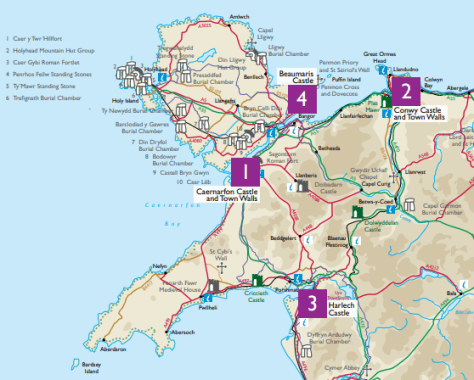
These castles are not only impressive feats of medieval engineering but also symbolic representations of English dominance over Wales. They played a significant role in shaping the political and cultural landscape of the region for centuries to come. Today, these castles stand as enduring testaments to the historical events that unfolded in North Wales during Edward I’s reign.
Behind the design and construction of these castles was master of works/architect, James of Saint George from Savoy, regarded as one of the greatest architects of the European Middle Ages.
Caernarfon Castle
Situated on the Menai Strait, Caernarfon Castle is perhaps the grandest fortress constructed by Edward I in Wales.
Begun in 1283, it took 47 years to complete, at the enormous cost of £25,000. The remains of the Roman fort Segontium (founded AD 77) are close by.
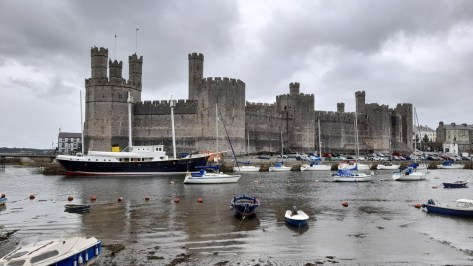
Caernarfon Castle from the southwest, across the Afon Seiont.
The castle was designed not only as a military stronghold but also as a royal residence, exemplifying Edward’s desire to display English authority in North Wales. Edward I’s fourth son (who became Edward II) was born at Caernarfon in April 1284 and later, in 1301, he was invested here as the first English Prince of Wales. Caernarfon Castle was the location, in July 1969, for the investiture of Prince Charles (now King Charles III) as Prince of Wales. Not a popular occasion for many proud Welsh.
Caernarfon’s distinctive polygonal towers and color-coded stone work make it one of the most visually striking castles in the region.


View more photos of Caernarfon Castle here.
Conwy Castle
One of the most iconic examples of Edwardian architecture, Conwy Castle, built in the remarkably short period between 1283 and 1289, stands at the mouth of the River Conwy. The castle is characterized by its twin-towered gatehouse and imposing curtain walls. Once again, James of Saint George was the master mason.
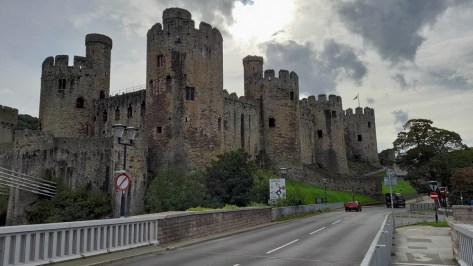
The town of Conwy was also enclosed in town walls, like at Caernarfon.


Take a look at this photo album.
Harlech Castle
Perched dramatically on a cliff overlooking the Irish Sea, Harlech Castle was strategically positioned to control the vital sea routes along the western coast of Wales.
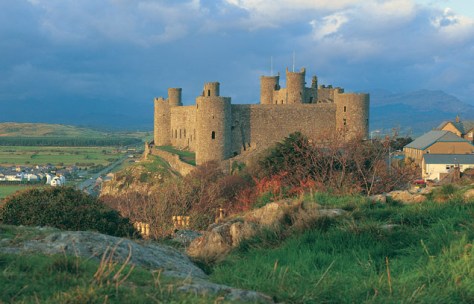
Its design included a concentric structure, making it an architectural marvel of its time. Harlech played a significant role in the Welsh uprisings of the 15th century, becoming a symbol of Welsh resistance.


Here are a few more photos.
Beaumaris Castle
While Beaumaris Castle was part of Edward I’s comprehensive plan to assert control over North Wales, it remained unfinished. He ran out of funds while campaigning against the Scots. So although the castle today looks like it was slighted (demolished), the towers never reached their projected height. Nevertheless, its design was highly innovative for its time, incorporating concentric walls and a water-filled moat. Beaumaris Castle is located on Anglesey.
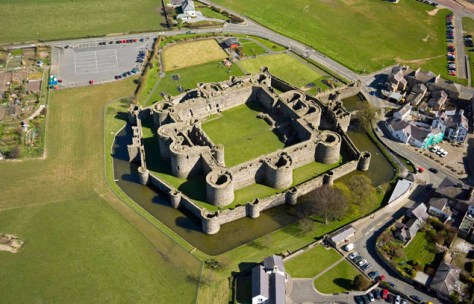
Although the castle was never completed due to resource shortages, its architectural prowess is evident in its symmetrical layout.


This is a photo album of more Beaumaris photos.
Cadw does a great job of looking after these castles, and enhancing the visitor experience as much as possible. There’s lots of information posted everywhere.
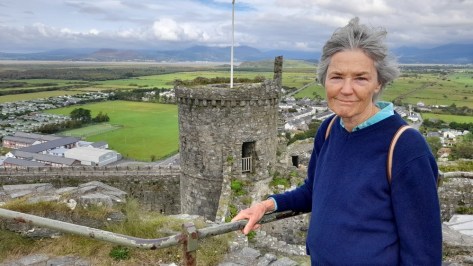
I was surprised to find such extensive access to the castle walls and towers/turrets, from where there are excellent views over the castles and surrounding landscapes, as you can see from the photos I have posted. And the passageways inside the walls connecting the various exterior towers.
During our visit to Harlech the walls were closed because workmen were repairing the safety handrails. Just one turret (very high) was accessible there, but the climb was well worth it, with just enough space at the top for four or five people.
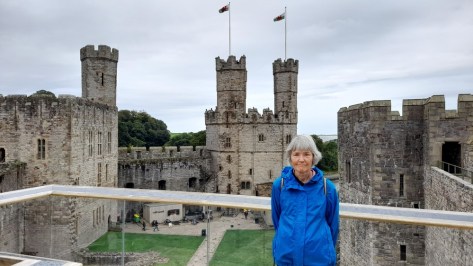
At Caernarfon, Cadw has constructed a viewing platform on the King’s Gate Tower (the main entrance), where the gift shop and a cafe are also located, for those unable or unwilling to tackle the walls and numerous (and narrow) tower steps.
 A balanced diet . . .