
Until recently, I hadn’t been back to North Wales for decades, apart from just passing through on three occasions when traveling to Holyhead (on Anglesey) to catch the ferry to Ireland.
It was different in the late 1950s and early 60s. My parents loved camping in North Wales. It was less than 100 miles west from their home in Leek in North Staffordshire, and most summers they would head off there for a week.
Until around 1955, we enjoyed family holidays there, including my eldest brother Martin and sister Margaret. Later on, just my my elder brother Edgar and I would join Mum and Dad. I guess it must have been around 1963 that I last went camping with them. I would have been fourteen.


Ten days ago, Steph and I traveled the 246 miles south from our home in North Tyneside to a holiday cottage just inland from the Menai Strait, and five miles from Caernarfon, to enjoy a week exploring this fascinating part of the country.
The return journey home was slightly longer as we stopped off at a National Trust property, Speke Hall, on the eastern outskirts of Liverpool. But more of that later.
Our base for the week was Hafod, a one bedroom self-catering granary cottage at Tŷ Mawr Farm, a great (and very comfortable) location for exploring the whole area. Highly recommended! The owner, Jane, also offers bed and breakfast accommodation on the farm.
This video shows our arrival at the farm, where I initially took a slightly wrong turn, before parking in front of our cottage. Entering the farm drive, you can see Yr Wyddfa (Mt Snowdon) and surrounding mountains off to the left. Yr Wyddfa is the highest peak in Wales, at 1,085 metres or 3,560 ft.


Yr Wyddfa is the peak in the center of this image, taken from the Tŷ Mawr farmyard.
On arrival, we found that Jane had left several plates of baked treats (including her excellent Welsh cakes) for us to enjoy throughout our stay.
Looking back on our holiday, it’s amazing how much we managed to pack so much into just six days, as you can see from this map. Just use the +/- buttons to view more details.
And, despite earlier forecasts, the weather behaved during the whole week – just a couple of overcast days, but mostly sunny, and even quite warm.
I’ll also be blogging about some of the places we visited in more detail.
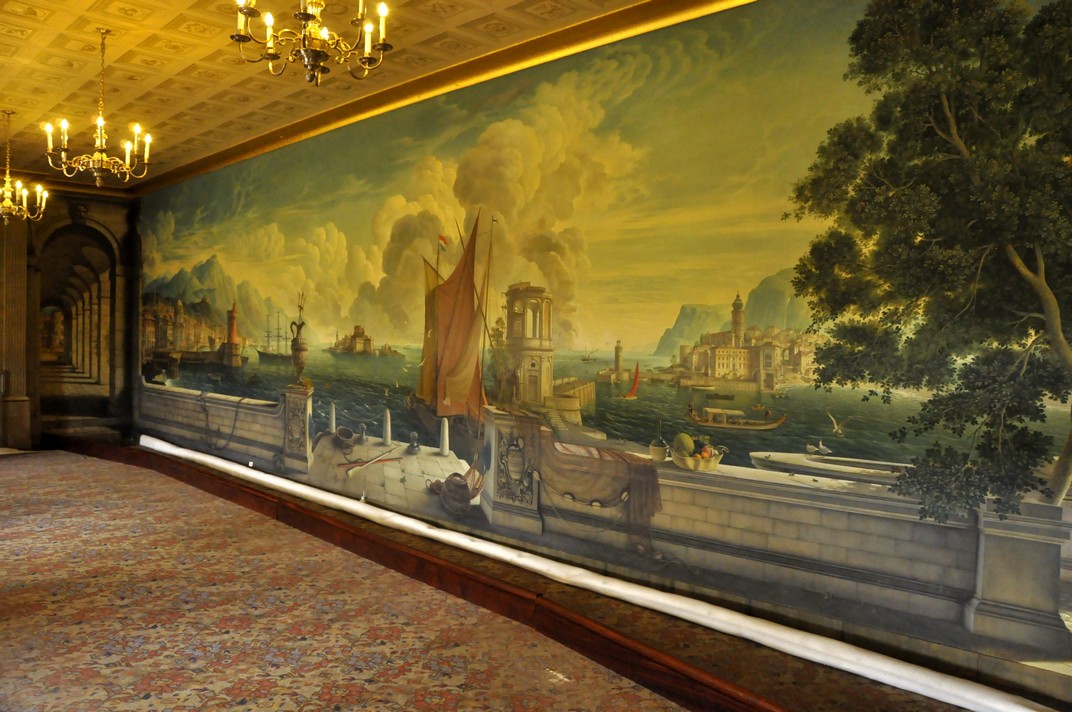
Our National Trust visits took in Penrhyn Castle, near Bangor, Bodnant Garden, a horticultural jewel in the Conwy valley, the Conwy Suspension Bridge (built by Thomas Telford in 1826), Plas yn Rhiw, a cottage overlooking Aberdaron bay at the far western end of the Llŷn Peninsula, and we made a return visit to Plas Newydd on Anglesey to have another look at the Whistler mural and the Italian garden. We’d first visited Plas Newydd in 2017 on our way to Northern Ireland.


As members of English Heritage, we could use our membership to visit Cadw (the Welsh heritage protection organization) sites. And we took full advantage of that privilege.
On the way to Plas yn Rhiw, we stopped off to view a medieval farmhouse at Penarth Fawr.


In the late 13th century, King Edward I (also known as Edward Longshanks – on account of his height; reigned 1272-1307) built a string of castles along the North Wales coast as part of his campaign to subdue the Welsh. We visited four at Caernarfon (built from 1283 for almost 40 years), Conwy (1283-1287), Beaumaris (started in 1295 but never completed), all along the coast separating the mainland from Anglesey, and Harlech (1283-1289), a little further south and standing on a cliff overlooking Cardigan Bay.


Just by chance we came across two prehistoric sites on Anglesey, also managed by Cadw. On the northwest tip of the island lies Holy Island, and overlooking the Irish Sea are the remains of about 20 hut circles, dating back to the Iron Age, 2500 years ago. But there’s also evidence of ancient farmers growing wheat, oats, and barley among other crops, and keeping livestock, as long ago as 5500 years.


On the east side of the island we eventually found the celtic village of Din Lligwy, which dates from around 400 AD, at about the time the Romans were abandoning these islands.


Thomas Telford (1757-1834) was a remarkable engineer. Besides the smaller suspension bridge at Conwy, his bridge over the Menai Strait must be one of his most remarkable designs and constructions.

Opened in 1826, a marvel of early 19th century engineering, it was the world’s first iron suspension bridge, 1,265 feet/305m long, with a central span of 579 feet/177m and its roadway set 98m/30m above the water to allow tall ships to sail beneath.
It still carries traffic today, and we crossed it, but it’s also undergoing some extensive maintenance works, and only one lane was open.
In 1845, the larger Britannia Bridge carrying both road and rail traffic was constructed further west, and today is the main route on to Anglesey. Designed by renowned railway engineer Robert Stephenson (son of George), the bridge took four years to complete. It suffered a serious fire in 1970. While the main road is a dual carriageway, the bridge itself has only one in each direction, and is the cause of considerable traffic congestion during peak travel times.
And in our travels around North Wales, there were so many spectacular landscapes to admire, but so few places where we could stop and capture them photographically. But we managed some, shown on the map.
On our tour of Snowdonia National Park, we stopped off in the village of Beddgelert, to view the grave of Gelert, the faithful hound of Llywelyn ab Iorwerth (Llywelyn the Great).
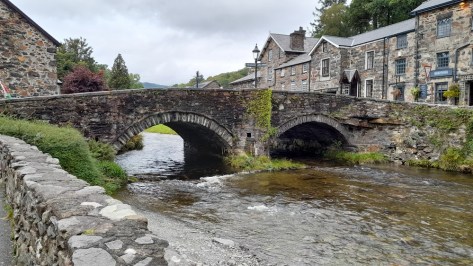


 According to the legend, Llywelyn returned from a hunting trip (when—unusually—he hadn’t taken Gelert along), only to find his son missing from his cradle, and the dog covered in blood. Believing that the dog had killed his son, he thrust his sword through its heart. At that moment he heard a cry and discovered his son was alive. Beside the boy was a dead wolf that Gelert had killed while saving the baby. Grief-stricken, Llywelyn buried the hound where we now find the grave.
On one of visits to Anglesey, I had to stop briefly in the small community of Llanfairpwllgwyngyll, which probably has one of the most famous railway stations in the world. And certainly the longest name.


I was there just the once, about 70 years ago. In the B&W photo below, taken around 1954, I’m the little boy on the extreme left, with my mum and her sister, my two brothers Edgar (next to me) and Martin, and sister Margaret.


Having changed our plans to tour Snowdonia on one particular day, we decided on Anglesey as the weather looked much more promising. And we weren’t disappointed, heading to the Royal Society for the Protection of Birds (RSPB) reserve at South Stack cliffs on the northwest tip of Holy Island, very close to the hut circles mentioned earlier.
The view over the cliffs to the lighthouse is spectacular. There are 400+ steps down the cliff to the lighthouse, and a suspension bridge over to the island on which the lighthouse stands.
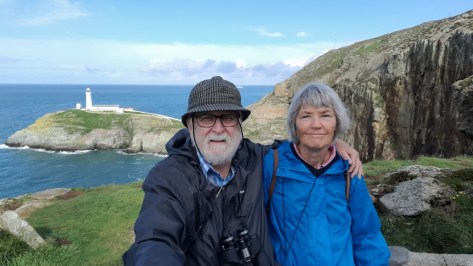
Even if I didn’t have my current mobility issue, we wouldn’t have attempted visiting the island. Too many steps. But in the late 1950s, on holiday with our parents, my elder brother Edgar and I did make the climb down and up the cliff, and even climbed to the top of the lighthouse, which was open to visitors in those days.


I remember quite distinctly that my mum (who must have been around 52 or so) being quite distressed once we had reached the top of the cliff again. I wonder how I would have felt had I made the excursion today, just short of my 75th birthday. Not good!
And besides the great views, the main reason for our visit was to see the choughs, iconic birds for the South Stack cliffs, and some of the only 300 breeding pairs in the UK. We’d first seen choughs on our visit to Cornwall at The Lizard in 2018.

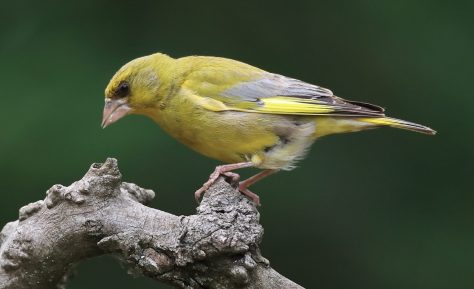
We weren’t disappointed. Within a couple of minutes of our arrival in the RSPB car park, a flock of about six or seven choughs flew low overhead. And throughout the couple of hours we walked around, we had several more sightings. Impressive. And the icing on the bird cake was a flock of seventeen greenfinches perched on the telegraph wires. Greenfinches have been in serious decline in recent years, and I hardly ever see one nowadays. So to see seventeen was wonderful.
One cannot help but be impressed by the many different landscapes of North Wales: the coast, the mountains and river valleys, the lush greenness. Here are just a few views that we enjoyed, and which, with any luck, we might return to enjoy once again.


We decided to break our journey home a week later. It was almost 83 miles from Hafod to Speke Hall on the eastern outskirts of Liverpool (right next to Liverpool John Lennon Airport that was built on land that once belonged to the Speke estate).


On the outside it’s a Tudor building, built in 1598. But it was extensively remodelled inside during the 19th century, and from that perspective, Speke Hall is essentially Victorian. It was only ever owned by two families, the Norrises and the Watts although various tenants did live there, notably Frederick Leyland, a Liverpool shipping magnate, for a decade from 1867. It was Leyland who made most of the interior alterations.
From Speke, it was a 3 hour 15 minute (and 177 miles) drive northeast along the M62, M1, A1(M), and A19 to arrive home safe and sound just around 4:15 pm, and to enjoy a cup of tea with some more Welsh cakes provided by Jane just as we departed Tŷ Mawr.






 A balanced diet . . .