
I’m totally unfamiliar with the convention that gives names to rivers.
The Mississippi is only the second longest river in the United States. At 2,340 miles it’s shorter than the Missouri, by just one mile apparently. Yet, when they come together (or the Missouri flows into the Mississippi) north of St Louis, the river takes on the name of the Mississippi. And again, near Cairo in southern Illinois, the Ohio joins the Mississippi, and loses its identity thereafter even though the Ohio is a much bigger river in terms of discharge (but shorter) at that point.
The Mississippi flows through 10 states: Minnesota, Wisconsin, Iowa, Illinois, Missouri, Kentucky, Tennessee, Arkansas, Mississippi, and Louisiana. It flows through Minnesota for 681 miles, the most miles of any state.
By the time the Mississippi reaches Minneapolis-St Paul (the Twin Cities) from its origin at Lake Itasca in the northern part of the state (which we visited in 2016), it’s already an impressive river, fast flowing, deep, and wide. Our elder daughter Hannah lives just a stone’s throw from the bluff overlooking the river, which you would easily see if it wasn’t for the dense stand of trees on both banks.

That line of trees across the road from Hannah’s is the top of the Mississippi Gorge bluff.
Nevertheless, there are various scenic viewpoints, riverside regional parks, and overlooks in the Twin Cities where you can admire the majesty of the river. Whenever we visit our daughter and her family, we always take the opportunity of spending some time beside the Mississippi. I somehow feel it drawing me to its banks.


During this year’s Minnesota vacation, we decided not to make any long distance road trips as we have done in previous years (and which you can read about in the USA section of my blog here). Except for one overnight stay at La Crosse on the Mississippi in Wisconsin, about 150 miles south of the Twin Cities. And for a very special reason, that I’ll come to in a moment.
 The route south on US61 and US14 follows the river, and you’re never very far from it. In several places the Mississippi opens out into large lakes before continuing its flow south to the Gulf of Mexico. And it was while we were driving along that I realised just how close to the river the railroad line was built, and which we experienced in 2015 on Amtrak’s Empire Builder to Chicago and back.


So why the visit to La Crosse? A couple months back I was contacted by an old friend of 50 years, Roger Rowe, who lives in Peru with his wife Norma. Now 87, Roger was planning to visit central Illinois where his younger brother farms corn and soybeans, and would be celebrating his 80th birthday. Knowing of our visit to St Paul, Roger enquired whether we could meet up, halfway (more or less) between Princeton, IL and the Twin Cities. And that’s precisely what we did on 6/7 June.
Just after I joined the International Potato Center (CIP) in January 1973, a workshop was held to plan for a research program on the conservation of cultivated and wild potatoes from the Andes, and their taxonomy. At that time, Roger was the geneticist/curator of the USDA’s potato collection at Sturgeon Bay in Wisconsin, and one of the participants of the workshop.
Here we are in the field in Huancayo, in central Peru where CIP grew its large potato collection.
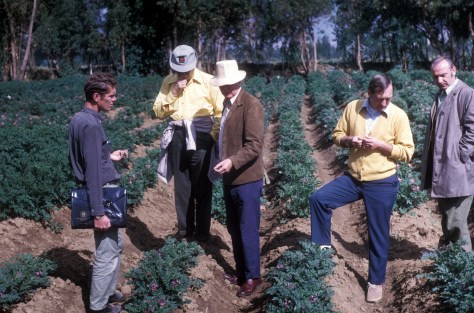
L-R: David Baumann (CIP), Dr Frank Haynes (North Carolina State University), Professor Jack Hawkes (University of Birmingham), Dr Roger Rowe (USDA-Sturgeon Bay), and Dr Donald Ugent (University of Southern Illinois-Carbondale).
Several months later, in May 1973, Roger joined CIP as the head of the breeding and genetics department and became my first boss there. He also became a co-supervisor (with Jack Hawkes) of my PhD dissertation. Steph joined CIP in July as an associate geneticist in the same department.
So, 50 years later, we were again reunited on the banks of the Mississippi in La Crosse.
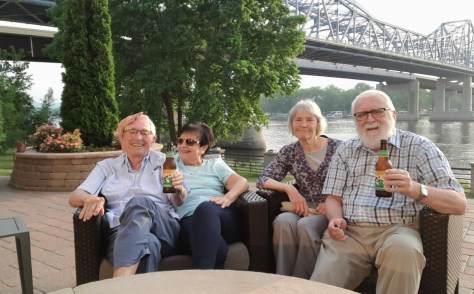
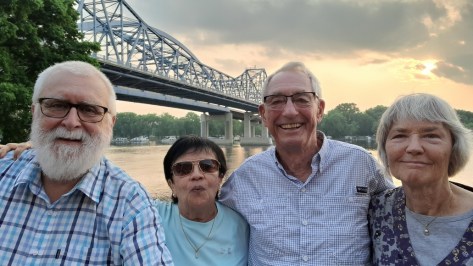
We enjoyed several beers and dinner together, reminiscing over old times, as well as putting the world and the CGIAR to rights.

After I left CIP in 1981 to take up a faculty position at the University of Birmingham, I didn’t meet up with him again until 1993, although I’d met Norma in Mexico during a British Council-sponsored visit to that country in 1988.
In the late 1980s, Roger became the Deputy Director General for Research at the International Maize and Wheat Improvement Center (CIMMYT) after a spell working in Africa. We met for the first time after many years when attending the annual meeting of the CGIAR’s Inter-Center Working Group on Genetic Resources, held at the ILCA campus in Addis Ababa in January 1993. By then I was leading the genetic resources program at the International Rice Research Institute (IRRI) in the Philippines.

Members of the ICWG-GR from all the CGIAR centers with genebanks, in Addis Ababa, January 1993.
From CIMMYT, Roger joined another CGIAR center, ICLARM (later becoming WorldFish) as Deputy Director General for one of its programs based in Egypt. Steph and I would meet up with Roger for Sunday breakfast in Manila whenever he was in town since ICLARM then had its headquarters in Manila.
Before our reunion in La Crosse, the last time I’d seen Roger and Norma was in Lima in July 2016, when I was the lead author for a review of the center genebanks and their management, and I was visiting CIP. We managed to catch a couple of hours together for pisco sours.
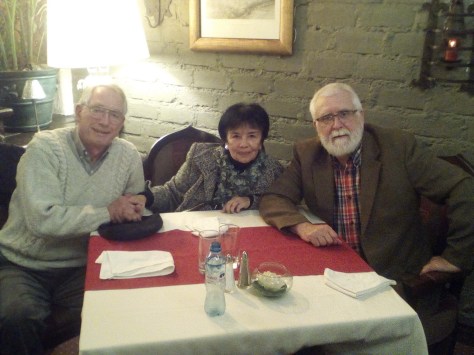
At my hotel in Lima, just after I had arrived from the UK.
As I mentioned, our hotel in La Crosse was right beside the Mississippi, and ‘underneath’ the Big Blue Bridges (actually the Cass Street Bridge and the Cameron Avenue Bridge) that cross from the Minnesota side to Wisconsin.
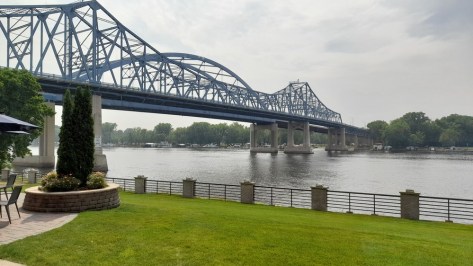
That got me thinking. The population expansion across the USA in the 19th and 20th centuries involved crossing many rivers, and building many bridges. On the Mississippi alone there are at least 130 bridges along its length. In the Twin Cities alone there are nine major crossings and several minor ones. One of the most impressive is the Smith Avenue or High Level Bridge, from where there is a magnificent view of the St Paul skyline and the river.

The Smith Avenue bridge from the river.
As this video pans right, you can first see the magnificent Catholic cathedral, then the white Capitol building, followed by downtown St Paul.
Finally, on our last Thursday in St Paul, we took our grandchildren Callum and Zoë on a relaxing 90 minute river cruise up the Mississippi to the confluence of the Minnesota River with the Mississippi, which is a short distance downriver from where Hannah and Michael live. They tell us that the Fall cruises, when the autumn colors are at their height is a great time to cruise the river.


You can read about some of our other Mississippi adventures here.
Other blog posts in this Minnesota series:
 A balanced diet . . .