
Actually, that should be GEMS. But more of that shortly.
 While in Minnesota, I took the opportunity of looking up an old friend, Phil Pardey, at the University of Minnesota. A native Australian, Phil is Professor of Science and Technology Policy in the Department of Applied Economics.
So how did I, as someone working in genetic resources of rice, meet and become good friends with an agricultural economist?
From 1991-2001, I was head of the Genetic Resources Center at the International Rice Research Institute (IRRI) in the Philippines, and between 1993 and 1995, Chair of the CGIAR’s Inter-Center Working Group on Genetic Resources (ICWG-GR). Phil was a Senior Research Fellow at the International Food Policy Research Institute (IFPRI) in Washington, DC, a sister center of IRRI’s under the aegis of the Consultative Group on International Agricultural Research (CGIAR).
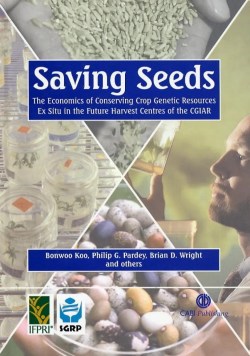 The ICWG-GR brought together representatives from all the CGIAR centers with genebanks, and others like Phil from IFPRI who were conducting research on the impact and use of genetic resources. At that particular time, Phil and a couple of colleagues were analysing the economics of conserving crop genetic resources, and developing methodologies to estimate the costs of running genebanks. I contributed to chapter 6 on rice in this book (right) published by CABI in 2004. It was an important publication as the centers were developing ideas on how to fund their germplasm collections in perpetuity and what it would take to set up an endowment fund for that purpose (now managed through the Crop Trust).
Phil left IFPRI in 2002 to move to the U of M, and I retired in 2010. So with a less hectic schedule this year during our visit to the USA (although we haven’t traveled there since 2019 because of the Covid-19 pandemic) I contacted Phil and we arranged to meet for lunch a couple of weeks ago.
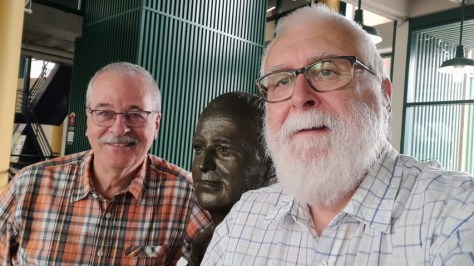
Phil and me beside a bust of Dr Norman Borlaug, ‘Father of the Green Revolution’ in the foyer of Borlaug Hall on the University of Minnesota campus, where I presented a seminar in the early 2000s.
Phil had a lot to tell me about a fascinating new initiative that he co-directs at the university.

Which was music to my ears. Let me explain.
GEMS Informatics, launched in 2015, is a unique public-private collaboration that is forging the future of the Data Revolution in agriculture. Minnesota is the birthplace of supercomputing in the early 1960s and has long been home to the world’s leading agri-food companies, making it the natural nexus for data-driven, public-private partnerships that create solutions to the complex challenges facing local and global agri-food systems.
Phil’s co-director is Jim Wilgenbusch, Director of Research Computing at the university.
What is so special about GEMS is that it brings together an impressive team of experts in super-computing, data management, genetics, genomics and bioinformatics, geospatial analysis, life sciences, and economics. Just take a look at the GEMS website to better understand the scope of what this initiative does deliver. And just imagine what such a combination of skills and resources could deliver even more in the future.
One of the areas that intrigued me most was the GEMS applications for multilocation testing of germplasm. Faced with the challenges of global climate change, plant breeders need to be able to better predict where the lines they have developed are successfully adapted and could be deployed to enhance agricultural activity. GEMS is bringing together data (not just numbers) on crop variety performance (yield in particular), weather, soils, and genomics (among others) to better understand the behavior of these across locations, or what we call genotype by environment interaction (GxE).
There’s an interesting account of GEMS applications for wheat variety development, for example.
I’ve had a long interest in multilocation testing. In 1990, I presented a paper¹ at a symposium in Wageningen, the Netherlands about the challenge of global warming, and how plant breeders should collaborate better across Europe to evaluate germplasm.
Then, in a blog post I published in August 2015, I wrote about the International Network for the Genetic Evaluation of Rice (INGER, managed by IRRI) as it celebrated its 40th anniversary. While recognizing the networks unequivocal and important role in facilitating the sharing of rice varieties and lines globally, I lamented that INGER had lost opportunities to transform itself to permit more critical and predictive testing of germplasm. My criticism was merited, I believe, but unlike GEMS Informatics, we did not have many of its computing and analysis tools. Had we built a database of quality trial data, gathering environmental as well as crop response data, we could go back today, using genomics tools, to ferret out those traits which endow varieties with superiority across environments.
GEMS is already pointing the way. Just look at the case studies that are highlighted on the GEMS website.
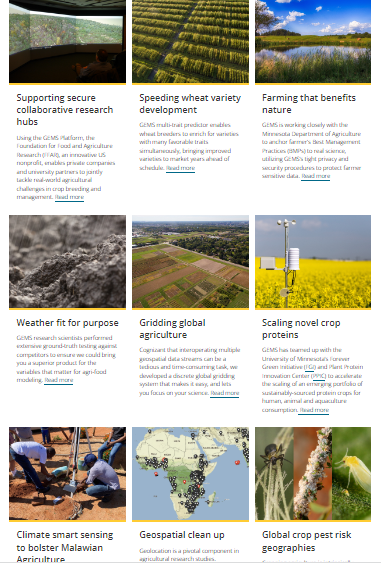
With progress like this in just eight years, just imagine where this initiative might take us. No wonder it was music to my ears, even though (being retired) I’m no longer involved in the conservation and use of plant genetic resources.

I really look forward to following future developments of GEMS Informatics. Not only did it take a strong vision to get it up and running, but support from the university and private sector organizations was crucial to implement that vision. Impressive indeed!
As we headed off to lunch, Phil just had to show me a new addition to the university campus, just in front of Borlaug Hall. It was a seven foot bronze statue of Norman Borlaug, who I had the pleasure of meeting at IRRI in the 1990s.
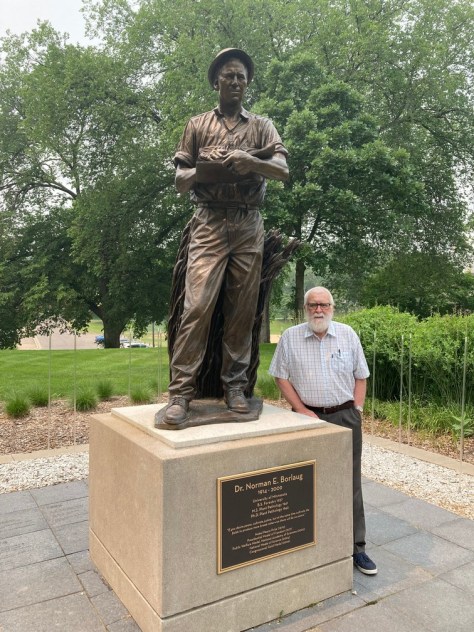
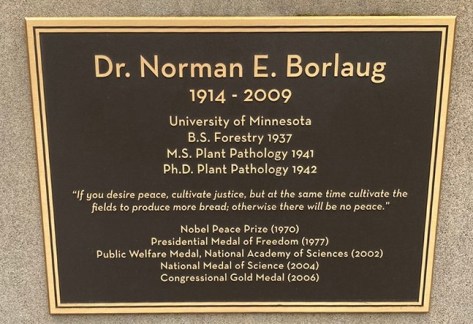
Borlaug was born in Cresco, Iowa in March 1914, where Steph and I passed through at the end of one of our long road trips in 2017.
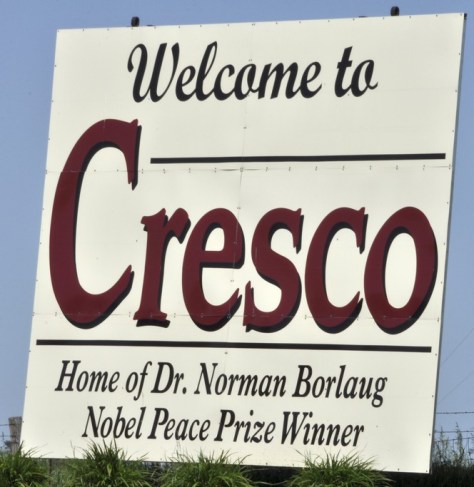
I now wish we’d taken the time to visit the Borlaug homestead in Cresco.
Anyway, Borlaug was an alumnus of the U of M, originally in forestry before converting to plant pathology. And the rest is history – the man who saved a billion lives.
The statue on the campus is a duplicate of one sculpted by Idaho resident Benjamin Victor (1979– ) that stands in the National Statuary Hall Collection in the Capitol Building in Washington, DC. The original was given by the state of Iowa to the Collection in 2014 on the centenary of Borlaug’s birth.
In the National Statuary Hall, each state is permitted to display just two statues, so that of former United States Senator, and Secretary of the Interior James Harlan, which the state of Iowa donated to the Collection in 1910, had to make room for Borlaug. And fittingly so.
Other blog posts in this Minnesota series;
- Time out in Minnesota: 1. Flying after four years
- Time out in Minnesota: 2. Beside, above, and on the Mississippi
- Time out in Minnesota: 3. The flowers that bloom in the Spring
- Time out in Minnesota: 5. Beer, brats, and sizzling steaks
¹Jackson, M.T., 1991. Global warming: the case for European cooperation for germplasm conservation and use. In: Th.J.L. van Hintum, L. Frese & P.M. Perret (eds.), Crop Networks. Searching for New Concepts for Collaborative Genetic Resources Management. International Crop Network Series No. 4. International Board for Plant Genetic Resources, Rome, Italy. Papers of the EUCARPIA/IBPGR symposium held in Wageningen, the Netherlands, December 3-6, 1990. pp. 125-131.
 A balanced diet . . .