Landmarks across the northeast

Across Tyneside, there are several impressive landmarks that no visitor to the region—by land, sea, or air—can fail to miss. All are just a few miles from where we are now living in North Tyneside (since October 2020).

Perhaps the most visible is the River Tyne itself, along whose banks the settlements of Newcastle upon Tyne (on the north) and Gateshead on the south were founded. Actually the River Tyne is two rivers. The North Tyne rises in the hills on the Scottish border, whereas the source of the South Tyne is in Cumbria. The two branches come together near Hexham, 20 miles due west from Newcastle city center.

Newcastle and Gateshead rise steeply away from the Tyne, and are connected by several road and rail bridges, including the iconic Tyne Bridge, opened in 1928 and undergoing a much-needed renovation, hopefully in time for its centenary in 2028.

There is a much more recent footbridge, the Gateshead Millennium Bridge, opened in 2001. Further east, the A19 trunk road crosses under the Tyne in the Tyne Tunnel between Wallsend and Jarrow.

There has been a long history of settlement along the river’s banks. The Romans built a garrison and supply base, Arbeia, near the mouth of the river on its south bank. Hadrian’s Wall begins its journey westwards from Wallsend, at Segedunum fort, just a few miles upstream from Arbeia, but on the north bank.

Arbeia, a Roman fort and supply base, built around 129 AD.

There was a long history of heavy industry along the Tyne, with the port developed for the export of coal from the many collieries in the area, as well as shipbuilding. Indeed, Newcastle was one of the leading shipbuilding cities in the country. All now long closed down.

Of course the mouth of the River Tyne looks very different now than when the Romans arrived. Today, there are piers on both sides of the river mouth. The north or Tynemouth pier (shown below, with a lighthouse at the seaward end), 900 m long (and open to the public during clement weather), took 40 years to build. The south pier is longer, and also took around 40 years to build.

If you fly into Newcastle International Airport, and the wind is blowing from the west, the usual flight path takes aircraft over the mouth of the River Tyne, before banking north. If you are lucky, there are some great views of the city and river.

Just beyond the Tyne, on the left, is St Mary’s Lighthouse (decommissioned since 1984) on its island, just south of Seaton Sluice. Just north of the lighthouse, aircraft then bank left and line up for landing at the airport nine miles west-southwest from the coast.

Just inside the mouth of the Tyne, and standing on the north bank below Tynemouth castle and priory, is the magnificent memorial statue of Vice Admiral of the Red, Lord Cuthbert Collingwood (1748-1810) whose flagship HMS Royal Sovereign was the first British ship to engage with the combined French and Spanish fleets at the Battle of Trafalgar in 1805. The statue of Collingwood is 23 feet or 7 m tall. The four canons either side of the steps come from HMS Royal Sovereign.

It must be seen many miles out to sea. And although we had seen it from Tynemouth castle and priory on previous visits to the town, it wasn’t until Monday afternoon past that we got to see it up close.

We took the path west along the river towards North Shields Fish Quay (about 1 mile), and came across a rather lovely statue (in steel), the Fiddler’s Green Sculpture by Ray Lonsdale from County Durham, that was erected in 2017. It is is a memorial to North Shields fishermen lost at sea. It was based on a photograph of a local fisherman.

Below the statue is a plaque that reads:

To the fishermen lost in the cold North Sea,
and the ones who will be so,
I’ll be seeing you all on Fiddler’s Green,

be steady as you go.

For Fiddler’s Green is a place I’ve heard tell,
though no one really knows,
where the fishermen go if they don’t go to hell,
and no Arctic wind will blow.

Fiddler’s Green is an imaginary paradise to which sailors are conveyed after death, traditionally a place of wine, women, and song. And here is the 19th century Irish song (and the lyrics), performed by The Dubliners.

Arriving to Tyneside from the south by road, on the A1, a huge sculpture suddenly comes into view on the outskirts of Gateshead. This is the iconic Angel of the North, by Sir Antony Gormley, which was erected in 1998.
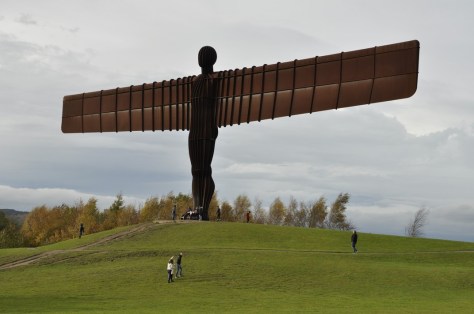
We took a close look at it in November 2018, but have not been back since we moved to the northeast.

My final landmark is Grey’s Monument in Newcastle city center. If you travel there by Metro, you are immediately confronted by the 133 foot (41 m) column as you emerge from Monument station.

Charles Grey, 2nd Earl Grey

It was erected in 1831 in recognition of Charles Grey, 2nd Earl Grey, [of supposed Earl Grey tea fame] Prime Minister of the United Kingdom from 1830 to 1834. In particular, it celebrates the passing of the Great Reform Act of 1832, one of Grey’s most important legislative achievements. The act reorganised the system of parliamentary constituencies and increased the number of those eligible to vote.

It certainly dominates the Newcastle skyline. Open to visitors, there are 164 steps to climb to the viewing platform. The views south from the top must be spectacular over Newcastle’s impressive Georgian architecture on Grey Street and Grainger Street, but that’s not something I’m likely to challenge.

Tyneside and so much of the surrounding region has so much to offer any visitor. English Heritage and the National Trust own a number of properties close by, and further out there is the magnificent coastline of Northumberland and County Durham, as well as the moors and hills stretching westwards to the Scottish border and into Cumbria.

 

Klaus Lampe, IRRI’s fifth Director General, passes away at 92

Dr Klaus J Lampe was the Director General of the International Rice Research Institute (IRRI) in the Philippines, serving one term from 1988 to 1995. He succeeded Professor MS Swaminathan as Director General.

Yesterday we heard the sad news that he had passed away in hospital in Germany on 6 February, aged 92.

Born in Freiburg in 1931, Klaus Lampe grew up in Nazi Germany, and he once described to me the horror of escaping the fire storm following Allied bombing.

He was an agricultural engineer, spending time in Afghanistan from 1965 to 1968, and thereafter he held various agricultural development aid positions back home in West Germany.

His appointment at IRRI in 1988 was the beginning of the institute’s renewal. Just shy of its 30th anniversary the institute was beginning to show its age. Its infrastructure was in dire need of refurbishment and enlargement to allow the institute to address several new research challenges, particularly in the areas of biotechnology and molecular biology.

And with a mandate to revitalise IRRI’s research strategy and program, Klaus adopted a matrix management system (alluded to in this post) with five research programs setting the specific research agenda on one side of the matrix and divisions (the organizational units where research was carried out) on the other.

He encouraged several long-term staff to retire or seek pastures new, and set about recruiting a new (and younger) cohort of staff. I was part of that recruitment, as head of the newly-formed Genetic Resources Center (GRC), with special responsibility for the genebank.

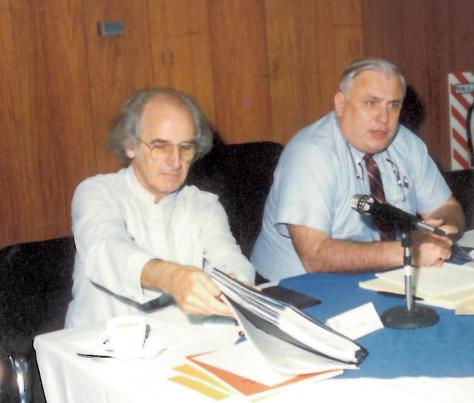
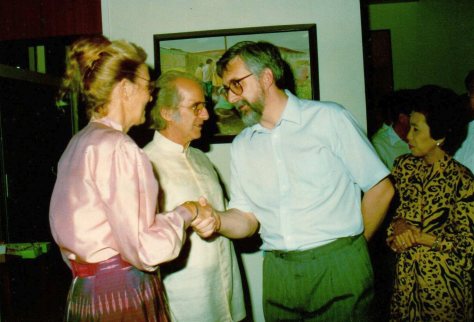
Meeting Dr Lampe and his wife, Annemarie, at an IRRI reception shortly after my arrival at IRRI in July 1991.

In addition to the innovative management that brought focus to IRRI’s research and refurbishment of the institute’s buildings, Klaus’s other achievements included his sincere engagement (not always successful) with suspicious NGOs in the Philippines and more widely across Asia as IRRI developed its biotechnology agenda (supported by the Rockefeller Foundation), and the adoption of new rice breeding objectives, particularly the so-called New Plant Type and hybrid rice. Certainly IRRI began to feel like a re-energised institute.

Klaus Lampe with US Ambassador to the Philippines, Frank G Wisner, Gurdev Khush, principal plant breeder, and agronomist Ken Cassman, discussing the ‘New Plant Type’.


When I interviewed for the GRC position (in January 1991), Klaus and I had a long discussion about the changes that he felt were needed to upgrade the genebank, known then as the International Rice Germplasm Center (IRGC), and how to integrate the operations of the International Network for Genetic Evaluation of Rice (INGER) and the Seed Health Unit into GRC. By the time of my arrival in Los Baños, it had been decided to retain the Seed Health Unit as an independent entity outside GRC.

I explained how important research on germplasm conservation and use was, and that I expected, if appointed, to add a research string to the activities of GRC. That had not been envisaged when IRRI advertised the GRC position in September 1990.

Once in post, Klaus supported my research plans for the genebank. I also pushed enthusiastically that the genebank should benefit substantially from the investment being made in the refurbishment around the institute. After all, I chided him, if the genebank was the jewel in IRRI’s crown, so to speak, it was only fair that management and Board of Trustees approved that investment. And he agreed.

We made major changes, adding a bespoke seed drying room, and reconfiguring many of the genebank facilities to increase the efficiency of genebank operations and bring them up to international standards. I was permitted to increase the number of staff to tackle the significant backlog of processing seeds for long-term conservation. And the majority of the staff positions were upgraded to reflect their increased responsibilities.

With Klaus’s support and commitment I was able to significantly enhance the genebank operations such that, in an external review around 1994, the genebank was described as a model for others to emulate. And for that I will remain forever grateful to him.


I had first come across Klaus Lampe in the summer of 1989 (maybe 1990). I was lecturing at the University of Birmingham, and had no intention then (or inkling even) of leaving, or that Klaus would  soon be my boss.

I was visiting Dr Jaap Hardon, head of the Dutch genebank (Centre for Genetic Resources, the Netherlands or CGN) in Wageningen. He invited me to attend a special university seminar one afternoon with guest speakers from two centers of the Consultative Group on International Agriculture or CGIAR: the Director General (I don’t remember his name) of the International Food Policy Research Institute (IFPRI) in Washington, DC, and Dr Klaus Lampe from IRRI.

Klaus was not a tall man, but he certainly stood out in a crowd, with his long flowing grey hair. Which reminds me of a story that former Chair of IRRI’s Board of Trustees, Dr Walter ‘Wally’ P Falcon recounted during his last report to the institute’s staff before he stepped down from the Board in the early 1990s.

Klaus and Wally Falcon at a meeting of IRRI’s Board of Trustees.

Although a member of the Board of Trustees when Klaus was appointed as Director General, Wally was not a member of the appointment committee, and did not meet Klaus until the next Board meeting. As Wally told it, he saw this man walking towards him, hair standing out, and he immediately thought, My God, they’ve appointed Beethoven!

Klaus, always supported by Annemarie (who predeceased him a few years back) encouraged visitors to IRRI, especially VIPs, and he was never short of a few words to say at the frequent receptions held at the IRRI Guest House.

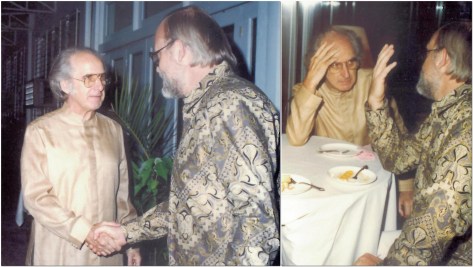
Klaus and Annemarie at the despedida for Dr Ernie Nunn, IRRI’s Director for Operations and his wife (next to Annemarie).

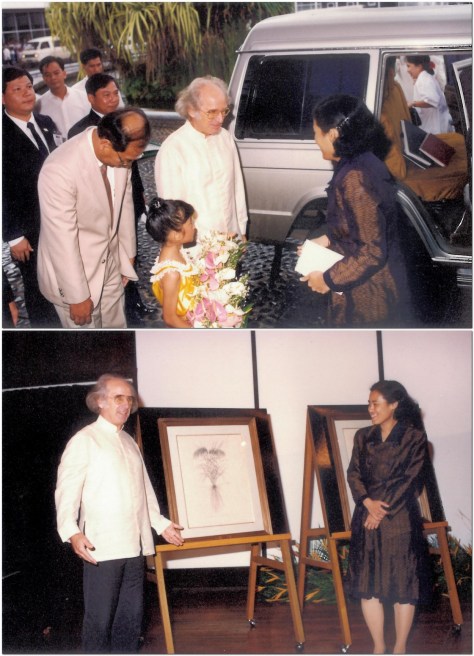
One of the first VIP visitors I had to show around the genebank was Princess Sirindhorn of Thailand, in 1991, not long after I arrived in Los Baños.


One of my colleagues, Dr Bob Zeigler, a plant pathologist from CIAT in Colombia was appointed Program Leader for Rainfed Lowland Rice at the end of 1991. Bob became IRRI’s 9th Director General in 2005.

DG5 and DG9 together in 1991.


Klaus was a complex man. Exceedingly kind on the one hand, but he could be quite ruthless, and a number of staff fell foul of his displeasure, me included. So when he left IRRI in 1995, we didn’t exactly part the best of friends, although for much of the time we worked together, I had an excellent relationship with him.

I didn’t meet him again until early 2010 when he returned to IRRI to attend some of the institute’s 50th anniversary celebrations. I can’t say I was particularly keen to meet him again. But we did, and during one reception he approached me, taking me by the arm and steering me to a quiet corner of the room. Whereupon he apologized for how he had behaved towards me 15 years previously. We parted on good terms, and that’s exactly how I will remember him.

My former colleague Gene Hettel interviewed Klaus for his series of Pioneer Interviews, who spoke at length on the challenges he saw IRRI facing. Here’s a snippet from that interview.

Gene has also today published this obituary on the IRRI website.


Let the mystery be . . .

Until quite recently, I’d never heard of American singer-songwriter Iris DeMent. I’ve since become quite obsessed with her music. She has quite an extraordinary voice, and a rare song-writing talent.

One evening, Steph and I were watching a compilation of programs from Transatlantic Sessions (on BBC Scotland via the BBC IPlayer), and Iris DeMent was featured from Series 1, Program 3, first broadcast in 1995.

Singing one of her own compositions, Let the Mystery Be, she was accompanied by members of the Transatlantic Sessions house band: American fiddle player Jay Ungar (composer of the well-known Ashokan Farewell), guitarist Russ Barenberg, mandola player Dónal Lunny, and accordionist Phil Cunningham. I believe the female bassist was Molly Mason.

She appeared on Transatlantic Sessions in the very first program (and the first featured performance) accompanying Emmylou Harris (whose music I came to appreciate in her collaboration with Mark Knopfler on the 2006 album, All the Roadrunning) on Wheels of Love, along with Irish singer Mary Black.

DeMent was born in 1961 in Paragould in northeast Arkansas, the youngest of 14 children, and now lives in rural southeast Iowa. Her music is a blend of folk, country, and gospel, often with a political theme. She has often dueted with folk-country singer-songwriter John Prine.

In Transatlantic Sessions Series 1, Program 4 DeMent sang one of her best compositions, Our Town, about one of her enduring themes: small-town America. Shetland fiddle virtuoso Aly Bain also figures in this version, as does a young dobro player Jerry Douglas (who would go on to co-host Transatlantic Sessions with Aly Bain in Series 2 to 6 between 1998 and 2013).

Here is another great song from Series 1, Program 6.

I did wonder whether DeMent had ever appeared on Garrison Keillor’s A Prairie Home Companion, from the Fitzgerald Theater in St Paul, Minnesota, believing that her music was just the genre to feature in the show. I found this reference to an appearance from 2 November 2002. You can hear her singing at 14′:22″ and another composition, Mama’s Opry, at 51′:42″. Garrison Keillor said that DeMent was one of his favorite singers, whose songs he had performed many times.

Here is DeMent singing Mama’s Opry with the Nitty Gritty Dirt Band and Matraca Berg (performed at the Grand Ole Opry?)


So what about Transatlantic Sessions? In my opinion, it was one of the best series to be broadcast from BBC Scotland. And as Aly Bain says by way of introduction, it brought together ‘. . . some of the best musicians from both sides of the Atlantic. No audience. Just the music‘.

We came late to the series, seeing Series 5 and 6 in 2011 and 2013 respectively, the previous four having been broadcast while we were living in the Philippines during the 1990s and 2000s. But since then, BBC Scotland has rebroadcast some compilations, hosted by North Uist singer Julie Fowlis and Irish singer Muireann Nic Amhlaoibh.

What a delight the programs were, and such talent on display – the best of Scottish, Irish and American music. Here’s a link to many of the videos from all six series. Enjoy!