
The relentless wet weather these past weeks has been a bit of a theme in my recent blog posts. Such that we haven’t been able to get out and about as much as we’d like. But when the forecast promises better days—even a few hours on some days—we grab those opportunities with enthusiasm. And so it was last Tuesday: sunny intervals although there was a cold wind blowing from the north.
 Just after 09:30 we headed out to Belsay Hall, Castle, and Gardens, which is about 19 miles west from home on the route we took, on the A696 past Newcastle International airport and through Ponteland.
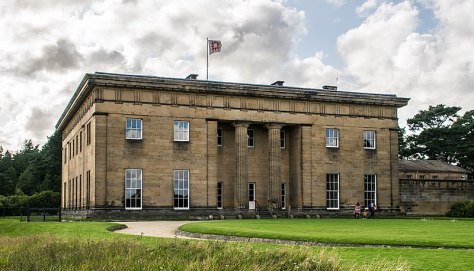
We first visited Belsay in 2009 while I was still working in the Philippines and we were back in this country on home leave. Since we moved to the northeast in 2020 we been back a handful of times, the last apparently in May 2022 (according to my photographic records) although I really did think we’d visited since then.
Belsay has been home to the Middleton family since the 13th century, living (until the early 19th century) in a castle and manor house some distance from the large hall that stands there today.

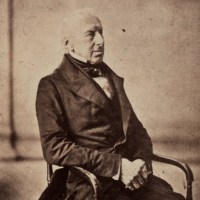
Sir Charles Monck (1779-1867)
To some eyes, Belsay Hall must appear rather austere, built between 1810 and 1817 for Sir Charles Monck, the 6th baronet (according to his own design – he was enthusiastic for the Greek classical style). It’s exactly square, 100 feet (30 m more or less) on all sides.
So why Monck? In order to inherit his maternal grandfather’s estates in Lincolnshire, Sir Charles he changed his surname from Middleton to Monck. His grandson, Arthur (the 7th baronet) inherited Belsay in 1867, and changed his name back to Middleton almost a decade later.
The Middleton baronetcy was created in 1662, but became extinct in 1999 on the death of the 10th baronet. However, the Middleton family still live on the Belsay estate, but not in the hall. That is an empty shell, and remains so under terms of its guardianship agreement from 1980. But that doesn’t mean that the interiors cannot be used for other purposes, as we saw last week. But more of that later on.
Belsay has been through a renaissance, receiving a huge investment to make the hall watertight by replacing its roof.
Two years ago Belsay was completely encased in scaffolding and English Heritage offered timed visits to see the repair work on the roof, which we just missed on our last visit.

A tubular slide was erected from the top of the building, which Steph and I could not resist trying out.

Now the scaffolding has been removed and you can once again appreciate Belsay in all its classical glory.
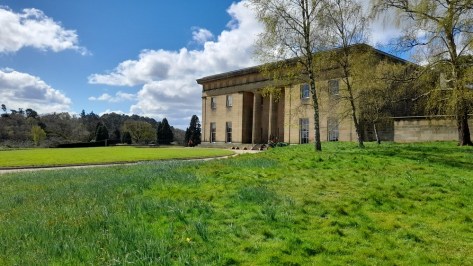
And English Heritage has not stopped there. Some of the estate buildings have been refurbished, such as the new café and toilets close to the castle. A new, and much larger car park has been opened close to the hall.
The gardens (which were always attractive) have received a lot of loving attention from staff gardeners and volunteers. We were told by one volunteer that during the Covid lockdown, there were only two gardeners working on the estate, and between them they planted more than 30,000 plants. On our visit the gardens were looking in excellent condition. It appeared that paths had been repaired, lots of new signs had been placed around explaining details about and the history of Belsay, and enhancing the visitor experience.


The Quarry Garden is a special place, and was waking up, with even some rhododendrons in full bloom. Having arrived just after 10 am, and after a welcome cup of americano in the café, we strolled through the gardens to the castle, and more or less had the whole garden to ourselves. So very peaceful.


The Belsay ‘wild man’.
On our walk around Belsay, there were many references to the ‘wild man‘, a medieval mythical figure —perhaps a Northumberland version of the ‘Green Man‘—adopted as a symbol of the Middleton family from the fifteenth century . . . and appear[ing] as a crest on the family’s coat of arms, in wall paintings, [and] as a carved stone statue. And in the ground floor hall of the castle, his story was told in an animation projected on the wall.
We also like to find the carved faces. Have you ever seen them?

Then it was back into the hall for the first time since 2021. As I mentioned earlier, all the rooms are bare, the wood panelling having been removed after World War II due to dry rot. And the leaky roof until recently didn’t help the situation one iota. Here’s an album of photos taken in 2021.
Since we became members of the National Trust and English Heritage in 2011 and 2015, respectively, I have become slightly obsessed with vintage wallpapers in their properties. And these have featured in several of my posts.
Belsay has some impressive wallpapers in several of the bedrooms on the first floor, although badly damaged in some rooms through damp and silverfish.


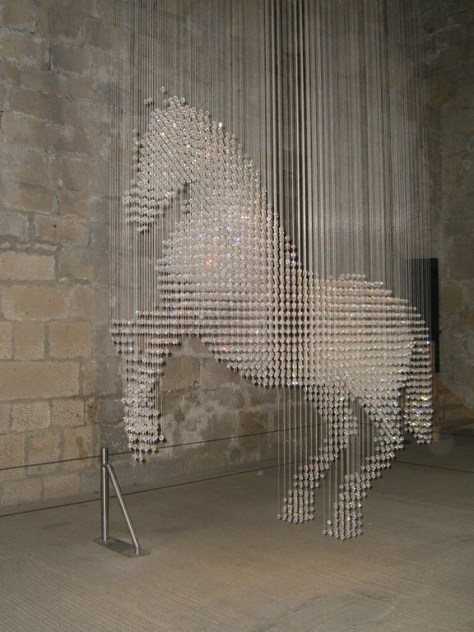
Having no furniture to display, Belsay Hall has become an excellent venue for art exhibitions, such as the Lucky Spot by Stella McCartney made from thousands of Swarovski crystals suspended from the ceiling of the Great Hall of the Castle, which we viewed in July 2009.
And there was another exhibition, by Ingrid Pollard MBE, on display last week, which will continue until mid-July.

Ingrid Pollard’s exhibition covers the ground floor Pillar Hall, library, and dining room, and three first floor bedrooms, as well as several strategically placed polished steel mirrors in the Quarry Garden.


On the whole, I’m afraid I didn’t find her pieces too inspiring, apart from the mirrors in the Quarry Garden (Fissures in Reflection), and the sandstone rock suspended from the Pillar Hall balcony by ropes.
However, I do applaud English Heritage for taking every opportunity of exhibiting (and even commissioning, I believe) works of art to be displayed amongst Belsay’s impressive architecture.
 A balanced diet . . .