
Steph and I first visited Costa Rica in April 1975. It’s hard to believe that it was 50 years ago. We were on our way back to the UK where I had to complete PhD residency requirements at the University of Birmingham, and submit my thesis.
 Since January 1973 I’d been working at the International Potato Center (CIP) in Lima, Peru. Subject to successful completion of my PhD, I’d been offered a postdoc position with CIP in its Region II (Mexico, Central America, and the Caribbean) program, and I’d been asked to check out various research options in Costa Rica and Mexico en route.
 A year later Steph and I relocated to Turrialba in Costa Rica, where I was an Affiliate Scientist at CATIE, an agricultural research and training center, while working in CIP’s regional program. Our elder daughter Hannah was born in San José in April 1978, and we remained in Turrialba until the end of November 1980 when we returned to Lima.
In this post I wrote about the years we spent in that beautiful country. 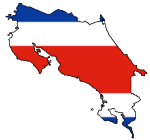
I’ve always enjoyed bird watching, and there were so many opportunities in Costa Rica, because it has such a rich avifauna. I regret however that I didn’t spend more time birding. My work took up so much time, and I traveled a good deal. Of course, there were plenty of colourful birds to see around the CATIE campus, and I always took my binoculars whenever out for a walk. However, we made only one special birding trip—in April 1980—to the Monteverde Cloud Forest Biological Reserve.
Hannah and her family live in Minnesota, and recently spent the school spring break on the northwest Pacific coast of Costa Rica in Guanacaste Province, just west of Liberia. Not long after arriving there, she sent me an WhatsApp message asking about the identity of two large birds that appeared beside their swimming pool.
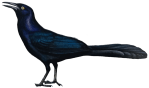 From Hannah’s description (and photos sent from her mobile), as well as consulting A Guide to the Birds of Panama [1], I concluded that one was a Great-tailed grackle (Cassidix mexicanus), and the other a Black (most probably) or Turkey Vulture.
I hadn’t consulted my Birds of Panama for many years, so was somewhat surprised to find a typed list (PDF) of birds of the Interamerican Institute of Agricultural Sciences in Turrialba (now CATIE) inside the back cover. I’d forgotten that I’d even kept it.
 The list, compiled in 1968 by Robert Jenkins (who I believe was the first science director of The Nature Conservancy in the USA) was based on an earlier list [2] by American ornithologist and tropical ecologist Dr Paul Slud (right, 1919-2006), Associate Curator in the Bird Division at the National Museum of Natural History (Smithsonian Institution) from 1964 to 1983. He must surely be ranked as one of the pioneers of Costarrican ornithology.
Someone had written my name on the list, as well as a location (Km 77 along Ruta 10 from Cartago to Turrialba), and a time (06:30). Then I remembered. It was the check list we used for a 1979 bird count around Turrialba as part of the National Audubon Society Christmas Bird Count in the Western Hemisphere (not just the USA) which now takes place annually between 14 December and 5 January.
I don’t remember how many teams (each a pair of observers) set out on the count, only that I was paired with a Costarrican who worked in CATIE’s coffee program and was incredibly knowledgeable about the birds of the area. The name Arnoldo Barrantes comes to mind, but again I could be wrong.
Over several hours, we moved around our target area (to the west and northwest of Turrialba town center), spending about 30 minutes or so at each observation point, counting the number of individuals of each species, and adding them to the check list. After the count was over, someone must have compiled all the observations and presumably submitted them to the National Audubon Society. However, I’ve not been able to find any of the Turrialba data on the society’s website. Online data for Costa Rica don’t stretch back to the late 1970s. Maybe they are just held as paper records still, if at all.
I do remember, however, that the teams observed over 100 species in total, and my colleague and I observed 54. Here are images of most of those 54 species. They were taken by Rob and Jane Beynon who have made several trips to Costa Rica, and who kindly gave me permission to reproduce them here.
With their help I was able to review the Jenkins list, noting that some scientific names and common ones have changed in the years since the list was compiled. And at least one of the species, the Chestnut-winged chachalaca (Ortalis garrula), is not known from Costa Rica, but the Gray-headed chachalaca (Ortalis cinereiceps, considered by some ornithologists as conspecific with O. garrula) is, and was probably the bird we saw.
Do have a look at Rob and Jane’s wonderful website of birds of Costa Rica, of Brazil, Florida, several countries in Africa, Australia, New Zealand, Singapore, and the UK. Taiwan coming soon, I hope. You won’t be disappointed!
This gallery of birds from the ‘1979’ count follows the Jenkins list order.


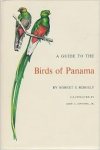 [1] There were no popular guides to the birds of Costa Rica back in the 1970s (unlike today), and no online resources of course. So we had to resort to A Guide to the Birds of Panama by Robert S Ridgeley and illustrated by John A Gwynne, Jr., which covered many (most?) of the birds of Costa Rica. It was published by Princeton University Press in 1976.
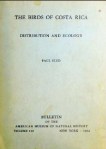 [2] Slud, Paul. 1964. The birds of Costa Rica – distribution and ecology. Bulletin of the American Museum of Natural History. Volume 128. New York.
 A balanced diet . . .
What a lovely memory and report. Thanks for including our photos and the acknowledgment and website. I liked the smaller images with popup name too. Might see if I can do that. If I can find more photos, I will let you know.
Finally, just fyi, we have booked trip number 5 in 2026! We’ll be in the North, near the Nicaragua border, for most of the trip.
Rob (&Jane) Beynon
LikeLike