
Rail transport was one of the most important technological advances of the 19th century, a key component of the so-called Industrial Revolution (approximately 1760-1840) that marked a transformative period characterized by mechanization, urbanization, and significant social changes.
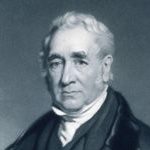 And today, 27 September 2025, is the 200th anniversary of the opening of the Stockton and Darlington Railway, the first public railway to use steam locomotives, and which is considered the beginning of the Railway Age. One man, George Stephenson (right, 1781-1848), is inextricably linked with the birth of the railways, having surveyed the Stockton and Darlington line and constructed (with his son Robert, 1803-1859) the first locomotive, Locomotion No.1, to haul passengers. But they built upon the ingenuity of great engineers before them, like the pioneering Cornish engineer Richard Trevithick who actually developed the world’s first steam locomotive in 1804.
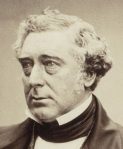 For this, and other inventions and innovations such as surveying lines, the standard gauge (at 4 feet 8½ inches) that was more or less adopted worldwide, and design of steam locos, George Stephenson is often referred to as the Father of the Railways, and rightly so. Although perhaps that’s an accolade that should be shared with son Robert (right).
Steam locomotives and the birth of the railways are part of the proud historic and heritage fabric of the northeast of England where the history of the railways is synonymous with the expansion of the coal mines. Coal had been transported since the late 17th century from the pits along waggonways to wharves or staiths along the River Tyne where it could be loaded on boats for export, most often to London.
Waggons were initially hauled by horses on rails made from wood. Later, stationary steam engines were built to pull the waggons, and wooden rails were replaced by cast iron ones. The design and development of steam locomotives to bring coal from the pits to the River Tyne was the driving force that brought about the birth of the railways. It was a major step forward, and dramatically reduced the cost of coal.
While working at Killingworth Colliery, northeast of Newcastle upon Tyne, Stephenson had a workshop where he constructed his first steam locomotive, Blücher in 1814, establishing his reputation as an engineer. Remarkable for a man who was illiterate until the age of 18.
And while Locomotion No 1 was a major step forward in the development of the railways in 1825, it was Rocket built by George and son Robert in 1829 for the Liverpool and Manchester Railway (which opened on 15 September 1830) that included design innovations (explained in the video below) seen in steam engines over the next century and a half. Although Stephenson did not design flanged wheels (that was done by William Jessop in 1788), he did use them on Rocket, a significant advance in railway technology.
Just imagine how sophisticated some steam locomotives became. Take Union Pacific Big Boy, a 4-8-8-4 locomotive in the USA, the world’s largest and most powerful locomotive ever built. What a beauty!
It’s also remarkable just how quickly railways expanded in and after the 1840s in the UK and around the world. By 1870, the network in the UK comprised around 16,000 miles of track. A year earlier, in May 1869, the the transcontinental rail line in the USA was completed, when the two construction companies met in Utah, north of Salt Lake City. The rail network had been important during the American Civil War (1861-1865) for the movement of troops and materiel, perhaps the first time that railways had taken on such a significant role.
For most railway buffs, I guess there’s no finer sight than a steam locomotive at top speed. Poetry in motion! Today, that’s something you’ll only ever witness here in the UK when special excursions are run on the mainline. And that speed capability came about because of the design innovations in Rocket, and subsequent improvements that engineers made, of course.
The last standard gauge mainline service in this country ran on 11 August 1968 from Liverpool to Carlisle. The focus thereafter was on diesel power and the expansion of electrification.
However, steam locomotives can still be seen in action on the many heritage lines around the UK such as the Severn Valley Railway, a 16-mile line between Kidderminster and Bridgnorth close to our former home in Worcestershire which we rode in 2008. However, trains on heritage lines are restricted to a 25 mph speed limit.
The days of steam power on the railways were always numbered, even as soon as 60 years after the opening of the first steam-only railway. Steam locos were already being replaced in some cities as early as the 1880s, and Switzerland for example, had achieved 50% electrification of its network by 1928.
George Stephenson was born in a cottage, known formerly as High Street House, in the colliery village of Wylam in Northumberland, which is about nine miles west of Newcastle upon Tyne, beside the River Tyne.
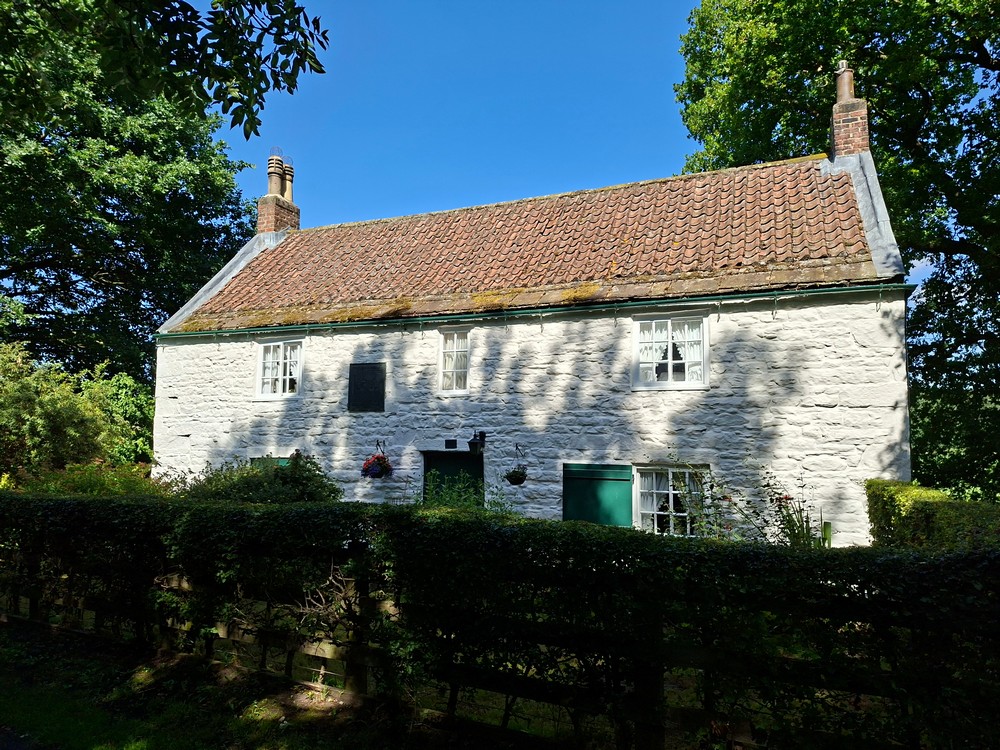
George Stephenson’s birthplace in Wylam, Northumberland.
His father Robert was a fireman for the Wylam Colliery pumping engine and, being poor, could not pay for George’s education. It’s remarkable, therefore, that George achieved so much, and having become wealthy through his own engineering prowess, ensured that his son Robert benefitted from a better education, and becoming one of the greatest engineers of the Victorian Age.
A week ago (on 21 September) Steph and I had the opportunity of visiting George Stephenson’s birthplace, which is owned by the National Trust and opened on a limited ticketed basis on just a few days each year.
Father Robert, his wife Mabel, and their five children occupied just one ground floor room (to the left of the front door) in this cottage, each of the other rooms also housing a single family. Can you imagine a family of seven living in one room, just 12 x 12 feet approximately? He lived there until he was eight.


The Wylam waggonway ran by the front door, so young George would have, from an early age, seen just what rail systems could achieve.
Then, during the tour of the cottage, and in subsequent reading, I discovered that George Stephenson lived, from 1805 to 1823 (after he had become engineer at Killingworth Colliery) in a cottage (known as Dial Cottage for the dial that he and son Robert made and placed over the front door) just 1.80 miles as the crow flies from our home in North Tyneside.
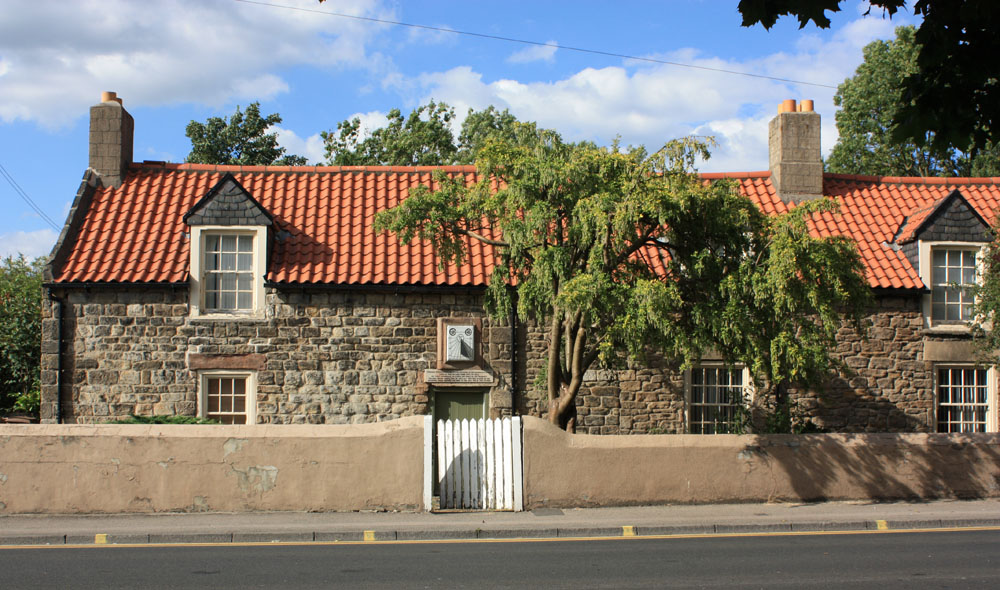
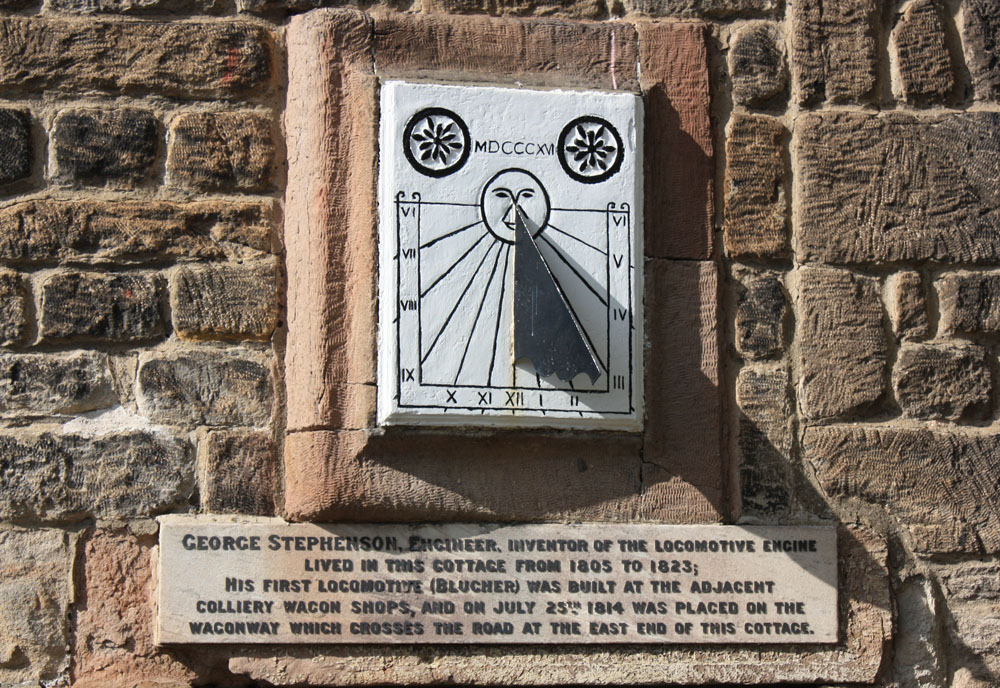
From such humble origins to fame and fortune, and perhaps even greater for son Robert who was elected a Fellow of the Royal Society. Neither accepted a knighthood.
And one final point. George Stephenson invented a mining safety lamp, the Geordie lamp, resulting in a lifelong controversy with Cornish aristocratic chemist Humphry Davy who accused Stephenson of stealing his design for a similar device.
By the mid-1860s, natives of Newcastle became known as Geordies, and it’s commonly believed that the name of the lamp attached to the pit men who worked in the numerous mines across Tyneside.
 A balanced diet . . .