
Laughter, so they say, is the best medicine. Until it (almost) kills you! Like the other day. I could hardly breathe I was laughing so hard. It was painful. I had to close the video clip I was watching and get my breath back.
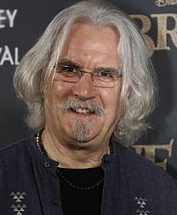 So who nearly brought about my demise?
Billy Connolly, of course. The Big Yin! Comedian, story-teller, musician, actor, artist, documentary maker, Knight of the Realm! And one of the funniest persons (in my opinion) to grace our TV screens. There are many clips from his one man shows on YouTube, and I delve into them from time-to-time if I need cheering up. I find myself laughing just as much after watching for the umpteenth time as I did the first. There are few comedians who really make me laugh, and laugh out loud. Billy Connolly never fails.
Born in Glasgow in 1942, he grew up in the tenements of the Anderston area of the city that were demolished in the 1970s and residents moved out to barren housing estates on the outskirts of the city.
He became a welder in the Glasgow shipyards after leaving school, but knew that there was a brighter life beckoning him. Turning to folk music, he paired up with fellow Scot and singer-song writer Gerry Rafferty to form The Humblebums. But, as Billy himself acknowledged, it was his patter between songs that began to attract interest from the audience. Thus began his transition to stand-up comedian and story-teller.
And that’s how I see him, a raconteur rather than as a traditional stand-up. Yes, he tells jokes (perhaps much more in his early career), but his act developed much more depth than that. He weaves stories, narratives, heading off at a tangent almost to the absurd, before reining the tale back in to its original direction. He is a brilliant master of story telling. That’s all I can say. Watching his performances, it’s clear he holds his audience in the palm of his hand. Given his propensity for using his Glaswegian vernacular (rather a lot of swearing) no-one would attend one of his shows if they were about to be offended.
He got his big break nationally appearing on the BBC’s Parkinson, a weekly chat show hosted by journalist Michael Parkinson, in 1975, telling this joke. And over the years he made 15 appearances on that show before it came to an end in 2007.
I still haven’t seen Connolly alongside Dame Judi Dench (as Queen Victoria) in Mrs Brown, the 1997 film that cast him as John Brown, a servant of the Queen and believed to have had a relationship with her. From the clips I’ve viewed, Connolly’s performance was outstanding, and he did receive nominations for several acting awards.
In recent year, documentaries of his travels throughout the USA, Australia and New Zealand, as well as his native Scotland have been widely acclaimed.
He was made a Knight Bachelor in the 2017 Queen’s Birthday Honours for services to entertainment and charity.
In 2013 he was diagnosed with Parkinson’s Disease and has become increasingly frail. In this clip he talks about the challenges he faces.
Anyway, enough of my musings. Sit back and watch (if you dare) some of the videos by Sir Billy Connolly that I’ve enjoyed recently.
WARNING: If you are offended by strong language, take care.
This is is the video that got me going on Christmas Day. It was the balsamic vinegar . . .
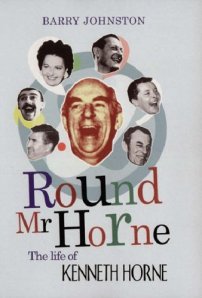 I’ve just finished a very readable biography of the late Kenneth Horne, one of the comedy greats of the 20th century, written by Barry Johnston (son of the late cricket commentator Brian Johnston). I’m sure, however, for many readers of this blog outside the UK or who did not grow up in the 50s and 60s, the name of Kenneth Horne will mean little if nothing at all. But he was the lynch-pin, so-to-speak, of some of the most successful comedy series on BBC radio in the 1940s, 50s and 60s until his untimely death from a massive heart attack at the age of 61 in 1969.
 Kenneth Horne
 And there was a strong supporting cast:
  A balanced diet . . .