
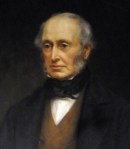
 We first visited the National Trust’s Cragside (near Rothbury in central Northumberland)—home of Victorian engineer, industrialist, inventor and entrepreneur William Armstrong, 1st Baron Armstrong (right)—in 2011, not long after we became members of the National Trust. Since we moved to the northeast in October 2020, we have been back there several times, most recently yesterday to see how the house had been decorated for the Christmas season.
Each December over the past 13 years, we have visited one or more National Trust properties to enjoy the seasonal decorations that have become part of the Trust’s calendar. Some very traditional, others a little more quirky, whimsical even, and perhaps not to everyone’s taste. I’m surprised some of the Christmas displays haven’t already compelled advocates of Restore Trust [1] to reach for their pens and fire off a letter of complaint to The Telegraph!
But we enjoyed our visit to Cragside, and the staff had gone to great lengths to open up several rooms, and brought the Spirits of the Forest inside.
“Imagine that the Armstrongs’ servants have decked the halls and trimmed the trees for their jolly festivities, but as day becomes night, the House falls under an enchanted spell. The carefully cultivated landscape has gone wild and is reclaiming the House. Rooms are bursting with trees, woodland animals are roaming the halls, foliage is growing down the furniture and the enormous marble fireplace in the Drawing Room is being transformed into a cave by the crag” (Source: National Trust website).
Inside the house, National Trust staff and volunteers (especially Yvonne and Sandy on the door) gave everyone a warm welcome.
On the ground floor, we followed a route through the butler’s pantry (champagne on ice), the kitchen (where someone had been busy making mince pies), into the dining room (where a tree had reclaimed the dining table), and the library where Armstrong peered down from the wall at the havoc that the Spirits had inflicted on his domain. I wonder what he would have made of it all? I hope he would have been impressed by the lengths the staff and volunteers had gone to bringing Christmas cheer inside.


There’s one feature in the dining room that has always attracted my attention. Either side of the fireplace are two pre-Raphaelite stained glass windows.


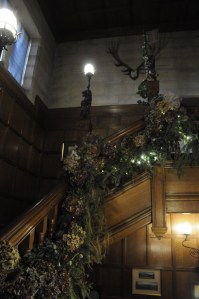 Moving to the first floor, the main staircase was sheathed in foliage and lights, but that didn’t prepare for the spectacle to come in the Gallery and Drawing Room.
The Gallery (normally lined with marble busts and cases of stuffed birds and other natural history elements) had become a forest, with Christmas trees on both sides, and the occasional owl making an appearance. The busts had been left in place to peer through the foliage.


Cragside’s Drawing Room is impressive. It must be 30 m long at least, 15 wide, and heaven knows how high, with a glass roof allowing diffuse light to enter. The walls are lined with portraits of all sizes. But this Christmas it had become a cave, with a stream flowing through. There was even an otter peaking out from under the stream’s bank.


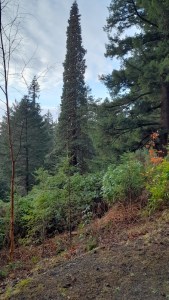 On 28 November, 2000 lights on a 42m giant redwood close to the house were switched 0n. Although the lights were on during the day, they can hardly be seen in this image on the right.
After enjoying the house, and the weather continuing bright and calm, we headed across the estate on foot to the formal garden. And afterwards, we took the Carriage Ride, stopping for a ‘picnic lunch’ (in the car) overlooking Nelly’s Moss Lakes (which Armstrong built to provide a head of water for the hydroelectricity he installed in the house).


Then, by about 14:45 we completed the Carriage Ride circuit, and headed back home, about 30 miles south.
This is the link to more photos in an online album.
[1] Restore Trust is a British political advocacy group which seeks to change policies of the National Trust. The group has aimed to bring resolutions to the National Trust AGM in an effort to restore the [National] Trust to what it sees as “its core purpose”, and has criticised the National Trust’s work on rewilding and social inclusion which Restore Trust’s organizers consider to be “woke” (from Wikipedia).


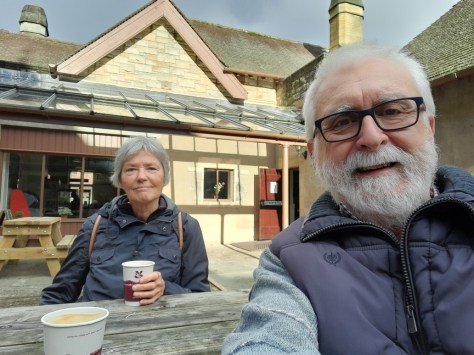


 A balanced diet . . .