
 Several weeks ago (or was it months?) UK Prime Minister Rishi Sunak (right) announced that his government would soon propose plans to reform secondary education for all pupils to study mathematics and English up to the age of 18, like many other countries.
After GCSEs (known as ‘O Levels’ back in the day when I was at school in the 1960s), taken at 15/16, many pupils receive no further tuition in maths (or English for that matter), and specialise in their final two years of high school, taking just three subjects, known as ‘A Levels’ (Advanced Level) as university entrance exams.
During his speech to the Tory Party conference on 4 October Sunak pledged to introduce this ‘revolutionary’ change. That’s assuming, of course, that the Tories remain in power after the next General Election. Which seems highly unlikely if the latest polls are to be believed. (Should Labour win the next election, I have no idea what its policy on continuing maths and English education will be, although as far back as 2014 they made it one of their policy pledges¹).
By teatime on the 4th, the Prime Minister’s Office had posted a press release on the government’s website.

Justifying this proposal, Sunak indicated that this new qualification for 16-19 year olds will put technical and academic education on an equal footing and ensure that all young people leave school knowing the basics in maths and English.
The new Advanced British Standard will bring together the best of A Levels and T Levels into a single new qualification. Students will take a larger number of subjects at both ‘major’ and ‘minor’ level, with most studying a minimum of five subjects at different levels – for example, three majors alongside two minors. Importantly, students will have the freedom to take a mix of technical and academic subjects, giving them more flexibility over their future career options.
However, it would take at least a decade to introduce such a change apparently. Very quickly, unions and teachers dismissed this proposed reform. Not, I hope, because they were opposed to reform in principle, but because schools do not have the staff or resources to teach English and maths to age 18. Yes, that is a real issue, and it will take political courage from the next government to tackle this issue head on, and support education at the level required. And to increase standards and achievements for GCSE students.
Notwithstanding there little or nothing about this Tory government I can support – and they certainly won’t have my vote in 2024 or whenever the election is called – I am actually in favor of this proposed educational reform. Let me explain.
When I was in high school (1960-1967), maths was one of my least favorite subjects. I dreaded maths lessons. But I did manage a pass in ‘O’ Level maths in 1964, but never took a maths course per se ever since. Much to my regret. And there are thousands of schoolchildren in exactly the same boat as me. Cowed by maths, and thus uninterested in the beauty of the discipline.
I often wish I had been able, had the ability, and perhaps more importantly had the support of good maths teachers to instill a continuing interest. I had really poor teachers at my high school, only interested in those who could and tolerating (just) those who struggled.
Having said all this, I have spent much of my career in agricultural science working with numbers, and thoroughly enjoying it. Indeed, in 2017 I wrote this blog post, There’s beauty in numbers, about my enjoyment of playing with data, looking for patterns and trends, and coming to conclusions about the behavior of the plants and crops I was studying. But although I became reasonably proficient (under guidance and advice from those better experienced than me) in the use of statistics, I do wish I had a better theoretical background underlying some of the statistical concepts I applied.
But beyond the basics of algebra, geometry, or trigonometry that high school pupils receive leading up to GCSEs, most do not need higher levels of mathematical education, like calculus for example. What they do need, in my opinion, are good numeracy skills, and how maths operates in the real world.
And as far as English is concerned, my emphasis for many students would be having the ability to write coherent prose and learning how to communicate effectively, both in written form and verbally. No need for deep analysis of set texts by Shakespeare or others.
So how would they achieve this? Sunak’s proposed Advanced British Standard qualification is his solution.
Often referred to (in previous government statements) as an English or British Baccalaureate, the Advanced British Standard seems remarkably similar to an existing and widely accepted  qualification: the International Baccalaureate Diploma, offered in over 3600 state and private schools worldwide (but in just 22 state schools in the UK, although offered in 71 private ones).
If a widely-accepted qualification is up and running, and has been for decades, since 1968 in fact, why bother to reinvent the wheel with the Advanced British Standard? Is this another case of British exceptionalism?
 This is what one headmistress, Victoria Hearn (right), Principal of state-assisted Impington Village College and Impington International College near Cambridge had to say about the proposal in a letter to The Guardian on 27 September last:
While Rishi Sunak’s plans to reform post-16 education are welcome news, I can’t help but feel that valuable resources could be saved by utilising a tried and tested education framework that students are already benefiting from. The international baccalaureate (IB) diploma enables students to study six subjects including mathematics, English and a foreign language until the age of 18, providing a broader and more rewarding syllabus compared with that of the UK’s national curriculum.
The development of a “British baccalaureate” will be costly, and funding this new vision will be a concern to many, particularly for state-funded schools that are already overstretched. In the UK, the IB is often seen as only accessible to independent schools, but with some creative budgeting and timetable management, a comprehensive IB programme can be delivered by state schools. We have been offering the IB at the state-maintained Impington Village college for more than 30 years as we believe it places our students in the best position to succeed in the global workplace.
Adapting the current curriculum framework is going to be lengthy and costly. The IB represents a proven alternative that can give students the broad range of skills required to thrive in the future.
Also, these are the IB values:
- valuing inquiry and reflection, encouraging students to be open minded in their learning;
- being principled and encouraging a caring attitude;
- promoting high quality communication and discussions within the school community; and
- encouraging international-mindedness and building respectful relationships.
I couldn’t agree more. And here are some reasons why.
First, from my own experience, I believe keeping your options broad is a positive perspective. In fact,
- I studied both humanities and sciences at ‘A Level’: English Literature, Geography, and Biology (and General Studies).
- I read for a combined BSc degree at the University of Southampton (1967-1970) in Environmental Botany and Geography.
- For my MSc degree at the University of Birmingham in the conservation and use of plant genetic resources (1970-1971) many different topics were included.
- It wasn’t until I began my PhD on potatoes (awarded 1975) that I settled into a narrow discipline.
Second, I don’t agree with either the retired teacher who thinks that additional ‘useless’ subjects in a baccalaureate would not be appropriate for many pupils, or the Emeritus Professor of Mathematical Education, who felt that students applying for maths at university would not have appropriate preparation. Both expressed their views in letters to The Guardian. The professor seemingly doesn’t appreciate that IB subjects are taught at both a higher and lower level. And, in any case, from my experience as a university lecturer (1981-1991, in plant biology in the School of Biological Sciences at the University of Birmingham) many first year university courses are designed to bring everyone up to the same level.
Furthermore, and again from my university days as a tutor, many students would certainly benefit from having a received a broader pre-university education, that would have given them a broader perspective on life, with access to the humanities as well as sciences, and would have enhanced, I believe, their ability to think and discuss more critically, and present their ideas verbally as well as written.
And lastly, both my daughters took the IB Diploma, and emerged with highly creditable grades at age 17, with subsequent access to good universities in the USA and UK, and endowing them with the academic capabilities and discipline to graduate with excellent degrees, and subsequently taking a PhD each in psychology.
But, I should add, their IB Diplomas were not earned at a British state school. In July 1991, I took a senior position with the International Rice Research Institute (IRRI) in the Philippines. My wife Steph and daughters followed me out to the Philippines by the end of the year, when Hannah and Philippa were 13 and nine (and had just moved up to high school and middle school respectively just three months previously in our home town, Bromsgrove, in Worcestershire).
Steph and I discussed the various education options. We were not keen in sending them to boarding school in the UK. There was a British School in Manila, but that did not, in the 1990s, offer an ‘A Level’ curriculum. So, after GCSEs, we would have had to send them back to the UK. Again not something we considered.
 So both were enrolled in the fee-paying International School Manila (ISM), with the expectation from the outset that the IB Diploma would be their pre-university goal. Fees were subsidised by my employer as many IRRI children were also enrolled there, and traveled the 70 km daily each way north from Los Baños, where IRRI’s research center is located, into the city.
Yes, the courses were tough. Since besides the six academic subjects (three at higher, three at lower), IB students took a Theory of Knowledge course. Both our daughters studied English, history, and biology at higher level, and maths studies, French, and psychology at lower level.
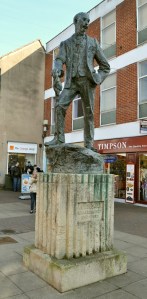 Each had to complete a 4000 word essay based on independent research. Hannah’s history project was an analysis of the impact of the railways on the canals in mid-19th century England. Philippa made an analysis of A Shropshire Lad, an epic poem by Bromsgrove classical scholar poet, AE Housman (whose statue, right, proudly stands in the High St there) and interpreting his repressed sexuality through the poem’s themes.
For her community project, Hannah helped each weekend at a Montessori school in Los Baños, while Philippa joined a group for two weeks helping to construct a road in the mountains north of Manila.
There was one last challenge: the daily journey into Manila. Classes began at 07:15, and by the time my younger daughter graduated in 1999, the IRRI bus for ISM was departing from Los Baños at 04:30, and not returning until 16:30 or later. Then there were homework assignments to complete until late evening. All the family was relieved come graduation!
I’ve asked them about the IB experience. Both were unequivocal. The Diploma gave them enhanced skills for critical thinking, time organization, as well as covering the various subjects in depth. They both said the Diploma was a worthwhile qualification. It certainly hasn’t held them back.
So as the discussion continues over post-16 education and whether to replace ‘A Levels’ with a broader curriculum qualification, it’s certainly worthwhile looking at the IB mix, and what level of maths and English education and skills most students really need to prepare them for the workplace, and life in general.
¹ 11 October update. Labour just announced at its 2023 Conference that there will be a focus on teaching ‘real world maths’ to younger children. See this article in The Guardian.
 A balanced diet . . .