Once one of the greatest monasteries in England

At breakfast earlier last week, Steph and I were comparing this past winter to the other three we have experienced since moving to the northeast in October 2020. It’s not that it has been particularly cold. Far from it. But, has it been wet!

It feels as though it hasn’t stopped raining since the beginning of the year. The ground is sodden. And as for getting out and about that we enjoy so much, there have been few days. Apart, that is, from local walks when it hasn’t been raining cats and dogs.

So, with a promising weather forecast for last Friday we made plans for an excursion, heading south around 70 miles into North Yorkshire to visit Byland Abbey, built by a Cistercian community in the 12th century, below the escarpment of the North York Moors.
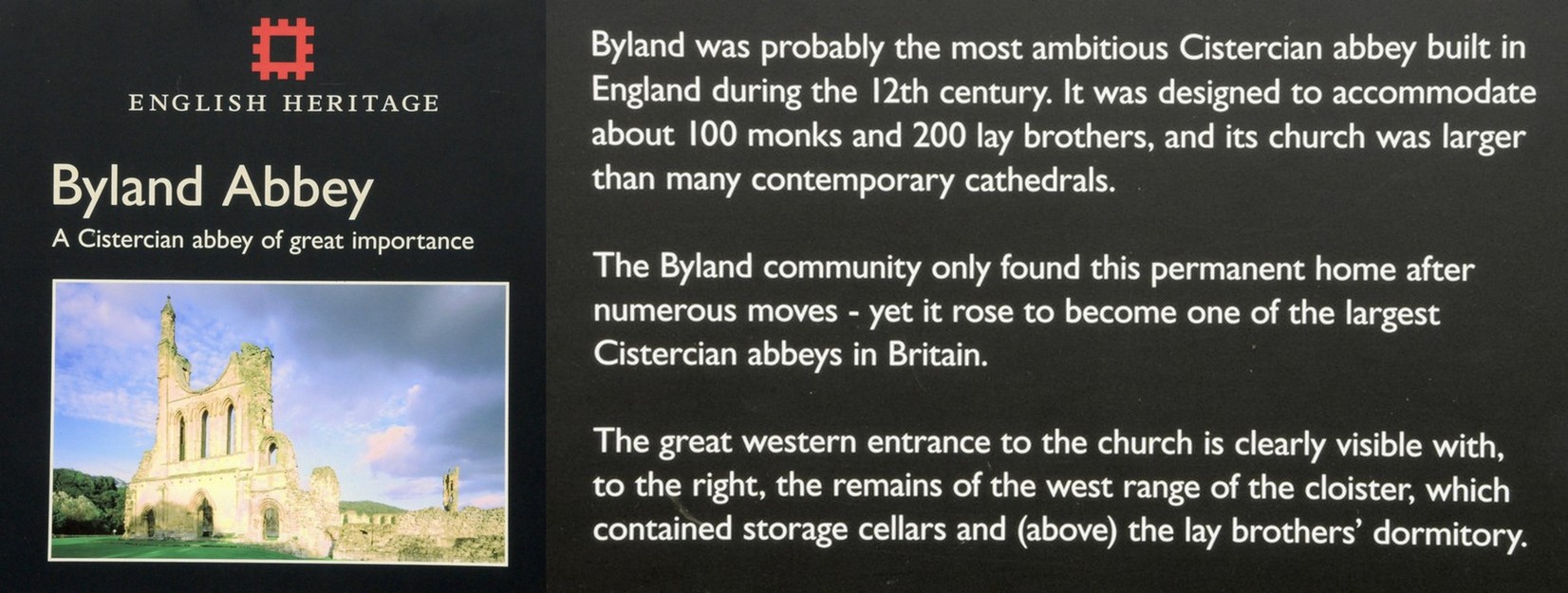
It’s 12th Cistercian neighbours—less ruined, and arguably more famous—Rievaulx Abbey and Fountains Abbey, stand just 4 miles north as the crow flies and 18 miles southwest, respectively from Byland Abbey.


We decided to take in a couple of other sites on our way south, stopping off at Mount Grace Priory for a welcome cup of coffee and a wander round the gardens, and then—just a few miles further on—the small 12/13th century church of St Mary the Virgin, beside the A19 trunk road that we have passed numerous times, but never taken the opportunity to visit.

St Mary’s was once the parish church of a medieval village, Leake, now disappeared. Nowadays it serves the communities of Borrowby and Knayton. The tower is the earliest remaining structure, and the church has been added to over the centuries (floor plan).

There is a very large graveyard, still in use today, clearly shown in this drone footage.

Then it was on to Byland, taking the cross country route from the A19. And along the way, I saw my first ever hare (and nearly killed, which you’ll see at 02’22 ” in the video below). This route takes you through the delightful village of Coxwold.


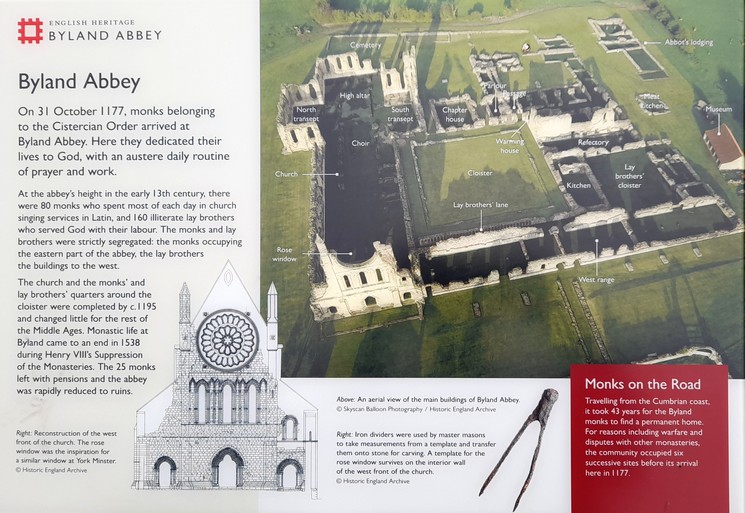
Byland Abbey is mightily impressive, even though it’s a shell compared to Rievaulx, for example. But I had the impression that it was much larger than Rievaulx, and it must have been magnificent in its heyday. Its foundation was far from straightforward, and it took the monks more than 40 years before settling on the site at Byland.
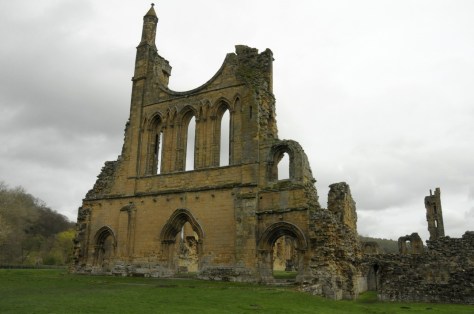
Its west entrance is simply a wall, with the remains of what must have once been an incredible rose window. We saw a note on the English Heritage hut (closed on our visit) that there was a template for the window on the inside of the West Wall, but we couldn’t find it.
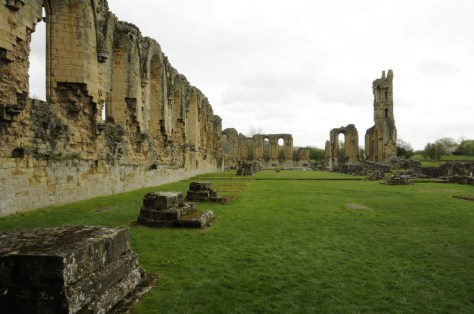
And from the entrance there is a view straight down the length of the church towards the North and South Transepts and the High Altar. Just the north wall is still standing, mostly. And when I look at ruins like Byland, I am just in awe of the craftsmanship that it took to build a church like this, with such beautifully dressed stone. I wonder how big a workforce was needed for the construction over the 25+ years it is estimated it took to complete the abbey?
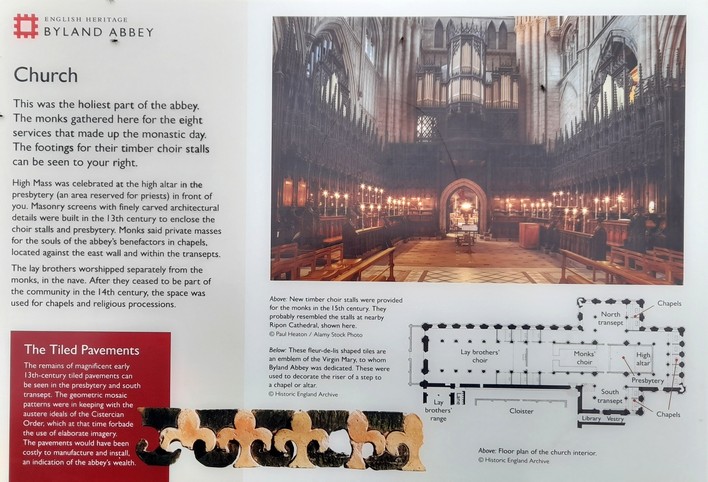
At various locations around the ruins, and especially around the site of the high altar, ceramic floor tiles uncovered during excavations are currently not on view, but protected by tarpaulins.
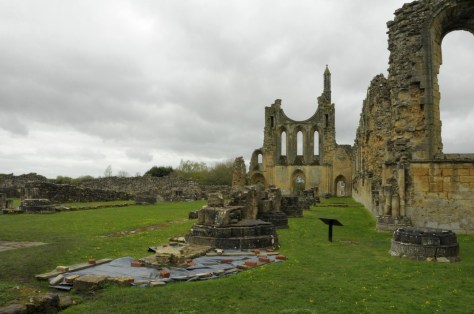
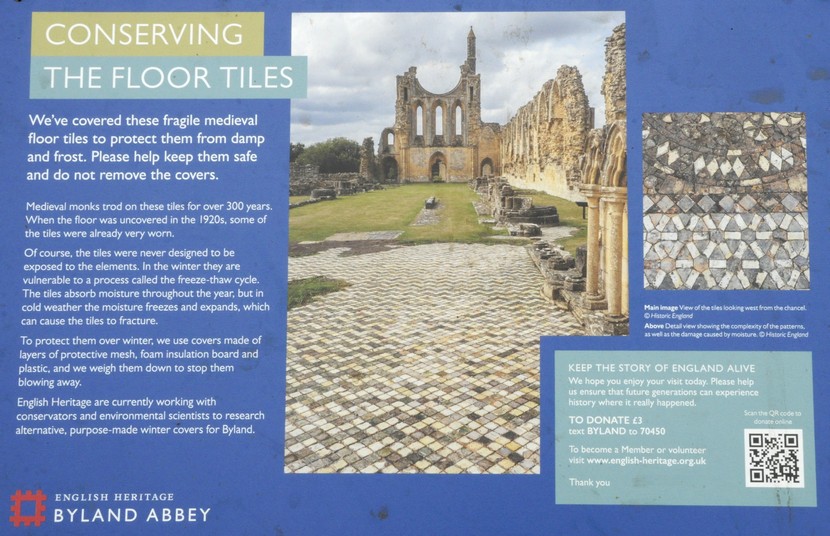
Like all the other religious houses across the nation, Byland was closed during the Suppression of the Monasteries by King Henry VIII in 1538 and rapidly became a ruin. You can read an excellent history of the abbey on the English Heritage website.

You can view my photo album of Byland Abbey images (and from St Mary’s, Leake) here.


Leaving Byland Abbey, we headed up the escarpment on Wass Bank, stopped off to view the Kilburn White Horse again before heading down the precipitous 1:4 (25%) incline that is the infamous Sutton Bank.

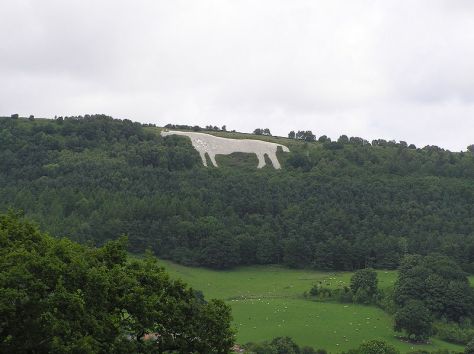
The Kilburn White Horse can be seen for miles around, primarily from the southwest. It was supposedly constructed by a local schoolmaster, John Hodgson and his pupils in 1857. It covers an area of 6475 m² (or 1.6 acres). We had only seen it previously from a distance, or from the car park immediately below. This time we took the footpath at the top of the cliff, emerging near the horse’s ears. The walk from where we parked the car (alongside the glider field) took less than 10 minutes.

And although there wasn’t a good view of the horse per se from the path, the view south over the Vale of York was magnificent. We could see for at least 30 miles over a 200° panorama.
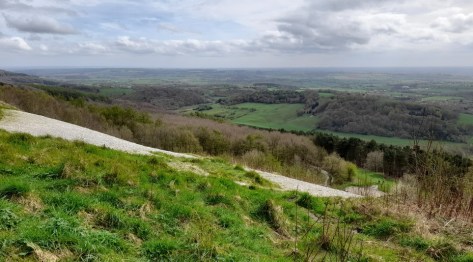
That’s the horse’s eye in the foreground.


Nunnington Hall – from 13th century manor house to 20th century family home

There has been a manor house beside the River Rye in the small village of Nunnington (lying within the Howardian Hills National Landscape of North Yorkshire) since the 13th century.

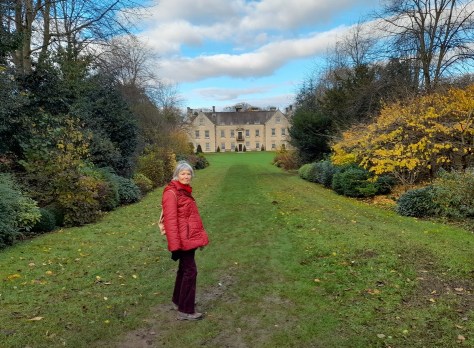
Built from a light colored coral rag Jurassic limestone, the Nunnington Hall estate occupies around 5 acres (2 ha) and is surrounded by a walled garden. The house has changed in character over the centuries, as each resident (owner or tenant) stamped their mark on its architecture and layout. It has been owned and managed by the National Trust since 1952, although it remained a family home until 1978.

In Tudor times there were distant royal connections, and during the 17th century English Civil Wars, Parliamentarian troops were garrisoned in the Hall.

A wealthy cloth merchant, Ranald Graham (right, created Viscount Preston in the Peerage of Scotland in 1681, died 1689) bought the Nunnington estate in 1655, and it remained in the family until the mid-18th century when the direct Graham line became extinct. Sublet and allowed to deteriorate, it was offered up for sale in 1839 in a semi-derelict state, and bought by William Rutson (1791-1867) whose family had made their fortune through colonial trade and slavery.

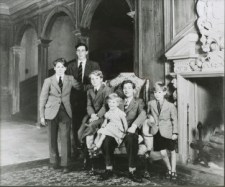
The five children of Susan and Peter Clive and their cousin Michael in the Oak Hall at Nunnington Hall.

Nunnington Hall was inherited by Margaret Fife (née Rutson, the great-niece of William Rutson) in 1920, and she set about the renovation of the Hall with her husband, Colonel Ronald D’Arcy Fife, funding the project from the sale of another Rutson property, Newby Wiske near Northallerton. One of their adopted daughters, Susan Clive, raised her family at Nunnington Hall, until moving to a house in the village.


I first visited Nunnington Hall in the summer of 1968, but recall very little of that visit, since only a few rooms were open to the public, and then only twice a week. It was only after the family vacated the Hall that the National Trust opened more of the house to the public, and more frequently.

In 2013, Steph and I stopped off on our way back south after visiting family in Newcastle.

Unlike Worcestershire where we lived until 2020, there are just a few National Trust properties near our home (since 2020) here in the northeast. And not all open for the Christmas season. I wrote briefly about our various Christmas visits after last year’s to Ormesby Hall near Middlesbrough.

So, on Friday last, we made the 162 mile round trip from North Tyneside to enjoy Nunnington Hall decorated in its Christmas finery. Being the first day of the Hall’s Christmas season (only each Friday to Sunday until just before Christmas), it was a delight to see many of the rooms brightly lit with Christmas trees and candles.


Let me take you on a brief tour of the house in 2013 and last Friday, highlighting some of the features that particularly caught my attention. A photo album of all the photos taken during both visits can be viewed here.

The entrance was suitably decorated for the Hall’s Christmas season, and we headed straight for the tearoom (with waitress service, unusual for National Trust tearooms) for a welcome cup of coffee before beginning the tour.

A kitchen or a Great Hall in earlier centuries, by 1921 the Stone Hall had become the entrance hall on the west facade of the building. One wall is hung with shooting trophies (mainly antelope of one species or another), with the skins of big cats on another. A huge fireplace (which was lit on our recent visit) dominates a third wall. And for Christmas, there was a tall (maybe 15 foot) tree, a Fashionable Victorian theme, with one of the volunteers (dressed as a butler) offering a small sherry or cranberry juice to each new visitor.

The Smoking Room, a few steps up from the Stone Hall, was Lord Preston’s bedchamber in the 17th century, but was adopted by Colonel Fife. The walls were painted Georgian green by Margaret Fife, and its theme was an indulgent Georgian Christmas. On our 2013 visit, this room was set up as a small dining room. And beyond the main room, in a small withdrawing room, the walls are covered in 18th century prints, and the ceiling decorated with original coats of arms.

From the Smoking Room, you step into the large Oak Hall with its stone floor, stone fireplace, and elegant, low-rise staircase leading to the first floor. This was an open courtyard in Tudor times, but was enclosed by Lord Preston in the late 17th century. There was a Tudor feast theme last Friday.

There are several paintings of William Rutson and his horses.

L: William Rutson’s groom and horses; R: William Rutson on a grey hunter

Hanging on the walls above the staircase are three tapestries, 300 years old, and another one in the Sitting Room.

During Margaret Fife’s time, the Sitting Room was the main family room, with a balcony overlooking the walled garden, with its terraces and orchard. Peacocks also strutting around the grounds. The Christmas theme was 1980s Party Time.

One feature which caught my attention in 2013 (and still prominently on display) was the superb set of porcelain figurines—Chelsea I presume—on the mantelpiece. How I would like to own a set like that, but my pockets aren’t deep enough!

In Margaret Fife’s bedroom and dressing room on the first floor, there is a charming (but controversial) portrait of her as a young girl, hanging above the fireplace.

Colonel Fife had his own bedroom, and particular feature that you can’t miss is the Chinese-style wallpaper, decorated with birds, flowers, and fruits.

A child’s bedroom, decorated with a tree and toys completed the bedrooms that were open. Wood-paneled, I seem to remember from our 2013 visit that there were carvings or graffiti in the wood made by Parliamentarian soldiers in the 17th century.

Schoolchildren from the nearby Slingsby Community Primary School had created the snowman exhibit in another bedroom.

The Nursery had a 1940s Rationing theme. The walls were covered with another impressive wallpaper, and a delightful doll’s house stood in one corner.

The attic floor under the eaves houses a couple of exhibitions. One of these is the permanent home of a collection of miniature rooms, donated to the National Trust by Londoner, Mrs Carlisle (known as ‘Kitty’). The models are truly exquisite in the amount of detail, even handwriting on miniature letters. The other exhibition, Fields, Folds, and Farming Life on display last week was a collection of photos and videos of farming life in Yorkshire by photographer Valerie Mather.

After a short (and rather muddy) walk around the garden, our visit to Nunnington Hall came to an end, and we headed back home.


But with just one other feature in the landscape to find: the Kilburn White Horse (map)The origin of the horse is disputed, but it appeared in November 1857, cut into the hillside above the village of Kilburn. Some credit the local schoolmaster and his pupils. The top soil was scraped away, and the horse covered in limestone chippings. It has needed regular maintenance over the years.

The Kilburn White Horse can be clearly seen from a distance, particularly from the A19 between Thirsk and York.

We made our way down the escarpment to the car park just below the horse, but from there you can only see the horse’s legs and part of its body.


I can’t finish this post without mentioning the spectacular climb into the Howardian Hills.

We had traveled south from North Tyneside on the A19 as far as Thirsk, where we took the A170 towards Scarborough. Just under six miles east of Thirsk, the A170 ascends the notorious Sutton Bank, with its 25% incline and hairpin bends. It’s such a challenge for some vehicles that caravans are banned from this stretch of road and have to find an alternative route on to the moors. Even HGVs struggle up the Bank.

Here’s some footage I made of the ascent and descent (almost 5 minutes, and available in HD).