
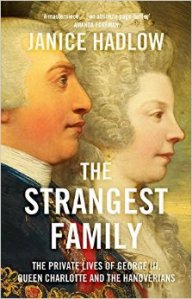
 Well if you think that your family has its quirks and secrets, just take a look at the family of George III, his queen, Charlotte of Mecklenburg-Strelitz, and their large brood of dysfunctional princes and princesses.
And that is what Janice Hadlow (former Controller of BBC2) has done in her excellent book, The Strangest Family, published by William Collins in 2014 (ISBN978-0-00-716519-3). It’s a mammoth tome, 617 pages (and another sixty plus pages of acknowledgements, notes and index).
Born in 1738, acceded to the throne in 1760 following the death of his grandfather George II, married in September 1761, George III was father to 15 children (nine boys, two of whom died very young, and six daughters). And although George entered marriage with the aim of not repeating the ‘errors’ of his great-grandfather (George I), his grandfather, and father Frederick, Prince of Wales (who died in 1751), the ‘Hanoverian curse’ did not by-pass his family.
It seems George III remained faithful to Charlotte—unlike his regal predecessors who all took a string of mistresses. And although family life in the George III household seems to have started well, and George was reportedly a loving father to his young family, divisions began to develop as the older boys struggled under the strict and moral lifestyle imposed on them by their father. Soon the relations between George and Charlotte and their elder sons George, Prince of Wales, Frederick, Duke of York, and William, Duke of Clarence had become as sour as those between George I and his son, George II, and him and his son, Frederick, Prince of Wales.
The six daughters of George and Charlotte were not spared either. Their parents were controlling and implacable when it came to them marrying and moving on beyond the family. With selfish parents like George and Charlotte it’s hardly surprising that their children grew up rebellious or forever denying that their parents had ever loved them. Three daughters eventually did marry: Charlotte, Princess Royal, Elizabeth, and Mary, but not until they had reached middle age. Two remained spinsters, Augusta and Sophia, and Sophia is widely believed to have borne an illegitimate boy. Amelia, who was George’s favourite, died unmarried (although deeply in love with one of George III’s equerries) at 27, from tuberculosis and an acute bacterial infection of the skin, erysipelas (or St Anthony’s Fire).
Hadlow’s is a thorough and entertaining account of the life that George and Charlotte built for themselves, during a remarkable period in history, the second half of the eighteenth and early part of the nineteenth centuries. Remarkable? This was a period of great social change from a largely rural to urban living, a time of great conflict (the Seven Years War with France came to an end in 1763 but saw the UK evolve as the major world power), the loss of the American colonies during the War of Independence, the French Revolution, and the rise of Napoleon Bonaparte and the two decades of conflict in Europe that came to an end at the Battle of Waterloo on 18 June 1815 with the defeat of the French. George’s reign also saw significant scientific and engineering developments such as vaccination against smallpox or the digging of the first canals. And not long after Waterloo, the first railways were built. George and Charlotte certainly presided over interesting times.
Janice Hadlow’s book is particularly interesting in the first 100 pages or so, and also in the latter part of the book. She spends time detailing the reigns of George I and George II, and how their familial relations were to impact eventually on George III. These pages give a contextual framework for George III’s reign that I hadn’t come across before. And of course, much of the familial dysfunction of George III was due in no small part to the periods of ‘madness’ he suffered from the later 1780s onwards, until he finally became totally incapacitated and his son, the future George IV became Regent. It split the family asunder, and Charlotte became increasingly irascible and hostile to her daughters. It’s no wonder they desired to seek the haven of marriage, even if it would be an arranged marriage to someone who they did not know nor could ever love.
Several years ago I had come across another book, published in 2004, by Flora Fraser, and from the princesses’ perspectives. Princesses – The Six Daughters of George III is also worth a few days of your literary time.
 Do you remember where you were on Sunday 20 July 1969? I do.

 A balanced diet . . .