
Do bridges speak to your soul? They do to mine. I find them completely fascinating. Many are architecturally stunning, and wonders of engineering, apart from the odd miscalculation that can lead to catastrophic collapse, as was the case of the Tacoma Narrows Bridge, Washington in 1940.
Many have stood the test of time, crossing obstacles in the landscape and connecting communities for hundreds of years.
Numerous bridges across rivers in the USA aided the westward expansion, and I wrote about many that we have seen (and crossed) in a blog posted in April 2022 (just scroll down to the section about the USA).
Some bridges, like the Golden Gate (opened 1937) in San Francisco, the Sydney Harbour Bridge (1932), or the Forth Bridge (1890) for example, have become icons in their own right.


More recent icons include the Millau Viaduct (20004) in France, or the road and rail Øresund Bridge (2000) connecting Denmark and Sweden (and featured in that excellent Scandi Noir series, The Bridge).
I’m now living in Newcastle upon Tyne, where there are several road, rail, and pedestrian bridges over the River Tyne. The iconic Tyne Bridge (1928) is home, during the nesting season, to some 700 pairs of kittiwakes, the furthest inland colony in the world.


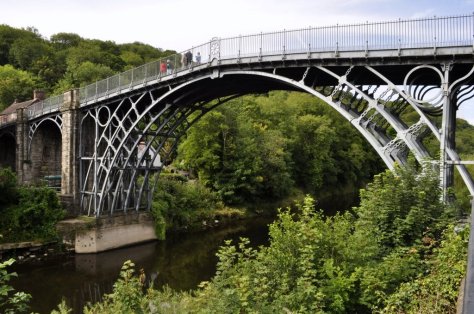
In the small community of Ironbridge, in Shropshire, stands a remarkable bridge over the River Severn. Erected in 1779, it was the world’s first cast iron bridge, the pieces fitting together as though constructed from wood.
While we were on holiday just over a week ago in North Wales we crossed the Menai Strait to Anglesey several times, on the Britannia Bridge that was first opened (as a tubular bridge of wrought iron to carry rail traffic only) in 1850. It was designed by Robert Stephenson, son of the great railway engineer, George Stephenson (the Father of the Railways), who was born in the small village of Wylam, Northumberland, west of Newcastle in 1781.
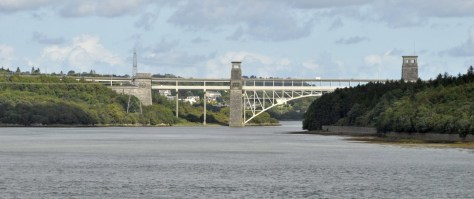
The Britannia Bridge today, seen from Plas Newydd, home to the Marquesses of Anglesey.
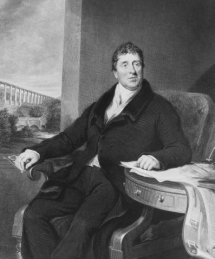
Thomas Telford
So why was the Britannia Bridge rail only to begin with? That’s because there was already a suspension road bridge, carrying the A5 trunk road, further east, designed and built by an even more famous engineer, Thomas Telford (1757-1834).
Telford was a Scottish civil engineer, who established himself as an engineer of road and canal projects in Shropshire, and designing numerous infrastructure projects in his native Scotland, as well as harbours and tunnels.
The Menai Suspension Bridge (and its ‘little brother’, the Conwy Suspension Bridge further east up the coast) was opened in 1826, as was the Conwy bridge.
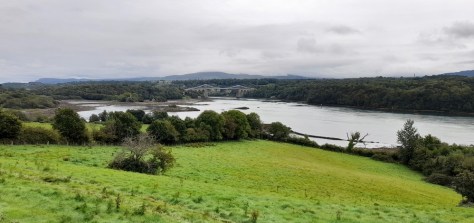
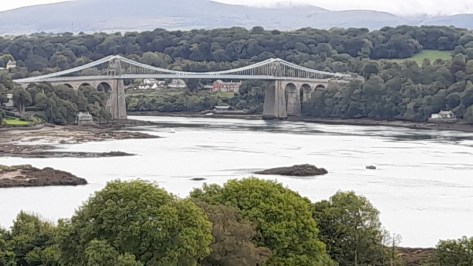
It really is a marvel of early 19th century engineering, being the world’s first iron suspension bridge, 1,265 feet/305m long, with a central span of 579 feet/177m and its roadway set 98m/30m above the water to allow tall ships to sail beneath.
It was constructed from iron links, and you can appreciate its construction in the video below as we crossed the bridge. It is remarkable that it’s still open to traffic after almost 200 years, although it is currently undergoing some serious maintenance to extend its life.
Exactly the same construction method was used on the Conwy Bridge. Check out this informative National Trust video.


The Conwy bridge is open only to pedestrians, and is managed by the National Trust. To the west is a modern road bridge. To the east, a tubular rail bridge, also designed by Robert Stephenson, and opened in 1849.
Until 1972, the Menai Suspension Bridge was the only road link on to Anglesey.
After a major fire in 1970 caused extensive damage to the Britannia Bridge, it was reconstructed and a second deck was added above the rail level to take road traffic. That was opened in 1980. Even so, and although much wider than the Menai Suspension Bridge, it carries traffic in each direction in one lane only, reducing from dual carriageway on both sides of the bridge. And is therefore a source of considerable traffic congestion at busy times of the day.
On our way back home from North Wales, we stopped off briefly at Speke Hall on the eastern outskirts of Liverpool, right next to Liverpool John Lennon Airport. Our route in from North Wales took us over the Mersey Gateway Bridge. Opened in 2017, and spanning the River Mersey and the Manchester Ship Canal, it adds a new elegance to the local landscape.
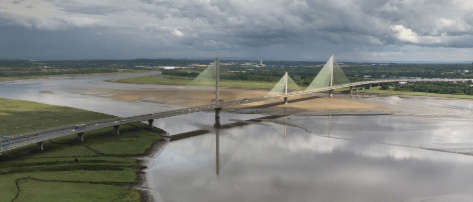
Mersey Gateway Bridge
 A balanced diet . . .