400 years of prosperity . . . then along came Henry VIII (Updated 4 April 2025)

Founded in the early 12th century, Fountains Abbey – lying alongside the River Skell just to the southwest of Ripon in North Yorkshire – became one of the most prosperous of the many Cistercian abbeys in Europe.

However, in 1539, Henry VIII and his henchman destroyed Fountains Abbey at the time of the Dissolution of the Monasteries. With its wealth plundered, and the lead roofing removed and sold, Fountains Abbey soon slipped into complete disrepair and became a ruin – a ghost of its former glory. Today the ruins, cared for in a partnership between the National Trust and English Heritage, receive hundreds of thousands of visitors. I wonder if, like me, many of them wonder what it must have looked like in its heyday, and perhaps, in the silence, imagine for a fleeting moment the plainsong of monks at prayer.

But the community at Fountains comprised both monks and lay people who tended the fields and looked after flocks of sheep (the Cistercians built their wealth on wool) leaving monks time for daily mediation. The abbey also took in visitors and the sick, and several of the ruined buildings were used for this purpose. Today there is a small museum in what was once the Porter’s Lodge, with a timeline of the abbey’s development and ultimate downfall. At it’s dissolution it was valued at around £1160, the equivalent today of tens of millions of pounds.

Most of the buildings have lost their roof, but one – the Cellarium (storeroom or undercroft) – has an impressive and beautiful vaulted ceiling. Whether there originally was glass in the windows, I’m not sure although I would expect so.

Close-by are the Guest House Bridge and monks’ latrine building – the Reredorter, strategically positioned over the River Skell in which effluent flowed away, without contaminating any sources of drinking water.

This slideshow requires JavaScript.

The Refectory opens on to the Cloister, across from the Church and its impressive Tower.

This slideshow requires JavaScript.

And then there’s the Church and Tower, dominating the whole site. No wonder that Fountains Abbey has been designated a UNESCO World Heritage Site.

This slideshow requires JavaScript.

In the 18th century, the pools and gardens of Studley Royal were created to the east of the abbey ruins, where visitors could stroll and take in the views. At another Cistercian Abbey – Rievaulx – not that far away from Fountains Abbey, a viewing terrace was also built in the 18th century to facilitate access to the abbey ruins.

This slideshow requires JavaScript.

When we first arrived at Fountains there were several parties of school children, a number of whom were making the most of being in the open air, running around and making rather a cacophony. After about 20 minutes, however, peace descended and we could then appreciate the magnificence of this ruined abbey in the relative silence it demanded. Very spiritual.


I wrote this post just after we made our first visit to Fountains Abbey in July 2013. And then, the following year at the end of March, we stopped by on our way north to visit our daughter and her family in Newcastle.

And although we moved to the northeast over four years ago, we hadn’t made another visit to Fountains until a couple of days ago on the 2nd.

On both previous occasions, the weather was overcast, and on the March 2014 visit particularly cold. Not so this week. With a promising weather forecast ahead of the journey south (a round trip of 152 miles), we set out from home around 09:15 arriving at Fountains just before 11:00. In time for a welcome cup of coffee in the National Trust’s excellent restaurant.

While there was some low cloud and mist on the drive south, it didn’t last much south of Durham on the A1(M). We did wonder whether the weatherman had got it wrong. Oh ye of little faith!

It was a glorious day, hardly a cloud in the sky, and although there was a cool breeze at times, it was a perfect Spring day.

And how different the ruins of the abbey looked in the bright sunshine, and the water gardens at Studley Royal. Here is a small selection of photographs I took on Wednesday. There’s a full album of photos here.


Once one of the greatest monasteries in England

At breakfast earlier last week, Steph and I were comparing this past winter to the other three we have experienced since moving to the northeast in October 2020. It’s not that it has been particularly cold. Far from it. But, has it been wet!

It feels as though it hasn’t stopped raining since the beginning of the year. The ground is sodden. And as for getting out and about that we enjoy so much, there have been few days. Apart, that is, from local walks when it hasn’t been raining cats and dogs.

So, with a promising weather forecast for last Friday we made plans for an excursion, heading south around 70 miles into North Yorkshire to visit Byland Abbey, built by a Cistercian community in the 12th century, below the escarpment of the North York Moors.

It’s 12th Cistercian neighbours—less ruined, and arguably more famous—Rievaulx Abbey and Fountains Abbey, stand just 4 miles north as the crow flies and 18 miles southwest, respectively from Byland Abbey.


We decided to take in a couple of other sites on our way south, stopping off at Mount Grace Priory for a welcome cup of coffee and a wander round the gardens, and then—just a few miles further on—the small 12/13th century church of St Mary the Virgin, beside the A19 trunk road that we have passed numerous times, but never taken the opportunity to visit.

St Mary’s was once the parish church of a medieval village, Leake, now disappeared. Nowadays it serves the communities of Borrowby and Knayton. The tower is the earliest remaining structure, and the church has been added to over the centuries (floor plan).

There is a very large graveyard, still in use today, clearly shown in this drone footage.

Then it was on to Byland, taking the cross country route from the A19. And along the way, I saw my first ever hare (and nearly killed, which you’ll see at 02’22 ” in the video below). This route takes you through the delightful village of Coxwold.


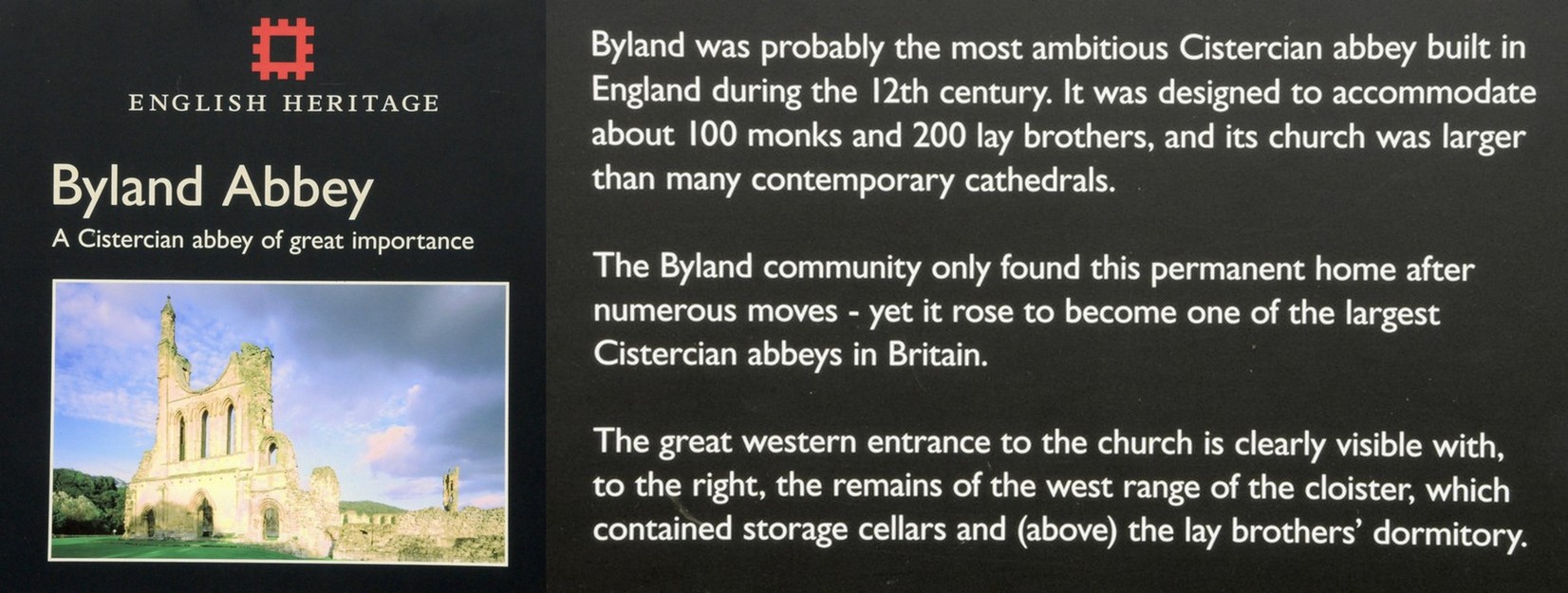
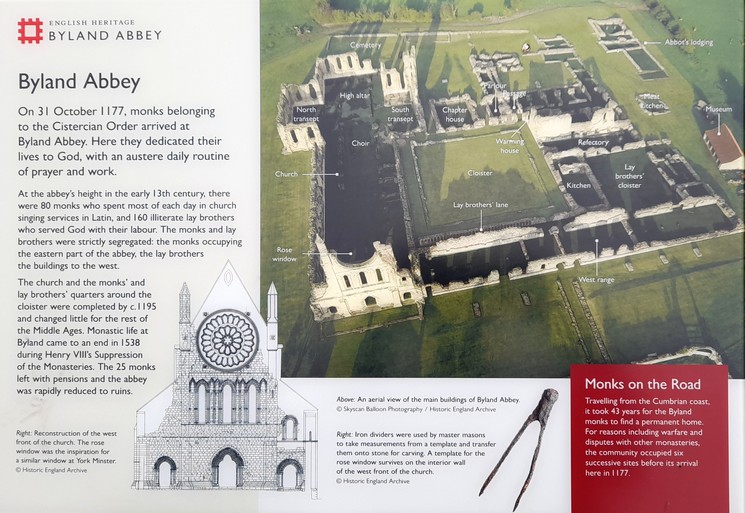
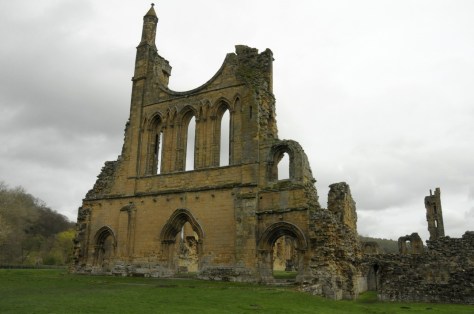
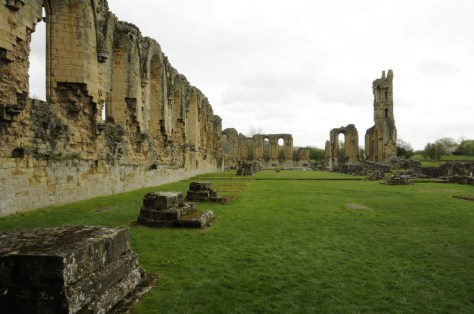
Byland Abbey is mightily impressive, even though it’s a shell compared to Rievaulx, for example. But I had the impression that it was much larger than Rievaulx, and it must have been magnificent in its heyday. Its foundation was far from straightforward, and it took the monks more than 40 years before settling on the site at Byland.

Its west entrance is simply a wall, with the remains of what must have once been an incredible rose window. We saw a note on the English Heritage hut (closed on our visit) that there was a template for the window on the inside of the West Wall, but we couldn’t find it.

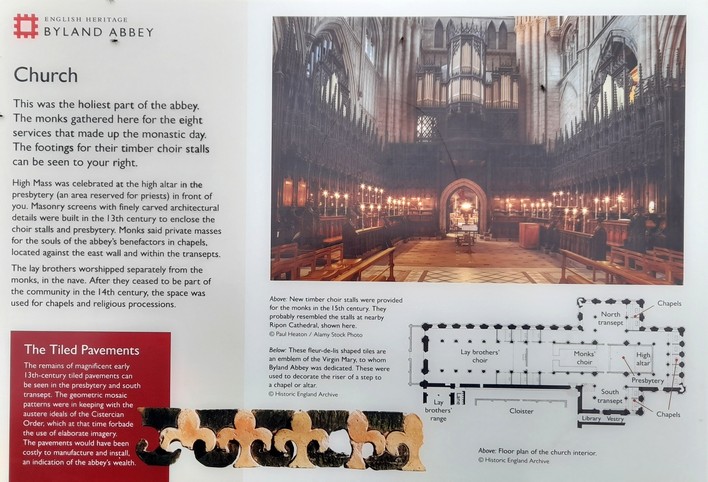
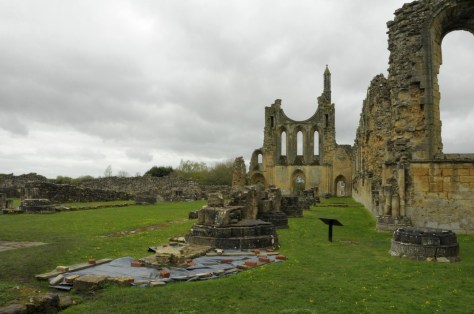
And from the entrance there is a view straight down the length of the church towards the North and South Transepts and the High Altar. Just the north wall is still standing, mostly. And when I look at ruins like Byland, I am just in awe of the craftsmanship that it took to build a church like this, with such beautifully dressed stone. I wonder how big a workforce was needed for the construction over the 25+ years it is estimated it took to complete the abbey?

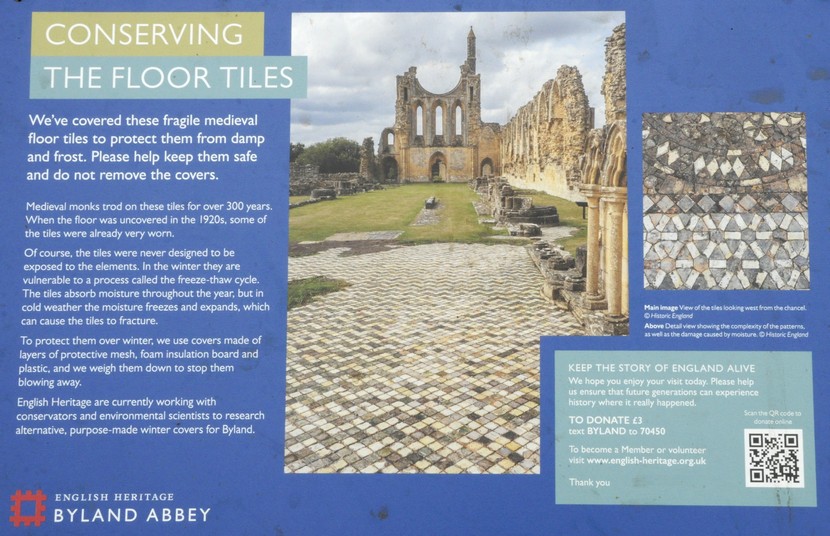
At various locations around the ruins, and especially around the site of the high altar, ceramic floor tiles uncovered during excavations are currently not on view, but protected by tarpaulins.

Like all the other religious houses across the nation, Byland was closed during the Suppression of the Monasteries by King Henry VIII in 1538 and rapidly became a ruin. You can read an excellent history of the abbey on the English Heritage website.

You can view my photo album of Byland Abbey images (and from St Mary’s, Leake) here.


Leaving Byland Abbey, we headed up the escarpment on Wass Bank, stopped off to view the Kilburn White Horse again before heading down the precipitous 1:4 (25%) incline that is the infamous Sutton Bank.

The Kilburn White Horse can be seen for miles around, primarily from the southwest. It was supposedly constructed by a local schoolmaster, John Hodgson and his pupils in 1857. It covers an area of 6475 m² (or 1.6 acres). We had only seen it previously from a distance, or from the car park immediately below. This time we took the footpath at the top of the cliff, emerging near the horse’s ears. The walk from where we parked the car (alongside the glider field) took less than 10 minutes.

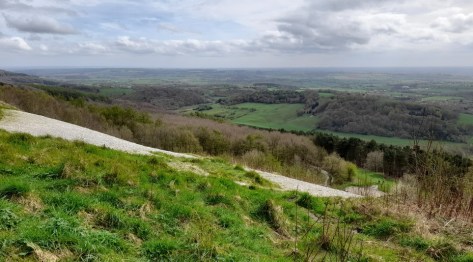
And although there wasn’t a good view of the horse per se from the path, the view south over the Vale of York was magnificent. We could see for at least 30 miles over a 200° panorama.

That’s the horse’s eye in the foreground.