Don’t put all your eggs in one basket . . . or your seeds in a single genebank

On 20 May 2015, a long article was published in The Guardian about the Svalbard Global Seed Vault (SGSV), popularly—and rather unfortunately—known as the ‘Doomsday Vault’. I’ve recently been guilty of using that moniker simply because that’s how the vault has come to be known, rightly or wrongly, in the media.

Authored by US-based environment correspondent of The Guardian, Suzanne Goldenberg, the article had the headline grabbing title: The doomsday vault: the seeds that could save a post-apocalyptic world.

You get a flavor of what’s in store, however, from the very first paragraph. Goldenberg writes: ‘One Tuesday last winter, in the town nearest to the North Pole, Robert Bjerke turned up for work at his regular hour and looked at the computer monitor on his desk to discover, or so it seemed for a few horrible moments, that the future of human civilisation was in jeopardy.’

Turns out there was a relatively minor glitch in one of the supplementary cooling systems of this seed repository under the Arctic permafrost where millions of seeds of the world’s most important food staples and other species are being stored, duplicating the germplasm conservation efforts of the genebanks from which they were sent. Hardly the stuff of Apocalypse Now. So while making a favorable case for the need to store seeds in a genebank like the Svalbard vault, Goldenberg ends her introduction with this somewhat controversial statement: ‘Seed banks are vulnerable to near-misses and mishaps. That was the whole point of locating a disaster-proof back-up vault at Svalbard. But what if there was a bigger glitch – one that could not be fixed by borrowing a part from the local shop? There is now a growing body of opinion that the world’s faith, in Svalbard and the Crop Trust’s broader mission to create seed banks, is misplaced. [The emphasis in bold is mine.] Those who have worked with farmers in the field, especially in developing countries, which contain by far the greatest variety of plants, say that diversity cannot be boxed up and saved in a single container—no matter how secure it may be. Crops are always changing, pests and diseases are always adapting, and global warming will bring additional challenges that remain as yet unforeseen. In a perfect world, the solution would be as diverse and dynamic as plant life itself.’ 

I have several concerns about the article—and the many comments it elicited that stem, unfortunately, from lack of understanding on the one hand and ignorance and prejudice on the other.

  • Goldenberg gives the impression that it’s an either/or situation of ex situ conservation in a genebank versus in situ conservation in farmers’ fields or natural environments (in the case of crop wild relatives).
  • There is a perception apparently held by some that the development of the SGSV has been detrimental to the cause of in situ conservation of crop wild relatives.
  • Because there is no research or use of the germplasm stored in the SGSV, then it only has an ‘existence value’. Of course this does not take into account the research on and use of the same germplasm in the genebanks from which it was sent to Svalbard. Therefore Svalbard by its very nature is assumed to be very expensive.
  • The role of Svalbard as a back-up to other genebank efforts is not emphasized sufficiently. As many genebanks do not have adequate access to long-term conservation facilities, the SGSV is an important support at no cost directly to those genebanks as far as I am aware. However, Svalbard can never be a panacea. If seeds of poor quality (i.e less than optimum viability) are stored in the vault then they will deteriorate faster than good seeds. As the saying goes: ‘Junk in, junk out’.
  • The NGO perspective is interesting. It seems it’s hard for some of our NGO colleagues to accept that use of germplasm stored in genebanks actually does benefit farmers.Take for example the case of submergence tolerant rice, now being grown by farmers in Bangladesh and other countries on land where a consistent harvest was almost unheard of before. Or the cases where farmers have lost varieties due to natural disasters but have had them replaced because they were in a genebank. My own experience in the Cagayan valley in the northern Philippines highlights this very well after a major typhoon in the late 1990s devastated the rice agriculture of that area. See the section about on farm management of rice germplasm in this earlier post. They also still harbour a concern that seeds in genebanks are at the mercy of being expropriated by multinationals. In the comments, Monsanto was referred to many times, as was the issue of GMOs. I addressed this in the comment I contributed.

I added this comment that same day on The Guardian web site:
‘For a decade during the 1990s I managed one of the world’s largest and most important genebanks – the International Rice Genebank at the International Rice Research Institute (IRRI) in the Philippines. Large, because it holds over 116,000 samples of cultivated varieties and wild species of rice. And important, because rice is the most important food staple feeding half the world’s population several times daily.

The Svalbard Global Seed Vault (SGSV), the so-called ‘Doomsday Vault’ in Spitsbergen, holds on behalf of IRRI an almost complete duplicate set of samples (called ‘accessions’), in case something should happen to the genebank in Los Baños, south of Manila. I should add that for decades the USDA has also held a duplicate set in its genebank at Fort Collins in Colorado, under exactly the same ‘black box’ terms as the SGSV.

Germplasm is conserved so that it can be studied and used in plant breeding to enhance the productivity of the rice crop, to increase its resilience in the face of climate change, or to meet the challenge of new strains of diseases and pests. The application of molecular biology is unlocking the mysteries of this enormous genetic diversity, making it accessible for use in rice improvement much more efficiently than in past decades.

Many genebanks round the world and the collections they manage do not have access to long-term and safe storage facilities. This is where the SGSV plays an important role. Genebanks can be at risk from a whole range of natural threats (earthquakes, typhoons, volcanic eruptions, etc.) or man-made threats: conflicts, lack of resources, and inadequate management that can lead to fires, flooding, etc. Just take the example of the International Rice Genebank. The Philippines are subject to the natural threats mentioned, but the genebank was designed and built to withstand these. The example of the ICARDA genebank in Aleppo highlights the threat to these facilities from being located in a conflict zone.

To understand more about what it means to conserve a crop like rice please visit this post on my blog.  There is an enlightening 15 minute video there that I made about the genebank.

It is not a question of taking any set of seeds and putting them into cold storage. Only ‘good’ seeds will survive for any length of time under sub-zero conditions. Many studies have shown that if stored at -18C, seeds with initial high viability may be stored for decades even hundreds of years. The seeds of many plant species – including most of the world’s most important food crops like rice, wheat, maize and many others conform to this pattern. What I can state unequivocally is that the seeds from the genebanks of the world’s most important genebanks, managed like that of IRRI under the auspices of the Consultative Group on International Agricultural Research (CGIAR), have been routinely tested for viability and only the best sent to Svalbard.

Prof. Phil Pardey, University of Minnesota

Prof. Phil Pardey, University of Minnesota

The other aspect of Goldenberg’s otherwise excellent article are the concerns raised by a number of individuals whose ‘comments’ are quoted. I count both Phil Pardey and Nigel Maxted among my good friends, and it seems to me that their comments have been taken completely out of context. I have never heard them express such views in such a blunt manner. Their perspectives on conservation and use, and in situ vs. ex situ are much more nuanced as anyone will see for themselves from reading their many publications. The SEARICE representative I do not know, but I’ve had many contacts with her organization. It’s never a question of genebank or ex situ conservation versus on-farm or in situ conservation. They are complementary and mutually supportive approaches. Crop varieties will die out for a variety of reasons. If they can be stored in a genebank so much the better (not all plant species can be stored successfully as seeds, as was mentioned in Goldenberg’s article). The objection to genebanks on the grounds of permitting multinationals to monopolize these important genetic resources is a red herring and completely without foundation.

So the purpose of the SGSV is one of not ‘putting all your eggs in one basket’. Unfortunately the name ‘Doomsday Vault’ as used by Goldenberg has come to imply a post cataclysm world. It’s really much more straightforward than that. The existence of the SGSV is part of humanity’s genetic insurance policy, risk mitigation, and business continuity plan for a wise and forward-thinking society.’

Over the next couple of days others chipped in with first hand knowledge of the SGSV or genetic conservation issues in general.

Simon Jeppsonsiminjeppson is someone who has first-hand knowledge and experience of the SGSV, and he wrote: ‘I’m currently working as the project coordinator of the Svalbard Global Seed Vault on behalf of NordGen and I just wanted to add some of my reflections on this article some of the comments.

This article is an interesting read but a rather unbalanced one. The temperature increase that is described as putting the world heritage in jeopardy is a misconception. There has been a background study used as a worst case scenario during the planning stage of the Svalbard Global Seed Vault based on the seeds stored in the old abandoned mine shaft mentioned. These results were published in 2003 and even the most recent data (after 25 years in permafrost conditions prevailing in the same mountain without active cooling) shows that all samples are still viable. Anyone curious about this can for themselves try out various storage temperatures and find out the predicted storage time for specific crops at: http://data.kew.org/sid/viability/

Further I have some reflections regarding some of the recently posted comments. The statement “Most seed resources for plant breeding come from farmers’ fields via national seed stores in developing countries: these countries are not depositing in Svalbard.” is wrong; more than 60% of the deposited material originates from developing countries. Twenty-three of depositors represent national or regional institutes situated in developing counties, 12 are international centers and 28 are from developed countries according to IMF. This data is readily available at: http://www.nordgen.org/sgsv

Finally, a comment about the statement that “Seeds will not be distributed – only ever sent back to the institute that provided them. The reason is that seeds commonly have seed-borne diseases, sometimes nasty viruses and the rest.” This statement is also a misconception. The seeds samples stored in the vault are of the same seed lots already readily distributed worldwide from the depositing institutes. There are more than 1750 plant genetic institutes many of them distributing several thousand samples every year.’

maxted-nigel-Cropped-110x146Nigel Maxted is a senior lecturer in the School of Biosciences at the University of Birmingham. As I suspected, when I commented on Goldenberg’s article, Nigel’s contribution to the discussion was taken out of context. He commented: ‘I believe I have been mis-quoted in this article, I do think the Svalbard genebank is worthwhile and I hope the Trust reach their funding goal, even though ex situ does freeze evolution for the accessions included, it provides our best chance of long-term stability for preserving agrobiodiversity in an increasingly unstable world.

I was trying to make a more nuanced point to Suzanne, that I strongly support complementary conservation that involves both in situ and ex situ actions. However at the moment if we compare the financial commitment to in situ and ex situ conservation of agrobiodiversity, globally over 99% of funding is spent on ex situ alone, therefore by any stretch of the imagination can we be considered to be implementing a complementary approach? I was used to make a point and I suppose it would be naive of me to complain, but I hope one day we will stop trying to create an artificial dichotomy between the two conservation strategies and wake up to the need for real complementary conservation. Conservation that includes a balanced range of in situ actions as well to conservation agrobiodiversity before it is too late for us all.’

HawtinGeoff Hawtin is someone who knows what he’s talking about. As Director General of the International Plant Genetic Resources Institute for just over a decade from 1991, and the founding Executive Secretary of the Global Crop Diversity Trust, Geoff had several telling comments: ‘As someone who has worked for the last 25 years to help conserve the genetic diversity of our food crops, I welcome the article by Suzanne Goldenberg in spite of its very many inaccuracies and misconceptions. She rightly draws attention to the plight of what is arguably the world’s most important resource in the fight against food and nutritional insecurity. If this article results in more attention and funds being devoted to safeguarding this resource—whether on farm or in genebanks—it will have served a useful purpose.

The dichotomy between in situ and ex situ conservation is a false one. The two are entirely complementary and both approaches are vital. For farmers around the world the genetic diversity of their landraces and local varieties is their lifeblood—a living resource that they can use and mould to help meet their current and future needs and those of their families.

But we all live in a world of rapid and momentous change and a world in which we all depend for our food on crops that may have originated continents away. The diversity an African farmer—or plant breeder—needs to improve her maize or beans may well be found in those regions where these crops were originally domesticated – in this case in Latin America, where to this day genetic diversity of these two crops remains greatest. Without the work of genebanks in gathering and maintaining vast collections of such genetic diversity, how can such farmers and breeders hope to have access to the traits they need to develop new crop varieties that can resist or tolerate new diseases and pests, or that can produce higher yields of more nutritious food, or that are able to meet the ever growing threats of heat, drought and flooding posed by climate change?

Scientists have been collecting genetic diversity since at least the 1930s, but efforts expanded significantly in the 1970s and 80s in response to growing recognition that diversity was rapidly disappearing from farmers fields in many parts of the world as a result of major shifts in agricultural production systems and the introduction and adoption of new, higher yielding varieties. Today, thanks to these pioneering efforts, diversity is being conserved in genebanks that no longer exists in the wild or on farmers’ fields.

The common misconception that the Svalbard Global Seed Vault exists to save the world following an apocalyptic disaster is perpetuated, even in the title of the article. In reality, the SGSV is intended to provide a safety-net as a back-up for the world’s more than 1,700 genebanks which themselves, as pointed out in the article, are often far from secure. At a cost of about £6 million to build and annual running and maintenance costs of less than £200,000 surely this ranks as the world’s most inexpensive yet arguably most valuable insurance policy.’

Susan_BragdonFinally, among the genetic resources experts, Susan Bragdon made the following comments: ‘I think the author overstates the fierce debates between the proponents of ex situ and in situ conservation. Most would agree that both are needed with in situ being complemented by ex situ.

The controversy over money is because funders are not understanding this need for both and may feel they have checked off that box by funding Svalbard (which is perhaps better seen as an insurance policy—one never hopes to have to use one’s insurance policy.) Svalbard is of course sexier than the on-farm development and conservation of diversity by small scale farmers around the world. Donors can jet in, go dog sledding, see polar bears. Not as sexy to visit most small-scale farms but there are more and more exceptions (e.g., the Potato Park in Peru)

Articles like this set up a false choice between ex situ and in situ which is simply not shared except by a few loud voices. We need to work together to create the kind of incentives that make small scale farming in agrobiodiverse settings an attractive life choice.’

In her staff biography on the Quaker United Nations Office web page, it relates that ‘from 1997-2005 Susan worked with the International Plant Genetic Resources Institute as a Senior Scientist, Law & Policy, on legal and policy issues related to plant genetic resources and in particular managed projects on intellectual property rights, Farmers’ Rights, biotechnology and biological diversity, and on developing decision-making tools for the development of policy and law to manage plant genetic resources in the interest of food security.’

Comments are now closed on The Guardian website for this article. I thought it would useful to bring together some of the expert perspectives in the hope of balancing the arguments—since so many readers had taken the ‘apocalypse’ theme at face value— and making them more widely available.

When I have time, I’ll address some of the perspectives about genebank standards.
Chilling in Los Baños . . .

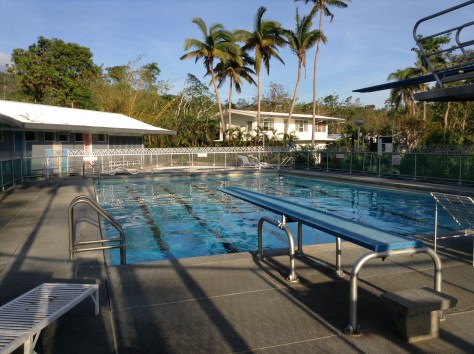
For the past week I have been at the headquarters of the International Rice Research Institute (IRRI) in Los Baños in the Philippines, where I worked for almost 19 years until my retirement in April 2010. I had to attend two meetings in preparation for the 4th International Rice Congress (IRC2014) that will be held at the end of October in Bangkok, Thailand. The first meeting, from Monday to Wednesday, was the SciCom Exec to finalize the content and structure of the scientific conference. The IRC2014 Organizing Committee met on Thursday and Friday. We were kept busy from morning to night, although there were opportunities for some social gatherings, and I also took full advantage of staying in IRRI’s Guesthouse to enjoy the nearby swimming pool every morning at 6 am.

But I’m getting ahead of myself. My journey began on Friday 8 August, traveling on Emirates Airlines from Birmingham to Manila via Dubai (BHX-DXB-MNL). There were minimal delays at BHX, and we landed more or less on time in DXB around midnight local time.

The stopover was about three hours, and by the time I’d cleared security, checked out Duty Free, and made my way to the EK lounge in Terminal 3, there wasn’t too long to wait before we were boarding the next flight to Manila. That wasn’t a good flight. It was comfortable enough, but there was turbulence the whole flight – not severe by any stretch of the imagination, except for the occasional sharp bump – and just persistent enough to prevent me from settling. Added to that, a large gentleman across the aisle from me settled to sleep immediately after take-off from DXB, and snored the whole way to Manila! After landing in Manila NAIA Terminal 1, I had passed through immigration and customs in less than 20 minutes, but traffic congestion around the airport (it was around 5:15 pm on Saturday), and during the 65 km drive to Los Baños, delayed our arrival at the Guesthouse until almost 8 pm.

Meeting old friends
Despite the busy schedule of meetings, I was able to catch up with the many old friends at IRRI. I was given an office in my former DPPC unit, now called DRPC.

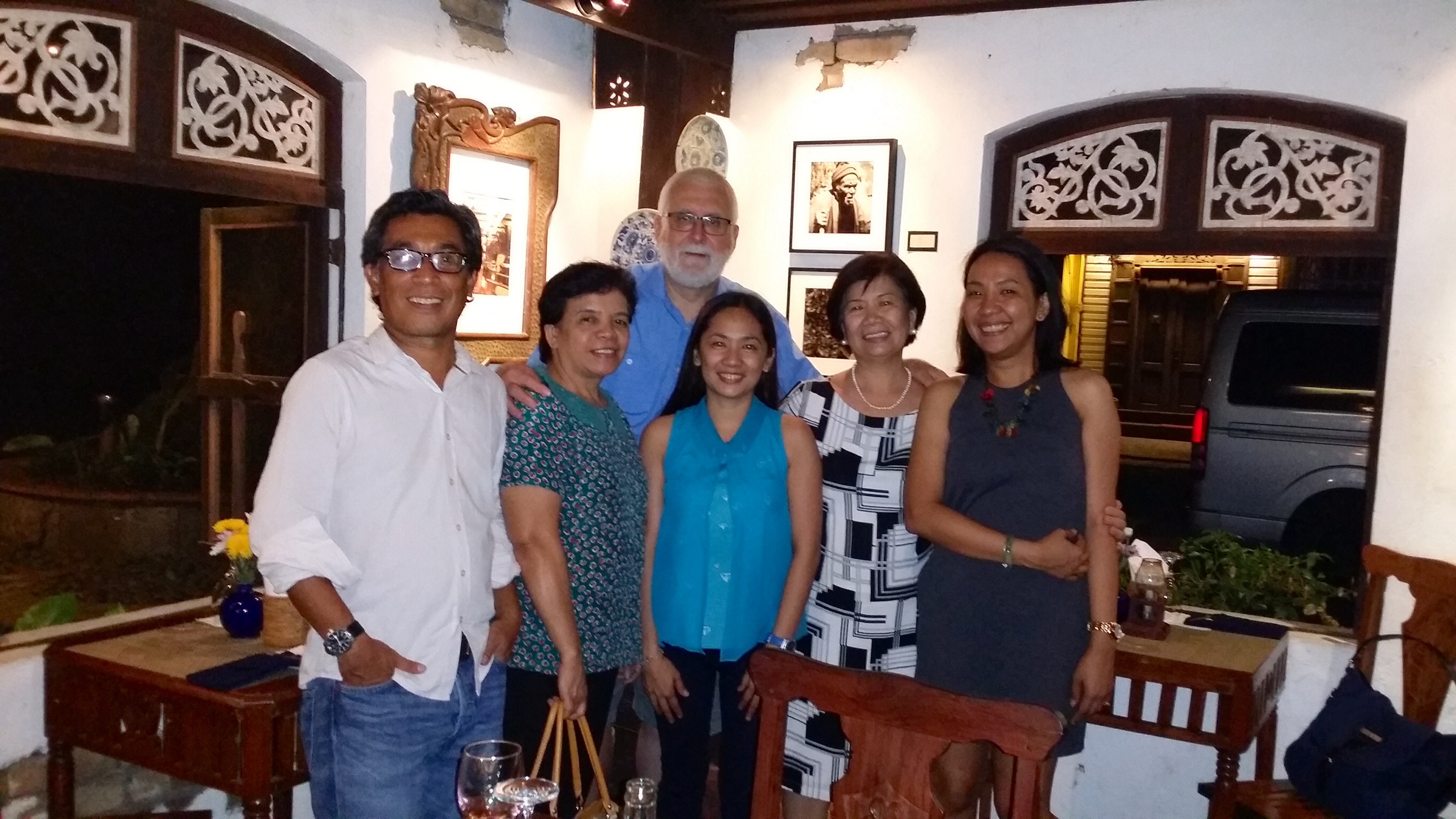
On Tuesday night I was treated to dinner at Sulyap Gallery Café and Restaurant in San Pablo, about 10 km south of Los Baños. And we had a lovely evening: great company, great food. What more can you ask for?

L to R: Eric, Zeny, me, Vel, Corints and Yeyet

L to R: Eric, Zeny, me, Vel, Corints and Yeyet

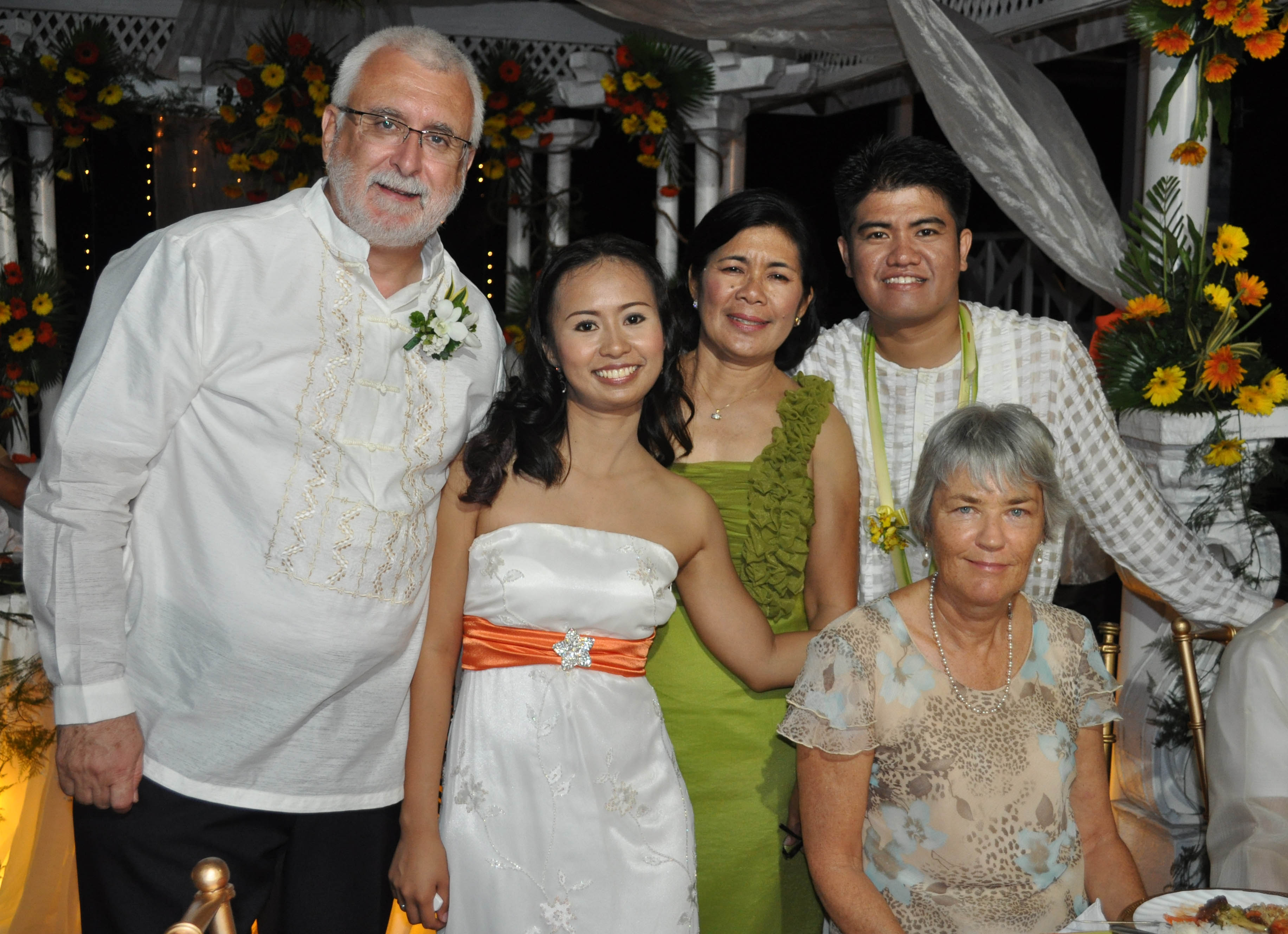
On Wednesday, Yeyet and her husband Christian took me out to dinner in Los Baños. They were married in March, and had invited me to be one of their sponsors or ninong. Of course I wasn’t able to travel then, but I did send a short video message that was played during the wedding reception. It was a complete surprise to everyone (except Vel with whom I’d made the arrangements to receive and show the video).

On Thursday and Friday nights the IRC2014 committees got together to relax.

Checking out the genebank
Our meetings finished by Friday lunchtime, so I took advantage of some ‘free’ time in the afternoon to visit the International Rice Genebank in the TT Chang Genetic Resources Center, and meet my former staff and colleagues.

Now the genebank is really the only place in Los Baños where you can chill out. The Active Collection is kept around 2-3C, but the Base Collection is maintained at a decidedly frosty -18C. Since I left IRRI in 2010, a new and much larger cold room to house the Base Collection was added to the genebank infrastructure, with funding from the World Bank. Seeds are still stored in vacuum-sealed aluminium cans, but nowadays, everything is neatly bar-coded. (I was even shown a new tablet-based scoring system, complete with photos and descriptions, for germplasm characterization).

Despite the fact that I had responsibility for the genebank for a decade from 1991, and obviously it’s my ‘baby’, I’m immensely proud of the staff and their conscientious attitude in conserving this extremely important germplasm collection.

Out and about on the farm – Typhoon Glenda
This morning (Sunday) I decided to take a tour of the IRRI Experiment Station, not only to see all the various rice breeding plots and experiments, but to visit the wild species screenhouses on the Upland Farm, and see what damage the recent Typhoon Glenda had caused.

‘You can take the man out of IRRI, but you can’t take IRRI out of the man’. Wandering around the farm, looking at all the fields and labs where I worked for almost 19 years it was hard not to feel really nostalgic. But when I visited IRRI last November, it was almost 4 years then since I had retired and I had been away long enough to have made ‘the separation’. Nevertheless, IRRI and its work has become part of my DNA, and I really do get a thrill wandering through the fields. Rice breeding and science is a numbers game, and IRRI plays that game to the highest proficiency. The field plots are immaculate, and surprisingly so considering the severity of Typhoon Glenda which apparently hung around the Los Baños area for more than 6 hours. There must have been some extremely turbulent vortices to have caused the damage that it did, although this time, there was little if no rain damage. Typhoon Glenda was a ‘dry’ typhoon compared to many.

An Iranian feast
On Sunday evening, I met up with an old friend and former staff member, Bita, who now works for Accenture in Manila. Bita is originally from Iran, but moved to the Philippines when she was eleven. Both her parents are rice scientists. So Bita grew up in Los Baños, went to UPLB, married and had four lovely children, and has now opened an authentic Iranian restaurant in Los Baños called Everyday Kabab.

I had a lovely meal of dips and naan bread (check out Bita’s garlic and yoghurt dip) followed by chicken and beef kababs, prepared using Bita’s secret recipe. She also serves a traditional cherry drink from Iran; it’s neither sweet nor sour, but very refreshing. And Everyday Kabab is growing in popularity among the LB community – it certainly began to fill up while I was there.

And finally, another surprise . . . 
Once we’d finished early on Friday afternoon and I left GRC, I returned to the Guesthouse for some rest, and to work in a more comfortable location. At least I could wear shorts and a T-shirt. But I hadn’t been in my room much more than 30 minutes when the phone rang, and to my surprise, it was Lilia Tolibas, our helper who worked for us for 18 years. Although working mostly in Manila these days, Lilia still has family ties in Los Baños, and had heard I was in town. And she came specially to see me.

We had a good chat for almost an hour, and it was then I heard about her misfortune during last November’s Typhoon Yolanda that hit her home town of Tacloban so badly. After we had left, she built a small house in Tacloban and moved many of her belongings there. But the tidal wave that hit the town destroyed her house, and sadly one of her sisters drowned. She works for the American Chamber of Commerce in Manila and they were quickly offering humanitarian relief. They found her family, and quickly also found her sister’s body who was given a decent burial, a dignity not afforded to so many victims. Lilia is still waiting for her compensation from the government from the humanitarian relief that so many countries donated. It’s a scandal that this is not being released to the victims and families.

Flying home . . .
Tomorrow night, Monday, my EK flight to DXB departs at 23:55 from the ‘new’ Terminal 3 at NAIA. I say ‘new’ advisedly since it was constructed almost a decade ago but, until now, had not be used by the major airlines. Emirates transferred to Terminal 3 last Friday. Let’s hope that this NAIA experience is far superior to many I’ve had out of the decrepit Terminal 1. I should be home in the UK by early afternoon on Tuesday.

A busy week, yes. Fruitful? Yes. Many things accomplished? Yes. Now it’s time to complete the final tasks and before we know it we’ll all be heading off to the congress in Bangkok at the end of October.

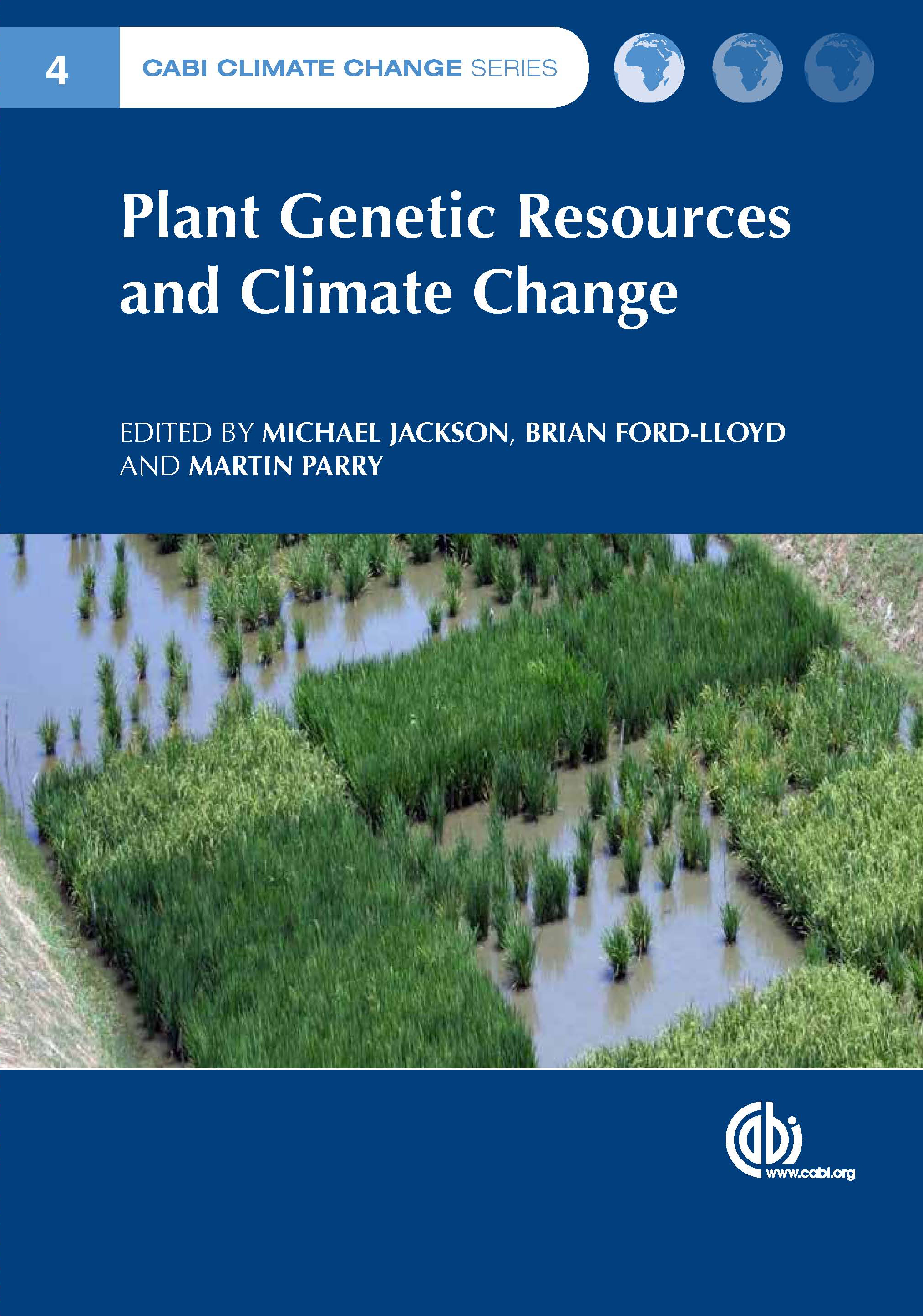
Plant Genetic Resources and Climate Change: available mid-December 2013

Our new 16 chapter book on plant genetic resources has 34 contributors who agree that enhanced use of plant genetic resources is critically important for mitigating against the effects of climate change. The book reveals strong positive messages for the future, but also some substantial negative ones if improvements to conservation and the use of plant genetic resources for food and agriculture (PGRFA) by plant breeders do not happen soon.

Positive messages:

  • While the latest IPCC report (and Betts and Hawkins, Chapter 3) ‘confirms’ that climate change is a reality – and it will affect agriculture – already we can compare regions and see what the scale of the agricultural challenge is, and extrapolate to what will be the situation in the future (Parry, Chapter 4; Berry et al., Chapter 5).
  • Even though climate change will exacerbate the problem of food insecurity – and some of the poorest countries will be affected worst (Zeigler, Chapter 1) – the good news is that breeders are confident they will be able to produce the next generation of ‘climate-adapted crops’. To adapt crops to new climate conditions it is now universally agreed that breeders need access to sources of genetic diversity – and tools to use this diversity more efficiently and effectively. The good news is that major sources of genetic diversity are already conserved in ex situ genebanks.
  • It is also good news that it’s now possible through novel molecular and bioinformatic approaches to more carefully identify valuable genes and track their progress in breeding. New technologies – molecular and bioinformatic – should massively improve exploitation of PGRFA provided those resources still survive. Seed genebanks will lead to DNA sequence genebanks and then on to in silico genebanks and the creation of the ‘digital plant’ (McNally, Chapter 10) enabling the modelling of the ‘ideal plant’ for whatever conditions prevail.
  • Good news also is that breeders are already addressing climate change constraints and using germplasm for submergence, drought, salinity, heat, and pests and diseases, and making progress which gives optimism for the future (Chapters 12 to 16). Drought, submergence, heat and salinity are all environmental stresses that are likely to increase as a result of climate change. For example, rice has 25 related wild species, and 22 of these have already contributed genes to new stress tolerant varieties (Zeigler, Chapter 1).
  • We now have good evidence indicating that some plants in their natural environments can adapt genetically to changing conditions very rapidly – easily within 20 or 30 years and within the timescale of climate change. So as well as conservation in genebanks, plant genetic resources need to be conserved in situ in natural reserves (Maxted et al., Chapter 7) or on farms (Bellon and van Etten, Chapter 8) so that new genes can evolve and provide a greater armory against climate change than afforded just by germplasm ‘frozen’ in genebanks (Ford-Lloyd et al., Chapter 2).

Issue for concern:

  • International mechanisms are in place, through the International Treaty, for breeders to share germplasm for the benefit of society. But there are still political issues constraining the use of plant genetic resources currently conserved (Ford-Lloyd et al., Chapter 2). ‘Ready access’ to genetic resources has been jeopardized by the International Treaty. But, the International Treaty is the only instrument we have for allowing for the exchange and then use of PGRFA so we have to make the best of it (Moore and Hawtin, Chapter 6).

  • Enhanced use of PGRFA can help reduce the increasing risk of hunger predicted by climate change, but does not detract from the need to reduce or stabilize greenhouse gas emissions which would have the greatest effect on reduction of increasing world hunger (Parry, Chapter 4).

  • It is clear that up to now, use of PGRFA by breeders has been neither systematic nor comprehensive, and the vast majority of crop wild relatives remain untapped (Maxted et al., Chapter 7).

  • Critically, we know virtually nothing about how many landraces are currently being grown and fulfilling their potential for adapting to changes in the environment, so there is a need for a step change (Ford-Lloyd et al., Chapter 2).

  • As much as 20% of all plants, not just crop wild relatives, are now estimated to be threatened with extinction. Even within Europe substantial numbers of crop wild relatives are threatened or critically endangered in International Union for Conservation of Nature (IUCN) terms. However, it is the genetic diversity within species that is of greater value for crop improvement, and this diversity is almost certainly being lost (genetic erosion) at a much greater rate than the species themselves, and yet their conservation is far from sufficient (Maxted etal., Chapter 7).

  • Relatively few crop wild relatives (9%) are conserved in genebanks, and even fewer conserved in natural reserves. So, currently there is no guarantee that the genes we need for combating climate change will be available in newly adapted forms when we need them.

Would you like to purchase a copy? You can order online from CABI. When ordering from CABI online purchasers can use this code (CCPGRCC20) for a 20% discount off the retail price. The discount code is valid until 31 December 2013. The standard prices are £85.00, U5$160.00, or €11 0.00. The discounted prices are £68, $128, or €88 .

THE CONTRIBUTORS

Susan J. ARMSTRONG
Senior Lecturer, School of Biosciences, University of Birmingham, Edgbaston, Birmingham, B15 2TT, UK

Mauricio R. BELLON
Principal Scientist, Bioversity International, Via dei Tre Denari 472/a, Maccarese, Rome, Italy

Pam BERRY
Senior Research Fellow, Environmental Change Institute, University of Oxford, Dyson Perrins Building, South Parks Road, Oxford, OX1 3QY, UK

Richard A. BETTS
Professor and Head of the Climate Impacts, Met Office Hadley Centre, FitzRoy Road, Exeter, Devon EX1 3PB, UK

Helen BRAMLEY
Research Associate, Institute of Agriculture, The University of Western Australia, 35 Stirling Highway, Crawley, WA 6009, Australia

Joana Magos BREHM
Collaborator, Centre for Environmental Biology, University of Lisbon, Portugal and Research Assistant, School of Biosciences, University of Birmingham, Edgbaston, Birmingham, B15 2TT, UK

Colette BROEKGAARDEN
Postdoctoral Fellow, Wageningen UR Plant Breeding, PO Box 16, 6700 AJ Wageningen, The Netherlands

Salvatore CECCARELLI
Former Barley Breeder, International Center for Agricultural Research in the Dry Areas (ICARDA), Aleppo, Syria (now retired)

Maduraimuthu DJANAGUIRAMAN
Postdoctoral Research Associate, Department of Agronomy, 2004 Throckmorton Plant Science Center, Kansas State University, Manhattan, KS 66506, USA

Johannes M.M. ENGELS
Honorary Research Fellow, Bioversity International, Via dei Tre Denari 472/a, Maccarese, Rome, Italy

William ERSKINE
Professor and Director, International Centre for Plant Breeding Education and Research (ICPBER) and Centre for Legumes in Mediterranean Agriculture (CLIMA), The University of Western Australia, 35 Stirling Highway, Crawley WA 6009, Perth, Australia

Jacob van ETTEN
Theme Leader – Climate Change Adaptation, Bioversity International, Regional Office of the Americas, CIAT, Recta Cali – Palmira Km. 17, Palmira, Colombia

Brian FORD-LLOYD
Emeritus Professor, School of Biosciences, University of Birmingham, Edgbaston, Birmingham, B15 2TT, UK

Ed HAWKINS
NERC Advanced Research Fellow, National Centre for Atmospheric Science, Department of Meteorology, University of Reading, Earley Gate, PO Box 243, Reading, RG6 6BB, UK

Geoffrey HAWTIN
Former Director General, International Plant Genetic Resources Institute (IPGRI), Maccarese, Rome, Italy (now retired)

Abdelbagi M. ISMAIL
Principal Scientist – Plant Physiology, International Rice Research Institute (IRRI), DAPO 7777, Manila 1301, Philippines

Michael JACKSON
Former Head of the Genetic Resources Center and Director for Program Planning and Communications, International Rice Research Institute (IRRI), DAPO Box 7777, Manila 1301, Philippines (now retired)

Shelagh KELL
Research Fellow, School of Biosciences, University of Birmingham, Edgbaston, Birmingham, B15 2TT, UK

David J. MACKILL
Adjunct Professor, Department of Plant Sciences, University of California, Davis, CA 95616, USA and former Principal Scientist – Rice Breeding, International Rice Research Institute (IRRI), DAPO 7777, Manila 1301, Philippines

Al Imran MALIK
Research Associate, Centre for Legumes in Mediterranean Agriculture (CLIMA) and Institute of Agriculture, The University of Western Australia, 35 Stirling Highway, Crawley, WA 6009, Australia

Nigel MAXTED
Senior Lecturer in Genetic Conservation, School of Biosciences, University of Birmingham, Edgbaston, Birmingham, B15 2TT, UK

Kenneth L. McNALLY
Senior Scientist II – Molecular Genetics and Computational Biology, International Rice Research Institute (IRRI), DAPO Box 7777, Manila 1301, Philippines

Mary A. MGONJA
Principal Scientist and Program Leader (Genetic Resources Enhancement and Management), International Crops Research Institute for the Semi-Arid Tropics (ICRISAT), Regional Office for Eastern and Southern Africa, United Nations Avenue, World Agroforestry Centre, Gigiri PO Box 39063-00623, Nairobi, Kenya 

Samarendu MOHANTY
Head, Social Sciences Division, International Rice Research Institute (IRRI), DAPO Box 7777 Manila 1301, Philippines

Gerald MOORE
Former Legal Counsel, Food and Agriculture Organization of the United Nations (FAO), Rome, Italy (now retired)

Helen OUGHAM
Former Reader, Institute of Biological, Environmental and Rural Sciences, Aberystwyth University, Penglais, Aberystwyth, Ceredigion, SY23 3DA, UK(now retired)

Martin PARRY
Visiting Professor, Grantham Institute and Centre for Environmental Policy, Imperial College London, London, SW7 2AZ, UK

P.V. Vara PRASAD
Associate Professor and Director of K-State Center for Sorghum Improvement, Department of Agronomy, 2004 Throckmorton Plant Science Center, Kansas State University, Manhattan, KS 66506, USA

Jeremy PRITCHARD
Senior Lecturer and Head of Education,School of Biosciences, University of Birmingham, Edgbaston, Birmingham, B15 2TT, UK

Julian RAMIREZ-VILLEGAS
Doctoral Researcher, Institute for Climatic and Atmospheric Science (ICAS), School of Earth and Environment, University of Leeds, Leeds, UK, CGIAR Research Program on Climate Change, Agriculture and Food Security (CCAFS), Cali, Colombia, and International Center for Tropical Agriculture (CIAT), Cali, Colombia

Ian D. THOMAS
Research Scientist, Institute of Biological, Environmental and Rural Sciences, Aberystwyth University, Penglais, Aberystwyth, Ceredigion, SY23 3DA, UK

Hari D. UPADHYAYA
Principal Scientist, Assistant Research Program Director – Grain Legumes, and Head – Gene Bank, International Crops Research Institute for the Semi Arid Tropics (ICRISAT), Patancheru 502 324, Andhra Pradesh, India

Ben VOSMAN
Senior Scientist – Resistance Breeding, Wageningen UR Plant Breeding, PO Box 16, 6700 AJ Wageningen, The Netherlands

Robert S. ZEIGLER
Director General, International Rice Research Institute (IRRI), DAPO Box 7777, Manila 1301, Philippines

THE CHAPTERS

1. Food security, climate change and genetic resources
Robert S. Zeigler

2. Genetic resources and conservation challenges under the threat of climate change
Brian Ford-Lloyd, Johannes M.M. Engels and Michael Jackson

3. Climate projections
Richard A. Betts and Ed Hawkins

4. Effects of climate change on potential food production and risk of hunger
Martin Parry

5. Regional impacts of climate change on agriculture and the role of adaptation
Pam Berry, Julian Ramirez-Villegas, Helen Bramley, Samarandu Mohanty and Mary A. Mgonja

6. International mechanisms for conservation and use of genetic resources
Gerald Moore and Geoffrey Hawtin

7. Crop wild relatives and climate change
Nigel Maxted, Shelagh Kell and Joana Magos Brehm

8. Climate change and on-farm conservation of crop landraces in centres of diversity
Mauricio R. Bellon and Jacob van Etten

9. Germplasm databases and informatics
Helen Ougham and Ian D. Thomas

10. Exploring ‘omics’ of genetic resources to mitigate the effects of climate change
Kenneth L. McNally

11. Harnessing meiotic recombination for improved crop varieties
Susan J. Armstrong

12. High temperature stress
Maduraimuthu Djanaguiraman and P.V..Vara Prasad

13. Drought
Salvatore Ceccarelli

14. Salinity
William Erskine, Hari D. Upadhyaya and Al Imran Malik

15. Response to flooding: submergence tolerance in rice
Abdelbagi M. Ismail and David J. Mackill

16. Effects of climate change on plant-insect interactions and prospects for resistance breeding using genetic resources
Jeremy Pritchard, Colette Broekgaarden and Ben Vosman 

THE EDITORS

MICHAEL JACKSON retired from the International Rice Research Institute (IRRI) in 2010. For 10 years he was Head of the Genetic Resources Center, managing the International Rice Genebank, one of the world’s largest and most important genebanks. Then, for nine years, he was Director for Program Planning and Communications. He was also Adjunct Professor of Agronomy at the University of the Philippines-Los Baños. During the 1980s he was Lecturer in the School of Biological Sciences at the University of Birmingham, focusing on the conservation and use of plant genetic resources. From 1973-81 he worked at the International Potato Center, in Lima, Perú and in Costa Rica. He now works part-time as an independent agricultural research and planning consultant. He was appointed OBE in The Queen’s New Year’s Honours 2012, for services to international food science.

BRIAN FORD-LLOYD is Emeritus Professor of Conservation Genetics at the University of Birmingham, former Director of the University Graduate School, and former Deputy Head of the School of Biosciences. During his tenure as Director of the University Graduate School he aimed to ensure that doctoral researchers throughout the University were provided with the opportunity, training and facilities to undertake internationally valued research that would lead into excellent careers in the UK and overseas. He drew from his experience of having successfully supervised over 40 doctoral researchers from the UK and many other parts of the world in his chosen research area which included the study of the natural genetic variation in plant populations, and agricultural plant genetic resources and their conservation.

MARTIN PARRY is Visiting Professor at The Centre for Environmental Policy, Imperial College London, and also Visiting Research Fellow at The Grantham Institute at the same university. Until September 2008 he was Co-Chair of Working Group II (Impacts, Adaptation and Vulnerability), of the Intergovernmental Panel on Climate Change (IPCC) based at the Hadley Centre for Climate Prediction and Research, UK Meteorological Office. Previously he was Director of the Jackson Environment Institute (JEI), and Professor of Environmental Science at the University of East Anglia (1999-2002); Director of the JEI and Professor of Environmental Management at University College London (1994-99); foundation Director of the Environmental Change Institute and Professor of Geography at the University of Oxford (1991-94); and Professor of Geography at the University of Birmingham (1989-91). He was appointed OBE in The Queen’s New Year’s Honours 1998, for services to the environment and climate change.

Where good science matters . . . and it’s all relevant

A well-deserved reputation
It was early November. However, I can’t remember which year. It must be well over a decade ago. I was on my way to a scientific meeting in the USA – via Kuala Lumpur where I’d been invited to participate in a workshop about intellectual property rights.

My flight from Manila arrived quite late at night, and a vehicle and driver were sent to KL airport to pick me up. On the journey from the airport my driver became quite chatty. He asked where I was from, and when I told him I was working in the Philippines on rice, he replied ‘You must be working at IRRI, then‘ (IRRI being the International Rice Research Institute in Los Baños in the Philippines). I must admit I was rather surprised. However, he had once been the chauffeur of Malaysia’s Minister of Agriculture. No wonder then that he knew about IRRI.
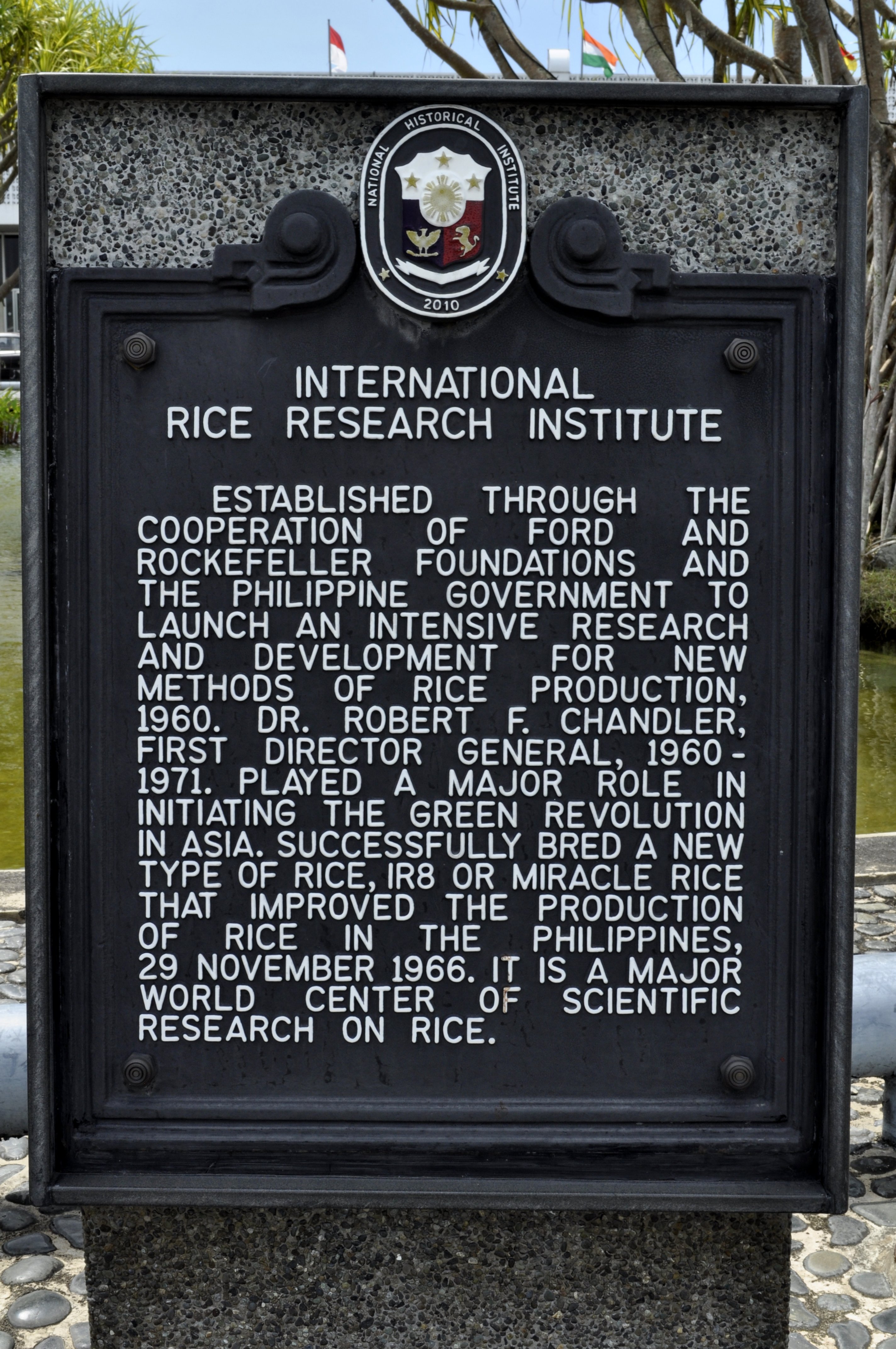
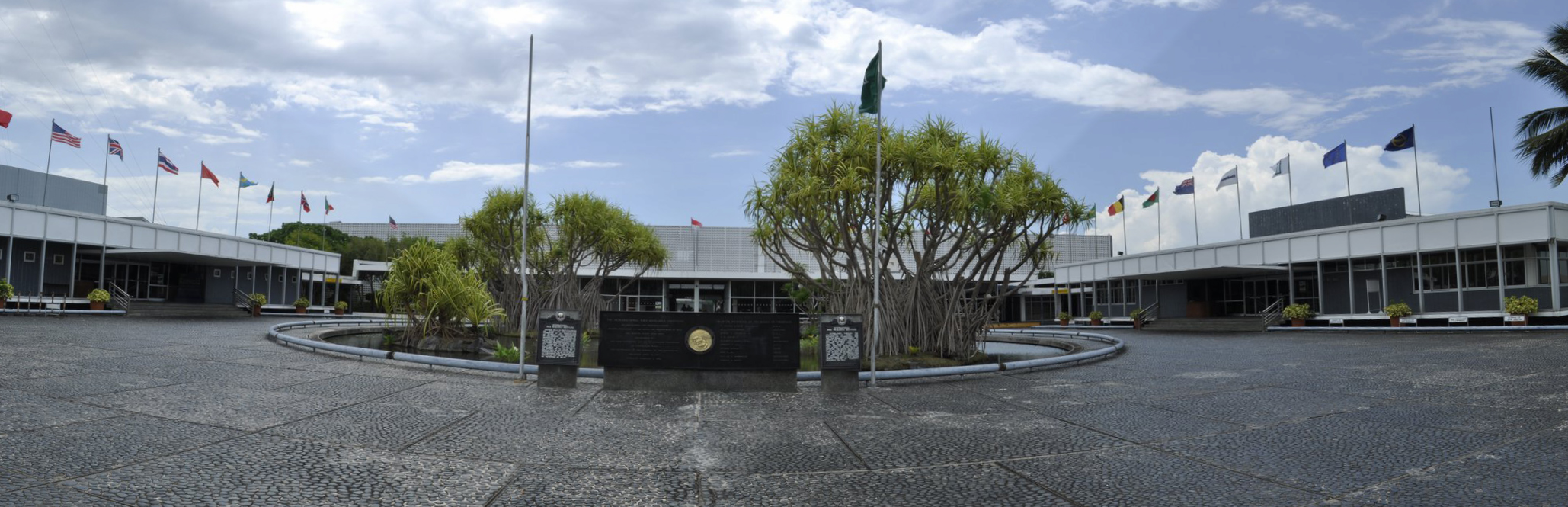
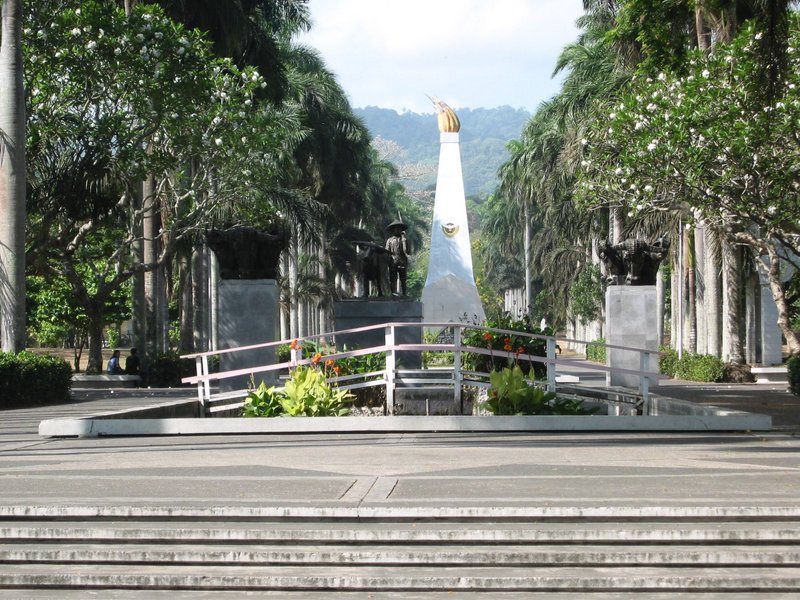
One of the national historical markers dedicated on 14 April 2010, the 50th anniversary of IRRI's founding

One of the national historical markers dedicated on 14 April 2010, the 50th anniversary of IRRI’s founding

IRRI’s reputation has spread far and wide since its foundation in 1960, and IRRI is now one of the world’s premier agricultural research institutes. Its reputation is justified. At the forefront of technologies to grow more rice and more sustainably, IRRI can be credited with saving millions of people around the world from starvation, beginning in the 1960s with the launch of the Green Revolution in Asia (see a related story about Green Revolution pioneer, Norman Borlaug). Now its work touches the lives of half the world’s population who depend on rice every day. No wonder IRRI is such an important place. But over the decades it has had to earn its reputation.

On a recent visit

20130504057 IRRI

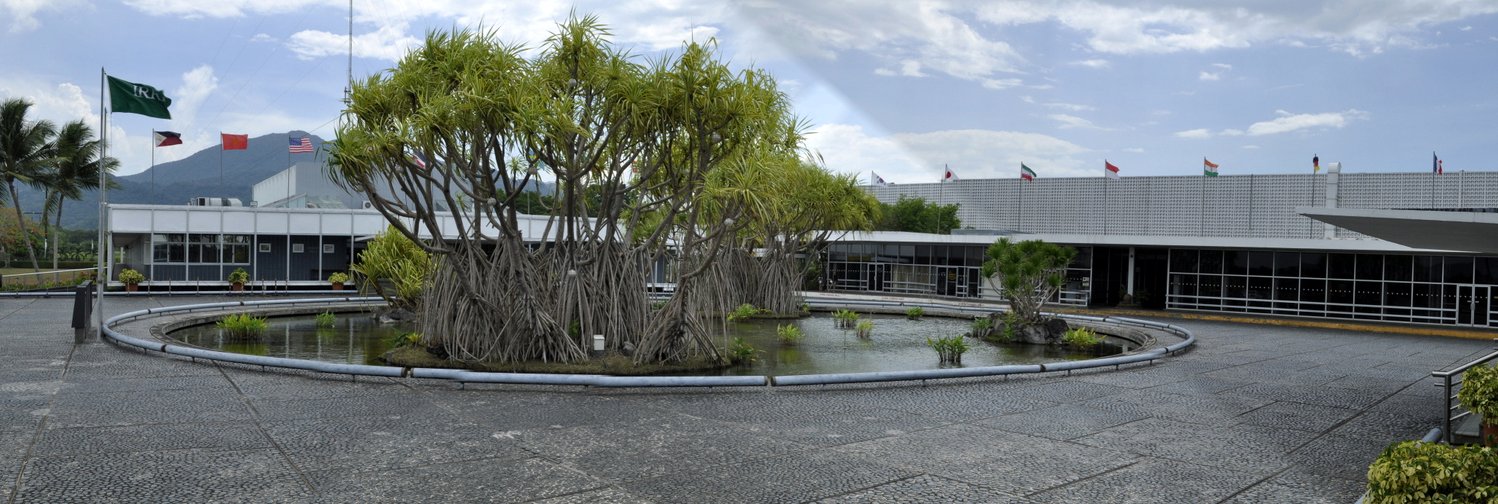
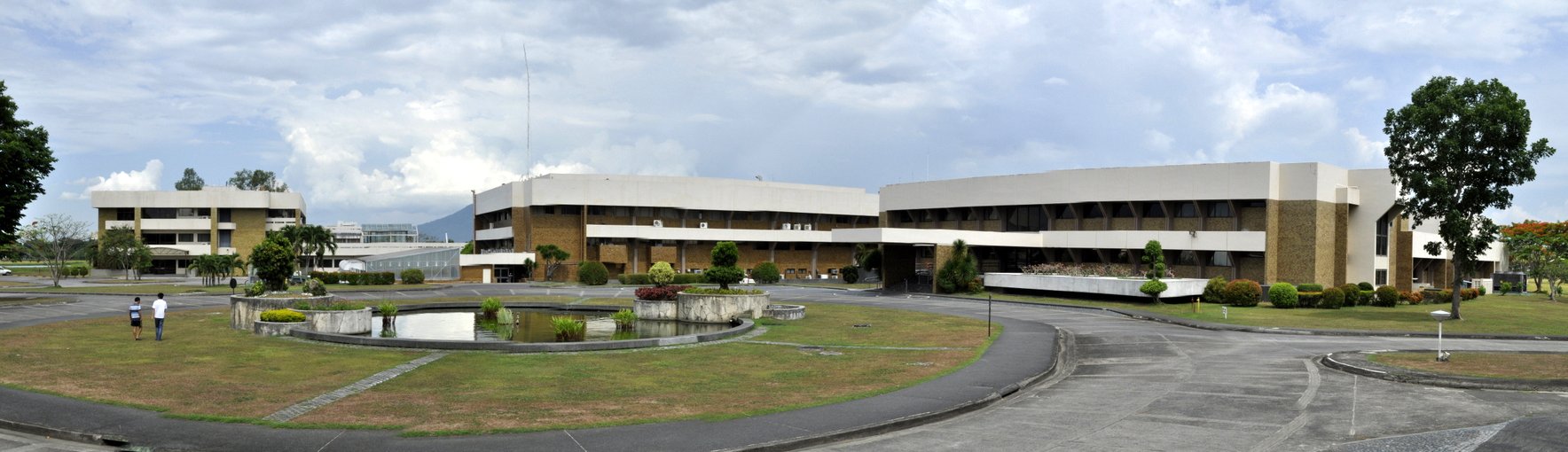
The main entrance in front of the admin buildings, between Chandler Hall (on the left) and the FF Hill Building (on the right, where I worked for almost a decade)

Between Chandler Hall and the FF Hill Building, with Mt Makiling in the distance

A view south over the long-term trail plots and others, looking towards Mt Banahaw

A view south over the long-term trial plots, looking towards Mt Banahaw, with the entrance gate to IRRI on the right, and the research labs off to the left

Some of the research labs, with the NC Brady building on the right, home to the International Rice Genebank

Some of the research labs, with the NC Brady building on the right, home to the International Rice Genebank

I was there recently, exactly three years after I had retired. And the place was buzzing, I’m pleased to say. There was such an optimistic outlook from everyone I spoke to. Not that it wasn’t like that before, but over the past decade things have moved along really rather nicely. That’s been due not only to developments in rice research at IRRI and elsewhere, but also because the institute has had the courage to invest in new approaches such as molecular genetics as just one example, and people. That was an aspect that I found particularly gratifying – lots of young scientists beginning their careers at IRRI and knowing that it will be a launching pad to opportunities elsewhere.

I was visiting in connection with the 4th International Rice Congress that will take place in Bangkok, Thailand during the last week of October 2014. I’ve been asked to chair the committee that will develop the scientific conference. We expect to have a program of more than 200 scientific papers covering all aspects of rice science and production, as well as a number of exciting plenary speakers.

IRRI’s strengths
You only have to look at IRRI’s scientific publication record – and where its scientists are publishing – to appreciate the quality of the work carried out in Los Baños and at other sites around the world (primarily but not exclusively in Asia) in collaboration with scientists working in national research programs. IRRI’s soon-to-retire senior editor  Bill Hardy told me during my recent visit that by the beginning of May this year he had already edited more journal manuscripts than he did in the first six months of 2012. And IRRI has a very good strike rate with its journal submissions.

IRRI’s research is highly relevant to the lives of rice farmers and those who depend on this crop, ranging from the most basic molecular biology on the one hand to studies of adoption of technologies conducted by the institute’s social scientists. It’s this rich range of disciplines and multidisciplinary efforts that give IRRI the edge over many research institutes, and keep it in the top league. IRRI scientists can – and do – contemplate undertaking laboratory and field experiments that are just not possible almost anywhere else. And it has the facilities (in which it has invested significantly) to think on the grand scale. For example, it took more than 30,000 crosses with a salt-tolerant wild rice to find just a single fertile progeny. And in research aimed at turbocharging the photosynthesis of rice, a population of 1 million mutant sorghum plants was studied in the field, with only eight plants selected after all that effort. Both of these are discussed in a little more detail below. In 2012, IRRI made its 100,000th cross – rice breeding remains a mainstay of the institute’s work, keeping the pipeline of new varieties primed for farmers.

Take a look at this 11½ minute video in the skies above IRRI’s 252 hectare experimental farm. In the first few minutes, the camera pans eastwards along Pili Drive over the institute’s main administrative buildings, before heading towards the research laboratory and glasshouse complex. In the middle sequence, with the Mt Banahaw volcano in the distance (due south from Los Baños) you can see the extensive experimental rice paddies with rice growing in standing water. In the final segment, the camera sweeps over the ‘upland’ farm, with dormant Mt Makiling in the distance, and showing the multiplication plots from the International Rice genebank, before heading (and closing) over the genebank screen houses where the collection of wild Oryza species is maintained. It’s certainly an impressive sight.


Taking a long-term view

You can’t get much longer-term than conservation of rice genetic resources in the institute’s genebank. This is the world’s largest collection of rice genetic resources, and I was privileged to head the genebank and genetic resources program for a decade from 1991. I’ve written about this in more detail elsewhere in my blog.

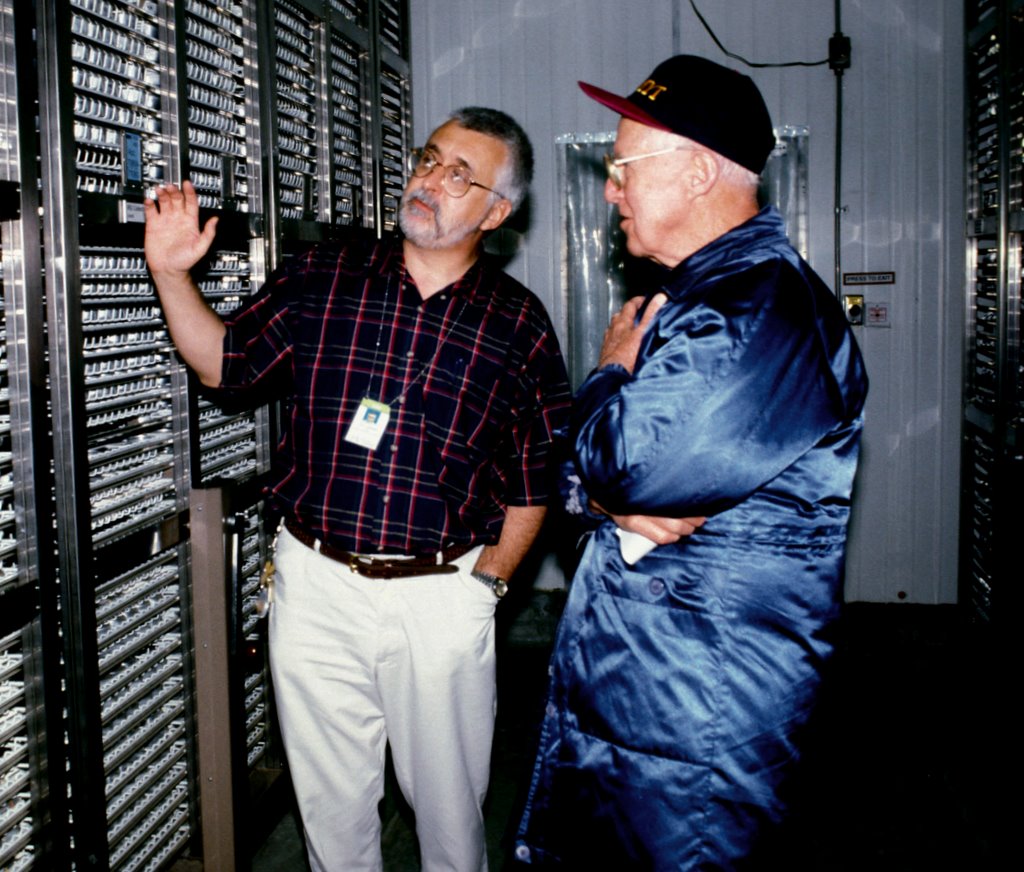
Explaining how rice seeds are stored in the International Rice Genebank to Nobel Laureate Norman Borlaug

Explaining how rice seeds are stored in the International Rice Genebank to Nobel Laureate Dr Norman Borlaug

In 1963 (just three years after IRRI was founded) long-term experimental plots were laid out to understand the sustainability of intensive rice cropping. In these next videos soil scientist Dr Roland Buresh explains the rationale behind these experiments. They are the tropical equivalent of the Broadbalk classic experiment (and others) at Rothamsted Experiment Station just north of London in the UK, established in the mid-19th century.

And in this next video you can watch a time-lapse sequence from field preparation to harvest of two crops in the long-term trials.

Making rice climate ready
Three areas of work are closely linked to the problem of climate change, and highlight how IRRI is at the forefront of agricultural research.

Rice varieties with and without the SUB1 gene after a period of inundation

Rice varieties with and without the SUB1 gene after a period of inundation

Scuba rice. Although rice grows in standing water, it will die if inundated for more than a few days. But several years ago, a gene was found in one rice variety that allowed plants to survive about two weeks under water. In a collaborative project with scientists from the University of California, the gene, named SUB1, has been bred into a number of varieties that are grown widely throughout Asia – so-called mega-varieties – and which are already bringing huge benefits to the farmers who have adopted them in India and Bangladesh. In this video, the effect of the SUB1 gene can easily be seen. Much of the work was supported by the Bill & Melinda Gates Foundation, and has (as stated on the Foundation’s web site) ‘exceeded our expectations’.

Careful with the salt. Recently, IRRI announced that breeders had made crosses between a wild species of rice, Oryza coarctata (formerly known as Porteresia coarcata – which already indicates how remote it is from cultivated rice) to transfer salt tolerance into commercial varieties. Building on the wide hybridization work of Dr Darshan Brar (who retired in 2012), Dr KK Jena has achieved the impossible. After thousands of crosses, and culture of embryos on culture medium, he now has a plant that can be used as a ‘bridge species’ to transfer salt tolerance. As IRRI Director General Bob Zeigler explained to me, ‘Now we have fertile crosses with all the wild rices, we can tap into 10 million years of evolution‘. I couldn’t have expressed it better myself!

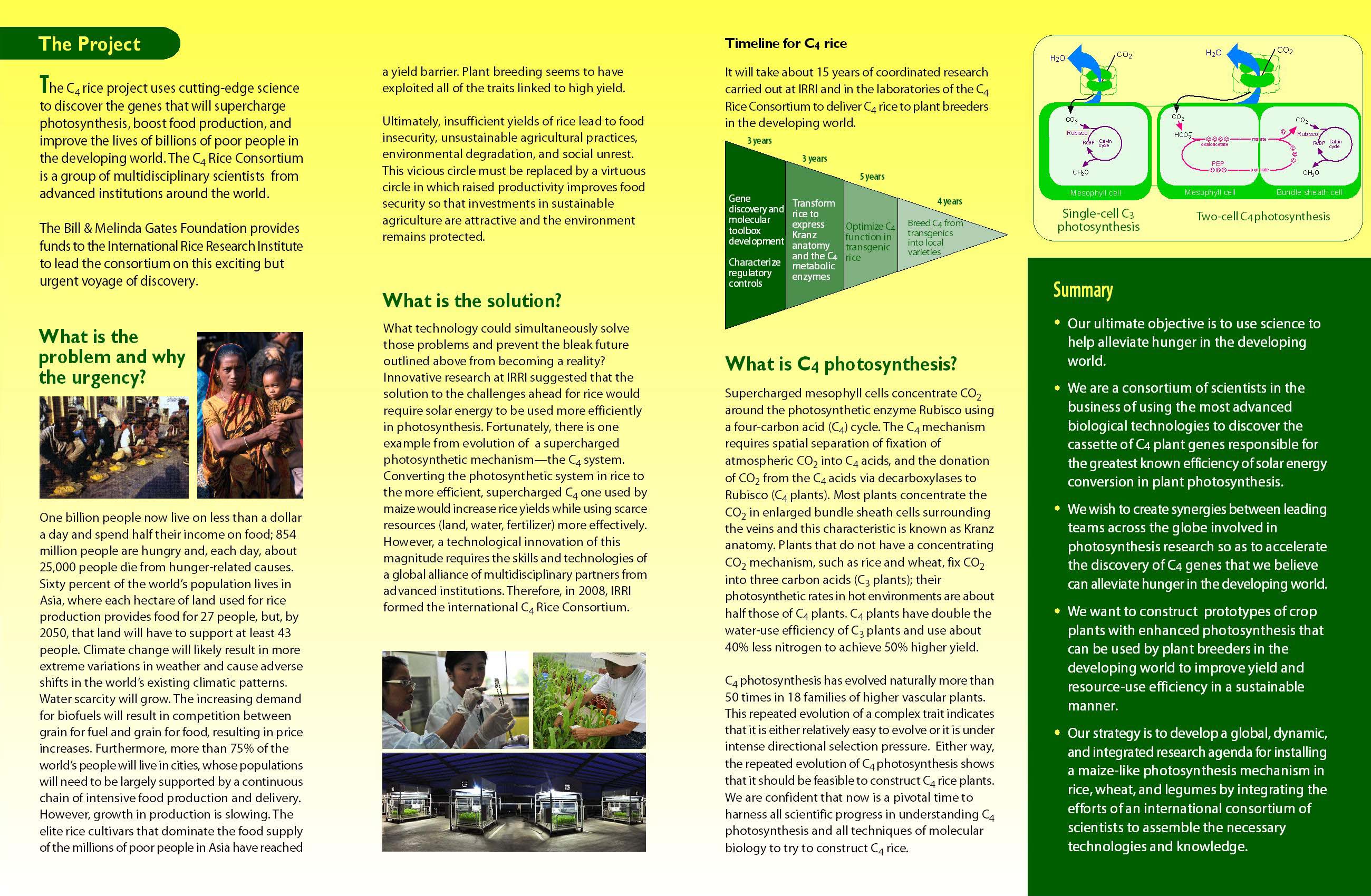
Boosting output. Lastly, since 2008 IRRI has led the C4 Consortium, a network of scientists around the world who are studying how photosynthesis in rice (which is quite inefficient in an environment where temperature and CO2 levels are increasing) could be modified to make it as efficient as maize or sorghum that already have a different process, known as C4 photosyntheis (just click on the image below for a full explanation). This work is also funded by the Bill & Melinda Gates Foundation and the UK government.

There are so many examples I could describe that show the importance and relevance of IRRI’s research for development. I think it’s the breadth of approaches – from molecule to farmer’s field (it’s even working with farmers to develop smartphone apps to help with fertilizer management) – and the incredible dedication of all the people that work there that makes IRRI such a special place. Now part of the Global Rice Science Program (GRiSP) funded through the CGIAR Consortium, IRRI’s work with a wide range of partners goes from strength to strength.

There’s no doubt about it. Joining IRRI in 1991 was the second best career decision I ever made. The best career move was to get into international agricultural research in the first place, way back in 1971. What a time I had!

Like a duck to water . . . scuba diving in the Philippines

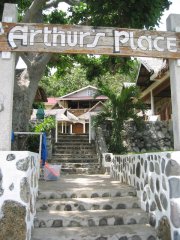
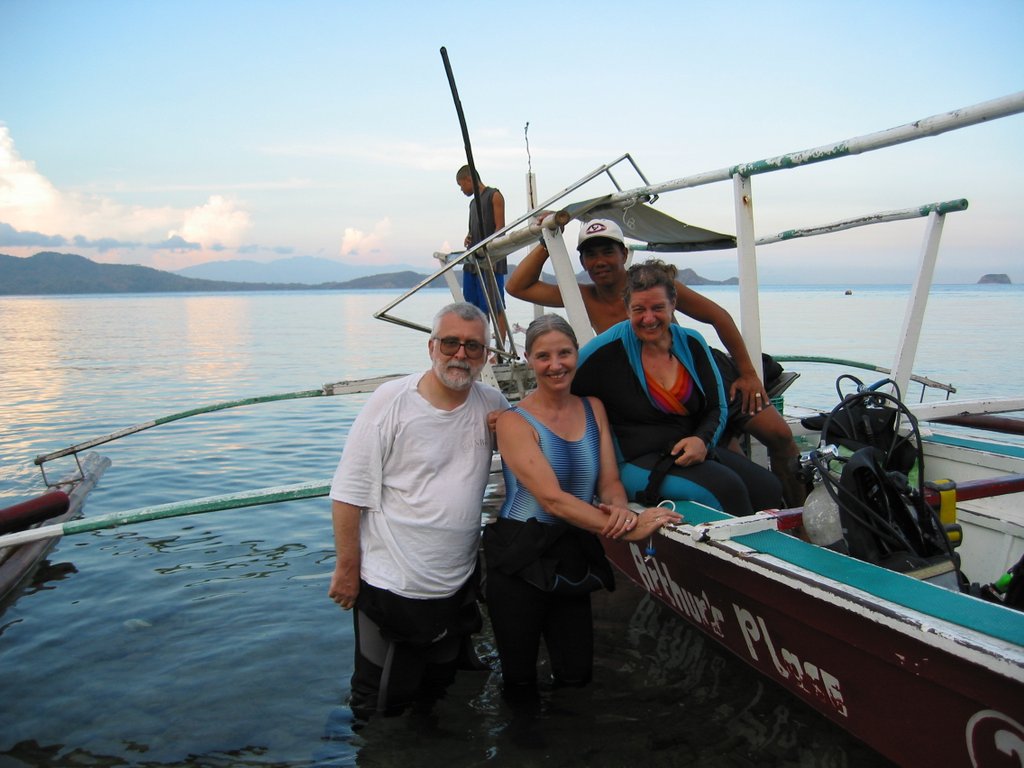
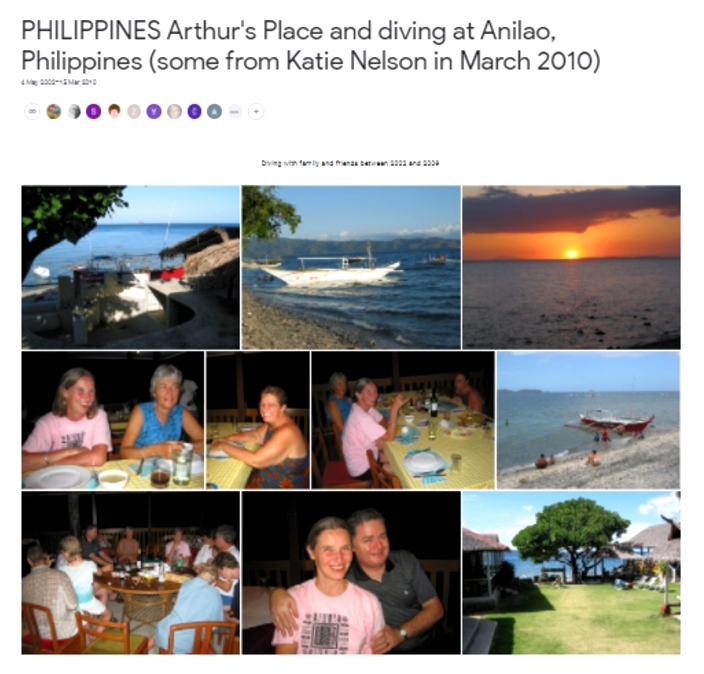
Late afternoon in front of Arthur’s Place, Anilao
(with Maricaban Island in the distance)

I’ve never been one for competitive sport, or strenuous outdoors exercise. No fell or hill walking for me, nor rock climbing, potholing, or other like pursuits.

So it was rather out of character that I took to scuba diving in the Philippines with such enthusiasm. Although I’d lived in the Tropics before moving to the Philippines in 1991, in Peru, I only went occasionally to the beach south of Lima during the summer months from January to March; and when we lived in Costa Rica, the best beaches were hours away by road.

In the Philippines, on the other hand, quite a number of IRRI staff had learned to scuba dive, and spent weekends away, either in Anilao (about 90 km or so south of Los Baños) or at Puerto Galera on Mindoro, the next island south of Luzon.

In fact, when we did go to the beach in Puerto Galera for the first time, in February 1992 (just a few weeks after Steph, Hannah and Philippa had joined me from the UK), I’d never even snorkeled before! So the last thing on my mind was the idea of taking a scuba diving course. Snorkeling was fine – once I’d got the hang of it, and learned to relax and actually breathe with my face in the water. So we invested in masks, boots and fins, and started visiting Anilao about once a month. Our first resort was Arthur’s Place, established by local dive master and entrepreneur Arturo Abrigonda and his wife Lita. Arthur’s Place was quite modest in 1992, just a few rooms available. And since there was no telephone at that time, making a reservation was rather hit-and-miss. In fact, it was only possible to reach the resort from Anilao village by outrigger canoe or banca, which took about 30 minutes or so. Eventually, the road was opened up, the mobile phone network spread to include the Mabini peninsula, and Arthur’s Place even had email and a web presence. But I’m getting ahead of myself.

My elder daughter Hannah took a NAUI dive course in 1992, not long after we first went to Puerto Galera (my one and only visit there). She’d have been about 14 or 15 at the time. There was a group of IRRI staff and children taking a course, and the dive instructors came down to the staff housing where we had a 20 m pool to conduct the theory classes and confined water exercises. The open water exercises and final certification were carried out at Anilao. Well, for a year I watched Hannah getting ready for one of her dives each time we went down to Anilao, and began to wonder what it would be like.

Mario Elumba - a recent pic

Mario Elumba – a recent pic

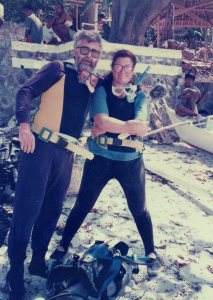
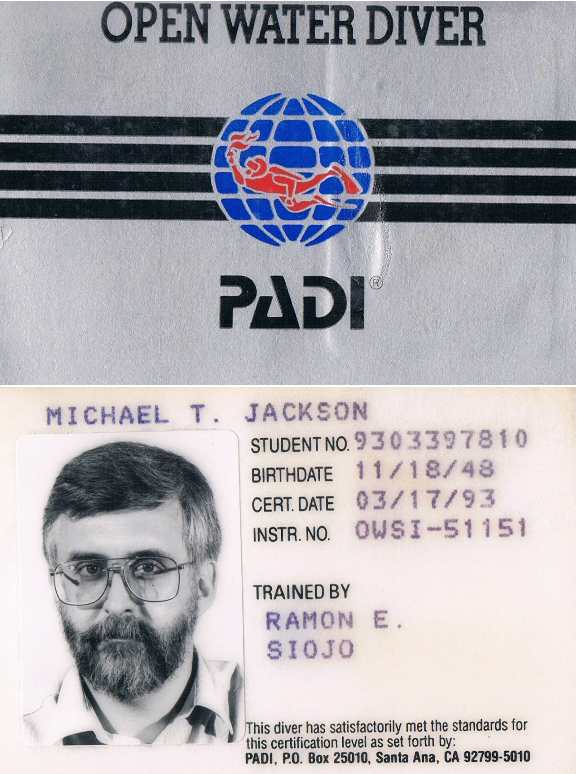
And my opportunity came in March 1993 when a group of us got together to arrange dive classes with two PADI instructors – Boy Siojo and Mario Elumba. I took to scuba diving like a duck to water, and I have to say it has been one of the best things I have ever done. Including my four open water exercises dives (just prior to receiving my Open Water Diver certification) I completed 356 dives, making my first on 13 March 1993, and my last (just before I retired from IRRI and returned to the UK) on 14 March 2010. I only dived in the Anilao area – there’s just so much to see, and in any case, as Steph did not dive but loved just to snorkel, there was no reason to go elsewhere. The reefs just in front of Arthur’s Place were ideal for this, and for about 18 years she kept quite detailed records of what she observed, some 100-150 m either side of Arthur’s Place.

Steph checking her records after another successful snorkel

Steph checking her records after another successful snorkel

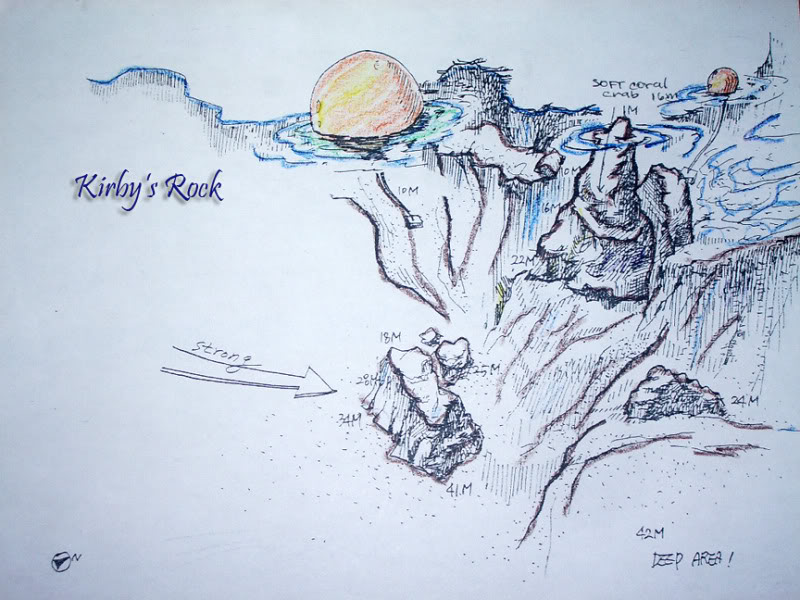
I also kept a detailed log of all my dives, who I dived with, where we dived, the conditions, and how long each dive lasted. For the first few years, my main dive buddy was Arthur. Most weekends I would complete three dives (very occasionally four, and exceptionally five). But three dives was a comfortable number: a morning and afternoon dive on the Saturday, and an early morning dive (usually to Kirby’s Rock) on the Sunday morning (that was always followed by a great plate of bacon and eggs, toast and coffee).

Sunday morning - post Kirby's. Bacon and eggs on the table.

Sunday morning – post Kirby’s. Bacon and eggs on the table.

We stayed at Arthur’s Place as often as we could  but when full, we had to stay at other resorts along the coast. However, I guess we stayed at Arthur’s more than 95% of the time, and by the time we left the Philippines, we had become the longest term clients at the resort. So much so, that Lita’s younger daughter Joanne invited me to be one of the ‘godfathers’ or ninong at her wedding in January 2010. Steph and I were the only non-Filipinos at the wedding – a great honour.

20100110166

There are many great dive sites around Anilao, but my two favorites have to be Kirby’s Rock and Twin Rocks. I think Arthur was one of the pioneers of the conservation strategy along the coast, and the development of many dive resorts led, quite quickly, to an overall increase in health of the many reefs, because the presence of divers (a considerable economic benefit to the local communities  reduced the incidence of dynamite and cyanide fishing.

One or two sites were famous for their fierce currents, especially Beatrix and Bahura. Both Kirby’s Rock and Seepok Wall had impressive walls to explore. At Kirby’s it is possible to descend about 140 feet to the bottom of one of the walls – which I did many times. The feeling of the water pressure, the (general) clarity of the water (many times over 100 feet of visibility), and the wealth of marine life make this a special dive site for me.

Nudibranchs at Mainit Point,
27 March 2004

There’s so much I could write about. We often saw white-tipped reef sharks, and my particular bugaboo was the giant triggerfish, a particular aggressive beastie that has chased us around the reef from time to time. The myriad of brightly coloured shoals of small fish, especially the butterfly fish in all their diversity, the jacks, and tuna, the occasional turtle, the soft corals and nudibranchs – what sights on a bright morning to make one’s heart sing. And the big advantage as far as I was concerned – no-one could phone me or send me an email, or bother me about work whatsoever, when I was diving.

L to r: me, Clare, Lito, and Judy, in front of Arthur’s Place, 4 May 2003, just after diving at Kirby’s Rock

Sadly Arthur died of cancer in 2002, but in any case once I had gained some diving experience I did not really need him to be my dive buddy. I used to take Hannah and Philippa diving (Philippa learned to dive in January 1995 when she was 12), and for many years I used to buddy with one of the International School Manila teachers, Judy Baker, or Clare O’Nolan, the wife of IRRI’s IT Services manager Paul. Lito Bonquin became the resident dive master at Arthur’s Place in the late 1990s, and he was the person I dived with most over my almost 18 years of diving. He was very experienced and a safe buddy to dive with – and we had great fun exploring familiar sites.

Lito and me after my last dive (at Kirby’s Rock) on 14 March 2010

Do I miss scuba diving? From time-to-time, especially on a grey winter morning, or after someone at Arthur’s Place has posted a particularly nice photo on the Facebook page. I’m pleased I had the opportunity of taking up this great sport. I enjoyed diving with most folks I came into contact with, but there were one or two (including some of my IRRI colleagues – no name, no pack-drill  who I was less than enthusiastic to dive with, because I just didn’t feel safe buddying with them  And I was quite an experienced diver.

I remained an Open Water Diver – I had no interest in gaining further certification as an Advanced Diver, or rescue, wreck or whatever diver. I still have my mask (with its prescription lenses), my boots and fins, and my wet suit. Maybe I’ll get the chance to dive again some day, and if I do get back to the Philippines before I’m too old to enjoy diving again, I reckon there’ll be a welcome for me at Arthur’s Place, and marine friends at Kirby’s Rock and Twin Rocks might ‘realize’ their old ‘buddy’ is back in town.


Around the world . . . in 40 years. Part 1: Home is where the heart is.

The other day I was using TripAdvisor on Facebook to see how many countries I’d visited over the past 40 odd years, and was surprised to discover that it’s almost 90. Many of these visits were connected with my work one way or another. However, I’ve lived in three countries outside the UK:

  • in Peru from January 1973 to April 1976, and November 1980 to March 1981, with the International Potato Center (CIP), at its Lima headquarters; 
  • in Costa Rica, from April 1976 to November 1980, leading CIP’s regional program at that time, located at CATIE in Turrialba; and
  • in the Philippines, from July 1991 to April 2010, with the International Rice Research Institute (IRRI) in Los Baños, about 65 km south of Manila.

In this series of stories, I will recall many of the places I’ve visited, and my impressions. In this first part, I focus on Peru, Costa Rica, and the Philippines. I’ll add more images to all posts as and when I am able to digitize the many slides that I have in my collection.

First foreign forays
But first things first. Until 1969, however, I had never been outside the UK. In September that year, I joined a group of Morris and sword dancers from Newcastle-upon-Tyne to participate in a bagpipe festival at Strakonice in Czechoslovakia. It was a novel experience for me to travel across Holland and southern Germany by road, seeing new sights (and sites). But more of this in another post.

In 1972, I attended a genetic resources conference organized by EUCARPIA – the European Association for Plant Breeding Research, held at Izmir on the Aegean coast of Turkey, south of Istanbul – quite exotic. Together with a group of other students from Birmingham, I stayed at an olive research institute at Bornova, some miles outside Izmir, rather than at the comfortable hotel in the city center where the conference was being held. One thing I do remember was the daily breakfast – a plate of stuffed olives, some goat’s milk cheese, crusty bread, and a glass of tea. I was a much fussier eater in those days, and was not taken with olives – quite the reverse today! We did get to visit the ancient ruins of Ephesus – a magnificent city. I returned to Izmir in the late 70s while I was working for CIP, and there was a regional meeting about potato production.

Peru
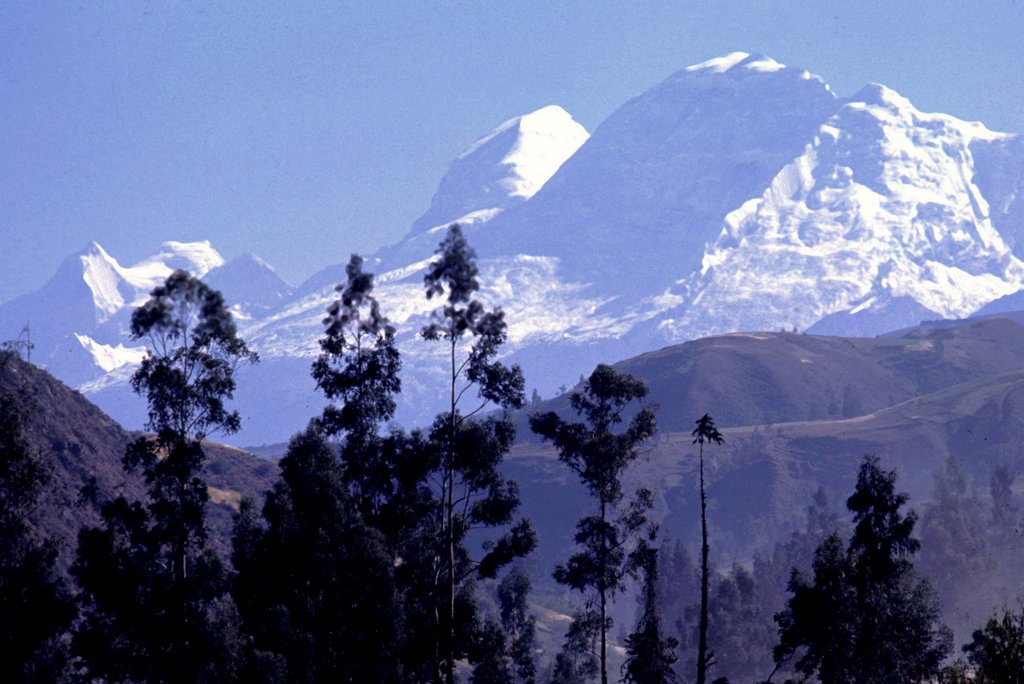
In January 1973 I moved to Lima, Peru, fulfilling an ambition I’d had since I was a little boy. Peru was everything I hoped it would be. It’s a country of so many contrasts. Of course the Andes are an impressive mountain chain, stretching the whole length of the country, and reaching their highest point in Nevado Huascarán (shown in the photo above), at over 22,000 feet.  Then there’s the coastal desert along the Pacific Ocean, which is bisected every so often with rivers that flow down from the mountains, creating productive oases, wet enough to grow rice in many places. And on the eastern side of of the mountains, the tropical rainforest drops to the lowlands of the Amazon basin, with rivers meandering all the way to the Atlantic Ocean, thousands of miles away.

Lima is a huge city today, with more than 8 million inhabitants; in 1973 it had perhaps a million or so. Situated in one of the world’s driest deserts, there is always a water problem. Goodness knows how the city authorities cope; it was a big problem 40 years ago. I first arrived to Lima in the dead of night and was whisked away to my pensión. It was a bit of a shock the following morning seeing all the bare mountains surrounding the city, even though I was staying in one of the more leafy and green suburbs, San Isidro. Flying into Lima in daylight, and driving into the city from the airport one is confronted by the reality of poverty, with millions now living in the shanty towns or pueblos jovenes that spread incessantly over the desert and into the coastal foothills of the Andes.

But Lima is a vibrant city, and the country is full of exquisite surprises. In 1973 there was a left-wing military junta governing Peru, and although there have been many democratically-elected governments since (and some more military ones as well) there was the major threat from terrorist groups like Sendero Luminoso and Tupac Amaru in the 80s that made travel difficult around the country. Between 1973 and 1975 when I lived there it was relatively safe, and my work took me all over the Andes, collecting potatoes for the germplasm collection at CIP, and carrying out research in farmers’  fields.

I visited Cuzco and Machu Picchu on a couple of occasions, and the market town of Pisac, as well as many of the archaeological sites on the Peruvian coast. Although I have traveled across the Nazca plain by road, and could see evidence of the famous lines even at ground level, I never did get to see them from the air – one ambition yet to be fulfilled. Getting to know Lima is a must, and visiting the many museums. The skyline of the second city Arequipa, in the south of the country is dominated by the volcano El Misti. And no visit to Peru is complete without a trip to Puno and Lake Titicaca at over 4000 m above sea level. Take your oxygen bottle, or try the mate de coca (an infusion made from the leaves of the coca plant) to cope with the altitude.

My work with IRRI took me back to Peru on several occasions in later years. While at Birmingham University in the 80s I had also been part of a four man review that traveled around Peru for three weeks looking at a seed potato project. I also had a research project with CIP, and on a couple of visits, I also did some work on cocoa, traveling to some native cocoa sites near Iquitos on the Amazon River, and also at Tarapoto. Unfortunately, a cocoa germplasm project I was advising the UK chocolate industry about, and some of my potato research, was affected by the activities of the terrorist groups mentioned earlier, and the drug dealers or narcotraficantes.

My wife and I were married in Lima in October 1973.

Click to read all my Peru stories, my CIP stories, and view a web album of Peru photos taken in 1973 and 1974.

Costa Rica
After three years in Peru, we moved to Costa Rica, one of the most beautiful countries in the world. The continental divide, dotted with a number of active volcanoes, runs the length of the country, with tropical lowlands on the east Caribbean coast, and drier lowlands on the west Pacific. We lived in Turrialba, some 70 km or so, east of the capital San José. Our elder daughter Hannah was born in Costa Rica.

The volcanoes are spectacular, and my potato work took me almost every week to the slopes of the Irazú volcano, the main potato growing area of the country, and about 50 km from Turrialba. It dominates the horizon from San Jose, and its most famous recent activity was in 1963 on the day that President Kennedy landed in San José for a state visit. That eruption lasted for more than a year. But the volcanic activity is the basis of deep and rich soils on the slopes of the volcano.
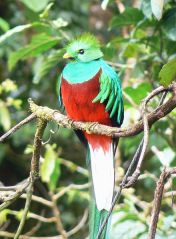
Costa Rica has had an interesting history. After a short civil war in 1948 the armed forces were abolished, and the country invested heavily in social programs and education. It also established a nation-wide network of national parks, and has one of the biggest proportions of land dedicated to national parks of any country. In April 1980 Steph, Hannah and me were staying at the Monteverde Cloud Forest Reserve when we received the sad news of my father’s death. We’d gone to Monteverde to try and see the resplendent quetzal – and how lucky we were. Magnificent!
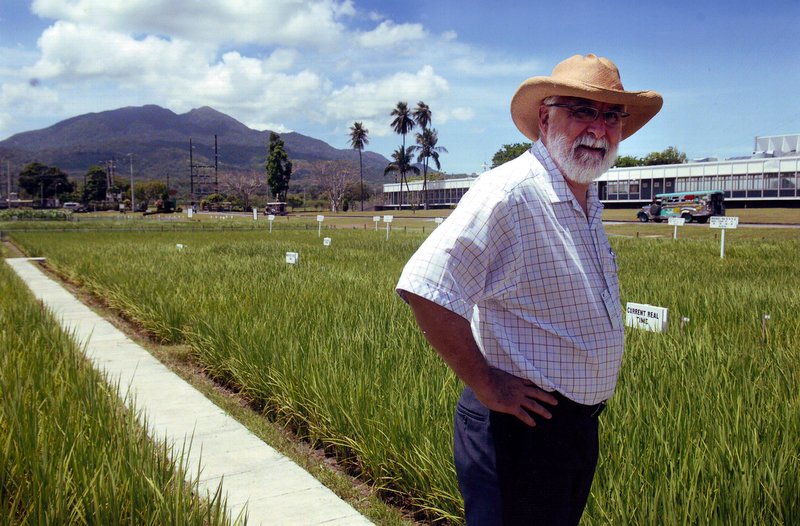
In the 1970s, Costa Rica was a very safe place to live. San José was a small city; it had only about 250,000 inhabitants while we lived there. And the police did not carry any sidearms or other automatic weapons – only screwdrivers. Screwdrivers? Yes, to remove the plates from illegally parked cars! In the late 70s, when the Sandinista Revolution against the Somoza government was at its height in Nicaragua, many refugees came south over the border. And crime rates – along with house rentals – climbed steeply.

In the mid-90s I had opportunity to return to Costa Rica on a couple of occasions, and went hunting wild rices in the Guanacaste National Park in the northwest of the country, close to the frontier with Nicaragua. Ecotourism is a major activity, and with so many national parks to visit and a wealth of wildlife to observe, Costa Rica offers plenty for those interested in the outdoors.

The Philippines
Having spent a decade teaching at the University of Birmingham in the UK after leaving CIP, I began to get itchy feet towards the end of the 80s, and was offered a position at IRRI from July 1991. I moved then, and my family (my wife and two daughters, Hannah and Philippa) made the move just after Christmas.

Even today the Philippines is the easiest country to travel in – especially if you don’t have much free time. First of all, it’s spread over more than 7000 islands. But travel by road can be slow, and extremely frustrating. It certainly tested my patience for long enough – and I was driving mainly between Los Baños and Manila. For all the almost 19 years we lived in the Philippines, there were always roadworks on the road to Manila – now completed – and the highway also connects the port of Batangas on the south coast of Luzon with Manila. The volume of traffic is horrendous, and on the open road the slow-moving (and frequently stopping) tricycles and jeepneys don’t help with the traffic flow.

And because we took our annual home-leave in the UK, there wasn’t much other time for getting to know the Philippines., even though my wife and I lived in Los Baños for longer than we’d lived anywhere else. Each year we’d depart on home-leave and going home. On the return we would be coming home. Our home was provided by IRRI in a gated community some 10 minutes drive from the research center. It was built in the early 60s on the slopes of dormant volcano Mt Makiling. Los Baños is the thriving Science City of the Philippines, home to the Los Baños campus of the University of the Philippines (UPLB) and other important scientific research institutes, besides IRRI.

Our daughters attended the International School in Manila (ISM), and were bused into Manila early each day. By 1999, Philippa’s senior year, the school bus would leave IRRI Staff Housing at 0430 in order to reach the Makati campus by the start of school at 0715. The children would return by about 1630 or so, relax for a while, have dinner, then get down to homework, studying sometimes as late as midnight. Then up again at 0400. We were all glad when Philippa graduated. In 2002 ISM moved to a new (and more easily accessible) campus, several years after Hannah and Philippa had left, and a move that had been promised since about 1994.

Steph and I would get away to the beach as often as possible, about once a month. She would snorkel, and kept very detailed records over 18 years of the fish and corals that she observed in front of Arthur’s Place in Anilao, Batangas. I learned to scuba dive in 1993, and until we left the Philippines, that was my main hobby. Here are two more underwater videos from Anilao:

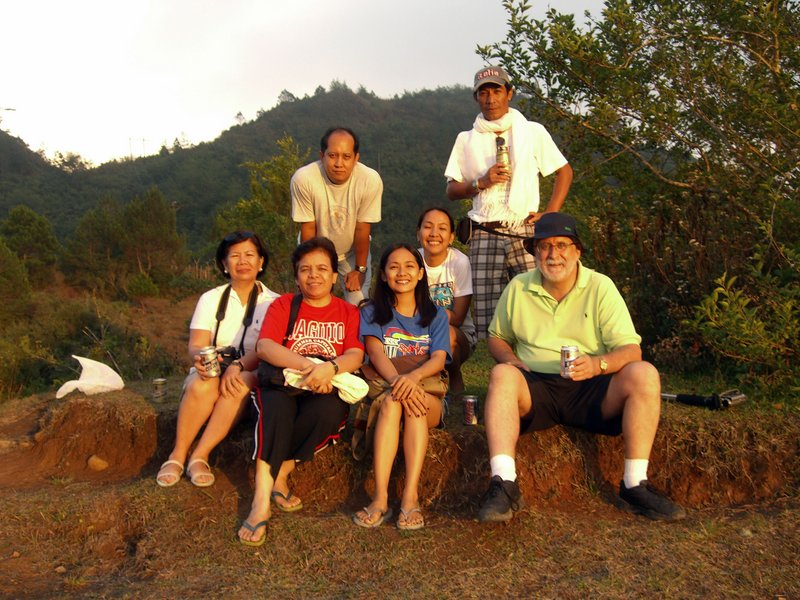
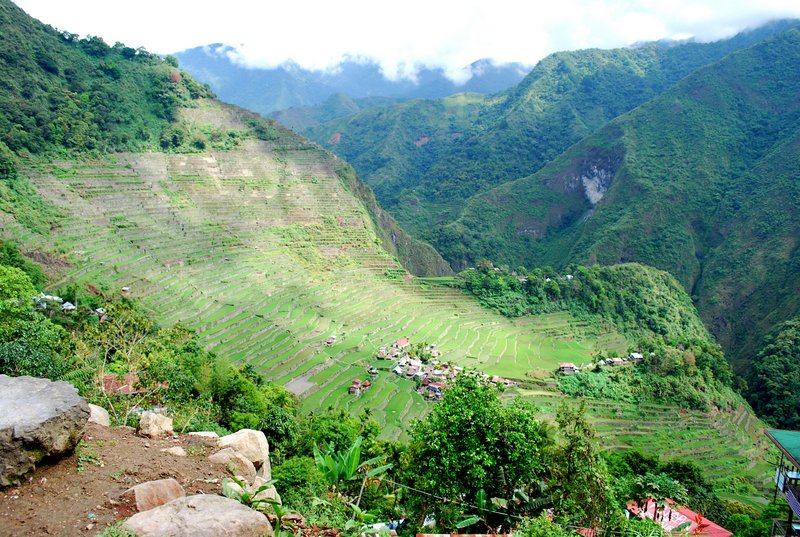
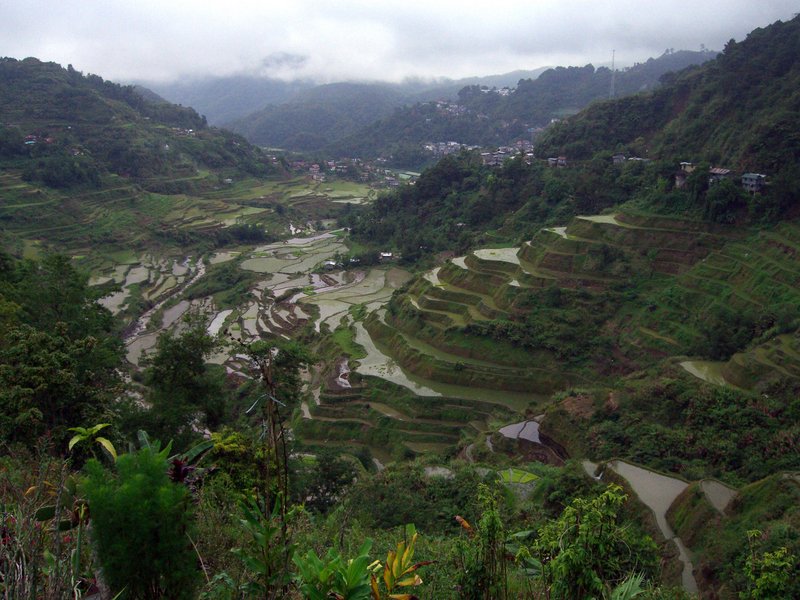
Finally in March 2009, we had the opportunity of visiting the world-famous rice terraces in the Ifugao province north of Manila. We went with a group of staff from my office. The journey both ways was tedious to say the least, taking almost 17 hours door-to-door on the return, with stops, even though the distance is less than 500 km. But it was worth it. The terraces are spectacular, and although it’s necessary to walk into the terraces at Batad, it’s well worth the effort. We stayed in Banaue, then traveled on to Sagada to see the famous caves with ‘hanging coffins’ and the local weaving. It was a short trip, but very memorable. Click here to open a web album.

We unfortunately did not get to see many of the fiestas that abound in the Philippines. But what we did see – every day – were the smiling faces of the lovely Filipino people. Yes, the Philippines was where our hearts were, for almost 19 years.

I’ll be posting other stories about the countries and places I’ve visited over the past 40 years, so please check from time-to-time.

Anilao: jewel in the Philippines diving crown

I never imagined for one minute when I moved to the Philippines in 1991 that I’d ever take up scuba diving. I’ve never been one for water sports, or lazing about on the beach either. But that changed not long after Steph, Hannah and Philippa arrived in the Philippines, and we decided to see what the beach had to offer. This is how it happened.
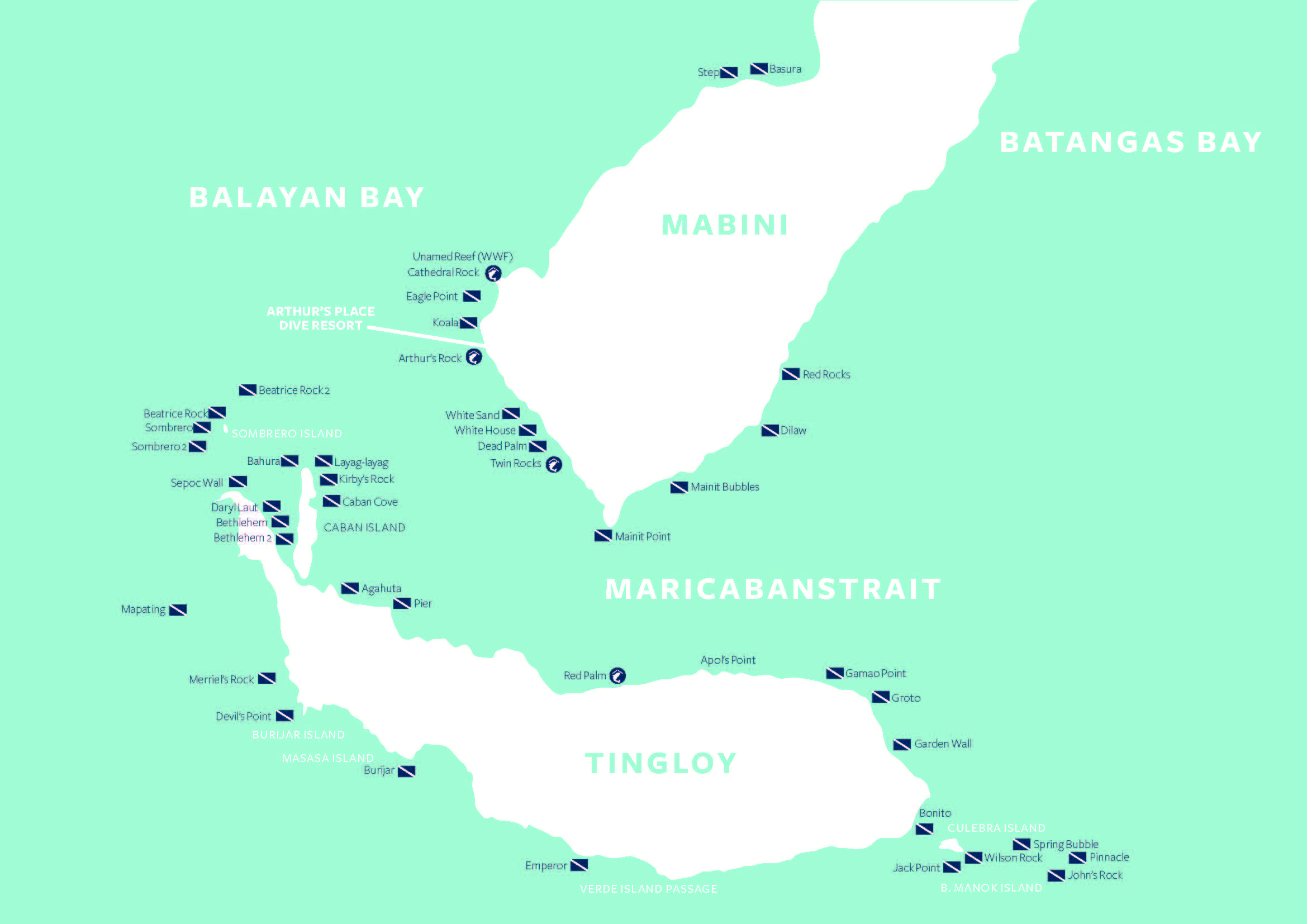
Our first beach trip was to Puerto Galera (at the bottom of the map below) in February 1992, taking the ferry from Batangas City.


We went there with IRRI entomologist Jim Litzinger and his family, and a couple of other IRRI staff at that time (Jim left IRRI during 1992). Much as I enjoyed walking along the beach, taking the odd dip every now and then, I’d never even considered snorkeling (something I hadn’t actually tried before). Well, I borrowed a mask and snorkel, and some fins, and off I went for my first attempt at snorkeling. Not being a very competent swimmer (I almost drowned when I was about 10 – my elder brother Ed had to dive into the river and drag me out), I found it quite a challenge to relax and breathe through the snorkel – it just didn’t feel right. However, I persevered, and after about 30 minutes I was beginning to get the hang of it, and the wealth of marine life that opened up to me in the shallows of a coral garden was just stunning. “That’s it” I thought, “something to keep me occupied if and when we come to the beach again.” Just to add, we never did go back to Puerto Galera. Instead, we discovered Anilao.

Arthur’s Place in Anilao
A few weeks after our Mindoro trip, another IRRI colleague, Jean-Claude Prot (a French nematologist), suggested we try a resort in Anilao – Arthur’s Place [1]- about 95 km south of Los Baños, at the tip of the Mabini Pensinsula, to the west of Batangas City.

Arthur’s Place was opened in the 1980s by local divemaster Arturo Abrigonda and his wife Lita. 

Sadly, Arthur died in September 2002, but Lita has kept the business going – and has expanded it significantly in terms of rooms and other facilities. And of course the resort is a haven for divers who come from all over the world, although most are actually based in the Philippines. It rapidly became a focal point for IRRI staff wanting a weekend away at the beach.
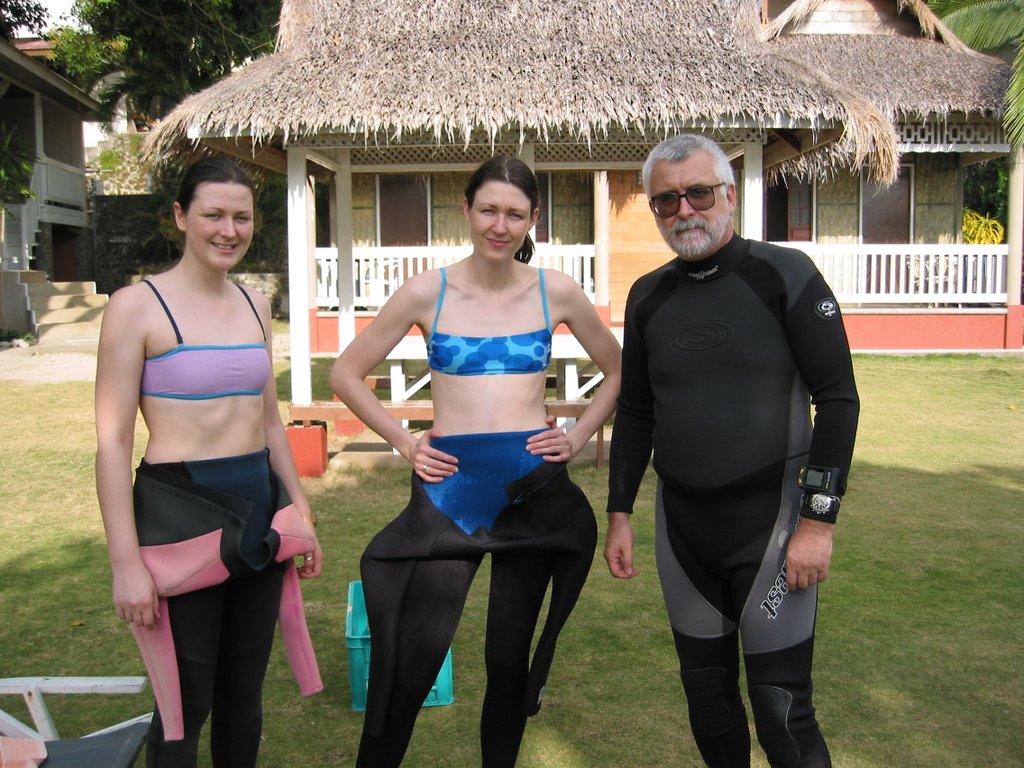
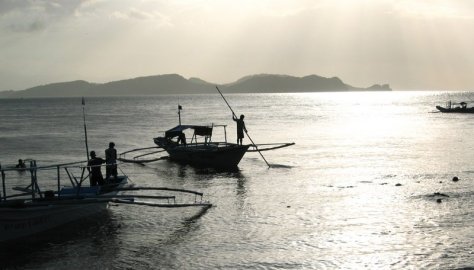
In 1992, the paved road did not reach Anilao, and even along the main roads between Calamba and Batangas the journey was quite slow due to the volume of traffic on a single carriageway highway – mainly jeepneys and tricycles. Between Anilao itself and Arthur’s Place there was just a mud road, essentially impassable except for a few vehicles. So we used to drive to Anilao, and then take an outrigger boat, known locally as a banca, sent by the resort to pick us up. Quite often we’d set off from Los Baños after 5 pm once work was over on a Friday afternoon, and Hannah and Philippa had arrived back from school in Manila. Taking the banca in the darkness was always enjoyable on a calm and moonlit night, but if squally could be quite unpleasant. After a couple of years I became increasingly uncomfortable driving at night, so we’d get up early on the Saturday morning and head off to Anilao before the traffic became too heavy. With the opening of better highways over the past decade, that by-passed most of the towns on the old highway where most traffic congestion occurred, the journey from Los Baños to Arthur’s Place could be made in 90 minutes or less on a good day. Over the years the road from Anilao to Arthur’s Place was widened and eventually paved, and a road down the hill to the beach was constructed. Before this road to the beach was opened we had to park at the top and walk down – I can’t remember the number of steps, fine on the way down, somewhat more taxing on the way up. Fortunately there was always a helping hand from the resort staff to carry all our dive gear in crates. Take a look at the video below to see how things have improved on the 15 minute drive from Arthur’s Place to Anilao.

Unless there were no vacancies at Arthur’s Place, that’s where we spent our Anilao beach weekends over the next 18 years, trying to get away once a month, about eight times a year. Most often the resort would be full of other guests, but just occasionally we would essentially have the resort to ourselves – time for chilling out with a good book, a backlog of the Guardian Weekly, and some great music on my iPod.

In 2010, I was honored to be invited by Lita’s daughter Joanne and her fiancé Rhonson to be a principal sponsor (or ninong) at their January wedding. And Steph and I were the only non-Filipinos at the wedding and reception, held at the resort – and there must have been more than 200 people at the reception.

Learning to dive
As I said earlier, in my wildest dreams I never expected to learn to become a PADI Open Water Diver, but that’s what I achieved in March 1993. Hannah had received her NAUI certification the previous year (I was too busy during 1992 at the time when she took the course), and Philippa received her PADI certification in 1995.

Diving was THE hobby among IRRI staff in the early to mid-1990s, and several courses were organized to train groups of budding divers.

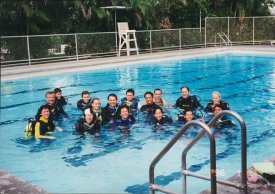
Instructors would come down from Manila to give the theory classes over a week, we’d take the confined water training in the IRRI pool, and then head off to the beach the next weekend for the open water training sessions.

We were fortunate to have an excellent dive instructor, Ramon E (Boy) Siojo, assisted by Mario Elumba. I’ve lost contact with Boy Siojo, but I ran into Mario several times while diving, and am still in contact through Facebook [2]. Our dive group included IRRI physiologist Tim Setter and his son, Crissan Zeigler, Jane Guy, Michael Goon Jr, and Art and Victor Gomez.

With Crissan Zeigler after completing one of the open water certification dives at Anilao.

Our open water training session was held over the weekend of 13-14 March 1993, in Anilao. Everything went well, and for one of our training sessions, the instructors took us to Layag-Layag, a banca ride across the channel from the Mabini peninsular (check the dive site map below). What an experience – I knew then that diving was for me! On the trip back to the mainland, we rescued passengers from a large banca that started to sink – men, women and children in the water, even babies. I was facing towards the bow of our banca, and one of the instructors was sat facing me, looking over the stern. I suddenly saw his jaw drop, and he screamed for the boat to stop. We turned round, as did the other banca in our group and we headed back for the rescue, with dive instructors donning their scuba equipment again. After all the passengers were safe, we began to tow the stricken banca back to its port, but the engine fell through the boat’s bottom and sank. By the time we arrived back at Bethlehem, and were greeted by the villagers – silent and stunned; you’d have thought half the passengers had drowned. But they were on their way to a wedding across the channel, and had lost everything.

I received my PADI certification on 17 March 1993, and the rest is history. I completed all my 356 dives from 1993 until 2010 (my last dive was on 14 March 2010) in the Anilao area. In the early days I would dive with Arthur, but when he became ill, he hired Lito Bonquin as the resident divemaster at Arthur’s Place. I made most of my dives with Lito, but there was a two year period 2002-2004 when Clare O’Nolan (wife of IRRI’s IT manager Paul O’Nolan) was my regular dive buddy. Judy Baker, a teacher at the International School Manila (ISM) was also a regular dive buddy.

Anilao dive sites
Anilao is a biodiversity hotspot, especially for soft corals, and is reported to be one of the most diverse marine sites in the Philippines. There are about 40 dive sites within easy reach of Arthur’s Place, the furthest being only a 30 minute or so banca ride away.

Most sites were relatively easy to dive, especially when you had a good divemaster like Lito to show you the ropes. Visibility was mostly fair to good, occasionally excellent with more than 100 feet. Some sites like Bahura, Beatrice and Mainit Point could be quite challenging if the tide was running – strong currents. But my favorite sites were Kirby’s Rock and Twin Rocks. Kirby’s was a 15 minute banca ride straight across the channel from Arthur’s Place. It was a site I got to know extremely well, and I must have dived there over 50 times, and each time was different, in terms of conditions, and what we saw. At Kirby’s there are two rocks, one of which (to the west) mostly peaks above the surface, depending on the tide). It drops steeply to about 75 feet, where there is an overhang; the ocean floor then slopes away north to deep water.

To the east (shown on the left in the dive plan drawing above) is another rock, with its tip at about 55 feet, and base at 125 feet. On most of our dives we’d explore the first rock before crossing to the second, spending about five minutes at 125 feet, and then slowly ascending round and over the rock before making our way back to Kirby’s and the banca. I’ve dived to 140 feet here. As I gained experience I was able to make a deep dive yet have enough air to spend more than 60 minutes underwater. In the video below, I was able to dive only to 95 feet because of the limitations on the housing for my Canon Powershot S40 camera (which permitted only 30 second video clips); you can see the other divers dropping well below 100 feet at the second rock. Kirby’s Rock was a Sunday morning dive, and we aimed to be in the water before 7 am if possible – often when there was calm water and no current. Returning to Arthur’s Place for a breakfast of toast, bacon and fried eggs, and coffee was always a delight!

Another favorite was Twin Rocks, which just got better and better over the years. When we first went to Anilao in 1992 there were few resorts, and the local fishermen were still practising dynamite fishing, causing untold damage to the reefs. But as the tourist trade developed and more resorts were opened, then the reefs began to recover and fish return. Now, Twin Rocks is a marine sanctuary where you regular see giant clams, batfish, a huge school of jacks, barracuda, and cuttlefish among others.

Anilao is not visited by many pelargics, although tuna and barracuda are quite frequent. Whale sharks are seen occasionally, and dolphins come through from time to time; sea turtles are regular visitors. White-tip reef sharks are quite common at Bahura (up to 2 m in length), but the one creature that always made me feel uncomfortable was the giant triggerfish, which can be extremely aggressive. On one dive with Lito and two teachers from ISM at Bahura, we hadn’t noticed one particular critter, about 1 m, in the vicinity. Lito had handed me a shell, and turning around, there was this fish about two meters in front of him – decidely pissed off. It chased him up to the surface (about 60 feet – apologies for the mix of metric and feet in this post; I learnt to dive in feet!), and not having success, came back after me and the other two. We were crouching behind some rocks and eventually it swam off. These fish can inflict serious bites, and afterwards we always gave them a wide berth if possible.

In all my dives there were few incidents that I look back on as being difficult. On one dive that I was leading at Kirby’s with two Americans, as we descended and reached about 90 feet, my regulator went into free flow (it had been serviced just a couple of weeks previously!). I took it from my mouth, and gave it a bash – something that would often correct this sort of problem. Well, I reached for my spare, and before I knew it, it had the same problem. So there I was at 90 feet, losing air by the second. I alerted my dive buddies and indicated we had to surface. I slowly ascended – it took about 90 seconds – just breathing into the air bubbles streaming from the mouthpiece. I had no air left in my tank once we surfaced. But I walked away from the dive – a success.

Here are some photos I took at various dive sites at Anilao:

When I retired from IRRI and left the Philippines, I sold much of my dive equipment, although I kept my mask and fins. Whether I shall dive again, I have no idea – it was great fun while I had opportunity. But it’s now a case of ‘been there, done that’. I have no plans (or desire) to dive in the cold waters around the UK. I look back on all those years of visits to Anilao with great affection – and I still miss my trips there. We were always made most welcome at Arthur’s Place by Lita and her staff, and left to our own devices. I always returned home from a weekend away at Anilao with my batteries recharged. I’m sure most of the folks who stay there have the same experience.

Here is an album of photos of Arthur’s Place and underwater images as well; just click on the image below to open.


[2] On 4 January 2020, Mario posted this photo of him with Boy Siojo:

Divemasters Boy Siojo (L) and Mario Elumba (R).