
Around the world in 40 years. Part 9. That is the trouble with flying: we always have to return to airports . . . (Henry Minizburg)

Maybe you’re a frequent flyer. Maybe not. How many of the flights you have taken were memorable? I hardly remember one flight from another (unless they were the two occasions when I was invited on to the flight-deck, on LH and EK flights, for the landing at Manila (MNL, RPLL). On the other hand, how many airport experiences – good or bad (mostly bad) – have you experienced?

Unless a flight was really bad – lots of turbulence, poor service, etc., you’re more likely to remember your airport experience. After all, for some journeys, you can spend more time getting to and from the airport, waiting for your flight to leave, or passing through immigration and customs on arrival, than you actually spend in the air.

Ever since I flew for the first time in 1966 – a short flight from Glasgow Airport (GLA, EGPF – then called Abbotsinch) to Benbecula (BEB, EGPL) in the Outer Hebrides on a British European Airways Viscount – I’ve passed through at least 180 airports worldwide. Since then, Glasgow has become quite an important hub for the west of Scotland, with many international airlines flying there. Benbecula is probably still the same – a small hut for a terminal building.

Now of all these 180 or so airports, some were just a transit stop en route from A to B; and others just a single visit or two.

On the other hand there are airports like Birmingham (BHX, EGBB) , Ninoy Aquino International Airport in Manila and Juan Santamaría International Airport in San Jose, Costa Rica (SJO, MROC) that I must have passed through many, many times – since they are/were my home airports for many years. And yet again others, like Hong Kong International (HKG, VHHH that replaced Kai Tak), the Twin Cities (Minneapolis-St Paul International, MSP, KMSP), or Narita in Tokyo (NRT, RJAA), are important hubs that I’ve passed through frequently over the years. Furthermore, I have traveled through MSP a lot (and still do) because my elder daughter Hannah and her family live there.

So what makes a good or a bad airport experience? And I’m sure we all have different criteria and tales to relate. As I was thinking about this, these are some of the ideas that came to mind:

  • the airport itself, its facilities, and capacity to handle passengers; travel to and from the airport; does it have one large terminal (such as Amsterdam Schipol, AMS, EHAM) or several like London Heathrow (LHR, EGLL) or New York JFK (a nightmare, JFK, KJFK) with all the headaches that can bring;
  • the check-in experience (depends on the airline to a large extent);
  • the immigration and customs experience;
  • connecting time between flights and the ability of the airport to handle tight schedules;
  • and then there’s the physical location of the airport and whether that can affect the takeoff and landing experience – as I’ll illustrate later on.

Some airports are well past their sell-by dates, and should have been demolished years ago. Although a new airport terminal was built at Manila a decade ago, it didn’t open for several years (a dispute with the company that financed its construction). Terminal 1 at NAIA is certainly not one of the most comfortable to travel from. The operators are always patching up the services, and there never do seem to be enough seats for everyone who needs one. But after almost 20 years of traveling through NAIA many times a year I can state unequivocally that the airport works and, most of the time on arrival, immigration, baggage handling and customs are really rather efficient. And of course (most of the time) one is greeted by a beautiful Filipino smile. I wish airport staff around the world were half as courteous and friendly as those you meet in Manila.

I was always wary of traveling through Murtala Muhammed International Airport in Lagos (LOS, DNMM) in Nigeria in the 90s. Immigration and customs staff could be quite menacing, and would always look for something in your bags to confiscate. The common question was’ What do you have for me?’ I’d always reply: ‘A big smile’ and then gave a big cheesy one. But they never did get anything off me. I wonder how things have changed since I was last there, more than a decade ago.

In Asia there has been an incredible airport boom – at Singapore’s Changi International (SIN, WSSS), Kuala Lumpur’s International Airport (KUL, WMKK) in Malaysia, and Bangkok’s Suvarnabhumi Airport (BKK, VTBS) in Thailand, and Hong Kong, of course. Another iconic airport, with a terminal building over a kilometer long, is Kansai International (KIX, RJBB) in Osaka, Japan, constructed (like Hong Kong) on an artificial island in Osaka Bay.

Some of the most difficult airports to pass through are in the USA. Many don’t have a transit area and even if you are only changing from international flight to another, you have to pass through immigration and customs. Not the easiest thing to do if you have a tight connection and there are a couple of other jumbo loads of  passengers waiting in the immigration queues ahead of you. US border staff are often not the friendliest. It must be tough sitting there facing a sea of faces every day. London Heathrow has become renowned for its difficult immigration, and that was a major concern ahead of the 2012 Olympic Games.

As I’ve been fortunate to travel business class on many long-haul flights, I’ve been able to take advantage of airline lounges in which to relax while waiting for a flight – a boon if there are delays. The Emirates lounges at Dubai International (DXB, OMDB) are superb.

In many airports it’s now difficult to view aircraft traffic easily from inside the terminal building. One of the best – when the airport was open – was the Cathay Pacific lounge at Hong Kong’s Kai Tak, with a view looking right down the runway from one end to the other. It was fascinating watching even the biggest jets manoeuvering above the apartment buildings and making the final sharp right turn to line up on the runway. It’s also quite an experience on board!

Now Kai Tak could be challenging for many reasons, as is the ‘new airport’ because of frequent crosswinds. But the landing on the short runway after a challenging approach at Tegucigalpa’s Toncontín International Airport (TGU, MHTG) in Honduras takes the biscuit. I flew in and out of there quite a few times in the 70s – never a comfortable experience.

I never visited Bhutan, but one of my staff, Eves Loresto, traveled there several times between 1995 and 2000 in connection with our Swiss-funded rice biodiversity project. Paro Airport (PBH, VQPR) in the heart of the Himalayas is considered one of the most demanding airports in the world, as this landing video shows. Only small jets operated by Drukair land there.

As I started this post, I suggested we’d all have our own stories to relate. And certainly while I have had some excellent flights (like when I was upgraded to First Class on my first A380 flight from DXB to BKK on EK), most of what I remember about those journeys has invariably to do with my experiences of the airports. What are yours?

¿Donde esta el baño?

I’ve just begun reading Anchee Min’s memoir The Cooked Seed (published by Bloomsbury in 2013). I’m only on page 58, but I’ve already reached the description about her arrival in Chicago, aged 27, in August 1984. Escaping from an impoverished upbringing in Shanghai and all the tribulations of the earlier Cultural Revolution that had so dramatically affected her life, she had applied (on false pretenses) to study in the US for a bachelor’s degree in art. She had one huge drawback: although indicating on her application and during her visa interview that she was fluent in English, she hardly spoke or understood a word of English. Her sense of utter helplessness leaps off the pages. A new language, new alphabet, as well as the challenge of a new consumer-driven culture and society, something way beyond her experiences until then.
And that got me thinking about how we adapt to new situations, cultures and language. I can empathize with Anchee Min, although of course my life experiences in childhood and my teens prior to moving abroad do not hold comparison with hers.

Before I moved, aged 24, to Peru in January 1973, I had traveled outside the UK on only two occasions, the first time in 1969 to Czechoslovakia, and then in April 1972 to attend a EUCARPIA genebank conference in Izmir Turkey. I’d flown only three times, never intercontinental, and Turkey was my furthest destination. So it was with a certain degree of trepidation I set out for Peru.

While I had made some (rather pathetic) attempts to begin to learn Spanish before I moved to Peru – I’d known for about a year that I would be working there before I actually left the UK – I didn’t make much progress. I was a graduate student at the University of Birmingham, and decided to take advantage of the language laboratory to begin Spanish lessons. I didn’t find it inspiring whatsoever – sitting alone in a booth, listening to a tape on headphones, and attempting to follow along with a text. Until then, my foreign language skills were minimal. I’d studied French at high school, passed the necessary exam (‘O Level’) in 1965, and not bothered subsequently. Well, at the language lab I thought I was making some progress until, that is, someone walked off with the only copy of the course text. On reflection I should have stuck with the audio tapes but being (at that time of life) a bit of a procrastinator, I gave up. With the consequence that when I landed in Peru I had hardly a word of Spanish.

In fact, when I came down to breakfast on my first morning in Lima – it was a Friday – I couldn’t even order my own breakfast! I must admit that I felt rather confused for several weeks, maybe months, until I began to understand a little more how things worked, and I’d picked up a basic vocabulary. I certainly used a lot of single words and waving of arms to get by.

In some ways there was less language pressure because many colleagues at the International Potato Center (CIP) at La Molina (then on the outskirts of Lima), where I worked as an Associate Taxonomist, were bilingual. Many of the support staff were not, and being able to communicate with them was a priority. I began intensive Spanish lessons with Maestro Jorge Palacios, who had taught ‘generations’ of ex-pats on the Peru-North Carolina State University Potato Program mission, and CIP staff. By mid-1973 I was much more confident and had begun to string sentences together – not particularly competently – but i was getting by. In May 1973 my colleague Zosima Huaman and I made a three-week germplasm collecting trip to the provinces of Ancash and La Libertad. I could never have made that trip alone. In one village we were greeted by everyone in the community. It was clear I would have to respond, having been identified as a ‘representante de la Reina Isabel‘. I quickly jotted down some phrases on the palm of my hand that Zosimo gave me. Afterwards, everyone (about 200 people) came and shook my hand!

By the time Steph joined me in July 1973 (and we were married in Lima in October that year) I was becoming a little more competent, and within a year I could make germplasm collecting trips in the boondocks (originally a Filipino word) on my own with just a support driver. It wasn’t until I moved to Costa Rica and Central America in April 1976 (where I stayed for almost five years)  however, that I became more or less fluent in Spanish, although my written Spanish has never really been competent. At CATIE in Turrialba where we lived English was used very little. In my potato work with farmers in various countries and researchers from national research institutes, I always spoke Spanish. It’s such a lovely language to learn and speak. And that’s one of the legacies of my time abroad. I got to learn a second language, and although I haven’t spoken Spanish for 30 years or more, it’s still locked away in the further recesses of my brain. So it’s quite fun when something in Spanish is broadcast on the TV (as the other night, in a program about Easter Island) trying to follow along without reading the sub-titlkes.

Faced with the difficulties of a new language and adjusting to a different society and culture – as I did in 1973 – I think made me better prepared to help graduate students who came to study genetic resources at the University of Birmingham when i taught there in the 1980s. Most were overseas students with English as a second language; and quite a numbered really struggled. As part of our teaching commitments we worked with the staff of the English as a Second Language Unit in English Department to provide weekly remedial classes. Each week one of the course staff would record a lecture that then formed the basis of a tutorial with the students. In this way they not only learned about the technical use of English, but also how the lecturers would sometimes (often?) unknowingly use colloquialisms, or maybe repeat the same idea but in a different way, using other descriptive terms.

I’m afraid that when I moved to the Philippines in 1991 I never did make an effort (shame on me!) to learn Tagalog, although I picked up a smattering of words, and was  able after some years to understand the gist of a conversation in Tagalog. But I’ve rarely been in a situation, as Anchee Min found herself, completely at sea and unable to communicate. As English has become (much to the chagrin of the French) the world’s lingua franca, it’s no longer unusual to find public signs and notices, even announcement on public transport, in English in Japan, China, Thailand and elsewhere that use a different alphabet.

It was colder than a witch’s tit . . .

Yes. It was that cold.

Having lived in some pretty hot places around the world over the past 40 years, I’d never experienced cold like that until then.

When? Well it was Christmas 2007, and Steph and I spent Christmas with Hannah and Michael in St Paul, Minnesota. And having flown in from the Philippines on Christmas Eve (and arriving in Minnesota almost before we departed the Philippines), you can imagine that super low temperatures came as a bit of a shock to the system. But I’m getting ahead of myself.

In all the almost 19 years in the Philippines we spent Christmas there, often heading to the beach for some well-deserved R&R, some diving, and generally lazing around under the tropical sun, except for four occasions when we visited Australia (twice) and once each to Hong Kong (and Macau) and Angkor Wat in Cambodia.

However, in 2007, I thought it would be fun to experience Christmas in a cold climate so, in my devious way, set about planning a Christmas break in Minnesota. Hannah had moved (as an undergraduate) to St Paul in 1998, and has settled there with husband Michael (and now children Callum and Zoë). Anyway, in about September of that year, I contacted Hannah and asked her if we could come and spend Christmas with them – if her Mum was willing to travel. Of course, Hannah was delighted at the idea and immediately said ‘Yes!’. Then I tackled Steph, asking her if she liked the idea of Christmas with Hannah and Michael. It didn’t take her long to agree – even though she has never been a fan of long-distance travel.

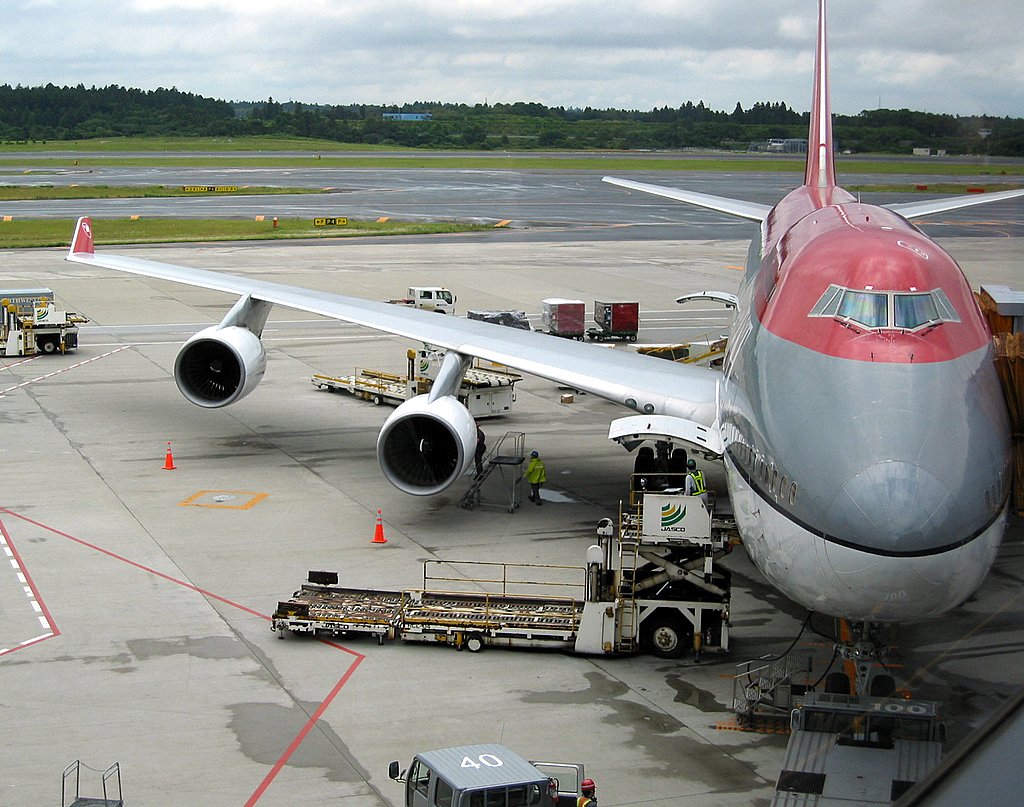
Unbeknown to either Hannah or Steph, I had already made Business Class reservations with Northwest Airlines, to depart on Christmas Eve (arriving to Minneapolis-St Paul, MSP, that same day), returning on New Year’s Eve, and back home on New Year’s Day. Originally our schedule was to fly to MSP via Tokyo (Narita) and Detroit, but about a week before flying seats opened on the direct Narita-MSP.

That was very fortunate as a major blizzard had moved through the Midwest just a couple of days before Christmas Eve and caused all manner of travel disruption, and our journey would have been even more tedious had we had to fly via Detroit.

There wasn’t a cloud in the a clear blue sky as we came into land at MSP, but we could see that a lot of snow had fallen within the previous 24-48 hours. Hannah and Michael were at the airport to meet us, and Hannah had brought along several items of warm clothing for Steph who didn’t have any in the Philippines since it was way below zero (Fahrenheit!). I was OK, since I often used to travel to the US or Europe during the winter months and had to have appropriate warm clothing to hand. From the airport we headed off to Target for a quick shop of extra clothes for Steph. We were amazed at how clear all the main roads were, eve tough there had been at least a couple of feet of snow.

Christmas Day was quite special. Not only was it nice to be with family, but it really did have a special traditional feel about it, sitting in front of a roaring log fire, opening presents, having a wee dram or three, and anticipating an excellent Christmas lunch of turkey.

We sat down to eat around 3 pm. It was just getting dark, the neighbors had switched on their Christmas lights (something that has grown in popularity here in the UK in the past few years), and then magic – it began to snow. Well, I’m now 65, and this for me was just about my first white Christmas. Even though there was food on the table, Steph and I had to go outside and experience that magic first hand.

Over the course of the next few days, Steph and I got to experience what ‘real cold’ was all about. It certainly was rather bracing heading out for a daily walk. But, by the same token, it was an experience that I thoroughly enjoyed, even though I don’t think I would recommend living somewhere that gets that cold.

All too soon our Minnesota sojourn was over, and on New Year’s Eve we headed back to MSP to catch a midday flight to Narita and on to Manila, arriving late at night on New Year’s Day. Great to be home, but pleased Continue reading

The Lady of the North

A couple of weeks ago I posted a story about the desecration of the landscape through industrial pollution, specifically the impact of coal mining.

Last week, my wife and I made the 225 mile journey from our home just south of Birmingham to Newcastle in the northeast of England. The route we took – M42, M1, M18, A1(M) – passes through many areas where coal mining was the main industry until quite recently. But as you speed past you would be hard pressed to realize that coal mining had ever taken place, such has been the rehabilitation of the landscape. Yes, in some places there are rolling ‘hills’, covered with scrubby vegetation, the remnants of the once dominating slag heaps associated with the deep mines. In general, the coal mining footprint is slowly and irrevocably disappearing.

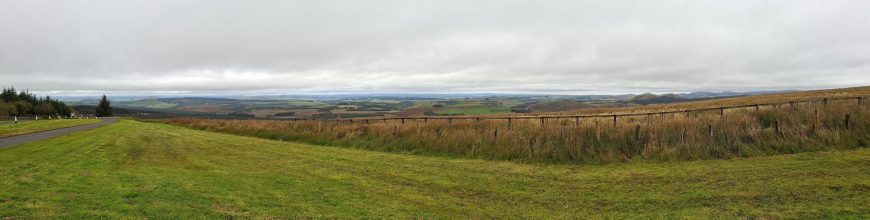
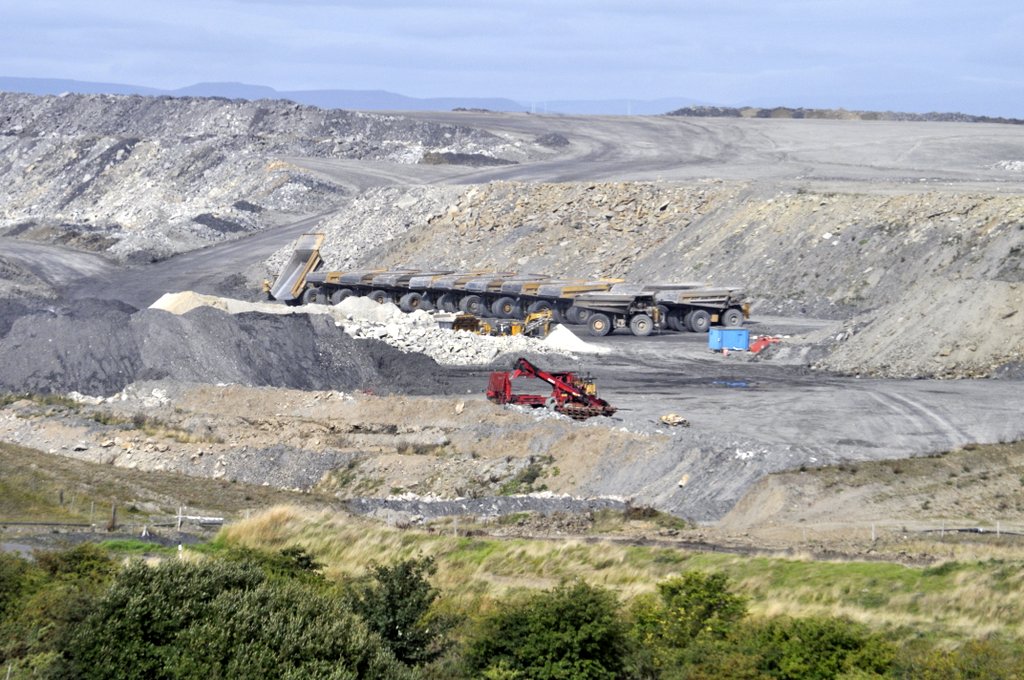
Not so just a few miles north of Newcastle close by the village of Cramlington (where the musician Sting once taught at a local primary school before discovering his musical mojo). Just to the west of the village is the huge Shotton surface mining complex. And this is what it looks like from a slightly elevated location.

Not a pretty sight, but thankfully you can’t really see the extent of the open cast mining from ground level. It looked as though the mine operators were restoring some parts of the site, bringing in loads of top soil.

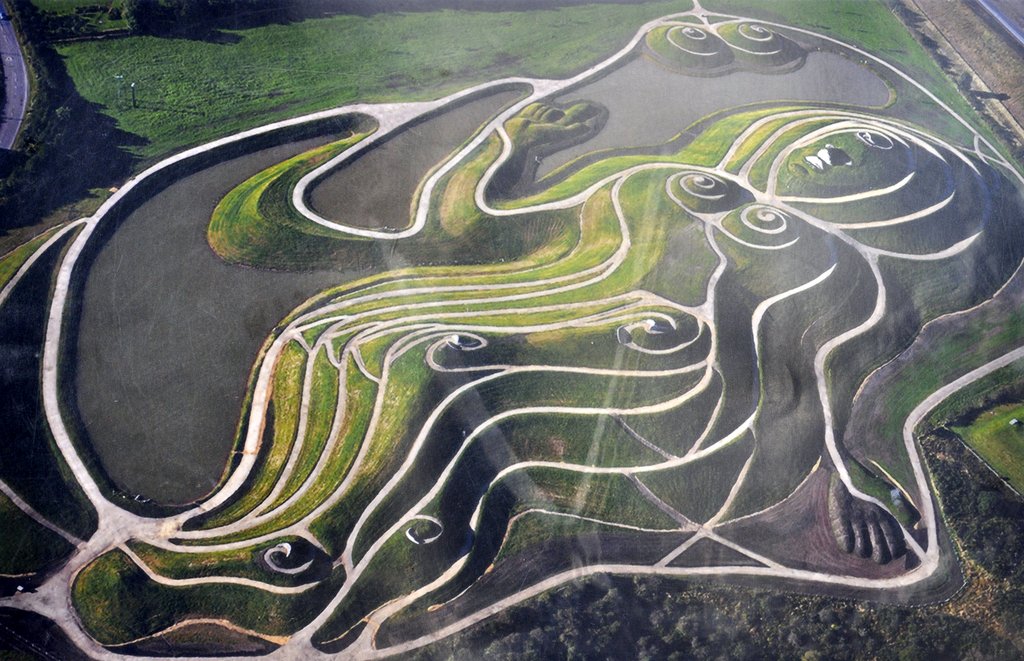
However, if you have £3 million, and are prepared to move 1.5 million tons of rock, gravel, clay and soil, then it’s possible to really make something from a ‘derelict’ landscape. And that’s what has been achieved at Northumberlandia (from where the photos above were taken). Undoubtedly one of the largest landscape sculptures of a figure – in this case a reclining nude Lady of the North, Northumberlandia – in the world, it took a couple of years of landscaping to achieve a truly remarkable design, and was opened in September 2012.

An aerial view of Northumberlandia, with her head on the right and feet on the left.

An aerial view of Northumberlandia, with her head on the right and feet on the left.

1. Viewing points. 2. Head. 3. M’lady’s breasts. 4. Hands. 5. Hip. 6. Knee. 7. Ankles.

Rising to 100 feet apparently at the head, there are over four miles of paths winding around the lady, with viewpoints from M’Lady’s breasts, hip, knees and ankles. Her right hand is raised in a salute with the index finger raised. There are three ponds to one side, which will surely become colonized by reeds and other water-loving plants and become a haven for wildlife. Already there is quite an impressive array of wild flowers on her flanks.

The paths have been laid out to provide easy access for everyone; the gradients are steeper in some sections than in others. Entry to Northumberlandia is free, but one is asked to contribute towards car parking – £2 is the suggested fee. It was a beautiful day when we visited last Saturday along with daughter Philippa and her husband Andi, and sons Elvis and Felix. Here is a small selection of the photos I took. This is what you see from ground level. It’s well worth a visit.

Around the world in 40 years . . . Part 7. Letting the train take the strain

trainI love traveling by train.

And were it possible to travel everywhere by train, that would be my preferred mode of transport. There are many journeys I would love to take, particularly on the luxury trains such as the Orient Express, the Blue Train in South Africa, or the Eastern & Oriental Express from Singapore to Bangkok (I have the time, but don’t have the budget), as well as others across the USA and Canada through the Rockies, or in Australia (from Adelaide to Darwin on The Ghan, for example or across the Nullarbor Plain from Adelaide to Perth on the Indian Pacific).

When traveling on business for IRRI in Europe to visit the institute’s donor agencies, I most often traveled from city to city by train rather than flying. More relaxed, comfortable, convenient, and a better use of my time than sitting in an airport departure lounge wondering if the flight would depart on time, never mind – if there was inclement weather – if it would depart at all. The longest journey I made (twice), over about two weeks in total, was : Bromsgrove (my home town) – Birmingham New Street – London Euston / London Waterloo – Brussels (on the Eurostar) – Bonn (on the Thalys to Cologne) – Basel (down the Rhine valley) – Bern – Milan (cutting through Alps and along the Italian lakes such as Como) – Rome (but return to Birmingham by air). Seat reservations are a requirement on many European train journeys – none of this ‘sardine’ travel so typical on a number of commuter lines in the UK (and even on long distance trains at some times of the day or on holidays).

Braunschweig to Gatersleben and Berlin
In the late 1980s, while I was still working at the University of Birmingham, I decided to visit two genetic resources programs in Germany – at Braunschweig (in West Germany) and Gatersleben (in East Germany). This was before the Berlin Wall had been pulled down. It was actually quite easy to cross over from the West to the East, and at the crossing, border guards came on board to check documents. I must admit that I wasn’t particularly relaxed until my passport had been checked, all was in order, and I continued with my journey, via Magdeburg, Halberstadt, to Gatersleben.

Gatersleben is home to the Leibniz-Institut für Pflanzengenetik und Kulturpflanzenforschung (IPK-Gatersleben) with one of the most important crop genebanks in Europe. I was made most welcome by the head of the genebank, the late Dr Christian Lehmann and his colleagues Karl Hammer and Peter Hanelt (and other genebank staff). It was a memorable visit, particularly walking through the impressive summer regeneration plots of cereals such as wheat, barley (seeing hooded barleys for the first time) and oats, and other crops, and discussing crop evolution and diversity with Dr Lehmann.

My return journey took me to Berlin, where I left the train at Schönefeld Airport station (in the southeast of Berlin), and crossed through the Berlin Wall by taxi, to arrive at the airport in the West. I’ve remembered that as Templehof Airport, although it might have been Tegel.

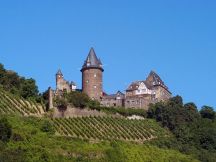
Stahleck Castle at Bacharach

The Rhine Valley
I’ve visited Bonn on many occasions. Flying into Frankfurt I could have taken the direct, fast train to Cologne via Bonn. But it’s much more enjoyable to take the (slightly) slower train that hugs the River Rhine. What magnificent views of the vineyards that embroider the steep slopes either side of the river. And also the fairytale castles that  cling to rocky outcrops. The river is a watery motorway, with barges flying the flags of many nations, many carrying a motor vehicle for use at ports along the journey.

Bern to Montpellier (via Geneva, Lyon, Valence and Avignon)
For my second visit to Montpellier in southern France in the early 90s I traveled from Switzerland’s capital Bern down the Rhône Valley. It’s not a particularly fast journey, because the line snakes along the valley. But the views of the surrounding mountains are simply stunning – impressive precipices over which plunge waterfalls for hundreds of feet.

Switzerland
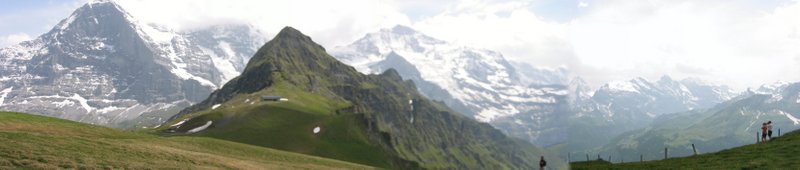
Even 30 secs is late for Swiss trains. They have remarkable punctuality. I’ve spent time visiting various places throughout the country when I’ve had a weekend to spare during my business trips. Bern is a good base with excellent rail connections. Close by is the Jungfrau, and although I’ve not taken the train to the summit, I have twice been on the funicular up to Wengen (starting the journey in Interlaken), then the cable car up to Männlichen where there is a fabulous view of the Alps (Eiger on the left). From Männlichen you take the cable car down to Grindelwald, and then the train back to Interlaken.

The view from Männlichen, with the north face of the Eiger on the left.

Then there was the weekend I decided to see the Matterhorn in May 2004. Leaving Bern early in the morning, we headed through the Alps to Brig where I transferred to the local line up to Zermatt. What a fabulous day out – made even better by the train journey!

High speed journeys
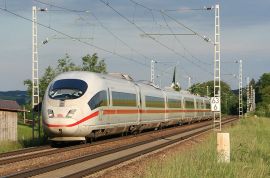
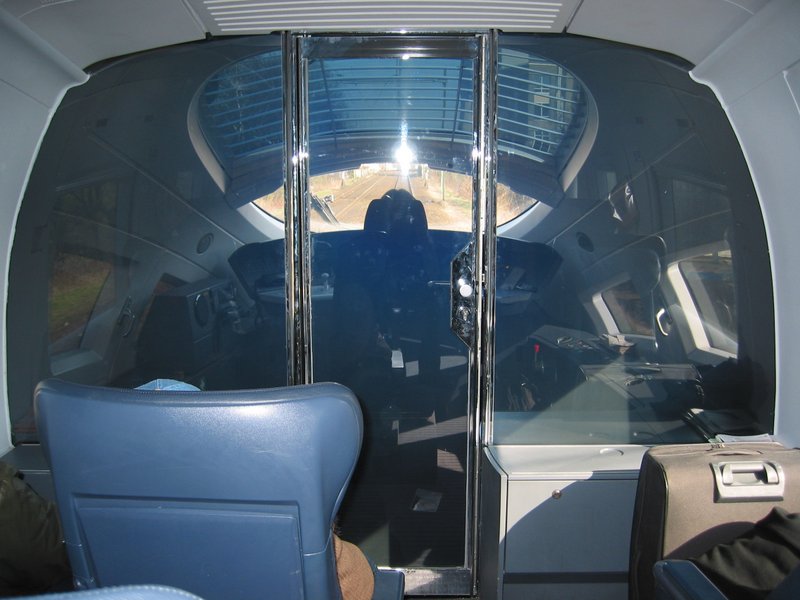
Eurostar, Thalys or TGV. There’s something impressive about these high speed trains across Europe. I’ve been through the Eurotunnel a couple of times, and joined the Thalys (Belgian equivalent of the TGV) to Cologne or Amsterdam (and return). The German ICE (shown here) is incredible – fast, silent and very comfortable. I took this the first time from Amsterdam Central to Cologne, and had a seat just behind the driver’s cab. When he didn’t want to be distracted the driver could make the glass screen turn translucent. Otherwise it was fun watching the train eat up the kilometers from the driver’s perspective.

One thing I do remember from my first TGV from Paris-Gare de Lyon to Montpellier, is the speed we reached south of Paris to Lyon, over undulating terrain. It was the first time I had that sinking feeling on a train – just as in a plane descending – as we went over one hill and down the other side. South of Lyon, the TGV proceeds at a more stately pace since the line follows the river.

Yangon to Yezin, Myanmar
I visited Myanmar (Burma) just the once in about 1997 – I don’t remember the exact year. I had received a grant from the Swiss government of more than US$3.3 million to develop and manage a project to collect and conserve rice varieties and wild species in South and Southeast Asia and sub-Saharan Africa. Although Myanmar had been essentially closed to the outside world for many years, IRRI had retained a presence there, with a liaison scientist and small office. Given the importance of rice in that country, it was appropriate to see what might be done in terms of collecting rice germplasm. So with my colleague Eves Loresto we  traveled the 250 miles or so north from Yangon (Rangoon) by train to Yezin where the Central Agricultural Research Institute (and university) is located, with its large rice genebank. Our outward journey was during the day, and although very slow (about 10 hours) it was interesting traveling through the vast plain of rice paddies. Several times the train was reduced to a snail’s pace as the track was flooded. We returned to Yangon a few days later by the ‘sleeper’ – I use that term advisedly, because I didn’t get much sleep and the accommodation wasn’t exactly desirable. At Yezin we had to evict a group of about five passengers who had commandeered our cabin.

Melbourne – Sydney
On Christmas Day 2003 Steph and I flew to Sydney, arriving the following morning, Boxing Day. We spent a couple of days looking round the city (we’d been there for the first time in December 1998 and saw the New Year in watching the fireworks display over the Sydney harbor bridge).

Anyway, on this second trip, we took a memorable road trip to Melbourne (about 1,000 miles) along the coast road with several diversions inland. After a couple of days in Melbourne we returned to Sydney by train. It was scheduled for about nine hours, but due to the heat (>40C) between Albury on the Victoria-New South Wales border and Wagga Wagga (in NSW) (about half way through the journey), the train speed was seriously reduced because the track was buckling. Instead of arriving in Sydney at around 5 pm, we didn’t get in until after 10 pm. An interesting but rather tiring journey. Thankfully we had a couple more days to recover, enjoy a evening Sydney harbor dinner cruise (courtesy of Hannah and Philippa) before flying back to the Philippines.

One regret
One regret I do have is that I never traveled by train from Lima on the coast of Peru to Huancayo, crossing the Andes at over 16,000 feet at Ticlio (at 11:20 in the excellent video by takyvlaky on YouTube below). I used to travel by road to Huancayo almost weekly when I lived in Lima in the early 70s. The road and railway climb up into the Andes almost side by side, as you will see at various points in the video.

The wonder of steam
Wonderful as the train journeys were that I have described, there’s nothing quite like a journey on a steam train. Near where I live, the Severn Valley Railway – a heritage line from Kidderminster to Bridgnorth via Bewdley – has hundreds of thousands of visitors each year. I made this short video in 2008 when I was back in the UK on home leave.


I just had to include the next video that I found on YouTube, celebrating the Age of Steam.


Capes, coves . . . and endless beaches – the beauty of Oregon

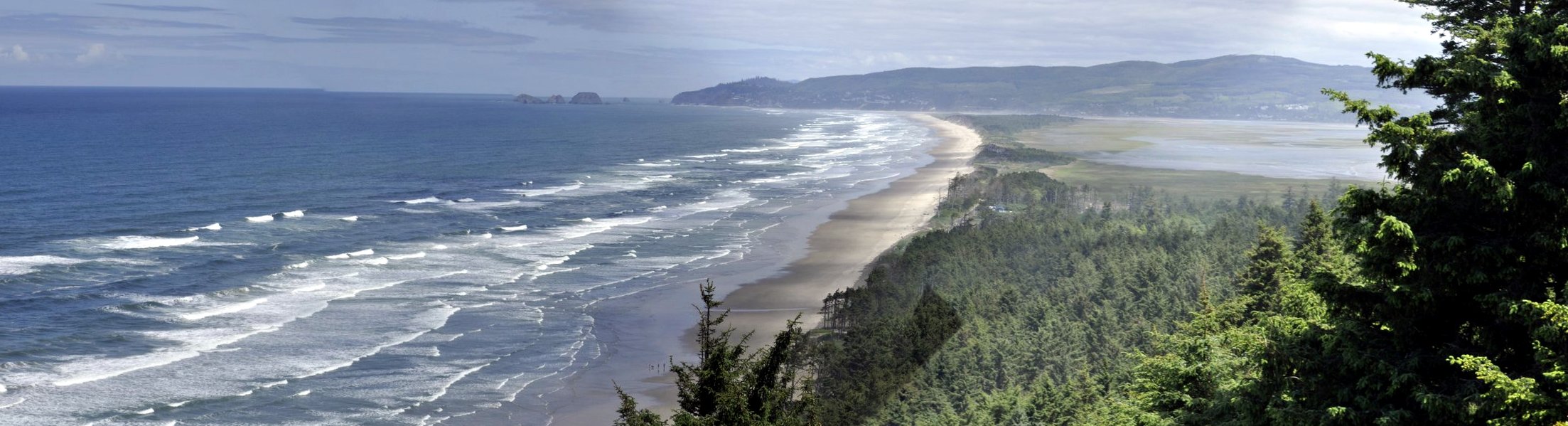
From Cape Lookout, looking north to Cape Mears

From Cape Lookout, looking north to Oceanside, and Cape Mears beyond

We hadn’t planned on a beach vacation in Oregon this year, but Steph and I had mulled over the idea of a road trip from San Francisco to Seattle, and returning to the Twin Cities from there by train. Just a whim of mine.

For the past three years we’ve tried to make a ‘side trip’ away from St Paul when we travel to the USA to visit Hannah and family. In 2011, it was ‘canyon country‘; last year it was the Minnesota Riviera. Then Hannah told us about a beach house on the Oregon coast that was available for rent, and that was it: vacation agreed, and planned. Well, not quite. In addition to the week at the beach, Steph and I traveled south to Crater Lake in Oregon, and then on into northern California to see the majestic coastal redwoods, following US101 most of the way. This is the route we took.

So on 8 June we boarded our 3½ hour Delta flight from MSP to Portland, and then it was a 110 mile drive (a little under two hours) to the coast. Our beach house was just outside and to the north of the coastal community of Oceanside (just south of Cape Mears), and about nine miles west of the nearest large town Tillamook, the cheese capital of Oregon. That in itself was an interesting trip, passing through the Coastal Range, a rather winding road, and suddenly emerging into this coastal plain that is Tillamook.

It didn’t take long to determine this was a dairy farming center; just a quick sniff and the presence of lots and lots of cows could be detected in the air.

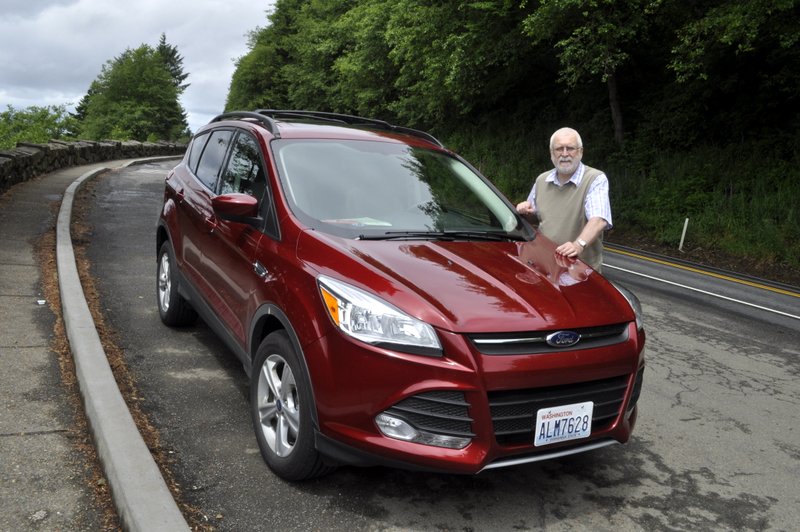
I’d originally booked a standard saloon rental with Budget, but agreed an upgrade to an SUV – a Chevy Captiva. Nice vehicle, spanking new, only nine miles on the clock. But after a major system failure a couple of days later (a known Chevrolet problem for a number of years – just Google ‘Chevrolet’ and ‘Reduced engine power’) Budget replaced it with a Ford Escape, and had it delivered to Oceanside from Portland.

Our beach house had a fabulous view out over the Pacific Ocean. And while we thought this was pretty spectacular, it wasn’t necessary to travel far to see some more pretty impressive landscapes. US101 hugs much of the Oregon coast, snaking around jagged headlands, soaring above others before plunging to stretches of beach that seem to stretch into the distance forever. In places this road seems no wider than a country lane, occasionally becomes a divided highway, or at least two lanes for the uphill traffic. Sandwiched between the cliff edge and the mountains, surrounded by trees, with the occasional glimpse of the coast far below, or at the many viewpoints, this has to be one of the most spectacular road trips on the west coast.

The wind blows constantly, the waves roll in incessantly, and the eye is drawn to the horizon – next stop Japan or the Philippines (where we lived for 19 years). While it was mostly bright and sunny during our stay in Oregon, there were times when the sea mists rolled in, giving the landscapes a rather mysterious ambience. We didn’t see any whales, although the coast off Cape Mears is a well-known whale watching spot at certain times of the year. But there were plenty of seabirds, and some sea lions.

Around the world in 40 years . . . Part 6. Trekking the red wine trail

Discovering German red wine
It was February 1997. Steph joined me on a work trip to Laos, and we were returning to the Philippines via Bangkok where we’d spent a couple of nights. We checked into our Lufthansa (LH) flight, and went off to the lounge. Since I had a stack of air miles, I’d treated Steph to an upgrade to Business Class.

When we checked in at the gate, our boarding passes were exchanged for a couple of seats in First Class, so we enjoyed the three hour flight back to Manila as almost the only passengers on the upper deck of a 747-400.

I used to fly with Lufthansa a lot in the 90s. In many ways it then had the best flight connections into Europe, and as I used to travel to Rome quite frequently, LH was my airline of choice. So I was quite used to the Lufthansa cabin service. But on this flight I was offered something I’d never tried before – a German red wine. The purser even gave me a couple of bottles as I left the flight in Manila. Of course I’d often sampled several of Germany’s white wines previously. But a red wine was quite a novelty.

The Rotweinwanderweg
Then, a few years later I discovered that there’s one wine region in Germany – the Ahr valley – that’s famous for its red wine. Lying to the west of the Rhine, and to the south of Bonn, the Ahr valley is one of Germany’s smallest wine producing regions. But what excellent wines it produces, principally from the Pinot Noir grape.


The town of Ahrweiler, near the mouth of the Ahr Valley, is shown in this gallery:


So how did I come to discover this oenological treasure? Well, it was through my good friend and plant pathologist, Dr Marlene Diekmann, who I first met in the early 90s on one of my trips to the International Plant Genetic Resources Institute (IPGRI – now Bioversity International) in Rome. Marlene left IPGRI and moved to Aleppo in Syria to join a sister CGIAR center, ICARDA where her husband Jürgen was also the farm manager. After Marlene left ICARDA and returned to Bonn, to join the German overseas development assistance program, our paths crossed again when I attended my first annual meeting of the CGIAR after I’d become IRRI’s Director for Program Planning and Communications in 2001.

Thereafter, whenever I had to travel to Europe to visit the donor agencies supporting IRRI, and if Germany was on my itinerary, I’d try and arrange a weekend in Bonn. And that’s when I was introduced to the wonders of the Ahr valley, its wines, and the Rotweinwanderweg – the Red Wine Hiking Trail. The photos in this gallery were taken along the trail above the small town of Dernau:


Above the town of Dernau, there are kilometers of trails through the vineyards. The vines are grown on extremely steep slopes, as you can see in the photos above. Heaven knows what effort it takes not only to harvest the grapes each year but also to till the soil. If I remember correctly, Marlene told me that the farmers contract helicopter pilots to spray the vines when necessary – it certainly wouldn’t be feasible to walk up and down the lines of vines trying to apply pesticides.

I’ve seen the vineyards along the Red Wine Trail in all seasons. And after a nice long walk, I’ve also enjoyed the liquid output from the vineyards, on several occasions.


This is truly a wonderful part of western Germany, and it’s well worth a visit if you happen to be in the vicinity. I look forward to returning one day, and also getting to know the Rhine vineyards in more detail.

Around the world in 40 years . . . Part 4. Elections and bombs in Jo’burg

Nelson Mandela has been much in the news of late. His failing health is of concern not only to South Africans; ‘Madiba’ is highly respected worldwide. Seeing these images on TV and hearing the latest news reminded me of my visits to South Africa and other countries over the years. But there’s one visit – I was in transit actually – that I’ll never forget.

In April 1994, I had been asked by the Directors General of IRRI in the Philippines and WARDA (now the Africa Rice Center) in the Ivory Coast to undertake a review of a very important rice breeding network called INGER – the International Network for the Genetic Evaluation of Rice. As I was also developing a major rice biodiversity project to be funded by the Swiss, I decided to take the opportunity of this trip to Africa, and visit possible collaborators in Zambia and Kenya. Looking at the various flight options – none very easy at that time, but considerably better today – I chose a flight with Singapore Airlines into Johannesburg, and on to Lusaka with South African Airways (SAA).

On board my SQ 747-400 at Changi, I was slightly perplexed that there were so few passengers on board. I was seated on the upper deck in Business Class – and the only passenger. I asked the purser who confirmed that there were only about 20 passengers in total on board. And he went on to explain that the following day when we landed in Johannesburg – 27 April – was the first post-apartheid election, which Nelson Mandela and the Africa National Council (ANC) were expected to win. Because of several bombing incidents around South Africa leading up to the election there had been a drop in passenger traffic on SQ. Election on the day of my arrival? Well that one had gone completely over my head when I was planning the trip.

35754-april-27-1994-e237fWe landed in Jo’burg in the early morning, and I made my way to the SAA lounge. I prepared myself a little breakfast – some juice, a Danish, perhaps, nothing heavy – and settled down to watch news of the election on the TV. My flight to Lusaka was scheduled around 11 am if I remember correctly, and this was around 0730 or so. Of course the highlight was watching Nelson Mandela cast his vote, and afterwards he appeared on the steps of the polling station to make a statement.

BOOM! An enormous explosion, and the whole airport terminal shook. I realized at once that a bomb had gone off – and right above my head. It took several minutes for anyone to advise us what had happened and what to do. We were told to stay in the safety of the Business Lounge until further notice. At which point, I got a ‘call of nature’ and had to find a rest-room, and quick. I’d been there for only a couple of minutes, when I heard someone shouting in the lounge ‘Everyone outside, now!’ Well, I was in a pretty pickle, I can tell you. Someone came into the rest-room to check if anyone was there, and I was told to get out as quick as possible. We were led through the departure hall – which was pretty much destroyed – and on to the grass outside. Fortunately it was an early autumn morning, bright and sunny, but a little chilly at the beginning. It seems that there had been an Afrikaner backlash, and a car bomb had been placed outside the departure hall.

Here’s what was written in a US Department of State dispatch: There were a number of serious incidents of domestic political violence in the run-up to South Africa’s first multiracial election in April 1994. There was also one act of international terrorism on 27 April when members of the right-wing Afrikaner Resistance Movement (AWB) detonated a car bomb at the Jan Smuts Airport in Johannesburg. The bomb injured 16, including two Russian diplomats and a pilot for Swiss Air.

The airport didn’t close, and the domestic terminal kept operating more or less normally; international arrivals were diverted there. After a couple of hours we were taken back inside, and my SAA flight to Lusaka was delayed by only about 30 minutes.

But that is my memory of the election that Nelson Mandela won in 1994. It’s hard to believe that he’s been out of the political limelight already for more than a decade.

Around the world . . . in 40 years. Part 2. Winter days in Santiago

During the years that I lived in Lima (1973-March 1976) I didn’t visit any other country in South America. However, once I moved to Costa Rica in April 1976, I traveled extensively in Central America, Mexico, and out to the Caribbean islands (more of those in a later posts). And from Costa Rica I also made my first excursions to Brazil and Chile; while I was working in the Philippines, I also got to travel once again to Brazil and Peru on more than one occasion, and also to Caracas, capital of Venezuela.

But let me tell you about a visit to Santiago in Chile during July 1979 while I was working for the International Potato Center (CIP) in Costa Rica.

Nelson Estrada

Nelson Estrada

I was asked by my boss in Lima, Ken Brown, to join a small team (with two CIP colleagues Drs Oscar Malamud and Nelson Estrada, who worked in Lima) to review some of the activities and strategy of the Chilean National Potato Program (INIA, the government agricultural research institute). While the potato growing regions of Chile are south of Santiago, the five day review was scheduled only for office and laboratory visits in the capital.

I flew down to Santiago from San José via Panama City, picking up an overnight LAN Chile flight in Panama. It had just the one stop en route – in Lima, where I had the opportunity of phoning my boss at CIP and telling him I was on the way south. I had traveled down from mid-summer in Costa Rica to mid-winter in Chile, and it was quite a shock to the system. I hadn’t experienced a cold climate for several years, seeing all the trees bare of leaves, and a nip in the air. There were also street vendors roasting chestnuts in Santiago.

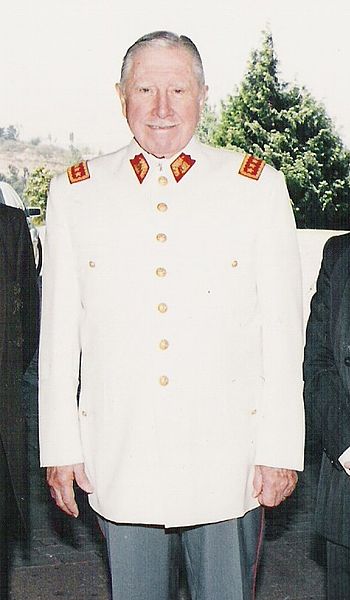
Arriving in Santiago around noon, an INIA driver took me to my hotel, and agreed to pick me up later that evening to return to the airport to meet my two Lima-based colleagues, whose flight was arriving at about 8.30 pm. That evening at the airport, I was a little puzzled why it was so busy as there didn’t seem to be many flights departing or arriving.  I decided to go outside and have a look at the airport apron (something you could do in those pre 9-11 days), and I saw there was quite a large crowd, that spontaneously broke into applause. It was then that I saw Chile’s dictator, General Augusto Pinochet, stepping down from his air force plane that had just arrived, and being met by government officials – and a large crowd of fervent Pinochet supporters had gone to the airport to greet him. This was less than six years after he had seized power in a coup that toppled the democratically-elected government of left-wing politician Salvador Allende in September 1973. And we all know what horrors that led to in Chile. But Pinochet’s government was firmly in control in 1979 – everything seemed calm in Santiago.
I don’t actually remember too much about the potato program review – it must have gone quite well, because on the last evening the head of INIA took us all to a very fine restaurant called Enoteca. Now I’ve looked for this restaurant on the web, and it looks like it’s undergone some major changes since I was there more than 30 years ago. The restaurant was also a ‘Chilean wine library’, housed in an old monastery, on a hill overlooking the city. It was  a fantastic view, and the meal was excellent. In the basement, all the wines produced in Chile were on display, available for tasting, and you could then choose one (or more) to have with your meal. Is it now called the Camino Real, on the Cerro San Cristobal in the Parque Metropolitano?

But what I remember most was the entertainment. In those days I spoke quite fluent Spanish – it’s still there in the recesses of my brain, but a little rusty. These two musicians, with guitars, wearing short dark jackets, broad black hats, came into the room and began to sing, moving between the tables, asking for requests, and stopping to chat with the guests around each table. At our table were our Chilean hosts, of course, and my two colleagues and me. What I’ve forgotten to mention is that Oscar and Nelson were Argentinian and Colombian, respectively. The musicians greeted and welcomed each of us, but with Oscar they had some fun. In 1979, tensions were still high as Chile and Argentina had been to the brink of war in 1978 over the Beagle Channel in the far south of both countries.

So‘, says one of the musicians to Oscar, ‘from Argentina, eh? Welcome, welcome. And isn’t it stupid‘, he continued, ‘that two great countries like Chile and Argentina, with very similar traditions and history and background, should be on the verge of war. I have this vision‘ he emphasized, ‘that one day our two nations will be united, and called Chile!

It brought the house down. Doesn’t translate so well into English, but at the time, we almost fell off our chairs we were laughing so much.

There are two other things I remember particularly about this trip. First, I was meandering down one of the main shopping streets when I heard ABBA’s Chiquitita for the first time, emanating from a record store – it had just been released. But my two colleagues didn’t go shopping for souvenirs like me. Instead they headed to the nearest butcher and bought enough beef, securely wrapped in plastic bags, to fill a 20 kg suitcase each. In those days there was a shortage of beef in Lima.

My stay in Chile was all too short. I would love to return, and visit the regions south of Santiago where Chile’s great wines are produced, to visit the potato growing areas around Puerto Montt, and close to one of the centers of origin and diversity of the potato, the Isle of Chiloé, and further south still to the land of snow-capped peaks, glaciers,  and fjords.

When you’ve heard one bagpipe tune, you’ve heard them both . . . (Jack Finney) – updated 7 November 2018

Bagpipes are maybe an acquired taste.

For many Scots the skirl o’ the pipes is a profoundly cultural expression, but bagpipes are not – contrary to popular perception – a peculiarly Scottish ‘invention’. Indeed, many countries have their own indigenous varieties, and the Scottish version has been adopted widely around the world. Macalester College in St Paul, Minnesota, where my elder daughter Hannah graduated in 2000 has its own pipe band, and many of its staff and student members have little or no ‘cultural’ attachment to the instrument. The band is very much in evidence during annual commencements and at other events in the state.

Pipes are a very emotive and emotional instruments. I am actually quite fond of the sound of bagpipes, and can confess to the odd raising of hairs on the back of my neck when hearing a pipe band, or even a lone piper playing a pibroch. Besides the Scottish pipes, I particularly love the softer sound of the bellows-blown Northumbrian small pipes, outstanding in the hands of a virtuoso piper like Kathryn Tickell.

And, of course, there are the Irish or uillean pipes, also bellows-blown. Maybe it’s in my Irish genes, but the sound of the Irish pipes in the hands of someone like Paddy Maloney of The Chieftains never ceases to inspire me.

November 2018 update:
Just yesterday I came across a couple of videos on YouTube that really caught my attention, and inspired me about the talent of so many young musicians. Here are just a couple of examples featuring young female pipers. And in both videos they play the same air, Táimse im’ Chodladh, but their styles are quite different.

Amy Campbell is a blind musician from Ireland who has really taken to the uillean pipes. In this video, recorded in 2016 (when she was sixteen) at the Kennedy Center in Washington, DC she is joined by pipers Gay McKeon (on the left in the video) and Emmett Gill. She plays pipes without the drones that you can see played by the other two. McKeon teaches blind children how to play [and] noted what an amazing achievement it was for Amy.

Amy has a condition known as optic nerve hypoplasia, a genetic condition that carries with it a many other medical challenges. In this video she talks about her love of piping.

Having watched that video, YouTube then ‘offered’ me another featuring Catherine Ashcroft, playing in Northern Ireland in 2014.

There are two very interesting facts about Catherine. First, she’s self taught, and that must have been a great challenge to master such a notoriously difficult instrument. Second, she’s English, from Cumbria in the north of England. She has no Irish piping heritage to fall back on.

Performing with Belfast guitarist and singer Maurice Dickson as Mochara, Catherine has made a name for herself on the folk scene in the UK. I also read that she was invited to tour with Riverdance in China. Some pipes purist aficionados think her piping a little brash (my interpretation of their comments), but all acknowledge her skill and talent, and given a few more years experience will develop into an even finer piper. I’m impressed (and a little envious)!


Strakonice International Bagpipe Festival
I’ve mentioned bagpipes in a couple of previous posts about morris dancing, and my first trip abroad. Now let me recount that visit to Strakonice in Czechoslovakia in September 1969 to attend the Second International Bagpipe Festival (Mezinárodní Dudácký Festival). Czechoslovakia has a long tradition of bagpiping, and one of the foremost pipers, and founder of the Strakonice Festival, is Josef Režný

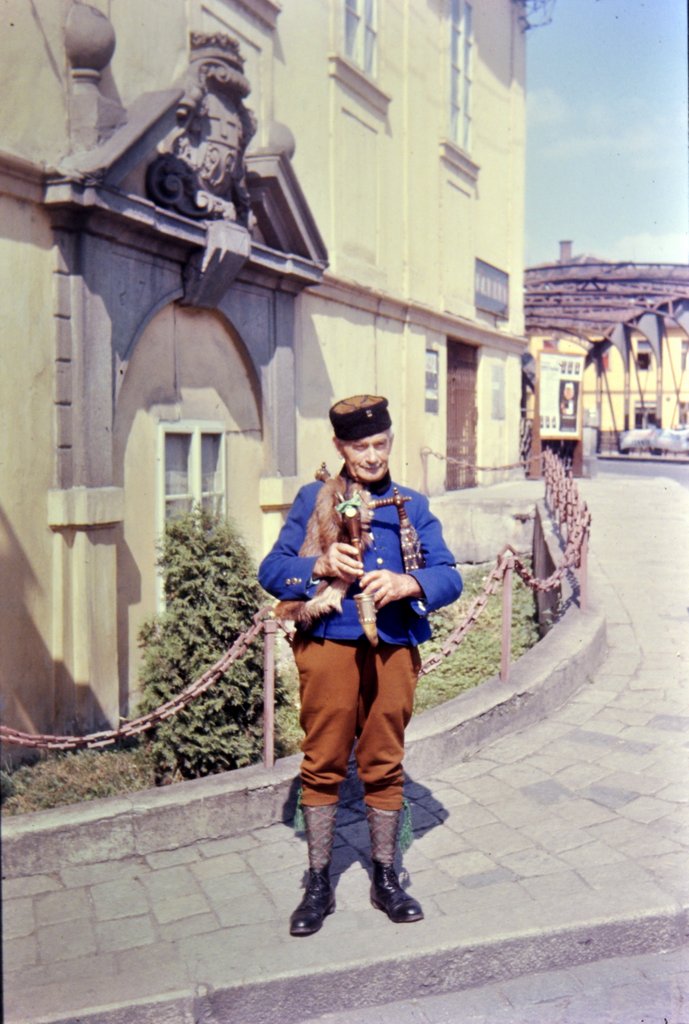
I think this is Josef Režný

Forty three years later the festival is still held every two years, with the latest taking place in August this year.

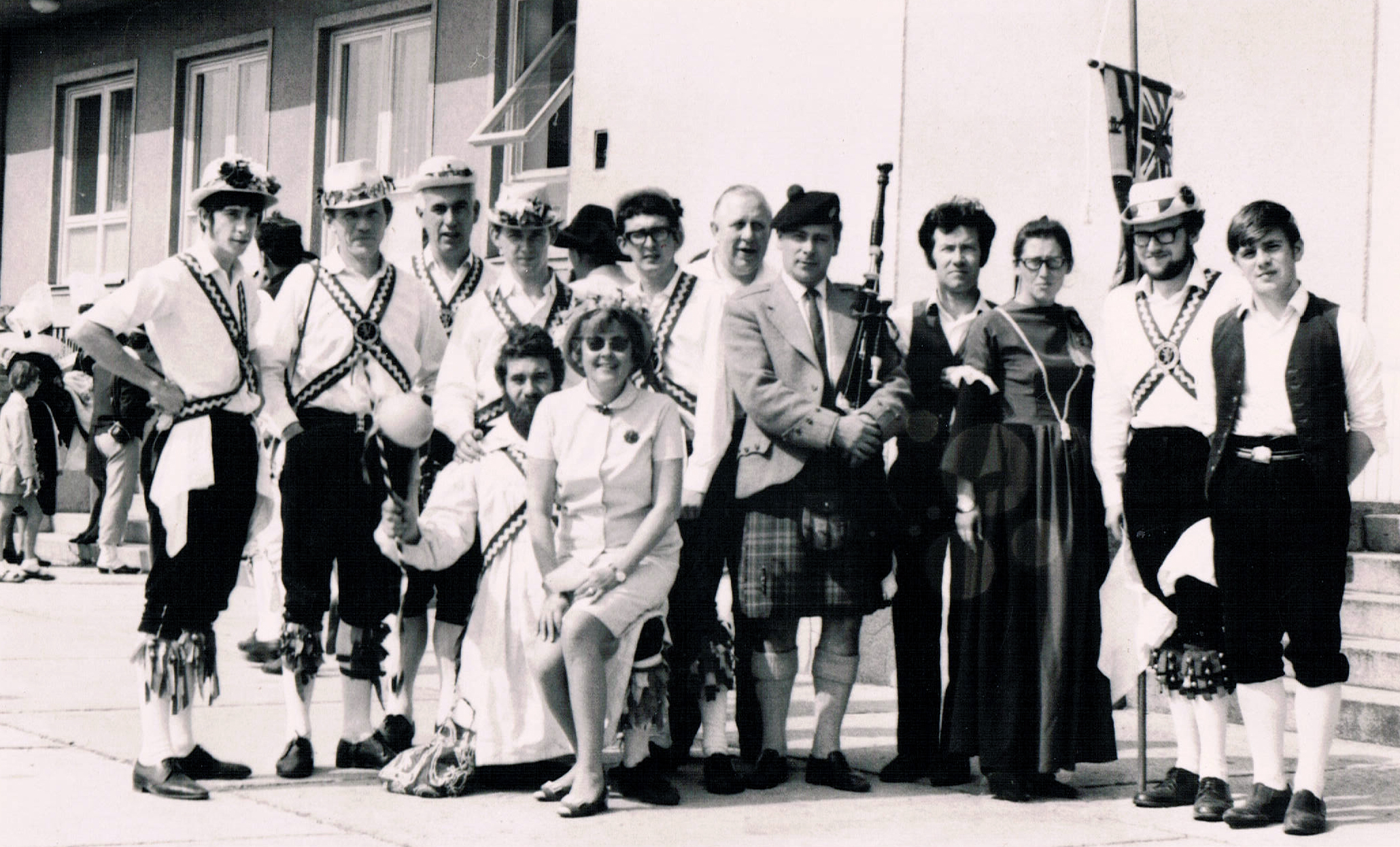
However the festival is not just about piping as such, but also about pipe music as an accompaniment to folk dance. I joined a group of pipers and dancers from Newcastle upon Tyne in the northeast of England (along with two fellow dancers from Southampton University – Dr Joe Smartt and Russell Meredith) organized by renowned Northumbrian piper Forster Charlton. The group also comprised fiddler and piper Colin Ross [1] of High Level Ranters fame, and his wife Ray Fisher, a well-known and respected Scottish folk singer (formerly dueting with her brother Archie Fisher).

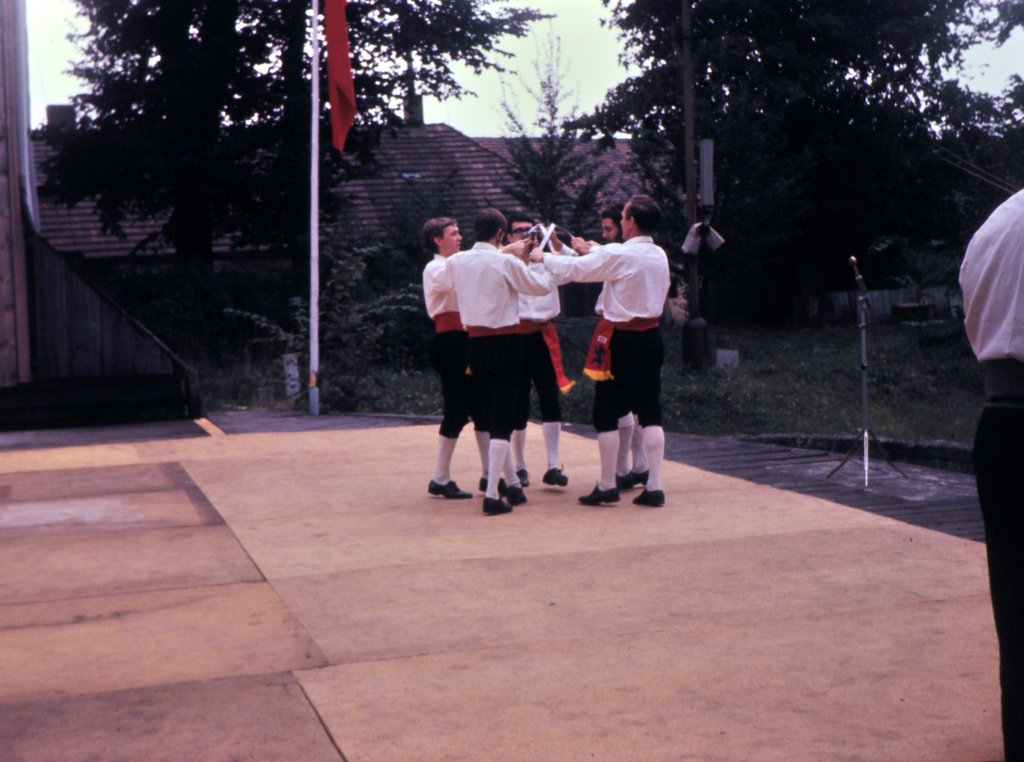
Joe, Russell and I landed in Newcastle one weekend in early September, were met at Newcastle Central by Forster, and taken to various abodes for the weekend. Meeting up that first evening, we agreed that we would put together sides to dance Morris and rapper. Now although neither of these traditions are performed to pipe music, it was one way of showing something of the dance traditions of England, besides having world-class pipers in the group.

We spent the weekend dancing around the working men’s club in colliery towns and villages near Newcastle, and I was introduced to the rigors of rapper sword dancing. The rapper dance steps are quite intricate – think of tap dancing or maybe even Riverdance, and you’ll get the idea – and I had no idea before that weekend of what was involved. I quickly learned the various moves, but the stepping alluded me for quite some time. Overhearing one old timer in one of the clubs criticizing my lack of stepping ability, one of the team – Les Williamson – quickly explained that I’d only been dancing rapper for a couple of hours. I think the old fella was quite impressed!

Traveling to Czechoslovakia
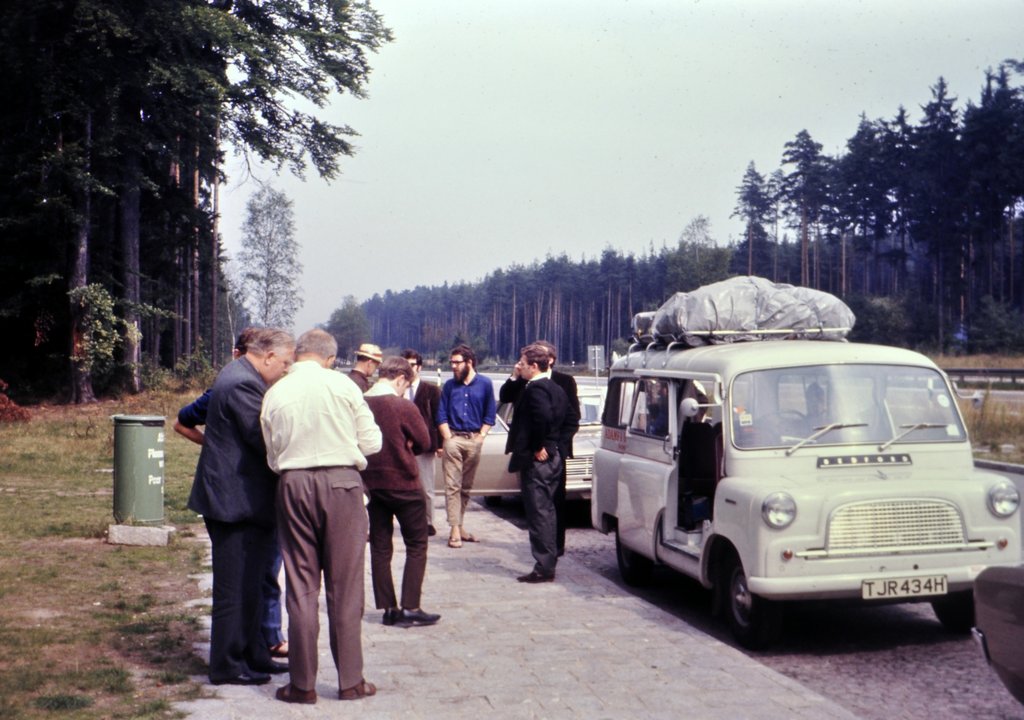
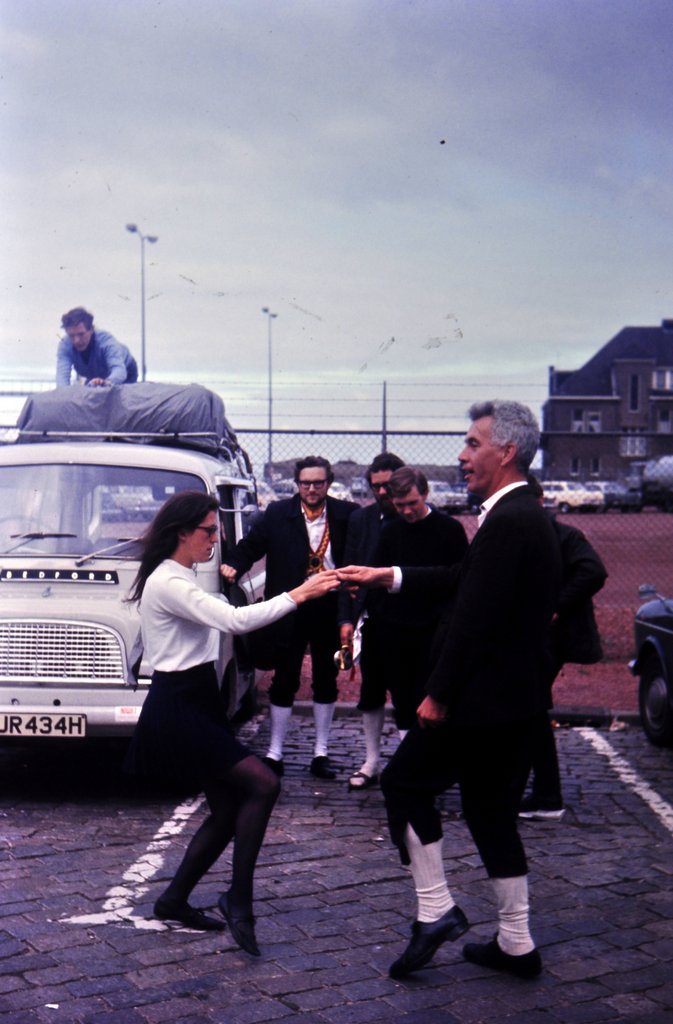
On the Monday we set off in an old Bedford minibus and a car for Harwich to take the overnight ferry to the Hook of Holland, and the 970 km drive from there to Strakonice. We were rather bleary-eyed in the Hook of Holland, but that didn’t stop some impromptu dancing on the quayside.

Ray Fisher and Joe Smartt dancing an impromptu jig on the quay at Hook of Holland

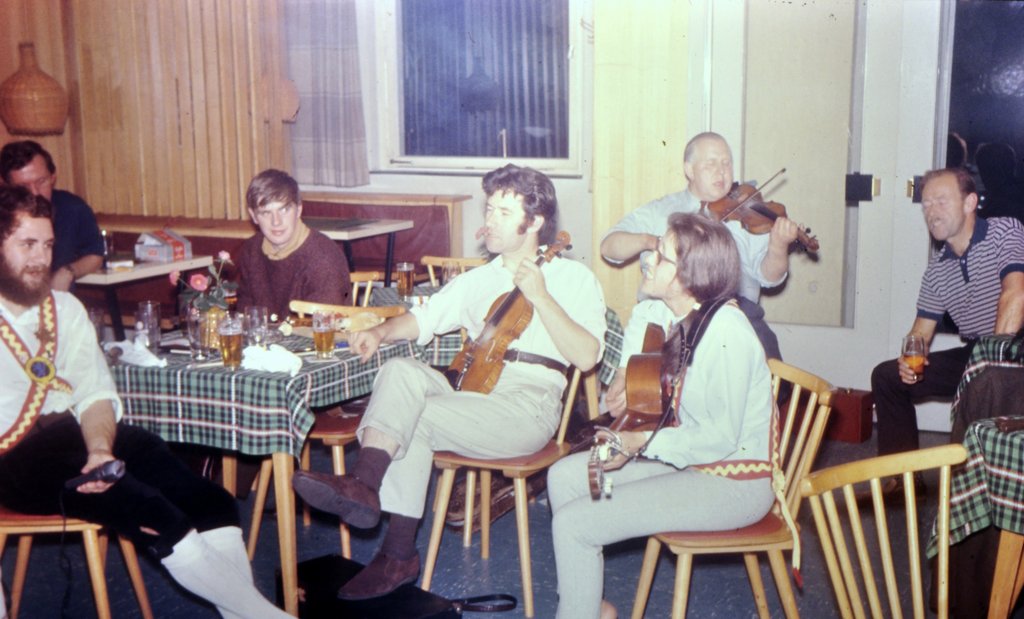
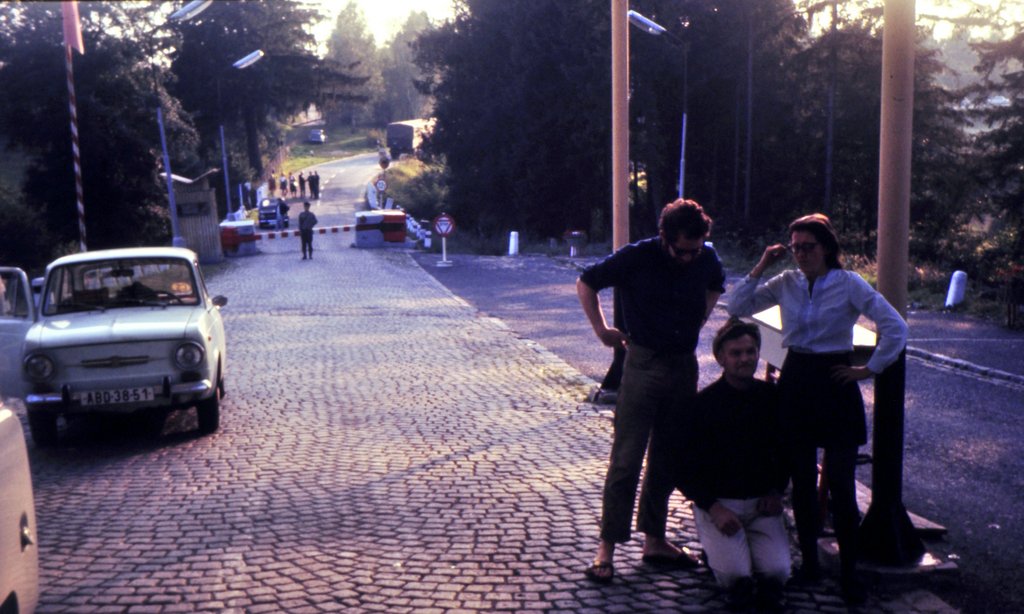
We stopped for a night in a hostel in Offenbach near Frankfurt, continuing on the next day via Nuremberg and into Czechoslovakia (now the Czech Republic). Those were pre-Schengen days when we were stopped at the German border and informed, in no uncertain terms, that we should pay a special road tax or turn around and go home. Crossing into Czechoslovakia (a Communist country, just one year after the Soviet invasion after the Prague spring of 1968) was not as difficult as I guess we all had anticipated.

At our overnight stop in Offenbach, near Frankfurt, with Colin Ross and Forster Charlton on fiddle, and Ray Fisher playing the guitar

Crossing into Czechoslovakia

Impressions
Our accommodation was not in Strakonice itself, but in a small village about ten or more kilometers away. Not that this was a problem, but since our participation in the festival was sponsored by the local brewery, the drive back at night (with wild boar crossing the road on one occasion) was not without incident. We had our midday and evening meals in a local factory, manufacturing textiles if I remember correctly. The food left a lot to be desired.

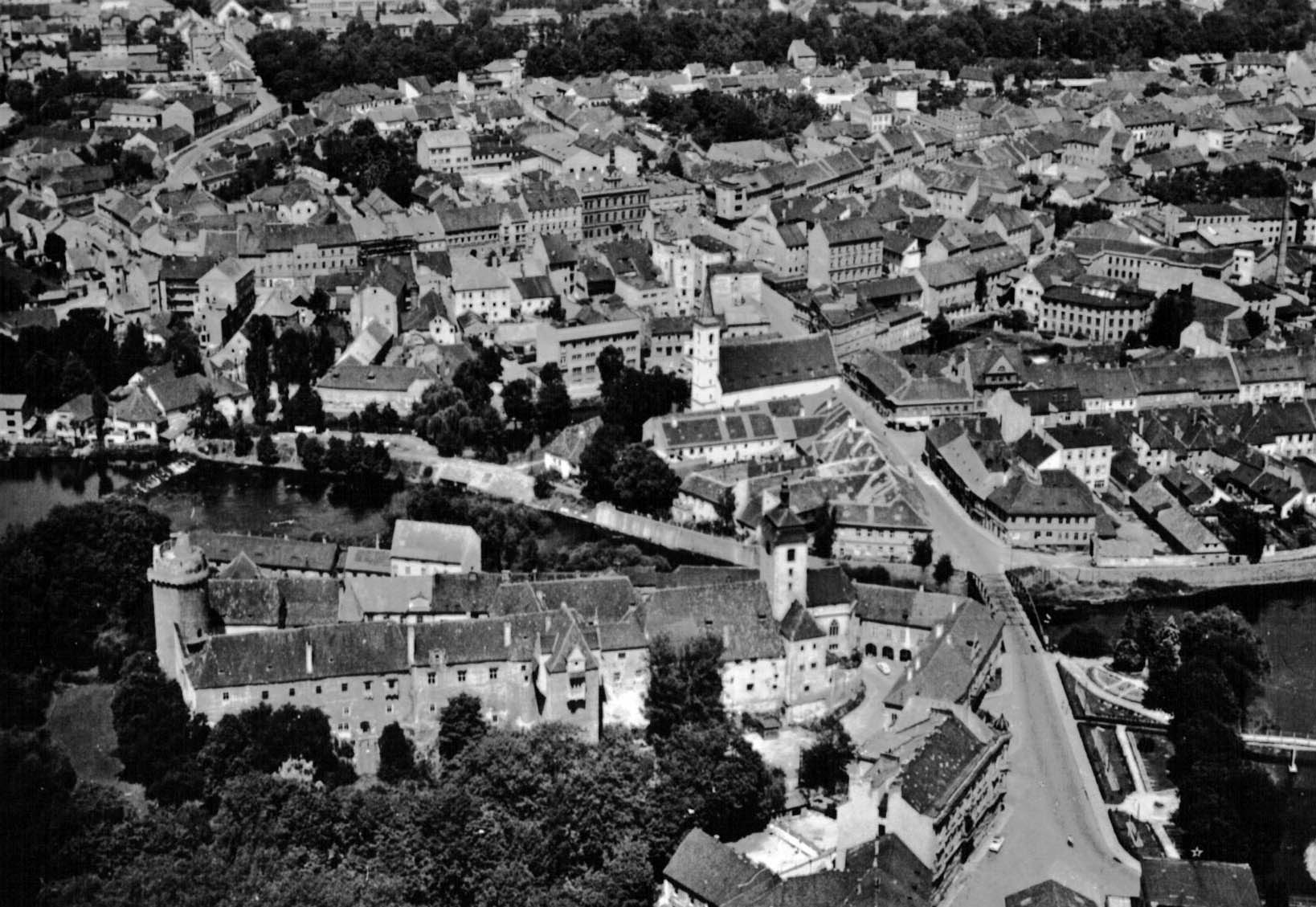
The castle is in the foreground

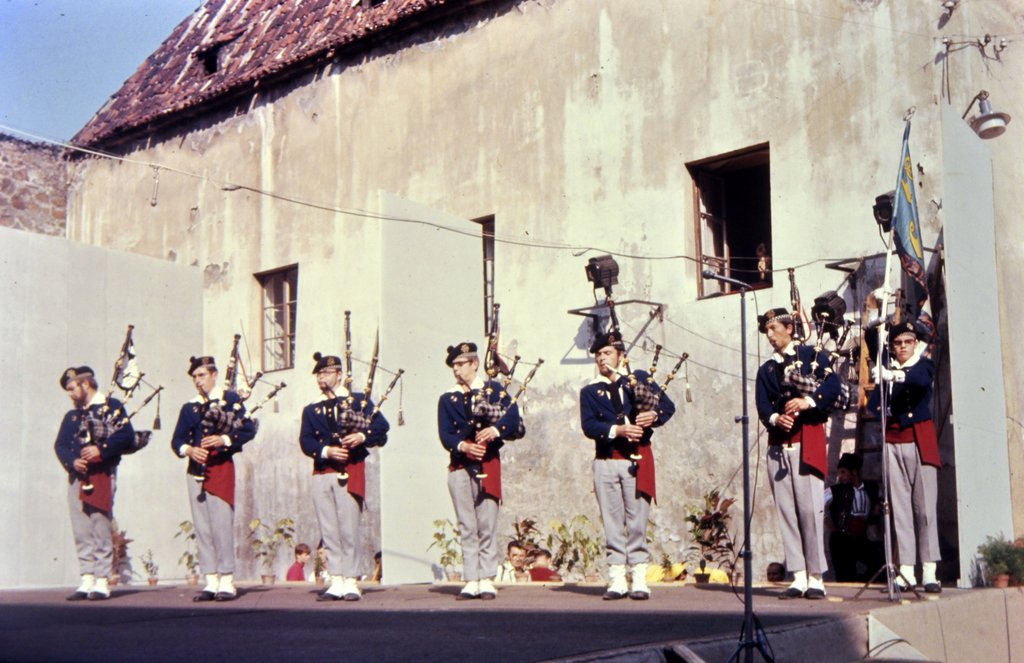
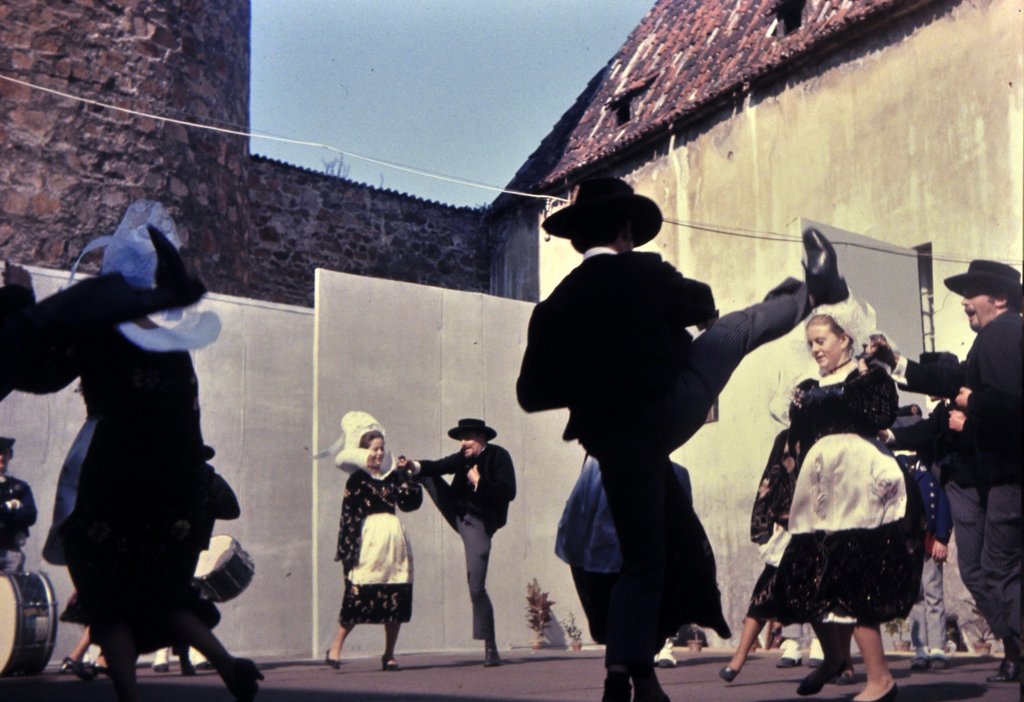
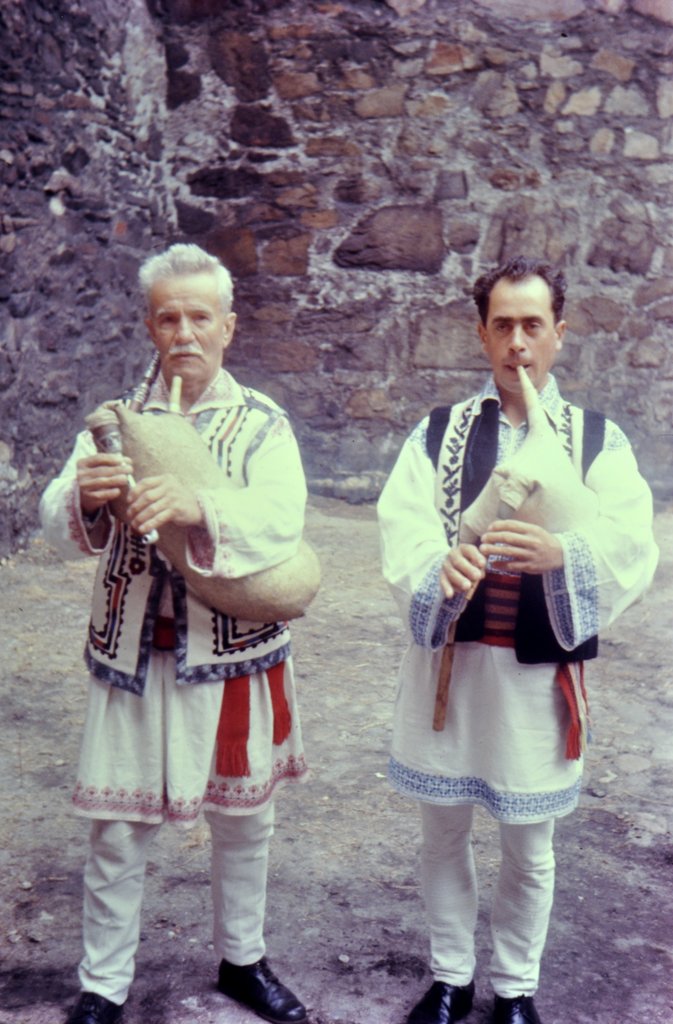
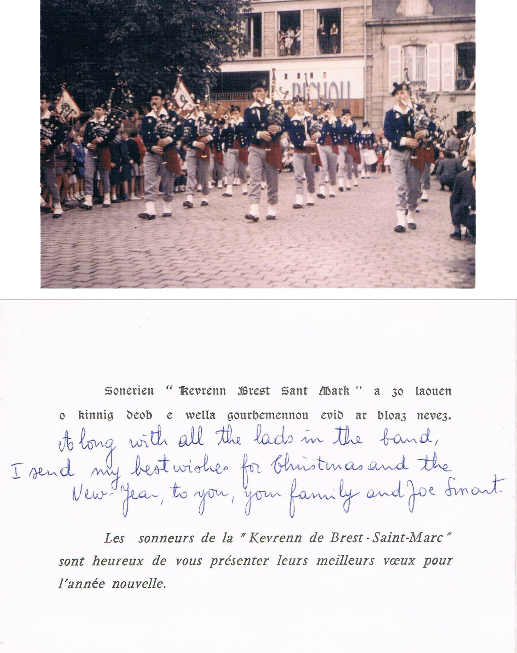
The festival itself involved both staged performances in the castle, as well as impromptu performances around the town. There were pipers and dancers from Brittany (from Brest and Concarneau), from Romania and Bulgaria, and from Czechoslovakia itself. The Brest pipe band, Kevrenn Brest Sant Marc, played the highland pipes, but the pipes from Romania and Bulgaria looked like the skin of a sheep for the bag, and the mouthpiece, drone and chanter fastened into the neck and front legs.

Kevrenn de Brest Sant Marc

Dancers from Concarneau, Brittany

Romanian or Bulgarian pipers

There was great camaraderie among all the groups, and lively competition. The highlight was the grand parade through the town, shown in the 2012 video above. The music and dancing were wonderful, especially the haunting Celtic melodies of the Breton band and dancers. It was great to be part of such a vibrant festival – and something quite unlike anything else I’d ever experienced.

Our rapper team – I’m on the far side, facing

On one occasion, each group was asked to send a delegate to a civic reception hosted by the town authorities. I drew the short straw, since the brewery sponsoring our stay had invited our group over to the brewery to sample some special lager they had prepared in our honor. I was disappointed to miss that, and to put up with what I expected to be a rather formal and somber afternoon of speeches. Yes, there were speeches, but there were also many toasts of very strong plum brandy or slivovitz from the mayor and his colleagues to us, but then becoming a free-for-all as each group member returned the compliment  and we began to toast each other. Needless to say it didn’t take long to become extremely intoxicated!

You can view a complete album of photos here.

All too soon our stay in Strakonice was over, and we headed west to the Hook of Holland and the ferry home. I kept in touch with Les Williamson for a couple of years, since we met through the Inter-Varsity Folk Dance Festival. The Strakonice rapper team formed the nucleus of the Sallyport Rapper that is still going strong today (click here and here for stories that mention the Strakonice trip). The leader of the Brest pipe band, Gilles, sent me some tapes of their music, and a Christmas card in 1969.

Almost fifty years on, the memories are still vivid of that first trip abroad.


[1] Colin passed away in 2019 after a short illness. Here is a short obituary. A few years ago, after I published this blog post, I managed to share it with Colin and we exchanged emails. It was a few months after Ray died.


Around the world . . . in 40 years. Part 1: Home is where the heart is.

The other day I was using TripAdvisor on Facebook to see how many countries I’d visited over the past 40 odd years, and was surprised to discover that it’s almost 90. Many of these visits were connected with my work one way or another. However, I’ve lived in three countries outside the UK:

  • in Peru from January 1973 to April 1976, and November 1980 to March 1981, with the International Potato Center (CIP), at its Lima headquarters; 
  • in Costa Rica, from April 1976 to November 1980, leading CIP’s regional program at that time, located at CATIE in Turrialba; and
  • in the Philippines, from July 1991 to April 2010, with the International Rice Research Institute (IRRI) in Los Baños, about 65 km south of Manila.

In this series of stories, I will recall many of the places I’ve visited, and my impressions. In this first part, I focus on Peru, Costa Rica, and the Philippines. I’ll add more images to all posts as and when I am able to digitize the many slides that I have in my collection.

First foreign forays
But first things first. Until 1969, however, I had never been outside the UK. In September that year, I joined a group of Morris and sword dancers from Newcastle-upon-Tyne to participate in a bagpipe festival at Strakonice in Czechoslovakia. It was a novel experience for me to travel across Holland and southern Germany by road, seeing new sights (and sites). But more of this in another post.

In 1972, I attended a genetic resources conference organized by EUCARPIA – the European Association for Plant Breeding Research, held at Izmir on the Aegean coast of Turkey, south of Istanbul – quite exotic. Together with a group of other students from Birmingham, I stayed at an olive research institute at Bornova, some miles outside Izmir, rather than at the comfortable hotel in the city center where the conference was being held. One thing I do remember was the daily breakfast – a plate of stuffed olives, some goat’s milk cheese, crusty bread, and a glass of tea. I was a much fussier eater in those days, and was not taken with olives – quite the reverse today! We did get to visit the ancient ruins of Ephesus – a magnificent city. I returned to Izmir in the late 70s while I was working for CIP, and there was a regional meeting about potato production.

Peru
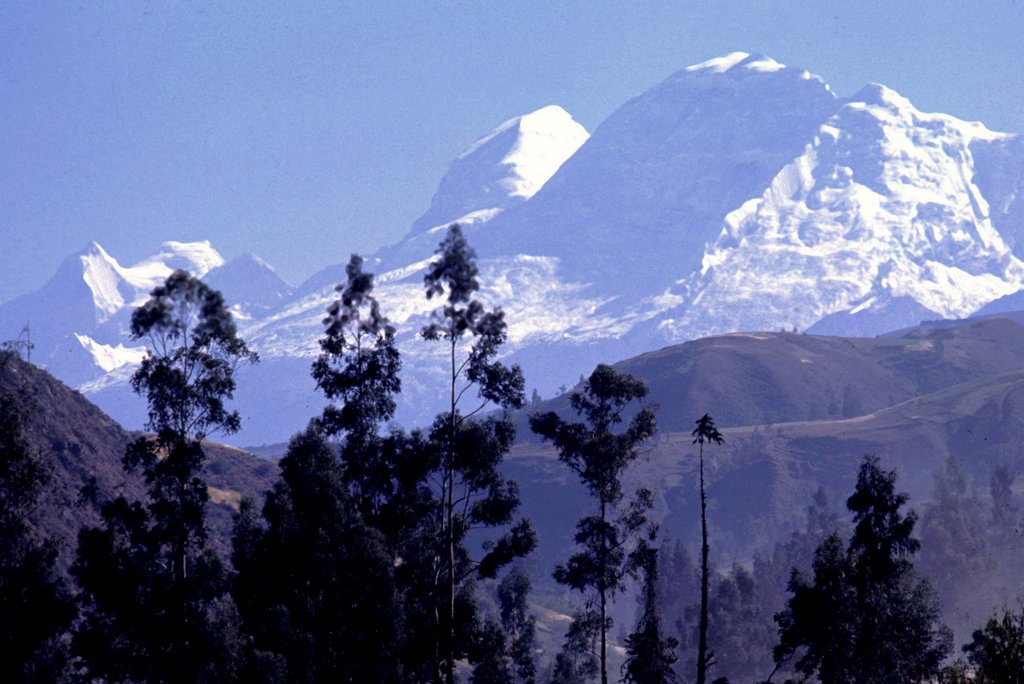
In January 1973 I moved to Lima, Peru, fulfilling an ambition I’d had since I was a little boy. Peru was everything I hoped it would be. It’s a country of so many contrasts. Of course the Andes are an impressive mountain chain, stretching the whole length of the country, and reaching their highest point in Nevado Huascarán (shown in the photo above), at over 22,000 feet.  Then there’s the coastal desert along the Pacific Ocean, which is bisected every so often with rivers that flow down from the mountains, creating productive oases, wet enough to grow rice in many places. And on the eastern side of of the mountains, the tropical rainforest drops to the lowlands of the Amazon basin, with rivers meandering all the way to the Atlantic Ocean, thousands of miles away.

Lima is a huge city today, with more than 8 million inhabitants; in 1973 it had perhaps a million or so. Situated in one of the world’s driest deserts, there is always a water problem. Goodness knows how the city authorities cope; it was a big problem 40 years ago. I first arrived to Lima in the dead of night and was whisked away to my pensión. It was a bit of a shock the following morning seeing all the bare mountains surrounding the city, even though I was staying in one of the more leafy and green suburbs, San Isidro. Flying into Lima in daylight, and driving into the city from the airport one is confronted by the reality of poverty, with millions now living in the shanty towns or pueblos jovenes that spread incessantly over the desert and into the coastal foothills of the Andes.

But Lima is a vibrant city, and the country is full of exquisite surprises. In 1973 there was a left-wing military junta governing Peru, and although there have been many democratically-elected governments since (and some more military ones as well) there was the major threat from terrorist groups like Sendero Luminoso and Tupac Amaru in the 80s that made travel difficult around the country. Between 1973 and 1975 when I lived there it was relatively safe, and my work took me all over the Andes, collecting potatoes for the germplasm collection at CIP, and carrying out research in farmers’  fields.

I visited Cuzco and Machu Picchu on a couple of occasions, and the market town of Pisac, as well as many of the archaeological sites on the Peruvian coast. Although I have traveled across the Nazca plain by road, and could see evidence of the famous lines even at ground level, I never did get to see them from the air – one ambition yet to be fulfilled. Getting to know Lima is a must, and visiting the many museums. The skyline of the second city Arequipa, in the south of the country is dominated by the volcano El Misti. And no visit to Peru is complete without a trip to Puno and Lake Titicaca at over 4000 m above sea level. Take your oxygen bottle, or try the mate de coca (an infusion made from the leaves of the coca plant) to cope with the altitude.

My work with IRRI took me back to Peru on several occasions in later years. While at Birmingham University in the 80s I had also been part of a four man review that traveled around Peru for three weeks looking at a seed potato project. I also had a research project with CIP, and on a couple of visits, I also did some work on cocoa, traveling to some native cocoa sites near Iquitos on the Amazon River, and also at Tarapoto. Unfortunately, a cocoa germplasm project I was advising the UK chocolate industry about, and some of my potato research, was affected by the activities of the terrorist groups mentioned earlier, and the drug dealers or narcotraficantes.

My wife and I were married in Lima in October 1973.

Click to read all my Peru stories, my CIP stories, and view a web album of Peru photos taken in 1973 and 1974.

Costa Rica
After three years in Peru, we moved to Costa Rica, one of the most beautiful countries in the world. The continental divide, dotted with a number of active volcanoes, runs the length of the country, with tropical lowlands on the east Caribbean coast, and drier lowlands on the west Pacific. We lived in Turrialba, some 70 km or so, east of the capital San José. Our elder daughter Hannah was born in Costa Rica.

The volcanoes are spectacular, and my potato work took me almost every week to the slopes of the Irazú volcano, the main potato growing area of the country, and about 50 km from Turrialba. It dominates the horizon from San Jose, and its most famous recent activity was in 1963 on the day that President Kennedy landed in San José for a state visit. That eruption lasted for more than a year. But the volcanic activity is the basis of deep and rich soils on the slopes of the volcano.
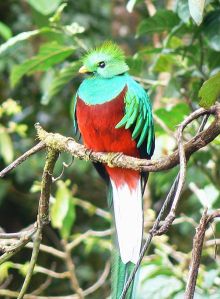
Costa Rica has had an interesting history. After a short civil war in 1948 the armed forces were abolished, and the country invested heavily in social programs and education. It also established a nation-wide network of national parks, and has one of the biggest proportions of land dedicated to national parks of any country. In April 1980 Steph, Hannah and me were staying at the Monteverde Cloud Forest Reserve when we received the sad news of my father’s death. We’d gone to Monteverde to try and see the resplendent quetzal – and how lucky we were. Magnificent!
In the 1970s, Costa Rica was a very safe place to live. San José was a small city; it had only about 250,000 inhabitants while we lived there. And the police did not carry any sidearms or other automatic weapons – only screwdrivers. Screwdrivers? Yes, to remove the plates from illegally parked cars! In the late 70s, when the Sandinista Revolution against the Somoza government was at its height in Nicaragua, many refugees came south over the border. And crime rates – along with house rentals – climbed steeply.

In the mid-90s I had opportunity to return to Costa Rica on a couple of occasions, and went hunting wild rices in the Guanacaste National Park in the northwest of the country, close to the frontier with Nicaragua. Ecotourism is a major activity, and with so many national parks to visit and a wealth of wildlife to observe, Costa Rica offers plenty for those interested in the outdoors.

The Philippines
Having spent a decade teaching at the University of Birmingham in the UK after leaving CIP, I began to get itchy feet towards the end of the 80s, and was offered a position at IRRI from July 1991. I moved then, and my family (my wife and two daughters, Hannah and Philippa) made the move just after Christmas.

Even today the Philippines is the easiest country to travel in – especially if you don’t have much free time. First of all, it’s spread over more than 7000 islands. But travel by road can be slow, and extremely frustrating. It certainly tested my patience for long enough – and I was driving mainly between Los Baños and Manila. For all the almost 19 years we lived in the Philippines, there were always roadworks on the road to Manila – now completed – and the highway also connects the port of Batangas on the south coast of Luzon with Manila. The volume of traffic is horrendous, and on the open road the slow-moving (and frequently stopping) tricycles and jeepneys don’t help with the traffic flow.

And because we took our annual home-leave in the UK, there wasn’t much other time for getting to know the Philippines., even though my wife and I lived in Los Baños for longer than we’d lived anywhere else. Each year we’d depart on home-leave and going home. On the return we would be coming home. Our home was provided by IRRI in a gated community some 10 minutes drive from the research center. It was built in the early 60s on the slopes of dormant volcano Mt Makiling. Los Baños is the thriving Science City of the Philippines, home to the Los Baños campus of the University of the Philippines (UPLB) and other important scientific research institutes, besides IRRI.

Our daughters attended the International School in Manila (ISM), and were bused into Manila early each day. By 1999, Philippa’s senior year, the school bus would leave IRRI Staff Housing at 0430 in order to reach the Makati campus by the start of school at 0715. The children would return by about 1630 or so, relax for a while, have dinner, then get down to homework, studying sometimes as late as midnight. Then up again at 0400. We were all glad when Philippa graduated. In 2002 ISM moved to a new (and more easily accessible) campus, several years after Hannah and Philippa had left, and a move that had been promised since about 1994.

Steph and I would get away to the beach as often as possible, about once a month. She would snorkel, and kept very detailed records over 18 years of the fish and corals that she observed in front of Arthur’s Place in Anilao, Batangas. I learned to scuba dive in 1993, and until we left the Philippines, that was my main hobby. Here are two more underwater videos from Anilao:

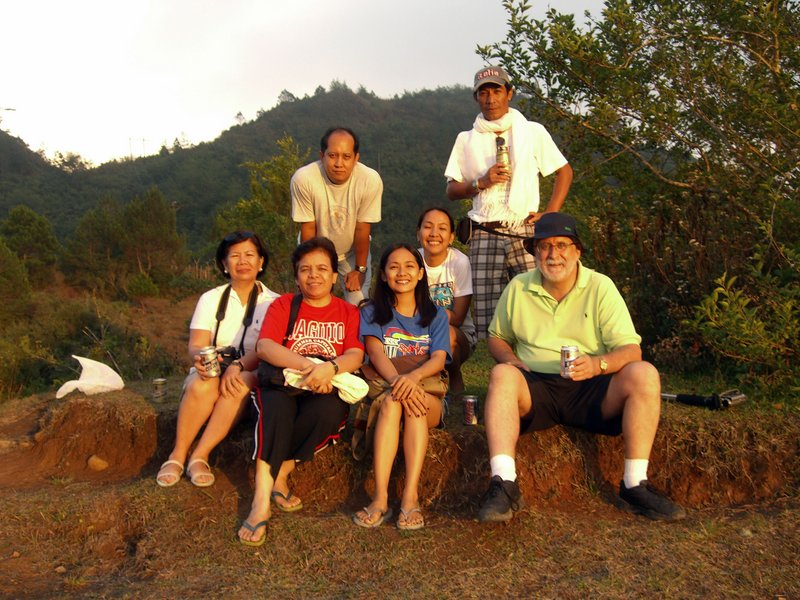
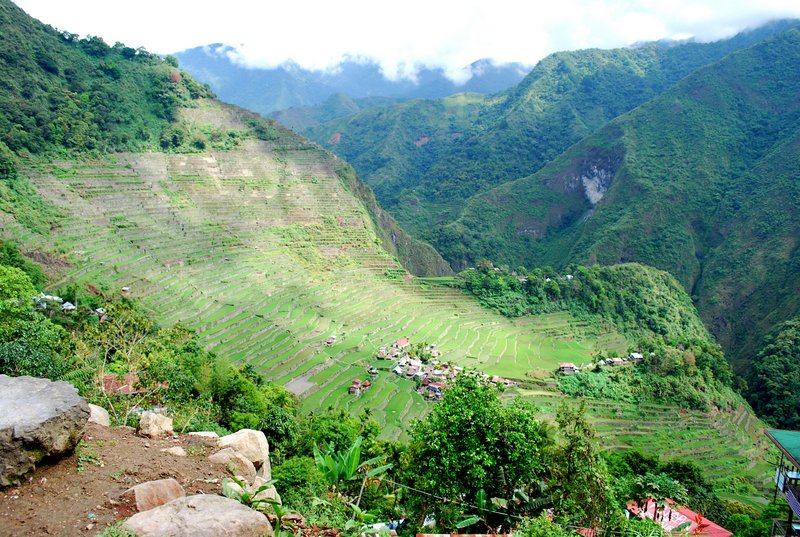
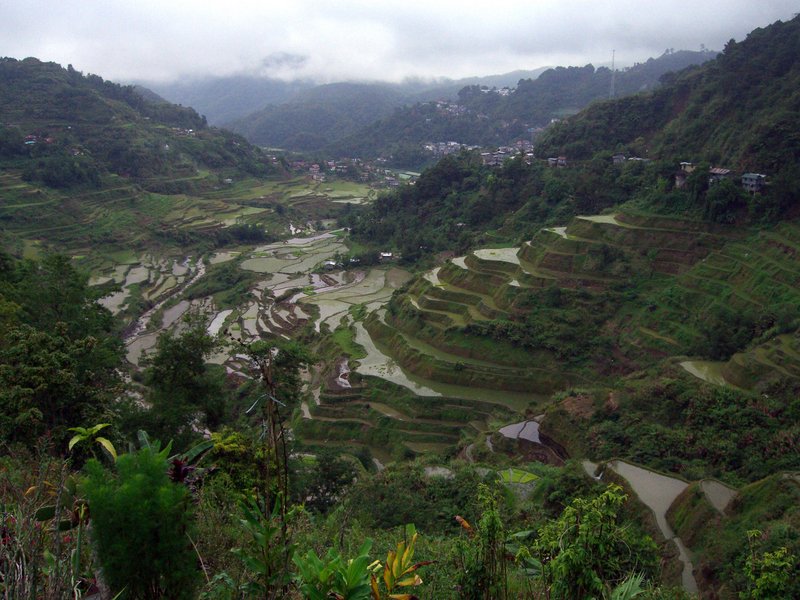
Finally in March 2009, we had the opportunity of visiting the world-famous rice terraces in the Ifugao province north of Manila. We went with a group of staff from my office. The journey both ways was tedious to say the least, taking almost 17 hours door-to-door on the return, with stops, even though the distance is less than 500 km. But it was worth it. The terraces are spectacular, and although it’s necessary to walk into the terraces at Batad, it’s well worth the effort. We stayed in Banaue, then traveled on to Sagada to see the famous caves with ‘hanging coffins’ and the local weaving. It was a short trip, but very memorable. Click here to open a web album.

We unfortunately did not get to see many of the fiestas that abound in the Philippines. But what we did see – every day – were the smiling faces of the lovely Filipino people. Yes, the Philippines was where our hearts were, for almost 19 years.

I’ll be posting other stories about the countries and places I’ve visited over the past 40 years, so please check from time-to-time.

Indiana Me . . . temples in the jungle

Over my career, I was very fortunate to be able to combine business trips with short visits to some of the world’s iconic heritage sites, or take time out for a quick vacation in the region without having to fly half way round the world.
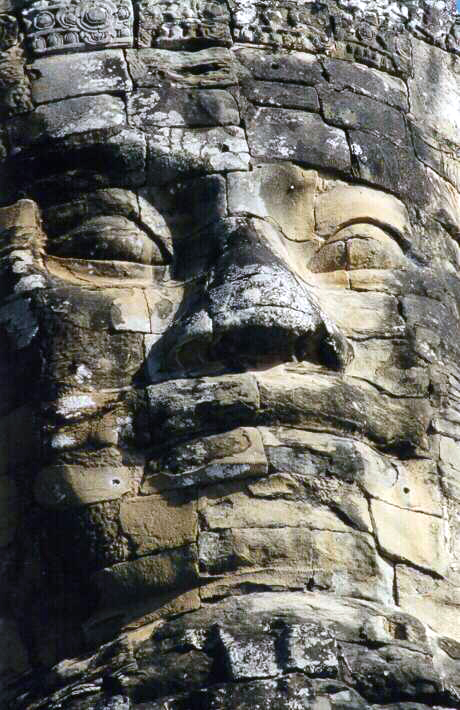
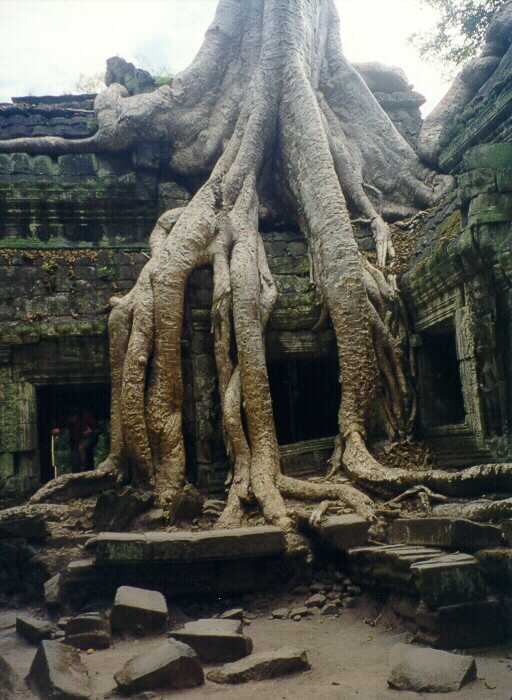
When we lived in Peru, I visited Machu Picchu a couple of times; almost anywhere you travel in Peru you are immersed in archaeology. In Central America we had the opportunity to visit the pyramids of Tikal in Guatemala (and I hope to post photos from here once I have digitized the slides), and also those at Teotihuacan, just north of Mexico City. But one of the most impressive sites must surely be the huge temple complex at Angkor Wat in Cambodia. And we had the chance to visit there in December 2000.

On flights from Bangkok to Manila I have often overflown Angkor Wat, and even from 30,000 feet its extent looks truly impressive (even if there is also evidence over the whole countryside of the intense bombing that Cambodia suffered over several decades of war).

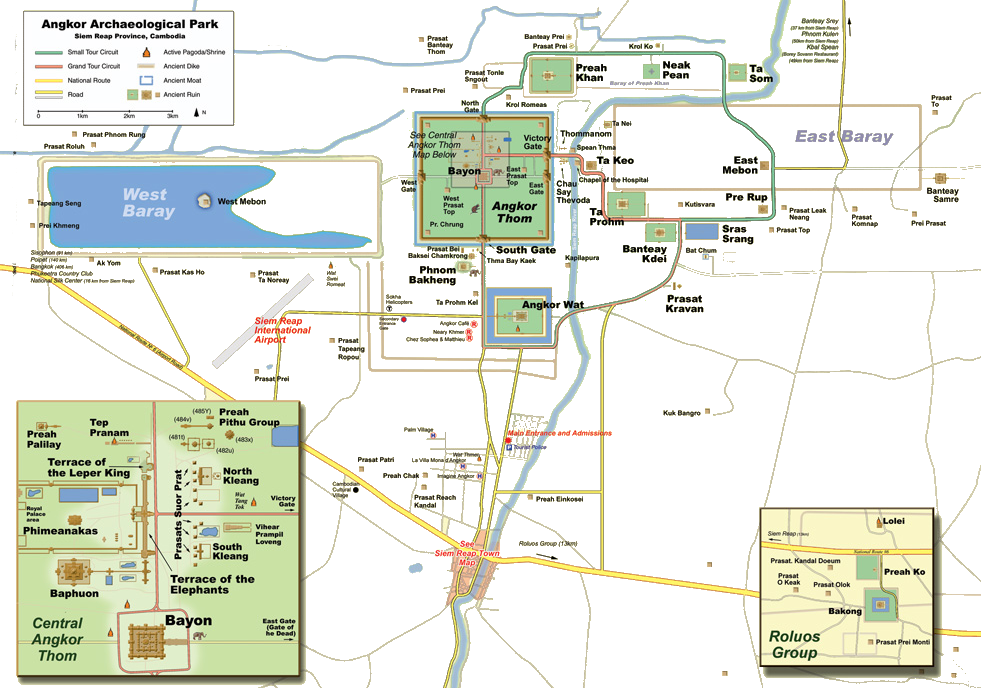
Angkor Wat is located in northwest Cambodia, near the town of Siem Reap, and near the Tonlé Sap, a huge seasonally flooded lake that acts as an overflow for the Mekong River during its flooding.

While we refer to Angkor Wat as a ‘site’, there are in fact many temples and other complexes covering a large area, apparently about 200 square kilometers. The beauty of the stone carvings, the iconic stone faces pointing in four directions, and the wonder of the forest reclaiming the various temples all add to the mystery of Angkor.

I’m not going to attempt to describe in detail what Angkor Wat has to offer, but a visit there has to last more than just one day. We stayed there for three nights, and although we were able to many of the sites and temples, there are plenty more mysteries to uncover, hidden by the jungle that has reclaimed its dominance over the area.

Some of the temple complexes, like the Angkor Wat site itself and Bayon are large with many beautiful buildings to explore, others are much smaller, comprising just a couple of buildings or so. Just click on these photos to open web albums (scanned images rather than original digital photos).

Angkor Wat

Bayon

When we visited, it was possible to move freely around all the sites, look inside the temples, climb the towers – and really explore. While it was quite busy in some sites, we did manage to get away from the bulk of the tourists. But the increasing number of visitors to Angkor Wat is now giving rise to concerns, as this recent story on the BBC website discusses.

Settlements at Angkor Wat stretch back thousands of years, but much of what we see today was constructed from about the 11-12th centuries onwards, reaching its peak a couple of centuries later. I’ve read estimates of more than 1 million people were involved in building the temples. And for an ex-rice scientist like myself, that begs the question about the extent and productivity of rice agriculture that was required to keep this huge population fed.

In addition to the Angkor Wat and Bayon sites, these are the other sites you can ‘visit’:

Let me finish with a quote from the Introduction in Dawn Rooney’s guidebook to Angkor Wat [1]: The temples startle with their splendour and perfection, but beyond the emotions they evoke lie complex microcosms of a universe steeped in cosmology. While a thorough understanding may be out of reach for many, the monuments’ profound beauty touches everyone . . . 

~~~~~~~~~~~~~~~~~~~~~~~~~~~~~~~~~~~~~~~~~

[1] Rooney, D (1997). Angkor – an Introduction to the Temples. Passport Books, Lincolnwood (Chicago), Illinois 60646-1975.
ISBN: 0-8442-4766-9

My style is ‘eclectic’ . . .

My tastes in art are as eclectic as those in music. I like what takes my fancy. And that makes me somewhat of a impulsive buyer.

Over almost three decades of living overseas – in South and Central America, and in the Philippines – and having also the opportunity of visiting many countries throughout Europe, the Americas, Africa, and Asia, I have been able to pick up the odd piece of art (and jewelry for Steph), and a range of handicrafts.

Anyone visiting our home in the UK can expect to see works of art and handicraft ranging from painting, to sculptures, batik, and gourd carvings among others.

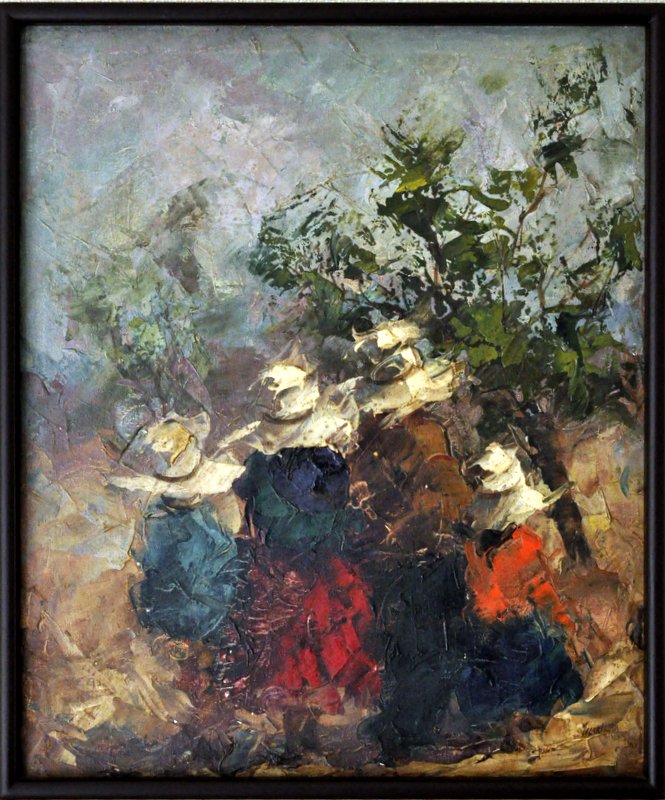
Taking center stage in our living room (over the mantelpiece) is an oil painting that I purchased at the weekly art fair in the JF Kennedy Park in Miraflores, Lima. It must have been January or February 1996 or so. I was in Lima for a genetic resources meeting among the centers of the CGIAR. On one Sunday morning we all decided to go down to Miraflores (from La Molina where we were staying at the headquarters of the International Potato Center – CIP). It was a bright, sunny day and many local artists were displaying their works along the various paths in the park. I had purchased a painting there in the late 1970s when I was working for CIP in Costa Rica, and was back in Lima for a visit.

Well, I saw this particular painting, and immediately the whole scene just caught my attention. I’d seen that scene (or something like it) many times – parents and two children – when I’d been out and about collecting potatoes in the province of Cajamarca in northern Peru  in 1974. The people of Cajamarca wear these beautiful reddish brown ponchos, and tall straw hats. And so this painting just resonated with me. Since I spoke Spanish I decided to haggle with the artist – he wanted about $175, but I was prepared to pay only $100. He wouldn’t accept that, so I walked on. On my next circuit, he’d dropped the price to $150, but still I wasn’t interested. As I walked round the park again, I took a crisp $100 bill from my wallet, ready to discuss with him again. I told him I had a $100 bill ready to hand over if he’d sell me the painting. The vision of cash in hand was too much for him, and so I was able to purchase this painting for $100 – a bargain. The painting is signed, but I’m not able to read it easily. I’ve tried to see if there are artists with a similar name in Peru, but haven’t had any luck yet. No matter. I like the painting, and it never ceases to bring me pleasure each day.

On a visit to Beijing, in about 1995, I picked up a couple of water colors of birds. They may not be of the highest quality, but they are quite good nevertheless.

Among the many Peruvian handicraft items we have are several carved gourds, known as mates burilados in Spanish. Many are made in the Mantaro Valley in Central Peru. The International Potato Center has its highland field station there (at over 3000 m) near Huancayo. My good friend Jim Bryan had good connections with one of the finest of the gourd carvers, and we purchased a number of excellent mates from him. Those on sale in the handicraft markets in Lima are quite nice but nowhere near the quality.

In the late 1970s, when I was in Costa Rica, I attended a Organization of American States meeting on agriculture in the Caribbean in Port-au-Prince, Haiti. I was able to pick up a couple of nice carvings, one of a farmer, the other of a beggar.

The one on the left, standing about 80 cm, is carved from a single piece of wood. Despite having it carefully packed, and getting it back in one piece to San José, I knocked it over while waiting for my ride back down to Turrialba (and stepping off the curb and damaging a tendon in my foot, that had to be kept in plaster for almost six weeks), and it split between the hand and the pineapple fruit. The carving of the beggar (on the right) is about half the size of the farmer.

When I retired from IRRI in 2010, I was given a carving of a rice farmer as a leaving present. IRRI had been presenting these to retiring members of the Board of Trustees, and I’d thought that one of these carvings would make an excellent leaving present. And that’s what I suggested when asked if I had any ideas. Imagine my surprise at the despedida (actually the celebration dinner for IRRI’s 50th anniversary) when IRRI Director General Bob Zeigler presented me with one of the larger versions of the carving – normally they were about half this size – signed by the artist, Bernard Vista.

Bernard Vista comes from Pakil, on the east side of the Laguna de Bay, perhaps 35 km from Los Baños (at the bottom of the lake on this map). and has a studio (and cafe) there. Pakil and Paete are sister towns famous for their wood carvings

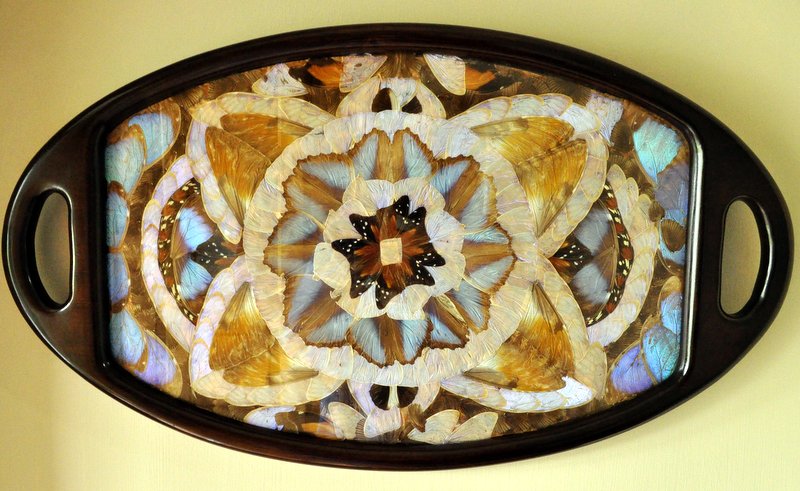
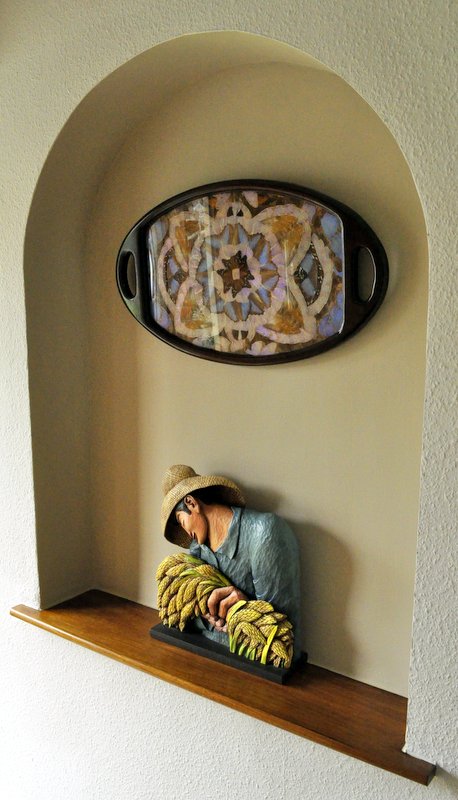
Another treasured possession – but not one I collected myself – is a glass-covered tray made of butterfly wings, encased in a mahogany frame.

My father bought that in Rio de Janeiro in the mid-1930s when he worked for the White Star Line as ship’s photographer. It was on my parents’ wall for decades, and after they died, I inherited it. It takes pride of place (above the rice farmer) in an alcove just inside our front door.

Perú – país precioso

I can’t remember why I had always wanted to visit Peru. All I know is that since I was a small boy, Peru had held a big fascination for me. I used to spend time leafing through an atlas, and spending most time looking at the maps of South America, especially Peru. And I promised myself (in the way that you do when you’re small, and can’t see how it would ever happen) that one day I would visit Peru.

Just a few months after I had begun my graduate studies at the University of Birmingham in October 1973, my head of department, Professor Jack Hawkes, returned from a 2-month trip to Bolivia to collect wild potatoes, and had spent time in Lima with Dr Richard Sawyer who became the first Director General of the International Potato Center (CIP) in October 1971. He was looking for someone to work at CIP for one year from September 1971 to look after a large collection of native Peruvian potato varieties while a young Peruvian took his MSc degree at Birmingham.

To cut a long story short, I didn’t go in 1971, but landed in Lima at the beginning of January 1973 after a long and gruelling flight on B.O.A.C. from London via Antigua (in the Caribbean), Caracas, and Bogotá.

Until I was able to rent an apartment, I stayed in the Pensión Beech (a boarding house) in San Isidro for about three weeks. Arriving at night, I was driven through the darkness to the pensión and hadn’t a clue where I was or where I was going. The following morning I woke to a bright summer’s day, and was amazed at the beauty of Lima gardens, particularly the stunning bougainvilleas that seemed to be growing everywhere, as well as bright red poinsettia shrubs (small trees actually), a plant I had only ever seen growing as a pot plant!

Eventually, I found a one bedroom apartment in the center of Miraflores, next to the Todos supermarket (I wonder if it’s still there?), and then, once my wife had joined me in July 1973 (we were married in the Municipalidad de Miraflores in October 1973) we rented a 12th floor apartment on Av. Larco near the corner with Av. Benavides (there was an ice cream parlor on the ground floor – 20 Sabores). But the 12th floor is not ideal place to be when an earthquake struck, as they did with increasing regularity after the massive quake of October 1974 (measured at 8.1 on the Richter scale at La Molina where I was working, and lasting for more than 2 minutes).

Peru is a country of amazing contrasts. Just click here to view a web album of photos I took during 1973.

First there is the geography: the long coastal desert stretching north from Lima to the border with Ecuador, and south to Chile where it merges with the Atacama Desert. It hardly ever rains on the coast, but the sea mists that are prevalent during the months of July-September do provide sufficient moisture in some parts (lomas) to develop quite a rich flora. The Andes mountains take your breath away with their magnificence. The foothills begin just a few kilometers from the coast, and the mountains rise to their highest point in Huascarán (6,768 m), the fourth highest mountain in the western hemisphere.
And to the east of the Andes is the selva, the vast plain of tropical rainforest, dissected by huge rivers, flowing north towards the River Amazon, and, thousands of kilometers later, eastwards to the Atlantic Ocean.

Second, Peru is a country of cultural diversity and a rich archaeology. Everyone has heard of the Lost City of the Incas, Machu Picchu, ‘discovered’ by Yale professor Hiram Bingham in 1911. But throughout the country there are many sites that demonstrate the long cultural development of different groups, especially along the coast oases where rivers flowing westwards from the Andes brought life-giving water to the coastal desert. And there is also considerable evidence for the range of plants and animals that these peoples domesticated: the potato, beans, cotton, peanut, and llamas to name but a few. Fortunately this rich history has been preserved and Lima boasts some of the best museums in the world.

From north to south, different peoples wear different dress. In Cajamarca, the typical dress is a tall straw hat and a russet-colored poncho. In central Peru, the women wear hats like the one shown in the photo on the right. The south of Peru, around Cuzco and Puno is more traditional still.
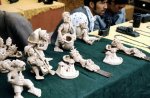
Peru is also a country of great handicrafts – from the leather goods made  in Lima, to the carved gourds or mate burilado, clay figures of farmers or religious effigies, to a wealth of brightly colored textiles.
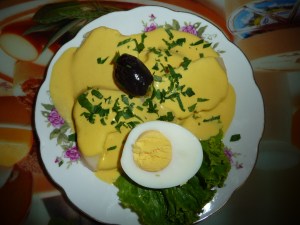

Lastly on this short celebration of Peru, I have to mention some of my favorite food – and I’ve learned that in recent years Lima has become one of the top gourmet capitals of the world. If I had to mention just a couple of dishes they would be ceviche (fish marinated in lime juice and hot chili peppers, and served with sweet potato) and papa a la huancaina, made from sliced yellow potatoes, and boiled eggs, and covered with a spicy sauce.

And one of the great ways of serving food is the pachamanca. Of course, all washed down with a good Peruvian beer – Cusqueña, Arequipeña, or Pilsen Callao (my favorite). But I have to mention my favorite drink: pisco sour. Whoever invented that deserves a medal! The only drink better than a pisco sour is a second one.

I was privileged to live in Peru for three years, and have visited there many times since. My work took me all over the country to collect native varieties of potatoes, and to carry out field studies on how farmers adopt and use different varieties. I never lost the excitement of arriving in Lima and waiting to get out into the wild country.

Lima is an enormous city now. It’s been more than a decade since I was last there. In 1973 it seemed there was hardly enough water for a population of about 1.5 million if my memory serves me well. The latest data indicate that Lima now has a population in excess of 9.3 million. I’m told the traffic situation is horrendous.

Certainly the road network around the country has improved – much of my time was spent on dirt roads, hugging the sides of mountains, with precipices up to 1000 m. Not the sort of place to take your eyes off the road.

Given the opportunity I would go back to Peru tomorrow. Although I have seen a good deal of the country, there’s still more to see. I traveled by road, by air, on foot, and on horseback. I slept in schools and a post office, and been eaten up by fleas in a hotel in northern Peru. But I enjoyed (almost) every minute – the friendliness and friendship of Peruvians, and the wonderful paisajes (landscapes), and its illustrious history.

Kit Carson: he led the way . . .

Early in 2011, Steph and I began to plan our next visit to Minnesota to visit daughter Hannah, husband Michael, and grandson Callum, scheduled for May when Callum would be around nine months, and almost at the crawling stage.

I suggested that we should take the opportunity of being in the US to fulfil one of our long-held ambitions, namely to visit the Grand Canyon. Well, as chance would have it, I’d been reading a biography of 19th century frontiersman and Indian agent and fighter, Kit Carson. And I discovered that much of his life had been spent in northern Arizona and north-west New Mexico. This got me thinking. Why not combine a visit to the Grand Canyon to a number of the sites mentioned in the book I’d been reading? And so we planned an itinerary that would take in the Grand Canyon, Monument Valley, the Canyon de Chelly (pronounced shay), the Petrified Forest National Park and the Painted Desert in Arizona, and the mountains of north-west New Mexico, including the Rio Grande gorge, and the mountains near Los Alamos, where the first atomic bomb was assembled. During our trip we visited Carson’s grave in Taos, NM.

 Click on the images below to view various web albums.

After spending a few days chez Foldes in St Paul, we flew to Phoenix, AZ and drove up to Flagstaff via the Sedona Valley. This was our first introduction to canyon country, red buttes and all. After an overnight stop in Flagstaff (where it began to snow!), we headed north via the Sunset Crater National Park and Wupatki National Monument (a series of Pueblo Indian settlements in the desert) to reach the Grand Canyon.

Words cannot describe the awesome spectacle as you gaze over the canyon for the first time at Desert View (just after entering the Grand Canyon National Park).

We spent a couple of nights at Grand Canyon Village, in very comfortable motel-style accommodation. Since it was the beginning of May (and even though the various hotels/motels were full), the area was not heaving with tourists. On the second full day there, we took the bus on the crater rim route to the west, getting down after a couple of stops, and walking a few kilometres along the rim – literally just a meter or so from a sheer drop to the canyon floor below. Not for the faint-hearted! Now I’m haven’t got the best of heads for heights, and at one viewpoint, with sheer drops on three sides, and just a narrow neck of path to walk along, my legs went to jelly. And since it was also rather windy, I began to doubt whether I could overcome my feeling of helplessness, and actually make it to the end, and look over and around. I sat down, and told myself not to be so silly, that having come all this distance, it would be silly to let a little vertigo get in the way of enjoying some spectacular vistas. It took about 10 minutes, but eventually I made my way gingerly to the guard rail, and after that, I had little difficulty in standing on the edge. For much of the crater rim walk, there were no safety rails, and so I just concentrated on looking ahead at the path, and not over the lip.

Too soon our Grand Canyon visit was over, and we headed east and north to Monument Valley, which straddles the Arizona-Utah state line, and which was used by film director John Ford on several occasions as the location for films such as Stagecoach, The Searchers, and She Wore a Yellow Ribbon, all starring John Wayne. Monument Valley is iconic mesa and butte country, owned by the Navajo Nation. We were able to drive through the valley, and saw very few other cars. We had been advised to get to the valley as early as possible because of potential tourist congestion, but that just wasn’t a problem for us. Maybe a few weeks later, once the grade schools were on vacation, the situation would have been very different. But in mid-May and throughout our whole trip, we saw very few tourists.

Our next stop was the Canyon de Chelly National Monument that bisects a range of mountains in the north-east of Arizona.


Canyon de Chelly is a magical and mystical place, and although the canyon itself is not as deep or wide, Steph and I actually preferred this to the Grand Canyon. It was much more intimate, so-to-speak, and still occupied and farmed by the Navajo. At a number of places throughout the canyon there are ancient ruins of settlements. There were fantastic viewpoints at several sites on the north and south sides of the canyon, and spectacular views of Spider Rock. Canyon de Chelly was the site of several massacres of the Navajo in past centuries – by the Spanish, and later in the 19th century, by the US government. The sides of the canyon are sheer, often dropping 1,000 feet straight down to the canyon floor. Had I not read the Carson biography I would never have dreamt of visiting Canyon de Chelly, which was certainly for me the highlight of the vacation.

We drove south to the Painted Desert and the Petrified Forest National Park. The Painted Desert has to be seen to be believed – I’ve never seen horizontal sedimentary layers like these, all banded in different colours.

We then headed north-east, and into New Mexico. Time was pushing on, and although we passed close by, were were unable to visit Shiprock or the Four Corners (where Arizona, Utah, Colorado and New Mexico meet).

Heading over the mountains in north-west New Mexico, we dropped down to the Rio Grande and Taos, and then headed south towards Albuquerque, and up into the Valles Caldera. Quite often we saw road signs indicating possible congestion on the road ahead, but in all our 1,200 miles over eight days we never encountered any hold-ups. In fact sometimes we drove for an hour or more without seeing another vehicle.

All too soon our holiday in the southwest was over and we flew back to St Paul to enjoy several more days with Callum.

Here is our route in two maps:

  • Phoenix – Flagstaff – Grand Canyon – Monument Valley – Canyon de Chelly (route)
  • Chinle – Petrified Forest – Farmington – Taos – Los Alamos – Albuquerque (route)

Potatoes – the real treasure of the Incas . . .

Home of the potato
The Andes of South America are the home of the potato that has supported indigenous civilizations for thousands of years. As many as 4,000 native potato varieties are still grown. The region around Lake Titicaca in southern Peru and northern Bolivia is particularly rich in genetic diversity, and the wild potatoes from here are valuable for their disease and pest resistance [1].

For three years, from 1973-1975 I had the privilege of living and working in Peru (fulfilling an ambition I’d had since I was a boy) and studying the potato in its homeland. My work took me all over the mountains to collect potato varieties (for conservation in the germplasm collection of the International Potato Center (CIP), and to carry out studies of potato cultivation that I hoped would throw some light on different aspects of potato evolution [2].

I joined CIP in January 1973 as Associate Taxonomist, charged with the task of collecting potato varieties and helping them to maintain the large germplasm collection, that grew to at least 15,000 separate entries (or clonal accessions), but was reduced to a more manageable number through the elimination of duplicate samples. The germplasm collection was planted each year from October through April, coinciding with the most abundant rains, in the field in Huancayo, central Peru at an altitude of more than 3,100 meters.
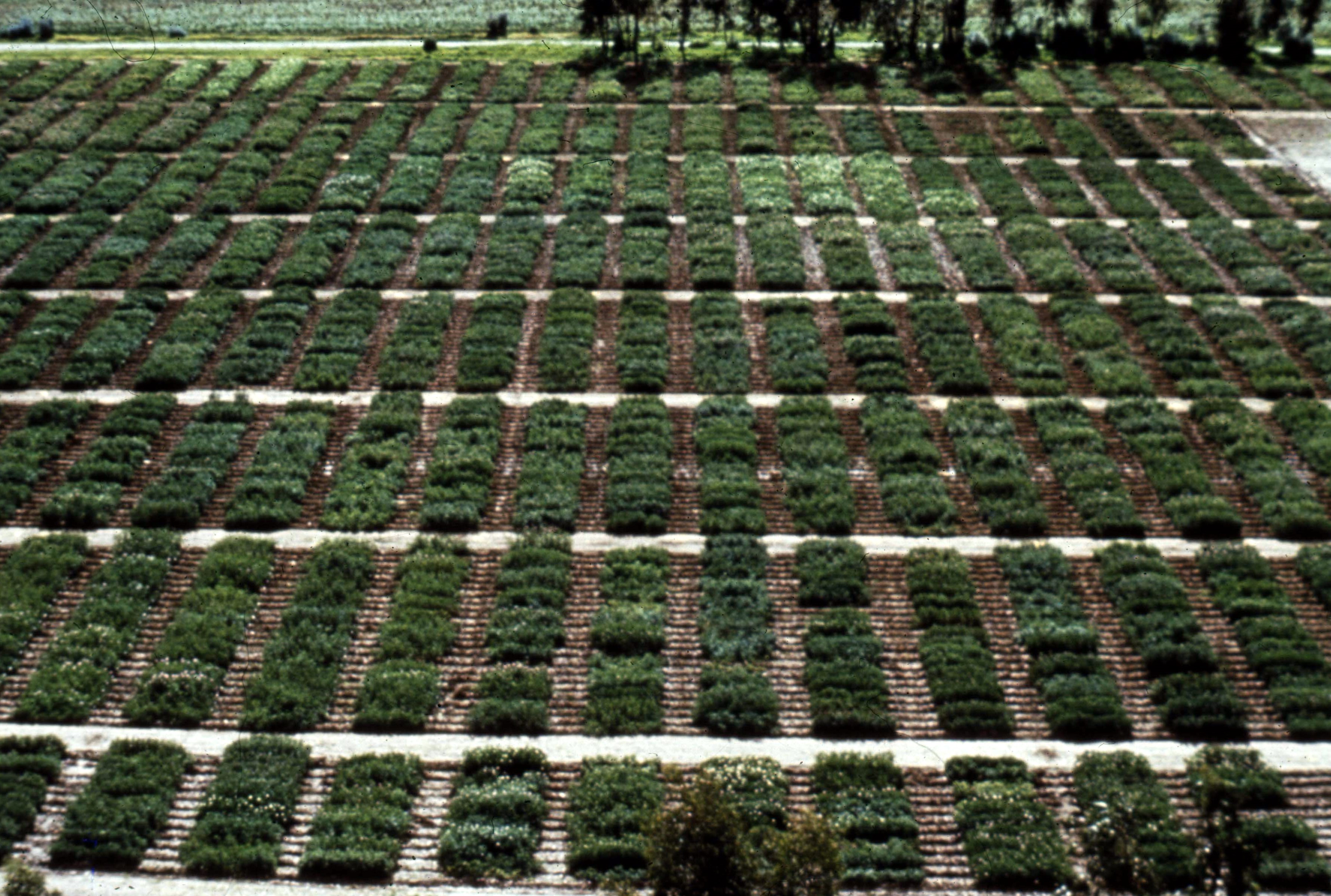
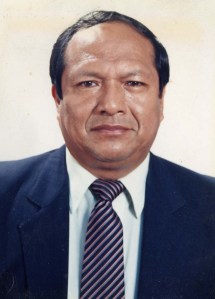
Potato collection at CIP, grown in the field at Huancayo, central Peru, at 3100 m. Taken around mid 1980s.

When CIP was founded in 1971, several germplasm collections from various institutes in Peru and elsewhere were donated to the new collection, but from 1973 CIP organized a program of collecting throughout Peru – and I was fortunate to be part of that endeavour. In May 1973 I joined my colleague Zosimo Huaman to collect potatoes in the Departments of Ancash and La Libertad, to the north of Lima. The highest mountains in Peru are found in Ancash, and our route took us through into the Callejón de Huaylas (between two ranges of the highest mountains in Peru, the Cordillera Blanca on the east, and Cordillera Negra on the west), and over the mountains to valleys on the eastern flanks. This was my first experience of collecting germplasm, and it was exhilarating. I think we did quite well in terms of the varieties collected, and the photograph below illustrates some of  their  immense genetic diversity.

Genetic diversity in cultivated potatoes

The following year I traveled with just a driver, Octavio (who was unfortunately killed in a road accident a couple of years later) further north into the Department of Cajamarca during April-May 1974. The photograph below shows the view, in the early morning sun, south towards Cajamarca city. The mist hanging over the city comes from hot springs that were utilized centuries ago by the Incas to build bath houses.

We collected potatoes in the field at the time of harvest, but also in markets (here is shown the market of Bambamarca), and from farmers’ own potato stores. Incidentally, the tall straw hats are very typical Cajamarca, as are the russet-colored ponchos.

In January 1974 I made a trip south, with Dr Peter Gibbs, a taxonomist from the University of St Andrews, Scotland, who was interested in the tri-styly pollination of a minor Andean tuber crop called oca (Oxalis tuberosa). We went to the village of Cuyo Cuyo, more than 100 km north of Puno in southern Peru. Dropping down from the altiplano, the road hugs the sides of the valley, and is often blocked by landslides (a very common occurrence throughout Peru in the rainy season). Along the way – and due to the warmer air rising from the selva (jungle) to the east – the vegetation is quite luxurious in places, as the white begonia below shows (the flowers were about 8 cm in diameter). Eventually the valley opens out, with terraces on all sides. These terraces (or andenes) are ancient structures constructed by the Incas to make the valley more productive.

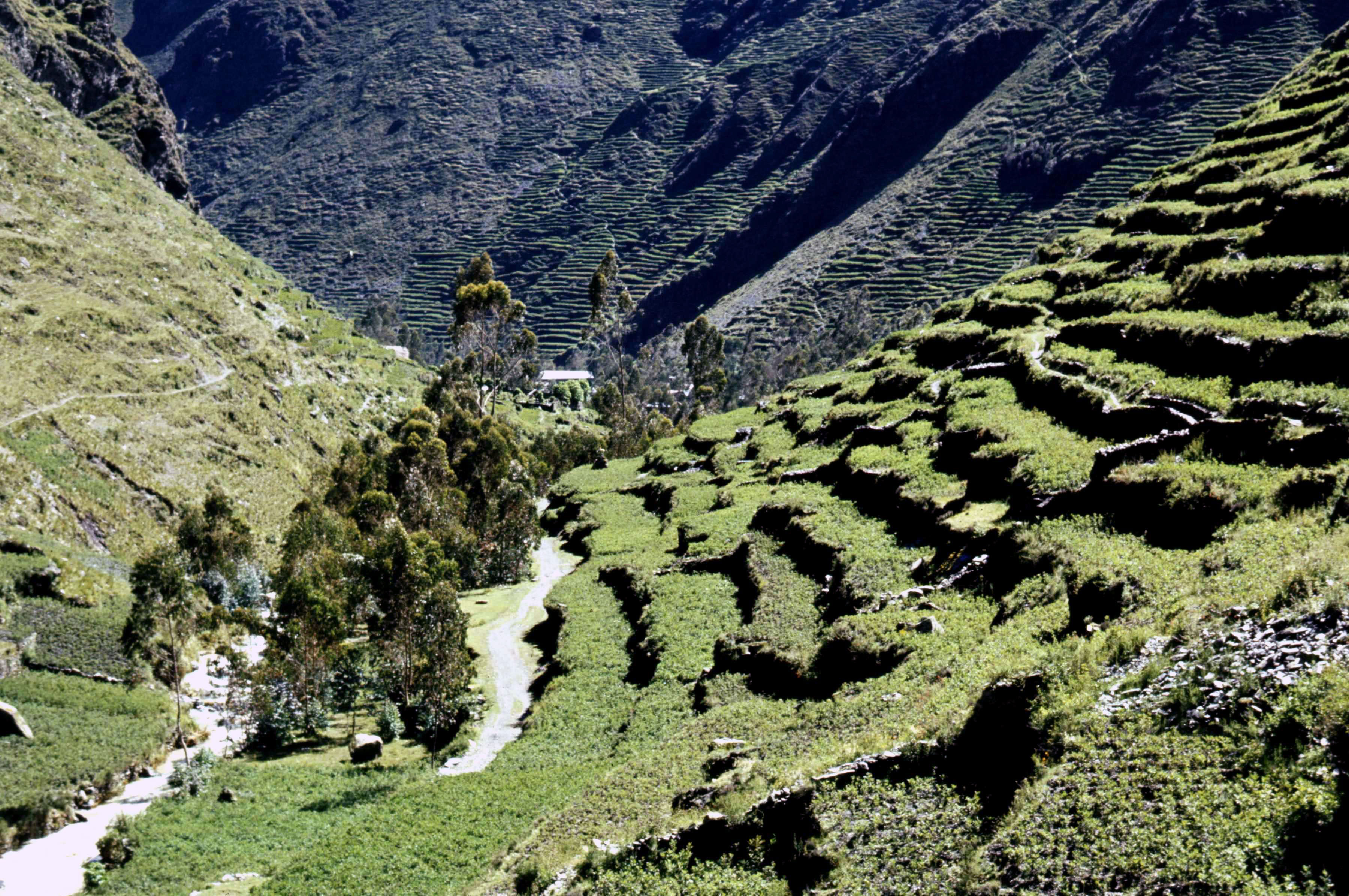
In Cuyo Cuyo, I studied the varieties growing in farmers’ fields, and their uses [3].

Getting to some locations by four-wheel drive vehicle was often difficult. Then it was either ‘shanks’ pony’, or real pony. I do remember that I became very sore after many hours in the saddle. Incidentally, I still have that straw hat and it’s as good as the day I bought it in January 1973.

But studying potato systems, and working with farmers was fascinating. Here I am collecting flower buds, and preserving them in alcohol ready to make chromosome counts in the laboratory, back in Lima.

The next photograph shows a community we visited close to Chincheros, near Cuzco in southern Peru. While farmers grew commercial varieties to send to market in Cuzco – the large plantings of potatoes in the distance -closer to their dwellings they grew complex mixtures of varieties, with different cooking and eating qualities.

Most farmers do not have access to mechanization, apart from manual labor and oxen to pull ploughs. In any case, much of the land in these steep valleys is unsuitable for mechanization. For centuries, farmers use the chakitaqlla or foot plough illustrated by Peruvian chronicler Felipe Guaman Poma de Ayala in the early 17th century. There are many different foot ploughs in used throughout Peru. The foot plough shown below in one of Poma de Ayala’s illustrations is the same as that used by farmers in Cuyo Cuyo. The photograph underneath shows farmers near Huanuco in central Peru.

I never collected wild potatoes as such, but it was fun on two occasions to accompany my thesis supervisor and mentor, Jack Hawkes (a world-renowned expert on the taxonomy and evolution of potatoes, and one of the founders of the genetic resources movement in the 1960s) on short trips. In January 1973 we visited Cuzco, and Jack found Solanum raphanifolium growing among the ruins of the Inca fortress of Sacsayhuaman.

Early 1975 (during one of his annual trips to CIP)  Jack, Juan Landeo (then a research assistant, who later became one of CIP’s potato breeders), and I traveled over four days through the central Andes just north and east of Lima, in the Departments of Cerro de Pasco, Huanuco, and Lima. It was fascinating watching an expert at work, especially someone so familiar with the wild potatoes and their ecology. We’d be driving along, and suddenly Jack would say “Stop the car! I can smell potatoes”. And more than nine times out of ten we’d find clumps of wild potatoes after just a few minutes of searching. Here we are (looking rather younger) about to make a herbarium collection just south of Cerro de Pasco (I don’t remember which wild species, however).

Markets are always fascinating places to collect germplasm of many different crops. The next two photographs show colorful diversity in maize and peppers.

Among the many you can find in the market is chuño, a type of freeze-dried potato, made from several varieties of so-called bitter potatoes, which have a high concentration of alkaloids which must be removed before eating. This is done by first leaving the tubers on the ground on frosty nights to freeze, and then thaw the following morning. After several cycles of freezing and thawing the tubers are then soaked for several weeks in fast-flowing streams to leach out the bitter compounds. Afterwards, they are left to dry in the sun, and in this preserved state will last for months. This photograph was taken in the Sunday market at Pisac, near Cuzco.

Clearly the potato is an ancient crop in Peru (and other countries of the South American Andes), and domesticated several thousand years ago. It was revered by ancient civilizations, as these anthropomorphic potato pots (or huacos) show. The national anthropological museum in Lima has a fine collection of these pots showing a vast array of different crop plants. It also holds an extensive collection of erotic ceramics for which the Incas, Moche, and other coastal civilizations were equally famous.

After the conquest of the Incan empire by Francisco Pizarro González in the 16th century, the Spanish plundered all the gold and other precious items they could find, and sent everything back to Spain. It’s often said, however, that the value of all this gold fades into insignificance compared to the value of the potato crop today worldwide. The real treasure of the Incas has certainly been put to better use.

~~~~~~~~~~~~~~~~~~~~~~~~~~~~~~~~~~~~~~~~~~~~~

[1] Jackson, M.T., J.G. Hawkes, B.S. Male-Kayiwa & N.W.M. Wanyera, 1988. The importance of the Bolivian wild potato species in breeding for Globodera pallida resistance. Plant Breeding 101, 261-268.

[2] Jackson, M.T., J.G. Hawkes & P.R. Rowe, 1977. The nature of Solanum x chaucha Juz. et Buk., a triploid cultivated potato of the South American Andes. Euphytica 26, 775-783.

[3] Jackson, M.T., J.G. Hawkes & P.R. Rowe, 1980. An ethnobotanical field study of primitive potato varieties in Peru. Euphytica 29, 107-113.


Love it or hate it . . .

I guess we all have mixed feelings about flying. For the most part, it’s the hassle of checking in and waiting around crowded airports that bugs us most. Once in the air, most flights are uneventful, boring even. And it’s now taken for granted – rather like taking a bus ride (especially on flights within the USA).

Over the past 40 odd years I can’t imagine how many hundreds of thousands of miles I have flown, even though my travel was really quite modest compared to many of my colleagues. And much of that travel in the past two decades has been intercontinental, and business class.

In 1973, I took my first intercontinental flight from London Heathrow (LHR) to Lima’s Jorge Chavez airport, with intermediate stops in St John’s – Antigua, Caracas – Venezuela, and Bogota – Colombia. That was on a BOAC (now British Airways) Boeing 707.

Today, non-stop flights of up to 17 hours or more are considered normal. And since the maiden flight of the Boeing 747 in February 1969 aviation world-wide has undergone so many changes, and opened up air travel to everyone. More’s the pity, Concorde has come and gone, even though it had its maiden flight just a few weeks after the 747.

In Peru, we flew with AeroPeru and Faucett, both of which ceased operations in 1999. In Central America it was LACSA (Costa Rica), TACA (El Salvador), SAHSA (Honduras – Stay At Home Stay Alive), and COPA (Panama). Only COPA still flies as an independent airline; the others have either merged or folded. We also had Pan Am (flying Boeing 707s) operating a network to North and South America, based on a hub in Guatemala City.

Moving to the Philippines in 1991, we first flew British Airways via Heathrow. But by 1993 the air connection between Birmingham (BHX) and LHR had been terminated, so we began flying KLM to Manila (MNL) via Amsterdam Schipol (AMS). KLM operated a 747-400 service (quite often a Combi freight and passenger aircraft), with a refueling stop either in Bangkok (BKK) or Kuala Lumpur.

Now KLM provides a non-stop Boeing 777 service between AMS and MNL.

Once Emirates Airlines (EK) began flying into both MNL and BHX, that became our preferred route for home-leave, originally on an Airbus 330-200, but almost exclusively in recent years on a Triple-7.

I made this next video in 2007 on the flight from BHX to DXB, from taxiing and take-off, to landing in just under 10 minutes later! Listen to the magnificent roar of the GE engines on take-off, and the captain throttling back at about 1,000 ft (just over 3 minutes into the video).

On a trip to Hanoi – Vietnam in November 2010, my preferred route was BHX – Dubai (DXB) – BKK, flying the super jumbo A380. That’s an amazing plane, and the flight from DXB to BKK was my first (and so far only) flight on this aircraft. The EK seating configuration has the upper deck almost entirely allocated to business class, each passenger having their own pod, but with a first class cabin (for about 16 passengers) in front of the business class cabin. Due to a mix-up over seating I was upgraded to first class! So I took advantage of having a shower in one of the two spas at the front of the cabin. It’s rather an odd experience taking a shower (you are limited to five minutes – beware getting caught out while still soapy) while travelling at about 1,000 kph and 12,000 m altitude.

Most of my flights have been smooth, but there was once some severe turbulence over Colombia (lots of thunder clouds about) on one flight from Panama to Lima; and quite often over the Bay of Bengal during the monsoon season between May and November. I once experienced a bad landing with the now defunct airline AVIATECA of Guatemala on a new Boeing 727 from Mexico City to Guatemala, which burst a tyre on landing, sending us off  the side the runway. It happened so quickly but we came to a stop almost before anyone realized what had happened. No harm though.

And I have flown into some difficult airports – of which Tegucigalpa – Honduras is probably the most dangerous, as the this video of an American Airlines Boeing 757 landing there shows. The approach is low over a hill at the head of the runway (there’s usually only one way in, but I have seen a video of a 737 landing from the north), and there’s a drop-off at the north end of the runway as well. It takes great skill to land here.

I do my own bit of flying – on Microsoft Flight Simulator, and have been known to while away some time trying to get from Manila to Hong Kong without crashing. As they say, it’s relatively straightforward getting into the air – landing is the hard manoeuvre. And a few years ago, Philippa gave me a flying lesson as a Christmas present, so during home leave the following summer I spent half a day at Wellesbourne Mountford airfield near Stratford-upon-Avon.

‘Thank you, Margaret Thatcher’ – my Pioneer Interview with Gene Hettel

The head of IRRI’s Communication and Publications Services (CPS), Gene Hettel, is compiling a set of Pioneer Interviews with IRRI staff, past and present. These have been published in IRRI’s in house magazine for the past decade, Rice Today. In addition he usually also makes a video.

In mid-February 2010, just over two months before I retired from the institute, Gene and I found a time for my Pioneer Interview. If you want to know about many of the things I did at IRRI, and elsewhere – and some of my opinions about international agricultural research and how it’s organized, just watch the videos.