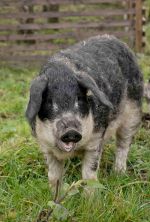
Eat ’em to conserve ’em . . .

That’s right. Eat ’em to conserve ’em. Sounds counter-intuitive? Well, the answer is not what you might expect.

On a recent BBC Two program [1], Lisa, a pig breeder from North Yorkshire of rare—and very hairy—Hungarian Mangalica pigs, told one of the presenters (who’d wondered if he might turn vegetarian after seeing the cuteness of Mangalica piglets): “We need you to eat the meat, because if you don’t eat the meat, then farmers won’t breed them, and that’s how you lose them“.

Regular viewers of BBC One’s Countryfile (broadcast on Sunday evenings) will be familiar with the preservation of rare breeds in the UK. One of the presenters is Cotswold farmer Adam Henson, whose father Joe founded the Rare Breeds Survival Trust (RBST) in 1973. The RBST supports the UK National Livestock Gene Bank where semen and embryos are stored.

Joe Henson also set up the Cotswold Farm Park in 1971 on his farm near Guiting Power that Adam and his business partner continue to run, where the public can see different breeds of cattle, sheep, pigs, horses, and poultry, most of which no longer play any significant role in commercial agriculture. They only survive because of the interest and efforts of farmers like Adam and the RBST. While preservation of rare breeds is one of Adam’s passions, he frequently acknowledges that they have to pay their way. So, for many farmers like pig breeder Lisa, keeping rare breed livestock is a commercial enterprise. And there is a growing interest in and demand for rare breed meat.


What are the parallels in crops?

For decades now crops (and their wild relatives) have been conserved in genebanks around the world. Scientists in the 1960s acknowledged that unless these crop varieties were collected they might be lost forever. So the good news is that important genebank collections were established, crop varieties and diversity preserved, and used to create more productive varieties for farmers to grow.

Conservation in genebanks or seed banks (often referred to as ex situ conservation, and the plant equivalent of semen and egg or embryo storage) ensures that genetic diversity is protected over the long term, subject of course to the best genebank management practices.  However, there are crops, like potatoes that reproduce vegetatively by tubers (important for maintaining specific varietal identity), and others that either don’t produce seeds, or which are short-lived and cannot be stored in a seed bank.

In the UK there are several important genebank collections: the Commonwealth Potato Collection (CPC) at the James Hutton Institute, Dundee; the Germplasm Resource Unit (GRU, with important collections of wheat, barley, oat, and pea) at the John Innes Centre in Norwich; and the UK Vegetable Genebank (UKGVB) at the Warwick Crop Centre, Wellesbourne.

And the centers of the CGIAR around the world manage some of the largest and genetically most diverse genebank collections anywhere. I have been involved with two of these: for rice at the International Rice Research Institute, in Los Baños, in the Philippines, and for potatoes at the International Potato Center, in Lima, Peru. The Svalbard Global Seed Vault provides an extremely important safety backup to these and many national genebank collections.


However, what is the situation on farms? Do farmers continue to grow the varieties that have sustained their communities for generations? Is it feasible to conserve varieties on farm? And how many would opt to grow new varieties if these were available?

Just like livestock, crop varieties can only survive if farmers continue to care for them, and they are consumed. Eat ’em to conserve ’em.

Now many of these farmer varieties (often referred to as landrace or ‘heirloom’ varieties) are found in subsistence farm systems where the full impact of modern bred varieties has yet to be felt.

Take the situation of rice in the northern part of Laos in southeast Asia, for example. Many of the rice varieties grown there are upland rices, and modern rice breeding has produced fewer improved varieties for these agricultural systems. Farmers (many of them women) continue to grow hundreds of rice varieties. While I was head of genetic resources at the International Rice Research Institute in the Philippines during the 1990s, I spear-headed an international project to collect and conserve these varieties in Laos and many other countries, and one of my colleagues, Dr Seepana Appa Rao spent five years in Laos assisting local scientists there.

‘Heirloom’ rice varieties are an important cultural foundation of many societies throughout Asia (and Africa). But farmers need to make a living, aspire to a better life, producing food for their families, and generate income if possible to pay for their children’s education. Many farmers want something better than the drudgery of agriculture for their children.

Is it possible to make a profitable living from these varieties? What are the opportunities to make the old varieties more commercially appealing? To commodify them. Certainly if these traditional varieties could generate an income, then farmers would be more willing to grow them. And, in the process, fulfill an important objective of on-farm or in situ conservation in a sustainable manner, rather than having to rely on farmer-conservators or subsidies (which can always be taken away).
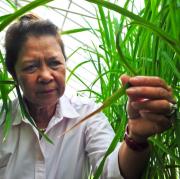
Nollie Vera Cruz

The Heirloom Rice Project (HRP) was a collaboration between the Philippines Department of Agriculture and the International Rice Research Institute (IRRI, coordinated by my former colleague, Dr Casiana ‘Nollie’ Vera Cruz) to enhance the productivity and enrich the legacy of ‘heirloom’ or traditional rice through empowered communities in unfavorable rice-based ecosystems. It focused on traditional rice varieties found only in the Cordillera Region provinces of Ifugao, Mountain Province, Benguet, and Kalinga or northern Luzon island.

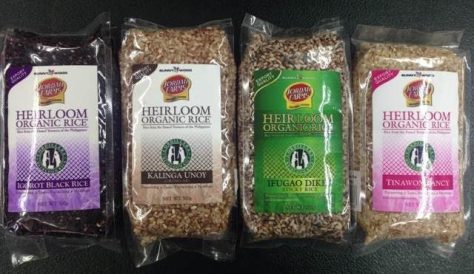
As explained in one website story, ‘heirloom’ rice varieties come in grains of astonishing colors: brown, black, pink, purple, and pearly white; fragrant, nutty in taste, high in fiber; healthy to eat; a gourmet’s delight. Yet for all their captivating look and taste, they thrive in the most fragile places, on mountain tops, where dew, rain, and air are their only means of sustenance. 

Rice terraces at Banaue, Ifugao Province, Philippines.

Furthermore . . . ‘heirloom’ rice varieties have been grown on the terraces of the Cordillera Mountains of Luzon, Philippines [for centuries], terroirs known for their significant historical, cultural, and aesthetic values. However, heritage ‘heirloom’ rice farming is gradually being abandoned, mainly because of its lower productivity and the struggle of the sector to create a sustainable niche market for heirloom rice by branding its cultural, social, and nutritional values.

One of the important outcomes was to link farmers with markets so that these special rice varieties could find a particular niche in the market, even exported during the course of the project to the USA. And it’s those linkages that were so important.

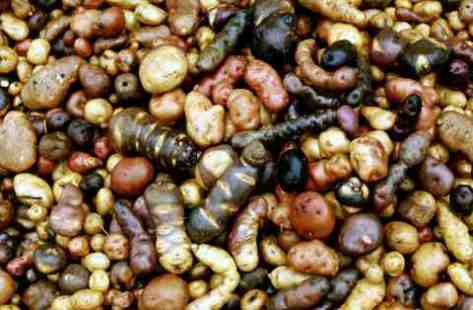
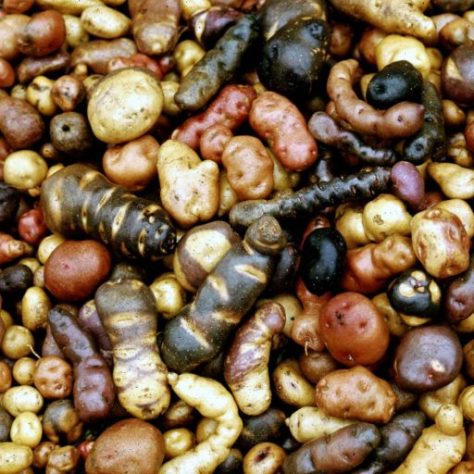
Let’s now to cross to South America where there is a wealth of potato varieties grown throughout the Andes of Peru and Bolivia in particular, mainly (until now) for home consumption.
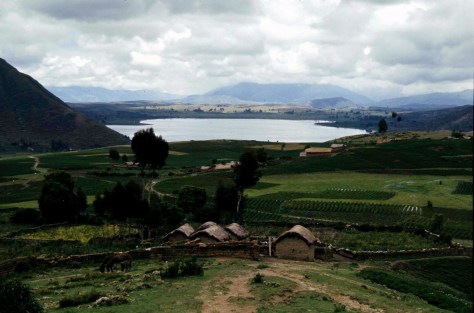
As I have seen for myself, as long ago as 1974 near Cuzco in southern Peru, farmers successfully combined the cultivation of commercial varieties for the market while cultivating the ‘old’ varieties in small plots close to the farmstead, the basis of household food security.

In this photo, northwest of Cuzco, large commercial plantings of improved varieties can be seen in the distance, while inside the wall surrounding the farmstead only native varieties were grown.
Have farmers found a way to make these ‘heirloom’ varieties more commercial? Well, there’s a very interesting initiative in Peru that has spread across quite a large part of the country.

Potato farmers have formed AGUAPAN(Asociación de Guardianes de la Papa Nativa del Centro del Perú) that is supported by Grupo Yanapai, an NGO that has considerable experience in participatory research.
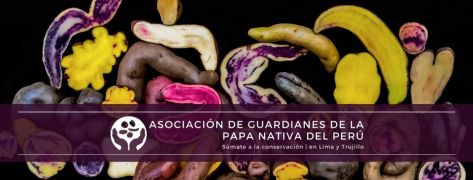
Farmers commercialize their varieties directly to households in Lima, even delivered directly to the door, as mixtures (chaqru) under the trade name Miski Papa.
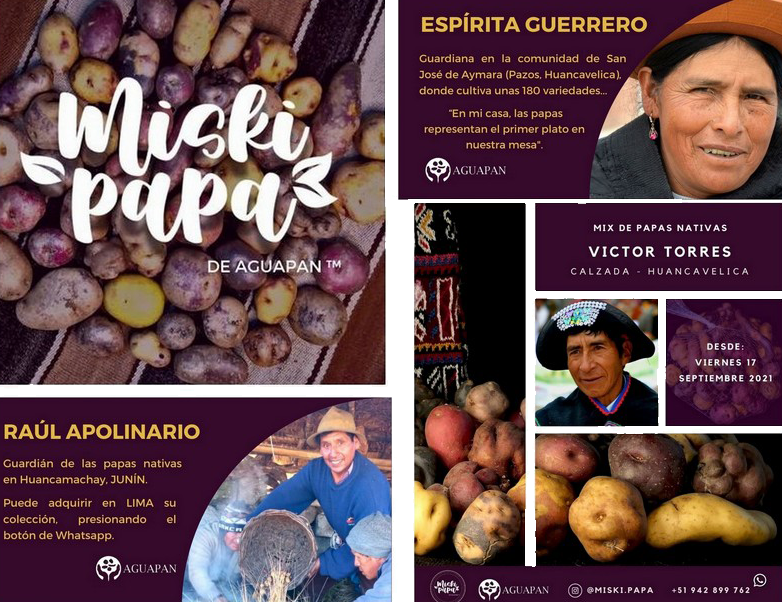
What is particularly interesting about the project is that individual farmers are identified, and the commercialization strategy is geared towards understanding their roles and the varieties they grow. See how Sra. Guerrero grows 180 different varieties!

Now look at these other photos (on AGUAPAN’s Facebook page) showing different farmers and their varieties.

AGUAPAN has taken the opportunity to increase farmer incomes through this project and at the same time ensuring farmers continue to grow ‘heirloom’ varieties. There is an interesting paper published in 2021 by a former colleague of mine at CIP, Andre Devaux (and others) that describes how these potato varieties have become a culinary sensation and a market innovation.


These two projects on rice and potatoes (there must be more around the world on the same and other crops) show how two objectives can be met:

  • Enhancement of farmer livelihoods through market innovations with native ‘heirloom’ varieties;
  • On-farm (in situ) conservation that permits the dynamics of farmer management to prosper, and exposing genetic diversity to environmental challenges, so important under a changing climate.

Personally, until now, I have had some doubts about the wisdom of prioritizing on-farm conservation for crop genetic resources. Certainly in the 1990s there was quite a push to promote in situ conservation, and in the rice biodiversity project that I referred to at the beginning of the post, we learned a great deal about the choices farmers make on a daily basis. And that is what on-farm conservation should be all about: allowing farmers to make informed choices, to change their varieties, to discard some, adopt others. Even though some farmers take on a role of conservators, I’ve never believed that subsidies paid to farmers to ‘conserve’ their varieties was a viable, long-term option. With the commercialization initiatives I’ve described here, there are now excellent opportunities to ensure the long-term survival of ‘heirloom’ varieties in the systems where they originated.

Eat ’em to conserve ’em!


[1] The Hairy Bikers Go North, Episode 4 North Yorkshire (not available everywhere), just before three minutes, first broadcast on 14 October 2021.


Discovering pre-Columbian humanity in the Americas

Over recent weeks, Steph and I have been enjoying the latest series of Digging for Britain on BBC2, hosted by Alice Roberts who is Professor of Public Engagement in Science at the University of Birmingham. In this ninth series (as in the earlier programs) she visited digs all over the UK where archaeologists were busy uncovering our distant (and not-so-distant) past, and the lives of the people who lived there.
In one program she visited a (secret) site in Rutland (England’s smallest county in the East Midlands) where, in a farmer’s field, the most remarkable Roman mosaic floor had been uncovered, depicting scenes from the Trojan War. This was only one of many treasures that were ‘discovered’ during the series.

The British landscape has been transformed by multiple waves of immigration and conquest over thousands of years. But scrape away the surface, as archaeologists are wont to do, and fascinating histories begin to emerge, from prehistoric times through to the arrival of the Romans in AD 43, and in the centuries afterwards.

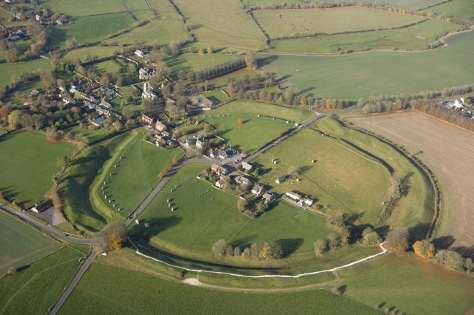
Sites like Stonehenge or the Avebury Stone Circle remind us that humans were living in and modifying these landscapes thousands of years before the Romans arrived on these shores.

Avebury Stone Circle.

Northumberland in the northeast of England (where I now live) is particularly rich in Roman remains. Besides the iconic Hadrian’s Wall, forts like Housesteads or Chew Green, and towns like Corbridge and Vindolanda are a visible reminder that these islands were once under the military control of an empire the like of which the world had never seen before. Northumberland was the northwest frontier.

And after the Romans departed in the 5th century AD, northern tribes such as by Angles, Saxons, and Jutes from continental Europe made these islands their home.

However, I often view our landscape as essentially post-Norman (that is, after 1066) since the Normans (and their descendants) left so many statements of their hegemony: magnificent castles (such as Prudhoe, Warkworth, and Dunstanburgh that stand as proud ruins even today), manor houses, churches and abbeys, and royal hunting parks.


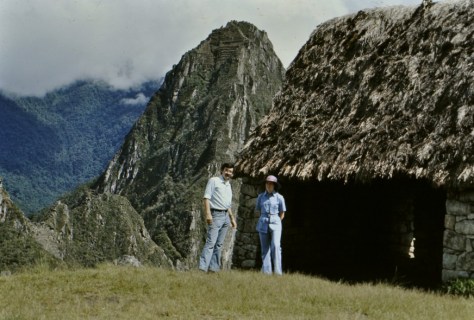
I guess our appetite for the archaeological past was whetted when we moved to Peru in 1973. Within two weeks of landing in Lima in January I had already visited Machu Picchu while attending a meeting in Cuzco. Then, after Steph arrived in Lima in July, we spent many weekends exploring the coast and heading off into the numerous valleys that lead inland from Lima. In December, I took her to Machu Picchu (for a delayed honeymoon!)

Over the three years we spent in Peru, five in Central America, and more recently in the southwestern United States, we have visited a number of iconic pre-Columbian archaeological sites, and others less well known.

It’s not just the remains that various cultures have left behind, however. It’s also understanding their connection with the environment, the types of agriculture practiced for example, and the crops that were domesticated and brought into cultivation (a particular interest of mine).

So permit me to take you on a brief archaeological travelogue through the Americas.


Hiram Bingham III

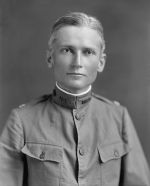
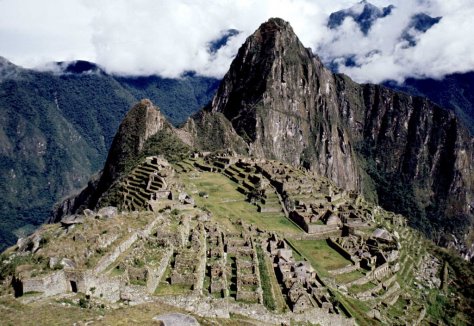
As I’ve already mentioned Machu Picchu, perhaps I should start there. I guess it’s not only the location of this Incan refuge, but something of the mystery that surrounds it until it was ‘discovered’ by Hiram Bingham III in 1911 (although there are earlier claimants).

But tales of a lost city in Peru certainly caught the public imagination, and soon Machu Picchu was a notable tourist destination. In 1973, the rail journey between Cuzco and Machu Picchu was slow and left early in the morning. Nowadays the line has been upgraded and beside the river (way below the ruins) a small town has sprung up to accommodate the multitude of tourists who descend on Machu Picchu daily from all over the world.

I made just a day visit there in January 1973. However, Steph and I were lucky to reserve a room at the turista hotel that once stood just outside the ruins. So, once most tourists had returned to Cuzco late in the afternoon, we (and a handful of other hotel guests) had the ruins to ourselves. Next morning we breakfasted early to watch the sun rise, and enjoy the peace and quiet of this iconic site until, late morning, it was thronging once again with a trainload of tourists.

In many ways it’s not surprising that Machu Picchu remained ‘undiscovered’ for so long, five centuries after the last Inca took refuge there. Other ruins, further out into the jungle, have been uncovered in recent years, like Choquequirao, a two day hike from Cuzco.


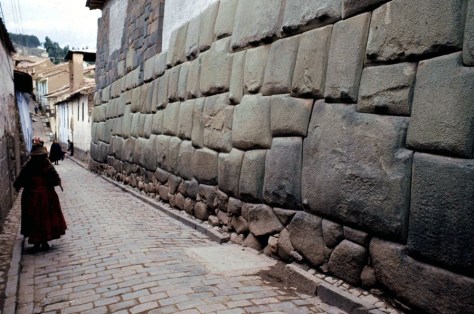
What is remarkable about Cuzco, the Inca capital before the Spaniards arrived in the 16th century, is the juxtaposition of Incan and colonial architecture, in many places the latter built over the former. The beautiful Incan stonework is epitomized, for example, in the 12-sided stone in Calle Jatun Rumiyoc, east of the Plaza de Armas (the city’s main square).

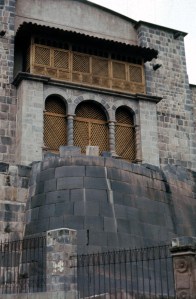
Or the foundations of the Qorikancha temple (right) on which the colonizing Spaniards built the Santo Domingo convent five centuries ago.

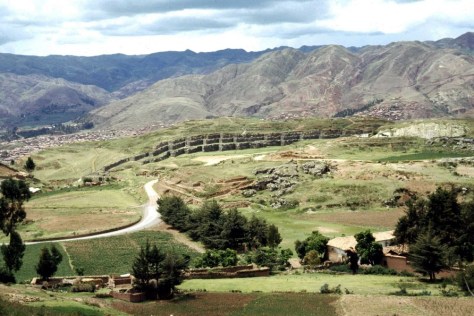
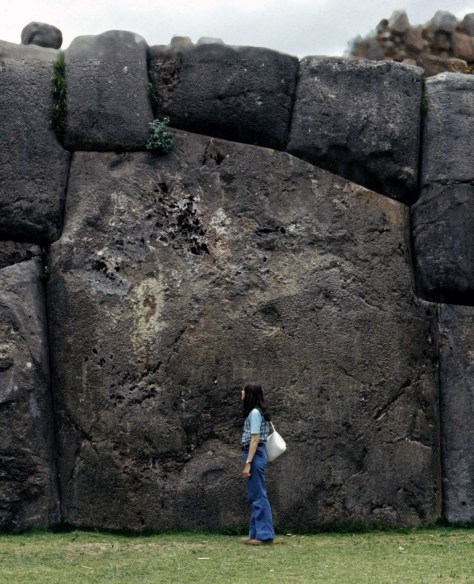
Outside and overlooking Cuzco from the north is the impressive Inca fortress Sacsayhuamán (below). It’s not only its size, but especially the precision with which the stones have been placed together, some stones (like that shown below) weighing tens of tons at the very least.

Just 32 km to the northeast of Cuzco, and standing at the head of the Sacred Valley of the Incas is the market town of Pisac. Even in 1973 it was a major tourist attraction, even though it had changed little from almost 40 years previously when my PhD supervisor Professor Jack Hawkes had visited as a young man of 24. Check out these photos I took in 1973, and compare them with scenes in the film that Jack made in 1939 (after minute 25:25).

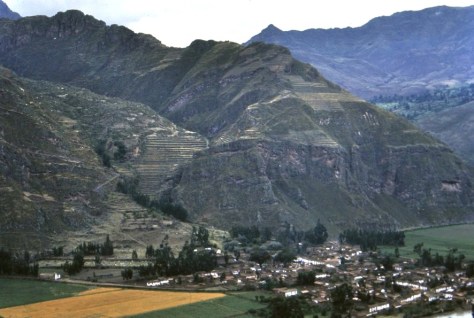
Above the town, 15th century terraces or andenes stretch up the hillside, where there are also temple remains; due to limited time we didn’t have an opportunity of exploring those nor travel further down the valley to Ollantaytambo where there are also impressive Inca remains.

Andenes above the town of Pisac.

But what is particularly remarkable about the Incas is the relative short period (perhaps a little over 300 years until the Spanish conquest in the mid-16th century) in which they held domain over many of the other cultures that had gone before them. Not only in the mountains, but on the coast as well, as I shall describe a little later.


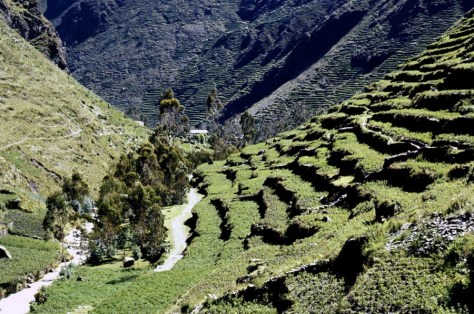
But talking of terraces, I was fortunate to visit the small town of Cuyo Cuyo in Puno in the far south of Peru, in February 1974 while undertaking some fieldwork for my PhD research. Agricultural terraces built centuries ago are still being farmed communally today (at least when I visited almost 50 years ago).

Potato terraces at Cuyo Cuyo, Puno in southern Peru.

While some terraces had fallen into disrepair, the majority were still being carefully tended, and planted with a rotation of potatoes-oca (a minor Andean tuber crop)-barley or beans-fallow over about an eight year period. Impressive as they are, terraces like those at Cuyo Cuyo can be seen in many valleys all over Peru, but perhaps not so actively farmed as there.


Puno is one of the highest cities in the world, at just over 3800 m (12,556 ft), alongside Lake Titicaca, the highest navigable lake.

On a peninsula overlooking a lake about 33 km northwest of Puno stands a cluster of rather peculiar round towers, known as chullpas, of the most exquisite masonry, mostly ruined. Some of these stand 12 m tall. This is Sillustani, a pre-Incan Aymara cemetery site.

It seems that once this area came under Inca control, many of the chullpas were redressed with Incan masonry, much of what we see today.


One could be forgiven for imagining that the coastal desert of Peru is one huge cemetery, such is the extent of the burial sites where Moche (AD 100 -AD 800) and Chimú civilizations (AD 900 until about AD 1470 when the Incas arrived on the scene), and others, held sway leaving behind a vast array of artefacts that tell us so much about them. Having no written language, their pottery tells us much about the crops they grew, the animals they kept, even their sex lives.

Mummy bundles have been excavated in their thousands, and many of the contents are now carefully stored in one of Lima’s most prestigious museums, with just a fraction on display at any one time. Take a moment to read about the museum and its contents that I published in 2017.

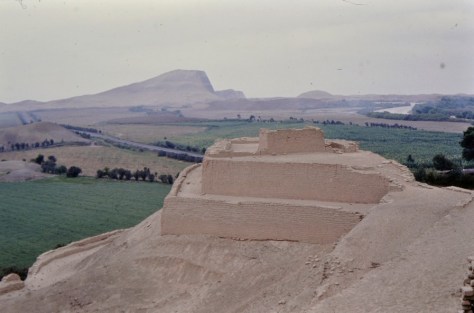
All along the coast there are temples built of mud bricks, like the one below. I don’t remember exactly where this was located, but I think maybe in one of the valleys inland from the coast, 4-500 km north of Lima.

One of the more important ones lies just 40 km (or 25 miles) south of Lima. Pachacamac covers about 240 hectares, and was continuously occupied from about AD 100 until the Spanish conquest, 1300 years later.

North of Lima there are two interesting sites.

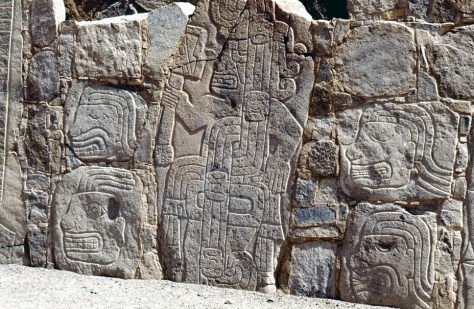
Just outside the coastal city of Casma (about 350 km or 165 miles north of Lima) stand the unusual remains of Cerro Sechín, an archaeological complex covering many hectares, and one of the oldest sites in Peru, dating back about 4000 years. The striking elements of this site are the bas-reliefs etched into the stonework depicting war-like scenes, of warriors, mutilation and the like. It really is a most unusual site. Steph and I visited there (with our CIP friends John and Marian Vessey) in 1974.

At Sechín, as at other coastal sites, the archaeological evidence shows that not only did the inhabitants practice agriculture (maize and beans being the domesticated staples) but depended on the abundant marine resources close by.

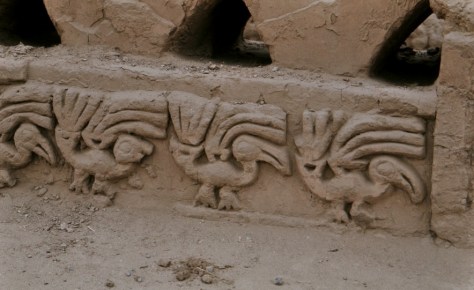
Further north, outside the city of Trujillo stand the degraded remains of Chan Chan, once the great Chimú capital covering 20 km², and built of adobe bricks. It’s regarded as the largest adobe-built city in the world. The complex comprises plazas and citadels, and because of the extremely arid conditions, many of the walls (and their carvings of animals, birds and marine life) have survived to the present.

While the coastal desert is one of the driest in the world, it does rain heavily from time-to-time, and when we visited the walls were being protected from further rain erosion.

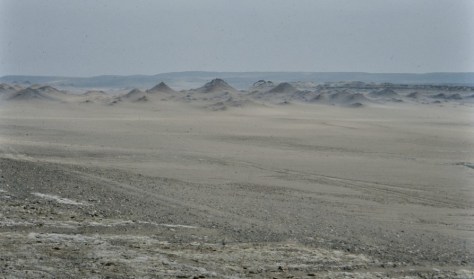
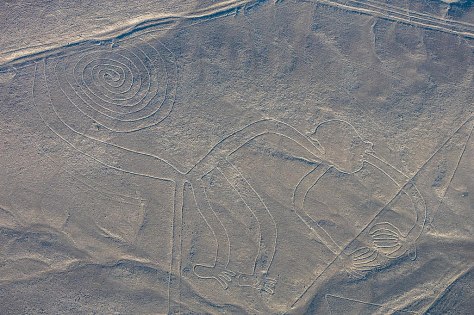
Unfortunately, I never got to view the world-famous Nazca Lines from the air. As you cross the Nazca plain (over 400 km south of Lima) you can see some of the lines stretching into the distance but with no comprehension of what they might represent. Furthermore, indiscriminate vehicular access to this area in the past (even army manoeuvres!) has left indelible tracks across the desert, desecrating some of the incredible figures there.

The Nazca Plain from the Panamericana Sur. You can see vehicle tracks heading off into the desert.

The monkey on the Nazca lines.


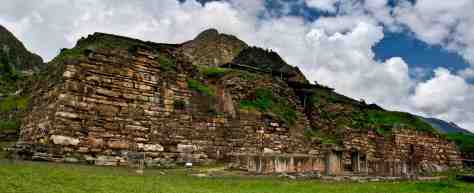
On the southeastern side of the Cordillera Blanca in the Department of Ancash the ruins at Chavín de Huántar, a site that was occupied over 3000 years ago, and regarded as the oldest highland culture in Peru.

‘El Castillo’ at Chavín de Huántar.

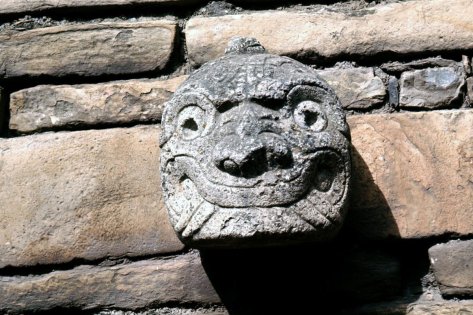
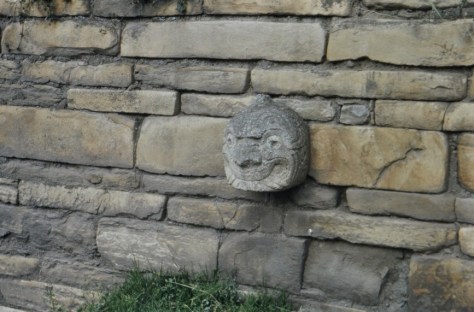
A stone head or tenon at Chavín de Huántar.

I visited there in May 1973 when collecting potatoes in that part of Peru, and again with Steph and the Vesseys a year later.

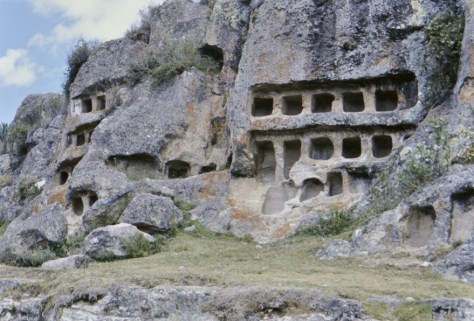
Just outside the highland city of Cajamarca (2750 m, about 180 km inland from the coast between Trujillo and Chiclayo) are the Ventanillas de Otuzco, and ancient necropolis (over 2000 years old) carved in the rock face.


Steph and I lived in Costa Rica in Central America for almost five years from April 1976. There are few remains of indigenous cultures around the country (unlike Guatemala or Mexico for instance).

However, just under 20 km north of Turrialba (where we lived) lie the enigmatic remains of Guayabo National Monument, which I wrote about in October 2017.

There’s good evidence however that this site was first occupied over 2000 years ago, until the beginning of 15th century.

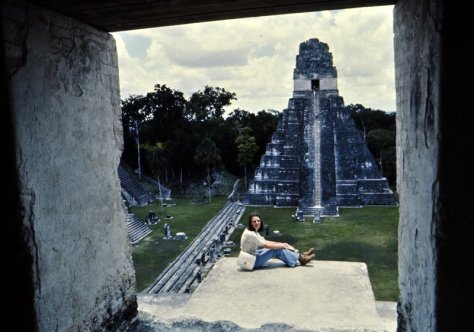
In the jungle of northeast Guatemala stands the ruins of ancient Tikal, a Mayan complex dating back more than 2400 years, surely one of the most iconic archaeological sites on the planet (and which even featured in the very first Star Wars movie).

Steph and I flew there in 1977, on an Aviateca DC3, spending one night in one of the lodges. Back in the day it was possible to reach Tikal only by air, but the whole region has now opened up via roads and even an international airport in the nearby city of Flores, just 64 km to the south. I guess the site must now be overrun to some extent by tourists, much like has happened at Machu Picchu. We were fortunate to visit here, as with many of the sites I have described, before they appeared on the everyday tourist routes.

We spent hours wandering around this huge site, and managing to see just a fraction probably. It’s hard to imagine just how steep the temple steps are. No wonder Steph was out of breath. We later learned that she was pregnant when we were there.

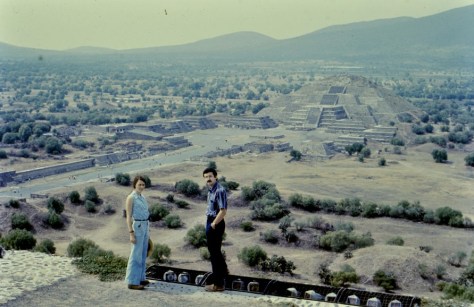
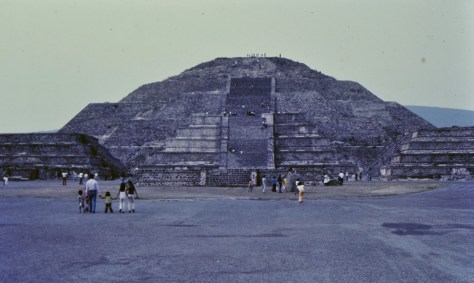
It seems that Tikal was conquered, around the 4th century AD, from Teotihuacán from the valley of Mexico. And it’s there, north of present day Mexico City that the important temple complex of Teotihuacán can be found. Its famous Temple of the Sun and others are significant Mesoamerican pyramids standing on a site that covers 21 km². We visited there in April 1975 on our way back to the UK, staying with our friends John and Marian Vessey who had left CIP to join a sister research center, the International Maize and Wheat Improvement Center (CIMMYT) that is located not far from Teotihuacán. I’ve been back there a couple of times in the 1990s and 2000s.


Our elder daughter Hannah moved to Minnesota in 1998 to complete her undergraduate degree at Macalester College in St Paul, then registered at the University of Minnesota for her PhD in psychology. In 2006 she married Michael, and they set up home in St Paul. Grandchildren Callum and Zoë came along in 2010 and 2012, respectively. And since I retired from IRRI in 2010 and returned to the UK, Steph and I have visited them every year, and made some pretty impressive road trips across many parts of the USA. That is until Covid 19 put paid to international travel for the time being.

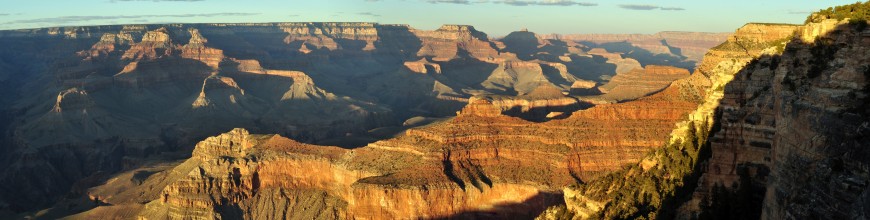
In 2011, we had the opportunity of fulfilling a lifetime ambition: to travel to the Grand Canyon in Arizona. So we flew from Minneapolis-St Paul (MSP) to Phoenix (PHX) to take in the Grand Canyon, and travel extensively through Arizona and New Mexico. We visited three sites on this trip, but only one, the Canyon de Chelly, was a pre-trip destination. We fortunately came across the other two during the course of our travels.

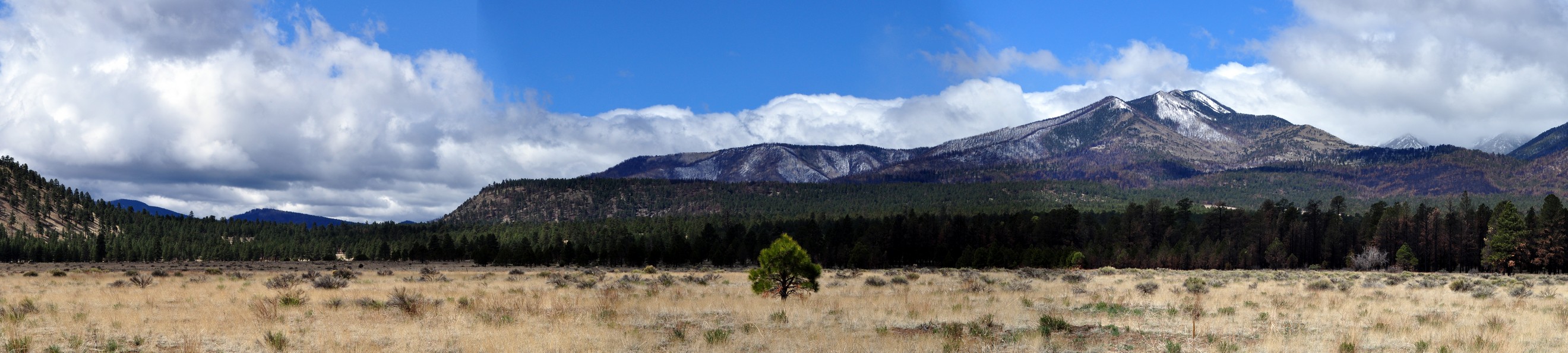
We stopped in Flagstaff on our first night, having traveled north from Phoenix through the Sedona valley and having our first taste of the magnificent red-rock buttes. Then, the following day as we headed north on US89, we saw a sign to Sunset Crater Volcano National Monument.

Checking the map, I saw that we could make a useful diversion, and also taking in further north Wupatki National Monument, a 100-room pueblo and other buildings in the surrounding small ‘canyons’. It is believed that peoples first gathered here around 1100 AD, just a century after the Sunset Crater Volcano erupted. Even today, Wupatki is revered by the Hopi, Zuni, and Navajo tribes.

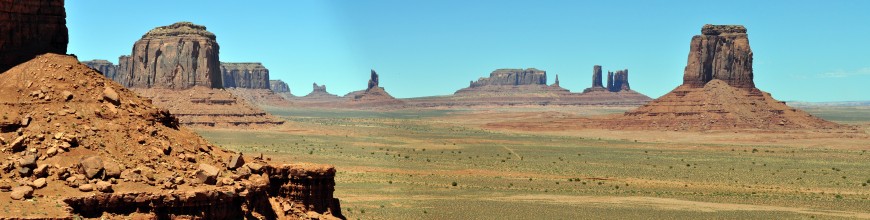
After a couple of nights at the Grand Canyon (South Rim), and a detour to Monument Valley we found ourselves in Chinle, in northeast Arizona.

In the heart of the Navajo Nation, Chinle is the gateway to the Canyon de Chelly National Monument. Occupied for thousands of years, Canyon de Chelly is a very special place, and somewhere in the USA that I would return to tomorrow, given half the chance.

It was settled by ancient Puebloans at least 4000 years ago, finding the steep-sided canyon an ideal place to settle, raise their families in a safe environment, and raise their crops. These included, after the Spanish arrival in the Americas in the 16th century, peaches that were destroyed during reprisal raids by the US Army in the late 19th century, led by Indian agent and Army officer Kit Carson. In fact, it was reading a biography of Kit Carson in February 2011 that was the impetus to visit Canyon de Chelly.

We viewed the canyon from the rim only. Access to the canyon floor is limited to just one access point to visitors on foot, who can climb the long way down (800-1000 feet) to view houses built into the cliff face. We could see that from the rim, as well as two others at different locations and at different heights on the canyon wall. The Navajo must have felt they were safe from invaders, but unfortunately not, making a last stand at the tall pillar Spider Rock that you can see in one of the images below.

The Navajo do provide guided tours into the canyon, and if I ever return, I’ll spend several days there and take the tour.

On the penultimate day of our road trip, passing through Los Alamos (where the first atom bombs were designed) in New Mexico, we’d seen signposts to Bandelier National Monument. There’s good evidence of human settlement in this area over 10,000 years ago; ancestral Puebloan peoples settled here 2000 years ago, but had moved on by the mid-16th century.

Rooms were carved into the soft rock or tuff, with ladders used to scale the cliff face. In a few places rock art can be seen. There is also good evidence of agriculture based on the staple triumvirate of maize, beans, and squashes, as well as hunting for deer. Since we had to make progress towards Albuquerque for the last night before flying back to MSP, we were not able to spend as much time exploring the site as we wanted.

Nevertheless, with our visits to Wupatki, Canyon de Chelly, and Bandelier, we gained an appreciation of ancient lives in these desert environments. Of course there’s more to see and learn about the Chaco culture that thrived in New Mexico. Ancient settlements are scattered all over Arizona, New Mexico, and Colorado.


Collecting potatoes in Peru – following in Jack Hawkes’ footsteps (Part 2)

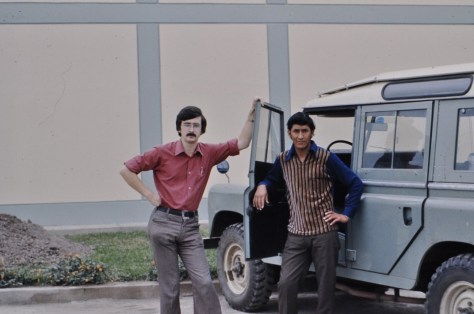
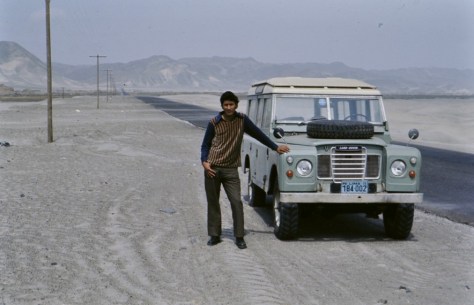
A year after returning from collecting in Ancash and La Libertad (as described in Part 1) I was heading north once again, this time to the Department of Cajamarca. In a long wheelbase Land Rover, a donation from the British government to CIP. But alone this time, almost. By May 1974 I was already quite fluent in Spanish, and had done more travelling around the country. It was assumed therefore I could look after myself, so we decided I should travel with just one of the CIP drivers, Octavio. I regret I cannot recall his surname.

Just about to head out (May 1974)

Parked on the side of the Panamericana Norte highway north of Lima

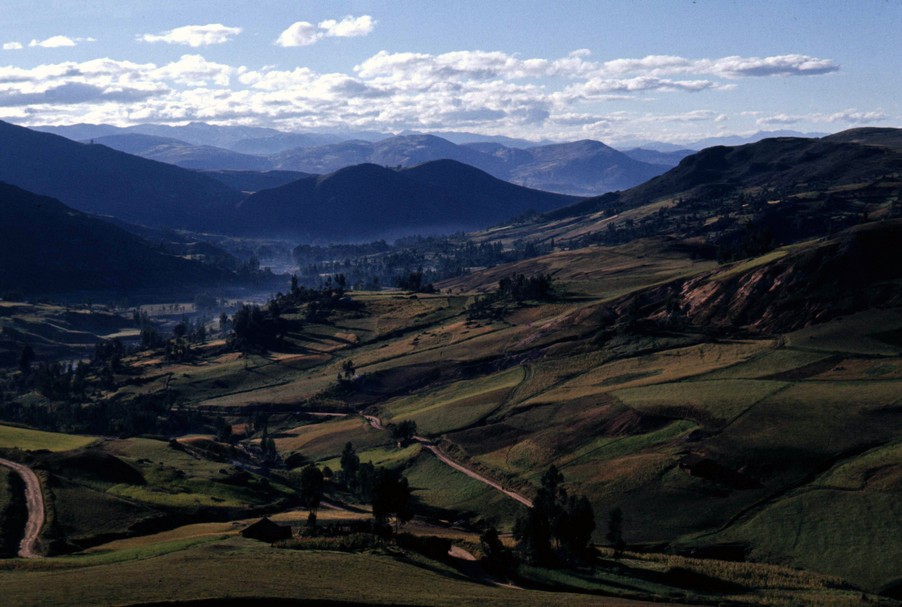
Cajamarca is also the capital city of the department, and is one of my favorite places in Peru. At 2700 m elevation, the city lies in a broad valley among rolling hills. The landscape of Cajamarca has a much gentler feel to it than the high peaks of Ancash or further south around Cuzco, or the altiplano surrounding Puno.

We must have split the journey to Cajamarca city. It’s almost 900 km and even today, on better roads, the journey is estimated to take more than 14 hours. North of the coastal city of Trujillo, the road to Cajamarca diverges east from the Panamericana Norte, winding through a lush river valley in the desert, and climbing into the mountains. Dropping down the other side, you eventually are treated to views of the city unfolding in the distance. The climate is spring-like, the food is good (the leche asada or caramel custard is a local treat), and the architecture of the (unfinished) cathedral on the main square of Plaza de Armas is a wonder.

We spent around three weeks travelling to remote areas, but were able to return from time to time to Cajamarca to enjoy the comforts of the Turista Hotel, and the Inca baths and their hot springs.

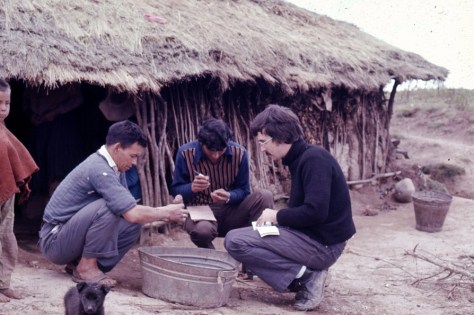
As with our collecting the previous year, we stopped to chat with farmers, ask about the varieties they and their neighbors cultivated, and requesting a sample of healthy tubers of each variety.

The market town of Bambamarca, 100 km or so north of Cajamarca was particularly interesting. It was a colorful, vibrant scene with many wearing their typical tall sombreros and russet-red ponchos, typical of Cajamarca.

On one day we stopped to chat with one farmer and his wife who became very interested why we were collecting potato varieties, and what we would do with them once back in Lima. They were so pleased to show me this particular variety with its large tubers. It’s one of my favorite images from my time in Peru.

There was even a little time for some sightseeing. Just 10 km northeast from the Plaza de Armas in Cajamarca stands an unusual archaeological site, the Ventanillas de Otuzco, a pre-Inca necropolis with more than 300 niches carved in the rock face. We even found wild tomatoes growing there.

If I have one abiding image of Cajamarca—city and landscape—it would be this one. Having eaten an early breakfast, Octavio and I headed north from the city, climbing above the valley. We stopped almost at the summit so I could take this photo of the Cajamarca valley. If you look carefully you can see the steam rising from the Inca baths in the distance.

Octavio and I got along quite well. He’d never traveled to that part of Peru before and, as a driver from the big city, had very little knowledge of potatoes. We had just the one falling-out, if you can call it that. He would insist in driving downhill along quite treacherous roads in high gear, or even in neutral, relying solely on the brakes alone to control our speed. I had to insist he use low gear to slow the vehicle or he wouldn’t be driving any more until we reached the coast and the Panamerican highway. Anyway, we arrived back in Lima after an incident-free trip.

Later on that year, I returned to Cajamarca with my wife Steph and two English friends from CIP. Again in 1988, as a member of a CIP project review team, I spent a few days in the city and surrounding countryside looking at seed production and storage systems.


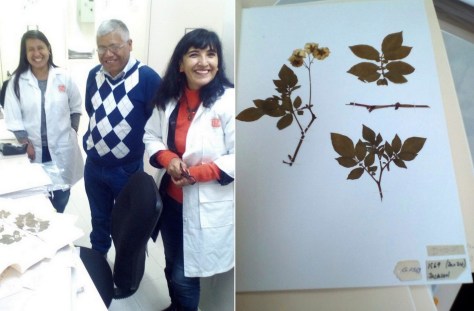
When I visited CIP in 2016 as part of a review of the genebank, the staff showed me some herbarium sheets from some of the varieties I had collected on that trip to Cajamarca.


Earlier in 1974, in February, I traveled to Puno and Cuzco in the south of the country with Dr Peter Gibbs from the University of St Andrews, Scotland. He was studying the floral biology of another Andean tuber crop known as oca (Oxalis tuberosa). He had contacted CIP’s Director General to see if anyone might be headed south for fieldwork with whom he could travel.

I’d already decided to carry out some field studies of potato varietal mixtures and was looking for suitable locations. Peter suggested that we might head to Cuyo Cuyo, a municipality just under 250 km northeast of Puno and Lake Titicaca. Famous for its agricultural terraces or andenes, there had been one study in 1951 describing the cultivation of oca in the valley. Peter convinced me that it was worth heading in that direction. Which is precisely what we did.

On this trip we drove a short wheelbase Land Rover, another donation to CIP from the British government. It had a separate cab; the rear was covered with a canvas hood, not the most secure vehicle for venturing into remote parts.

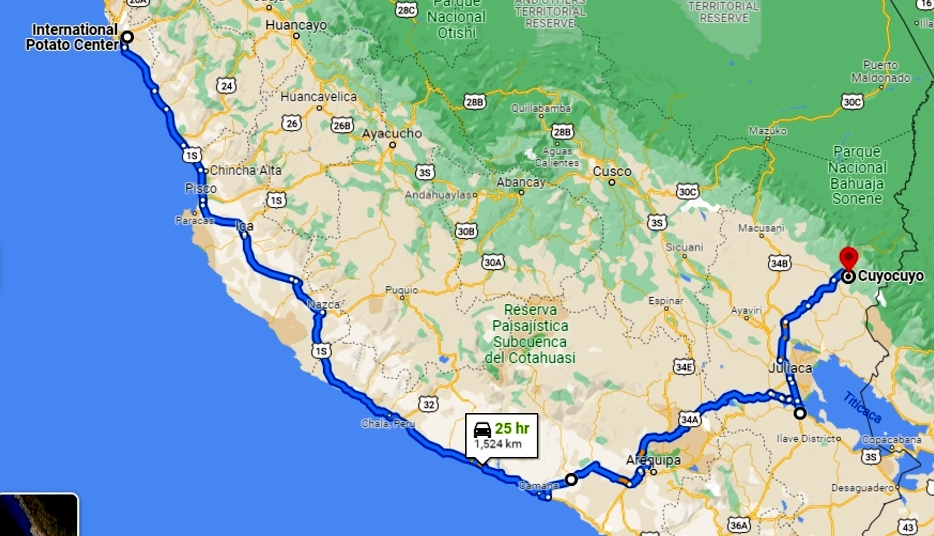
Heading south down the Panamericana Sur, we had a road trip of almost 1300 km ahead of us. I know we stopped in Nazca on the first night, after driving 447 km. From there to Arequipa was another 568 km, and the final leg into Puno was 295 km. I think we must have made it to Arequipa on the second day, resting up before the climb to the altiplano on the third day.

In Puno, we rested for a couple of days, checking our gear, and meeting with some officials from the Ministry of Agriculture for further advice before setting off for Cuyo Cuyo. Peter had developed a taste for algarrobina, a popular Peruvian cocktail, a bit like egg-nog, but with a kick, especially after one too many. We weren’t in the best shape to head off across the altiplano the next day.

Each time I crossed the altiplano it was hard to understand just how people managed to survive in such a harsh environment: flat, cold, and often over 4000 m. Yet we passed farms, growing the bitter and frost-resistant potatoes that are processed to make chuño as well as herding llamas and alpacas. Crossing several rivers, we finally reached the head of the Cuyo Cuyo valley and, descending into the cloud, encountered workmen struggling to clear a landslide. However that gave an opportunity for some impromptu botany, finding a beautiful begonia with flowers as large as saucers.

Once clear of the landslide, and out of the cloud, the most amazing vista opened up before us. The whole valley was terraced and, as we learned over the next few days, supported a rotation system involving potatoes, oca, barley and faba beans (both imported by the Spanish in the 16th century), and a fallow.

Arriving in the village it was important to find somewhere to stay. We hadn’t thought to make any enquiries before setting out for Cuyo Cuyo. There was no hotel, but the postmaster offered us space to set up our camp beds and herbarium drying equipment, and there we stayed for about five days. We were certainly a curiosity with the village children.

Peter set about collecting samples of oca with different floral structures for his study, and to make herbarium specimens to take back to St Andrews. At the time of our visit many of the oca fields were planted in the lower levels of the valley often close to the river. I set off on my own, guided by a local farmer, to potato terraces higher up the valley to study the varietal mixtures and to learn more about the agricultural system. That study was finally published in the journal Euphytica in 1980 and can be read here.

Peter’s oca samples were the devil to dry because of their fleshy stems. When he finally made it back to St Andrews a couple of months later, he found that his ‘dry’ specimens were still alive. So he planted them in a university glasshouse, and had the best of both worlds being able to continue his study with living plants.

Leaving Cuyo Cuyo, we headed back to Puno staying one night there before setting off for Cuzco some 385 km to the northwest.

I was interested in locating another site for study, and we settled on a community near Chinchero outside Cuzco. We hired horses to reach remote fields, and there I collected flower buds (for chromosome counts) from several fields.

It was interesting to find large commercial cultivation of potatoes (for sale in markets like Cuzco) alongside smaller plots of native varieties that farmers grew for home consumption. As I was collecting samples from one field, two women stopped close-by and one of them crouched down to feed her baby. Both were dressed in the typical costume of that region.

Soon we had all the information we thought we needed (in hindsight I would have done things very differently, and at Cuyo Cuyo), and headed back to Cuzco where we left the vehicle to be collected by Zósimo Huamán who was heading south for his own field studies, and who would drive it back to Lima.

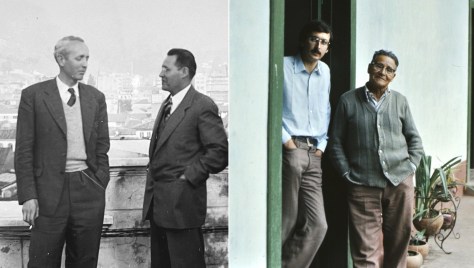
While we in Cuzco, we visited the home of Professor César Vargas, a renowned Peruvian botanist, who I had first met in January 1973 when Jack Hawkes introduced me to him. Jack first met Vargas when he was working in Colombia between 1948 and 1951. Also, Vargas’ daughter Martha was an MSc student at St Andrews so it was a good opportunity for Peter also to meet him.


I only made one field trip with Jack Hawkes, in March 1981 just a few weeks before I left CIP to return to the UK and take up a lectureship at The University of Birmingham.

Jack was in Lima on his way back to the UK having led yet another expedition to collect potatoes in Bolivia. He suggested that we take a long weekend to head up into the mountains and see what wild species of potato could be found. A CIP colleague, potato breeder Juan Landeo, came along for the trip.

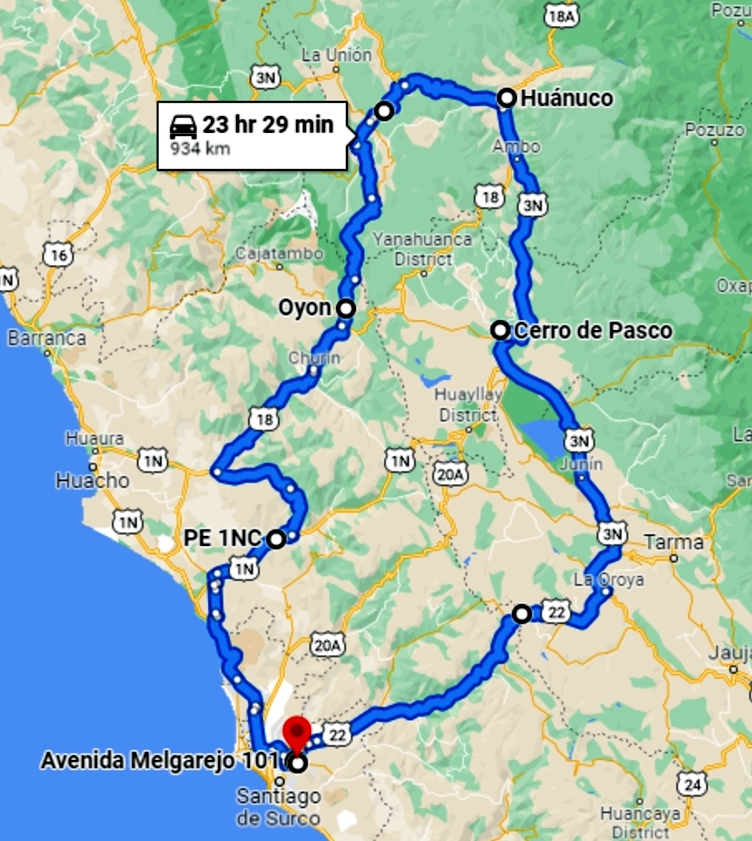
On the first day, we set off east up the Carretera Central, over Ticlio at 4800 m and on to the smelting town of La Oroya, before heading north to the important mining center of Cerro de Pasco (4330 m), one of the highest (and bleakest) cities in the world.

The next morning we continued north, finally descending to the warmth of Huánuco, a lovely city at just 1880 m. We spent the night there.

I don’t recall if we split the journey back to Lima (or the exact route) or traveled from Huánuco in one day, stopping every now and then to collect potatoes.

Early in the day we came across some farmers using the traditional foot plough or chaqui tacclla. This is an iconic image.

We passed through some awesome landscapes. Even encountering a significant landslide that blocked our path. Closer to the coast the mountains were lost in the clouds as we made our way down the side of the valley.

I learned one very important lesson from Jack Hawkes: that a sound knowledge of the ecology of the species was very important (a point emphasized by Israeli geneticist Gideon Ladizinsky when I took a party of Birmingham students to a genetic resources course near Tel Aviv in 1982).

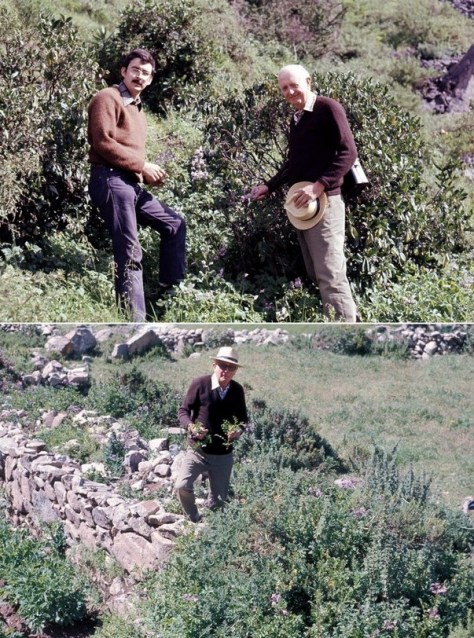
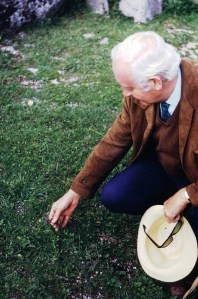
We’d be driving along, when Jack would suddenly ask us to pull over, saying that we’d find potatoes in the vicinity. Even naming which species we’d be likely to find. And I don’t remember him ever being wrong. It was fascinating to see how his deep knowledge guided his approach to collecting wild potatoes.

This is the only photo of me in the field with Jack, as we collected Solanum multiinterruptum (or was it S. multidissectum?).

It was a great experience, learning more about wild species in the field, from the master. These are memories that will stay with me for years to come.


Collecting potatoes in Peru – following in Jack Hawkes’ footsteps (Part 1)

Professor Jack Hawkes examines a specimen of the wild potato species Solanum raphanifolium in the ruins of Sacsayhuaman outside Cuzco, January 1973

Potatoes are native to the Americas; the wild Solanum species are found from Colorado in the United States, south through Mexico and Central America, and throughout the Andes as far south as northern Argentina. They even grow on the plains of Argentina, Uruguay and Brazil. Different forms of potato were domesticated thousands of years ago in the Andean region and southern Chile. Even today, farmers in the Andes grow (and conserve) a wonderful range of potato varieties.

Over many decades potato scientists made expeditions to the Americas to collect wild and cultivated potatoes, to learn about their biology and ecology, and how they might be used to enhance potato productivity through plant breeding. Among the potato pioneers was my friend, colleague, and mentor, the late Professor Jack Hawkes, a world-renowned expert on potato diversity and taxonomy and a leading light in the genetic resources conservation movement that emerged in the 1960s.

The wonder of potato diversity

I began my own studies on potato under Jack’s tutelage in September 1971 at The University of Birmingham, after graduating with an MSc degree in genetic resources conservation. Jack took me under his wing, so to speak, to teach me about potatoes and prepare me for a posting at the International Potato Center (CIP) in Lima, Peru where (from January 1973) I worked as an Associate Taxonomist for three years. I had just turned 24 the previous November.

Jack made his first trip to South America in 1939 at the age of 23, turning 24 during the course of the expedition in June that year, as a member of the Empire Potato Collecting Expedition to South America and spending nine months collecting wild and cultivated potatoes along the Andes of Argentina, Bolivia, Peru, Ecuador, and Colombia.

Jack Hawkes (second from right) with expedition leader Edward Balls (on Jack’s right) and two others outside a church in La Paz, Bolivia in March 1939.

Returning to Cambridge in December 1939, just after the Second World War broke out, Jack continued to study the materials collected on the Empire expedition, completing his PhD in 1941. He remained at Cambridge until 1948 when he was seconded by the Government of Colombia to set up a research station for potatoes near Bogota.

In 1952, he returned to the UK, joining The University of Birmingham as a lecturer in the Department of Botany, but he returned to the Americas many times over the next four decades to collect potatoes. Awarded a personal chair in taxonomic botany in 1961, he became Mason Professor of Botany and head of department in 1967.

In 1969 he launched the one year MSc course I referred to earlier, and that’s when I first met him a year later. It would be no exaggeration to state that Jack Hawkes played an incredibly important role in shaping my subsequent career in international agricultural research and academia.


In December 1970, just three months after I arrived in Birmingham, Jack joined his Danish colleague Peter Hjerting on an expedition to collect wild potatoes in Bolivia, accompanied by Jack’s research assistant and PhD candidate Phil Cribb.

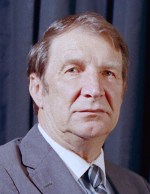
Richard Sawyer

The expedition received support from the newly-established International Potato Center (CIP) in Lima whose Director General, Dr Richard Sawyer kindly loaned a four-wheel drive vehicle. Joining the expedition was a young Peruvian scientist, Zósimo Huamán who had been hired by CIP to manage its large germplasm collection of native potato varieties.

While in Lima, Jack was asked to accept Zósimo on the Birmingham MSc course in September 1971. And then Sawyer asked Jack if he could recommend someone to join CIP on a one-year posting to cover for Zósimo while away in Birmingham. Apparently, so Jack later told me, my name immediately came to mind. Perhaps I’d mentioned that I had a burning ambition to visit South America and, in any case, I would graduate just when Zósimo was expected in the UK.

Anyway, to cut a long story short, immediately on his return to Birmingham at the end of February 1971, Jack told me about the opportunity at CIP. Was I interested? There was no question about it.

Zósimo and Jack in a potato field in Bolivia standing beside a variety of S. ajanhuiri

As it turned out, my departure to Peru was delayed by 15 months while different funding options for my posting were finalized. I began my PhD study, and after he graduated with his MSc in September 1972, Zósimo also registered for a PhD, studying the evolution of a frost-resistant form of cultivated potato known as Solanum ajanhuiri that he and Jack had collected at high altitude in Bolivia.

I departed for Lima on 4 January 1973, and by the beginning of April that year Zósimo had also returned to Peru having completed the first six month residency requirement for his PhD at Birmingham.


With hardly any time to get himself sorted after being outside Peru for 18 months, Zósimo and I organized a trip in May to collect potato varieties from two departments to the north of Lima: Ancash and La Libertad.

To say that I found the experiences beyond my expectations would be an understatement. Peru was everything I hoped it would be when I spent hours poring over a map of the country as a young boy. It is an extremely beautiful country, even if (at least in the 1970s) it was not the easiest country to travel around.


After 49 years, and without access to any notes we made, reports we wrote, or the books in which we recorded the germplasm samples collected, I am unable to detail the routes we took with any degree of confidence, except in the most broad terms. We were away from Lima for almost a month, and explored much of these two departments as best we could: by road, on foot, and on horseback.

At the end of the road, preparing to walk into a distant village; and below, riding back from a side-trip to a village

This was the first collecting trip that I had made. Time to put theory into practice. I bowed to Zósimo’s better knowledge, not only of potatoes and the terrain, but because he was a native Spanish speaker and after just a few months in Peru my Spanish was rudimentary to say the least. Also, as I mentioned earlier, Zósimo already had experience of collecting, having joined the Hawkes-led expedition to Bolivia in 1971.

We headed north on the Panamerican highway, destination Huaraz, the capital of Ancash located in the Callejón de Huaylas, a long north-south valley between the Cordillera Blanca to the east with the highest snow-covered peaks in the country and the Cordillera Negra to the west. Our aim was to explore regions right round these mountain ranges, and we certainly found ourselves in some remote locations.

We moved north into La Libertad, spending a little less time there than in Ancash before heading back to Trujillo on the coast for a well-deserved shower and rest at a good hotel, and better food before heading south to Lima, a journey of 575 km. I don’t recall if we attempted that last sector in one day or made an overnight stop about half way. In any case the journey would have taken about 10 hours or more, and given an incident on the way south that I’ll explain below, maybe we did split the journey.


In 1973, the Peruvian government was led by left-wing-leaning military junta headed by General Juan Velasco Alvarado who came to power in 1968 following a coup d’état. We encountered military checkpoints frequently on our travels in the mountains, often manned by young recruits or conscripts, teenagers even, armed with automatic weapons. Coming from a country where the police never carried firearms (at least then) nor were the armed forces deployed on the streets (that would change in Northern Ireland in the 1970s) I found it extremely disconcerting to be faced with soldiers pointing weapons at me and wondering if their discipline was as tight as I hoped. Needless to say we never encountered any specific threats or hostility.

What particularly struck me during this trip (and others that I made in 1974 and 1975, which I describe in Part 2) was the generosity of almost everyone we met. Farmers were generous with the potato varieties and knowledge they shared with us. Each potato variety collected was carefully labeled with a unique number inscribed on each tuber, and on the paper bags in which they were stored. All the details were recorded in a small booklet; I wonder if these are still archived in the CIP genebank in Lima.

Often we were invited to share a meal with a family, and only on one occasion did I baulk at what was put in front of me: fried cuy or guinea-pig (which are native to Peru and most households keep a small herd of them running around the house ready for the pot). I just couldn’t bring myself to tuck in. Guinea-pigs, to my mind, were furry pets. Needless to say that, as I grew older, such inhibitions diminished.

Despite being memory-deficient when it comes to the route or the places we stayed, there are several anecdotes that are still fresh today.

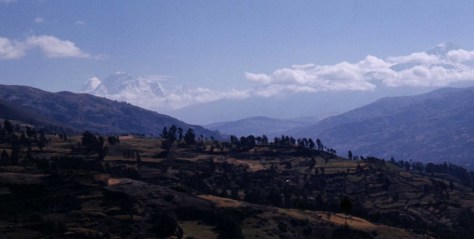
One experience was particularly emotional. Just 57 km north of Huaraz lies the town of Yungay, and a few kilometers closer to Huaraz, the town of Ranrahirca. On 31 May 1970 a powerful earthquake off the coast west of here, dislodged a massive landslide, a mixture of ice and rocks, that fell from Huascarán, Peru’s highest mountain.

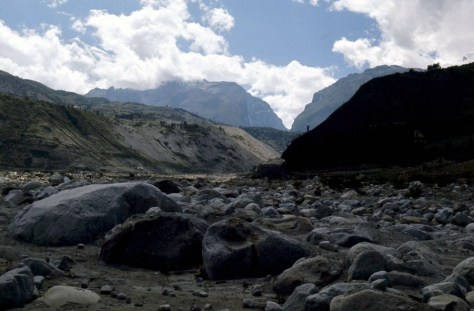
Looking north along the Callejón de Huaylas towards the twin peaks of Huascarán

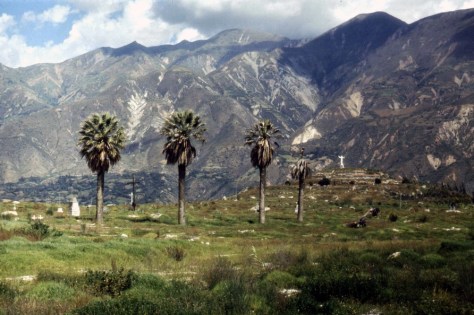
Travelling at speeds up to 335 kph the landslide quickly reached and obliterated both towns, killing tens of thousands. In Yungay, when we visited almost three years later, the only remains of the town still standing were the cemetery mound with a statue of Christ with outstretched arms, and four palm trees. They had survived, yet everywhere else the landscape was dotted with crosses marking where houses used to stand and presumably families perished. What a sobering sight indeed.

The statue of Christ in the site of Yungay, May 1973

This was the site of Ranrahirca where the town had been obliterated by boulders the size of houses, May 1973


We followed the road south from Huaraz and round to the east of the Cordillera Blanca, to Chavín de Huántar.

A stone tenon head, one of the iconic features of the ruins at Chavín

The next day we headed north up a steep and extremely muddy road, slipping and sliding from side to side. Fortunately the road was wide and there were no drop-offs, until we reached the highest point. The road levelled off, snaking along the side of the valley, barely wide enough for our Toyota Landcruiser. It was also quite muddy there as well.

We could see there was a drop-off, but given that we were in cloud, couldn’t see more than about 50-100 m ahead. It was only on the return journey and checking our maps that we saw that the side of the road plunged about 1000 m to the valley below. Talk about a stressful situation.

Having enjoyed a good bistek in Chavín that evening, we both got very drunk on Ron Pomalca, regretting sincerely the following morning that we had imbibed so freely. Incidentally, Zósimo found that the rum was also a useful liniment after several hours on horseback, and kept a bottle for that purpose.


On one occasion, we drove as far as we could before walking to two villages some kilometers away. When we arrived at the first village, we found everyone celebrating the jubilee of its founding (and were informed that the next village was also in fiesta mode). We were made welcome, offered refreshments, and talked with village officials before explaining that we had to push on to the next village before it got dark. There we found almost everyone in an advanced state of inebriation, especially the schoolteacher, who spoke a little English.

As special guests on that auspicious day, the mayor invited us to a reception, where the whole village crammed into the town hall. Speeches were made, with Zósimo translating for me. It was clear we would have to respond, especially me as a representative of La Reina Isabel. I frantically whispered to Zósimo how to say such and such in Spanish, writing his translations on the palm of my hand. When it was my turn to make a short speech, I nervously complimented the village on its anniversary and how pleased we were to be there. On sitting down, everyone in that room, at least a hundred men and women, maybe more, came and shook my hand. What a memory.

Zósimo (on the right) beside the teacher, his wife and child in front of his house where we spent the night


Later in the trip in La Libertad, we arrived in one village looking for a hotel. There were two: one had been opened not many months before our arrival there; the other was quite run down. We chose the new hotel, ignoring ‘advice’ that it was flea-infested. Surely that couldn’t be the case? How wrong could we be, waking next morning covered in flea bites and itching madly. Those pesky fleas got everywhere, so we had to endure several days of purgatory until we reached the coast and could send all our gear for cleaning. And take a welcome shower.


Finally, on the return journey south on the Panamerican Highway south of Trujillo, there was a puncture in the rear nearside tyre. We quickly replaced it with the spare, and resumed our journey, hoping to find a grifo or garage soon where the tyre could be repaired. I was driving. Suddenly there was a bang, and the vehicle lurched wildly. I managed to bring it under control, even though the rear was touching the ground. You can imagine our surprise when the wheel passed beside us, travelling at speed ahead. Zósimo and I had each thought the other made a final check of the wheel nuts. They just worked their way loose until the wheel fell off. Our humble jack was not powerful enough to lift the vehicle, but we flagged down a truck driver who used his more robust jack. We retrieved the wheel several hundred meters down the road, and even located all four wheel nuts scattered across the highway. What luck! Fortunately there were no further incidents before we reached CIP’s headquarters in the La Molina district of the Lima.

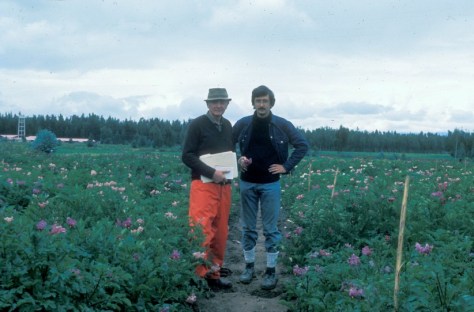
What an experience, and despite some stressful incidents (and occasional differences of opinion with Zósimo) we returned to Lima after a successful collecting trip. Maybe there were a couple of hundred samples or more to add to CIP’s germplasm collection. That collection eventually grew to around 15,000 samples or accessions but was reduced to its current more manageable size of around 4000 accessions after possible duplicate samples were removed (although converted to botanical or true seed samples before discarding the tubers). On his trips to Peru after 1973 Jack would spend time in the collection at CIP’s high altitude station in Huancayo (3100 m), a six-hour drive east of Lima, working through the germplasm samples and giving his advice about their conservation status. In the photo below, taken in early 1974, I briefly left off my own research to join Jack as he studied different varieties.


In Part 2, I write about the trips I made to Cuyo Cuyo in the south of Peru in February 1974, then to Cajamarca in May the same year. Finally, I describe the trip over a long weekend I made in March 1981 with Jack and a CIP colleague to collect wild potatoes in the mountains northeast from Lima. This was the only time that I went collecting with Jack, but even in that short journey I learned so much.


I thought I was going to have a heart attack

Laughter, so they say, is the best medicine. Until it (almost) kills you! Like the other day. I could hardly breathe I was laughing so hard. It was painful. I had to close the video clip I was watching and get my breath back.

So who nearly brought about my demise?

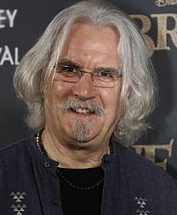
Billy Connolly, of course. The Big Yin! Comedian, story-teller, musician, actor, artist, documentary maker, Knight of the Realm! And one of the funniest persons (in my opinion) to grace our TV screens. There are many clips from his one man shows on YouTube, and I delve into them from time-to-time if I need cheering up. I find myself laughing just as much after watching for the umpteenth time as I did the first. There are few comedians who really make me laugh, and laugh out loud. Billy Connolly never fails.

Born in Glasgow in 1942, he grew up in the tenements of the Anderston area of the city that were demolished in the 1970s and residents moved out to barren housing estates on the outskirts of the city.

He became a welder in the Glasgow shipyards after leaving school, but knew that there was a brighter life beckoning him. Turning to folk music, he paired up with fellow Scot and singer-song writer Gerry Rafferty to form The Humblebums. But, as Billy himself acknowledged, it was his patter between songs that began to attract interest from the audience. Thus began his transition to stand-up comedian and story-teller.

And that’s how I see him, a raconteur rather than as a traditional stand-up. Yes, he tells jokes (perhaps much more in his early career), but his act developed much more depth than that. He weaves stories, narratives, heading off at a tangent almost to the absurd, before reining the tale back in to its original direction. He is a brilliant master of story telling. That’s all I can say. Watching his performances, it’s clear he holds his audience in the palm of his hand. Given his propensity for using his Glaswegian vernacular (rather a lot of swearing) no-one would attend one of his shows if they were about to be offended.

He got his big break nationally appearing on the BBC’s Parkinson, a weekly chat show hosted by journalist Michael Parkinson, in 1975, telling this joke. And over the years he made 15 appearances on that show before it came to an end in 2007.

I still haven’t seen Connolly alongside Dame Judi Dench (as Queen Victoria) in Mrs Brown, the 1997 film that cast him as John Brown, a servant of the Queen and believed to have had a relationship with her. From the clips I’ve viewed, Connolly’s performance was outstanding, and he did receive nominations for several acting awards.
In recent year, documentaries of his travels throughout the USA, Australia and New Zealand, as well as his native Scotland have been widely acclaimed.

He was made a Knight Bachelor in the 2017 Queen’s Birthday Honours for services to entertainment and charity.

In 2013 he was diagnosed with Parkinson’s Disease and has become increasingly frail. In this clip he talks about the challenges he faces.


Anyway, enough of my musings. Sit back and watch (if you dare) some of the videos by Sir Billy Connolly that I’ve enjoyed recently.

WARNING: If you are offended by strong language, take care.

This is is the video that got me going on Christmas Day. It was the balsamic vinegar . . .