Time out in Minnesota: 5. Beer, brats, and sizzling steaks

We’ve just returned from a very relaxing vacation in Minnesota, visiting our elder daughter Hannah and her family: son-in-law Michael, and grandchildren Callum (almost a teenager) and Zoë (just 11).
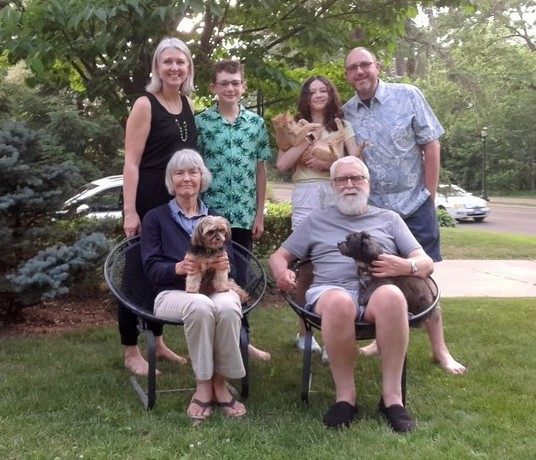
Our last evening in Minnesota.

Since we’d decided not to make any serious road trip this visit, apart from a short, overnight stay to La Crosse in Wisconsin, about 150 miles south of the Twin Cities, I travelled light this year. No heavy DSLR camera, no laptop. In fact, for the first time, I simply used my mobile phone for both images and video clips.

When we moved north to Newcastle upon Tyne in the autumn of 2020, I acquired a new – and better – mobile that allowed me to run many of the apps that so many utilities expect everyone to deploy these days. And, of course, the Samsung model I chose had a far better resolution camera than my Chinese cheepo.

And because of my more limited mobility right now (a painful nerve inflammation affecting my lower back, legs, and feet) Steph and I stayed close to home in St Paul, only taking our usual local walks as we’ve enjoyed in previous visits when I felt up to it. Even so, close to where Hannah and Michael live there is so much to see; their house sits at the top of the Mississippi Gorge bluff.

The weather was incredible, mostly warm (hot even) and dry. Just one afternoon of rain on Michael’s birthday when we had to postpone the planned grilling until the next day.

And talking of grilling. I can’t remember a visit when Michael fired up the BBQ or the Big Green Egg so many times, or we simply ate outside, even at the various restaurants we patronised.

Our flight from Amsterdam to Minneapolis-St Paul arrived on time on 29 May at around 12:30, and Hannah, Callum, and Zoë were waiting at the airport to meet us. Navigation through US Immigration, baggage claim, and Customs was probably the smoothest I’ve enjoyed throughout the many decades I’ve been visiting the USA. It was actually quite a pleasant experience.

So, for us, it was early evening British Summer Time, and normally Steph and I would manage to stay awake for only an hour or two before submitting to jet lag, and finally crashing. Not this time. We both had a reasonably comfortable flight over the Atlantic in Delta Comfort+, and managed some sleep.

On arrival, it was bright and sunny and warm and, being Memorial Day, everyone was at home. So we sat in the garden, enjoying a cup of tea to begin with, followed (in my case) by a couple of the fantastic local beers. There are so many to choose from these days. But more of that later.

Late afternoon, and Michael cranked up the BBQ and we enjoyed a very satisfying dinner of Von Hanson steaks, beer brats, and salad. So it must have been almost 9 pm that we admitted defeat, and headed to bed. I’ve never been over jet lag so quickly.

I now wish I’d taken more notice of the various beers I sampled – I could have tried a different beer for everyday of our stay, there are so many to choose from. There’s nothing quite like a cold, cold beer on a hot afternoon when the temperature is reaching 90ºF.

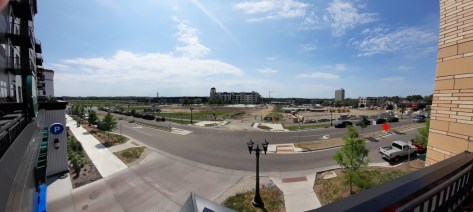
Less than a mile from Hannah and Michael’s home in the Highland Park area of St Paul (map), redevelopment of the 122 acre site of the former Ford Motor Company Twin Cities Assembly Plant (closed in 2011) began in 2020, now renamed Highland Bridge.

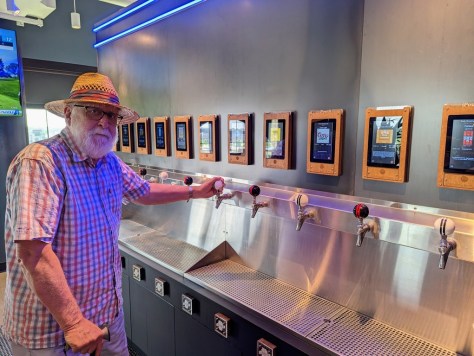
The local supermarket, Lunds & Byerlys has relocated a couple of blocks west along Ford Parkway to Highland Bridge. On the first floor they have opened The Mezz Taproom—with a terrace overlooking the new development—where you have the choice of about 20+ beers on tap, plus some wines. Michael took me there one blisteringly hot afternoon a few days after we arrived in St Paul.

It’s an interesting concept. There is no bar. With an electronic wrist tag (which opens the beer tap) you can sample as much or as little of any of the beers on offer, with a wide range of glass sizes and shapes to match. You just pay for the amounts consumed, which are electronically tallied. Simples!
Panorama of the Highland Bridge redevelopment, looking west.

The Highland Bridge redevelopment comprises commercial and residential units, including those for the elderly, and townhouses. Thoughtfully, and together with the St Paul Parks and Recreation department, the developers have created several parks with innovative water features that also act as storm drainage (when it rains in St Paul, it really rains). All parks cater for all ages, with paths, seating, and roller and skateboard parks, beach volleyball courts, and even a Little League pitch as well.

Steph and I took a wander (very slowly) through these. What an impressive development, even though I can’t say I particularly admired the architecture. The water features are already attracting a range of wildlife, and it will be interesting to see how the biodiversity increases in years to come.


Michael’s birthday celebration was postponed one day due to rain on the actual day. He smoked pork ribs on the Big Green Egg. I don’t think I have ever tasted such delicious (and meaty) ribs, that just fell off the bone.


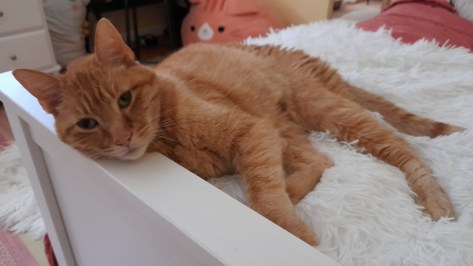
Several years ago, Hannah and Michael adopted a lovely (but occasional crabby) rescue ginger cat called Hobbes, now about 11 years old.
Then, during the Covid lockdown, Bo (a rescue Yorkshire terrier from Alabama) joined the family, followed about 18 months later by Ollie (a combined Yorkie, Shih Tzu, and at least one another breed, also from Alabama). Ollie and me bonded very quickly.

Bo
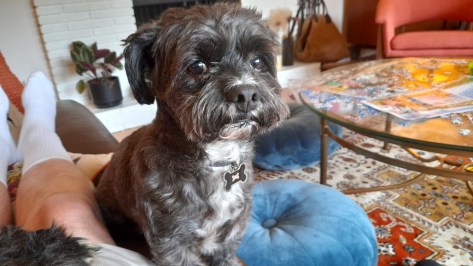
Ollie


Earlier, I mentioned my reduced mobility during this trip. But one evening, after enjoying another fine BBQ, and with a couple of G&Ts tucked away, not to mention a glass or two of red wine, I couldn’t resist the music (just take a listen, an incredible track from Joe Bonamassa with Australian Mahalia Barnes, Riding With The Kings).

Here’s the outcome, that I very much regretted the following morning (and perhaps posting this video might come to regret for a long time to come).

Compare this with another video, taken six years earlier with a five-year-old Zoë which, given my back and legs, would have been more appropriate.
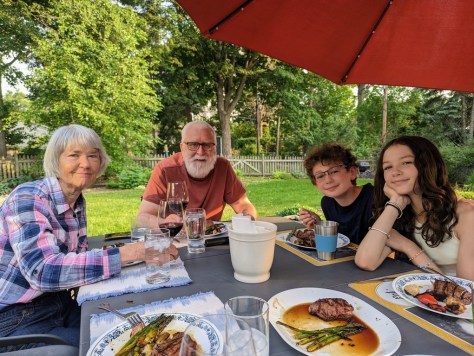
And S’Mores, of course.

What a great way to take time out . . .


Other blog posts in this Minnesota series:

Time out in Minnesota: 4. Gems at the University of Minnesota

Actually, that should be GEMS. But more of that shortly.

While in Minnesota, I took the opportunity of looking up an old friend, Phil Pardey, at the University of Minnesota. A native Australian, Phil is Professor of Science and Technology Policy in the Department of Applied Economics.

So how did I, as someone working in genetic resources of rice, meet and become good friends with an agricultural economist?

From 1991-2001, I was head of the Genetic Resources Center at the International Rice Research Institute (IRRI) in the Philippines, and between 1993 and 1995, Chair of the CGIAR’s Inter-Center Working Group on Genetic Resources (ICWG-GR). Phil was a Senior Research Fellow at the International Food Policy Research Institute (IFPRI) in Washington, DC, a sister center of IRRI’s under the aegis of the Consultative Group on International Agricultural Research (CGIAR).

The ICWG-GR brought together representatives from all the CGIAR centers with genebanks, and others like Phil from IFPRI who were conducting research on the impact and use of genetic resources. At that particular time, Phil and a couple of colleagues were analysing the economics of conserving crop genetic resources, and developing methodologies to estimate the costs of running genebanks. I contributed to chapter 6 on rice in this book (right) published by CABI in 2004. It was an important publication as the centers were developing ideas on how to fund their germplasm collections in perpetuity and what it would take to set up an endowment fund for that purpose (now managed through the Crop Trust).
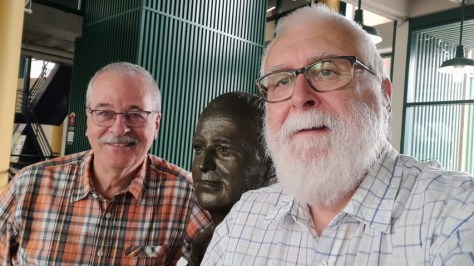
Phil left IFPRI in 2002 to move to the U of M, and I retired in 2010. So with a less hectic schedule this year during our visit to the USA (although we haven’t traveled there since 2019 because of the Covid-19 pandemic) I contacted Phil and we arranged to meet for lunch a couple of weeks ago.

Phil and me beside a bust of Dr Norman Borlaug, ‘Father of the Green Revolution’ in the foyer of Borlaug Hall on the University of Minnesota campus, where I presented a seminar in the early 2000s.

Phil had a lot to tell me about a fascinating new initiative that he co-directs at the university.

Which was music to my ears. Let me explain.

GEMS Informatics, launched in 2015, is a unique public-private collaboration that is forging the future of the Data Revolution in agriculture. Minnesota is the birthplace of supercomputing in the early 1960s and has long been home to the world’s leading agri-food companies, making it the natural nexus for data-driven, public-private partnerships that create solutions to the complex challenges facing local and global agri-food systems.

Phil’s co-director is Jim Wilgenbusch, Director of Research Computing at the university.

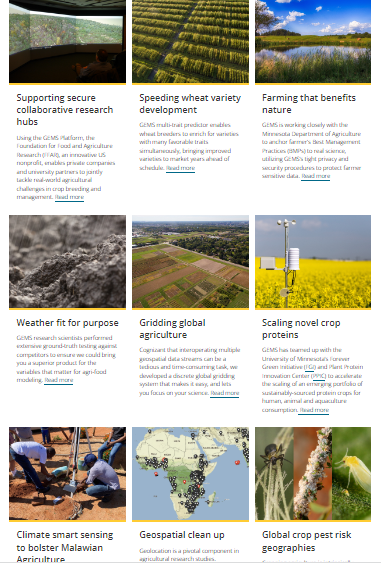
What is so special about GEMS is that it brings together an impressive team of experts in super-computing, data management, genetics, genomics and bioinformatics, geospatial analysis, life sciences, and economics. Just take a look at the GEMS website to better understand the scope of what this initiative does deliver. And just imagine what such a combination of skills and resources could deliver even more in the future.

One of the areas that intrigued me most was the GEMS applications for multilocation testing of germplasm. Faced with the challenges of global climate change, plant breeders need to be able to better predict where the lines they have developed are successfully adapted and could be deployed to enhance agricultural activity. GEMS is bringing together data (not just numbers) on crop variety performance (yield in particular), weather, soils, and genomics (among others) to better understand the behavior of these across locations, or what we call genotype by environment interaction (GxE).

There’s an interesting account of GEMS applications for wheat variety development, for example.

I’ve had a long interest in multilocation testing. In 1990, I presented a paper¹ at a symposium in Wageningen, the Netherlands about the challenge of global warming, and how plant breeders should collaborate better across Europe to evaluate germplasm.

Then, in a blog post I published in August 2015, I wrote about the International Network for the Genetic Evaluation of Rice (INGER, managed by IRRI) as it celebrated its 40th anniversary. While recognizing the networks unequivocal and important role in facilitating the sharing of rice varieties and lines globally, I lamented that INGER had lost opportunities to transform itself to permit more critical and predictive testing of germplasm. My criticism was merited, I believe, but unlike GEMS Informatics, we did not have many of its computing and analysis tools. Had we built a database of quality trial data, gathering environmental as well as crop response data, we could go back today, using genomics tools, to ferret out those traits which endow varieties with superiority across environments.

GEMS is already pointing the way. Just look at the case studies that are highlighted on the GEMS website.

With progress like this in just eight years, just imagine where this initiative might take us. No wonder it was music to my ears, even though (being retired) I’m no longer involved in the conservation and use of plant genetic resources.

I really look forward to following future developments of GEMS Informatics. Not only did it take a strong vision to get it up and running, but support from the university and private sector organizations was crucial to implement that vision. Impressive indeed!


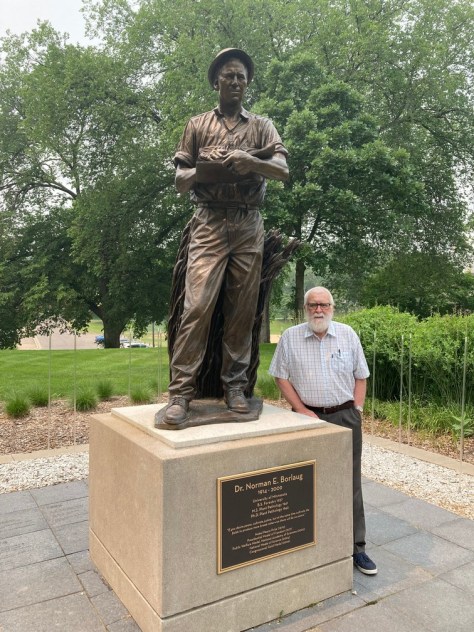
As we headed off to lunch, Phil just had to show me a new addition to the university campus, just in front of Borlaug Hall. It was a seven foot bronze statue of Norman Borlaug, who I had the pleasure of meeting at IRRI in the 1990s.

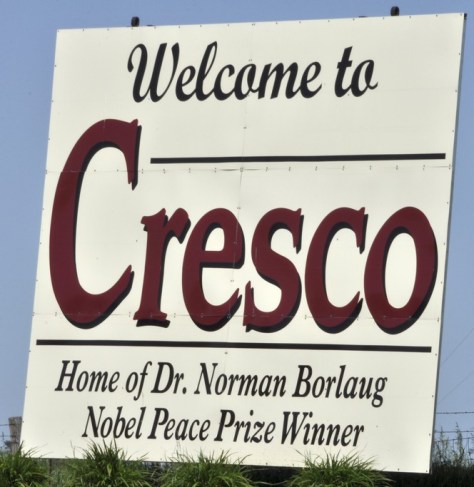
Borlaug was born in Cresco, Iowa in March 1914, where Steph and I passed through at the end of one of our long road trips in 2017.

I now wish we’d taken the time to visit the Borlaug homestead in  Cresco.

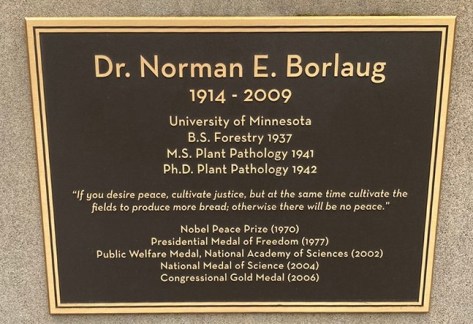
Anyway, Borlaug was an alumnus of the U of M, originally in forestry before converting to plant pathology. And the rest is history – the man who saved a billion lives.

The statue on the campus is a duplicate of one sculpted by Idaho resident Benjamin Victor (1979– ) that stands in the National Statuary Hall Collection in the Capitol Building in Washington, DC. The original was given by the state of Iowa to the Collection in 2014 on the centenary of Borlaug’s birth.

In the National Statuary Hall, each state is permitted to display just two statues, so that of former United States Senator, and Secretary of the Interior James Harlan, which the state of Iowa donated to the Collection in 1910, had to make room for Borlaug. And fittingly so.


Other blog posts in this Minnesota series;


¹Jackson, M.T., 1991. Global warming: the case for European cooperation for germplasm conservation and use. In: Th.J.L. van Hintum, L. Frese & P.M. Perret (eds.), Crop Networks. Searching for New Concepts for Collaborative Genetic Resources Management. International Crop Network Series No. 4. International Board for Plant Genetic Resources, Rome, Italy. Papers of the EUCARPIA/IBPGR symposium held in Wageningen, the Netherlands, December 3-6, 1990. pp. 125-131.

Time out in Minnesota: 3. The flowers that bloom in the Spring

It was hard to imagine, when we landed in the Twin Cities on 29 May, that only five or six weeks previously there had been snow on the ground and sub-zero temperatures.

Why? The trees were in full leaf (as you can see in this photo below as we landed at MSP – so many trees in the Twin Cities!), many plants were in full flower, and some even setting seed. Spring and early summer arrive quickly in Minnesota.

During our stay (of three weeks) we had just one day of rain (and then not all day), and during daylight hours the temperature never dipped below 70°F, often rising to 90°F or more. I don’t think we’ve ever experienced such a long dry spell on any of our other visits there.

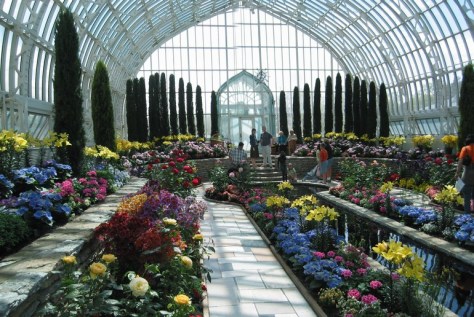
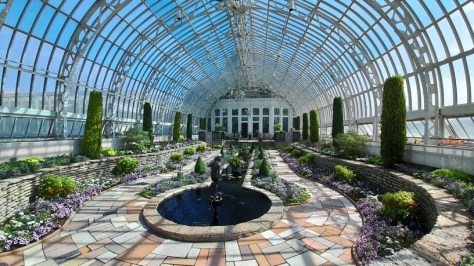
Over the couple of decades or more that we have been visiting the Twin Cities, one of our favorite places to visit is the Marjorie McNeely Conservatory in Como Park.

Just scroll out to see its location in St Paul.

The Conservatory was opened in 1915, and in 2002 renamed in honor of Marjorie McNeely (right), a remarkable woman who made many contributions to arts and culture during her lifetime.

Each season, summer and winter, the staff of the Conservatory develop elegant planting schemes, and we always look forward to whatever they have designed, bringing together sympathetic varieties and colors.

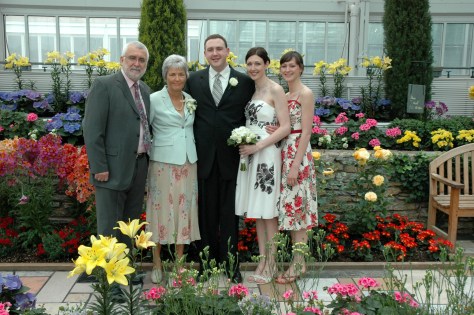
We’ve had two particularly memorable visits to the Conservatory. Our elder daughter Hannah married Michael at the Conservatory on a particularly cold evening in May 2006 – although it was beautifully warm inside.

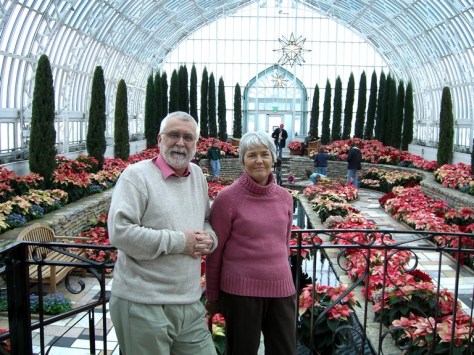
Then, at Christmas the following year, Steph and I spent the holiday with Hannah and Michael in a very cold St Paul. Our first white Christmas. But inside the Conservatory, it was red and pink Christmas poinsettias everywhere.

This year the planting scheme was less flamboyant compared to what we have seen before, but nevertheless quite beautiful.

There is also a tropical wing to the Conservatory, with many moisture-loving (and some edible plants) on display, including a range of orchids and bromeliads.

Outside, you can wander through the peaceful Charlotte Partridge Ordway Japanese Garden or admire the delicate bonsai specimens on display.

A visit to the Conservatory is always worthwhile. When we arrived, there were loads of schoolchildren already disgorging from their buses. But not to visit the Conservatory (which, unusually, we had to ourselves for about 10 minutes). They were headed to the Como Park zoo.

Entrance to the Conservatory and Zoo is free, but recommended donations are welcome.


The other venue we have visited several times is the Minnesota Landscape Arboretum, about 26 miles due west from St Paul. Since we were last there in 2019, the Arboretum has rebranded itself as the arb!

Entrance tickets for adults are $30, but children 15 and under go free.

We took our grandchildren Callum and Zoë to the arb after they finished school for the year. In past years, we have walked quite some distance around the various gardens close to the visitor center or along the Three Mile Drive. Due to my reduced mobility this year, we concentrated on the Three Mile Drive and just a selection of some of the gardens (map).

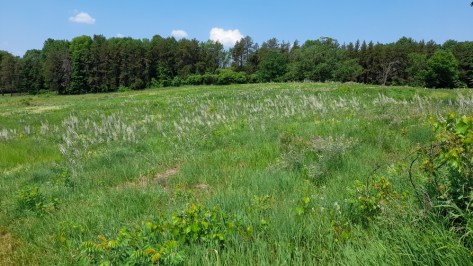
I think my favorite is the prairie garden, and across the road, the staff have set out to recreate a prairie community that once covered vast areas of the country before agriculture changed the landscape forever.

The whole site was covered in tall Baptisia alba (I think it was) and other species in full flower. Quite a sight!

The Chinese Garden was quite new when we last visited, and there were some large steel dragons, now removed from the garden. But it was a tranquil setting to spend a few minutes of contemplation.

The Harrison Sculpture Garden is located on about 3 acres (1.2 ha) surrounding the arboretum’s High Point. Even though we didn’t notice any new additions to the garden, it’s always a pleasure to view the 26 pieces (some by very famous sculptors like Barbara Hepworth – she has three there) in different light and from different angles. Here are five that caught my attention this time.

The bedding plants near the Visitor Center had yet to flower in profusion, but the Rose Garden was just beginning to come into its own.

After a quick lunch in The Eatery (and inevitable ice cream) we headed home after an enjoyable visit of around four hours. We’ll be back.


Since Callum and Zoë had a 10 days free between finishing school for the year and summer camp, we had many opportunities to enjoy their company on day trips. Another favorite venue of ours is Taylors Fall on the St Croix River, just over 53 miles northeast of St Paul. There, in the Interstate State Park (with Wisconsin on the opposite bank of the river), there is a fascinating formation of glacial potholes formed at the end of the last Ice Age when the St Croix was one of the world’s greatest rivers.

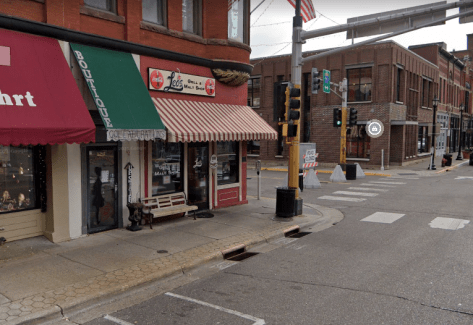
Then we headed south to Stillwater (also along the St Croix), a small town very popular with tourists, where we took a short walk along the riverfront, and then enjoyed some of the best toasted cheese sandwiches at Leo’s Grill and Malt Shop in the town center, an establishment we have patronized on several occasions before.

The historic Stillwater Lift Bridge across the St Croix River, connecting Minnesota and Wisconsin, now closed to traffic since the St Croix Crossing south of the town was opened in August 2017.


Other blog posts in this Minnesota series:

Time out in Minnesota: 2. Beside, above, and on the Mississippi

I’m totally unfamiliar with the convention that gives names to rivers.

The Mississippi is only the second longest river in the United States. At 2,340 miles it’s shorter than the Missouri, by just one mile apparently. Yet, when they come together (or the Missouri flows into the Mississippi) north of St Louis, the river takes on the name of the Mississippi. And again, near Cairo in southern Illinois, the Ohio joins the Mississippi, and loses its identity thereafter even though the Ohio is a much bigger river in terms of discharge (but shorter) at that point.

The Mississippi flows through 10 states: Minnesota, Wisconsin, Iowa, Illinois, Missouri, Kentucky, Tennessee, Arkansas, Mississippi, and Louisiana. It flows through Minnesota for 681 miles, the most miles of any state.

By the time the Mississippi reaches Minneapolis-St Paul (the Twin Cities) from its origin at Lake Itasca in the northern part of the state (which we visited in 2016), it’s already an impressive river, fast flowing, deep, and wide. Our elder daughter Hannah lives just a stone’s throw from the bluff overlooking the river, which you would easily see if it wasn’t for the dense stand of trees on both banks.

That line of trees across the road from Hannah’s is the top of the Mississippi Gorge bluff.

Nevertheless, there are various scenic viewpoints, riverside regional parks, and overlooks in the Twin Cities where you can admire the majesty of the river. Whenever we visit our daughter and her family, we always take the opportunity of spending some time beside the Mississippi. I somehow feel it drawing me to its banks.

During this year’s Minnesota vacation, we decided not to make any long distance road trips as we have done in previous years (and which you can read about in the USA section of my blog here). Except for one overnight stay at La Crosse on the Mississippi in Wisconsin, about 150 miles south of the Twin Cities. And for a very special reason, that I’ll come to in a moment.

The route south on US61 and US14 follows the river, and you’re never very far from it. In several places the Mississippi opens out into large lakes before continuing its flow south to the Gulf of Mexico. And it was while we were driving along that I realised just how close to the river the railroad line was built, and which we experienced in 2015 on Amtrak’s Empire Builder to Chicago and back.


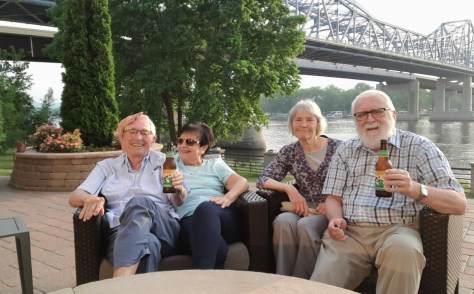
So why the visit to La Crosse? A couple months back I was contacted by an old friend of 50 years, Roger Rowe, who lives in Peru with his wife Norma. Now 87, Roger was planning to visit central Illinois where his younger brother farms corn and soybeans, and would be celebrating his 80th birthday. Knowing of our visit to St Paul, Roger enquired whether we could meet up, halfway (more or less) between Princeton, IL and the Twin Cities. And that’s precisely what we did on 6/7 June.

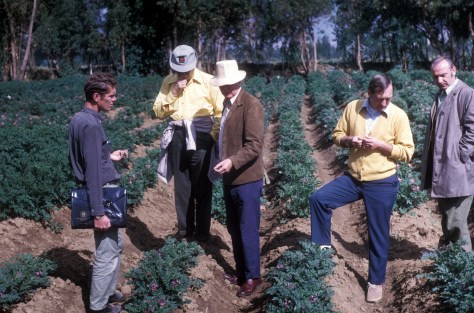
Just after I joined the International Potato Center (CIP) in January 1973, a workshop was held to plan for a research program on the conservation of cultivated and wild potatoes from the Andes, and their taxonomy. At that time, Roger was the geneticist/curator of the USDA’s potato collection at Sturgeon Bay in Wisconsin, and one of the participants of the workshop.

Here we are in the field in Huancayo, in central Peru where CIP grew its large potato collection.

L-R: David Baumann (CIP), Dr Frank Haynes (North Carolina State University), Professor Jack Hawkes (University of Birmingham), Dr Roger Rowe (USDA-Sturgeon Bay), and Dr Donald Ugent (University of Southern Illinois-Carbondale).

Several months later, in May 1973, Roger joined CIP as the head of the breeding and genetics department and became my first boss there. He also became a co-supervisor (with Jack Hawkes) of my PhD dissertation. Steph joined CIP in July as an associate geneticist in the same department.

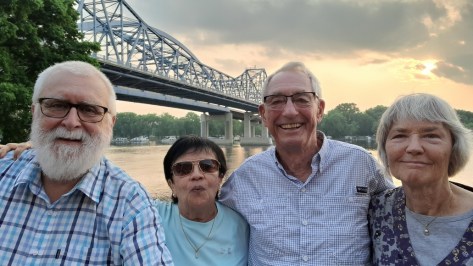
So, 50 years later, we were again reunited on the banks of the Mississippi in La Crosse.

We enjoyed several beers and dinner together, reminiscing over old times, as well as putting the world and the CGIAR to rights.


After I left CIP in 1981 to take up a faculty position at the University of Birmingham, I didn’t meet up with him again until 1993, although I’d met Norma in Mexico during a British Council-sponsored visit to that country in 1988.

In the late 1980s, Roger became the Deputy Director General for Research at the International Maize and Wheat Improvement Center (CIMMYT) after a spell working in Africa. We met for the first time after many years when attending the annual meeting of the CGIAR’s Inter-Center Working Group on Genetic Resources, held at the ILCA campus in Addis Ababa in January 1993. By then I was leading the genetic resources program at the International Rice Research Institute (IRRI) in the Philippines.

Members of the ICWG-GR from all the CGIAR centers with genebanks, in Addis Ababa, January 1993.

From CIMMYT, Roger joined another CGIAR center, ICLARM (later becoming WorldFish) as  Deputy Director General for one of its programs based in Egypt. Steph and I would meet up with Roger for Sunday breakfast in Manila whenever he was in town since ICLARM then had its headquarters in Manila.

Before our reunion in La Crosse, the last time I’d seen Roger and Norma was in Lima in July 2016, when I was the lead author for a review of the center genebanks and their management, and I was visiting CIP. We managed to catch a couple of hours together for pisco sours.

At my hotel in Lima, just after I had arrived from the UK.


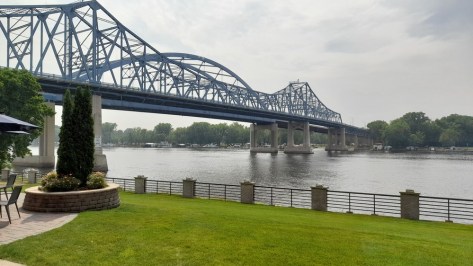
As I mentioned, our hotel in La Crosse was right beside the Mississippi, and ‘underneath’ the Big Blue Bridges (actually the Cass Street Bridge and the Cameron Avenue Bridge) that cross from the Minnesota side to Wisconsin.

That got me thinking. The population expansion across the USA in the 19th and 20th centuries involved crossing many rivers, and building many bridges. On the Mississippi alone there are at least 130 bridges along its length. In the Twin Cities alone there are nine major crossings and several minor ones. One of the most impressive is the Smith Avenue or High Level Bridge, from where there is a magnificent view of the St Paul skyline and the river.

The Smith Avenue bridge from the river.

As this video pans right, you can first see the magnificent Catholic cathedral, then the white Capitol building, followed by downtown St Paul.

Finally, on our last Thursday in St Paul, we took our grandchildren Callum and Zoë on a relaxing 90 minute river cruise up the Mississippi to the confluence of the Minnesota River with the Mississippi, which is a short distance downriver from where Hannah and Michael live. They tell us that the Fall cruises, when the autumn colors are at their height is a great time to cruise the river.


You can read about some of our other Mississippi adventures here.


Other blog posts in this Minnesota series:

Time out in Minnesota: 1. Flying after four years

Every year since 2010, Steph and I have visited our elder daughter Hannah and her family in St Paul, Minnesota, one half of the Twin Cities (with Minneapolis). We made our last visit in 2019, and then the Covid-19 pandemic struck.

Travel wasn’t possible in 2020 or 2021, but last year Hannah, Michael, Callum, and Zoë flew over to the UK to spend a couple of weeks with us in the northeast of England, just outside Newcastle upon Tyne.

Even though for most people the pandemic is over, and Covid is perhaps less of a risk right now, it’s still around, so Steph and I have continued to mask when we shop at the supermarket, in fact, in any situation where we could be in close proximity with others.

So it was with some slight trepidation that I went online at the end of January and booked flights to the Twin Cities with Delta, to depart from Newcastle International Airport (NCL) on 29 May, and returning from Minneapolis-St Paul (MSP) on 19 June. And with both schedules transiting through Schipol (AMS). Until Delta made a schedule change for us, and had us returning via Detroit (DTW) and AMS.


On 29 May, we had an early start to get to the airport for our 06:05 KLM952 flight (codeshare DL9627) to AMS. I’d booked a taxi with the local Blueline Taxis for 03:45, and about 15 minutes before it arrived I received, via the company’s mobile app, details of the taxi (make of vehicle, color, registration) and name and photo of the driver. NCL is only a few miles west of Newcastle city center, and just 11 miles from our home. At that time of the morning it took only 20 minutes or so for the journey.

For the past three months I have struggled with my mobility (due to a nerve issue in my lower back, legs and feet) and have to use a walking stick for added stability. However, that has certain advantages when there are long queues at check-in. We were invited to move to the front of the queue, using the business class lane.

That’s our KLM Boeing 737-800 (registration PH-BCK) at the terminal.

We had just under an hour to wait until boarding, when a very kind member of the cabin crew saw me attempting to climb the steps into the aircraft, carrying a light piece of hand luggage at the same time. She came down to meet me and took the bag to my seat.

And there we sat for the next hour, until 07:17. Why the delay?

There was a high pressure weather system over the UK that morning, giving clear and calm conditions at NCL. In the Netherlands at Schipol on the other hand, the airport was experiencing brisk northerly breezes, and had to change the landing runways. However, one of the two used for landing into northerly winds was under maintenance, and so our flight wasn’t given permission to leave NCL until a landing slot had been confirmed. Meanwhile, the attentive crew served drinks and snacks and kept everyone well-informed of flight connection details and any complications.

Fortunately we were not affected since we had more than two hours connecting time between flights. Arriving at Gate D28 (if my memory serves me right) at the far end of the pier, we had to make our way to D3 close to the main concourse. So, by the time we’d picked up some duty free and made our way slowly to our gate, flight DL161 was already boarding, and business class passengers called forward for the 10:40 departure.

Once again, Steph and I were directed to the front of the queue and once on board, settled ourselves into seats 30A and B in the Delta Comfort+ section of the economy cabin.
We’ve travelled in Comfort + several times now, and find that it’s definitely worth the extra premium you have to pay for that little bit of extra legroom that can make a long flight more bearable. Also our seats were against a bulkhead, making access to the aisle that little bit easier.

Our aircraft, an Airbus A330-300 (registration N801NW) had been in service for around 20 years, and was beginning to show its age somewhat. The flight pulled back from the gate 36 minutes late and the taxi at AMS to runway 36L took another 15 minutes. But we were soon on our way, arriving in MSP just over 8 hours later.

Here’s a video of that flight. I was unable to take any video of the flight from NCL to AMS. Seated in row 10, there was no window!

On our return to the UK on 19 June, flight DL2619 (an Airbus A320-212, registration N368NW) departed MSP at just after 09:00, arriving in DTW at 11:35 (taking into account the 1 hour time difference from CDT to EDT).

We had four hours to kill. The McNamara Terminal at DTW is enormous, 1 mile long. There is an express tram inside the terminal—just under the roof—travelling the length of terminal and connecting to the gates at various stops. In the video below, there’s a short clip of the tram.

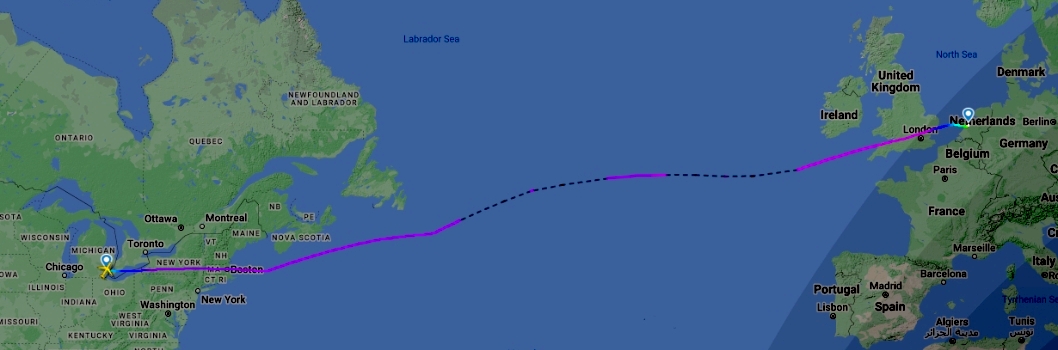
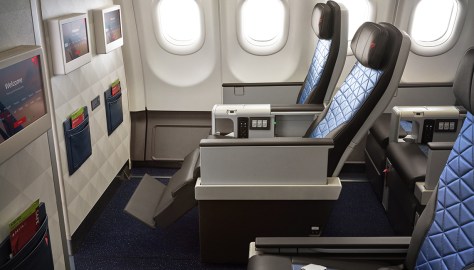
The Airbus A350-900 (registration N503DN) on DL132 to AMS was a new aircraft for me, and I used Skymiles to upgrade to the Delta Premium Select cabin (seats 22H and J, aisle and window).

Premium Select cabin 2-4-2 configuration on the left (that’s Steph sitting in the third row), and the economy (3-3-3 configuration) on the right.

It’s a beautiful aircraft, and its enormous Rolls-Royce Trent WXB engines swiftly launched us on our way. I think you will be impressed with the take-off in the video. On landing in AMS, after a 7 hour flight, the pilot applied the brakes rather abruptly and you can hear all manner of glass and cutlery crashing to the floor (around 12’36”).

Route of DL132 from DTW-AMS on 19/20 June 2023

Our final 1 hour connection to NCL was a KLM Cityhopper-operated flight, KL953 (codeshare DL9689) on an Embraer E190 (registration PH-EZT).

Despite all the glorious weather in the UK over the three weeks we were away, the approach into NCL from the west was cloudy, and we saw very little of the glorious Northumberland landscape until we descended through the thick cloud layer.


So, after four years, what were our impressions and experience of flying once again? As with so much air travel, it’s not the flying per se, it’s navigating the airports. And having a mobility issue, I’ve come to realise how unfriendly so many airports can be in terms of accessibility. Too many stairs, or broken elevators or walkways!

Then there are the unannounced gate changes. On our arrival in AMS at 05:35 on 20 June (Gate E6), we had to walk towards the main concourse before we found a departure board, listing our NCL flight departing from E21, exactly in the opposite direction from which we had walked, and right at the end of the pier. It was a bus gate. But after an hour waiting patiently there, I noticed that the monitor was no longer showing our flight. But there was no further information nor announcement about a gate change.

After some enquiries I discovered that we had to go all the way back to D6, and although I asked for transport from a KLM representative, she told me it wasn’t anything to do with her, and we’d have make our own way to the gate.

Our flight from AMS to MSP was comfortable and smooth, in the main. I noticed that the safety announcements no longer referred to ‘turbulence’ but ‘rough air’. Perhaps ‘turbulence’ implies much more. Our return flight in the Premium Select seats was definitely more comfortable, with an extendable leg rest.

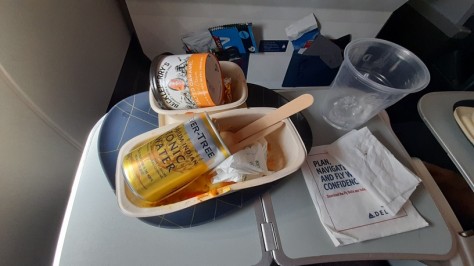
Overall, I felt that the service offered in Delta Comfort + had declined, and was essentially the same in Premium Select (which had a printed menu, steel cutlery, and a better amenity bag and headphones). The food was the same, served in compressed (and presumably recyclable) containers, but with wooden cutlery in Delta Comfort + that was hardly usable.

Served with ice cream from Northumberland!

I’m not sure I would actually pay the extra for a Premium Select seat, but as long as Steph and I have Skymiles to ‘spend’, then I reckon we might well upgrade again in the future.

Well, that’s how we flew to the USA and returned. You’ll find out what we got up to during our three week vacation in Minnesota in the other blog posts in this series.


Other blog posts in this Minnesota series: