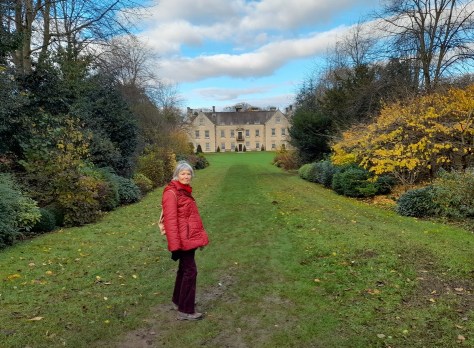
Nunnington Hall – from 13th century manor house to 20th century family home

There has been a manor house beside the River Rye in the small village of Nunnington (lying within the Howardian Hills National Landscape of North Yorkshire) since the 13th century.

Built from a light colored coral rag Jurassic limestone, the Nunnington Hall estate occupies around 5 acres (2 ha) and is surrounded by a walled garden. The house has changed in character over the centuries, as each resident (owner or tenant) stamped their mark on its architecture and layout. It has been owned and managed by the National Trust since 1952, although it remained a family home until 1978.

In Tudor times there were distant royal connections, and during the 17th century English Civil Wars, Parliamentarian troops were garrisoned in the Hall.

A wealthy cloth merchant, Ranald Graham (right, created Viscount Preston in the Peerage of Scotland in 1681, died 1689) bought the Nunnington estate in 1655, and it remained in the family until the mid-18th century when the direct Graham line became extinct. Sublet and allowed to deteriorate, it was offered up for sale in 1839 in a semi-derelict state, and bought by William Rutson (1791-1867) whose family had made their fortune through colonial trade and slavery.
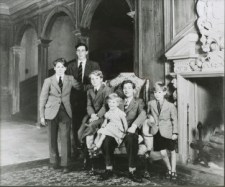
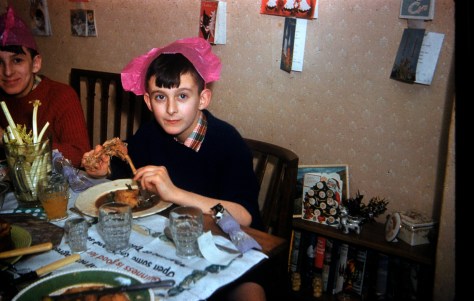
The five children of Susan and Peter Clive and their cousin Michael in the Oak Hall at Nunnington Hall.

Nunnington Hall was inherited by Margaret Fife (née Rutson, the great-niece of William Rutson) in 1920, and she set about the renovation of the Hall with her husband, Colonel Ronald D’Arcy Fife, funding the project from the sale of another Rutson property, Newby Wiske near Northallerton. One of their adopted daughters, Susan Clive, raised her family at Nunnington Hall, until moving to a house in the village.


I first visited Nunnington Hall in the summer of 1968, but recall very little of that visit, since only a few rooms were open to the public, and then only twice a week. It was only after the family vacated the Hall that the National Trust opened more of the house to the public, and more frequently.

In 2013, Steph and I stopped off on our way back south after visiting family in Newcastle.

Unlike Worcestershire where we lived until 2020, there are just a few National Trust properties near our home (since 2020) here in the northeast. And not all open for the Christmas season. I wrote briefly about our various Christmas visits after last year’s to Ormesby Hall near Middlesbrough.

So, on Friday last, we made the 162 mile round trip from North Tyneside to enjoy Nunnington Hall decorated in its Christmas finery. Being the first day of the Hall’s Christmas season (only each Friday to Sunday until just before Christmas), it was a delight to see many of the rooms brightly lit with Christmas trees and candles.


Let me take you on a brief tour of the house in 2013 and last Friday, highlighting some of the features that particularly caught my attention. A photo album of all the photos taken during both visits can be viewed here.

The entrance was suitably decorated for the Hall’s Christmas season, and we headed straight for the tearoom (with waitress service, unusual for National Trust tearooms) for a welcome cup of coffee before beginning the tour.

A kitchen or a Great Hall in earlier centuries, by 1921 the Stone Hall had become the entrance hall on the west facade of the building. One wall is hung with shooting trophies (mainly antelope of one species or another), with the skins of big cats on another. A huge fireplace (which was lit on our recent visit) dominates a third wall. And for Christmas, there was a tall (maybe 15 foot) tree, a Fashionable Victorian theme, with one of the volunteers (dressed as a butler) offering a small sherry or cranberry juice to each new visitor.

The Smoking Room, a few steps up from the Stone Hall, was Lord Preston’s bedchamber in the 17th century, but was adopted by Colonel Fife. The walls were painted Georgian green by Margaret Fife, and its theme was an indulgent Georgian Christmas. On our 2013 visit, this room was set up as a small dining room. And beyond the main room, in a small withdrawing room, the walls are covered in 18th century prints, and the ceiling decorated with original coats of arms.

From the Smoking Room, you step into the large Oak Hall with its stone floor, stone fireplace, and elegant, low-rise staircase leading to the first floor. This was an open courtyard in Tudor times, but was enclosed by Lord Preston in the late 17th century. There was a Tudor feast theme last Friday.

There are several paintings of William Rutson and his horses.

L: William Rutson’s groom and horses; R: William Rutson on a grey hunter

Hanging on the walls above the staircase are three tapestries, 300 years old, and another one in the Sitting Room.

During Margaret Fife’s time, the Sitting Room was the main family room, with a balcony overlooking the walled garden, with its terraces and orchard. Peacocks also strutting around the grounds. The Christmas theme was 1980s Party Time.

One feature which caught my attention in 2013 (and still prominently on display) was the superb set of porcelain figurines—Chelsea I presume—on the mantelpiece. How I would like to own a set like that, but my pockets aren’t deep enough!

In Margaret Fife’s bedroom and dressing room on the first floor, there is a charming (but controversial) portrait of her as a young girl, hanging above the fireplace.

Colonel Fife had his own bedroom, and particular feature that you can’t miss is the Chinese-style wallpaper, decorated with birds, flowers, and fruits.

A child’s bedroom, decorated with a tree and toys completed the bedrooms that were open. Wood-paneled, I seem to remember from our 2013 visit that there were carvings or graffiti in the wood made by Parliamentarian soldiers in the 17th century.

Schoolchildren from the nearby Slingsby Community Primary School had created the snowman exhibit in another bedroom.

The Nursery had a 1940s Rationing theme. The walls were covered with another impressive wallpaper, and a delightful doll’s house stood in one corner.

The attic floor under the eaves houses a couple of exhibitions. One of these is the permanent home of a collection of miniature rooms, donated to the National Trust by Londoner, Mrs Carlisle (known as ‘Kitty’). The models are truly exquisite in the amount of detail, even handwriting on miniature letters. The other exhibition, Fields, Folds, and Farming Life on display last week was a collection of photos and videos of farming life in Yorkshire by photographer Valerie Mather.

After a short (and rather muddy) walk around the garden, our visit to Nunnington Hall came to an end, and we headed back home.

But with just one other feature in the landscape to find: the Kilburn White Horse (map)The origin of the horse is disputed, but it appeared in November 1857, cut into the hillside above the village of Kilburn. Some credit the local schoolmaster and his pupils. The top soil was scraped away, and the horse covered in limestone chippings. It has needed regular maintenance over the years.

The Kilburn White Horse can be clearly seen from a distance, particularly from the A19 between Thirsk and York.
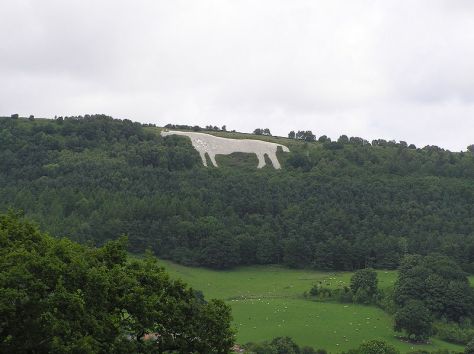
We made our way down the escarpment to the car park just below the horse, but from there you can only see the horse’s legs and part of its body.


I can’t finish this post without mentioning the spectacular climb into the Howardian Hills.

We had traveled south from North Tyneside on the A19 as far as Thirsk, where we took the A170 towards Scarborough. Just under six miles east of Thirsk, the A170 ascends the notorious Sutton Bank, with its 25% incline and hairpin bends. It’s such a challenge for some vehicles that caravans are banned from this stretch of road and have to find an alternative route on to the moors. Even HGVs struggle up the Bank.

Here’s some footage I made of the ascent and descent (almost 5 minutes, and available in HD).



‘Teaching is the one profession that creates all other professions.’ (Unknown)

I was surprised recently to read a tweet (or whatever they’re now called) on X suggesting that all university lecturers should be required to receive formal teacher training and an appropriate qualification. Just as teachers of schoolchildren must complete the Postgraduate Certificate in Education (or PGCE). Not that the PGCE automatically makes everyone a good teacher. Far from it. But the training must surely provide or hone the skills needed to teach better.

Well, whoever it was who tweeted that comment is behind the times. Many (most/all?) universities here in the UK now require incoming, probationary staff at least to take courses, such as the Postgraduate Certificate in Higher Education (PGCHE, a Masters level qualification) and also offer various teaching support modules to more established staff, that cover topics such as small/large group teaching, curriculum design, supervision, and many more.

But when I joined the University of Birmingham as a lecturer in the Department of Plant Biology (School of Biological Sciences) in April 1981 there was no such requirement for teacher training, nor do I remember much if any support being provided. You simply got on with it – for better or worse. Furthermore, teaching loads or commitments, or ability never counted much towards promotion prospects. Research (and research income) was the be-all and end-all.


I’d never aspired to be an academic. Before joining the university, I was working in the Americas over the previous eight years. In November 1980, I had just returned from a five-year assignment in Central America to the headquarters of the International Potato Center (CIP) in Lima, Peru while waiting for my next assignment in the Philippines. I had, however, already applied to Birmingham.

In January 1981 I flew to the UK for an interview and was offered the position immediately. So I returned to Lima knowing that my wife Steph and young daughter Hannah and I would be resettling in the UK before long.

Initially I had no teaching commitments, and I was able to get myself settled and oriented as a faculty member. I knew my way around the Birmingham campus since I was awarded my MSc degree in genetic resources there in 1971, and PhD in botany in 1975. But being a faculty member was very different from being a graduate student.

Come the beginning of the Summer Term in May however, I found myself facing a group of about 35 second year plant biology students for the first time to teach them some aspects of flowering plant taxonomy (along with my colleague Dr Richard Lester, at right, with whom I didn’t always see eye-to-eye over many aspects of course content and delivery).

Anyway, until then I had never taught a class in my life, although I was quite comfortable with public speaking, even enjoying it. I think I must have inherited my ‘love’ of public speaking from my father. Anyway, getting up in front of an audience never particularly fazed me, talking to my peers about my work, and the like. Nevertheless, I always had ‘butterflies in my stomach’ before facing a class for the first time.

Fortunately during the decade I spent at Birmingham I never had to teach any first year classes. Much of my teaching focused on graduate students (many from overseas) attending the 1-year MSc course on Conservation and Utilisation of Plant Genetic Resources (the very course I had attended in 1970-71). I taught a semester long (10 week term) course on crop evolution, two lectures and three hour practical classes per week, principles of germplasm exploration and collection (also with a practical component using a synthetic population made up of many different barley varieties), and a small module on agroecosystems. I also helped my colleague Professor Brian Ford-Lloyd (right) in some aspects of his data management module.
Then, during the summer months (when undergraduates were on vacation) we would supervise the dissertation projects of the MSc students. I guess I must have averaged two or three each year.

Brian and I jointly taught a five week undergraduate course on plant genetic resources, with at least one lecture per day, for final year undergraduates who would graduate with a Biological Sciences (Plant Biology) degree. I guess we must have between 10 and 15 students on average each year, who also had to complete an independent research project over the same period. It was always a challenge to devise projects that could be completed in the time available and that would (generally) generate positive results. Each student would take four of these five week modules.

I also gave a lecture on potato diseases on the third year plant pathology module taught by my colleague Dr Gillian Butler.

Around the mid-1980s I was asked to become chair of the Second Year Common Course, one that all biological sciences students had to take and which was taught by staff from all the four departments (Plant Biology, Zoology and Comparative Physiology, Genetics, and Microbiology) that made up the School of Biological Sciences. I contributed five or six lectures on agriculture and agroecosystems, based on my own experiences of working with crops in the Americas.


To some extent I agree with American novelist Gail Godwin that Good teaching is 1/4 preparation and 3/4 theatre. When you get up in front of a class of students, whether you feel up to it or not, whether it’s a topic you are enthusiastic or not, you have to ‘perform‘. Engage with the class.

The feedback I had from my students was that I was quite an effective teacher. That was gratifying to know. Back in the day, there was no Powerpoint or other digital props. Just the blackboard and chalk (which I hated as I had a slight allergy to chalk), the overhead projector with acetates, and 35 mm slides.

The tools which are available today permit a much more dynamic use of information, provided that there isn’t information overload. Less is often more. And you don’t try to use all 56 million colours in the Powerpoint pallette (as I have seen some speakers attempt to do!).

I think I became a more effective teacher because I had to interact with many graduate students who did not have English as their first language. We worked closely with a unit in the English department who assisted these students, to make their Birmingham experience better and help them through the rigors of graduate study. Lecturing to these students, I learned how to pace myself, and also how better to explain, often in different ways, aspects of the topics I was teaching. And working with the English unit staff (who would analyse our recorded lectures) I came to realise (as did my colleagues) just how often we use colloquialisms in everyday speech, and which are not easily translated for someone who is not a native English speaker.

Anyway, that experience of a decade’s worth of teaching overseas students stood me in good stead when I moved to the Philippines in 1991 and often had to give talks to diverse groups of visitors.


But returning to the opening premise of this post, about teaching qualifications for university staff, I think I would have welcomed much more formal feedback. Nowadays, there are mechanisms in place in universities to provide feedback. After all, the students are the clients who are paying handsomely for their education, and are not shy about denouncing poor teaching (and value for money) when warranted.


Three score and ten . . . plus five

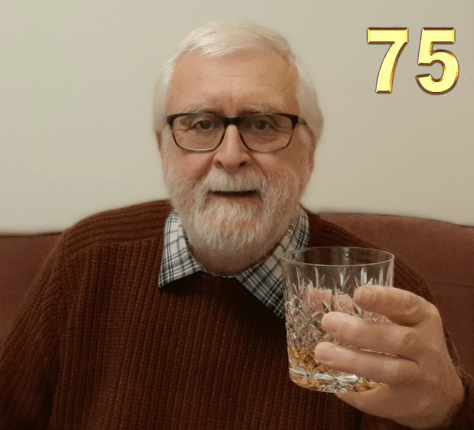
It was my birthday yesterday.

Let me take this opportunity of thanking friends and former colleagues – from all over the world – who sent me birthday greetings. Very much appreciated.

One friend greeted me on achieving three quarters of a century. Now that sounds really old. Another wished me 25 years more. I replied that 10-15 would do me nicely.

In 1948, average life expectancy for males in England and Wales was only 65.9 years. Now it’s 79, due undoubtedly to increased living standards over the intervening decades leading to healthier diets, and better health propped up by the National Health Service that had been founded just a few months before my birth.

I wonder what hopes my Mum had for me on that day.

I was living in Congleton, Cheshire with my parents, Fred and Lilian Jackson, my brothers Martin (b. 1939) and Edgar (b. 1946), and sister Margaret (b. 1941). I started school around 1953.

Come 18 November 1958 – my 10th birthday – we had been living in Leek, Staffordshire for 2½ years already. I attended the local Catholic primary school, St Mary’s, just a few minutes walk from home, and hoped eventually to win a place at the Catholic grammar school in Stoke-on-Trent a couple of years later. Which I did.

Christmas 1958 in Leek (with my elder brother Edgar).


Moving on to 18 November 1968, I had just started the second year of my BSc degree course in environmental botany and geography at the University of Southampton. I had enjoyed my first year there, living in South Stoneham House, one of the halls of residence southeast of the university campus. I’d been elected Vice President of the Junior Common Room at the end of the first year, and that guaranteed me a second year at Stoneham. I guess I celebrated my 20th birthday in the pub with a few friends.

Over the previous summer vacation I’d attended an excellent botany field course on the west coast of island. And afterwards had spent several weeks with my girlfriend at her home just south of York or at my parents’ home in Leek. We also enjoyed a walking tour together of the North York Moors, staying at youth hostels (YHA) each night.

But our relationship was not to last. Just before the beginning of term in October, I received a Dear John letter from her. But not one to be downhearted for long, I picked myself up but forswore dating for a while.

And I threw myself into a new interest: morris dancing. Together with one of the botany department lecturers, Dr Joe Smartt, we founded the university morris side, the Red Stags (still active today, but in a different format and no longer associated with the university).

The Red Stags Morris Men after performing at the University of Southampton Open Day in March 1970. That’s me, kneeling on the right.

Along with my continuing enjoyment of English and Scottish folk dancing, this foray into morris dancing became one of my principal hobbies for the rest of my time at Southampton, and afterwards for several years.

I graduated from Southampton in June 1970, and by September I was studying once again at the University of Birmingham.


By my 30th birthday in November 1978, I already had MSc and PhD degrees from Birmingham under my belt, and had been working for the International Potato Center (CIP), an international agricultural research institute based in Lima, Peru for five years.

Steph (who I met in Birmingham) and I had been married for just over five years, and our first daughter Hannah was born in April. We were living in Costa Rica, but my work with CIP took me throughout the region, as well as to Mexico and the islands of the Caribbean.

If my memory serves me right, I ‘celebrated’ this birthday, a Saturday, on the Caribbean island of Montserrat. I was stuck in my hotel room in Plymouth (the island’s capital until it was destroyed in the Soufrière Hills volcanic eruption of the 1990s) while it rained cats and dogs outside.


In 1988, I had been teaching at the University of Birmingham for over seven years, in the Department of Plant Biology. It was a Friday. My 40th birthday. By then, my colleagues and I had developed a ‘tradition’ of celebrating in the Staff House bar at lunchtime (disgraceful!) with a bottle or two of Beaujolais Nouveau, the release of which always occurs around my birthday. Enjoying a bottle of the ‘new release’ was quite the rage in the UK back in the 1980s, perhaps less so today.

Hannah had turned 10 that year, and Philippa (born in Bromsgrove in 1982) turned six.


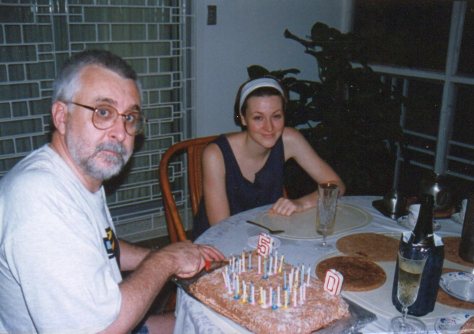
I left the university in 1991, to head the Genetic Resources Center (GRC) at the International Rice Research Institute (IRRI) at Los Baños, south of Manila, in the Philippines. In 1998, my GRC staff helped me celebrate my milestone 50th birthday. There must have been lots of snacks such as pancit and spring rolls and the like, ice cream (always vanilla!) and lots of cake. Probably donuts.

Then, in the evening, Steph and Philippa served champagne, and our helper Lilia had made a cake. Hannah was already away at university in Minnesota (where she still lives).

Steph and I celebrated our 25th (Silver) wedding anniversary just a month earlier.


A decade on, and I had changed jobs at IRRI, having moved from GRC to become the institute’s Director for Program Planning and Communications in May 2001.

I had an office suite in the main administration building, and my staff and others from nearby offices in HR and finance joined me to celebrate my 60th birthday.

Then, in the evening, Steph and I enjoyed the company of very close friends Corinta Guerta from my office, plant physiologist (and my closest friend at IRRI) John Sheehy, and Director for Development Duncan Macintosh (from Australia) and Cel (his Filipina girlfriend and now his wife) for an intimate dinner that almost ended in disaster before it had begun.

Nevertheless,we had a great time, but I think I must have drunk too much because I chose the wrong settings on my camera and the resulting images were not the best quality.


I retired from IRRI in 2010, and Steph and I returned to our home in Bromsgrove that we had first moved into way back in 1981, but which we’d kept furnished by unoccupied during the 19 years we stayed in the Philippines.

I celebrated my 70th birthday in 2018, and we did something I’d wanted to do for several years: a weekend away in Liverpool, visiting the childhood homes of Paul McCartney and John Lennon (both managed by the National Trust), as well as The Beatles Story beside the Royal Albert Dock.

We had a great weekend, taking the train from Bromsgrove (via Birmingham New Street) to Liverpool Lime Street. That was an added bonus. I love train journeys!


So here we are in 2023. It has become a tradition over the years for Steph to prepare my favorite meal on my birthday: homemade steak and kidney pie. I always look forward to that one special meal. And, as always, it was delicious, served with a bottle of good Portuguese red: Montaria Gold 2020 from the Lisbon region, a blend of Syrah, Alicante Bouschet, Trincadeira, and Aragonez grape varieties, made by Luis Vieira.


Had the weather been better we would have taken an excursion yesterday. But since the forecast had promised rain (which was the case) we headed north on Friday to the Alnwick Garden and the beach at Amble afterwards.

Oh, and we’d quietly celebrated our 50th (Golden) wedding anniversary a month ago.


Celebrating the beauty of England’s northeast coast

We moved to North Tyneside, just east of Newcastle upon Tyne, a little over three years ago, from our home of 39 years in Bromsgrove, Worcestershire to be closer to our younger daughter and her family who live in Newcastle. We had enjoyed living in Worcestershire; it’s a lovely county. But we also relished the thought of exploring the glorious northeast.

We have not been disappointed. It’s also a special delight living so close to the North Sea coast, just six miles to the spot where we usually park for a walk on Seaton Sluice beach.

Having lived in the Tropics for so many years, and enjoyed snorkeling and scuba diving there, swimming in the cold North Sea holds no attraction whatsoever. There are, however, hardier individuals than me.

But the magnificent coastline has everything: long, sandy beaches; dunes; rocks; and cliffs. And, as often as we can, weather permitting, we make a beeline for the coast.

So let me share with you some of the beauty of this coast that we’ve experienced so far.  A coast that boasts some of the best beaches in the whole of the country, and many stunning views. Several parts of the coast are managed by the National Trust.

I’ll take you on a tour from north to south.


Lying just off the Northumberland coast, a few miles north of Bamburgh, the Holy Island of Lindisfarne is separated twice a day by a tidal causeway. We first visited Holy Island in 1998 when, on home leave from the Philippines, we spent a week touring the county. We returned in July 2022.

Holy Island was a centre of early Celtic Christianity, and the ruins of the priory still stand there. As does the Tudor castle (very much modernised) on a promontory.

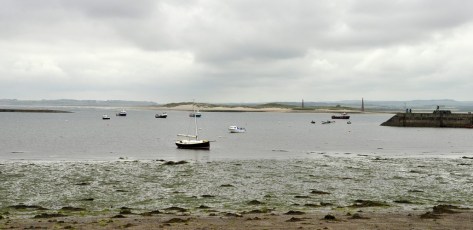
At the entrance to the harbor (on Guile Point) are two obelisks, which can be seen just right of center in the image below.

These are the Old Law Beacons, built in 1826 and are a navigational aid that, when lined up, guide sailors into the harbor through the safe channel.

Heading south, it’s not long before the early 14th century ruins of Dunstanburgh Castle on a remote headland come into view. The castle is only accessible on foot, just under 1½ miles north of the fishing village of Craster (famous for its kippers!) along a rugged rocky coast. The cliffs around the castle are home to an important colony of kittiwakes.

Embleton beach can be seen from the castle to the north, but we’ve not been there yet.


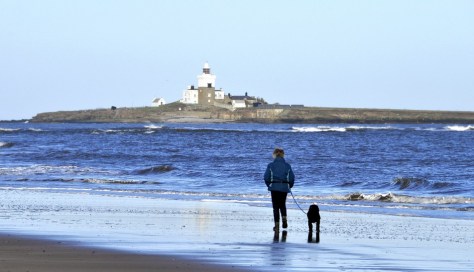
Just 5 miles south from Craster, the River Aln reaches the North Sea at Alnmouth, with sandy beaches flanking the estuary. On the distant horizon to the south lies Coquet Island, 1 mile off the coast from the fishing port of Amble (a town we have yet to explore).

Next south is Warkworth beach, a favorite of my daughter and her family. It’s just north of the town, with its 12th century castle, and the estuary of the River Coquet (which has its source high in the Cheviot Hills to the west). It’s a good walk through the dunes from the car park to the beach itself.

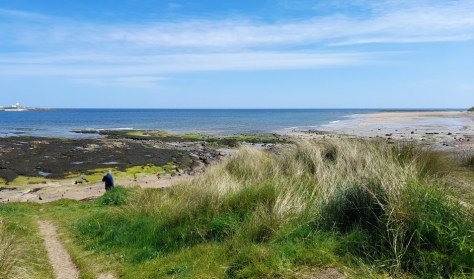
Quite often after we have made one of our regular visits to the Alnwick Garden (where we have Friends of the Garden membership), we head down to the coast south of Amble (next images) to have our picnic lunch looking out towards Coquet Island, an important reserve managed by the Royal Society for the Protection of Birds (RSPB) and the most important breeding site in the UK for roseate terns.

It has been badly hit by avian flu. Boat-landings are not permitted on the island even without the restrictions of avian flu.

Just a little further south, and inland from the northern end of Druridge Bay lies Hauxley Wildlife Discovery Centre. There’s a circular walk (about 1¼ miles or 2 km), several hides from which to observe the numerous bird species, and the Lookout Café there serves an excellent cup of coffee.

We’ve visited there a few times, most recently less than a month back. On that visit we saw 36 different species of birds within the space of an hour: wildfowl, waders, and hedgerow birds. A complete range.

Druridge Bay must be one of the longest beaches in Northumberland, over 7 miles long, and backed by high dunes (which, in one location, is the haunt of naturists—presumably during the summer months only!). The Bay stretches from Amble in the north to Cresswell in the south. Inland from the beach, Druridge Bay Country Park covers an area of almost 66 acres (27 ha), with a large freshwater lake, woodland, and grassland and meadows, as well a stretch of the beach and dunes.

At Cresswell there are exposed—at very low tides—the remains of an submerged forest, but we’ve not yet had luck in finding them. The beach is flanked by rocky outcrops at both ends. Parts of the beach are also covered with sea coal which some of the locals gather.


We haven’t yet explored any of the beaches between Cresswell and Blyth, but those south of Blyth as far as the mouth of the River Tyne are where we most often go for a walk. These include Blyth and Seaton Sluice beaches, St Mary’s lighthouse, Whitley Bay, Cullercoats, Long Sands Beach between Cullercoats and Tynemouth, with King Edward’s Bay nestling under the Tynemouth headland on which stand Tynemouth castle and priory, with a magnificent view over the Tyne.

The small harbor at Seaton Sluice, at the mouth of the Seaton Burn, was built by the Delaval family (of nearby Seaton Delaval Hall) in the 18th century to export coal and glass.

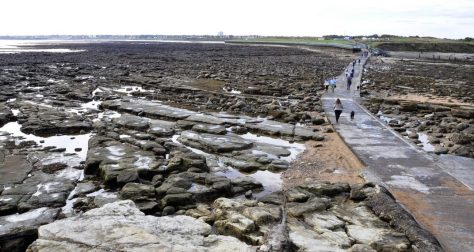
St Mary’s Lighthouse is only accessible across a causeway at low tide.

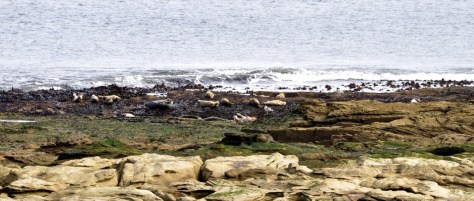
We regularly see a small colony of Atlantic grey seals, and the rocky outcrops there attract large numbers of waders like curlew and golden plover in autumn and early winter.


At the end of March this year, we took the Tyne Ferry to cross from North Shields to South Shields, mainly to visit Arbeia, the Roman fort there. But also to take a look at the entrance to the Tyne from the south and the beaches at South Shields.

South of the South Shields beaches, crumbling magnesian limestone cliffs tower over the coast at Marsden and Whitburn. There are sea stacks and arches dotted along the coast, nesting sites for many sea birds. This stretch of coast is one of our favorites to walk. There is also the added attraction of Souter Lighthouse, visible from miles away.

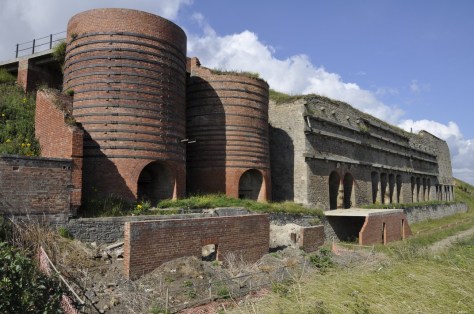
The limestone is quarried, and in the 1870s a bank of 15 lime kilns was built to process the limestone, linked to the Whitburn colliery and Marsden colliery village, both of which have now been demolished.

The National Glass Centre stands alongside the River Wear in Sunderland.

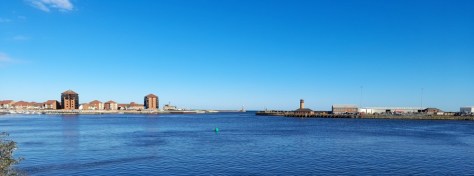
The mouth of the Port of Sunderland on the River Wear, across from the National Glass Centre.

It’s really worth a visit, and we enjoyed ours a year ago. There’s a long history of glass-making there, and it’s also connected to the establishment of early Christianity. Close by is the Saxon church of St Peter (below), one half, with St Paul’s in Jarrow, of the double Monkwearmouth-Jarrow monastery where the Venerable Bede, one of England’s greatest ecclesiastical scholars spent most of his life in the 8th century.

And talking of glass, in August 2022, Steph and I did some serious beachcombing at Seaham, south of Sunderland, searching for sea glass. I wrote about that visit in this blog post. The beaches there are part of the Durham Heritage Coast, which has been rehabilitated after decades of industrial abuse in the past. Blast Beach is where we found a nice source of sea glass, but the beach north of the town is supposed to be richer. We’ve yet to search there.

So, there you have it. At around 80 miles, and in many locations less than an hour from home, this stretch of coast must be one of the more interesting and beautiful in the country.