Anything you can do I can do better . . . performance management and monitoring

Society – in the UK at least – seems obsessed these days with performance. And I’m not referring to the exploits of our athletes in Team GB during London 2012.

No, what I’m concerned about is the focus we seem to have on performance targets and monitoring. Now don’t get me wrong. I do agree that there has to be accountability for many of the things in which society invests. But there are some areas where performance monitoring and appraisal have been taken a little too far in my opinion. I have to be a little circumspect, I guess, since my elder daughter Hannah is a PhD psychologist specializing in industrial and organizational psychology and particularly in issues relating to performance.

In the public eye
Before the Olympics Games finally got under way, there was great concern that the company that had been contracted to provide security cover had not been able to recruit the necessary number of staff or get those that had been trained in time. Thankfully, all went quiet and appears to have gone smoothly as the Games commenced.

But the company in question, G4S, had contracted to provide all these people, yet only came clean a couple of weeks before the Games were due to open that they could not fulfil the terms of the contract. Now it’s not my role here to criticize how G4S managed its contract. What I do find hard to understand is how its failure to deliver was not picked up until so close to the Games. I would have expected the contract to have some very carefully defined targets and a set of milestones that had to be achieved by certain dates. These would have permitted adequate monitoring of contract progress. Maybe these were in place, but no-one bothered to monitor what was going on.

Now we have the furore about GCSE English exam results, and the moving of grade boundaries. Not only will this change in marking practice affect individual students, lower grades affect the targets which schools are expected to achieve in terms of passes at certain grades among students taking exams if the funding from the government is not to be adversely affected. Again, targets, targets, targets.

My own experiences with performance setting and monitoring have been concerned with two aspects. First, as with most employees these days I guess, I’ve had to undergo an annual performance appraisal. And second, as Director for Program Planning and Communications at IRRI between 2001 and 2010 I had responsibility for developing the institute’s Medium Term Plan and helping colleagues to define/refine their annual research targets, as well as respond to the increasingly idiotic and meaningless questions raised by the small-minded accountant hired by the CGIAR Secretariat in Washington, DC who hadn’t the first clue about scientific research (either basic, applied or for development) and was, in reality, the proverbial ‘bean counter’.

Performance appraisal
It was the late 1980s, and I was working at the University of Birmingham, as lecturer in plant biology. The Thatcher government had made any salary increase for academic staff contingent on the introduction of a performance appraisal system – something that was very new in academic circles. We had training courses – both for those supervising staff and for those being appraised. I have to admit I was dead set against this new fangled approach. It seemed to me that if you were found not to be performing as expected there were measures in place to help you do better. If, on the other hand, everything was going well, you might get a pat on the back, and that seemed about it.

I think I surprised myself when, after the first round of performance appraisal, I became a convert. I had found the whole exercise worthwhile and, following a complete reorganization in the School of Biological Sciences into four research groups (I was in the Plant Genetics group), had a better understanding of my niche in the School – and that it was appreciated by my head of group. It was also very useful to be able to have a frank and unconstrained discussion, one-on-one, with my head of group, Dr (later Professor) Mike Kearsey. From this experience, I became convinced that performance appraisal should be more about personal development rather than a means primarily to set remuneration policy and merit increases, although it surely plays a part.

So I was rather shocked when I moved to IRRI in 1991 to find a system of forced ranking, where local staff expected to be rated ‘excellent’ just for doing their job, simply because salary increases were tied to the outcome of the appraisal cycle. In fact during the 19 years I was at IRRI, I think I must have been through more than half a dozen different appraisal systems – and to my mind, none of them was particularly satisfactory. I was able to have some aspects of the development criteria I’d experienced at Birmingham brought into the IRRI system, however, and I think they were appreciated by staff at all levels.

But getting staff performance appraisal just right is a tricky issue, and I do not count myself an expert by any stretch of the imagination. But I think I can recognise a system that is just not delivering – either for the individual staff members or the organization.

Performance targets and monitoring
The days when a researcher could follow his or her scientific curiosity are long gone. Just ask anyone who has had to write a research proposal – for basic research, applied research, or research for development, and the problem of crystal ball gazing emerges once again. Scientists are often asked, as one of the criteria for evaluation, what the impact of their research is likely to be, 10, 20 or 50 years down the road. This is an impossible question for many.

But in the fields of research that I have been associated with for several decades, the success of any grant submission is the ability to clearly demonstrate what the outcomes and impact are expected to be, and to plot a pathway (through milestones) to achieving those. I don’t have much of a problem with that; after all this type of research is not done for its own sake, but has the ultimate aim of improving people’s livelihoods. But while a targets and monitoring scheme can be a framework to assess the benefit-cost of research investment, it had, in my opinion, become a millstone around the collective necks of the international agricultural research community, imposed from above by a group of donors whose staff (well some of them at least who were calling the shots) had little understanding of the nature, complexities and constraints of carrying out research for development, and often in rather challenging conditions.

Among the beefs I had with that accountant in DC were first, the ambiguity of the monitoring metrics – which allowed interpretation and therefore gaming of the system among research centers in the system (after all the ranking that performance monitoring brought about had a direct impact on the next year’s funding), and second, the complete lack of understanding that even though a research project had not met its targets to the letter,  there could have been nevertheless significant impact on the ground. It was the numbers that mattered. And I’m afraid I did, on more than one occasion, let my frustration with system get the better of me, and interact with the Secretariat folks in less than my usual courteous way.

I worry that research for development is increasingly being devised and carried out to a formula, and the performance targets and monitoring are only exacerbating the problem. As I said from the outset, I have no issues with performance assessment per se. But when these exercises take away significant valuable time from active researchers in order to feed into a bureaucratic system (for certain months of the year I was spending over 50% of my time responding to external performance monitoring and auditing requests and having to ask researchers to take time away from their work to meet the deadlines which were imposed on us) then the balance is wrong.

Since retiring I’ve fortunately not had to deal with these issues any more – and it was the increased bureaucracy of international agricultural research that finally decided me to retire. I’m sure this won’t be the end of it. The CGIAR has gone through a major reform and reorganization program, and I’m sure it will have to devise new (better, probably not less complicated?) performance monitoring schemes in order to justify the shape, feel, direction, and expense of spending several years navel gazing to move its agricultural research agenda forward.

I’ve never thought of myself as a cynic. Unfortunately in the last 18 months before I retired I felt myself developing a cynical outlook, and I didn’t like what I saw. Time to get out. I’m happier now.

Postscript (20 March 2014)
Just after the beginning of 2014 I received an email from an old friend, Sirkka Immonen, who works for the CGIAR Independent Evaluation Arrangement, based in Rome. Sirkka and a colleague had made an analysis of the CGIAR’s performance management system, which they had published in the journal Evaluation [1]. One of their compelling conclusions is ‘ . . . that the CGIAR’s PM [Performance Measurement] experiment failed against all the intended purposes. There were inherent difficulties in developing a set of annual indicators with high validity in reflecting the kind of performance that research institutions are expected to demonstrate, on outputs, outcomes and impacts. The system therefore was dominated by simpler observations related to quantitative records and institutional issues with unclear connections to performance of research organizations.’ The whole article is certainly worth a read. And after I had read it myself, I did feel somewhat vindicated for the stance that I had taken and the many concerns that I had raised while trying to implement what I then considered a flawed system in the research context.

[1] Immonen, S and LL Cooksy (2014). Using performance measurement to assess research: Lessons learned from the international agricultural research centres. Evaluation 20 (1), 96-114.

TV habits . . .

I guess I watch a little too much TV, perhaps. Of one thing I am sure, however. I’m a news junkie, and the availability of a 24 hour news channel on the BBC is good news as far as I’m concerned. So if I miss the scheduled main bulletins at 1 pm and 6 pm, I can always catch up at any time in between.
Funnily enough, I quite like tuning into the BBC Parliament channel to see what our representatives are up to – or not, as the case may be. It’s incredible how empty the Chamber is sometimes. Must be soulless being a Member of Parliament on some days when you decide to make speech on a topic close to your heart and only a handful of colleagues (from all sides of the House) turn up to listen. And there are 650 MPs elected to parliament.

I do like adaptations of the classics – such as Jane Austen and Dickens, and there have been some wonderful series over the years. While we lived abroad we were able to catch up through DVD purchases. So we look forward each year to the autumn schedules and wonder what new adaptations will be presented for our delectation.

And I particularly enjoy history programs very much. We’ve just watched an excellent three-part series on The Churchills by David Starkey (a rather controversial historian), in which he ‘showed’ how Winston Churchill was destined to become a great wartime Prime Minister after having researched and published during the 1930s a magnum opus biography of his ancestor, John Churchill, Duke of Marlborough, one of the greatest generals in the first decade of the 18th century, under Queen Anne.

Other historians that have presented interesting series recently are Amanda Vickery on the Georgians, Cambridge classics scholar Mary Beard on the Romans, and Bettany Hughes, most recently presenting a 3-part series Divine Women and co-presenting Britain’s Secret Treasures (with, I have to say, increasing focus on her ample Rubensesque, Nigella Lawson-like bosom, all plunging necklines and profile shots); Lucy Worsley (Chief Curator at Historic Royal Palaces) rarely fails to please in the various series she has presented. Michael Wood has also made some good series, particularly that about Trojan War (as long ago as 1985 – how time flies).

But there are three BBC programs, all of which have enjoyed multiple series, that I’ve become somewhat ‘addicted’ to, and I’m not quite sure why.

Bargain Hunt
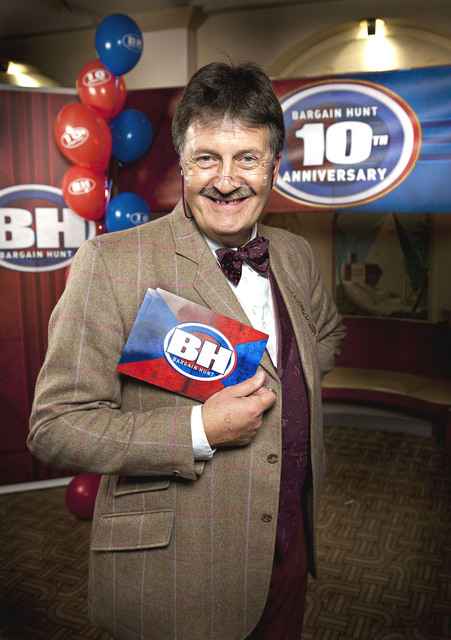
Presented by Chartered Auctioneer and Chartered Surveyor Tim Wonnacott, the program format is surprisingly simple.

Two teams, the Reds and the Blues (of two contestants each) are given £300 each (it was £600 in the early series) – and the support of an expert – to find three bargains at an antiques fair or similar within one hour, which will then be sold at auction (filmed at a later date at an auction house somewhere in the UK). The balance of what they pay for their items is given to the expert (often auctioneers themselves) to spend on a bonus buy. The winners are the team that makes the most profit at auction – whether or not they choose to use the bonus buy – or make the least loss. Any profit is kept by the contestants. A team that makes a profit on all three of their items gets the award of the Golden Gavel – actually a pin button with the BH logo.

What I really like is the last 20 minutes or so of each program when the various purchases are assessed by the auctioneer who is going to sell them. Did they really buy a bargain or a load of junk? It’s impressive the knowledge these auctioneers and the other experts have – but they don’t always come up trumps. It just depends on the ‘buzz’ at the auction on a particular day and, it seems, that some items do better in one part of the country than another (the program is filmed in different auction rooms all over the country). And it’s really interesting to watch the skill of the different auctioneers, and how they move items that don’t look to have any chance of making a profit whatsoever.

Dragons’ Den
This is presented in the UK version by broadcaster Evan Davies (one of the regular anchors of the BBC Radio 4 Today program each morning). Apparently Dragons’ Den began life in Japan, but now there are versions in a number of countries. I’ve seen the Irish and Canadian versions on the TV over here.

Budding entrepreneurs seeking investment in their company or an idea make a pitch to five venture capitalists who have made it, and who are (apparently) prepared to invest their own money in return for an equity stake. The pitch can only last about three minutes, during which time they have to convince the investors about the potential of their idea/product/invention.

And while a few are successful, it never ceases to amaze me how many budding entrepreneurs arrive in the Den ill-prepared. Obviously they are nervous, and some just blow it, and go to pieces. Quite a number do not have the necessary financial details and projections at their fingertips, nor a viable business plan. But there are two ‘mistakes’ that crop up time and again.

The first relates to intellectual property on inventions. The investors are unlikely to invest (maybe up to £200,000) in an invention that has not been protected. The award of a valid patent is sure to attract their attention. And the other mistake is to value their companies or product too high, by asking for an investment and yet unwilling to offer a sufficiently high equity stake. So asking for £100,000 and offering only 10% equity (thus valuing the company or product at £1 million) is sure to end up in some hardball negotiation, and the Dragons usually ask for a much higher stake, even as high as 49%.

But there have been some impressive investments. I have to say however that watching some entrepreneurs squirm under the intense (and sometimes quite hostile) grilling from the Dragons does make for compulsive TV.

QI
Now this is a different kettle of fish – much more light-hearted.

With resident quizmaster, polymath Stephen Fry and resident panelist, comedian and actor Alan Davies (who is joined each program by three other panelists) the show aims to throw some light on things that just might be Quite Interesting – thus QI. It was created by John Lloyd who wrote/produced/created a whole load of other shows on British TV, including Spitting Image and Blackadder, among others.

The panelists are most often other comedians (although Professor Brian Cox was a guest on a recent episode), who are asked about different topics; each show seems to have a particular theme. They are lulled into traps to provide an ‘obvious’ but quite often incorrect answer. Which then allows for much witty banter to-and-fro among the panelists.

The scoring system is a mystery, with Alan Davies most often coming last, with multiple minus points. In recent series the ‘nobody knows’ option has been introduced. In each program there is one question for which nobody knows the answer. Extra points are awarded for correctly identifying this question.

But it’s not about the points – it’s all about the free exchange of wit among Fry and his guests. Forty-five minutes or so of jovial entertainment.

Indiana Me . . . temples in the jungle

Over my career, I was very fortunate to be able to combine business trips with short visits to some of the world’s iconic heritage sites, or take time out for a quick vacation in the region without having to fly half way round the world.

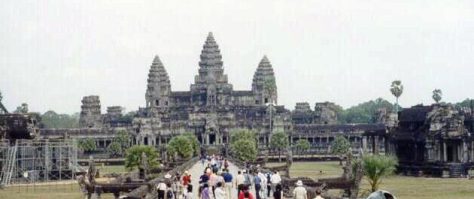
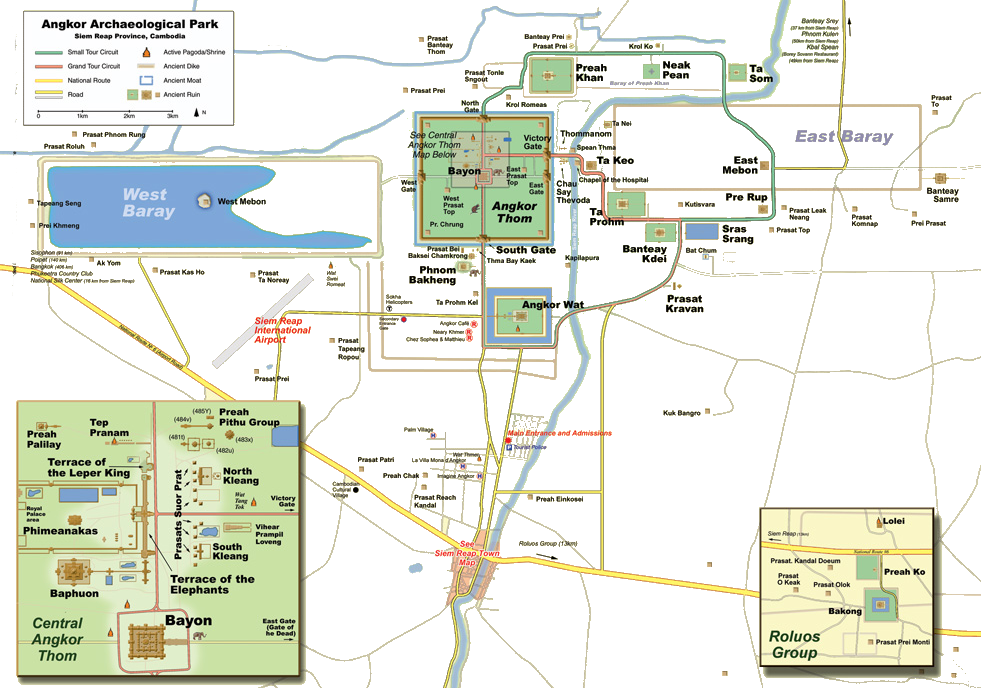
When we lived in Peru, I visited Machu Picchu a couple of times; almost anywhere you travel in Peru you are immersed in archaeology. In Central America we had the opportunity to visit the pyramids of Tikal in Guatemala (and I hope to post photos from here once I have digitized the slides), and also those at Teotihuacan, just north of Mexico City. But one of the most impressive sites must surely be the huge temple complex at Angkor Wat in Cambodia. And we had the chance to visit there in December 2000.

On flights from Bangkok to Manila I have often overflown Angkor Wat, and even from 30,000 feet its extent looks truly impressive (even if there is also evidence over the whole countryside of the intense bombing that Cambodia suffered over several decades of war).

Angkor Wat is located in northwest Cambodia, near the town of Siem Reap, and near the Tonlé Sap, a huge seasonally flooded lake that acts as an overflow for the Mekong River during its flooding.

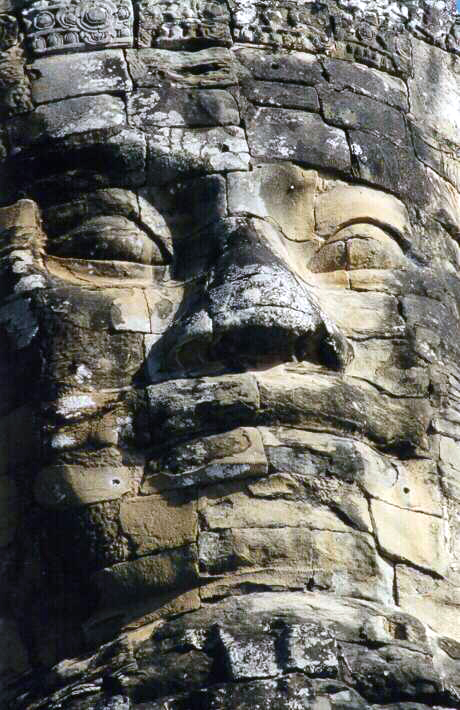
While we refer to Angkor Wat as a ‘site’, there are in fact many temples and other complexes covering a large area, apparently about 200 square kilometers. The beauty of the stone carvings, the iconic stone faces pointing in four directions, and the wonder of the forest reclaiming the various temples all add to the mystery of Angkor.

I’m not going to attempt to describe in detail what Angkor Wat has to offer, but a visit there has to last more than just one day. We stayed there for three nights, and although we were able to many of the sites and temples, there are plenty more mysteries to uncover, hidden by the jungle that has reclaimed its dominance over the area.

Some of the temple complexes, like the Angkor Wat site itself and Bayon are large with many beautiful buildings to explore, others are much smaller, comprising just a couple of buildings or so. Just click on these photos to open web albums (scanned images rather than original digital photos).

Angkor Wat

Bayon

When we visited, it was possible to move freely around all the sites, look inside the temples, climb the towers – and really explore. While it was quite busy in some sites, we did manage to get away from the bulk of the tourists. But the increasing number of visitors to Angkor Wat is now giving rise to concerns, as this recent story on the BBC website discusses.

Settlements at Angkor Wat stretch back thousands of years, but much of what we see today was constructed from about the 11-12th centuries onwards, reaching its peak a couple of centuries later. I’ve read estimates of more than 1 million people were involved in building the temples. And for an ex-rice scientist like myself, that begs the question about the extent and productivity of rice agriculture that was required to keep this huge population fed.

In addition to the Angkor Wat and Bayon sites, these are the other sites you can ‘visit’:

Let me finish with a quote from the Introduction in Dawn Rooney’s guidebook to Angkor Wat [1]: The temples startle with their splendour and perfection, but beyond the emotions they evoke lie complex microcosms of a universe steeped in cosmology. While a thorough understanding may be out of reach for many, the monuments’ profound beauty touches everyone . . . 

~~~~~~~~~~~~~~~~~~~~~~~~~~~~~~~~~~~~~~~~~

[1] Rooney, D (1997). Angkor – an Introduction to the Temples. Passport Books, Lincolnwood (Chicago), Illinois 60646-1975.
ISBN: 0-8442-4766-9

A state of decline . . . repair, not restore

A few days ago, with a fair to promising weather forecast (it actually turned out much brighter and warmer than expected) we made another of our National Trust visits – this time to Calke Abbey, near the village of Ticknall which lies just to the southeast of Derby (of Rolls Royce aeroengines fame), in the English Midlands.
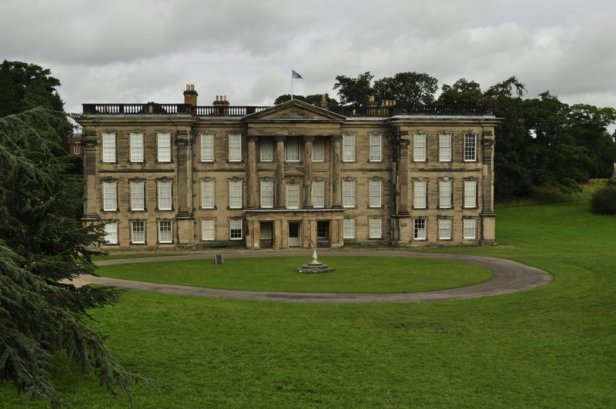
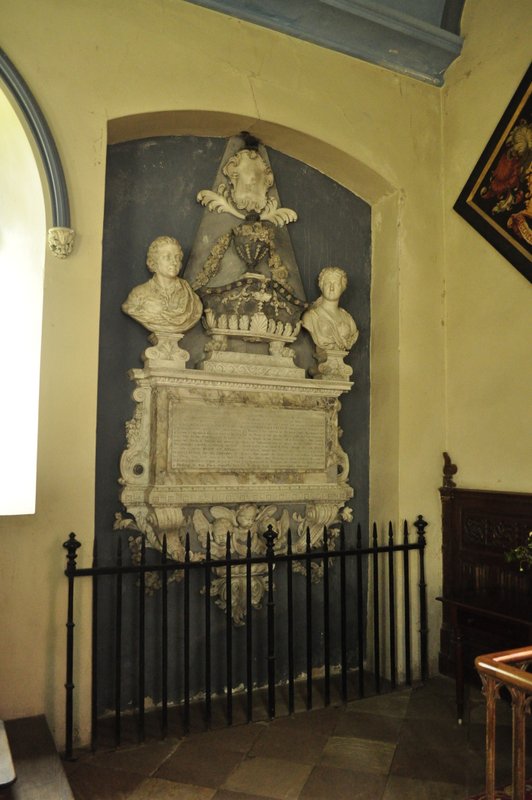
Calke Abbey (incidentally there was never an abbey there, although there had been an Augustinian priory in the vicinity from the 13th century) is a country house, rebuilt between 1701 and 1704 – amid several hundred acres of farm and park land (including a deer park) – by Sir John Harpur, the 4th baronet. His impressive memorial was built in St Giles Church on the Calke Abbey estate.

The original estate was purchased by the 1st baronet in 1622, and remained in the Harpur family until 1985. Sir John Harpur married a daughter of Lord Crewe, and at some date thereafter the family name was changed to Crewe, and then Harpur Crewe. The last baronet died in the early 20s, and the estate passed to a grandson, Charles Jenney – who changed his name to Harpur Crewe. When he died in 1981, the estate was faced with crippling death duties, and like so many ‘stately homes’ it began to deteriorate because the family could no longer afford its upkeep. In 1985 ownership passed to the National Trust. And what a treasure trove the Trust encountered!

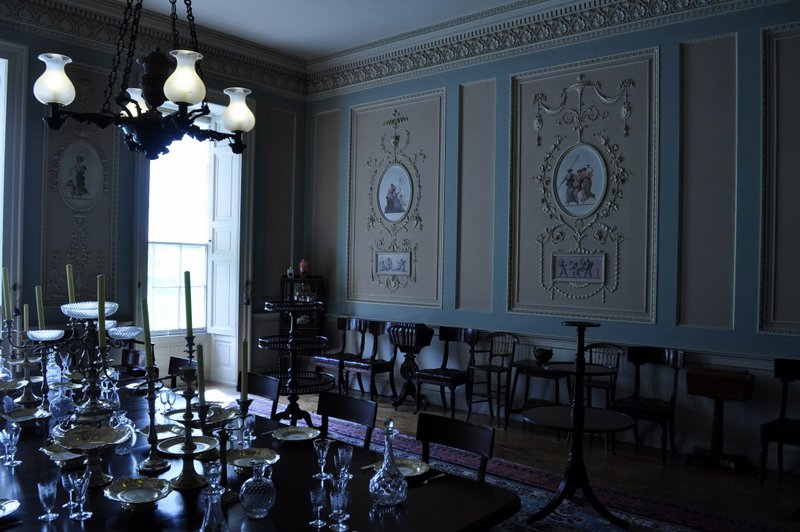
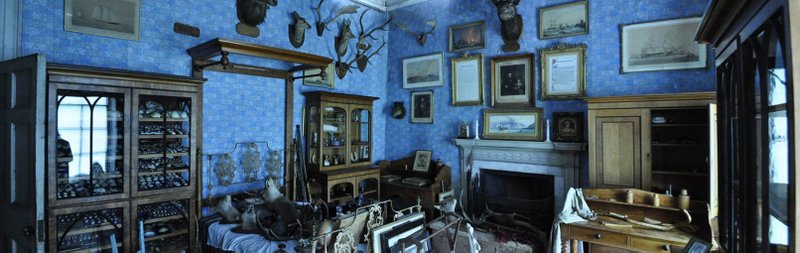
It seems the Harpur Crewes were mildly eccentric, didn’t have electricity installed in the house until 1962, and almost never threw anything away – they were great hoarders. So when the National Trust came to inventory the house and its contents, they found a property that consisted entirely of its original contents. Whole rooms, such as the dining room, were furnished just as they had been originally completed in the 18th century.

Normally the National Trust acquires various items and displays them in its different properties according to the period or aspect they want to emphasise. But not so with Calke Abbey – nothing has been brought in. Although extensive roof repairs had to be carried out, there has been remarkably little water damage in the house. Even when the house was occupied, different wings were abandoned after the Second World War, and essentially left to their own devices and deteriorate (these had the feel perhaps of Miss Havisham’s house in Great Expectations by Victorian author and one of the world’s greatest novelists, Charles Dickens).

In the case of Calke Abbey, the National Trust took the decision to repair the fabric of the building (to reduce further deterioration) but not to renovate. So it’s quite fascinating to move through the house and see those parts which continued to be occupied, and those which had been shut up for decades.

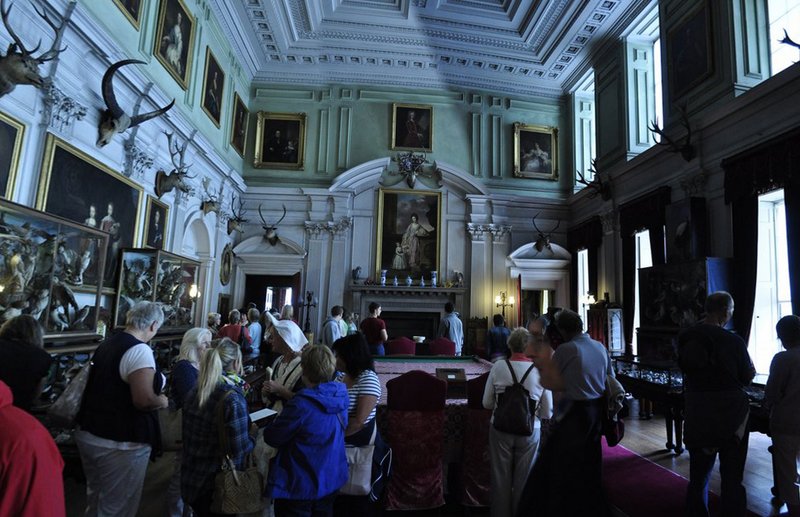
In the entrance hall and lobby there is a number of stuffed heads of longhorn cattle that were once farmed on the estate. In fact, the house is full of stuffed heads of deer – they are everywhere – and throughout the house there are dozens of glass cases of stuffed birds, mainly of British origin, but also fine examples from around the world. It’s a taxidermist’s paradise.

In the caricature room the walls are covered with 18th century cartoons relating to politics and society at that time.

The main staircase is very impressive, and is made from oak and yew.

But it’s in the dining room, the breakfast room, and the saloon that the glory of Calke Abbey comes to the fore. The original plasterwork is still intact and speaks volumes for the quality of the craftsmanship of the 18th century.

The bedroom of Sir Vauncey Harpur Crewe remains apparently much as it was when he abandoned it for another when he was married in 1876.

On the National Trust website, it’s possible to take a virtual tour of Calke Abbey, which certainly gives you a feel for the house and its contents. I have also posted a web album where you can see many more photos from inside the house and the park and gardens.

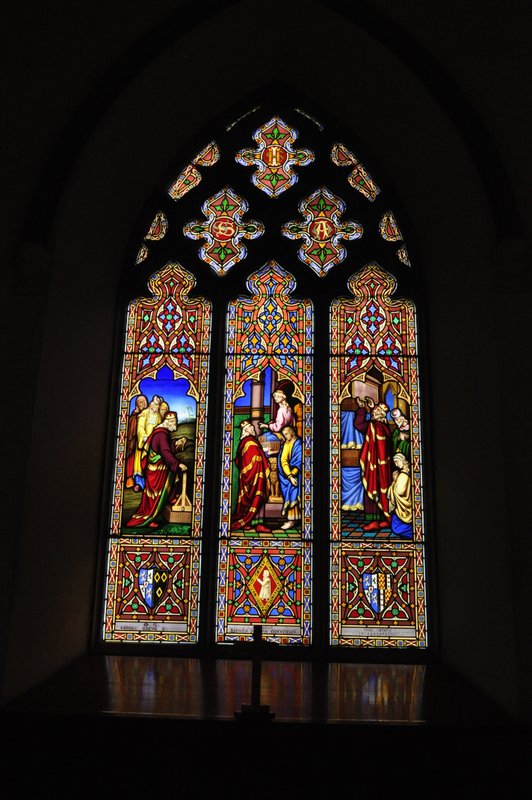
A short distance from the house stands St Giles Church, and there is a beautiful stained glass window above the altar that was installed by Sir George Crewe who died in 1844.

There is a formal garden, and a walled kitchen garden (that was formally much larger) in addition to the farm and parkland. And two very interesting features are the tunnels that connect the gardens with the house, and one from the wine cellars in the house to the brew house, alongside the stable yard. This tunnel weaves for about 100 m, and allowed domestic staff to pass from the house to the brew house without being seen!

Calke Abbey was certainly more than I had expected, and is a fascinating insight to 18th and 19th century living.

Just a late summer morning walk . . .

After a couple of weeks of mostly excellent weather while the London 2012 Olympics were taking place, it has been quite iffy since then, and we’ve even had some torrential downpours from slow-moving storms. We’re back to the Jet Stream hovering just south of the country allowing North Atlantic weather systems to blow in and give us quite unseasonable weather.

But today has been different. Although it’s been breezy at times, we’ve had a bright sunny morning, and quite warm, thanks to a weak ridge of high pressure shown in the map above.

Not having had chance to get out and about for my (almost) daily walk recently, I relished the opportunity today of walking along the local Worcester and Birmingham Canal. Whatever the weather, it’s a great walk – from just a mile or so, to upwards of a dozen or more, to and from where we often park the car. In both directions (north and south) one eventually comes to tunnels, and the towpath then winds it way up and over to join the canal on the other end of the tunnels.

Today, Steph and I just made a short walk of about three miles, from Whitford Bridge (just near the Queen’s Head pub), to one of the local access roads, Upper Gambolds Lane.

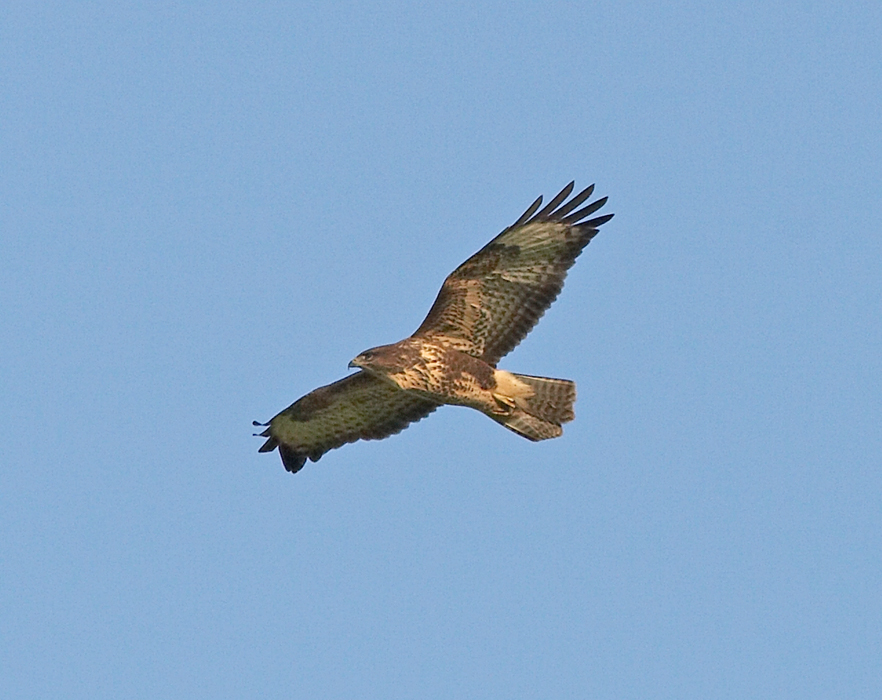
Just after we started our walk we saw four buzzards flying over head (photo courtesy of Barry Boswell), seeking the thermals and wheeling ever upwards until we could hardly make them out. But even though they were hard to see we could hear them mewling to each other. (Just a few days ago I’d seen four other buzzards quite close to the centre of Bromsgrove, calling to each other, and displaying the tumbling flight which is one of their characteristics.)

At first we were rather surprised that there were so few other folks out walking, and the canal traffic itself was also quiet even though it’s a Bank Holiday weekend here in the UK. However, we finally came across about five narrowboats that were following each other up the Tardebigge flight of 30 locks, one after the other.

On a walk like today it gives me chance to hone some of my digital photographic skills. I’m finally getting to grips with my Nikon DSLR. Here are just a few of the photos I took this morning.

Even though the flowers are dying off there’s the glory of developing fruits and seed heads. There was definitely a whiff of autumn in the air today. The nights are drawing in quite rapidly, and it won’t be too long, I guess, before we get the early morning mists developing over the waters of the canal. And eventually those first frosty mornings, with a weak sun forcing its rays through the mist. It’s definitely a canal for all seasons.

My style is ‘eclectic’ . . .

My tastes in art are as eclectic as those in music. I like what takes my fancy. And that makes me somewhat of a impulsive buyer.

Over almost three decades of living overseas – in South and Central America, and in the Philippines – and having also the opportunity of visiting many countries throughout Europe, the Americas, Africa, and Asia, I have been able to pick up the odd piece of art (and jewelry for Steph), and a range of handicrafts.

Anyone visiting our home in the UK can expect to see works of art and handicraft ranging from painting, to sculptures, batik, and gourd carvings among others.

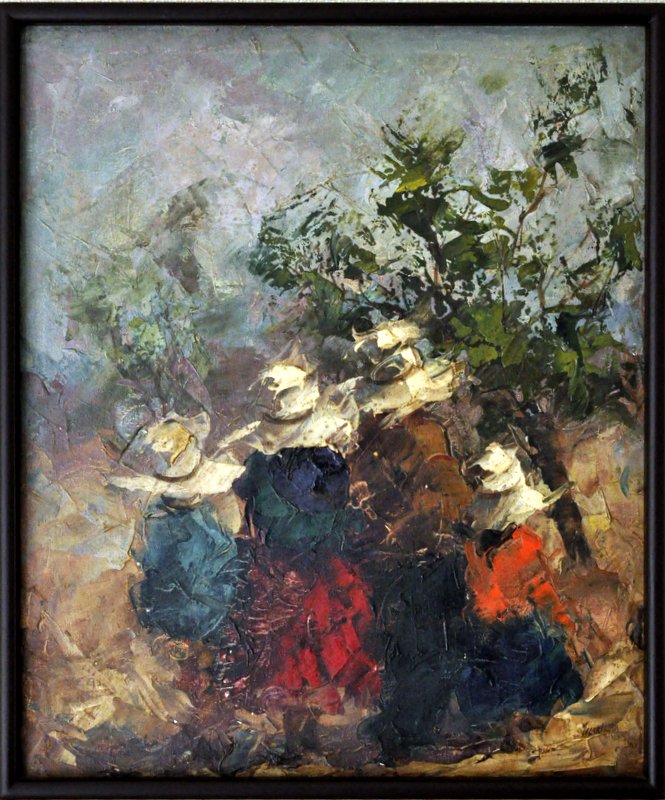
Taking center stage in our living room (over the mantelpiece) is an oil painting that I purchased at the weekly art fair in the JF Kennedy Park in Miraflores, Lima. It must have been January or February 1996 or so. I was in Lima for a genetic resources meeting among the centers of the CGIAR. On one Sunday morning we all decided to go down to Miraflores (from La Molina where we were staying at the headquarters of the International Potato Center – CIP). It was a bright, sunny day and many local artists were displaying their works along the various paths in the park. I had purchased a painting there in the late 1970s when I was working for CIP in Costa Rica, and was back in Lima for a visit.

Well, I saw this particular painting, and immediately the whole scene just caught my attention. I’d seen that scene (or something like it) many times – parents and two children – when I’d been out and about collecting potatoes in the province of Cajamarca in northern Peru  in 1974. The people of Cajamarca wear these beautiful reddish brown ponchos, and tall straw hats. And so this painting just resonated with me. Since I spoke Spanish I decided to haggle with the artist – he wanted about $175, but I was prepared to pay only $100. He wouldn’t accept that, so I walked on. On my next circuit, he’d dropped the price to $150, but still I wasn’t interested. As I walked round the park again, I took a crisp $100 bill from my wallet, ready to discuss with him again. I told him I had a $100 bill ready to hand over if he’d sell me the painting. The vision of cash in hand was too much for him, and so I was able to purchase this painting for $100 – a bargain. The painting is signed, but I’m not able to read it easily. I’ve tried to see if there are artists with a similar name in Peru, but haven’t had any luck yet. No matter. I like the painting, and it never ceases to bring me pleasure each day.

On a visit to Beijing, in about 1995, I picked up a couple of water colors of birds. They may not be of the highest quality, but they are quite good nevertheless.

Among the many Peruvian handicraft items we have are several carved gourds, known as mates burilados in Spanish. Many are made in the Mantaro Valley in Central Peru. The International Potato Center has its highland field station there (at over 3000 m) near Huancayo. My good friend Jim Bryan had good connections with one of the finest of the gourd carvers, and we purchased a number of excellent mates from him. Those on sale in the handicraft markets in Lima are quite nice but nowhere near the quality.

In the late 1970s, when I was in Costa Rica, I attended a Organization of American States meeting on agriculture in the Caribbean in Port-au-Prince, Haiti. I was able to pick up a couple of nice carvings, one of a farmer, the other of a beggar.

The one on the left, standing about 80 cm, is carved from a single piece of wood. Despite having it carefully packed, and getting it back in one piece to San José, I knocked it over while waiting for my ride back down to Turrialba (and stepping off the curb and damaging a tendon in my foot, that had to be kept in plaster for almost six weeks), and it split between the hand and the pineapple fruit. The carving of the beggar (on the right) is about half the size of the farmer.

When I retired from IRRI in 2010, I was given a carving of a rice farmer as a leaving present. IRRI had been presenting these to retiring members of the Board of Trustees, and I’d thought that one of these carvings would make an excellent leaving present. And that’s what I suggested when asked if I had any ideas. Imagine my surprise at the despedida (actually the celebration dinner for IRRI’s 50th anniversary) when IRRI Director General Bob Zeigler presented me with one of the larger versions of the carving – normally they were about half this size – signed by the artist, Bernard Vista.

Bernard Vista comes from Pakil, on the east side of the Laguna de Bay, perhaps 35 km from Los Baños (at the bottom of the lake on this map). and has a studio (and cafe) there. Pakil and Paete are sister towns famous for their wood carvings

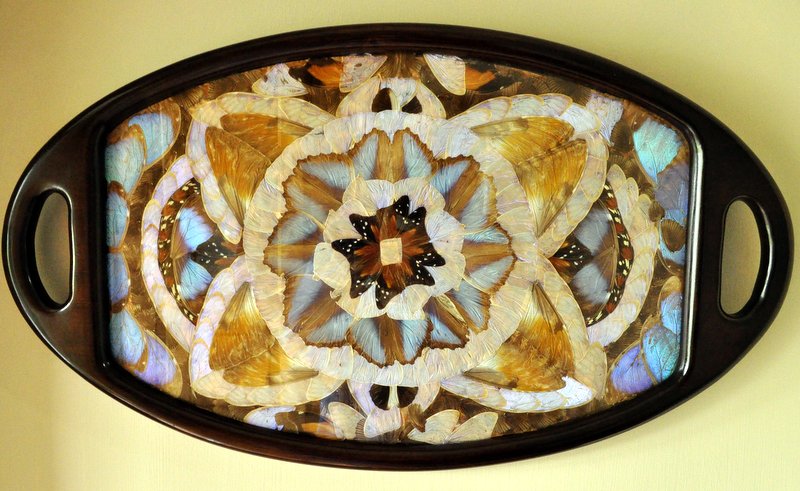
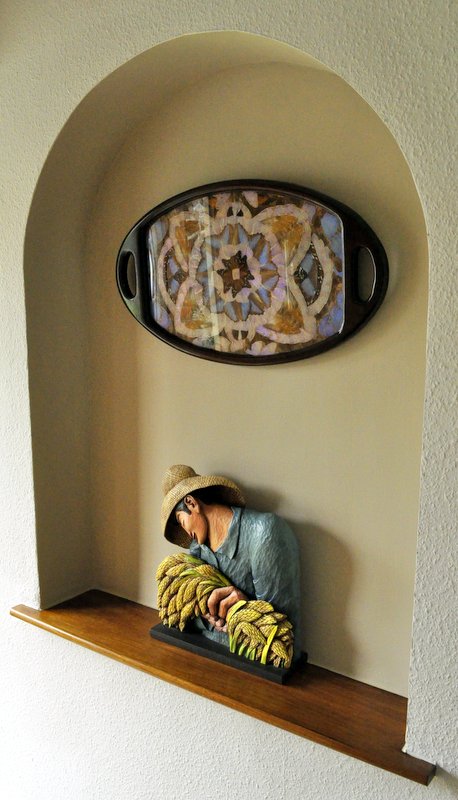
Another treasured possession – but not one I collected myself – is a glass-covered tray made of butterfly wings, encased in a mahogany frame.

My father bought that in Rio de Janeiro in the mid-1930s when he worked for the White Star Line as ship’s photographer. It was on my parents’ wall for decades, and after they died, I inherited it. It takes pride of place (above the rice farmer) in an alcove just inside our front door.

Early morning cup of tea . . .

Tea – the elixir of life.

It was just before 6 am today. I was lying in bed, enjoying my early morning cup of tea, and waiting for the news bulletin on Radio 4 on the hour.

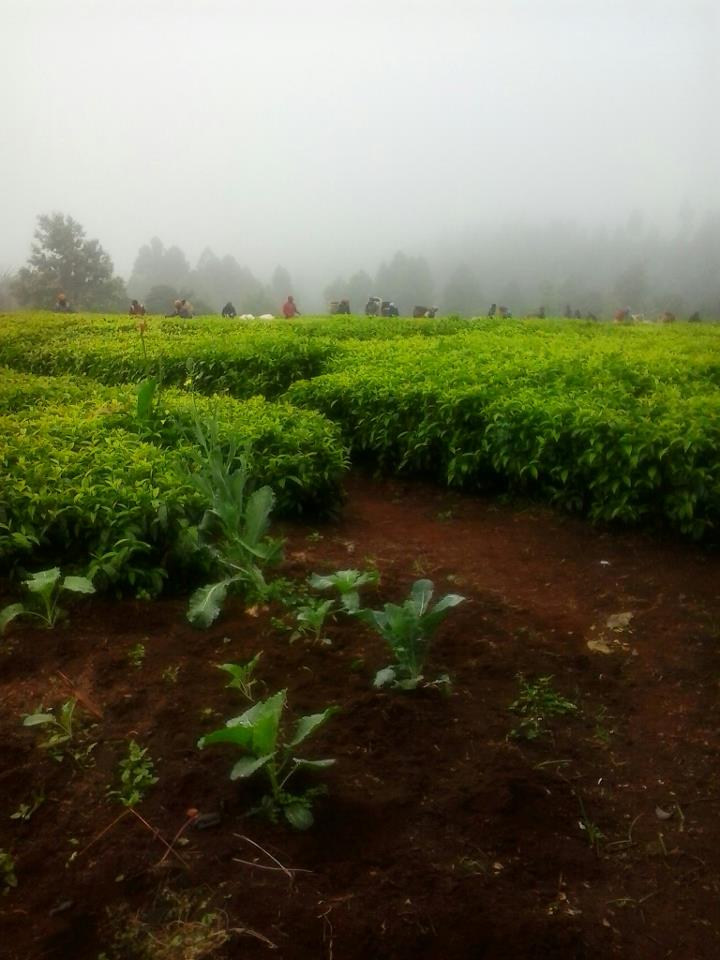
And I got to thinking about this photo of tea pickers in the highlands of Kenya that my friend Luigi had posted on Facebook yesterday. Tea is a very important crop in Kenya, and it now ranks as the world’s third largest producer, after China and India, with Sri Lanka and Turkey coming fourth and fifth, respectively. I’ve seen tea cultivation in Sri Lanka (above Kandy) and Indonesia (in the hills east-southeast of Bogor).

Tea is not, however, a crop that is native to Kenya, having originated in east Asia. And the same could be said for most of the plants we consume today. Just a quick survey of country of origin of fruits and vegetable on sale in supermarkets here in the UK demonstrates the global system of food production, and how far from their original regions of cultivation many of them have spread – beans from Kenya, asparagus from Peru, etc. The potato is referred to in the USA as the ‘Irish potato’ (presumably to distinguish it from the sweet potato, to which it is not related at all; or was it because of the dependence of the Irish in the 19th century on this one crop that led to mass emigration, most often to the USA, during and after the potato famine of the mid-1840s), but comes from the Andes of South America, with its greatest diversity in southern Peru and northern Bolivia. It’s now a major crop worldwide. Maize originated in the Americas but is a major staple today in many parts of Africa, although the major production area is the Corn Belt of the USA. Wheat originated in the Middle East, but major wheat-producing countries are the USA and Canada, Australia, and Russia. Rice is still the staple of Asia where it originated – probably in several centers of domestication.

In the 1980s, when I was on the faculty at the University of Birmingham, I taught a graduate course on crop evolution. I guess this interest in and research on crop origins had been instilled in me by Jack Hawkes, former head of the Department of Plant Biology at Birmingham (and my PhD supervisor), and I continued my work on potatoes for more than 20 years before moving on to rice.

One of the reasons why I find the study of crop evolution so fascinating is that it is a synthesis of so many seemingly unrelated disciplines: the biology of the wild and domesticated plants themselves, their genetics and molecular biology, ecology, and use plant breeding and farming, as well as their history and archaeology, social context, and economics over the past 10,000 years or so since the beginnings of agriculture in the Middle East, in China, and in parts of South and Central America. An interesting introductory text for anyone interested in the origins of crops is Evolution of Crop Plants (1995) edited by Joe Smartt and Norman Simmonds.

Today, the application of molecular techniques is helping to unravel further the ancestry of crop plants, showing linkages to their related wild species, and opening up many opportunities of using these genetic resources for the benefit of farmers and consumers alike, making the crops we depend on more productive, climate resilient, and pest and disease resistant.

In the 1980s the two BBC TV series of Geoffrey Smith’s World of Flowers documented the origins and history of many of the flowers that we grow in our gardens today – roses, tulips, daffodils, fuchsias, dahlias, and lilies, to name just a few. Based on the success of these programs, I did contact the series producer and sent in a prospectus for a series of programs about the origins of crop plants.

I could imagine a program on potatoes, for example, that would take the viewer to the Andes of Peru, looking at indigenous potato cultivation, linking it to the origins of Inca agriculture and the archaeology of the coastal cultures, the wealth of diversity of more than 200 wild species in the Americas, how these are conserved in major genebank collections in the USA and Europe (as well as at the International Potato Center in Lima), and how this diversity is used in potato breeding. No longer would we take these crops for granted! And the same could be done for wheat and barley – the cereal staples of the Middle east, with its wealth of archaeology in Turkey, Syria and Iraq, maize in Mexico and coastal Peru, and many other examples.

I even spent some time with a BBC producer who visited me at Birmingham – but to no avail. While they liked the idea, there was no budget to do the programs justice. I could just imagine Sir David Attenborough waxing lyrical – in his inimitable way – about our food and where it comes from. Who knows – it might happen one day (but Sir D is an unlikely presenter given his age).

I was inspired . . .

That’s it. Games over. The countdown to Rio de Janeiro in 2016 has begun.

I feel kind of deflated today. I’m not a sportsman by any stretch of the imagination, although a few years before retiring I did become quite a badminton and swimming enthusiast. I haven’t continued either since returning to the UK, but do try to take a daily walk – weather and inclination permitting – of varying length between a couple of miles and about seven maximum.

But the past two weeks have seen me take my sports exercise vicariously through many hours of TV coverage on the BBC. I haven’t been able to watch the Olympic Games since 1988 (when they were held in Seoul), and the time difference with the UK didn’t make for the most convenient viewing. But during my 19 years in the Philippines, there was only scant coverage on the local TV channels, and very selective at that, and often only several months after the event (always interspersed of course with a plethora of adverts). The national sport of the Philippines is basketball. While I can and do appreciate the great athletic prowess of the top basketball players, the sport seems rather pointless to me. There again, I’m sure many cannot understand my interest in and love of cricket (it was once an Olympic sport!).

The slogan of the London 2012 games was Inspire a generation. And yes, I can say that they have inspired a(n older) generation – ME!. It’s hard not to marvel at the focus and dedication of the athletes participating in the Games. Clearly winning an Olympic medal of whatever colour takes dedication to the exclusion of almost any other aspect of what most of us would regard as a normal life. The days when one could turn up for a few hours training every now and then and go on to win a medal at the Olympic Games are long gone. It’s a full-time commitment, supported by coaches, psychologists, physiotherapists, and managers. Let’s not forget that many of the athletes are full-time sportsmen and women, although few enjoy the financial rewards of the USA basketball players for example, or can expect the sponsorship that an athlete like Usain Bolt must already receive; or the tennis players for whom the Olympics was just another fixture on a busy schedule of international tournaments – although this one had no prize money to offer, just the glory of winning an Olympic medal (nevertheless, well done Andy Murray).

The TV coverage here in the UK was, for the most part, of a high standard, and thank goodness we didn’t experience the Games NBC-style, so I’m led to believe, with incessant advert breaks and some of the major events (such as the Men’s 100 m sprint) not even broadcast live! Some of the camerawork could have been better – but that wasn’t the fault of the BBC, since the images were, I believe, provided by a special Olympics broadcast company. Although quite a number of the presenters were below par, Clare Balding was certainly the best of those commentating – on several events including the swimming and equestrian events. Ian Thorpe, the Australian multi-gold medal swimmer was also a great addition to the BBC team, as was Michael Johnson, the 200 and 400 m sprint gold medalist from the USA. Many others appeared to have been instructed to fill every quiet moment with incessant and repetitive chatter, instead of letting the images speak for themselves (but I already posted a blog about my irritation in this regard). And some of the ‘insensitive’ questioning of competitors who had ‘failed’ to win gold, or any medal for that matter, was ridiculous. I half expected someone to answer How the f*** do you think I feel?

So what did inspire me? On the mainstream channels there was a focus on sports in which Team GB was expected to do rather better: rowing, cycling, and athletics. But there was also good cover of the various equestrian events (dressage was a revelation – especially Charlotte Dujardin’s choice of ‘patriotic’ music for her gold medal routine in the individual event, including the theme from the World War II movie The Great Escape and Elgar’s Land of Hope and Glory; given that our closest rivals and multi-winners were the Germans, I wonder whether this music was chosen on purpose). But I did get to watch some of the hockey, canoeing (something I’d never really seen before), volleyball (although beach volleyball – bikinis notwithstanding – doesn’t interest me), judo, taekwondo, and gymnastics, but very little weightlifting or Graeco-Roman wrestling.

But you have to marvel at the inspiring performance of the rowers and cyclists (both road and track – especially Bradley Wiggins road time trial gold a week after winning the Tour de France), the beauty of seeing Mo Farah take the 10,000 and 5,000 m distance events (the only ones which actually had me on my feet yelling at the TV!), the awesome Jamaican sprinters, and the USA Women’s 100 m relay team who broke a 26 year old record. Perhaps the best performance on the track was that of Kenyan David Rudisha who led from the front in the Men’s 800 m and even broke the world record, something that is normally achieved only at the regular ‘professional’ athletics events where a pace-setter is employed to ensure that fast times are clocked. Long jump champion Greg Rutherford from Team GB had slipped under the radar; once he’d posted his winning leap there wasn’t much competition. In the pool the USA team was awesome, but the performances of the young Chinese swimmer Shiwen Ye, Lithuanian Ruta Meilutyte,  and American Katie Ledecky, 16, 15 and 15 respectively, stand out. Michael Phelps – what more can I say?

I learnt a lot about sports I knew little about before the Games. I can now wax lyrical about strategy in the cycling keirin, or the finer points of dressage’s piaffe, passage, extended trot and flying changes. But I still find it odd at the end of a BMX cycle race to discover that the participants are not 10-year-old kids, but men and women in their 20s and even 30s; and taekwondo is lost on me. Surprisingly I found the women’s boxing interesting, and Team GB gold medalist Nicola Adams is surely an inspiration to anyone interested in sport – what a smile and bright and breezy attitude.

Team GB dominated the cycling, rowing and boxing events, and had several significant wins in the athletics track and field. After the Beijing 2008 games, the track cycling authorities decided to limit participation in each event to one entry per nation – apparently because of the domination of Team GB. Well, we still dominated, taking seven of the 10 gold medals on offer.

And if you want to find out any statistics at all about who won what and how, this BBC link provides a medals table and a complete breakdown sport by sport. Incidentally, the Wall Street Journal has published an alternative medals list, awarding gold to nations that came last in its events. Apparently Team GB topped that list. Not surprising really, given that Great Britain & Northern Ireland were allowed to field teams in all events, as host nation, even if they had not met the Olympic qualifying standard.

Many of the venues were spectacular: the velodrome, the aquatics center, the main stadium itself. It was inspiring to hold the equestrian events at Greenwich (behind the Naval College, and along the prime meridian) from where the whole of London could be seen during the cross country eventing. And so many others – such as the road cycling, the triathlon, and the marathon all passed many of London’s skyline iconic buildings. What a backdrop for these different sports.

And finally, what about the Opening and Closing Ceremonies? I already posted a blog about the Opening Ceremony. I thoroughly enjoyed that event. And last night’s Closing Ceremony was equally spectacular – but different. I read one review this morning that said there had been no ‘wow’ moment. I think there was, and that was the video of John Lennon joining the schoolchildren singing Imagine. It was totally unexpected, sent shivers down my spine, and brought a tear to my eye. You can watch the official video on YouTube.

I have to say that I even thought the Spice Girls did their bit rather well, and it was amazing to see and hear the reaction of the audience in the stadium to the Freddie Mercury segment, as though he were actually performing. Here’s a link to the full ceremony on the BBC Sports website.

I didn’t visit London during the games, so am unable to comment firsthand on what everyone is talking about: the welcome and enthusiasm of the 70,000 volunteers or Games Makers, as well as the excellent security arrangements provided by the armed services.

Yes, we’ve seen a lot of the Union Jack these past 17 days, and heard our national anthem sung – with gusto – rather a lot. And what’s more, the real winner perhaps was the weather (after such a bleak and depressing build up to the Games). So the Games brought a smile to our faces, and made our hearts swell with pride – if even for just a short time. London – you did us proud. Well done!
What will Rio 2016 bring us? Well, golf will be included (why, for heaven’s sake) but windsurfing has been dropped. I think there’s going to be a LOT of samba in both the Opening and Closing Ceremonies. And despite my lack of enthusiasm for beach volley, that event from Ipanema Beach will be iconic. I wonder how small a tanga can get?

Among the green hills . . .

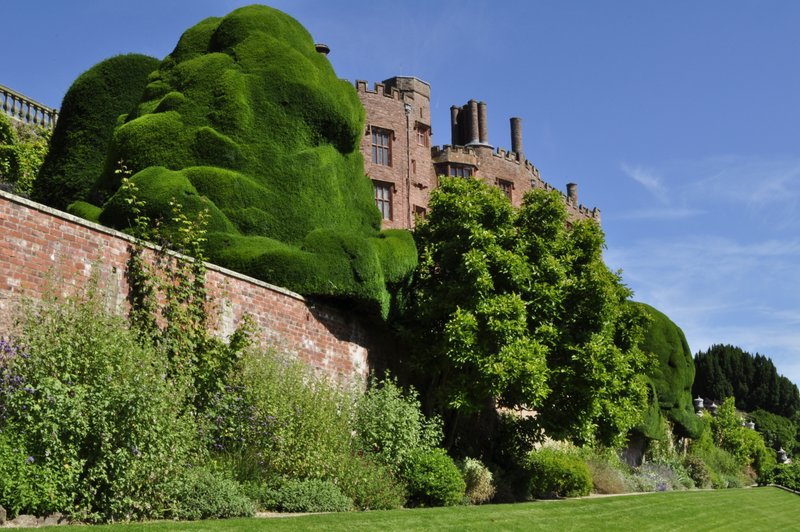
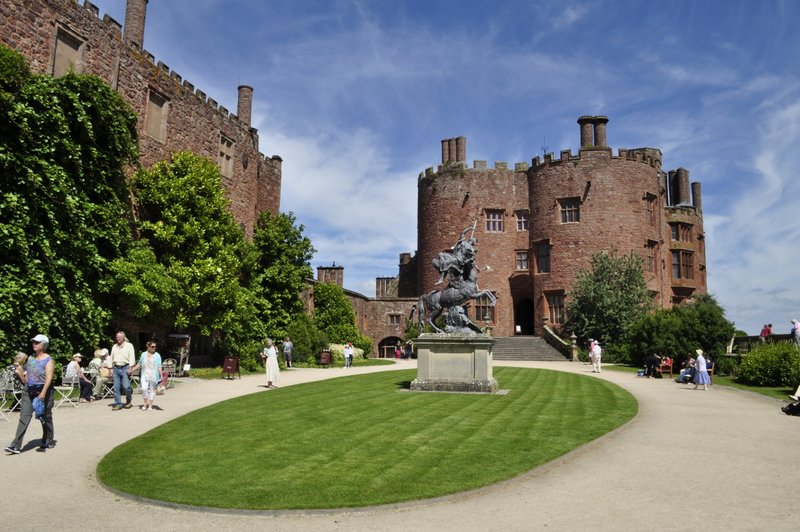
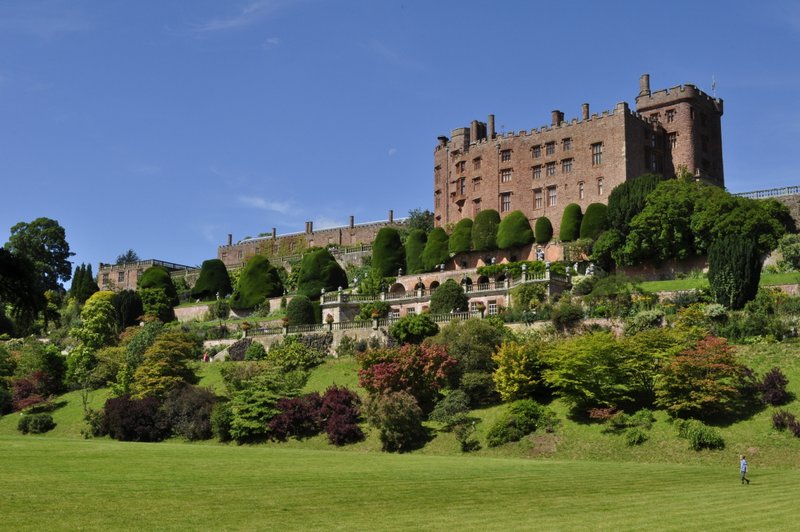
Powis Castle. A jewel among the rolling hills of mid-Wales just south of Welshpool, on the border with the English county of Shropshire, some 80 miles by road from my home in Bromsgrove.

The original fortress was built around 1200, but over several hundred years it was extensively rebuilt and remodelled, reaching its zenith in the late 17th century under the Stuarts and into the 18th century. While many castles in Wales were built by the Normans post conquest to keep the Welsh under control, Powis Castle was built and retained by a local family, the Herberts, who accumulated power and were given titles under various monarchs, especially the Stuart monarchs Charles II and James II.

The Herberts fought on the Royalist side in the English Civil War, and the castle was eventually occupied by Cromwell’s Parliamentary forces. The Herberts were Catholic, and the then Lord Powis went into exile with James II in 1689, although his lands and estate were returned in about 1725.

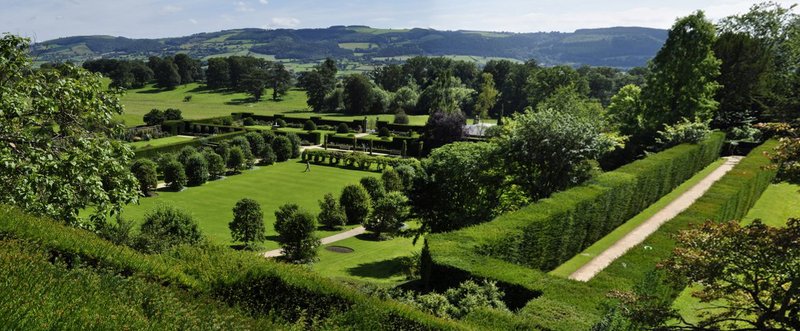
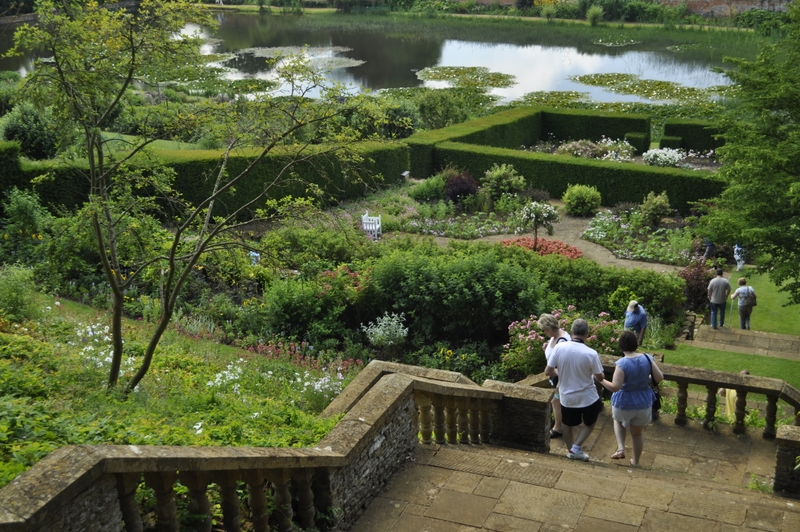
Built on a craggy rock, the castle and gardens owe much to 17th century investment, with formal gardens laid out on a series of very steep terraces cascading down from the house to a large lawn and formal garden that was once a vegetable and fruit garden.

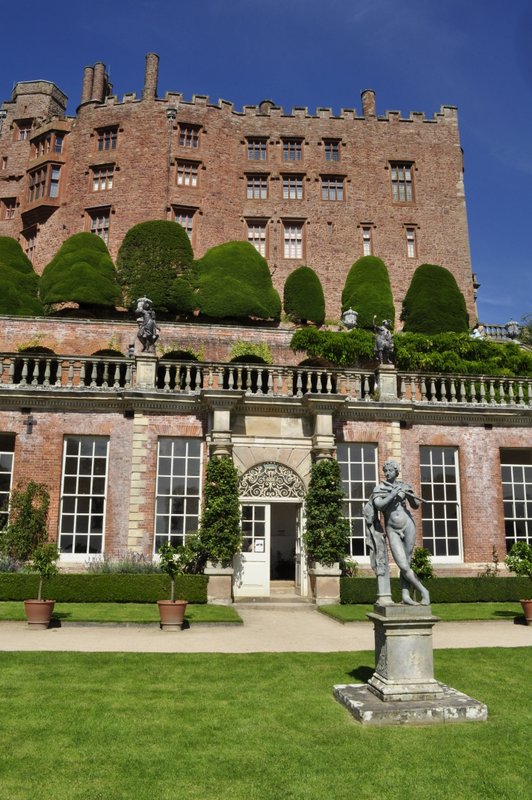
All around are quite large, sculptured yew trees that were planted in the 1680s. Originally they were allowed to grow ‘naturally’ but in the 19th century the change in horticultural taste was for a more formal look.

The terraces are full of colour, and the garden staff have taken great care to label many of the plants.

In the 18th century, one of the Herbert daughters married the son of Clive of India, and the castle houses a large collection of Clive memorabilia. While the National Trust owns and manages the buildings and gardens, it does not own many of the furnishings. As a consequence photography is not permitted inside the castle, so the only photos I have to show are external views of the castle and round the gardens.

The weather was fantastic, and we thoroughly enjoyed our visit to Powis.

More rabbit than Sainsbury’s

I’m not a great sports fan, on the whole. But, from time-to-time, I do enjoy watching some. Cricket is a particular favorite. And recent GB successes in cycling and rowing have caught my attention.

With the Olympics upon us, there’s a plethora of sports to watch, although I’m not able (easily) to access all 26 channels. The TV coverage on the BBC has been quite good, and I’d rate it higher were it not for the commentators and pundits and their incessant chatter. Alongside each professional commentator it seems that there now has to be an expert – even if they have little or no TV commentating experience.

. . . coz you wont stop talkin,
why dont you give it a rest?,
you got more rabbit than Sainsburys . . .

It seems that the current policy at the BBC is to fill every second with commentary – whether it’s needed or not. In the men’s cycle road race last Saturday, Chris Boardman (the expert – well, he did win a gold medal in Barcelona at the 1992 Olympic Games) was rabbiting on throughout, constantly repeating himself, and surmising what the riders would do. It was worse during the men’s 10m synchronized diving competition on Monday. After each dive a slow motion (and ultra slow motion) repeat was shown. And each time the ‘expert’ had to remind us that the judges didn’t see this – they made their (subjective) decisions in real time. Slo-mo showed up the discrepancies between the divers in great detail.

Frankly, today’s presenters and pundits could take a leaf out of the books of cricket and golf commentators – famous for their minimalist and witty comments. Even commentating on cricket on the radio commentators like the late Brian Johnston or John Arlott never assaulted our audio senses with incessant chatter; likewise Peter Alliss in golf.

But in this hi-tech and fast-moving age it seems that the pace of commentating has to match the speed of the action, instead of letting the magic of the images speak for themselves.

And in case you are wondering about the meaning of ‘more rabbit than Sainsbury’s, just click here, and hear Cockney duo Chas & Dave in the song that made this phrase famous.


It’s all relative really – why some superlatives annoy me

With the Olympics upon us, we’re being bombarded with superlatives – morning, noon, and night.
Fastest. Strongest. Tallest. Highest. It goes on and on.

Yet these adjectives are part of the fabric of our rich (and evolving) language, that permit us to describe and appreciate the wonder of nature around us, as well as celebrate the achievements of our fellow humans.

In geography, they help us locate mountains, rivers, oceans, and lakes – highest, longest, deepest, largest. In history we talk about the longest reigns of monarchs, or the bloodiest battles.

So, in the right context, we can’t really do without superlatives at all.

But they are so subject to abuse – absolutely, and one in particular: BEST.

The problem with ‘best’ is that it’s both objective and, problematically, subjective. [Here’s an interesting analysis of this relative to gymnastics].

In terms of performance, it can denote fastest, highest, or longest, in athletics for example. But it’s not necessarily absolute, final. An athlete can always hope to better his/her ‘best’ performance.

We also use ‘best’ when commentating on how well someone performs a piece of music, for example, or a dance routine. ‘I was not at my best’ implies a below-par performance.

But what has begun to annoy me in recent times is the use of ‘best’ (most often by politicians at their worst) when making claims that make them look not only arrogant or conceited, but also rather silly.

Take two recent examples, both from Prime Minister Cameron, when being interviewed on BBC TV.

When asked about the less-than-ideal security arrangements for the Olympics for which G4S had been contracted to provide (more of that in another post), he replied (and I’m paraphrasing), in relation to the deployment of additional troops: ‘Of course, here in the UK we have the best armed forces in the world’. What arrant nonsense!

And last Friday morning, before heading off to address an international conference on investing in the UK, one of the incentives Cameron cited for such investment was that the UK had ‘the best universities in the world’. Not true! Well, some maybe, according to widely-cited international tables. A little later the same morning he had toned down his claims somewhat to our universities being ‘among the best in the world’.

These constant claims (and I cite just a couple of the many examples which our politicians have spouted) of being ahead of the pack internationally – whatever that is supposed to mean – are, for me at least, quite irrelevant.

What should be asked is whether the armed forces, the universities, or other services for which outstanding status is claimed vis-à-vis everyone else on the planet, are FIT FOR PURPOSE, rather than pandering meaninglessly to national pride or puffing up our national status. Absolutely.

And that’s another word that has become devalued through its current constant and irrelevant usage. ‘Absolutely’ is pervasive in the media as a response to any question that merits a simple ‘Yes’ or ‘No’, ‘Of course’, or ‘That’s right’. I often wonder if this use of ‘absolutely’ is meant to imply a greater certainty than either ‘Yes’ or ‘No’ can offer.

Language evolves, and that’s one of the beauties of English, being such an adaptable language. In the mouths of presenters, pundits, and politicians it often loses its elegance.

Warwickshire country retreats . . .

In the lead up to the Olympics, summer finally arrived last week. It was bright and sunny, hot even, and so welcome after all the wet weather we’ve had for so many weeks.

So we decided to make a couple of National Trust visits, to a couple of country houses about 30 miles as the crow flies to the southeast of Bromsgrove. And they were two very different properties.

Upton House lies close to the village of Edghill, site of the first pitched battle of English Civil War in October 1642. An original house was built on the site towards the end of the 17th century, but the estate was acquired by William Samuel, the 2nd Viscount Bearsted, whose father had founded the Shell oil company. With his private fortune, the house was extensively remodelled as a country retreat (it was never intended as a permanent home) and as a location for his collection of paintings and priceless ceramics.

The house, garden and art collection was donated to the National Trust in 1948. The gardens are not large by country house standards, but beautifully complement the style of the house, with landscaping to the south.

Here’s a link to a web album.

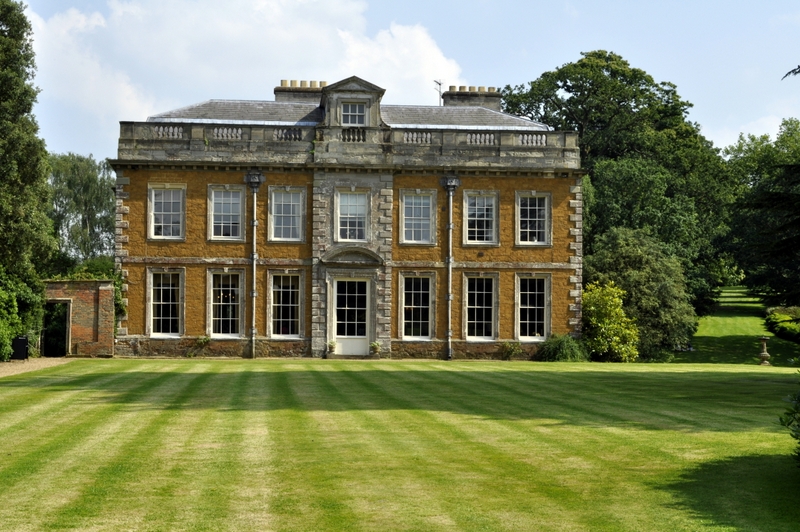
The other house we visited, Farnborough Hall, lies only about 7 miles almost due east from Upton House (just follow the map over the M40 to the northeast). But in this instance, Farnborough Hall is essentially the same house that was built by the Holbech family who acquired the estate in 1684.

And although partially open to the public twice a week during certain months through the National Trust, the house is still occupied by the Holbech family. There’s a nice collection of artefacts collected during the Grand Tour.

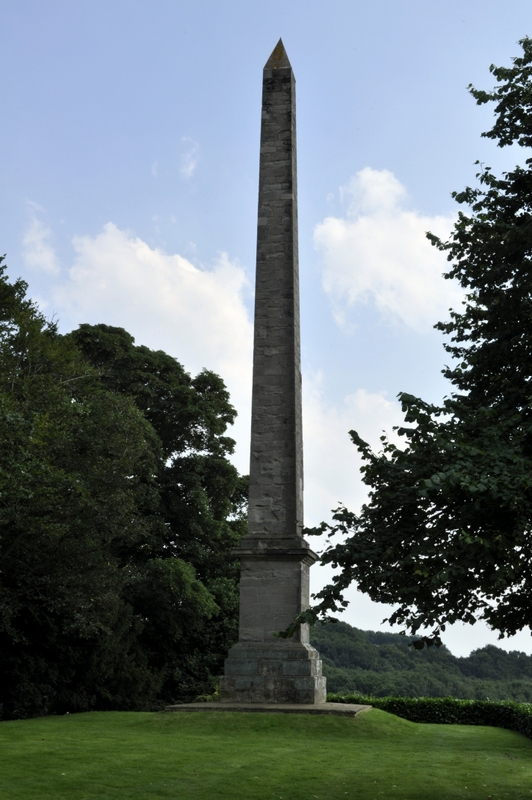
The gardens are small, but there’s a fine grassy avenue, about a mile in length, leading to an obelisk (raised in the early 18th century) overlooking the valley below Edghill.

Quirky, eccentric even . . . quintessentially British

Reaction to the Opening Ceremony at the London 2012 Games has indeed been mixed.

Despite the thousands of participants, much of the show remained under wraps, and we did not discover what would be featured until we tuned in.

Several comments on Facebook (especially by Americans) indicated bewilderment at the British sense of humour. Others decried the lack of Wow factor. Here’s a quick summary (and critique) from the BBC website. And here are a few views from abroad (in The Guardian and The Telegraph) and closer to home (in The Telegraph).

From the outset, ceremony director Danny Boyle had stated that he never intended to ‘compete’ with Beijing extravaganza. What he did come up with was an event that was quintessentially British, quirky and eccentric, understated – and full of humour. We certainly didn’t expect to see Mr Bean given a starring role. And if anyone wonders if that was humour that wouldn’t translate internationally, you only have to see how popular Mr Bean is worldwide.

The involvement of HM The Queen (and her corgis) was a masterstroke.

While I found some of the ceremony not as inspiring as I hoped (the NHS section, for example), others were breath-taking: for example, the forging and release of the Olympic rings, the celebration of British music, and the lighting of the Olympic flame.

But the involvement of Paul McCartney was a mistake. At 70, he just doesn’t have the voice for such an occasion. Time for his superannuation (and I say that as a Beatles and McCartney fan), although he’s being tipped for the Closing Ceremony as well. I hope there’s time to pull the plug after watching his [lack of] performance on Friday night. I could level the same criticism at two other celebrity knights – Cliff Richard and Elton John – who [under]performed at the Queen’s Diamond Jubilee concert on 4 June 2012.

One aspect of the BBC broadcast (and in the lead up to the Games – and what I’ve experienced on the TV so far today) that has irked me considerably is the incessant chatter of the presenting team. They just don’t seem to understand when it’s better NOT to say anything at all, and let the images speak for themselves. They could take a lesson from broadcast presenters of earlier years. Even those commenting on cricket on the radio were minimalist in what they said. Today it seems you have fill silent spaces with inane comments. Pity.

It’s all in the genes . . .

It was 1969, maybe early 1970.

I was just leaving the university library at Southampton where I was studying botany and geography. I should add that this was one of my too infrequent visits to the library.

As I headed for the main entrance, I was approached by two teenage girls, one of whom had long, dark, straight hair. They ‘invited’ me to purchase a raffle ticket – I think it was something to do with one of the charity events that students tend to organize each year, and these two girls were at one of the education colleges in Southampton. So I bought a couple of tickets, and then did something rather out of character.

Turning to the girl with long hair, I asked: ‘Is your name Jackson?’

Well, the look on her face made me think I was right.

‘Yes’, she replied, still looking rather surprised.

‘In that case’, I answered, ‘I think you are my cousin Caroline’.

And she was. As soon as I saw her, something inside told me she was ‘family’.

Now I should point out that I had last met Caroline maybe a decade earlier – she would have been five or six, and me about eleven. In some ways it was not such a total surprise, since her father (my dad’s younger brother Edgar) and his family lived in one of the small towns in the New Forest, to the west of Southampton. But I hadn’t made contact with them since arriving in Southampton two or more years earlier, although I had seen Uncle Edgar and his wife Marjorie at the funerals of my grandparents in 1967 and 1968.

Now this memory came to the fore just the other day for a couple of reasons. I’ve been doing some web searches for friends from my university days, so all-things-Southampton were on my mind. Secondly, my youngest grandchild Zoë was born (in the USA) at the beginning of May, and I’d been thinking that she was the youngest of a long line of Jacksons and Healys (Healy being my mother’s maiden name), and wondering what she will make of her antecedents. In just a few generations (my great-great-great grandfather) we’re back to the time of the French Revolution. I also heard in June (via my brother Martin) that my mother’s younger brother Pat had recently died at the ripe old age of 97 – he was the last surviving of eight siblings. Martin had heard about Uncle Pat’s death through his son, Pat – a cousin I did not know I had.

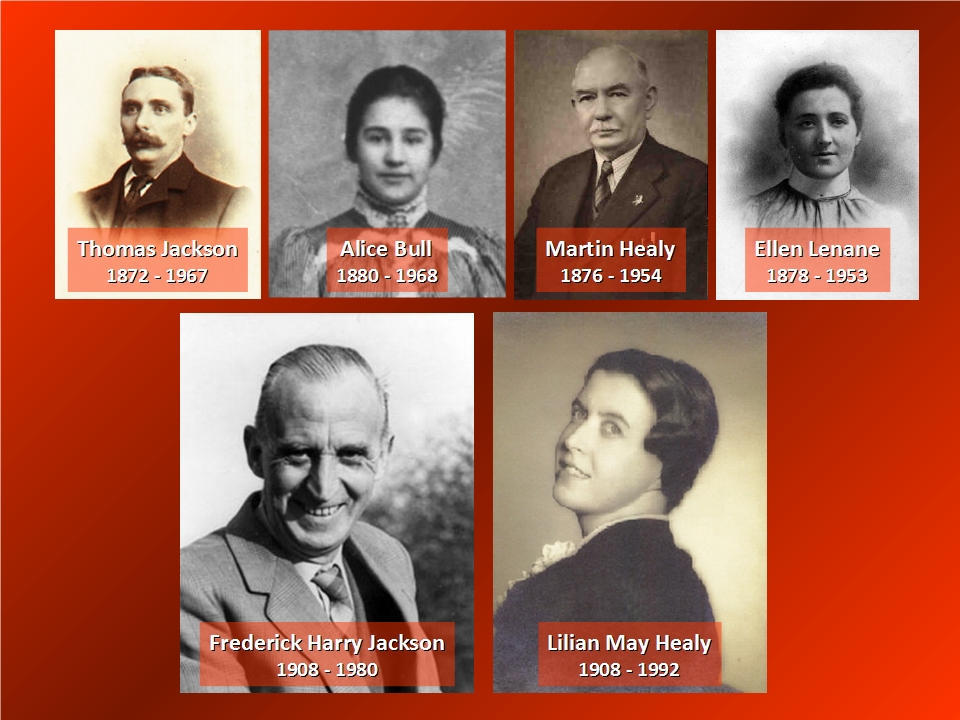
After my dad died in 1980, Martin began a major project to research the family genealogy, which is available online. On the Jackson side of the family he’s been able to trace back to about 1711, and on the Bull side (my paternal grandmother’s side of the family), there’s information stretching back about 12 or 13 generations to around 1480! Other lines – the Tippers and Holloways – can be traced back to 1610 and 1600 respectively.

Martin is going to have a more challenging time of it on the Healy-Lenane side of the family, who hailed from Ireland, Co. Kilkenny and Co. Waterford.

I have now made Facebook contact with cousin Pat, who lives in the Forest of Dean, about 60 miles south of Bromsgrove where I live. And through Facebook, I was contacted by two cousins, Karen and Patsy – daughters of one of my mother’s younger sister Bridie who emigrated to Canada in the 1940s – who live in Indiana, USA and Ontario, Canada, respectively.

There’s only one of my father’s siblings alive – my Aunty Becky, 96, who lives near Newcastle Upon Tyne, and who I’ve visited a couple of times recently since we have been travelling to there to visit our younger daughter Philippa and her family.

But to get back to the genes. As I look at the photos of my parents and grandparents, I can see very clear resemblances of my daughters to one side of the family or the other. Hannah favours, I think, the Jackson side. Philippa is a strong Healy!

I haven’t mentioned anything about Steph’s side of the family: Tribble / Legg. Steph’s parents came from small families. Her father had just one sister, and I believe her mother was a single child, so there’s not the raft of aunts and uncles and cousins on her side of the family as on the Jackson-Healy side. But both Tribble (a West Country name) and Legg are not that common, so I guess if someone with the time and inclination were to look into this side of the family, some quite rapid progress could be made.

Being British . . .

I’m British.

I’m British – from England. Not Wales, Scotland, or Northern Ireland (although half my genes are Irish in origin, whatever that means in strictly genetic terms). Nevertheless British. And it will be sad day, I believe, if the Scots decide to terminate the Acts of Union (1707) and go their own way. Unity in diversity, I say. And let’s celebrate the diversity that defines this country of mine.

But what does it mean to be British? I started thinking about this the other day as I was watching the hearing of the House of Commons Treasury Select Committee on the LIBOR scandal which has so far embroiled international bank Barclays.

Up before the Committee was former CEO, Mr Robert Edward “Bob” Diamond, Jr. – an American. Throughout the hearing Diamond responded to each member of the committee by their first name, and also referred to third parties not present by their first names as well. The MPs assiduously called him ‘ Mr Diamond’, often icily.

There was quite a furore the next day in the press – Diamond’s assumption of familiarity was not only seen as a faux pas on his part (and his advisers), but also extremely discourteous in what was a rather formal situation. But to cap it all, it’s just not the British way – to use someone’s first name without being invited to do so. I have to say it irks me when I receive a cold call and the person on the end of the phone – who’s trying to sell me something, and who I don’t know from Adam – addresses me as ‘Michael’.

Nevertheless I think we are becoming a little more relaxed about this whole issue in our day-to-day relationships. I remember reading some years ago a short newspaper piece on this very topic, in which the author decried the American custom of using first names from the outset – at least for the first 30 minutes! Having worked abroad for most of my working life, using first names is something which I grew to be comfortable with.

Foreigners often are baffled by we British, as this recent article in The Guardian indicates. In the late 1990s, when I was contemplating a career move, I asked my staff in the Genetic Resources Center at IRRI to assess my strengths and weaknesses (which they did quite openly). One of my colleagues, a French population geneticist stated ‘British’ as one of my strengths. On the other hand, my main weakness was ‘Very British’! I’m still not quite sure what he meant.

So what makes me British? Is it an obsession with the weather (although we could be forgiven for this right now, given the appalling weather we’ve had since April)? Or is it the self-deprecating humour, a nostalgia for an imperial past, or our high culinary standards such as fish and chips. Maybe it’s the appreciation of warm beer. On the positive side is our sense of fair play, not winning at any costs (play the game and play it well!), our ability to queue, and cricket, of course (although this does not hold the same status in Wales, Scotland and Northern Ireland as it does in England).

I like to think that the English, Welsh, Scots, and Northern Irish are all British – in their own ways. I appreciate our ‘national’ differences within a single nation, and that we will be competing as one in the Olympic Games – although I still don’t understand why we are Team GB instead of Team UK. The Commonwealth Games are another thing, however, as is football when nationalism comes to the fore. But those are among the idiosyncracies of proudly being British.

Incidentally, I just attempted (on 8 July 2012) the practice UK Citizenship Test, and scored only 58% (14 correct out of 24). When will someone be along to confiscate my passport? I have to say that many of the questions had very little to do with what it means to be British. And I guess many other native-born Britons would fail the test, as it stands. When faced with choices of say ’10 million, 11, 12 or 13 million’ as the number of under-16s, for me it was a random choice. Not sure what knowing this actual statistic has to do with me being a bona fide British citizen.

The Home Secretary, Teresa May, has announced recently that the test will be revised to include questions of more relevance – information about the rich history and culture of these isles. I just tried out the ‘test’ on The Guardian website and scored 87% – the two I got wrong were random choices – I really did know the answers to the others.

It’s all part of the ‘performance’ culture that grows by the day, which seems to be an obsession these days.

The Minnesota Riviera . . .

Minnesota Riviera? Yes, you could call it that. With its beaches, bays and secluded coves, its headlands and cliffs, along Lake Superior’s North Shore, not to mention its summer temperatures in the 80s and 90s at times (let’s forget about those sub-zero winter extremes), it’s as attractive and warm as the south of France.

Minnesota has about 150 miles of coast along Lake Superior, a body of water vast enough to appear like the ocean itself. Indeed the lake statistics are impressive. It is the largest freshwater lake in the world – by surface area, at 31,700 sq. miles, and the third largest in terms of volume. The maximum depth is 1,332 feet, and its surface is about 600 feet above sea level. At over 160 miles across, it experiences some severe storms in winter, with waves regularly reaching 20 feet, and 30 foot waves not uncommon. But more of that later.

We just returned from a two week vacation in Minnesota – the principal purpose was to visit our daughter Hannah, husband Michael, and two grandchildren: Callum (22 months) and Zoë Isobel (just 4 weeks when we arrived!)

And we took advantage of our visit to travel north and visit Duluth, the most westerly port on the Great Lakes, as well as the Boundary Waters Canoe Area Wilderness (BWCAW) along the Gunflint Trail just south of the international border with Canada (Ontario). This is the route of our trip.

Duluth is the fourth city of Minnesota in terms of population. At one time there were passenger services connecting Minnesota with the Atlantic Ocean. Now the port is a major conduit for coal and iron ore. Part of the old port area – Canal Park – has been transformed into a tourist attraction, with the conversion of some of the old warehouses into hotels and shopping venues. There’s also a large aquarium featuring the biology of Lake Superior. One of the Great Lakes steamers, the William A. Irvin, is permanently moored (just behind our hotel in fact) and converted to a museum. Here are some more photos of the Canal Park area.

One of the the main landmarks is the entrance canal to the harbor under the Aerial Bridge. The main span is at road level, and is lifted to varying heights depending on the size of the ship wishing to pass through. During our walk-about, we saw the bridge lifted twice: the first time for a pleasure cruiser offering a tour of the harbor and Duluth Bay, and secondly for an ore freighter, the Hon. James L. Oberstar (of the Interlake Steamship Co.) – very impressive. Here’s the freighter approaching the bridge and signalling its intention to pass through, and given the all-clear from the bridge operator.

And this photo just shows how high the bridge can be raised to let the biggest ships through.

The evening of our stay we decided to eat in the steakhouse attached to our hotel. It was offering a free appetizer per table and free drinks (it was happy hour). For the appetizer we chose local Minnesota (and Wisconsin) speciality – you’d hardly call it a delicacy: cheese curds. Actually these are pieces of cheese (usually Cheddar or Monterrey Jack), coated in batter, and deep fried! One plate for the two of us was plenty. I wonder how much that contributed to my cholesterol levels?
[In September 2010, we enjoyed the Minnesota State Fair (reported to be the biggest in the country) and attended a broadcast of A Prairie Home Companion. Raconteur Garrison Keillor and Californian singer-songwriter Sara Watkins sang a duet about State Fair food – especially deep fried cheese, during the broadcast on 4 September 2010. Deep fried cheese was very much in evidence as we wandered around the Fair.]

We hit the road early the next day, heading north. Highway I-35 ends just north of Duluth, and is replaced by scenic highway US 61. Between Duluth and Two Harbors there is an expressway, but the old road (still an excellent surface) meanders alongside the lake, with some stunning views.

We didn’t stop in Two Harbors but headed for our first destination: Gooseberry Falls State Park.

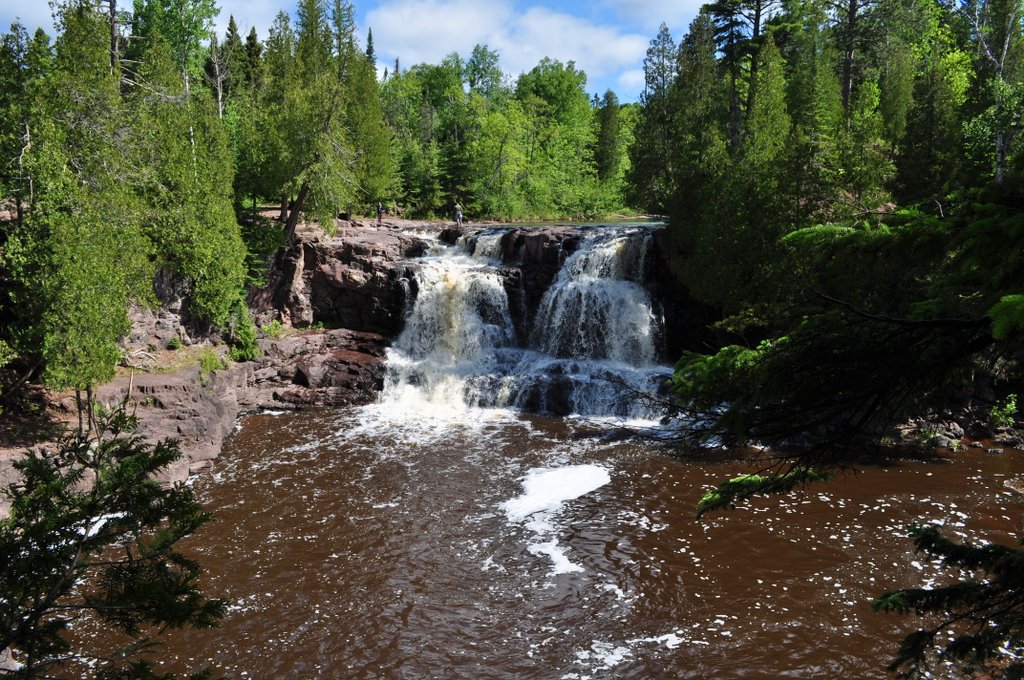
Just beside the road, the falls drop in five cataracts to a meandering river that empties into Lake Superior at Agate Beach. We took the 20 minute walk down the falls to Agate Beach, but didn’t find any agate. In any case removal of any stones is prohibited.

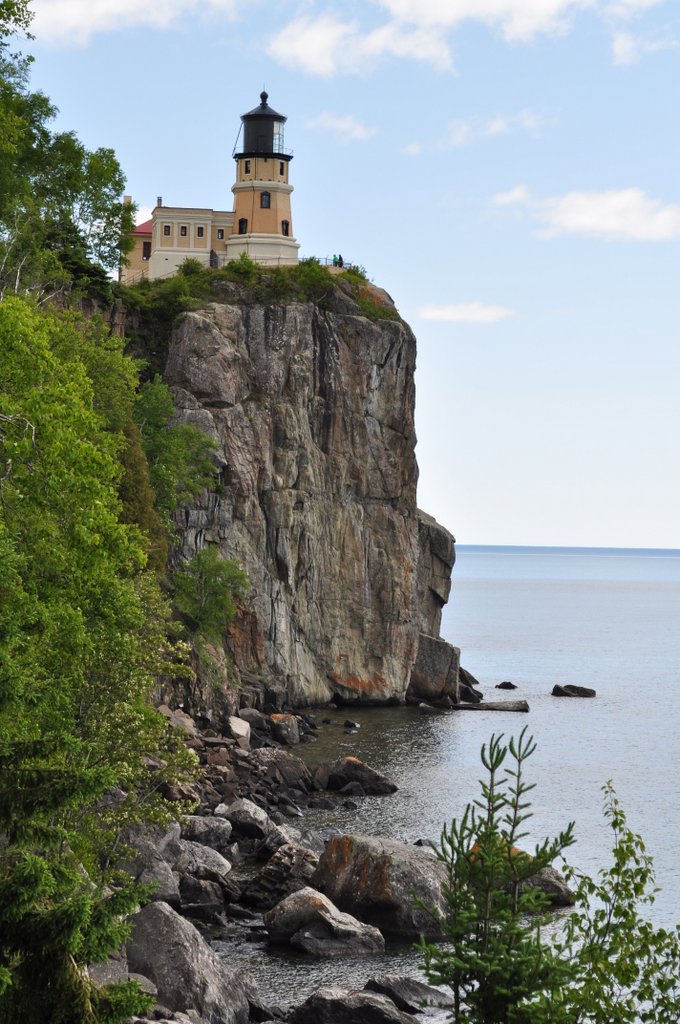
Just a little further north from Gooseberry Falls, and southwest of Silver Bay stands Split Rock Lighthouse, which opened in 1910. Its construction was prompted by a major storm a few years earlier after a ship came to grief on the rocky shore. In fact there’s a whole network of lighthouses around Lake Superior. Split Rock Lighthouse was decommissioned in 1969 once radar (and now GPS) was used for navigation. It remains an iconic site standing 100 feet above the lake, and attracts thousands and thousands of visitors each year – but thankfully not on the day we visited.

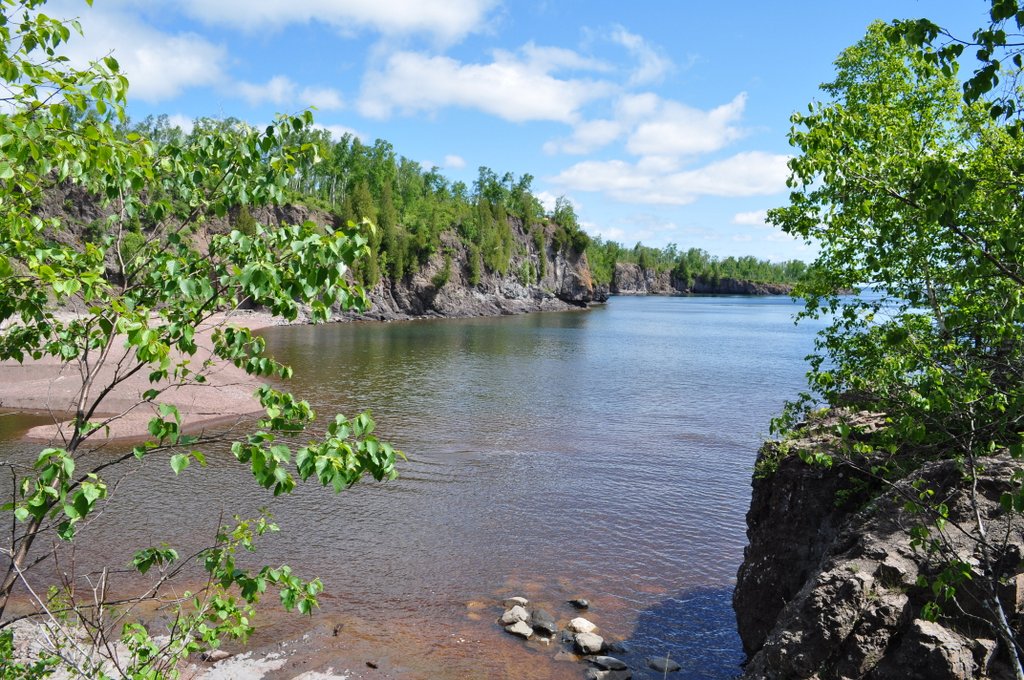
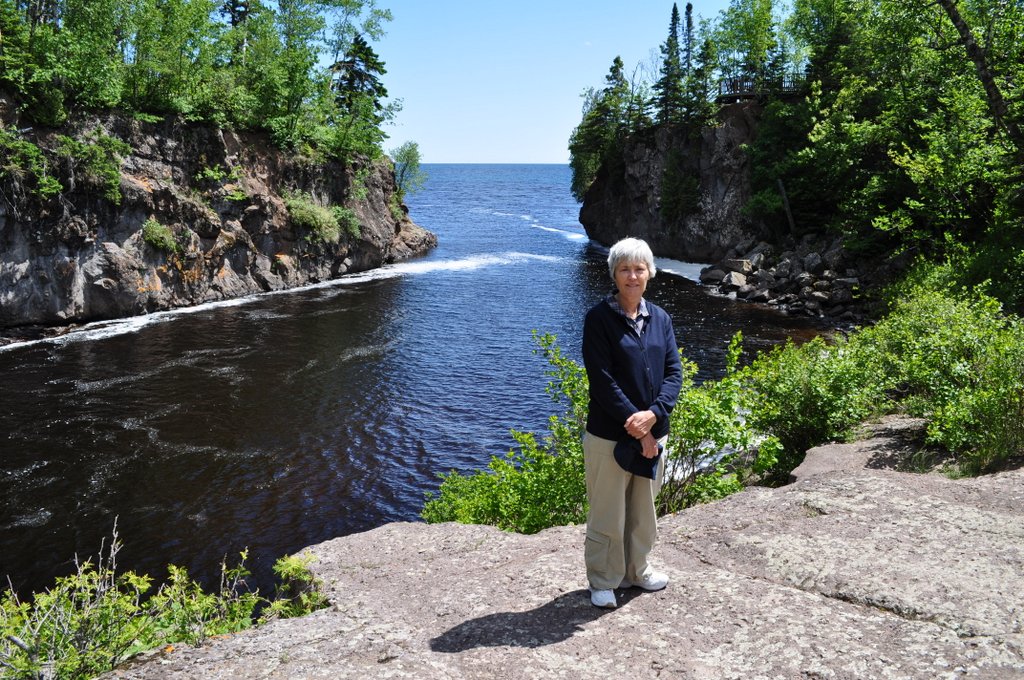
Next stop on our journey was the Temperance River Gorge and State Park, just south of Tofte. While the falls themselves were attractive, what we liked best was the small cove where the river meets the lake – very beautiful.

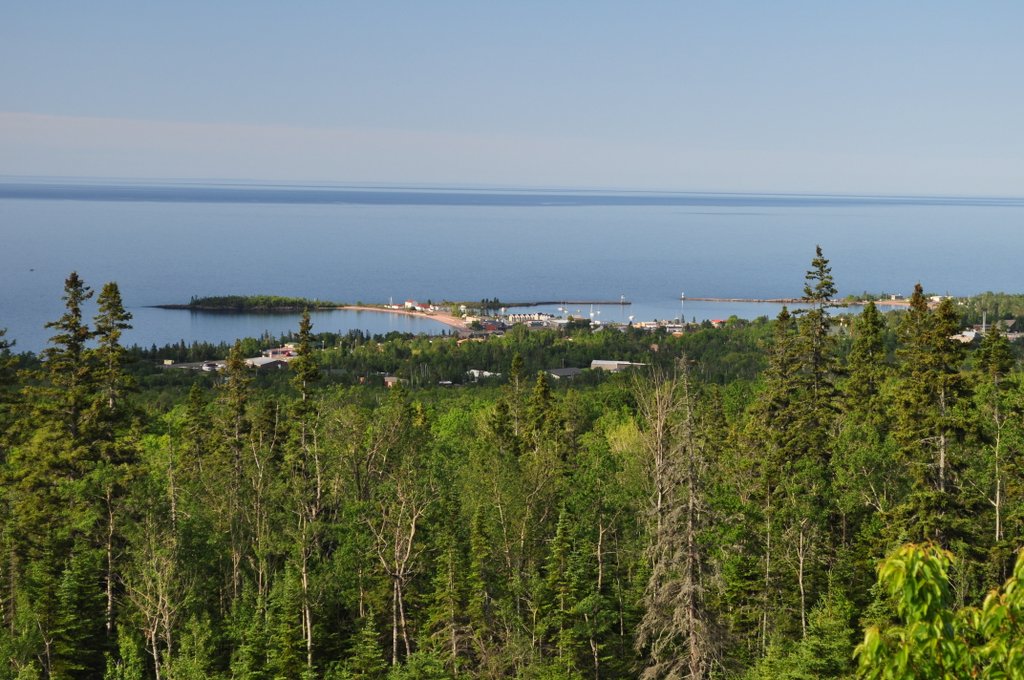
Our travels ended in Grand Marais, a small town (and harbor, mainly for pleasure craft) about 50 miles south of the border with Canada, where we spent two nights. This was an excellent base to explore the Gunflint Trail and Superior National Forest in the BWCAW.

The Gunflint Trail is paved, and extends some 57 miles inland. At the top end of the Trail lies Gunflint Lake, with the international border bisecting the lake. This was the closest, at about half a mile, that we came to Canada on this trip. The BWCAW is a myriad of forest roads, and there are many resorts and eating places along its length, where camping and all manner of field activities and sports are permitted. Off the beaten track the only access is on foot or by canoe. Beware of bears! Unfortunately we didn’t see any large animals apart from a few deer.

We hoped to see moose at a well-known site with an observation platform, and black bears as well (that had been featured on a major BBC TV broadcast from this area over several weeks in the month prior to our visit) – but none showed. We did see millions of trees. At the top of the trail it seems there had been a major fire in past years, and the vegetation is still recovering.

One of the disappointments was the limited access to lakeside views along the trail. We did leave the paved road on the return journey, heading off down the Arrowhead Trail, and joining US 61 at Hovland, about 20 miles north of Grand Marais.

We thoroughly enjoyed our trip to the Minnesota Riviera and, as with our trip to Arizona and New Mexico in 2011, we saw relatively few tourists. Indeed, along the Gunflint Trail it often seemed as though we had the whole BWCAW to ourselves. This is definitely a region of the USA that I would recommend anyone to visit. Until you have seen it for yourself, it’s hard to imagine the vast extent of Lake Superior. Of course, we saw the area at its best – blue skies, nice warm temperatures. There was a great diversity of wild flowers – especially the bluebonnets, a wild lupin species along the roadside (although not all were blue as we saw some white and pink specimens). On the trip south back to the Twin Cities, we decided to cross over into Wisconsin since we’d experienced some delays on I-35 due to road works and a contraflow. Around Two Harbors we ran into heavy downpours and thunderstorms which stayed with us all the way back to St Paul. A week later (in fact on the night of our homeward flight from MSP) there was a major storm that hit the Duluth area, dumping 5-7 inches of rain in just a few hours. Needless to say there was considerable disruption and damage to roads. We were very lucky to have avoided that.

If you get the chance, do make a visit to the Minnesota Riviera – you won’t regret it.

Eating out for breakfast – a great American tradition

Over the past 35 years I’ve visited the United States on many occasions, and traveled through 21 of the 50 states.

It never ceases to amaze me what a wonderfully diverse country the US is – geographically, ethnically, socially, and politically. I can’t deny that there are regions of the US where I feel more comfortable than others. But everywhere (well, almost everywhere) folks have been courteous and welcoming – I think it must be the British accent.

On a recent trip to northern Minnesota, which took us (temporarily) into Wisconsin on the way back to St Paul, the waitress in the diner where we stopped for lunch (an excellent grilled ham and cheese sandwich and fries, plus soda) in Frederic asked where I was from. When I told her ‘England’, she replied ‘I thought so. I could listen to your accent all day long.’

And one of the aspects of American life I have come to enjoy very much is the ‘tradition’ of going out to eat breakfast – and a whole host of diners has developed nationwide. Getting out of bed on a Sunday morning, and first of all deciding which diner to visit. Then there’s the anticipation of a full breakfast: eggs, bacon or sausage, hash browns, and a myriad of choices of bread for toast. Or will it be a stack of pancakes, with exquisite maple syrup (the real deal – not some concoction that we buy over here in the UK, which has a hint of maple added as flavoring), or maybe the french toast, inch-thick slices of course, dusted with powdered sugar. As one sits down to make a choice, the server immediately pours a cup of steaming, freshly-brewed coffee. Heaven!

In the Twin Cities (that’s Minneapolis-St Paul, Minnesota to non-residents), I’ve dined at three breakfast venues, all excellent, and different in their own ways.

I’m most familiar with the Grandview Grill, on the corner of Grand and Fairview Avenues, just down the street from Macalester College from where Hannah and Michael graduated (also alma mater to Kofi Annan). We had breakfast there just a couple of weeks ago. The pancakes were delicious. It was a Saturday – we decided to go then since the following day was Father’s Day and we knew the place would be heaving. Accommodating a toddler and a small baby on a quieter morning was better for us and other clients.

Along Selby Avenue, at the junction with Dale, is the New Louisiana Cafe. Also a great venue for a filling breakfast. Seems it’s owned by the same people who run the Grandview Grill – if logos are anything to go by.

In downtown Minneapolis is Hell’s Kitchen, a rather eclectic venue that seems (from the photos posted on its site) also to have undergone some transformations from what I remember.

At one time the walls were covered with paintings by British cartoonist Ralph Steadman. On the two or three occasions I’ve had breakfast there, we had to wait quite some time for a table – it’s a popular venue. In December 2007, when we visited Hannah and Michael, we had a long and rather cold wait in the lobby. The outside temperature was well below zero – we’d just flown in from the Philippines. The breakfast more than made up for the wait.

Why do I like this breakfast-out approach? Well, it’s just not done here in the UK, and for us visitors to the US, it is just one big treat.

Grandparenting duties . . .

A few months back I posted a short piece about what it felt like to be a Grandad. Well, the past few weeks have been quite Grandad busy, as we visited Philippa and Andi and Dexter in Newcastle upon Tyne in mid-May for four days, followed by a two week visit to Hannah and Michael in St Paul, Minnesota, and to see Callum (now 22 months) and meet Zoë Isobel who was born on 8 May. We’d last been in the US in May 2011. Seeing our grandchildren grow and develop is such a joy.

Phil and Dexter came to visit just before Christmas. And how Dexter has grown in the intervening months – such a happy chappy. He’s full of smiles and chatter, all unintelligible.
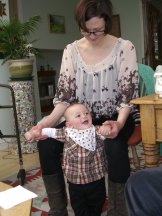
Now almost nine months, it looks like he’ll by-pass the crawling stage as all he wants to do is be upright, and loves being held in the standing position. Time will tell.
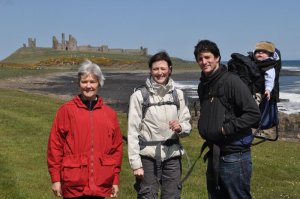
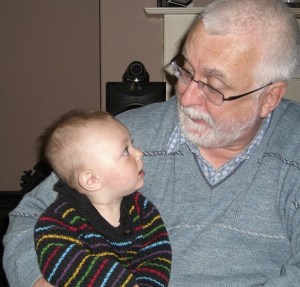
On the Sunday of our visit we took a trip up the Northumbrian coast to Dunstanburgh Castle. Safely strapped to Andi’s back, Dexter seemed to enjoy himself.

But when we arrived back in Craster to enjoy a pub lunch in the garden overlooking the North Sea, that’s when the fun started. Dexter was on my knee, and to keep him amused I began to softly pat the table top. Very soon he was joining in, and really chuckling away – as this video shows.

And as this photo shows, young Dexter gets on well with his Grandad.

We hadn’t seen Callum since May 2011, when he was about nine months, and barely crawling. What a difference a year makes.

Now he’s a real little boy, full of giggles and exploring the world. It’s amazing to see him absorbing so much information – like a sponge his dad Michael says. His vocabulary grows each day – although there’s also a lot of chatter that I guess only he understands. And I inducted Callum into the Ministry of Silly Walks (of Monty Python fame) – it was great to watch him copy what I was doing.
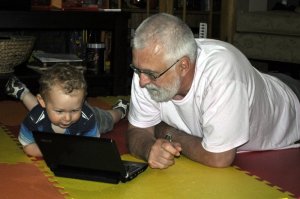
And I had the delight of introducing him – via YouTube – to Sesame Street and Elmo. We had a great time enjoying the various clips together. This was one of his favorite videos.
Callum loves books, and enjoyed both Steph and I reading to him, and for him to tell us all the names, or make the sounds of the animals and other things he saw.

Zoë was just four weeks old when we arrived in St Paul at the beginning of June. What a cutie, with a lovely dimple when she smiles. In the first few days we thought how much she looked like Callum at the same age, but over the two weeks of our stay, we began to see other differences. She’s also doing well, and beginning to take an interest in everything around her. Hopefully her sleep pattern will stabilize soon, and Hannah and Michael will enjoy unbroken sleep – for a few hours at least.

We look forward to watching Callum, Dexter, and Zoë growing up – it will a fascinating time.

Supervising graduate students . . .

Completing a PhD thesis is one thing. Supervising the research of someone else is another.
And when I joined the University of Birmingham in April 1981 as lecturer in plant sciences, one of the duties expected of me was to supervise graduate students. Since I had already spent over eight years overseas, I was quite keen to take on graduate students from different countries. So over the decade I remained at Birmingham, half of my PhD students were from overseas, as were many of the students on the genetic resources MSc course.

Apart from advice to give a prospective student regarding a suitable thesis topic (and the opportunity to secure adequate funding), it’s very important for a supervisor to be ‘there’ for a graduate student, to be a sounding board, to be available for discussion on a regular basis, to help make contacts with others working in the same or similar field, and to dedicate a good deal of attention when students begins to write their thesis in earnest. I remember very clearly how my PhD supervisor helped me during the writing phase. And the most important aspect was that he gave me thorough, detailed and prompt feedback – usually no more than 24 hours or so after I had handed a draft to him. Over the years I’ve heard horror stories of supervisors not being available at this critical stage, of taking weeks, months even, to read drafts and provide feedback. I decided from the outset that I would always provide feedback promptly.

Professor Jack Hawkes was still head of department when I joined Plant Biology (in the School of Biological Sciences); we overlapped for just over a year, since he retired in September 1992. I took on a couple of Jack’s PhD students who were, in April 1991, about half way through their PhD programs. Most of the theses I supervised were about potatoes, and a couple on legume species. Some were carried out entirely at Birmingham, but most were collaborative studies with research institutes in the UK or overseas (in Peru and Italy). Unfortunately I have lost touch with some of these students and have been unable to find out what they are now up to.

In any case, here’s a brief description of them all.

Lynne Woodwards 1982The non-blackening character of Solanum hjertingii Hawkes – studies on its nature and transference into European potato cultivars
Lynne had completed her MSc degree and began this study with Jack Hawkes, who asked me to take on responsibility for her supervision as soon as I arrived at Birmingham. Solanum hjertingii is a tetraploid species from Mexico. In most potatoes the tuber flesh begins to blacken since cells when sliced because cells are ruptured and phenols are oxidised. We looked at the variation in various accessions of this wild potato and others in the same taxonomic group, and investigated how easily the character might be bred into commercial varieties. Lynne published just one paper from her thesis:

  • Woodwards, L. & M.T. Jackson, 1985. The lack of enzymic browning in wild potato species, Series Longipedicellata, and their crossability with Solanum tuberosum. Zeitschrift für Pflanzenzüchtung 94, 278-287.

Ardeshir B Damania 1983: Variation in wheat and barley landraces from Nepal and the Yemen Arab Republic
Adi carried out much of his field work at the Italian genebank at Bari in southern Italy, and was co-supervised by Prof. Enrico Porceddu. Adi is now working in the genetic resources program at the University of California-Davis, and has been a collaborator of emeritus professor and cereal breeder Cal Qualset for many years. We published two papers:

rene002Rene Chavez 1984The use of wide crosses in potato breeding

Rene had come to Birmingham as an MSc student from the University of Tacna in the south of Peru. He then started a PhD with me in 1981 based at CIP, working on the problems of inter-ploidy crosses to transfer pest resistance from wild to cultivated potatoes. At CIP, his principal supervisor was Peter Schmiediche (also a Birmingham graduate), but was supported by other CIP staff whose names appear on the three  papers we published:

After returning to South America, Rene spent a couple of years at CIAT, in Cali, Colombia, helping to curate a large field collection of wild species of Manihot – cassava. He then returned to the University of Tacna, and as far as I’m aware, developed some collaborative research on potatoes with CIP. Sadly Rene died of cancer a couple of years ago.

denise002Denise B Clugston 1988Embryo culture and protoplast fusion for the introduction of Mexican wild species germplasm into the cultivated potato
Denise came to Birmingham as an MSc student in the early 80s and stayed on to complete her PhD on different biotechnology options to transfer genes from the valuable Mexican wild potato species into commercial forms. She had studied originally at the Royal College of Music in London, and had played the oboe professionally. She then took an Open University degree in biology, and came to Birmingham to study genetic resources. Regretfully I have lost touch with her completely.

Elizabeth L Newton 1989: Studies towards the control of viruses transmitted through true potato seed
Beth was a Birmingham graduate in biological sciences. I was able to offer her a studentship in collaboration with the then Ministry of Agriculture, Food and Fisheries (MAFF) Harpenden Laboratory to study the mechanisms of sexual transmission of potato viruses. Her co-supervisor at Harpenden was Dr Roger Jones, an ex-colleague of mine from CIP in the 70s. As a government laboratory the Harpenden lab had permission to study several dangerous viruses under quarantine, so Beth had to carry out her practical work there. Before she completed her PhD, Roger moved to Australia in 1986 where he is now a Research Professor at the University of Western Australia. Supervision of the work at Harpenden was then taken over by Dr Lesley Torrance, who subsequently moved to Dundee to what is now the James Hutton Institute. I’ve lost touch with Beth.

Carlos Arbizu 1990The use of Solanum acaule as a source of resistance to potato spindle tuber viroid (PSTV) and potato leaf roll virus (PLRV)

Another Birmingham MSc genetic resources graduate, Carlos hails from Ayacucho in central Peru, and can relate many stories about the emergence of the terrorist group Sendero Luminoso and how it affected him and his family, and some of the adventures he found himself in while collecting germplasm in the Andes. He is also a widely-acclaimed expert on minor Andean tuber crops. At CIP, he worked with eminent virologist Luis Salazar (now retired, but who obtained his PhD in Scotland). Carlos stayed with CIP for several years, but has now retired.

Abdul Ghani Yunus 1990Biosystematics of Lathyrus Section Lathyrus with special reference to the grass pea, L. sativus L.
Ghani is from Malaysia. He first came to Birmingham in the early 80s, and completed his MSc dissertation on Lathyrus. Later on in the decade he successfully applied for a government scholarship and returned to Birmingham, and made an excellent study of breeding relationships among Lathyrus species, several aspects of which were published:

Ian R Gubb 1991The biochemical and genetic basis for the lack of enzymic browning in the wild potato species Solanum hjertingii Hawkes
We continued our work on non-blackening potatoes and, with a joint studentship with Dr JG Hughes at the Institute of Food Research in Norwich, we recruited Ian to carry out this much more detailed study on Solanum hjertingii. After completing his PhD, Ian moved to Wye College for a while, but I’ve lost contact with him. Just one paper was published:

F Javier Franisco Ortega 1992An ecogeographical study within the Chamaecytisus proliferus (L.fil.) Link complex (Fabaceae: Genisteae) in the Canary Islands
Javier came to Birmingham as a self-funded MSc student from Spain. He completed a dissertation with me on Lathyrus pratensis, which led to one publication:

  • Francisco-Ortega, J. & M.T. Jackson, 1992. The use of discriminant function analysis to study diploid and tetraploid cytotypes of Lathyrus pratensis L. (Fabaceae: Faboideae). Acta Botanica Neerlandica 41, 63-73.

Having obtained a Spanish government scholarship, Javier undertook an extraordinary ecogeographical study of a perennial forage legume species, known locally as tagasaste, from his native Canary Islands, and our field studies in 1989 were supported by the International Board for Plant Genetic resources (now Bioversity International). Javier published prolifically afterwards:

Javier is now an Associate Professor at Florida International University in Miami, USA and holds a joint appointment at the Fairchild Tropical Botanic Garden.

Susan A Juned 1994: Somaclonal variation in the potato (Solanum tuberosum L.) cultivar Record with particular reference to the reducing sugar variation after cold storage
Sue came to Birmingham to study genetic resources, and when my colleague Brian Ford-Lloyd and I were awarded a commercial grant to study low temperature sweetening and somaclonal variation in potatoes (see an earlier post), we offered her the research position attached to the grant. Sue had completed her MSc dissertation with me on variation in a wild potato species from southern South America:

The somaclonal project, funded by United Biscuits, was quite successful, and although we did identify several somaclones that responded better to low storage temperatures, none were taken into commercial production, as the variety Record was increasingly dropped in favor of better crisping varieties. But we did demonstrate some of the disadvantages of producing seed potatoes from tissue culture and its implications for different ‘clones’ to emerge:
After leaving Birmingham, Sue became involved with Liberal Democrat politics, serving in local government in Warwickshire, and standing as a candidate twice in parliamentary elections. Sue now works as an environmental consultant.

When I resigned from Birmingham in 1991 to join IRRI as head of the Genetic Resources Center, two students had already begun their PhD studies with me in October 1990. Since I already knew by the beginning of February 1991 that I would be leaving the university later that year, I arranged for other colleagues to take over their supervision.

Gisella Orjeda (Peru) transferred to geneticist Dr Mike Lawrence and completed her study in 1995 on ploidy manipulations for sweet potato breeding and genetic studies, in collaboration with the International Potato Center (CIP). Gisella is now the President (CEO) of CONCYTEC (Consejo Nacional de Ciencia, Tecnología e Innovación Tecnológica) in Lima, Peru.

Sarah Jane Bennett completed her study on the ecogeographcal variation in ryegrass (Lolium) in Europe with Dr Mike Hayward from the Institute of Grassland and Environmental Research, Aberystwyth (now retired) and Dr Dave Marshall at Birmingham (now at the James Hutton Institute near Dundee) in 1994. She is now a senior lecturer in farming systems agronomy at Curtin University in Western Australia.

My favorite weather is bird-chirping weather (Loire Hartwould) – all year round

Bird watching is a hobby of mine – although I’m not as active by any means as I was years ago growing up in the Staffordshire Moorlands, or when I was working in Costa Rica in the 1970s. I’ve never been a ‘twitcher’ however.

Costa Rica is a bird watcher’s paradise. In Turrialba where I used to live, it was not uncommon to see 40 or more different species just in our garden – humming birds, parrots, and toucans, and a range of migrants between North and South America. One Christmas Day (1979 I think it was) I took part in a bird count for the Audubon Society, and a group of us counted all the species we could (and approximate numbers per species) over a six  hour period in the Turrialba valley. We managed over 100 species between us, and my birding partner and I saw over 60! When I moved to the Philippines in 1991 I was hoping for a repeat of Costa Rica – the Philippines has a reported rich avian fauna. How disappointed I was over 19 years. Although we lived on the slopes of dormant volcano Mt Makiling, about 65 km south of Manila, which still had some virgin rainforest, in a gated community with many mature native trees (planted in the early 1960s) we actually saw very few different species in our garden, maybe fewer than ten over the entire time we were there. Indeed, one of my friends and former colleagues who grew up in Zimbabwe and is a much keener bird watcher than me told me that bird watching in the Philippines was ‘hard work’.

I now live on the east side of Bromsgrove, a small(ish) town in the northeast of Worcestershire, in the English Midlands. It only takes a few minutes, and I can be walking down country lanes, enjoying the tranquility of local farmland as well as the beauty of the towpath along the Worcester and Birmingham Canal that’s just over two miles from home. And it has been intersting to note and watch the various birds that visit our garden and surrounding houses on a regular basis, and the occasional surprise. So here is a brief account of what we see on a regular basis, and those additional visitors. I’m going to update this post as necessary when we see new species, or I want to comment on those species already recorded.

With permission I am including beautiful photographs taken by Northamptonshire amateur photographer Barry Boswell. Just click on a thumbnail to view a larger image.

I’ve also made links for each species to the web site of the Royal Society for the Protection of Birds (RSPB) where you can find more information and even audio of each species’ song, and also BBC Radio 4’s Tweet of the Day.

Residents (which we see often in the garden)

Blackbird
One of the commonest birds in the UK, and very frequent in our garden. It’s not unusual for us to see three or four pairs in the garden at the same time, with males vying for females, and fighting among themselves. Also, there’s nothing quite like the song of the blackbird to raise your spirits. During August 2012 we’ve seen up to eight or nine individuals in the garden at the same time – mostly juveniles. We wonder if they are from the same nest. Certainly they are very active.


House Sparrow

A noisy little bird, now not as common as it once was. We have a small colony of perhaps half a dozen pairs that regularly come into the garden, but I’m not sure where they nest. Often thought as a rather drab bird, but just look at the plumage on an enlarged image.

Robin
The iconic British bird – a feisty creature. We seem to have a very healthy population of robins in the vicinity, and I often hear them singing ‘against’ one another. Although they are regular visitors to the garden, we often go several weeks without seeing any, and then they are back again.

Dunnock
Also known as the hedge sparrow, I think the dunnock is an underrated species. On a closer look, it has a nice plumage, with grey around the head and neck turning to brown on its back and wings. It’s very active in the undergrowth. We have a couple that regularly feed in the garden.

Great Tit
The largest of the four species of tit that regularly feed in the garden. In recent weeks (April-May 2012) we’ve seen two or three each day.

Blue tit
One of the ‘cheeky’ birds, blue tits are not as common or frequent visitors now than they were in the past. But small flocks – families – pass through from time-to-time.

Coal tit
There are a couple of individuals that regularly visit the seed feeder, and were especially frequent visitors during the coldest months of winter.

Long-tailed tit
The delightful little bird has made something of a comeback around here, and we see small flocks of six to ten individuals much more frequently than we did just a few years ago. The plumage is that delicate cinnamon pink, contrasting so well with the black and white. Barry Boswell’s photo is beautiful.

Wood pigeon
In some ways, the wood pigeon is one of the most regular visitors to the garden, and hardly a day goes by without up to six individuals spending some time feeding or looking for suitable nesting materials, such as thin twigs. Although they are more common in open country, the woodpigeon seems to be one of those species that has made the successful transition to suburban life. They regularly nest and raise young in the gardens roundabout, although they are often attacked by magpies. Although we consider them a ‘pest’ in the garden, they are quite a handsome species. At the end of August 2012, a couple of wood pigeons are making a half-hearted attempt at nesting in our Himalayan birch tree.

Magpie
The local vandals – but seem to be a highly intelligent species. There’s no mistaking the iridescent black and white plumage and long tail. Magpies have increased in number over the past decade, and we regularly see a couple of pairs or more seeking out ‘opportunities’. I do wonder if the increase in the magpie population (and some other larger birds such as woodpigeons and jackdaws) has negatively impacted on the populations of smaller birds.

Jackdaw
This is quite a stunning member of the crow family, with its grey nape. We have noticed an increase in numbers just over the past few months. Not sure where they are nesting. It was nice to see them a week ago in quarry conditions on the coast near Craster in Northumberland. They certainly looked in their element there.

Carrion crow
This is another species that we now see on a regular basis.

Occasional visitors (these drop by from time-to-time, or with the seasons such as winter visitors)

Redwing
This is a winter visitor that suddenly appears out of nowhere, stays with us for the coldest months, and disappears as quickly as it came. We usually see it in flocks of a dozen or so individuals. Sitting at the top of a tree in sunlight, its russet red flanks are very noticeable. A handsome thrush.

Fieldfare
Normally a species of open countryside around here, we had a couple of individuals visit us on one day this past winter. Just like the redwing it has very typical plumage – also a handsome species.

Song thrush
There was a time, more than a decade ago, when song thrushes were very common in the garden. Now we hardly ever see any. In fact, even in the vicinity, I can’t remember when I last saw a song thrush. The population must be in quite a decline around here.

Blackcap
The appearance of a male blackcap several times over the past winter months was indeed a great surprise. At first I thought my eyes were deceiving me, but the black head feathers were so typical of this species. On one occasion I was able to get a good (and long) look at one individual, sitting on an open branch not far from the living room window – and I had my binoculars to hand. There was no mistaking its identity – and a most welcome addition to the list of species seen in our garden.

Great spotted woodpecker
We’ve seen this woodpecker on just two occasions over the past few months, visiting and pecking away at our Himalayan birch. On the first occasion it was my wife who was lucky enough to spy it land at the top of the tree. On the second occasion I had a great view, since I was already upstairs somewhat looking into the tree from above. The woodpecker stayed there for about five minutes, so there was enough time to retrieve my binoculars. A pleasant surprise.

Grey Heron
Our neighborhood has a ‘resident’ heron, that we see circling overhead – at quite a low level – rather frequently. It even comes in to land on a neighboring roof – quite a silhouette against the sky. We’re sure it’s scouting for fish in all the gardens. On one occasion I was watching the breakfast news early one morning when it landed in the garden and began to strut towards the fishpond. I remained still for a few moments, but as I reached for my binoculars it must have seen my movement, and with great beats of its wings, it was up and away. My wife is quite concerned it will re-visit our garden for its dinner one day when we are not around.


Update 17 October 2013: it’s four days since we encountered a heron in the garden after returning from our weekly supermarket shop. It seems likely that it breakfasted on our goldfish because we’ve not seen any swimming around since.

Collared dove

About a decade collared doves were quite numerous nearby, and we’d regularly see a couple of pairs or so in the garden. Then they went away – maybe displaced by the much larger wood pigeon. Anyway, I’m pleased to say that they have returned, and only today, I have seen an individual in the garden about half a dozen times. A beautiful delicate bird, and I wish we saw them more often than the rather dominant wood pigeon.

Starling
Although starlings are seen in huge flocks in some parts of the UK, we have noticed a decline in those coming into the garden or even in the vicinity. Once upon a time we’d have a flock of 20-30 individuals descend and carry out some lawn aeration for me in the late afternoon. So it’s quite a special occasion these days when one drops by.

Goldfinch
It’s a real delight to see goldfinches in the garden. It must be one of the most brightly plumaged species on the British list. After seeing so many spectacular species in the Tropics it’s wonderful to see this brightly colored species. And although not a very common visitor, it does appear a little more regularly when certain foods are more available (such as thistle-like plants gone to seed); but it’s quite common in the vicinity and I do see goldfinches quite often when I’m out walking.

Greenfinch
This species was once quite common in our garden, but has seriously declined in recent years. I believe that it has been affected by a disease nationwide.

Bullfinch
I’m sure bullfinches must be much more common to the south of Bromsgrove, in the Worcestershire fruit-growing areas. We get the occasional individual through, but I’ve not seen them commonly in the vicinity either. It has very striking plumage.

Chaffinch
Once among the most common species in the UK, we now see chaffinches only occasionally in the garden, although in the vicinity they do appear to be more common.

Wren
The second smallest bird – and rather secretive. We get individuals from time-to-time. A delightful species to see, and what a wonderful song.

Pied wagtail
This species has such a striking plumage, and its wagtail gait is so typical.

Sparrowhawk
A sudden swoop across the garden often leaves me wondering if the ‘resident’ sparrowhawk has flown by. Sometimes it does come into the garden, and it’s most impressive to see it attack and capture prey on the ground. Wonderful to have such a species on our garden list.

In the vicinity

Buzzard

We often see  buzzards flying overhead, often at quite a low level, looking for thermals as they circle and rise with the warming air. It seems we have quite a healthy population of buzzards in this neck of the woods. Hardly a walk goes by without me seeing buzzards, and recently I saw four individuals wheeling and tumbling high in the sky, and really quite close to the center of Bromsgrove.

Swallow
A ubiquitous and common summer visitor, although never landing on our property. But we do see them flying overhead, or gathering in groups along the overhead wires as they prepare for their autumn migration south.

Swift
In the height of summer I sometimes think we see more swifts than swallows.

Mallard
When a new housing development was put up a few years ago on farmland just to the north of where we live, the developers did leave a pond, which is now home to a small population of mallards (and moorhens). Recently a group of mallards has been flying over and landing on neighboring roofs (I’ve not seen them on ours yet). It’s quite strange to see ducks walking up and down a roof where we would normally see woodpigeons, jackdaws or gulls.

Blackheaded gull
There’s quite a large population of these gulls around the town, although they do congregate in several areas. Recently they have moved on to our community, and making a nuisance of themselves. I also wonder if their presence is having an effect on other species.

Waxwing
Until the 2010-2011 winter I had never seen a waxwing. One day in February I was out on my daily walk, about 1½ miles from home, when I saw a couple birds in a shrub about 15 feet in front of me. I knew at once they were waxwings – they’re very hard to confuse with any other species. And then I realised there were about 50 or more individuals in a tree. A great pity I didn’t have my binoculars with me, but I did stop and watch them for about ten minutes, and even without binoculars I had a great view.


So this is the current list of species from my Bromsgrove garden and near vicinity. I intend using this post as the basis for continuing recording additional species, and commenting on any special observations.