It’s not an accolade . . .

Call me a pedant? Ok. I accept the accusation. But only sometimes, and with good reason, however.

I confess. Incorrect use of English language and terminology does ‘get my goat’ from time-to-time.

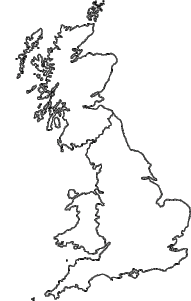
ukTake media references for example that I’ve seen over recent days to ‘Great Britain’ in the context of the upcoming referendum on membership of the European Union or, in another instance, when referring to the treatment of Muslim immigrants in this country. Let me explain.

‘Great Britain’ is a geographical term. It refers to the largest island of the British Isles, and comprises England, Wales and Scotland and some offshore islands, but not the Channel Islands nor the Isle of Man. It was first officially used in 1474, but there are references to ‘Great Britain’ more than a thousand years earlier by the Greco-Egyptian scientist Claudius Ptolemy.

‘Great Britain’ is NOT an accolade. We may have the world’s fifth largest economy (as the Brexit campaigners are continually telling us), a permanent seat on the UN Security Council (but for how much longer?), and for better or worse (unfortunately for worse, in so many instances) this country has given a lot to the world. Not least the English language. Taking a long hard look at ourselves, we’re really rather an insignificant archipelago off the west coast of continental Europe.

But ‘Great’ has been employed recently, it seems to me, to describe a country that’s punching above its weight that we are special, above average. In other words, ‘great’. Humbug.

Don’t get me wrong. I’m proud to British, a citizen of the United Kingdom of Great Britain and Northern Ireland. I just wish that politicians would stop claiming how the country is best at this or that, as though we are trying to place ourselves at the top of some hypothetical ranking. In my book it never looks good if we use superlatives or claim accolades ourselves. Let others bestow those.

On his return from Brussels after negotiating a change to the UK’s membership of the EU, Prime Minister David Cameron was obviously confused (or maybe using the term merely for effect, if I’m being generous). ‘Let’s make Great Britain greater’, he implored. His speech writers clearly hadn’t got the message.

Then Scottish trawlerman from Peterhead, Jimmy Buchan, interviewed on BBC Radio 4’s The World Tonight a couple of nights ago was clearly mistaken. Complaining about EU interference in the fishing industry and the imposition of ‘unfair’ fishing quotas, he claimed a Brexit vote would permit our fisherman, unfettered by such regulations, to have a thriving industry once again (wishful thinking?), and make Great Britain great again.

And then this, just yesterday, in a report about reaction among immigrant Muslim women in the UK to ‘requirements’ that they should become fluent in English. ‘People from third world countries contributed to turning Britain into Great Britain . . . ‘ Undeniably, immigrants from all over have contributed to the well-being and growth of the UK. However, they haven’t made it ‘Great’; it was Great already. But they have made it better.

I just hope that the racist bigotry of some political parties and elements of others does not hold sway when we come to cast our ballots in the EU referendum on 23 June. We might end up as ‘Diminished Britain’.


‘Leave’ is not in my vocabulary . . .

uk-and-eu

Should the United Kingdom remain a member of the European Union or leave the European Union?

That will be the question (approved by Parliament) that the British electorate will be asked in a ‘once in a generation’ referendum on our membership of the European Union (EU) on Thursday 23 June later this year.

And my response?

voteI’m 67 years old. I’ve been a proud ‘European’ much longer than not, since Edward Heath took the UK into the European Economic Community (EEC) in January 1973. In fact, half the UK population has only ever experienced life as a UK member of the EEC or its successors, the European Community (EC) and, since 2009, the European Union.

Has that diminished my pride in being a UK national. I don’t feel that I have lost anything of my Britishness by also being part of the EU. In fact, I believe that our nation has been enhanced by being a member of the EU.

Don’t get me wrong. I’m no apologist for the EU. The workings of the Commission, and the seemingly endless stream of directives and regulations—not, by any stretch of the imagination, always clear or even necessary perhaps—have built up a legacy of resentment. Not just in the UK but in other member countries.

But I do feel that after more than four decades our place should remain in Europe. It’s not just about safety and security. The economic considerations are enormous. And although the referendum campaign is less than two weeks old, I’m already annoyed by the ‘Leavers’ continually claiming that the ‘Remainers’ are using scare tactics. The Leavers—latter-day Creationists—are asking to take a leap of faith that the other 27 countries of the EU (after a departure of the UK) would bend over backwards to accommodate us. Pie in the sky, in my opinion. Is it scare tactics to insist they clarify what would be the actual consequences of leaving the EU?

I certainly support the BRITAIN STRONGER IN EUROPE campaign.

stronger

Environmental and human rights are stronger by being a member of the EU. One of the more powerful arguments I heard on the radio recently was by Frances O’Grady, General Secretary of the Trades Union Congress who stated that workers’ rights in the UK were stronger because of our EU membership. Would these be eroded if the UK left the EU? Almost certainly, given the overall policy perspectives of this Conservative government. Furthermore, the immigration and benefits arguments are overplayed, and represent a minuscule cost apparently compared to the overall economic status of the country. Given the political focus on immigration by UKIP and others I fear the referendum is taking on an unsavory perspective.

Our science base is stronger by being a member of the EU, a position supported by many of the most distinguished British scientists. We relinquish science funding and easy collaboration through the EU at our peril.

scientists for EU

But perhaps this whole EU Referendum has more to say about the state of the Conservative Party—which is hopelessly split (and may not recover whichever way the referendum goes)—and the jockeying for power among politicians (including failed ones like Ian Duncan-Smith) with super egos, or foolish individuals like Nigel Farage. I just wish that those on the Remain side in the Conservative Party would also make their arguments from a positive standpoint, as well as demanding the Leave side clarify what OUT would really look like. As for the Labour Party, even though it is almost unanimous in its support for the Remain campaign, I despair of Jeremy Corbyn. What a lacklustre leader! He needs to be out there campaigning actively for continuing EU membership.

Whatever arguments are put forward, and however hard the Leave campaign might try to persuade me otherwise, I’m definitely . . .

IN

. . . and, rather than carping from the sidelines (a ‘tradition’ of successive governments over the decades) we will need a UK government (of whatever persuasion) as an active member of the EU, working positively on the inside, delivering liberal doses of British pragmatism to bring about the real reforms that will benefit all member states.

I really hope that the UK will, after 23 June, still be one among 28. If we vote to leave the EU, I fear that we might end up a lonely and increasingly insignificant small island looking longingly at what might have been. That’s not a prospect I relish during this next stage of my life.


How many crop varieties can you name?

Do you ever look at the variety name on a bag of potatoes in the supermarket? I do. Must get a life.

How many potato varieties can you name? Reds? Whites? Or something more specific, like Maris Piper, King Edward, or Desiree to name just three? Or do you look for the label that suggests this variety or that is better for baking, roasting, mashing? Let’s face it, we generally buy what a supermarket puts on the shelf, and the choice is pretty limited. What about varieties of rice? Would it just be long-grain, Japanese or Thai, arboreo, basmati, maybe jasmine? 

When I lived in the Philippines, we used to buy rice in 10 kg bags (although you could buy 25 kg or larger if you so desired). On each, the variety name was printed. This was important because they all had different cooking qualities or taste (or fragrance in the case of the Thai jasmine rice). In Filipino or Thai markets, it’s not unusual to see rice sold loose, with each pile individually labelled and priced, as the two images below show¹:

Today, our rather limited choice of varieties on the shelf does change over time as new ones are adopted by farmers, or promoted by the breeding companies because they have a better flavor, cooking quality, or can be grown more efficiently (often because they have been bred to resist diseases better).

Apples on the other hand are almost always promoted and sold by variety: Golden Delicious, Pink Lady, Granny Smith, Red McIntosh, and Bramley are some of the most popular. That’s because, whether you consciously think about it, you are associating the variety name with fruit color, flavor and flesh texture (and use). But there were so many more apple varieties grown in the past, which we often now describe as ‘heirloom varieties’. Most of these are just not commercial any more.

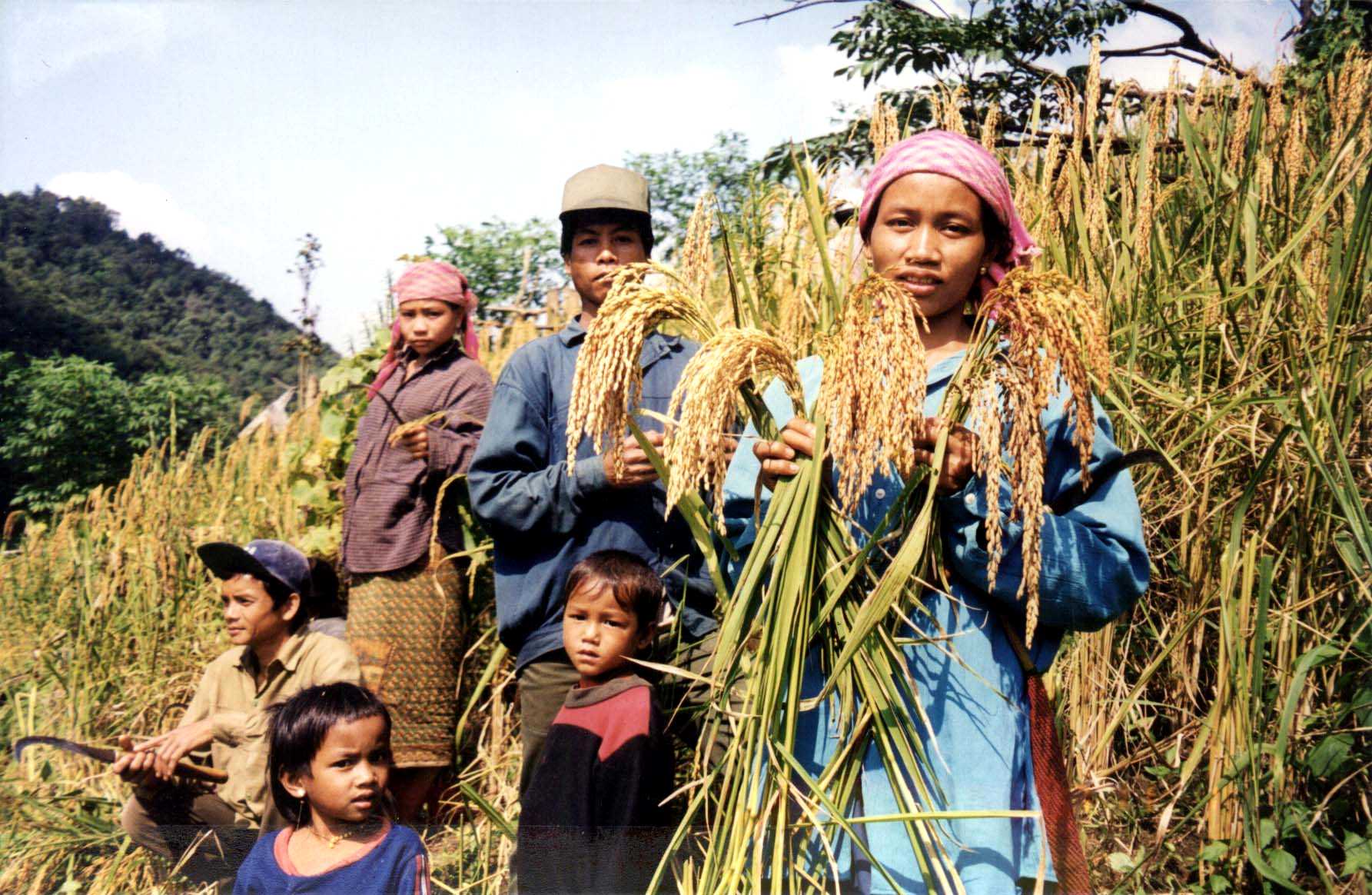
In many parts of the world, however, what we might consider as heirloom varieties are everyday agriculture for farmers. For example, a potato farmer in the Andes of South America, where the plant was first domesticated, might grow a dozen or more varieties in the same field. A rice farmer in the uplands of the Lao People’s Democratic Republic in Southeast Asia grows a whole mixture of varieties. As would a wheat farmer in the Middle East. There’s nothing heirloom or heritage about these varieties. This is survival.

Heirloom potato varieties still grown by farmers in the Andes of Peru.

An upland rice farmer and her family in the Lao People’s Democratic Republic showing just some of the rice varieties they continue to cultivate. Many Lao rice varieties are glutinous (sticky) and particular to that country.

What’s even more impressive is that these farmers know each of the varieties they grow, what characteristics (or traits) distinguish each from the next, whether it is disease resistant, what it tastes like, how productive it will be. And just as we name our children, all these varieties have names that, to our unsophisticated ears, sound rather exotic.  Names can be a good proxy for the genetic diversity of varieties, but it’s not necessarily a perfect association. In the case of potatoes, for example, I have seen varieties that were clearly different (in terms of the shape and color of the tubers) but having the same name; while other varieties that we could show were genetically identical and looked the same had different names. The cultural aspects of naming crop varieties are extremely interesting and can point towards quite useful traits that a plant breeder might wish to introduce into a breeding program. Some years back, my colleague Appa Rao, I and others published a paper on how and why farmers name rice varieties in the Lao PDR.

In the genebank of the International Rice Research Institute (IRRI) in Los Baños in the Philippines, there are more than 120,000 samples of cultivated rice. And from memory there are at least 65,000 unique names. Are these genetically distinct? In many cases, yes they are. The genebank of the International Potato Center (CIP) in Lima, Peru conserves about 4000 different potato varieties.

What these potato and rice varieties represent (as do maize varieties from Mexico, wheats from the Middle East, soybeans from China, and beans from South and Central America, and many other crops) is an enormous wealth of genetic diversity or, if you prefer, agricultural biodiversity (agrobiodiversity): the genetic resources of the main staple crops and less widely planted crops that sustain human life. The efforts over the past six decades and more to collect and conserve these varieties (as seeds in genebanks wherever possible) provides a biological safety net for agriculture without depriving farmers of the genetic heritage of their indigenous crops. But as we have seen, time and time again, when offered choices—and that’s what it is all about—farmers may abandon their own crop varieties in favor of newly-bred ones that can offer the promise of higher productivity and better economic return. The choice is theirs (although agricultural policy in a number of countries has worked against the continued cultivation of so-called ‘farmer varieties’).

CGIARThank goodness for the genebanks of 11 centers of the global agricultural research partnership that is the Consultative Group on International Agricultural Research (CGIAR). These centers carefully conserve the largest, most important, and genetically-diverse collections of crop germplasm (and forages and trees) of the most important agricultural species. The flow of genetic materials to users around the world is sustained by the efforts of these genebanks under the International Treaty on Plant Genetic Resources for Food and Agriculture. And, of course, these collections have added long-term security because they are duplicated, for the most part, in the long-term vaults of the Svalbard Global Seed Vault¹ deep within a mountain on an island high above the Arctic Circle.

Heritage is not just about conservation. Heritage is equally all about use. So it’s gratifying (and intriguing) to see how IRRI, for example, is partnering with the Philippines Department of Agriculture and farmers in an ‘heirloom rice project‘ that seeks ‘to enhance the productivity and enrich the legacy of heirloom or traditional rice through empowered communities in unfavorable rice-based ecosystems‘ by adding value to the traditional varieties that farmers continue to grow but which have not, until now, been widely-accepted commercially. I gather a project is being carried out by the International Maize and Wheat Improvement Center (CIMMYT) for maize in Mexico that aims to raise the cuisine profile of traditional varieties.

Genetic conservation is about ensuring the survival of heritage varieties (and their wild relatives) for posterity. We owe a debt of gratitude to farmers over the millennia who have been the custodians of this important genetic diversity. It’s a duty of care on which humanity must not renege.

~~~~~~~~~~~~~~~~~~~~~~~
¹ Courtesy of IRRI
² The Seed Vault is owned and administered by the Ministry of Agriculture and Food on behalf of the Kingdom of Norway and is established as a service to the world community. The Global Crop Diversity Trust provides support for the ongoing operations of the Seed Vault, as well as funding for the preparation and shipment of seeds from developing countries to the facility. The Nordic Gene Bank (NordGen) operates the facility and maintains a public on-line database of samples stored in the seed vault. An International Advisory Council oversees the management and operations of the Seed Vault.

Just an occasional whimper . . .

It’s now eight weeks—to the day—since I went base over apex and broke my leg.

I’m actually quite surprised, if not a little relieved, at just how fast one’s body can heal itself. Not that it has been all plain sailing.

IMG_1491

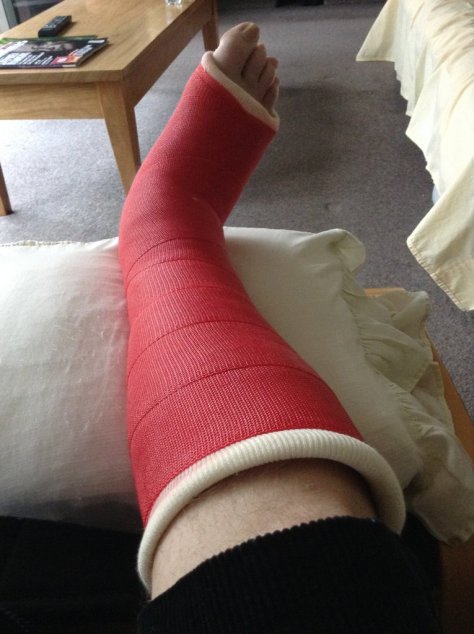
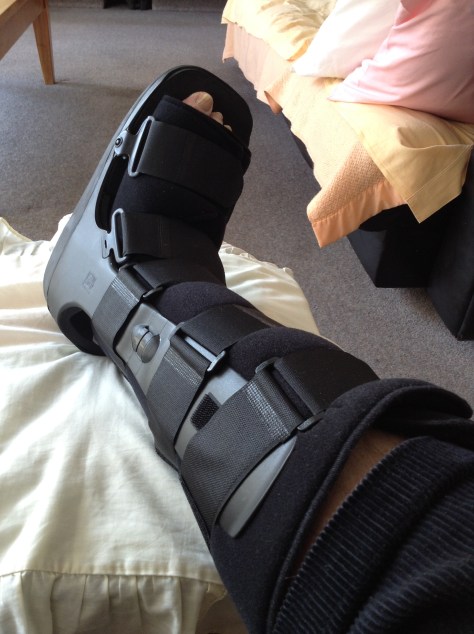
I’ve attended an outpatient fracture clinic three times since I discharged from hospital. On the first visit, a week later, the plaster cast was removed, and the scar checked for healing. It was replaced by my lovely purple cast. A week after that, in my second appointment, that cast was removed, the stitches taken out, and a new cast (red this time) fitted. My third appointment, after another three weeks, was quite momentous. I achieved such a lot in just over an hour. The red cast was removed, I had X-rays taken, spoke with the surgeon, had a ‘moon boot’ fitted, and saw a physiotherapist who gave me a pair of crutches and checked that I was safe to manoeuvre with them, especially going up and down stairs.

Since then I’ve been much more mobile, and have even been outside on a number of days for walks up and down the road we live in, and even slightly further afield. I actually managed over half a mile just a few days ago. But I only stray outside if the weather is fine. It has been frosty on a number of mornings recently. Frost and ice and me don’t go well together!

I’ve also had two physiotherapy sessions at the local Princess of Wales Community Hospital. This is very convenient as I don’t have to travel the nine miles or so to the Alexandra Hospital in Redditch. The physiotherapist has checked that everything is healing as it should be, and has given me a set of exercises that I have to do several times a day.

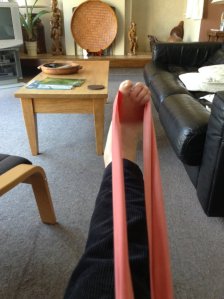
IMG_1515This is an interesting exercise (left) using a contraption called a Theraband. Actually it’s just a length of elasticated rubber (could I develop a latex fetish it’s so nice and soft), that allows me to stretch and flex my ankle.

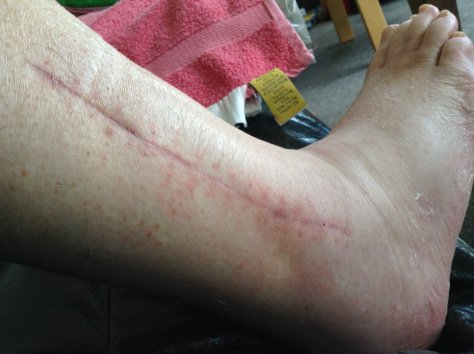
And of course I’m now expected to place an increasing amount of weight on the damaged leg as that will encourage the healing process. So while the breakage is held together by the steel plate, the ligaments and tendons in the ankle below the tibia will take some time to heal fully. Even after eight weeks my ankle and parts of my leg are still quite swollen, with some bruising visible.

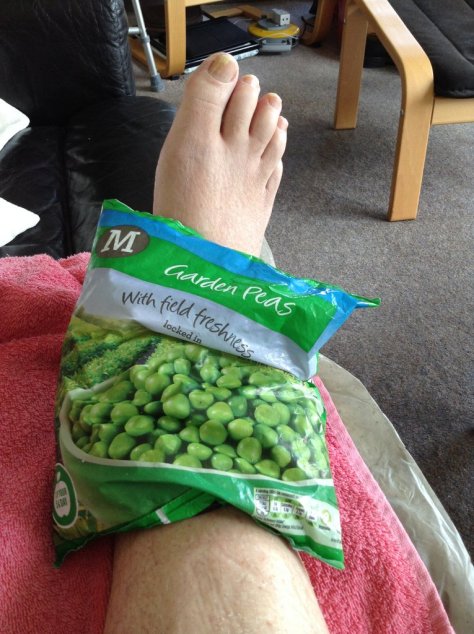
But on the outer side of my leg I can now feel the metal plate and screws through the flesh, and it feels rather uncomfortable. So while I’m no longer in any great pain, some days there is quite a lot of discomfort, and on others hardly anything at all. A bag of peas (should I have chosen ‘petit pois’?) make an excellent ice pack, applied for about 20 minutes after an exercise session.

IMG_1493

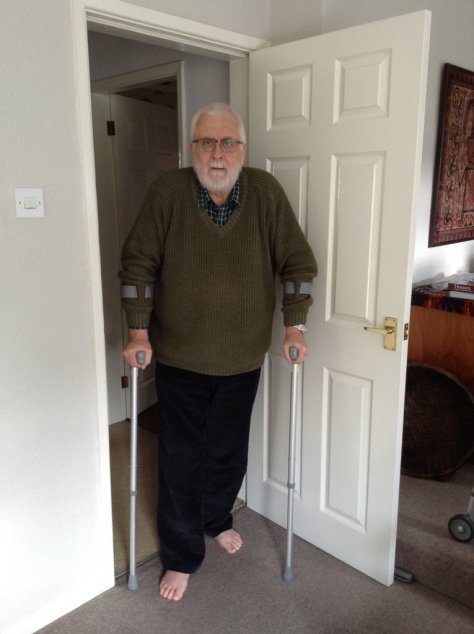
But what is clearly progress is that the physiotherapist has got me walking around the house in bare feet—but supported on crutches—to add even more weight to my leg and to get all the muscles working together properly once more. In some ways it’s like learning to walk all over again.

IMG_1522

Onwards and upwards!

Four years on . . . and still the same sense of pride

20160229001 OBE

Four years ago today

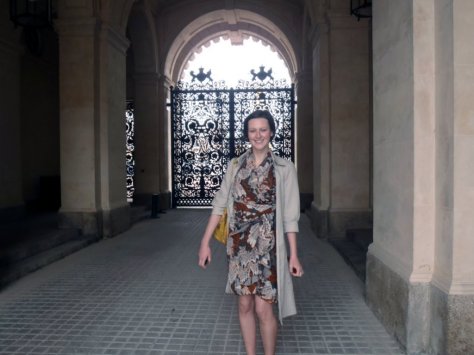
Yes. Four years. How time flies. It was Wednesday 29 February 2012, and I was in London—with Steph, our younger daughter Philippa, and former IRRI colleague Corinta—to attend an investiture at Buckingham Palace.

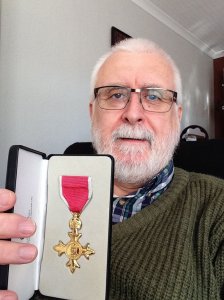
I was there to receive my OBE that had been awarded in the 2012 New Years Honours, for services to international food science. Since this honour was given after I’d retired from the International Rice Research Institute (IRRI) in the Philippines, I assume it was a recognition of the contributions I’d made to genetic conservation of rice as well as strengthening international support for rice research.

Travelling to London
It was an early start from Bromsgrove, to catch the train from Solihull to London Marylebone Station, where we met Phil, who had traveled down from the northeast. Then a short hop across central London by taxi to arrive at Buckingham Palace in time for the briefing before the actual investiture took place.

As you can imagine, security was tight. We all had to show IDs, and the invitation tickets. I had to be at the Palace about 45 minutes before the investiture, and was surprised to find that I was one of the last to arrive.

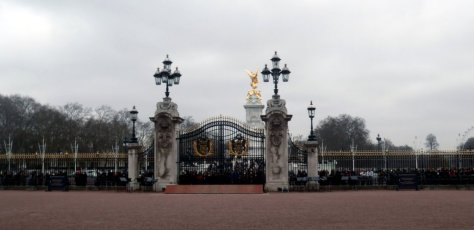
The gates of Buckingham Palace - from inside.

The gates of Buckingham Palace – from inside.

OLYMPUS DIGITAL CAMERA

OLYMPUS DIGITAL CAMERA

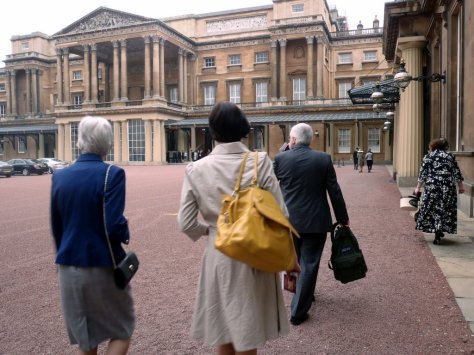
Corinta was impressed by Buckingham Palace

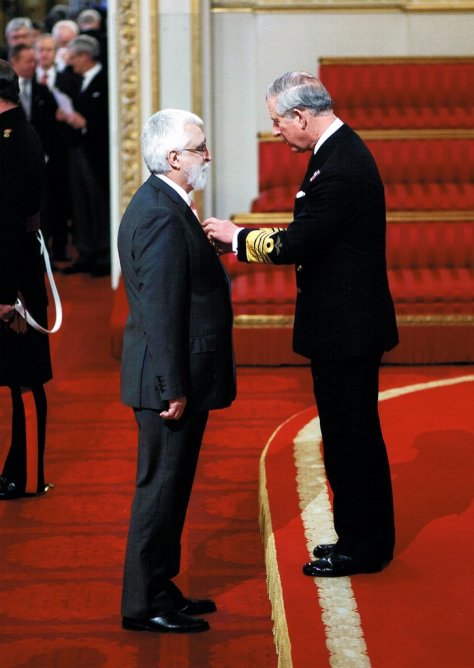
Briefing over, and the investiture was also over before it had begun. I’m still surprised how quickly it went, even though it seemed as though HRH The Prince of Wales spent at least five minutes speaking with each of the awardees. It couldn’t have been more than a minute. But he was remarkably well-briefed, and we held a conversation about rice in the Philippines. His opening question being, ‘Are you still working in the Philippines, Dr Jackson?

20120229104 OBE

Talking rice with HRH

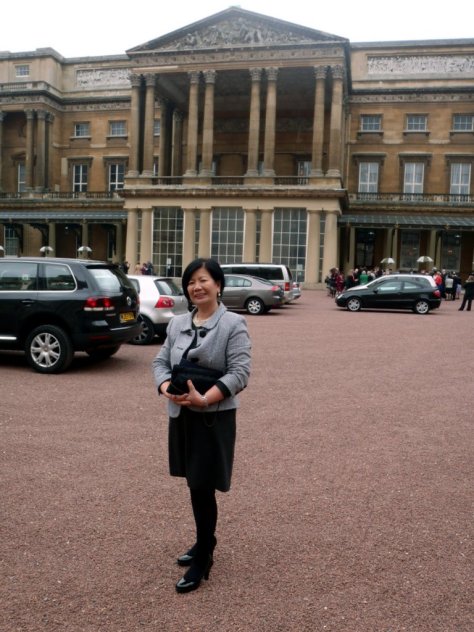
After the ceremony we joined up in the palace courtyard, and outside the gates for more photographs.

It was a memorable occasion for all of us, and after four years I still have that same sense of pride as I did when I first received the letter in November 2011 informing me I had been nominated for the OBE. I rarely take my insignia out of the safe, but this morning I thought I would have a four-year update.

Making progress . . . one step at a time

Believe me, there’s almost nothing more annoying than an unscratchable itch beneath a plaster cast. Finally, however, my cast was removed during an outpatient appointment yesterday at the ‘Alex’.

I had an appointment for 10:30 and, based on my previous two appointments, I expected to have to wait for at least an hour beyond my appointment time before I would be seen.

Imagine my surprise, therefore, after having just arrived to the clinic, and making myself comfortable, that I was called to the ‘plaster room’ to have my cast (the red one) removed.

20160204005

That took about five minutes or so. Given that the cast was very hard (made, I was told, from bandages infused with a type of fiber glass that sets on exposure to the air), the nurse had to use a small circular saw to cut through it.

Then I was sent to the X-ray unit in the fracture clinic. I didn’t have to wait very long there either. But I did get into conversation with a couple a little older than myself. The wife had broken her arm, and was also waiting for an X-ray after me. They asked me what I had done to myself, and before long, after discovering I was retired, they asked me what I used to do before retirement. I mentioned that I’d worked at the International Rice Research Institute. ‘Golden rice?’ asked the husband, and they both went on to decry the irresponsible campaign (their words) against GMOs that denied life-saving technologies like Golden Rice to millions of people (many of them children) around the world. I have to say it was most heartening to hear these perspectives from complete strangers.

Anyway, after a couple of X-rays had been taken, I was wheeled back to the reception waiting area to see one of the surgeons. Again I didn’t have to wait more than about five minutes before joining one or two other patients waiting outside the actual consultation rooms. I was with the surgeon less than 10 minutes. He showed me the latest X-ray images, told me that everything was healing as it should be, and that I would be fitted with a ‘boot’, and have to attend physiotherapy sessions. I don’t have to return to see the surgeon for another six weeks, when he expects to give me the all-clear.

Wheeled around the corner again, one of the staff from the plaster room fitted a ‘boot’—what a marvellous invention—and then I had to wait for someone from the Physiotherapy Unit to come and see me. That was my longest wait, maybe 20 minutes. Anyway, the young woman brought me a pair of crutches, had me test them out and adjusted them to my height. Then she wheeled me over to the Physiotherapy Unit so I could quickly practice climbing and descending stairs. Tricky!

image

And before I knew it, I was ready to go home. I called the taxi company, a driver arrived after about 15 minutes, and I was home before 12:15. Feeling very positive and optimistic.

I’m now allowed, encouraged even, to walk about and begin (slowly) to put weight on my damaged leg. In fact the surgeon told me that adding weight to the leg would encourage healing, surprising as it may seem. Anyway, I still have my walking frame as well as crutches, but the surgeon has told me that after about three weeks, I’m to give up walking with any support at all. Let’s see.

I’m also now allowed to shower, and that’s a treat to be enjoyed later today once I’ve mastered climbing and descending the stairs using crutches.

It was bliss having the cast removed. A good scratch, but even more so the chance to bathe my foot and leg that has been encased for the past six weeks. A nice foot massage in warm water, followed by a generous application of cocoa butter cream, and my foot began to feel almost normal.

I’ve been very pleased with my treatment under the National Health Service (NHS), and it has not cost me a penny. I think of the hours of treatment from the moment the first ambulance arrived on the scene on 8 January, the four days spent in hospital, the outpatient appointments, the drugs administered, the equipment loaned to me (Zimmer frame, crutches, and a frame around the toilet for support), and last but not least, the boot that I’m now wearing. The boots, for example, don’t come cheap and I have no idea if they are recycled once I have finished with mine in six weeks’ time (hopefully).

Having lived in a country like the Philippines where there is limited socialized medicine, and where families can very quickly run up catastrophic medical bills, it makes me appreciate even more the value of the NHS in the UK. No wonder it is such a hot potato and contentious political challenge (which this current Conservative government does not appear to be facing professionally nor astutely).

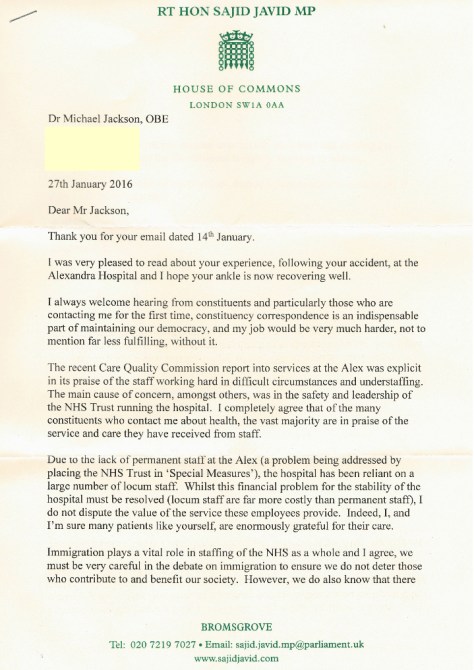
A reply from my Member of Parliament . . .

When I broke my leg at the beginning of January, I spent four days in the Alexandra Hospital in Redditch, one of three hospitals managed by the Worcestershire Acute Hospitals NHS Trust. The ‘Alex’ has not been out of the news for many months—for all the wrong reasons. Now I know there’s a lot in the media these days about the shortcomings of the NHS. One ‘failing’ hospital after another is brought into ‘special measures‘ (the situation with the Alex), the NHS is almost broke, the junior doctors are on strike. Also, there is a perception that this Conservative government aims to privatize our cherished NHS, step-by-step. In my earlier post I mentioned that the A&E department at the Alex had recently lost several of its consultants, and that the maternity unit had been closed (supposedly only a temporary measure) and its services transferred to Worcester.

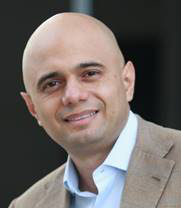
JavidHowever, the care I received during my brief stay was second-to-none. I tweeted about that, but also felt compelled to write to my Member of Parliament (for the Bromsgrove constituency), the Rt. Hon. Sajid Javid (right), who sits in the Cabinet as Secretary of State for Business, Innovation and Skills. After all, positive outcomes need to be highlighted just as much as the negative (of which we hear all too frequently).

So I penned the following letter on 14 January, and sent it to him through his House of Commons web site:

Dear Mr Javid,
I have unfortunately had to avail of local NHS services in recent days, having slipped on black ice outside my home last Friday and severely dislocating and fracturing my right ankle.

I was rushed to the Alexandra Hospital in Redditch, after a remarkably rapid response from the ambulance service, and spent three nights there following surgery on Saturday night.

At a time when the NHS is under ‘assault’ from all quarters, including, I’m afraid to say, the Government of which you are a member, as well as the continual bad press that the ‘Alex’ seems to attract, I believe it’s opportune to celebrate what is great and worthy about the NHS and those dedicated doctors, nurses and support staff who are its backbone.

From the moment of my arrival in A&E, admission and stay on Ward 17 (Trauma and Orthopaedic), and visit to theatre, I have nothing but the highest praise for all the staff, who looked after me with dedication and compassion, and a good degree of good humour. Although their morale has recently taken somewhat of a battering, this did not affect their sense of professional pride in offering the best care possible.

And lying there on the ward, another thing struck me. At least 50% of the staff, possibly more, were immigrants, both EU and non-EU, and of all faiths. Indeed, I believe that the particular speciality where I was being cared for would not be able to operate were it not for the support of our immigrant friends and colleagues.

Mr Farage and his moronic UKIP followers, and those on the right of your party, have been permitted to hijack the immigration (and EU) debate with the result that those from outside the UK who come here to make our country a better place, are demonised. Surely as the son of immigrant parents this is a perspective you should be fighting tooth and nail to reverse.

I spent much of my career working overseas with scientists and support staff from all around the world. I celebrate this cultural, ethnic and religious diversity. I deplore deeply that our society, famed for its broad mindedness and tolerance is being dragged in a direction that undermines these core values.

I deplore that this Conservative government does not appear to have the stomach to take on the immigration bigots.

Yours sincerely,
Michael Jackson

And there I left it. Last weekend, Mr. Javid organized a job fair in Bromsgrove and there was a lot of publicity in the local press. It was that which reminded me I’d not received any reply from my MP. I thought (incorrectly, as it turned out) that he and his staff had chosen to ignore my comments.

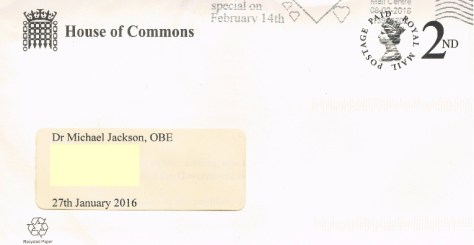
However, this envelope dropped through my mailbox yesterday afternoon.

HoC envelope

If you click on the image below you can read the full reply from Mr. Javid. It’s a courteous and explanatory letter, and (to a certain extent) agrees with the points I raised. He does duck the immigration issue since I guess he can’t deviate from the government line.

Javid letter

Nevertheless, I am pleased to see that someone in his office did take time to address the issues I raised. While my politics (such as they are) do not align with this Conservative administration, I do acknowledge that Sajid Javid has a high and prominent profile in the constituency, and appears to be a good constituency MP. Which is saying something considering the ministerial responsibilities that he has to balance as well.


A wounded badger update . . .

It’s now four weeks since I had my mishap. And while there has obviously been a lot of healing going on, I’m getting impatient to be back to normal, sleeping in my own (new) bed again, and be able to get out and about and enjoy some fresh air. It’s ironic that we had ordered the new bed from Dreams in Redditch on 3 January. The store is located about half a mile further down the road from the Alexandra Hospital, a district in Redditch we’d never visited before. I never had the slightest inkling that I’d be back there five days later, under rather different circumstances.

20160204001

Once and future bed in the living room.

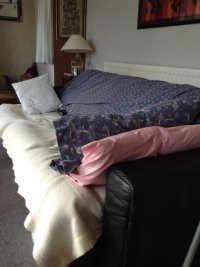
Since leaving hospital four days later, I’ve been confined to the ground floor of our home. Fortunately, with a three-seater sofa at my disposal, we were able to make a comfortable bed  there. The downstairs toilet/washroom is just a few hops away (with the support of my Zimmer frame), as is our kitchen diner. So there’s been no need to even face the challenge of going upstairs.

The surgeon has been quite clear in his instructions to me: no weight whatsoever on the damaged ankle and leg for at least another two weeks.

A week after leaving hospital I returned to the Alex to attend the Redditch Orthopedic Clinic. Although we had a specific appointment, there was still a delay of more than 90 minutes before I saw anyone, and I beginning to become somewhat frustrated. When returned to the clinic a week later I anticipated there would again be a delay, but was pleasantly surprised when we were called to see the surgeon after only about 30 minutes. The plaster cast was removed, and the surgeon checked that everything was healing as it should be.

I was quite surprised to see the extent of the ‘damage’, with a scar down the outside of my right leg (held together by 17 stitches) through which a 10 inch steel plate had been screwed to the fibula. The surgeon showed me the X-rays taken when I was first admitted to hospital. I hadn’t realized then that the fibula had completely snapped, a displaced fracture with a 1 inch break. Yikes! The 10 hole steel plate looked pretty impressive on the X-ray, as did the ‘tie’ between the tibia and fibula adding additional strength in that part of my ankle where I’d done all the damage to the tendons and ligaments.

On that first outpatient appointment my plaster cast was replaced with a lightweight one made of fiber glass bandages that react to air and harden. Much more comfortable than the old plaster one. What surprised me is the choice of colors I was offered: white, black, blue, red, purple or pink. I chose purple that time, and a week later when I returned to the clinic to have the stitches removed I wanted the blue, but had to settle for red. Pink was a color too far!

So here I sit in my chair, with my leg in the air. It still hurts more than I’d expected by this time, but at least I can move it around and find more comfortable positions. I return to the clinic on 16 February. This red cast will be removed, and it’s likely that a ‘boot’ will be fitted after which I should be able progressively to put some weight on the leg.

20160204006Hopefully I’ll be approaching normality by the middle of April, but the surgeon did warn me it would be a long, slow recuperation as it had been a nasty fracture. Patience is not one of my better virtues, but I’m learning.


Music can stir such improbable memories . . .

It was a Saturday afternoon in September 1970. I’d arrived in Birmingham less than two weeks before to start an MSc degree on plant genetic resources at the university. However, I’d spent the first week of classes holed up in the university medical centre where I’d had two impacted wisdom teeth extracted under general anaesthetic.

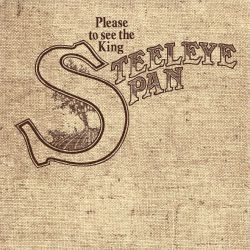
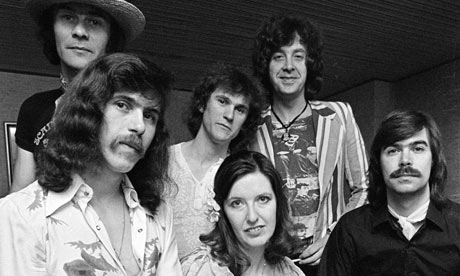
SteeleyeSpan-frontBack home in my digs¹, I was taking it easy, feeling sorry for myself, with a very sore mouth indeed. I’d been listening to a folk music program on the radio. I don’t remember the actual details. What I do remember very clearly about that afternoon, however, was listening to what must have been a pre-release of a beautiful track, Lovely on the water, from the second album (Please to see the king²) of the electro-folk group Steeleye Span. And I’ve been a fan ever since. I saw them in concert twice in Birmingham before I moved to South America in January 1973. The first concert, held in one of the university halls of residence was brilliant. Peter Knight on the fiddle was clearly inebriated, but his playing was unbelievable. The sound balance and level for the relatively small hall was just right. The second concert was at Birmingham Town Hall, a much bigger venue. By then the group had become more rock focused, the sound level was too high and almost painful. Not such an enjoyable experience.

Photo-of-STEELEYE-SPAN-001

Rear row ( L to R): Rick Kemp, Nigel Pegrum, Bob Johnson; front row (L to R): Tim Hart, Maddy Prior, Peter Knight

But there are some twists to this story, as I’ll explain below after you’ve had chance to listen to Lovely on the Water.

After the radio program was over, I decided to take a brief nap. I’d planned to meet an old friend, Allan Mackie, from my undergraduate days in Southampton, for a pint at a pub in the city centre later that evening. We would meet there from time-to-time.

I woke up more than an hour later. It was already dark. I quickly realized that my mouth was full of blood, and the pillow was stained a rather bright red. I’d haemorrhaged while asleep. I dialled 999 for assistance, and very soon afterwards an ambulance turned up outside, blue lights flashing, and I was rushed into the Dental Hospital (part of the University of Birmingham) in the city centre. The medical staff stanched the haemorrhage after about an hour, when they felt I was safe to be discharged. The problem was that I’d left home without my wallet. I didn’t have any money on me whatsoever.

Fortuitously, the pub where I was due to meet Allan was just around the corner from the Dental Hospital, so I set off there to see if he had hung around, even though I was late (no mobile phones 45 years ago). I was very relieved to see that he’d not gone home, and he was propping up the bar, pint in hand. Once I’d downed a couple of pints of Ind Coope Double Diamond, he lent me a couple of pounds, and I made my way home by bus.

Now the reason all this has come to mind right now is that I have been listening to a lot of music in recent days, since I had my mishap and am unable to do much but sit in a chair all day with my broken leg in the air.

I was working my way through all the Steeleye Span CDs I have. And that brought back memories of when I first joined the University of Southampton as an undergraduate in October 1967. Having an interest in folk music, a Sunday evening spent in the Students’ Union at the weekly Folk Club became a regular fixture on my list of entertainments.

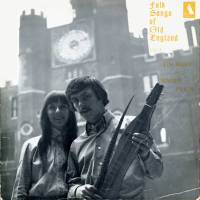
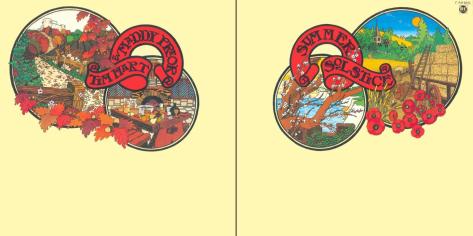
folksongsofoldengland_1_tepeeNow Steeleye Span only formed in 1969, but two of the members were Tim Hart and Maddy Prior who sang at the Folk Club quite frequently over the three years I was in Southampton. They were quite popular on the folk circuit, and had released two well-received LPs of traditional folk songs. In 1971 they released their widely-acclaimed LP Summer Solstice. Click on the album cover below to listen.

summersolstice_cas1035

skiffle

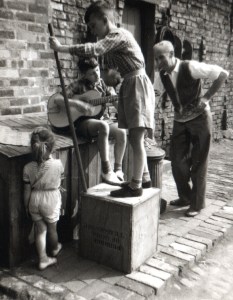
That’s me on tea-chest bass.

My continuing interest in folk music had grown out of an earlier 1950s interest in skiffle music, which I’ve blogged about elsewhere.

But in the early 1960s, it was The Beatles, The Hollies, Herman’s Hermits and a host of other rock and pop groups that took my fancy. I’ve never been a Rolling Stones fan. However, I always returned to my folk music roots: The Ian Campbell Folk Group (with the inimitable fiddler Dave Swarbrick who later formed a duo with Martin Carthy [an early member of Steeleye Span], and was a member of Fairport Conventionn), The Dubliners, The Corries, Robin Hall & Jimmy Macgregor, among others.

Here are The Corries with Flower of Scotland (recorded in 1968 ), that has—to all intents and purposes—become the unofficial national anthem of Scotland.

All these memories came flooding back, just because I’m sat here with time on my hands. And while researching snippets of information for this blog post, I also unearthed another jewel.

bobd

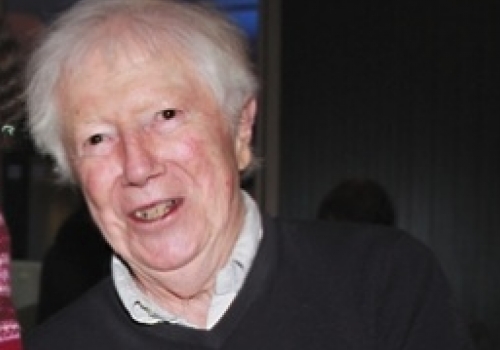
Bob Davenport (born in 1932)

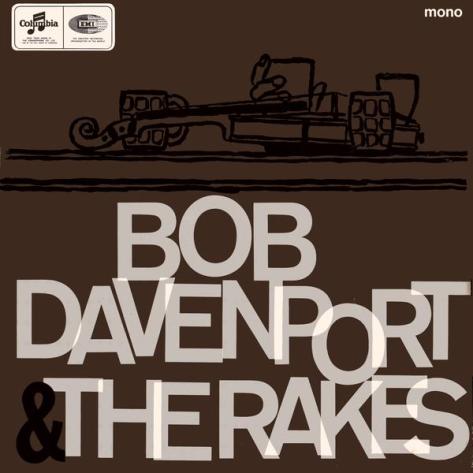
In 1965, a Geordie singer, Bob Davenport released an LP, Bob Davenport & The Rakes, which my elder brother Ed bought, and it quickly became a favourite of mine. I’m not sure how, but I inherited it from Ed, although it was lost in Turrialba, Costa Rica following a burglary in my house.

Now this Bob Davenport & The Rakes LP had never been released as a CD.

bobdavenportandtherakes_33sx1786

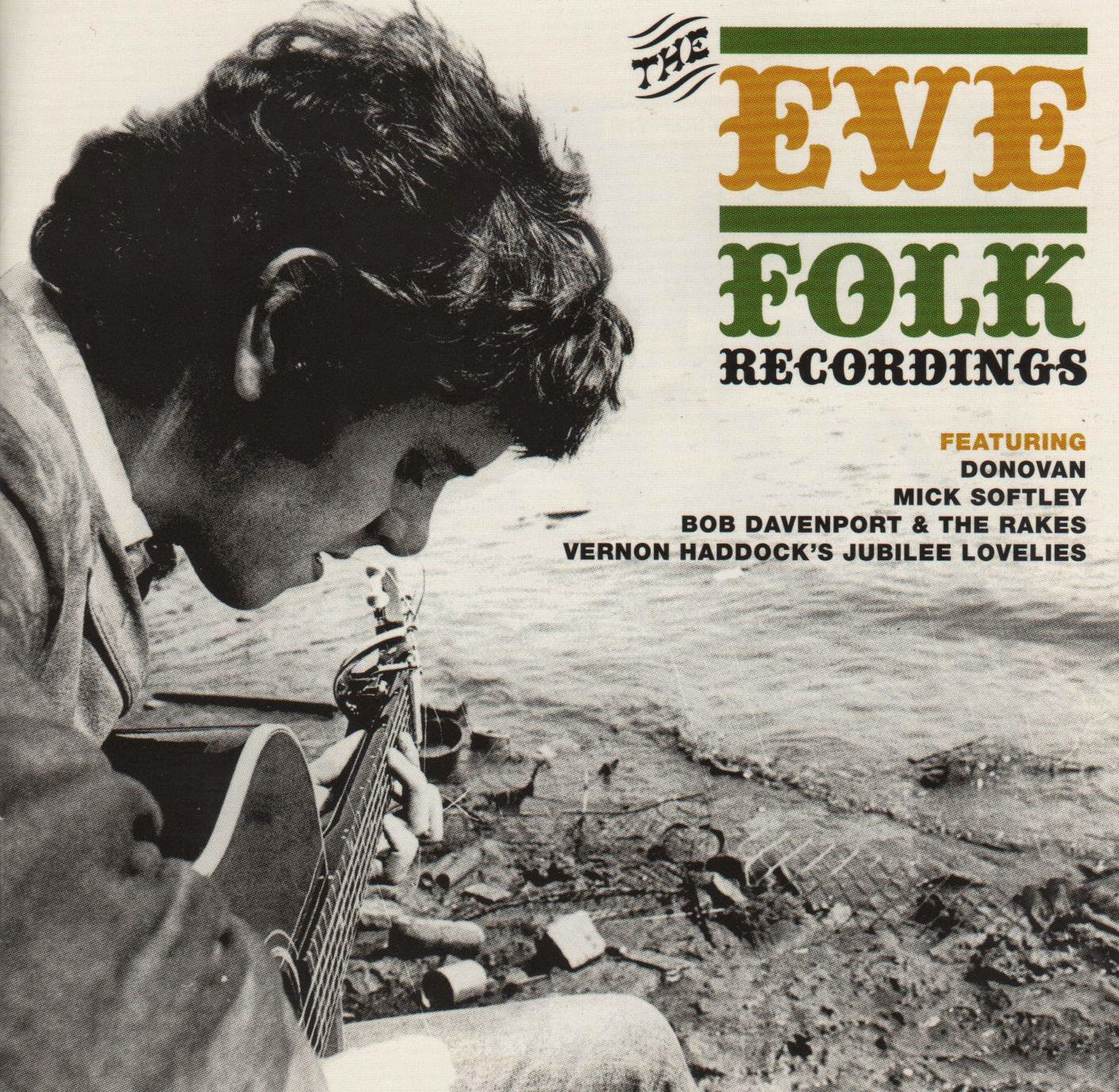
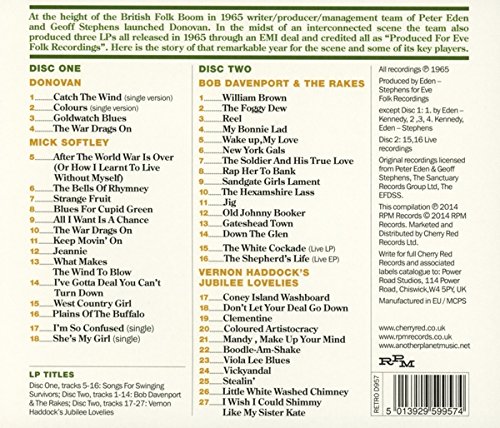
Until now. And last week, as I was surfing through various Google searches, I discovered that it, and other recordings by Donovan, Mick Softley, and Vernon Haddock’s Jubilee Lovelies had been released in 2014 as The Eve Folk Recordings (RETRO D957). There’s an interesting review here.

eve

61PtRWoRU+L

I did a bit of folk singing myself, and a few of the tracks on the Bob Davenport LP became part of my repertoire. I even sang this song, Old Johnny Booker at a folk evening jointly held with the local girls’ convent school, St. Dominic’s when I was in high school in Stoke-on-Trent.

One Folk Club evening in Southampton, Bob Davenport was the guest singer, and I asked him if I he would mind if I sang Old Johnny Booker. He was most gracious and supportive.

So, there you have it. Just listening to a single track, and all these other stories began to take shape. So, to end, here is another classic song, William Brown from that Bob Davenport album, accompanied by The Rakes.


~~~~~~~~~~~~~~~~~~~~~~~
¹ Digs: an informal term for lodgings, actually a bedsit.

² Released in March 1971.

Just 120 feet . . . and history was made

One hundred and twenty feet, that’s all. Insignificant? Hardly, yet it’s less than half the length of a Boeing 747-800.

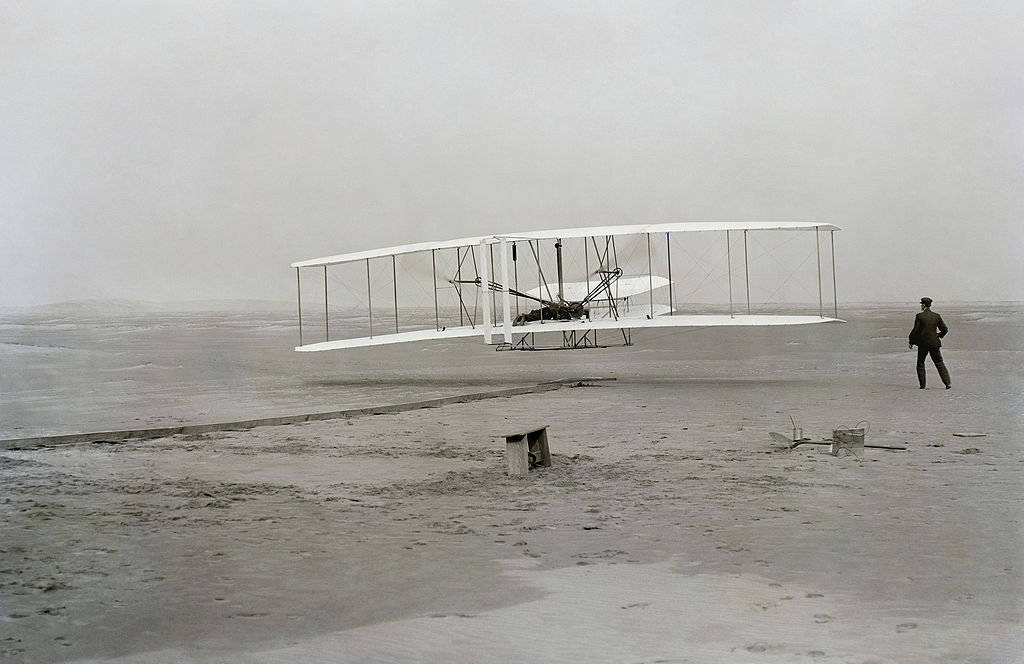
It was however the distance of the first ever powered flight, in an aircraft designed, engineered, and built by Wilbur and Orville Wright, near Kitty Hawk on the coast of North Carolina on 17 December 1903. The flight lasted a mere 12 seconds, but it would change the face of transport forever.

This must surely be one of the most famous photographs ever taken, of that historic flight.

1024px-First_flight2

What’s even more remarkable—and depressing at the same time—is that just over a decade later, aircraft had become serious military machines and deployed on both sides in the First World War.

Well, apart from an overall general interest in all things ‘aviation’, why this sudden interest of mine in the pioneers of powered flight?

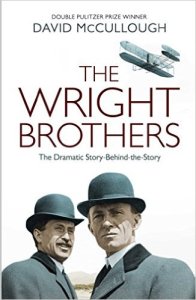
51Esm+pkCSL._SX324_BO1,204,203,200_Among the books I recently received for Christmas was one by American writer and historian David McCullough. Published in 2015 by Simon & Schuster UK (ISBN-10: 1471150364; ISBN-13: 978-1471150364) The Wright Brothers: The Dramatic Story-Behind-the-Story is a lively account about how two brothers from Dayton, Ohio, designers and manufacturers of bicycles, developed an interest—obsession even—to design and build their own flying machine and, in the process, to become the first persons to fly a powered, heavier-than-air machine. Remember also that they had no flying manual to refer to. They wrote it, had to work out the dynamics of flying, and really did learn to fly by the ‘seat of their pants’.

McCullough’s writing style is entertaining and inviting, and I found myself romping through the fascinating story of these brothers from their humble beginnings (their father, Bishop Wright, was an itinerant preacher) to world fame.

Wilbur Wright (in 1905)

Wilbur Wright

Orville Wright (in 1905)

Orville Wright

I learned things I had no inkling about, and what the Wright brothers achieved. Beginning with gliders, then transitioning to powered aircraft, it’s amazing to discover that the brothers built almost everything they needed from scratch, their early engines, even a rudimentary wind tunnel. Their test flights were conducted in the relative secrecy of the North Carolina coast on sand dunes, buffeted by the reliable wind needed for lift, and providing a relative soft landing should something go wrong. Which did from time to time. But the brothers picked themselves up, dusted themselves off, and began again. It’s a tale of focus and perseverance, and utter belief in what they were achieving. And if something went wrong at Kitty Hawk, then they would just return to Dayton (a round trip of about 1500 miles), manufacture a replacement, and carry on.

I found two aspects of their story particularly fascinating. First, how little they spent (of their own money), about US$1000, to bring about this first flight. In contrast, a failed competitor program under the head of the Smithsonian Institution that had received financial backing from the Federal Government, spent more than USD 70,000 (that’s about USD 1.9 million today). Second, the astonishing incredulity with which their claims for flight were received: in the media, among government agencies, and fellow aviators (especially the French) who thought they were charlatans. Undoubtedly they were quite secretive until they were confident that they had conquered powered flight, and some patents granted. Eventually they were hailed as heroes and recognized as the true pioneers of aviation.

By 1909 they had demonstrated the possibilities and advantages of flight, having flown many different courses and for varying lengths of time. Increasingly, they carried a passenger. It was on one of these flights at Fort Myer, in September 1908 that Orville Wright crashed just after take-off on a demonstration flight for the US Army, and his passenger, Lieutenant Thomas Selfridge became the first aviation fatality. Wright himself was badly injured and took months to recover.

Sadly, Wilbur Wright died in 1912 from typhoid and never saw the full potential of aviation. However, Orville lived until 1948, and saw the sound barrier conquered just a year earlier.

Delving into the extensive Wright archive of letters (the brothers and their sister Katharine were avid correspondents) and other records, McCullough has written a wonderful tribute to these famous Ohioans. They were successful, and obviously proud of their home state, as Wilbur is quoted as saying: “If I were giving a young man advice as to how he might succeed in life, I would say to him, pick out a good father and mother, and begin life in Ohio.”

The Wright Brothers: The Dramatic Story-Behind-the-Story is one of the most interesting reads I’ve tackled in a long time. Even if you have no interest at all in aviation, there is plenty in this book to hold your attention. I found it a page turner.


Industrial heritage is all around . . .

The legacy of the Industrial Revolution is all around here in north Worcestershire, and I am reminded of it almost every day.

Bromsgrove lies on the Birmingham-Bristol (and all stations to the southwest) main railway line, at the bottom of the Lickey Incline (the longest and steepest sustained gradient of 2.65% for two miles on the rail network). It’s just under a mile east of where I live.

Because of the steepness of the gradient it’s not uncommon today to see two diesel engines pulling and pushing a long freight train. In the days of steam, a specially-designed locomotive (the Fowler 0-10-0 Big Bertha) was stationed at Bromsgrove to help through trains up the Incline.

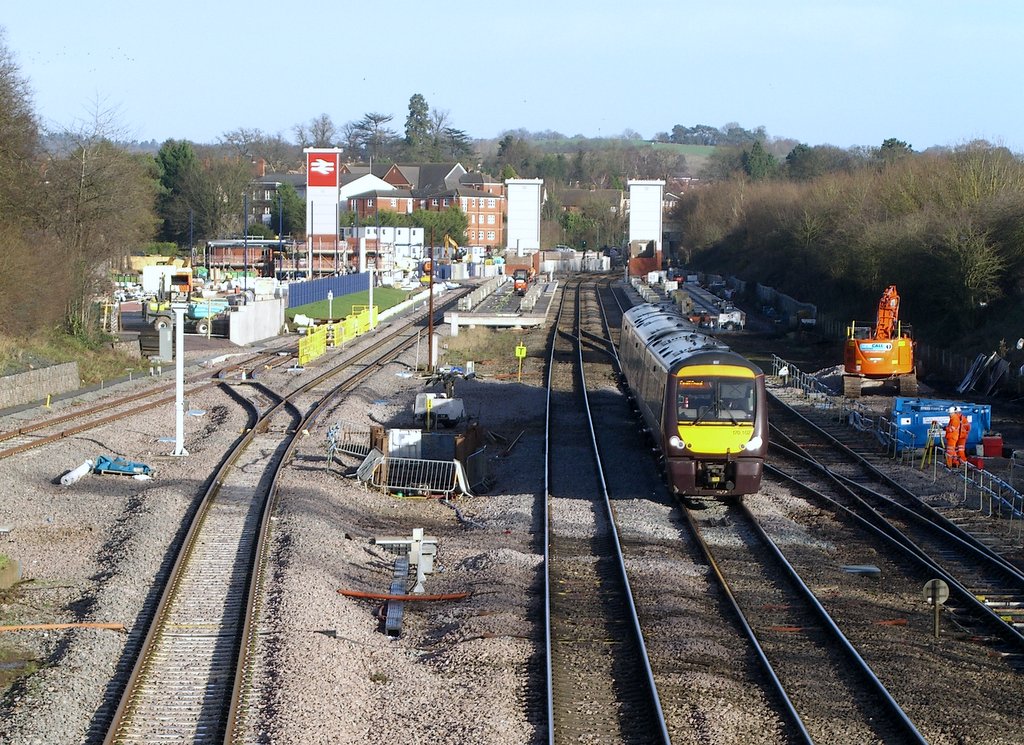
As I write, 175 years after a station was opened, Bromsgrove is having a new station. In fact, construction has been ongoing for almost two years now. After failing to meet a November 2015 schedule to open, the new station is expected to open by May this year. Maybe.

20151231 013

When I took the train occasionally into the University of Birmingham in the 1980s, there was only one platform, on the up line. The current station is just round the bend on the photo above. Trains arriving from Birmingham had to cross from the down line on to the up line, drop off or pick up passengers, then re-cross to the down line south of the station. Not really advisable. You can see the switch just behind this train heading south yesterday. Then a new platform was added on the down line. The main problem is that the platforms are short, and can only accept three-coach London Midland trains that stop at Bromsgrove., So with the growing commuter traffic into Birmingham, something needed to be done.

And that’s how the new station came about. It will have four island platforms, and trains stopping at Bromsgrove can be diverted off the main lines. Doing so will allow more trains to run per hour. Also, the line will be electrified as far as Bromsgrove, connecting the town into the wider West Midlands electrified commuter routes as far north as Lichfield. Freight trains heading up the Lickey Incline can wait in the branch on the left of the photo until they can have a clear—and slow—run at it. Sometimes in the summer, when we have the bedroom window open, and the wind is in the right direction, it sounds as though some of these freighters are headed right towards us. The rails on the extreme right have yet to be laid, and that can’t happen until the new station is open and the existing platforms decommissioned because the switch of the main line has to begin about where the current down line platform ends. That’s scheduled for October 2016, and the lines will be closed for 10 days while some major track engineering takes place, signalling is installed, and presumably the electrification completed.

The bridge where I took this photo is on one of my regular walks, so I have been watching progress over the past 21 months. I wish I’d taken photos more often. But what has been interesting to observe is the impressive kit that the engineers used to lift old track, lay new ones (that branch on the left replaced several different sidings), excavate culverts that had collapsed, and the like. Part of the delay in completing the project in 2015 was the need to decontaminate the site that had been an oil terminal for a major engineering works formerly alongside the railway, and reroute signalling and an underground stream that did not figure on any of the plans available to the engineers. There was a further delay, and a need to apply again for planning permission when it was discovered that the bridge connecting platforms would have to be raised just 14 inches to conform to EU regulations concerning the distance between a bridge and overhead electrification wires.

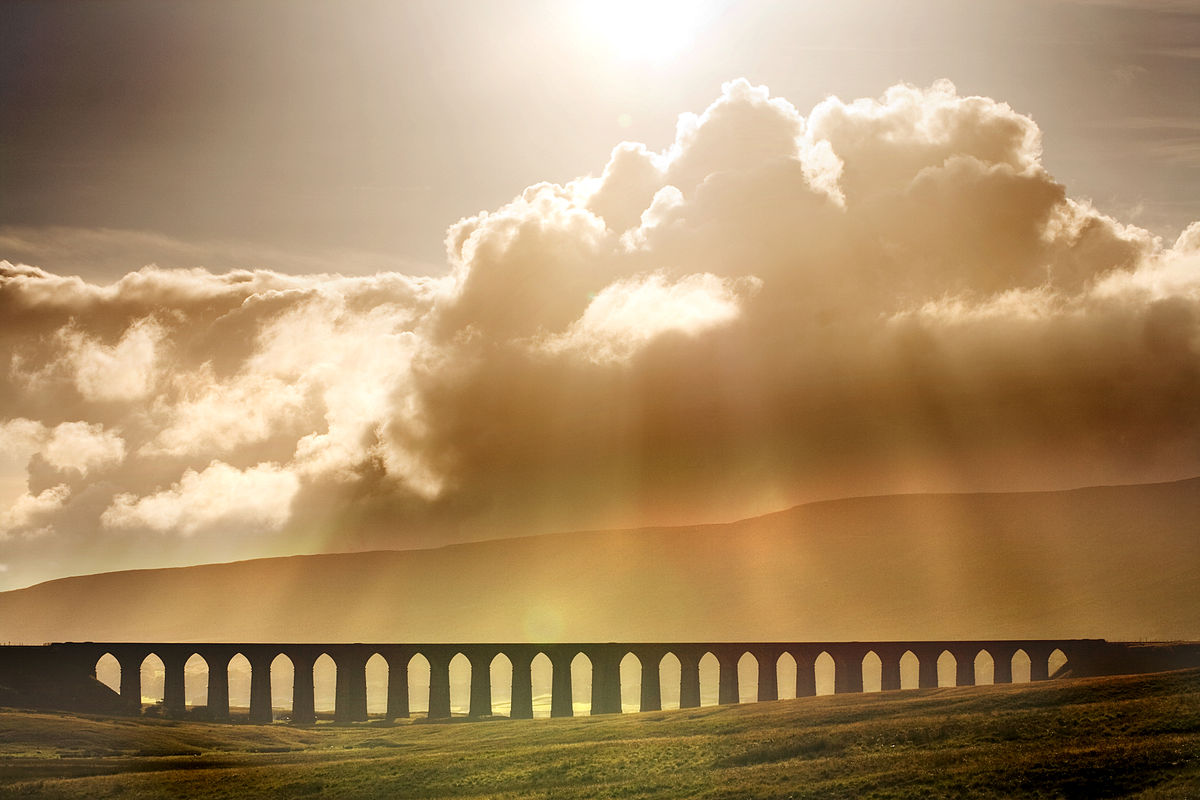
The Ribblehead Viaduct

Access to sophisticated equipment today really puts in context how the railways were first constructed, almost 200 years ago. And although much of the work would have been carried out by gangs of navvies, I guess by mid-Victorian times engineers would have had steam-powered machines available. Nevertheless, the construction of embankments, tunnels, and viaducts is surely an impressive feat of human enterprise. It was hard, dirty, and dangerous work in isolated locations where temporary communities sprang up—and men, women, and children died and were buried. This account of the Settle-Carlisle line and the construction of the Ribblehead Viaduct gives a sense of the isolation and hardship of building this railway.

These communities are being celebrated, if that’s the right word, in a new drama that started to air on the commercial ITV channel from 7 January.

Before the trains . . .
The rail network in the UK today is a shadow of its former glory, having been deliberately dismantled, maybe I should say restructured, in the 1960s by Dr Beeching.

But, to my mind, there’s an even more impressive example of civil engineering that began half a century before the railways were built.

I’m referring, of course, to the canals, and their construction began in the last quarter of the eighteenth century. And what’s particularly impressive, is that they were dug mostly by hand, by gangs of navvies.

Just a little over a mile to the east of the Lickey Incline is the Worcester and Birmingham, that has just celebrated its 200th birthday. Begun in 1791, it was finally completed in December 1815. I find it fascinating that construction of this canal wonder took place while Europe was in turmoil through the Napoleonic Wars and the final defeat of Napoleon at the Battle of Waterloo in June 1815.

At 29 miles long, the canal connects Worcester with Birmingham, climbing 130m (428 feet) over the same topographical feature that would tackled on the Lickey Inlcine half a century later. There are 58 locks; the Tardebigge Flight of 30 locks is the longest in the UK, raising the canal some 200 feet in just five miles between Stoke Bottom Lock to Tardebigge Top Lock. You can explore a detailed map on the website of the Canal & River Trust.

In addition to all the locks there are five tunnels, with a combined length of 2.4 miles.

The channels were dug by hand, and then lined with mud to make them ‘waterproof’ so the water did not leak away. A series of three reservoirs provide a constant supply of water, and at Tardebigge there is a disused pump house, once powered by steam to raise water to different levels in the Tardebigge Flight.

As I’ve mentioned in other blog posts, sections of the towpath along the canal from south of Stoke Prior and Tardebigge are some of my favorite walks in all seasons. Here is a selection of photographs that I have taken over the years. In some of them you can see the details of canal and lock construction because on a number of occasions sections of the canal had to be drained for maintenance. I always feel inspired and full of admiration for those hard-working labourers who set their backs to dig the Worcester and Birmingham Canal over 200 years ago.

Screaming like a wounded badger . . .

Well, I’ve never heard a wounded badger, but that’s what one of my neighbours told me I sounded like.

It was a week ago yesterday, Friday 8 January, just after 08:30. I’d just finished my breakfast and saw there were a few items of rubbish to add to the recycling bin that was already outside the house waiting for the bin men later in the morning. So I took them out.

We’d had a frost overnight, and I could see the frosted roofs. What I didn’t see was the black ice on the pavement. And the next thing I knew I was on my back, looking up at the sky, and screaming at the top of my lungs. From the intensity of the pain in my right foot I knew something wasn’t quite right.

I had waved to our neighbour Pat across the road who was working at her kitchen sink, but she apparently didn’t see me go base over apex. So it must have been a minute or so before she saw me on the pavement and came out to investigate. By then, my next door neighbour Kath and her daughter Sophie were on the scene. As my wife Steph has a hearing problem, she hadn’t heard the racket I was making, and had to be fetched—utterly bewildered. But ever the committed blogger that I am, I asked her to quickly fetch the camera and record the goings-on for posterity!

Now Kath is a theatre sister at the Royal Orthopaedic Hospital in Birmingham, and Sophie has just finished her nursing training. They were great, fetching blankets from the house to keep me warm, and contacting the emergency services for an ambulance.

An ambulance arrived after about five minutes, and it very quickly became clear that I would need a trip to Accident and Emergency (A&E) at the Alexandra Hospital in Redditch, just under nine miles away. Little did I expect the further drama that would ensue.

The two young ambulance technicians quickly had me inhaling laughing gas (nitrous oxide, N2O) while they removed my slipper and sock. From the odd angle of my foot it was clear there was a dislocation. But what other damage had I done?

A second ambulance was called, because the crew of the first were not licensed to administer morphine. And, in any case, they jokingly said I was too heavy to lift off the ground. The second ambulance with two male crew quickly arrived, and before I knew it I was lifted into the ambulance, a number of ‘vital signs’ checks accomplished, accompanied by liberal puffs of laughing gas, and we were headed to the Alex.
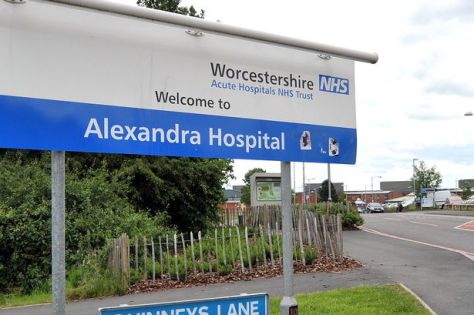
alexandra-hospital-redditch-entrance

On arrival at A&E I was immediately wheeled into a bay and attended to. I knew that my ankle was dislocated. I didn’t realise then that there was also a fracture. But before they could do anything else, they had to get my foot straight. And this is what I’d been dreading. One of the nurses showed me how to inhale the laughing gas for optimum effect, taking deep breaths and holding the gas in my lungs. As they could see it taking effect, and on my third deep breath, one of the doctors took hold of my foot, and swiftly jerked it back into alignment. They then proceeded to wrap my foot, ankle and leg in plaster. Pain? It certainly brought a tear to my eye. Then, with a cannula inserted into my wrist, they gave me a strong dose of morphine and things seemed to settle down. I was sent to X-ray twice, and by about 2 pm a bed had become available on Ward 17 (Trauma and Orthopaedic).
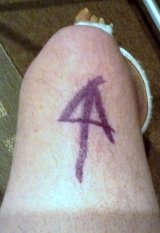
20160112 002The Mark of Zorro
Funnily, one of the first things they did in A&E was to draw a large arrow on my right leg, just above the knee, in permanent ink, just so everyone knew exactly which side had been injured. And although I knew I’d fractured the fibula, what I had not expected was an operation to sort this out.

I’d last eaten and had something to drink just before 08:30, so I was kept on a fast—NBM (Nil By Mouth) for the rest of the day, with the expectation I would go to theatre later on Friday. By 9 pm it was clear that my operation would not take place, so I was permitted a cup of tea and something to eat. Tuna mayo sandwiches have never tasted so delicious! However, I went back on to NBM at midnight so I could go to theatre early on Saturday.
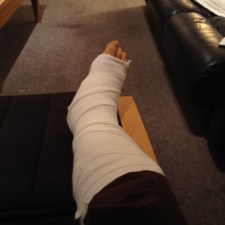
IMG_1351My operation was continually delayed throughout Saturday because other higher priority patients had been admitted for emergency treatment. Anyway, my turn came around just after 8 pm. By then I was climbing the wall I was so thirsty and hungry. I was back on the ward just after midnight, operation apparently successful. The surgeon inserted a 10 hole steel plate to repair the fractured fibula, and also tied together the tibia and fibula low down where I’d damaged all those ligaments, to provide additional strength. My leg is in another heavy cast.

And so it will remain until I return next Tuesday to the fracture clinic at the Alex when I hope to have this plaster cast replaced by a ‘boot’ that will be lighter and very strong. The consultant has to remove the plaster cast in any case as he needs to observe how well my incision is healing, on both sides of my leg.

I came out of hospital on Monday afternoon, and have been getting around the house with the aid of a Zimmer frame. It’s not easy and you don’t realise just how much you rely on two fully functioning limbs to accomplish even the simplest of tasks. Fortunately we have a large three-seater leather sofa (that we purchased in Costa Rica in 1976) that is comfortable to sleep on, and with a duvet wrapped round me, and with my usual pillows, I’m as ‘snug as a bug’ each night. We have a downstairs toilet and wash basin, and the dining room/kitchen is just a few hops away. So I’m all set here on the ground floor, not exactly waited on hand and foot by Steph, but she is looking after me very nicely, thank you.

I’ll be like this for the next six weeks at a minimum, and the surgeon already told me it could be as long as 12 weeks before I’m signed off. There’s going to be many weeks of physiotherapy once I’m able to put some weight on my ankle. Hopefully it will be possible to arrange physiotherapy appointments at our local Princess of Wales Community Hospital here in Bromsgrove rather than having to travel each time to the Alex.

And talking of the Alex, let me get a couple of things off my chest that came to mind as I was lying there on Ward 17.

The Alex is part of the Worcestershire Acute Hospitals NHS Trust (along with hospitals in Worcester and Kidderminster). It’s fair to say that in the past couple of years, the Alex has been in and out of the news, for all the wrong reasons.

Opened in 1985, the Alex has 360 beds, serving a population over 200,000. Due to problems in staff recruitment, the maternity unit was temporarily closed last November, and all expectant mums are now sent to Worcester. There has been a stream of criticism over poor patient care and cleanliness in the Alex. In February 2015, four A&E consultants resigned. Clearly there has been some sort of crisis, although I haven’t kept up to date with what has actually been going on.

All I can say is that the treatment and care I received at the Alex, from the first minutes in A&E, in X-ray, on Ward 17, in theater, and physiotherapy, was fantastic. I was treated with respect, with compassion, and continual good humour. On Ward 17 the staff couldn’t do more for the patients. I observed good levels of hygiene; patients were never neglected, and response to call buttons was almost immediate.

The other issue that came to mind very early on is that the Alex could not function—in all departments—without the services provided by EU and non-EU nationals who have come to this country and contributing to make it a better place. And I should add, persons of many faiths: Christian, Hindu, Muslim, and probably several others. It’s about time Nigel Farage and his Ukip morons as well as those right-wingers in the Conservative Party accepted the immense contributions that immigrants are making to the well-being of this country of ours. It’s time to stop denigrating them as a group of spongers only interested in benefitting from our welfare system.

So although I would never choose to spend four days in hospital, it was a positive experience, and made me appreciate the selfless service, through long hours, that staff in the National Health Service provide. Hopefully I can build on those positive thoughts to help me through the next few months of recuperation. I hope it won’t be too long before I’m able to get out and about and enjoy our National Trust and English Heritage visits once again.

After three months (1 April)
Today, it’s exactly 12 weeks since I had my accident. Three months! How time flies when you’re enjoying yourself.

I am making great progress. And that’s no April Fools’ prank.

Last Tuesday (29 March) I attended my last Fracture Clinic appointment at the Alexandra Hospital. The consultant surgeon told me I was making good progress, and there would be no need to return—unless something untoward crops up. So, for the next three months I have an ‘open appointment’. The surgeon explained that the swelling in my ankle and leg is likely to persist for up to 12 months! And I do need to take care when out and about. It will still be a slow rehabilitation. Nevertheless, he has discharged me. I’m walking (with a stick) but without my ‘moon boot’, and now up to about 1 mile each walk (longer when I used the boot). I think I’ll be using the sticks for some months to come because the pavement here are so uneven. And I do fear twisting my ankle. That would certainly set me back.

He told that I could now drive, provided I feel comfortable with that, and in using the brake in an emergency there’s no pain. I’m also allowed to fly, so can begin to think about my travels this year.

So, yesterday, taking advantage of the beautiful weather, Steph and I went out for a short spin in the car, to The Jinney Ring Craft Centre, a few miles southeast of Bromsgrove, near the village of Hanbury. The drive was fine; no discomfort. Later this morning I have another physiotherapy session, perhaps the last one. Onwards and upwards!


Since I posted this blog in mid-January, I also wrote several updates, listed below.

A Balanced Diet: the year in review

I started this blog just under four years ago. Since then, I guess I must have written at least 300,000 words in 280 posts, probably many more. And 2015 has once again been a busy blogging year (76 posts including this one), with stories about our tour of Scotland, a September visit to the USA (including a trip to Chicago), and our National Trust and English Heritage visits. The obituary I wrote for an old friend, Trevor Williams, caught the attention of many of his past students all around the world; I also wrote about other former colleagues who passed away.

I’m always surprised at what catches everyone’s attention, and where my readers come from (160 countries during this year). And some stories written in previous years continue to run, on and on, such as those about genetic resources, and my trip to Buckingham Palace on Leap Year Day in 2012 to be invested as an Officer (OBE) of the Most Excellent Order of the British Empire, or cricket.

One of my favorite posts has to be that about our visit to the Fitzgerald Theater in St Paul, Minnesota in September, to watch a live broadcast of the long-running radio variety show broadcast each Saturday on Minnesota Public Radio (MPR), A Prairie Home Companion, hosted by Garrison Keillor.

So, it’s quite interesting to read the 2015 annual report for this blog prepared by the WordPress.com stats helper monkeys.

Here’s an excerpt:
The concert hall at the Sydney Opera House holds 2,700 people. This blog was viewed about 33,000 times in 2015. If it were a concert at Sydney Opera House, it would take about 12 sold-out performances for that many people to see it.

You can read the full report here.

2015: a great year for National Trust and English Heritage visits

Steph and I have been members of the National Trust for five years now. We even qualify for the Seniors discount from January! And we’ve been members of English Heritage for just a year.

But we will be renewing our membership of both organizations in 2016. Why? Because they both offer excellent value for money, and certainly give purpose to our trips out, whatever the weather. Be it a visit to a stately home, a ruined castle, a country park, or a beautiful garden, there are so many properties to visit and experience so many aspects of our cultural heritage.

Looking back on our 2015 visits we have certainly had our money’s worth, and annual membership has more than paid for all the entrance fees we would have had to pay in any case. And much more!

So here is a pictorial summary of our great visits this past year, beginning in early April and ending just last week when we visited Charlecote Park to see the Christmas decorations. And there are links to individual posts about each visit.

NATIONAL TRUST

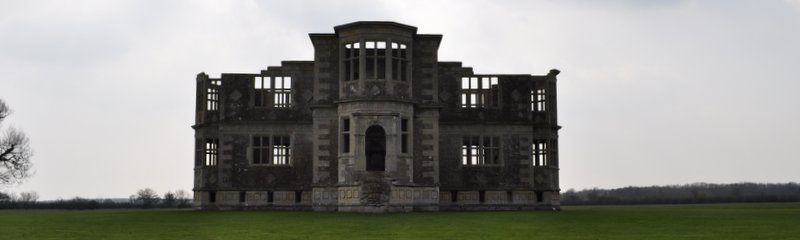
Lyveden New Bield (9 April)

20150409 092 Lyveden

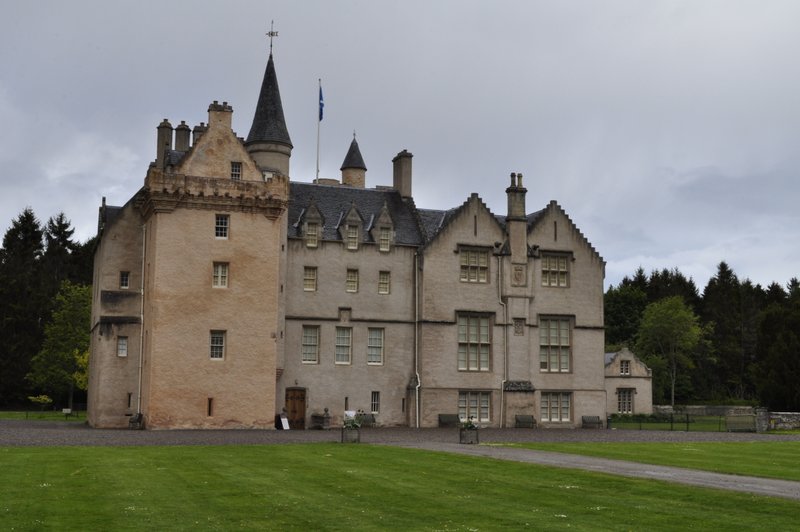
Brodie Castle (National Trust for Scotland – 29 May)

Brodie Castle

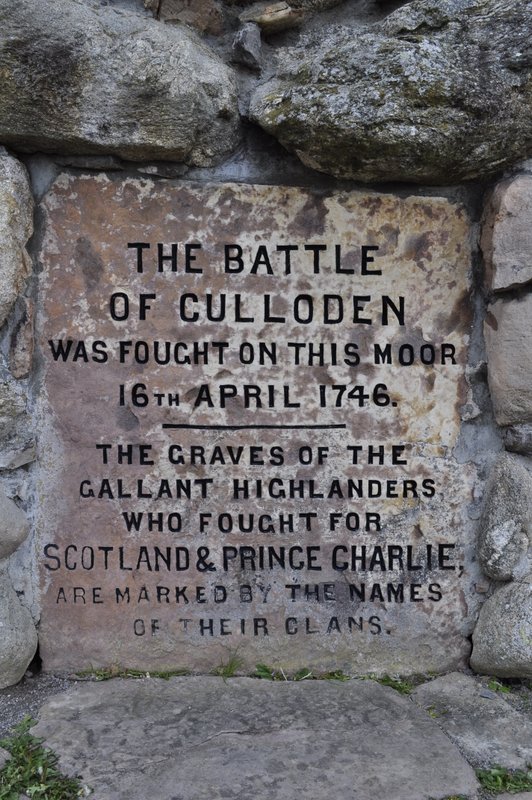
Culloden Battlefield (National Trust for Scotland – 29 May)

Scotland 082

Inverewe Garden (National Trust for Scotland – 1 June)

Scotland 312

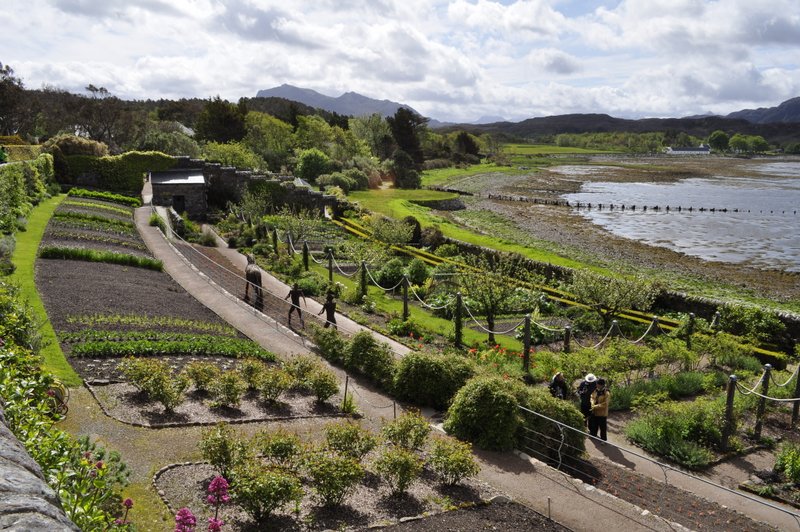
Arduaine Garden (National Trust for Scotland – 7 June)

Scotland 877

Rufford Old Hall (8 June)

The main entrance in the seventeenth century wing.

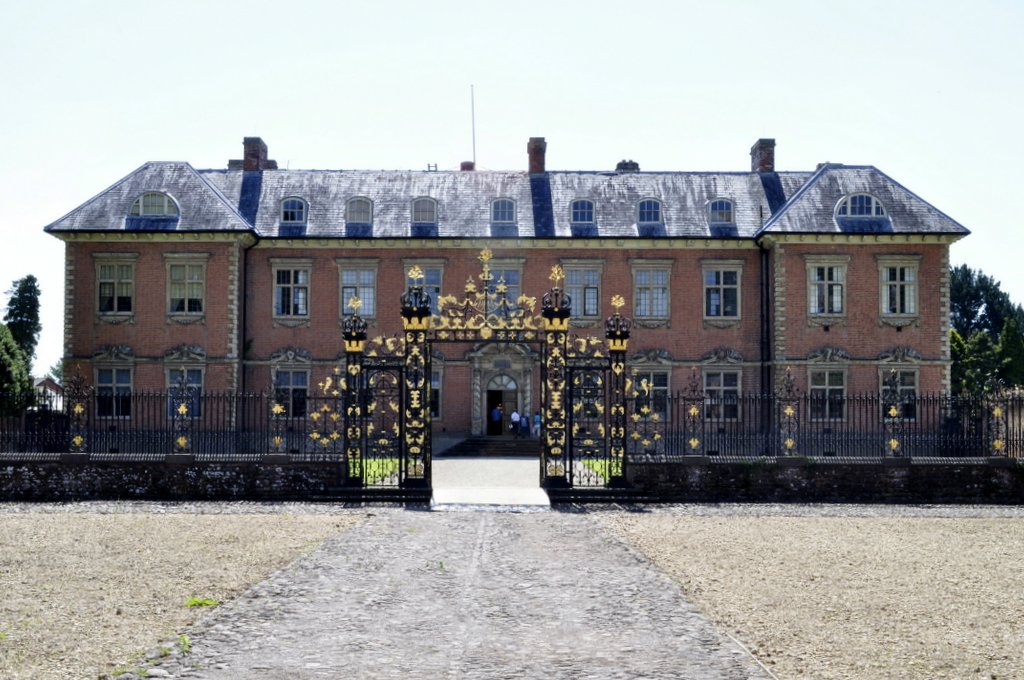
Tredegar House (18 June)

Tredegar House, near Newport in South Wales

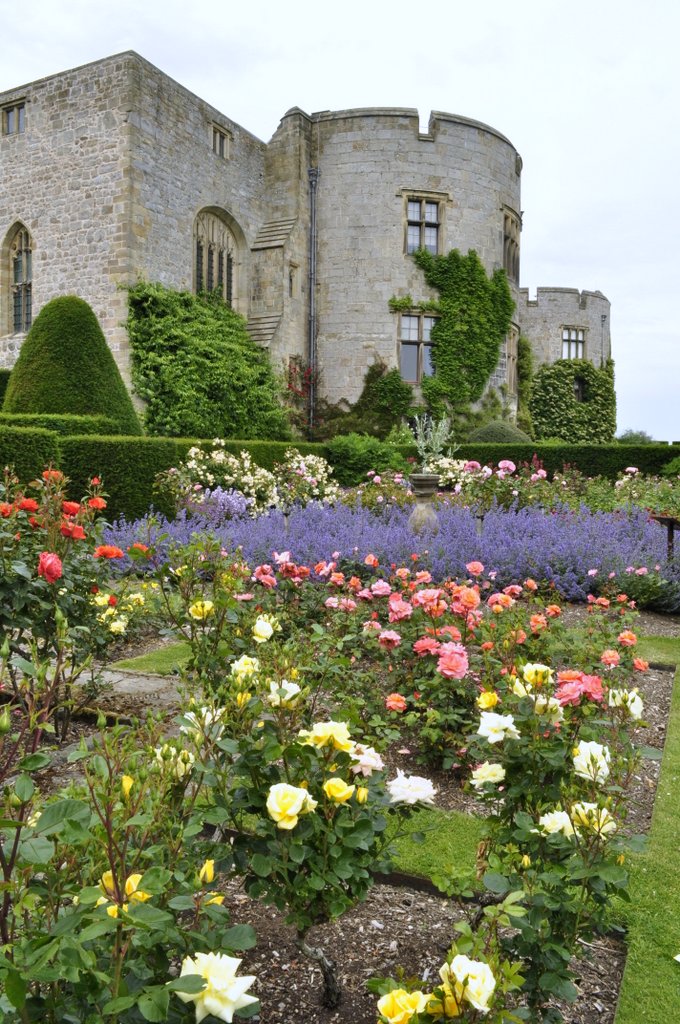
Chirk Castle (1 July)

20150701 147 Chirk Castle

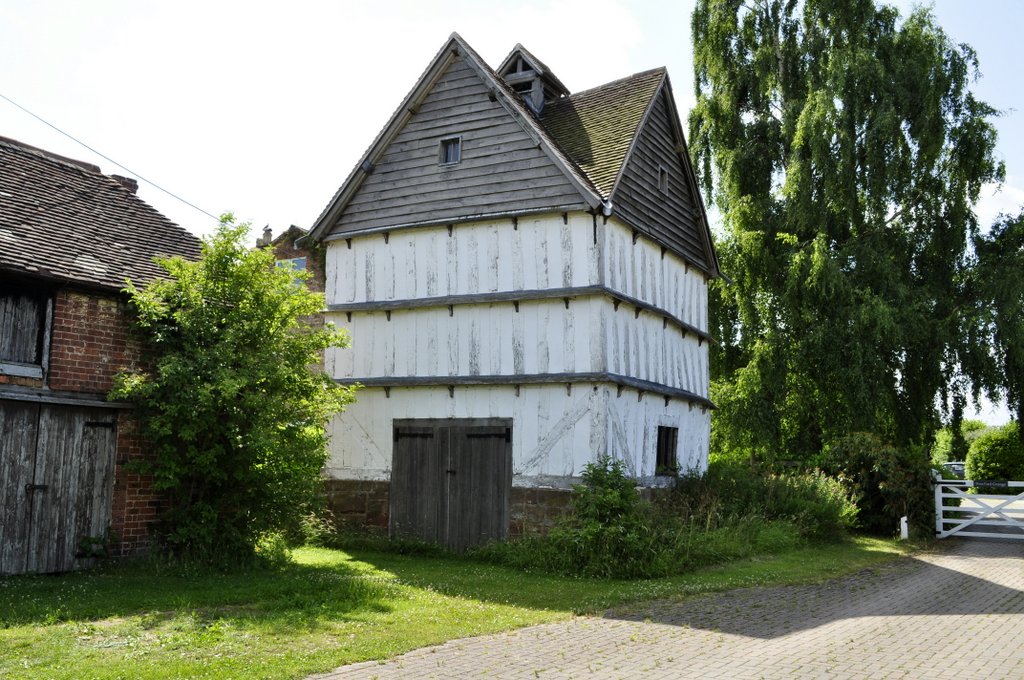
Hawford Dovecote (9 July)

20150709 010 Hawford dovecote

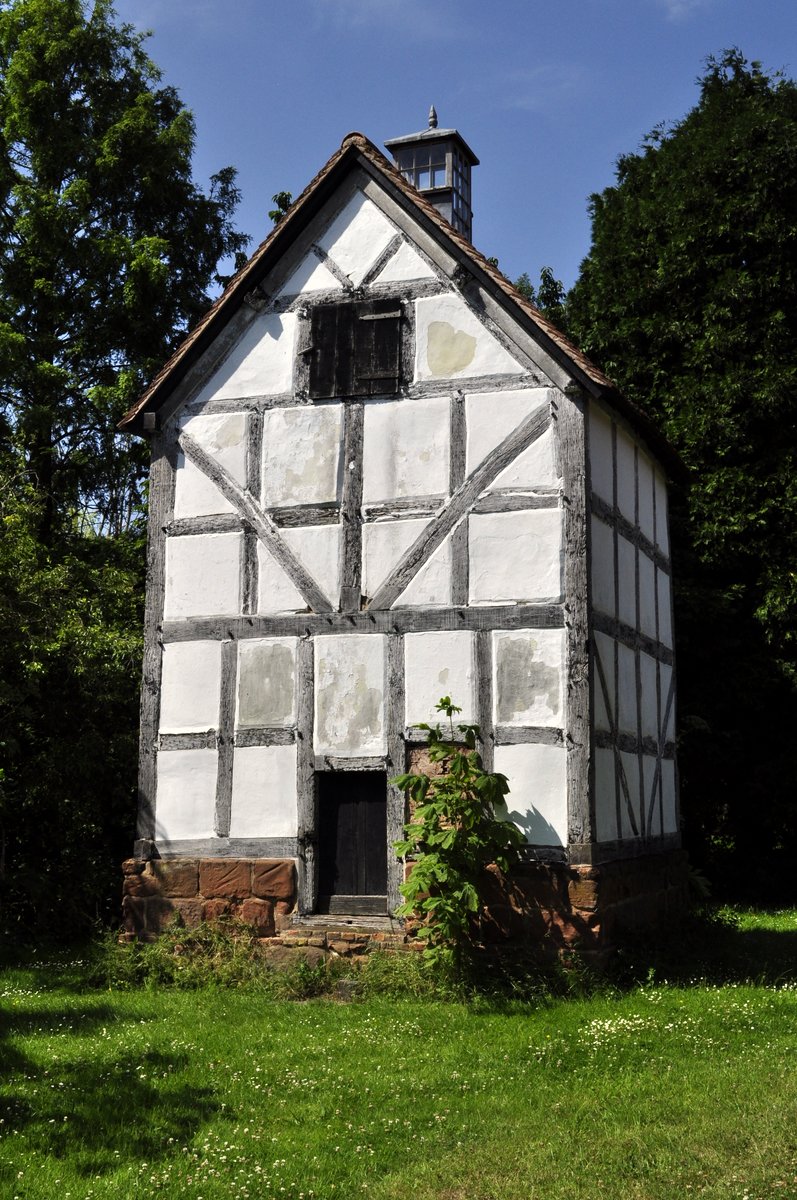
Wichenden Dovecote (9 July)

20150709 022 Wichenford dovecote

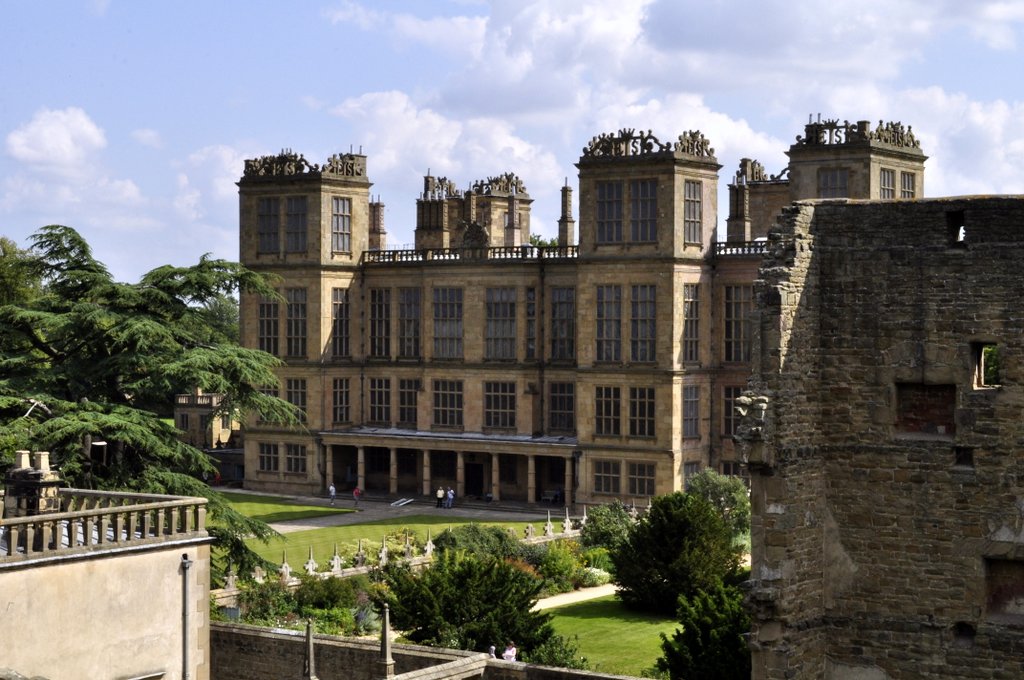
Hardwick Hall (12 August)

Hardwick Hall, Derbyshire

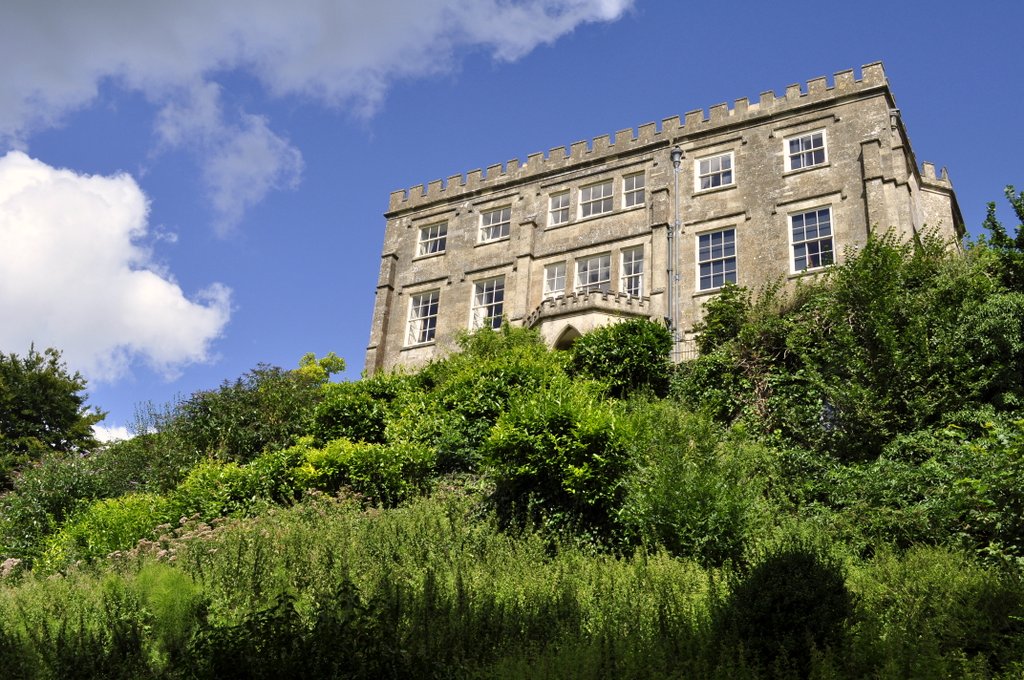
Newark Park (28 August)

20150828 031 Newark Park

Croome Park (12 October)

20110328046 Croome Court

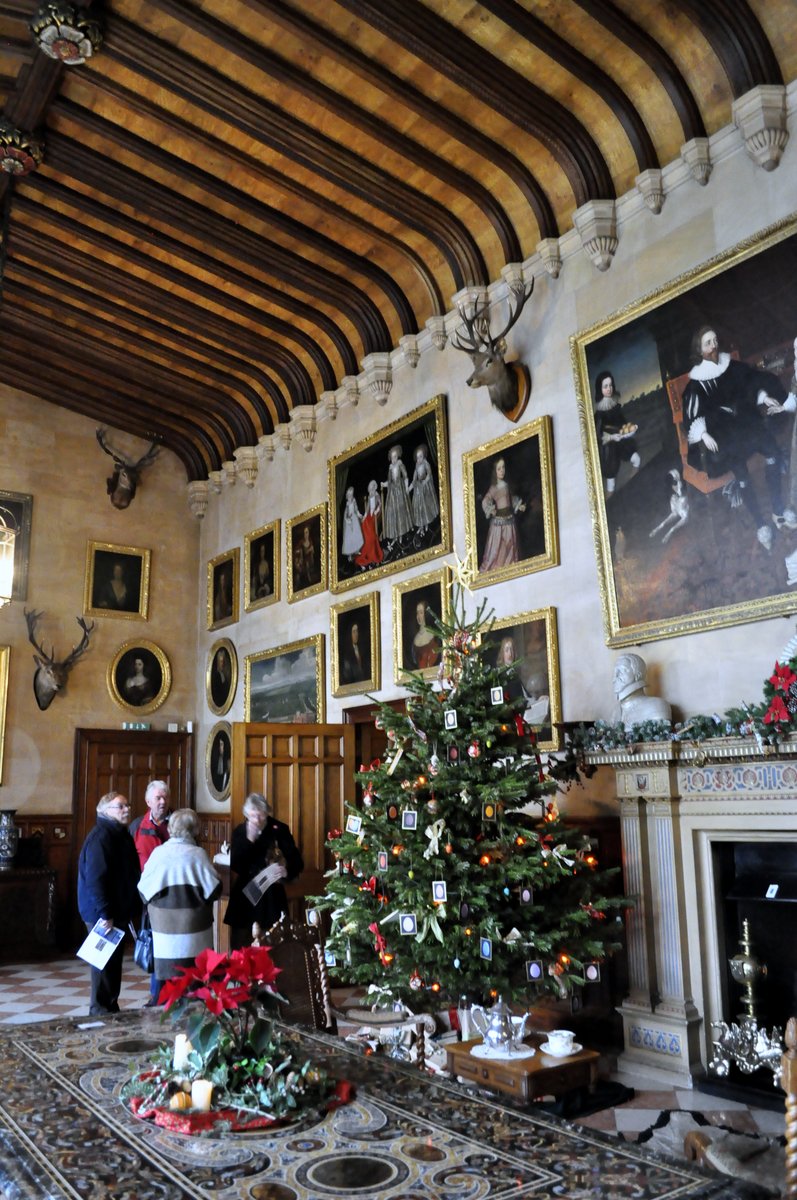
Charlecote Park (16 December)

The entrance hall.

ENGLISH HERITAGE

Rushton Triangular Lodge (9 April)

Rushton Triangular Lodge, Northamptonshire

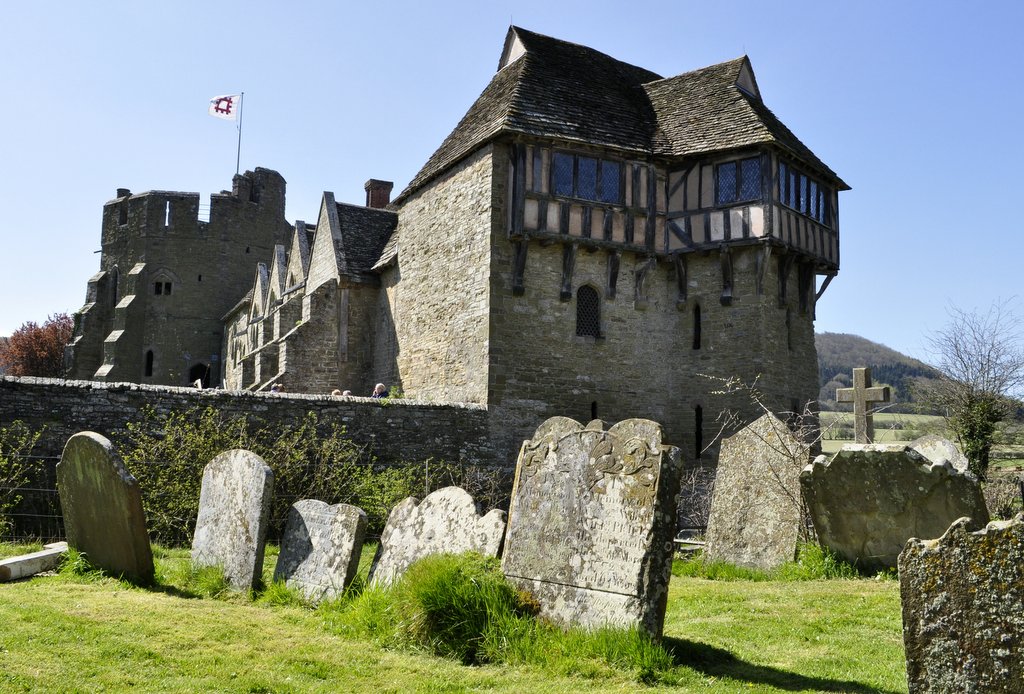
Stokesay Castle (14 April)

Stokesay Castle, Shropshire

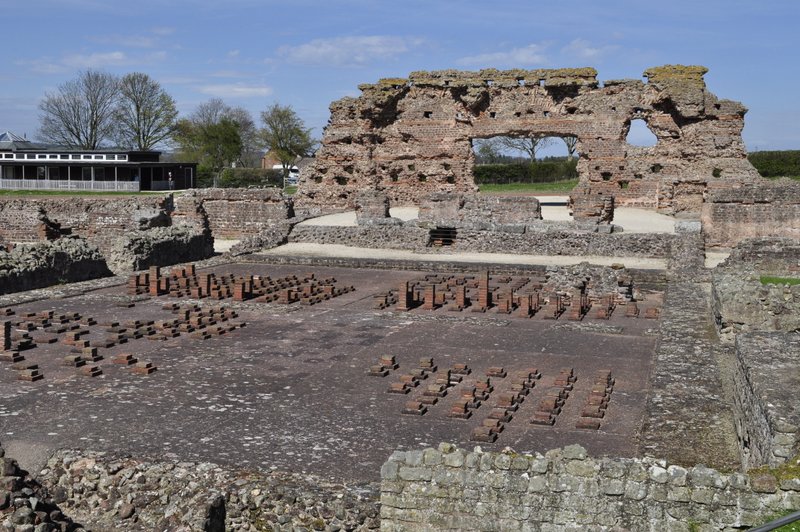
Wroxeter Roman City (14 April)

20150414 130 Wroxeter Roman city

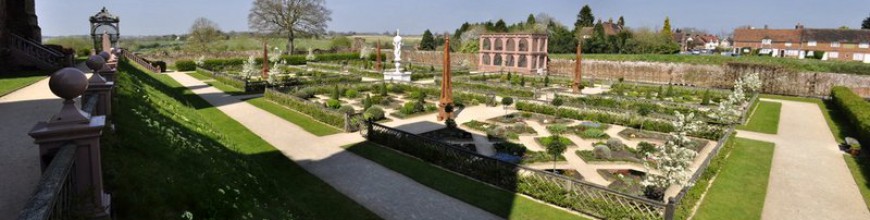
Kenilworth Castle (21 April)

cropped-20150421-023-kenilworth-castle.jpg

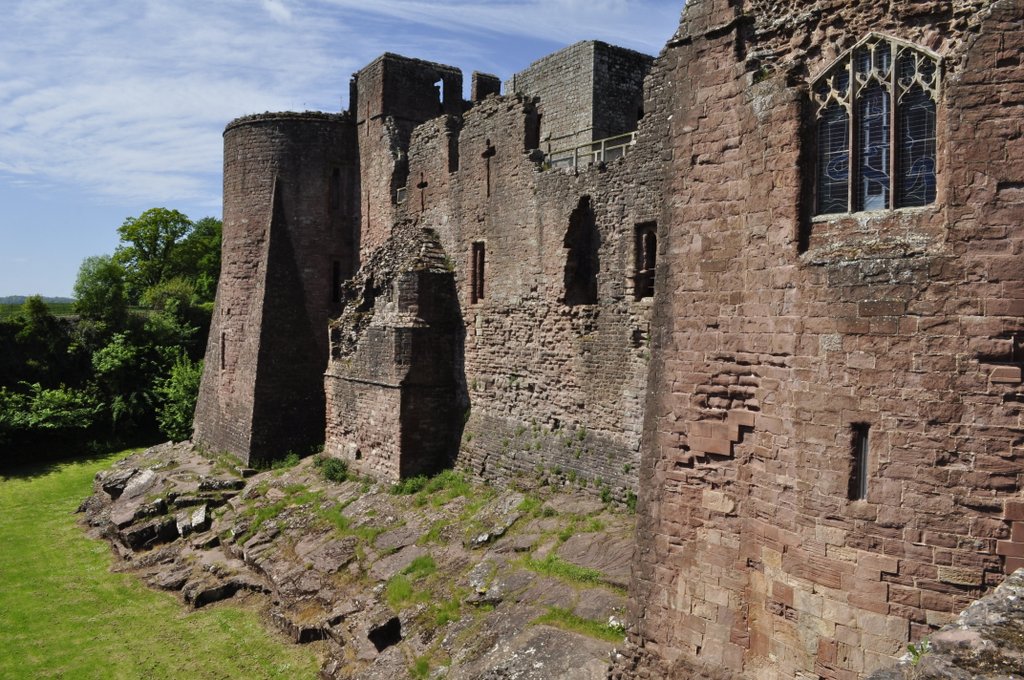
Goodrich Castle (21 May)

Goodrich Castle, Herefordshire

St Mary’s Church, Kempley (21 May)

20150521 135 St Marys Kempley

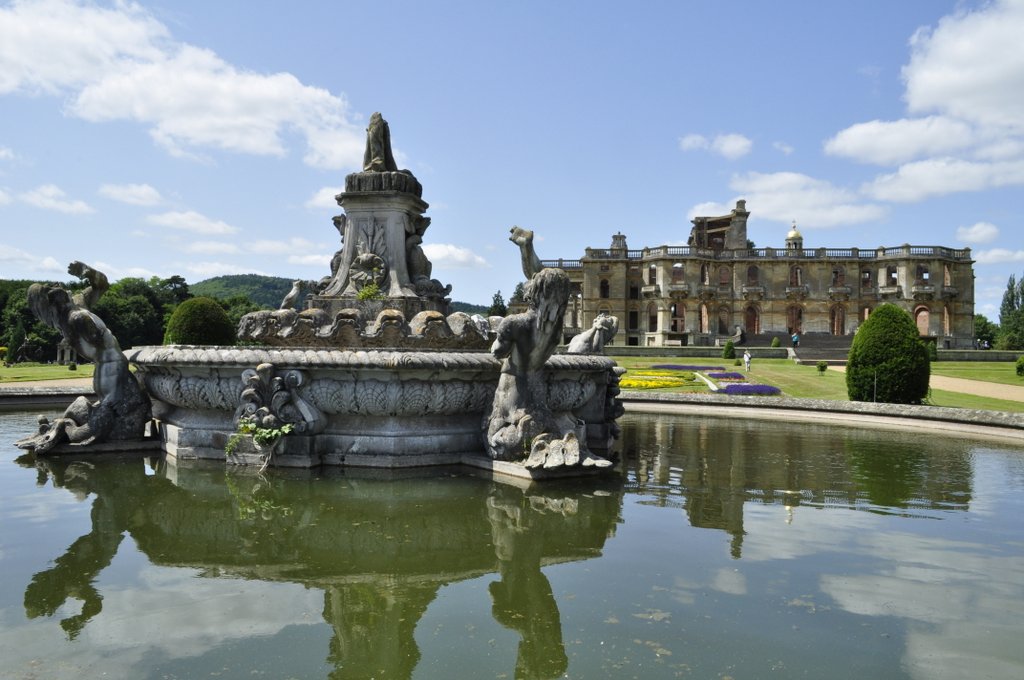
Witley Court (9 July)

20150709 091 Witley Court

Hardwick Old Hall (12 August)

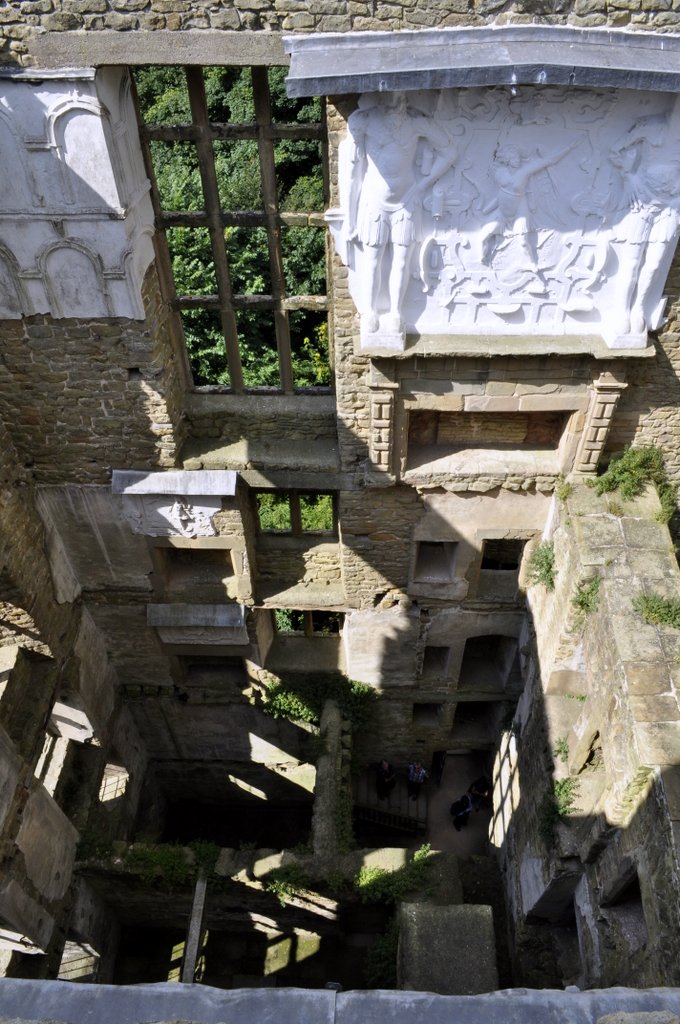
Looking down six floors in the Old Hall. And the magnificent plasterwork on the walls.

Wenlock Priory (18 August)

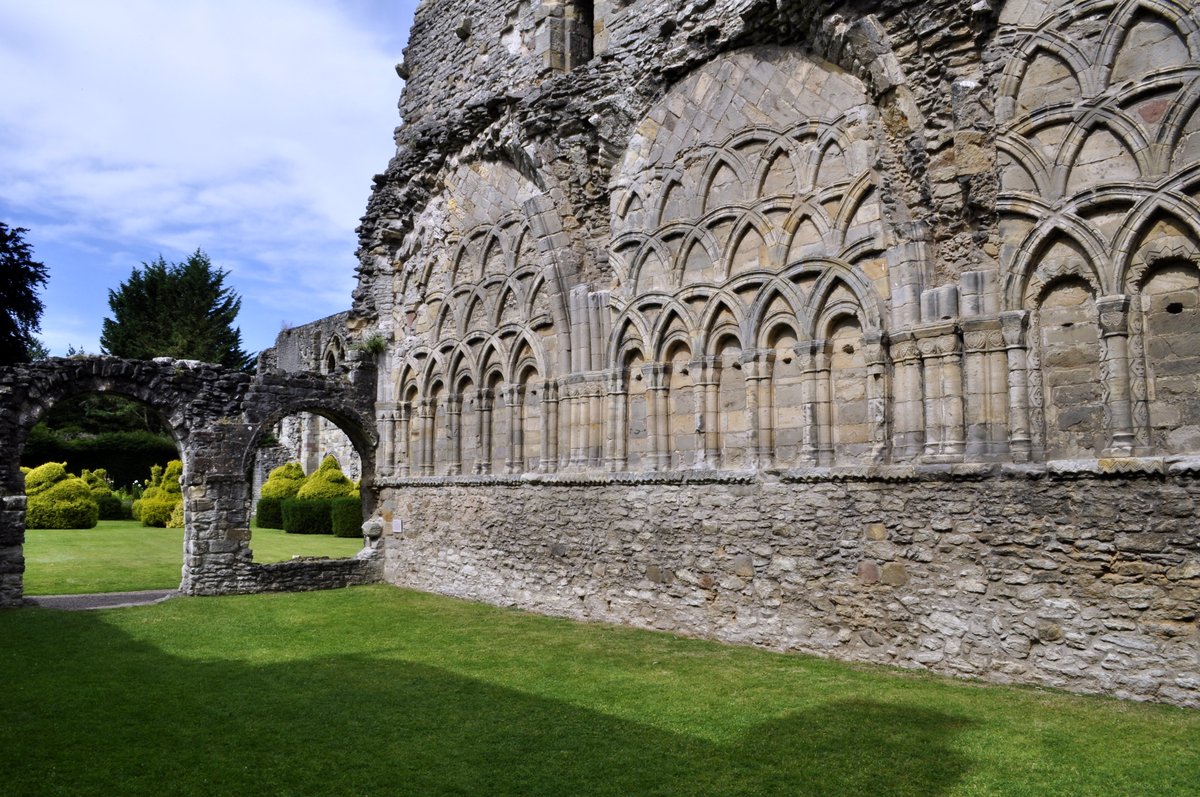
20150818 043 Wenlock Priory

Ironbridge (18 August)

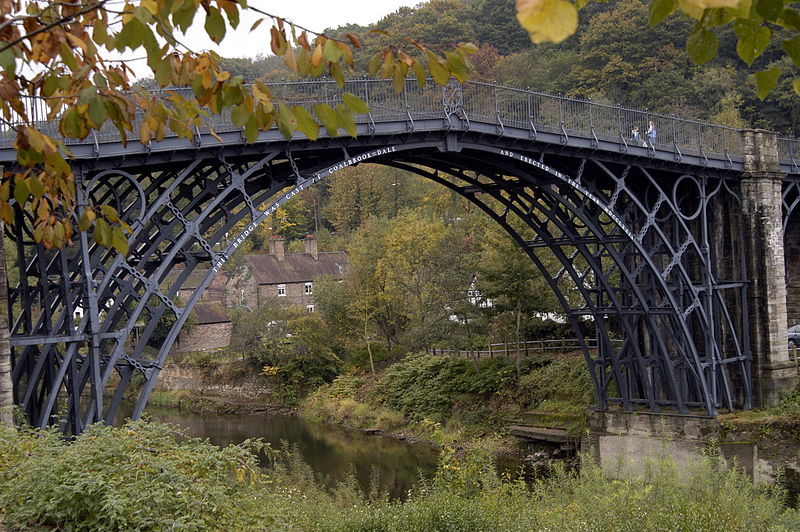
From: http://en.wikipedia.org/wiki/File:Ironbridge

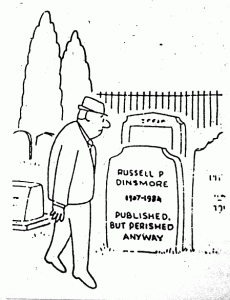
It’s publish or perish, Jim – but not as we know it

perishOr to put it another way: The scientist’s dilemma . . . Where to publish?

Let me explain.

It’s autumn 1982. And just over a year since I joined the faculty of The University of Birmingham. Our department had a new Mason Professor of Botany, someone with a very different academic background and interests from myself.

At one departmental coffee break several of us were sitting around discussing various issues when the topic of academic publishing came up.

“In which journals do you publish, Mike?” the new head of department asked me. 1355408371_883_00_800I told him that I’d published several papers in the journal Euphytica, an international journal covering the theoretical and applied aspects of plant breeding. It’s now part of the Springer stable, but I’m not sure who was the publisher then.

His next question surprised me. It’s not an exaggeration to say that I was gob-smacked. “Is that a refereed journal?” he asked, and went on to explain that he’d never even heard of Euphytica. In my field, Euphytica was considered then as an excellent choice for papers on genetic resources. In a sense he was valuing my academic output based on his ‘blinkered’ view of our shared discipline, botany, which is after all a broad church.

10722Springer now has its own in-house genetic resources journal, Genetic Resources and Crop Evolution (I’m a member of the editorial board), but there are others such as Plant Genetic Resources – Characterization and Utilization (published by Cambridge University Press). Nowadays there are more journals to choose from dealing with disciplines like seed physiology, molecular systematics and ecology, among others, in which papers on genetic resources can find a home.

But in the 1970s and 80s and beyond, I’d always thought about the visibility of my research to others working in the same or allied fields. My research would be of little or no interest to researchers beyond genetic resources or plant breeding for example. So choice of journal in which to publish was predicated very much on this basis. Today, with online searches, the world’s voluminous scientific publishing is accessible at the click of a mouse, it’s perhaps less important exactly where you publish.

Back in the day we had to seek out a hard copy of a journal that interested us, or use something like Current Contents (I’m surprised that’s still going, even in hard copy) to check, on a regular basis, what was being published in various journals. And then contact the author for a reprint (before the days of email).

I can remember way back in the mid-1980s when I had to write a review of true potato seed, when you had to pay for a special literature search through the university library. Now everyone can do it themselves—from their own desk. Nowadays you just search for a journal online, or tap in a few key words, and Hey Presto! there’s a list of relevant papers, complete journal contents lists, abstracts, and even full papers if your institute has a subscription to the journal or the article itself is Open Access.

So the dynamics of scientific publishing have changed from the days when I first began. In some respects then scientific publishing has never been easier but then again never more challenging. Not only are scientists publishing more but they are expected to publish more. Sink or swim!

About a year ago, I was ‘invited’ to join ResearchGatea social networking site for scientists and researchers to share papers, ask and answer questions, and find collaborators. Since then I receive almost daily (if not more frequent) stats about my science publications and who is citing them. It’s obviously quite gratifying to know that many of the papers I published over the decades are still having scientific traction, so-to-speak. And ResearchGate gives me a score indicating how much my papers are being cited (currently 32.10—is this good? I have no idea). There’s obviously no metric that determines the quality of these papers, nor whether they are being cited for good or bad.

In the 1980s there was some discussion of the value of citation indices. I remember reading an interesting article in an internal University of Birmingham newsletter, Teaching News I think it was called, that was distributed to all staff. In this article the author had warned against the indiscriminate use of citation indices, pointing out that an excellent piece of scholarship on depopulation in rural Wales would receive a much lower citation than say a lower quality paper on the rise of fascism, simply because the former represented a much narrower field of academic pursuit.

Today there are so many more metrics, journal impact factors and the like that are taken into account to assess the quality of science. And for many young researchers these metrics play an important role—for good or bad—for the progression of their careers. Frankly, I don’t understand all of these, and I’m glad I didn’t have to worry about them when I was a young researcher.

David_Colquhoun

Prof. David Colquhoun, FRS

And there are many pitfalls. I came across this interesting article on the blog of Professor David Colquhoun, FRS (formerly professor of pharmacology at University College London) about the use (and misuse) of metrics to assess research performance. There was one very interesting comment that I think sums up many of the concerns about the indiscriminate use of publication metrics:

. . . in six of the ten years leading up to the 1991 Nobel prize, Bert Sakmann failed to meet the metrics-based publication target set by Imperial College London, and these failures included the years in which the original single channel paper was published and also the year, 1985, when he published a paper that was subsequently named as a classic in the field. In two of these ten years he had no publications whatsoever.

Application of metrics in the way that it’s been done at Imperial and also at Queen Mary College London, would result in firing of the most original minds.

We seem obsessed by metrics. And whenever there is a request for publication metrics for whatever purpose, there are always perverse incentives and opportunities to game the system, as I discovered to IRRI’s cost during the CGIAR annual performance exercise in the late ‘Noughties’. And when the submitted data are scrutinized by someone who really does not understand the nature of scientific publishing, then you’re on a slippery slope to accepting scientific mediocrity.

The passion and intemperance of ignorance . . .

This past weekend, I was called a liar on Facebook. Not once. But three times.

Well, I’ve been called many things over my career but never a liar when it comes to my science. Back in the day that would have been sufficient cause for challenging the perpetrator to a duel. Instead, I’ll just blog about this incident.

The background I guess to this whole episode is a flurry of Facebook posts after ‘the Supreme Court of the Philippines recently ordered a permanent ban on field trials of genetically engineered (GE) eggplant and a temporary halt on approving applications for the “contained use, import, commercialisation and propagation” of GE crops, including the import of GE products. The court ruled in favour of Greenpeace Southeast Asia, as well as several Filipino activists, academics and politicians.’ This ban also affects the work of the International Rice Research Institute (IRRI) with regard to its research on Golden Rice.

The decision of the court invalidates the Department of Agriculture’s Administrative Order No. 08-2002 (DAO8).  The Department of Agriculture and the Department of Science and Technology may not issue any GE approvals until a new Administrative Order is approved. This seems an odd decision, especially since biotech maize (Bt/Ht maize) has been grown commercially in the Philippines since 2003.

While Greenpeace and other opponents of GM technology are undoubtedly elated by this turn of events, the Supreme Court’s decision has been widely condemned among the scientific community, none perhaps more powerfully than Filipino geneticist Michael Purugganan (the Dorothy Schiff Professor of Genomics, Professor of Biology, and Dean for Science at New York University) reported on the www.rappler.com website.

tolentino-contactThere then followed a number of posts on Facebook. The latest spat at the weekend began after I had read something posted by Dr Bruce Tolentino (IRRI’s Deputy Director General – Communication and Partnerships) about the value of GMOs. He was citing a recent article by computational biologist Grant Jacobs on the New Zealand Sciblogs, titled GMOs and the plants we eat: neither are “natural”.

This is what Jacobs wrote and which caused the subsequent furore on Facebook:
Some say that genetically modified plants are a concern because they’re genetically modified organisms (GMOs), that “natural” plants are safer.

Yet what most people call “natural” foods are rare mutants that have been selected or have been artificially bred (or often both). They have much more dramatic genetic changes than GMOs. Changes that scientists are still learning about.

Foods we eat today bear little resemblance to the wild species they were originally derived from. Even plants that we might not at first consider to be cultivated have been selected for many hundreds or, more usually, thousands of years.

LOGOGREENPEACECOLORThree hours after Bruce had posted the link to Jacobs’ blog piece, this comment was posted by someone affiliated to Greenpeace Sweden, Mr Stefan Bruhn:
‘Who is paying you for your lies Bruce Tolentino? Monsanto? Of course natural plants are safer since they have been consumed for hundreds or, more usually, thousands of years. And no, GMOs are not unsafe because they are GMOs, they are unsafe because they haven’t been properly tested. Further, most types of GMOs are crafted to be immune to toxics, which increases the use of toxics. And Monsanto owns the patent to the majority of GMOs, and Monsanto is evil. Stop lying your ass off for money you fraudster.’

stefan-bruhn-160x185Well, I was quite shocked to see such a response so decided to discover who had made such a wild—and unfounded—accusation. Mr Bruhn (an erstwhile Facebook ‘friend’ of Bruce’s) is a political science graduate from Lund University who is listed on the Greenpeace site as having a responsibility for Donor Relations and Marketing (although ‘off duty’ right now, whatever that means). He has has worked at Greenpeace for almost 13 years.

I couldn’t resist adding a comment myself, and suggested that Mr Bruhn’s comment had been uncouth. I also made a link to something I had posted on my blog posts earlier in the year about GMOs after a Golden Rice field trial in the Philippines had been trashed by activists. Unfortunately I spelled his first name ‘Stephan’ rather than ‘Stefan’, and that appeared to have incensed him in subsequent comments:
‘Pity that you don’t even have the decency to spell my name right. Pity that you are trying to make people believe that GMOs are natural. Since when did fish naturally mate with tomatoes and strawberries? You know what is truly uncouth? Lying to people just to make more money.’

He then directed me to this blog by Green Diva Meg where there are some truly wacky ideas about GMOs and technology being promoted as ‘truth’ without incontrovertible scientific evidence. He followed up with:
‘You people are LIARS, you lie so good that you even believe it yourself.’

Some of the things mentioned in that Green Diva Meg blog reminded me of the Penn and Teller Bullshit video I had posted elsewhere (there’s some strong language), and in which GM myths promoted by the likes of Greenpeace are debunked.

Mr Bruhn again raised the ‘Monsanto bugaboo’. I agree that Monsanto did not play a particularly responsible role during the 1980s in the UK when the deployment of GMOs was first being explored; Monsanto’s response (or lack of response) set back biotechnology in the UK from which it has yet to fully recover. But to lay the blame at Monsanto’s door for everything that activists like Greenpeace believe is wrong about GM technology is not only unwarranted but egregious. They obviously have not fully understood how the technology for the development of Golden Rice, for example, has been donated by industry and placed in the public domain for the benefit of humanity. Nor the involvement of philanthropic foundations like the Bill & Melinda Gates Foundation. But I’m sure there’s nothing I can write or say that would convince them otherwise. Pity.

Anyway, getting back to our Facebook spat, I apologized for spelling Mr Bruhn’s name wrong, and then attempted to calm things down with a little humor (I suggested that perhaps he’d got out of bed the wrong side, and that Santa might leave him some tasty GM treats—I’m afraid I couldn’t resist winding him up), he finally added this:
Pity that you keep on avoiding the topic and instead choose to focus on my moods. That is an old school classic for people without arguments. I know I am right and you know you are wrong. GMOs are not natural, and anyone who says so is either a paid liar or plain stupid. Regarding your GM treats, just mark them “GMO” so that I can make an informed choice and throw them away. And to make my Xmas more merry, please don’t waste my time by writing back, you have already proved yourself to be a liar.

And there our exchange of comments ended, for the time being, although I guess this blog post might stir things up again. It’s really a pity that a rational discussion about GMOs and GM foods is seemingly impossible. Opposition to GM technology seems to be an article of faith. I think that I—as a convinced atheist—am more likely to believe in God than Mr Bruhn would accept GM approaches to solving food insecurity.

Greenpeace has, in many respects played an important role in highlighting and tackling important environmental issues, and I can sympathize with some of these. No worries! But not with regard to their opposition to GM technology. I also wish they would also base their campaigns on solid scientific evidence rather than beliefs. I also decry the tactics and stunts they pull from time-to-time, such as the desecration of the Nazca lines on the coast of Peru (for which they apparently apologized but didn’t seem particularly contrite).

And there it remains.


A balmy day (and Victorian Christmas) at Charlecote Park

6 March 2013. A beautiful Spring day, and our first National Trust visit of the year. Temperature: about 13C. Destination: Charlecote Park, Warwickshire.

Fast forward to 16 December 2015, and we visited Charlecote for a second time, to experience a Victorian Christmas, circa 1842.

Temperature: A balmy 14C! Although in contrast to our first visit, it was generally overcast with occasional—but very welcome—breaks in the cloud for the sun to peek through. This is what the BBC had to report about the weather yesterday.

And what better evidence that it was a balmy day—in fact, a balmy month to date. The weather has been so mild that plants such as snowdrop that we’d expect to see in flower by the end of January were already blooming yesterday at Charlecote.

20151216 026 Charlecote Park

Early snowdrops!

Not only snowdrops, but also the primulas and daisies that had been planted in the parterre on the west side of the house, alongside the River Avon, were coming into bloom. I guess these had been planted out to provide some Spring colour for next March or so.

20151216 029 Charlecote Park

Daisy beds in the Parterre.

20151216 030 Charlecote Park

Now these daisies should be flowering next Spring.

It’s about a 300 m walk from the car park to the Gatehouse (3 on the map below) and the house itself, down a long drive. Charlecote has several herds of fallow deer, and we were fortunate that a large herd was grazing quite close to the house in the Front Park (16). Several of the bucks had impressive sets of antlers.

charlecote map

20151216 036 Charlecote Park-001

One of the herds of fallow deer at Charlecote Park.

Since the house did not open until noon, we planned a walk in the park, taking in part of the West Park (13), the Cascade (11) where the River Dene meets the Avon, and views of the house from the Paddock (10) that were quite spectacular yesterday as the sun came out and highlighted the lovely red brick against a glowering sky to the north.

Although it was a little boggy underfoot in places, we enjoyed the walk, eventually made it all the way round the lake between the Front Park and Hill Park (18). ‘Capability Brown‘ made his mark here at Charlecote, beginning in 1757.

We decided to tour the house (or the parts that were open to the public yesterday) before having lunch. Everywhere was festively decorated. The table in the Dining Room was laid out for an 1842 Christmas feast.

Then we headed for the Orangery Restaurant for something to eat—the only downside to our visit. The sandwiches we bought were fine, but the service left much to be desired. I think it was a question of ‘too many cooks’ behind the counter, staff tripping over each other, difficult customers, and a failure of planning in terms of what food would be available. I saw a number of customers disappointed because their chosen meal was no longer available. And this was about 1 pm. So it took around 30 minutes to queue up and buy our lunch and there were no more than 10 people ahead of us in the queue. I appreciate that many of the staff at National Trust properties are volunteers. I’m not sure what the situation regarding their restaurants. But clearly the staff were overwhelmed.

Nevertheless, we didn’t let this affect our day out. It was great to be out and about, especially since both of us have been fighting nasty colds and chesty coughs for over a month and haven’t felt like stirring outside at all. And, with the festive decorations, it felt good to be getting into the spirit of the season. At last!


Gardens, apples and pumpkins

For one weekend last September, I almost felt like a ‘latter-day Johnny Appleseed‘. I hadn’t seen so many apples in a long time, nor been apple picking before. Seems it’s quite a family outing sort of thing in Minnesota, towards the end of September, and especially if the weather is fine—maybe an Indian Summer day even.

But I’m getting a little ahead of myself.

Steph and I flew to the USA on 10 September to spend almost three weeks with our daughter Hannah, son-in-law Michael, and grandchildren Callum and Zoë in St Paul, Minnesota. And we still can’t believe how lucky we were with the weather this vacation. Almost every day for the entirety of our stay (including a side trip to Chicago), the weather was bright and sunny, hot even with days often in the low 80sF.

The first weekend in St Paul, Hannah and Michael took us to the Minnesota Landscape Arboretum (part of the University of Minnesota), around 23 miles due east of Minneapolis-St Paul International Airport, along I-494 W and MN-5 W. There are miles and miles of roads and trails to explore, but with two small children of 5 and 3 in tow, we limited our visit to a walk through the various glades and gardens close to the arboretum’s Oswald Visitor Center (map).

Hannah and Michael had taken Callum and Zoë to the arboretum on 4 July, when there was an impressive display of Lego sculptures around the gardens.

On the Sunday of our second weekend in St Paul, we met up with Hannah and Michael’s lovely friends, Katie and Chris and their daughters Nora and Annie, to go apple picking at a farm in the valley of the St Croix River (that joins the mighty Mississippi just five miles south), about 30 miles southeast from their home in the Highland district of St Paul. Thanks to Katie for several of the photos below.

The Whistling Well Farm offers several apple varieties for picking, as well as pumpkins and pot chrysanthemums for sale, and chickens to feed.

It’s a great place for the children to explore, and to get thoroughly wet. There was a heavy dew!

Having ‘exhausted’ possibilities at Whistling Well Farms, we journeyed just a couple of miles west to Afton Apple Orchard, to take a trailer ride around the orchards and pumpkin fields.

20150930 0418

What a lovely way to enjoy the company of family, especially grandchildren.

DSC_2984

L to R: Hannah, Zoë, Michael, Callum, Steph and me.


Transitions . . .

The community of the Consultative Group on International Agricultural Agriculture (CGIAR) has mourned the loss of three giants of agricultural research for development, two of whom I have blogged about earlier in the year. For a number of years they were contemporaries, leading three of the research centers that are supported through the CGIAR.

Sawyer3

Richard Sawyer

In March, Dr Richard Sawyer, first Director General of the International Potato Center (CIP) in Lima, Peru passed away at the age of 93. Richard was my first boss in the CGIAR when I joined CIP in January 1973. He remained Director General until 1991. Not one to suffer fools gladly, Richard set CIP on a course that seemed – to some at least – at odds with the way they thought international agricultural research centers should operate. He was eventually proved correct, and CIP expanded its mandate to include sweet potatoes and other Andean crops. His legacy in potato research lives on.

Trevor Williams

Trevor Williams

In April, Professor Trevor Williams, the first Director General of the International Board for Plant Genetic Resources (that became the International Plant Genetic Resources Institute, and now Bioversity International) passed away after a long respiratory illness, aged 76. Trevor had supervised my MSc thesis when I first joined the Department of Botany at the University of Birmingham in September 1970. We did some interesting work together on lentils. Here is my blog post. I also published an obituary in the scientific journal Genetic Resources and Crop Evolution.

Nyle Brady

Nyle Brady

Now we have just heard that Dr Nyle C Brady, third Director General of the International Rice Research Institute (IRRI), based in Los Baños, Philippines, passed away at the end of November. He was 95. I never worked for Brady, although I met him on several occasions during the 1990s and early 2000s. However, for a decade I worked at IRRI in the building that was named after him when he retired from IRRI in 1981. There is a long-standing tradition of such naming honours at IRRI for former Directors General (and two other dignitaries who were instrumental in setting up IRRI in 1959/60).

This is what IRRI just published recently on its website (where you will find other links and videos):

Dr. Nyle C. Brady, the third director general of the International Rice Research Institute (IRRI) and long-time professor and leader in soil science at Cornell University in the United States, passed away on 24 November in Colorado at age 95.

After 26 years at Cornell, Brady became IRRI’s director general in 1973. During 8 years at the helm, he pioneered new cooperative relationships between the Institute and the national agricultural research systems in Asia.

In October 1976, Dr. Brady led an IRRI group of scientists on a historic 3-week trip to China where they visited most of the institutions conducting rice research, as well as rice-growing communes where they interacted with farmers (a rare circumstance in 1976). Brady had previously provided China with seeds of IRRI-developed varieties, which jump-started the Institute’s formal scientific collaboration that facilitated the development of the country’s rice economy. The October 1976 trip marked the beginning of dramatic changes in China and of a close relationship between China and IRRI that has resulted in major achievements in rice research.

In a 2006 interview, Dr. Brady said, “My IRRI experience ranks very high. I had three careers: one at Cornell as a professor and a teacher, one at IRRI, and then one in Washington, D.C. with the U.S. Agency for International Development (USAID; as senior assistant administrator for science and technology, 1981-89), the United Nation Development Programme (UNDP), and The World Bank. I won’t say which one was the more critical. I will say that my experience at IRRI, not only for me but for my wife and family, was a highlight because we were involved in something that would help humanity. I felt I was working with a group of individuals, men and women, who wanted to improve the lot of people. They were not there just to do research and write papers; they were there to solve problems.”

“Nyle Brady led IRRI into a tremendous period of growth in the 1970s, through which some of its greatest achievements came to fruition,” said Robert Zeigler, IRRI’s current director general. “Even after he left IRRI to join USAID, and through his retirement, he was always looking out for IRRI’s best interest. He understood the power of what IRRI had to offer some of the world’s least advantaged people and did what he could to help us realize our full potential. IRRI and the world are better places for having had Nyle at the helm for so many productive years.”

Born in Colorado in the U.S., he earned his B.S. in chemistry from Brigham Young University in 1941 and his PhD in soil science from North Carolina State University in 1947. An emeritus professor at Cornell, he was the co-author (with Ray R. Weil) of the classic textbook, The nature and properties of soils, now in its 14th edition. “He was a giant in soil science and agriculture, and left an important legacy in many ways,” said Weil, professor of environmental science and technology at the University of Maryland.

“Brady was one of the giants of our field, and yet known for his personable approach to students and colleagues,” said Pedro Sanchez, director of the Agriculture and Food Security Center and senior research scholar at Columbia University’s Earth Institute, whom Brady mentored.

Season’s Greetings 2015

red banner

xmas2

It has been an interesting year, one way or another. We enjoyed more travel in the UK than in previous years. However, for the first time since we retired in April 2010 Mike has had no consultancies and associated travel at all during 2015.

20150930 0942

Enjoying our very first s’mores during our Minnesota visit in September.

Early in the year, Hannah and Michael raised the possibility of coming over to the UK during the summer. And on that basis we decided that we wouldn’t go to Minnesota this year but instead take a road trip holiday around Scotland at the end of May, something that we had wanted to do for several years. In the event, Hannah and Michael had to postpone their UK visit. By then however, Steph and I had already worked out an itinerary for Scotland, and booked bed and breakfast accommodation. But then we decided to make our annual visit to the USA as well, and we enjoyed almost three weeks there from early September.

5, 4, 3, and 2
Those are the ages of our grandchildren – Callum, Elvis, Zoë, and Felix.

22255298729_e48ad07fd4_k

Callum and Zoë

Elvis&Felix July 2015

Elvis and Felix

It was a big year for Callum who turned five in mid-August, and started kindergarten during the first week of September, just a few days ahead of our arrival in St Paul. After a thorough check about local school opportunities, Hannah and Michael settled on the Nova Classical Academy (NCA), about 15 minutes away by car. Callum won his place in a ballot. It has a ‘traditional’ curriculum, including Latin, logic, and rhetoric. During our visit we got to hear a couple of recitations that Callum had to learn and present in front of his class. The kindergarten schedule has been quite a challenge for him, after the informality of day care for so many years. He was quite exhausted after a long day at school, and soon settled down to a good night’s sleep.

20150930 1038

Now that Callum is a pupil at NCA, Zoë is almost certainly guaranteed a place there when it’s her turn to start kinder. We had great fun with them during our visit. They certainly kept Grandma and Grandad entertained and occupied.

We made it up to Newcastle just twice this year, but Phil and Andi and the boys visited us a couple of times during the summer. Elvis and Felix spend four days each week at their day care centre just 100 m from home. As Phil compresses a five day working week into four days as a Senior Research Fellow at Northumbria University, she can spend Fridays with them. Elvis graduated to a bicycle on his 4th birthday in September; Felix has become an expert scooter rider.

It’s wonderful to see how all our grandchildren are growing and their personalities developing. We wish we could see everyone more regularly, but distance and work commitments make that difficult. Next year might be the first time we have all the family together. That would be something to look forward to.

Busy times at No. 4
We had a busy year around the house. In February we finally got around to having a proper loft access hatch and ladder installed, something we should have done years ago. No more fetching a step-ladder from the garage. In mid-May, we discovered that the underfelt on our roof had deteriorated badly, so had that completely replaced. Just a week later the worn-out tarmac drive was replaced with brick paving, and an electric garage door installed in mid-June. Hannah says that the house now has kerb appeal!

National Trust and English Heritage
This has been our fifth year as National Trust members, and whenever the weather permitted we had quite a number of day outings visiting thirteen properties. We also became members of English Heritage this year (annual membership was a Christmas present from Hannah and Philippa and families), and visited nine. We are fortunate that within less than 80 miles of home there are many NT and EH attractions to visit. English Heritage has given us access to many different types of property – ruined castles and the like that are not part of the National Trust’s portfolio. However, many of these are day outing ‘hanging fruits’ and we will have to go much further afield next year to visit a whole new range of venues, probably spending a night or two away in bed and breakfast accommodation. Being NT and EH members certainly is an incentive to make the best of the better weather days. Actually, on reflection the 2015 summer was not too bad, although August was cold and wet.

Fàilte gu Alba
Our Scotland trip lasted 13 days, and 2,260 miles. On Day 1, we headed to Mike’s sister’s home in Fife, just across the Firth of Forth from Edinburgh, for one night. And then we headed north through Aberdeenshire, taking in the Cairngorms and Culloden battlefield, up the east coast to John o’ Groats, across the top of Scotland through Caithness and Sutherland, down the west coast as far south as Ullapool, and then over to the Outer Hebrides (Lewis and Harris, North and South Uist, and Eriskay) for five days. Returning to the mainland via the Isle of Skye, we headed further south on the west coast into Argyll and Bute, before heading southeast towards Loch Lomond and on south to home. We took in a couple of National Trust for Scotland gardens at Inverewe and Arduaine, but undoubtedly one of the highlights of our trip were the mysterious Calanish Standing Stones on Lewis. Mike visited the Outer Hebrides (for bird-watching) in 1966 and 1967, but had not returned since; Steph had never been to the islands.

Despite the generally poor weather at the end of May, we actually didn’t do too badly. And looking at all the photos we took (almost 1000) there were many bright days as well. The weather did not stop us doing anything at all, which was quite a relief given the number of weather fronts that came powering in off the Atlantic.

The Outer Hebrides have not lost their magic, although a lot has changed in the past 48 years, most conspicuously in the housing. In the late 60s, most residents lived in thatched, stone cottages (or ‘blackhouses’), but almost all of these have now been abandoned.
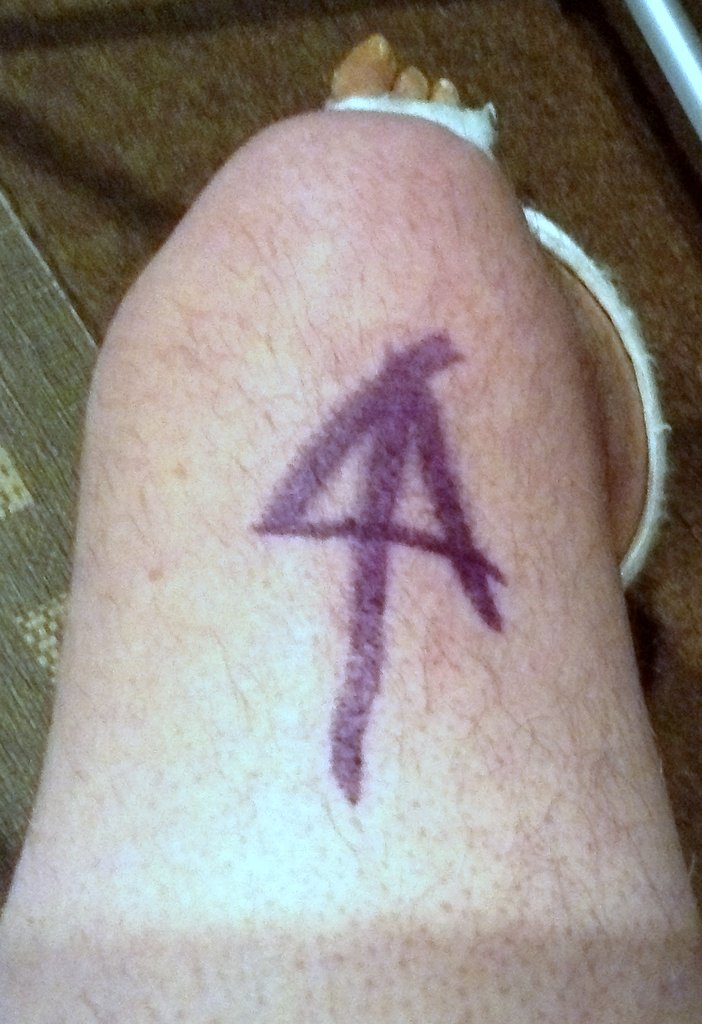
We had long desired to make this Scotland trip, and now that’s something crossed off our ‘bucket list’. Maybe Northern Ireland next year.

The Windy City

20150930 0768

During our most recent visits to the USA since 2011, we have aimed to make a road trip to various parts. It was Arizona and New Mexico in 2011, the Minnesota Riviera in 2012, Oregon and northern California in 2013, and the Great Plains and Yellowstone last year. Having made our long road trip to Scotland, Mike didn’t fancy another one in the USA. But we did get out of the Twin Cities, if even for only three nights – travelling to Chicago and back by train. With temperatures hovering around 80F, we had a wonderful visit in that great city.

At home and in the garden
Steph is always busy keeping the garden looking lovely. 2015 has generally been a good garden year. It’s remarkable that even in November there was so much colour to see.

Mike keeps busy with this blog, with 270+ posts since its launch in early 2012, and more than 65 posts this year alone.

So, that’s a brief account of our year. Retirement continues sweet, and we’re already thinking about our travels for next year.

Fortunately we are keeping fit and well, apart from the odd creaky joint here and there – and a particularly nasty cold bug that hit us both towards the end of November and lasted for more than two weeks. No resistance! We trust our Christmas Letter finds you in mostly robust health.

xmas1

Click here for a shorter print version.

red banner