‘The bowler is Holding, the batsman’s Willey’

I spent much of yesterday listening to Test Match Special (TMS) on BBC Radio 5 Live – I don’t subscribe to Sky Sports so couldn’t watch it on TV (except for the highlights in the evening).
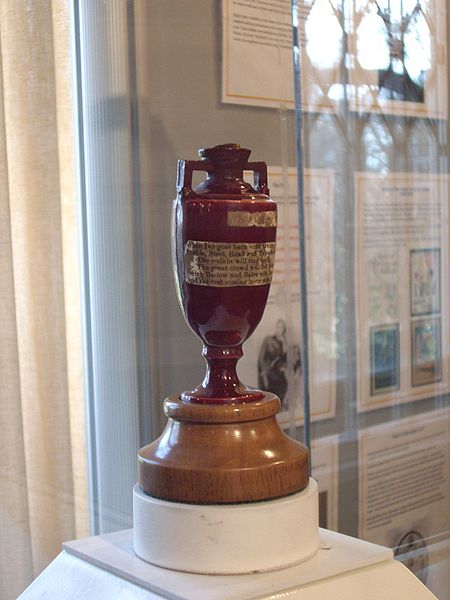
The Ashes urn is only six inches tall.

The Ashes urn is only six inches tall.

Test Match Special? Well, for my many followers on this blog I’m referring to cricket. And yesterday, England won a remarkable victory over the Australians in the 4th Test Match (= match between international teams) of the summer 2013 Ashes Series (the rivalry between England and Australia goes back more than a century, and is fierce). I say remarkable, because midway through the afternoon session it seemed as though Australia were cruising to victory, having lost only two wickets for 168 runs. Then England fast bowler Stuart Broad found his mojo, and Australia were scuttled out 74 runs short of the required 299. So England win the five match series 3-0 so far, with one match (at Old Trafford last week) drawn, and one to play, at The Oval in London next week.

My father was a great cricket fan, often spending a Saturday summer evening watching a local match at Leek Cricket Club, or occasionally traveling to Chesterfield to watch county side Derbyshire play. When I was growing up in the 1950s and 60s, there were few overseas players in the county sides, because they had to gain their residency in English cricket before they could play in the First Class (i.e. county) game. Many did this by playing for local clubs. So in the North Staffordshire League (I think that was its name) we could watch some of the world’s greatest players, such as West Indian batsmen Sir Frank Worrell and Sir Gary Sobers, and fast bowlers Wes Hall and Charlie Griffiths. Quite a treat to watch these players before they hit the big time, and for any team to come up against these players in the opposing side.

I can’t remember anyone ever explaining the rules of cricket to me. Maybe it’s a ‘genetic’ thing – growing up with the game, I just became aware of how it was played. And at high school we did play cricket during the summer semester, although I was never good enough to play for one of the school teams. Cricket for me was much more a recreational sport. As a graduate student at Birmingham, a group of us would play a few overs (six ball deliveries) during the lunch break, and when I was based at CATIE in Turrialba, Costa Rica in the late 70s, we managed to scrape a team together, prepare a pitch, and challenge the San José Cavaliers to a limited overs match (which we easily lost). Even at IRRI in the early 90s we managed a game or two, and given the high number of staff and students from India, Pakistan and Bangladesh, that’s not surprising.

Already, however, I’ve lapsed into jargon: ‘overs’, ‘sides’, ‘wickets’, etc. So for many, especially in the USA, cricket remains a ‘remote’ sport. In some ways that’s hardly surprising when you have fielding positions such as ‘silly mid on’, ‘silly mid off’, ‘slips’, gully’, and ‘deep fine leg’ to mention but a few. And the fact that Test Matches are played over five days, with lunch, drinks and tea breaks further adds to cricket’s unfathomability for some. Needless to say I have the same issues with American football and baseball.

There has been a significant change in the way that cricket is played, with the expansion of the one day, limited overs, matches, and the more recent phenomenon: T20 (20-twenty), in which both sides have just 20 overs to score as many runs as possible. It’s a big thing in India, and fortunes are spent on promotion, commercialization, and key players. Not really my cup of tea.

Yesterday’s match at the Emirates Durham in Chester-le-Street was a great exhibition of the very best of Test Match cricket. The balance of the game swung from one team to the other, until England finally made the breakthrough late on in the afternoon. Roll on The Oval!
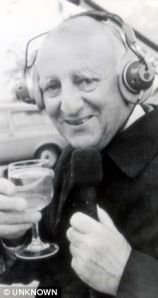
Brian Johnston

Listening to a cricket match on the radio is also special – but you have to know something about the game, and the field placings, etc. to fully understand the commentary. I grew up listening to the likes of John Arlott and Brian Johnston and later former Australian captain Richie Benaud. Other commentators have come and gone, but the current crew are, in the main, very good (Jonathan Agnew, former England captain Michael Vaughan, former England opener Geoffrey Boycott, Henry Blofeld, and others). Then and now, you can detect the camaraderie among the commentators, and the fun they are having – as well as their love of cricket. But commentating live has its pitfalls.

The title of this blog refers to something that Brian Johnston is reported to have said during a Test Match in 1976 between England and the West Indies at The Oval Cricket Ground in south London. England were batting, and Peter Willey was facing a ball from West Indian (very) fast bowler Michael Holding. It’s up to the commentator to describe, as succinctly as possible, what’s happening on the field of play. So, for the listening audience, Jonners (as he was known) quickly described the state of play: ‘The bowler is Holding, the batsman’s Willey’. Listen  to cricket commentator Henry Blofeld talk about this. 

Well, if true, it’s a classic, as good if not better than Jonathan Agnew’s (Aggers) description of Ian Botham missing a shot and trying to get out of the way by leaping over his wicket – but failing. ‘Botham can’t get his leg over’ was the comment! On cue, commentators in the booth falling about, laughing so hard, unable to broadcast.

And this is how it was. Here’s Aggers setting up former England captain Michael Vaughan. Lots of great commentating, lots of humour – and lots of cakes sent in by listeners, which became a TMS tradition which endures to this day.

And it’s not just during cricket matches that commentators wish they could rewind the tape, so-to-speak. Out of the mouths of babes and commentators, come some of the best unintended double entendres, which I discovered earlier today on the Internet. Enjoy!

1. Ted Walsh – Horse Racing Commentator: ‘This is really a lovely horse. I once rode her mother.’

2. Pat Glenn, weightlifting commentator: ‘And this is Gregoriava from Bulgaria. I saw her snatch this morning and it was amazing!’

3. Harry Carpenter at the Oxford-Cambridge boat race 1977: ‘Ah, isn’t that nice. The wife of the Cambridge President is kissing the Cox of the Oxford crew.’

4. US PGA Commentator: ‘One of the reasons Arnie (Arnold Palmer) is playing so well is that, before each tee shot, his wife takes out his balls and kisses them …. Oh my god !! What have I just said??’

5. Carenza Lewis about finding food in the Middle Ages on ‘Time Team Live’ said: ‘You’d eat beaver if you could get it.’

6. A female news anchor who, the day after it was supposed to have snowed and didn’t, turned to the weatherman and asked: ‘So Bob, where’s that eight inches you promised me last night?’ Not only did HE have to leave the set, but half the crew did too, because they were laughing so hard!

7. Steve Ryder covering the US Masters: ‘Ballesteros felt much better today after a 69 yesterday.’

8. Clair Frisby talking about a jumbo hot dog on Look North said: ‘There’s nothing like a big hot sausage inside you on a cold night like this. ‘

9. Michael Buerk on watching Philippa Forrester cuddle up to a male astronomer for warmth during BBC1’s UK eclipse coverage remarked: ‘They seem cold out there, they’re rubbing each other and he’s only come in his shorts.’

10. Ken Brown commentating on golfer Nick Faldo and his caddie Fanny Sunneson lining-up shots at the Scottish Open: ‘Some weeks Nick likes to use Fanny, other weeks he prefers to do it by himself.’
Three days, three houses . . .

During our trip to the northeast a couple of weeks ago, we visited three National Trust properties over three days. They all had one feature in common: until quite recently they were still occupied by their owners.

In Northumberland, the two houses were: Seaton Delaval Hall, just north of Whitley Bay, about a mile inland from the North Sea Coast (map); and Wallington House and Gardens (map), home to generations of the Blackett and Trevelyan families for generations, about 25 miles northwest of Newcastle. In North Yorkshire, just south of Helmsley in the North York Moors lies Nunnington Hall (map), which we visited on the journey home.

Seaton Delaval Hall
This impressive property was designed in 1718 by Sir John Vanbrugh (who also designed Blenheim Palace and Castle Howard) for the Delaval family who had occupied estates in the area since the time of the Norman Conquest in the 11th century. It comprises a Central Hall and West and East Wings (which houses the large stables). The Central Hall was destroyed in a fire in 1822, although a number of features did survive. The West Wing (and the extensive cellars) originally housed the servants, but in the 20th century became the residence of the owner. Some restoration has taken place, and the Parterre Garden was designed in the 1950s. Although Seaton Delaval will never again reach its former glory, its outward appearance speaks volumes for what it must have been like.

This slideshow requires JavaScript.

Wallington House and Gardens
The hall dates from the 17th century, but had extensive modifications in the Palladian style in the 18th. Two aspects particularly impressed me: it definitely had the feel of a family home; and the walled garden, about 15 minutes walk away from the house, in among the woods, is perhaps one of the nicest gardens I have visited. The entrance hall has bright murals showing many different aspects of the history of Northumbria, and the house is full of beautiful treasures. Wallington is definitely worth a visit for so many reasons.

This slideshow requires JavaScript.

Nunnington Hall
Alongside the River Rye, parts of the house date from the Tudor period, but over the centuries it was remodeled. There are signs of its occupation by Parliamentary forces during the English Civil Wars of the 1640s. The gardens are not extensive, but quite attractive.

This slideshow requires JavaScript.

An apo in the Northeast

A couple of weeks ago our daughter Philippa asked us if we could babysit grandson (= ‘apo’, Tagalog for grandchild) Elvis Dexter for a couple of nights while she and Andi attended a wedding. They live in Newcastle upon Tyne in the northeast of England, 225 miles north of where we live.

I can’t deny that Steph and I were a little apprehensive. It’s one thing babysitting while parents are out for the evening. It’s quite another being left completely responsible for a small child. After all, we haven’t had that sort of practice for more than 30 years.

We needn’t have concerned ourselves. Young Elvis was a delight to look after. Having been introduced to his nursery ‘teachers’ on the Monday afternoon, we went along with Philippa when Elvis attended nursery early on the following morning. It was then up to us to collect him in the afternoon, give him his evening meal, bath-time, play, stories and bed.

Once down for the night (around 19:30) we didn’t hear a peep out of him. In fact, on the second morning, I had to wake him up to get ready to head off to nursery!

As you can see from the slideshow, he also enjoyed himself.

This slideshow requires JavaScript.


It will be interesting to see how he reacts when his baby brother/sister comes along in about five to six weeks time.

Leek – Queen of the Moorlands (updated 2018-11-05)

April 1956. Did my world fall apart? I probably thought so at the time.

We moved from Congleton in Cheshire (where I was born seven years earlier) to the small market town of Leek in north Staffordshire. Less than 12 miles away, but it could have been another planet for all I was concerned.

New town, new home, new school, and new friends.

When I say ‘small market town’ I always was under the impression that Leek had a population of about 20,000 when we moved there in 1956. So I was quite surprised to note in the 2001 census that the population was a smidgen under 19,000. It seems the population has changed very little over the past century.

I’m not sure that I could say that Leek is a picturesque town, but it’s certainly a very interesting one, with some remarkable features and history (the link gives a pretty comprehensive account). And it’s surrounded by some of the most glorious landscapes in the country, the Staffordshire moorlands on the southern edge of the Peak District (the UK’s first national park). Although I was not born there, and actually only lived there for a little over a decade before moving away to university (and moving on) I still think of Leek as my home-town – and proudly so!

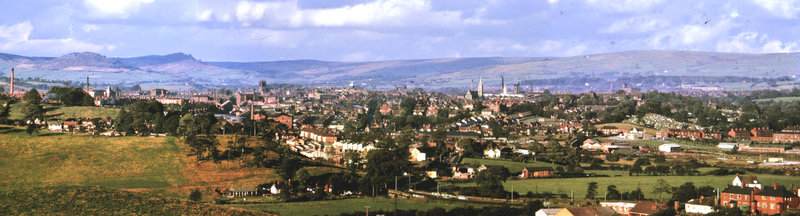
In the 1960s panorama below, taken from the top of Ladderedge (on the southwest of the town, besides the main road linking Leek with Stoke-on-Trent – the Potteries) looking towards the northeast, you can see many of the distinctive features of the Leek skyline.

1-13 Leek

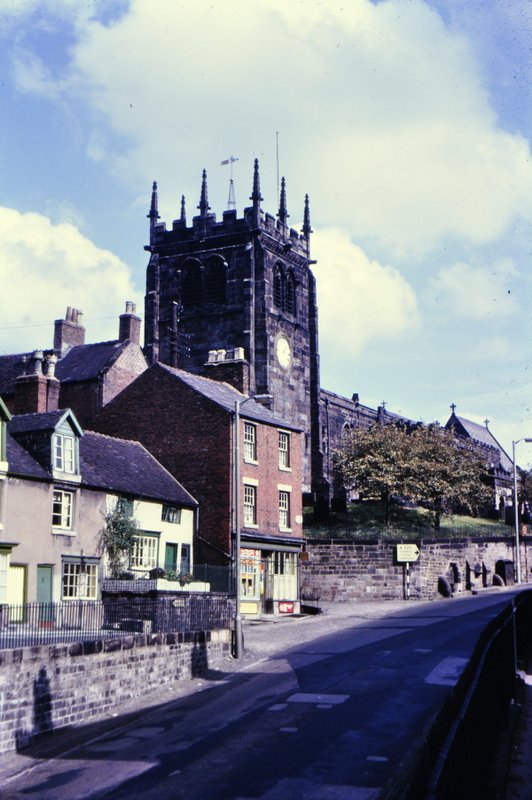
Just to left of center is the square tower of the 13th century Anglican Church of St Edward the Confessor (although there is some evidence for a pre-Norman church in the vicinity), and to the right of center, the tall spire of the Roman Catholic church, St Mary’s (which we attended), built in 1887, although there had been earlier churches.

Church of St Edward the Confessor

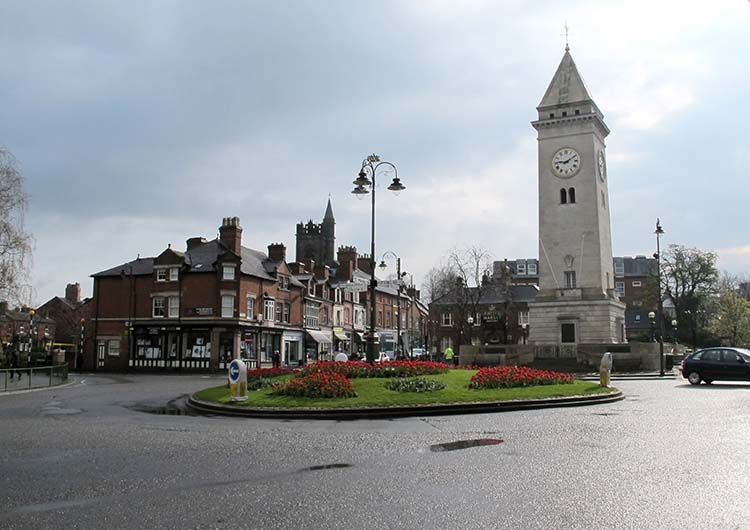
To the right of St Mary’s spire is the white clock tower of Leek’s impressive war memorial, the Nicholson War Memorial, commonly known as The Monument (at the eastern end of the main shopping Derby Street), and to the right of that another Anglican church, St Luke’s, with a square tower and a small spire to one side.

The Nicholson War Memorial (the Monument), photographed in April 2012. The roundabout has now disappeared – a great local controversy – as part of road ‘improvements’ to ease the flow of traffic. The video below shows its dedication in 1925.

And in the middle of the panorama rises the impressive green copper dome (no longer green) of the Nicholson Institute, housing the public library and art gallery (including a facsimile of the Bayeux Tapestry) and (in the past at least when I was growing up) a celebration of much of Leek’s wealth that was built on the silk weaving industry. Indeed, textile manufacturing and dyeing were among the main industrial endeavours in Leek, and quite a few of the mills and their chimneys can be seen on the Leek skyline. In the mid-60s a couple of these were destroyed by fire within the space of just one week – very dramatic happenings in a small town. William Morris, a prominent member of the Arts and Crafts Movement, may have resided in Leek for several years.

The central area of Leek is bounded by five streets: St Edward Street on the west, Stockwell Street on the north, Brook Street/Hayward Street on the south, and Ball Haye Street on the east. And these are through routes connecting Leek with Buxton to the northeast, Macclesfield to the north-west, the Potteries to the southwest, and Ashbourne to the east.


We lived in a couple of properties in St Edward Street where my father established his photographic retail business between our arrival in Leek in 1956 until 1962.

Then my father was able to purchase a prime site in the Market Place, which he kept until his retirement in 1976. I’ve recently discovered that 19 Market Place is now a shop selling home-made jewellery – Little Gem. That’s quite interesting since my wife’s main hobby is making bead jewellery. We must visit next time we are in Leek. But I digress . . .

Leek was granted a charter to hold a market on Wednesdays during the reign of King John at the beginning of the 13th century. And that market thrives today. In the valley of the River Churnet, and on the north-west of the town lie the rather depleted ruins of a Cistercian abbey, Dieulacres; many of the stones were used in local building after Henry VIII’s men had done their business, and particularly in the Abbey Inn that is found close by.

Leek was connected to the growing canal system in 1801, with a branch of the Caldon Canal. It closed in the mid-1940s, and was eventually filled in (now part of an industrial estate on the southeast side of the town). Famous 18th century canal engineer James Brindley lived in Leek for many years. Until the 1960s Leek was served with rail connections, but after these ended, the station was demolished in 1973. The last steam trains from Leek in 1965 are shown in the video below.

I read recently of plans to try and reopen the mothballed railway link between Leek and Stoke. The web site has some stunning photos of steam locomotives near Cauldon Lowe.

Close by the Monument is the bus station, opened in the 60s on the site of the former cattle market (that moved afterwards close to the site of the old railway station. Thanks to my old friend Geoff Sharratt for sharing these two photos with me.

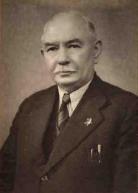
We never talked politics at home. I suspect my parents voted Conservative, but I do not know for sure. When we lived in Congleton my father was elected to the local council – Congleton was a borough with a mayor. Not long after we moved to Leek my father sought election to the Leek Urban District Council – as an Independent since he strongly believed that national political affiliations had little or no place in local government. In 1968 he became Chairman of the Leek Urban District Council.

In the 1950s and 60s as I was growing up in Leek the annual Club Day, a 200 year-old tradition, held in mid-July was (and still is, apparently) a very important event in the town’s calendar. Held on a Saturday afternoon, it brought together churches and Sunday schools of all denominations in an ecumenical celebration, held in the Market Place. It was a riot of colour and best outfits, banners and bands, with the children and their parents and friends processing from the individual churches to the Market Place, and afterwards around the town.

This slideshow requires JavaScript.

Today it seems that Club Day in Leek is rather a different celebration altogether. My elder brother Ed and I took part for a number of years with the St Mary’s 5th Leek Cub (cub scout) Pack. Here we are in our Cub uniforms.

Me with my brother Ed (r) in our Cub uniforms in the late 1950s.

Me with my brother Ed (r) in our Cub uniforms in the late 1950s.

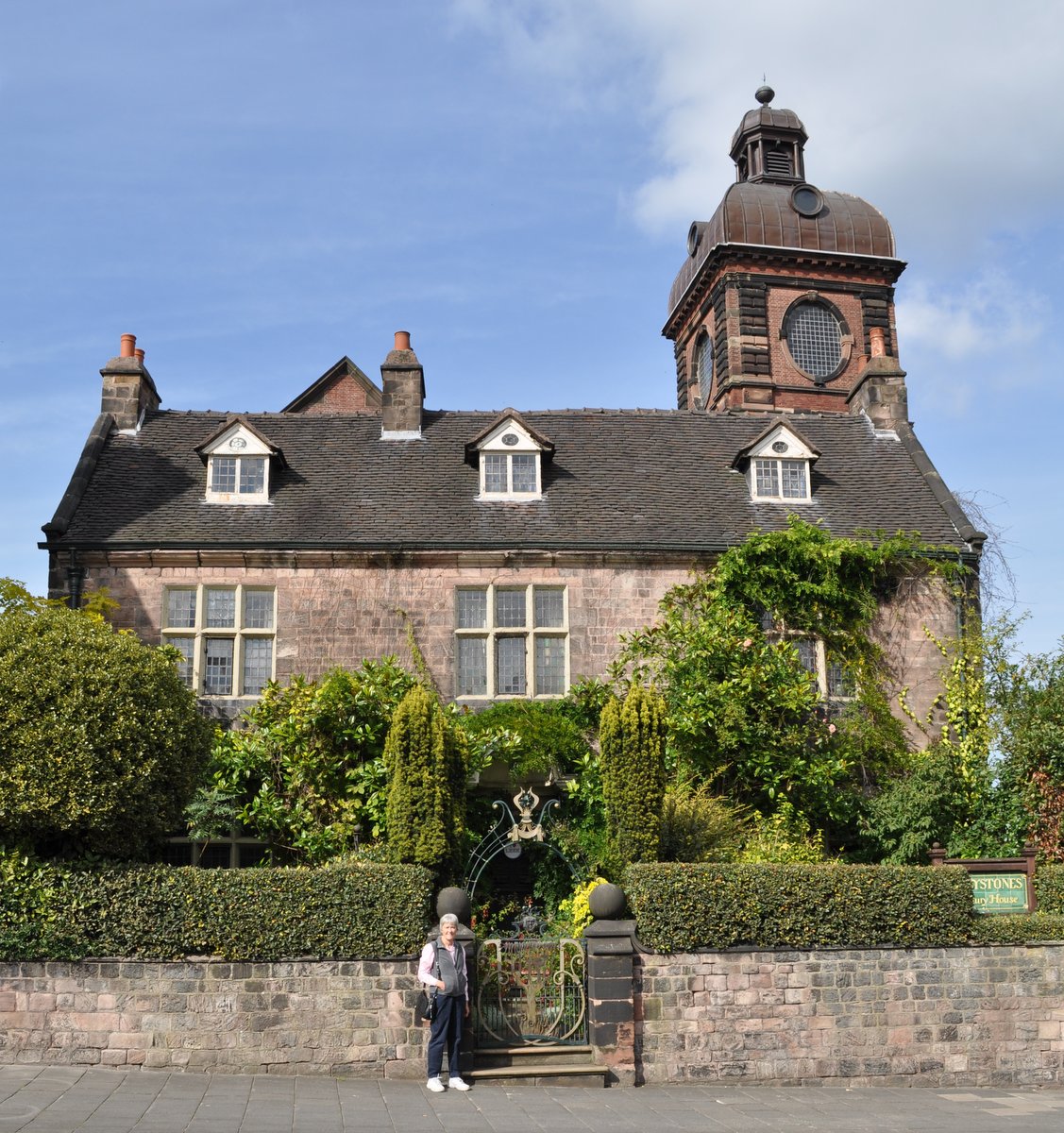
After my parents retired in 1976 they took up residence in a first floor apartment in Greystones, a 17th century town house on Stockwell Street, just in front of the Nicholson Institute. After my mother (and the lady on the ground floor) moved out in the mid-80s, the property became a tea room.

Greystones, with the Nicholson Institute behind.

Greystones, with the Nicholson Institute behind.

But in many ways it’s the location of Leek that is one of its best assets, nestling as it does in the shadow of the Staffordshire Moorlands, with close access to the Peak District National Park, and particularly the Roaches, Dovedale, and the Manifold Valley to mention just a few special places, and the famous ‘double sunset‘ that figures in the old coat of arms (two suns).

Here’s a video I found recently on YouTube (2014-04-25) about the Staffordshire Peak District – all within a 10 mile or so radius of Leek:

I visit Leek rather rarely now, but when I do walk around the town, and look at how it has changed over the decades, my mind fills with good memories of a happy childhood. It was good growing up in Leek. And it seems that many around the world also hold fond memories of Leek, as comments on the Visitors’ Book at Leekonline show.

And finally, here are some recent photos of Leek that I have put together in a short video.

Ireland’s turbulent history

I guess I first became aware of Ireland’s turbulent past when I was studying Advanced Level (pre-university) English Literature between 1965 and 1967. Our English teacher, Frank Byrne, had family from Co. Roscommon in Ireland, and on the curriculum the years I studied was the poetry of Irish poet William Butler Yeats (Nobel laureate in Literature for 1923). Through his famous poem Easter, 1916, in which three of the four verses have as a final line ‘A terrible beauty is born‘, Yeats emphasizes his belief that the genie was out of the bottle, so-to-speak – Ireland would be changed forever.

Martin HealyElsewhere in this blog I have written about my own Irish ancestry, and often wondered how my Irish family reacted to – or even took part in – the events that shook Ireland in the early and mid twentieth century following the April 1916 rebellion. My maternal grandfather, Martin Healy, had served in the British army in South Africa and on the Northwest Frontier in India, and afterwards served as a policeman in London’s Metropolitan Police. As a Catholic, did he ever suffer from any sort of discrimination while in the Army or the police? Of course from his birth in 1876 he was a British citizen of Ireland. The Irish Free State was founded in 1922. I assume he retained his British citizenship throughout. But his roots were Irish. He and my grandmother came from large families. Were any of their brothers or sisters involved in the various struggles in Ireland from 1916 onwards: the Easter Rising, the civil war, and the various bombing campaigns carried out by the Irish Republican Army (IRA) both in Ireland and in England? A family anecdote has a great uncle of mine serving in the IRA and being executed by the Black and Tans, but I have no further evidence for this.
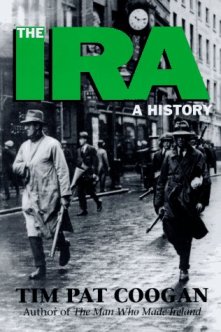
I’ve often wondered what and who the IRA was, are. And during a visit to St Paul, MN a couple of years ago I picked up a secondhand copy of Tim Pat Coogan’s tome The IRA – A History. I recently had a second stab at reading this. When I bought it I managed just a few pages – it’s not the easiest of reads. But having just finsihed T. Ryle Dwyer’s Big Fellow, Long Fellow – A Joint Biography of Collins & de Valera, I decided to give Coogan’s book another go. This time I managed about one fifth (it’s a long book, >500 pages, small font) before giving up. There is little attempt I felt at synthesis. Instead one is bombarded with fact after fact after fact. Indeed, I quite lost track of the overall narrative. Nevertheless I did begin to understand the origins of the IRA, how it became a proscribed organization in the Irish Free State and Republic, and its role in destabilizing society and politics in Northern Ireland more recently in ‘The Troubles’. While Coogan’s text is undoubtedly of considerable value to the serious scholar of Irish events – because he interviewed many of the leading characters in the IRA story – getting to grips with the big picture is not something that this book achieves.
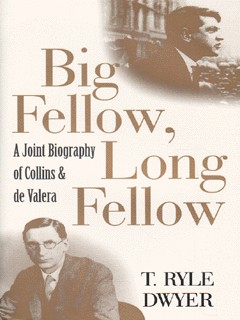
9780717127870On the other hand Dwyer’s joint biography of Irish patriot Michael Collins and elder statesman Éamon de Valera is a much more accessible read, and one I enjoyed from cover to cover.

One thing that came though quite clearly to me is that both Collins and de Valera at various times of their careers were rather unsavory and ruthless characters, not averse to ordering the assassination of opponents when necessary. However, Collins seems to have been the more pragmatic of the two whose life and contribution to an Ireland on the road to becoming a republic was cut short when he was killed in an ambush in 1922. As a member of the negotiating team that agreed a treaty in 1921, leading to the partition of Ireland into the 26 counties of the south and the six counties of Northern Ireland, Collins was vilified by Republican purists, among whom was then numbered Éamon de Valera. But as Collins emphasized in debates about the Treaty to establish the Irish Free State, ‘In my opinion it gives us freedom, not the ultimate freedom that all nations desire … but the freedom to achieve it.’

de Valera had commanded a unit during the 1916 rebellion but was saved from execution by the fact he was actually born an American. From Dwyer’s book I had the distinct impression that de Valera was never consistent in his opinions or deeds, and certainly changed tack as and when it suited him politically. He did help found the political party Fianna Fáil, led nine governments, and became President of the Irish Republic in 1959, serving until 1973 when he was 90. He died in 1975. He did become father of the nation.

I’m still looking for that one book that will give me the overview and honest interpretation of recent (well, the last century) Irish history.

The majesty of Kedleston Hall

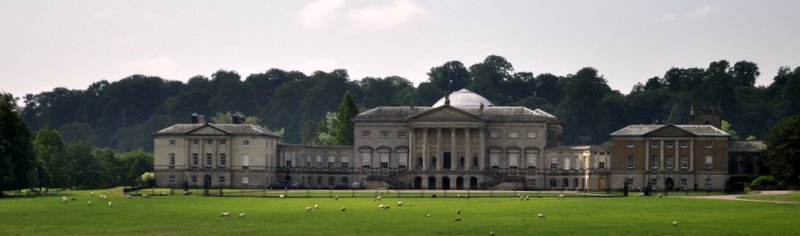
Kedleston Hall. An impressive Palladian mansion in the Derbyshire countryside, just a few miles to the west of Derby city centre. Kedleston has been the seat of the Curzon family for generations, almost 1,000 years! The Curzons accompanied William the Conqueror on his 1066 jaunt to England, and stayed on, accruing vast estates in the process. What’s interesting from a personal point of view is that my grandmother’s family (BULL) come from the village of Hollington (and neighbouring villages) only a few miles further west from Kedleston. I guess over the centuries their lives must have been influenced, one way or the other, by the Curzons.

The present builing was designed by Robert Adam, relatively unknown at the time he received the commission from Sir Nathaniel Curzon. Kedleston Hall remains one of the best examples of Adams’ designs still standing.

Standing in about 800 acres of parkland, Kedleston is approached along a winding road, that crosses a bridge over a weir in the man-made lake.

It was never intended, apparently as a family home, but as a venue for Lord Curzon to show off all his accumulated art.

01-20130708001 Kedleston Hall

The east wing (on the left in the photo above) did house the family quarters, while the servants lived and worked in the west wing. The Grand Salon in the central structure was meant for entertaining and displaying the works of art. The entrance today is through the ground floor on the north, and entering the main hall on the first floor the size and height of the entrance hall are very impressive with marble columns either side. There are rooms leading off on both sides, and it’s possible to make a circular tour of the rooms, passing through a music room, a sitting room, a library, the dining room, and a state bedroom, among others.

This slideshow requires JavaScript.

Alongside the hall is the small All Saints Church, no longer used for worship, but the mortal remains of many of the Curzon family are buried there. Under floor near the main altar are two figures of the Fifth Lord Curzon of Kedleston and his wife, dated 1275.

While this house does not have impressive gardens through which to wander, the large parkland does offer the visitor an ample opportunity for some pleasant exercise in the Derbyshire countryside.

And on the ground floor is an interesting museum of Indian artifacts – weapons, jewellery, ornaments, silverware, and costumes – from the time of George Nathaniel Curzon who was Viceroy of India from 1899-1905.

Capes, coves . . . and endless beaches – the beauty of Oregon

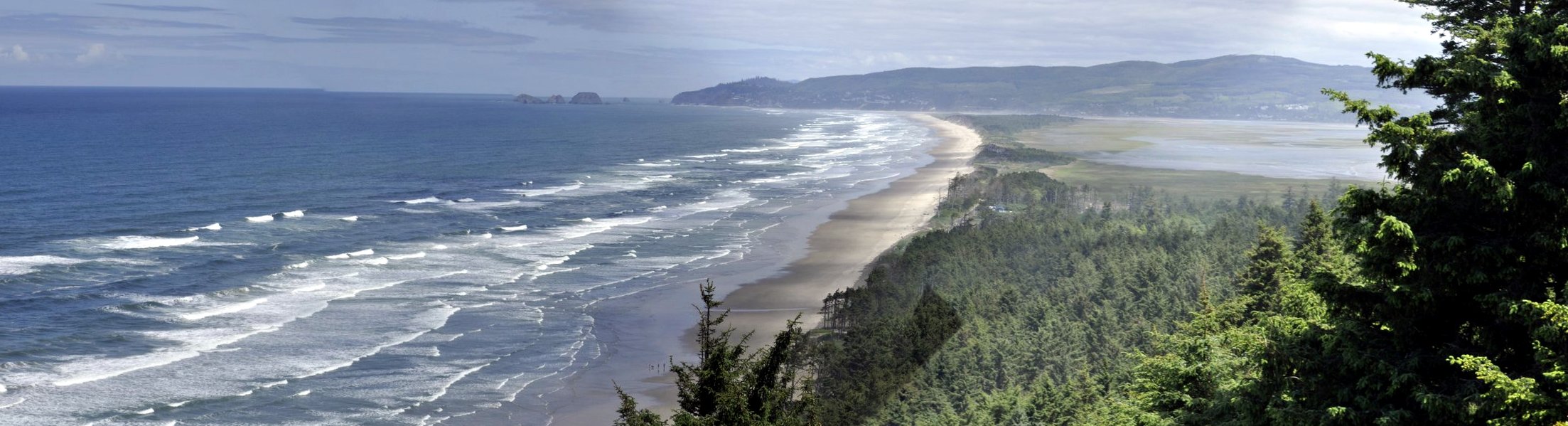
From Cape Lookout, looking north to Cape Mears

From Cape Lookout, looking north to Oceanside, and Cape Mears beyond

We hadn’t planned on a beach vacation in Oregon this year, but Steph and I had mulled over the idea of a road trip from San Francisco to Seattle, and returning to the Twin Cities from there by train. Just a whim of mine.

For the past three years we’ve tried to make a ‘side trip’ away from St Paul when we travel to the USA to visit Hannah and family. In 2011, it was ‘canyon country‘; last year it was the Minnesota Riviera. Then Hannah told us about a beach house on the Oregon coast that was available for rent, and that was it: vacation agreed, and planned. Well, not quite. In addition to the week at the beach, Steph and I traveled south to Crater Lake in Oregon, and then on into northern California to see the majestic coastal redwoods, following US101 most of the way. This is the route we took.

So on 8 June we boarded our 3½ hour Delta flight from MSP to Portland, and then it was a 110 mile drive (a little under two hours) to the coast. Our beach house was just outside and to the north of the coastal community of Oceanside (just south of Cape Mears), and about nine miles west of the nearest large town Tillamook, the cheese capital of Oregon. That in itself was an interesting trip, passing through the Coastal Range, a rather winding road, and suddenly emerging into this coastal plain that is Tillamook.

It didn’t take long to determine this was a dairy farming center; just a quick sniff and the presence of lots and lots of cows could be detected in the air.

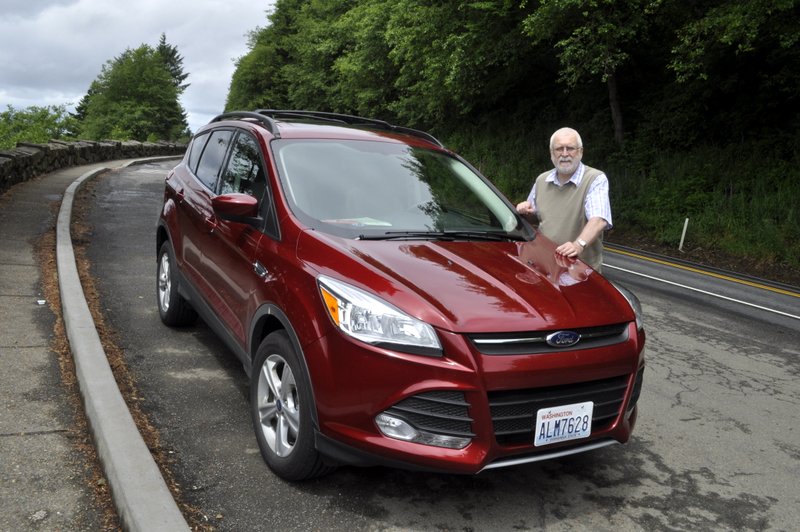
I’d originally booked a standard saloon rental with Budget, but agreed an upgrade to an SUV – a Chevy Captiva. Nice vehicle, spanking new, only nine miles on the clock. But after a major system failure a couple of days later (a known Chevrolet problem for a number of years – just Google ‘Chevrolet’ and ‘Reduced engine power’) Budget replaced it with a Ford Escape, and had it delivered to Oceanside from Portland.

Our beach house had a fabulous view out over the Pacific Ocean. And while we thought this was pretty spectacular, it wasn’t necessary to travel far to see some more pretty impressive landscapes. US101 hugs much of the Oregon coast, snaking around jagged headlands, soaring above others before plunging to stretches of beach that seem to stretch into the distance forever. In places this road seems no wider than a country lane, occasionally becomes a divided highway, or at least two lanes for the uphill traffic. Sandwiched between the cliff edge and the mountains, surrounded by trees, with the occasional glimpse of the coast far below, or at the many viewpoints, this has to be one of the most spectacular road trips on the west coast.

The wind blows constantly, the waves roll in incessantly, and the eye is drawn to the horizon – next stop Japan or the Philippines (where we lived for 19 years). While it was mostly bright and sunny during our stay in Oregon, there were times when the sea mists rolled in, giving the landscapes a rather mysterious ambience. We didn’t see any whales, although the coast off Cape Mears is a well-known whale watching spot at certain times of the year. But there were plenty of seabirds, and some sea lions.

Fulfilling our apostolic duties in the USA

Steph and I flew to the US at the beginning of June to spend some time with Hannah and Michael, and grandchildren Callum (almost three) and Zoë (one in early May). We enjoyed three wonderful weeks over there, marred only by the fact that we all came down with nasty coughs and colds (courtesy of day care virus diversity from Callum and Zoë) which certainly took the edge off our holiday.

We all traveled to Oregon to spend a week at the beach – at Oceanside, some 100 miles or so west of Portland. It was great playing with Callum and Zoë, and they seemed to have enjoyed the beach and ocean, and having Grandma and Granddad’s attention almost constantly for the week we were in Oregon. During our visits to St Paul, Callum and Zoë are at day care every day from early morning until late afternoon, Monday to Friday, so we only get to see them at breakfast and dinner, and over the weekend.

This slideshow requires JavaScript.

It was fantastic to see how they had developed since we were last in the USA in June 2012. Zoë was only a few weeks old then. Now she’s walking, trying some first words: ‘Mama’, ‘Dada’, ‘Hi’, really developing a great personality. But she can be very stubborn. In this short video you can see one of the games we played.

Callum is no longer a toddler, so-to-speak. His language has come on leaps and bounds, and it was fascinating to see him reasoning things for himself.

All in all, a great three weeks.

400 years of decline in the heart of the Cotswolds . . .

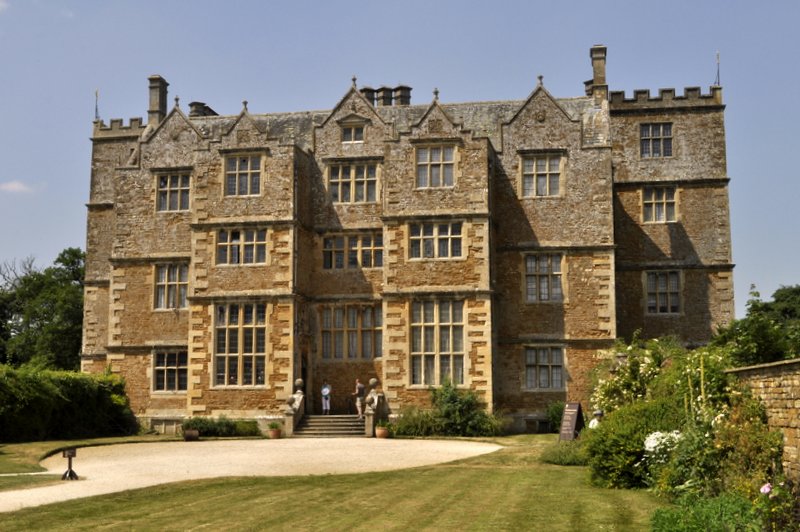
The entrance to Chastleton House

The entrance to Chastleton House

It seems that Chastleton House – a Jacobean mansion built between 1607 and 1612 in north Oxfordshire in the heart of the Cotswolds near Moreton-in-Marsh – was destined for decline. The same Jones family lived at Chastleton House for almost the entire period, until it was sold and became a National Trust property in the early 1990s.

Although the house itself has a rather grand façade, it has rather modest grounds, and is located in the centre of Chastleton village. The journey from Bromsgrove took us south around the historic town of Evesham, and a steep climb up the Cotswold escarpment near Broadway. On a glorious day like yesterday the views of the Cotswold landscapes were wonderful.

What makes this National Trust property different from most others is that there has been essentially no attempt to restore the house to its former glory (as with Calke Abbey in Derbyshire). Instead the Trust has made essential repairs to prevent further deterioration of the property’s fabric, but what’s on show is what was there when the house was vacated. And quite a number of rooms, such as the Great Chamber, with its magnificent plastered ceiling and fireplace, appear today much like they did several centuries ago.

And because the Trust is preserving not restoring, many more rooms are open to the public, who can access the house on timed visits. This means that the number of visitors in the house at any one time is limited which enhances the visitor experience.

Over four floors from the magnificent entrance hall, the dining room (with a fine display of Staffordshire salt ware from the 17th century), up the East Stairs to the Great Chamber, a library, and some of the bedrooms, and finally to the top floor to the Long Gallery that stretches the entire width of the house, and faces east. Apparently the family used the Long Gallery for exercise on days when it was impossible to go outside.

The gardens are not large, and must have been much finer in the past. The topiary bushes deteriorated many decades ago when it was no longer possible to maintain them. The village of Chastleton lies just beyond the garden walls, and the lack of several ‘expected’ facilities in the house (such as a laundry) is apparently down to these having been provided by villagers living close-by.

There were fewer visitors to Chastleton House yesterday than I expected, and it was lovely to experience the tranquility of its surroundings. Definitely well worth a visit, and one of the Trust properties that I have enjoyed most.

The coastal giants of northern California

No description, no photograph, no video can prepare you for a face-to-face encounter with the tallest trees on the planet. Towering as much as 300 feet or more overhead, and living often in excess of 1,500 years, the coastal redwoods of northern California are a sight to behold. Awe-inspiring! Sequoia sempervirens is truly a marvel of the natural world.

Steph and I recently vacationed on the Oregon coast for a week, and then took four days to travel south to Crater Lake and through the redwoods national park of northern California before flying back to the Twin Cities from Sacramento. We’d visited Crater Lake just the day before the redwoods, and although it’s ‘unfair’ to make a comparison between Crater Lake (‘spectacular’) and the redwoods (‘awesome’), if I had to choose which one moved me more, I would have to plump for the redwoods.

My original plan was to overnight in Brookings (just north of the Oregon-California state line), visit the various national and state redwood parks, return to Brookings for a second night, and then head south to Sacramento. What was I thinking about? In any case, once I was in the USA, I did a little more online research and discovered that access to some of the tallest trees in the Redwood National Park had been closed to vehicles, and that some of the more spectacular sights were to be found further south in the Humboldt Redwoods State Park and the Avenue of the Giants. So I was easily able to change our hotel reservations, spending the first night, as planned in Brookings, and the second at Garberville, some 205 miles south, and about halfway to Sacramento. It was a good decision.

If you ever get chance to see the redwoods, a good place to start is the information center in Crescent City, along US101 (the Redwood Highway), on the south side of the town.

The staff in the information center couldn’t have been more helpful and pleasant. They gave us several brochures, and advised on the best sights and routes. While vehicle access to the Tall Trees Grove (much further south) was now restricted, they encouraged us to visit an ancient stand of redwoods in the Jedediah Smith Redwoods State Park, just a few miles away to the northeast. In fact we’d passed the northern access road to this park as we entered Crescent City. And in particular they recommended we visit Stout Memorial Grove, reached on a dirt, but easily passable track (especially if you have an SUV as we did). Stout Memorial Grove, only 40-some acres in extent, has some fine old redwoods. Had the long-term fate of the redwoods not been recognized early last century, the forests would have been logged out and destroyed. The early settlers in this part of California had no vision for the future, and must have seen the redwoods as an inexhaustible resource. How wrong they were.

Moving on south, we took the Newton B Drury Scenic Parkway as a diversion from US101, through Elk Prairie (where we actually saw some elk), and on to the Lady Bird Johnson Grove, dedicated by former President Richard M Nixon to former First Lady and wife of President Lyndon B Johnson.

US101 is not called the Redwood Highway for nothing. As you drive along, you move into and out of various stands of these magnificent trees (as you saw in the video above). But just south of Scotia, there is an opportunity to leave US101 for a while at Exit 674, and take CA254 for the 31-mile scenic drive Avenue of the Giants (a clip of which is shown at the beginning of the video). The two-lane highway meanders through the trees that ‘took no prisoners’ when it came to determining the road’s route. Driving slowly along the ‘Avenue’ was just a memorable trip, a delight. And here are some of the memorable sights of that awe-inspiring day.

Then we rejoined US101 and rolled into Garberville, which lies just south of the south entrance to the Avenue of the Giants, for our penultimate night on this once-in-a-lifetime OR-CA road trip.

The blue waters of Crater Lake, Oregon

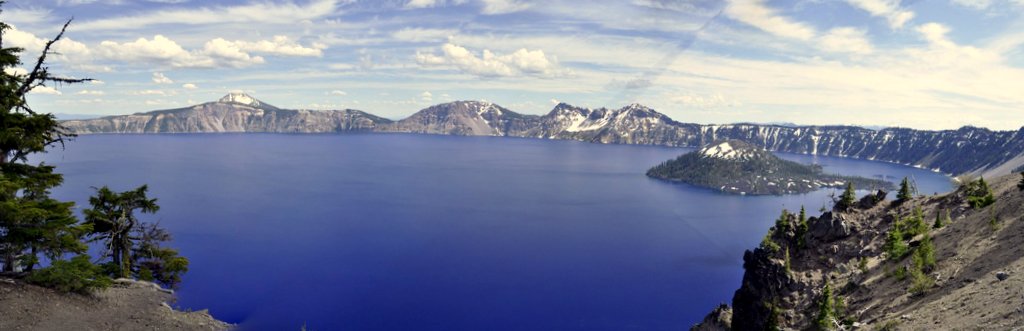
The still waters of Crater Lake, Oregon run deep, and are as blue as all the brochures claim.

Above and below: Crater Lake from Merriam Point, with Wizard Island on the right.

Steph and I had opportunity of visiting Crater Lake just a couple of weeks ago while vacationing on the West Coast in Oregon and northern California. Formed less than 8,000 years ago when volcanic Mt Mazama exploded and then collapsed in on itself, Crater Lake is a large caldera, some 5-6 miles across, the remnant of what was the volcano’s cone. Crater Lake is only sleeping, not extinct, apparently. And who knows if or when she might blow her top again.

Crater Lake (Mt Mazama) is one of the many volcanoes in the Cascades of Washington and Oregon: Mt Baker and Mt Rainier, as well as Mt St Helens in Washington, and a string of volcanoes close to Crater Lake that are considered as potentially active. As a student of geography, I’d known about Crater Lake for decades, and it had always been an ambition – given the opportunity – to visit. But having researched how to get there and stay overnight, I was surprised about some of the lake’s statistics:

  • As I mentioned earlier, it was formed less than 8,000 years ago, and they have found native American artifacts buried beneath the pumice and pyroclastic flow fields which means they witnessed the explosion.
  • Crater Lake is the deepest lake in the US, with a maximum depth of almost 2,000 feet.
  • The rim of the caldera lies at an altitude of between 7,000 and 8,000 feet.
  • No rivers flow into or out of Crater Lake. All the water comes from snow or rain.
  • And until fish were introduced into the lake several decades ago, there were no indigenous fish populations.

What’s more, Crater Lake is a stunningly beautiful natural feature of the Oregon landscape.

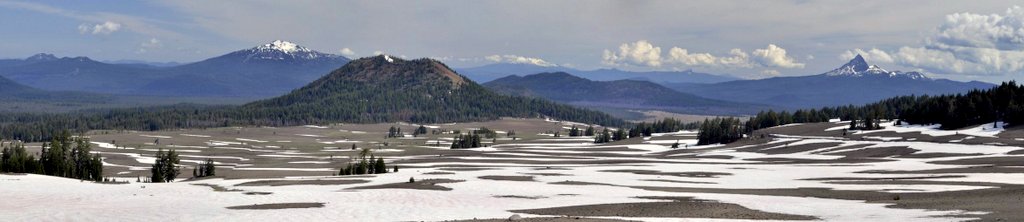
The Pumice Desert to the north of Crater Lake, with Mt Bailey on the left and the pointed peak of Mt Thielsen on the right.

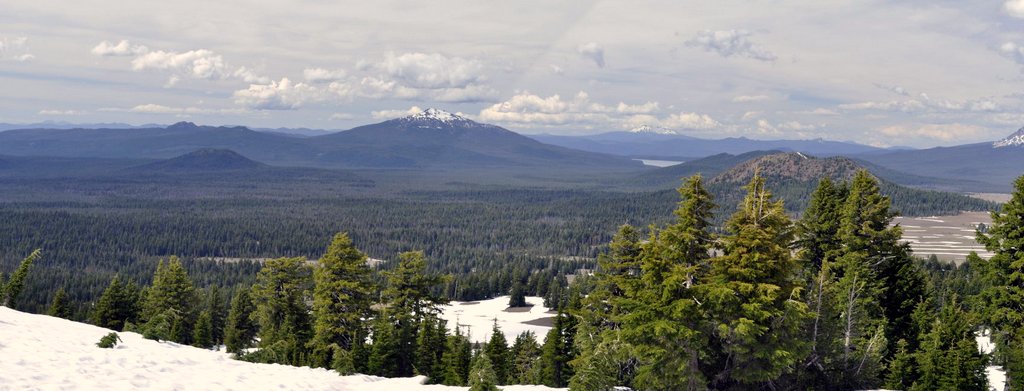
Looking west southwest from Crater Lake.

From our beach-side holiday home near Tillamook in northwest Oregon, it was a 340 mile drive to Crater Lake, down US 101 on the coast to Florence, before heading inland and up into the mountains; a long 8 hour but exhilarating drive.

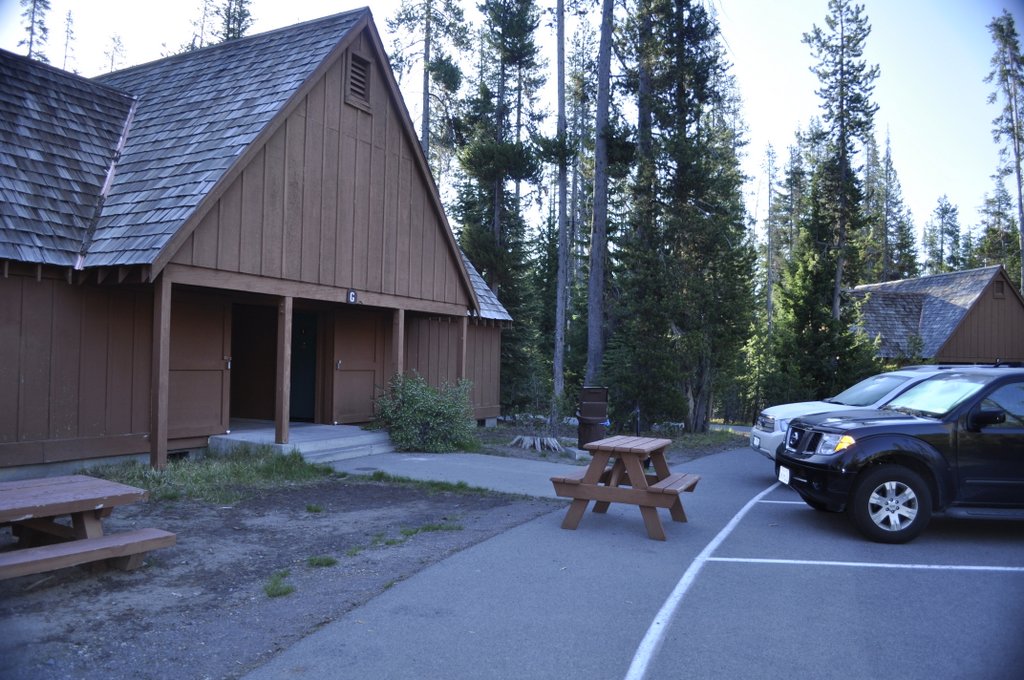
We arrived to Crater Lake National Park around 16:15. much to my relief, since I wanted to get there before dark, and in any case I’d read several poor reviews about the Mazama Village Motor Inn where I’d booked us a cabin, and that there could be problems with registration and even getting a meal if arriving after 20:00. As it turned out everything was fine – in fact, better than fine, and we experienced no problems with the accommodation whatsoever. The cabins were quite basic, but very clean and comfortable, with four rooms per cabin. I had originally tried for a reservation at the Rim Lodge, but that was booked up months before – and much more expensive. So if you do decide to visit Crater Lake and want to stay overnight, I can recommend the Mazama Village Motor Inn.

A Mazama Village Motor Inn cabin – each with four rooms.

I also wanted to take advantage of the afternoon light from the west for some photo opportunities from the rim. Only the western road of the Rim Loop was open; the eastern road was still blocked by snow in places, and we were told that it had snowed at Crater Lake (which gets more than 550 inches per year) only two days earlier. We first stopped at Merriam Point, then moved on to Discovery Point where I managed to lock us out of our rental SUV. I have no idea how this happened, but once we’d marshaled the help of Park Rangers, they were able to ‘break into’ the vehicle in less than 3 minutes! What a relief, and a moment of great embarrassment for me. Talk about mortification.

The following morning we had a quick breakfast in our room since the restaurant didn’t open until 08:00. We headed to the Rim again before 08:00, and were able to take advantage of the sunrise from the east, and the perfectly still morning to see Crater Lake at its best.

By 10:15 we’d reached Merriam Point once again, and completed our ‘tour’ of Crater Lake. Despite the long drive to get there it was definitely worth the effort. I’d checked the Crater Lake webcam just a couple of days before we visited and the clouds were so low it was hard to see any details at all. The gods were on our side, however, as you can see from the photos.

Make Crater Lake one of your destinations if you are ever on the West Coast! You won’t be disappointed (weather permitting). We weren’t!

A Minnesota monsoon . . . and more

Tempestuous weather is not uncommon in Minnesota in the late Spring and early Summer. And further south, well into ‘Tornado Alley’ severe storms occur on a regular basis as cold air from the north collides with warm, humid air moving north from the Gulf of Mexico. Just the ingredients for some lively weather.

Fortunately, the Twin Cities (Minneapolis-St Paul), where our daughter Hannah and her family live, are only occasionally hit by tornadoes. In fact, last year (or was it the year before) during one of our visits, the sky began to take on a rather ominous tinge late one afternoon, and soon the tornado sirens were sounding. A tornado did touch down just a couple of miles away, and caused damage in one residential street.

On the other hand, severe thunderstorms seem to be two a penny. But there’s severe and then there’s SEVERE. And we experienced a couple of those last weekend, just as we were preparing to return to the UK after a great vacation in Minnesota, with a side trip to Oregon and northern California.

Early on Friday morning I woken up by the sound of thunder and brilliant flashes of lightning. On a walk later that day we saw some branches had been torn off a number of trees, but nothing untoward. That evening, Hannah, Michael, Steph and I went out for a meal in downtown St Paul. Hannah had arranged a baby-sitter for Callum and Zoë. Even so, we left the house early, as we had a table reservation for 18:15 (it always amazes me just how early Americans tend to eat out).

About 19:30 the sky began to darken and within minutes there was a deluge. I’ve only seen it rain harder in the Philippines during a typhoon. When we left the restaurant (around 20:00), the rain had eased a little – enough to scramble into the car. Even so, the volume of water was lifting manhole covers in the street. Hannah had also by then received an SMS from the baby-sitter that the power had gone off.

On the way home we saw more damage to the trees (and St Paul must be one of the ‘leafiest’ cities in the USA – flying into MSP International all you see are trees, trees, trees), but were completely gob-smacked when we turned into Cretin Avenue South (pronounced Cree – tin). There were trees down everywhere, and across the road from Hannah and Michael’s house trees had been felled onto two houses. Further down the avenue, trees had come down across the road, on to vehicles, and demolished one garage. Everywhere, huge trees had been uprooted as if they were matchsticks. And on Mississippi Boulevard (a couple of blocks or so from Cretin Avenue South, several very large trees had been felled. Most damage was caused it seems to the many ash trees planted along the sides of the road. They appeared to have rather shallow root systems, and maybe the long period of wet weather in the Spring also contributed to their downfall. But even some majestic oaks were not spared. Fortunately Hannah and Michael’s house was not affected at all.

The power did not come back on until 14:00 on Saturday. We were lucky. Some parts of the Twin Cities were affected on Thursday evening, and some had not had their power restored when we left on Monday afternoon. The power company, Xcel, reported that this was among the most serious power outages ever experienced. Teams of linesmen worked long hours to restore power, but the downing of power lines by fallen trees certainly caused considerable chaos. Unlike the situation is most UK cities, where power lines are underground, most in St Paul (and many other cities in the US) are above ground, and whenever there’s a storm, there’s always the chance of damage to the power supply.

It’s only when it goes off that you realize just how dependent we are on electricity for everything. Yes, it was an unusual experience for Twin Cities residents – at least being without power for so long. For Steph and me with our Philippines experiences (where brownouts are rather common) and typhoons and tropical depressions occur with expected regularity, being without power was an inconvenience but not something novel.

With severe storms expected to become rather more frequent as a result of climate change, it’s time for St Paulites and Minnesotans to assess the continuing risks and plan accordingly.

How costly can the letter ‘e’ be?

Dlta Air Lins
Booking air tickets online should be simple. Right?
Wrong! Not if our experience is anything to go by. Having agreed dates with our daughter and family in Minnesota for our trip here this year (which we’re currently enjoying), I began the search for the best deals way back in February. Unlike last year I found that I could get the best fares directly with Delta Airlines from Birmingham (BHX) to the Twin Cities (MSP) via Amsterdam (AMS) rather than working through a price comparison site.

Having duly selected our preferred route and dates (with the BHX-AMS sector operated by KLM), and at convenient departure times, I proceeded to make the reservations and purchases.

That’s when the nightmare began (although I didn’t know it at the time). Having completed all the passenger and debit card information, I then printed the receipts and e-tickets. And that’s when I discovered a ‘small’ error in one of the tickets. My wife’s middle name is Claire, but the receipt printed only ‘Clair’. I was certain I’d typed her names correctly, and when I checked the background security information held on file by Delta, everything was ship-shape and Bristol fashion – no errors.

Knowing that even a small spelling mistake can be costly at the time of boarding, I decided to contact Delta and have the error corrected. In Europe, all Delta reservations are handled by Air France (part of the Skyteam alliance). So the 0845 (and costly per minute) number I dialed connected me with someone in France. Yes, I was told, the error could be corrected – at a cost of £60!!! What choice did I have? And with that I thought all would be in order.

Later that same evening I received a call from an Air France senior supervisor who told me that Steph’s reservation had been transferred to the Air France system (with a new confirmation code), and since I’d advised the airline of the error immediately, the fee was being waived. And I received an email confirming all this.

Two weeks before departure
A couple of weeks before our trip I needed to check a detail of our itinerary so went to my account on the Delta website, only to discover that the AMS-MSP sectors of our trip were not registered. Yet if I checked the Air France site with the other confirmation code, everything was there including our selected seats.

Another phone call to ‘Delta’ – unfortunately Delta in Europe does not have the very convenient call back system it operates in the USA. So once you are through, you have to wait on line – with the minutes and pennies ticking away – until a representative attends to your call. When finally connected, the representative was somewhat confused by the information she found in the Delta / Air France system and informed me she would sort it out and call me back. Which she did, almost two hours later. ‘All sorted’ she told me, but told me to check-in online through the Air France web site.

Check-in time
On Sunday 2 June I received an email from Air France advising me to check-in online (and I also received an email from KLM later the same morning with the same information). But I only received boarding passes for the BHX-AMS sector. Oh well, I thought, I’ll get the AMS-MSP passes in Schipol. But when we got to Birmingham Airport the following morning, the agent could see our reservations but could not check us in for the MSP flight from AMS, and advised us to sort it in Amsterdam. It took more than an hour in Schipol to get new boarding passes – but not for our preferred seats (we were initially given two seats in the very last row!). And the agent spent time getting the information configured between the Delta, Air France and KLM systems. Then it was off to the gate with a printed Delta confirmation of our return flight from MSP to AMS, and seats.

More problems in the Twin Cities
The day after we arrived to St Paul, I decided to check if everything was fine with our return reservations. Nothing on the Delta web site, but OK with Air France – but not the seats we’d been assigned in Schipol. A phone call to Delta again, and when I did get through all the changes that had been made in Schipol were nowhere to be seen in the Delta system. A very helpful agent, Kathy Beard, spent more than an hour working with one of her colleagues (fortunately at Delta phone expense) to reissue the return tickets. But again we’ve lost our preferred seats – at least we’re on the flight home (we were still the last time I checked). Let’s see what happens next Sunday when I attempt to check-in online.

And the outcome?
On all our boarding passes so far, Steph’s middle name has been abbreviated to ‘C’, ‘Cla’ or the like – never her full name. We also traveled to Oregon and California, and when I booked those tickets with Delta I was super careful about filling in Steph’s data correctly. Yet the system returned a ticket for ‘Stephanie Clair Jackson’! Well, I asked Ms Beard about this, and she told me not to worry. Provided that the security background information that Delta holds matches the information in Steph’s passport – which it does – then there is no issue.

All that hassle and heartache, and for nothing. Now why the Delta system won’t recognize ‘Claire’ instead of ‘Clair’ beats me.

Apart from that, we’ve had a wonderful time with Hannah, Michael, Callum and Zoë, and our trip to the West Coast was awesome.

Dr Joe Smartt

Dr Joe SmarttJoe Smartt, an old and dear friend, passed away peacefully in his sleep on Friday 7 June, in Southampton, UK, just three months shy of his 82nd birthday. He had been in poor health for several years, and towards the end of 2012 he’d moved into a care home. I last visited Joe in July 2012, and although he was essentially bed-ridden by then, we sat and reminisced over old times while drinking many mugs of tea (a ‘Joe favorite’!).

Groundnuts and beans
A geneticist by training, Joe obtained his BSc from Durham University, took a diploma in tropical agriculture from Cambridge University, and spent time in Northern Rhodesia (now Zambia) working on groundnuts. He completed his PhD in the Department of Genetics at North Carolina State University (NCSU) in 1965, submitting a thesis Cross-compatibility relationships between the cultivated peanut Arachis hypogaea L. and other species of the genus Arachis.

In 1967 he was appointed to a Lectureship in the Department of Botany at the University of Southampton, and remained there until his retirement in 1996, having been appointed Reader in Biology in 1990, and awarded the DSc degree by the university in 1989 for his significant work on grain legumes – the area of scientific endeavour for which he will perhaps be best remembered. He authored two books on grain legumes, edited a major volume on groundnuts, and was invited to co-edit a second edition of the important Evolution of Crop Plants with the late Professor Norman Simmonds. In the late 60s he worked on cross compatibility relationships of Phaseolus beans, and also published a series of strategically important synthesis articles on grain legumes, which did much to re-energize interest in their development and improvement.

In the latter part of his career Joe turned his attention to the genetics and breeding of goldfish, co-editing one book and authoring another two which became essential texts for goldfish enthusiasts.

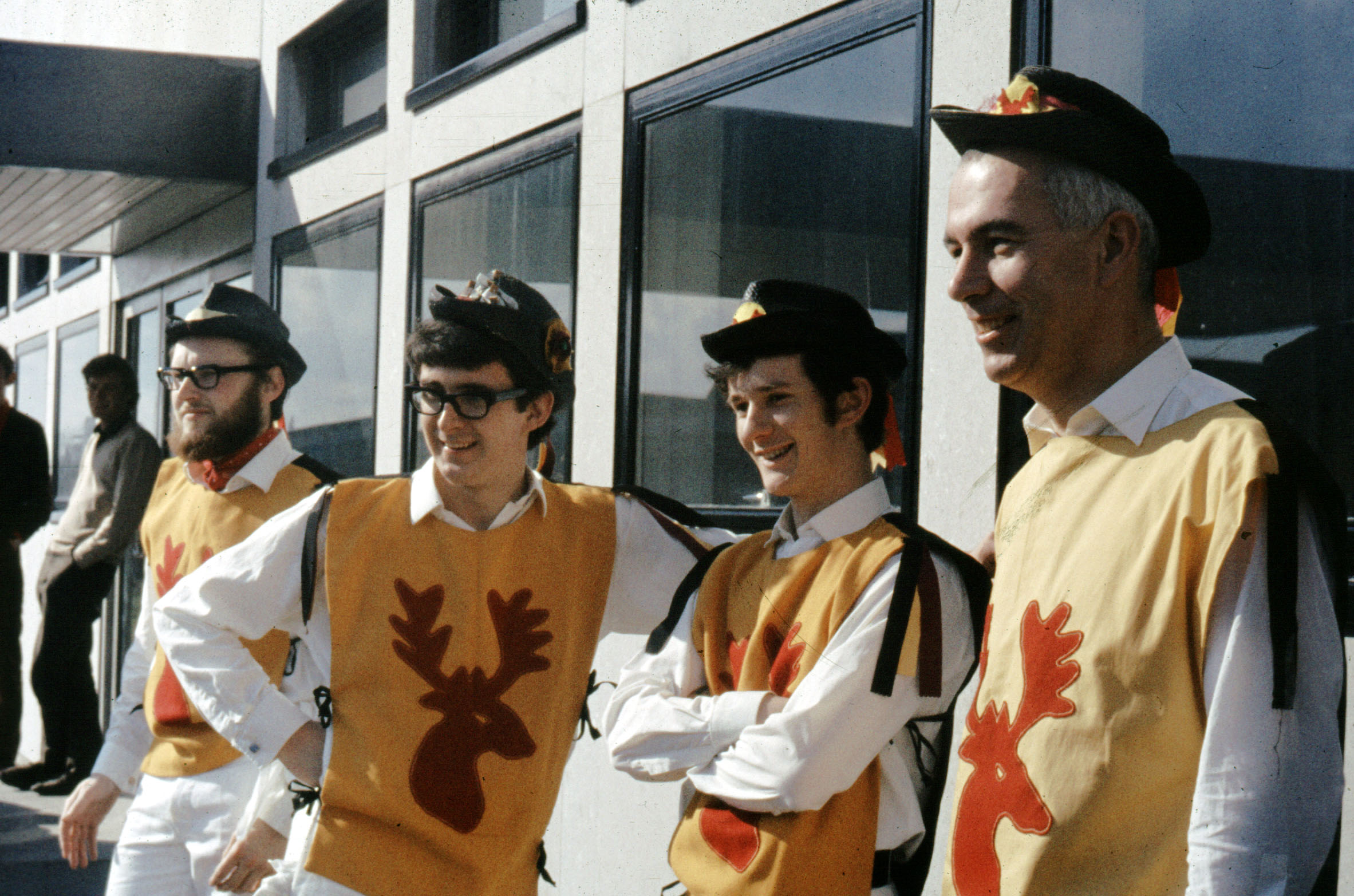
L to r: Russell Meredith, Mike Jackson, Steve Jordan, and Joe

Sticks, bells and hankies
I first met Joe in 1968, which might seem strange as I began my undergraduate studies at Southampton in 1967 in the Departments of Botany and Geography. Joe taught a second year class on genetics, so it wasn’t until the autumn term in October 1968 that I was faced with ‘Smartt genetics’. But by then I had made myself known to him, as I have described in another post on this blog. Joe and I were the co-founders of the first Morris side at the university in autumn 1968 – the Red Stags, and our common interest in traditional music (particularly bagpipe music – see this post) was the basis of a friendship that lasted more than 45 years. Many’s the time Joe and I sat down with a beer or a wee dram to enjoy many of the LPs from his extensive music library.

A friend indeed
But Joe was more than a friend – he was a mentor whose opinions and advice I sought on several occasions. In fact, it was a suggestion from him in February 1970 that I apply to the University of Birmingham for a new MSc course under the direction of Professor Jack Hawkes that got me into genetic resources conservation and use in the first place, and the start of a successful career in international agricultural research lasting more than 40 years.

Physically, Joe was a big man – but a gentle person and personality. I’ve seen him slightly cross, but I never saw him angry. It seemed to me that he had the most equitable of temperaments. He married Pam in 1970, and they had two daughters, Helena and Fran (about the same ages as my two daughters), and both have been very successful academically. Joe often told me of his pride in what they had achieved. I know that was a source of great comfort to him in his latter years as his health declined.

While I feel sadness at his passing, I can also celebrate the many scientific contributions he made, and his true friendship over so many decades. He will be missed by many colleagues in legume and goldfish circles, but particularly by his family and friends. Friends like Joe come along very few times in one’s lifetime. It’s been my luck – and privilege – to be among his.


I wrote this obituary in 2013:

Jackson, MT (2013). Dr. Joseph Smartt (1931–2013). Genet Resour Crop Evol 60, 1921–1922 (doi:10.1007/s10722-013-0044-7


Click here to read the Order of Service for Joe’s funeral on 21 June 2013 in Southampton. Several homilies were delivered during the service by Joe’s brother and his daughters Helen and Fran. You can read them here.

The RHS Chelsea Flower Show . . . 100 not out!

The Chelsea Flower Show – one of the most prestigious – is 100 years old this year. Organised by the Royal Horticultural Society, it’s held in the grounds of the Royal Hospital in Chelsea along the Thames Embankment in London.

1-20130523  234 Chelsea Flower Show

CFC timelineBut although it’s 100 years since the very first show in 1913, this year’s show is not the 100th (click on the timeline at the right). That’s because no shows were held during the First and Second World Wars. Patronized throughout its history by the UK’s Royal Family, the 2013 show was no different, as HM The Queen attended earlier in the week when the show was not open to the general public, and Prince Harry was involved in the design of the B&Q Sentebale Forget-Me-Not Garden inspired by his Lesotho charity, also the memory of his mother, Diana, Princess of Wales.

And yesterday, 23 May, Steph and I spent five hours at the CFS during which we walked more than 5 miles around the showground, viewing the various show and artesan gardens, and the magnificent displays of blooms in the Great Pavilion. Our daughters Hannah and Philippa had given tickets to the show as their 2012 Christmas present to us. Thank you!

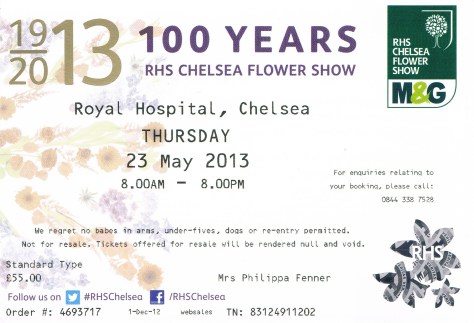
CFC ticketWe left home just after 09:00, and arrived back home just after 21:00, rather tired (by the end of the day my ‘dogs were barking’*) but it was a very enjoyable day out in London. We took a train from Warwick Parkway, about 25 miles from where we live, to London Marylebone, arriving there just after 11:30. We were at the show just after noon having had a surprisingly smooth trip across London on the Underground (and the same was the case on the return journey, although I’d expected it to be much busier).

There’s so much to see at the CFS it’s hard to know where to begin. And of course there are thousands and thousands of visitors each day, and yesterday was no exception. The weather forecast was not promising from the outset. But apart from a couple of short, sharp showers – when we had to take shelter in the Pavilion – the weather was fine with sunny periods, but generally overcast. There was, however, a stiff  cold breeze which took the edge off things. It was hard to believe this was almost the last weekend in May – with the temperatures hovering around 10-12C most of the day.

It would be wonderful to visit the CFS when there are fewer visitors – there must have been well over 20,000 all the time we were there. Click on any other galleries below to open larger images, and press Esc to return to his post.

That meant it was often difficult to get close to some of the gardens, especially the artisan gardens that were spaced rather closely down a quite narrow path on one side of the show ground. But as we went round the whole show about three times, we did manage to see pretty much everything  and even when it was crowded (like trying to get into the Pavilion when the first shower passed by) by and large we saw – and photographed – what we wanted. Lots of people were taking photographs and all manner of cameras were being used. However, I guess the most common were smartphone cameras, and quite a number of iPads even. But people using their phones to send texts or even make calls were a real pain in the backside – suddenly stopping in among the throngs, or shuffling along causing the flow of visitors to be disrupted.

The Show Garden chosen as Best in Show – The Trailfinders Garden designed and built by Fleming’s nursery from Victoria in Australia – was so popular that there was a one-way flow for viewing, and impossible to get near. The two gardens which caught my eye in this category however were the East Village Garden, a delightful blend of traditional and contemporary design, and the M&G Centenary Windows through Time Garden which I found very inspiring.

To enhance any garden there was a huge selection of ornaments and statues to grace any space, from weird and wonderful animals made from wire or driftwood, fountains, and all manner of objects.

And of course, the fabulous displays of flowers in the Great Pavilion. Three stalls caught my fancy – and I made a beeline for them because I’d seen them featured on one of the BBC broadcasts from the CFS earlier in the week. I think the most stunning display was one of carnivorous plants – that although appearing incredibly exotic are apparently quite easy to grow. But I wonder how much effort it takes to grow them to this standard?

Then there were the narcissi – a small selection of the 400 varieties that Walkers Bulbs of Lincolnshire cultivate.

And finally, an exceptional display of auriculas – a hardy species of Primula that were very popular in Victorian and Edwardian times, but have since fallen out of fashion. With blooms and displays like these I’m sure they will find favor once again.

Now while these certainly attracted my attention, I could have included here special galleries of tulips, roses, irises, rhododendrons, alliums and amaryllis lilies, besides huge blousy lilies. Here’s just a taster.

What a day . . . certainly I think Steph has got some further inspiration from the various gardens. Most handed out a leaflet that also included lists of the plants used – very helpful.

After quite a long day it was good to sit down in London Marylebone station, and grab a bite to eat before catching out 19:15 train back north. A cup of tea on arrival back home quickly revived us both. I slept like a log. And today, the weather here at home is dreadful – incredibly windy, and I’ve heard reports that there is heavy rain in London. What luck we had!

__________
* a colloquial term for ‘sore feet’, origin uncertain

Around the world in 40 years . . . Part 6. Trekking the red wine trail

Discovering German red wine
It was February 1997. Steph joined me on a work trip to Laos, and we were returning to the Philippines via Bangkok where we’d spent a couple of nights. We checked into our Lufthansa (LH) flight, and went off to the lounge. Since I had a stack of air miles, I’d treated Steph to an upgrade to Business Class.

When we checked in at the gate, our boarding passes were exchanged for a couple of seats in First Class, so we enjoyed the three hour flight back to Manila as almost the only passengers on the upper deck of a 747-400.

I used to fly with Lufthansa a lot in the 90s. In many ways it then had the best flight connections into Europe, and as I used to travel to Rome quite frequently, LH was my airline of choice. So I was quite used to the Lufthansa cabin service. But on this flight I was offered something I’d never tried before – a German red wine. The purser even gave me a couple of bottles as I left the flight in Manila. Of course I’d often sampled several of Germany’s white wines previously. But a red wine was quite a novelty.

The Rotweinwanderweg
Then, a few years later I discovered that there’s one wine region in Germany – the Ahr valley – that’s famous for its red wine. Lying to the west of the Rhine, and to the south of Bonn, the Ahr valley is one of Germany’s smallest wine producing regions. But what excellent wines it produces, principally from the Pinot Noir grape.


The town of Ahrweiler, near the mouth of the Ahr Valley, is shown in this gallery:


So how did I come to discover this oenological treasure? Well, it was through my good friend and plant pathologist, Dr Marlene Diekmann, who I first met in the early 90s on one of my trips to the International Plant Genetic Resources Institute (IPGRI – now Bioversity International) in Rome. Marlene left IPGRI and moved to Aleppo in Syria to join a sister CGIAR center, ICARDA where her husband Jürgen was also the farm manager. After Marlene left ICARDA and returned to Bonn, to join the German overseas development assistance program, our paths crossed again when I attended my first annual meeting of the CGIAR after I’d become IRRI’s Director for Program Planning and Communications in 2001.

Thereafter, whenever I had to travel to Europe to visit the donor agencies supporting IRRI, and if Germany was on my itinerary, I’d try and arrange a weekend in Bonn. And that’s when I was introduced to the wonders of the Ahr valley, its wines, and the Rotweinwanderweg – the Red Wine Hiking Trail. The photos in this gallery were taken along the trail above the small town of Dernau:


Above the town of Dernau, there are kilometers of trails through the vineyards. The vines are grown on extremely steep slopes, as you can see in the photos above. Heaven knows what effort it takes not only to harvest the grapes each year but also to till the soil. If I remember correctly, Marlene told me that the farmers contract helicopter pilots to spray the vines when necessary – it certainly wouldn’t be feasible to walk up and down the lines of vines trying to apply pesticides.

I’ve seen the vineyards along the Red Wine Trail in all seasons. And after a nice long walk, I’ve also enjoyed the liquid output from the vineyards, on several occasions.


This is truly a wonderful part of western Germany, and it’s well worth a visit if you happen to be in the vicinity. I look forward to returning one day, and also getting to know the Rhine vineyards in more detail.

Around the world in 40 years . . . Part 5. Under African skies.

Over the years I’ve had the opportunity of visiting a number of African countries, my first being Ethiopia in early 1993. From then until my retirement in 2010, I made a number of forays into that continent linked to my work in international agricultural research, including South Africa, Zambia, Mozambique, Madagascar, Kenya, Nigeria, Ivory Coast, and Morocco.

Ethiopia
In 1993 I attended my first meeting of the CGIAR Inter-Center Working Group on Genetic Resources (ICWG-GR), hosted by what was then the International Livestock Center for Africa (ILCA) in Addis Ababa (now ILRI-Ethiopia). After several days couped up in a tiny meeting room we did manage a field trip and I traveled down into the Rift Valley to visit ILCA’s research station at Debre Zeit. There was also lots of Eragrostis tef – teff -to see growing in the fields – a small-grained, indigenous cereal that is used to make injera, a fermented flat bread. There – but also on the ILCA campus in Addis – the bird life is truly magnificent. Beside a lake in Debre Zeit the fish eagles were as common as sparrows in the trees.
In early 2010 I was ‘asked’ to attend a CGIAR planning meeting in Addis for just one day. I flew all the way from the Philippines for one day! However, my departure flight on the second day didn’t leave until the evening, so I spent much of the day relaxing or walking around the campus bird-watching – buzzards two-a-penny, beautiful long-tailed flycatchers chasing one another through the scrub, and flocks of brilliantly colored bee-eaters on the open ground, just to mention a few. Having lived in the Philippines for almost 20 years seeing so many bird species was truly a delight, because where we lived in Los Baños was essentially an ‘avian desert’. But it has become much better – see the latest issue of Rice Today.
South Africa
Although I had passed through Jo’burg in South Africa on a couple of occasions, I did spend a week in Durban in May 2001 to attend a meeting of the CGIAR. All delegates had been warned to take care when walking around outside, but that didn’t prevent some Malaysians being mugged right outside the hotel entrance. And one of my colleagues found himself in the middle of a gun battle when he took a walk along the sea front. We did have a day trip to visit agricultural research in Pietermaritzburg so that gave an opportunity to see something of the country. The day of activities in Pietermaritzburg was opened by a member of the Zulu royal family, and I can still remember the shivers up my neck as a choir sang the South African national anthem, Nkosi Sikelel.

And as with my Rift Valley trip in Ethiopia and in Kenya on another occasion, it reinforced this perspective that Africa is a continent of huge landscapes.

Mozambique
I first visited Mozambique in about 1995 when I was setting up a large rice biodiversity project funded by the Swiss government. I spent much of my time in Maputo, with just one short field trip. One thing that has stayed in my memory are the Danger – Landmines! warning signs, a consequence and reminder of the various conflicts that dogged Mozambique in previous decades.

Until recently, IRRI’s regional office for Eastern and Southern Africa was based in Maputo (now transferred to Burundi). Here’s IRRI’s former regional leader Joe Rickman talking about rice research and development in the region.

Mozambique was also the venue for the CGIAR to hold its annual meeting in 2008.

Zambia
Again this was another biodiversity-related trip, specifically to meet scientists at the SADC Plant Genetic Resources Centre in Lusaka, where a couple of my former MSc students from Birmingham were working. The genebank had been set up in a collaborative project with the Nordic Genebank in Sweden, and I took a number of ideas away from that visit about low-cost, appropriate technology genebank design that I introduced to several genebank programs in Asia.

On my last day, I had a late afternoon flight to Nairobi, Kenya, but no other commitments. I’d been struggling with a draft of a paper that IRRI had committed me to write for German-published GeoJournal (IRRI had been given the opportunity of a special issue). I decided to use my several ‘free’ hours in Lusaka to make some headway with my draft. After an early breakfast – and with just a couple of ‘comfort breaks’ over the next six or seven hours, I finally drafted almost 40 pages of single-spaced hand-written text. I’d brought along a sheaf of plain paper (I hate using ruled paper) and a bunch of sharp HB pencils. When I came to have the draft typed up ready for editing I surprised myself by actually making very few changes. This was the result.

Kenya
I’ve spent time in Nairobi on three occasions, although I passed through the airport on a couple of others. The first time I flew in for 48 hours en route to Nigeria. In 1998, the ICWG-GR met, hosted by the World Agroforestry Centre, and we held our meeting upcountry near Mt Kenya. Not that we got to see much of it as it was shrouded in cloud almost all of the time. Nor did we see any big game.

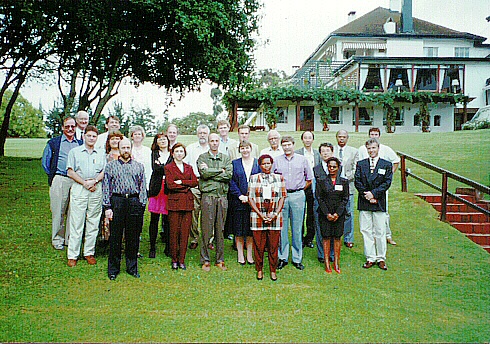
L to r: Bent Skovmand (CIMMYT, deceased), Lindsey Innes (consultant), Joel Cohen (ISNAR), Roger Pullin (ICLARM), Jane Toll (SGRP), ??, Wanda Collins (CIP), Paula Bramel (ICRISAT), Jan Valkoun (ICARDA), Maria Zimmerman (FAO-TAC), Mike Jackson (IRRI), Tim Boyle (CIFOR), Cary Fowler (FAO), Jean Hanson (ILRI), Daniel Debouck (CIAT), ??, Randy Barker (IWMI), Geoff Hawtin (IPGRI), Quat Ng (IITA), Masa Iwanaga (IPGRI), ??, ??, Tony Simons (World Agroforestry Centre-WAC), Ian Dawson (WAC)

But the meeting was successful and the Group awarded me about USD200,000 to organize a meeting the following year in The Hague on Genebanks and Comparative Genetics, a first for the CGIAR!

The CGIAR held its annual meeting in Nairobi in 2003 – I managed to lose my mobile phone. At all these meetings there are opportunities to visit agricultural research projects. The one I joined had to do with range land ecology, i.e. big game! That was a popular outing with many delegates, and eventually took us into the Nairobi National Park that really does come right up to the outskirts of the city. This was the only time that I have ever seen big game in the wild: rhinos, buffalo, giraffes, cheetahs, and wildebeest and zebra, of course. This park does not have elephants, unfortunately; you have to travel to some of the other reserves to see those.


Nigeria
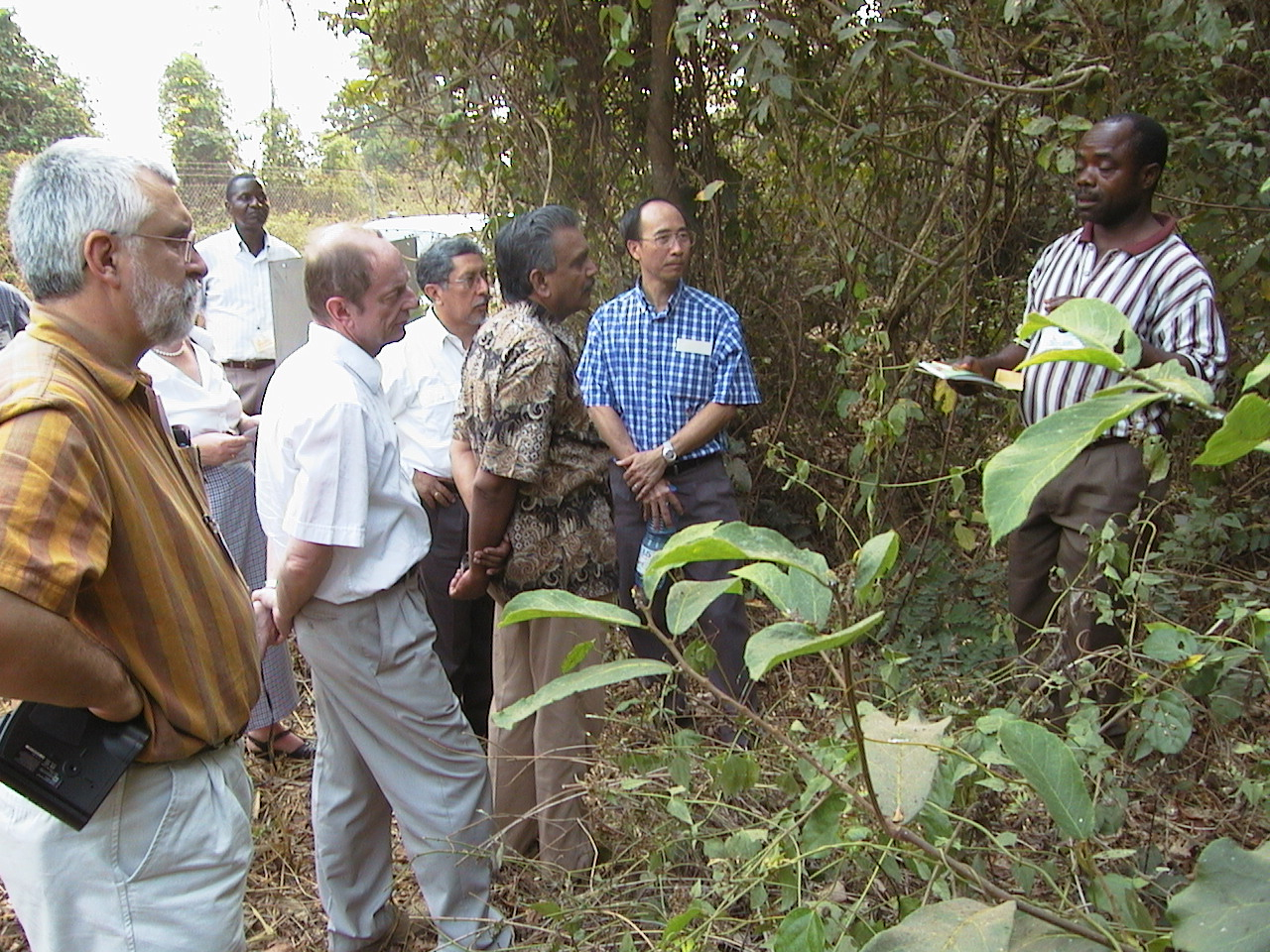
Another CGIAR center, IITA, is based at Ibadan, and I guess I must have been there maybe half a dozen times. Ibadan is about 170 km north-north-east of Lagos, a three-hour drive. IITA has a marvelous 1,000 ha campus. It was once quite isolated from Ibadan (now one of the largest cities in sub-Saharan Africa) but over the years the city has sprawled right up to the IITA boundary fences. In addition to its experimental fields, there is some virgin rainforest, and even a lake stocked with Nile perch – angling is a favorite IITA sport. But there are miles of roads to wander, and I always found the IITA campus a place of great relaxation after work hours. It was just the threat of malaria that always used to worry me. The ICWG-GR met there in the 90s, and one day we took an excursion into the forest looking for wild yams.

With Jan Valkoun (ICARDA), Willy Roca (CIP), Murthi Anishetty (FAO) and Quat Ng (IITA).

An overnight stay in the IITA-Lagos guest-house is a must if a flight arrives in the evening. There is no shuttle service – for obvious security reasons – at night. And even during the day, a second vehicle, riding shotgun – literally, but also carrying luggage would accompany a passenger vehicle on the trip from Lagos to Ibadan.

Lagos airport was always a cause for concern, especially on departure, where both immigration and customs officials would be looking for a ‘gift’, and searching one’s hand-luggage for any suitable item. Always a source of tension, although by the time of my last visit, maybe around 2000, the situation had improved beyond any comparison with my first visit in 1994.

Being met at the airport in Lagos was always a relief, and IITA staff were immensely helpful. I remember one occasion when I was flying in from Abidjan, Ivory Coast. On arrival at Abidjan airport I was informed that my ‘confirmed’ flight would not be departing. In fact it had ‘never existed’, but I could fly on the next flight later that evening, with intermediate stops in Accra (Ghana), Lomé (Togo), and Cotonou (Benin). I hadn’t been able to contact IITA to let them know of the changes in my travel plans, and was praying that someone would be at the airport. My sense of anxiety was not helped when, on arrival in Lagos, and just before the immigration desk, this man in plain clothes stepped out and demanded my passport. I’d always been advised not to hand over my passport unless the person could provide some means of identity. After showing some hesitation to comply with the ‘request’ I was threatened with dire consequences. Who this man was I never found out. On collecting my luggage and departing the customs area it was a huge relief to see someone wearing an IITA cap – my meeter and greeter.

Ivory Coast
The Africa Rice Center (formerly known as WARDA – the West Africa Rice Development Association) had its headquarters in Bouaké until it was forced to abandon the site and leave the country when the civil war commenced in 2002. It relocated to the IITA sub-station in Benin, just over the international border from Lagos in Nigeria. While it has hopes to return to Bouaké some day, personally I think that day is a long way off.

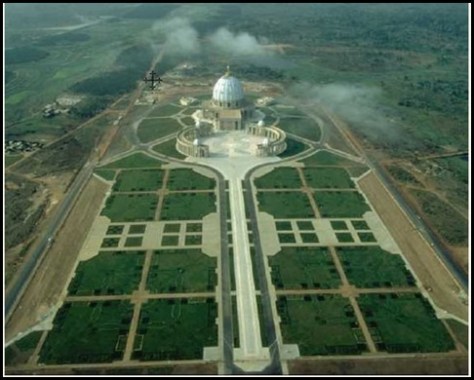
On two occasions I flew from Abidjan on the coast to Bouaké, but have traveled south by road via the capital Yamoussoukro, where a former president built one of the largest Catholic basilicas in the world, and one to rival St Peter’s in Rome.

Under the then Director General, Eugene Terry and Deputy Peter Matlon, I found WARDA to be a small but dynamic institute, well-focused on its regional mandate, but in awe of its bigger rice sister, the International Rice Research Institute in the Philippines. I believe that some of the work I undertook on a joint mission commissioned by Terry and IRRI Director General Klaus Lampe, helped to improve relations between them. They certainly couldn’t have dipped much lower at that time in the mid-90s.

Madagascar
I visited Madagascar just the once, in the late 90s, although I had tried to get there a couple of years earlier, but had to cancel, even as I was in Jo’burg waiting for a flight because the schedules was totally disrupted and I had no idea when I’d be able to travel.

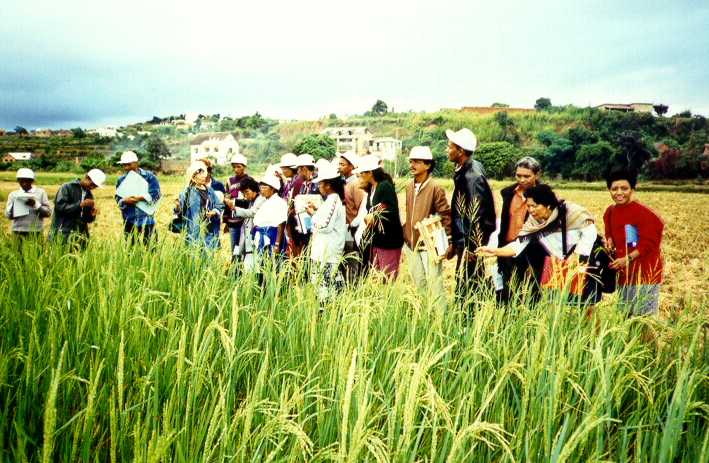
Again it was related to my rice biodiversity project. We supported a major program to collect both wild and cultivated rices, one of the major staples of Madagascar. Having seen something of the incredible wealth of indigenous animal species through some of David Attenborough’s TV specials, it would have been great to go beyond rice and see what else this fascinating island has to offer. Regrettably there was no chance, but a couple of short trips, on incredible bad roads, from the capital Antananarivo to a rice research station in the boondoks allowed me to see something of the countryside.

Morocco
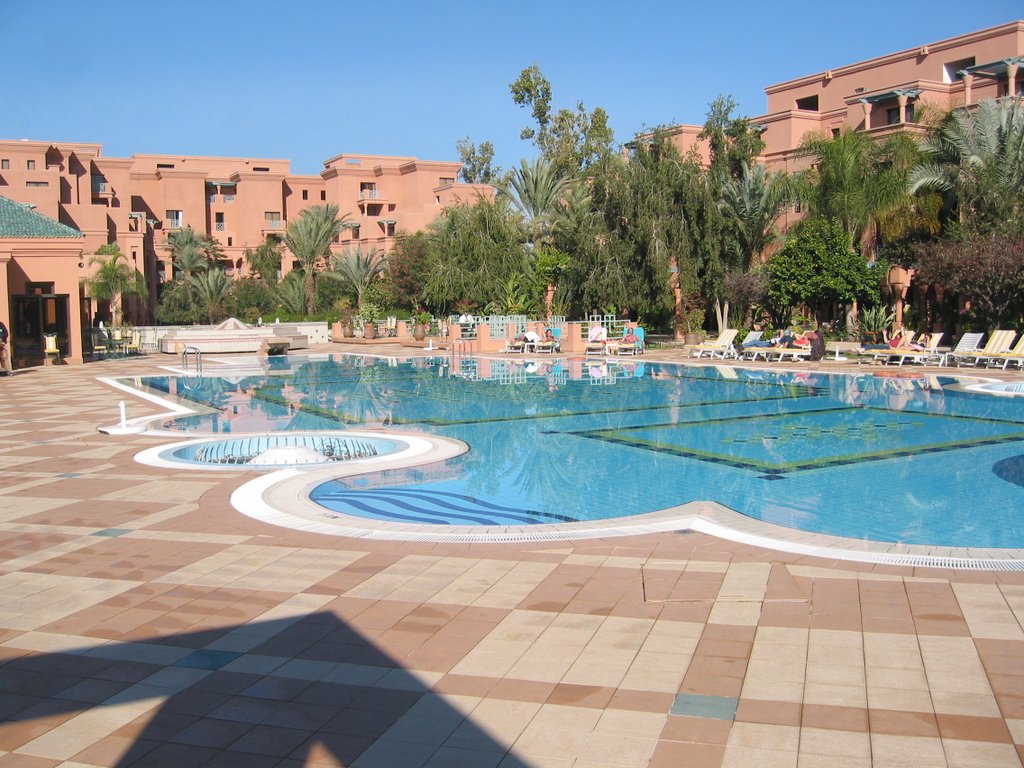
And that’s more than I can say bout my one and only visit to Morocco in 2005 when the CGIAR held its annual meeting in Marrakesh. I went down with a nasty cold not long after I arrived, and because of some pressing commitments, I had to spend much of my time locked away in my room finalizing a research project proposal to an important donor worth several million dollars. You can imagine where my DG saw my priorities! So most of the time, I only saw the hotel.

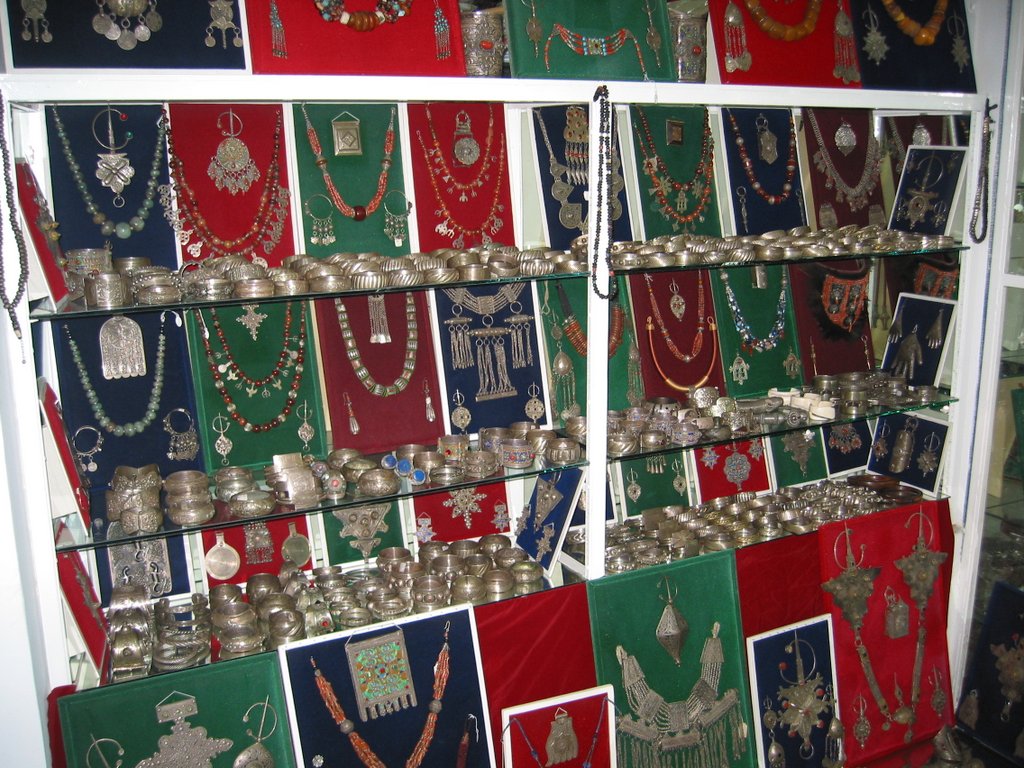
But I did manage to visit the market on one afternoon, and pick up some silver beads for Steph that she has subsequently used in her beading projects.

1-20051204014

600 years in the same family

Coughton Court. An elegant Tudor house in the Warwickshire countryside near Alcester (and only 12 miles from home).


A National Trust property since 1946, it’s been owned by or lived in by the same Throckmorton family for six centuries.

The family has been involved in some of the major events of English history – as a major Catholic family during the Reformation under Henry VIII, Edward VI and Elizabeth I. They were dragged into the Gunpowder Plot of 1605, even if only tangentially.

One wing of the house is still occupied by the family under the terms of a very long lease with the National Trust. The house contains some wonderful treasures, and the extensive gardens and bluebell wood are worth the walk.

Where good science matters . . . and it’s all relevant

A well-deserved reputation
It was early November. However, I can’t remember which year. It must be well over a decade ago. I was on my way to a scientific meeting in the USA – via Kuala Lumpur where I’d been invited to participate in a workshop about intellectual property rights.

My flight from Manila arrived quite late at night, and a vehicle and driver were sent to KL airport to pick me up. On the journey from the airport my driver became quite chatty. He asked where I was from, and when I told him I was working in the Philippines on rice, he replied ‘You must be working at IRRI, then‘ (IRRI being the International Rice Research Institute in Los Baños in the Philippines). I must admit I was rather surprised. However, he had once been the chauffeur of Malaysia’s Minister of Agriculture. No wonder then that he knew about IRRI.
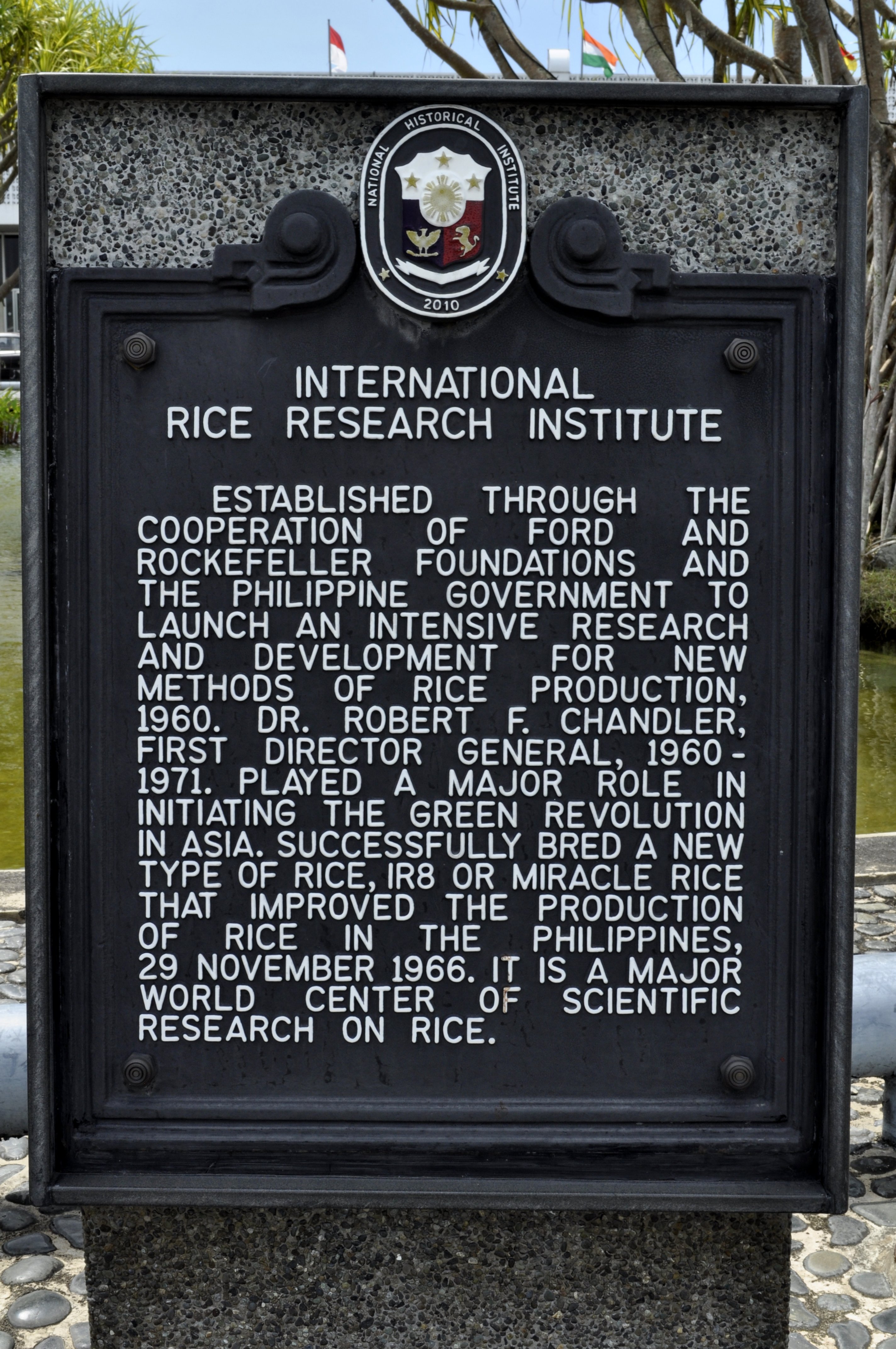
One of the national historical markers dedicated on 14 April 2010, the 50th anniversary of IRRI's founding

One of the national historical markers dedicated on 14 April 2010, the 50th anniversary of IRRI’s founding

IRRI’s reputation has spread far and wide since its foundation in 1960, and IRRI is now one of the world’s premier agricultural research institutes. Its reputation is justified. At the forefront of technologies to grow more rice and more sustainably, IRRI can be credited with saving millions of people around the world from starvation, beginning in the 1960s with the launch of the Green Revolution in Asia (see a related story about Green Revolution pioneer, Norman Borlaug). Now its work touches the lives of half the world’s population who depend on rice every day. No wonder IRRI is such an important place. But over the decades it has had to earn its reputation.

On a recent visit

20130504057 IRRI

The main entrance in front of the admin buildings, between Chandler Hall (on the left) and the FF Hill Building (on the right, where I worked for almost a decade)

Between Chandler Hall and the FF Hill Building, with Mt Makiling in the distance

A view south over the long-term trail plots and others, looking towards Mt Banahaw

A view south over the long-term trial plots, looking towards Mt Banahaw, with the entrance gate to IRRI on the right, and the research labs off to the left

Some of the research labs, with the NC Brady building on the right, home to the International Rice Genebank

Some of the research labs, with the NC Brady building on the right, home to the International Rice Genebank

I was there recently, exactly three years after I had retired. And the place was buzzing, I’m pleased to say. There was such an optimistic outlook from everyone I spoke to. Not that it wasn’t like that before, but over the past decade things have moved along really rather nicely. That’s been due not only to developments in rice research at IRRI and elsewhere, but also because the institute has had the courage to invest in new approaches such as molecular genetics as just one example, and people. That was an aspect that I found particularly gratifying – lots of young scientists beginning their careers at IRRI and knowing that it will be a launching pad to opportunities elsewhere.

I was visiting in connection with the 4th International Rice Congress that will take place in Bangkok, Thailand during the last week of October 2014. I’ve been asked to chair the committee that will develop the scientific conference. We expect to have a program of more than 200 scientific papers covering all aspects of rice science and production, as well as a number of exciting plenary speakers.

IRRI’s strengths
You only have to look at IRRI’s scientific publication record – and where its scientists are publishing – to appreciate the quality of the work carried out in Los Baños and at other sites around the world (primarily but not exclusively in Asia) in collaboration with scientists working in national research programs. IRRI’s soon-to-retire senior editor  Bill Hardy told me during my recent visit that by the beginning of May this year he had already edited more journal manuscripts than he did in the first six months of 2012. And IRRI has a very good strike rate with its journal submissions.

IRRI’s research is highly relevant to the lives of rice farmers and those who depend on this crop, ranging from the most basic molecular biology on the one hand to studies of adoption of technologies conducted by the institute’s social scientists. It’s this rich range of disciplines and multidisciplinary efforts that give IRRI the edge over many research institutes, and keep it in the top league. IRRI scientists can – and do – contemplate undertaking laboratory and field experiments that are just not possible almost anywhere else. And it has the facilities (in which it has invested significantly) to think on the grand scale. For example, it took more than 30,000 crosses with a salt-tolerant wild rice to find just a single fertile progeny. And in research aimed at turbocharging the photosynthesis of rice, a population of 1 million mutant sorghum plants was studied in the field, with only eight plants selected after all that effort. Both of these are discussed in a little more detail below. In 2012, IRRI made its 100,000th cross – rice breeding remains a mainstay of the institute’s work, keeping the pipeline of new varieties primed for farmers.

Take a look at this 11½ minute video in the skies above IRRI’s 252 hectare experimental farm. In the first few minutes, the camera pans eastwards along Pili Drive over the institute’s main administrative buildings, before heading towards the research laboratory and glasshouse complex. In the middle sequence, with the Mt Banahaw volcano in the distance (due south from Los Baños) you can see the extensive experimental rice paddies with rice growing in standing water. In the final segment, the camera sweeps over the ‘upland’ farm, with dormant Mt Makiling in the distance, and showing the multiplication plots from the International Rice genebank, before heading (and closing) over the genebank screen houses where the collection of wild Oryza species is maintained. It’s certainly an impressive sight.


Taking a long-term view

You can’t get much longer-term than conservation of rice genetic resources in the institute’s genebank. This is the world’s largest collection of rice genetic resources, and I was privileged to head the genebank and genetic resources program for a decade from 1991. I’ve written about this in more detail elsewhere in my blog.

Explaining how rice seeds are stored in the International Rice Genebank to Nobel Laureate Norman Borlaug

Explaining how rice seeds are stored in the International Rice Genebank to Nobel Laureate Dr Norman Borlaug

In 1963 (just three years after IRRI was founded) long-term experimental plots were laid out to understand the sustainability of intensive rice cropping. In these next videos soil scientist Dr Roland Buresh explains the rationale behind these experiments. They are the tropical equivalent of the Broadbalk classic experiment (and others) at Rothamsted Experiment Station just north of London in the UK, established in the mid-19th century.

And in this next video you can watch a time-lapse sequence from field preparation to harvest of two crops in the long-term trials.

Making rice climate ready
Three areas of work are closely linked to the problem of climate change, and highlight how IRRI is at the forefront of agricultural research.

Rice varieties with and without the SUB1 gene after a period of inundation

Rice varieties with and without the SUB1 gene after a period of inundation

Scuba rice. Although rice grows in standing water, it will die if inundated for more than a few days. But several years ago, a gene was found in one rice variety that allowed plants to survive about two weeks under water. In a collaborative project with scientists from the University of California, the gene, named SUB1, has been bred into a number of varieties that are grown widely throughout Asia – so-called mega-varieties – and which are already bringing huge benefits to the farmers who have adopted them in India and Bangladesh. In this video, the effect of the SUB1 gene can easily be seen. Much of the work was supported by the Bill & Melinda Gates Foundation, and has (as stated on the Foundation’s web site) ‘exceeded our expectations’.

Careful with the salt. Recently, IRRI announced that breeders had made crosses between a wild species of rice, Oryza coarctata (formerly known as Porteresia coarcata – which already indicates how remote it is from cultivated rice) to transfer salt tolerance into commercial varieties. Building on the wide hybridization work of Dr Darshan Brar (who retired in 2012), Dr KK Jena has achieved the impossible. After thousands of crosses, and culture of embryos on culture medium, he now has a plant that can be used as a ‘bridge species’ to transfer salt tolerance. As IRRI Director General Bob Zeigler explained to me, ‘Now we have fertile crosses with all the wild rices, we can tap into 10 million years of evolution‘. I couldn’t have expressed it better myself!

Boosting output. Lastly, since 2008 IRRI has led the C4 Consortium, a network of scientists around the world who are studying how photosynthesis in rice (which is quite inefficient in an environment where temperature and CO2 levels are increasing) could be modified to make it as efficient as maize or sorghum that already have a different process, known as C4 photosyntheis (just click on the image below for a full explanation). This work is also funded by the Bill & Melinda Gates Foundation and the UK government.

There are so many examples I could describe that show the importance and relevance of IRRI’s research for development. I think it’s the breadth of approaches – from molecule to farmer’s field (it’s even working with farmers to develop smartphone apps to help with fertilizer management) – and the incredible dedication of all the people that work there that makes IRRI such a special place. Now part of the Global Rice Science Program (GRiSP) funded through the CGIAR Consortium, IRRI’s work with a wide range of partners goes from strength to strength.

There’s no doubt about it. Joining IRRI in 1991 was the second best career decision I ever made. The best career move was to get into international agricultural research in the first place, way back in 1971. What a time I had!

Plant Genetic Resources and Climate Change – in the production phase at last

At the end of March I submitted to CABI all 16 manuscripts and associated figures for our book on Plant Genetic Resources and Climate Change.

These are now being checked and moving through the various production phases. We hope that the book will be published in the last quarter of 2013. I gather that the target price will be around £85 – but that has yet to be confirmed. The book will be around 300+ pages.

Plant Genetic Resources - cover design

Rationale and audience:
The collection and conservation of plant genetic resources have made significant progress over the past half century, and many large and important collections of crop germplasm have been established in many countries. A major threat to continuing crop productivity is climate change, which is expected to bring about disruptions to patterns of agriculture, to the crops and varieties that can be grown, and some of the constraints to productivity – such as diseases and pests, and some abiotic stresses – will be exacerbated. This book will address the current state of climate change predictions and its consequences, how climate change will affect conservation and use of crop germplasm, both ex situ and in situ, as well as highlighting specific examples of germplasm research related to ‘climate change threats’. All of this needs to take place under a regime of access to and use of germplasm through international legal instruments such as the Convention on Biological Diversity and the International Treaty on Plant Genetic Resources for Food and Agriculture. This book will be essential reading for plant breeders and physiologists, as well as those involved with germplasm conservation per se. In particular it will be a companion volume to the recently published CABI volume Climate Change and Crop Production (2010) by MP Reynolds (ed.), but of interest to the same readership as Crop Stress Management and Global Climate Change (2011) by JL Araus and GA Slafer (eds.) and Climate Change Biology (2011) by JA Newman et al.

Chapters, authors and their affiliations:

Preface
Michael Jackson, Brian Ford-Lloyd and Martin Parry
The Editors

1. Food security, climate change and genetic resources
Robert S. Zeigler
IRRI

2. Genetic resources and conservation challenges under the threat of climate change
Brian Ford-Lloyd, Johannes M.M. Engels and Michael Jackson
University of Birmingham, Bioversity International, and formerly IRRI (now retired)

3. Climate projections
Richard A. Betts and Ed Hawkins
UK MetOffice and University of Reading

4. Effects of climate change on potential food production and risk of hunger
Martin Parry
Imperial College

5. Regional impacts of climate change on agriculture and the role of adaptation
Pam Berry, Julian Ramirez-Villegas, Helen Bramley, Samarandu Mohanty and Mary A. Mgonja
University of Oxford, University of Leeds and CIAT, University of Western Australia, IRRI, and ICRISAT

6. International mechanisms for conservation and use of genetic resources
Gerald Moore and Geoffrey Hawtin
Formerly FAO and formerly IPGRI (now retired)

7. Crop wild relatives and climate change
Nigel Maxted, Shelagh Kell and Joana Magos Brehm
University of Birmingham

8. Climate change and on-farm conservation of crop landraces in centres of diversity
Mauricio R. Bellon and Jacob van Etten
Bioversity International

9. Germplasm databases and informatics
Helen Ougham and Ian D. Thomas
University of Aberystwyth

10. Exploring ‘omics’ of genetic resources to mitigate the effects of climate change
Kenneth L. McNally
IRRI

11. Harnessing meiotic recombination for improved crop varieties
Susan J. Armstrong
University of Birmingham

12. High temperature stress
Maduraimuthu Djanaguiraman and P.V. Vara Prasad
Kansas State University

13. Drought
Salvatore Ceccarelli
Formerly ICARDA (now retired)

14. Salinity
William Erskine, Hari D. Upadhyaya and Al Imran Malik
University of Western Australia, ICRISAT, and UWA

15. Response to flooding: submergence tolerance in rice
Abdelbagi M. Ismail and David J. Mackill
IRRI and University of California – Davis

16. Effects of climate change on plant-insect interactions and prospects for resistance breeding using genetic resources
Jeremy Pritchard, Colette Broekgaarden and Ben Vosman
University of Birmingham and Wageningen UR Plant Breeding

The editors:
Michael Jackson retired from the International Rice Research Institute (IRRI) in 2010. For 10 years he was Head of the Genetic Resources Center, managing the International Rice Genebank, one of the world’s largest and most important genebanks. For nine years he was Director for Program Planning and Communications. He was Adjunct Professor of Agronomy at the University of the Philippines-Los Baños. During the 1980s he was Lecturer in the School of Biological Sciences at the University of Birmingham, focusing on the conservation and use of plant genetic resources. From 1973-81 he worked at the International Potato Center, in Lima, Perú and in Costa Rica. He now works part-time as an independent agricultural research and planning consultant. He was appointed OBE in The Queen’s New Year’s Honours 2012, for services to international food science.

Brian Ford-Lloyd is Emeritus Professor of Conservation Genetics at the University of Birmingham, former Director of the University Graduate School, and former Deputy Head of the School of Biosciences. As Director of the University Graduate School he aimed to ensure that doctoral researchers throughout the University were provided with the opportunity, training and facilities to undertake internationally valued research that would lead into excellent careers in the UK and overseas. He drew from his experience of having successfully supervised over 40 doctoral researchers from the UK and many other parts of the world in his chosen research area which included the study of the natural genetic variation in plant populations, and agricultural plant genetic resources and their conservation.

Martin Parry is Visiting Professor at The Centre for Environmental Policy, Imperial College London, and also Visiting Research Fellow at The Grantham Institute at the same university. Until September 2008 he was Co-Chair of Working Group II (Impacts, Adaptation and Vulnerability), of the Intergovernmental Panel on Climate Change (IPCC) based at the Hadley Centre for Climate Prediction and Research, UK Meteorological Office. Previously he was Director of the Jackson Environment Institute (JEI), and Professor of Environmental Science at the University of East Anglia (1999-2002); Director of the JEI and Professor of Environmental Management at University College London (1994-99), foundation Director of the Environmental Change Institute and Professor of Geography at the University of Oxford (1991-94), and Professor of Geography at the University of Birmingham (1989-91). He was appointed OBE in The Queen’s New Year’s Honours 1998, for services to the environment and climate change.