
Have you ever bumped into an old acquaintance, even a relative, who you haven’t seen for a long time, just by chance?
This has happened to me on several occasions. The planets must have been in an appropriate alignment.
It was 1969. I was an undergraduate student at the University of Southampton, studying for a BSc degree in Environmental Botany and Geography. On one of the infrequent occasions that I actually used the university library (I burnt the candle at one end more than the other), I was leaving the building on my way to grab a bite to eat, when two young women who I didn’t know asked if I would like to buy a raffle ticket for the city-wide student rag events and charities.
I happily coughed up, and having thanked me, they turned to walk away. But I had to stop them. During our brief encounter, I’d had a very strong feeling that I knew one of them. Not only that, but we were related. How odd. I couldn’t let them walk away without asking.
I turned to the one with very long, almost black hair and asked: ‘Is your surname Jackson?‘ Her jaw dropped, and she replied ‘Yes‘. ‘Then‘, said I, ‘I think your name is Caroline and you’re my cousin [daughter of my dad’s younger brother Edgar]’. And, of course it was Caroline.
I had last seen her around the summer of 1961 or 1962 when my parents and I took our caravan to the New Forest (west of Southampton) and met up with my Uncle Edgar and his wife Marjorie, and cousins Timothy and Caroline.
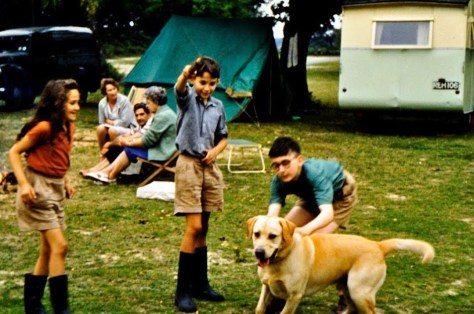
L-R: Caroline, Timothy, me, and Barley the labrador, and my mum in the background talking to her brother-in-law Edgar, and Marjorie.
It wasn’t until the summer of 2008 that I met her again, when Steph and I joined Caroline’s eldest brother Roger at a special steam event in Wiltshire.
After Southampton, I began my graduate studies in genetic conservation and potato taxonomy at the University of Birmingham. One of my classmates the following academic year, Dave Astley, was, for several years, the research assistant of our joint PhD supervisor, Professor Jack Hawkes.
In January 1973 I joined the International Potato Center (CIP) in Lima, Peru. By August, Steph and I were settled in a larger two bedroom apartment on Avda. Larco in the commercial Miraflores district of Lima, close by the Pacific Ocean. So, the following January, Dave stayed with us for a few days before continuing on to Bolivia where he joined a potato germplasm expedition led by Jack Hawkes.
 By 1976, Steph and I had moved to Costa Rica, where I was CIP’s regional leader for Mexico, Central America, and the Caribbean. In early 1980, I was returning from a trip to the Dominican Republic, and transiting overnight in Miami. Joining one of the (interminable) immigration queues, I looked over to my right and, lo and behold to my surprise, Dave was just a couple of passengers ahead of me in the parallel queue. He had just flown in from the UK, on his way to Bolivia, his second expedition there. He had a connecting flight, and once we were both through immigration we only had about 15 minutes to chat before he had to find his boarding gate. What a coincidence!
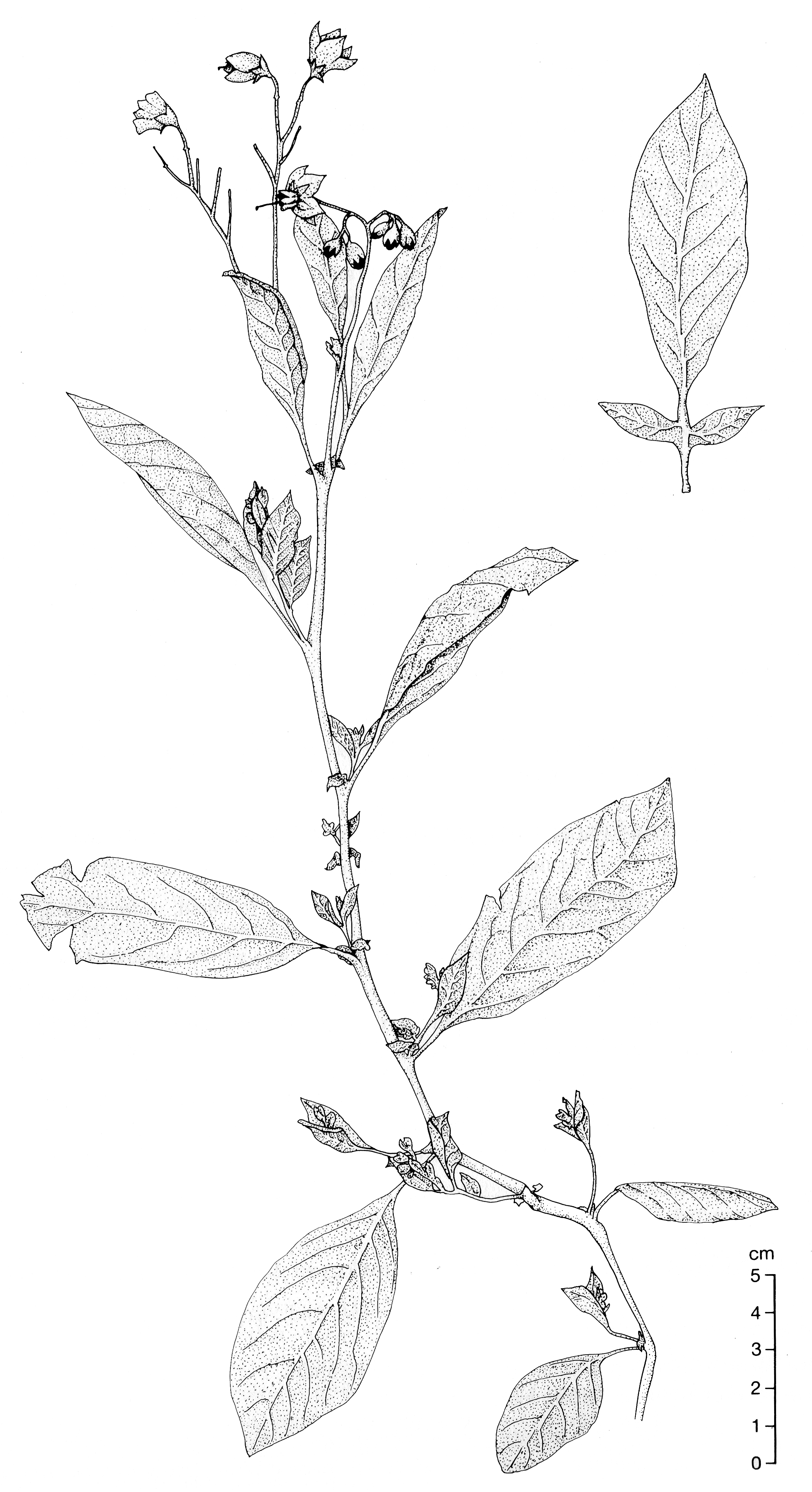 During that expedition in Bolivia, Dave collected a new species of Solanum that was described by Hawkes and his Danish colleague Peter Hjerting in 1985 and named after Dave as Solanum astleyi (right, from JG Hawkes and JP Hjerting, 1989, The Potatoes of Bolivia, Fig. 22, p. 206. Oxford University Press).
In 1991, I resigned from the University of Birmingham where I had worked for the previous decade as a lecturer in the Department of Plant Biology and joined the International Rice Research Institute (IRRI) in the Philippines as Head of the Genetic Resources Center (GRC)
I made my first visit to China in March 1995, accompanied by one of my colleagues in GRC, Dr Lu Bao-Rong, a Chinese national who had just completed his PhD in Sweden before starting at IRRI in 1993 as a rice taxonomist/cytogeneticist in GRC.
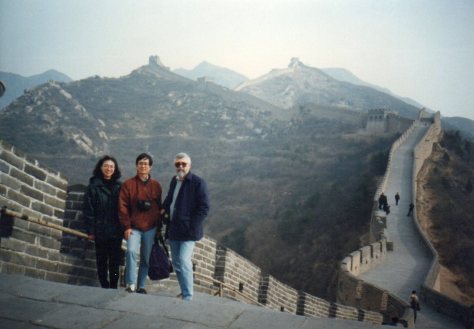
With my colleague, Lu Bao-Rong (middle) on the Great Wall, north of Beijing, and a staff member from the Institute of Botany, Chinese Academy of Sciences.
The first part of our trip took us to Beijing (followed by visits to Hangzhou and Guangzhou). And it was while we were in Beijing that I had my third unexpected encounter.
I think it must have been our last night in Beijing. Our hotel had a very good restaurant serving delicious Sichuan cuisine (Bao-Rong’s native province), and after dining, Bao-Rong and I retired to the hotel bar for a few beers. The bar was on a raised platform with a good view over the hotel foyer and main entrance.
I happened to casually glance towards the foyer and saw, I thought, someone I knew heading for the restaurant. Curiosity didn’t kill the cat, but I had to find out. And sure enough, it was that person: Dr Trevor Williams, who supervised my MSc dissertation on lentils in 1971, and who left the University of Birmingham in 1976 to join the International Board for Plant Genetic Resources (IBPGR) in Rome. The last time I saw Trevor as a Birmingham faculty member was in 1975 when I returned there to complete my PhD dissertation and graduate.
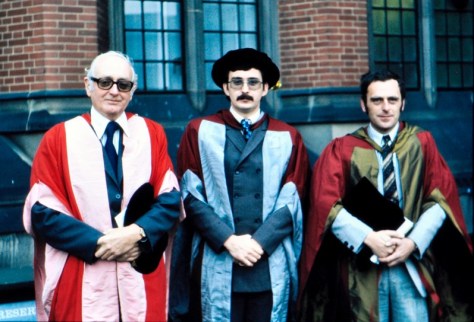
Graduation Day at the University of Birmingham, 12 December 1975. With my PhD supervisor Professor Jack Hawkes on my right, and MSc dissertation supervisor Dr Trevor Williams on my left.
I met him again in 1989 at IBPGR, which had approved a small grant to enable a PhD student of mine from the Canary Islands to collect seeds of a forage legume there as part of his study. And also later that same year when he attended the 20th anniversary celebration of the MSc Course on Conservation and Utilisation of Plant Genetic Resources.
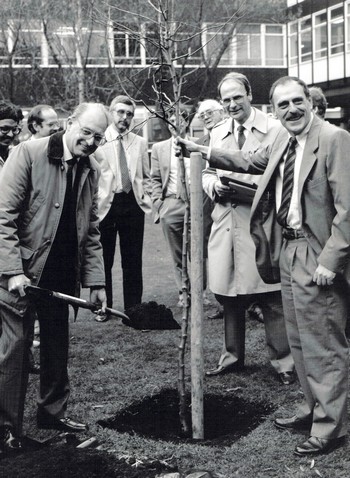
Trevor Williams planting a medlar tree with Professor Ray Smallman, Dean of the Science and Engineering Faculty at the University of Birmingham.
 However, by 1990, Trevor had left IBPGR and was working out of Washington, DC, helping to set up the International Network for Bamboo and Rattan (INBAR, now the International Bamboo and Rattan Organization) that was founded in Beijing in 1997. And that’s how our paths came to cross.
Lastly, I had an encounter last year with someone who I hadn’t seen for 63 years.
I was born in Congleton, Cheshire in 1948 and until 1956, when my family moved to Leek (about 12 miles away), my best friend from our toddler years was Alan Brennan who lived a few doors away on Moody Street. Although we made contact with each other in recent years (he found me through this blog) we never met up.
At the end of April last year, Steph and I visited the National Trust’s Quarry Bank mill, just south of Manchester, on our way north from a week’s holiday in the New Forest. Making our way to the mill entrance, we crossed paths with a couple with a dog. I took no notice, but just as we passed, the man called me by name. It was Alan, and his wife Lyn. He recognised me from a recent photo on the blog!
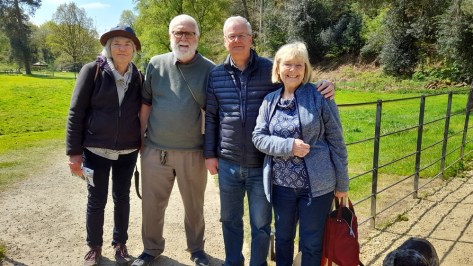
L-R: Steph, me, Alan, and Lyn
Neither of us had too much time to catch up unfortunately. Alan and Lyn were coming to the end of their visit to Quarry Bank (essentially just down the road from Congleton where they still live), and we had yet to look round the cotton mill before completing the remainder of our journey north, around 170 miles. But the planets were definitely lined up on that day. What were the chances that we’d be in the same place at the same time – and actually meet?
So, there you have it. Chance but brief encounters close to home and on the other side of the globe. It really is a small world.
 During the




 A balanced diet . . .