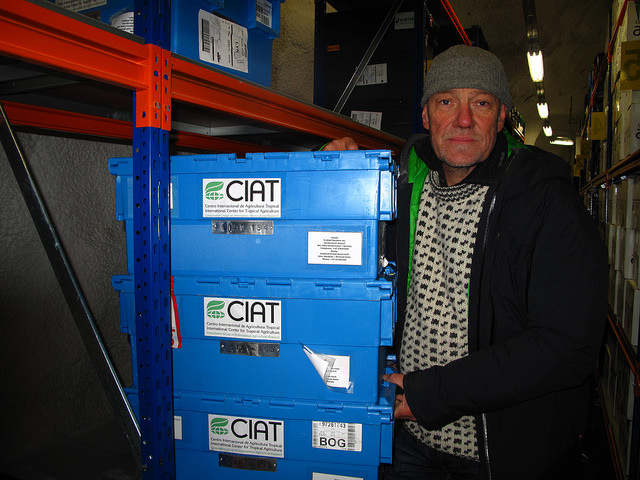
A new beginning for biodiversity . . .

Earlier this week, I enjoyed—on catch-up TV—the third episode (about South America) of David Attenborough’s latest series on the BBC, Seven Worlds, One Planet. Here’s a taster of this wonderful series.

Once again, Sir David has treated us to a feast of images from the natural world, accompanied by his typical understated but informative commentary. And, as I was saying to Steph afterwards, cinematic technology such as drones with HD cameras has added a new dimension to natural history storytelling.

Most natural history programs routinely highlight loss of biodiversity (and its causes such as climate change), and Seven Worlds, One Planet is no exception. We live on a species-rich planet. But with so many programs about the natural world appearing on our screens, do we take for granted the diversity of nature and its millions of animal, plant, fungal, and microbial species?

Apart from Seven Worlds, One Plant, a couple of other biodiversity-related items on the radio have caught my attention in recent weeks.

The first, at the beginning of November, was an item on the early morning Today news and current affairs program on BBC Radio 4 (that I listen to in bed as I enjoy my early morning cup of tea) about an initiative to unravel the genetic code of all known 60,000 species of eukaryotes [1] in the United Kingdom.

Known as the Darwin Tree of Life Project (a most appropriate name!) it’s the UK arm of a worldwide initiative, the Earth BioGenome Project (EBP) to sequence the genomes of all 1.5 million known species of animals, plants, protozoa and fungi on Earth. That’s some challenge!
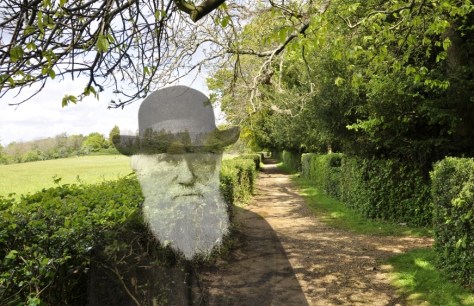
Each day, Charles Darwin would take a stroll along the Sandwalk at the bottom of his garden, where ideas about species and evolution not doubt swirled around his mind.

Why is the Darwin Tree of Life Project only possible now?

As stated on the EBP website: Powerful advances in genome sequencing technology, informatics, automation, and artificial intelligence, have propelled humankind to the threshold of a new beginning in understanding, utilizing, and conserving biodiversity. For the first time in history, it is possible to efficiently sequence the genomes of all known species, and to use genomics to help discover the remaining 80 to 90 percent of species that are currently hidden from science.

But also cost. Since the very first genome was sequenced in 1995 (of a pathogenic Gram-negative bacterium) the costs of sequencing have plummeted making it now economically feasible to even contemplate a project on the scale of the Darwin Tree of Life Project.

The UK component (launched on 1 November) is led by the Wellcome Sanger Institute in Cambridge in collaboration with Natural History Museum in London, Royal Botanic Gardens, Kew, Earlham Institute, Edinburgh Genomics, University of Edinburgh, EMBL-EBI (the European Bioinformatics Institute), and others. It is estimated that the project will take ten years to complete, costing £100 million over the first five years.

Dr Ken McNally

Molecular genetics and genomics have come a long, long way in just a few years. Just read the excellent 2014 analysis [2] by my former IRRI colleague, molecular geneticist Ken McNally how the latest developments in genomics (and related techniques) could contribute towards the conservation and use of biological diversity. And I’m sure things have progressed since Ken gazed into his ‘omics’ crystal ball just five years ago.

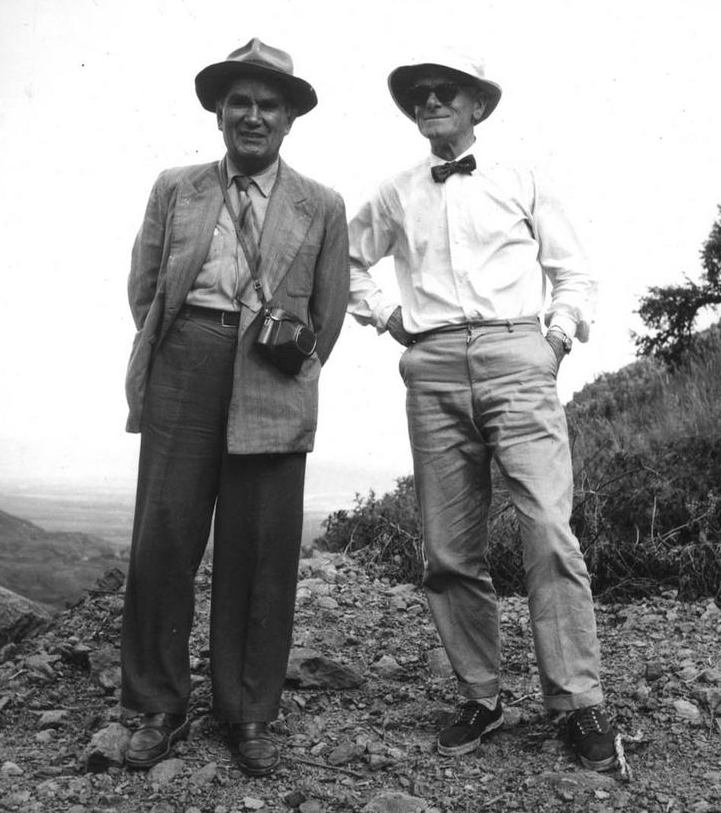
It’s remarkable how the science has accelerated in just a few decades. I completed my PhD under the supervision of Jack Hawkes, one of the world’s leading potato taxonomists and genetic resources conservation pioneer. In the 1960s (with colleagues from the immunology department at the University of Birmingham) he demonstrated that serology [3] could help clarify relationships between wild potato species (genus Solanum) [4].
As a graduate student at Birmingham in the early 1970s, I used a technique known as gel electrophoresis to separate potato tuber proteins, using the resultant patterns (position, and presence or absence) to better understand the relationships of different classes of cultivated potato.

Since the 1980s several different classes of molecular markers have been developed, and today—through whole genome sequencing—we can begin to decipher the complex relationship between genetic code and phenotypic and physiological diversity. We are beginning to explain better why species are different and how they are adapted to their environments.

My own research at IRRI and in collaboration with former colleagues Brian Ford-Lloyd, John Newbury, and Parminder Virk at the University of Birmingham in the mid-1990s, used molecular markers to analyse the diversity of rice varieties [5].

Another of the Birmingham-IRRI papers [6] was among the first (if not the first) to show a clear (and predictive) relationship between molecular markers (in this case RAPD markers) and appearance and performance of rice plants in the field.

Much of this rice research was aimed at understanding the diversity within a single species, Oryza sativa, which is grown over millions upon millions of hectares across the world. With hindsight, that research looks quite primitive, even though it was cutting edge at the time. Since the rice genome was first sequenced at the turn of the millennium, things have moved on apace, and more than 3000 genomes have been analysed to understand rice diversity.

But the Darwin Tree of Life Project will look across species, and hopefully keep a careful track of exactly which specimens/individuals are sequenced.
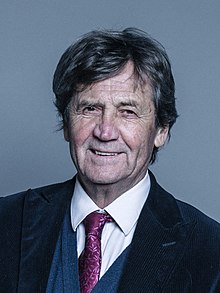
So, this brings me to the other radio broadcast I mentioned earlier. It was a discussion—about hybridisation between species—in the regular Thursday night In Our Time program, hosted by that doyen of broadcasting, Lord Melvyn Bragg with three biologists: Professor Steve Jones, Emeritus Professor of Human Genetics at University College London; Dr Sandra Knapp, from the Natural History Museum and a specialist in the taxonomy of the nightshade family, Solanaceae (that includes potatoes, tomatoes, eggplants, and many more); and zoologist Dr Nicola Nadeau of The University of Sheffield University. You can listen to that discussion here.

I found this discussion particularly interesting because in much of my research on potatoes, various legume species, and rice over many years I studied the relationships between species, and their ability to hybridise.

From the outset, Melvyn Bragg was working from the premise that species are distinct and rarely hybridise. That’s a reasonable point of view to take. After all, we can describe and identify millions of species based on the commonality of appearance (morphology) that individuals of one species share and make them different from other species. Like breeds with like.

Hybrids are less common between different animal species. Breeding behavior is a powerful isolating mechanism between species.

In plants, hybridisation is more common. However, there are many pre- and post-fertilization mechanisms that reduce the potential for hybridisation. It doesn’t matter if one can bring different species into cultivation alongside and successfully produce hybrids. In nature, many species never come into contact with each other because they grow in different habitats (in the same or different geographical regions). If they do grow in close (or relatively close) association, different species may not be reproductively compatible. Pollen from one species may fail to germinate on another or, if germinating, fail to achieve fertilization. Hybrid embryos may fail to develop, or even if hybrid seeds are formed, the plants are weak and fail to survive.

In the fluorescence images below (from pollinations between different tomato species that I used in class experiments with some of my students when I was teaching at Birmingham in the 1980s), a compatible pollination is shown in the images on the left and bottom. The other two images show poor pollen germination and growth in incompatible pollinations. Yet one or two pollen tubes have grown ‘normally’.

So, hybrids do occur, and are often successful in disturbed habitats that do not favor one parent or the other. There is a potential for species to expand their gene pools by exchange of some genetic material—or introgression, as it is called—that I described in one of my first blog posts in 2012.

Thank goodness plants can and do hybridise. As Steve Jones pointed out during the discussion, much of agriculture depends on ancient hybridisations and our ability to exploit cross compatibility between species. Wheat, one of the most important staple crops worldwide, is an ancient hybrid between three grass species. Potatoes evolved following crosses between different species (sometimes with different chromosome numbers) and hybrids were maintained by farmers since potatoes are grown vegetatively from tubers, not from seeds. Once a hybrid is formed then it can be maintained indefinitely through tubers.

Through hybridisation between cultivated varieties and wild species important characteristics or traits such as disease resistance can be added to the crops that farmers grow.

Just take this example from rice, showing the pedigree of the variety IR72 that was released in 1990. Many landrace varieties were crossed to produce this variety. But also very importantly, a wild rice, O. nivara (a close relative of O. sativa with which it crosses easily, and in the same genepool – see diagram below) was the source of resistance to grassy stunt virus, and it was this resistance that made IR72 such a successful variety.

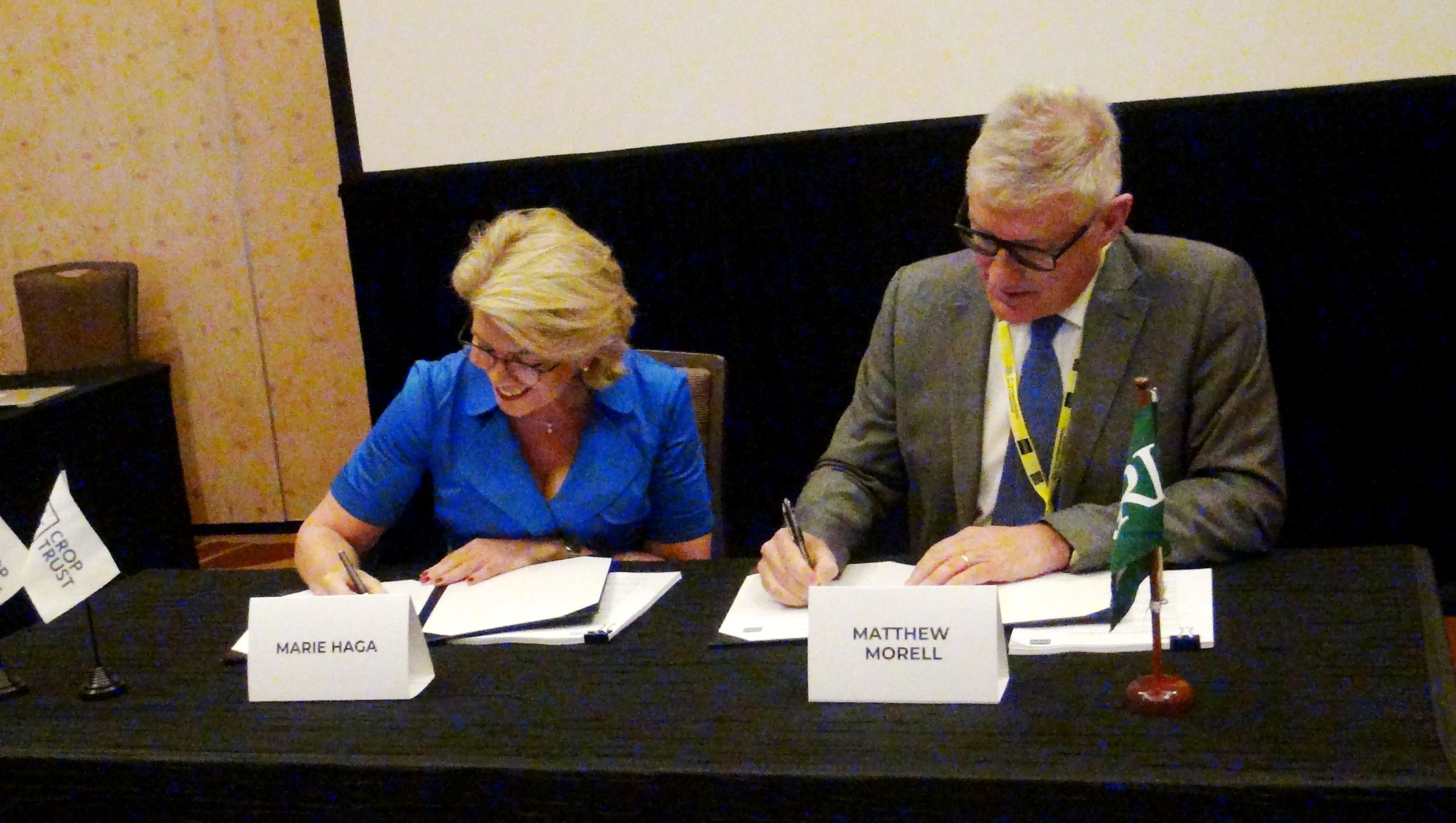
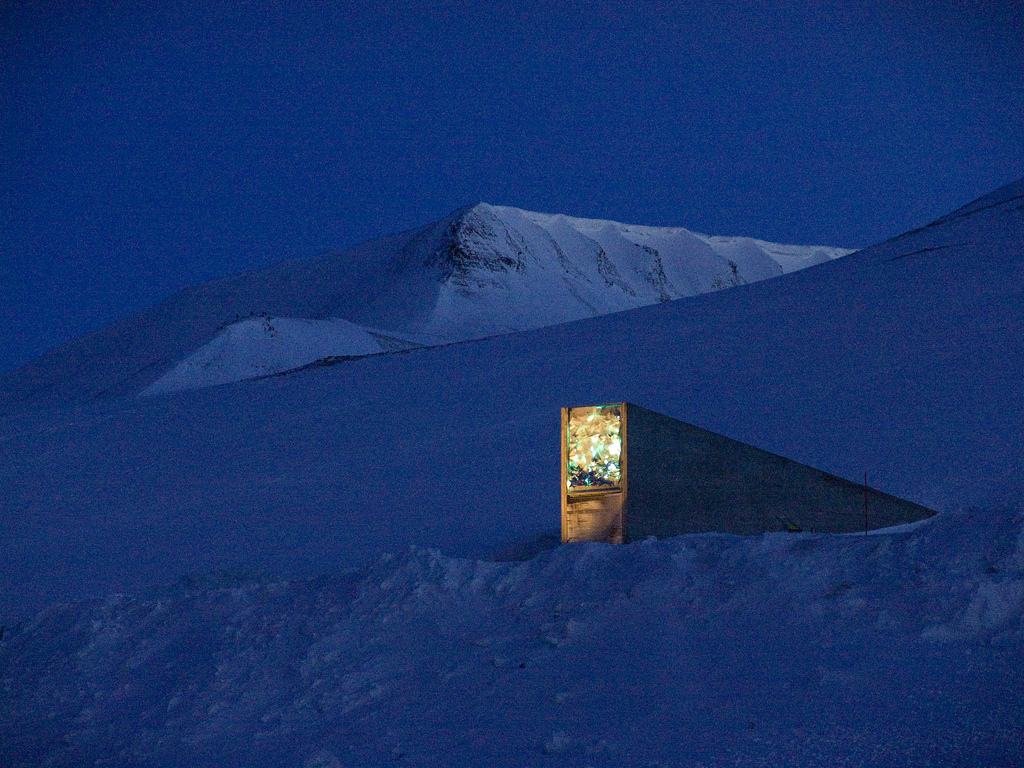
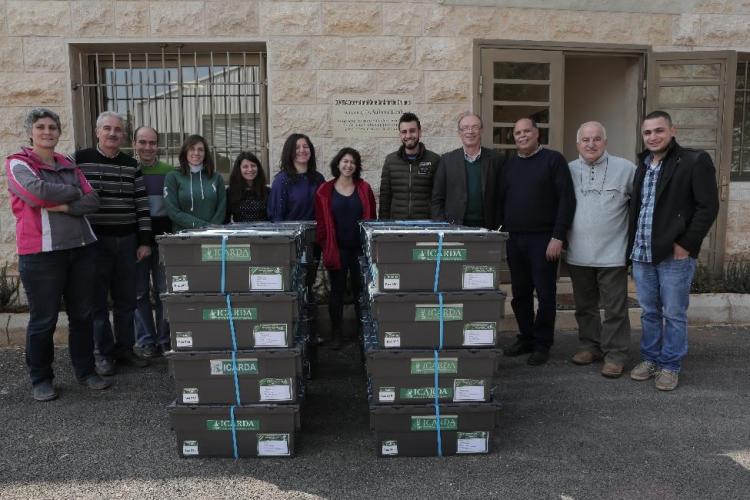
One of the most important biodiversity initiatives in recent years has been the Crop Wild Relatives Project, started in 2011, managed by the Crop Trust with the Royal Botanic Gardens, Kew and many partners around the world. It is funded by the Government of Norway.

The project has a number of priorities including collection of crop wild relatives and their conservation around the world. But also evaluation and pre-breeding, exactly the same type of approach I used in my own studies on species relationships. This research aims to determine the gene pools (GP on the diagram below) of crops and their wild relatives (a concept developed by Jack Harlan and JMJ de Wet in 1971 [7]), and provides plant breeders with useful and important information about the value of different wild species, and what traits can be exploited for greater adaptation.
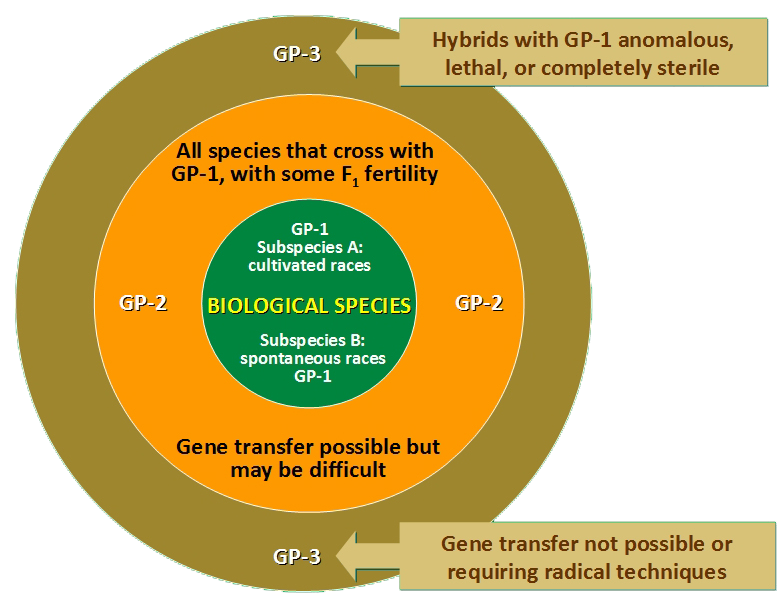
These are exciting times for the collection, conservation, evaluation, and use of the many species of crop wild relatives. With regular access to this valuable germplasm in genebanks around the world, and data on how they can be hybridised, and with the additional information about plant genomes, then plant breeders can begin to use these species more strategically, even using GM approaches. However, the cultivation of GM crops is banned in many countries including the countries of the European Union (one of the biggest mistakes the European Union has collectively made), even though these GM technologies can significantly reduce the time and effort required to transfer useful traits from one species into another.

Scientists have many tools in the plant breeding toolbox. It all starts with a seed, collected from nature, studied in the laboratory, and conserved in genebanks. There’s hope yet.

~~~~~~~~~~~~~~~~~~~~~~~~~~~~~~~~~~~~~~~~~~~~~~~~~

[1] Eukaryotic species are defined as organisms whose cells have a nucleus enclosed within membranes, unlike prokaryotes, which are unicellular organisms that lack a membrane-bound nucleus, mitochondria or any other membrane-bound organelle (Bacteria and Archaea).

[2] McNally, KL. 2014. Exploring ‘omics’ of genetic resources to mitigate the effects of climate change. In: M Jackson, B Ford-Lloyd and M Parry (eds.) Plant Genetic Resources and Climate Change. CABI climate change series 4, CABI Wallingford.

[3] See Hawkes, JG (ed.) 1968. Chemotaxonomy and Serotaxonomy. Systematics Association and Academic Press, London. pp. 299.

[4] Hawkes published several immunological studies in the mid- to late 60s on North American and Mexican species of potato, with Richard Lester, one of his PhD students (and later Lecturer in the Department of Plant Biology at Birmingham).

[5] Virk, P.S., B.V. Ford-Lloyd, M.T. Jackson & H.J. Newbury, 1995. Use of RAPD for the study of diversity within plant germplasm collections. Heredity 74, 170-179. PDF

[6] Virk, P.S., B.V. Ford-Lloyd, M.T. Jackson, H.S. Pooni, T.P. Clemeno & H.J. Newbury, 1996. Predicting quantitative variation within rice using molecular markers. Heredity 76, 296-304. PDF

[7] Harlan, JR and JMJ de Wet, 1971. Toward a rational classification of cultivated plants. Taxon 20, 509-517.

Exploring the southern Lincolnshire Wolds and Cambridgeshire Fens*

Last week, Steph and I spent three days exploring five National Trust and English Heritage properties in Lincolnshire and Cambridgeshire. This is not an area with which we are familiar at all. We spent the first night on the coast at Skegness, and the second in the Georgian town of Wisbech.

It was a round trip of just under 360 miles from our home in Bromsgrove, taking in nine counties: Worcestershire, West Midlands, Warwickshire, Leicestershire, Nottinghamshire, Lincolnshire, Cambridgeshire, Norfolk (for about three minutes), and Rutland.

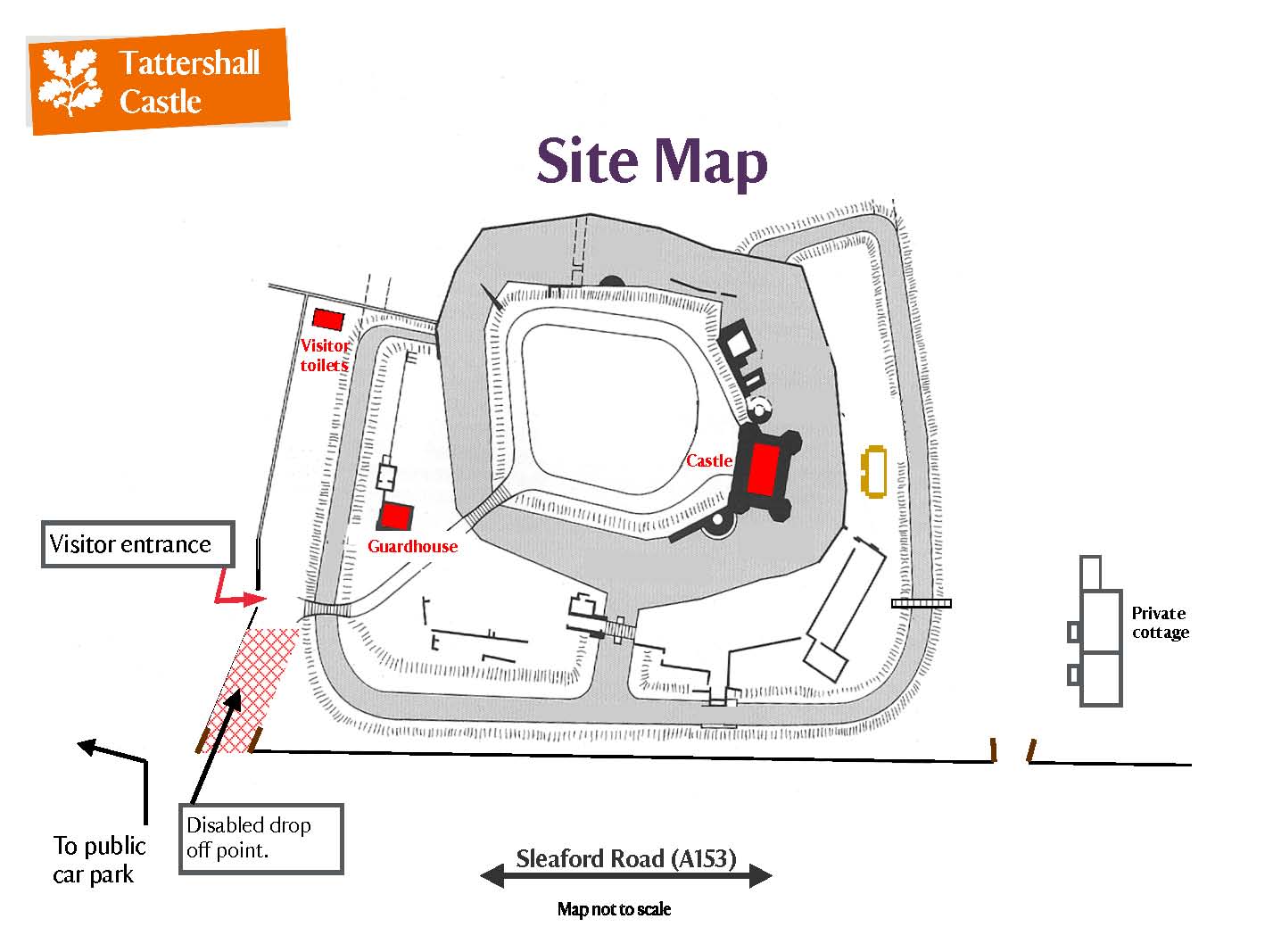
Our first stop was Tattershall Castle in Lincolnshire. There has been a fortified residence on this site since the mid thirteenth century, but it wasn’t until two centuries later that the remarkable brick tower was built. This is quite unusual for any castle, and Lord Cromwell is believed to have seen such buildings during his sojourns in France.

The tower and part of a stable block are all that remain today, although the position of other towers and a curtain wall can be seen. The whole is surrounded by a double moat.

Like so many other castles (see my blogs about Goodrich Castle in Gloucestershire, Corfe Castle in Dorset, and Kenilworth in Warwickshire) Tattershall was partially demolished (or slighted) during the Civil Wars between 1642 and 1651.

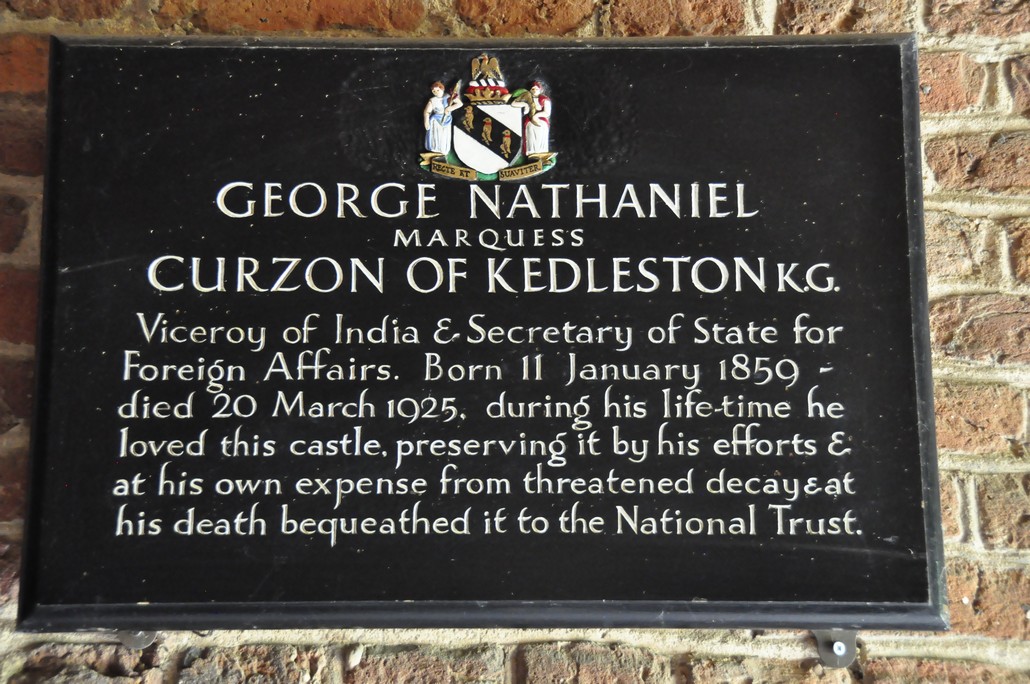
And over the subsequent centuries it slipped into decay. Until the 1920s when a remarkable man, Viscount Curzon of Kedleston (near Derby) bought Tattershall Castle with the aim of restoring it to some of its former glory, the magnificent tower that we see today.

The castle was then gifted to the National Trust in whose capable hands it has since been managed.

There is access to the roof (and the various chambers on the second and third floors) via a beautiful spiral stone staircase, quite wide by the normal standard of such staircases. But what makes this one so special is the carved handrail from single blocks of stone. And on some, among all the other centuries-old graffitti, are the signatures of some of the stonemasons.

Do take a look at this album of photos of Tattershall Castle.

Just a mile or so southeast of the castle is RAF Coningsby, very much in evidence because it’s a base for the RAF’s Typhoon aircraft, and a training station for Typhoon pilots. So the noise from these aircraft is more or less constant. However, RAF Coningsby is also the base for the Battle of Britain Memorial Flight, and just as we reached the car park on leaving Tattershall, we were treated to the sight of a Lancaster bomber (the iconic stalwart of the Second World War Bomber Command) passing overhead, having just taken off from the airfield, just like in the video below. At first, it was hidden behind some trees, but from the roar of its engines I knew it was something special. Then it came into view while banking away to the east.

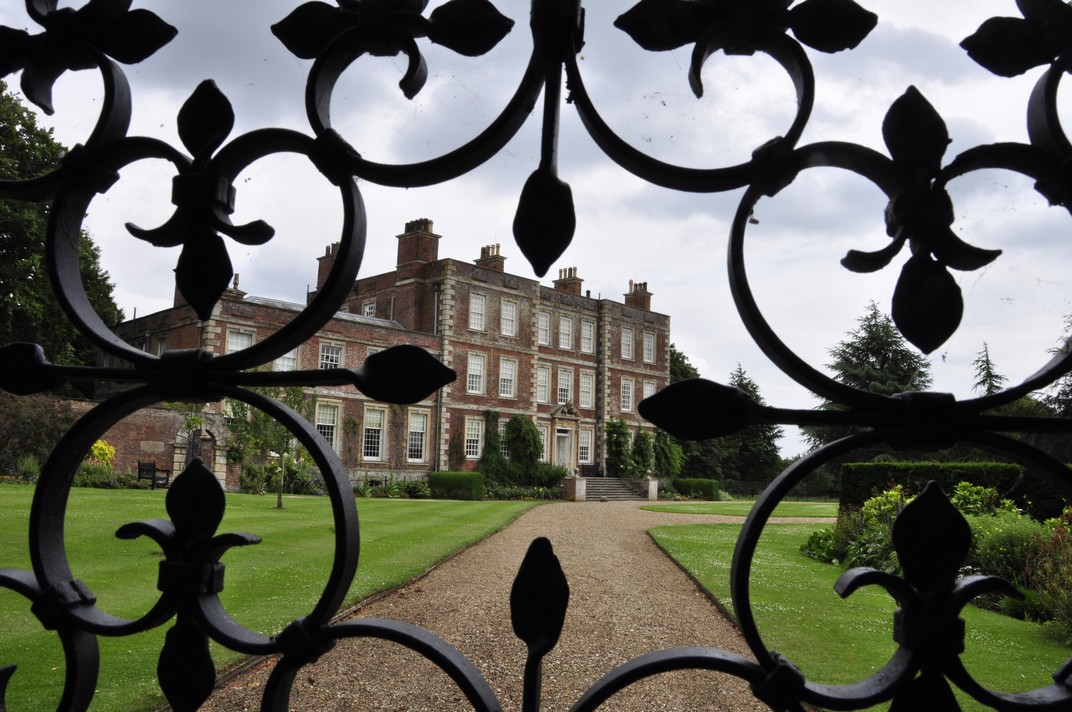
Just 20 miles further east lies Gunby Hall, a William and Mary townhouse masquerading as a country house, and built in 1700. The architect is not known.

It was built by Sir William Massingberd (the Massingberds were an old Lincolnshire family) and was home to generations of Massingberds until the 1960s. You can read an interesting potted history of the family here.

Gunby Hall, and almost all its contents accumulated by the Massingberds over 250 years were gifted to the National Trust in 1944. Lady Diana Montgomery-Massingberd (daughter of campaigner Emily Langton Massingberd) was the last family member to reside at Gunby, and after her death in 1963, tenants moved in until 2012 when the National Trust took over full management of the house, gardens and estate.

Gunby is remarkable for two things. During the Second World War, the house was in great danger of being demolished by the Air Ministry because the runway at nearby (but now closed) RAF Spilsby had to be extended to accommodate the heavy bombers that would operate from there. But Sir Archibald Montgomery-Massingberd (husband of Lady Diana) was not a man without influence. He had risen to the rank of Field Marshal, and had served as Chief of the Imperial General Staff between 1933 and 1936. After he wrote to the king, George V, the location of the runway was changed, and Gunby saved.

It was then decided to gift the property and contents to the National Trust. So what we see in the house today is all original (nothing has been brought in from other properties or museums).

Sir Archibald Montgomery-Massingberd started life a simply Archibald Montgomery, but changed his name by deed poll to Montgomery-Massingberd on his marriage to Diana. It was a condition of the inheritance of the estate that the name Massingberd was perpetuated. Both he and Diana are buried in the nearby St Peter’s Church on the edge of the gardens.

Although not extensive, Steph and I thought that the gardens at Gunby were among the finest we have seen at any National Trust property. Yes, we visited in mid-summer when the gardens were at their finest perhaps, but the layout and attention to detail from the gardeners was outstanding. Overall the National Trust volunteers were knowledgeable and very friendly. All in all, it was a delightful visit.

You can see more photos here.

On the second day, we headed west from our overnight stay in Skegness on the coast (not somewhere I really want to visit again), passing by the entrance to Gunby Hall, en route to Bolingbroke Castle, a ruined castle owned by English Heritage, and birthplace of King Henry IV in 1367, founder of the Lancaster Plantagenets.

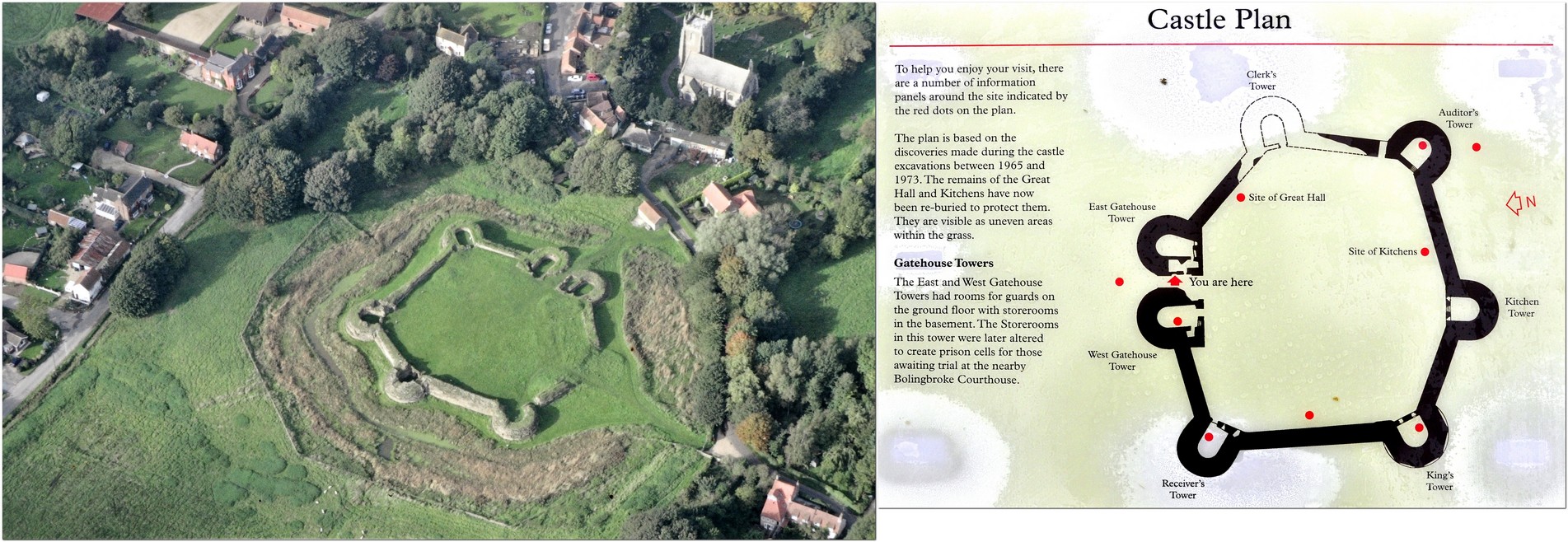
There’s not really too much to see of the castle except the foundations of the various towers and curtain wall. Nevertheless, a visit to Bolingbroke Castle is fascinating because English Heritage has placed so many interesting information boards around the site explaining the various constructions, and providing artist impressions of what the castle must have looked like.

So the castle footprint is really quite extensive, surrounded by a moat (now just a swampy ditch) that you can walk around, inside and out, taking in just how the castle was built.

A local sandstone, rather soft and crumbly, was used and couldn’t have withstood a prolonged siege. Interspersed in the walls, now revealed by deep holes but still in situ elsewhere, are blocks of hard limestone that were perhaps used for ornamentation as well as giving the walls additional strength. The castle was slighted in the Civil Wars of the 1640s.

The complete set of Bolingbroke photos can be viewed here.

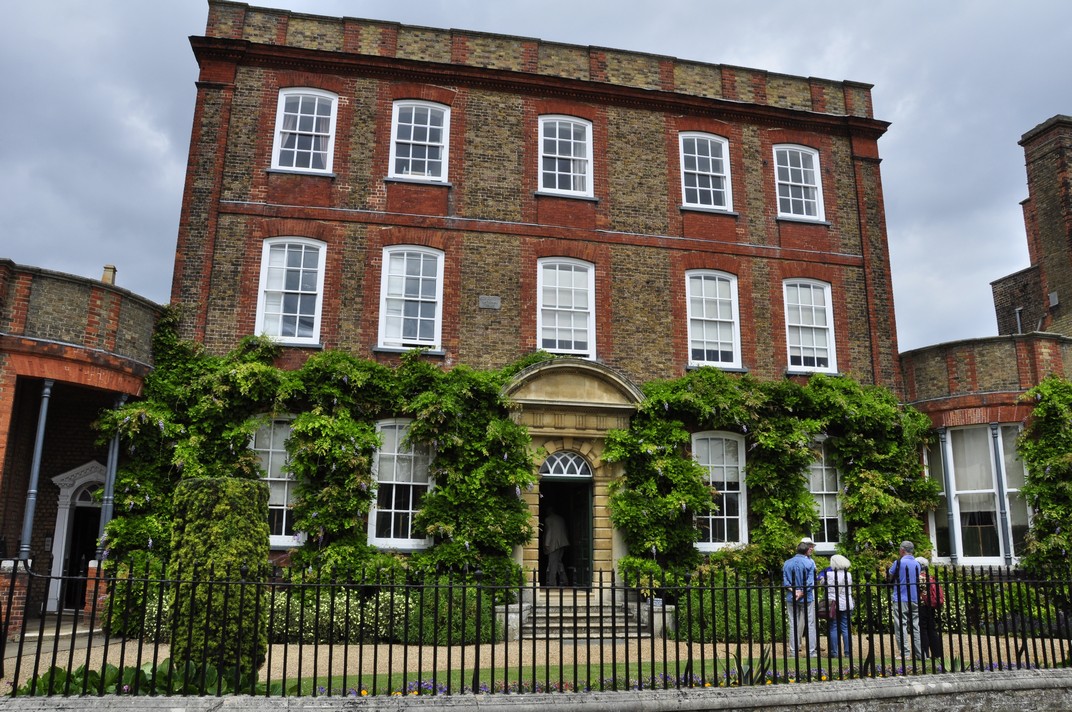
Heading south to Wisbech, our aim was Peckover House and Garden, occupied from the 1770s until the late 1940s by the Peckover family of Quakers and bankers.

Peckover House is a detached Georgian mansion, among a terrace of elegant houses on North Brink, the north bank of the tidal River Nene, and facing a counterpart terrace on South Brink, where social reformer Octavia Hill, one of the founders of the National Trust, was born in 1838.

Standing in front of Peckover House, it’s hard to believe that there is a two acre garden behind. Among the features there is a cats’ graveyard of many of the feline friends that have called Peckover home.

Inside the house, I was reminded (though on a much smaller scale) of Florence Court in Northern Ireland that we visited in 2017. The hall and stairs are a delicate duck-egg blue, and there and in many of the rooms there is exquisite plasterwork. Above the doorways downstairs are fine broken pediments.

The most celebrated of the family was Alexander (born in 1830) who traveled extensively and built an impressive collection of books and paintings. He was Lord Lieutenant of Cambridgeshire, and was elevated to a peerage in 1907.

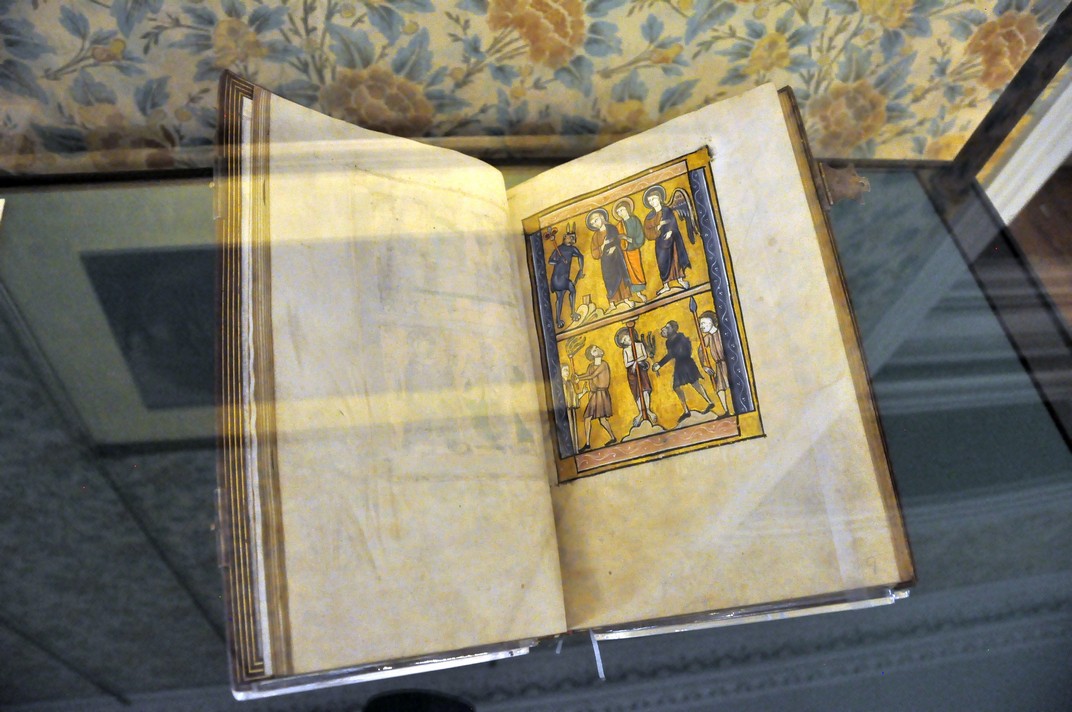
He bought one of his books, a 12th century psalter, in about 1920 for £200 or so. Now on loan from Burnley library and displayed in Alexander’s library, the book has been insured for £1,200,000!

Check out more photos of Peckover House and garden.

Our final stop, on the way home on the third day, was Woolsthorpe Manor, birthplace of Sir Isaac Newton, President of the Royal Society, who was born on Christmas Day in 1642 three months after his father, also named Isaac, had passed away.

This is the second home of a famous scientist we have visited in the past couple of months, the first being Down House in Kent, home of Charles Darwin. Woolsthorpe has become a pilgrimage destination for many renowned scientists, including Albert Einstein and Stephen Hawking who are shown in some of the exhibits.

Woolsthorpe is not a large property, comprising a limestone house and outbuildings. It has the most wonderful tiled roof.

It came into the Newton family as part of the dowry of Isaac Sr.’s marriage to Hannah Ayscough. Keeping sheep for wool production was the principal occupation of the family.

Isaac Newton won a place at Trinity College, Cambridge but had to escape back to Woolsthorpe during an outbreak of the plague in 1665 and 1666. He thrived and the 18 months he spent at Woolsthorpe were among his most productive.

Open to the public on the upper floor, Newton’s study-bedroom displays his work on light that he conducted there.


And from the window is a view over the orchard and the famous Flower of Kent apple tree that inspired his views on gravitation.

On the ground floor, in the parlour are two portraits of Newton, one of him in later life without his characteristic wig, and, high above the fireplace, his death mask.

Also there are early copies (in Latin and English) of his principal scientific work, the Principia Mathematica, first published in 1687.

There’s a full album of photos here.

And, with the 50th anniversary of Apollo 11 and the first landing on the Moon on 20 July 1969, there was a display of NASA exhibits and how Newton’s work all those centuries ago provided the mathematical basis for planning a journey into space. The National Trust has also opened an excellent interactive science display based on Newton’s work that would keep any child occupied for hours. I’m publishing this post on the anniversary of Apollo 11’s blast off from Cape Kennedy, now Cape Canaveral once again.

All in all, we enjoyed three excellent days visiting five properties. Despite the weather forecast before we set out, we only had a few minutes rain (when we arrived at Bolingbroke Castle). At each of the four National Trust properties the volunteer staff were so friendly and helpful, full of details that they were so willing to share. If you ever get a chance, do take a couple of days to visit these eastern England jewels.

~~~~~~~~~~~~~~~~~~~~~~~~~~~~~~~~~

* The Lincolnshire Wolds are a range of hills, comprised of chalk, limestone, and sandstone. The Fens are drained marshlands and a very important agricultural region.

Boris Johnson is a mendacious ****!

****? Maybe *****, even ******.

I leave it to you, my readers, to substitute an appropriate epithet. A few come to mind, but I prefer not to say in print.

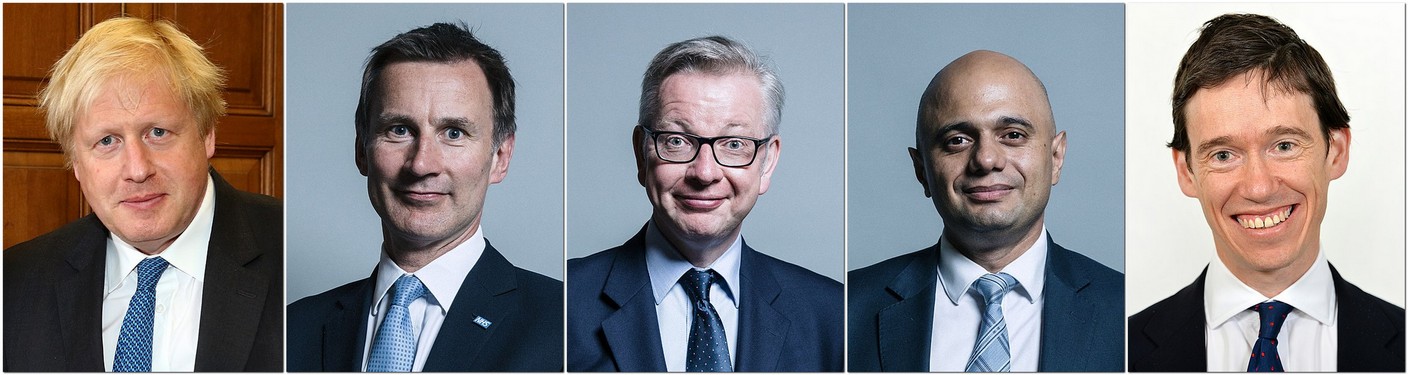
This coming Sunday it will be three years since the referendum was held to determine our future inside or outside the European Union. Three years! I wholeheartedly voted Remain, and still have [fading] hopes the decision to Leave can be reversed. Based on what I heard in the ‘debate’ on BBC1 a couple of nights ago among five contenders who made it to the fourth ballot among MPs, Boris Johnson, Jeremy Hunt, Sajid Javid, Michael Gove, and Rory Stewart, for leadership of the Conservative Party (and de facto Prime Minister), we don’t appear to have made much progress. 

L-R: BoJo, JeHu, MiGo, SaJa, and RoSt.

None of the contenders had a viable plan, no clear idea of how they would deliver Brexit.

While Boris Johnson has been egregiously mendacious throughout his career, three of the other candidates were also living in cloud-cuckoo-land. And, in hopes of winning the Tory Party election, were trying to ‘out-Brexit’ each other.

Listening to Sajid Javid (my local constituency MP) I did wonder whether Dominic Raab (who was eliminated from the contest in a ballot earlier in the day) had reappeared on stage. Only one of the candidates, Rory Stewart, has adopted the reality of the situation that the nation is facing. But even he was floating around in cloud-cuckoo-land in proposing some measures to unblock the parliamentary impasse. Must be the residual effects of the opium he is reported to have smoked in Iraq.

And the same goes for three of the other candidates: Boris Johnson (“I was once at university offered a white substance, none of which went up my nose, and I have no idea whether it was cocaine or not”), Michael Gove (who has admitted taking cocaine on several occasions 20 years ago), and Jeremy Hunt (who admitted drinking a cannabis-infused drink while backpacking in India years ago). What next? Javid admitting he has a drink problem?

Anyway, two days on, and we’re down to the final two candidates, Boris Johnson and Jeremy Hunt, who will now go forward to hustings around the country and a vote by 160,000 or so members of the Conservative Party only.

But the clear favourite (so we are led to believe), and winner of the ballot among MPs, is BoJo. A man who has openly spoken or written racist comments, who has lied through his teeth (and denied he ever said such things), and who was, as far as commentaries from insiders go, a disaster as Foreign Secretary.

This is the man who even his former employer Max Hastings¹ (former editor of The Telegraph) says can’t be trusted and is unfit to be Prime Minister, in comments widely circulated on social media:

Boris is a gold medal egomaniac. I would not trust him with my wife nor – from painful experience – my wallet. His chaotic public persona is not an act – he is indeed manically disorganised about everything except his own image management. He is also a far more ruthless and frankly, nastier, figure than the public appreciates. I would not take Boris’s word about whether it is Monday or Tuesday. He is not a man to believe in, to trust or respect, save as a superlative exhibitionist. He is bereft of judgement, loyalty or discretion. Only in the star-crazed, frivolous Britain of the 21st Century, could such a man have risen so high, and he is utterly unfit to go higher still. 

So, there we have it. The MP ballots have been cast. From the original ten candidates, there are now just two: a mendacious **** up against a disastrous and incompetent former Health Secretary (not something I’d want on my CV) and current Foreign Secretary, Jeremy Hunt. And both believing that a new deal can be negotiated with the EU to deliver the Brexit 17.4 million citizens of this benighted nation of ours supposedly voted for. Except nobody (on the UK side at least) seems to agree on what the endgame really was. And none of the candidates for Conservative Party leader and PM had a clear vision for the future. Except that the Promised Land is over the horizon, and the unicorn breeding program is doing just fine.

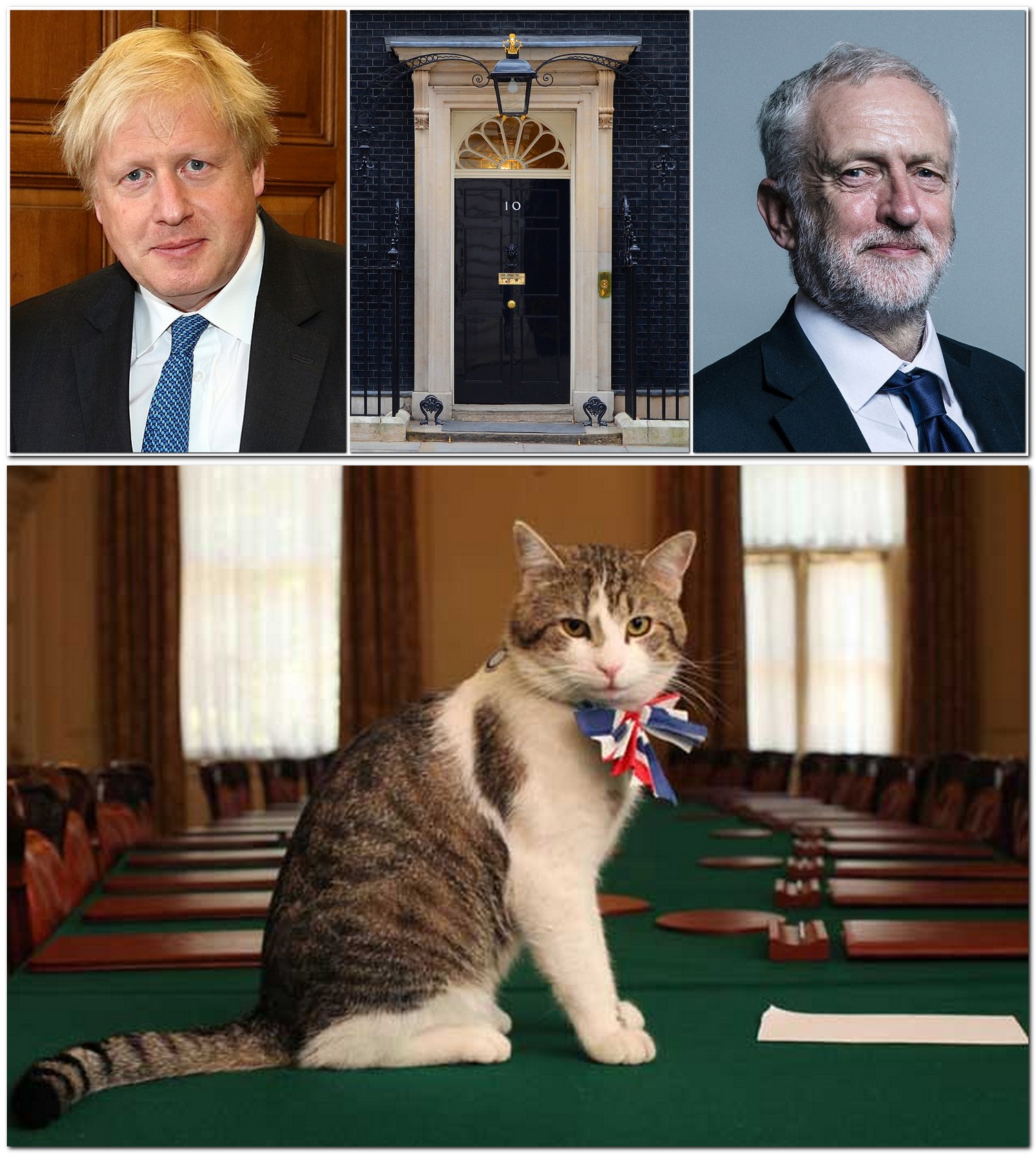
Boris Johnson soon to reside in No 10 Downing Street? Already there are predictions that his premiership will last no longer than a few months. The parliamentary arithmetic has not changed.

However, another thing that concerns me equally is the thought of a General Election, and Labour’s Jeremy Corbyn winning the keys to No 10.  Either Johnson or Corbyn in No 10? It’s the stuff of nightmares. I think I prefer the incumbent — Larry!

Update: 23 June After I’d posted this story, David Thompson left the comment below, to which I have just replied. And he rightly raises the spectre of The Brexit Party winning a General Election, and Nigel Farage becoming Prime Minister. He’s an even bigger buffoon than BoJo. Nevertheless, it’s not beyond the realms of possibility that this could come to pass. What has politics come to in the UK?
As Private Frazer from the BBC’s series about the Home Guard during the Second World War, Dad’s Army, would probably have said: We’re doomed, doomed!


¹ This article, by Max Hastings, was published in The Guardian on 24 June 2019. It totally destroys Boris Johnson.

Of Prime Ministers and Presidents . . .

Earlier today, I was lying in bed sipping a mug of tea and listening to the news on BBC Radio 4. And wondering what progress (or lack thereof) there had been regarding negotiations between the Tories and Labour to resolve the Brexit impasse that has bedeviled politics in this country for far too long.

I couldn’t help speculating that this whole Brexit debacle will be the one and only thing that Prime Minister Theresa May will be remembered for. Political legacies are the basis of history. So whenever some historian or other comes to analyze her legacy, the Brexit negotiations will be at the top of any list, whether they actually lead to Brexit or not. We’ll find out over the next week. Maybe.

Then, that got me thinking about earlier Prime Ministers and what they are remembered for. Not necessarily their full legacies. And Presidents of the United States as well. One of the reasons for this is that I can think of no point in my lifetime (I was born in November 1948) when there were two more inept occupants of No 10 Downing Street and the White House.

While I can recall Presidents of other countries, of France, of Peru, Costa Rica, or the Philippines where I lived for many years, or countries like South Africa that had leaders who performed on the world stage, like Nelson Mandela for example, or his predecessor, FW de Klerk, the last apartheid head of state, even German Chancellors, I’m much more familiar with US politics and political figures.

Why my interest in US politics? That began in January 1973, when I moved to Peru, and my weekly news roundup came courtesy of Time and Newsweek. It was, after all, also the time of Watergate. And I’ve followed US politics closely ever since. However, let’s start with Prime Ministers.


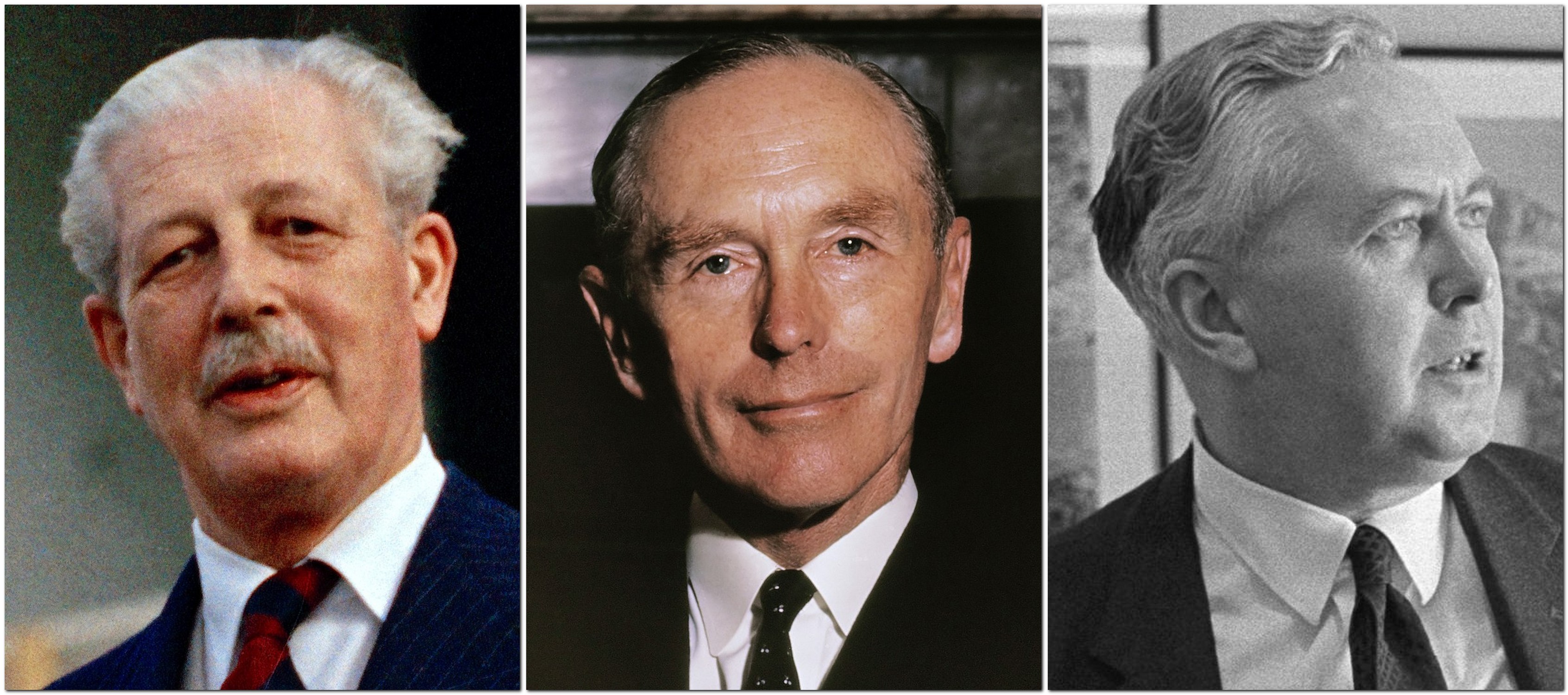
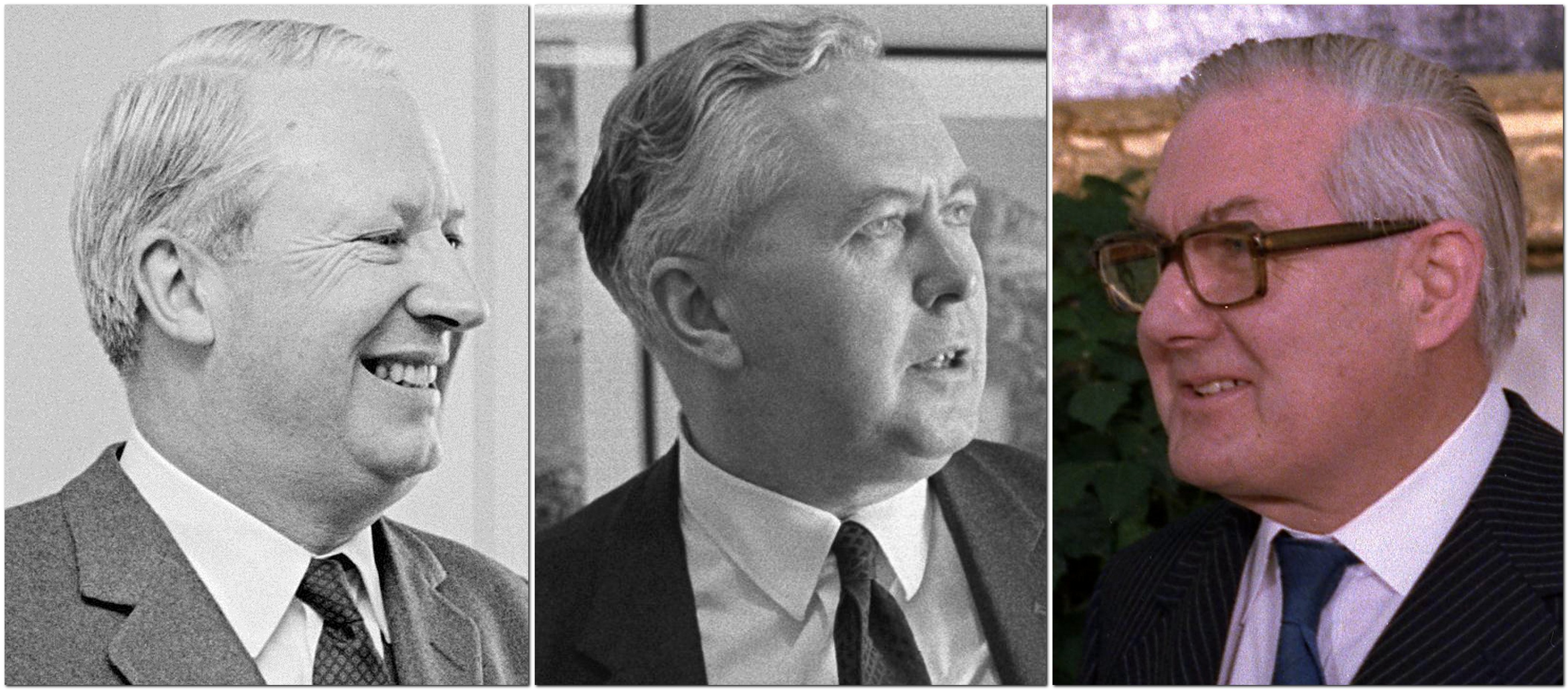
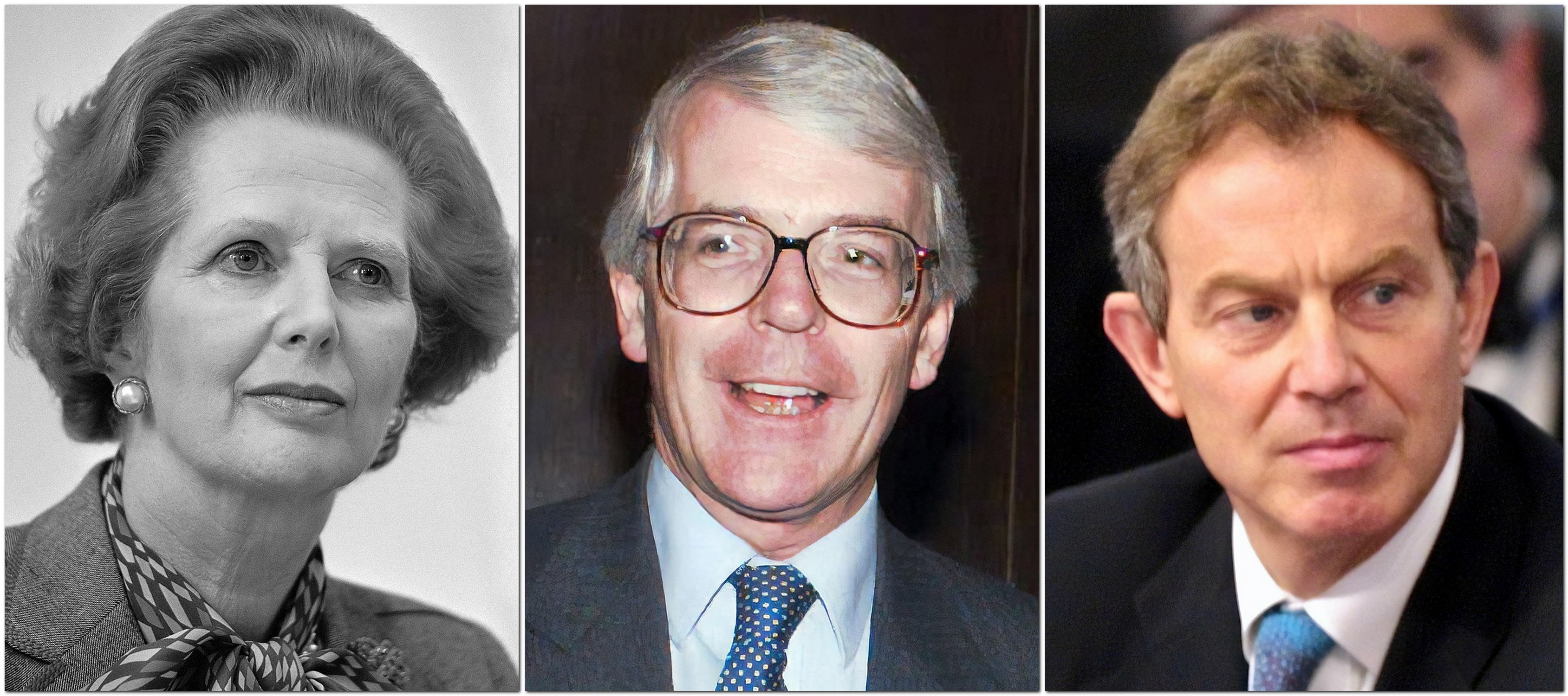
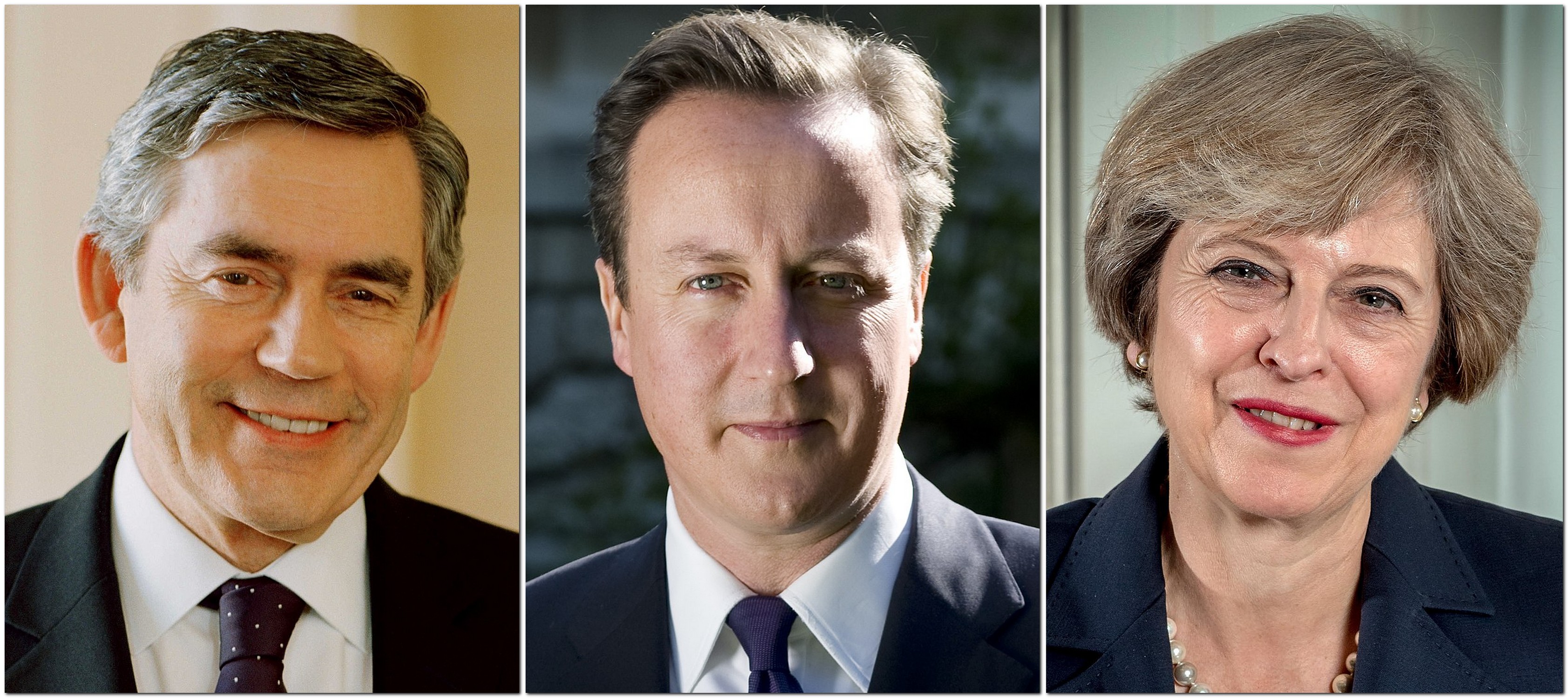
Since November 1948 there have been fifteen Prime Ministers of the United Kingdom (Harold Wilson headed two separate administrations).*

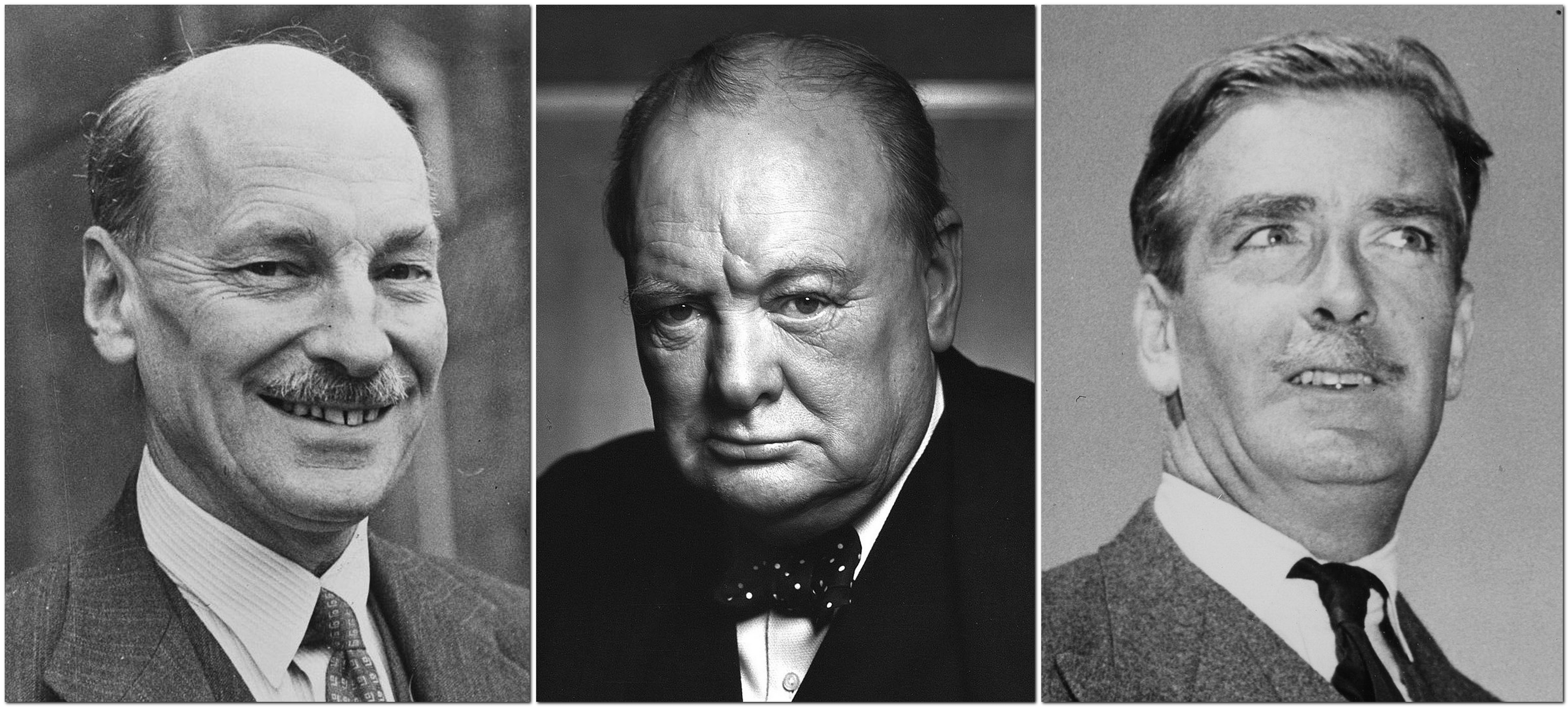
L-R: Clement Attlee (Labour), Jul 1945-Oct 1951; Sir Winston Churchill (Conservative), Oct 1951-Apr 1955; Sir Anthony Eden (Conservative), Apr 1955-Jan 1957.

L-R: Harold Macmillan (Conservative), Jan 1957-Oct 1963; Sir Alec Douglas-Home, Oct 1963-Oct 1964; Harold Wilson (Labour), Oct 1964-Jun 1970.

L-R: Edward Heath (Conservative), June 1970-Mar 1974; Harold Wilson (Labour), Mar 1974-Apr 1976; James Callaghan (Labour), Apr 1976-May 1979.

L-R: Margaret Thatcher (Conservative), May 1979-Nov 1990; John Major (Conservative), Nov 1990-May 1997; Tony Blair (Labour), May 1997-Jun 2007.

L-R: Gordon Brown (Labour), Jun 2007-May 2010; David Cameron (Conservative, in coalition with Lib Dems), May 2010-Jul 2016; Theresa May (Conservative), Jul 2016-present.

So what are these fourteen individuals remembered for, good or bad?

My first recollections of politics in the UK came with the administration of Sir Anthony Eden. His time in office must surely be remembered for the Suez Crisis (or second Arab-Israeli War) of late 1956, when UK and French forces waded in on the side of Israel to seize control of the Suez Canal. What I particularly remember was rationing of petrol (gasoline), and using coupons to purchase fuel for the car. The UK’s subsequent humiliation led to Eden’s resignation shortly afterwards.

In 1945, the Labour Party led by Clement Attlee surprisingly won a General Election, defeating the Conservatives led by Sir Winston Churchill, the successful war-time Prime Minister. Undoubtedly, Clement’s legacy is the foundation of the National Health Service (NHS), in July 1947. I was approximately the 190,063rd baby born under the NHS!

Churchill had his political revenge in 1951. While his second administration oversaw the end of hostilities of the Korean War, and an armistice, there was a deepening of the Cold War that had commenced immediately after the end of Second World War. Churchill had coined the phrase ‘Iron Curtain’ in 1946.

On Eden’s resignation, Harold Macmillan became leader of the Conservatives and Prime Minister, and headed an administration that saw the first sustained economic revival since the war. Macmillan is famous for two sayings. The first, Most of our people have never had it so good (from a speech in 1957) relates to the growing economic prosperity. The second, I was determined that no British government should be brought down by the action of two tarts, concerns the 1963 political scandal, the Profumo Affair, that irreparably damaged Macmillan’s government. Macmillan resigned in October that year.

Sir Alec Douglas-Home became Prime Minister on Macmillan’s retirement (having renounced his peerage, as the 14th Earl of Home), and headed a Conservative administration for just one year, being defeated in the October 1964 General Election by the Labour Party led by Harold Wilson. Douglas-Home is perhaps best remembered for his stint (1960-1963) as Foreign Secretary rather than his premiership.

Wilson won the 1964 election with a majority of just four MPs. In 1967, his government was forced to devalue the currency, the GB pound (£), and Wilson is remembered (and criticized) for his pound in your pocket speech in which he assured listeners that the pound had not lost its value. In 1965, during Wilson’s first administration, the political decision was made (on cost grounds) to cancel the TSR-2 strike and reconnaissance aircraft, considered one of the most sophisticated planes to have been designed in the UK. As one aeronautical engineer said at the time, All modern aircraft have four dimensions: span, length, height and politics. TSR-2 simply got the first three right.

The first Wilson administration saw the outbreak of The Troubles in Northern Ireland, which intensified and continued right up to the administration of Tony Blair in 1998 and the signing of the Good Friday Agreement.

The Labour Party was defeated in the June 1970 General Election (the first election I ever voted in) by the Conservatives under Edward Heath. Heath’s administration lasted just under four years. But his significant contribution was to lead the country into membership of the European Economic Community (EEC) in January 1973 (just as I was leaving to work in Peru). Forty-six years later the nation is divided over its continued membership of the European Union (successor to the EEC and European Community, EC).

Harold Wilson returned to power in the 1974 General Election. Continued membership of the EC was at the forefront of UK politics. In an unprecedented move in the nation’s political history, a referendum was held on 5 June 1975 in which a substantial majority voted for continued membership. How times have changed!

Wilson resigned in March 1976, and was replaced by his Foreign Secretary, James Callaghan. Callaghan’s government lasted just three years, buffeted by economic stresses, and his downfall followed the disastrous 1978-79 Winter of Discontent.

In 1979, the nation had its first female Prime Minister, Margaret Thatcher. She had ousted Edward Heath as leader of the Conservative Party in 1975. Her premiership is remembered for three issues. First was her forceful response to the invasion of the Falklands Islands by Argentina in April-June 1982. But two issues eventually brought her down. The introduction of the Community Charge (commonly known as the Poll Tax) in 1989 was highly unpopular. Industrial relations during her premiership also deteriorated. The Miners’ Strike of 1984-85 was a major industrial action in protest at the closure of coal pits. It was prolonged, violent at times, and divided communities, many of which have hardly yet recovered the loss of jobs. By November 1990, Thatcher had been visited by senior Tory politicians and told to go. She resigned and was replaced by her Chancellor, John Major.

I left the UK in July 1991 to work in the Philippines, returning in May 2010, just before a General Election in which I was not eligible to vote. Thus I have very little direct experience of the premierships of John Major, and his successors Tony Blair and Gordon Brown (both Labour leaders).

John Major was Prime Minister during the first Gulf War in 1991. He helped negotiate the Maastricht Treaty that same year that led to further European integration and the formation of the European Union. After the government withdrew the pound from the European Exchange Rate Mechanism, Black Wednesday on 16 September 1992, there was a fall in confidence in Conservative economic policies, a situation from which Major hardly recovered. However, he remained in office until May 1997, and even won a General Election. Under John Major the privatization of British Railways began; the monopoly was broken up and individual franchises sold to operate the nation’s rail system.

Tony Blair led Labour to a landslide victory over the Tories in the General Election of May 1997. Blair, at age 43, was the youngest Prime Minister since 1812. He went on to win two more elections in 2001 and 2005. He had very high popularity ratings for his handling of the response to the death of Diana, Princess of Wales in August 1997. Under his administration the Human Rights and the National Minimum Wage Acts were introduced, and the Good Friday Agreement finally brought peace to Northern Ireland.

On the other hand, Tony Blair will probably be remembered most for his cozy foreign policy relationship with US President George W Bush and his involvement of UK forces in the invasions of Afghanistan in 2001 and Iraq in 2003. For these actions he will never be forgiven by a significant portion of the population, and it’s fair to say that his reputation has been permanently damaged despite the many good things achieved by his centrist Labour administration. Blair resigned on 27 June 2007, and Gordon Brown (then Chancellor of the Exchequer) immediately assumed the premiership.

Gordon Brown was in office until May 2010 when he was defeated by David Cameron and the Conservatives. His most notable achievement was to steer the nation through all the challenges of the 2008 global recession, bailing out the banks and helping to stabilize financial systems here and around the world.

David Cameron did not achieve a House of Commons majority in the May 2010 election, and was forced to seek support of the Lib Dems in a coalition government. Budget austerity was the watchword of this government, the introduction of tuition fees for university students, and other financial measures from which the nation is still suffering. This was also a consequence of the recession before Cameron came to power.

One of the early pieces of legislation from the Coalition was the Fixed-term Parliaments Act 2011, that has had its consequences subsequently.

Cameron also sought to negotiate revised membership terms for the UK in the European Union and, as a sop to the right wing faction in his party, he foolishly promised to hold a referendum on continued membership of the EU if the Tories were returned to power in 2015. He didn’t expect to win an outright majority, and when he did, he was in hock to anti-EU factions among his MPs.

The fateful referendum was held on 23 June 2016, and although Remain was official government policy, the result was a Leave majority of 52 to 48%. A decision that we continue to rue three years on. On losing the referendum, Cameron immediately resigned leaving the contest wide open for his successor. Although originally a favorite to succeed Cameron, Brexiteer Boris Johnson withdrew before polling began among Tory MPs and constituency members, leaving former Home Secretary Theresa May as the only candidate. She became Prime Minister on 11 July 2016.

And she has proven to be one of the most inept politicians I can ever remember, without empathy (viz. her response to the Grenfell Tower fire tragedy in June 2017 around the time of the general Election), a cold fish, who has led the nation down a disastrous Brexit path. She was so inept as to call an early General Election in 2017 (despite the Fixed-term Parliaments Act), losing her overall majority, and since then propped up by ten Democratic Unionist Party MPs from Northern Ireland. But due to major policy splits in her own party, she has been unable to push through her EU Withdrawal Agreement. It has been defeated three times in the past eight weeks, and unless something comes of the discussions between the Conservatives and Labour over the next week, the UK will crash out of the EU on 12 April. Theresa May will also be remembered, and in a very bad light, for her anti-immigration stance and policies she introduced when Home Secretary.

Fortunately, it seems she will not be Prime Minister for much longer. But will it be a question of out of the frying pan and into the fire? Boris Johnson as her replacement? Heaven forfend!

Let’s now turn to the Presidents of the Unites States, or POTUS.


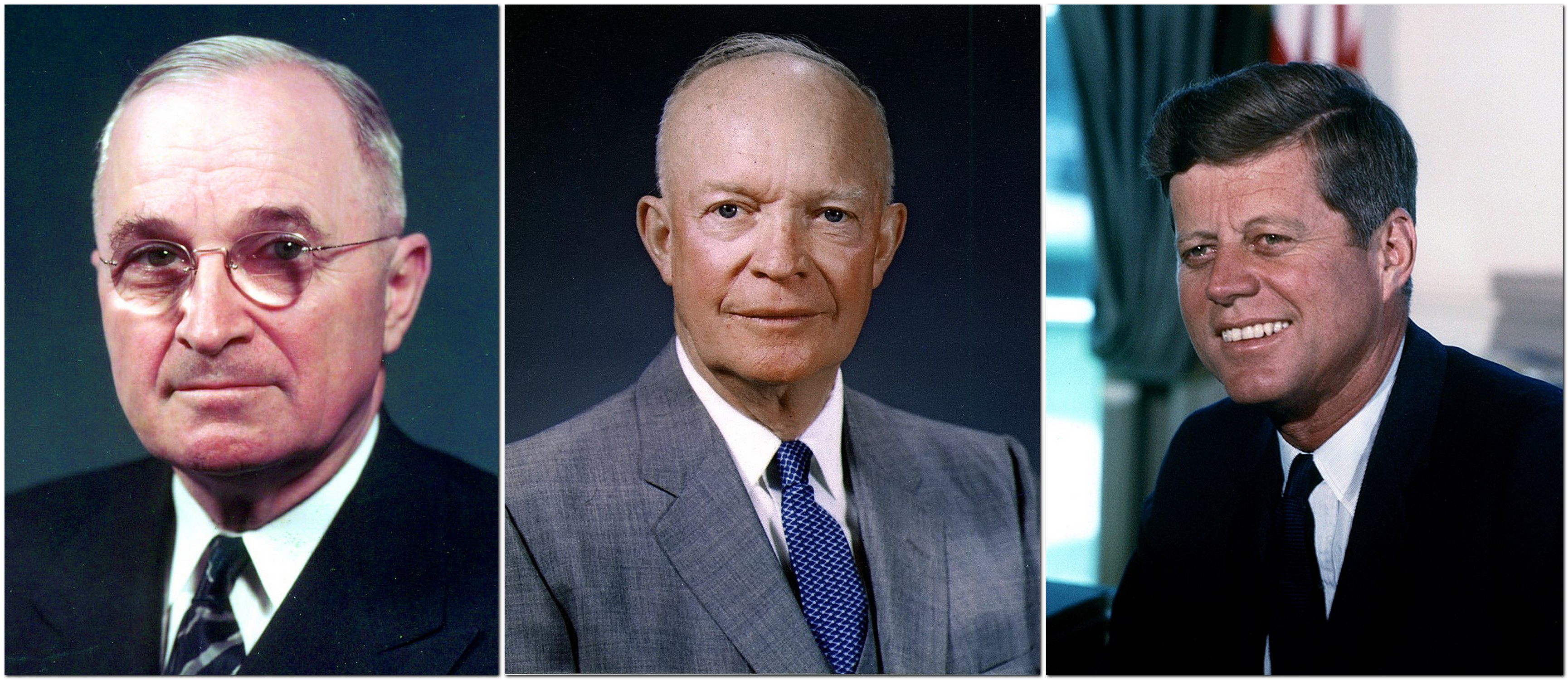
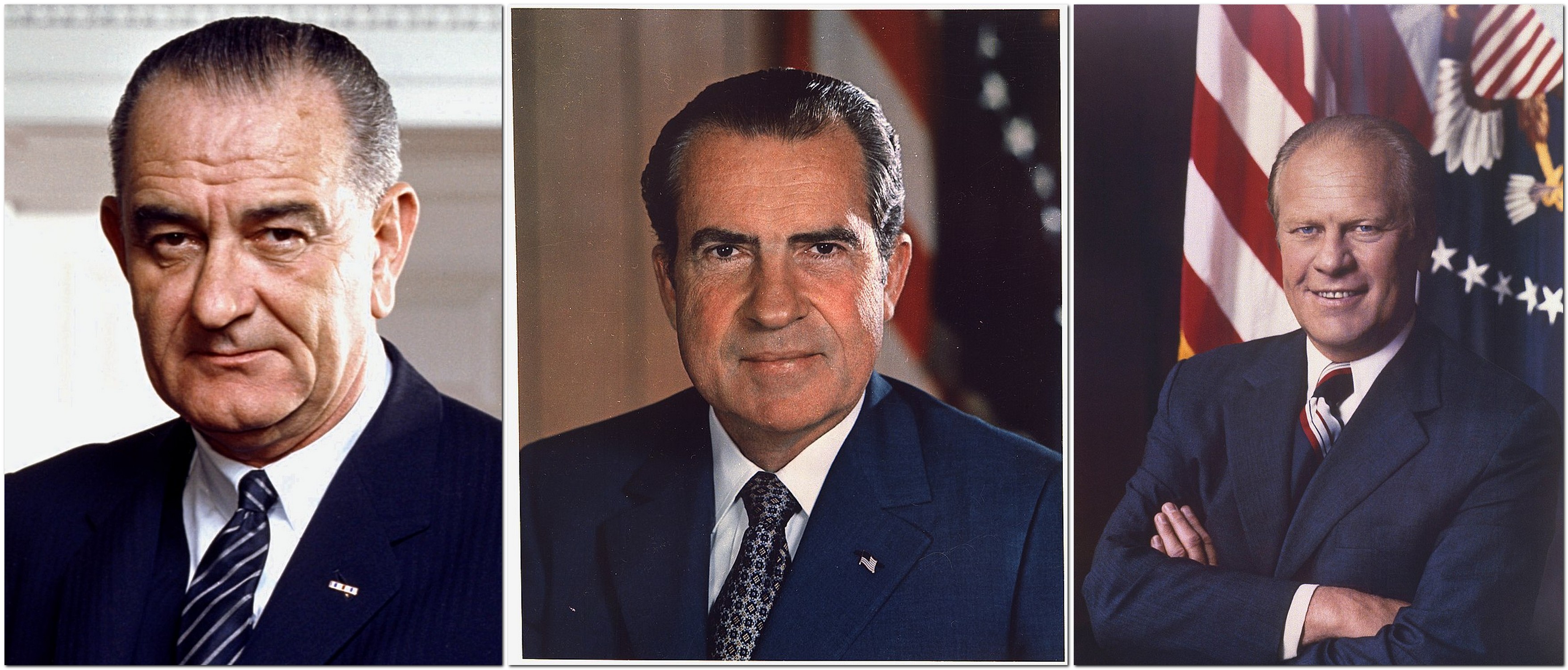
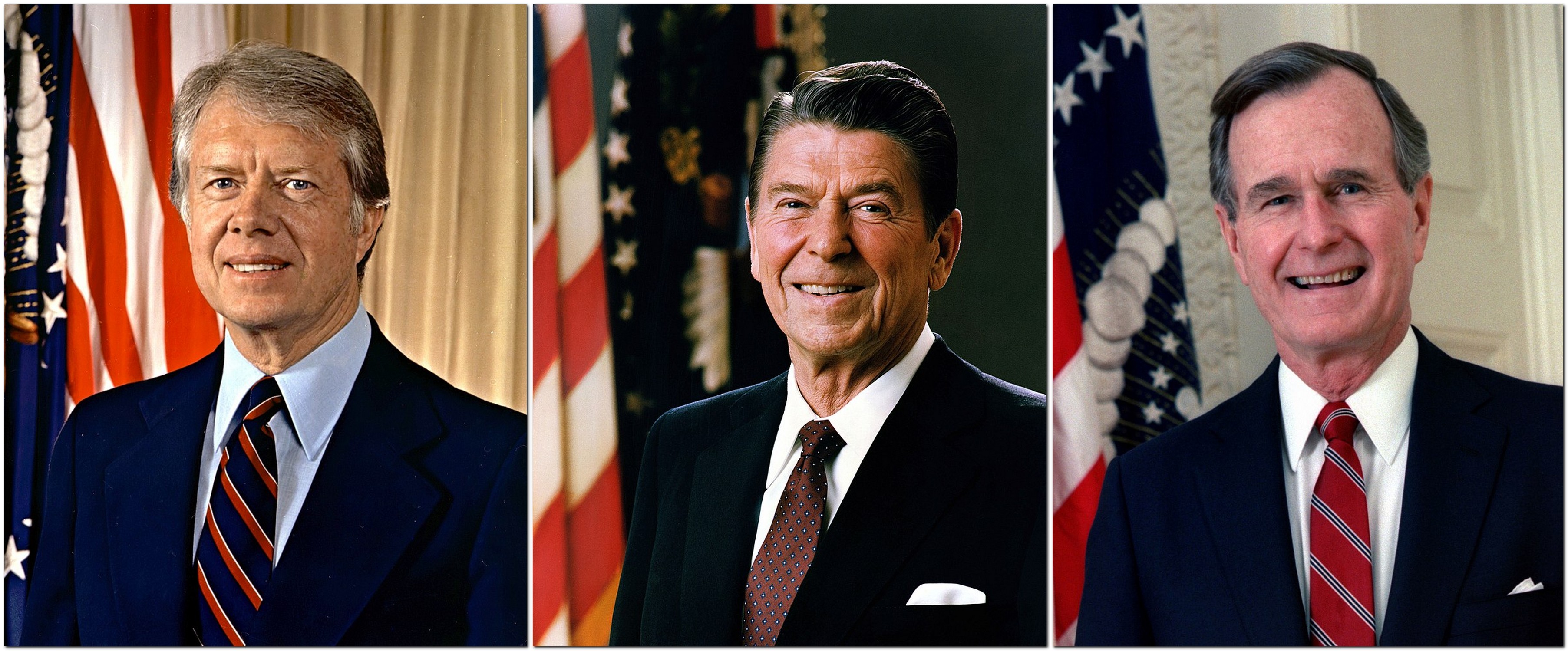
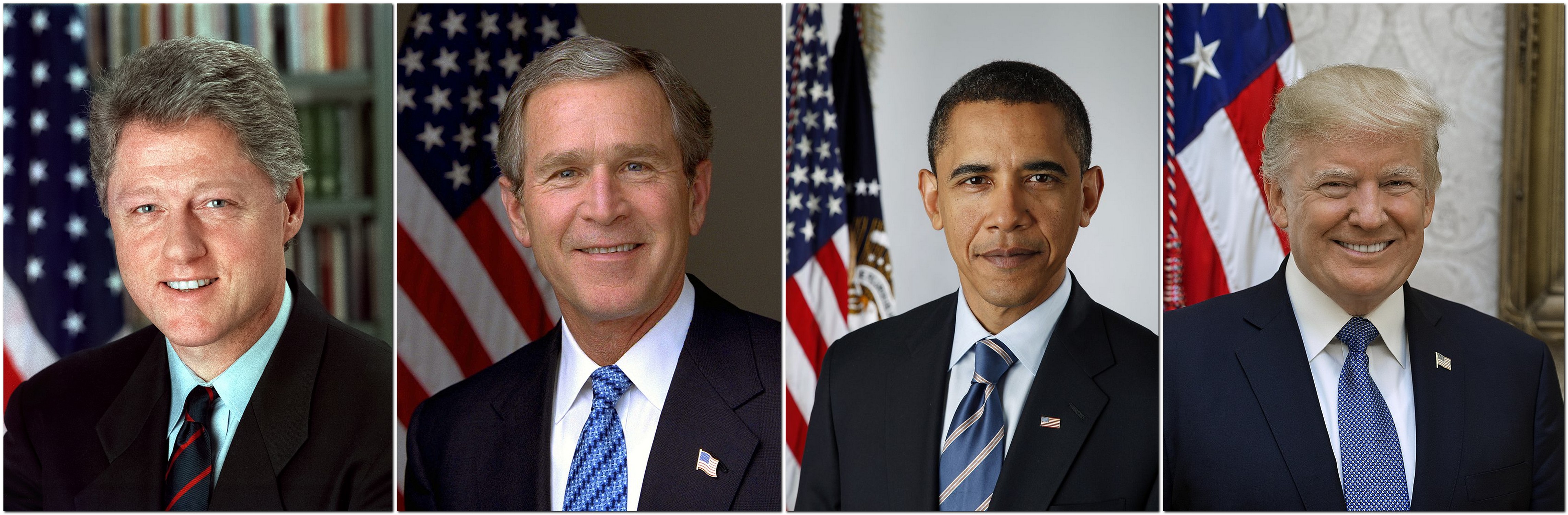
From Harry Truman to Donald Trump, there have been thirteen Presidents of the United States since 1948.

L-R: Harry S Truman (33rd, Democrat), 1945-1953; Dwight D Eisenhower (34th, Republican), 1953-1961; John F Kennedy (35th, Democrat), 1961-1963.

L-R: Lyndon B Johnson (36th, Democrat), 1963-1969; Richard M Nixon (37th, Republican) 1969-1974; Gerald Ford (38th, Republican) 1974-1977.

L-R: Jimmy Carter (39th, Democrat) 1977-1981; Ronald Reagan (40th, Republican) 1981-1989; George HW Bush (41st, Republican) 1989-1993.

L-R: Bill Clinton (42nd, Democrat) 1993-2001; George W Bush (43rd, Republican) 2001-2009; Barack Obama (44th, Democrat) 2009-2017; Donald J Trump (45th, Republican) 2017-present.

Harry Truman assumed the presidency on 12 April 1945 on the death of Franklin D Roosevelt. Truman will undoubtedly be remembered as the first head of state to authorize the use of atomic weapons, with the bombing of Hiroshima and Nagasaki in early August 1945. The Cold War began under his presidency. He was responsible for the Berlin Airlift in 1948, but also saw the start of the Korean War. He famously won re-election in 1948, defeating Thomas Dewey; even newspapers had gone to press declaring Dewey as the winner.

Truman was succeeded by General Dwight Eisenhower who had been Supreme Commander of Allied Forces in Europe during the Second World War. Eisenhower served two terms. This was the era of the Cold War. And one consequence of that was the 1960 U-2 spyplane incident during his last year in office. The US Interstate Highway System was inaugurated during his presidency.

The presidency of John F Kennedy was all too short. It had promised so much more, but an assassin’s bullet robbed the nation of that promise in November 1963. I remember vividly the moment that programs were suspended on TV in the UK to announce his death. And what grief there was, not just in the USA, but globally.

In May 1961, Kennedy announced a plan to land a man on the moon and bring him safely back to Earth before the end of the decade. He did not live to see that dream realized eight years later.

In August 1961, the East Germans under Soviet encouragement began to build the Berlin Wall, that was to remain in place for the next 28 years. Kennedy visited Berlin in June 1963, making his famous Ich bin ein Berliner speech.

Perhaps Kennedy will be remembered for his handling of the Cuban Missile Crisis in October 1962. It was a period of heightened tension that we also felt in the UK. I clearly remember waiting in class on that fateful day, wondering if Armageddon was about to happen. Soviet leader Nikita Khrushchev backed down. Crisis averted.

Who knows what Kennedy would have achieved, despite his prolific womanizing, had his life not been cut short.

Vice President Lyndon Johnson was sworn in as the 36th POTUS on Kennedy’s death. He served out the rest of Kennedy’s term, and won one for himself in 1964, but did not seek re-election to a second term as he was entitled to do in 1968. Johnson has two legacies. Let me state the positive one first: his enactment of Civil Rights Act in 1964, and other progressive legislation.

But he was also responsible for the escalation of the Vietnam War, that damaged his credibility with the electorate.

Democrats lost the White House in the election of 1968, that brought Richard Milhous Nixon to power. And how he abused that power. Nixon is synonymous with Watergate, impeachment proceedings, and resignation. Yet, Nixon had two significant achievements: rapprochement with China in 1972, and détente with the Soviet Union leading to the signing of the Anti-Ballistic Missile Treaty.

Nixon had already lost his Vice President Spiro Agnew to scandal before he himself was forced from office. Several months later, House Minority Leader Gerald Ford was appointed Vice President, and assumed the presidency on Nixon’s resignation in August 1974. He was the first person to have held both the Vice Presidency and Presidency without being elected to office. Perhaps Ford will be best remembered for his September 1974 full and unconditional pardon for any crimes [Nixon] might have committed against the United States while president. Ford lost the 1976 election to Georgia governor and outsider Jimmy Carter.

Carter served only one term. His denouement was the Iran hostage crisis that lasted from November 1979 to January 1981. He was perceived as a weak leader, the rescue of the hostages in Tehran having failed. The crisis ultimately led to Carter losing the 1980 election to Ronald Reagan. Minutes after Reagan was sworn into office the hostages were released by Iran.

Since leaving the presidency in 1981, Carter and his wife Rosalind have shown themselves to be exemplary citizens through their work to wage peace, fight disease and build hope. Carter was awarded the Nobel Peace Prize in 2002.

Ronald Reagan survived an assassination attempt in March 1981, just a few weeks after his inauguration as the 40th POTUS. A former governor of California, Reagan took the Republican Party to a more conservative side of politics. While he will be remembered for his escalation of the Cold War (his ‘Star Wars’ initiative) after a period of better relations with the Soviet Union under Jimmy Carter, Reagan nevertheless attended the Reyjavik summit with Soviet President Mikhail Gorbachev that led to the end of the Cold War and the signing of the Intermediate-Range Nuclear Forces Treaty in 1987.

Reagan was re-elected in 1984, defeating Jimmy Carter’s Vice President, Minnesotan Walter Mondale.

George HW Bush was elected as 41st POTUS, and served just one term. He was defeated by Arkansan Bill Clinton in the 1992 campaign. Bush was a Second World War fighter ace in the US Navy, and one of the youngest to serve in that capacity.

The most significant event of Bush’s presidency was the Gulf War, that pushed Saddam Hussein back from his occupation of Kuwait, but left much unfinished business that would be completed by his son George W Bush who was elected as the 43rd president in 2000.

Bill Clinton will undoubtedly be remembered for just one thing: the Monica Lewinsky scandal that almost led to his impeachment. Clinton, in my opinion, was one of the most gifted speakers I have ever heard. Without notes or teleprompters he could hold an audience spellbound as he embraced a wide range of topics in his speeches. The economy boomed under his presidency, and he left office with one of the highest approval ratings ever.

George W Bush came to the presidency somewhat controversially. It was all about hanging chads and the recount in Florida that eventually handed the election to Bush. Later in 2001 he was faced with the aftermath of the September 2001 attacks on the World Trade Center in New York and the Pentagon in Washington, DC, that then led on to the invasions of Afghanistan and Irag, that I alluded to earlier.

With the election of Democrat Barack Obama in 2008, as the 44th POTUS, the presidency entered an eight year period of relative calm, but above all decency. Obama is a charismatic orator, but perhaps his presidency did not achieve as much as was hoped for or expected. His signature achievement was the Patient Protection and Affordable Care Act (Obamacare) that was signed into law in March 2010. It must have been significant because ever since No 45 assumed the presidency he and Senate Republicans have been doing their darndest to repeal the Act. The same can be said for other legislation and initiatives that Obama sponsored. Donald Trump seems hell bent on eradicating any aspect of Obama’s legacy.

And, at last, that brings me on to Donald J Trump, No 45, elected to the presidency with around 3 million fewer votes in the popular vote than his Democrat rival, Hillary Clinton, but squeaked in through winning the Electoral College 304 to 227.

What can I say about Donald Trump that has not been said more eloquently elsewhere? He is perhaps the most odious and inept (and allegedly corrupt) individual elected to the presidency. However, whatever happens over the next 18 months before the 2020 election, and whether Trump is re-elected, he has already secured a legacy. How? He has achieved something, twice, that all presidents aspire to but rarely do. Two of his nominees were appointed Justices on the Supreme Court, thereby ensuring a conservative bias on the bench, and Trump influencing a conservative political agenda for decades to come. He may even yet have a third nominee appointed. It depends if and when octogenarian Justice Ruth Bader Ginsburg succumbs to ill health (or worse) and a replacement has to be found.

But how would I sum up his presidency to date? There is but one word: NARCISSISM.

The presidency, what he says, what he does, how he interacts with others all comes down to just one thing: himself. It affects his whole outlook on the world, his embrace of ‘fake news’, his weak relationship with the truth, his attacks on friends and foes alike.

https://youtu.be/lZZ9p-4PxMs

Never have we seen the like in the White House. Donald Trump makes even Richard Nixon look presidential. And that’s saying something.


* All images of Prime Ministers and US Presidents from Wikipedia.

I had a dream . . .

Well, more of a nightmare, actually.

I dreamt that I’d been elected a Member of Parliament. For the Labour Party even. Me, an MP sitting in the House of Commons! Nothing could be further from any aspirations I ever had nor, at my age, could I now want to explore.

I can’t imagine why I would have such a dream, except that my mind must be sensitized to politics given that Brexit is rarely out of the news for five minutes these days.

However, given the parlous state of the Labour Party under the leadership of Jeremy Corbyn (increasingly anti-Semitic in some quarters of the Party), that would not be my natural home. As I mentioned in a recent post, I once voted (in the General Election of June 1970) for the Conservative Party candidate. Never again. My seat in the House of Commons could never be on the Conservative benches, a party standing accused of entrenched Islamophobia.

I also wrote recently that politics in the UK is broken. Broken by Brexit. The fissures were already there perhaps, underneath the surface. They have been blown wide open by Brexit, an issue that has split the two major parties, Conservative and Labour. It’s not an issue that lends itself to tribal loyalties, For or Against, that dominate so many of the issues that Parliament is tasked to resolve.

So the idea that I should go into politics is ludicrous, to say the least. But then again? Political gravity pulls me to the center-center left, towards the Liberal Democrats, but since the 2017 General Election the Lib Dems are no longer a force to be reckoned with. They had already been punished in the 2015 election for having gone into coalition with the Conservatives in 2010 (although I personally believe they didn’t really have much choice, and did help moderate some [many?] of the more extreme Conservative aims in government). They have not shone in recent months although always supporting Remain and a People’s Vote.

But what has become clear to me during the whole Brexit debacle is that politics in the UK needs a root and branch reform. I’ve come to this conclusion because I have probably watched more than my fair share of broadcasts from Parliament.

Our way of doing politics is anachronistic. Just watch the goings-on in the House of Commons during PMQs (Prime Minister’s Questions, which are questions to the PM). I doubt many would argue that change isn’t needed. Debates and member behavior in the House of Lords are much more restrained, probably because half of the members are asleep.

The whole Westminster set up is adversarial, opposing benches of tribal MPs baying at each other. Such a set-up is not conducive to compromise – precisely what is needed at this time of national crisis brought on by Brexit. Party before country! Whatever must anyone from outside the UK think?

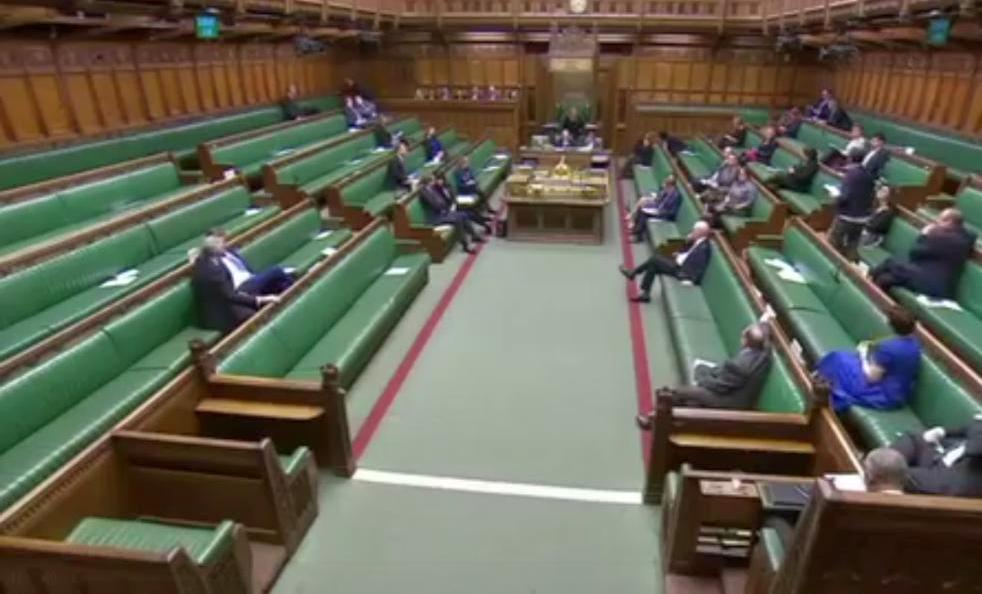
It’s interesting to note that the devolved legislatures in Scotland (the Scottish Parliament or Parlàmaid na h-Alba in Gaelic) and Wales (the National Assembly for Wales or Cynulliad Cenedlaethol Cymru in Welsh) are not configured in this way, nor the Northern Ireland Assembly (if it ever meets again). Each member has an individual desk. In the House of Commons there is not enough room for all 650 MPs. Many are forced to stand during certain sessions like PMQs attended by all MPs. At other times it must be quite disheartening to be an MP. Here is Green Party MP Caroline Lucas is introducing a debate (video) last week on an issue as important as climate change to an almost empty chamber.

Caroline Lucas, Green Party MP for Brighton Pavilion, introduces a debate on climate change to an almost empty House of Commons on 28 February 2019.

And then there is the antiquated voting system, where the Speaker asks MPs to signify their support, Aye of No, before deciding whether an actual ‘hard’ vote is needed. Then MPs file through the Lobby to cast their votes. You can imagine how long this can take if there are multiple votes, one by one. Parliamentary procedures and rituals seem locked in the Medieval Period.

The Palace of Westminster (where both the House of Commons and House of Lords meet in separate chambers) is no longer fit for purpose. Indeed it is falling down around Parliamentarians’ heads and is need of an urgent (and very costly) refurbishment. Yet MPs are reluctant to abandon the ‘Westminster ship’ to decamp to temporary premises while the buildings are brought up to standard one might expect in the 21st century for ‘the Mother of Parliaments‘.

But how about moving, permanently, to a bespoke parliament building, preferably in one of the regions outside London? The Palace of Westminster could then be converted to the museum it has (increasingly) become.

And while we’re considering reforms, how about introducing proportional representation in our voting system? Yes, that would probably lead to more frequent coalitions, but unless we break the stranglehold of the main parties I fear increased lurches to the right and left of politics.

MPs’ pay is a contentious issue. Currently MPs receive a basic salary of £77,379 (plus allowances and expenses). Personally, I think that £77,000 is rather low for such an important and responsible position. Not that many MPs are currently worthy perhaps of what they actually receive or might expect in the future. However, one proviso I would insist upon, that no MP may increase his/her income through external emoluments (directorships and the like, or as newspaper columnists, for example). Politics might then attract another (and better) generation of aspiring politicians.

You may accuse me of naïvety, and I would accept the criticism. But unless and until we are willing to openly confront the issues that challenge politics today in the UK, nothing will change. We will continue to be mired in a pit of our own delusions that Westminster really is the ‘Mother of Parliaments’, the epitome of democracy.

It’s time to cut the Brexitian knot

Tick tock. Tick tock. We are inching inexorably towards the UK’s departure from the European Union (EU).

Yes, the UK is due to leave the EU at 11 pm on Friday 29 March. Even the Brexit deadline will play out according to the EU’s schedule, Brussels time. It will be midnight there. How ironic.

However, it’s hard to fathom that more than 2½ years on from the vote (by a small majority) in the ‘advisory’ referendum of June 2016 to leave the EU, we are essentially no closer to resolving many of the issues (and prejudices) that Brexit has brought to the surface. Indeed, some have become even more deeply entrenched.

Many seem almost insoluble, given the almost even split in opinion (in 2016) among the nation’s voters, and the parliamentary deadlock that currently blights the House of Commons. Party before nation!
It seems as if everyone has a different idea of what Brexit really means or its consequences. Opinion across the House ranges from Remain on one side of the debate, to the hardest of hard Brexits (the purview of Jacob Rees-Mogg and his European Research Group¹ or ERG acolytes).

Much of the criticism can be laid at Prime Minister Theresa May’s door for her (mis)handling of the negotiations, her red lines, and obsession about immigration as I wrote just a few days ago.

Remainers knew what they were voting for in the 2016 referendum. I’m not sure if Leavers fully understood what they voted for. A land of milk and honey, unicorns? From interviews of many Leave supporters I have watched in recent weeks, they do not appear to have the slightest inkling what Brexit means or how it might affect their day-to-day lives. When they voted they had little or no idea about the EU or how it works (the Single Market or the Customs Union), the real level of the UK’s financial contributions to the EU, or the many benefits that membership has brought to the UK (particularly benefits from the EU’s regional funds in impoverished areas of the UK). For many, a vote to leave the EU was simply a protest vote against the status quo, years of austerity, of neglect. A xenophobic vote against immigration. More worryingly, many ardent Brexiteers clearly don’t care about any economic, social, or constitutional consequences of Brexit.

But this week has seen a significant change in parliamentary dynamics. Several groups of MPs of different political persuasions are working to prevent the UK leaving the EU without a Withdrawal Agreement, taking the so-called ‘No Deal’ option ‘off the table’. Incredibly, a not insignificant number of voters understand ‘No Deal’ to mean ‘Remain’!

Even the Labour Party has now publicly come out in favor of holding a second referendum that would give the electorate an opportunity to make its will known about the outcome of the negotiations between the EU and the UK.

But as things currently stand we are facing acceptance of Theresa May’s draft Withdrawal Agreement or No Deal (leaving the EU without any agreement, no transition period, nothing). The parliamentary arithmetic suggests that Theresa May still does not have enough votes for her agreement to pass, having been rejected by the House of Commons in mid-January by a margin of 432 votes to 202. Yet, with nothing new to offer, she is bringing the deal back to Parliament by 12 March for yet another ‘meaningful vote’. Funny how this second vote is seen as the epitome of democracy, yet asking the electorate to pass its verdict on the same deal, or other Brexit options, in a People’s Vote is viewed as a subversion of that same democracy. Meanwhile, we all sit on the edge of our seats, staring into a Brexit abyss.

But talk of a second referendum worries me. For many Brexiteers and the Leave-supporting public, a ‘second referendum’ is or will be seen simply as a re-run of the 2016 referendum. A People’s Vote is not a second referendum per se. The opinion of the electorate, the British people, is now needed on how to move forward because no single Brexit option commands a parliamentary majority. There is stalemate.

So, moving towards another national vote, it’s not like 2016, a simple question of ‘Leave’ or ‘Remain’. The choices are more complex and, I think, among the reasons why politicians have shied away from agreeing to a new vote, notwithstanding their faux support of democracy.

So what form should a second vote take? I’ve thought long and hard about this, and as I said, it can’t be described (vilified even from some quarters) as 2016 Mk 2. How will the vote be organized? Must a vote be based only on binary choices, or can a vote be based on three or more choices? This is what the Institute for Government has to say on the matter. I was reminded of this issue yesterday in a tweet from my former colleague.

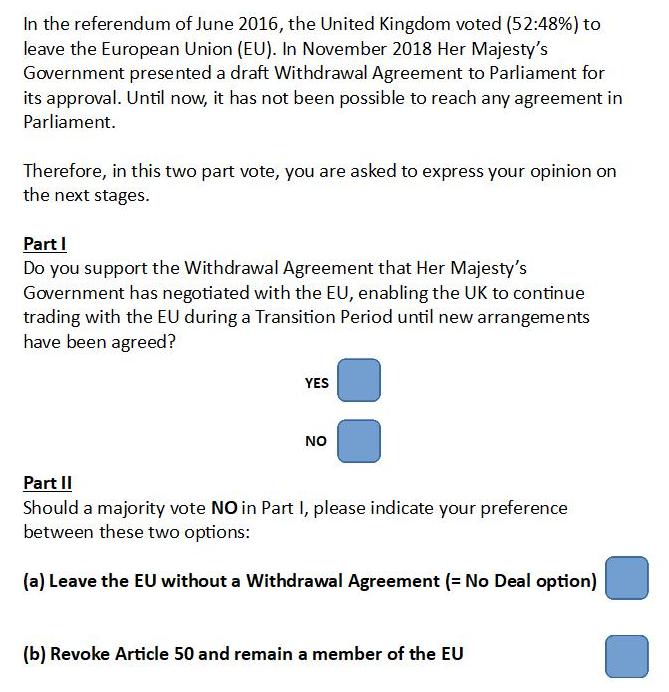
In my opinion, a People’s Vote has to have two parts, otherwise the expectations of many voters will simply not be captured in a binary choice (while avoiding re-running 2016).

Here’s my take. My wording maybe be naïve or inappropriate, but it gets us to the outcome I think we all want to achieve.

This format allows the electorate to vote to continue with Brexit if it so desires, but under terms they understand and agree with (May’s agreement). It’s a simple choice: support Theresa May’s deal or not. The outcome is a majority one way or the other. If the vote is YES, then that’s it. We leave the EU under defined terms.

In the second part, assuming a NO majority in Part I, the electorate can choose to continue with Brexit (whatever the consequences) or remain in the EU.

Is this format too complicated? Maybe. But it does provide clear binary choices. There is no guarantee, however, that all voters would complete both parts. Maybe a ballot paper would be void/spoiled unless both parts are completed. I don’t know enough (which is very little) about the electoral process. I do know that a People’s Vote must avoid language or outcome ambiguities.

Some way has to be found to cut the Brexitian knot,  resulting in a clear decision for a defined option. The nation is sick and tired of the constant Brexit bickering that meets the aspirations of neither Leavers nor Remainers.


¹ European Research Group – yes, these MPs are a group, a definite caucus within the Conservative Party. As a scientist, however, I object to them using the term ‘Research’. They don’t appear to understand even the basic principles of what research is all about.

The perfect Brexit storm

I have voted Conservative just once, in the June 1970 General Election that brought Ted Heath to power. It was the first election in which I was eligible to vote, aged 21 (although the voting age had been lowered to 18 in January of that year).

Now, wild horses couldn’t drag me into the polling booth to vote for the Conservative Party. Nor for Labour either, while Jeremy Corbyn remains Leader.

I can’t remember a more chaotic situation in British politics than we are currently experiencing. Politics is broken. Indeed, it’s hard to remember when politics was held in such low esteem nationwide; respect for politicians has evaporated.

And the cause? Brexit, of course, which has thrown politics into disarray. And while the same tribal party loyalties affect most parliamentary decisions, perspectives on Brexit or No Brexit, Leave or Remain, cut right across party lines and policies.

No wonder then that eight MPs resigned from the Labour Party last week and formed The Independent Group (TIG), joined by three Conservative MPs. Another Labour MP has resigned from the party, but not joined TIG.


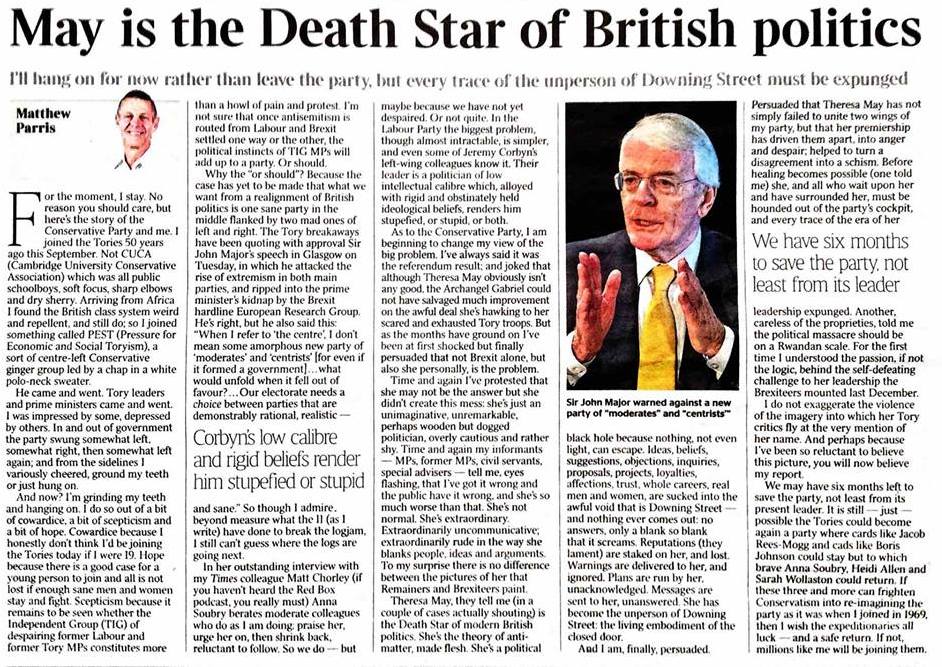
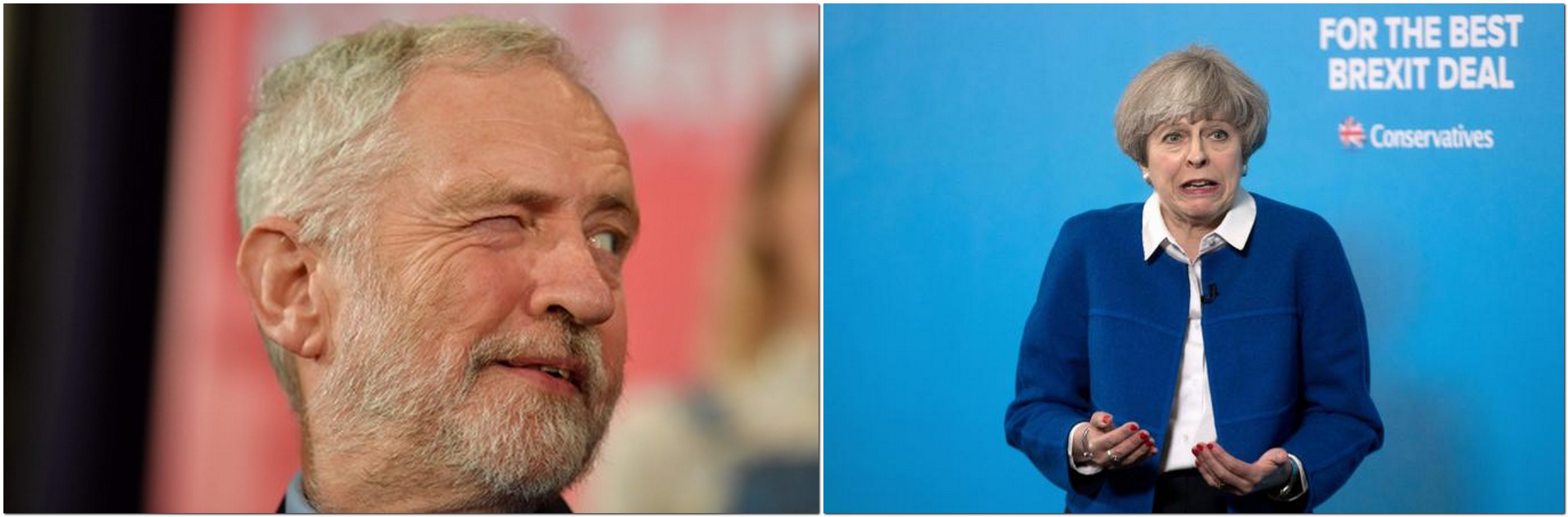
Prime Minister Theresa May is the Death Star of British politics and Leader of the Labour Party Jeremy Corbyn is a politician of low intellectual calibre which, alloyed with rigid and obstinately held ideological beliefs, renders him stupefied, or stupid, or both.

Jeremy Corbyn and Theresa May

Not my descriptions, I should add, although they are ones that resonate with me. No, they come from the pen of  long-time Conservative supporter, former Conservative Member of Parliament for West Derbyshire, and newspaper columnist, Matthew Parris.

Writing in The Times last Friday, 22 February, he wrote what is probably one of the most damning indictments of two party leaders that I have ever read. But particularly damning of Theresa May. Click on the image below to read the article in full.

With just 32 days before the UK is due to leave the European Union (EU), potentially crashing out without a deal if the Withdrawal Agreement negotiated over many months with the EU is once again rejected by Parliament, Theresa May has again kicked the ‘Brexit can’ down the road. Parliament will not hold a ‘meaningful vote‘ to decide the future of that agreement until 12 March. FFS! Pardon my language.
You can imagine some of the reactions. Mike Galsworthy is a leading Remain campaigner.

And this, despite the EU and European Commission consistently stating that negotiations over the Withdrawal Agreement will not be re-opened to rework the wording over the Irish backstop.

Now listen to former Conservative MP (and TIG member) Anna Soubry commenting on Theresa May’s leadership and her obsession with immigration that seems to be driving her Brexit ‘strategy’.

Anna Soubry is not the only person concerned about Theresa May’s approach to Brexit. Philosopher and author AC Grayling tweeted this message a couple of days ago.

Here’s another view from Labour MP for Birmingham Yardley Jess Phillips.

Corbyn has led a totally ineffective Opposition throughout the whole Brexit process. Labour should be points ahead in the polls. Instead they are lagging behind the Conservatives. Extraordinary! Corbyn appears more concerned about winning a General Election, and implementing a ‘real’ Socialist agenda than he is about Brexit and its impact on the nation. Post-Brexit, the country won’t be able to afford his vision.

Because of the Fixed-term Parliaments Act 2011, Parliament will have to vote to hold a General Election, if Theresa May decides to call one. Corbyn will find himself on a very sticky wicket. Because of his consistent calls for an election, Labour can hardly vote against such a motion even though recent polls don’t give them much hope of success.

Unless . . . ?

Unless Labour openly support a second referendum or People’s Vote (that seems to be the favored option among the electorate). Clearly, there is a groundswell of support for such a vote, even within Labour.

https://twitter.com/peoplesvote_uk/status/1099640535902547968

So, with the nation staring down the barrel of a Brexit gun, who knows what the outcome will be, after 29 March. Brexit has opened fissures in both main political parties that are unlikely to heal very quickly. Is this the beginning of a realignment in British politics? Only time will tell. Brexit has caused the perfect storm.


The will of the British people?

A common (but misleading and annoying) refrain, frequently repeated by Prime Minister Theresa May and other Brexit supporters, is that delivering Brexit is ‘the will of the British people’, respecting the vote of the June 2016 referendum. Delivery of Brexit and hang the consequences!

Will of the British people? Whatever does that mean? And who are the British?

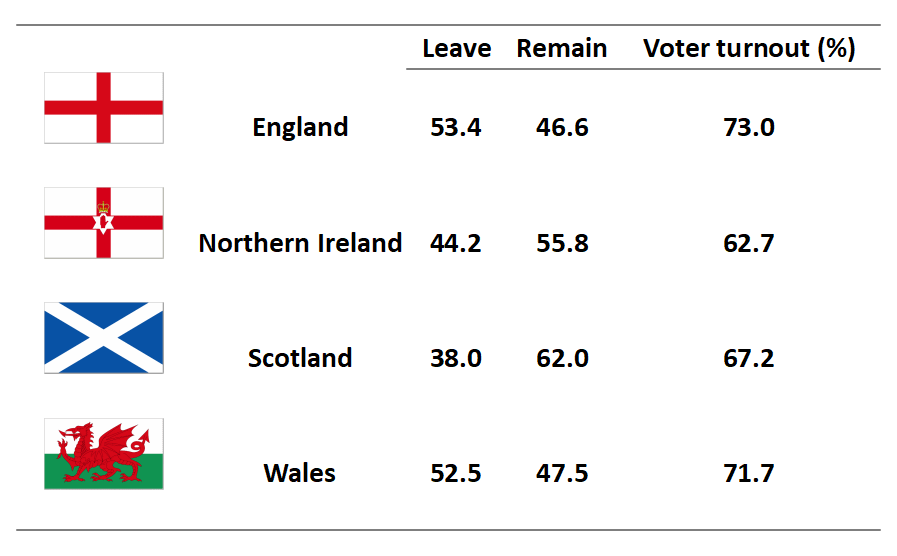
Yes, the Leave campaign was supported by more voters, 52:48% and ‘won’ the referendum. However, only 37.4% of the electorate (of 46.5 million) actually voted Leave. Not even 50% or more. Had they supported Brexit to that level then it would be appropriate to make that claim. As it is, it’s just a ridiculous platitude that Theresa May repeats ad nauseam.

So voting to leave the EU was the will of the British people? Well, let’s see how they voted.

Blue: Leave; yellow: Remain (2016 referendum result)

Actually, voting to Leave was the will of a majority of the English and the Welsh, although listening to the antediluvian Democratic Unionists of Northern Ireland, you might be led to believe that the Province also voted overwhelmingly to Leave.

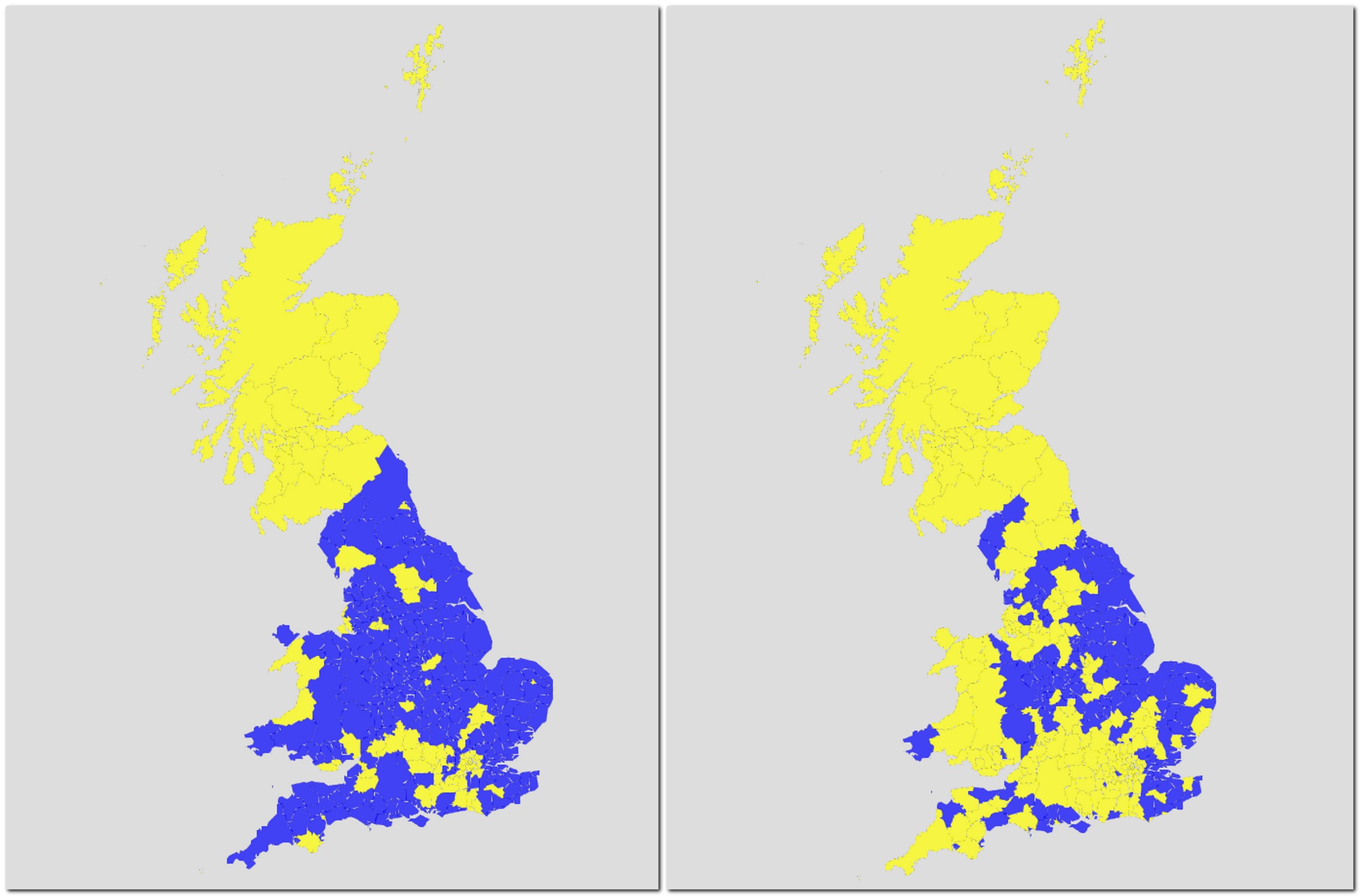
There is now strong evidence that voting preferences have changed (in favour of Remain) since the referendum as the potential impact of Brexit (especially a No Deal Brexit) has dawned on a naïve electorate.

L: the actual results of the 2016 referendum by local authority. R: voting intention in a Channel 4 survey in November 2018, by local authority. Yellow = Remain; Blue = Leave.

Naïve? Just listen to these British expats who live in or frequently visit Spain. I feel embarrassed (ashamed even) to be part of the same age demographic.

Immigration was a serious driver of the Leave result. I find it incredible that so many voters thought that ending free movement (under the Single Market, if they indeed ever understood what that was) only applied to those EU nationals coming into the UK. Not to the British moving around the EU! And, regrettably, ‘British’ is often perceived (especially by those on the Far Right of politics) simplistically as white English.

As I recently wrote, Brexit perspectives will be forensically dissected at some time in the future when the histories of this debacle come to be written.

If the UK crashes out of the EU without a deal, I believe (and fear) the United Kingdom will soon disintegrate. And this once proud, but increasingly impoverished nation, will descend to a state of insignificance on the world stage. Scotland will, in a second referendum, overwhelmingly vote for independence. And who could blame them? Northern Ireland will, within a decade, probably draw even closer to the Irish Republic. I’m not sure about Wales.

Brexiteers (predominantly Tory English MPs) continue to see a role and influence of the UK projecting ‘neo-colonialist’ power (‘lethality’ even) far beyond what this small island nation with a shrinking economy can hope, or should ever again aspire, to achieve. Just take the ludicrous comments of Gavin Williamson, MP for the South Staffordshire constituency and the miserably inadequate Secretary of State for Defence, just a few days ago.

And on the trade and diplomatic front, things aren’t going so well either.

What is also lamentable right now, is that the ‘will of the people’ appears to be cast in stone. Theresa May can bring her failing deal back to Parliament for multiple votes, yet hypocritically denies the electorate the opportunity of comment on the outcome of the Brexit negotiations through holding a second referendum or so-called People’s Vote.

With only 39 days left to Brexit, and nothing clearer appearing on the horizon, it’s about time to recognize that the will of the people has changed. Politics in the UK is broken. Party politics (and survival) have taken precedence over the well-being and future of the country.

I’m a citizen of the United Kingdom, British by nationality. I’m British from England, and I want my British voice and will to be heard and felt along with those from Brits from Scotland, Northern Ireland, and Wales.

I feel and am European!


If it ain’t broke, don’t fix it

Unfortunately, politics in the UK is broken and requires more than a sticking plaster.

A minority Conservative government under Prime Minister Theresa May has been rent asunder by Brexit. The draft withdrawal deal announced yesterday already appears dead in the water. Even as the Cabinet ‘approved’ the draft text at a marathon meeting yesterday, there were reports that as many as nine cabinet members were opposed, although apparently going along with the whole charade.

It’s now just before noon, and already two Cabinet members have resigned, including the second idiot in charge of the Brexit negotiations, Dominic Raab. And several junior ministers have gone as well. More are expected. Theresa May is entering a dark place.

Immediately on release of the draft agreement, the Brexiteer vultures began to circle. Without having read the text (a 580 page document, which was published online later in the evening), they rejected the draft out of hand. It has not found favor with Remainers either. In speaking briefly to the assembled press outside No 10, Theresa May said it was her deal, no deal, or no Brexit. Hope lingers eternal that if Parliament rejects the draft, a sane way out of this chaos might yet be found. One thing is clear. Theresa May is going to struggle to win support for the agreement in the House of Commons. Opinion is too divided.

May lost her overall parliamentary majority in the disastrous 2017 General Election (for the Conservatives anyway), and has since been kept in power by 10 members of Northern Ireland’s Democratic Unionist Party (DUP). But even they are preparing to abandon the May Brexit ship, despite having accepted a £1 billion ‘bribe’ after the General Election to provide May with a working majority under a confidence-and-supply agreement. They are even more blinkered than usual. It has not been a pretty sight, especially as the border between Northern Ireland and the Republic became the major sticking point in the withdrawal agreement negotiations with the European Union (EU).

Given the ‘civil war’ within the ranks of the Conservative Party, Labour should have won the 2017 election, hands down. Or perhaps I should say it could have won the election if its stance on Brexit had been unequivocally in favor of Remain. Unfortunately, Jeremy Corbyn, has consistently proved just what a weak and prevaricating leader of the Labour Party he is. Certainly there is now a clear majority of Labour supporters—in every Labour-held constituency—in favor of remaining, as evidenced by a nationwide poll of 20,090 people that Channel 4 commissioned recently. Even regions of the UK that voted heavily in favor of Brexit: the northeast, Wales, and the southwest, now have majorities in favor of remaining members of the EU.

Referendums are, to some extent, a clumsy democratic tool. However, in Switzerland they are used all the time. But, if social mores change, then the Swiss can change their minds, and this shift in opinion can be reflected in another referendum. Referendums are employed in California to guide opportunities to change the law (such as the legalization of cannabis), if I understand that situation correctly.

The Brexit referendum was different. Why? Although it was ‘advisory’, it is now seen (on the Brexiteer side) as immutable, the ‘will of the British people’, cast in stone, never to be challenged or overturned. But clearly public opinion has moved on, now that the actual consequences of Brexit are becoming clearer, already realized in some instances.

On the other hand, referendums have one important aspect that normal elections (at least in the UK) do not have. Every vote counts. For example, with our first-past-the-post electoral system, there’s hardly any chance that my vote ever counts in parliamentary elections in our Bromsgrove constituency, held by the Conservatives with a comfortable majority; Home Secretary Sajid Javid is the sitting MP.

So, the 2016 referendum result, 51.9-48.1% in favor of leaving the EU was an accurate reflection of those who voted. But since only 72.2% of the electorate turned out to vote (actually high by other election standards), those explicitly in favor of leaving were only about 37%. I’ve always maintained that for this referendum that would have such economic, political, constitutional, and social implications, there had to be a minimum agreed voter turnout for the referendum to be valid in the first place (which I think would be the case for 2016), and an overall majority of the electorate (not just those who voted).

Goodness knows what the outcome is going to be. Politics has become so tribal, factional, and disjointed, I have no idea where the country is heading – except down the bowl, perhaps. The extremes of politics, on the right and on the left, are center stage right now. It’s time to claim back the center ground, but that’s increasingly difficult with our first-past-the-post system.

Reluctantly—and I never thought I would ever come to this position—I do believe it’s time to take really hard and serious look at proportional voting and representation. Compromise is denigrated quite often in politics today, but working to reach compromise does focus minds.

Proportional representation in many European countries most often leads to coalition governments that take months to agree a parliamentary agenda. Is that such a bad thing? Is coalition government per se such a bad thing?

After the 2010 election the Liberal Democrats went into coalition with the Conservatives and, based on reaction to at least one key decision in government (student tuition fees), the Liberal Democrats were hammered in the 2015 General Election. But was their participation in the coalition so terrible? I sincerely believe that they did help reduce the impact of the hard right (who hated the Lib-Dems with a vengeance), and the natural orientations of Prime Minister David Cameron and Chancellor of the Exchequer George Osbourne.

I, for one, would be willing to give coalition government a try once again. And if that means introducing proportional representation, then that’s what needs to be done. After all, future governments can always reverse that decision, something that apparently we are unable or powerless (forbidden?) to effect now to steer a course away from the omnishambles that Brexit has become.

Changes to how we elect our politicians would certainly be more than a sticking plaster.

Brexiteers are like turkeys voting for Christmas

But it’s Remain supporters who are getting plucked and stuffed.

I’ve tried hard over the past two years not to disparage the views of those who voted, in the June 2016 referendum, for the UK to leave the European Union, many of whom continue to support that aim. After all, civilized debate is (or should be) what it’s all about.

Now, however, the gloves are off! Because the negative social, economic, political, and constitutional consequences of Brexit, and especially a no-deal Brexit, are too grim to contemplate. In the long term, the nation will survive but not without self-inflicted pain and hardship.

Unless, this silly trajectory can be halted.

Brexiteers. Makes them sound like a bunch of mischievous rogues. But they are not. Many politician Brexiteers are dangerous, self-interested, ignorant, bigoted, and short-sighted individuals. All for one and one for all. Gobble, gobble.

Short-sighted, except one, perhaps. Jacob Rees-Mogg, MP for the 18th Century, has conceded that the nation shouldn’t expect any real economic benefits from Brexit for a long time, perhaps 50 years. He’s obviously playing the long game, cushioned by the sort of wealth that most of us can never imagine.
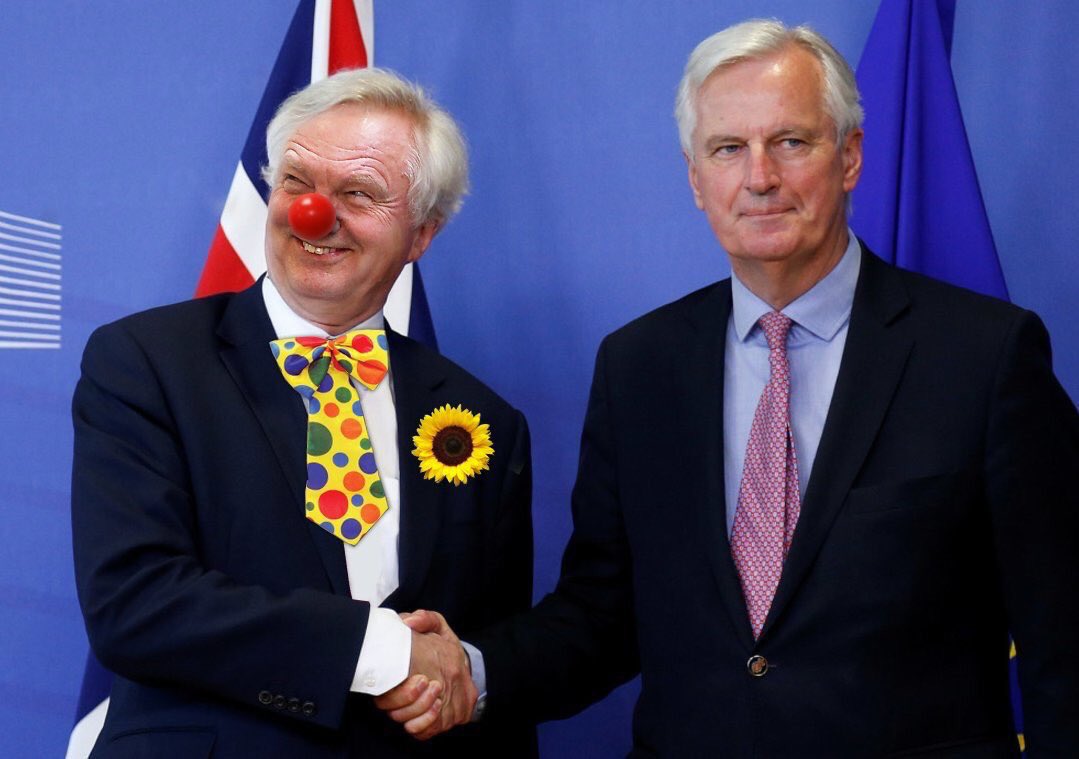
50 years! Good grief. My grandchildren will be approaching pensionable age by then. Are we so callous, stupid even, to condemn the youth of this country to such an uncertain future?

I can’t remember, during my lifetime (I’ll be 70 in a month’s time), the nation ever being polarized by a single issue such as Brexit. The referendum result revealed an almost equally divided electorate, with a small majority on the Leave side. In my opinion they were conned, taken in by the lies and false promises (and illegality) of the Leave campaign.

I don’t deny that some Leavers’ views were (and are) deeply held. As I have followed the debate about Brexit since the referendum, and particularly during the last few months, I watch and hear Remainers clearly and considerately lay out scenarios, based on evidence, for a Brexit outcome. In contrast, what do we hear from the Brexiteers? Project Fear! they cry.

And that’s what gets me, I’m afraid: the continuing inability of Brexit-supporting politicians and public to clearly spell out what they expect from Brexit, and what their plans are, instead of just repeating, ad nauseam, that we will be taking back control of our borders, our money, and our laws, and that it’s the will of the people.

When it comes to the law, I haven’t seen Parliament resting on its laurels because there is a continuous stream of new legislation. It seems more to do with their prejudiced view about the role of the European Court of Justice (ECJ) with respect to the EU’s regulatory framework. But if we trade under World Trade Organization (WTO) rules post-Brexit, we’ll still be subject to external controls. Not from the ECJ, but instead from the unelected WTO bureaucrats in Geneva who will hold our collective feet to the fire.

We always had control of our borders. It’s just that successive governments chose not to apply existing EU regulations to manage immigration into the UK from EU countries. Incidentally, very little is mentioned in the immigration/free movement context that immigration from countries outside the EU runs many times higher than from EU countries. Nigel Farage, bless his cotton socks, racist that he is, played the immigration card to great effect during the referendum campaign.

When it comes to money, the UK chose not to join the euro, and has, for many years, been the recipient of a healthy annual rebate after paying into the EU budget. Assuming that Brexit does indeed go ahead, one possible scenario is the UK asking to re-join the EU at some later date. But it won’t be, I believe, on the same favorable terms we currently enjoy: we’d have to join the Euro, budget rebates would be less generous or non-existent, and I guess we’d also have to become a Schengen country and abolish all border controls with other EU members.

The other point that gets my goat is the referendum result being the ‘will of the people’ (it was ‘advisory’), and must therefore be respected as though no-one is permitted to change their mind, ever. Recent polls indicate however, that if the referendum were held today, based on what we know now and what was just speculation or false promises in 2016, there would be a majority to Remain in the EU. Voters are changing their minds – in both directions. The outcome might still be close.

Maybe some of the 27+% who didn’t exercise their democratic right in 2016 will come to understand the consequences of the Leave vote. Those who were too young to vote last time are already expressing their desire for continued membership of the EU. Older voters (part of my demographic that overwhelmingly voted Leave – but not me, I hasten to add) have died since the referendum. The balance of the electorate is not what it was.

The electorate deserves, demands even, the right to pass judgment on whatever Theresa May salvages from her negotiations with the EU. And one of the options must be the right to Remain.

It’s time for the electorate to take a second look, hold a #People’sVote. And for that cause, a major demonstration will be held in London tomorrow (which I am unable to attend).

I can however express my support through this blog.


I was angry (still am), but now I’m also embarrassed

Embarrassed . . . to be British. But come autumn 2019, however, I’ll be able to thumb my nose at the world with my new iconic blue and gold passport (to be manufactured, apparently, in France – oh the irony!). Even though I might not be able to visit as many countries, visa-free, as UK citizens currently enjoy under membership of the European Union (EU).

Let’s go back a couple of years.

I woke up on the morning of Friday 24 June 2016 and, as was my wont, tuned into BBC Radio 4’s Today news program at 06:00. I say ‘wont’ because I seldom listen nowadays. But more of that later.

From: the Daily Express, 3 February 2016

I was keen to hear the result of the previous day’s referendum on continuing membership of the EU, expecting a majority in favor. How cruel reality can be!

I was amazed, bewildered, dismayed even, when the result sank in. The nation was divided, voting 52-48% (a difference of 1,269,501 votes on a turnout of 72.2%) to leave the EU. Brexit was now on the cards. Or was it?

I just couldn’t believe that the electorate had turned its back on an institution it had been part of, and benefited from, for over 40 years. Leave supporters had swallowed the false promises, mistruths, downright lies even (and, as we now know, the illegality) of the Leave campaign.

But since the referendum was not legally binding (just check the legislation that gave substance to the referendum) I thought (misguidedly as it has transpired) everyone would come their senses and reach a suitable compromise, allowing us to stay in the EU. However, the ‘will of the people’ has become almost an article of faith that cannot (may not), under any circumstances if you are a Brexiteer, be challenged.

I’ve long argued that since the referendum would potentially have far-reaching social, economic, and constitutional consequences, the bar should have been set much higher. By this I mean that a minimum voter turnout must have been reached, e.g. 75%, and that the margin voting to Leave should have been >50% of the electorate, not just those who voted. I guess I can be accused of wanting it both ways: heads I win, tails you lose. But the referendum was to decide a fundamental transformation of this (once proud) nation. So, if the voter turnout did not meet the agreed threshold, or less than 50% of the electorate (22,750,063 in June 2016) voted to leave, then the referendum would have been declared null and void.

That, unfortunately was not the case, because former Prime Minister David Cameron was too complacent during the whole referendum campaign and the lead up to its implementation. Holding a referendum on the UK’s membership of the EU was a political sop to the right wing of the Conservative Party. He never imagined that he would have to contend with the likes of Boris Johnson and Michael Gove on the Leave side, never mind Nigel Farage of UKIP, who had few if any scruples about telling like it wasn’t. And he expected to win. Having lost, he bowed out of politics leaving the consequences for an even more incompetent Prime Minister to address.

It didn’t take long for my dismay to turn to anger. But now I’m also embarrassed. Embarrassed by the complete shambles (I could use stronger language) of the way that Theresa May’s inept (but ostensibly ‘stable and strong’) government has attempted to reflect the ‘will of the British people’ in a withdrawal agreement with and from the EU, and establish a new relationship post-Brexit. The UK has become a laughing stock among the nations of the world. We are on a trajectory to becoming an irrelevant little island off the coast of Europe. Under those circumstances, can (should?) the UK still lay claim, for example, to a permanent seat on the United Nations Security Council? Its status will be diminished. Yes, for many, the UK will become an irrelevance.

I say ‘attempted to reflect’ because almost 2½ years on from the referendum, we still seem to have no idea of what the UK’s post-Brexit status will be. Given the growing prospect that no deal is agreed by the Brexit date (29 March 2019, just five months away), the government apparently has no plan, but has started to publish grim impact papers of what a no deal or hard Brexit would encompass. But ask any of the Brexiteers what their reaction is (more of ‘Project Fear’) or their plan, and you are faced with the same old platitudes: we’re taking back control of our borders, money, and laws. Hang the economic, social and constitutional consequences. What a parlous state we have reached.

All I can assume is that when Theresa May invoked Article 50 on 29 March 2017 (triggering the process to leave the EU), she thought that any agreement with the EU would be done and dusted in a matter of weeks. In fact, former Secretary of State for Exiting the European Union, David Davis (now there’s a clown of a politician if ever I saw one), stated that this agreement would be one of the easiest to achieve.

From Twitter on 19 June 2018: Robert Campbell #FBPE Deeply Unhelpful @madman2. David Davis with EU Chief Negotiator Michel Barnier.

Theresa May didn’t have to invoke Article 50 in March 2017, but she did. And we were then locked into a situation that seems to be heading for failure. She must have assumed that the EU members would simply accede to any of the ‘having our cake and eat it’ proposals put forward by the British government. In fact, I’m surprised that the other 27 members hadn’t shown the door to the British a long time ago.

It seems to me that Brexiteers feel the EU owes us something. Nonsense! We’re the ones asking to leave; or at least some of us are (don’t count me among them). It’s been made crystal clear that the UK’s relationship with the EU post-Brexit cannot be equal to what we currently enjoy as full members: frictionless trade, freedom of movement, and the like. Indeed as a ‘third country’ post-Brexit, we will be at a serious disadvantage, and all those trade and other agreements that the UK participates in as a member of the EU will have to be renegotiated, one by one. A Canada +++ agreement to fill the void? Canada +++, my backside!

Brexiteers simply talk about an independent UK outside the EU in terms of trade, and their desire to negotiate free trade agreements (FTA) on our own terms, notwithstanding that we already have FTAs with more than 60 counties or blocks of countries through membership of the EU. At 11 pm on 29 March next we lose all of those. Brexiteers object to the role of the European Court of Justice overseeing the EU’s regulatory framework. But even operating under the rules of the World Trade Organization we will still be subject to the authority of that body, and trading under far less favorable conditions than at present. It doesn’t take Economics 101 to see that. But at least our Secretary of State for International Trade will be able to travel globally on his new blue passport to negotiate all those trade deals that he assures us are just waiting to be signed.

Membership of the EU has brought so much more. For one thing, the EU has, among its members ensured peace in Europe over many decades. Joint membership of the EU by the UK and Republic of Ireland is one of the principles of the Good Friday Agreement. The future of the border between Northern Ireland and the Republic is one of the main stumbling blocks of further progress in the withdrawal agreement, as it was long foreseen by many on the Remain side but discounted by Brexiteers, chief among them Boris Johnson and Jacob Rees-Mogg.

In the early 2000s, when I was working at IRRI in the Philippines, risk assessment was one of the conditions insisted upon by the donors to the international agricultural research centers to continue receiving overseas development assistance support. It’s ironic that the UK government, through the Department for International Development, DFID, was one of the leading proponents of such conditions. And clearly, as far as Brexit is concerned, the government does not appear to have made an appropriate risk assessment or developed a contingency plan. Or if it has, it’s not telling anyone.

I still live in some hope that a #PeoplesVote will be held to pass judgment on any agreement that the government brings back from Brussels, and that one of the options would be to remain in the EU. But I’m not holding my breath.

Once the bastion of impartiality and independent journalism, the BBC is now perceived as taking a very partisan, pro-government stance on Brexit. For a long time now I have deplored the presenting and interviewing style of the program’s senior broadcaster, John Humphrys. Not only does he come across as a self-opinionated bully, but also as favoring one side (i.e. Brexit) over another in his interviews, often lacking a basic understanding of the issues. It’s time for Humphrys to be superannuated.

In perpetuity . . . or longer (updated 17 October 2018)

The airwaves yesterday were full of the news¹ about the secure, in perpetuity funding that the Crop Trust has awarded (annually USD1.4 million) to support the operations of the International Rice Genebank at the International Rice Research Institute (IRRI), based in Los Baños, Philippines. The genebank conserves the largest and most genetically diverse collection of rice genetic resources that is the genetic base of rice improvement programs worldwide. It’s the first genebank to receive this sort of funding commitment.

In perpetuity! Forever! That’s a long time. In some ways, of course, it’s not a completely open-ended commitment. The agreement (to be signed on World Food Day, 16 October², during the 5th International Rice Congress in Singapore) will, I understand, be subject to five-year reviews, and the development of a business plan that will guide how, where and what will get done. That plan must inevitably evolve over time, as new technologies not only enhance how rice seeds can be better preserved but also how they can be used in rice improvement. Not that I can see IRRI screwing up and losing the funding. That behavior is not in the institutional DNA!

The collection holds more than 130,000 seed samples or accessions of landrace varieties, wild species, and other research materials, among others. You can check the status of the IRRI collection (and many more genebanks in the Genesys database).
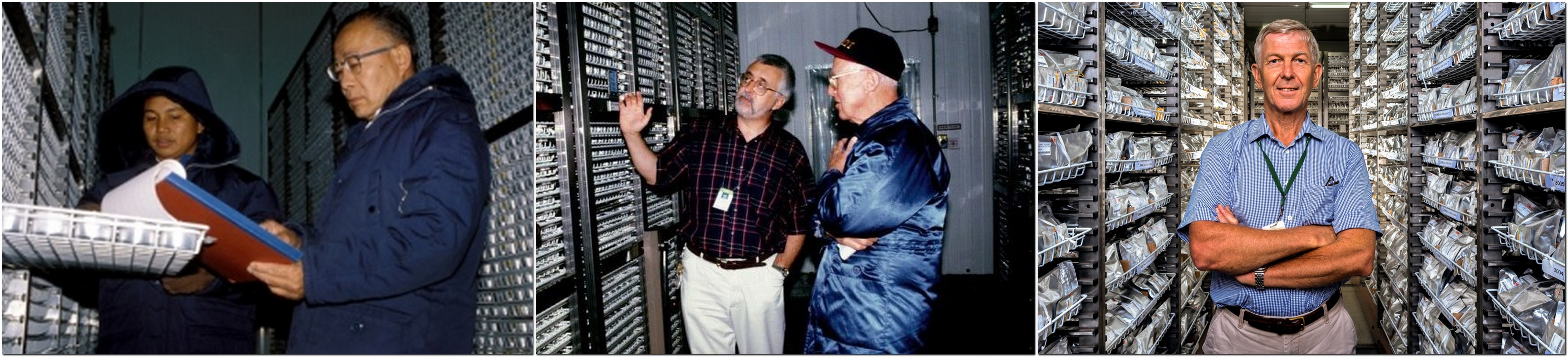
My congratulations to Genebank Head and compatriot, Ruaraidh Sackville Hamilton and his key genebank lieutenants, Genebank Manager Flora ‘Pola’ de Guzman and Sr Associate Scientist Renato ‘Ato’ Reaño, for guiding the genebank to this happy state.

It has been a long journey, almost 60 years, from 1960 when IRRI was founded and Dr TT Chang (the first head of the genebank) began to assemble a collection of rice varieties that soon became the International Rice Germplasm Center (IRGC).

L-R: Dr TT Chang was head of the International Rice Germplasm Center from 1962-1990; Mike Jackson served as Head of the Genetic Resources Center (here with Nobel Peace Prize Laureate Dr Norman Borlaug) from 1991-2001; and Dr Ruaraidh Sackville Hamilton joined IRRI in 2002.

There was a significant change of direction, so to speak, to the genebank and its operations in 1991 after my appointment as Head of the newly-created Genetic Resources Center (the IRGC acronym was subsequently changed to International Rice Genebank Collection) with a mandate to rationalize and upgrade the genebank’s operations. I held that position for the next decade before moving on to the institute’s senior management team as Director for Program Planning & Communications in 2001. Ruaraidh joined IRRI in 2002 and has been at the helm ever since.

In other stories posted on this blog I have described what it entails to run a genebank for rice, and some of the important changes we made to modernize genebank management and operations, especially how they were impacted with respect to the institute’s international obligations to FAO and subsequently under the International Treaty on Plant Genetic Resources for Food and Agriculture.

In 2015 I made my own video to illustrate many of the different operations of the genebank, some of which have been modified in the light of new research concerning the handling of rice seeds post-harvest. Nevertheless, the video reflects the changes I introduced during my tenure as head of the International Rice Genebank, many of which still prevail.

Ruaraidh built upon the changes I introduced, bar-coding all samples for example, and linking the collection with others in the CGIAR through the Genebank Platform. There have been further improvements to how data about the collection are managed, and seed management was enhanced through the research of former employee and seed physiologist Dr Fiona Hay and her PhD student Kath (now Dr) Whitehouse.

Ruaraidh has also successfully steered IRRI and its genetic resources through the turbulent currents of international germplasm politics that culminated in the entering into force of the International Treaty in June 2004, and the subsequent negotiations over access and benefit sharing. I can’t deny I was quite happy to leave these ‘political’ aspects behind when I left GRC in 2001. Management and use of genetic resources in the 1990s were increasingly affected by the various negotiations that affected access to and sharing of biodiversity after the Convention on Biological Diversity (CBD) came into force in December 1993. To some extent they were a distraction (but an important one) from the technical aspects of rice genetic resources that I tackling.

It’s quite humbling that for generations to come, I will have been a part of securing the genetic heritage of rice. Besides making the necessary technical changes to genebank structure and operations in the 1990s, I’m particularly proud of the personnel structures I introduced. These permitted staff to really fulfill their potential.

I quickly recognized that Pola should be placed in the role of Genebank Manger, and Ato given responsibility for all field operations. We built a team that believed in a culture of mutual support.

Ken McNally

Another aspect was the recognition, way back in 1998, of the power of genomics and molecular genetics to unravel the secrets of rice diversity. To that end I had organized an international workshop in The Hague in September 1999, which is described about two-thirds through this blog post. I was fortunate to hire Dr Ken McNally as a molecular geneticist in this respect, and he has taken the study of rice genetic diversity to another level, supported by someone who I believed in from my early days at IRRI, Dr Elizabeth Naredo.

But the genebank is also facing some changes. Ruaraidh is expected to retire in the near future, and Pola and Ato can’t be far off retirement. No-one is irreplaceable, but they will be a hard act to follow. Finding individuals with the same breadth of experience, commitment to genetic resources conservation, and work ethic will certainly be a challenge. Other staff from my era have already retired; the genebank did not fall apart. With this secure funding from the Crop Trust the genebank can, for the first time in its 60 year history, set itself on a trajectory into the future in a way that was always uncertain in the past (because of year-to-year funding), but always the Holy Grail of genetic resources conservation.

I also hope that IRRI will step up to the plate and secure other funds to build a completely new genebank appropriate for the 21st century. After all, the facilities I ‘inherited’ from TT Chang are approaching 40-50 years, and even those I improved are 25 years old. Relieving the institute of the genebank annual operating budget should open up other opportunities.

Congratulations to IRRI, and on behalf of the genetic resources community (especially those depending on rice) a big thank you to the Crop Trust!


¹ BBC, Nature, and New Food Magazine, among others.

² My friend and former IRRI colleague, Gene Hettel, kindly sent me some photos and videos from yesterday’s signing ceremony in Singapore between IRRI and the Crop Trust.

Crop Trust Executive Director Marie Haga and IRRI Director General Matthew Morell sign the agreement assuring in perpetuity funding for the International Rice Genebank.

Head of the genebank Ruaraidh Sackville Hamilton speaking after the signing of the agreement. On the left is Charlotte Lusty, Head of Programs and Genebank Platform Coordinator at the Crop Trust.

One very nice touch during the ceremony was the recognition of Pola de Guzman’s 40 years dedicated service to genetic conservation at IRRI.

Well done, Pola!

The emperor has no clothes . . .

I have the Brexit blues.

While I probably can’t add much to the debate, I feel I have to express my frustration, angst even, about the Brexit state of play, and what it portends for this (soon to be impoverished) nation of ours. And hopefully explain to many of my blog followers and readers overseas what Brexit means. I offer no apologies for being decidedly pro-European Union (EU).

Just over a month ago I returned from a five week vacation in the USA. Prior to traveling I had become increasingly depressed about the whole Brexit fiasco and where this incompetent Tory government was leading us. I’d even decreased my exposure to Twitter as the exasperation that I read there only fueled my own anxieties. So, I took a break from the news and Twitter for five weeks. My spirits revived.

Five weeks on and I feel myself sinking into a state of despair once again. We’re still getting the Brexit is Brexit line from the government, and taking back control of our border, laws, and money. Following the publication of the ‘agreed’ but soon unraveling Chequers Plan that Theresa May foisted on her Cabinet, it’s clear that Leavers also  don’t have a plan for what happens following Brexit, be it a Cliff-edge Brexit, a Hard or a Soft one. Ask them to put it down on paper or explain in detail what the future holds under each scenario and they have little to say. Even the future status of the border between Northern Ireland and the Irish Republic—a key sticking point in the negotiations with the EU—remains unresolved. Government and Parliament is paralyzed. The only solution is to ask the electorate again.


I need someone to square the circle for me and explain why Brexiteers can still claim that leaving the European Union is akin to entering the land of milk and honey. Facing the real risk of a no deal Brexit, HM Government has now started to publish technical notes (two years too late) outlining (and often short on crucial details) what will be the consequences of the UK leaving the EU next March without a withdrawal agreement. The government has even suggested that businesses should consult the Irish government regarding trade across the border post-Brexit. Talk about dereliction of duty.

It feels as though most of my waking hours are pervaded by Brexit news, and the half-truths as well as the outright mendacity of those on the Leave side of the referendum campaign who sold us (illegally, as it turned out) an illusion.

Jacob Rees-Mogg

Even the most optimistic commentators and partners now fear that the UK will crash out of the EU without a deal. That would be disastrous. The Tory Party is at war with itself. Theresa May’s Chequers Plan has been dismissed by Hard Brexiteers on the right of the Tory party like Jacob Rees-Mogg and his European Research Group (ERG) cronies. The talk is all about trade and how we will be better off striking our own trade deals. No mention of the other benefits of EU membership that we will forfeit at 11 pm on 29 March next year if there is no deal.

Nigel Farage

Two years on, Brexiteers are unable to provide any details or are extremely vague about what a post-Brexit United Kingdom will look like, and what actual benefits we will gain. Arch-Brexiteer Nigel Farage (MEP and former leader of UKIP) claims he never said that the UK would be better off outside the EU: I made ONE absolute promise in that campaign … We will be in control … for good or for bad … I never promised it would be a huge success, I never said it would be a failure, I just said we’d be in control. Independent, and with blue passports! Rees-Mogg has unequivocally stated that it might take 50 years for any benefits to accrue. Good grief! This is not the vision that the electorate was sold during the referendum campaign.

Jeremy Corbyn

Even Labour Party Leader Jeremy Corbyn can’t—or won’t—state categorically whether we’d be better off or not outside the EU. What a pathetic politician. But that’s for another post some other time.

With nothing better to say, It’s the same old mantra of taking back control of our border, laws, and money. Well, I thought we always had control of our borders; there’s more immigration from countries outside the EU than from EU countries. In terms of laws, it comes down to alignment with EU frameworks and regulations, and oversight by the European Court of Justice (that’s anathema to Brexiteers). Furthermore, Parliament seems always to be busy, passing sovereign legislation on one thing or another. Even outside the EU we will still be subject to oversight by external bodies, such as the World Trade Organization (WTO). That’s what peaceful coexistence means: compliance to agreed rules and standards. And while we make a financial contribution to the EU, we have successfully negotiated favorable rebates, we have our own currency, and many parts of the country (even those that voted overwhelmingly to Leave) have benefited from inward investment from the EU in ways that a UK government wouldn’t or couldn’t make.


It seems to me that we face four options:

  • No Withdrawal Deal, Catastrophic Brexit (it’s not just about trade), increasingly likely
  • Withdrawal Deal, Hard Brexit, beloved by many Brexiteers
  • Withdrawal Deal, Soft Brexit – but for some on the Brexit side, it will be like the curate’s egg, good (or softer) in parts: retaining membership of the Customs Union (CU), or the Single Market (SM), or both (but having no say in how regulation of the CU or SM continue to operate)
  • NO BREXIT – an aspiration that is growing. Having looked at what’s really on offer, not the illusion that was offered on the side of a large red bus during the referendum campaign, the electorate should be given the opportunity to pass judgment in a second referendum. This is only way to break the impasse of Parliament, and for the electorate to confirm its decision to leave the EU if that’s how the majority still feel.

Michael Morpurgo

Democracy is, however, also about changing one’s mind, and there is growing polling data to indicate that many who voted to Leave the EU now regret their decision. The problem is that many Brexiteers claim that the ‘British people’ have spoken, and there can be no reversal of that decision (even though it was taken without the necessary knowledge—or understanding—of what Brexit would entail). However, just a few years ago, even Rees-Mogg favored a second referendum once the terms of a withdrawal deal were known. Here’s a Twitter link that shows Rees-Mogg speaking to that effect in the House of Commons in 2011. A couple of weeks ago I was listening to Radio 4 and heard this Point of View by War Horse author Michael Morpurgo. It lasts almost 10 minutes, but is well worth taking time out to listen to his words of wisdom. He makes a strong case for thinking again.


The Brexit lies continue. Just a few days ago (17 August) I saw an official tweet from the Department for International Trade about the UK’s trading links with the USA. Liam Fox (Secretary of State at the DIT) claimed that the USA was the UK’s single largest trading partner. Lie!

Yes, we have exports of almost £100 billion to the USA, according to the Office for National Statistics (2016 data published in 2017). And from what I can determine the USA is the largest country we trade with in terms of exports. But the DIT/Fox said trading partner, and the UK’s largest trading partner is the European Union (EU), with UK exports valued at £235.8 billion through seamless trading (compared with £284.1 billion with the Rest of the World, mostly conducted through trade agreements negotiated through our membership of the EU).

But hey, why let facts get in the way of a good Brexit lie. Fox’s focus on expanding trade with the USA—some might say obsession—is a major part of his Brexit narrative about seizing opportunities to trade with other nations around the world on our terms, not the EU’s. However, these Brexiteers seem to forget (conveniently so) that negotiations are two-sided, and the completion of any trade agreement will require concessions on both sides. Would the price of an agreement with the USA lead for example to imports of food produced to lower standards than we currently enjoy under the EU, or more US healthcare company involvement in the NHS, for example?

It never ceases to amaze me that Brexiteers seem to imply that it’s only under post-Brexit trade deals that we can increase our exports. Even a recent trade deal with China was touted as an example of what the UK could achieve, notwithstanding it was signed under the trade agreement we already have with China through the EU. Liam Fox is certainly economic with the truth.

Post-Brexit, we will have to develop all the schedules to operate under WTO rules and, in any case, deals could take years to negotiate. Furthermore, I can see no reason why manufacturers are already unable to expand exports under the umbrella of existing trade agreements negotiated by the EU. Maybe increased exporting capacity is non-existent. We are no longer a manufacturing nation.

There’s hardly been mention of financial services, which account for about half of our exports. There are serious implications of leaving the EU without an agreement. Just listen to an experienced trade negotiator on James O’Brien‘s LBC show.

The focus has been/is almost entirely on trade post-Brexit, but there’s so much more to our membership of the EU that is not covered—and never will be—by the WTO. These are all the many frameworks and agreements that have brought 28 nations together (and probably more cost effectively than if they had acted independently) that regulate aviation and safety, nuclear fuels and isotopes, environmental protection, animal welfare, food standards, and employment law, to list just a few. I have yet to hear any of the likes of Jacob Rees-Mogg, John Redwood, Iain Duncan-Smith, David Davis, Peter Bone, Bernard Jenkin, not even Theresa May, raise any concerns or offer any perspectives on these issues that are as important—perhaps even more important—than the trade issues.

The Government’s narrative is that its Chequers Plan should be accepted, lock, stock and barrel, by the EU. Sorry Theresa, it doesn’t work like that any more. Gun boat diplomacy died with the Empire.


Although there is a groundswell of support for a second referendum, or at least a say on any agreement negotiated with Brussels, there’s no certainty that one will be held. For one thing the practicalities of legislating for a referendum rule out the possibilities before Article 50 becomes a reality next March, crashing, hard or soft.

Nevertheless, there does need to be some sort of People’s Vote. Furthermore, for an issue that has such long-lasting constitutional, economic, and social implications for the future of this country, politicians need to put the welfare of the country ahead of their own party political considerations. The fact that we have a divided and incompetent governing party, and an Opposition that’s equally divided, with a leader who’s inept and misguided in the face of what many Labour supporters are saying, is perhaps unprecedented. Political turmoil is the last thing that’s needed right now.

I’m sure many who voted to Leave did not foresee or expect many of the scenarios that are looming before us. For example, the National Health Service (NHS) will not reap any ‘Brexit Dividend’. Why? There simply is no dividend. Brexit will impact almost every aspect of our lives for years to come.

There. I’ve said it. I’ve expressed my frustrations. I don’t expect to write much more about Brexit. But once 29 March 2019 has come and gone, I expect I’ll have plenty more to say, no doubt.


Development aid is under threat . . . and Brexit isn’t helping

The United Kingdom is one of just a handful of countries that has committed to spend 0.7% of Gross National Income (GNI) on overseas development assistance (ODA or foreign aid) in support of the UN’s development goals. In fact that 0.7% target commitment is enshrined in UK law passed in 2015 (under a Conservative government), and the target has been met in every year since 2013. That’s something we should be proud of. Even the Tories should be proud of that. It seems, however, that many aren’t.

For a variety of reasons, the aid budget is under threat. After years of government austerity and the decline of home-grown services (NHS, police, education, and the like) through under-funding, and as we lurch towards Brexit, the right-wing media and politicians are seizing every opportunity to ignore (or actively distort, even trivialize) the objectives of development aid and what it has achieved around the world.  Or maybe they just lack understanding.

In 2016, the UK’s ODA budget, administered by the Department for International Development (DFID), was just over £13 billion (almost USD20 billion). Check this link to see where DFID works and on what sort of projects it spends its budget. That budget has ‘soared’, according to a recent claim by The Daily Mail.

In the post-Brexit referendum febrile atmosphere, the whole topic of development aid has seemingly become toxic with increasing calls among the right-wing media, headed by The Daily Mail (and supported by The Daily Express and The Telegraph) for the development budget to be reduced and instead spent on hiring more doctors and nurses, and other home-based services and projects, pandering to the prejudices of its readers. Such simplistic messages are grist to the mill for anyone troubled by the UK’s engagement with the world.

From: John Stevens and Daniel Martin for the Daily Mail, published at 22:42, 5 April 2018 | Updated: 23:34, 5 April 2018

There is unfortunately little understanding of what development assistance is all about, and right-wing politicians who really should know better, like the Member for Northeast Somerset (and the Eighteenth Century), Jacob Rees-Mogg have jumped on the anti-aid bandwagon, making statements such as: Protecting the overseas aid budget continues to be a costly mistake when there are so many other pressing demands on the budget.

Now there are calls for that 2015 Act of Parliament to be looked at again. Indeed, I just came across an online petition just yesterday calling on Parliament to debate a reduction of the development aid budget to just 0.2% of GNI. However, 100,000 signatures are needed to trigger a debate, and as I checked this morning it didn’t seem to be gaining much traction.

I agree it would be inaccurate to claim that all development aid spending has been wise, reached its ultimate beneficiaries, or achieved the impacts and outcomes intended. Some has undoubtedly ended up in the coffers of corrupt politicians.

I cannot agree however, with Conservative MP for Wellingborough and arch-Brexiteer, Peter Bone, who is reported as stating: Much of the money is not spent properly … What I want to see is more of that money spent in our own country … The way to improve the situation in developing countries is to trade with them.

As an example of the trivialization by the media of what development aid is intended for, let me highlight one example that achieved some notoriety, and was seized upon to discredit development aid.

What was particularly irksome apparently, with a frenzy whipped up by The Daily Mail and others, was the perceived frivolous donation (as high as £9 million, I have read) to a project that included the girl band Yegna, dubbed the Ethiopian Spice Girls, whose aim is to [inspire] positive behavior change for girls in Ethiopia through drama and music.

I do not know whether this aid did represent value for money; but I have read that the program did receive some positive reviews. However, the Independent Commission for Aid Impact raised some concerns as far back as 2012 about the Girl Effect project (known as Girl Hub then).

From their blinkered perspectives, various politicians have found it convenient to follow The Daily Mail narrative. What, it seems to me, they failed to comprehend (nor articulate for their constituencies) was how media strategies like the Girl Effect project can effectively target (and reach) millions of girls (and women) with messages fundamental to their welfare and well-being. After being in the media spotlight, and highlighted as an example of ‘misuse’ of the aid budget, the support was ended.

In a recent policy brief known as a ‘Green Paper’, A World for the Many Not the Few, a future Labour government has pledged to put women at the heart of British aid efforts, and broaden what has been described by much of the right-wing media as a left-wing agenda. Unsurprisingly this has received widespread criticism from those who want to reduce the ODA budget or cut it altogether.

But in many of the poorest countries of the world, development aid from the UK and other countries has brought about real change, particularly in the agricultural development arena, one with which I’m familiar, through the work carried out in 15 international agricultural research centers around the world supported through the Consultative Group on International Agricultural Research or CGIAR that was founded in 1971, the world’s largest global agricultural innovation network.
In a review article¹ published in Food Policy in 2010, agricultural economists Mitch Renkow and Derek Byerlee stated that CGIAR research contributions in crop genetic improvement, pest management, natural resources management, and policy research have, in the aggregate, yielded strongly  positive impacts relative to investment, and appear likely to continue doing so. Crop genetic improvement research stands out as having had the most profound documented positive impacts. Substantial evidence exists that other research areas within the CGIAR have had large beneficial impacts although often locally and nationally rather than internationally.

In terms of crop genetic improvement (CGI) they further stated that . . . estimates of the overall benefits of CGIAR’s contribution to CGI are extraordinarily large – in the billions of dollars. Most of these benefits are produced by the three main cereals [wheat, maize, and rice] . . . average annual benefits for CGIAR research for spring bread wheat, rice (Asia only), and maize (CIMMYT only) of $2.5, $10.8 and $0.6–0.8 billion, respectively . . . estimated rates of return to the CGIAR’s investment in CGI research ranging from 39% in Latin America to over 100% in Asia and MENA [Middle east and North Africa].

DFID continues to be a major supporter of the CGIAR research agenda, making the third largest contribution (click on the image above to open the full financial report for 2016) after the USA and the Bill & Melinda Gates Foundation. At £43.3 million (in 2016), DFID’s contribution to the CGIAR is a drop in the ocean compared to its overall aid budget. Yet the impact goes beyond the size of the contribution.

I don’t believe it’s unrealistic to claim that the CGIAR has been a major ODA success over the past 47 years. International agricultural research for development has bought time, and fewer people go to bed hungry each night.

Nevertheless, ODA is under threat everywhere. I am concerned that in the clamour to reduce (even scrap) the UK’s ODA international collaborations like the CGIAR will face even more funding challenges. In Donald Trump’s ‘America First’ dystopia there is no certainty that enormous support provided by USAID will continue at the same level.

Most of my professional career was concerned with international agricultural research for development, in South and Central America (with the International Potato Center, or CIP, from 1973 to 1981) and the International Rice Research Institute (IRRI) in the Philippines (from 1991 to 2010). The conservation of plant genetic resources or  agrobiodiversity in international genebanks (that I have highlighted in many stories on this blog) is supported through ODA. The crop improvement programs of the CGIAR centers like CIMMYT, IRRI, ICARDA and ICRISAT have released numerous improved varieties for use in agricultural systems around the world. Innovative research is combating the threats of new crop diseases or the difficulties of growing crops in areas subject to flooding or drought².

This research (often with critical links back into research institutes and universities in donor countries) has led to improvements in the lives of countless millions of poor people around the world. But the job is not finished. Populations continue to grow, with more mouths to feed. Civil unrest and conflicts continue to blight some of the poorest countries in the world. And biology and environment continue to throw challenges at us in the form of new disease strains or a changing climate, for example. Continued investment in ODA is essential and necessary to support agricultural research for development.

Agriculture is just one sector on the development spectrum.  Let’s not allow the likes of Jacob Rees-Mogg, Peter Bone, or The Daily Mail to capture the development debate for what appear to be their own xenophobic purposes.

~~~~~~~~~~~~~~~~~~~~~~~~~~~~~~~~~~~~~~~~~~~~

¹ Renkow, M and D Byerlee, 2010. The impacts of CGIAR research: A review of recent evidence. Food Policy 35 (5), 391-402. doi.org/10.1016/j.foodpol.2010.04.006

² In another blog post I will describe some of this innovative research and how the funding of agricultural research for development and greater accountability for ODA has become rather complicated over the past couple of decades.

Fashion, so said Louis XIV, is the mirror of history

Amber Butchart (photo by Jo Duck – used with permission)

Just when you least expect it, a real gem of a television series comes along. You’re gathered in. Then you’re hooked!

And that was our experience with fashion historian Amber Butchart’s six part series, A Stitch In Time, recently screened on BBC4.

This is what Amber has to say about the series on her blog: Fusing biography, art and the history of fashion, throughout A Stitch in Time I get to explore the lives of historical figures through the clothes they wore, while key garments are recreated using the original techniques.

She peers into the mirror and helps us to interpret the costume clues held within Van Eyck’s mysterious Arnolfini portrait, the role of hand-me-downs among 18th century workers, the impact of cotton on British life, a flamboyant armorial piece which sits at odds with the allegedly brutal nature of its wearer and the impact a scandalously informal gown would have on an already unpopular queen.

What an eye-opener A Stitch in Time has been! And from what I’ve seen in various media, we are not alone in being enthralled by the series.

My wife Steph and I enjoy watching almost any history-related program, so tuned into the first episode on 3 January almost by default. We had no idea what to expect, and we’d never heard of Amber Butchart (herself a fashion icon) even though (as I’ve now discovered) she has broadcast regularly over the past four or five years on BBC radio.

To recreate the items of clothing, Amber relied on the talents and experience of historical costumier Ninya Mikhaila  and her team, Harriet Waterhouse and Hannah Marples. It was amazing to see how every item of clothing was hand stitched. Not a sewing machine is sight, nor an electric iron.

L to R: Harriet, Ninya, Amber, and Hannah

In each program Amber talked about a particular painting—and a tomb effigy in one program—and what each tells us about the person(s) portrayed, how their clothing speaks to us about their social status, and the society in which they lived. And then she enjoyed modeling each of the recreated costumes.

She also delved into other background issues that are part of the story, none perhaps more emotive than that of Dido Belle, born in 1761 the natural (i.e. illegitimate) daughter of Sir John Lindsay and a slave, who moved in the highest circles of English aristocracy since her great uncle was Lord Mansfield, the Lord Chief Justice. I was already familiar with her story having read the 2014 book that same year by Paula Byrne.

Choosing the topics
I asked Amber how she came to choose the six subjects for the series. She replied: I wanted to show a real range of clothing from history—not just womenswear and royalty. I also wanted to touch on stories that are harder to uncover, to show the difficulties that can be part of the process when looking at marginalised histories. So I chose the artworks for a mixture of these reasons—plus some which are more well known within fashion history, such as Marie Antoinette and Charles II.

Charles was the subject of the first program (depicted receiving a pineapple from his head gardener, in a painting from around 1667, now part of the Royal Collection Trust, © Her Majesty Queen Elizabeth II) and “how he used fashion as propaganda with an outfit that foreshadowed the three piece suit”. From what appeared a rather drab suit of clothes in the painting, the completed reconstruction was extremely elegant, with its shot silk lining and black silk ‘bows’ on the trousers, shoulder and sleeves. The other fashion statement is the fantastic number of handmade buttons and their corresponding button-holes.The second program considered the famous Arnolfini portrait by Van Eyck from 1434, that hangs today in the National Gallery.

Once thought to portray a pregnant Mrs Arnolfini, wife of a wealthy merchant, this is no longer believed to be the case. She’s just holding up the rather large amount of cloth that went into making her dress—just because she could, a sign of the family’s wealth. The resulting recreation was stunning, and it was also interesting to watch how the green dye was made. Not for those of a weak olfactory constitution!

The ‘common man’ was the subject of the third program, depicted in a full-size portrait at Broughton Castle in Oxfordshire. Portraits of working men are uncommon. Just take a visit to any National Trust property, as Steph and I do all year round, and there are a thousand and one portraits of members of the aristocracy in all their finery. Such statements of power and fashion!

But The Hedge Cutter at Broughton shows a working man wearing a hand-me-down leather coat, evidently worn by several  generations and generously patched. It’s dark and stained, tattered in places.

The coat expertly recreated by Ninya and her team from soft, pale leather was a delight to behold. Even more compelling were the sewing techniques they had to employ to join the expensive pieces of leather together.

The story of Dido Belle in Program 4, was particularly interesting. In the painting of Dido (with Lady Elizabeth Murray), on display at Scone Palace in Scotland, not all of her dress can be seen, so Ninya and her team had to interpret how it might have been made.

Calling upon all their knowledge and experience, they recreated a dress that they believe was close to the original. Ninya confirmed to me that Dido’s clothes were the biggest challenge to research, mainly because so much of them are obscured in the painting, and because very little survives in the way of informal dress. Loose, voluminous garments made from expensive silk are prime targets for being made over, cut and reused. As we said in the programme, we were very happy with the results, but there were definitely several possible answers for how this gown was actually cut and constructed!

The Black Prince, son of King Edward III and father of King Richard II, is buried in Canterbury Cathedral, and Amber took us to look at the prince’s gilt-bronze tomb effigy, which shows the item of clothing that was the focus of this episode. The prince is wearing a jupon, a close-fitting tunic worn over a suit of armor and bearing heraldic arms. Warriors wore such an item of clothing in battle so they could be recognized and serve as a rallying point for their troops.

What was particularly interesting about this program (5) is that the prince’s original jupon still exists although no longer on display. After 600 years it’s just too fragile. But after his death in 1376, the jupon was hung above the prince’s tomb and remained there for centuries. Now stored carefully away in a box at the cathedral, the jupon no longer displays its vibrant colors, and although there was perhaps less interpretation needed to reconstruct it, there were still some challenges. The principal one was how to sew the cotton protective wadding between the layers of linen as a backing and the red and blue velvet of the outer layer.

Nevertheless, the completed garment was the most exuberant of the series. As Ninya told me: I loved working on the Black Prince’s jupon. It was an incredibly time-consuming process but it was so rewarding seeing it emerge in all its brightly coloured, gold-embellished glory!

Apparently the gold embroidery alone took 900 hours to complete, stitched on to a linen backing, cut out, and then sewn on to the jupon. Stunning!

In the final programme, Amber explained the court reaction to the most unroyal-like muslin dress (chemise de la reine) worn by the unpopular Austrian-born Queen Marie Antoinette, wife of Louis XVI, in an infamous portrait painted by Louise Élisabeth Vigée Le Brun in 1783. Such was the uproar, that the artist had to paint another portrait in a more appropriate dress worthy of a French queen. Muslin was used for undergarments, not for royal portraits. Vigée Le Brun painted more than 30 portraits of Marie Antoinette.

The recreation was an elegant, free-flowing gown, but not (to our modern eyes) the scandalous display for which Marie Antoinette was censured. She would have worn this type of dress in informal settings such as her retreat in the grounds of the Palace of Versailles, the Petit Trianon, surrounded by intimates. Underneath the dress Marie Antoinette would have worn stays, and these were also part of the recreation. Ninya told me: . . . the silk damask stays that Harriet made for Marie Antoinette were ridiculously beautiful. There was an elegant sash at the waist, made by Hannah.

Even though the dress looks simple in style, it would nevertheless have been costly to make in the 18th century, as was demonstrated in its reconstruction. Ninya also gave a useful tip to all budding seamstresses on how to make a level hem. Tip of the series!

Perspectives
On reflection, I found the story of Dido Belle the most compelling. And while her dress appeared the most simple among the six, it was, as Ninya told me, a challenge for her team.

But as I think back on the last program and the beautiful dress that was worn by Marie Antoinette, I have to say that was my favorite. Elegant in its ‘simplicity’.

I asked Amber which costume she found the most challenging. This is what she told me: The most challenging to research in many ways was Dido Belle, and also the Hedge Cutter. Researching working dress can be difficult as it doesn’t tend to be kept in museums and wasn’t seriously written about until relatively recently. Dido has a really compelling story, and the transatlantic slave trade played a huge part in our history but is often overlooked. It runs like a thread through fashion history as it relates to cotton, and so I felt it needed to be addressed.

But what was her favorite costume? Having discovered online (from an interview she once gave) that green is apparently her favorite color, I expected her to choose the Arnolfini dress. But no!

In terms of aesthetic, I love the Charles II suit and would absolutely wear it, she replied (in the photo above it does really look elegant on her). In terms of uniqueness of experience, she continued, and historical revelation, it would be the Black Prince’s jupon. Such an incredible experience to literally walk in his shoes, and so far from the clothing that we’re used to today. Experimental archaeology at its best!

So there you have it.

I don’t think I’ll look at a portrait again in quite the same way during one of my many National Trust visits. This series has certainly opened my eyes to another aspect of social history that had, until now, passed me by.

If I have one criticism of the series, it would be this. Each program was short by about 15 minutes, that would have allowed just a little more time to explore the background story, and to focus in on some more detail of the actual techniques for making the costumes. BBC producers take note!

So, I hope that the BBC will commission another series, and allocate sufficient air time to do justice to this fascinating subject. Amber Butchart’s A Stitch in Time has been a joy to watch. This is why we willingly pay the TV licence fee.


Brexit means Brexit. What an almighty cock-up!

Forty-five years ago today, 1 January 1973, the United Kingdom (along with Denmark and Ireland) became a member of the European Economic Community (EEC), now the European Union (EU). Now we are on the verge of leaving the EU. March 2019 is not so far away.

Brexit is and, I believe, will become a social, political, and economic catastrophe for this country. I am firm Remainer, yet a member of that demographic who apparently swung the referendum vote in favour of Leave (I turn 70 in November this year). I refuse to be labelled a ‘Remoaner’.

What beggars belief is that the government apparently had no end-plan developed when Article 50 was triggered earlier in 2016 (and only just beginning to discuss this!), nor had they carried out comprehensive risk analyses or impact studies, never mind what Brexit Secretary David Davis has or has not said. His vagueness and the way he has approached the Brexit negotiations seemingly as a game with limited or no consequences is an insult to the nation.

What I still cannot fathom—and the blame must be placed at the door of former Prime Minister David Cameron—is why the referendum bar (which was ‘advisory’) was never set higher. By this I mean that there should there have been an absolute majority of the electorate required in favour of leaving the EU. As it is, only 37% of the electorate (almost 52% of those who voted) are forcing us out of the EU with all the consequences for our economy, for trade, security, travel, education, science, health, human rights. Every part of the fabric of the nation will be affected in one way or another. It’s also astonishing to me that parts of the UK that have benefited especially from EU membership (in terms of regional grants and the like) voted to leave, or that constituencies like the fishermen believe that things will improve for them post-Brexit.

I’m sick to death of hearing Brexit means Brexit, the will of the British people, the best deal possible, or taking back control. Well, Theresa, David, Boris Johnson and all you other second class politicians (or failed ones like Ian Duncan-Smith and Chris Grayling, to mention but two among the many, especially on the Conservative benches), I’m afraid the EU holds all the cards in these negotiations. Our status as a small island of diminishing consequence off the coast of mainland Europe will be confirmed.

Our accession to the EEC came a decade after the President of France, Charles de Gaulle famously failed to back the UK’s application to become a member stating that the British government lacks commitment to European integration. In November 1967, he vetoed the UK’s application a second time.
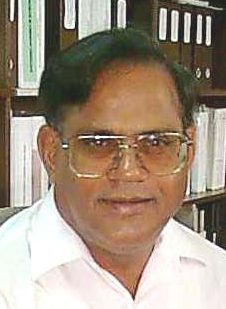
In the light of what has happened ever since, including a confirmatory membership referendum in 1975 under the Labour government headed by Harold Wilson, and subsequent constant carping from the sidelines by the British government under Margaret Thatcher, you have to admit that de Gaulle’s perspective was somewhat prescient.

From my own perspective, I was proud that Prime Minister Edward Heath eventually prevailed and signed the terms of accession to the EEC in December 1972.

I believe that membership has brought a level of stability and economic prosperity to the UK that we could not have achieved on our own. The EU represents a market for 50% or more of our international trade. And now we are about to throw that away and jeopardise our future. Talk about baby and the bath water.

More than 50% of the UK population (based on 2011 census demographic data) were born at or after the UK joined the EEC. That goes up to around 75% if you take into account those who were teenagers or so on accession. The UK inside the EEC/EU is all they have ever known.

I’m a passionate supporter of continued membership of the EU. Well, perhaps passionate is a little strong. But I’m certainly an keen advocate for continued (and pro-active) membership. Yes, there are problems, issues, challenges being a member of the EU; no doubt about it. The EU is not a perfect institution, by any stretch of the imagination. Had the UK been a more committed member (rather than carping constantly from the sidelines), then I believe we could have brought much of our renowned British pragmatism to help resolve many of the structural and operational issues that bedevil the EU.

Theresa May’s government is incompetent (more a Coalition of Chaos than Strong and Stable), and while the Brexit ‘divorce’ negotiations are said to have made some progress (although I’m not really sure what), her ministers, especially David Davis, have become increasingly mendacious. Their arrogance and lack of respect for the electorate and facts is truly staggering. The Conservative Party has become a party of ostriches (especially MPs like the honorable member for the eighteenth century, Jacob Rees-Mogg). Furthermore we are being held to ransom by the short-sighted, bigoted, and lack of imagination Democratic Unionist Party (DUP) in Northern Ireland, that May now has to rely on for support in the House of Commons. What a mess we are in.

The lack of focus and understanding in particular over the border issues between Northern Ireland and the Irish Republic are not only worrying but potentially dangerous. In September I spent 10 days in Northern Ireland, and witnessed how that part of the UK has benefited from a couple of decades of prosperity and peace, now in jeopardy because of Brexit.

But a dilemma I face is that I cannot imagine the opposition Labour Party flourishing in government under Jeremy Corbyn, nor can I see myself supporting Labour in an election. I make no bones about it. I am no fan of Corbyn and his closest acolytes. He is not a credible Prime Minister-in-waiting. I regret that he and his party did not take a stronger pro-EU position. His equivocation is reprehensible. I worry for the future of the Labour Party as the left-wing Momentum group strengthens its stranglehold. Likewise, I am no supporter of what the Conservatives now stand for, and its right-wing agenda.

I can only hope that sounder minds will prevail and brought to bear during 2018. Can Brexit be stopped? More from hope than expectation, I think it just might. But will the EU exert a forfeit to allow us back in, requiring the UK to sign up for measures that we have opted out of? Perhaps.

That is my wish for 2018, and although I never make New Year resolutions, I will continue to support pro-EU initiatives as I am able.


Laos – jewel in the rice biodiversity crown

From 1995 to late 2000, the International Rice Research Institute (IRRI) through its Genetic Resources Center (GRC, now the TT Chang Genetic Resources Center) coordinated a project to collect and conserve the genetic diversity of rice varieties that smallholder farmers have nourished for generations in Asia and Africa. The collecting program also targeted many of the wild species relatives of cultivated rice found in those continents as well as Latin America.

With a grant of more than USD3 million from the Swiss Agency for Development Cooperation (SDC) the project made significant collections of rice varieties and wild species at a time when, in general, there was a moratorium on germplasm exploration worldwide. The Convention on Biological Diversity had come into force at the end of December 1993, and many countries were developing and putting in place policies concerning access to germplasm. Many were reluctant to allow access to non-nationals, or even exchange germplasm internationally. It’s not insignificant then that IRRI was able to mount such a project with the full cooperation of almost 30 countries, and many collecting expeditions were made, many of them including IRRI staff.

As Head of GRC from 1991 to 2001, I developed the project concept and was responsible for its implementation, recruiting several staff to fill a number of important positions for germplasm collection, project management, and the research and training components. I have written about the project in more detail elsewhere in this blog.

One of the most important strategic decisions we took was to locate one staff member, Dr Seepana Appa Rao, in Laos (also known as the Lao People’s Democratic Republic) where IRRI already managed the Lao-IRRI project for the enhancement of the rice sector. This project was also funded by the SDC, so it was a natural fit to align the rice germplasm activities alongside, and to some extent within, the ongoing Lao-IRRI Project.

The leader of the Lao-IRRI Project was Australian agronomist, Dr John Schiller, who had spent about 30 years working in Thailand, Cambodia and Laos, and whose untimely death was announced just yesterday¹.
Until Appa Rao moved to Laos, very little germplasm exploration had taken place anywhere in the country. It was a total germplasm unknown, but with excellent collaboration with national counterparts, particularly Dr Chay Bounphanousay (now a senior figure in Lao agriculture), the whole of the country was explored and more than 13,000 samples of cultivated rice collected from the different farming systems, such as upland rice and rainfed lowland rice. A local genebank was constructed by the project, and duplicate samples were sent to IRRI for long-term storage as part of the International Rice Genebank Collection in GRC. Duplicate samples of these rice varieties were also sent to the Svalbard Global Seed Vault when IRRI made its various deposits in that permafrost facility inside the Arctic Circle.
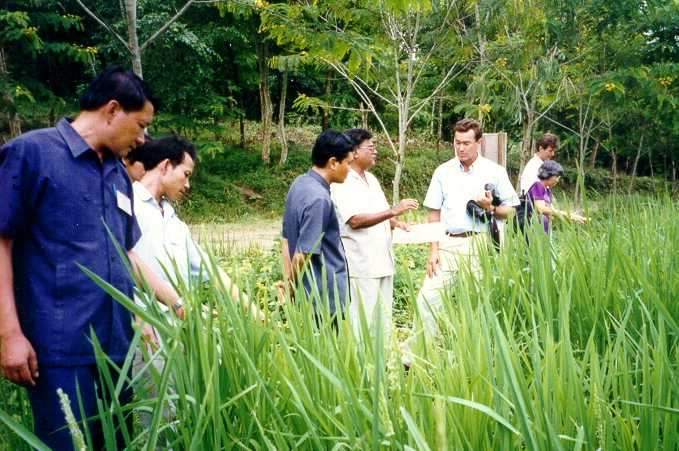
Appa Rao and John Schiller (in the center) discussing Lao rice varieties. Im not sure who the person in the blue shirt is. In the background, IRRI scientist Eves Loresto describes rice diversity to her colleague, Mauricio Bellon.

Of particular interest is that Lao breeders immediately took an interest in the collected germplasm as it was brought back to the experiment station near the capital Vientiane, and multiplied in field plots prior to storage in the genebanks. There are few good examples where breeders have taken such an immediate interest in germplasm in this way. In so many countries, germplasm conservation and use activities are often quite separate, often in different institutions. In some Asian countries, rice genebanks are quite divorced from crop improvement, and breeders have no ready access to germplasm samples.

Appa Rao was an assiduous rice collector, and spent weeks at a time in the field, visiting the most remote localities. He has left us with a wonderful photographic record of rice in Laos, and I have included a fine selection below. We also published three peer-reviewed papers (search for Appa Rao’s name here) and seven of the 25 chapters in the seminal Rice in Laos edited by John and others. 

The rices from Laos now represent one of the largest components (maybe the largest) of the International Rice Genebank Collection. Many are unique to Laos, particularly the glutinous varieties.

This slideshow requires JavaScript.

~~~~~~~~~~~~~~~~~~~~~~~~~~~~~~~~~~~~~~~~~~~~~~

¹ Yesterday, I received an email from one of my former IRRI colleagues, Professor Melissa Fitzgerald who is now at the University of Queensland, with the very sad news that John Schiller had been found in his apartment just that morning. It’s believed he had passed away due to heart failure over the course of the weekend.

I first met John in November 1991, a few months after I’d joined IRRI. He and I were part of a group of IRRI scientists attending a management training course, held at a beach resort bear Nasugbu on the west coast of Luzon, south of Manila. The accommodation was in two bedroom apartments, and John and I shared one of those, so I got to know him quite well.
Our friendship blossomed from 1995 onwards when we implemented the rice biodiversity project, Appa Rao was based in Vientiane, and I would travel there two or three times a year. In February 1997, I had the opportunity of taking Steph with me on one trip, and that coincided with the arrival of another IRRI agronomist, Bruce Linquist (with his wife and small son) to join the Lao-IRRI Project. We were invited to the Lao traditional welcoming or Baci ceremony at John’s house, for the Linquists and Steph. I’d already received this ceremony on my first visit to Laos in 1995 or 1996.

John also arranged for Appa and Chay to show Steph and me something of the countryside around Vientiane. Here were are at the lookout over the Ang Nam Ngum Lake, just north of the capital, where we took a boat trip.

L to R: Mrs Appa Rao, Appa, Kongphanh Kanyavong, Chay Bounphanousay, Steph, and me.

After he retired from IRRI, John moved back to Brisbane, and was given an honorary fellowship at the University of Queensland. He continued to support training initiatives in Laos. As he himself said, his heart was with those people. But let John speak for himself.

My other close colleague and former head of IRRI’s Communication and Publications Services, Gene Hettel, overnight wrote this eloquent and touching obituary about John and his work, that was published today on the IRRI News website. Just click on the image to read this in more detail.


The sting was in the tail . . . or was it?

Sting in the tail. An unexpected, typically unpleasant or problematic end to something.

That’s what the Nawaz Sharif and his family has just found out. If you recall, Sharif was, until yesterday, Prime Minister of Pakistan.

Sharif and his family got caught up in the Panama Papers scandal that erupted in 2016, although they denied (as one might expect) all guilt or culpability. Nevertheless, Pakistan’s Supreme Court justices unanimously decided that Sharif should be excluded from office. Who would credit that a typeface would bring a political dynasty to its knees?

There was one rather unlikely source of evidence against the family that no-one could have anticipated. Among the documents presented by the family in its defence was one dated from 2006 and using one the Calibri fonts. Not a font with a tail on many of the characters. Unfortunately for the Sharifs, the date on the document pre-dated the commercial release of Calibri by Microsoft by some months. There was little chance that the document could be genuine.

I’m sure that’s the last thing anyone would have expected; it was unpleasant and problematic, and Fontgate (as it’s come to be known) has had far-reaching consequences. Here’s something I found on the endgadget website:

The documents from 2006 submitted by Maryam Nawaz (daughter of PM Nawaz Sharif) were in the Calibri font. That font, according to the investigation team’s leaked report, wasn’t publicly available until 2007 . . .

A cursory glance at the history of Calibri reveals it became the default font on Microsoft PowerPoint, Excel, Outlook, and WordPad in 2007. However, Microsoft’s website states that version 1.0 of the font was available to download separately as far back as 2005. And, according to font consultant Thomas Phinney, Calibri was also available as part of a Windows pre-release in 2004 . . . 

Pakistan’s leading English newspaper Dawn even reached out to Calibri creator Lucas de Groot, who seemed skeptical of the font’s use before its public release. “Why would anyone use a completely unknown font for an official document in 2006?” he questioned.

I have to admit that I’m a bit of a font geek, but I hadn’t realised that Sans Serif Calibri had become the default typeface for several Microsoft products. I use it all the time, Calibri 12 pt. Incidentally, check out a list of type designers here.

Sans Serif typefaces have become more popular in recent years, no doubt because of the Microsoft default font decision, although until the release of Calibri, Arial (and also Helvetica and Tahoma to some extent) was more commonly used. In earlier versions of Microsoft Word, maybe even Outlook (I don’t remember), the default was I believe Times New Roman (TNR). It’s a typeface that I find particularly ugly. Text appears, to my eyes at least, as rather cramped compared to others. I made a conscious decision to change the default in my Microsoft Office settings from TNR to something else.

When I was setting up the Office for Program Planning and Coordination (later Communications)—DPPC—at the International Rice Research Institute (IRRI) in 2001, I decided we should give all the documents sent to donor agencies (such as project proposals, reports, and the like) a distinctive look and ‘feel’. We felt it was important that IRRI documents stood out from others they might receive. At a glance, a document had to be recognised as one from IRRI, notwithstanding that we also placed the institute’s logo on the cover sheet, of course.

From the outset, I excluded Times New Roman (TNR) as the DPPC typeface, and of course Calibri was not available then. We chose Palatino Linotype 12 pt as our default font. It’s an elegant serif font, but more open, rounded even than Times New Roman. And I find it much easier to read than a document in TNR.

What do you think? Click on the text below in three different fonts: TNR 12, Palatino Linotype 12, and Calibri 12, justified and left justified.

The design and release of typefaces goes back centuries of course to the first experiments in printing in the 1400s. Digital printing has opened up many new avenues for design, as the work of Luc(as) de Groot shows.

I often check the typeface of the books I read, if that information is provided. Mostly it’s not, which for typeface geeks like me, is a pity. I’m halfway through a book about Jefferson Davis, the President of the Confederacy during the American Civil War in the 1860s. Titled Embattled Rebel, it’s by James M McPherson, George Henry Davis ’86 Professor of History at Princeton University, and published by Penguin Press in 2014. Not only is it well written, but Penguin chose a typeface and font that just adds to the overall reading enjoyment. Here’s a sample below.

Incidentally, the default font of the regular text in this Dusk to Dawn blog theme is Verdana, and PT Serif for the headings.

Returning to the original story, however, Sharif was caught out by a Sans Serif font. It was another sting in the tail, but not of the Serif kind. Maybe we should be talking about Nawaz Sharif as Nawaz (Sans) Serif instead.

Outside the EU . . . even before Brexit

Imagine a little corner of Birmingham, just a couple of miles southwest of the city center. Edgbaston, B15 to be precise. The campus of The University of Birmingham; actually Winterbourne Gardens that were for many decades managed as the botanic garden of the Department of Botany / Plant Biology.

As a graduate student there in the early 1970s I was assigned laboratory space at Winterbourne, and grew experimental plants in the greenhouses and field. Then for a decade from 1981, I taught in the same department, and for a short while had an office at Winterbourne. And for several years continued to teach graduate students there about the conservation and use of plant genetic resources, the very reason why I had ended up in Birmingham originally in September 1970.

Potatoes at Birmingham
It was at Birmingham that I first became involved with potatoes, a crop I researched for the next 20 years, completing my PhD (as did many others) under the supervision of Professor Jack Hawkes, a world-renowned expert on the genetic resources and taxonomy of the various cultivated potatoes and related wild species from the Americas. Jack began his potato career in 1939, joining Empire Potato Collecting Expedition to South America, led by Edward Balls. Jack recounted his memories of that expedition in Hunting the Wild Potato in the South American Andes, published in 2003.

29 March 1939: Bolivia, dept. La Paz, near Lake Titicaca, Tiahuanaco. L to R: boy, Edward Balls, Jack Hawkes, driver.

The origins of the Commonwealth Potato Collection
Returning to Cambridge, just as the Second World War broke out, Jack completed his PhD under the renowned potato breeder Sir Redcliffe Salaman, who had established the Potato Virus Research Institute, where the Empire Potato Collection was set up, and after its transfer to the John Innes Centre in Hertfordshire, it became the Commonwealth Potato Collection (CPC) under the management of institute director Kenneth S Dodds (who published several keys papers on the genetics of potatoes).

Bolivian botanist Prof Martin Cardenas (left) and Kenneth Dodds (right). Jack Hawkes named the diploid potato Solanum cardenasii after his good friend Martin Cardenas. It is now regarded simply as a form of the cultivated species S. phureja.

Hawkes’ taxonomic studies led to revisions of the tuber-bearing Solanums, first in 1963 and in a later book published in 1990 almost a decade after he had retired. You can see my battered copy of the 1963 publication below.

Dalton Glendinning

The CPC was transferred to the Scottish Plant Breeding Station (SPBS) at Pentlandfield just south of Edinburgh in the 1960s under the direction of Professor Norman Simmonds (who examined my MSc thesis). In the early 1970s the CPC was managed by Dalton Glendinning, and between November 1972 and July 1973 my wife Steph was a research assistant with the CPC at Pentlandfield. When the SPBS merged with the Scottish Horticultural Research Institute in 1981 to form the Scottish Crops Research Institute (SCRI) the CPC moved to Invergowrie, just west of Dundee on Tayside. The CPC is still held at Invergowrie, but now under the auspices of the James Hutton Institute following the merger in 2011 of SCRI with Aberdeen’s Macaulay Land Use Research Institute.

Today, the CPC is one of the most important and active genetic resources collections in the UK. In importance, it stands alongside the United States Potato Genebank at Sturgeon Bay in Wisconsin, and the International Potato Center (CIP) in Peru, where I worked for more than eight years from January 1973.

Hawkes continued in retirement to visit the CPC (and Sturgeon Bay) to lend his expertise for the identification of wild potato species. His 1990 revision is the taxonomy still used at the CPC.

So what has this got to do with the EU?
For more than a decade after the UK joined the EU (EEC as it was then in 1973) until that late 1980s, that corner of Birmingham was effectively outside the EU with regard to some plant quarantine regulations. In order to continue studying potatoes from living plants, Jack Hawkes was given permission by the Ministry of Agriculture, Fisheries and Food (MAFF, now DEFRA) to import potatoes—as botanical or true seeds (TPS)—from South America, without them passing through a centralised quarantine facility in the UK. However, the plants had to be raised in a specially-designated greenhouse, with limited personnel access, and subject to unannounced inspections. In granting permission to grow these potatoes in Birmingham, in the heart of a major industrial conurbation, MAFF officials deemed the risk very slight indeed that any nasty diseases (mainly viruses) that potato seeds might harbour would escape into the environment, and contaminate commercial potato fields.

Jack retired in 1982, and I took up the potato research baton, so to speak, having been appointed lecturer in the Department of Plant Biology at Birmingham after leaving CIP in April 1981. One of my research projects, funded quite handsomely—by 1980s standards—by the Overseas Development Administration (now the Department for International Development, DFID) in 1984, investigated the potential of growing potatoes from TPS developed through single seed descent in diploid potatoes (that have 24 chromosomes compared with the 48 of the commercial varieties we buy in the supermarket). To cut a long story short, we were not able to establish this project at Winterbourne, even though there was space. That was because of the quarantine restrictions related to the wild species collections were held and were growing on a regular basis. So we reached an agreement with the Plant Breeding Institute (PBI) at Trumpington, Cambridge to set up the project there, building a very fine glasshouse for our work.

Then Margaret Thatcher’s government intervened! In 1987, the PBI was sold to Unilever plc, although the basic research on cytogenetics, molecular genetics, and plant pathology were not privatised, but transferred to the John Innes Centre in Norwich. Consequently our TPS project had to vacate the Cambridge site. But to where could it go, as ODA had agreed a second three-year phase? The only solution was to bring it back to Birmingham, but that meant divesting ourselves of the Hawkes collection. And that is what we did. However, we didn’t just put the seed packets in the incinerator. I contacted the folks at the CPC and asked them if they would accept the Hawkes collection. Which is exactly what happened, and this valuable germplasm found a worthy home in Scotland.

In any case, I had not been able to secure any research funds to work with the Hawkes collection, although I did supervise some MSc dissertations looking at resistance to potato cyst nematode in Bolivian wild species. And Jack and I published an important paper together on the taxonomy and evolution of potatoes based on our biosystematics research.

A dynamic germplasm collection
It really is gratifying to see a collection like the CPC being actively worked on by geneticists and breeders. Especially as I do have sort of a connection with the collection. It currently comprises about 1500 accessions of 80 wild and cultivated species.

Sources of resistance to potato cyst nematode in wild potatoes, particularly Solanum vernei from Argentina, have been transferred into commercial varieties and made a major impact in potato agriculture in this country.

Safeguarded at Svalbard
Just a couple of weeks ago, seed samples of the CPC were sent to the Svalbard Global Seed Vault (SGSV) for long-term conservation. CPC manager Gaynor McKenzie (in red) and CPC staff Jane Robertson made the long trek north to carry the precious potato seeds to the vault.

Potato reproduces vegetatively through tubers, but also sexually and produces berries like small tomatoes – although they always remain green and are very bitter, non-edible.

We rarely see berries after flowering on potatoes in this country. But they are commonly formed on wild potatoes and the varieties cultivated by farmers throughout the Andes. Just to give an indication of just how prolific they are let me recount a small piece of research that one of my former colleagues carried out at CIP in the 1970s. Noting that many cultivated varieties produced an abundance of berries, he was interested to know if tuber yields could be increased if flowers were removed from potato plants before they formed berries. Using the Peruvian variety Renacimiento (which means rebirth) he showed that yields did indeed increase in plots where the flowers were removed. In contrast, potatoes that developed berries produced the equivalent of 20 tons of berries per hectare! Some fertility. And we can take advantage of that fertility to breed new varieties by transferring genes between different strains, but also storing them at low temperature for long-term conservation in genebanks like Svalbard. It’s not possible to store tubers at low temperature.

Here are a few more photos from the deposit of the CPC in the SGSV.

I am grateful to the James Hutton Institute for permission to use these photos in my blog, and many of the other potato photographs displayed in this post.

There’s more to genetic resources than Svalbard

Way above the Arctic Circle (in fact at 78°N) there is a very large and cold hole in the ground. Mostly it is dark. Few people visit it on a daily basis.

A germplasm backup for the world
Nevertheless it’s a very important hole in the ground. It is the Svalbard Global Seed Vault, where more than 70 genebanks have placed — for long-term security, and under so-called blackbox storage [1] — a duplicate sample of seeds from their genetic resources (or germplasm) collections of plant species important for agriculture. Many of the most important and genetically diverse germplasm collections are backed up in Svalbard. But there are hundreds more collections, including some very important national collections, still not represented there.

A beacon of light – and hope – shining out over the Arctic landscape. Photo courtesy of the Crop Trust.

Since it opened in 2008, the Svalbard vault has hardly ever been out of the media; here is a recent story from Spain’s El Pais, for example. If the public knows anything at all about genetic resources and conservation of biodiversity, they have probably heard about that in relation to Svalbard (and to a lesser extent, perhaps, Kew Gardens’ Millennium Seed Bank at Wakehurst Place in Sussex).

The Svalbard Vault is a key and vital component of a worldwide network of genebanks and genetic resources collections. It provides a long-term safety backup for germplasm that is, without doubt, the genetic foundation for food security; I have blogged about this before. At Svalbard, the seeds are ‘sleeping’ deep underground, waiting to be wakened when the time comes to resurrect a germplasm collection that is under threat. Waiting for the call that hopefully never comes.

Svalbard comes to the rescue
But that call did come in 2015 for the first and only time since the vault opened. Among the first depositors in Svalbard in 2008 were the international genebanks of the CGIAR Consortium, including the International Center for Agricultural Research in the Dry Areas (ICARDA). The ICARDA genebank conserves important cereal and legume collections from from the Fertile Crescent (the so-called ‘Cradle of Agriculture’) in the Middle East, and from the Mediterranean region. Until the civil war forced them out of Syria, ICARDA’s headquarters were based in Aleppo. Now it has reestablished its genebank operations in Morocco and Lebanon. In order to re-build its active germplasm collections, ICARDA retrieved over 15,000 samples from Svalbard in 2015, the only time that this has happened since the vault was opened. Now, thanks to successful regeneration of those seeds in Morocco and Lebanon, samples are now being returned to Svalbard to continue their long sleep underground.

ICARDA genebank staff ready to send precious seeds off to the Arctic. Dr Ahmed Amri, the ICARDA Head of Genetic Resources, is third from the right. Photo courtesy of ICARDA.
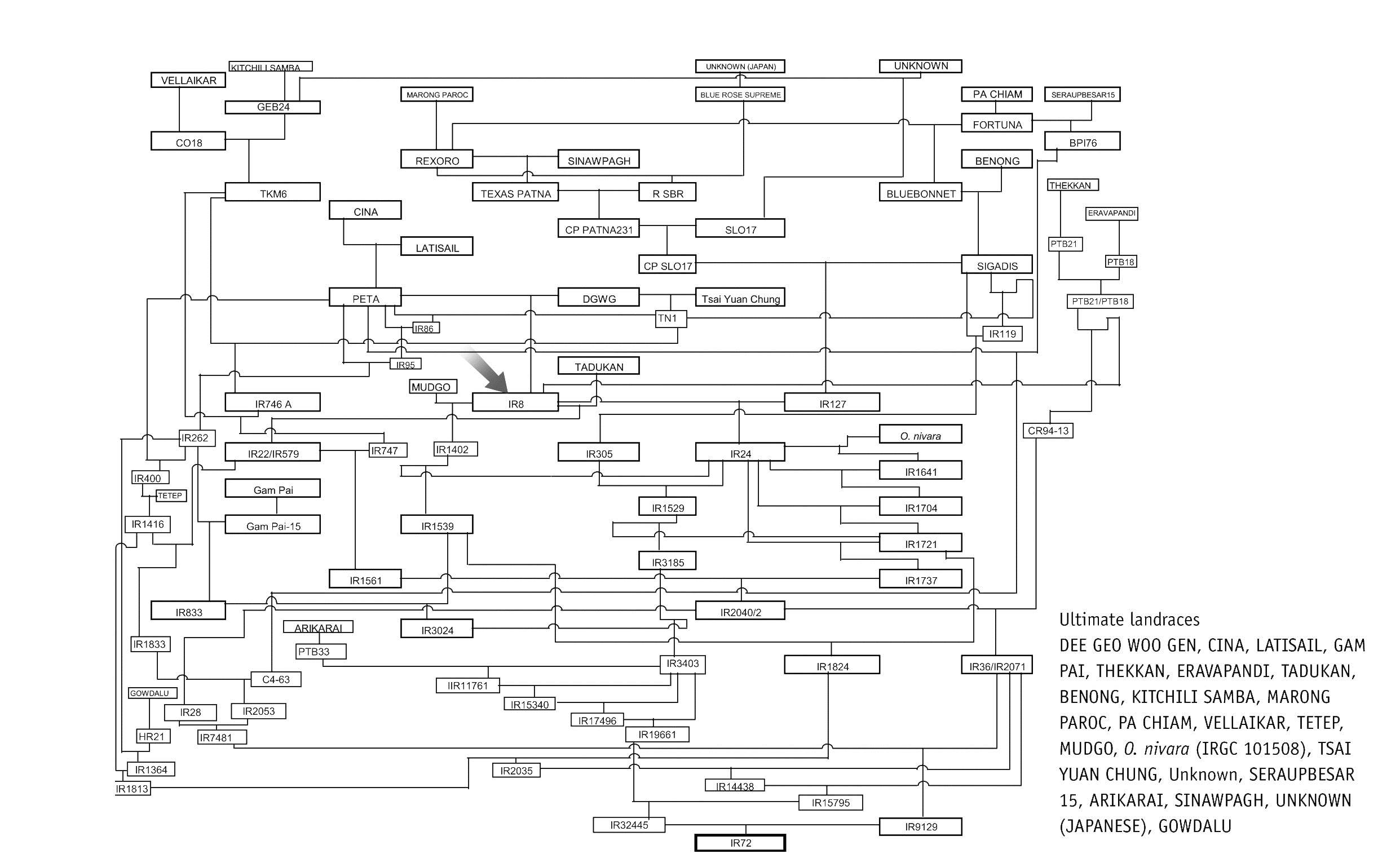
Another point that is often not fully understood, is that Svalbard is designated as a ‘secondary’ safety backup site. Genebanks sending material to Svalbard are expected to have in place a primary backup site and agreement. In the case of the International Rice Research Institute (IRRI), which I am most familiar with for obvious reasons, duplicate germplasm samples of almost the entire collection of 127,000 accessions, are stored under blackbox conditions in the -18°C vaults of The National Center for Genetic Resources Preservation in Fort Collins, Colorado. Although ICARDA had safety backup arrangements in place for its collections, these involved several institutes. To reestablish its active collections in 2015 it was simpler and more cost effective to retrieve the samples from just one site: Svalbard.

We see frequent reports in the media about seeds being shipped to Svalbard.  Just last week, the James Hutton Institute in Dundee, Scotland, announced that it was sending seeds of potatoes from the Commonwealth Potato Collection to Svalbard; it was even reported on the BBC. A few days ago, the International Maize and Wheat Improvement Center (CIMMYT) in Mexico sent a ton of seeds to the vault. The International Center for Tropical Agriculture (CIAT), in Cali, Colombia sent its latest shipment of beans and tropical forages last October.

30423318505_1b5fdb9c2d_z

Dr Åsmund Asdal, Coordinator of the Svalbard Global Seed Vault, from the Nordic Genetic Resource Center (NordGen), receives a shipment of germplasm from CIAT in October 2016. Photo courtesy of the Crop Trust.

The germplasm iceberg
Key and vital as Svalbard is, it is just the tip of the germplasm iceberg. The Svalbard vault is just like the part of an iceberg that you see. There’s a lot more going on in the genetic resources world that the public never, or hardly ever, sees.

There are, for example, other types of genetic resources that will never be stored at Svalbard. Why? Some plant species cannot be easily stored as seeds because they either reproduce vegetatively (and are even sterile or have low fertility at the very least; think of bananas, potatoes, yams or cassava); or have so-called recalcitrant seeds that are short-lived or cannot be stored at low temperature and moisture content like the seeds of many cereals and other food crop species (the very species stored at Svalbard). Many fruit tree species have recalcitrant seeds.

Apart from the ICARDA story, which was, for obvious reasons, headline news, we rarely see or hear in the media the incredible stories behind those seeds: where they were collected, who is working hard to keep them alive and studying the effects of storage conditions on seed longevity, and how plant breeders have crossed them with existing varieties to make them more resistant to diseases or better able to tolerate environmental change, such as higher temperatures, drought or flooding. Last year I visited a potato and sweet potato genebank in Peru, a bean and cassava genebank in Colombia, and one for wheat and maize in Mexico; then in Kenya and Ethiopia, I saw how fruit trees and forage species are being conserved.

Here is what happens at IRRI. You can’t do these things at Svalbard!

These are the day-to-day (and quite expensive) operations that genebanks manage to keep germplasm alive: as seeds, as in vitro cultures, or as field collections.

But what is the value of genebank collections? Check out a PowerPoint presentation I gave at a meeting last June. One can argue that all germplasm has an inherent value. We value it for its very existence (just like we would whales or tigers). Germplasm diversity is a thing of beauty.

Most landraces or wild species in a genebank have an option value, a potential to provide a benefit at some time in the future. They might be the source of a key trait to improve the productivity of a crop species. Very little germplasm achieves actual value, when it used in plant breeding and thereby bringing about a significant increase in productivity and economic income.

There are some spectacular examples, however, and if only a small proportion of the economic benefits of improved varieties was allocated for long-term conservation, the funding challenge for genebanks would be met. Human welfare and nutrition are also enhanced through access to better crop varieties.

impact-paper_small_page_01Last year, in preparation for a major fund-raising initiative for its Crop Diversity Endowment Fund, the Crop Trust prepared an excellent publication that describes the importance of genebanks and their collections, why they are needed, and how they have contributed to agricultural productivity. The economic benefits from using crop wild relatives are listed in Table 2 on page 8. Just click on the cover image (right) to open a copy of the paper. A list of wild rice species with useful agronomic traits is provided in Table 3 on page 9.

Linking genebanks and plant breeding
Let me give you, once again, a couple of rice examples that illustrate the work of genebanks and the close links with plant breeding, based on careful study of genebank accessions.

The indica variety IR72 was bred at IRRI, and released in 1990. It became the world’s highest yielding rice variety. One of its ancestors, IR36 was, at one time, grown on more than 11 million hectares. IR72 has 22 landrace varieties and a single wild rice, Oryza nivara, in its pedigree. It gets its short stature ultimately from IR8, the first of the so-called ‘miracle rices’ that was released in 1966. IRRI celebrated the 50th anniversary of that release recently. Resistance to a devastating disease, grassy stunt virus, was identified in just one accession of O. nivara from India. That resistance undoubtedly contributed to the widespread adoption of both IR36 and IR72. Just click on the pedigree diagram below to open a larger image [2].

IR Varieties_TOC.indd

The pedigree of rice variety IR72, that includes 22 landrace varieties and one wild species, Oryza nivara. Courtesy of IRRI.

A more recent example has been the search for genes to protect rice varieties against flooding [3]. Now that might seem counter-intuitive given that rice in the main grows in flooded fields. But if rice is completely submerged for any length of time, it will, like any other plant, succumb to submergence and die. Or if it does recover, the rice crop will be severely retarded and yield very poorly.

Rice varieties with and without the SUB1 gene after a period of inundation

Rice varieties with and without the SUB1 gene following transient complete submergence. Photo courtesy of IRRI.

Seasonal flooding is a serious issue for farmers in Bangladesh and eastern India. So the search was on for genes that would confer tolerance of transient complete submergence. And it took 18 years or more from the discovery of the SUB1 gene to the release of varieties that are now widely grown in farmers’ fields, and bringing productivity backed to farming communities that always faced seasonal uncertainty. These are just two examples of the many that have been studied and reported on in the scientific press.

There are many more examples from other genebanks of the CGIAR Consortium that maintain that special link between conservation and use. But also from other collections around the world where scientists are studying and using germplasm samples, often using the latest molecular genetics approaches [4] for the benefit of humanity. I’ve just chosen to highlight stories from rice, the crop I’m most familiar with.

~~~~~~~~~~~~~~~~~~~~~~~~~~~~~~~~~~~~~~~~
[1] Blackbox storage is described thus on the Crop Trust website (https://www.croptrust.org/our-work/svalbard-global-seed-vault/): “The depositors who will deposit material will do so consistently with relevant national and international law. The Seed Vault will only agree to receive seeds that are shared under the Multilateral System or under Article 15 of the International Treaty or seeds that have originated in the country of the depositor.

Each country or institution will still own and control access to the seeds they have deposited. The Black Box System entails that the depositor is the only one that can withdraw the seeds and open the boxes.” 

[2] Zeigler, RS (2014). Food security, climate change and genetic resources. In: M Jackson, B Ford-Lloyd & M Parry (eds). Plant Genetic Resources and Climate Change. CABI, Wallingford, Oxfordshire. pp. 1-15.

[3] Ismail, AM & Mackill, DJ (2014). Response to flooding: submergence tolerance in rice. In: M Jackson, B Ford-Lloyd & M Parry (eds). Plant Genetic Resources and Climate Change. CABI, Wallingford, Oxfordshire. pp. 251-269.

[4] McNally, KL (2014). Exploring ‘omics’ of genetic resources to mitigate the effects of climate change. In: M Jackson, B Ford-Lloyd & M Parry (eds). Plant Genetic Resources and Climate Change. CABI, Wallingford, Oxfordshire. pp. 166-189.