Only a heartbeat away – who was that Vice President?

With a new administration now firmly ensconced in the White House, I did wonder the other day (after seeing a photo-op with Vice President Mike Pence standing alongside The Donald) how long it would take for this VP to fade into obscurity (or semi-obscurity at least). I wonder if he is beginning to regret life under his new boss. Well, at least during this four-year term, Trump cannot say ” You’re fired!”, but he can side-line his vice president quite effectively if he chooses to do so. And I suspect with this self-centered, narcissistic President, that is exactly what will happen.

However, VP Pence has already left one legacy by casting the deciding vote in the Senate to confirm Betsy DeVos as the incoming Secretary of Education, and he sounds rather pleased with himself.

The fate of VPs
Vice Presidents have been side-lined before. After all, under the US constitution, the only formal—and limited—roles for the Vice President are ‘to become President, should the President become unable to serve, and to act as the presiding officer of the Senate‘.

384px-dan_quayle_official_dod_photoOn the inauguration platform on 20 January, alongside former Presidents Carter, Clinton, George W Bush, and Obama, stood former Vice President Dan Quayle.

Dan who? I bet many people who read this blog will never have heard of Dan Quayle, or if they have, will have forgotten about his four years in office under George Bush Senior from 1989-1993. He was the 44th Vice President, remembered perhaps only for his inability to spell ‘potato’.

Anyway, this got me thinking.

Harry S Truman was the 33rd President when I was born in November 1948. He had assumed the presidency in 1945 on the death of Franklin D Roosevelt, just 82 days after having been sworn in on 20 January. He then served out the remainder of Roosevelt’s term until the general election of 1948. Truman won a famous election victory just a couple of weeks before my birth, defeating Thomas Dewey in the face of all the election polls to the contrary. He remained in office until 1953. Between Roosevelt’s death and his election win in 1948, Truman served without a Vice President; I guess in constitutional terms his successor, should he have died in office, was the Speaker of the House. From 1949-1953, Truman’s Vice President was Alben W Barkley from Kentucky, consigned like so many Vice Presidents to the dustbin of history.

Then came:

  • Eisenhower – Nixon
  • Kennedy – Johnson
  • Johnson – Humphrey
  • Nixon – Agnew / Ford
  • Ford – Rockefeller
  • Carter – Mondale
  • Reagan – Bush Sr
  • Bush Sr – Quayle
  • Clinton – Gore
  • Bush Jr – Cheney
  • Obama – Biden
  • Trump – Pence

Lyndon B Johnson became President on the assassination of President Kennedy in November 1963. Johnson served for 14 months without a Vice President, until his election victory in his own right in November 1964 alongside Hubert Humphrey.

Richard Nixon fought an unsuccessful election against Kennedy in 1960; but he did eventually win the presidency in 1968 against Hubert Humphrey, only to resign half-way through his second term following the Watergate scandal. Nixon’s Vice President, Spiro Agnew from Maryland was forced to resign in October 1973.

Agnew’s resignation triggered the first use of the 25th Amendment, specifically Section 2, as the vacancy prompted the appointment and confirmation of Gerald Ford, the House Minority Leader, as his successor. This remains one of only two instances in which the amendment has been employed to fill a vice-presidential vacancy. The second time was when Ford, after becoming President upon Nixon’s resignation, chose Nelson Rockefeller (originally Agnew’s mentor in the moderate wing of the Republican Party) to succeed him as Vice President (from Wikipedia).

Gerald Ford became the 38th President in August 1974 on the resignation of President Nixon; he also served without a Vice President until the appointment of Nelson Rockefeller in December that year.

Some Vice Presidents left a mark on history; most don’t. It has been interesting over the past eight years to observe the relationship between Barack Obama and his VP Joe Biden – a ‘bromance’ almost. I think Obama’s respect for Biden was summed up in his award to Biden, just a few days before leaving office, of the Presidential Medal of Freedom (With Distinction), the USA’s highest civilian honour.

Vice President Biden will long be remembered. So goes Pence? I doubt it. Unless . . . ?


“Oi’ll give it foive”

coat_of_arms_of_birmingham-svgBirmingham lies at the heart of England. It is the UK’s second city.

I first visited Birmingham in the 1960s. At that time I was living in Leek, just under 60 miles to the north in North Staffordshire. I moved to Birmingham in September 1970 when I began my graduate studies in the Department of Botany at The University of Birmingham, never envisaging that I would return a decade later to join the staff of the same department. Since 1981, my wife and I have lived in Bromsgrove, some 13 miles south of Birmingham in northeast Worcestershire (with a 19 year break while I worked in the Philippines).

birmingham

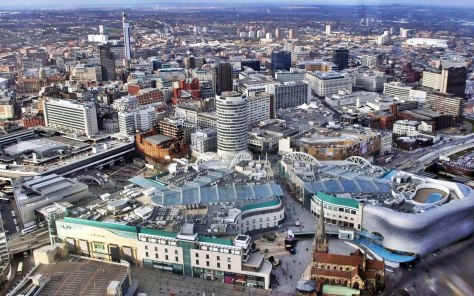
Birmingham city center, overlooking New Street Station, the Bull Ring Shopping Centre and Rotunda, and the BT Tower, and looking towards the Black Country further on.

Birmingham is one of seven metropolitan boroughs that make up the County of  West Midlands, from Wolverhampton in the northwest to Solihull and Coventry in the southeast, and encompassing the area known as the Black Country lying to the west of Birmingham proper.

To the ears of someone from outside the region, everyone in the West Midlands speaks with the same ‘Brummie‘ accent, rated the least appealing in the nation. Shame! There are subtle differences across the region, but I can understand why most outsiders maybe hear just a single accent. You can read (and hear) what one American writer has to say about ‘Brummie’ here.

It is rather interesting to note that one Brummie, accent and all, has made it big on US television. Comedian John Oliver came to the fore on The Daily Show with Jon Stewart, and now in his own Last Week Tonight with John Oliver.

And there have now been three series of the cult drama Peaky Blinders about a gangster family in Birmingham just after the ending of the First World War. Again, it’s amazing that this became so popular on the other side of The Pond, given the strong Brummie accents, strong language, and explicit sexual content.

So what has me waxing lyrical this morning about all things Brummie? Well, last night, Heavy Metal band Black Sabbath (of Ozzy Osbourne fame) performed the second of two concerts in Birmingham at the end of an 81-date tour that began in January last year. After 50 years, Black Sabbath have hung up their guitars and microphones. Yesterday’s concert was the final one.

Birmingham is the birthplace of Heavy Metal, but it’s not a genre I appreciate. Nevertheless, this story about Black Sabbath got me thinking.

The ‘Merseyside Sound’ of the 1960s, 1970s is rightly renowned worldwide for The Beatles, Gerry and the Pacemakers, Cilla Black, just to mention three of a very long list.

However, there was—and is—a vibrant ‘Birmingham Sound‘, with musicians and bands having an enormous impact everywhere. Do any come immediately to mind? No? Well, among the most famous are: Jeff Lynne and ELO, Roy Wood (in The Move and Wizzard), The Moody Blues, Duran DuranUB40, Dexys Midnight Runners, Slade, even Musical Youth. As anyone who follows my blog will know, I’m a great Jeff Lynne-ELO-Traveling Wilburys fan.

Fleetwood Mac’s Christine McVie was born in Lancashire, but from early childhood was raised in Birmingham. Led Zeppelin’s Robert Plant was born in West Bromwich in the Black Country, but grew up in Kidderminster, nine miles west of Bromsgrove.

So let’s enjoy some of the Brummie talent.

https://youtu.be/cwqhdRs4jyA

Flowers in the Rain was the first record to be played at the launch of BBC Radio 1 by DJ Tony Blackburn in 1967.

https://youtu.be/oDnNF5cHCdo

https://youtu.be/rVxcwe7EcaY

https://youtu.be/0A8KT365wlA

So what’s this Oi’ll give it foive business?

In the early to mid 1960s, there was a TV series, Thank Your Lucky Stars produced by the Birmingham-based commercial channel, ATV, and broadcast nationwide. In the show’s Wikipedia page it states: Audience participation was a strong feature of Thank Your Lucky Stars, and the Spin-a-Disc section, where a guest DJ and three teenagers reviewed three singles, is a very well remembered feature of the show. Generally American singles were reviewed. It was on this section that Janice Nicholls appeared. She was a former office clerk from the English Midlands who became famous for the catchphrase “Oi’ll give it foive” which she said with a strong Black Country accent.

Janice Nicholls released this dreadful single in 1963, but at least you can hear her say Oi’ll give it foive.

https://youtu.be/UoCi38LQSag

Among the notable comedians and actors proudly from the region are Sir Lenny Henry (who hails from Dudley in the Black Country), and Jasper Carrott and Julie Walters, who are true Brummies.

Narcissus was an amateur compared to The Donald

Do any of these words describe the new resident in the White House? All of them? That would surely be a burden for anyone to carry. Not so, it seems, Donald J Trump, who has made a career out of being the High Priest of Narcissism.

narcissist-acts

It’s just two weeks since The Donald was inaugurated as the 45th POTUS. Good grief! It seems like a lifetime. Now that I’m retired, I often wonder to my wife where time has flown to. When considering all that’s happening right now in the USA, and the profound polarizing impact of this dysfunctional administration, it seems as though we are wading through molasses.

The next four years stretch out endlessly ahead of us (if DJT survives that long), because whatever His Orangeness says or does, affects everyone, not just the USA. He sneezes; we catch a cold.

Following his unbelievable (for all the wrong reasons) Inaugural Address from the steps of the Capitol in Washington, DC on 20 January, The Donald has ratcheted up his invective and vitriol. His minions on the White House staff (Sean Spicer and Kellyanne Conway come immediately to mind) have stepped into the fray and revealed themselves to be unthinking and deluded acolytes, following the Donald line without question. The GOP in both Houses of Congress appears to have rolled over to have its collective tummy tickled.

Yes. Donald Trump is a narcissist. It’s all about him. He’s playing at being President. It’s the ultimate reality show, only the stakes are much higher, and he’s the apprentice. I think he was in love with the idea of being President. That’s why he ran. He liked the attention he would receive, the fawning, the center stage. Now, everything he does will be scrutinised, and I have great faith in political cartoonists on both sides of the Atlantic to pull him down more than just a peg or two. I signed up for Facebook page called Editorial & Political Cartoons; it’s a great resource.

And because he is so notoriously thin-skinned, this will eventually get to him. Expect a YUMONGOUS reaction before too long, especially when they insinuate that he is just a puppet. Take this cartoon distributed by Pia Guerra on Twitter just five days ago. As the narcissist sans pareil, The Donald won’t stand for this.

c3yqndivcaareg_

Cartoonists are already focusing on Trumpian characteristics, such as:

  • his remarkable hairstyle;
  • the kaleidoscope of facial expressions (the snarl, the pursed lips);
  • his hands and fingers (small as they are) and exaggerated gestures; and
  • the over-long tie (more like an extended loin-cloth).

He has to be the center of attention, referring to all his ‘achievements’ (but not his multiple bankruptcies) as ‘great’, ‘YUGE’, ‘the best’, etc., while disparaging others. His disrespectful comments are too numerous to list.

His speeches—if you can call them such—are mostly incoherent ramblings often punctuated by his two favourite words: ‘I’ and ‘Me’. Here’s a good example, made at a breakfast recently in the White House to commemorate Black History month. It’s also hard to believe he made these comments at the National Prayer Breakfast earlier this week. And talk about disrespect. During his visit to the CIA a short while after his inauguration, and speaking to an invited (and ‘packed’?) audience in front of the CIA Memorial Wall, he couldn’t resist boasting about the number of times he had appeared on the front cover of Time, as well the unprecedented record crowds who had turned up to his inauguration. He was certainly obsessed with those ‘alternative facts’. It just galls him that he simply is NOT the best.

Anyway, to get back to my original theme of Trump’s narcissism. I posted this simple comment on my Facebook page a couple of days ago or so: Narcissus was an amateur compared to Trump. And that’s why I decided to elaborate on that here.

I also posted the famous Caravaggio painting of Narcissus, painted between 1597 and 1599. Then, lying in bed this morning, thinking about today’s blog post, I wondered if I could superimpose Trump’s head in the painting. However, Google came to the rescue, and I found someone had been there before me.

Furthermore, the author of Poppa’s Cottage had already visited the theme of Trump’s dangerous narcissism in August 2016, and who has written more eloquently than I ever could.

I guess we can all hope that Congress will regain its senses and tell The Donald in no uncertain terms: YOU’RE FIRED!


America the Beautiful, Donald the Ugly!

I probably wasted a couple of hours yesterday afternoon watching the inauguration of Donald Trump as the 45th President of the United States. I couldn’t help myself. I just wanted to see how Trump would behave. I wasn’t disappointed. I even posted on Facebook while he was delivering his Inaugural Speech that he sounded like he was still on the campaign trail. It must continue to rankle, being such a narcissus I guess, that he won the election by a landslide loss to Hillary Clinton of almost three million votes.

img_1781

I bet he had his fingers secretly crossed . . . 

How depressing the spectacle was, for many reasons (and it seems that despite whatever spin Trump puts on it, his Inauguration was decidedly low-key) I was left at the end with a profound sense of unease, depressed even. It was the same feeling I had (and continue to have) after the EU referendum last June, and the UK voted (by the smallest of margins for such a social, economic, and constitutional—and irrevocable—change) for Brexit.

img_1783

Is Barron Trump thinking about all the stick he is going to take when he goes back to school in New York on Monday?

After Trump had taken the oath, the former President and Mrs Obama left Washington, DC on board a helicopter bound for the Joint Base Andrews in Maryland, en route to a well-deserved vacation (and period for reflection) in California. The BBC live broadcast captured an image of the helicopter flying northwest over Washington carrying the former president and his wife away.

img_1784

And I had this feeling that going with them was their dignity, decency, cordiality, ethical behaviour, and vision. Nature abhors a vacuum. It’s now filled with the mean-spiritedness of the Trump Administration, and the crass ostentation that The Donald personifies.

Welcome to the USA – about to become an extension of Trump, Inc. That’s certainly the impression seeing The Donald surrounded by his family. And the photo of him sitting at his desk in the Oval Office later on in the day, with Vice President Pence beside him (how soon will he fade from the limelight?), and Trump’s son-in-law and now Senior Adviser to the President, Jared Kushner (now there’s a prime case of nepotism).

As for Trump’s tie, I found this apt descriptionRed is an aggressive color that can make us feel passionate, angry, or hungry. The candidates in red ties want you to think they are decisive, bold, assertive, and powerful. Candidates accused of flip-flopping often roll out the red ties. Sound familiar?

We have a personal connection to the USA. Our elder daughter completed much of her education there, in St Paul, Minnesota, where she met her husband Michael, and where she continues to live and work, with children Callum and Zoë. We have visited the USA many times over the past 25 years,and have travelled extensively. Everywhere we went we have been met with warmth, courtesy and cordiality. I don’t recognise that in Trump’s take on America in his Inaugural Speech. No, I don’t deny that there is deprivation in swathes across many states, sites of former heavy industry that has been lost to competition elsewhere, or been overtaken by technology. These folks feel they have been neglected (just as those who voted to Leave the EU last June here in the UK), and Trump tapped into that sense of isolation.

He’s a multiple bankrupt billionaire businessman who is focused on one thing, and one thing only: himself (and his business opportunities of course). It’s unlikely to be America First! Trump First! Just like his branding franchises, will it soon be TRUMP USA?

What interest will he have in the common man and woman. Indeed one of his first Executive Orders, signed just hours after taking the oath of office, was to begin the process of rolling-back the Affordable Care Act. And that will directly affect the very constituency that expect him to perform miracles for them. And then any reference to climate change was removed from the White House website.

Trump has also surrounded himself with like-minded and very rich sycophants in his cabinet (if they are confirmed). Just like Pence, what influence will they actually have? The Tweet is mightier than the sword!

You know, Trump could found his own church (just like a number of fundamentalist preachers in the USA), and become the High Priest. After all, religion is faith, belief. Not fact. His invocation of God several times towards the end of his speech was, by the way, the depth of hypocrisy.

And as a Brit, it sickens me to see all our Conservative politicians wetting themselves over their future relationships with the Trump Administration. Also, deluding themselves that the UK will be ‘at the front of the queue’ when it comes to relations and trade deals with the USA (on American terms, of course). Trump is about to screw us. After all, Trump declared it would be America First! (after him, of course).

Then there’s the spectacle of UKIP former leader and self-proclaimed non-entity Nigel Farage almost orgasmic now that the bust of Winston S Churchill has been restored to its ‘rightful’ place in the Oval Office.

Don’t get me wrong. The UK needs to develop a solid relationship with whatever administration resides in the White House. But Trump has clearly signalled where his priorities lie. And that should give us all pause to consider what the next fours years hold in store, not only for the USA, but for all of us. A scary thought indeed.


After 157 years, Dickens’s words still ring true

dickens

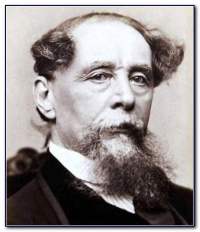
Charles Dickens (1812-1870)

It was the best of times, it was the worst of times, it was the age of wisdom, it was the age of foolishness, it was the epoch of belief, it was the epoch of incredulity, it was the season of Light, it was the season of Darkness, it was the spring of hope, it was the winter of despair, we had everything before us, we had nothing before us, we were all going direct to Heaven, we were all going direct the other way.

These are the opening lines to Charles Dickens’ 12th novel, A Tale of Two Cities, published in 1859.

These words could also be an accurate description of the past year. What a year 2016 has turned out to be, for so many reasons. I guess we can also now say that we live in the post-truth age.

The best (and worst) for me . . .
Personally, 2016 was the best of times and the worst.

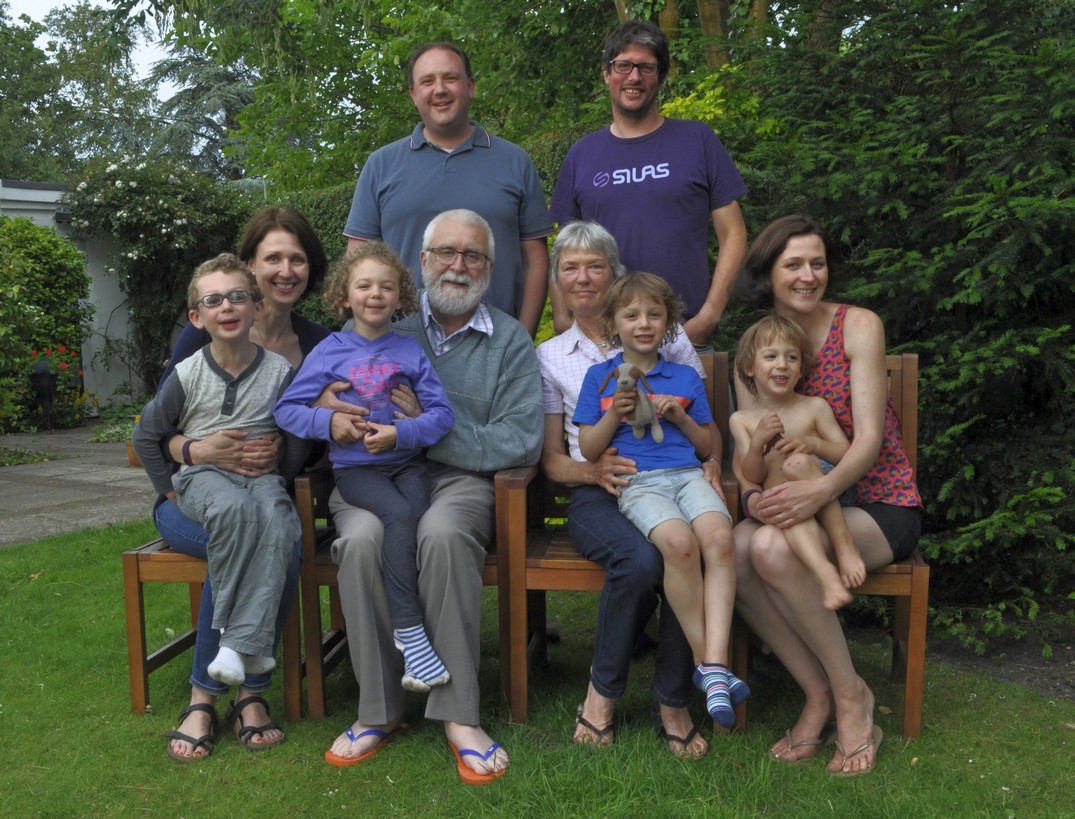
In July, our family got together for the first time. Hannah Michael with Callum and Zoë came over to the UK from Minnesota; Philippa and Andi with Elvis and Felix came down from Newcastle upon Tyne, and we all met up for two weeks’ holiday in the New Forest in Hampshire. A splendid time was had by all!

20160711-514-new-forest-holiday

In February, I was invited to lead a team of three genetic resources experts to evaluate a multi-center program of the CGIAR genebanks.

20160428 001

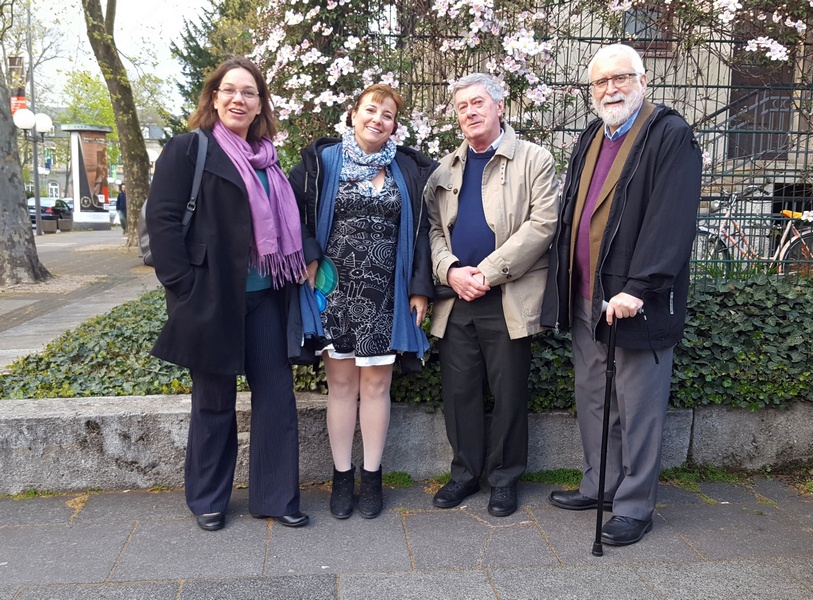
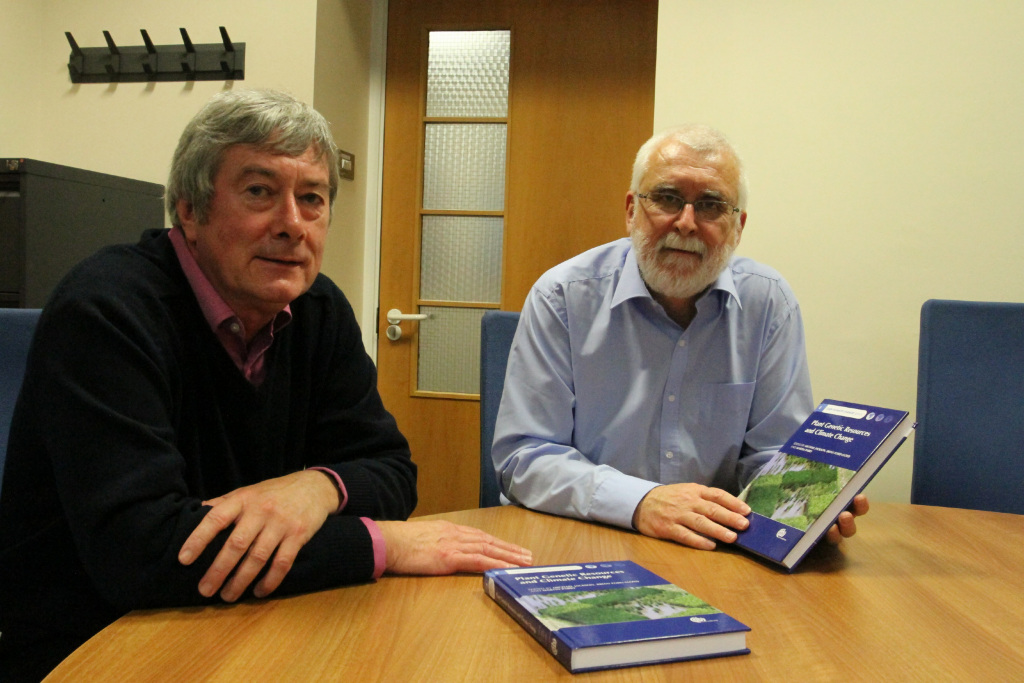
L to R: Jenin Assaf (of the CGIAR’s Independent Evaluation Arrangement, based at FAO in Rome), Marise Borja and Brian Ford-Lloyd (team members), and me.

That evaluation took me to Germany, France, Italy (twice), Peru, Colombia, Mexico, Kenya, Ethiopia and Australia. As I write this article the team is writing first drafts of its assessment of the program, and we hope to have everything wrapped up by early February. I’ll be glad when it’s done and dusted. I’ve thought about genetic resources and genebanks almost every waking hour since I was first invited to join the evaluation.

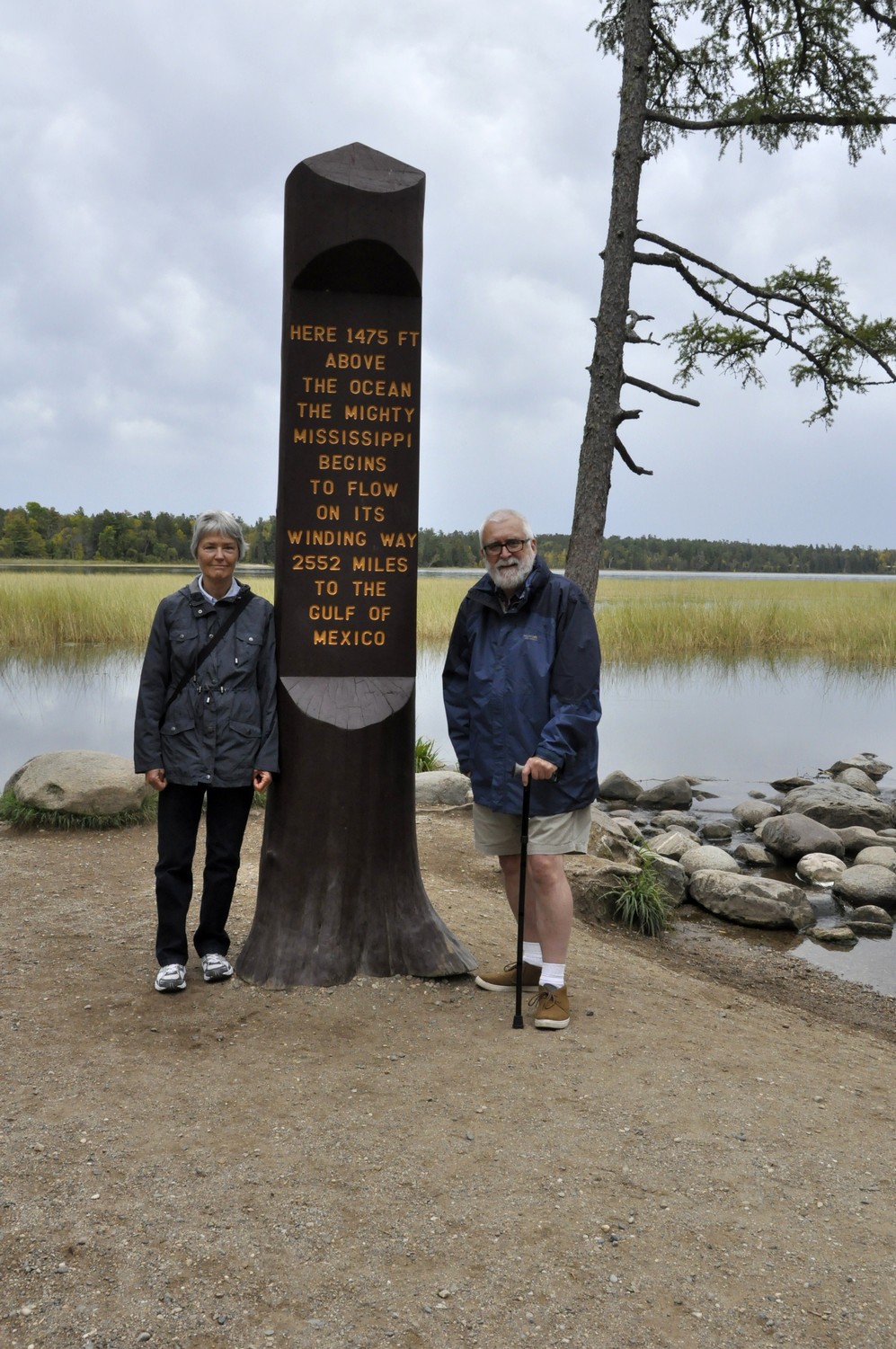
Besides our break with the family in the New Forest, Steph and I also managed our ‘annual’ vacation in Minnesota with Hannah and family. We took the opportunity of exploring Minnesota some more, and ‘trekking’ to find the source of the mighty Mississippi River. Actually trekking is rather an exaggeration and there were plenty of signposts showing where we’d encounter the Mississippi as it dribbled, so to speak, out of Lake Itasca at the beginning of its 2000 plus mile journey south to the Gulf of Mexico.

20160922-105-minnesota

Personally, 2016 was also the worst of times for me following an accident at the beginning of January when I slipped on black ice, dislocating my right foot and snapping the fibula. As a consequence I am now the proud owner of a long metal plate holding the bones in my right leg together. Once I was allowed to become mobile, I used crutches then a stick for many months. I only gave up using my stick about four weeks ago. I’m pleased with the progress I’ve made, but I’m in for the long haul. My ankle and leg still give me pain, and whereas in the past I might often cover three to five miles on my daily walk, I can still only comfortably cover about two miles. I’m sure this will get better.

And, worldwide, among the worst . . .
But my paltry troubles fade into insignificance compared to what has been played out on the international stage.

The suffering of Syrians in Aleppo (well, in Syria in general and throughout other countries of the Middle East terrorised by Daesh) seems never-ending. Talk about political spin! I have visited Aleppo two (maybe three) times. I was once a candidate for a senior position at ICARDA, one of the centers of the CGIAR, and I guess I would have accepted it had it been offered. Syria looked like an interesting country, and everyone I spoke with at ICARDA told me what a safe place Aleppo was. How times change! Will that seemingly interminable civil war come to an end? As we approach the close of 2016, the battle for Aleppo has ended (more or less), but Assad and his Russian and Iranian backers are not going to rest until they have turned the rest of Syria into a pile of rubble. Victory, it seems, comes at any price. Shame on them! The fate of civilians is not part of the security equation.

And there have been political earthquakes in the USA, in the UK (and Europe), and in the Philippines.

donald_trump_august_19_2015_cropped

PEOTUS – heaven help us!

The Donald . . . what more can I say?
Who would have believed that His Orangeness, The Donald, Mr Drumpf would secure the American presidency, albeit on a minority popular vote; 2.8 million votes more for Hillary Clinton is quite a margin, even though The Donald still claims he won by a landslide. But then again, his whole campaign was built on mis-truths (aka LIES), denials of comments he made in earlier interviews, lack of policy, a lack of any ability, it seems, to string two coherent words together, although they were, of course, the ‘best words’.

From what little he contributed to the first presidential debate, and in various speeches reported in the news, it’s hard to understand what he really means to Make America Great Again. Based on his choices for cabinet positions, his equivocation over continued links to all his nefarious business interests, and what seems like his complete lack of attention to the things you might expect PEOTUS to take notice of, the USA must be in for a bumpy ride over the next months. Trump scares the s**t out of me. He’s only predictable by his unpredictability, and in a fragile world, I am concerned that such a maverick (and moron) should occupy the most powerful political position in any country.

Brexit (and the clowns who are  taking us out of the EU) . . .
Nifa (Nigel Farage), BoJo (Boris Johnson) and MiGo (Michael Gove. Arch clowns among many.

We’ve certainly had to put up with our fair share of bozos in UK politics these past months. I voted Remain in last June’s referendum on continuing membership of the European Union. I was one of the 48% who voted. We’re not out of the EU yet, so we’ve not seen the full effect of what might happen. I’m not optimistic, although I’d like to be. Those who supported Leave seem to believe that the other 27 countries will simply roll over and give the UK (or will that be ‘UK lite’, i.e. minus Scotland?) whatever it wants. I fear not. So many benefits were touted if we voted Leave.

I think that worse is yet to come, and it will be years before everything has been sorted out or regularised. It’s not my generation that will suffer. But those who come after us. I feel the Leavers were sold a pony by the likes of Farage, Johnson and Gove. And on the day after the referendum it was clear they had no idea of what to do next. And the government still has no idea what to do. But ‘Brexit means Brexit‘. Time to apply for an Irish passport perhaps – I’m eligible.

President Rodrigo Roa Duterte and Laotian President Bounnhang Vorachith pose for a photograph during a courtesy visit at the Presidential Palace in Vientiane, Laos on September 7. TOTO LOZANO/PPD

President of the Philippines Rodrigo Roa Duterte

A psychopath at the helm in the Philippines . . .
Du30. Rodrigo Duterte, 16th President, ex-Mayor of Davao City in the southern island of Mindanao. He won last May’s general election by a landslide. He’s very popular.

He’s also very outspoken, crude, and—by his own admission—a murderer. An avowed strongman, perhaps he was the man of the moment needed to bring some discipline to day-to-day life in the Philippines, with its political dynasties and celebrity status among politicians. He had the opportunity to make a great difference to the lives of many impoverished Filipinos. Maybe he still can.

He declared war on drug pushers and users, and there have been thousands of extrajudicial killings in the few months since he was inaugurated. It’s clear that his election has split public opinion in the Philippines. It’s sad for me to see how, among many of my friends, there is such a lack of hope for the future under this president.

I know that many of my Filipino friends will not appreciate my candour concerning their country. It’s hard to see how someone as crude as Duterte could be elected president. He hasn’t made friends among the international community. As leader of a country of 100 million you don’t go around calling the President of your principal ally, the USA (or used to be) a ‘son of a whore‘.

Then again, did we expect Trump to be elected in the US general election? Hardly. May we live in interesting times!

2016 is not killing people . . . 
Over the past few days there have been several reported celebrity deaths:  guitarist Rick Parfitt (68, Status Quo), singer/songwriter George Michael (53), Star Wars actress Carrie Fisher (60), author Richard Adams (96, author of Watership Down), and actress Liz Smith (95, the Royle Family). But this follows many others throughout the year: musicians David Bowie (69) and Prince (57), TV legend Sir Terry Wogan (77), and actor Gene Wilder (83). But has 2016 been unusual?

Any death is a cause for sadness among family and friends, and fans. For an elderly person we shouldn’t be so surprised. It’s always a shock, however, when sudden illness robs us of one of our icons. I was only saying to my wife early this morning that perhaps we shouldn’t be so surprised that some celebrities have passed away at a relatively young age. After all, several of them must have been carrying quite a ‘substance abuse and lifestyle’ load that affected their chances of long life.

Not bad for ‘just a small island’

It was back in September 2013 that a Russian spokesperson is reputed to have commented about the UK, “. . . just a small island … no one pays any attention to them“. Actually more than 6200 islands, although only 267 are permanently inhabited.

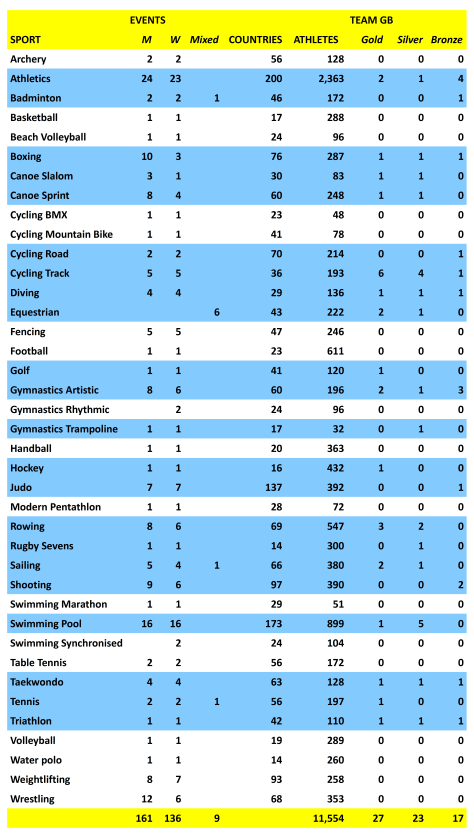
team gbHowever, based on Team GB’s success at Rio2016 perhaps we are not so ‘small’ after all. After winning a record haul of medals (more than won at our home London Olympics in 2012) British athletes from all competitions can hold their heads proudly.

Now, don’t get me wrong. I’m not particularly interested in the increasingly over-enthusiastic [nationalistic] commentaries and responses that accompany any gold medal success—whether for Team GB or any other country. Too much unfurling and waving of flags for my liking. A vexillologist’s paradise nevertheless.

In many ways, I wish it were possible for competitors to participate as individuals, not under their national flags. Nevertheless, I do accept that it’s this aspect that attracts public attention and increases interest in the Games.

And all this celebration of rankings. So what if Team GB came second in the medal list, even better than China? Better we should ask whether our athletes acquitted themselves in their respective competitions. After all, since 1997 there has been a massive investment in elite sport, primarily with support to UK Sport from the National Lottery, and that has permitted athletes to concentrate 100% (or almost so) on their sports.

Team GB’s 374 athletes participated in 201 events over 31 of the 39 Olympic sports (this classification taken from the official Rio2016 website). And they came away with medals in 22 of those sports, for a total of 67 medals, of which 27 were gold!

rio medals

It’s interesting to note that although most sports were split into men’s and women’s events, there were three sports with a mixed event (badminton, sailing, and tennis), one event was entirely mixed, men and women competing against each other (equestrian), and two events (synchronised swimming and rhythmic gymnastics) entirely for women.

The Olympics is an interesting mix of sports, disciplines and events. Personally, I do not agree with either tennis or golf being Olympic sports, even though Team GB came away with gold medals in both men’s events. For many Olympians, the games held every four years are what they train and aim for.  They are the focus of all their goals and dreams. Yes, there are World Championships, and regional ones (like the European Championships) and the Commonwealth Games, held at regular cycles. But the Olympics are something special. You only have to witness the reaction of successful athletes to winning a medal, especially if it’s gold, to appreciate just what participating in the Olympic Games means. A week after winning at Rio, Andy Murray was participating in the Western & Southern Open in Cincinnati, Ohio where he was defeated in the final by Marin Cilic of Croatia. This was just another tournament on the ATP Tour and, it seems, the Olympic Games were squeezed into his busy schedule. The same can be said for golf. Gold medal winner Justin Rose will no doubt be off playing another tournament somewhere on the professional golf circuit. Notwithstanding the above, I did appreciate the commitment of both Murray and Rose in competing in the Games, and what it meant to win. I just happen to believe that other sports are more worthy of inclusion. I cannot understand why squash has never become an Olympic sport. But we do have sport climbing to look forward to in Tokyo.

One hundred and twenty-nine British athletes won a medal (individual and team). But what is particularly remarkable is that nine Olympic champions from London2012 successfully defended their titles (or double champions in the case of track cyclist Laura Trott and long-distance runner Mo Farah, or triple champion in the case of track cyclist Jason Kenny). The men’s four in rowing retained the title for the fifth successive Olympics (though not with the same team members!), cyclists in three Olympics, and sailors in the Finn class in five. The BBC Sport Rio 2016 website tells the full story.

So, well done to Team GB athletes—and all Olympians—successful or not in terms of medals won. Many personal best times, etc. were surpassed. In swimming and cycling, Team GB athletes also broke world records.

Of course there were the various controversies. Boxing was not without its usual crop of ‘bad’ decisions. I guess that will always be the case in sports that are judged rather than measured (fastest, longest, highest, etc.). Should Team GB’s 4 x 400 m team have been disqualified? There was no visual evidence to fall back on—just the word of a judge. Conspiracy theories abound, because Team GB’s disqualification elevated the Brazilian quartet into the final. Does it really matter? That’s how the decision was called.

Disagree and appeal. Accept. Move on.

211px-2016_Summer_Olympics_logo.svgBut let’s also celebrate, in particular, the many fine examples of the spirit of the Olympics. Rafaela Silva, the gold medal winning judoka from Rio’s City of God favela. The Singaporean swimmer, Joseph Schooling, who defeated Michael Phelps in the 100 m butterfly to win his country’s first gold medal. Fiji winning their first ever medal, gold, in the Rugby Seevens. The Philippines silver medallist in weightlifting, Hidilyn Diaz. But also, who can forget Michael Phelps winning his 23rd gold medal?

But perhaps the epitome of the Olympic sportsmanship shone forth in the women’s 5000 m heats, when Nikki Hamblin from New Zealand and Abbey D’Agostino from the USA fell and helped each other to finish the race. Both were reinstated in the final, but D’Agostino was unable to compete. Hamblin did run, but came last, hobbling over the line obviously still suffering from the injury picked up during the heats.

It was, of course, disappointing to see so many empty seats at most of the Olympic venues. Rio residents didn’t appear to embrace the Olympics as was the case in London, because of the cost of tickets presumably, but also because many of the sports simply do not have a following in Brazil. This was in stark contrast to London 2012 when it was impossible to get hold tickets. This does not bode well for the Paralympics that begin in two weeks.

Who will forget, however, the majesty and magnificence of the Rio de Janeiro backdrop to many of the events, in particular the TV shots over the Christ the Redeemer statue to the Rodrigo de Freitas Lagoon (Lagoa) far below where the rowing and canoe events were held.

The view of Lagoa from the Christ the Redeemer statue, where the rowing and canoe events were held.

With the Sugar Loaf always in view, the long stretches of Copacabana and Ipanema beaches, Rio had it all. And despite the political and economic shocks that Brazil faced, the Rio Olympics seem to have been a great success. Was the athletics program debased because of the absence of the Russian athletes? Probably not, especially if their clean status could not be guaranteed. The Russian Federation was well-represented in other sports, and won its fair share of gold medals.

I’ve not heard of many—if any—actual doping incidents, although the organisation of the anti-doping organization has apparently not been held in high regard. Some examples of doping may yet come to light.

So, we move on to Tokyo 2020. Will Super Mario still be in office?

A new railway station for Bromsgrove (updated 5 October 2018)

20160717 023

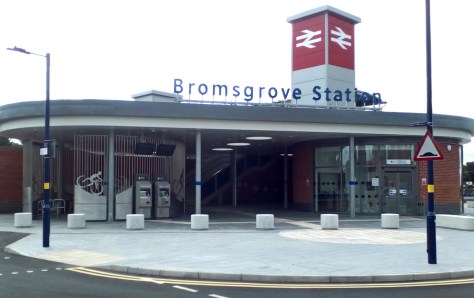
It has taken about three years or more to complete, but finally, on 12 July 2016, Bromsgrove’s new railway station in northeast Worcestershire opened for business as the first train pulled in, on time, at 6:21 am.

Bromsgrove station opens

20160717 011

So, 176 years after the first station opened on what was then the Birmingham and Gloucester Railway, Bromsgrove has a new station worthy of the 21st century, and managed by London Midland.

Bromsgrove station in 1960, looking south to where the new railway station has been constructed.

Bromsgrove’s one platform station in 1981.

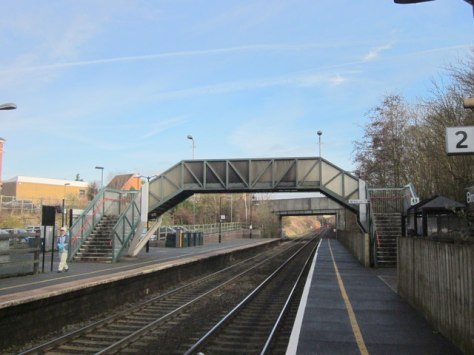
Bromsgrove station in 2012, looking north up the Lickey Incline, taken from the down line platform.

As with many infrastructure projects nowadays it seems, there have been several delays in completing this project. The station should have opened by Autumn 2015. Built on the site of the old carriage works, hidden signalling cables and a previously unmapped culvert required extensive additional engineering works to resolve these issues. In addition, hundreds of tonnes of oil-contaminated soil had to be removed from the site.

Now Bromsgrove proudly boasts of a modern, four platform station provided with lift access to all platforms, a ticket office, bicycle store, toilets, and parking for over 300 cars (payable by the day, week, month or annually). Regular bus services will connect the station with the town center over a mile away.

The new station replaces a two platform facility that was upgraded from a single platform (on the up line, towards Birmingham New Street) in the mid-1980s. Until then, trains on the down line (towards Worcester) were diverted on to the up line for the short period necessary to disembark and take on new passengers. Not the most convenient situation, as you can imagine, and one that led to serious traffic restrictions on this busy main line connecting the West Midlands with the south west (Gloucester, Bristol, South Wales, and beyond).

The station is about half a mile from my home, but I rarely used the train when I taught at the University of Birmingham in the 1980s. Even though the trains from Bromsgrove to Birmingham stopped at only one other station: University (right in the heart of the University of Birmingham campus, essentially).

The old station, at the foot of the famous Lickey Incline could accommodate trains with only three carriages. The new station has the length for six carriage trains, and once the electrification of the line has been extended from Barnt Green at the top of the Incline to Bromsgrove, a schedule of four or more trains per hour can be accommodated. Not only will stopping trains park on one of the platform branch platforms, thus permitting express through trains to keep to their schedule, but electric trains will be able to tackle the Lickey Incline faster from a standing start¹, unlike today’s diesel trains that chug up the Incline somewhat sedately.

The final platform branch line will not open until October this year, and new signalling installed. The mainline will be closed for two weeks. The final branch could not be laid until the old station closed as the curve into the fourth platform has to begin from where the old down line platform was located. Work has already begun, the old station platforms demolished, and the rails already laid ready to link into the main line later this year.


Update (November 2016)
The track laying and realignment are now complete, and new signalling has been installed. We just wait for the electrification of the line to Bromsgrove, which should be completed by this time next year.

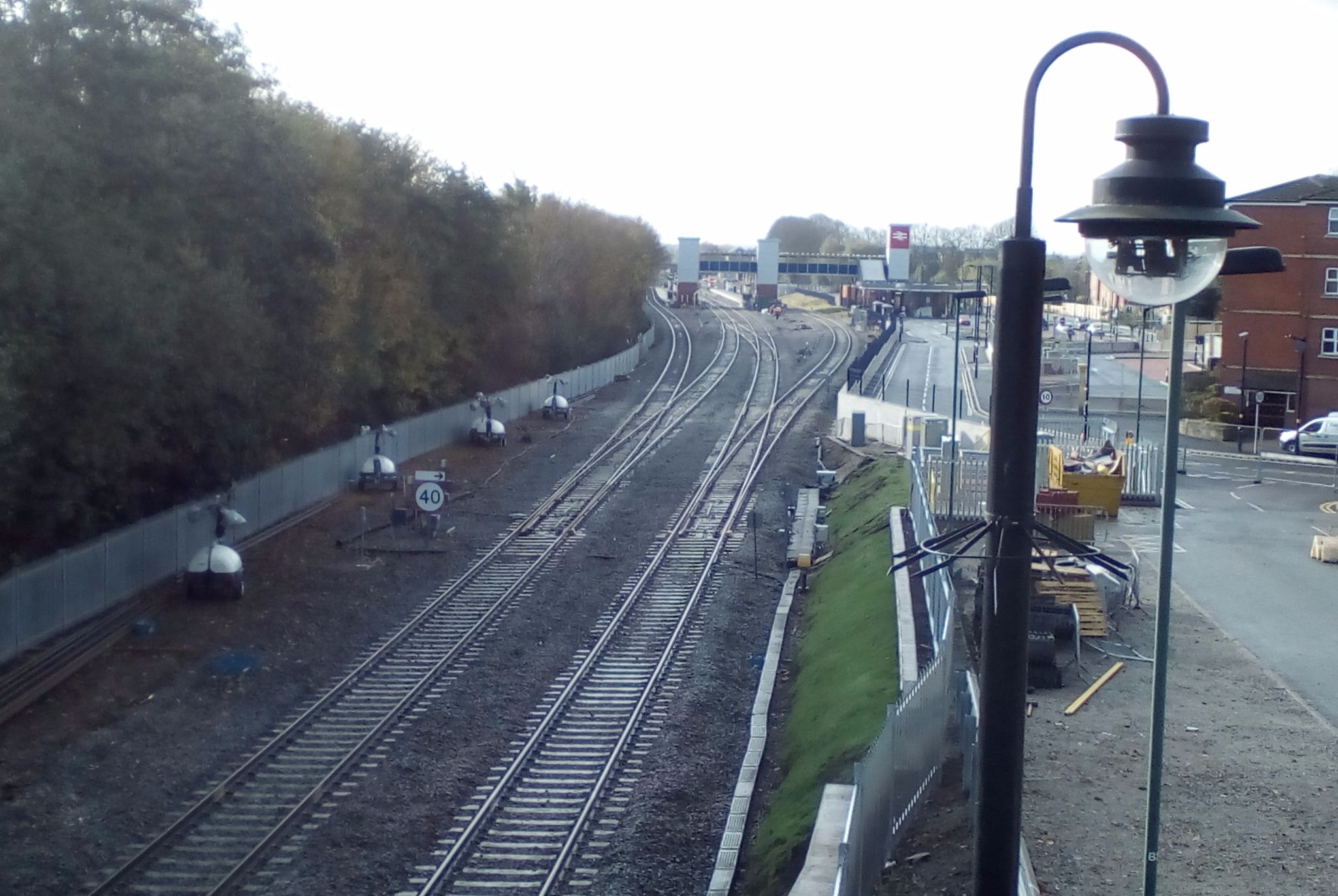
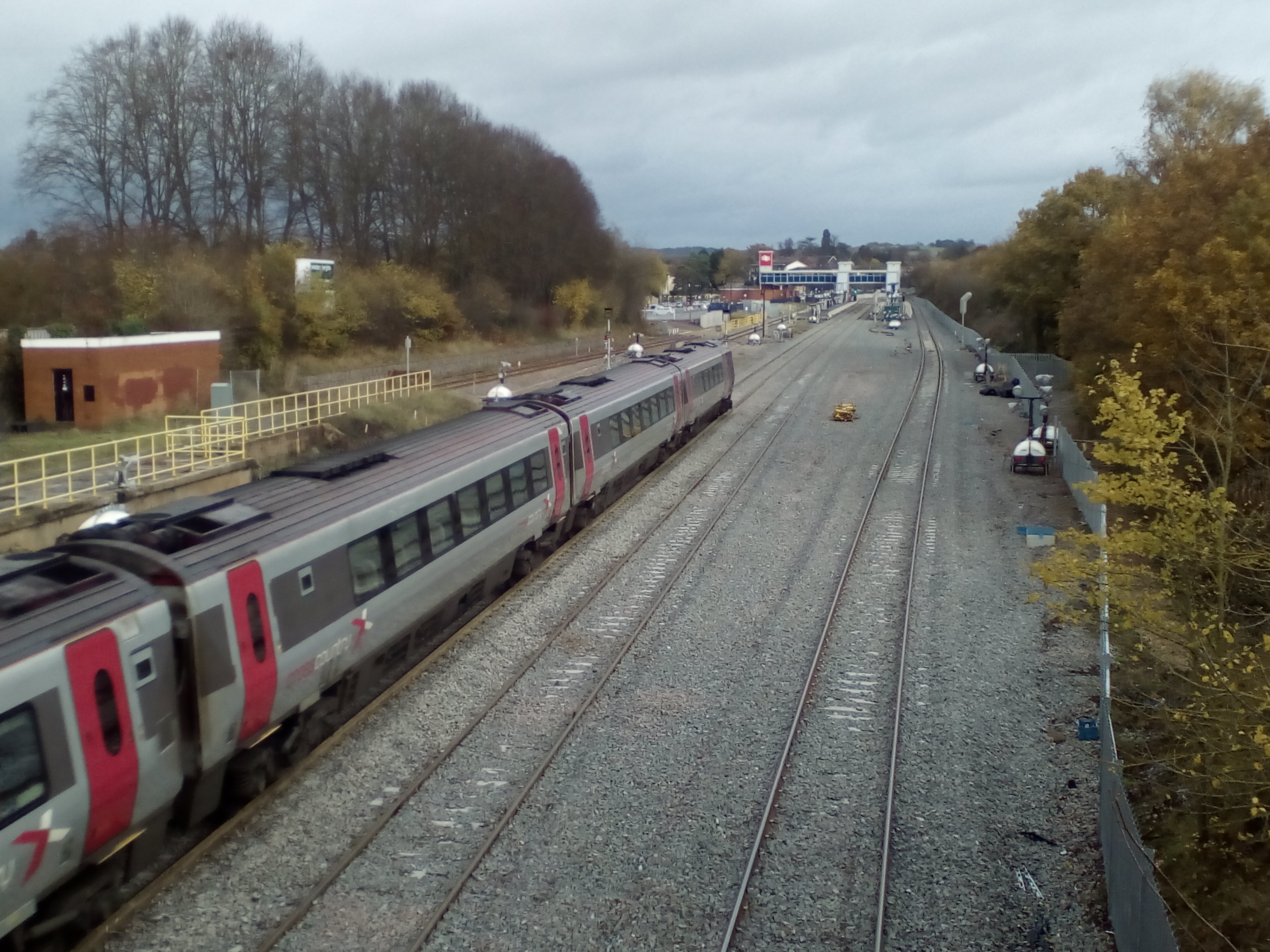
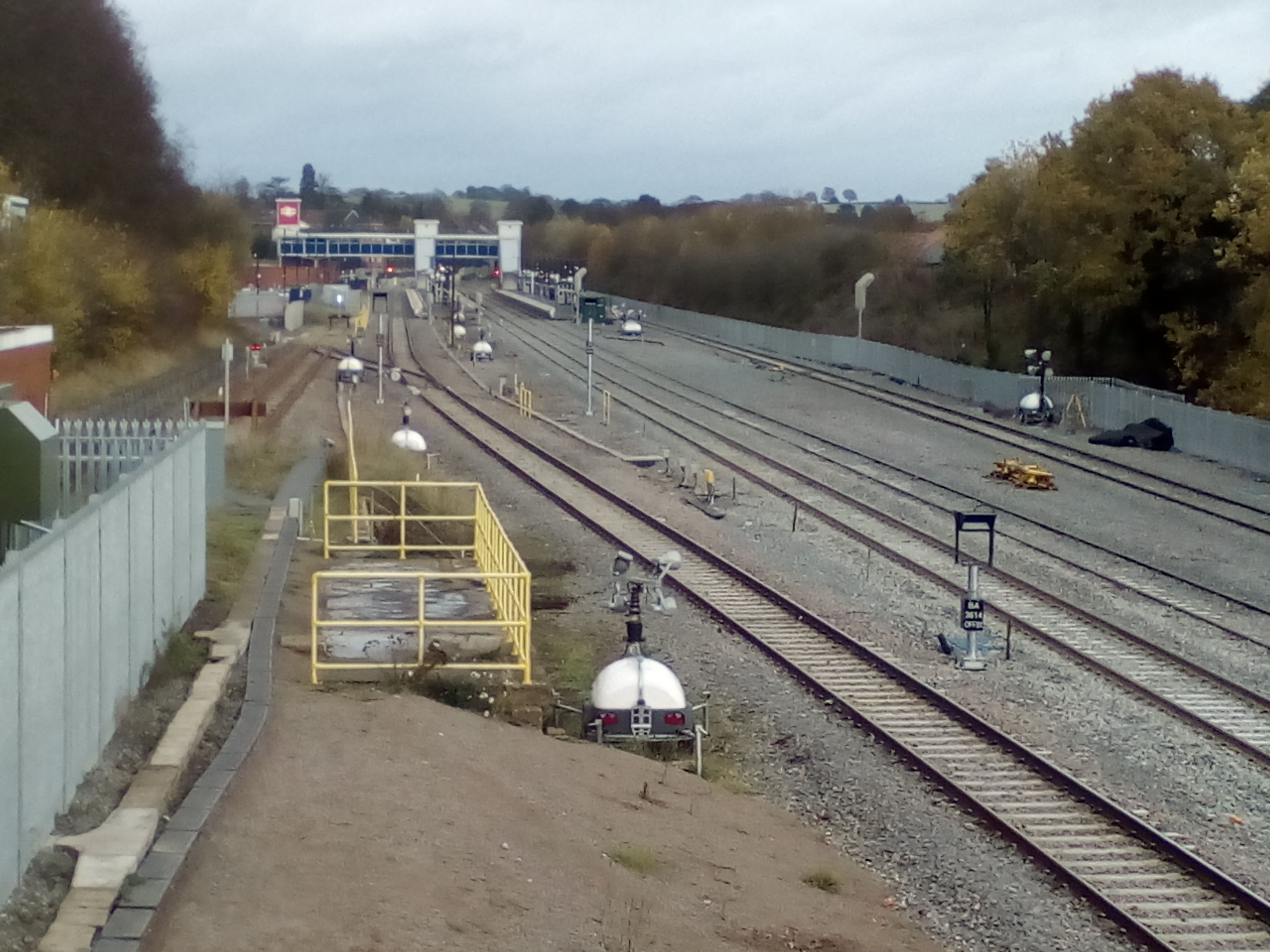
Much to my surprise, the new main down does in fact diverge from the old main down through the new Platform 4. You can see where that track was about to be laid in the photos above. And here is the track layout today. The old station was situated immediately below the bridge from where this photo was taken, looking south to the new station.

img_20161113_112359

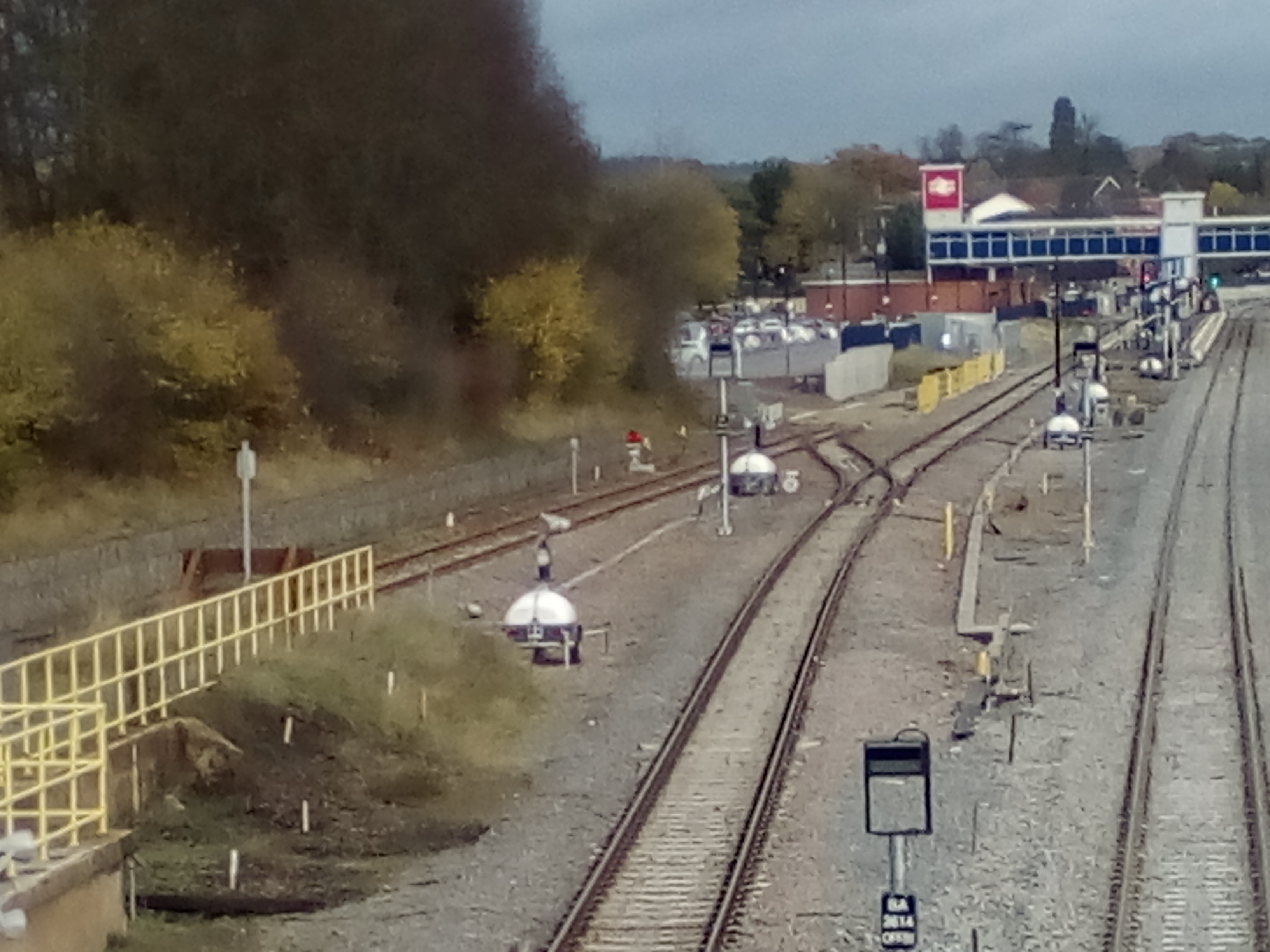
South of the station, looking north to the station, you can see the new track layout, with the new through down on the right.

img_20161116_113112

img_20161116_113200

img_20161128_113731

A down express passing at speed through the new Platform 4 loop

Just south of the station, and on the left of this photo is a small siding for ‘bankers’—locomotives that add power to freight trains waiting to climb the Lickey Incline. They sit at the rear and gives a well-deserved push. Here’s a video from YouTube that illustrates what I mean (before the new station was built and track layout changed. However, this freight train was waiting on the freight loop that has been realigned in the recent work).

Also, the freight loop, that passes through Platform 1, is on the left.

img_20161116_112926

img_20161116_113415


Update (5 October 2018)
Electrification finally came to Bromsgrove at the end of July 2018. There had been serious delays, and Bromsgrove commuters were becoming increasingly angry about the delays to their promised new services.

But the overhead wires were finally installed and went live at the end of May to permit testing of the new installations and driver training before the implementation of the new services. Over the next few weeks, empty trains passed between Birmingham and Bromsgrove.

Bromsgrove is now served by West Midlands Railway, and there are five trains an hour into Birmingham New Street at peak times. Some are Class 323 electric units on the Cross City Line (that now connects Bromsgrove with Lichfield to the north of Birmingham), others are the same old diesel-powered Class 170 units that connect Bromsgrove with Birmingham and Hereford.

As I mentioned earlier in this story when I posted it in August 2016, it was expected that the new electric units would power up the Lickey Incline faster¹ than the diesel ones. Two minutes faster in fact! That might not seem much, but with additional platforms at Bromsgrove to accommodate waiting trains, and faster trains clearing the Lickey Incline sooner, the through expresses are not affected, and more trains per hour can be run. Well, someone filmed the difference between the Class 323 and Class 170 trains; here is the video:


On political campaigns . . .

ballotbox copyI’m a bit of a news junkie, so I’ve been avidly following presidential election campaigns in three countries in online newspapers and on social media.

News from the US presidential election is never absent from the daily headlines, mainly because the two principal contenders on the Republican side, billionaire Donald Trump (or is that Donald Drumpf)¹ and evangelical Senator Ted Cruz, battling it out to win the nomination, increasingly descend to ever lower levels of political debate. Political debate? Their exchanges are not worthy of that epithet. Trump is hardly running an election campaign. I think it would be better to describe it as an election ego-trip.

You would hardly know there’s also an interesting contest on the Democrat side between former First Lady, New York Senator, and Secretary of State Hillary Clinton and Vermont Senator Bernie Sanders. At least they seem to be having a sensible debate.

The other campaigns that interest me are taking place in Peru in April, and in the Philippines in May. Why? Because I have lived and worked in both those countries.

Reading about the three campaigns, two quotations come to mind:

  • Toute nation a le gouvernement qu’elle mérite (Every nation gets the government it deserves) — attributed to Joseph de Maistre (1753 – 1821)
  • Democracy is being allowed to vote for the candidate you dislike least — Robert Byrne

Goodness knows what sort of campaign there will be in the US after the party conventions if Trump really does become the Republican candidate. He’s both scary and a worry. What will happen if he is ‘denied’ the nomination, and how will his supporters react. The violence we have seen so far directed by these folks against anti-Trump protesters does not bode well for the future.

But there are scary things going on in the Cruz camp as well. He is a right-wing evangelical Christian. And I’ve recently seen footage of him sharing the stage with a fundamentalist Christian preacher who, through his language was inciting Christians to violence, death even, against homosexuals. Because it says so in the Bible.

On the Democrat side, I’m actually surprised how well Bernie Sanders is doing, although I can’t believe he can win the nomination. Nor can I see a 74 year old candidate moving on to be a successful president.

In Peru and the Philippines, some of the candidates are as old as Sanders, but the political situation there is very different from the USA.

The polls in Peru seem to be dominated by Keiko Fujimori, daughter of the disgraced and gaoled former President Alberto Fujimori (who I met in the Philippines during his visit to IRRI). But Fujimori – daughter is also a controversial politician, believed to have benefited personally from her father’s corrupt government. Nevertheless, she is predicted to win the first round of voting. Another discredited candidate is the APRA former president Alan García who served two terms already (1985-1990, 2006-2011).

In the Philippines, which has a party system even weaker than that in Peru, the lists of candidates for both president and vice-president are filled with controversial characters. The posts of President and Vice-President are voted for separately (not as a single ticket in the USA), and it’s often the case that elected candidates come from different political persuasions and diametrically-opposed political platforms.

The current Vice-President Jejomar Binay heads yet another political dynasty, and has been accused of overwhelming corruption. The Mayor of Davao City (in Mindanao) Rodrigo Duterte has served his city for more than two decades, successfully apparently, and regarded as a political ‘hard man’. How a Duterte Administration would pan out nationally is anyone’s guess. Senator Miriam Defensor Santiago is an outspoken – and (formerly) popular – international lawyer who, once she had declared her candidacy (despite being near death’s door from Stage 4 lung cancer only a short time before), was thought to be well placed to win the presidency. Until, that is, she chose Senator Ferdinand Marcos, Jr. (aka ‘Bongbong’) as her running mate for vice-president. Son of former dictator Ferdinand Marcos (ousted in a popular uprising in 1986), Bongbong is widely regarded as corrupt and implicated in many of the worst human rights excesses of his father’s regime. Another, Senator Grace Poe, has had her candidacy questioned because of her nationality, having taken US citizenship at one time, which she has now renounced. Which leaves us with the ‘administration’ candidate and Secretary of the Interior and Local Government, Mar Roxas (a scion of yet another political dynasty). Is his wife Korina Sanchez a political liability??

So, in all three countries, the electorates are faced with choosing Presidents or Vice-Presidents from lists of some unsavory candidates, several of whom do not qualify (in my opinion) on ethical or moral grounds to ask for anyone’s vote, never mind political acumen or leadership potential, not even for the most humble elected post.

There will be bumpy political times and roads ahead in all three countries, whatever the election outcomes. Although not a General Election, we face an uncertain political (and economic) future here in the UK with the referendum on continuing membership of the European Union being held on 23 June. Political campaigning and false arguments have not brought out the best on either side of the referendum debate.

~~~~~~~~~~~~~~~~~~~~~~~~~~~~~~~~
¹ See the full 22 minute video here.

Nature abhors a vacuum . . .

PACIFIC_Royal.inddI’m thoroughly enjoying Simon Winchester’s Pacific – the Ocean of the Future (published in 2015 by William Collins, ISBN 978-0-00-755075-3), which I received for Christmas 2015. I already mentioned it in a recent post.

With a Prologue (The lonely sea and the sky), an author’s note (On carbon), and an epilogue (The call of the running tide), the chapters are ten essays on a range of topics about the Pacific Ocean, its geography, politics, and history since 1 January 1950 (Before Present):

  • Chapter 1: The great thermonuclear sea (all about the series of atomic bomb test at many locations in the Pacific in the 1950s)
  • Chapter 2: Mr Ibuka’s radio revolution (Sony and the transistor revolution)
  • Chapter 3: The ecstasies of wave riding (the rise of surfing culture, from Hawaii to California)
  • Chapter 4: A dire and dangerous irritation (North Korea)
  • Chapter 5: Farewell, all my friends and foes (the end of colonialism)
  • Chapter 6: Echoes of distant thunder (the Pacific and world weather)
  • Chapter 7: How goes the lucky country? (Australia)
  • Chapter 8: The fires in the deep (deep ocean exploration)
  • Chapter 9: A fragile and uncertain sea (climate change and other environmental challenges)
  • Chapter 10: Of masters and commanders (the emergence/resurgence of China)

It was Chapter 5 on the end of colonialism that fired the neurons in my brain, resurrecting several memories from the deep recesses of my mind. It began with an account of the Cunard ocean liner, RMS Queen Elizabeth and her demise after catching fire (in what appears to have been a deliberate act of sabotage) in Hong Kong harbor. The head of the company that had bought the QE, Tung Chee Hwa, became the first Chinese-appointed chief executive of the Hong Kong Special Administrative Region after the Union Jack was lowered on 30 June 1997 and British rule came to an end.

The essay in Chapter 6 described how the Pacific Ocean influences weather systems right across the globe. Pacific Ocean weather is something in both its glory and at its most ferocious I came to appreciate and experience during my 19 years in the Philippines.

But it was the tenth essay, about the geopolitics of the South China Sea, that made me sit up and really take notice. Hardly a week goes by without some report in the media about the territorial claims to the islands of and expansion into the South China Sea by the People’s Republic of China. Absurdly (but not obviously from a Chinese perspective) China has laid claim to almost all the South China Sea, riding roughshod over the legitimate (and, it has to be said, the conflicting claims of Vietnam, Philippines, Malaysia, Brunei, and Indonesia). But even a cursory glance at a map of the South China Sea shows just how outrageous China’s claims and actions are.

south-china-sea

China has even taken to building outposts on a number of islands, reefs and atolls, obviously destined to become military bases with sophisticated defences and airfields to take the biggest planes.

0,,18270383_303,00

Chinese claims
While China’s claims to the South China Sea stretch back to the end of the Second World War, it’s only in the past 25 years that this regional expansion has increased, and both the civil and military mobilized to achieve its aims. For the first time in 2006, evidence of China’s blue water navy aspirations and expanding naval capabilities was seen when a Chinese submarine sailed unnoticed within a few miles of a US carrier fleet. Over the years there have been a number of close encounters of the military kind. So far, both countries have managed to keep a lid on these confrontations escalating into a ‘shooting war’. But for how long?

Now, until I read Winchester’s account in Chapter 10, I had not put two and two together, even though I lived in the Philippines for almost two decades. Two events—one natural, one political—occurred in 1991, and subsequent analysis allows me to ask one of the important ‘What ifs’ of Southeast Asia history. As we approach the 25th anniversary of the Pinatubo eruption I’m just beginning to understand the inter-connectivity of the events of that year. Part of this will not make particularly comfortable reading for many Filipinos, I fear. Nevertheless it’s an interesting perspective on what events encouraged the Chinese to assert themselves as they have done, much to the chagrin of her neighbours. Not that China is concerned it seems, about their counter claims, or that much of the area they claim as sovereign territory is viewed as international waters or airspace. A UN international tribunal in The Hague, to which the Philippines had taken its case, ruled against China. But that will make no difference. China does not recognize the tribunal. Economic prowess and military might are what count.

The events of 1991
In 1991, Mt Pinatubo awoke from its slumber of many centuries, and erupted on 15 June in a climactic explosion, depositing ash over a huge area. This dire situation was further exacerbated because Typhoon Yunya (Diding in the Philippines) hit Luzon on precisely the same day. Within spitting distance of Pinatubo were located two of the US’s most important overseas military bases: Clark Field, nestling at the foot of the volcano near Angeles City, and Subic Bay, home to the US Seventh Fleet, and one of the most important naval facilities that the US had access to anywhere. As we approach the 25th anniversary of the Pinatubo eruption I’m just beginning to understand the inter-connectivity of different events of that year.

Mt Pinatubo (from Clark Air Base) erupting on 12 June 1991, three days before the climactic eruption that led to the abandonment of the airbase in November that year.

At Clark it became clear within a day or two of the eruption, and covered in feet of volcanic ash, that the airbase would have to be abandoned. Aircraft had been flown out beforehand and personnel successfully evacuated to Subic. In November 1991 the US Air Force closed Clark¹.

At the end of 1991 there was perhaps an even more event, political this time, that has perhaps contributed more to the present South China Sea situation than the Pinatubo eruption ever did. In an increasingly nationalistic Senate, the future of an American presence in the Philippines was being debated. The Senate rejected a treaty that would have extended use of Subic Bay because of concerns over the presence of nuclear weapons (which the US would not reveal). Finally at the end of December 1991, the then president Cory Aquino informed the US government that US forces would have to leave the Philippines by the end of 1992. The US Navy pulled out in November 1992.

And into the vacuum left by the US departure cleverly stepped the Chinese, sensing the opportunity to fulfill their long-standing regional geopolitical ambitions. The rest is history; the Chinese are now well and truly entrenched in the South China Sea, and will not be easily budged. There is, however, another interesting twist to the story. In January 2016, the Philippines Supreme Court approved the return of US troops to bases in the Philippines, as a counter to Chinese expansionism in the South China Sea. What goes around comes around?

What if?
What if Pinatubo had never blown her top on that fateful June day in 1991? What if the US had been more forthcoming about the status of nuclear weapons during the finely balanced base renewal negotiations in 1991? What if the Philippines Senate had not openly expressed its rejection of the treaty in a display of anti-colonialism? What if the US navy had never left?

Would the Chinese have been off the mark with such alacrity, developing its own blue water navy, and (with contempt, many would say) revealing its true regional hegemonic ambitions? Nature abhors a vacuum, as they say. The Chinese have been only too happy to fill the military vacuum.

Let us hope that the war of words being fought over the South China Sea never evolves into a ‘hot war’. Notwithstanding Chinese intransigence and, it has to be said, overt hostility at times, it may depend in some degree on who occupies the White House after next November’s presidential election in the US. The jingoistic foreign policy rhetoric of a couple of the Republican candidates does not give me much cause for optimism.

~~~~~~~~~~~~~~~~~~~~~~~~~~~~~~~~~~~
¹ In the intervening years, it should be noted, Clark has been refurbished and reopened as Clark International Airport. Were it closer to Manila, and connected with better transport links, Clark could well have become Manila’s principal airport, relieving congestion at the Ninoy Aquino International Airport, close-by Manila’s business district of Makati.

‘Leave’ is not in my vocabulary . . .

uk-and-eu

Should the United Kingdom remain a member of the European Union or leave the European Union?

That will be the question (approved by Parliament) that the British electorate will be asked in a ‘once in a generation’ referendum on our membership of the European Union (EU) on Thursday 23 June later this year.

And my response?

voteI’m 67 years old. I’ve been a proud ‘European’ much longer than not, since Edward Heath took the UK into the European Economic Community (EEC) in January 1973. In fact, half the UK population has only ever experienced life as a UK member of the EEC or its successors, the European Community (EC) and, since 2009, the European Union.

Has that diminished my pride in being a UK national. I don’t feel that I have lost anything of my Britishness by also being part of the EU. In fact, I believe that our nation has been enhanced by being a member of the EU.

Don’t get me wrong. I’m no apologist for the EU. The workings of the Commission, and the seemingly endless stream of directives and regulations—not, by any stretch of the imagination, always clear or even necessary perhaps—have built up a legacy of resentment. Not just in the UK but in other member countries.

But I do feel that after more than four decades our place should remain in Europe. It’s not just about safety and security. The economic considerations are enormous. And although the referendum campaign is less than two weeks old, I’m already annoyed by the ‘Leavers’ continually claiming that the ‘Remainers’ are using scare tactics. The Leavers—latter-day Creationists—are asking to take a leap of faith that the other 27 countries of the EU (after a departure of the UK) would bend over backwards to accommodate us. Pie in the sky, in my opinion. Is it scare tactics to insist they clarify what would be the actual consequences of leaving the EU?

I certainly support the BRITAIN STRONGER IN EUROPE campaign.

stronger

Environmental and human rights are stronger by being a member of the EU. One of the more powerful arguments I heard on the radio recently was by Frances O’Grady, General Secretary of the Trades Union Congress who stated that workers’ rights in the UK were stronger because of our EU membership. Would these be eroded if the UK left the EU? Almost certainly, given the overall policy perspectives of this Conservative government. Furthermore, the immigration and benefits arguments are overplayed, and represent a minuscule cost apparently compared to the overall economic status of the country. Given the political focus on immigration by UKIP and others I fear the referendum is taking on an unsavory perspective.

Our science base is stronger by being a member of the EU, a position supported by many of the most distinguished British scientists. We relinquish science funding and easy collaboration through the EU at our peril.

scientists for EU

But perhaps this whole EU Referendum has more to say about the state of the Conservative Party—which is hopelessly split (and may not recover whichever way the referendum goes)—and the jockeying for power among politicians (including failed ones like Ian Duncan-Smith) with super egos, or foolish individuals like Nigel Farage. I just wish that those on the Remain side in the Conservative Party would also make their arguments from a positive standpoint, as well as demanding the Leave side clarify what OUT would really look like. As for the Labour Party, even though it is almost unanimous in its support for the Remain campaign, I despair of Jeremy Corbyn. What a lacklustre leader! He needs to be out there campaigning actively for continuing EU membership.

Whatever arguments are put forward, and however hard the Leave campaign might try to persuade me otherwise, I’m definitely . . .

IN

. . . and, rather than carping from the sidelines (a ‘tradition’ of successive governments over the decades) we will need a UK government (of whatever persuasion) as an active member of the EU, working positively on the inside, delivering liberal doses of British pragmatism to bring about the real reforms that will benefit all member states.

I really hope that the UK will, after 23 June, still be one among 28. If we vote to leave the EU, I fear that we might end up a lonely and increasingly insignificant small island looking longingly at what might have been. That’s not a prospect I relish during this next stage of my life.


Thank you Science!

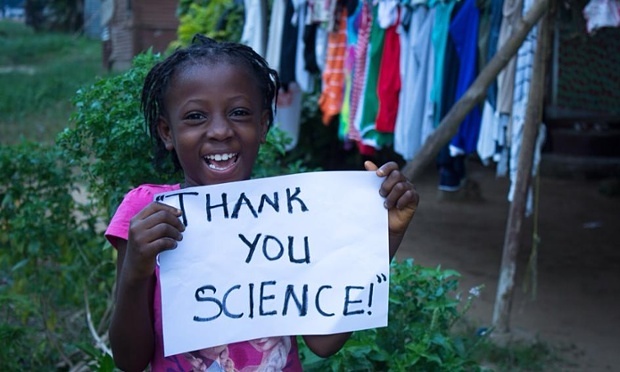
Last Monday (3 August) I came across an interesting article in The Guardian newspaper here in the UK. It was all about the success—or so it would seem—in developing a vaccine against the Ebola virus, the deadly pathogen that hit three countries in West Africa so dramatically over the past year. In particular, one photo caught my eye, which I have included below (and I hope no-one from The Guardian nor the photographer objects).

801de426-aa9e-476f-b100-b9e58614d838-620x372

From The Guardian 3 August 2015: Six-year-old Cecilia Kamara from Robertsport, Liberia holds up a sign after receiving news about the Ebola vaccine. Photograph: Alphanso Appleton

The development of this Ebola vaccine depended on rigorous scientific research and testing, and a little serendipity and luck as well in some cases. Isn’t science wonderful?

Not a scientist?
So it must come as a bit of surprise if I declare, here and now, that I never aspired to become a scientist, even though that’s what I spent more than 40 years doing. As a youngster, I was never enthralled by the moon and stars; dinosaurs didn’t pique my interest. On the other hand, I was quite a keen bird watcher, and had a general interest in nature and conservation. So while I ended up taking a science degree at the University of Southampton, I guess it could have gone the other way and I might have studied humanities instead. And that’s especially so given my deep interest in history over the past decade or so. I have even considered taking a history degree at the Open University in retirement, but have consigned that to the realm of fantasy. I don’t think I could take the discipline of formal study once again.

Paul Nurse has a passion for science
I can’t complain, however. Science gave me a good career and living, but I never developed a passion for it as described by Nobel laureate and President of the Royal Society, Sir Paul Nurse, in the BBC’s Richard Dimbleby Lecture in 2012. It’s really worthwhile persevering for the whole 45 minutes as Nurse delivers a most erudite analysis (without referring to notes at any point) of the importance and relevance of science to and for society.

There’s much of what Sir Paul describes that I can empathize with. After all, my own work on the conservation and use of plant genetic resources was a contribution to so-called ‘Green Revolution’ agricultural research aimed at improving the livelihoods of poor farmers around the world and the hundreds of millions of poor who depend on staple crops for their daily well-being.

Did I do good science?
Only my peers can confirm that. I think I did some competent science that was successfully submitted for publication in internationally-recognized journals. There was nothing I did that was ground-breaking science. But in terms of my contributions to agricultural research, I like to think that fewer people went to bed hungry each night because of the research I had contributed. Managing the world’s largest collection of rice genetic resources in the International Rice Genebank, not only did we study the nature and scope of genetic variation in rice, but we also aimed to enhance the long-term survival of rice seeds in cold storage. The submergence tolerant varieties of rice developed by IRRI in partnership with scientists at the University of California, and now released throughout Bangladesh and India are already enhancing the productivity of rice farming. Several rice germplasm accessions tolerant of complete transient submergence are safely conserved in the International Rice Genebank Collection.

Research management
I felt much more comfortable as a research manager, with a team of much more competent and talented colleagues. My role was to develop a broad perspective on research needs, and prioritize which research to undertake. And to provide a research environment where my colleagues could be productive to the best of their abilities. I think that’s where my forte lay.

Design, luck, or serendipity?
Nevertheless, there are several things I was directly involved with, or decisions made, which merit some highlighting, with serendipity playing a significant role. As Sir Paul Nurse pointed out, it’s up to the scientist to recognize the significance of—and then exploit—observations and discoveries made.

My work on bacterial wilt of potatoes at the International Potato Center (CIP) in Costa Rica depended on recognizing the significance of diseased plants in a field trial that was set up originally to test potato varieties for adaptation to warm and humid climates. Having identified ‘resistant‘ plants, as well as the importance of the field testing site, we went on to establish the importance of a particular variety (Cruza 148) that went on to become one of the most important in East Africa.

In work at the University of Birmingham, with my colleagues Professor Brian Ford-Lloyd and Dr Susan Juned, we discovered differential responses of cv. Record clones in terms of somaclone production. But that wouldn’t have been possible had we not taken a simple decision from the outset to number each stock tuber individually, and all the somaclones selected from each.

The application of molecular biology to study germplasm collections has come a long way since a PhD student of mine, Adi Damania, published a paper in 1983 using RAPD markers with wheat and barley landraces. Then, with colleagues at The University of Birmingham (Dr Parminder Virk, Brian, and Professor John Newbury – now at the University of Worcester), we published in 1995 one of the first—if not the first—paper on association genetics, based on studies of accessions in the International Rice Genebank Collection.

The experience of years
I’d like to think that the books I’ve written or edited have also contributed in some way to the discussion about the value of genetic resources and their importance as the planet faces the threat of climate chnage. And some of our thinking goes back to 1989 when the whole idea of climate change was far more contentious than today (unless you’re a Republican presidential hopeful).

The value of research metrics?
Some research has an impact, benefits society directly, other research is much longer-term. How can this be valued? Well, there’s a plethora of metrics to assess the value of published research such as citation indices, and others that frankly I don’t understand the meaning of or how they are calculated and applied. Journals have a so-called ‘Impact Factor’, and there’s great pressure on researchers to publish in high impact journals. Fortunately I never had to worry about these things when I worked at The University of Birmingham in the 1980s, and it was never raised as an issue when I was with IRRI. But there is growing concern about the use—and misuse—of research metrics, as highlighted in a recent article in The Guardian newspaper.

When I was teaching at The University of Birmingham in the 1980s, a monthly bulletin, Teaching News, was circulated to staff, by the School of Education, I believe. There was one article I remember quite vividly discussing the use and misuse of citation indices. Crude numbers don’t tell you anything. And to emphasize the point further, the article went on to compare two articles with very different citation indices. One, with a low index, was a piece of eminent scholarship about rural communities in South Wales, but cited infrequently simply because sociological studies in this field were not frequent. The other, in the crowded field on the rise of Naziism, had a very high index, because it had been cited so often—but mainly in a negative way.

I also saw something from IRRI the other day stating that the ORYZA2000 model had been cited more than 16,000 times in scientific publications. I’m sure most of those citations do reflect a meaningful application of the model, but it would be interesting to see beyond the raw metric.

Science should never be kept in the closet. Knowledge increases as ideas are shared, tested, and accepted or rejected in the course of scientific exploration. While I may not have been a dedicated scientist per se, I can also say “Thank you Science!” It was fun while it lasted.


“Education isn’t what you learn, it’s what you do with what you learn.” Anon.

degreeThere’s been quite a bit in the news again recently about the value of a university education, after George Osbourne, the UK’s Chancellor of the Exchequer, announced the scrapping of maintenance grants from the 2016/17 academic year. From that date, grants will be replaced by loans, adding yet further to the financial loan burden that university students are already facing to pay their tuition fees through loans. These financial challenges are making some (or is it many?) prospective students question whether they really do want or need a university education. Add to that the pressure on prospective students to study a subject that ‘should contribute’ more effectively to society and the economy, it’s no wonder that students are beginning to have second thoughts about going to university.

Also, with the publication of this year’s university exam results, the issue of grade creep is once again on the political agenda, since more than 50% of all students have graduated with a so-called ‘good’ degree. In the UK, this is a First or Upper Second (2:1) Class degree.

So why have these issues now attracted my attention?

Life on the south coast
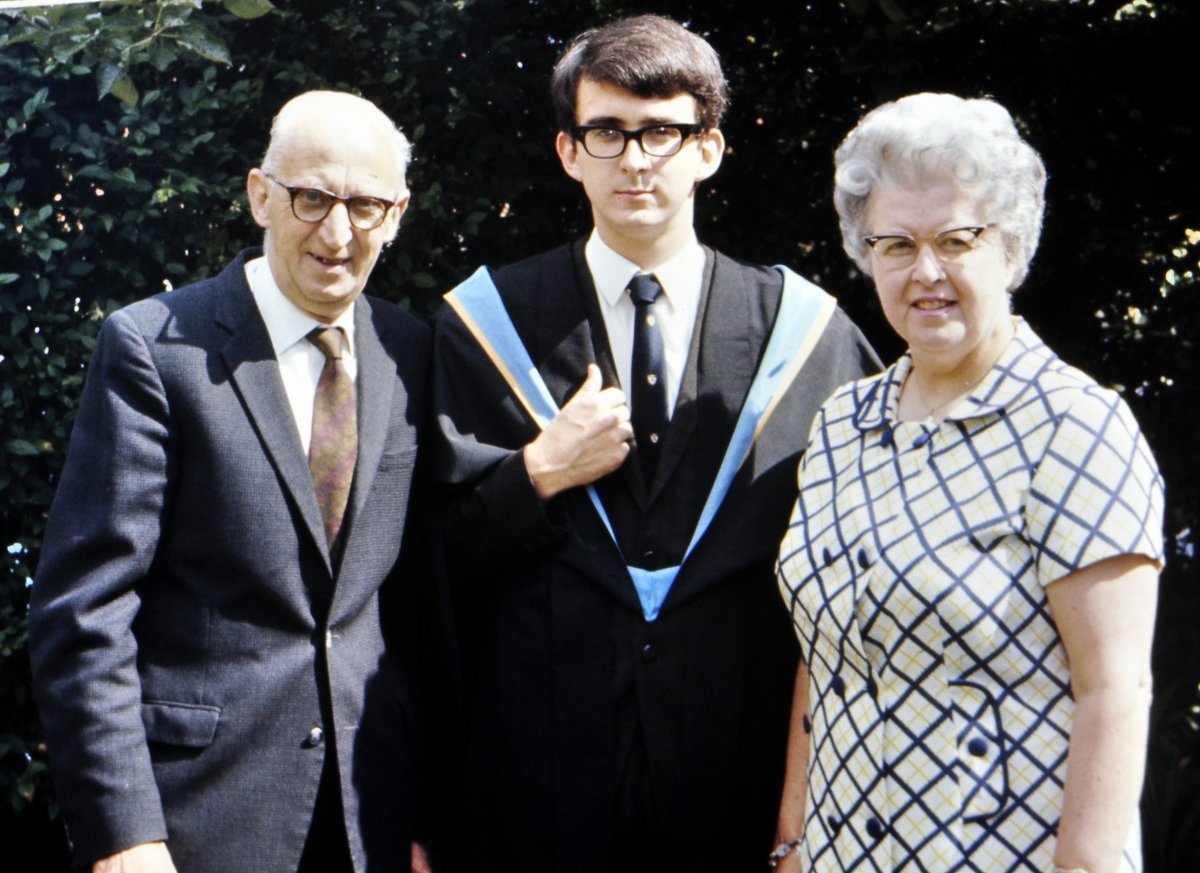
Early July 1970. Forty-five years! It’s hard to believe. Yes, it’s forty-five years since I graduated from the University of Southampton with a BSc degree (not a very good one, I’m afraid) in Environmental Botany and Geography. There again, no-one in my year gained a First in botany, only a couple in geography. They didn’t hand out many top degrees in those days. More than 70% of students today are awarded a First or Upper Second. What is interesting from my point of view is during my high school years, going to university was not a foregone conclusion, or even an expectation for that matter. However, a university education was something that my post-war generation did begin aspire to. I was only the second person in my family to attend university.

55 Ed & Mike

Graduation Day, July 1970 at the University of Southampton, with my Mum and Dad, Lilian and Fred Jackson. Was I ever that young looking?

Now, although I didn’t exactly excel academically at Southampton, I wouldn’t have traded those three undergraduate years for anything. Some of the best years I have ever spent. Ah, the enthusiasm of youth. Did I ever have second thoughts? Never. I was extremely fortunate that my parents were very supportive, even though it must have been hard financially for them at times. My elder brother Ed had (in 1967) just graduated from the London School of Economics (with a First in geography) when I started at Southampton. So my parents were faced with another three years of support, even though my tuition fees were paid by the state, and I did receive a maintenance grant which Mum and Dad had to top up.

I guess I was lucky that Southampton took me in the first place, and didn’t throw me out after my first year. I never was very good at taking exams, well not in those school and undergraduate years. I only found my métier once I’d moved on to graduate school in 1971.

I went for an admissions interview at Southampton in early 1967 and immediately knew that this was where I wanted to study at, if they offered me a place. So once I received the results from my high school A-level exams (in biology, geography, and English literature, but not quite what I’d hoped for, grades-wise) I was on tenterhooks for a couple of weeks waiting for a response from the university. I was earning some cash, working as a lorry (truck) driver’s mate for a company based in Leek called Adams Butter. We delivered processed butter to retail outlets all over the UK, often being away from home for several nights at a stretch. Then once we delivered our load of about 25 tons of butter, we would head to the nearest port to pick up another 25 tons of Australian or New Zealand ‘raw’ butter, in large 56 lb frozen packs. I soon got fit throwing those boxes around.

Anyway, to cut a long story short, I arrived back at the depot after a long day on the road, and my father had kindly left a brief message with the dispatcher on duty: “Southampton wants you!” Obviously elated, I began to make plans to start my university life in October. The rest is history.

Back to the Midlands
Having graduated, I still didn’t know what the next stage of my life held. I’d applied to The University of Birmingham for a place on its newly-established MSc course Conservation and Utilization of Plant Genetic Resources in the Department of Botany. In February 1970 I’d been interviewed by course director Professor Jack Hawkes, and was offered a place, but with no guarantee of any financial support. It wasn’t until mid-August that I received a phone call confirming that he had been able to secure a small maintenance grant (just over £6 a week for the whole year, equivalent to about £80 a week today) and payment of my tuition fees. Undaunted at the prospect, I quickly accepted. And what a joy studying at Birmingham was. I certainly found an area of plant sciences that I could really immerse myself in, the staff were (on the whole) inspiring (particularly Trevor Williams with whom I completed my thesis), and I knew that I’d made the right choice.

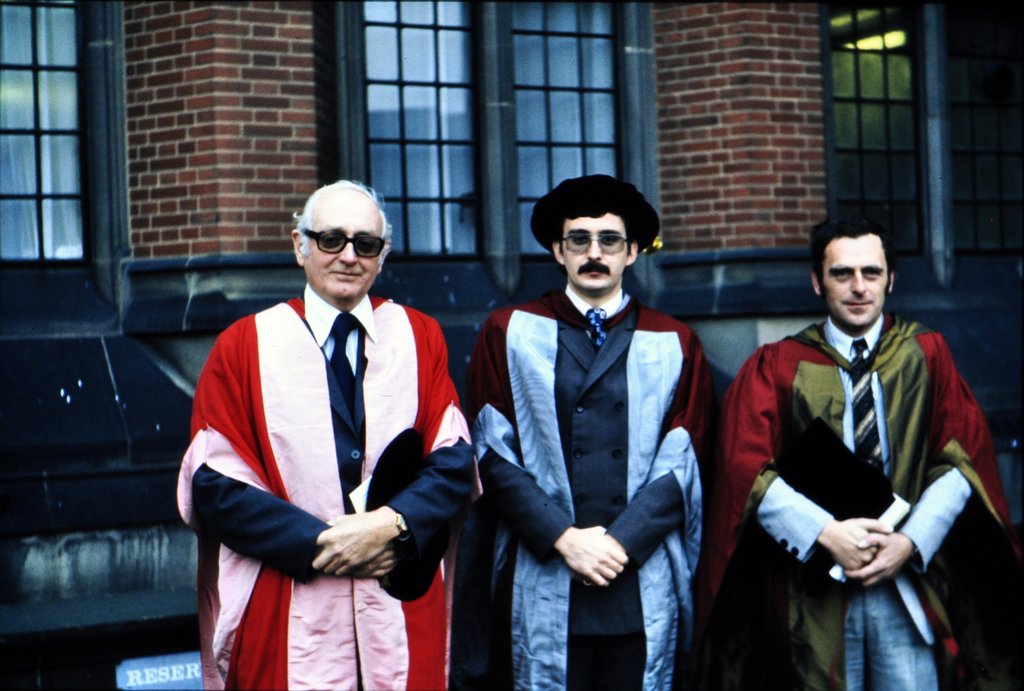
But still there was no guarantee of gainful employment in my chosen field. That is until Jack Hawkes invited me to consider a one-year position in Peru. As things turned out, I did make it to Peru, registered for a PhD (which I completed in 1975), and made a career for myself in international agricultural research and academia. I received my degree from the Chancellor of the University, Sir Peter Scott, renowned ornithologist and conservationist, and son of ill-fated Antarctic explorer, Captain Scott at a graduation ceremony at the University of Birmingham on 12 December 1975.

20 Ed & Mike

Graduation on 12 December 1975, with Professor Jack Hawkes on my right, and Dr Trevor Williams on my left. I’m with my Mum and Dad in the two photos above.

Was it worth it?
When I decided to study botany at university I had no idea whether this would lead to a worthwhile career. Actually, it was not something I considered when applying. I just knew I wanted to study plants and geography, and then I’d see what life had in store for me afterwards, assuming I did actually graduate.

Steph studied botany at Swansea University (BSc 2:1), and we met at Birmingham when she studied for her MSc (also in genetic resources conservation) in 1971-72.

1972 002 Steph MSc

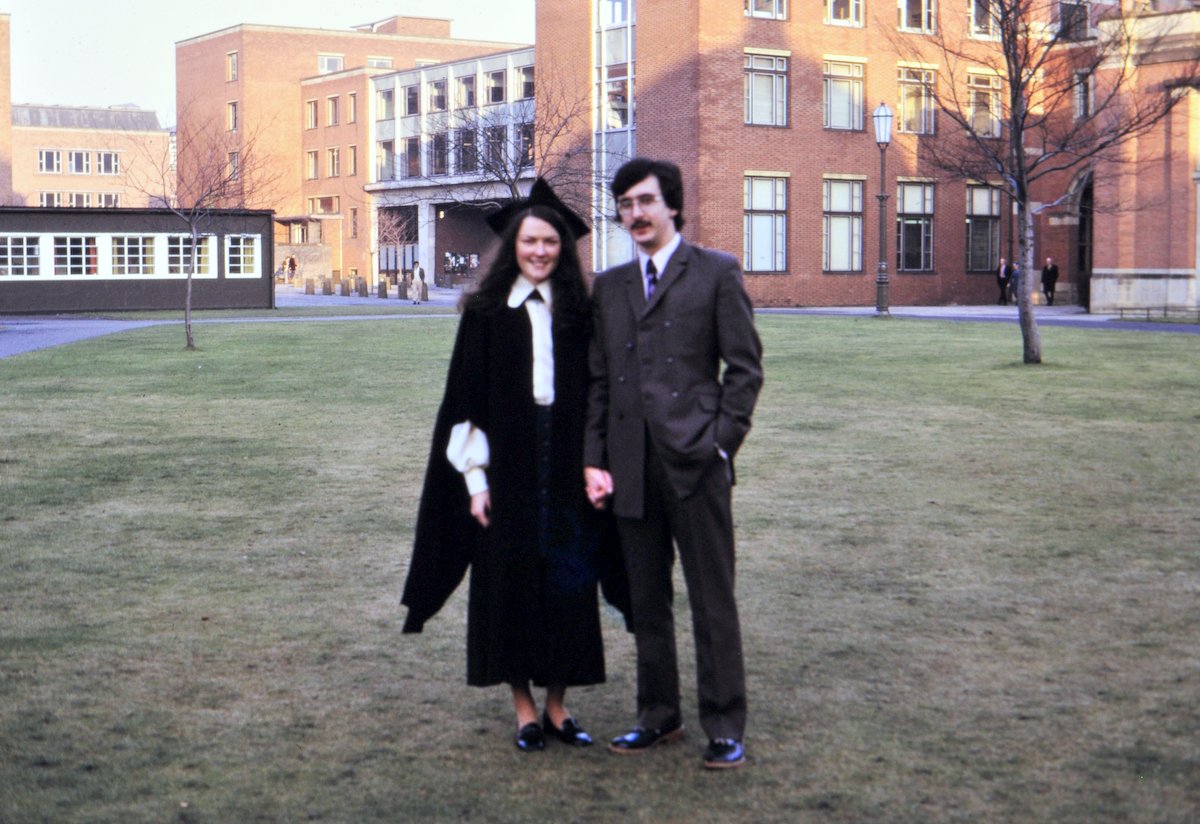
Steph’s MSc graduation in December 1972. This was about three weeks before I headed off to Peru. Steph joined me there in July 1973, and we were married in Lima in October that same year. We both had considerably longer hair then – and darker!

I think there was more expectation that our daughters, Hannah and Philippa, would go on to university, from our point of view and theirs. Indeed, having had the advantage of attending an international (and quite competitive) school in Manila, and studying for the International Baccalaureate diploma, university was the logical next step. And they both chose psychology (with an anthropology minor)—it wasn’t planned that way, that’s how it turned out.

Hannah originally started her university years at Swansea University in 1996, but after two years she transferred to one of the top liberal arts colleges in the USA: Macalester College in St Paul, and graduated BA summa cum laude in 2000 (left below, with the gold tassel). She then went on to the University of Minnesota to complete her PhD in industrial and organizational psychology in September 2006 (right below).

Philippa joined Durham University in 2000, and graduated in 2003 with her BSc (2:1) Honours degree (left below). After spending a year in Canada, she returned to the UK in 2004 and spent six months of more searching for a job. Eventually she secured a Research Assistantship in the Brain, Performance and Nutrition Research Centre at Northumbria University in Newcastle upon Tyne. After a couple of years she decided to register for a PhD and she was awarded her doctorate in December 2010 (right below).

So we’ve all benefited from having attended university, and have gone on to have successful careers. But I still believe it was the overall experience of university life as much as the academics that contributed those benefits. Unlike students today, we were fortunate not to have racked up significant debts while studying, and already Hannah and Philippa and their spouses are making plans for college education for their children—should they opt to follow that option.

I think the words of Cardinal John Henry Newman (1801-1890) are appropriate and as good today as when he wrote them in his essay ‘The Idea of a University’ in 1852: If then a practical end must be assigned to a University course, I say it is that of training good members of society… It is the education which gives a man a clear, conscious view of their own opinions and judgements, a truth in developing them, an eloquence in expressing them, and a force in urging them. It teaches him to see things as they are, to go right to the point, to disentangle a skein of thought to detect what is sophistical and to discard what is irrelevant.

I’m not sure that we do achieve those lofty ideals today as perhaps they aspired to in Newman’s day. There are just so many students moving through the system, the pressures to achieve are greater. While I was teaching at The University of Birmingham (for a decade in the 1980s) I became even more convinced that a university education is, in itself, worthwhile. This is often the first time that a young person leaves home, and has the opportunity to grow up away from the ever-watchful eyes of parents. Not everyone takes to university it must be said. But I think the majority who do make it to university would agree that, just like me, the three years they spend studying—and playing—are not three years wasted. It also makes it especially worrying that politicians are increasingly threatening the very existence and roles of universities, as is happening, for example, in a high profile way at the University of Wisconsin.

Don’t put all your eggs in one basket . . . or your seeds in a single genebank

On 20 May 2015, a long article was published in The Guardian about the Svalbard Global Seed Vault (SGSV), popularly—and rather unfortunately—known as the ‘Doomsday Vault’. I’ve recently been guilty of using that moniker simply because that’s how the vault has come to be known, rightly or wrongly, in the media.

Authored by US-based environment correspondent of The Guardian, Suzanne Goldenberg, the article had the headline grabbing title: The doomsday vault: the seeds that could save a post-apocalyptic world.

You get a flavor of what’s in store, however, from the very first paragraph. Goldenberg writes: ‘One Tuesday last winter, in the town nearest to the North Pole, Robert Bjerke turned up for work at his regular hour and looked at the computer monitor on his desk to discover, or so it seemed for a few horrible moments, that the future of human civilisation was in jeopardy.’

Turns out there was a relatively minor glitch in one of the supplementary cooling systems of this seed repository under the Arctic permafrost where millions of seeds of the world’s most important food staples and other species are being stored, duplicating the germplasm conservation efforts of the genebanks from which they were sent. Hardly the stuff of Apocalypse Now. So while making a favorable case for the need to store seeds in a genebank like the Svalbard vault, Goldenberg ends her introduction with this somewhat controversial statement: ‘Seed banks are vulnerable to near-misses and mishaps. That was the whole point of locating a disaster-proof back-up vault at Svalbard. But what if there was a bigger glitch – one that could not be fixed by borrowing a part from the local shop? There is now a growing body of opinion that the world’s faith, in Svalbard and the Crop Trust’s broader mission to create seed banks, is misplaced. [The emphasis in bold is mine.] Those who have worked with farmers in the field, especially in developing countries, which contain by far the greatest variety of plants, say that diversity cannot be boxed up and saved in a single container—no matter how secure it may be. Crops are always changing, pests and diseases are always adapting, and global warming will bring additional challenges that remain as yet unforeseen. In a perfect world, the solution would be as diverse and dynamic as plant life itself.’ 

I have several concerns about the article—and the many comments it elicited that stem, unfortunately, from lack of understanding on the one hand and ignorance and prejudice on the other.

  • Goldenberg gives the impression that it’s an either/or situation of ex situ conservation in a genebank versus in situ conservation in farmers’ fields or natural environments (in the case of crop wild relatives).
  • There is a perception apparently held by some that the development of the SGSV has been detrimental to the cause of in situ conservation of crop wild relatives.
  • Because there is no research or use of the germplasm stored in the SGSV, then it only has an ‘existence value’. Of course this does not take into account the research on and use of the same germplasm in the genebanks from which it was sent to Svalbard. Therefore Svalbard by its very nature is assumed to be very expensive.
  • The role of Svalbard as a back-up to other genebank efforts is not emphasized sufficiently. As many genebanks do not have adequate access to long-term conservation facilities, the SGSV is an important support at no cost directly to those genebanks as far as I am aware. However, Svalbard can never be a panacea. If seeds of poor quality (i.e less than optimum viability) are stored in the vault then they will deteriorate faster than good seeds. As the saying goes: ‘Junk in, junk out’.
  • The NGO perspective is interesting. It seems it’s hard for some of our NGO colleagues to accept that use of germplasm stored in genebanks actually does benefit farmers.Take for example the case of submergence tolerant rice, now being grown by farmers in Bangladesh and other countries on land where a consistent harvest was almost unheard of before. Or the cases where farmers have lost varieties due to natural disasters but have had them replaced because they were in a genebank. My own experience in the Cagayan valley in the northern Philippines highlights this very well after a major typhoon in the late 1990s devastated the rice agriculture of that area. See the section about on farm management of rice germplasm in this earlier post. They also still harbour a concern that seeds in genebanks are at the mercy of being expropriated by multinationals. In the comments, Monsanto was referred to many times, as was the issue of GMOs. I addressed this in the comment I contributed.

I added this comment that same day on The Guardian web site:
‘For a decade during the 1990s I managed one of the world’s largest and most important genebanks – the International Rice Genebank at the International Rice Research Institute (IRRI) in the Philippines. Large, because it holds over 116,000 samples of cultivated varieties and wild species of rice. And important, because rice is the most important food staple feeding half the world’s population several times daily.

The Svalbard Global Seed Vault (SGSV), the so-called ‘Doomsday Vault’ in Spitsbergen, holds on behalf of IRRI an almost complete duplicate set of samples (called ‘accessions’), in case something should happen to the genebank in Los Baños, south of Manila. I should add that for decades the USDA has also held a duplicate set in its genebank at Fort Collins in Colorado, under exactly the same ‘black box’ terms as the SGSV.

Germplasm is conserved so that it can be studied and used in plant breeding to enhance the productivity of the rice crop, to increase its resilience in the face of climate change, or to meet the challenge of new strains of diseases and pests. The application of molecular biology is unlocking the mysteries of this enormous genetic diversity, making it accessible for use in rice improvement much more efficiently than in past decades.

Many genebanks round the world and the collections they manage do not have access to long-term and safe storage facilities. This is where the SGSV plays an important role. Genebanks can be at risk from a whole range of natural threats (earthquakes, typhoons, volcanic eruptions, etc.) or man-made threats: conflicts, lack of resources, and inadequate management that can lead to fires, flooding, etc. Just take the example of the International Rice Genebank. The Philippines are subject to the natural threats mentioned, but the genebank was designed and built to withstand these. The example of the ICARDA genebank in Aleppo highlights the threat to these facilities from being located in a conflict zone.

To understand more about what it means to conserve a crop like rice please visit this post on my blog.  There is an enlightening 15 minute video there that I made about the genebank.

It is not a question of taking any set of seeds and putting them into cold storage. Only ‘good’ seeds will survive for any length of time under sub-zero conditions. Many studies have shown that if stored at -18C, seeds with initial high viability may be stored for decades even hundreds of years. The seeds of many plant species – including most of the world’s most important food crops like rice, wheat, maize and many others conform to this pattern. What I can state unequivocally is that the seeds from the genebanks of the world’s most important genebanks, managed like that of IRRI under the auspices of the Consultative Group on International Agricultural Research (CGIAR), have been routinely tested for viability and only the best sent to Svalbard.

Prof. Phil Pardey, University of Minnesota

Prof. Phil Pardey, University of Minnesota

The other aspect of Goldenberg’s otherwise excellent article are the concerns raised by a number of individuals whose ‘comments’ are quoted. I count both Phil Pardey and Nigel Maxted among my good friends, and it seems to me that their comments have been taken completely out of context. I have never heard them express such views in such a blunt manner. Their perspectives on conservation and use, and in situ vs. ex situ are much more nuanced as anyone will see for themselves from reading their many publications. The SEARICE representative I do not know, but I’ve had many contacts with her organization. It’s never a question of genebank or ex situ conservation versus on-farm or in situ conservation. They are complementary and mutually supportive approaches. Crop varieties will die out for a variety of reasons. If they can be stored in a genebank so much the better (not all plant species can be stored successfully as seeds, as was mentioned in Goldenberg’s article). The objection to genebanks on the grounds of permitting multinationals to monopolize these important genetic resources is a red herring and completely without foundation.

So the purpose of the SGSV is one of not ‘putting all your eggs in one basket’. Unfortunately the name ‘Doomsday Vault’ as used by Goldenberg has come to imply a post cataclysm world. It’s really much more straightforward than that. The existence of the SGSV is part of humanity’s genetic insurance policy, risk mitigation, and business continuity plan for a wise and forward-thinking society.’

Over the next couple of days others chipped in with first hand knowledge of the SGSV or genetic conservation issues in general.

Simon Jeppsonsiminjeppson is someone who has first-hand knowledge and experience of the SGSV, and he wrote: ‘I’m currently working as the project coordinator of the Svalbard Global Seed Vault on behalf of NordGen and I just wanted to add some of my reflections on this article some of the comments.

This article is an interesting read but a rather unbalanced one. The temperature increase that is described as putting the world heritage in jeopardy is a misconception. There has been a background study used as a worst case scenario during the planning stage of the Svalbard Global Seed Vault based on the seeds stored in the old abandoned mine shaft mentioned. These results were published in 2003 and even the most recent data (after 25 years in permafrost conditions prevailing in the same mountain without active cooling) shows that all samples are still viable. Anyone curious about this can for themselves try out various storage temperatures and find out the predicted storage time for specific crops at: http://data.kew.org/sid/viability/

Further I have some reflections regarding some of the recently posted comments. The statement “Most seed resources for plant breeding come from farmers’ fields via national seed stores in developing countries: these countries are not depositing in Svalbard.” is wrong; more than 60% of the deposited material originates from developing countries. Twenty-three of depositors represent national or regional institutes situated in developing counties, 12 are international centers and 28 are from developed countries according to IMF. This data is readily available at: http://www.nordgen.org/sgsv

Finally, a comment about the statement that “Seeds will not be distributed – only ever sent back to the institute that provided them. The reason is that seeds commonly have seed-borne diseases, sometimes nasty viruses and the rest.” This statement is also a misconception. The seeds samples stored in the vault are of the same seed lots already readily distributed worldwide from the depositing institutes. There are more than 1750 plant genetic institutes many of them distributing several thousand samples every year.’

maxted-nigel-Cropped-110x146Nigel Maxted is a senior lecturer in the School of Biosciences at the University of Birmingham. As I suspected, when I commented on Goldenberg’s article, Nigel’s contribution to the discussion was taken out of context. He commented: ‘I believe I have been mis-quoted in this article, I do think the Svalbard genebank is worthwhile and I hope the Trust reach their funding goal, even though ex situ does freeze evolution for the accessions included, it provides our best chance of long-term stability for preserving agrobiodiversity in an increasingly unstable world.

I was trying to make a more nuanced point to Suzanne, that I strongly support complementary conservation that involves both in situ and ex situ actions. However at the moment if we compare the financial commitment to in situ and ex situ conservation of agrobiodiversity, globally over 99% of funding is spent on ex situ alone, therefore by any stretch of the imagination can we be considered to be implementing a complementary approach? I was used to make a point and I suppose it would be naive of me to complain, but I hope one day we will stop trying to create an artificial dichotomy between the two conservation strategies and wake up to the need for real complementary conservation. Conservation that includes a balanced range of in situ actions as well to conservation agrobiodiversity before it is too late for us all.’

HawtinGeoff Hawtin is someone who knows what he’s talking about. As Director General of the International Plant Genetic Resources Institute for just over a decade from 1991, and the founding Executive Secretary of the Global Crop Diversity Trust, Geoff had several telling comments: ‘As someone who has worked for the last 25 years to help conserve the genetic diversity of our food crops, I welcome the article by Suzanne Goldenberg in spite of its very many inaccuracies and misconceptions. She rightly draws attention to the plight of what is arguably the world’s most important resource in the fight against food and nutritional insecurity. If this article results in more attention and funds being devoted to safeguarding this resource—whether on farm or in genebanks—it will have served a useful purpose.

The dichotomy between in situ and ex situ conservation is a false one. The two are entirely complementary and both approaches are vital. For farmers around the world the genetic diversity of their landraces and local varieties is their lifeblood—a living resource that they can use and mould to help meet their current and future needs and those of their families.

But we all live in a world of rapid and momentous change and a world in which we all depend for our food on crops that may have originated continents away. The diversity an African farmer—or plant breeder—needs to improve her maize or beans may well be found in those regions where these crops were originally domesticated – in this case in Latin America, where to this day genetic diversity of these two crops remains greatest. Without the work of genebanks in gathering and maintaining vast collections of such genetic diversity, how can such farmers and breeders hope to have access to the traits they need to develop new crop varieties that can resist or tolerate new diseases and pests, or that can produce higher yields of more nutritious food, or that are able to meet the ever growing threats of heat, drought and flooding posed by climate change?

Scientists have been collecting genetic diversity since at least the 1930s, but efforts expanded significantly in the 1970s and 80s in response to growing recognition that diversity was rapidly disappearing from farmers fields in many parts of the world as a result of major shifts in agricultural production systems and the introduction and adoption of new, higher yielding varieties. Today, thanks to these pioneering efforts, diversity is being conserved in genebanks that no longer exists in the wild or on farmers’ fields.

The common misconception that the Svalbard Global Seed Vault exists to save the world following an apocalyptic disaster is perpetuated, even in the title of the article. In reality, the SGSV is intended to provide a safety-net as a back-up for the world’s more than 1,700 genebanks which themselves, as pointed out in the article, are often far from secure. At a cost of about £6 million to build and annual running and maintenance costs of less than £200,000 surely this ranks as the world’s most inexpensive yet arguably most valuable insurance policy.’

Susan_BragdonFinally, among the genetic resources experts, Susan Bragdon made the following comments: ‘I think the author overstates the fierce debates between the proponents of ex situ and in situ conservation. Most would agree that both are needed with in situ being complemented by ex situ.

The controversy over money is because funders are not understanding this need for both and may feel they have checked off that box by funding Svalbard (which is perhaps better seen as an insurance policy—one never hopes to have to use one’s insurance policy.) Svalbard is of course sexier than the on-farm development and conservation of diversity by small scale farmers around the world. Donors can jet in, go dog sledding, see polar bears. Not as sexy to visit most small-scale farms but there are more and more exceptions (e.g., the Potato Park in Peru)

Articles like this set up a false choice between ex situ and in situ which is simply not shared except by a few loud voices. We need to work together to create the kind of incentives that make small scale farming in agrobiodiverse settings an attractive life choice.’

In her staff biography on the Quaker United Nations Office web page, it relates that ‘from 1997-2005 Susan worked with the International Plant Genetic Resources Institute as a Senior Scientist, Law & Policy, on legal and policy issues related to plant genetic resources and in particular managed projects on intellectual property rights, Farmers’ Rights, biotechnology and biological diversity, and on developing decision-making tools for the development of policy and law to manage plant genetic resources in the interest of food security.’

Comments are now closed on The Guardian website for this article. I thought it would useful to bring together some of the expert perspectives in the hope of balancing the arguments—since so many readers had taken the ‘apocalypse’ theme at face value— and making them more widely available.

When I have time, I’ll address some of the perspectives about genebank standards.

No fire in the belly . . .

It’s just seven weeks tomorrow to the General Election – and I’m already fed-up with the political rhetoric. Or should I say, the lack of it.

I really do feel that there is a distinct dearth of speech-making charisma among UK politicians these days. Prime Minister David Cameron, the Lib Dem’s Nick Clegg, Labour leader Ed Miliband, Chancellor of the Exchequeur George Osbourne and his Labour opposite number, Ed Balls, to name but five, do not inspire me whatsoever. Where have all today’s great political speech-makers gone?

One of the problems in the coming election I face is that I do not – cannot, even – support the perspectives and policies espoused by the one or two politicians who are, in the scheme of things, quite effective speakers. Who, you might ask? Well, Nigel Farage and Alex Salmond for instance. I actually find them quite obnoxious individuals, but acknowledge they are effective speakers.

Like them or loathe them, former Labour Prime Ministers Tony Blair and Gordon Brown were excellent speakers – of conviction. Gordon Brown certainly came alive towards the end of the Scottish independence referendum campaign. He was speaking from the heart and you could tell that he felt and meant every word.

Unfortunately that’s not the case with most political speech making today. No wonder many if not most Westminster parliamentarians lack credibility. They trot out trite slogans and expect us to believe them. I’m almost at the point of throwing something at the TV screen if I ever hear a Tory politician mention, for the umpteenth time, that the Party has ‘a long-term economic plan’ (sometimes shortened to ‘long-term plan’) in response to almost any question. And of course they are attempting to emphasize their difference from their Labour opponents who apparently do NOT have ‘a long-term economic plan’.

Well, it was in the context of catching up with last Sunday’s The Andrew Marr Show on BBC1, and his interview with George Osbourne, that the idea for this blog post formed in my mind. As soon as I heard the dreaded ‘ALTEP’ mentioned, I remembered an excellent piece I read recently in the BBC website by Cambridge University Professor of Classics Mary Beard. As a classicist, she makes the point that today’s politicians are too risk averse, not attempting to deliver convincing arguments, but instead just spouting a range of statements. Is there any attempt to convince us, or even to inspire us to believe what they are spelling out. And here is Professor Beard speaking on the BBC’s Newsnight program.

In all fairness to Ed Miliband, he was, I believe, a more effective speaker when he made a speech without reference to notes, or indeed never speaking from a lectern. It sounded as though he really believed what he was saying. But unfortunately he fell at the next fence, to use a horse-racing allegory. In his leader’s speech at the last Labour Party conference last autumn – the last conference before the General Election – Miliband omitted one important topic in his speech: the UK budget deficit and how Labour would tackle this. Since then, poor Ed has been tied to the lectern, has teleprompters either side, and carefully does not ‘ski off-piste’. In doing so he has become a run-of-the-mill political speech-maker and his credibility has declined accordingly.

Where would we have been in 1940 if David Cameron had been a war-time leader rather than Winston Churchill? Or Labour politician Aneurin ‘Nye’ Bevin, Minister of Health in Clement Atlee’s post-war cabinet, responsible for the introduction of the National Health Service, that ‘jewel in the crown’ of UK institutions that all political parties are fighting over as we head towards the election?

Maybe it’s the presidential political system in the United States that throws up more charismatic leaders. Just watch this speech by President Obama at Selma a week or so ago, and ask yourself (if you live in the UK) when was the last time you were moved by a speech by a politician here.

President Bill Clinton was also a charismatic speaker – love him or loathe him. But in 2001 (when I was in the Philippines) I tuned into the BBC one evening and watched Clinton deliver the annual Richard Dimbleby Lecture, on the topic The Struggle for the Soul of the 21st Century. It was one of the most remarkable speeches I have ever listened to. Speaking for almost 50 minutes – without notes – and leaning against the lectern, Clinton engaged his audience, was erudite, thoughtful, and challenging in what he had to say. There are few politicians that can match that sort of delivery, oratory even (Obama it seems was cut from the same cloth). And he inspired.

As the General Election approaches, I need inspiring and persuading. Give me some robust arguments to mull over. The politicians who seek our support at the ballot box need more fire in their bellies.


Mr Blue Sky . . .

I’ve been a fan of ELO – Electric Light Orchestra – for several decades, and also followed ELO lead Jeff Lynne after he made his solo album Armchair Theatre in the 1980s. There’s an interesting story about how I acquired a CD version of Armchair Theatre that I blogged about some time ago.

Then there was Lynne’s collaboration with George Harrison, Roy Orbison, Tom Petty, and Bob Dylan as Otis/Clayton Wilbury in the Traveling Wilburys.

While I knew that Lynne spent most of his time producing hit albums for other musicians, and writing new material, I hadn’t realized how unpopular ELO had become since their heyday in the 70s. Apparently they just weren’t cool. That didn’t diminish my enthusiasm for the music and the intricate arrangements of guitars and strings that were ELO’s signature.

So it was a surprise to read last week that BBC4 would be broadcasting a live concert of Jeff Lynne’s ELO that was recorded in Hyde Park, London in mid-September. Now that one passed me by. I finally got round to watching the concert on catch-up TV last weekend – and what pure joy it was. I walked around afterwards with a big smile on my face for at least a couple of hours.

This was the first time that Jeff Lynne had performed live for almost 30 years. You wouldn’t think that from seeing him and his backing band (with original ELO keyboard player Richard Tandy, and other musicians who normally tour and back Take That!), and supported by the BBC Concert Orchestra, playing to an audience of 50,000. It’s reported that when tickets went on sale they sold out in 90 minutes.

During a 17 song set* Jeff Lynne’s ELO treated us to some of the more magical tracks that had been written and first recorded several decades ago. And they sounded as fresh now – perhaps better even – than all those years ago. Having been persuaded by Radio 2 DJ Chris Evans to play live, I guess Jeff Lynne wanted to produce the sound on stage that he had only been able to achieve in the studio. And with the impressive light show as well, he not only achieved his goal but surpassed it. It was simply wonderful, and I could sit down and watch it all over again. There was just one song from his Wilbury days – Handle With Care – as a tribute to deceased members Roy Orbison and George Harrison.

Reviews of the concert on social media sites and in the press were overwhelming in praise for Lynne and his musicians. The old dog can certainly show the pups of the pop world a trick or two! There’s even talk now of some more concerts in the UK and maybe even a world tour. Now that would be something to look forward to.

*All Over The World
Evil Woman
Ma Ma Ma Belle
Showdown
Livin Thing
Strange Magic
10538 Overture
Can’t Get It Out Of My Head
Sweet Talkin Woman
Turn To Stone
Steppin Out
Handle With Care
Don’t Bring Me Down
Rock n Roll Is King
Telephone Line
Mr Blue Sky
Roll Over Beethoven


Something for your Christmas stocking – Plant Genetic Resources and Climate Change hits the shelves 11 December!

It’s taken just over two and half years, more than 2,400 emails, and many, many hours of editing. But Plant Genetic Resources and Climate Change, edited by myself, Brian Ford-Lloyd and Martin Parry will be published by CABI on 11 December.

Brian was first approached by CABI commissioning editor Vicki Bonham in April 2011. He was reluctant to take on the book by himself, but suggested to Vicki that the project would be feasible if he could persuade Martin and me to be co-editors. I was on vacation in the USA at the time, visiting the Grand Canyon and other locations in Arizona and New Mexico when Brian first contacted me about the possible project. Getting involved in a new book was the last thing on my mind.

The next steps were to produce an outline of the book and find authors whose arms we could twist to contribute a chapter. In the end the book has 16 chapters, as I have described elsewhere. Only two authors let us down and never completed a chapter before we met our deadline with CABI. The contract with CABI was signed in February 2012, and we submitted the final edited chapters by the end of March this year. After that things moved quite fast. We completed the review of page proofs by mid-September, and the figures a couple of weeks later. Early on we agreed I should take on the role of managing editor as I was the only one who was fully ‘retired’ at that time.

Martin Parry

And on Monday this week, David Porter (Books Marketing Manager at CABI) and his colleague Sarah Hilliar came up to Birmingham to video Brian and me (and two other authors, Nigel Maxted and Jeremy Pritchard of the University of Birmingham) for a short promotional video about the book. Unfortunately, Martin Parry was unable to join us.

So now the hard work is over and Plant Genetic Resources and Climate Change is about to be published. There are many interesting key messages, and the preface provides an excellent guide to the rest of the book.

Orange and Green: tribal loyalties and conflict in Northern Ireland

A story in The Guardian a couple of days ago caught my eye. It was a piece about happiness across the UK, the results from a survey by the Office for National Statistics (ONS). Those surveyed were asked to comment on their personal well-being, two components of which were ‘happiness’ and ‘anxiety’.

What surprised me, given its turbulent and uncertain past, were the apparent high level of happiness and low anxiety among those surveyed in Northern Ireland (relative to other regions of the UK). Now this interested me because I had just finished Michael Farrell’s detailed (and I have to say rather depressing) account of the birth of Northern Ireland, and the ethnic and religious conflicts and violence (tribal even, at least on the part of the Protestant community) that have characterized life in that province since 1922. Incidentally, the ONS survey provided aggregated data for Northern Ireland with no further breakdown across counties, some of which have a Catholic majority.

Northern Ireland: The Orange State is a comprehensive account of how partition and its aftermath shaped political, cultural and economic development in Northern Ireland, and how the domination of the Catholics by the majority Protestant Unionists or Loyalists was bound – eventually – to culminate in The Troubles that came to define the late 60s, the 70s and 80s.

The bald facts cannot be challenged. There was systematic and ‘official’ persecution of the Catholic population, collusion between the Unionist State and Protestant organizations like the Orange Order at the very least. With the backing of the Royal Ulster Constabulary (now disbanded and replaced with Police Service for Northern Ireland, PSNI), the Specials (particularly the violent B Specials) and other groups, the Northern Ireland government was determined never to let the Catholics improve their lot. Legislation, gerrymandering and discrimination (and thuggery) were used by the State as tools of repression of the Nationalist (Catholic) minority, and to prevent – as far as possible – the power and influence of the Protestant community from ever being assailed.

It’s no wonder then that at the end of the 1960s, a vibrant civil rights movement sprang up among the Catholic communities. And although I unreservedly condemn the violence that both sides of the conflict perpetrated on their fellow Irishmen, I can understand better the causes of that violence and what motivated the Provisional IRA to take up arms. And so Northern Ireland was subject to assassination and reprisals, often at ransom and against civilians not engaged in any form of political or civil disobedience or violence. Violence was used to inflict terror per se and, if Farrell’s analysis is to be believed, the Protestant community and its various bodies (including state bodies) has to carry the bulk of the blame. Even the British Army may have colluded with the Loyalist organizations to maintain the status quo.

In 1970 I was a young man of 21. Northern Ireland and its growing conflict didn’t really register on my radar. I was abroad for much of the 70s so didn’t fully appreciate what was happening in Northern Ireland. The 1980s (when I was back in the UK for a decade) were the Thatcher years, and the industrial conflicts seemed perhaps more newsworthy than what was happening across the Irish Sea. Frankly, my memory is now quite vague about those 10 years. And during the 1990s, when finally progress was being made in the Peace Process (with the active involvement of US President Bill Clinton and UK Prime Minister Tony Blair and their representatives) I was again out of the country, and got my news second-hand, so-to-speak.

I cannot – and don’t – claim to be a pundit on the affairs of Ireland. That would be naïve and presumptuous. As I have pointed out in other posts in this blog, I have been trying to understand my Irish ancestry and how the history of Ireland would have affected my family.

What I see today (simplistically or naïvely perhaps, and from afar it has to be said) is a more settled Northern Ireland, that is trying to come to grips with is turbulent past, trying to develop economically, and move forward. For several years the Peace process has led to a more stable democracy in which former arch enemies are working together, or at least giving the appearance of working together, and that can only be a positive thing. Unsavoury individuals like the Rev. Ian Paisley (whose bigotry and promotion of violence during the 60s and 70s must be roundly condemned), who formed the Democratic Unionist Party (DUP) that is the majority party in the Northern Ireland Assembly, eventually mellowed and did sit down in government with Sinn Féin. The signs of progress are everywhere to see. Derry-Londonderry is one of the 2013 European Cities of Culture. Who would have thought that would have been even thinkable several decades ago when Derry was the heart of the struggles.

But one of the iconic moments of the whole Peace Process in a broad sense happened in when HM The Queen visited Northern Ireland and was introduced to members of the Northern Ireland Assembly. Not only were its Assembly Leader Peter Robinson (DUP) and Martin McGuinness (Deputy, Sinn Féin, and a former commander of the Provisional IRA in Derry) standing side-by-side, but McGuinness shook hands with Her Majesty. Who would have predicted that?

Nevertheless serious tensions lie just below the surface, old wounds are opened, and violence breaks out between the two communities, as we see during the annual Orange Order marches (how they still remain so insensitive – indifferent  or disdainful might be better descriptions – beggars belief). And of course the Protestant community (or at least one hard-line element) came on to the streets in December 2012 to protest the ending of the flying the Union Flag above Belfast City Hall. Memories are long, and prejudices run deep in Northern Ireland, it seems. Even today, letter bombs have been sent to the Chief Constable of the PSNI, reportedly by dissident Republicans. And so it goes on.

Is there hope for the future? There has to be, and surely increasing economic prosperity – and a new generation – will bring about the lasting positive changes that most (but not all, I’m convinced) cherish. Even Burmese Nobel Peace Laureate Aung San Suu Kyi has visited Northern Ireland recently to understand more about the Peace Process. Nevertheless, I think I’ll have to leave Irish history for the time-being – it does begin to get to you after a while.

A tale of Dublin soul . . .

North Dublin.

A young man, Jimmy Rabbitte by name, walks through a street market, a horse fair, across a desolate 1960s housing estate, trying to sell merchandise – mainly videos – that he carries in a bag on his shoulder.

He’s on his way to a wedding reception, although he’s not one of the guests. No. He just wants to meet the members of a band who, as he arrives at the reception, are performing a dreadful interpretation of The Searchers’ 1964 hit Needles and Pins. Just as he enters the room, a group of children are running about, and in the melee, one little girl collides with the outstretched leg of an elderly gentleman dozing at one of the tables, no doubt having had one pint too many.

Woken from his slumber, ‘Fuck off’ he snarls at the child, almost the first dialogue in Alan Parker‘s classic 1991 film The Commitments – probably one of the best movies of the 90s.

Well what an interesting way to start a film. And so it went on. If you have ever read any of Roddy Doyle’s brilliant tales of Dublin life, you know that ‘effing and blinding’ is just part of the Dublin vernacular.

Well, I was reminded this past week of when and where I first watched The Commitments because it has just translated to the London stage, to quite favorable reviews.

It must have been about 1992, I guess. Saturday night in Los Baños (in the Philippines). Having finished dinner, we (Steph, Hannah, Philippa and me) sat down to watch a video we’d rented that afternoon from the local store on Lopez Avenue, Dis ‘n’ Dat.

The Commitments? Roddy Doyle? I’d never heard of either, so had no idea what the film was all about. Not a wise move, in some respects, since Hannah was only about 14, Phillipa 10. There was strong language from the outset, as I described earlier. What to do? Switch off or continue as though there was nothing untoward? We carried on. And we all enjoyed the movie.

So what is Alan Parker’s film (co-written by Dick Clement, Ian La Frenais and Roddy Doyle) all about? Young Jimmy Rabbitte wants to form ‘The World’s Hardest Working Band’ and bring soul music – black soul music – to the masses.  As one of the prospective band members reacts to this revelation: ‘Well like, maybe we’re a little white?’

Here they are singing Mustang Sally.

https://youtu.be/_25Hpf3EOyU

Alan Parker’s genius was in casting a group of youngsters who had never acted before, but who could really sing. Take Andrew Strong, cast as lead singer Deco, for instance. Only sixteen when The Commitments was made, he had an acting and singing maturity way beyond his age. And what a romp the film turns out to be. Needless to say, without spoiling the plot for anyone who has not yet seen the film – but I urge you to do so – it’s all about the formation and trials and tribulations of the band, and its ultimate break-up. It’s too successful.

Don’t worry about the strong language; that goes with the territory. A few years later, when a student in St Paul, Minnesota,  Hannah attended a reading by Roddy Doyle of some of his works. It was held in one of the local Lutheran churches, but true to form, Roddy pulled no punches, ‘effing and blinding’ his way through the various excerpts. Even though it was a church venue, the audience loved it. There’s a time and place for everything – I wish some of today’s so-called stand-up comedians understood the power of the appropriately chosen ‘eff and blind’ rather than sprinkling their acts with gratuitous profanities. I should add, I’m no prude when it comes to strong language on the TV. It can be used impressively to enhance a drama, as the recent series set in Birmingham, Peaky Blinders, has demonstrated. Also, I’m a great fan of Billy Connolly, whose language, for some, leaves a great deal to be desired. But it’s all part of his Glaswegian vernacular, just as Roddy Doyle’s use of this language reflects the reality of life in Dublin.

Would I eat genetically-modified foods? Damn right I would! (Updated 2020-02-18 & 2021-01-08)

MC900436915Eat genetically-modified foods? I’ve been eating them all my life and I haven’t noticed any negative effects yet.
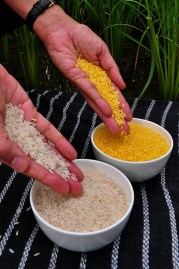
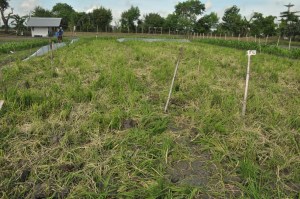

There’s hardly a food plant that we grow today that hasn’t undergone some sort of genetic modification. Let’s take the potato as a good example. I can’t think of any modern potato variety that does not have one or more wild species in its pedigree somewhere. These have been used for their disease resistance, among other reasons, such as Solanum demissum from Mexico to control the late blight pathogen Phytophthora infestans (the culprit in the Irish Potato Famine of the 1840s). That’s just one species – plenty more have also been crossed with modern potato varieties. There are also good examples from rice for submergence tolerance or salt tolerance using distantly-related wild species.

That’s genetic modification. Plain and simple. I guess most people don’t even realize. It’s what plant breeding is all about: taking different varieties or species (and their genes), crossing them (where possible) to make a hybrid, and selecting the best from the ‘DNA soup’. To increase the precision of conventional plant breeding, molecular markers are often now used to follow the transfer of useful characteristics or traits in conventional plant breeding populations.

GMO – genetically modified organism. An emotive term for some. For others, like me, genetic engineering is one of the tools in the arsenal for feeding a world population of 7+ billion – that’s growing rapidly – especially under a changing climate. Genetic engineering is even more precise than conventional plant breeding for moving genes (DNA) between species. However, there has been a lot of scare-mongering – and more – when it comes to GMOs. 

Now you might ask why I’ve focused on this topic all of a sudden. Well, on 8 August 2013, a field trial of Golden Rice (that contains beta carotene, a source of Vitamin A) in the south of Luzon, Philippines was vandalized by anti-GM activists (and maybe a few farmers), and destroyed.* This field trial was part of the important humanitarian research undertaken by the International Rice Research Institute (IRRI) and its partners in the Philippines, the Department of Agriculture and PhilRice (the Philippines Rice Research Institute) to develop biofortified rice varieties that can deliver Vitamin A and other micronutrients sustainably without having resort to supplementation or commercial fortification, which are expensive and only effective as long as such initiatives are funded.

In the video below, IRRI Deputy Director General, Dr Bruce Tolentino explains what happened on 8 August and why Golden Rice is so important for people who suffer from Vitamin A deficiency.

While GM crops are widely grown in the USA and some other countries, there has been significant public resistance in Europe, and particularly in the UK. I can understand, however, why the general public in the UK was – and is – wary. In the 1980s there were a couple of important food scares: a major foot and mouth outbreak in farm livestock; and BSE or ‘mad cow disease’. Furthermore, one or two commercial companies were attempting to commercialize some GM crops – without taking the time to explain why, how, and what for. The public lost faith in the ‘trust us’ line put out by the government of the day.

Environmental groups conducted major campaigns against even the testing of genetically-modified crops, let alone their commercialization. Very soon the activists had seized the initiative; the label of ‘Frankenstein foods’ stuck. An opportunity was lost, since scientists didn’t adequately step up to the plate and explain, in language that the average man in the street could understand, what GM technology was all about, and its importance. In the early days of GM research there were some inherent risks (such as the use of antibiotic markers to identify plants carrying the gene of interest); and some issues such as the ‘escape’ of genes from GMOs into wild plant populations. GM techniques have moved on, new approaches for identification of transgenic plants developed. But field research – based on the soundest of scientific principles, methods and ethics, generating good empirical data – is still needed to answer many of the environmental questions.

The vandalized Golden Rice field trial in Bicol, southern Luzon, Philippines

I do question the motives of some activists. Are they really concerned about real or perceived negative health and environmental impacts of GMOs? Or is the real issue that GM technology (as they see it) is in the hands of big agrochemical companies like Monsanto, Du Pont, Syngenta and others – an anti-capitalist campaign. In many countries much of the GM research is actually carried out by universities and publicly-funded research organizations such as the John Innes Centre in the UK.

I’ve had my own run-ins with these activists. In the early 1990s, then IRRI Director General Klaus Lampe opened a dialogue with a number of groups in the Philippines. He invited many anti-GM activists to IRRI for a two-day dialogue. I remember ‘challenging’ one prominent activist and future presidential candidate Nicanor Perlas about his anti-biotechnology campaign. As we analysed his perspectives, it became clear that his major concern was ‘genetic engineering’ – not biotechnology as a whole. I suggested to him that we could agree to disagree about genetic engineering (I appreciated there were risks, but as a scientist I wanted to study and evaluate those risks), but we should and could agree about the value of many of other biotechnology tools such as tissue culture, somaclones, or embryo rescue, among others. He concurred. Yet a few days after the meeting, he published a two page diatribe against ‘biotechnology’ (not just genetic engineering) in one of the Manila broadsheets. I find such actions (and positions) disingenuous, and typical of the lack of understanding that many of these people really have about GM. Just listen to the points of view presented by the activists in this Penn and Teller video (Eat This! Season 1. Episode 11. April 4, 2003). I already posted this before in my story about the late Nobel Laureate Norman Borlaug – but it’s worth repeating here. Just be careful – there is some strong language.

Here are a couple of classic quotes from Borlaug from that video:
Producing food for 6.2 billion people, adding a population of 80 million more a year, is not simple. We better develop an ever improved science and technology, including the new biotechnology, to produce the food that’s needed for the world today. And in response to the fraction of the world population that could be fed if current farmland was converted to organic-only crops: We are 6.6 billion people now. We can only feed 4 billion. I don’t see 2 billion volunteers to disappear.

Nevertheless, it is good to see the condemnation by the scientific community and media worldwide of the destruction of the Golden Rice field trial two weeks ago. In particular, it’s gratifying to hear that Mark Lynas, a well-respected British writer, journalist and environmental activist has turned his back on the anti-GMO lobby. He recently traveled to the Philippines to find out more for himself about Golden Rice research and the damage to the field trial.

Here are some of the media reports from around the world: in the New York Times; Slate; the Philippine Star; AGProfessional; Science 2.0; the BBC; and change.org. Even Fox News got in on the act in its characteristic over-the-top way! Here is an interesting piece about GM in general, published a couple of days ago in Forbes.

* Read this report by Mark Lynas after his visit to the Philippines recently.


Golden Rice has now been approved in the Philippines. Read this news story from the IRRI website, dated 18 December 2019:

After rigorous biosafety assessment, Golden Rice “has been found to be as safe as conventional rice” by the Philippine Department of Agriculture-Bureau of Plant Industry. The biosafety permit, addressed to the Department of Agriculture – Philippine Rice Research Institute (DA-PhilRice) and International Rice Research Institute (IRRI), details the approval of GR2E Golden Rice for direct use as food and feed, or for processing (FFP).

PhilRice Executive Director Dr. John de Leon welcomed the positive regulatory decision. “With this FFP approval, we bring forward a very accessible solution to our country’s problem on Vitamin A deficiency that’s affecting many of our pre-school children and pregnant women.”

Despite the success of public health interventions like oral supplementation, complementary feeding, and nutrition education, Vitamin A deficiency (VAD) among children aged 6 months to 5 years increased from 15.2 percent in 2008 to 20.4 percent in 2013 in the Philippines. The beta-carotene content of Golden Rice aims to provide 30 to 50 percent of the estimated average requirement (EAR) of vitamin A for pregnant women and young children.

“IRRI is pleased to partner with PhilRice to develop this nutrition-sensitive agricultural solution to address hidden hunger. This is the core of IRRI’s purpose: to tailor global solutions to local needs,” notes IRRI Director General Matthew Morrell. “The Philippines has long recognized the potential to harness biotechnology to help address food and nutrition security, environmental safety, as well as improve the livelihoods of farmers.”

The FFP approval is the latest regulatory milestone in the journey to develop and deploy Golden Rice in the Philippines. With this approval, DA-PhilRice and IRRI will now proceed with sensory evaluations and finally answer the question that many Filipinos have been asking: What does Golden Rice taste like?

To complete the Philippine biosafety regulatory process, Golden Rice will require approval for commercial propagation before it can be made available to the public. This follows from the field trials harvested in Muñoz, Nueva Ecija and San Mateo, Isabela in September and October 2019.

The Philippines now joins a select group of countries that have affirmed the safety of Golden Rice. In 2018, Food Standards Australia New Zealand, Health Canada, and the United States Food and Drug Administration published positive food safety assessments for Golden Rice. A biosafety application was lodged in November 2017 and is currently undergoing review by the Biosafety Core Committee in Bangladesh.

***

About the Healthier Rice Program
Together with its national partners, the Healthier Rice Program at IRRI is working to improve the nutritional status in countries across Asia and Africa, where rice is widely grown and eaten. Delivering essential micronutrients through staple foods like rice offers a sustainable and complementary approach to public health interventions for micronutrient deficiency, which affects 2 billion people worldwide. In addition to Golden Rice, research is being conducted on high iron and zinc rice (HIZR) to help address iron-deficiency anemia and stunting.


8 January 2021: gene editing
There was an important news item in The Guardian yesterday, reporting that the UK’s head of DEFRA (Department for  Environment, Food & Rural Affairs) George Eustice MP had indicated that gene editing of crops and livestock might be permitted in the UK before long, and that he was launching a consultation into this, and was quickly welcomed by many in the UK scientific community like Professor Sophien Kamoun, a plant pathologist at the John Innes Centre in Norwich who tweeted his support.

Under strict EU rules, gene editing had been classified as genetic modification and therefore banned. Now that the UK has left the EU, it can decide for itself how to harness the power of these biotechnology tools.

Don’t get me wrong. I was—and remain—a strong supporter of EU membership, but on the issue of GMOs and other biotechnology tools, I believe the European Commission and the courts got it very wrong. We need these powerful tools so we can harness the genetic resources to improve crops and livestock in a fraction of the time that would be needed using more conventional methods. Doubt remains, however, whether foods produced using any of these techniques could, for the foreseeable future, be exported to any EU countries.

Immediately after announcing the consultation, the usual opponents of any biotechnology, such as GeneWatch UK condemned this development. I’m sure it won’t be long before the likes of Friends of the Earth and Greenpeace add their voices in opposition.

The technique of gene editing (more correctly the CRISPR/Cas9 technique) was discovered and developed by Emmanuelle Charpentier and Jennifer A. Doudna who were awarded the Nobel Prize in Chemistry 2020 last October. That’s how important the scientific community believes this technology is.

Emmanuelle Charpentier and Jennifer Doudna

In a press release that announced the award of this prize, the Royal Swedish Academy of Sciences stated that Charpentier and Doudna had . . . discovered one of gene technology’s sharpest tools: the CRISPR/Cas9 genetic scissors. Using these, researchers can change the DNA of animals, plants and microorganisms with extremely high precision. This technology has had a revolutionary impact on the life sciences, is contributing to new cancer therapies and may make the dream of curing inherited diseases come true.

My hope is that the proposed DEFRA consultation can be conducted in a calm and collected way. Although I fear that emotions will once again take the debate off in unwelcome directions. Even on Channel 4’s new program last night, presented Jon Snow referred to genetically-modified foods as ‘Frankenfoods’ Use of this terminology does not help one iota.

Plant Genetic Resources and Climate Change – publication by the end of the year*

A perspective from 25 years ago
In April 1989, Brian Ford-Lloyd, Martin Parry and I organized a workshop on plant genetic resources and climate change at the University of Birmingham. A year later, Climatic Change and Plant Genetic Resources was published (by Belhaven Press), with eleven chapters summarizing perspectives on climatic change and how it might affect plant populations, and its expected impact on agriculture around the world.

We asked whether genetic resources could cope with climate change, and would plant breeders be able to access and utilize genetic resources as building blocks of new and better-adapted crops? We listed ten consensus conclusions from the workshop:

  1. The importance of developing collection, conservation and utilization strategies for genetic resources in the light of climatic uncertainty should be recognised.
  2. There should be marked improvement in the accuracy of climate change predictions.
  3. There must be concern about sea level rises and their impact on coastal ecosystems and agriculture.
  4. Ecosystems should be preserved thereby allowing plant species – especially crop species and their wild relatives – the flexibility to respond to climate change.
  5. Research should be prioritized on tropical dry areas as these might be expected to be more severely affected by climate change.
  6. There should be a continuing need to characterize and evaluate germplasm that will provide adaptation to changed climates.
  7. There should be an increase in screening germplasm for drought, raised temperatures, and salinity.
  8. Research on the physiology underlying C3 and C4 photosynthesis should merit further investigation with the aim of increasing the adaptation of C3 crops.
  9. Better simulation models should drive a better understanding of plant responses to climate change.
  10. Plant breeders should become more aware of the environmental impacts of climate change, so that breeding programs could be modified to accommodate these predicted changes.

Climate change perspectives today
There is much less scepticism today about greenhouse gas-induced climate change and what its consequences might be, even though the full impacts of climate change cannot yet be predicted with certainty. On the other hand, the nature of weather variability – particularly in the northern hemisphere in recent years – has left some again questioning whether our climate really is warming. But the evidence is there for all to see, even as the sceptics refuse to accept the empirical data of increases in atmospheric CO2, for example, or the unprecedented summer melting of sea ice in the Arctic and the retreat of glaciers in the Alps.

Over the past decade the world has experienced a number of severe climate events – wake-up calls to what might be the normal pattern in the future under a changed climate – such as extreme drought in one region, or unprecedented flooding in another. Even the ‘normal’ weather patterns of Western Europe appear to have become disrupted in recent years leading to increased stresses on agriculture.

Some of the same questions we asked in 1989 are still relevant. However, there are some very important differences today from the situation then. Our understanding of what is happening to the climate has been refined significantly over the past two decades, as the efforts of the International Panel on Climate Change (IPCC) have brought climate scientists worldwide together to provide better predictions of how climate will change. Furthermore, governments are now taking the threat of climate change seriously, and international agreements like the Kyoto Protocol to the United Nations Framework on Climate Change, which came into force in 2005 and, even with their limitations, have provided the basis for society and governments to take action to mitigate the effects of climate change.

A new book from CABI
It is in this context, therefore, that our new book Plant Genetic Resources and Climate Change was commissioned to bring together, in a single volume, some of the latest perspectives about how genetic resources can contribute to achieving food security under the challenge of a changing climate. We also wanted to highlight some key issues for plant genetic resources management, to demonstrate how perspectives have changed over two decades, and discuss some of the actual responses and developments.

Food security and genetic resources
So what has happened during the past two decades or so? In 1990, world population was under 6 billion, but today there are more than 1 billion additional mouths to feed. The World Food Program estimates that there are 870 million people in the world who do not get enough food to lead a normal and active life. Food insecurity remains a major concern. In an opening chapter, Robert Zeigler (IRRI) provides an overview on food security today, how problems of food production will be exacerbated by climate change, and how – in the case of one crop, rice – access to and use of genetic resources have already begun to address many of the challenges that climate change will bring.

Expanding on the plant genetic resources theme, Brian Ford-Lloyd (University of Birmingham) and his co-authors provide (in Chapter 2) a broad overview of important issues concerning their conservation and use, including conservation approaches, strategies, and responses that become more relevant under the threat of climate change.

Climate projections
In three chapters, Richard Betts (UK Met Office) and Ed Hawkins (University of Reading), Martin Parry (Imperial College – London), and Pam Berry (Oxford University) and her co-authors describe scenarios for future projected climates (Chapter 3), the effects of climate change on food production and the risk of hunger (Chapter 4), and regional impacts of climate change on agriculture (Chapter 5), respectively. Over the past two decades, development of the global circulation models now permits climate change prediction with greater certainty. And combining these with physiological modelling and geographical information systems (GIS) we now have a better opportunity to assess what the impacts of climate change might be on agriculture, and where.

Sharing genetic resources
In the 1990s, we became more aware of the importance of biodiversity in general, and several international legal instruments such as the Convention on Biological Diversity (CBD) and the International Treaty on Plant Genetic Resources for Food and Agriculture were agreed among nations to govern access to and use of genetic resources for the benefit of society. A detailed discussion of these developments is provided by Gerald Moore (formerly FAO) and Geoffrey Hawtin (formerly IPGRI) in Chapter 6.

Crop wild relatives, in situ and on-farm conservation
In Chapters 7 and 8, we explore the
in situ conservation of crop genetic resources and their wild relatives. Nigel Maxted and his co-authors (University of Birmingham) provide an analysis of the importance of crop wild relatives in plant breeding and the need for their comprehensive conservation. Mauricio Bellon and Jacob van Etten (Bioversity International) discuss the challenges for on-farm conservation in centres of crop diversity under climate change.

Informatics and the impact of molecular biology
Discussing the data management aspects of germplasm collections, Helen Ougham and Ian Thomas (Aberystwyth University) describe in Chapter 9 several developments in genetic resources databases, and regional projects aimed at facilitating conservation and use. Two decades ago we had little idea of what would be the impact of molecular biology and its associated data today on the identification of useful crop diversity and its use in plant breeding. In Chapter 10, Kenneth McNally (IRRI) provides a comprehensive review of the present and future of how genomics and other molecular technologies – and associated informatics – are revolutionizing how we study and understand diversity in plant species. He also provides many examples of how responses to environmental stresses that can be expected as a result of climate change can be detected at the molecular level, opening up unforeseen opportunities for precise germplasm evaluation, identification, and use. Susan Armstrong (University of Birmingham, Chapter 11) describes how a deeper understanding of sexual reproduction in plants, specifically the processes of meiosis, should lead to better use of germplasm in crop breeding as a response to climate change.

Coping with climate change
In a final series of five chapters, responses to a range of abiotic and biotic stresses are documented: heat (by Maduraimuthu Djanaguiraman and Vara Prasad, Kansas State University, Chapter 12); drought (Salvatore Ceccarelli, formerly ICARDA, Chapter 13); salinity (including new domestications) by William Erskine, University of Western Australia, and his co-authors in Chapter 14; submergence tolerance in rice as a response to flooding (Abdelbagi Ismail, IRRI and David Mackill, University of California – Davis, Chapter 15); and finally plant-insect interactions and prospects for resistance breeding using genetic resources (by Jeremy Pritchard, University of Birmingham, and co-authors, Chapter 16).

Why this book is timely and important
The climate change that has been predicted is an enormous challenge for society worldwide. Nevertheless, progress in the development of scenarios of climate change – especially the development of more reliable projections of changes in precipitation – now provide a much more sound basis for using genetic resources in plant breeding for future climates. While important uncertainty remains about changes to variability of climate, especially to the frequency of extreme weather events, enough is now known about the range of possible changes (for example by using current analogues of future climate) to provide a basis for choosing genetic resources in breeding better-adapted crops. Even the challenge of turbo-charging the photosynthesis of a C
3 crop like rice has already been taken up by a consortium of scientists worldwide under the leadership of the International Rice Research Institute in the Philippines.

Unlike the situation in 1989, estimates of average sea level rise, and consequent risks to low lying land areas, are now characterised by less uncertainty and indicate the location and scale of the challenges posed by inundation, by soil waterlogging and by land salinization. Responses to all of these challenges and the progress achieved are spelt out in detail in several chapters in this volume.

We remain confident that research will continue to demonstrate just what is needed to mitigate the worst effects of climate change; that germplasm access and use frameworks – despite their flaws – facilitate breeders to choose and use genetic resources; and that ultimately, genetic resources will be used successfully in crop breeding for climate change thereby enhancing food security.

Would you like to buy a copy?
The authors will receive their page proofs any day now, and we should have the final edits made by the middle of September. CABI expects to publish Plant Genetic Resources and Climate Change in December 2013. Already this book can be found online through a Google search even though it’s not yet published. But do go to the CABI Bookshop – the book has been priced at £85 (or USD160 and €110). If you order online I’m told there is a discount on the list price.

_______________________________________________________
* This post is based on the Preface from the forthcoming CABI book.