Sometimes, history just passes me by . . . particularly in Ohio

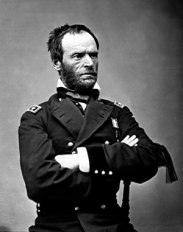
William Tecumseh Sherman. Red-haired. Union Major-General in the American Civil War. Outstanding military strategist. Commander of the Army of the Tennessee. Mastermind of the March to the Sea (that culminated in the capture of Savannah, GA) and the Carolinas Campaign, both of which contributed significantly to the end of the Civil War in 1865.

Born in 1820, Sherman was a native of Lancaster, Ohio (map). I wish I’d known that just a few weeks ago.

As Steph and I crossed Ohio on our road trip from Massachusetts to Minnesota, we passed through Lancaster on the route I’d planned from Canton, OH to Bloomington, IN. I do recall saying to Steph how prosperous it looked compared to others.

I only learned of the Sherman connection from a biography that I’m reading right now¹, and which I picked up at my favorite bookstore in St Paul, Half Price Books on Ford Parkway in the Highland Park area. This year I added three more to my American Civil War collection.

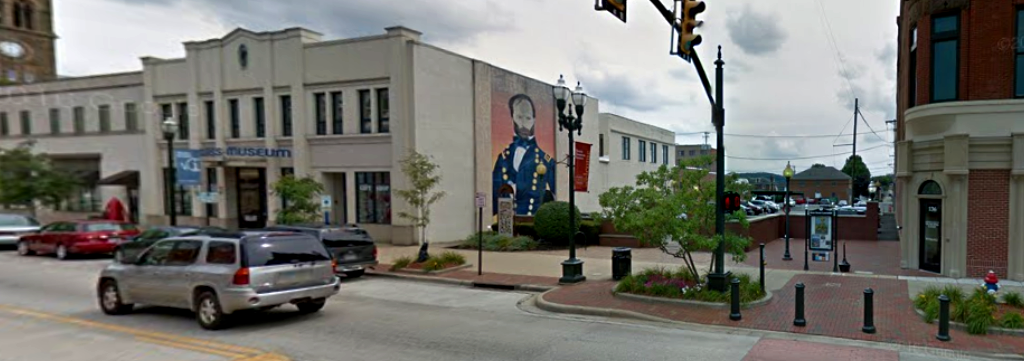
I could have made the Sherman connection in Lancaster had I looked in my rear-view mirror at the right moment, but I was too intent on following the sat nav instructions.  There, on a west-facing wall on Main Street (we were heading west) is a full height mural of Sherman. I didn’t see it, more’s the pity. I would have stopped to explore further.

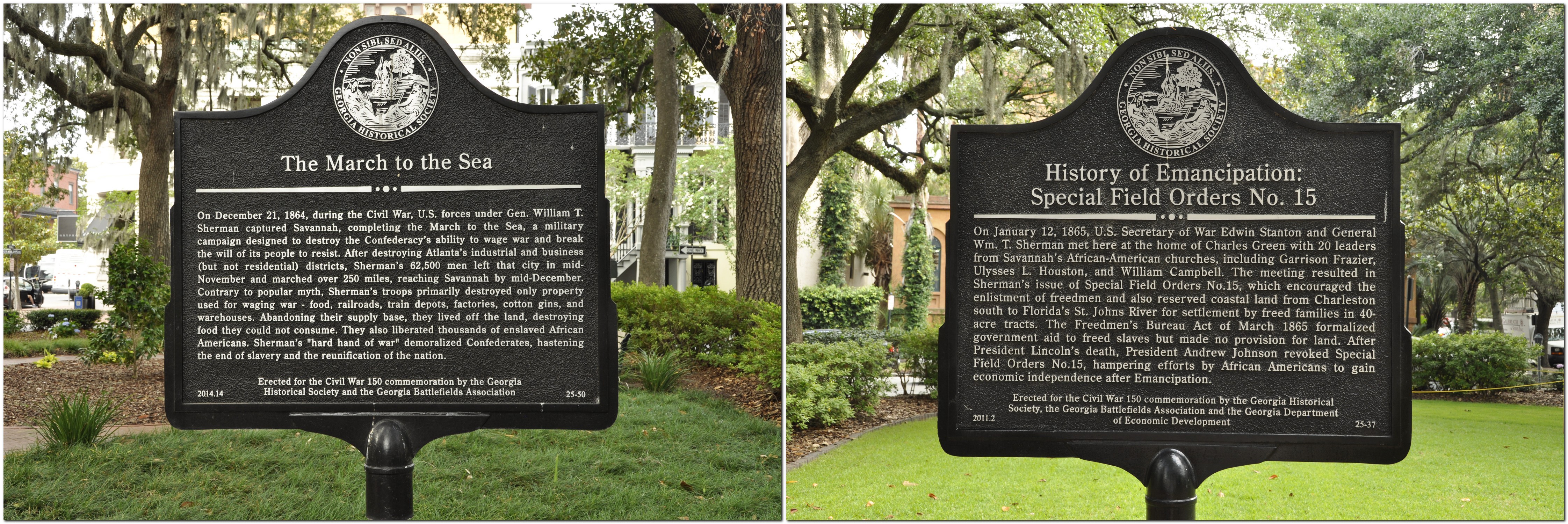
During the first part of our 2017 USA road trip, from Atlanta, GA (which Sherman ransacked in 1864) to Savannah, our route more or less mirrored Sherman’s March to the Sea. In the historic neighborhoods of Savannah his name appears on several historical markers, as you might expect.

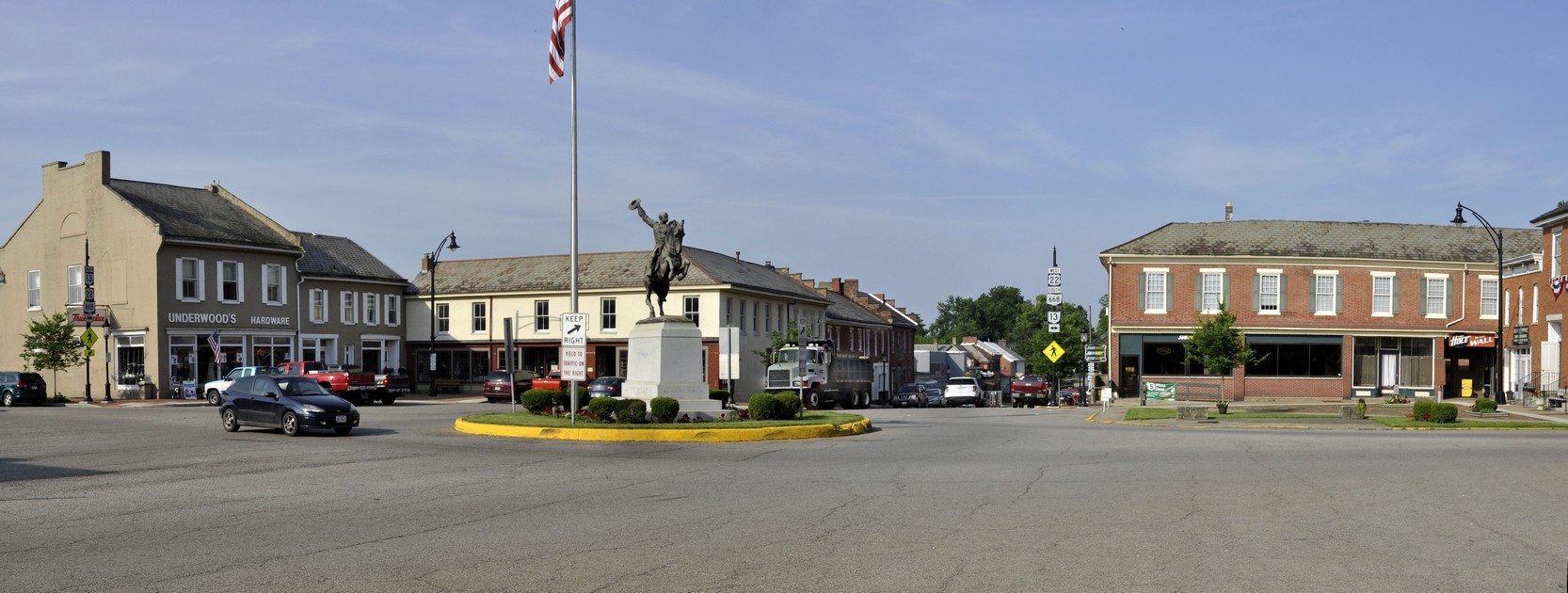
And there were other surprises. Just 18 miles northeast of Lancaster is the small community of Somerset, OH. It has a lovely town square, in the middle of which is an impressive statue of a mounted soldier, Philip Sheridan, a Major-General of Cavalry during the Civil War, who was eventually promoted to four star rank. Sheridan grew up in Somerset. After the Civil War he served on the Great Plains during the Indian Wars. He was also instrumental in developing Yellowstone as a national park.

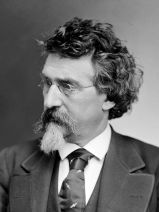
Despite its incredibly bloody outcomes and destructive consequences, the American Civil War, 1861-65 holds a certain fascination. To a large extent, it was the first war to be extensively documented photographically, many of the images coming from the lens of Mathew Brady.

But in terms of the war’s theater of operations, much of the fighting took place east of the Mississippi River, across the southern states, and into the maritime states as far north as Pennsylvania.

Imagine the topography, especially in the Appalachians, across which huge armies marched and fought each other. Imagine the effort needed to transport tens of thousands of men and their equipment and supplies over almost impenetrable terrain, along river valleys, crossing ridges, swamps, and huge rivers, while constantly being harassed by and engaging with the enemy.

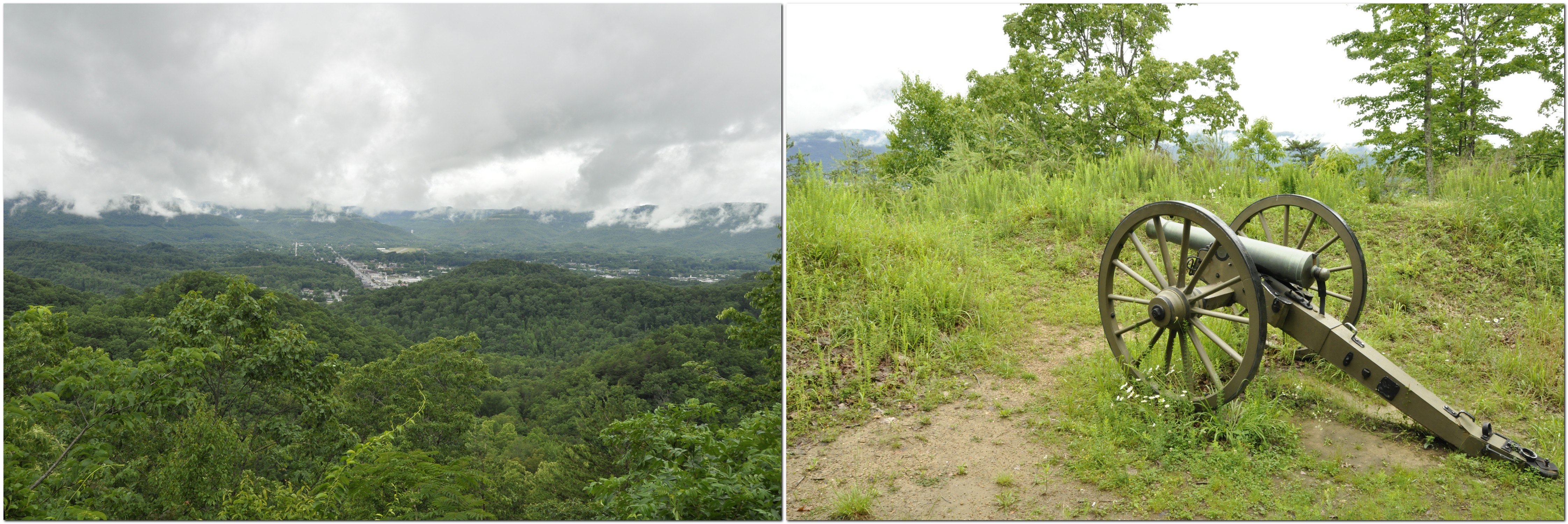
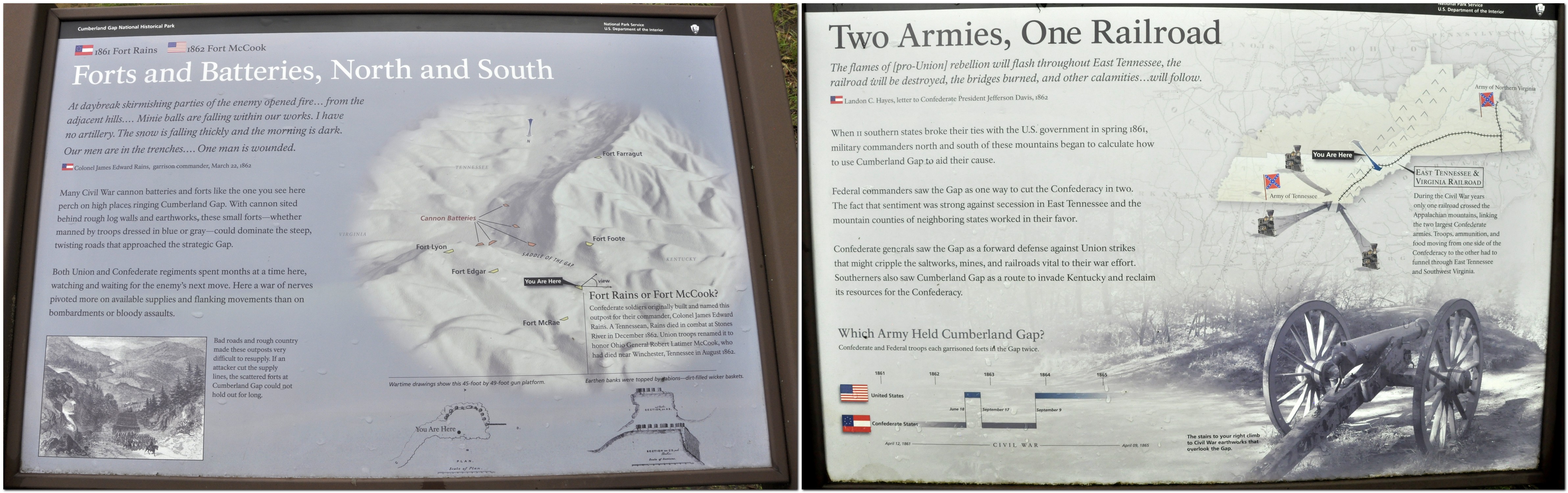
We saw much of this landscape along our 2017 road trip. At Cumberland Gap there were even reminders how the opposing armies had fought to gain the upper hand and strategic overlook that was afforded on the hills surrounding this important pass through the mountains.

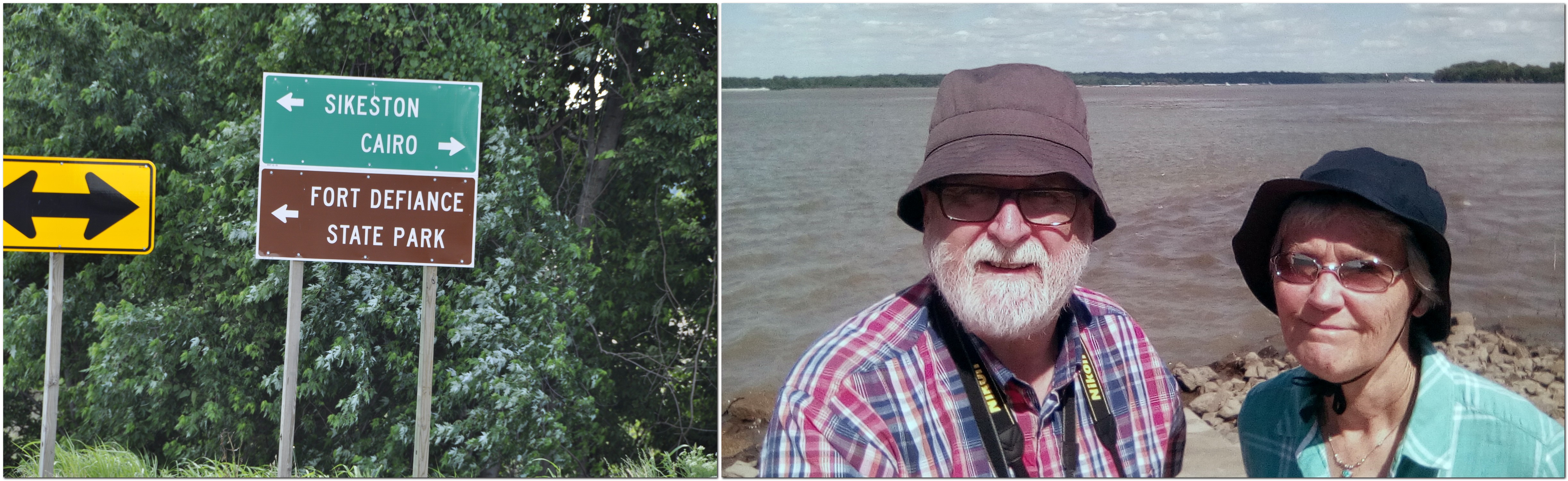
In that Sherman biography, I also learned that his superior, Major-General (then Brigadier General) Ulysses S Grant² (yet another Buckeye from Point Pleasant [map], just across the Ohio River from where we traveled this year) had his headquarters at Cairo (map) at the southern tip of Illinois in 1861, just a couple of miles north of Fort Defiance on the promontory at the confluence of the Mississippi and Ohio Rivers. Fort Defiance was on our route west in 2017.

Southwest from Canton, OH we passed by close to Dover (map), birthplace of one the Civil War’s most notorious Confederate raiders or bushwhackers, William Clarke Quantrill³. His theater of operations was the Kansas-Missouri border, an area that was already experiencing conflict between abolitionists and those who wanted to keep slavery in Missouri as early as 1858. Quantrill’s Raiders were the perpetrators of one of the Civil War’s most outrageous atrocity, the Lawrence (Kansas) massacre. Sherman’s brother-in-law, Thomas Ewing, Jr was a key Union general opposing Quantrill.

So while I may have missed out on some interesting historical aspects during this year’s road trip, that was not the case in 2011 when we toured extensively in Arizona and New Mexico. Earlier that year I had read an interesting biography of mountain man and Indian fighter Kit Carson whose campaigns against the Navajo are well documented. I planned parts of the trip around locations where he had been active. He is buried in Taos, NM, and after spending time at the Canyon de Chelly (site of a massacre of Navajos) in northeast Arizona, we headed for Taos.

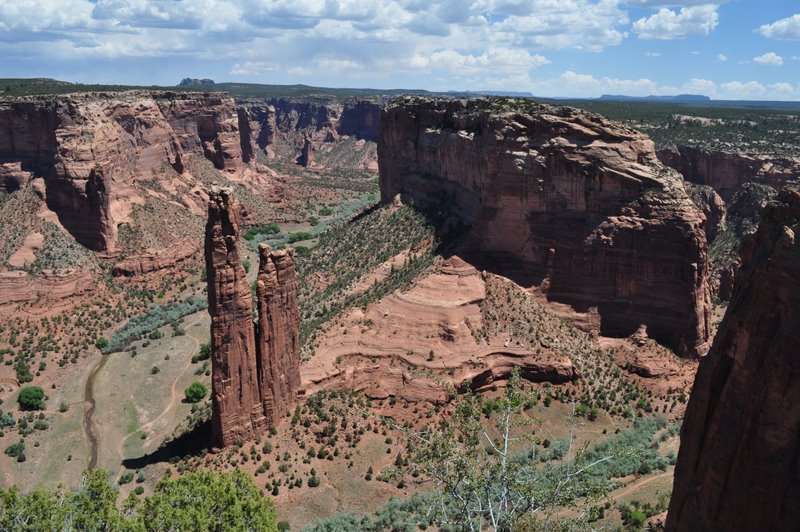
Spider Rock in the Canyon de Chelly.

History is undoubtedly one of my principal hobbies, and occupies much of my reading. On retirement eight years ago I almost enrolled for a history degree with the Open University, but eventually decided to keep it just as a hobby. I read very little fiction, and the catalyst for my 2017 challenge – to read all of the novels by Charles Dickens – was a book (also bought at Half Price Books) about the terrible plight of children (early in the 19th century) in factories and cotton mills in the north of England.

Here in the UK, Steph and I are very active members of the National Trust and English Heritage. Whenever we get the opportunity, we head off to one of their many properties (stately homes, castles, archaeological sites, gardens) open to the public. And we learn a little more each time about the history of this country and the people who shaped events over the centuries, for better or worse.

~~~~~~~~~~~~~~~~~~~~~~~~~~~~~~~~~~~~~~~~~~~~~

¹ Robert L O’Connell (2014). Fierce Patriot – The Tangled Lives of William Tecumseh Sherman. Random House. ISBN 978-0-8129-8212-1.

² I picked up this biography of Grant which I have yet to start: HW Brands (2012). Ulysses Grant in War and Peace. Anchor Books. ISBN 978-0-307-47515-2.

³ I started this book about Quantrill’s Raiders first. Jesse and Frank James were members of Quantrill’s guerilla band. Edward E Leslie (1998). The Devil Knows How to Ride – the True Story of William Clarke Quantrill and His Confederate Raiders. Da Capo Press. ISBN 0-306-80865-X.


Driving on the ‘wrong’ side

Since 2011, my wife and I have made several long-distance road trips across the USA. And although I’d driven some short distances around Seattle and the Twin Cities of Minnesota, I’d never done any serious driving until then. So, it’s not uncommon for someone to ask whether I find driving in the USA difficult.

Answer: not really. Most don’t know that I spent over 27 years driving on the ‘wrong’ side, i.e. the right, while living in Peru, Costa Rica, and the Philippines.

So driving on the ‘wrong’ side is as normal for me as driving in the UK, on the ‘right’ side on the left. It’s just a case of learning the dos and don’ts, and the manners of the road.

Driving in the USA is (mostly) a pleasure (and straightforward), since away from the cities and main highways, the roads are generally quite quiet. However, some of the Interstates can be quite daunting, especially when two or more come together or diverge like large bowls of spaghetti, often with three or more lanes. Choosing which lane to occupy and when is a challenge. My sat nav during our latest trip was a godsend.

Finding your way around however is not too difficult. The road numbering system is quite clear, but the same road can have more than one name if two highways merge for a section. The Interstates (like the motorways in the UK or autobahns in Germany for example) connect centers of population across the country and are a legacy of President Dwight D Eisenhower, from the 1950s. Then there are the US highways, state roads, and county roads. Each has its own road symbol.

US highways are often divided highways, or dual carriageways as we say in the UK. The one big difference between the Interstates and US highways however, are junctions on the latter (often controlled by traffic lights) where you might have to stop. Most state and county roads are single lane carriageways in each direction.

Compared to the UK, speed limits are generally lower in the US. The norm for Interstates is 70 mph (I’ve seen 75) with a minimum of 40 mph. The maximum speed on US highways is 60 mph (occasionally 65), but most often 55 mph widely applied across the country. In towns the limit is often as low as 25 mph, and special lower restrictions (15 mph) often apply near schools when in session.

Speed limits and driving restrictions around school and school buses are rigorously enforced. When a school bus stops, lights flashing and the Stop sign extended from the rear offside of the bus, you’d better stop or else, whether you’re behind or approaching the bus. I must admit that I didn’t initially realize that the rule applied to oncoming traffic. I remember when we were traveling on US101 in northern California that I passed a stationary bus. Luckily there was no speed cop waiting to ‘ambush’ me.

Roads are more congested with trucks (lorries) in the UK than in the USA, but trucks are behemoths in the USA in comparison, and consistently travel at much higher speeds, often well over 70 mph on the Interstates.

This was one ‘extra’ size load that we saw in Wisconsin.

The idea of overtaking on both sides is something I still cannot reconcile. But it’s common in the USA on roads with more than two lanes. Just maneuvering between lanes can be a nightmare, having to check fast-approaching vehicles on both sides. Also, drivers tend to join a highway high speed; they ‘take no prisoners’, and just keep coming on despite other traffic approaching and occupying the lane they will join.

I often find US drivers reluctant to overtake on single carriageway roads. Admittedly there are oftentimes fewer opportunities to overtake. As I mentioned, we like to take the byways when making one of our road trips, mostly on single carriageway highways, and I try to keep more or less to the speed limit. So I find it aggravating when a ‘local’ starts to tailgate me, ‘encouraging’ me to go faster. But when the opportunity to overtake presents itself, they just remain tucked in behind. Clearly they want to go faster but are not prepared to exceed the speed limit to overtake.

Turning right on a red light takes some getting used to. I now understand that unless it specifically states not to turn, it’s OK to make that turn. Not something we’re used to in the UK. Red means red! And also, having to be aware that if you turn right on a red light, there may be pedestrians crossing as they will have right of way.

‘Right lane must turn right’ (or left) is a common sign on most roads. In fact, it’s useful to have a sort of slip road for departing traffic even on single carriageway highways. But it can be confusing at a junction, when you suddenly find yourself in the right lane and are forced to turn even though you want to go straight ahead. Fortunately my sat nav helped in this respect, and having become accustomed to this situation, I try to position myself in the left lane at a junction to avoid an unwanted manoeuvre.

Roundabouts are common in the UK. Near my home in Bromsgrove there are five within the space of 2 miles. Not so in the USA. Instead there of full stop, all way junctions, governed by a particular road etiquette: the first vehicle arriving at the junction gets to manoeuvre first, but only after coming to a full stop.

When I look over what I have just written, it seems to me that my driving concerns in the USA are not really very important at all. We’ve now covered somewhere in the region of 15,000 miles I guess in our trips. Plenty of time to get accustomed to driving on the wrong side.

However, thinking about the dos and don’ts of driving made me ponder on some other aspects of visiting the USA. And, as it happens, I came across this article, by Sophie-Claire Hoeller (a trilingual journalist who grew up in Germany) in Business Insider: 51 things Americans are doing wrong.

For ease of reading, I also copied her list of ‘things’ into a file.

So, how do these resonate with me? Several on the list are bugbears of mine: (4) Portion sizes; (6) Tipping; (7) Taxes; (12) So. Many. Questions; (16) Checking ID; and (49) Serving a salad first.

I never cease to be amazed by the amount of food that is served in restaurants. Portions are huge compared to the UK. No wonder there’s an obesity problem. I’d rather portions were smaller and bills lower.

Ten per cent is the norm in the UK when tipping – if you think the service warranted a tip. Not so in the USA, where tops as high as 25% are the norm AND expected. I agree with journalist Sophie-Claire. Why should I pay someone else’s wages? In one restaurant recently, where I’d left a 15% tip on the table for our server, I was faced with adding a tip of 25% (no lesser amount) – or none – when using my debit card at the checkout.

Why don’t retailers in the US just include the sales tax in the price listed? How many times have I been caught out at the till, having to add on the tax. Thank goodness for plastic money, and although I used my debit card more this last trip for everyday expenses than I had in previous years, I still ended up with a purse-full of small change. The grandchildren’s piggy banks benefited!

While we were traveling from Massachusetts to Minnesota, we would buy sandwiches, often from Subway, so we could stop anywhere on the route to have our lunch. Then the questions start: wheat or wholemeal, Italian, this meat or that, cheese, mayo, pickles . . . etc., etc. Phew!

I’m almost 70, yet, when buying a couple of cases of beer at Target in St Paul recently, I was asked for my ID! Fortunately the lady at the checkout was from Scandinavia (and had lived in the UK for several years) so recognized my UK photo driving licence. She told me that normally it would have to be a US or Canadian driving licence or passport. Good grief, 70 years old and having to present a passport just to buy a beer! And then there was $2.36 sales tax to add to the offer of $25 for two cases that had attracted my attention.

Salads should be served on the side. Period. I got a strange look from one server when I asked her to bring my salad with the entree. That’s how I like to eat my salad, not as a meal in itself before any other course.

Yes, the UK and USA, two countries separated by a common language (and with Trump in charge, many other things unfortunately), according to George Bernard Shaw. But we enjoy our visits there. It’s a vast – and sometimes quirky – country. Lots more to explore!


Planning a USA road trip

Steph and I like to explore.

Since 2011, we have made five major road trips across the USA, and two of shorter duration.

That first year, we headed for Arizona and New Mexico, taking in the Grand Canyon, Canyon de Chelly and other interesting sites in those dry climates.

We decided to stay closer to home (home being where our daughter Hannah and her family live in St Paul MN) in 2012, just visiting the Boundary Waters Wilderness Region and the Gun Flint Trail of northern Minnesota .

2013 saw us on the Pacific coast of Oregon, and a trip as far south as Sacramento in California, taking in Oregon’s Crater Lake and the Californian redwoods on the way.

We headed west from St Paul across the prairies in 2014, the first of our really long trips, taking in the Badlands and Mt Rushmore in South Dakota, Devil’s Tower in Wyoming, the Bighorn Battlefield in Montana, and Yellowstone National Park.

We toured Scotland in May-June 2015 so decided not to make any road trip in the USA, instead choosing to take Amtrak to Chicago for three days.

I broke my leg in January 2016, so any long road trip was out of the question. However, we made a short trip north of the Twin Cities to find the source of the Mississippi River.

The Appalachians called us in 2017, so we flew into Atlanta and drove back to Minnesota through Georgia, South Carolina, North Carolina, Tennessee, Virginia, West Virginia,Kentucky, Illinois, Missouri, and Iowa.

We were equally ambitious this year, taking in New England (Massachusetts, Vermont, New Hampshire, and Maine) before heading west to Niagara Falls in New York, and then south and west through Pennsylvania, Ohio, Kentucky and Indiana, before heading north into Michigan, crossing Lake Michigan on the car ferry, and driving across Wisconsin to end up, once again, in the Twin Cities.

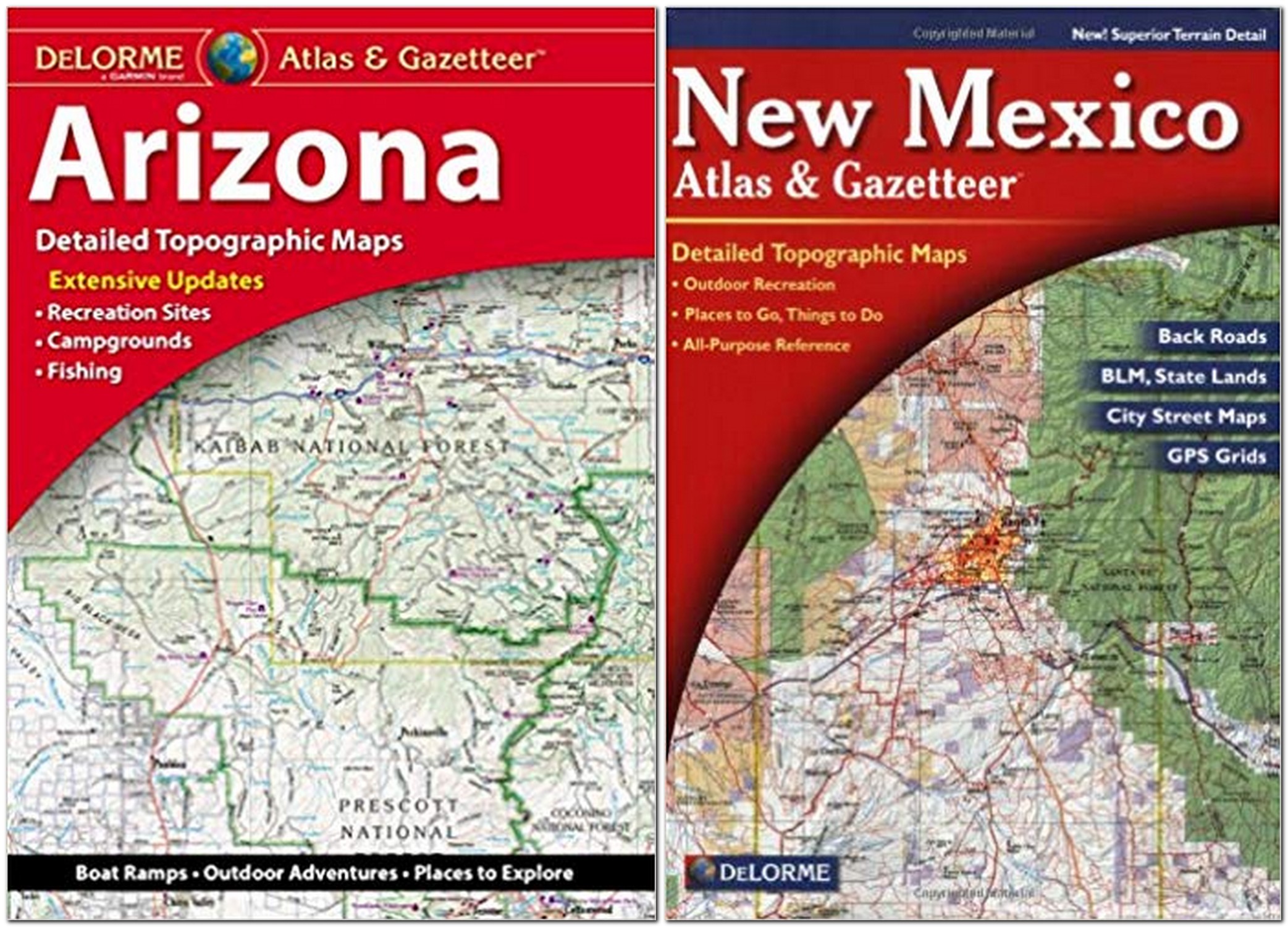
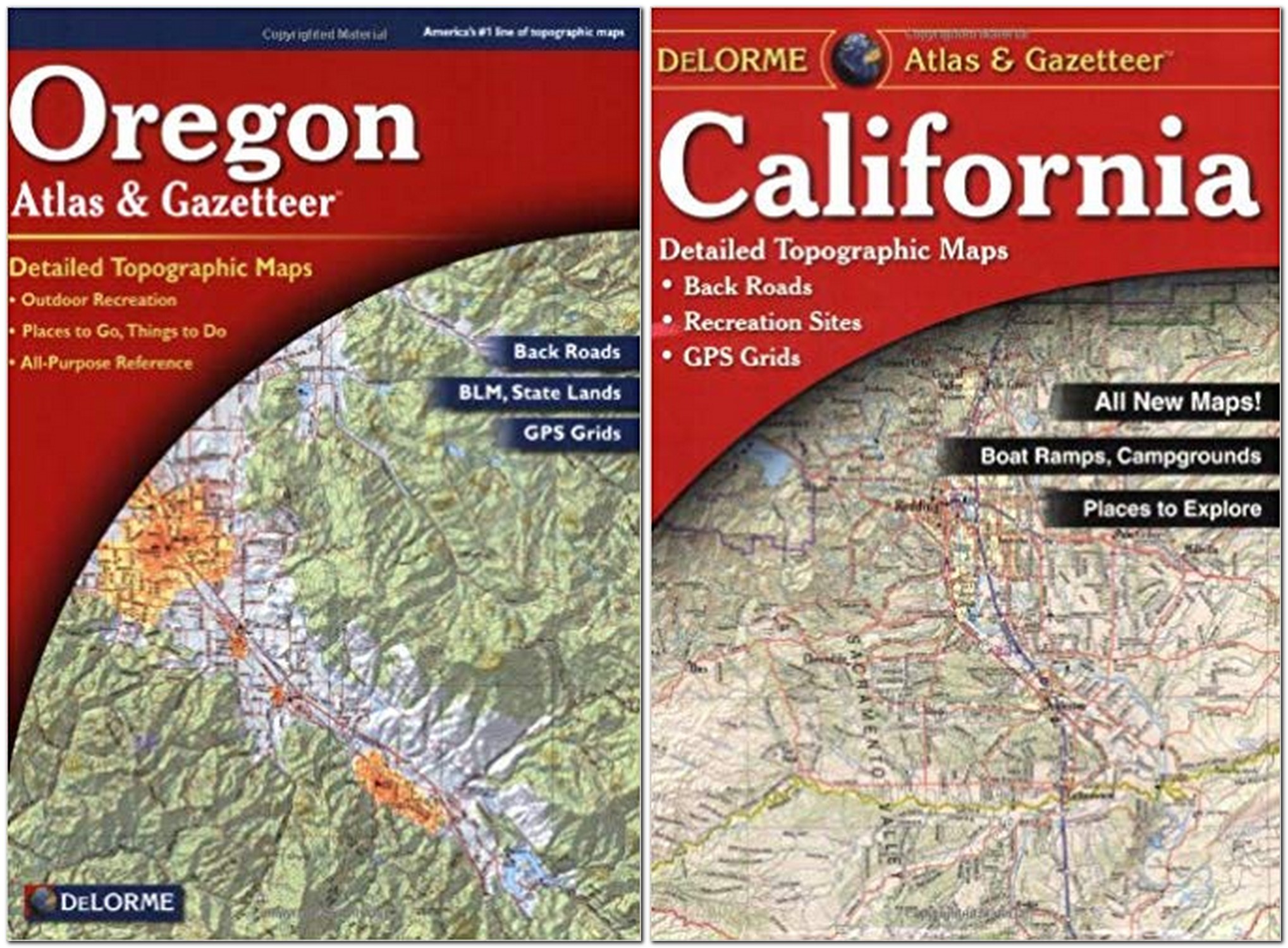
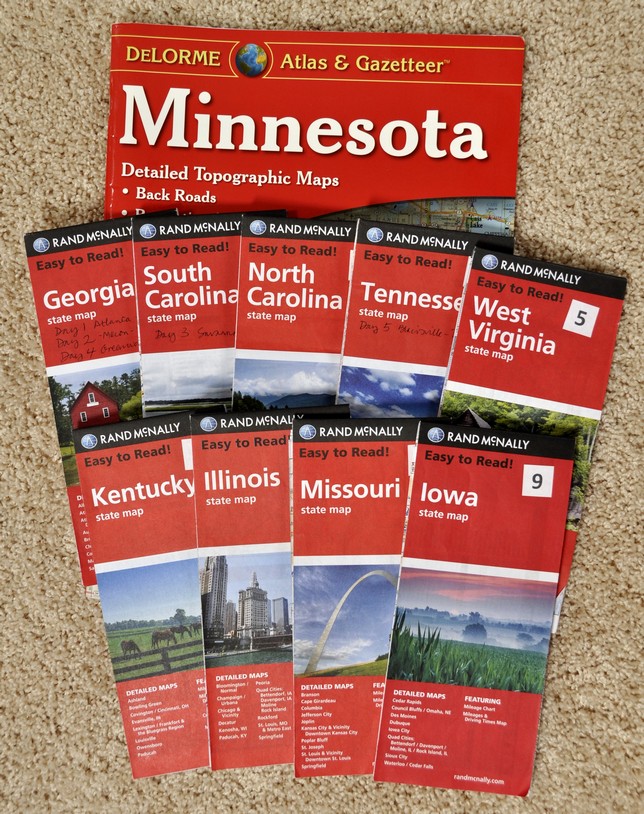
Until this year, I had planned our trips using various maps. For the Arizona/New Mexico and Oregon/California trips in 2011 and 2013, and for trips around Minnesota, I purchased a DeLorme Atlas & Gazetteer for each state. These are very detailed and comprehensive, and show even the most minor of roads. Since we like to take highways and byways (US roads, state highways, and even county roads) as much as possible and avoid the busy Interstates, these DeLorme publications allowed me to draw up quite detailed itineraries.

But they are heavy! And once we planned to drive from Georgia to Minnesota in 2017, carrying around a DeLorme Atlas for each state was not an option.

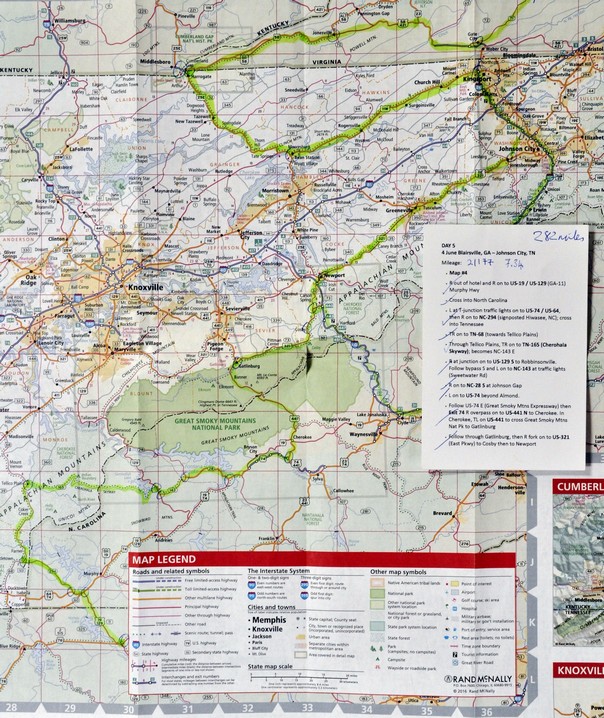
Instead, I purchased Rand McNally road maps for each state, and plotted a route using Google maps, then transferring it to the map itself, as shown in the image below. I also verified the route using Google Street View, especially to check out the various road junctions.

Steph was the navigator – which had the unfortunate consequence that she had to have her head in a map day in and day out. To assist with navigation I also drew up detailed route instructions on separate cards for each day. One of these is shown in the upper image above. These provided information on the road numbers (roads in the US can carry more than one number as roads combine for short or long distances), junctions, and any other special feature or attraction that we had decided to visit.

However, at Christmas 2017, I received a Garmin DriveSmart™ 51 LMT‑S GPS Navigator with a 5″ display, which came with UK and Ireland maps installed (that are regularly updated).

One of the features I really like is the accompanying BaseCamp software installed on my laptop that allows me to plan routes, with any degree of detail, and transfer them to the sat nav. Once I’d got the hang of its idiosyncrasies, I began plotting routes from home in the UK, finding the best options, and at the same time learning the various features of the sat nav itself.

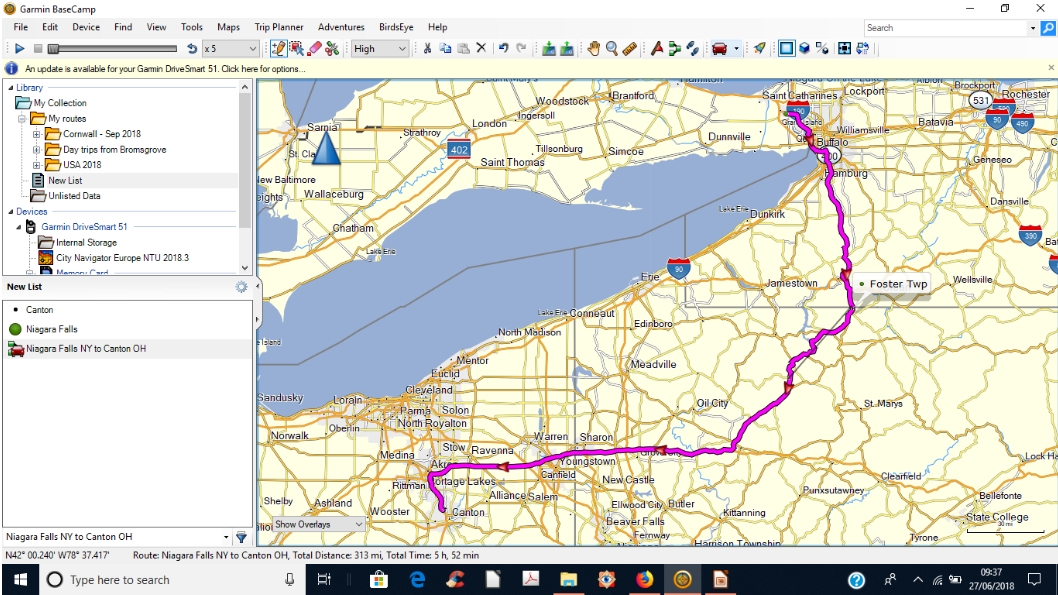
In BaseCamp I found the easiest way to plot a route was to choose the starting and destination waypoints, and let the software ‘find’ the optimum route. In this example below, I plotted a route from Niagara Falls NY to Canton OH, which was the third day of our recent trip after leaving Maine.

As you can see if you open a larger image, the route calculated would have taken us on the interstate close to the shore of Lake Erie. But I wanted to cut across country and travel through the Allegheny Forest of Pennsylvania.

BaseCamp allows you to shape any route by adding ‘via points’, as many as needed to develop an unambiguous route when it is recalculated by the sat nav itself once transferred.

Then, once all the via points have been added, your final route, below, is transferred to the sat nav.

My Garmin proved invaluable during this trip, especially when we did travel on the Interstates, and these merged with one another, giving me advice when lane changes were necessary, changes to speed limits, and always anticipating any junctions half a mile ahead.

We only had a couple of glitches. Once, after we’d arrived at our hotel, I discovered the reason why the sat nav had asked me to make a U-turn on one street earlier in the day. I’d programmed in the same via point twice. Another time, in deepest Ohio, one of the roads I’d chosen was closed some miles ahead, so we had to follow a set detour. The sat nav didn’t like that, urging me to make a U-turn, or turn at the next junction. Having completed the detour, our original route appeared on the screen, and on we continued. On another occasion, crossing Kentucky along the Ohio River, we had to make another detour, and suddenly the icon for the vehicle was moving across a blank screen – until we reached another road that it recognized. I think we had been diverted on to a new road that wasn’t programmed into the USA maps I’d bought before the trip.

With the installed UK and Ireland maps, I receive updates all the time. The USA (and Canada and Mexico) maps are a one-time purchase, not particularly cheap, but well worth it. It’s just a pity that Garmin does not offer regular updates for these purchased add-on maps as well.

The sat nav is great, but we also found it useful to have a map to refer to see the bigger picture. We were able to find road maps for some states in hotel receptions or at state information centers.

And one of the biggest advantages of using a sat nav? Steph no longer has to navigate hour after hour, and can enjoy looking at the changing landscapes. I wouldn’t say I was particularly stressed on any of my earlier road trips. But with the sat nav I did find that my anticipation level was much lower, and I could also enjoy seeing the countryside we were passing through, knowing that I would be navigated safely to our destinations, especially through built-up areas.

Massachusetts to Minnesota (4): heading west through NY, PA, OH, KY and IN, then on to MN

Leaving Niagara Falls via the Niagara Scenic Parkway on the Sunday morning, we headed south, skirting Buffalo and the eastern shore of Lake Erie towards Pennsylvania, and the Allegheny National Forest. Our destination was Canton in Ohio, just south of Akron, a journey of 313 miles.

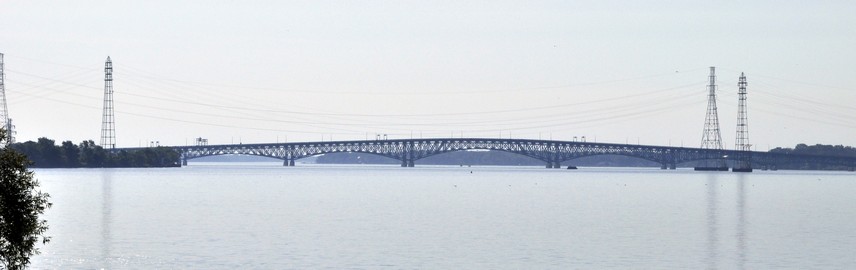
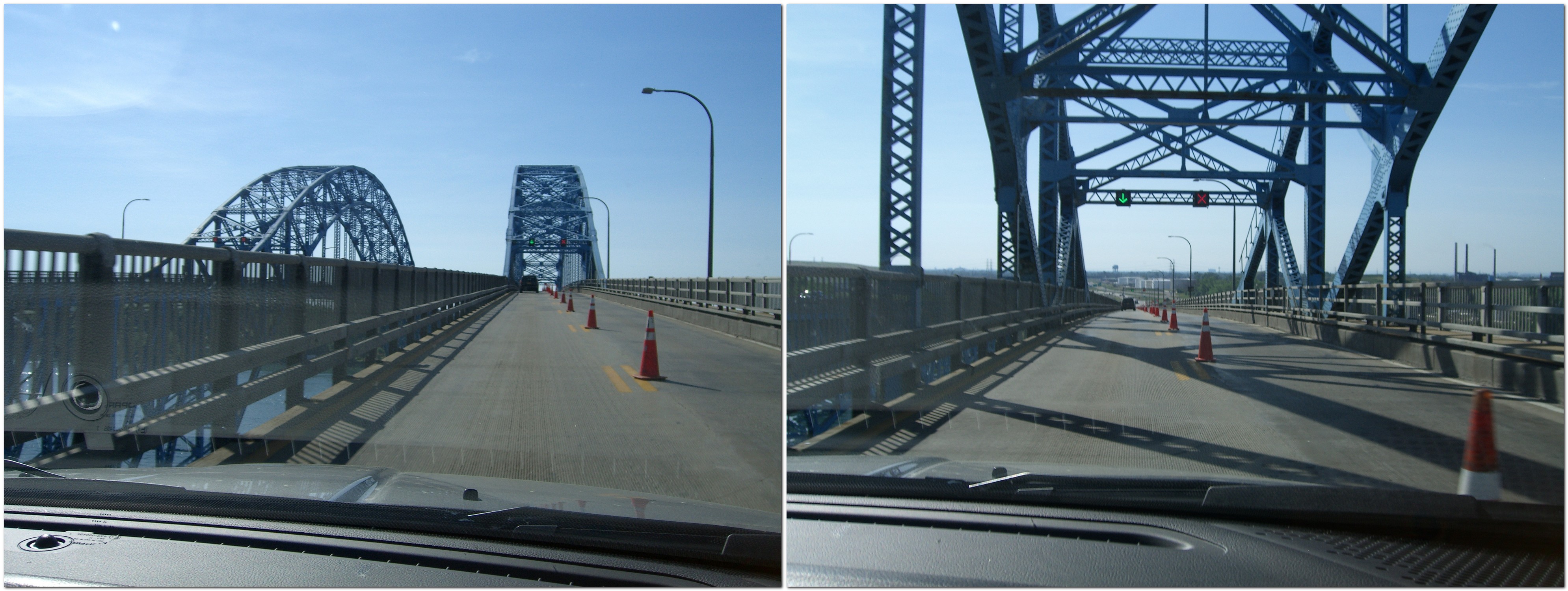
Along the Niagara Scenic Byway, there are two impressive bridges across the Niagara River on I-190.

There was little traffic around Buffalo, fortunately, even though it was a fine morning for Father’s Day. Soon enough we were outside the city limits and heading south into Pennsylvania.

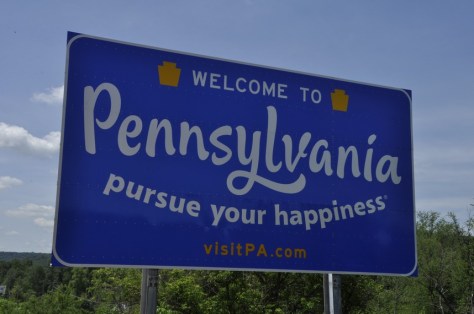
Pennsylvania was a ‘new’ state for us (as were OH and IN), and I particularly wanted to travel through the Allegheny National Forest.

We travel on the interstates as little as possible, taking US highways and county roads in preference. You get to see a lot more of rural America that way. But roads are none too wide with few places to stop. And certainly no easy stops for photography. So on these two days we have little to show, photographic-wise, for our long days on the road.

The next morning we had an early start as we decided to cover the whole route that I’d planned, some 447 miles south through Ohio, crossing the Ohio River into Kentucky, before crossing the river again further west into Indiana to reach our next destination, Bloomington.

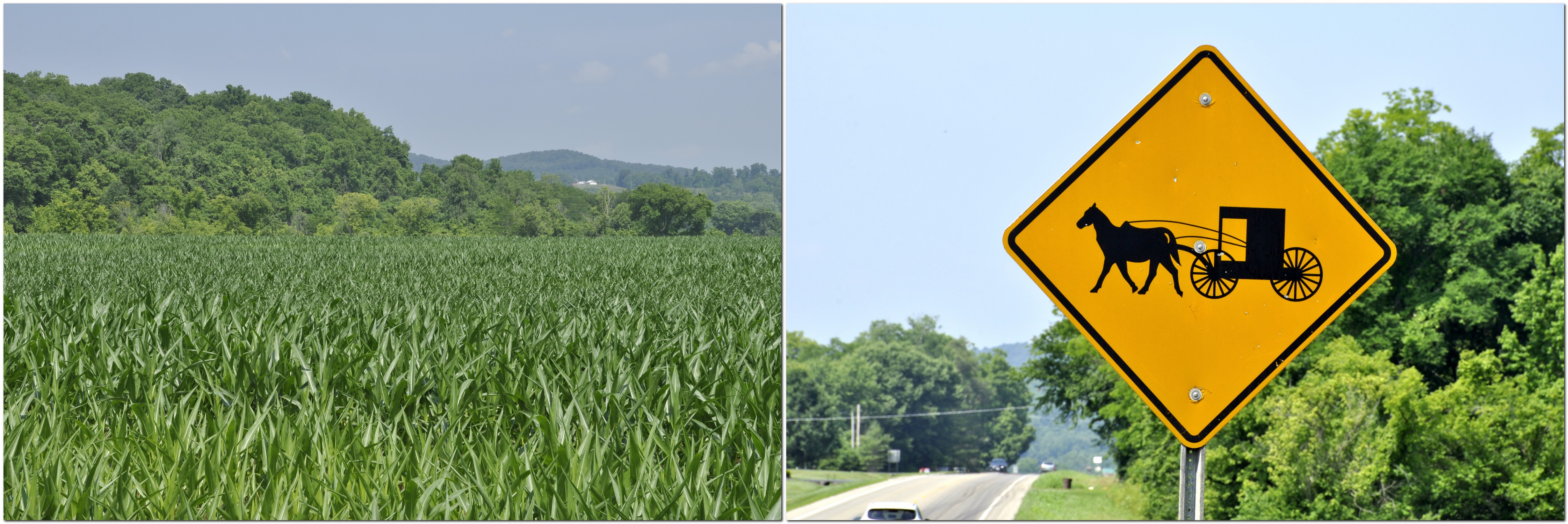
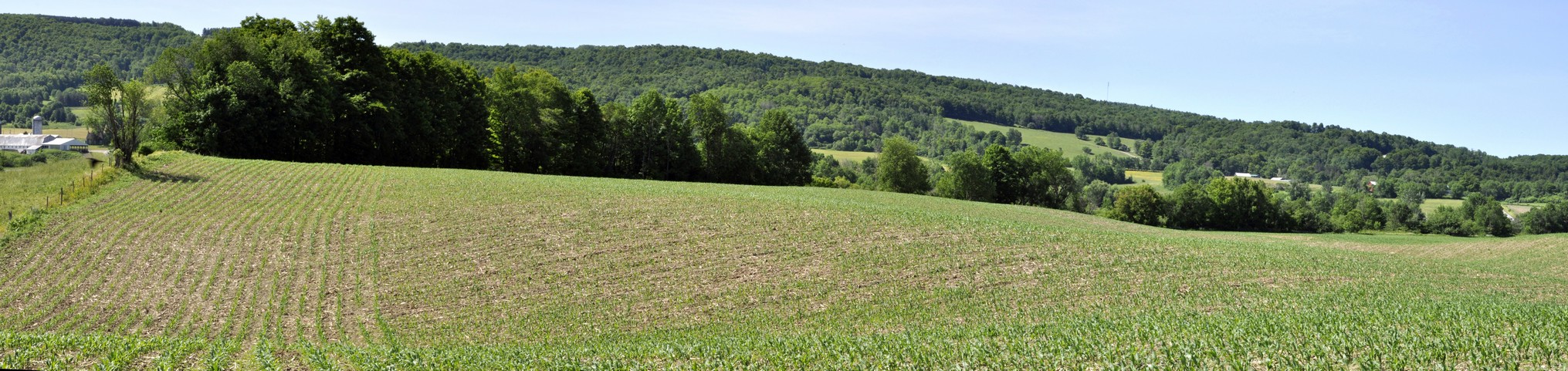
The drive through OH took us through some delightful towns and villages, and productive agricultural landscapes. Although we saw road signs to be aware of Amish buggies on the road, we only saw a couple.

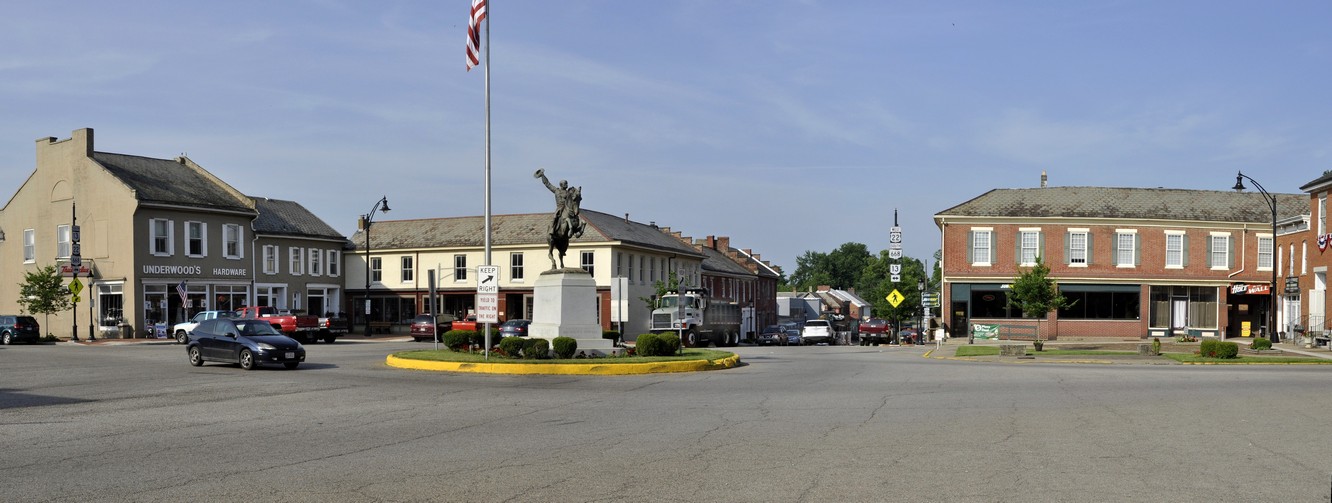
Somerset is a small town about 110 miles south of Canton. In the middle of its impressive town square (which had a very English feel to it) there was a statue to a famous son of Somerset, Union General Phil Sheridan.

We also passed by Dover OH, home to infamous Confederate guerilla leader William Clarke Quantrill (I just bought a biography to read), and also Bainbridge, home to the first dental school in the USA, opened in 1825.

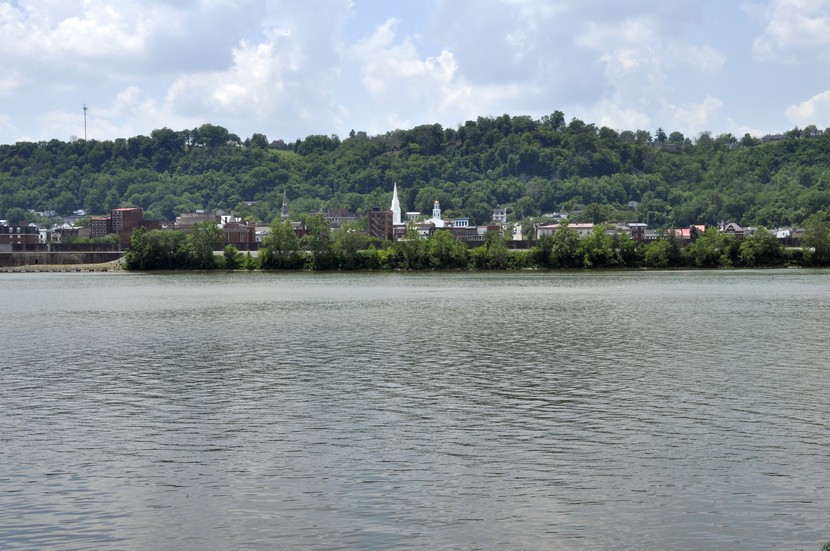
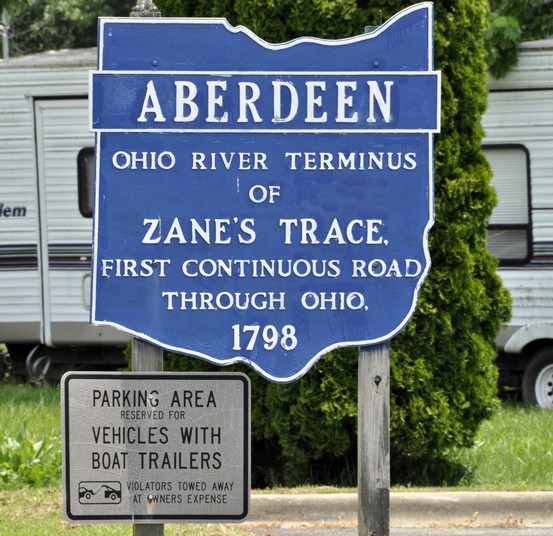
Eventually we reached the Ohio River at Aberdeen OH. The Ohio is a very impressive river and as I commented in a post after last year’s road trip, its flow is greater than the Mississippi. No wonder that rivers like the Ohio were used to open up the interior of the country.

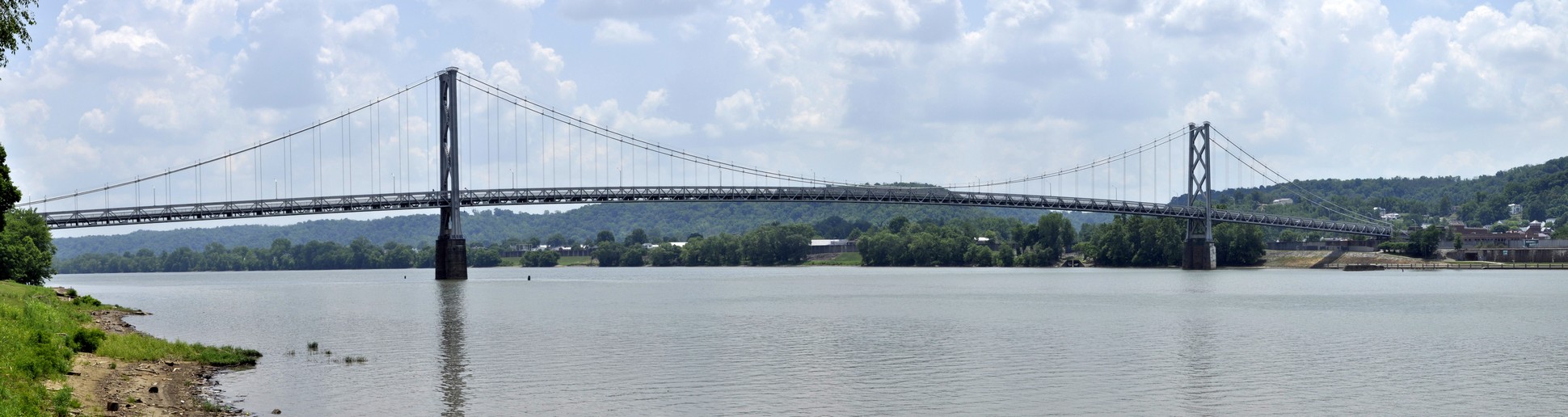
This is the bridge that carries US68 into Kentucky. We crossed a little further west on the William H Harsha Bridge, carrying US62.

Aberdeen is also the terminus of Zane’s Trace, the first continuous road through Ohio, from 1798.

Crossing into northern Kentucky, we were less than 50 miles north of where we had driven through the state in 2017. Then it was over the Ohio again, and into southeast Indiana. Our good friend and former IRRI colleague Bill Hardy (a native born Hoosier) told us that we should see the southern part of the state, since the northern half was flat and rather uninteresting, maize upon mile of maize. He was right. The drive into Bloomington was delightful in the early evening sunshine, with Highway 46 weaving through the trees, up and down dale.

After a restful night in Bloomington (yet another Comfort Inn!) we set off the next day for the penultimate sector of our trip that would take us to Ludington on Lake Michigan in the state of that name. This was another long drive, over 400 miles, north to Gary IN, and then wending our way north along the eastern shore of the lake.

Just over the state line into Michigan we stopped to have a quick picnic lunch at a rest area (and Michigan information center) on I-94. We were very impressed with the amount of tourist literature and maps available at the information center; Michigan certainly knows how to sell itself.

Just north of the state line we took a short detour to Warren Dunes State Park. Lake Michigan is like a vast internal sea, and along its shores, certainly the eastern shore, there are huge sand dunes, now covered with mature woodland. The sand is extremely soft, and hard to walk across. Just like being at the seaside, and although the day was overcast, enough brave souls were enjoying beach to the maximum.

This is Tower Hill Dune that rises to more than 230 feet above Lake Michigan.

Then it was back on the road again, heading for our last night stop of the trip, at Ludington, before taking the ferry across Lake Michigan the next morning to Manitowoc on the Wisconsin shore.

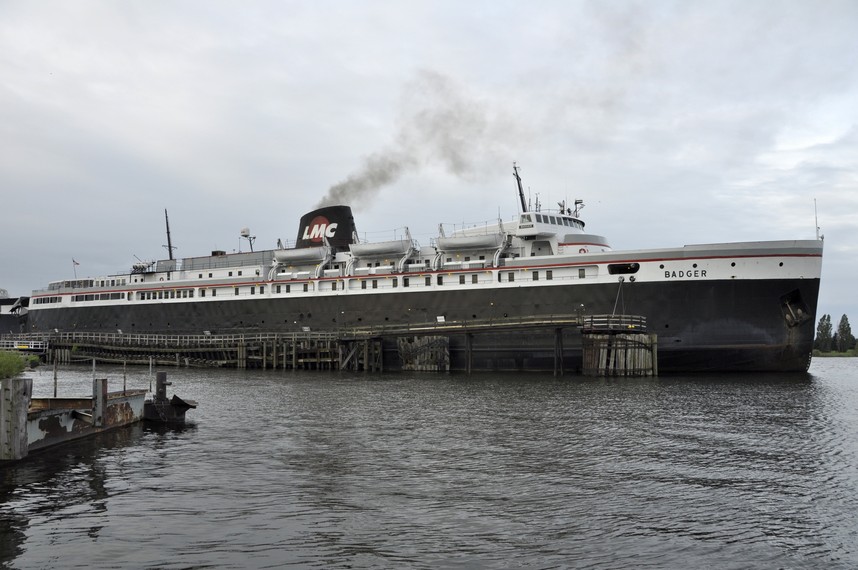
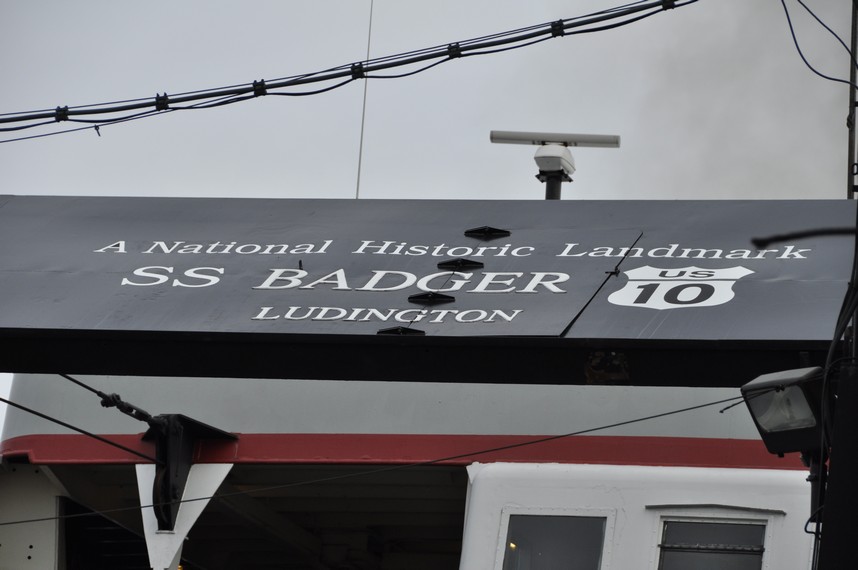
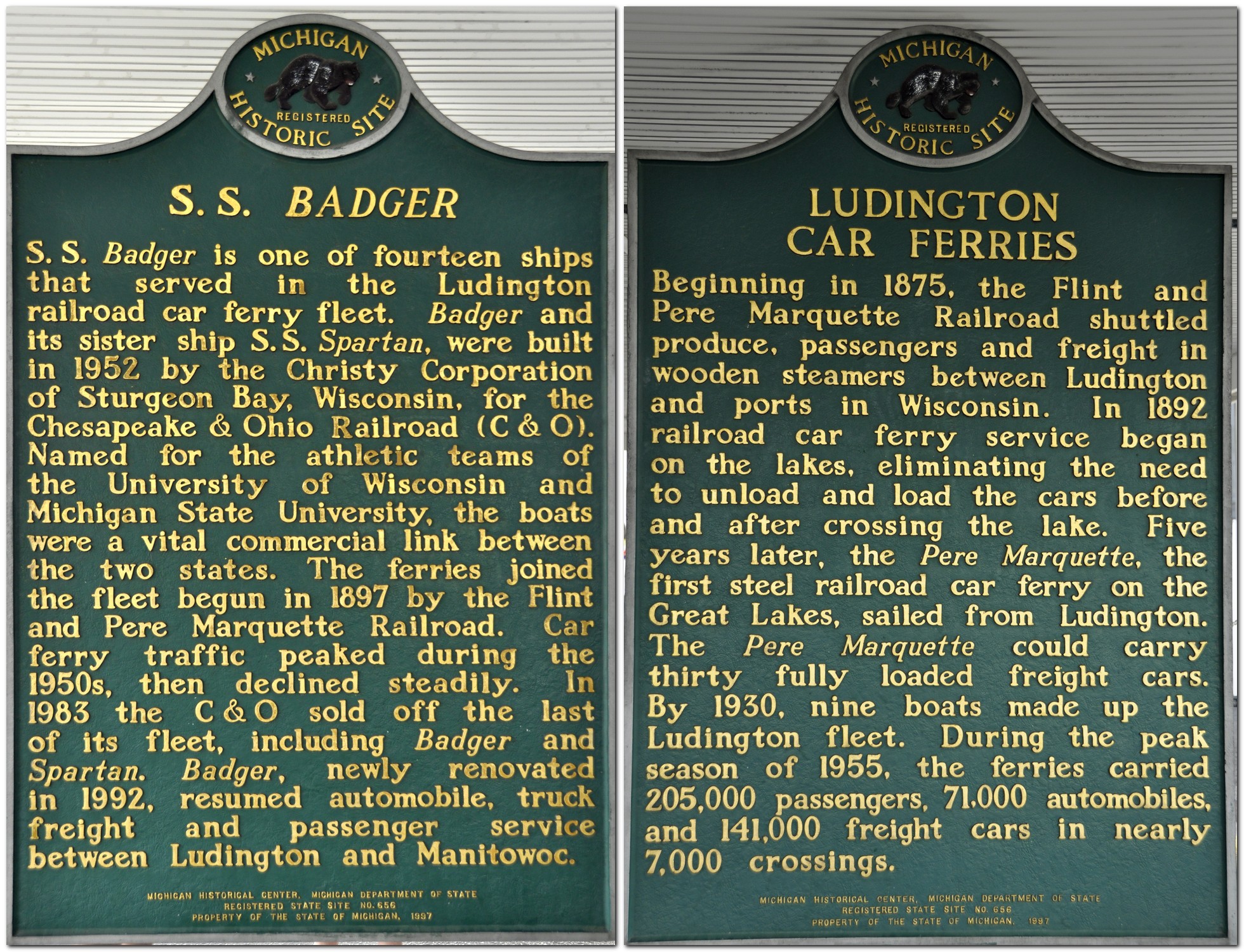
The ferry, SS Badger, across Lake Michigan is operated by LMC – Lake Michigan Carferry. Badger is the last coal-fired ferry operating in the world.

It is 393 feet long, and has a beam of almost 60 feet. It was built in 1953 in Sturgeon Bay, WI. Its sister ship, Spartan, has been laid up in Ludington for many years. Originally the ferries carried rail cars.

The 60 mile crossing of the lake takes four hours, but you gain 1 hour moving from Eastern Standard Time to Central Time. As it was a Wednesday in mid-June, before the height of the tourist season, the boat was far from busy. The slow, easy-paced crossing was just my opportunity to catch up on some sleep, in readiness for the final push into the Twin Cities from Manitowoc across Wisconsin, some 321 miles.

We were at the dockside a little after 07:30, and they started to board the vehicles shortly afterwards for an on-time departure from Ludington at 09:00. Vehicles are driven on board by company staff. So before we sailed we had a good look around the vessel.

Soon enough we were headed out of Ludington harbor.

And before we knew it, Manitowoc was coming into view, and everyone was getting ready to disembark.

I had planned a route across Wisconsin that took us from Manitowoc through Stevens Point on US10. We took I-43 north for a couple of miles or so, then came off to take US10, only to see a sign stating that the road was closed some miles ahead. With that, I changed the settings on my satnav to take the quickest route to St Paul, rejoining I-43 around Green Bay, and west on Highway 29, until we joined I-94 west of Chippewa Falls for the final 75 miles into the Twin Cities. Highway 29 was a nightmare. Although a dual carriageway (a divided highway) it just went on and on, unrelentingly, in a straight line across Wisconsin. However, we did arrive to Hannah and Michael’s almost an hour earlier than anticipated.

Thus ended our 2018 road trip across twelve states: MA, VT, NH, ME, NY, PA, OH, KY, IN, MI, WI, and MN.

In nine days we covered 2741 miles, plus another 477 miles in Maine itself during the six days we stayed at the cabin. We used 133 gallons of gasoline, at a cost of $384 ($2.89/gallon, less than half of what we would have to pay in the UK for the same amount of fuel), at an average consumption of 24.19 mpg.

I’m already planning for 2019; Georgia to Texas through the southern states seems a distinct possibility.

~~~~~~~~~~~~~~~~~~~~~~~~

See the other posts in this series:

Massachusetts to Minnesota (1): the first three days in MA, VT and NH

Massachusetts to Minnesota (2): a week in Maine

Massachusetts to Minnesota (3): onwards to Niagara Falls

Massachusetts to Minnesota (3): onwards to Niagara Falls

Leaving Waterford, ME for Niagara Falls early on the morning of 15 June, we allowed two days for this sector of our trip, 366 miles on the first day, and 289 on the second.

We headed west to the Kancamagus Highway through the southern part of the White Mountains of New Hampshire, and a slow climb to reach the the pass at 2855 feet. The cloud level was quite low, and at some scenic overlooks there was sometimes very little to see. But luck was on our side, and we did have some spectacular views in all directions, particularly at Pemigewasset Overlook northwards.

There were many road signs warning of the presence of moose along the highway throughout much of the trip in New England. But we saw neither hide nor hair, not even an antler. Roadkill raccoons were two a penny. This road sign (courtesy of Trip Advisor) warns drivers at the start of the Kancamagus Highway.

Once across the mountains, we turned south for about 30 miles on I-93, to join US4 to cross Vermont, a section we had more or less traveled the week before.

About 10 miles south on I-93 we saw a sign for road works ahead, and we could see the traffic slowing. But then I could also see vehicles moving beyond the ‘obstruction’, one at a time. Funny situation, I thought to myself. Anyway, to cut a long story short, agents (maybe 20 or more, plus dogs) of the US Customs & Border Protection were checking all vehicles for occupants. And, having British passports, we were asked to pull over while I retrieved our passports from a suitcase in the back. Once checked, we were waved on our way. By coincidence, I had read earlier that day a story about these ‘border checks’ miles and miles from any international border (with Canada in our case, or in the south with Mexico).

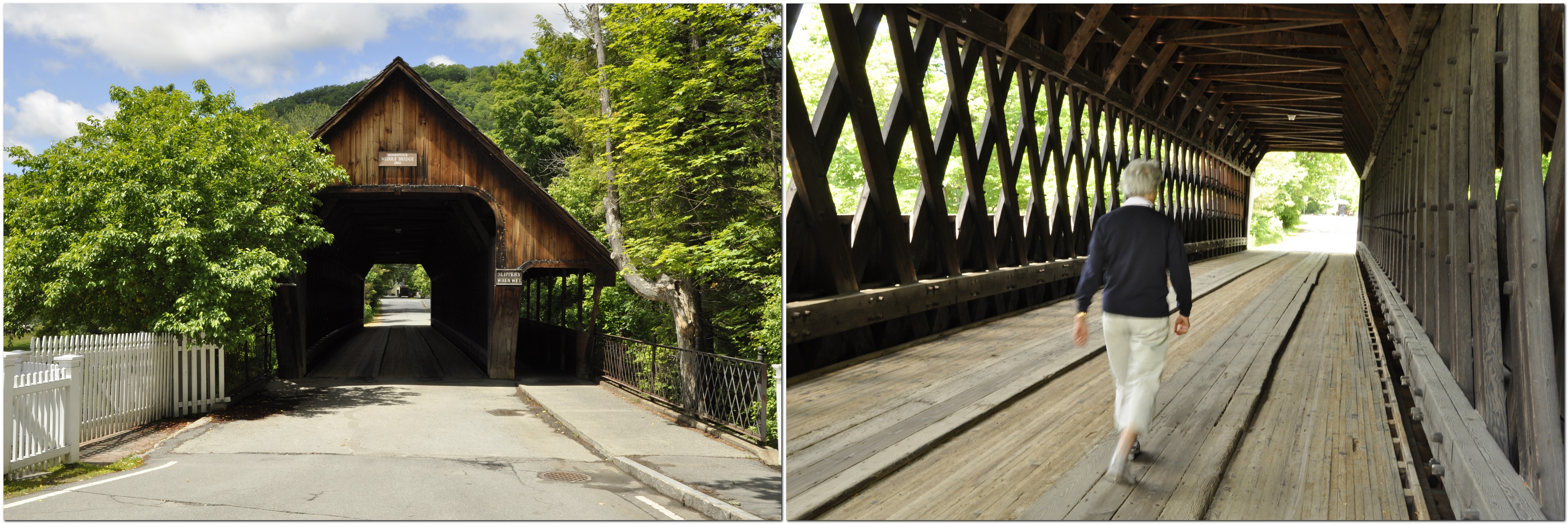
Once in Vermont we passed through a pretty town named Woodstock. No, not that one – that’s in NY. There was an interesting covered bridge, constructed in 1969 to replace an iron one that had been put across the river in 1877. Apparently this wooden construction was cheaper than other options.

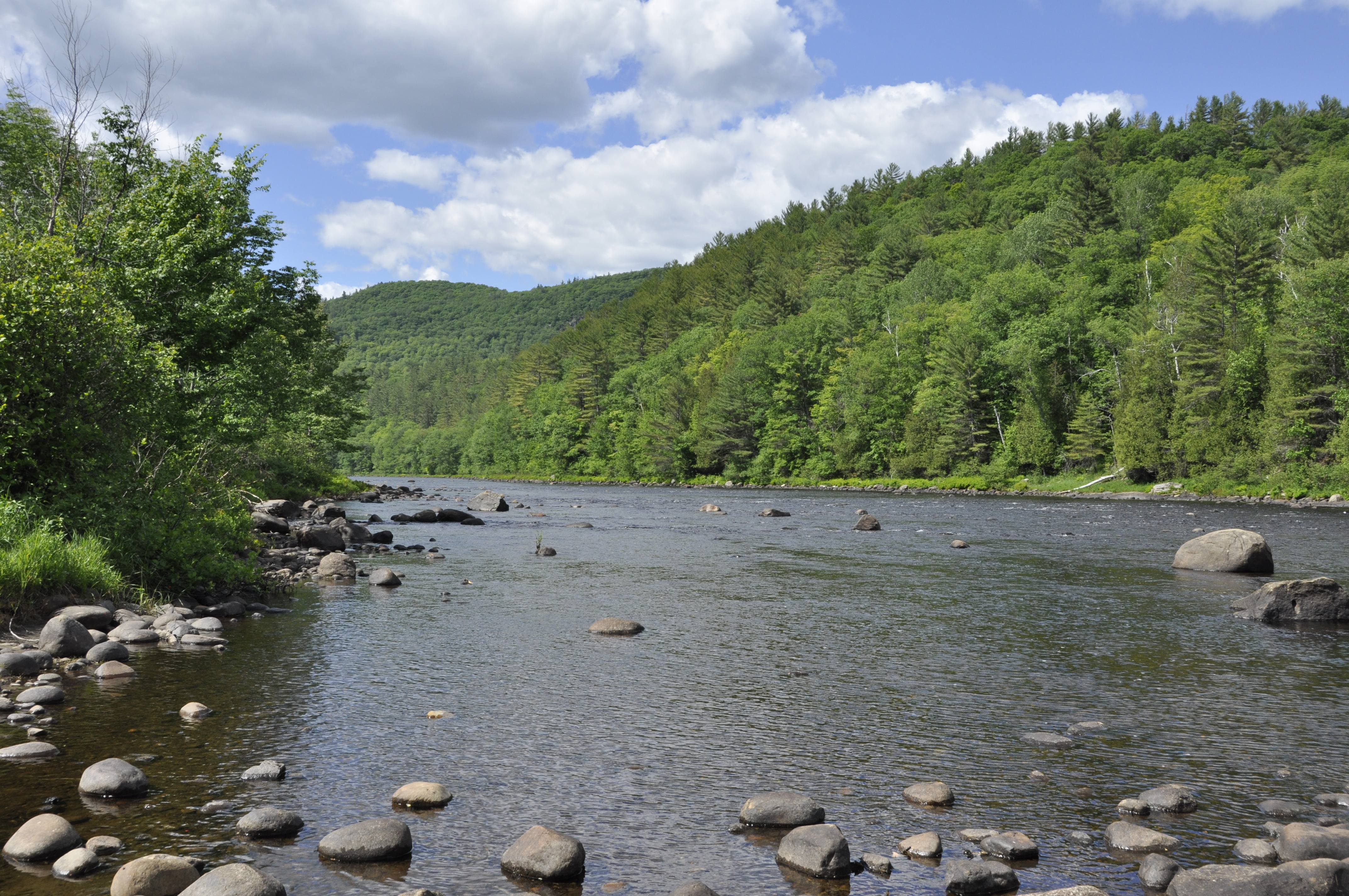
Our destination for this night was Herkimer, NY, about 10 miles east of Utica. Crossing from Vermont into New York, we headed north into the Adirondacks Regions and west around Indian Lake, following for the first part, the valley of the Hudson River.

The following day, we headed west from Herkimer towards Ithaca (home of Cornell University). We passed through many delightful villages, among them Sauquoit where Steph spotted a memorial plaque. I regret not stopping, since it commemorated Asa Gray, born 18 November 1810 (same birthday as me), who is considered the preeminent American botanist of the 19th century.

We enjoyed the rolling landscape, dotted with small farms, the chapels in the villages.

St Paul’s Church, Paris Hill, established in 1797. This is the oldest parish in Western New York, from 1838.

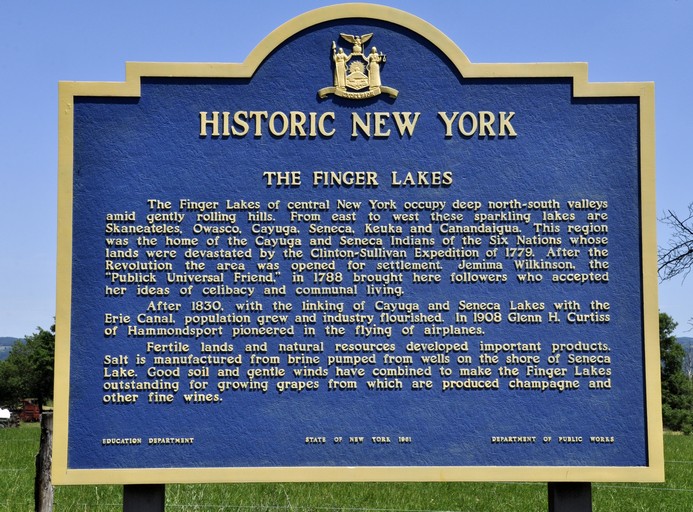
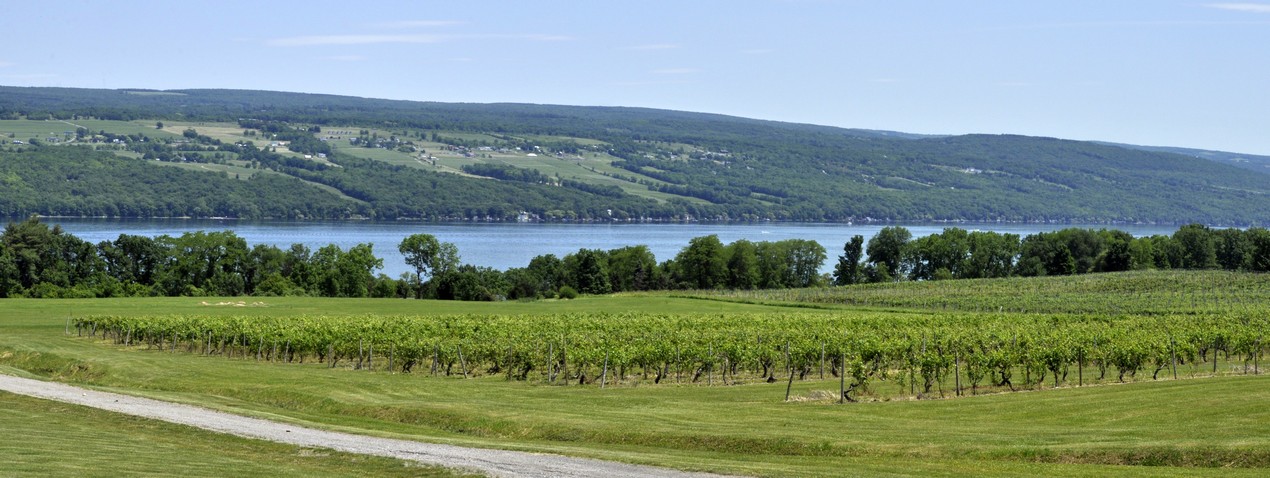
At Ithaca, we stopped to have a picnic lunch beside Lake Cayuga, one of the Finger Lakes that characterize this part of upstate New York.

This is also wine country, and the views across Lake Seneca heading north towards Geneva were stunning. Wineries everywhere!

As we had a prior engagement in Niagara Falls NY that evening, I changed our route, joining I-90 west just north of Geneva rather than cutting across country (a much longer route) as I originally intended.

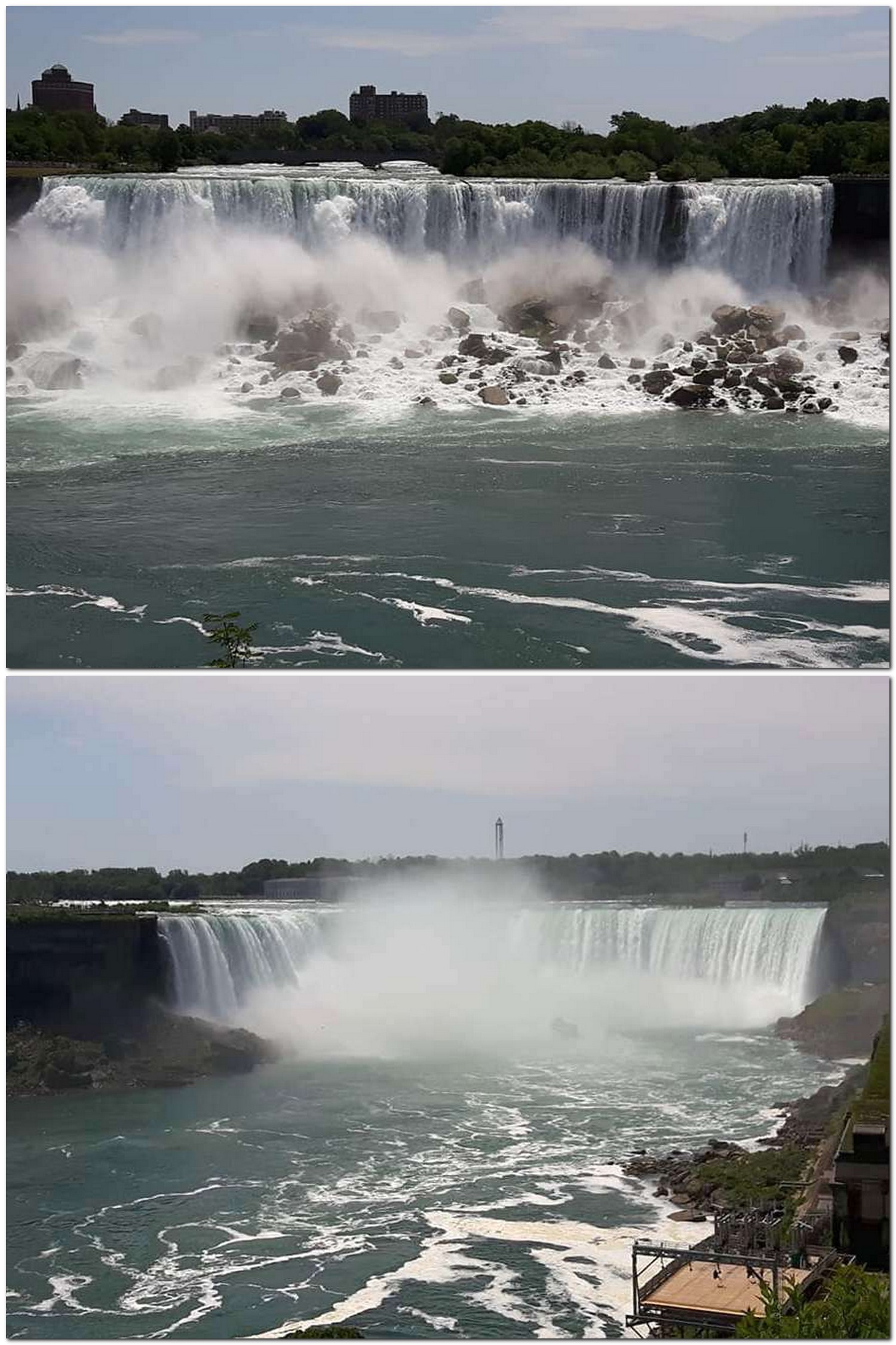
We arrived in Niagara Falls just before 5 pm, and after checking into our hotel close to the city center and the Falls, we decided to stretch our legs by taking the short walk to the American Falls. The light was just right, and although it was quite busy, I’m sure later in the season this site could be heaving with tourists.

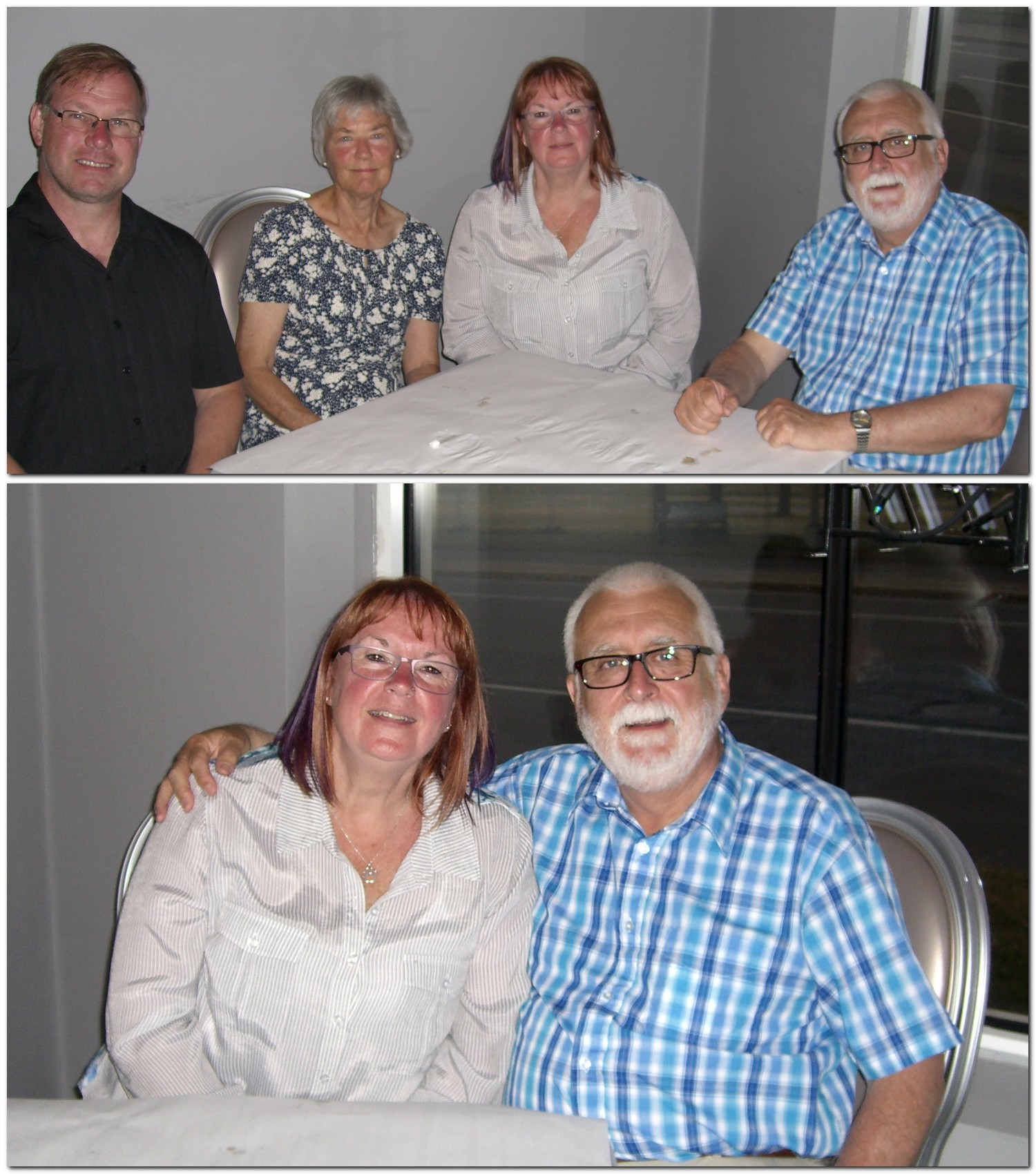
So what was this prior engagement? We had arranged to meet my cousin Patsy and her husband David, who had driven down from Ottawa the day before and were staying on the Canadian side. They had never been to Niagara Falls before either. I had met Patsy just once, in the summer of 1972 a few months before I headed off to Peru. Patsy (just 12 then) and her elder sister Karen had come over to the UK with their mother Bridie, one of my Mum’s younger sisters, to meet the Healy side of the family.

We had arranged to meet for dinner at a small Italian restaurant, La Cuccina Di Mamma on Rainbow Boulevard. What a lovely time we had: great company, good food, and heaps of reminiscing! Steph and David were most indulgent towards Patsy and me.

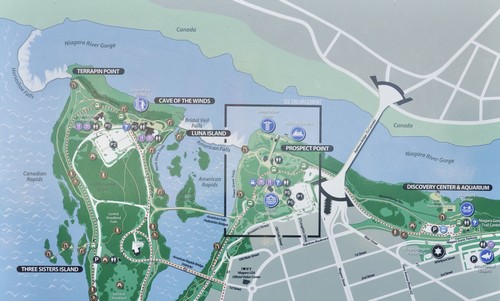
The next day we were up early to take advantage of the good weather, and to view the Horseshoe Falls from Terrapin Point on Goat Island, and the American Falls in the other direction from Luna Island.

The best views of the Falls (mist permitting) are from the Canadian side, but we decided not to cross over. Instead, Patsy sent me these two photos of the American and Horseshoe Falls from their side of the border.

And this short (<3 minute video) illustrates the awesome power of the falls, with a flow of 675,000 gallons/second over the Horseshoe Falls, and 75,000 gallons/second over the American Falls (both relating to summer daytime flow).

Around 10 am, we’d explored all that we wanted, and so set off on the next stage of our journey, 760 miles over two days southwest through New York into Pennsylvania, Ohio, a brief stretch through Kentucky along the Ohio River, and on to Bloomington, Indiana.

~~~~~~~~~~~~~~~~~~~~~~~~

See the other posts in this series:

Massachusetts to Minnesota (1): the first three days in MA, VT and NH

Massachusetts to Minnesota (2): a week in Maine

Massachusetts to Minnesota (4): heading west through NY, PA, OH, KY and IN, then on to MN

Massachusetts to Minnesota (2): a week in Maine

It has been great to meet up with our elder daughter, Hannah, and her family (Michael, Callum, and Zoë) for a week in a cabin at Waterford in Maine, taking a short break in our road trip. They flew in from St Paul (Minnesota) three days after we landed in the USA, and on the day that we drove over from Burlington in Vermont, crossing the White Mountains in New Hampshire.

And what fun we have all had together. It’s wonderful to see them again. It has been a year since we were last over on this side of the Atlantic.

On Saturday we decided not to stray far from the cabin, just the short distance to Hawk Mountain to take in the breathtaking panoramas south and west of Waterford.

Sunday was Michael’s 40th birthday so we celebrated by a visit to Attitash Mountain Resort, about 50 miles west of the cabin along US302. This map shows all the excursions we made during the six days we spent in Maine.

I’d been expecting huge crowds, and long queues for the rides. But no! Although school was out in some areas, the resort was quiet, and we could take as many rides up and down the mountain as we liked, and no waiting.

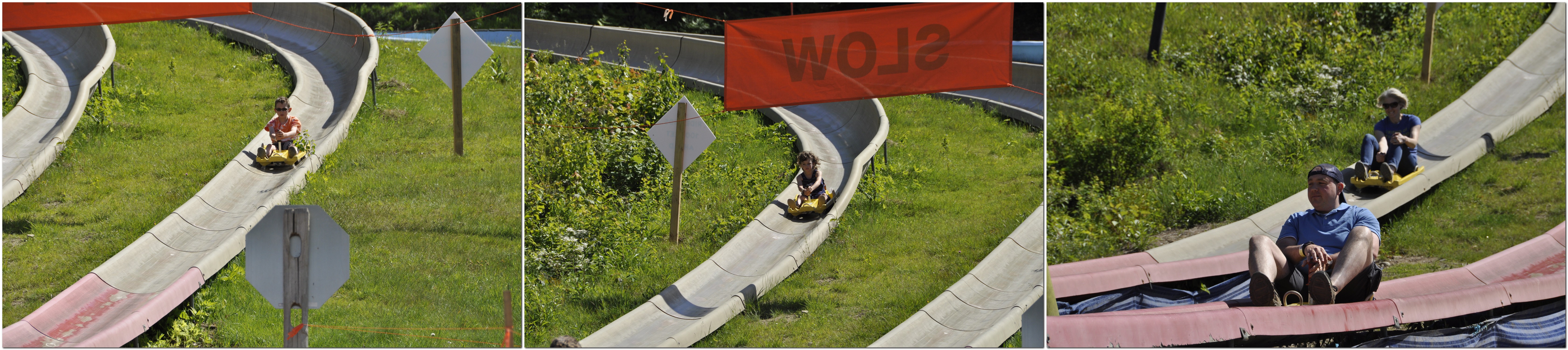
There were two rides that we enjoyed: the Alpine Coaster, and the Alpine slide. Never having experienced either, Steph decided to ride with Hannah on her Coaster ride; I took Zoë. Callum rode with Michael.

I’d seen videos on YouTube of alpine coasters around the USA. The one at Attitash is advertised as the longest. This is what it looks like.

Michael managed to capture me on his cellphone during one of my descents.

The Coaster was quite a bone shaker. More fun for us ‘oldies’ was the mile long and awesome descent on the Alpine Slide. It’s a bit like the Olympic luge. And we could all take our own carts, even Callum and Zoë.

Here’s what it looks like from a rider’s perspective, from a video I found on YouTube.

To begin the ride, it was necessary to take the chairlift up the mountain, about a 10 minute ride, with incredible views over the surrounding mountains.

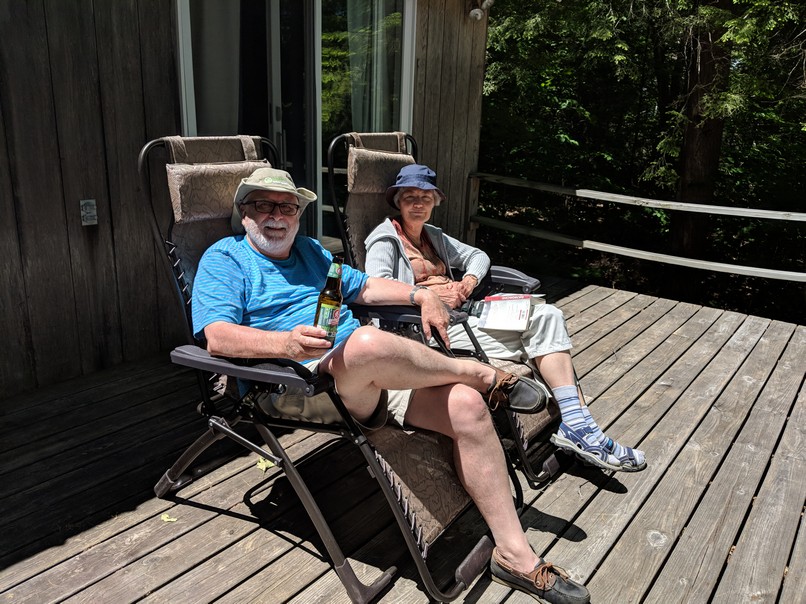
And when it all got too much, it was nice just to sit back, relax in the sun, and watch the others having the time of their lives.

Being Michael’s special day, we stopped off for dinner at a recommended restaurant, where he enjoyed lobster, and the rest of us something not quite so exotic. The end to a great day.

After all the excitement of the previous day, we decided to take it easy on the Monday. So Hannah and Michael took the children around McWain Pond in a canoe.

Meanwhile, this was a great opportunity for me to enjoy yet another cold beer in the sunshine, and Steph to knock off another couple of chapters of the book she’d brought with her.

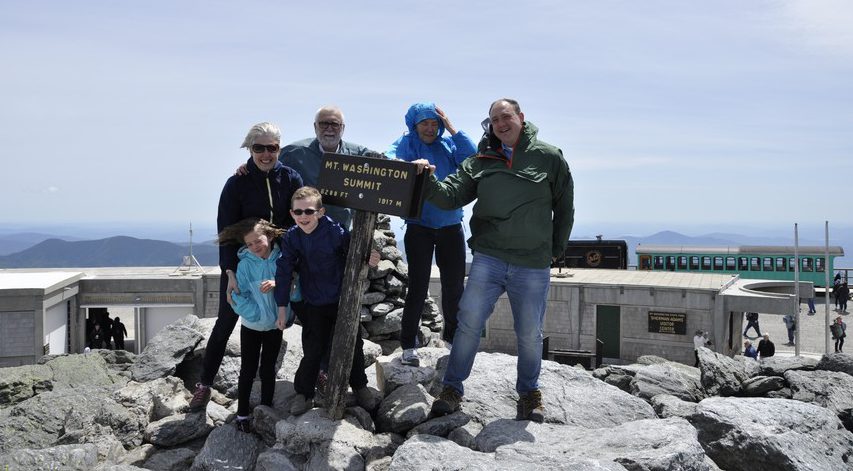
On the Tuesday we set off for Mt Washington, at 6228 feet the highest mountain in the northeast of the USA, and where the highest wind speed was recorded in the 1930s.

We passed by Mt Washington near Bretton Woods on the west side of the mountain while traveling across New Hampshire the week before.

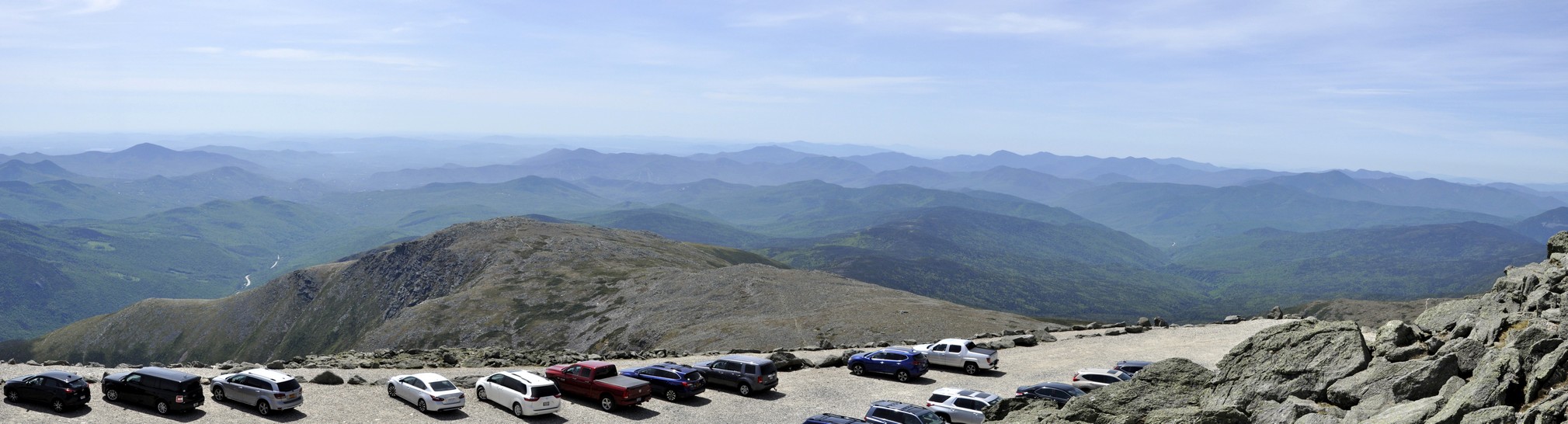
It’s a seven mile drive up to the summit, and we enjoyed a 360° panorama at the top. We were lucky. For more than 60% of days, the summit is completely fogged in. While it was windy (40-60 mph), it was just about manageable.

There’s also a cog railway that climbs to the top, bringing even more tourists who don’t relish the drive. While we were at the summit several trains arrived, and I was fortunate to capture this shot of three at the summit.

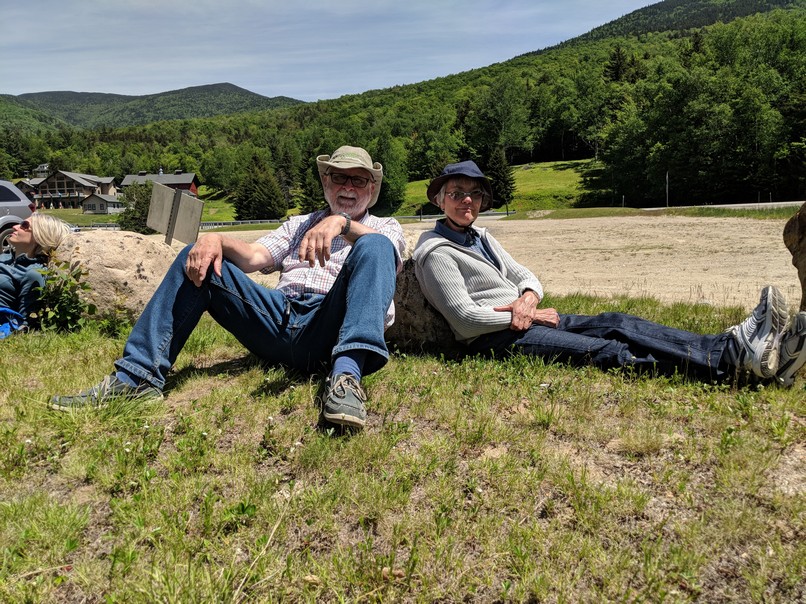
After the slow descent, and heating of the brakes, we found a nice spot to enjoy a picnic, let the car cool down, and a rest for ourselves.

On the way back to Waterford, we finally came across one of New England’s famous covered bridges – at Jackson, NH! They really are fascinating, and from what I could tell from various plaques and information online, they are really cherished.

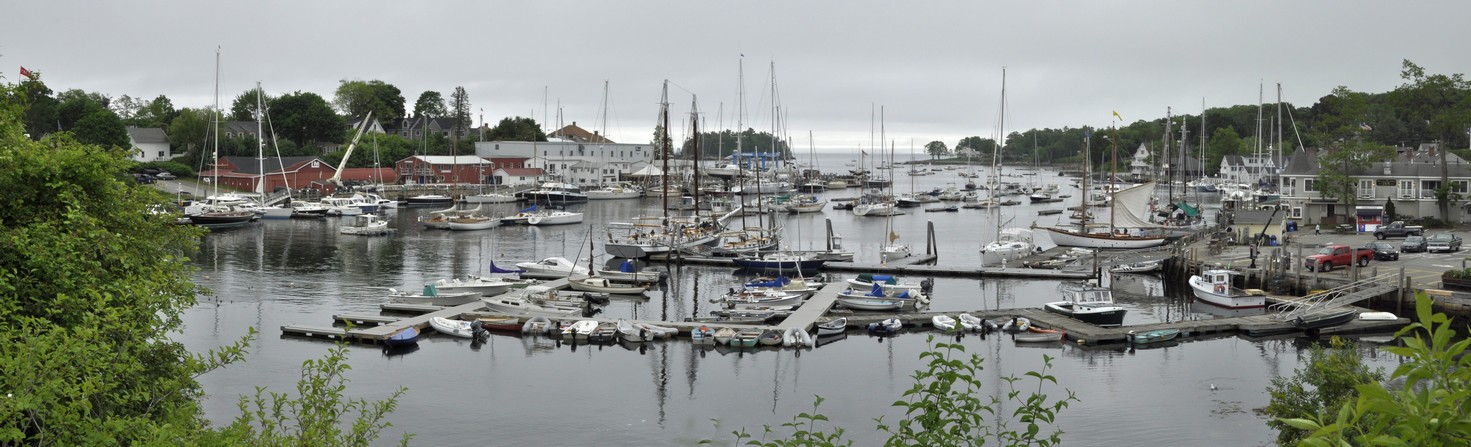
Wednesday and Thursday were our big excursion to the coast, to Camden on Penobscot Bay for an all-day sail around the bay on Sailing Vessel Owl with Capt Aaron (Lincoln) at the helm, a direct descendant of folks who came to the USA in the 1680s.

Michael used to sail these waters with his mother and stepfather when he was a boy, and was keen for Callum and Zoë to enjoy the same experience. We left the cabin by 06:30, and were ready for boarding the Owl around 09:30.

We set off east into the bay, arriving at the passage between North Haven and Vinalhaven (map) by lunchtime, in time for a short shore excursion on a small island. Until our return it had been warm and sunny, and mostly smooth. But as we set sail for the return to Camden, the wind got up, the waves increased and the temperature fell.

After a long day at sea, about 9 hours, we arrived back in the harbor, and enjoyed a welcome meal of freshly caught haddock. Since the drive from the cabin had taken about 2½ hours, we had already decided to spend the night in Camden, returning mid-morning the next day.

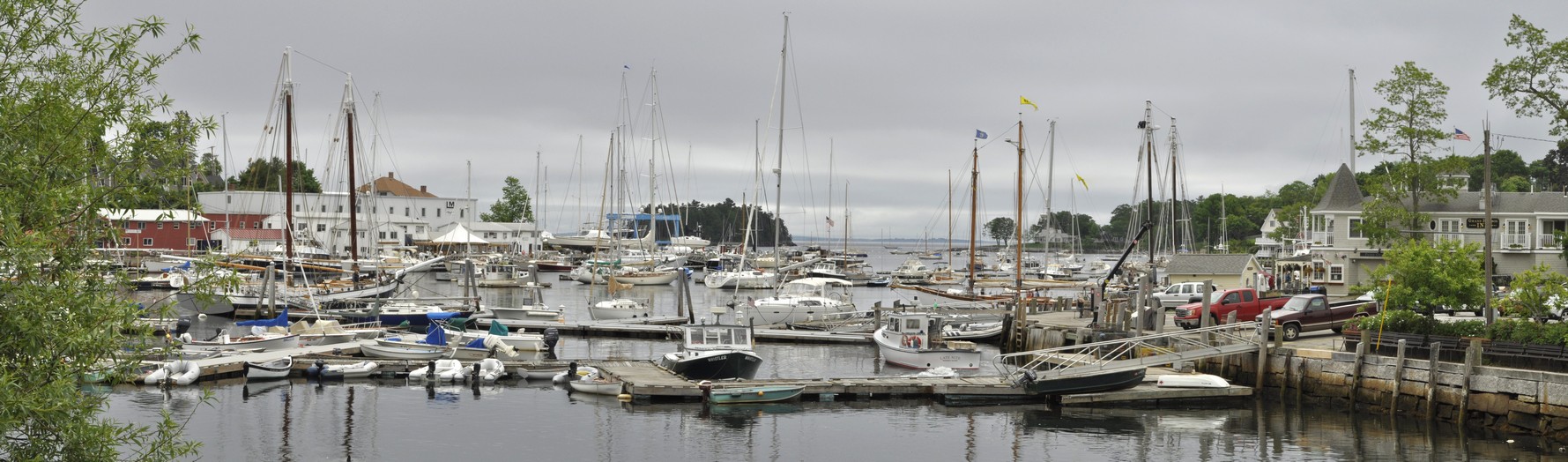
But before we left, we took a stroll around this pretty town and its harbor. In a small park overlooking the harbor there is a statue memorial to soldiers who fell in the American Civil War of the 1860s, referred to interestingly as The Great Rebellion.

There’s considerable wealth in Camden, given the large houses and boats moored in the harbor, owned by some of America’s most illustrious families.

Before heading back to the cabin at Waterford, Steph and I decided to take a look around Rockport, just a couple of miles south of Camden. On the point of a peninsula east of the town, the simple and beautiful Vesper Hill Chapel was built in 1962, and is dedicated to all young people who found God in their lives.

Then it was time to head west so that we would have enough time to pack, and prepare for the long trip even further westwards the next day.

Such was our week in Maine, enjoying time with Hannah and Michael, and the grandchildren. Callum and Zoë took everything in their stride, full of beans, and always ready for the next adventure. They keep us young!

~~~~~~~~~~~~~~~~~~~~~~~~

See the other posts in this series:

Massachusetts to Minnesota (1): the first three days in MA, VT and NH

Massachusetts to Minnesota (3): onwards to Niagara Falls

Massachusetts to Minnesota (4): heading west through NY, PA, OH, KY and IN, then on to MN

Massachusetts to Minnesota (1): the first three days in MA, VT and NH

It’s that time of the year, and here we are, on the road again in the USA. Another potentially daunting road trip that will take us from Boston, Massachusetts (MA) to St Paul, Minnesota (MN) via Vermont (VT), New Hampshire (NH), Maine (ME), New York (NY), Pennsylvania (PA), Ohio (OH), Kentucky (KY), Indiana (IN), Michigan (MI), and Wisconsin (WI), including a ferry crossing of Lake Michigan from MI to WI. This year I’m using my new Garmin DriveSmart 51 sat-nav, for which I purchased the USA-Canada maps. It saves Steph having to navigate, state by state, map by map, as in previous years, so she can enjoy looking at the passing scenery.

We are also spending a week near Waterford in western Maine, with our daughter Hannah and family (Michael, Callum, and Zoë) at a cabin on the shore of McWain Pond, one of the many small lakes that dot the landscape.

Anyway, it all started last Wednesday morning, very early, when a taxi picked us up from home at 04:00 to take us to Birmingham Airport (BHX) for our 06:00 KLM flight to Amsterdam Schipol (AMS), connecting with Delta 259 at 11:15 to Boston Logan International Airport (BOS).

Apart from a rather rude Delta ground agent at Schipol, our connection was uneventful, as was boarding (Sky Priority), and I was soon enjoying my first G&T on the 6 hour 55 minute flight, on a comfortable Airbus A330-300. When we landed in BOS there was a delay of more than 20 minutes while the ground crew figured out how to connect the air-bridge to the aircraft. But soon enough, we were checked through immigration on one of the newfangled automated passport control (APC) machines. I still had to pass through regular immigration (and facing another rude official who even queried me about any visits I’d made to the Middle East). Before long, luggage in hand, we were at the car rental center and picking up our SUV from Budget. The Mitsubishi we had been assigned had a flat battery, so Budget upgraded us to a full-size SUV, a Dodge Journey V6—rather larger than we needed, but extremely comfortable nevertheless, if a little heavy on fuel (about 25 mpg). But at USD3 a gallon, that’s not really an issue. It would be in the UK, however, where gasoline is more than twice the price!

We successfully navigated our way out of the airport and through the tunnels under Boston city center on I-90, after finally getting the sat-nav to behave itself. Our Wednesday night stop was in Hadley, in central MA, just over 100 miles west of Boston, and southwest by a handful of miles of Amherst.

Over the next two days we took in northwest MA, the Green Mountains of VT as far north as Burlington, and then over the White Mountains of NH, to arrive at our cabin destination in Waterford, ME.

Heading northwest from Hadley on Thursday, it was slow-going for the first 20 miles or so as we encountered school traffic and people heading to work. But soon we were in open country, on scenic byway 112 and often had the road to ourselves for long stretches (as we have enjoyed in past road trips). After about an hour we joined MA2, the Mohawk Trail, and followed that until North Adams where we turned north and crossed over into VT.

There was a glorious view south from Whitcomb Summit, and some miles further on, just short of North Adams, there is a spectacular view north into southern Vermont, reminding us of the views we saw when exploring the Appalachians in 2017.

Vermont is a beautiful state, with forested hills and mountains as far as the eye can see.

North of Wilmington, VT we stopped at a general store and deli to buy sandwiches and were intrigued with the Mini Cooper parked outside with an interesting registration plate BONKS. There was also a Golden Retriever with a Union Jack collar. We discovered that the proprietor was British, from Guildford in Surrey (near London)!

We spent Thursday night on the east side of Burlington, conveniently located for the next day’s travel northeast into New Hampshire and Maine, beginning around 08:00.

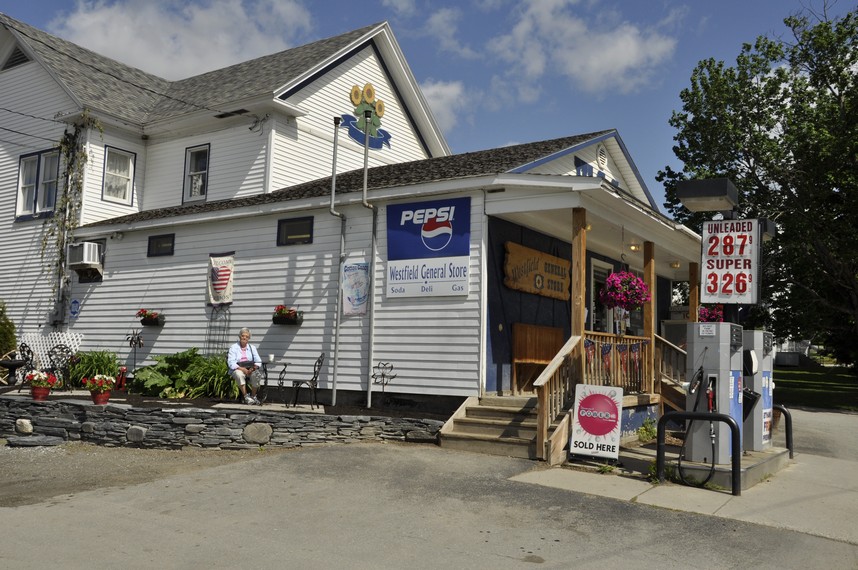
Most of the small communities we passed through have a general store or two, offering a whole range of produce, and many selling fresh sandwiches from a deli counter. We enjoyed a coffee in the sun at Westfield in the far north of the state, just south of the border with Canada.

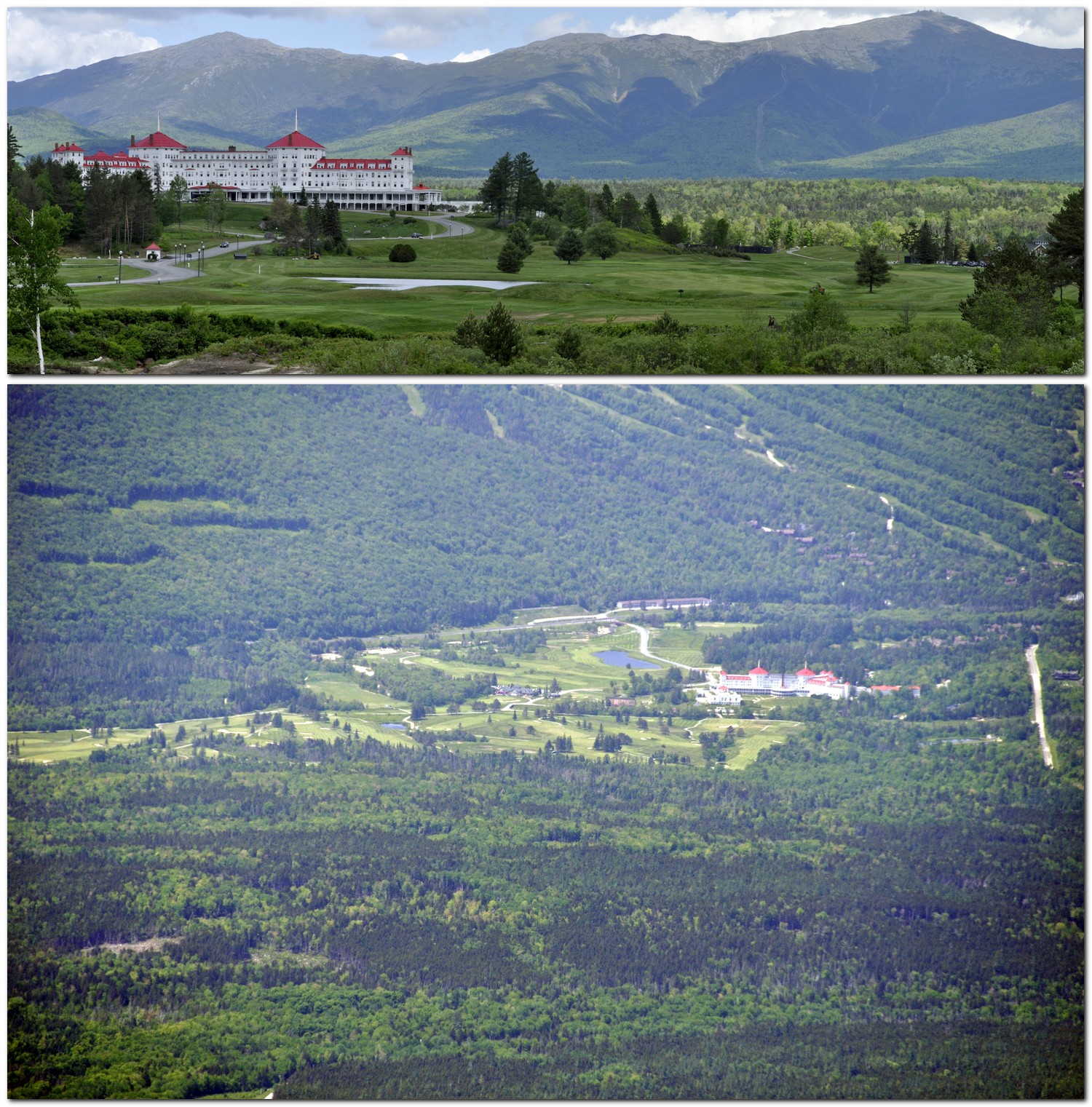
Crossing into New Hampshire, we headed towards the White Mountains and were not disappointed with the fantastic view of the Presidential Range and the Mt Washington Hotel Resort at Bretton Woods. That’s Mt Washington just left of center, at 6288 ft the highest mountain in the northeast USA.

But Bretton Woods also has special significance for me. Why? Well, I worked for 27 years at two international agricultural centers, CIP and IRRI,  sponsored by the CGIAR (Consultative Group on International Agricultural Research). The CGIAR was founded in 1971 under the auspices of the World Bank. In July 1944, an international conference was held at the hotel to plan for a post-war world, following which the World Bank and the International Monetary Fund were created.

Stopping at Conway to pick up a supply of groceries, we finally reached the cabin around 17:00. A long enough day, followed by a couple of cold beers, an early night, but still far short of some of the travel we have yet to make.

Watch this space!

~~~~~~~~~~~~~~~~~~~~~~~~

See the other posts in this series:

Massachusetts to Minnesota (2): a week in Maine

Massachusetts to Minnesota (3): onwards to Niagara Falls

Massachusetts to Minnesota (4): heading west through NY, PA, OH, KY and IN, then on to MN

Disillusionment also comes with age, not just youth . . .

I’m 70 later this year. I can’t think of any time during my adult life when I have been so disillusioned with politics here in the UK. Maybe I’ve just become a cynical old fart, but I’d like to think that’s not the case. Cynicism is not a personal attribute that I recognize. I am, however, a born optimist. My glass is almost always half full.

Yet the more this Brexit fiasco grinds on to its inevitable end in March next year (unless, by some political miracle, Theresa May and her inept government actually accept their own and independent analyses of the downside of leaving the European Union), the more pessimistic I become. Someone keeps taking sips from my glass.

Maybe I should quit Twitter. Inevitably, I follow tweeters who support Remain. So maybe I’m just reinforcing my own perspectives (prejudices) about the consequences of leaving the EU. Nevertheless, I did carefully weigh up both sides of the argument at the time of the June 2016 referendum, and voted to remain.

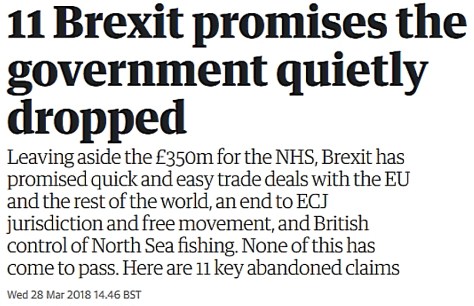
In the intervening two years, my opinion has not changed. If anything, I’m now a more committed Remain supporter given the distortion of the truth (I hate to use the term ‘lies’) pedaled by Theresa May and the Brexiteers in her Cabinet (the arch-protagonists being David Davis, Boris Johnson, and Michael Gove) and on the back benches of the Tory Party such as Jacob Rees-Mogg, Peter Bone, and John Redwood (and too many others to mention). If nothing else, they are certainly being economic with the truth.

It’s no better on the Labour benches, at least the Labour front bench. In my antipathy to the Tories, the Labour Party should be the logical recipient of my support. With Jeremy Corbyn at the helm I’m afraid that is never going to happen. Although he’s never said so explicitly, every action (or lack of) that he makes signifies that Corbyn is a Brexit supporter. Although not as commonplace as among the Tories, there are several prominent back-bench Labour Brexiteers like Kate Hoey who made a name for herself by spouting some of the most unverifiable drivel you can imagine in support of Brexit.

It’s remarkable that when the Tory government is in such disarray over Brexit that, in a recent poll, the Labour Party now finds itself several percentage points behind the Tories, notwithstanding the party making considerable parliamentary gains during Theresa May’s botched electoral campaign in 2017.

I just don’t see how being a member of the EU is holding this country back. I am sick of hearing that leaving the EU is the will of the British people. Yes, a majority of those who voted, 52%, supported Leave. One cannot dispute that result. I do believe that the referendum was flawed from the start, and evidence is emerging that there were shenanigans in the Leave campaign. Given the constitutional, social, and economic consequences of leaving the EU (after more than 40 years) the bar should have been set much higher for the vote. By that I mean that there should have been an absolute majority vote of the total electorate for one side or the other, not just those who voted. Because of the turnout, we now have a decision to leave the EU supported explicitly by just 37% of the electorate.

After two years we still do not know what the UK government’s negotiating position really is, or what outcome it desires, other than ‘Maybot’ slogans like Brexit means Brexit, Taking back control . . . of laws, borders, money.  Challenged on the BBC2 Daily Politics program yesterday to state clearly what she wanted from Brexit, Conservative MP Andrea Jenkyns just trotted out the same old slogans that I mentioned above. No ideas, no vision! If this is the best they can do after two years, Heaven help us! The situation has now became so untenable that the EU negotiators as recently as yesterday rebuked the government for living in a fantasy world.

What I find particularly irksome is the dismissal, denigration even, of expert opinion. Facts don’t seem to matter. Ideology is the name of the game. Appearing before a select committee this past week, the CEO and Permanent Secretary of Her Majesty’s Revenue and Customs (HMRC), Jon Thompson (someone who should be in the know), was asked for his assessment of the economic consequences of the two future customs options being ‘discussed’ by Theresa May’s Cabinet. He unequivocally stated that both options had severe economic consequences for businesses, as high as £20 billion. That’s more than the UK currently pays into the EU! Yet, when queried about that analysis, Andrea Jenkyns dismissed it, just as other Tories (particularly Michael Gove and Jacob Rees-Mogg, as well as The Daily Mail) have dismissed other expert opinion/analysis.

So, if things carry on as they have been, we’re headed for cloud cuckoo land¹. Flying in the face of reality, in the hope that the remaining 27 EU members will fall over to give the UK a special status post-Brexit (like being a member but not being a member), or that countries are lining up to sign trade deals (palpably untrue or, if under consideration, will exact terms that most of the population would consider unfavorable or unacceptable), we’re looking over a Brexit precipice and potentially sacrificing the futures of youth today.

And if the Brexit shambles wasn’t enough to cope with, this pathetic government has been mired recently in a scandal of its own ‘hostile environment’ making. Immigration is one of the major concerns of the Brexiteers, and a tough immigration policy has been a central plank of this and previous Tory governments. The Home Office (formerly occupied by Theresa May) is responsible for implementing immigration policy. But it has gone too far, and people who had a perfectly legal right to reside in the UK have been deported or threatened with deportation, and rights and benefits they enjoyed for decades were withdrawn. This was the case in particular with immigrants who came from the Caribbean (and other Commonwealth countries) in the 1950s and 1960s, the so-called Windrush Generation. It’s not only a scandal, but it’s a blot on the name and reputation of our country. The UK under the Tories really is becoming a nasty, insignificant little country, that aspires to greatness, but has lost the plot. This article highlights just one case.

Anyway, I refer to this latest scandal, because I found something rather interesting in the Conservative Party manifesto for the General Election held in June 1970, the first time I voted (I was 21, the minimum age for voting back then), and Edward Heath led the party to victory over Labour that had been in government from the mid-1960s under Harold Wilson. It also paved the way for the UK’s successful application to join the EEC (now the EU) on 1 January 1973. I searched the manifesto for any reference to the [EU]. This is all I could find:

These policies will strengthen Britain so that we can negotiate with the European Community confident in the knowledge that we can stand on our own if the price is too high.

But then, I came across something rather interesting with regard to immigration, and highly relevant in the current circumstances:

Good race relations are of immense importance. We are determined that all citizens shall continue to be treated as equal before the law, and without discrimination . . . We will establish a new single system of control over all immigration from overseas. The Home Secretary of the day will have complete control, subject to the machinery for appeal, over the entry of individuals into Britain. We believe it right to allow an existing Commonwealth immigrant who is already here to bring his wife and young children to join him in this country . . . We will give assistance to Commonwealth immigrants who wish to return to their countries of origin, but we will not tolerate any attempt to harass or compel them to go against their will (my emphasis).

How times have changed, and how the nasty party under Theresa May today has diverged from that broader church of Conservatism that I grew up under.

Come the next General Election, where will my vote go? Certainly not to the Tories. And unless Labour elects a different leader, and brings some realistic social thinking to its policies – and supports continuing membership of the EU – then my vote won’t be going there either. It’s a dilemma. It’s depressing. No wonder I’m disillusioned. Nevertheless, a little voice does whisper every now and again that things can get better. I certainly hope so.

~~~~~~~~~~~~~~~~~~~~~~~~~~~~~~~~~~~~~~~
¹ Cloud cuckoo land is a state of absurdly, over-optimistic fantasy or an unrealistically idealistic state where everything is perfect. Someone who is said to “live in cloud cuckoo land” is a person who thinks that things that are completely impossible might happen, rather than understanding how things really are. It also hints that the person referred to is naive, unaware of realities or deranged in holding such an optimistic belief.

Candles, paraffin lamps, electricity . . . and a ‘rule of thumb’

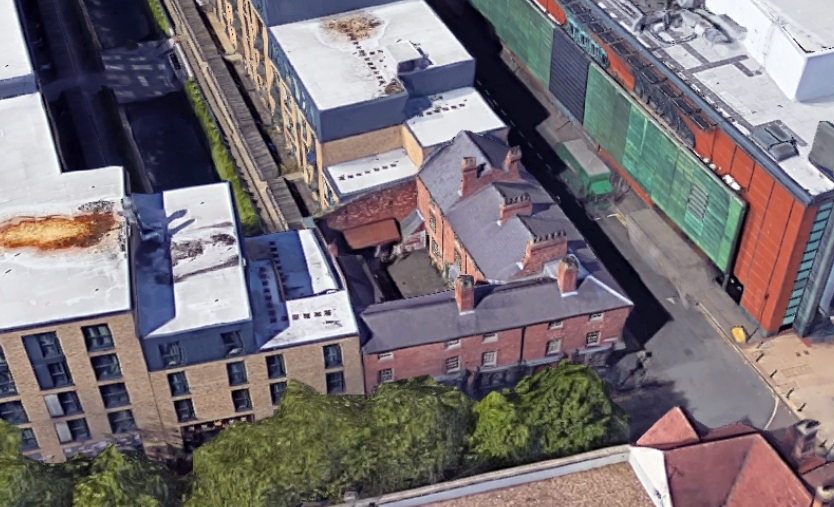
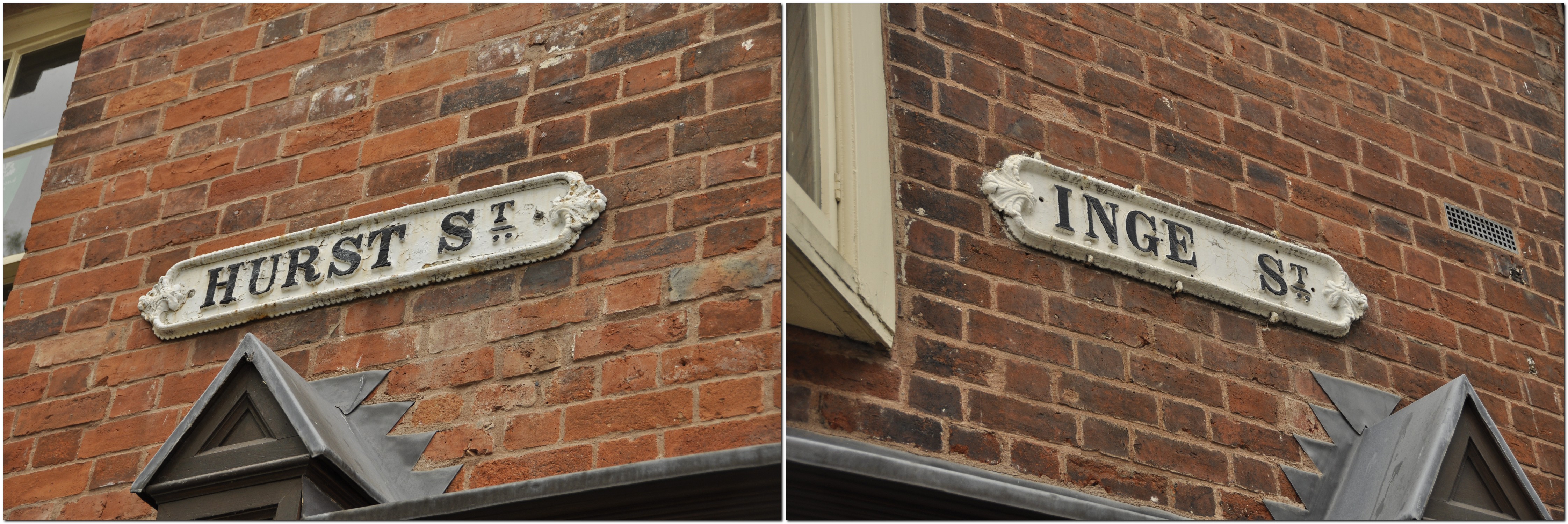
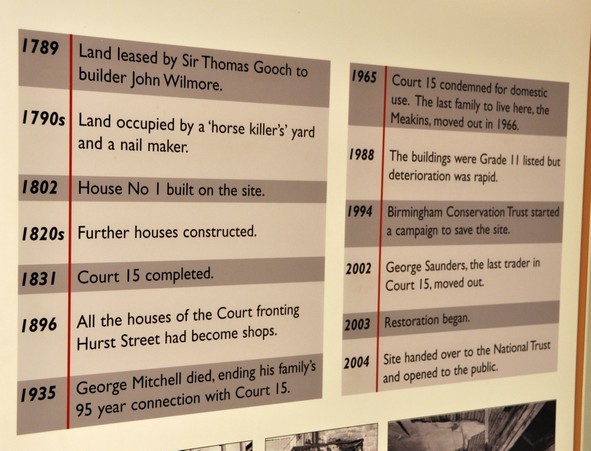
Once there were hundreds. Now there’s just Court No. 15, the last remaining (and carefully restored) courtyard of working people’s houses just south of Birmingham city center on the corner of Hurst and Inge Streets.

Court 15 of the Birmingham Back to Backs, with the Birmingham Hippodrome on the north (right) side. Just imagine what the area must have looked like in earlier decades with street upon street of these terraced and back to back houses.

This is the Birmingham Back to Backs, owned by the National Trust, which we had the pleasure of visiting a couple of days ago, and enjoyed a tour led by knowledgeable guide Fran Payne. This National Trust property should be on everyone’s NT bucket list.

Court 15 was completed in 1831 and its houses were occupied as recently as the mid-1960s, when they were condemned. Commercial premises on the street side were still being used as late as 2002.

Court 15 was a communal space for upwards of 60-70 men, women and children, living on top of one another, in houses that were literally just one room deep: built on the back of the terraces facing the street. Just imagine the crowding, the lack of running water and basic sanitation, leading to the spread of social diseases like tuberculosis or cholera that were common in the 19th century. Just three outside toilets for everyone.

Since coming into its hands in 2004, the National Trust has developed an interesting tour of three of the Court 15 houses, taking in the lives of families from the 1840s, 1870s, and 1930s known to be living there then. The tour, encompassing very narrow and steep (almost treacherous) stairs over three floors, takes you into the first 1840s house, up to the attic bedrooms, and through to that representing the 1870s. You then work your way down to the ground floor, and into the house next door. From the attic in that house, the tour passes into the former commercial premises of tailor George Saunders who came to Birmingham from St Kitts in the Caribbean and made a name for himself in bespoke tailoring. When Saunders vacated Court 15 in 2002 he left much of the premises as it was on his last day of trading.

A Jewish family by the name of Levi, was known to reside in one of the houses during the 1840s. The Levis had one daughter and three sons, and like many other families, Mr Levi practiced his trade (of making clock and watch hands) from his home.

On the top attic floor of this house there are two rooms still accessible on the street side, but have never been renovated.

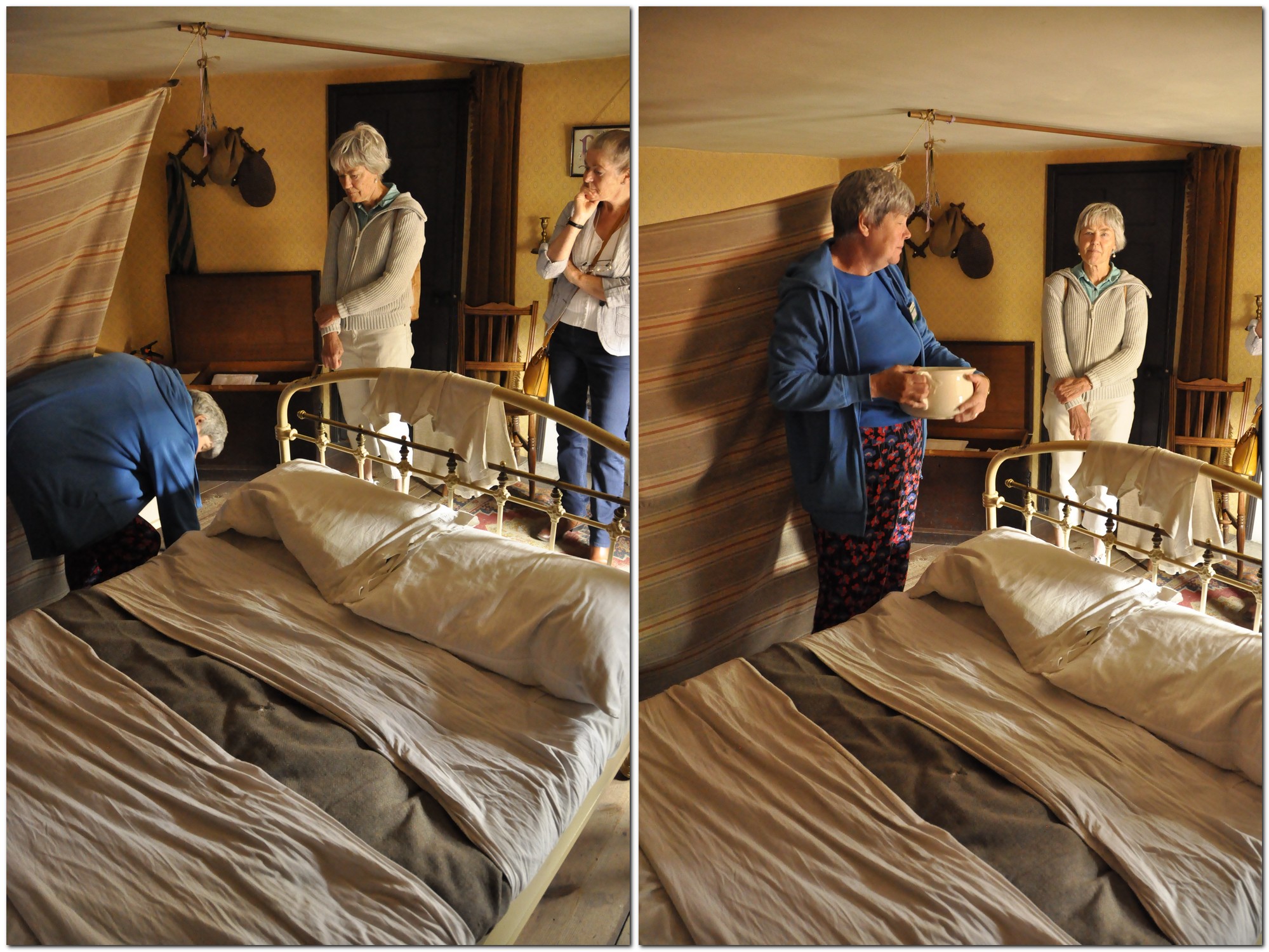
In the next 1870s house, occupied by the Oldfields, who had many children – and lodgers! – there is already a coal-fired range in the kitchen, and paraffin lamps were used throughout for lighting. The children slept head-to-toe in a bed in the attic room, shared with the married lodgers. Modesty was maintained by a curtain.

By the 1930s, there was already electricity (and running water) in the house, occupied by an elderly bachelor George Mitchell.

The premises of George Saunders are full of all the paraphernalia of the tailoring business. An old sewing machine, and another for making buttonholes. Patterns for bespoke suits handing from the walls, and bolts of cloth stacked on shelves. There are some half-finished garments, others ready to collect. Until his death, George worked with the National Trust to document the last years of the Back to Backs.

Throughout the houses there are many contemporary pieces of furniture and ornaments. My eye was caught by this particularly fine pair of (presumably) Staffordshire rabbits.

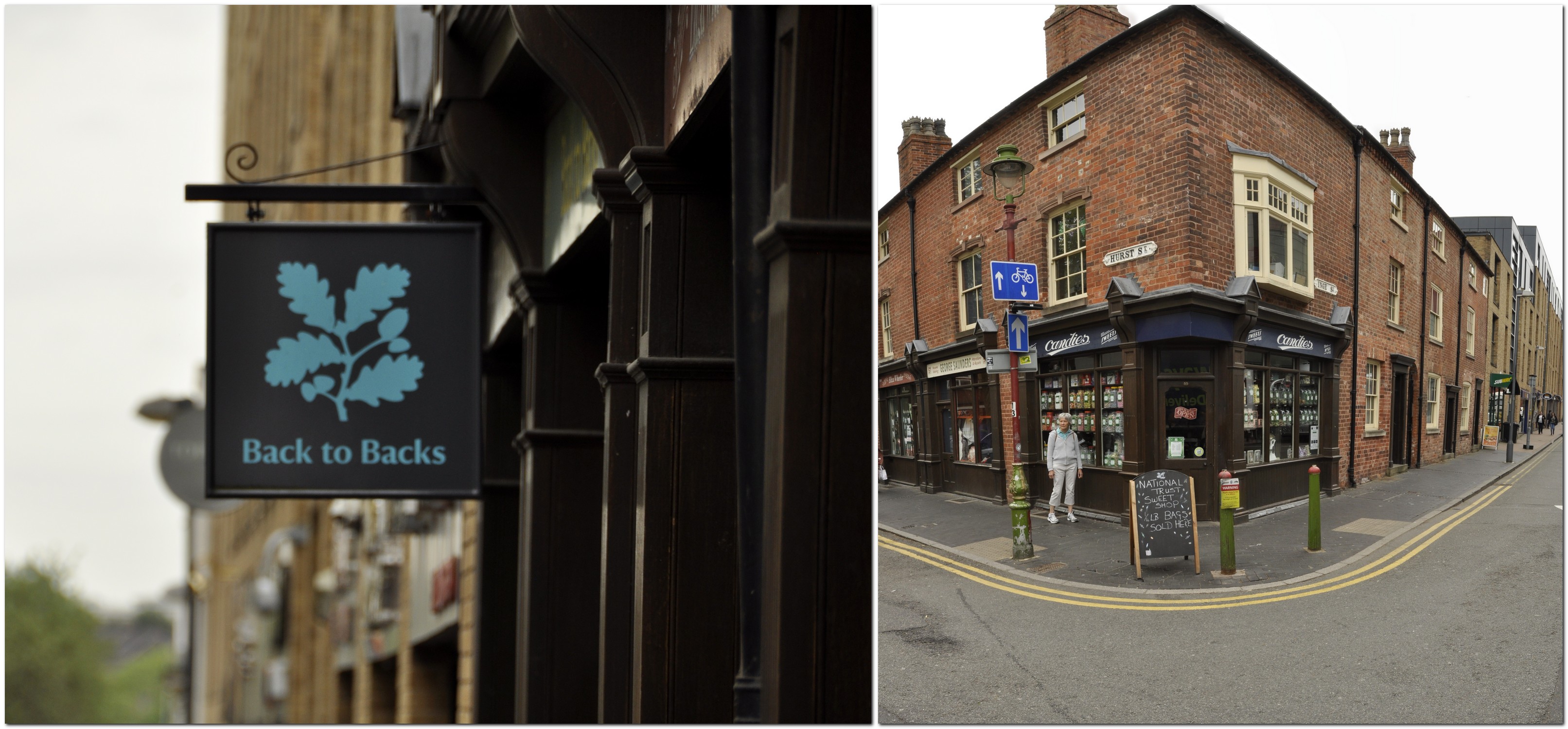
Finally, no visit to the Birmingham Back to Backs would be complete without a look inside Candies, a Victorian sweet shop on the corner of Hurst and Inge Streets at No. 55, purveyor of fine sweets that I remember from my childhood. What a sensory delight! In fact, tours of the Back to Backs start from outside Candies, so there’s no excuse.

And finally, what about that ‘rule of thumb’ I referred to in the title of this post. Well, while we were looking at the sleeping arrangements for the Oldfield children in the 1870s, Fran Payne reached under the bed for the gazunda, the communal chamber pot (‘goes under’). In the darkness, she told us, this how you could tell, with the tip of your thumb, whether a chamber pot was full or not. Dry: OK. Wet: time to go downstairs to the outside toilet in the courtyard.

I mentioned that our visit to the Back to Backs was very enjoyable, but it’s not somewhere that I would have made a special trip. We had to be in Birmingham on another errand, and since it was just a hop and a skip from the central Post Office, we took the opportunity. The Birmingham Back to Backs are a special relic of this great city of 1,000 trades.


A working-class movement for political reform

Less than 4 miles by road west of Bromsgrove in northeast Worcestershire (much less as the crow flies) lies the village of Dodford. Nothing remarkable in that, you might say.

Well, until 1849, the village didn’t even exist. The area was known then as Greater Dodford, but became a community (of sorts) when a ‘village’ of more than 40 redbrick cottages (like the one below, known as Rosedene) was built, each in its own 4 acre plot of land. That’s significant.

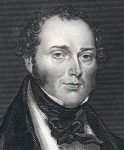
Feargus O’Connor

Rosedene was built by the Chartist Cooperative Land Company, and the Dodford community was the last of five that were set up around the country by Irish Chartist leader Feargus O’Connor.

So, what was Chartism and who were the Chartists?

Chartism was a national (but geographically uneven) working class movement, with violent and non-violent factions, campaigning for political reform between 1838 and 1857. The movement  was named after the 1838 People’s Carter that espoused six principles:

  • manhood suffrage (but not women)
  • the secret ballot
  • abolition of property qualifications for MPs
  • payment of MPs
  • equal electoral districts
  • annual elections.

Communities like Dodford were established to help working-class people satisfy the landholding requirement to gain a vote in county seats. That’s why each cottage was built on 4 acres of land, the minimum at the time to satisfy the landholding requirement to make a man eligible to vote.

O’Connor purchased a farm of more than 250 acres at Greater Dodford, and divided it into 4 acre plots for each cottage. The lanes around Dodford remain as narrow today as when first opened in the 1840s.

Potential occupants placed bids for the cottages, with the highest bidder receiving the ‘choicest’ plot, and so on until all plots had been allocated.

Having walked around the plot at Rosedene, I can vouchsafe that it’s a large plot for one family to manage. Many of those who came to Dodford were working class families from the cities, with little experience of agriculture. What they encountered at Dodford was a very heavy clay soil that was extremely difficult to cultivate. Eventually however, they established that strawberries did grow well, and opened up a market to Birmingham for their produce. Likewise, garlic thrived, which they sold to the makers of Worcestershire Sauce, Lea & Perrins, in Worcester, 15 miles to the south.

By the time Dodford was built, O’Connor had perfected his simple cottage design. Each cottage had a simple central living room with a range for heating and cooking, with a bedroom off to each side. To the rear was a small scullery and an indoor water pump. The ash toilet was in an outhouse (much like my grandparents’ cottage in Derbyshire that they occupied until the early 1960s). Maybe there was a pig sty attached to the enclosed small yard. Behind the cottage there is a small barn.

Bricks for each cottage were made on site. Rosedene sits on foundations of stone. I did wonder whether stones from the 12th century priory nearby (now incorporated into a farmhouse) had been used for this purpose but there is no record of that being the case. O’Connor’s design included the ‘modern’ feature of air vents low down on the walls and into the roof to reduce condensation.

The National Trust purchased Rosedene in 1997 and has faithfully restored it. We visited the cottage a week ago. There is only limited access on the first Sunday of each month between April and December (on pre-booked tours).

Unfortunately, the National Trust volunteers waiting to welcome us to Rosedene were unable to unlock the property so we never got to look inside, apart from peering through the windows.

However, you can see something more of the interior here, which also provides a potted history of Rosedene.


Spring is in the air in Worcestershire

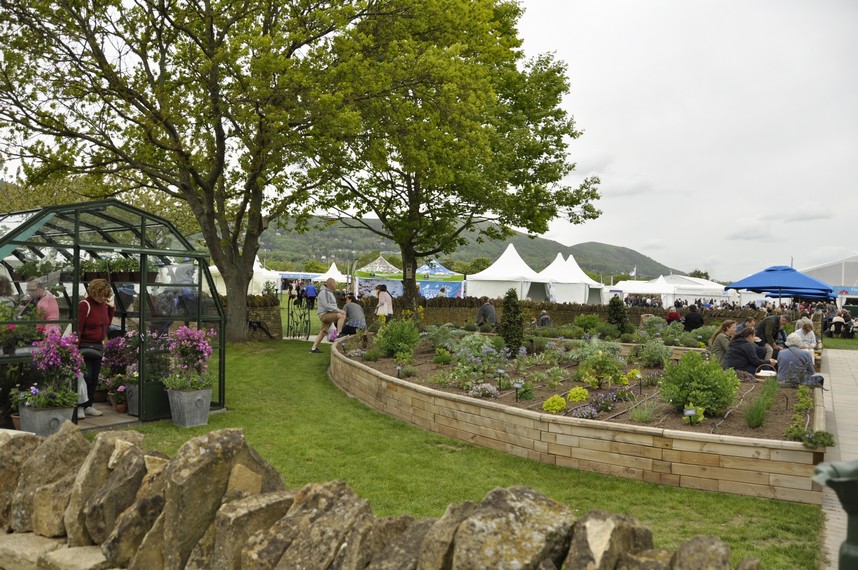
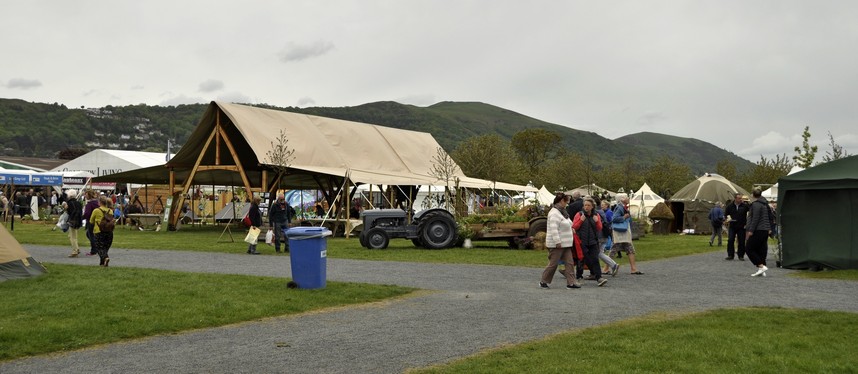
Nestling under the eastern flank of the Malvern Hills, the Three Counties Showground is home to the annual Royal Horticultural Society (RHS) Malvern Spring Festival (from 10-13 May this year), just 25 miles southwest from our home in Bromsgrove.

We were lucky enough to enjoy a day out at the festival yesterday, although somewhat marred unfortunately by a journey to the festival of almost 2½ hours, such was the volume of traffic trying to get round just 3 miles of the Worcester ring road, A4440. And the return journey wasn’t much better, taking almost 90 minutes, as we hit traffic north on the M5 due to a stranded vehicle. I can’t deny I was quite relieved to arrive home, put my feet up, and enjoy a welcome cup of tea.

Later that evening, almost half of the regular Friday night Gardeners’ World program on BBC2 was devoted to the Malvern festival, filmed the day before when it was much brighter,and far fewer visitors than on Friday. Drone footage showed us just how big the site was (we walked almost 3½ miles), and showcased many of the show gardens that we could obviously only view from ground level. It’s also remarkable just how ‘permanent’ some of these gardens appear, as though they (and their plantings) had been there for years, not just a week at most.

We didn’t see any of the Gardeners’ World presenters during our visit, but gardener and broadcaster Alan Titchmarsh was taking questions from the audience in the event tent; and later on we saw Master Chef judge John Torode waxing lyrical about the use of plants in Thai cooking.

The Royal Horticultural Society is the world’s leading gardening charity, and organizes a number of flower shows around the country between April and September each year. Of course its major attraction is the Chelsea Flower Show, that takes place at the end of May in London. It can rightly claim to be the world’s most prestigious flower show that inspires millions and leads the way in innovative garden design. We enjoyed a day there in 2013 when the show celebrated 100 years since its founding. Tickets for the Chelsea (also the Malvern, Kew Gardens, and two Gardeners’ World Live shows) were Christmas presents from our two daughters Hannah and Philippa.

The RHS Malvern Spring Festival is the second in the Society’s 2018 calendar and, set against the magnificent Malvern Hills . . . is packed with flowers, food, crafts and family fun. And yes, we did have fun. So rather than describe what we did and saw, here’s just a selection of the many photos I took during the day.

It never ceases to amaze me the lengths that almost all growers and exhibitors go to, bringing plants in flower from all seasons, even though it’s late Spring. Plants like daffodils and tulips that flowered in our garden at least a month ago were exuberant. Summer flowering plants like sweet peas and so many others were displayed in all their glory. In some ways, we should have gone into the huge floral show marquee from the outset, rather than exploring to the far corners of the show ground. It seemed just so commercial, with booths offering every sort of gardening equipment, clothing, and almost anything to do with gardening (or not in some instances).

But faith was restored once we’d entered the floral marquee and I was able to breathe in the beauty of all the fabulous displays of botanical beauty.

Among my favorites were the auriculasPrimula auricula, that come in a huge range of colors. Some are covered in a powdery coating called farina.

And I can never go to a flower show without seeking out the tulips. Maybe I should have been around during the Dutch tulip mania of the 17th century.

So after my early ‘disappointment’ that the Malvern was all about commercialism, I think we must have spent at least half of our time wandering around the various flower display marquees.

Having now been to two RHS and two Gardeners’ World Live (GWL) shows, I’m not sure I can agree with Monty Don (lead presenter of Gardeners’ World) that Malvern is a real jewel. He always waxes lyrical in his praise, as do the other presenters on that program. Yes, it’s a nice show, but I think the standard of displays is unquestionably higher at Chelsea, and also at GWL. Maybe my perspectives were jaundiced by the horrendous journey we had to Malvern. I was exhausted before we even began to look around.

Nevertheless, it was an enjoyable visit, and a lovely Christmas present from our two daughters and their families.

Almost 400 years of history in the vicinity . . .

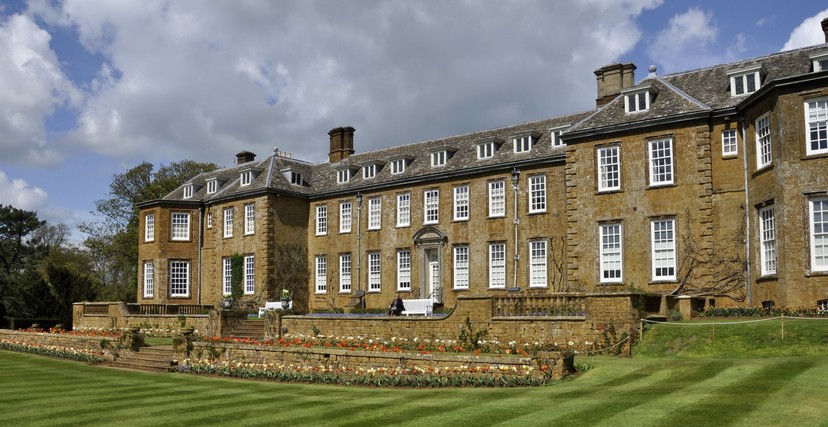
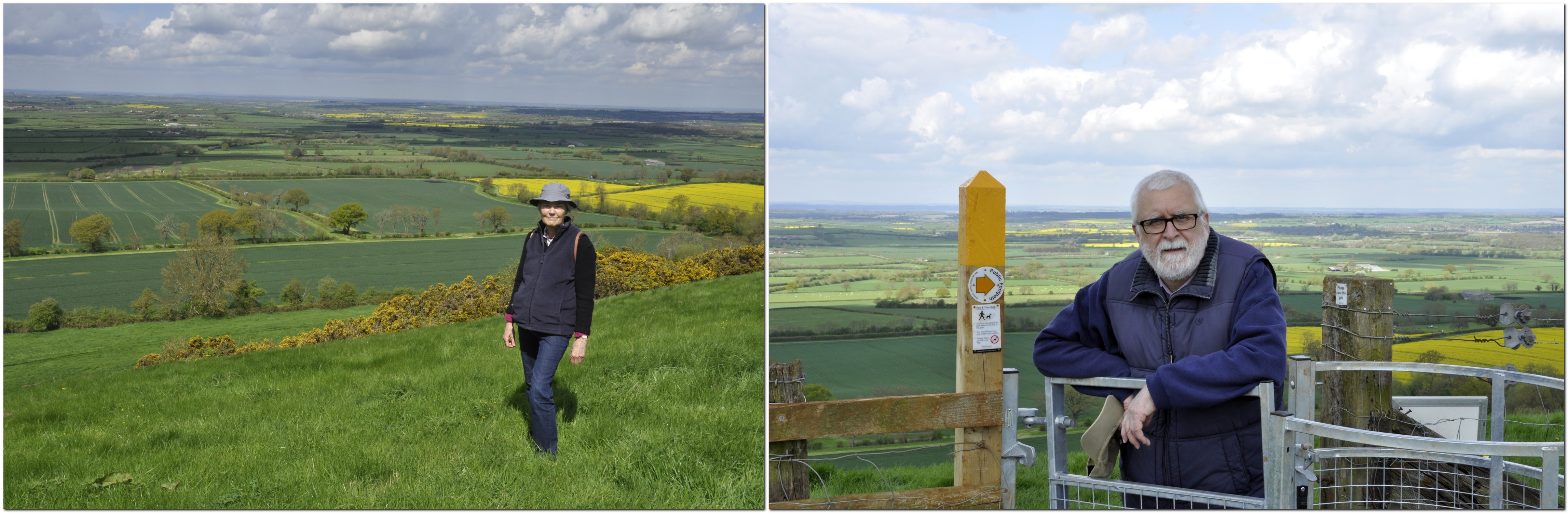
Yesterday, Steph and I traveled some 40 miles southeast from our home in Bromsgrove in north Worcestershire, to revisit the National Trust’s Upton House and Gardens near the village of Edgehill in Warwickshire, that lies some seven miles northwest from Banbury (map).

We were last there in July 2012, combined with a trip to nearby Farnborough Hall. Take a look at a web album of photos that I posted afterwards.

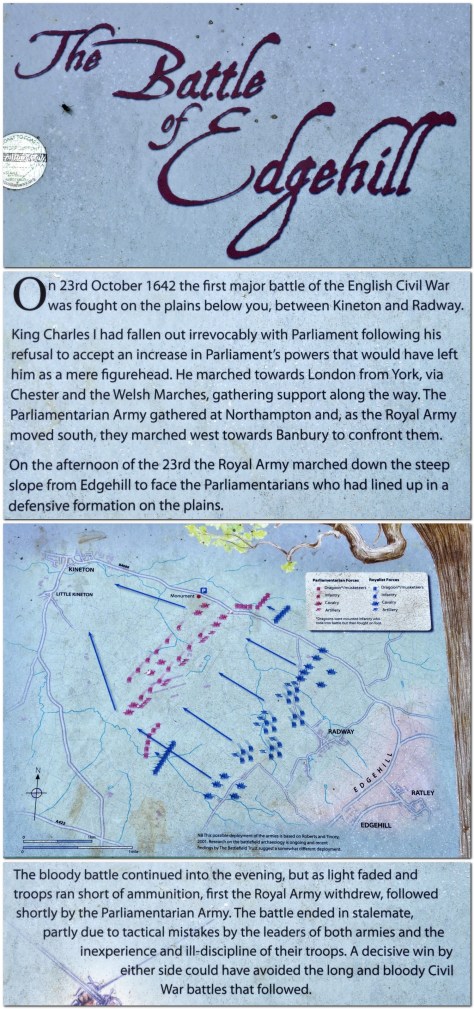
Edgehill was the site of the first major battle of the First English Civil War, on Sunday 23 October 1642. Here the Royalist supporters of King Charles I clashed with Parliamentary forces under the Earl of Essex. The King had commanded the high ground and his troops marched down the Cotswolds escarpment to join battle with the enemy, arrayed below. The battle ended in stalemate.

The roar of cannons has long faded, as have the tramp of troops or galloping of horses, the clash of steel on steel, and the screams of wounded and dying men. Over the past four centuries the landscape must have changed immeasurably. Probably back in 1642 there were no fields, just open country, intermittently broken by woodland. And there certainly were no vivid blotches of bright yellow oilseed rape that are so typical of farming in the UK today.

A panorama over the site of the Battle of Edgehill, and north across Warwickshire.

We could see almost 40 miles west to the Malvern Hills, just visible (using binoculars) through the distant murk of an approaching weather front (that finally arrived with a vengeance overnight, and it has been raining heavily since). But what a magnificent view we had, almost perfect weather on May Day, even if a little chilly.

We had been intending to visit Upton just a few weeks ago, and enjoy the National Trust’s recommended ‘What a View’ Walk from Upton house, that takes in the Edgehill escarpment and the glorious view, a circular walk of just under 2½ miles that took around 1½ hours before arriving back at the car park to enjoy a welcome picnic.

We decided just to take a look at the gardens, rather than tour the house again. That would be a better option when the weather is inclement. Yesterday, after weeks of poor weather, it was just too nice to be inside.

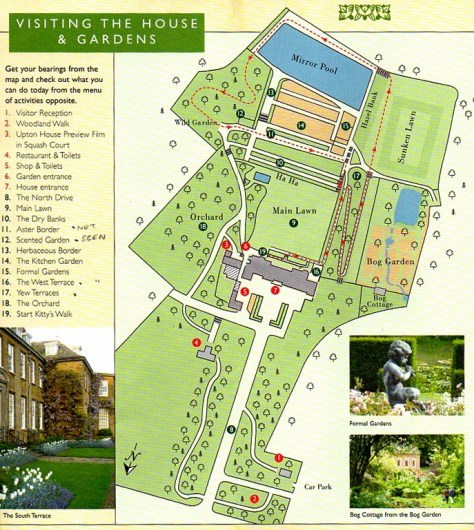
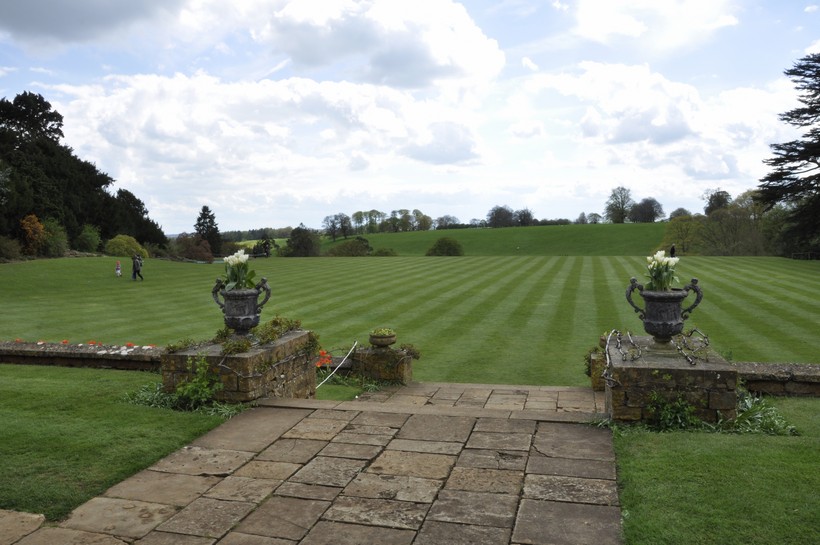
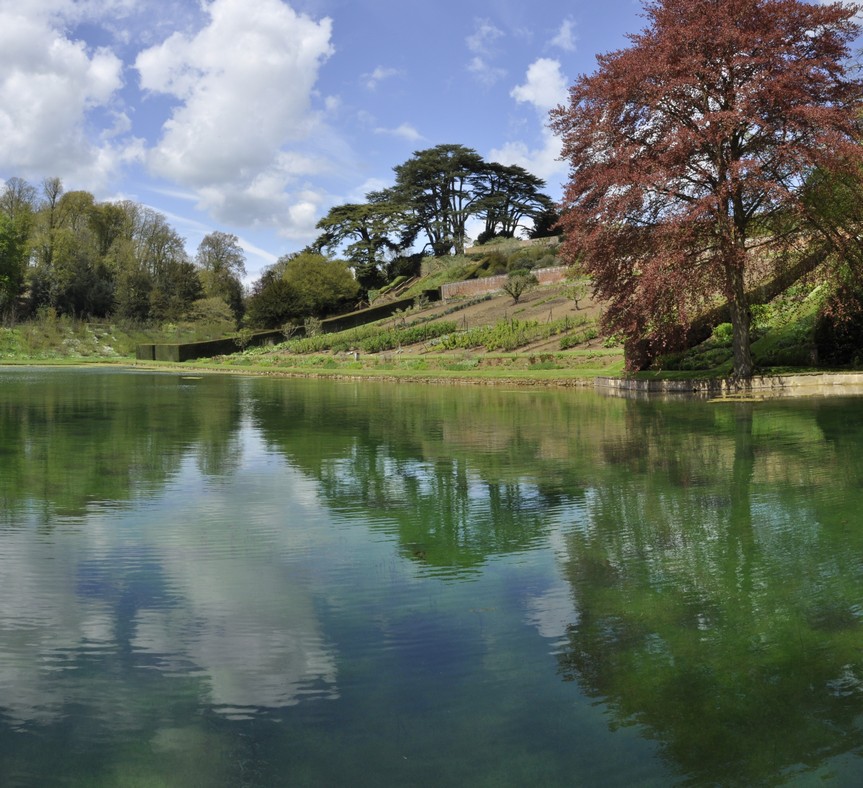
The south front of the house overlooks the Main Lawn towards a ha-ha that disguises a steep drop to the Mirror Pool in the valley bottom.

The Main Lawn, looking south to the ha-ha, from where the garden drops steeply to the Mirror Pool. The open fields can be seen beyond the brick wall of the garden (see image immediately below).

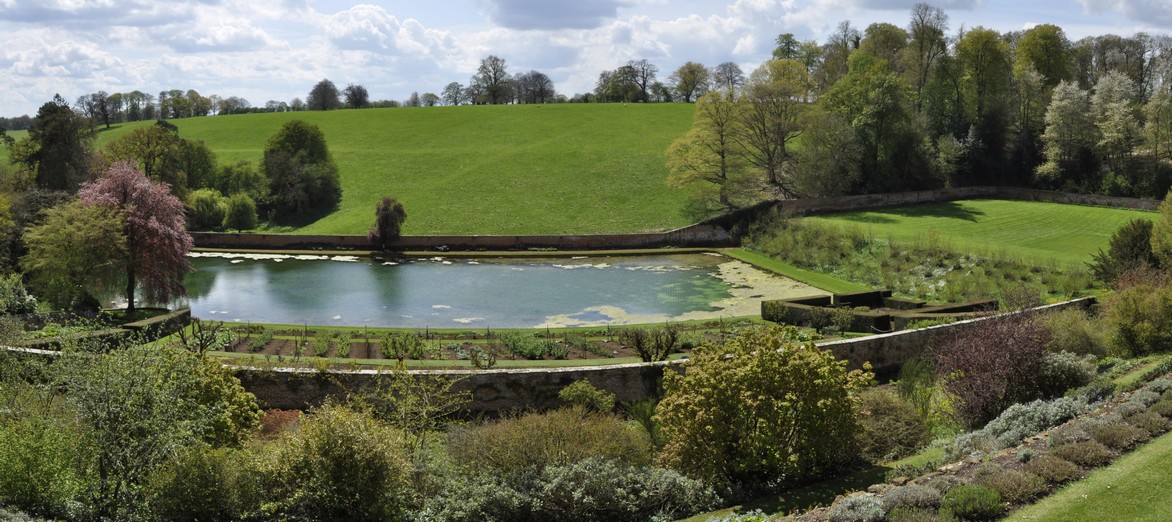
The Mirror Pool from the ha-ha, with the Hazel Bank and Sunken Lawn on the right.

It’s remarkable how the landscape was adapted to create quite an intimate garden. We really must return again a little earlier in the year and enjoy the Spring bulbs. Most had already flowered, although there were some patches of Narcissi and beds of tulips adding a vibrancy in the early afternoon sunshine.

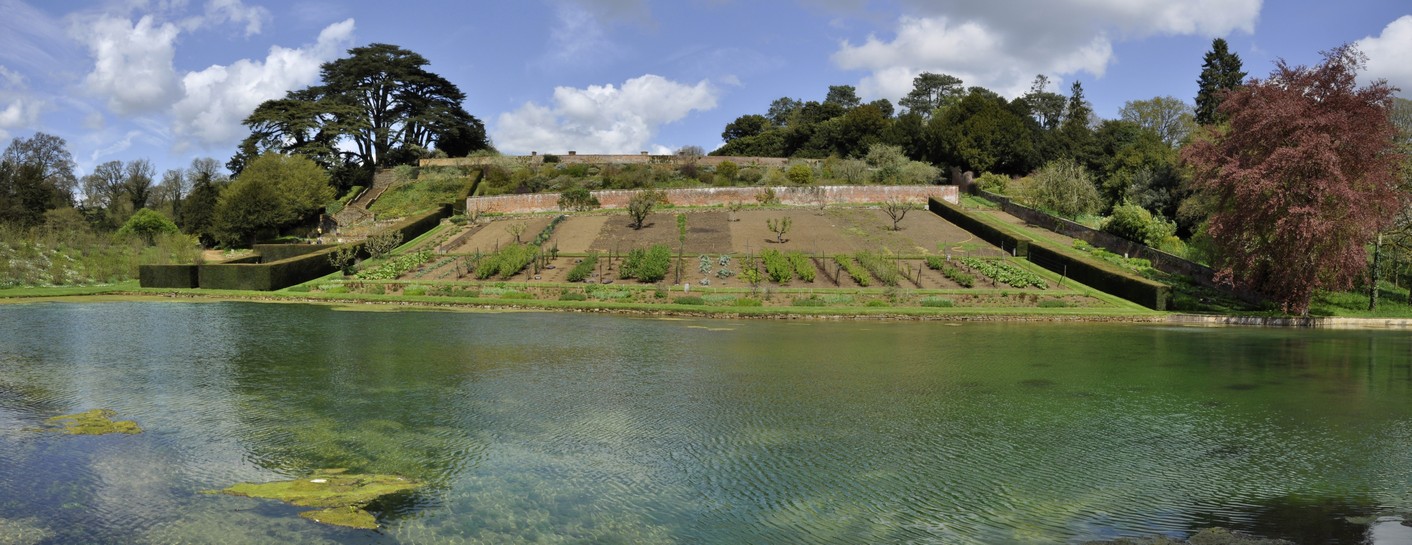
Looking west across the Mirror Pool to a magnificent yew behind the Kitchen Garden and the Dry Banks above.

A panorama of the Kitchen Garden and Dry Banks across the Mirror Pool, from the south. The ha-ha is at the top of the terraces, immediately below the Main Lawn.


‘High hills surround the valley, encircling it like a crown’ (Walter Daniel, 1167)

After the Normans conquered England in 1066, they quickly achieved hegemony over much of the country. By 1086 the ‘Great Survey’, the Domesday Book, had been completed for much of England and parts of Wales.

At the same time, different religious orders began to spread their influence and established communities around the country. In a peaceful and secluded valley beside the River Rye in the heart of the North York Moors near Helmsley, a Cistercian community founded Rievaulx Abbey in 1132, their first monastery in the north of England. A second magnificent Cistercian monastery, Fountains Abbey, lies about 27 miles west of Rievaulx.

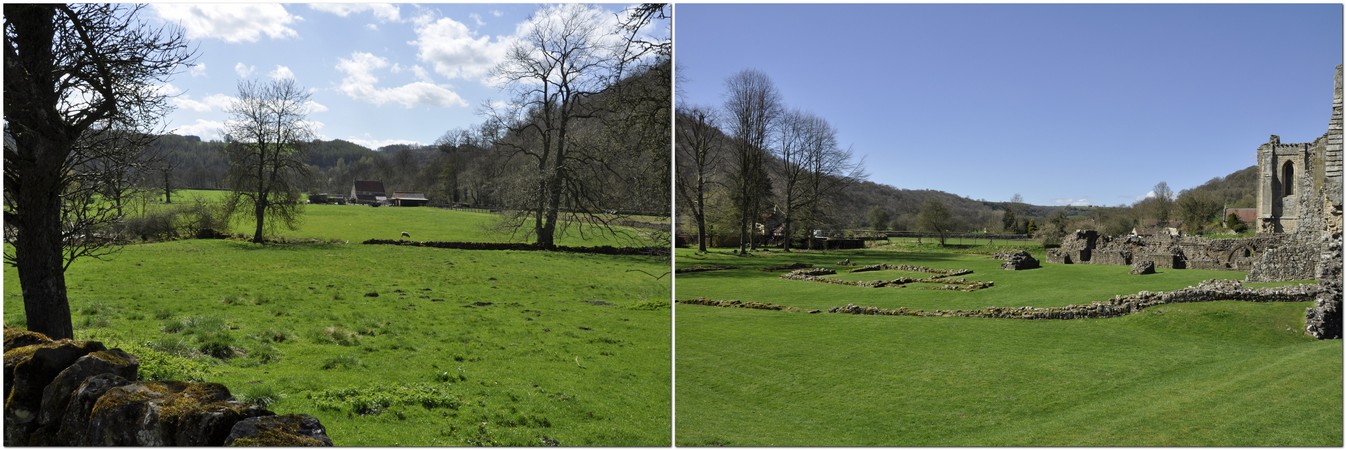
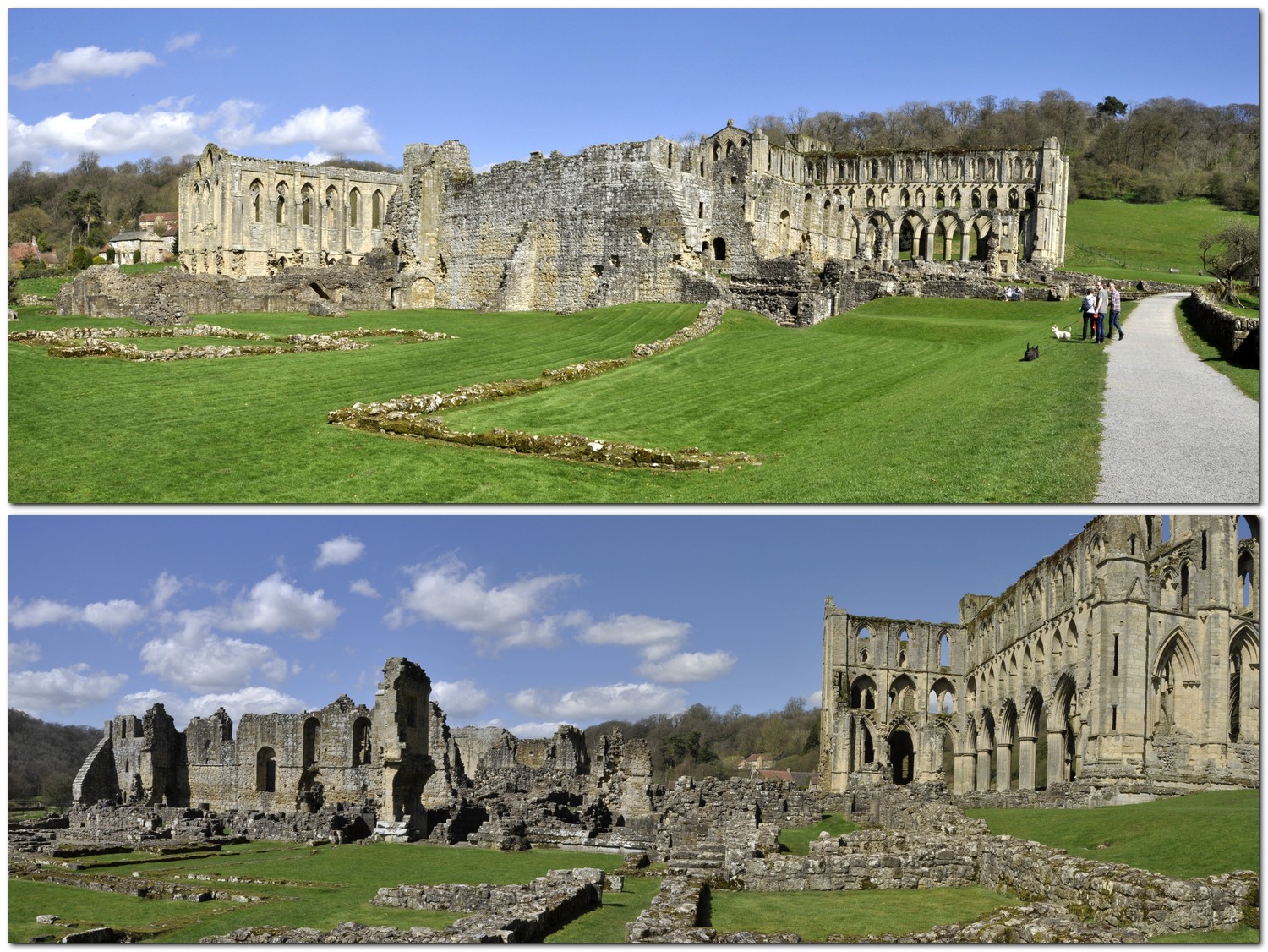
Originally a cluster of wooden buildings, the abbey expanded over the next four centuries until Henry VIII’s Suppression of the Monasteries (after 1536). The abbey was abandoned and became the ruin we see today, still standing proudly in the landscape where it was founded. Not much can have changed in the intervening centuries. Rievaulx still exudes a profound sense of peace and tranquility.

It’s not my intention here to provide a detailed history of Rievaulx Abbey. English Heritage owns and manages the site, and a detailed history of Rievaulx’s founding and growth can be found on its website.

I first visited Rievaulx in the summer of 1968 at the end of my first year at university, when I went on a youth hosteling holiday on the North York Moors. Fifty years ago! I can hardly believe it.

Then, in July 1988, when Hannah and Philippa were ten and six, we made a family visit while on holiday near the coast north of Scarborough. In 2013 we visited the National Trust’s Rievaulx Terrace that overlooks the abbey ruins (see below).

A week ago we took the opportunity of a visit to our younger daughter Philippa and her family in Newcastle upon Tyne—and the improving weather—to visit Rievaulx once again. It’s actually only a few miles off the usual A19 route we take when traveling to Newcastle these days.

It was a glorious sunny day. In fact, we enjoyed the first sensations of summer (the weather has since deteriorated, and it feels more like autumn as I write this blog post). The drive north from home (in Bromsgrove in northeast Worcestershire) took a little under four hours, including a 35 minute coffee and comfort break at the Woodall Services on the M1 south of Sheffield. On arrival at Rievaulx, we enjoyed a quick picnic lunch, then headed off to explore the ruined abbey and museum for about an hour and a half.

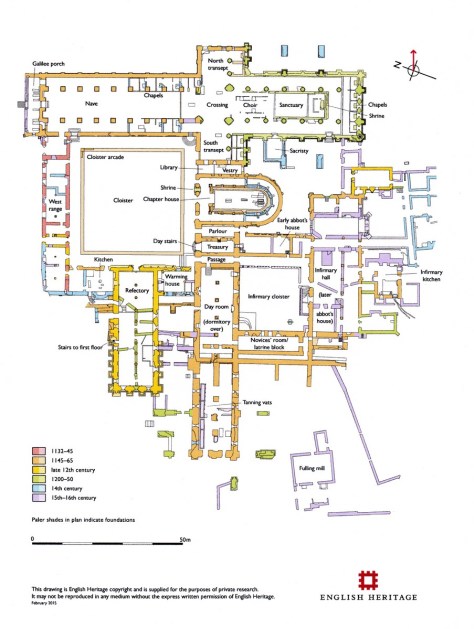
Rievaulx Abbey ground-plan (courtesy of English Heritage). Click on the image to open a PDF file of this plan, another one and a map of the valley where the abbey stands.

One’s first impression of Rievaulx are the ruins of the church, with tiers of pointed gothic windows on each side. There are some rounded and earlier Norman arches around the site. The eastern end of the church (enclosing the Sanctuary and Choir) was for use only by the monks. The western end, the nave (now completely demolished except for the bases of the main columns), was used by the lay brothers.

The Cloister and its Arcade must have been magnificent in the abbey’s heyday. Just one small fragment of the Arcade has survived, in the northwest corner of the Cloister. Immediately east of the Cloister are the remains of the Chapter House where monks came for their daily meetings. Several abbots are buried there, but the body of William, the first abbot was moved to its own shrine in the 13th century

This slideshow requires JavaScript.

To the south of the Cloister is large building housing the Refectory, and kitchen. The Day Room is located to the east of the Refectory, and this is where the monks worked on various activities, from mending clothes to copying manuscripts. South of the Day Room are the Tanning Vats where leather was prepared.

This slideshow requires JavaScript.

Further east is the Infirmary Cloister and a staircase to what became the Abbot’s House. Above the doorway is an original in situ figurative sculpture of The Annunciation.

This slideshow requires JavaScript.

There is a small museum displaying some interesting artifacts that have been uncovered on the site, as well as sections of sculptures that once adorned the various buildings of the abbey.

This slideshow requires JavaScript.

During its 400 years Rievaulx Abbey suffered several changes in fortune. There were raids from across the Scottish border, and the Black Death hit during the 14th century. The abbey was finally suppressed in December 1538, and the monks were cast out although they received a pension. The abbey was sold to Thomas Manners, Earl of Rutland although the most precious items were reserved for the crown. Thereafter the abbey buildings fell into ruin as we see today.

But there has long been a fascination with Rievaulx Abbey, and in the mid-eighteenth century, Thomas Duncombe II constructed Rievaulx Terrace high on the hillside above the abbey ruins where his guests could be entertained and walk. There are some spectacular views of the abbey from there, as we experienced in 2013.

This slideshow requires JavaScript.


‘Abandon hope, all ye who enter here . . . ‘

Well, that was what I thought. Until a few days ago, that is.

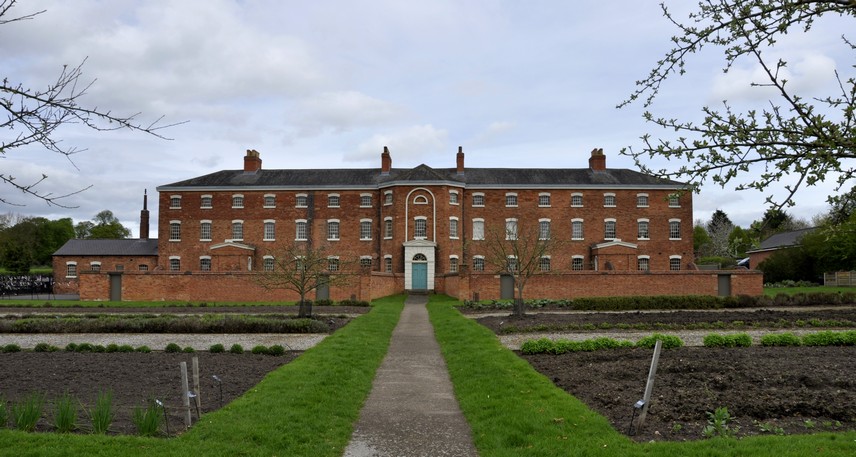
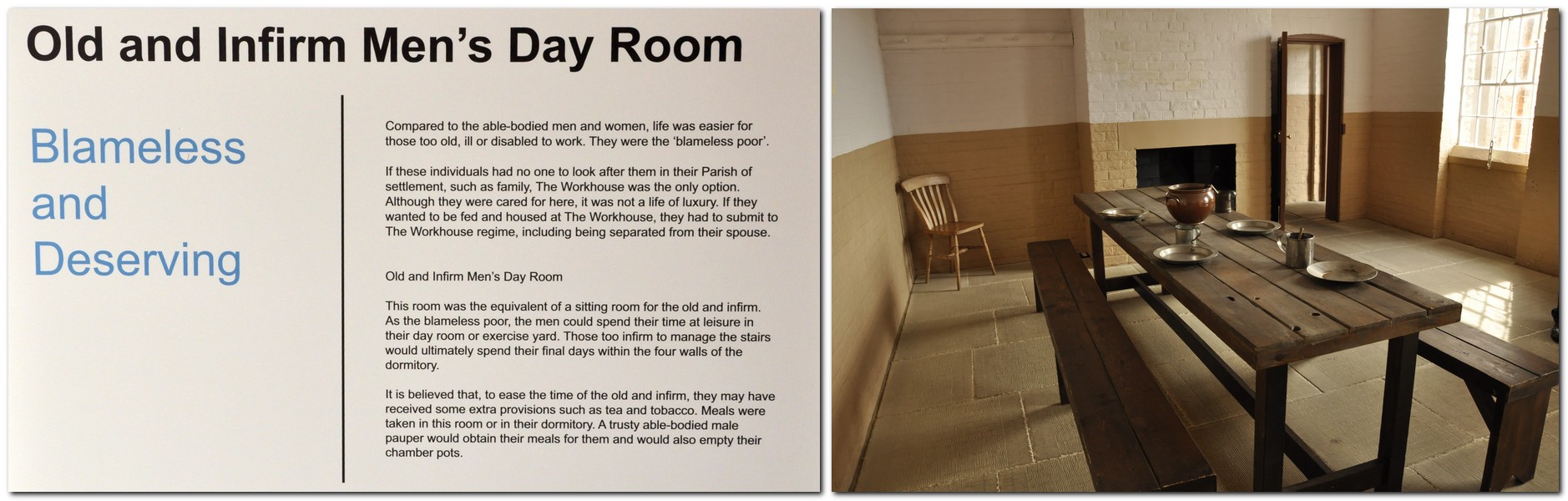
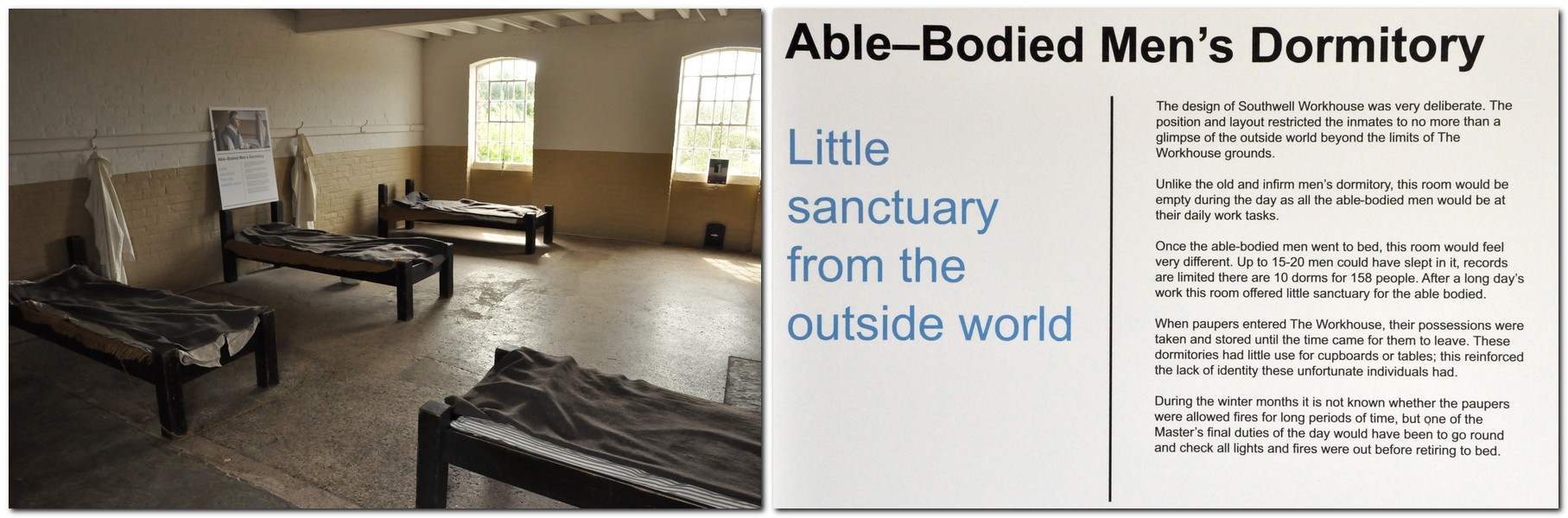
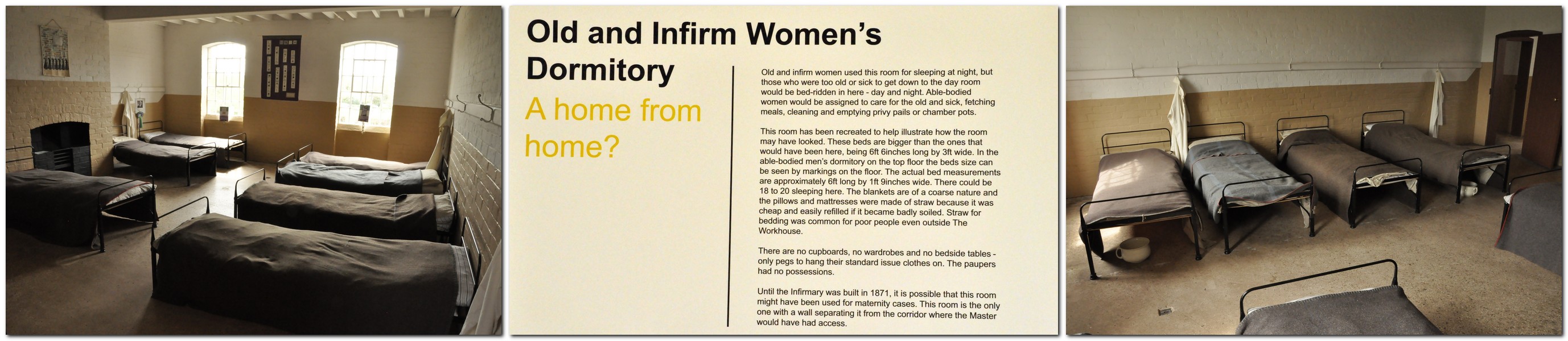
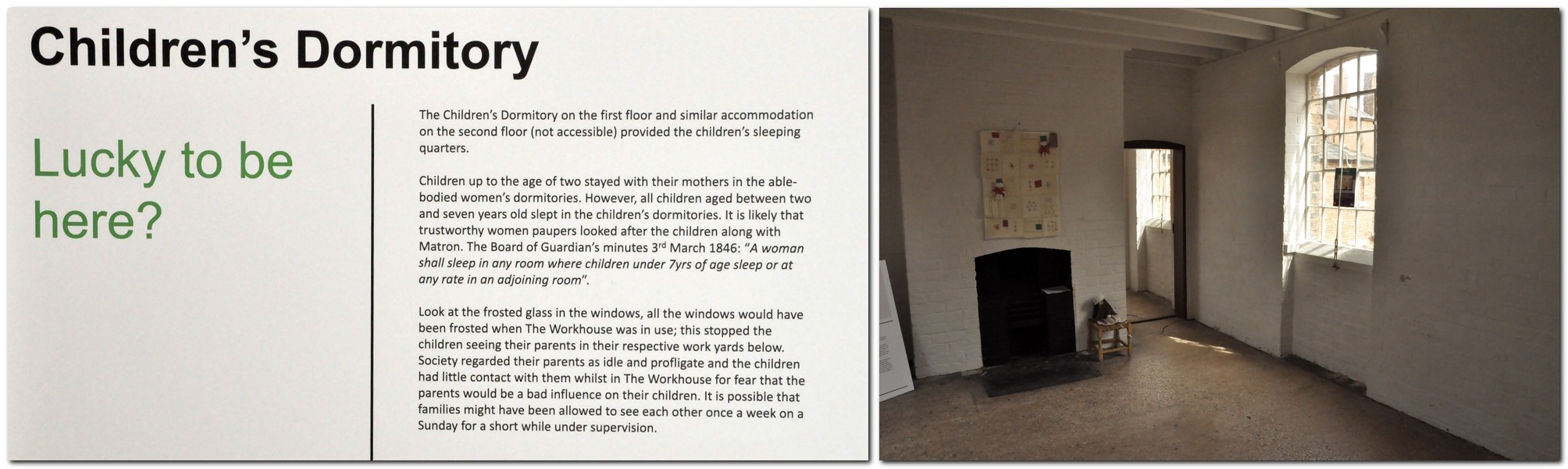
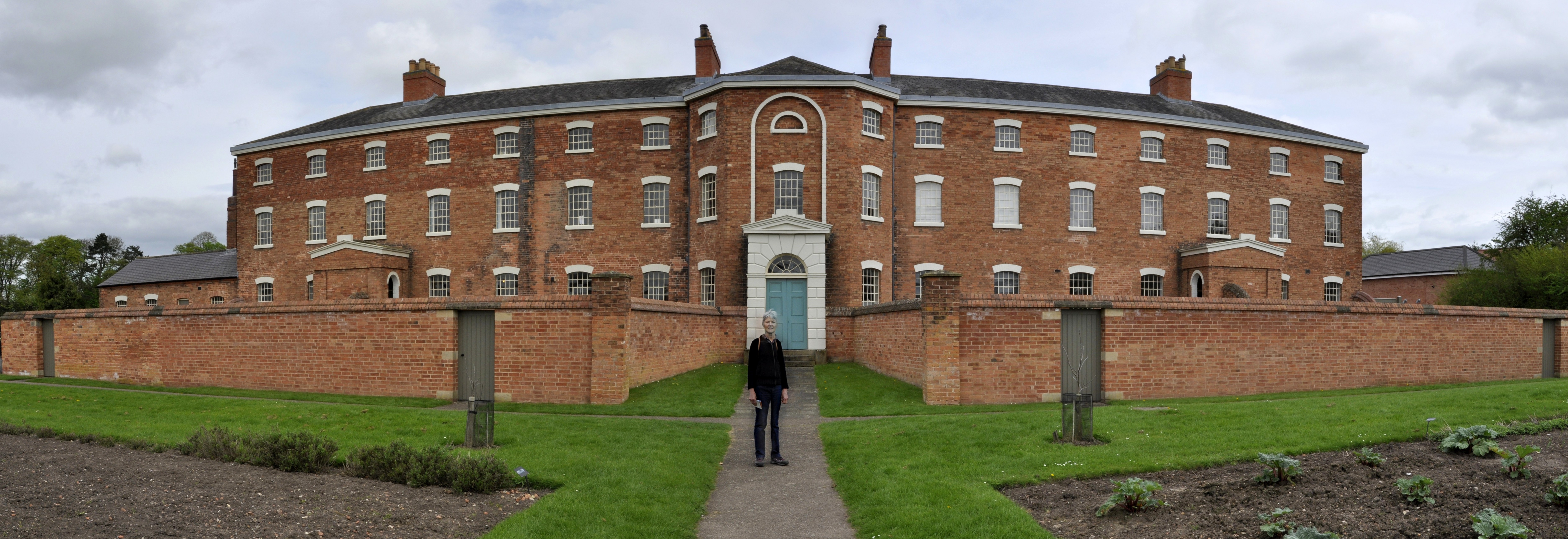
On the outskirts of Southwell (pronounced Suthell, or more precisely /ˈsaʊθwɛl/or /ˈsʌðəl/) in Nottinghamshire there is a large redbrick building standing in about six acres of land. This is The Workhouse (or Greet House), beautifully stark in its Georgian symmetry.

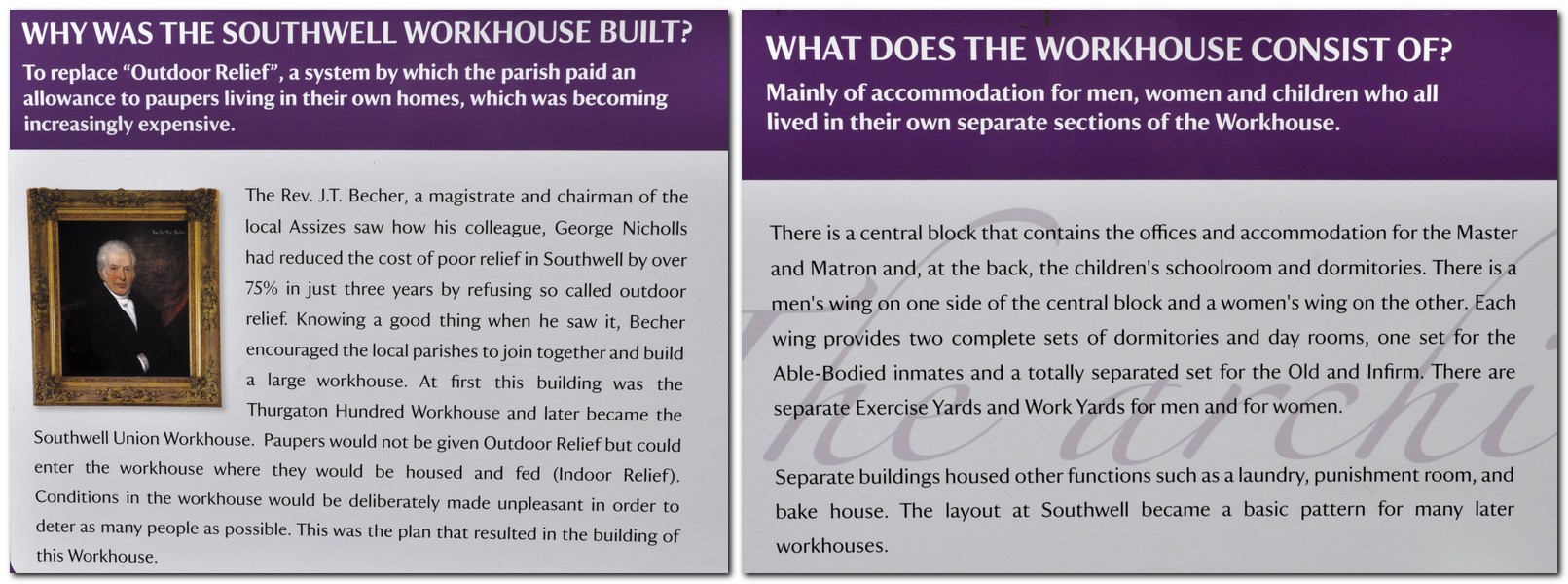
Built in 1824 during the reign of King George IV, The Workhouse was ‘home’ to about 160 destitute men, women and children who were provided with ‘Indoor Relief’. The cost of providing support, under the Poor Laws, to recipients in their homes (so-called ‘Outdoor Relief’) had become less sustainable. So the Workhouse was built at Southwell to provide shelter for a limited number of paupers, many old and infirm.

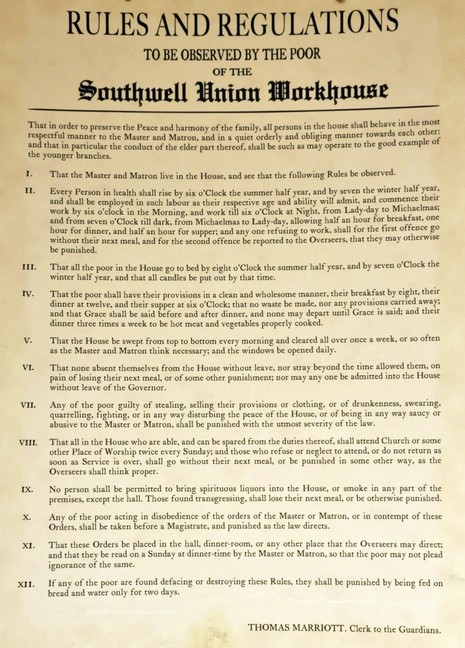
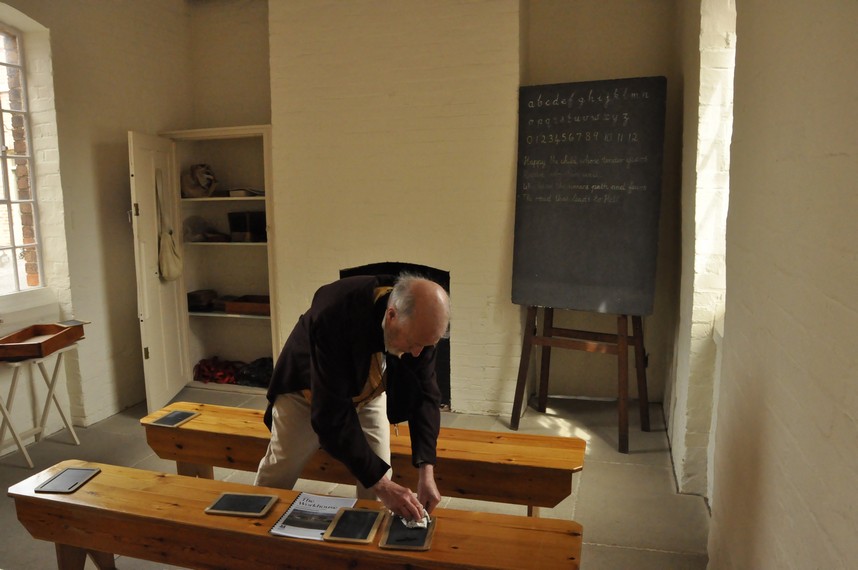
Life in The Workhouse was no bed of roses, but maybe not as harsh as many others around the country, where everyone toiled in the most appalling conditions. But shelter and food was provided, and both boys and girls received a basic education, learning to read and write, and do sums.

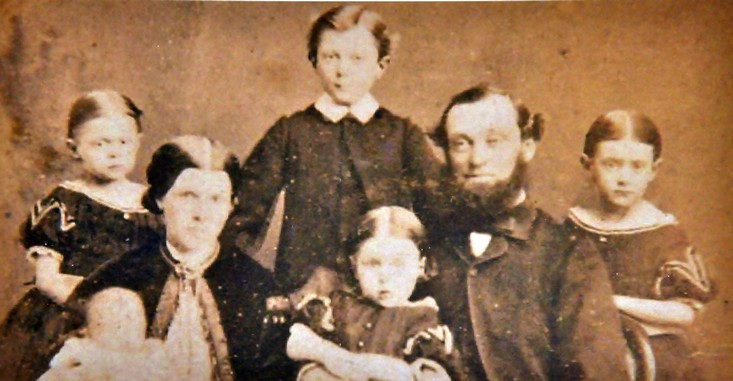
No doubt the workhouse regime changed from time to time, as each new Master was appointed and took control of their lives. The Master and his family lived in a suite of rooms above the main entrance.

Workhouse Master Herring and his family in 1855

The Workhouse at Southwell was featured in Episode 4 of the second series of Secrets of the National Trust broadcast recently on Channel 5, and presented by Alan Titchmarsh. I have to admit it presented such a despondent scenario, a visit there didn’t seem very appealing. Consequently, Steph and I decided we wouldn’t make a special visit there, but combine it with another trip in the vicinity. And, as it happened, a diversion to Southwell last Monday added only a few miles to our return journey to visit our younger daughter and her family in Newcastle.

I mentioned my preconceptions about The Workhouse (based on the Titchmarsh program) to one of the volunteers. From what he told me, it seems that Titchmarsh wanted to present a more balanced picture of life in The Workhouse, but the series producer somewhat ‘over-egged the doom-and-gloom pudding’ story of The Workhouse. As I said there’s no denying that life inside was tough for the inmates. Life would probably have been tougher on the outside.

Now, having made a visit to The Workhouse I am so pleased that we did. It was revealing, interesting, conscience-pricking (although it’s not altogether appropriate to judge what The Workhouse stood for by today’s standards), and the National Trust volunteers (mostly in contemporary costume) brought the story of The Workhouse to life and made the visit even more enjoyable. They were very convincing, particularly the skivvy in the cellars who answered all my queries, in character.

The Workhouse consists of a three-story main building (with cellars), divided into separate sections for men and women, and able-bodied or old and infirm for each. Each group had its own exercise yard, with a privy in the corner from which ‘night soil’ was collected as manure for the garden.

Plan of The Workhouse. (5) is the National Trust entrance; (6) is the wash-house; (8) is the garden. The exercise yards can be seen either side of the main entrance to The Workhouse, with a privy in one corner of each. There are now gaps in the wall between the exercise yards to facilitate the flow of visitors. (4) is an assembly point for guided tours.

Husbands were separated from wives, and children from their mothers beyond the age of two. In the children’s dormitory, the glass in the windows (at least the lower panes) was frosted so they could not look at and see their mothers working in the yards below.

A block of outhouses to the rear of the main building contained the laundry, a bakery, and the ‘dead’ room.

Water was collected from the roof, and stored in a 160,000 gallon storage tank underneath the kitchen. Food was stored in the cellars.

Able-bodied men, who were unemployed outside The Workhouse, were considered lazy, and set to work on menial tasks such as unpicking old ropes or oakum. The old and infirm often had no work to do.

The various dormitories were on the first and top floors.

Many of the upper rooms have deteriorated and are in urgent need of conservation.

What is remarkable is that The Workhouse was still being used as an emergency shelter to house homeless families, in the so-called ‘bedsit’, as late as the 1980s.

If walls could talk, what tales they would tell us. But in the able-bodied men’s exercise yard (on the right on the panorama immediately below), and presumably out of view of the Master, at least one of the inmates did leave a legacy of their days in The Workhouse. Clearly etched on several bricks, someone has marked off the days.

It’s hard to imagine just how tough life must have been for the inmates of The Workhouse at Southwell. Surely it cannot have been worse than what they had endured, penniless and hungry, outside. With the enactment of the Poor Laws, society provided (limited) support for those who had fallen on hard times. In many ways, society has a lot to answer for today.


Daffodils and doves . . . but no fireworks

Yesterday (18 April) was, in many parts of the UK, the warmest day since the end of August 2017. After the lingering cold and grey weather we have had to endure in recent weeks, the prospect of a bright, sunny day certainly was encouraging. And, not being ones to squander an opportunity to be out and about when possible, we made the short trip to Coughton Court, a National Trust property on the outskirts of Alcester in Warwickshire, just 12 miles from home.

Coughton Court is one of our ‘local’ National Trust visits, and we’ve been there on several occasions mostly to walk through the bluebell wood and gardens. It has been in the same Throckmorton family for over 600 years, and the family still has apartments there.

We were too early to see a carpet of bluebells in the ancient wood to the east of the house. But we were not totally disappointed and some had already begun to bloom.

The Daffodil Society is holding its 2018 show at Coughton this weekend that we would have liked to attend, but have other plans made. So our visit yesterday was to view the extensive planting of daffodils in the grounds of Coughton Court. We were concerned that they would be past their best, but because of the dreary weather (and access issues at Coughton due to waterlogged car-parking) just hadn’t been able to schedule our visit before now.

Yes, some daffodil varieties were past their best, but there were still plenty more to lift our spirits.

In the orchard, there was a carpet of purple and white fritillaries under the apple trees (just about to come into flower) mixed with primroses and grape hyacinths.

Afterwards, we headed a further two miles southeast to view Kinwarton Dovecote¹ that stands alone in the middle of a field. Built in the 14th century (probably during the reign of King Edward III), the circular dovecote has more than 500 nesting niches, from which young pigeons or squabs would be taken for their meat.

It has walls that are about three feet thick, and it rises at least 20 feet to the top of the nesting ledges. A ‘potence’ or pivoted ladder (in need of repair) provided access to the highest niches. What an impressive structure that has stood proudly in the Warwickshire landscape for six centuries. What stories it could tell.

But what about the reference I made in the title of this blog post to ‘fireworks’. Well, the Throckmorton family of Coughton Court were implicated in the 1605 Gunpowder Plot to overthrow recently crowned King James I (and VI of Scotland) by blowing up the Houses of Parliament. The plot, on 5 November, is celebrated each year by fireworks displays nationwide.

~~~~~~~~~~~~~~~~~~~~~~~~~~~~~~~~~~~~~~~~~

¹ We have visited other dovecotes owned by the National Trust and you can read about them here.

Crystal balls, accountability and risk: planning and managing agricultural research for development (R4D)

A few days ago, I wrote a piece about perceived or real threats to the UK’s development aid budget. I am very concerned that among politicians and the wider general public there is actually little understanding about the aims of international development aid, how it’s spent, what it has achieved, and even how it’s accounted for.

Throughout my career, I worked for organizations and programs that were supported from international development aid budgets. Even during the decade I was a faculty member at The University of Birmingham during the 1980s, I managed a research project on potatoes (a collaboration with the International Potato Center, or CIP, in Peru where I had been employed during the 1970s) funded by the UK’s Overseas Development Administration (ODA), the forerunner of today’s Department for International Development (DFID).

I actually spent 27 years working overseas for two international agricultural research centers in South and Central America, and in the Philippines, from 1973-1981 and from 1991-2010. These were CIP as I just mentioned, and the International Rice Research Institute (IRRI), a globally-important research center in Los Baños, south of Manila in the Philippines, working throughout Asia where rice is the staple food crop, and collaborating with the Africa Rice Centre (WARDA) in Africa, and the International Center for Tropical Agriculture (CIAT) in Latin America.

All four centers are members of the Consultative Group on International Agricultural Research (or CGIAR) that was established in 1971 to support investments in research and technology development geared toward increasing food production in the food-deficit countries of the world.

Dr Norman Borlaug

The CGIAR developed from earlier initiatives, going back to the early 1940s when the Rockefeller Foundation supported a program in Mexico prominent for the work of Norman Borlaug (who would be awarded the Nobel Peace Prize in 1970).

By 1960, Rockefeller was interested in expanding the possibilities of agricultural research and, joining with the Ford Foundation, established IRRI to work on rice in the Philippines, the first of what would become the CGIAR centers. In 2009/2010 IRRI celebrated its 50th anniversary. Then, in 1966, came the maize and wheat center in Mexico, CIMMYT—a logical development from the Mexico-Rockefeller program. CIMMYT was followed by two tropical agriculture centers, IITA in Nigeria and CIAT in Colombia, in 1967. Today, the CGIAR supports a network of 15 research centers around the world.

Peru (CIP); Colombia (CIAT); Mexico (CIMMYT); USA (IFPRI); Ivory Coast (Africa Rice); Nigeria (IITA); Kenya (ICRAF and ILRI); Lebanon (ICARDA); Italy (Bioversity International); India (ICRISAT); Sri Lanka (IWMI); Malaysia (Worldfish); Indonesia (CIFOR); and Philippines (IRRI)

The origins of the CGIAR and its evolution since 1971 are really quite interesting, involving the World Bank as the prime mover.

In 1969, World Bank President Robert McNamara (who had been US Secretary of Defense under Presidents Kennedy and Johnson) wrote to the heads of the Food and Agriculture Organization (FAO) in Rome and the United Nations Development Fund (UNDP) in New York saying: I am writing to propose that the FAO, the UNDP and the World Bank jointly undertake to organize a long-term program of support for regional agricultural research institutes. I have in mind support not only for some of the existing institutes, including the four now being supported by the Ford and Rockefeller Foundations [IRRI, CIMMYT, IITA, and CIAT], but also, as occasion permits, for a number of new ones.

Just click on this image to the left to open an interesting history of the CGIAR, published a few years ago when it celebrated its 40th anniversary.

I joined CIP in January 1973 as an Associate Taxonomist, not longer after it became a member of the CGIAR. In fact, my joining CIP had been delayed by more than a year (from September 1971) because the ODA was still evaluating whether to provide funds to CIP bilaterally or join the multilateral CGIAR system (which eventually happened). During 1973 or early 1974 I had the opportunity of meeting McNamara during his visit to CIP, something that had quite an impression on a 24 or 25 year old me.

In the first couple of decades the primary focus of the CGIAR was on enhancing the productivity of food crops through plant breeding and the use of genetic diversity held in the large and important genebanks of eleven centers. Towards the end of the 1980s and through the 1990s, the CGIAR centers took on a research role in natural resources management, an approach that has arguably had less success than crop productivity (because of the complexity of managing soil and water systems, ecosystems and the like).

In research approaches pioneered by CIP, a close link between the natural and social sciences has often been a feature of CGIAR research programs. It’s not uncommon to find plant breeders or agronomists, for example working alongside agricultural economists or anthropologists and sociologists, who provide the social context for the research for development that is at the heart of what the CGIAR does.

And it’s this research for development—rather than research for its own sake (as you might find in any university department)—that sets CGIAR research apart. I like to visualize it in this way. A problem area is identified that affects the livelihoods of farmers and those who depend on agriculture for their well-being. Solutions are sought through appropriate research, leading (hopefully) to positive outcomes and impacts. And impacts from research investment are what the donor community expects.

Of course, by its very nature, not all research leads to positive outcomes. If we knew the answers beforehand there would be no need to undertake any research at all. Unlike scientists who pursue knowledge for its own sake (as with many based in universities who develop expertise in specific disciplines), CGIAR scientists are expected to contribute their expertise and experience to research agendas developed by others. Some of this research can be quite basic, as with the study of crop genetics and genomes, for example, but always with a focus on how such knowledge can be used to improve the livelihoods of resource-poor farmers. Much research is applied. But wherever the research sits on the basic to applied continuum, it must be of high quality and stand up to scrutiny by the scientific community through peer-publication. In another blog post, I described the importance of good science at IRRI, for example, aimed at the crop that feeds half the world’s population in a daily basis.

Since 1972 (up to 2016 which was the latest audited financial statement) the CGIAR and its centers have received USD 15.4 billion. To some, that might seem an enormous sum dedicated to agricultural research, even though it was received over a 45 year period. As I pointed out earlier with regard to rice, the CGIAR centers focus on the crops and farming systems (in the broadest sense) in some of the poorest countries of the world, and most of the world’s population.

But has that investment achieved anything? Well, there are several ways of measuring impact, the economic return to investment being one. Just look at these impressive figures from CIAT in Colombia that undertakes research on beans, cassava, tropical forages (for pasture improvement), and rice.

For even more analysis of the impact of CGIAR research take a look at the 2010 Food Policy paper by agricultural economists and Renkow and Byerlee.

Over the years, however, the funding environment has become tighter, and donors to the CGIAR have demanded greater accountability. Nevertheless, in 2018 the CGIAR has an annual research portfolio of just over US$900 million with 11,000 staff working in more than 70 countries around the world. CGIAR provides a participatory mechanism for national governments, multilateral funding and development agencies and leading private foundations to finance some of the world’s most innovative agricultural research.

The donors are not a homogeneous group however. They obviously differ in the amounts they are prepared to commit to research for development. They focus on different priority regions and countries, or have interests in different areas of science. Some donors like to be closely involved in the research, attending annual progress meetings or setting up their own monitoring or reviews. Others are much more hands-off.

When I joined the CGIAR in 1973, unrestricted funds were given to centers, we developed our annual work programs and budget, and got on with the work. Moving to Costa Rica in 1976 to lead CIP’s regional program in Mexico, Central America and the Caribbean, I had an annual budget and was expected to send a quarterly report back to HQ in Lima. Everything was done using snail mail or telex. No email demands to attend to on almost a daily basis.

Much of the research carried out in the centers is now funded from bilateral grants from a range of donors. Just look at the number and complexity of grants that IRRI manages (see Exhibit 2 – page 41 and following – from the 2016 audited financial statement). Each of these represents the development of a grant proposal submitted for funding, with its own objectives, impact pathway, expected outputs and outcomes. These then have to be mapped to the CGIAR cross-center programs (in the past these were the individual center Medium Term Plans), in terms of relevance, staff time and resources.

What it also means is that staff spend a considerable amount of time writing reports for the donors: quarterly, biannually, or annually. Not all have the same format, and it’s quite a challenge I have to say, to keep on top of that research complexity. In the early 2000s the donors also demanded increased attention to the management of risk, and I have written about that elsewhere in this blog.

And that’s how I got into research management in 2001, when IRRI Director General Ron Cantrell invited me to join the senior management team as Director for Program Planning & Coordination (later Communications).

For various reasons, the institute did not have a good handle on current research grants, nor their value and commitments. There just wasn’t a central database of these grants. Such was the situation that several donors were threatening to withhold future grants if the institute didn’t get its act together, and begin accounting more reliably for the funding received, and complying with the terms and conditions of each grant.

Within a week I’d identified most (but certainly not all) active research grants, even those that had been completed but not necessarily reported back to the donors. It was also necessary to reconcile information about the grants with that held by the finance office who managed the financial side of each grant. Although I met resistance for several months from finance office staff, I eventually prevailed and had them accept a system of grant identification using a unique number. I was amazed that they were unable to understand from the outset how and why a unique identifier for each grant was not only desirable but an absolute necessity. I found that my experience in managing the world’s largest genebank for rice with over 100,000 samples or accessions stood me in good stead in this respect. Genebank accessions have a range of information types that facilitate their management and conservation and use. I just treated research grants like genebank accessions, and built our information systems around that concept.

Eric Clutario

I was expressly fortunate to recruit a very talented database manager, Eric Clutario, who very quickly grasped the concepts behind what I was truing to achieve, and built an important online information management system that became the ‘envy’ of many of the other centers.

We quickly restored IRRI’s trust with the donors, and the whole process of developing grant proposals and accounting for the research by regular reporting became the norm at IRRI. By the time IRRI received its first grant from the Bill & Melinda Gates Foundation (for work on submergence tolerant rice) all the project management systems had been in place for several years and we coped pretty well with a complex and detailed grant proposal.

Since I retired from IRRI in 2010, and after several years of ‘reform’ the structure and funding of the CGIAR has changed somewhat. Centers no longer prepare their own Medium Term Plans. Instead, they commit to CGIAR Research Programs and Platforms. Some donors still provide support with few restrictions on how and where it can be spent. Most funding is bilateral support however, and with that comes the plethora of reporting—and accountability—that I have described.

Managing a research agenda in one of the CGIAR centers is much more complex than in a university (where each faculty member ‘does their own thing’). Short-term bilateral funding (mostly three years) on fairly narrow topics are now the components of much broader research strategies and programs. Just click on the image on the right to read all about the research organization and focus of the ‘new’ CGIAR. R4D is very important. It has provided solutions to many important challenges facing farmers and resource poor people in the developing world. Overseas development aid has achieved considerable traction through agricultural research and needs carefully protecting.

Development aid is under threat . . . and Brexit isn’t helping

The United Kingdom is one of just a handful of countries that has committed to spend 0.7% of Gross National Income (GNI) on overseas development assistance (ODA or foreign aid) in support of the UN’s development goals. In fact that 0.7% target commitment is enshrined in UK law passed in 2015 (under a Conservative government), and the target has been met in every year since 2013. That’s something we should be proud of. Even the Tories should be proud of that. It seems, however, that many aren’t.

For a variety of reasons, the aid budget is under threat. After years of government austerity and the decline of home-grown services (NHS, police, education, and the like) through under-funding, and as we lurch towards Brexit, the right-wing media and politicians are seizing every opportunity to ignore (or actively distort, even trivialize) the objectives of development aid and what it has achieved around the world.  Or maybe they just lack understanding.

In 2016, the UK’s ODA budget, administered by the Department for International Development (DFID), was just over £13 billion (almost USD20 billion). Check this link to see where DFID works and on what sort of projects it spends its budget. That budget has ‘soared’, according to a recent claim by The Daily Mail.

In the post-Brexit referendum febrile atmosphere, the whole topic of development aid has seemingly become toxic with increasing calls among the right-wing media, headed by The Daily Mail (and supported by The Daily Express and The Telegraph) for the development budget to be reduced and instead spent on hiring more doctors and nurses, and other home-based services and projects, pandering to the prejudices of its readers. Such simplistic messages are grist to the mill for anyone troubled by the UK’s engagement with the world.

From: John Stevens and Daniel Martin for the Daily Mail, published at 22:42, 5 April 2018 | Updated: 23:34, 5 April 2018

There is unfortunately little understanding of what development assistance is all about, and right-wing politicians who really should know better, like the Member for Northeast Somerset (and the Eighteenth Century), Jacob Rees-Mogg have jumped on the anti-aid bandwagon, making statements such as: Protecting the overseas aid budget continues to be a costly mistake when there are so many other pressing demands on the budget.

Now there are calls for that 2015 Act of Parliament to be looked at again. Indeed, I just came across an online petition just yesterday calling on Parliament to debate a reduction of the development aid budget to just 0.2% of GNI. However, 100,000 signatures are needed to trigger a debate, and as I checked this morning it didn’t seem to be gaining much traction.

I agree it would be inaccurate to claim that all development aid spending has been wise, reached its ultimate beneficiaries, or achieved the impacts and outcomes intended. Some has undoubtedly ended up in the coffers of corrupt politicians.

I cannot agree however, with Conservative MP for Wellingborough and arch-Brexiteer, Peter Bone, who is reported as stating: Much of the money is not spent properly … What I want to see is more of that money spent in our own country … The way to improve the situation in developing countries is to trade with them.

As an example of the trivialization by the media of what development aid is intended for, let me highlight one example that achieved some notoriety, and was seized upon to discredit development aid.

What was particularly irksome apparently, with a frenzy whipped up by The Daily Mail and others, was the perceived frivolous donation (as high as £9 million, I have read) to a project that included the girl band Yegna, dubbed the Ethiopian Spice Girls, whose aim is to [inspire] positive behavior change for girls in Ethiopia through drama and music.

I do not know whether this aid did represent value for money; but I have read that the program did receive some positive reviews. However, the Independent Commission for Aid Impact raised some concerns as far back as 2012 about the Girl Effect project (known as Girl Hub then).

From their blinkered perspectives, various politicians have found it convenient to follow The Daily Mail narrative. What, it seems to me, they failed to comprehend (nor articulate for their constituencies) was how media strategies like the Girl Effect project can effectively target (and reach) millions of girls (and women) with messages fundamental to their welfare and well-being. After being in the media spotlight, and highlighted as an example of ‘misuse’ of the aid budget, the support was ended.

In a recent policy brief known as a ‘Green Paper’, A World for the Many Not the Few, a future Labour government has pledged to put women at the heart of British aid efforts, and broaden what has been described by much of the right-wing media as a left-wing agenda. Unsurprisingly this has received widespread criticism from those who want to reduce the ODA budget or cut it altogether.

But in many of the poorest countries of the world, development aid from the UK and other countries has brought about real change, particularly in the agricultural development arena, one with which I’m familiar, through the work carried out in 15 international agricultural research centers around the world supported through the Consultative Group on International Agricultural Research or CGIAR that was founded in 1971, the world’s largest global agricultural innovation network.

In a review article¹ published in Food Policy in 2010, agricultural economists Mitch Renkow and Derek Byerlee stated that CGIAR research contributions in crop genetic improvement, pest management, natural resources management, and policy research have, in the aggregate, yielded strongly  positive impacts relative to investment, and appear likely to continue doing so. Crop genetic improvement research stands out as having had the most profound documented positive impacts. Substantial evidence exists that other research areas within the CGIAR have had large beneficial impacts although often locally and nationally rather than internationally.

In terms of crop genetic improvement (CGI) they further stated that . . . estimates of the overall benefits of CGIAR’s contribution to CGI are extraordinarily large – in the billions of dollars. Most of these benefits are produced by the three main cereals [wheat, maize, and rice] . . . average annual benefits for CGIAR research for spring bread wheat, rice (Asia only), and maize (CIMMYT only) of $2.5, $10.8 and $0.6–0.8 billion, respectively . . . estimated rates of return to the CGIAR’s investment in CGI research ranging from 39% in Latin America to over 100% in Asia and MENA [Middle east and North Africa].

DFID continues to be a major supporter of the CGIAR research agenda, making the third largest contribution (click on the image above to open the full financial report for 2016) after the USA and the Bill & Melinda Gates Foundation. At £43.3 million (in 2016), DFID’s contribution to the CGIAR is a drop in the ocean compared to its overall aid budget. Yet the impact goes beyond the size of the contribution.

I don’t believe it’s unrealistic to claim that the CGIAR has been a major ODA success over the past 47 years. International agricultural research for development has bought time, and fewer people go to bed hungry each night.

Nevertheless, ODA is under threat everywhere. I am concerned that in the clamour to reduce (even scrap) the UK’s ODA international collaborations like the CGIAR will face even more funding challenges. In Donald Trump’s ‘America First’ dystopia there is no certainty that enormous support provided by USAID will continue at the same level.

Most of my professional career was concerned with international agricultural research for development, in South and Central America (with the International Potato Center, or CIP, from 1973 to 1981) and the International Rice Research Institute (IRRI) in the Philippines (from 1991 to 2010). The conservation of plant genetic resources or  agrobiodiversity in international genebanks (that I have highlighted in many stories on this blog) is supported through ODA. The crop improvement programs of the CGIAR centers like CIMMYT, IRRI, ICARDA and ICRISAT have released numerous improved varieties for use in agricultural systems around the world. Innovative research is combating the threats of new crop diseases or the difficulties of growing crops in areas subject to flooding or drought².

This research (often with critical links back into research institutes and universities in donor countries) has led to improvements in the lives of countless millions of poor people around the world. But the job is not finished. Populations continue to grow, with more mouths to feed. Civil unrest and conflicts continue to blight some of the poorest countries in the world. And biology and environment continue to throw challenges at us in the form of new disease strains or a changing climate, for example. Continued investment in ODA is essential and necessary to support agricultural research for development.

Agriculture is just one sector on the development spectrum.  Let’s not allow the likes of Jacob Rees-Mogg, Peter Bone, or The Daily Mail to capture the development debate for what appear to be their own xenophobic purposes.

~~~~~~~~~~~~~~~~~~~~~~~~~~~~~~~~~~~~~~~~~~~~

¹ Renkow, M and D Byerlee, 2010. The impacts of CGIAR research: A review of recent evidence. Food Policy 35 (5), 391-402. doi.org/10.1016/j.foodpol.2010.04.006

² In another blog post I will describe some of this innovative research and how the funding of agricultural research for development and greater accountability for ODA has become rather complicated over the past couple of decades.

Taking back control?

It seems that the [Dis]United Kingdom is inexorably on the path to the ‘Brexit Promised Land’, the Conservative’s ‘Land of Milk and Honey’, as we prepare to leave the European Union (EU) less than one year from now (at 23:00 on Friday 29 March 2019 to be precise, midnight Brussels time). Can that Brexit rollercoaster be stopped in its tracks? Regrettably, I’m less sanguine about that prospect than I was just a month or so back. The UK’s place should be in Europe, taking an active and leading role, bringing our renowned pragmatism to bear on the issues of the day.

What have we done over the past 40 years? Carped and whinged from the sidelines.

As I read online the other day, we spent decades seeking various opt-outs under the terms of the various EU treaties. Now that we are on course to leave, our negotiators are seeking to secure various opt-ins—the cherished ‘bespoke’ agreement that Prime Minister ‘Come What’ May tells us is the government’s end game. Ironic.

Recently, Brexit was knocked off the headlines. Why? Russia! While I agree that there is considerable (circumstantial) evidence linking the Russian government to the recent poisoning by nerve agent of a former Russian double agent and his daughter in Salisbury in the west of England, the government has done its best to exploit that incident, in my opinion, to remove Brexit from daily headlines. Isn’t that what all politicians do when faced with internal dissent. They try to galvanize support around an actual or perceived external threat. Result? Brexit hasn’t been hitting the headlines so much. Until yesterday, that is.

Woe is me! What have I done?

With one year to go, the Prime Minister embarked on a whistle-stop tour of the nation, visiting locations in England, Wales, Scotland, and Northern Ireland to spread the good word about our bright future once we have left the EU. She even raised, once again, the prospect of a ‘Brexit dividend‘ that would permit us to spend more on the National Health Service (NHS) and education. For my readers outside the UK, let me explain. During the 2016 referendum campaign, the Leave side toured the country in a bright red bus with this slogan emblazoned on its side:

Before the referendum, the UK had the fastest-growing economy among the G7 countries; now it’s the slowest, and we haven’t even left the EU yet.

It’s easy to quantify what we will lose when we leave the EU. What has not been spelled out without equivocation is what we stand to gain. Apart from the usual platitudes negotiating free trade agreements with nations around the world (assuming that they want to have agreements with us), the main driving force seems to be ‘taking back control’. But of what?

Of our borders, our laws, and our money, apparently. After 45 years of being a member of the EU (and the EEC/EC before that), our economy and fabric of the nation is intimately tied to Europe. Unraveling those close ties is complex and a daunting challenge.

The immigration card was played unashamedly by the Leavers during the referendum campaign, the despicable Nigel Farage (of UKIP) chief among them. Yes, membership of the Single Market does mean that citizens of other EU countries have the right to come to live and work in the UK. Many did come, and occupied jobs that UK citizens were often unwilling to take on (such as in the agricultural/horticultural and service/hospitality industries). They also paid their taxes and National Insurance (Social Security) contributions.

Already there has been a negative Brexit effect with EU citizens returning home, leaving vacancies that are hard to fill from local labor pools. The government has been and is obsessed by the immigration statistics, harking back surely to the time when Theresa May was Secretary of State for the Home Office. However, the data show that there has been more immigration from nations from outside the EU than from within.

What about our laws? I haven’t seen the British Parliament sitting on their laurels or out of a job since we joined the EU. Parliamentarians are constantly enacting new legislation. The bugbear of arch-Brexiteers such as Ian Duncan-Smith, Bernard Jenkin, Bill Cash, John Redwood, Peter Bone, and the pompous and inimitable Jacob Rees-Mogg, is the role of the European Court of Justice (ECJ). Being a member of the European club, we are subject to its rules and regulations but benefit from common rights, and any infringements come under the jurisdiction of the ECJ which is anathema to Brexiteers. The worry for Remainers is that when we leave the EU, and powers are repatriated to the British Parliament, there will be a wholesale ditching of many of these hard-won rights. Time will tell, but will be resisted fiercely.

DaDa, LiFo, and BoJo – the three Brexiteers

The UK is one of the top financial contributors to the EU budget, and there will be a black hole when we leave. That’s why, in the Brexit negotiations, the EU has (rightly) insisted that the UK meets its financial contributions to commitments it has already made. These stretch into decades in the future and amount to tens of billions of pounds. So much for the ‘Brexit dividend’ that the delusional Boris Johnson promoted (and successfully duped a section of the electorate) on the Leave campaign bus. As our economy slows, as the tax base declines, as trading possibly becomes more difficult, what will be the real economic outcome for us all? I cannot believe it can be as rosy as Secretary of State for Exiting the European Union David Davis has indicated, or the number of free trade agreements lined up as International Trade Secretary Liam Fox seems to believe.

At almost 70, I’m part of the demographic that overwhelmingly voted to leave the EU. Which I didn’t, I hasten to add, something you must have realized by now reading this blog post.

The next years outside the EU are likely to be tough economically and financially. There will be inconveniences that I guess we will cope with, albeit grumbling all the time. I have fewer years ahead of me than I have enjoyed. I fear for the younger generations, and how life outside the EU will impact on them. Our younger daughter and husband live in the northeast, one of the areas that is predicted to be most negatively impacted by Brexit (even though a majority there voted to leave). They have two young boys, six and four. What does the future hold for them. Our elder daughter lives in the USA and will soon become a US citizen. There again, the USA is going through its own Trumpian dystopia right now.

Listening to pro-Leave supporters interviewed on various news channels yesterday, it seems to me that they haven’t yet fully understood the impact of their fateful voting decisions two years ago. It’s hard to appreciate just what factors drove their agendas. Even regions of the nation that have benefited from EU regional development funds voted to leave. Extraordinary! But it will come home to them in due course in a very personal way, when they make plans for their annual summer vacations in Spain or Portugal, the south of France or sunny Greece. No more reciprocal health cover arrangements probably, possible airline and flights issues, long queues to pass through immigration, unexpected mobile phone roaming charges, among many others. Once their pockets are hit—and hard—for things they have come to expect, they will complain that they never signed up for these restrictions when they voted Leave.

Of course, everything is going to be fine, say May & Co. Even though we are leaving the Single Market and the Customs Union, we will eventually come to agreement with the EU for a sensible solution, if they would just stop bullying us. Or are we going to face that oft-quoted ‘cliff edge’ Here are two views.

And still nothing appropriate is said about the border between the Irish Republic and Northern Ireland, the only part of the UK that has a land border with another EU country. David Davis seems to be in ‘La-La Land’ on this issue.

The real negotiations for our future prosperity and security have yet to start. Liam Fox and others talk about free trade talks and agreements as if they are a one-way ticket. It is about arriving at a position acceptable to both parties to the negotiation. Compromise, give-and-take is the name of the game. Win some, lose some. That probably means that more of the so-called ‘red lines’ will be crossed, positions abandoned in the interests of an overall agreement. The fishermen (and their parliamentary supporters like Farage and Rees-Mogg) who were so enraged last week when the transition agreement was announced, and which did not exclude access to British territorial waters by boats from other EU countries, will probably find that in order to secure a comprehensive free trade agreement with the EU, fishing rights will be sacrificed. That’s just the reality.

Here are some more broken promises. Just click on the image below to read the article in The Guardian from a couple of days ago.

Another concern is that the UK just not have the technical capacity to negotiate multiple trade agreements. The government is frantically recruiting trade negotiators. Surely, heavyweights like the USA (with whom we have been ‘promised’ a quick and comprehensive free trade agreement after Brexit, notwithstanding Trump’s current protectionist stance) will flex their muscles, to ensure access by US corporations to UK markets and the NHS, the former for food produced under lower standards than we currently enjoy through the EU, and the latter with the aim of privatizing health cover. I envisage our government just rolling over in its desperation to secure the deal.

Will there be a second referendum to vote on the actual terms of the final agreement with the EU? While I hope there will be, I’m not optimistic, although I will continue to support efforts to make one a reality.

With less than a year to go before Brexit, and almost two years after the referendum, we are still no closer to knowing, never mind understanding, what a post-Brexit relationship with the EU (or the rest of the world for that matter) will look like. Either the Theresa May, David Davis et al. are playing their cards very close to their chests, or they simply have no idea, nor have effectively planned for the future. I fear the latter. The sooner the Conservatives are voted out of power the better. Unfortunately, the Labour alternative under left-wing Jeremy Corbin looks no more rosy. Where is the middle ground of politics? Where are the statesmen and women who are more concerned about the fate of the nation rather than their own political party or career? I despair of politics in the UK today, and I despair that the country is meandering down a path to its own economic decline.

Taking back control? Humbug! This must be the first time, as someone wrote recently, that a government is actively working to bring about a decline in the nation’s prosperity rather than the reverse.

There’s more to genebanking than meets the eye (or should be)

The weather was awful last Sunday, very cold, with snow showers blowing in on a strong easterly wind throughout the day. From time to time, I found myself staring out of the window at the blizzards and letting my mind wander. A couple of seemingly unconnected ideas were triggered by a tweet about genebanks I’d read earlier in the day, and something I’d seen about a former IRRI colleague on Facebook the day before.

That got me thinking. It’s almost eight years now since I retired from the International Rice Research Institute (IRRI) in the Philippines where I worked for almost 19 years from July 1991 until the end of April 2010. As the snowflakes fell in increasing abundance, obscuring the bottom of our garden some 15 m away, I began to reminisce on the years I’d spent at IRRI, and how they’d been (mostly) good years to me and my family. My work had been very satisfying, and as I retired I felt that I’d made a useful contribution to the well-being and future of the institute. But one thought struck me particularly: how privileged I felt to have worked at one of the world’s premier agricultural research institutes. It was though I was recalling a dream; not reality at all.

In rice fields at IRRI, with magnificent Mt. Makiling in the background.

Behind the plough – now that IS reality. I still have that sombrero, which I purchased shortly after I arrived in Peru in January 1973.

That journey began, as I said, in July 1991 when I became the first head of IRRI’s Genetic Resources Center (GRC) taking responsibility for one of the world’s largest and most important genebanks, the International Rice Genebank (IRG), as well as providing administrative oversight to the International Network for Genetic Evaluation of Rice (INGER). I gave up genebanking in 2001 and joined the institute’s senior management team as Director for Program Planning and Coordination (DPPC, later Communications). As I had made many important changes to the genebank operations and how rice germplasm was managed, my successor, Dr Ruaraidh Sackville Hamilton (who joined IRRI in 2002) probably did not face so many operational and staff challenges. However, he has gone on to make several important improvements, such as bar-coding, commissioning new facilities, and overseeing the first germplasm deposits (in 2008) in the Svalbard Global Seed Vault.

Any success I achieved at IRRI during those 19 years is also due to the fine people who worked closely with me. Not so long ago, I wrote about those who brought success to IRRI’s project management and resource mobilization. I haven’t, to date, written so much about my Filipino colleagues who worked in GRC, although you will find several posts in this blog about conserving rice genetic resources and how the genebank operates (or operated until 2010). The 15 minute video I made about the genebank shortly before leaving IRRI shows what IRRI’s genebank is and does, and featuring several staff.

The tweet I referred to earlier was posted by someone who I follow, Mary Mangan (aka mem_somerville | Wossamotta U, @mem_somerville), commenting on a genebank video produced by the Crop Trust on behalf of the CGIAR’s Genebank Platform.

She tweeted: Finally someone did a genebank video. People don’t understand that scientists are doing this; they are told by PBS [the broadcaster] that some grizzled farmer is the only one doing it.

What particularly caught my attention (apart from viewing the entertaining and informative video) was her comment about the role of scientists and, by implication I suppose, that genebanking is (or should be) supported by scientific research. From my own experience, however, a research role for genebanks has not been as common as you might think, or wasn’t back in the day. Unlike IRRI, where we did have a strong genebanking research program¹.

When I interviewed for the head of GRC in January 1991, I made it quite plain that I hoped for—expected even, almost a condition of accepting an appointment—a research role around germplasm conservation and use, something that had not been explicitly stated in the job description. Once I was appointed, however, at the same senior level as any other Division (i.e. department) Head or Program Leader, I was able to bring my genebanking perspectives directly to discussions about the institute’s research and management policies and program. In that respect, I was successful and, having secured an appropriate budget and more staff, I set about transforming the genebank operations.

The IRG organizational structure then was extremely hierarchical, with access to the head by the national staff often channeled through one senior member, Eves Loresto. That was how my predecessor, Dr TT Chang ran the genebank. That was not my style, nor did I think it an effective way to operate. I also discovered that most of the Filipino scientific staff, as Research Assistants, had been in those positions for several years, with little expectation of promotion. Something had to be done.

In 1991, the genebank collection comprised more than 70,000 seed samples or accessions² of cultivated rices (Oryza sativa or Asian rice, and O. glaberrima or African rice) and the 20 or so wild species of Oryza. I needed to understand how the genebank operated: in seed conservation; data management; the various field operations for regeneration, characterization and evaluation of germplasm; and germplasm exchange, among others. I’d never worked on rice nor managed a genebank, even though my professional formation was in the conservation and use of plant genetic resources for food and agriculture. That was a steep learning curve.

So I took my time, asked lots of questions, and listened patiently (mostly) to the detailed explanations of how and why rice germplasm was handled in this way and not that. It was also the period during which I got to know my Filipino staff. I say ‘got to know’ with some reservation. I’m ashamed to admit that I never did learn to speak Tagalog, although I could, at times, understand what was being said. And while almost all the staff spoke good English, there was always a language barrier. Obviously they always spoke Tagalog among themselves, even when I was around, so I came to rely on one or two staff to act as go-betweens with staff whose English was not so fluent.

After six months I’d developed a plan how to upgrade the genebank operations, and felt confident to implement staff changes. I was also able eventually to find a different (and more significant) role for Eves Loresto that took her out of the ‘chain of command’ between me and other staff members. We took on new ‘temporary’ staff to assist with the burdensome seed handing operations to prepare samples for long-term conservation (many of whom are still with the institute a quarter of century later), and I was able, now that everyone had better-defined responsibilities, to achieve the promotion of more than 70% of the staff.

The genebank needed, I believed, a flatter organizational structure, with each area of the genebank’s critical operations assigned to a single member of staff, yet making sure that everyone had a back-up person to take over whenever necessary. In the structure I’d inherited it was not uncommon for several members of staff to have overlapping responsibilities, with no-one explicitly taking a lead. And no-one seemed to be accountable. As I told them, if they wanted to take on more responsibility (which was a common aspiration) they had to be accountable for their own actions. No more finger-pointing if something went wrong.

How they all grew in their posts! Today, several of the national staff have senior research support positions within the institute; some have already retired.

Flora de Guzman, known to one and all as Pola, is the genebank manager. It soon became obvious to me that Pola was someone itching to take on more responsibility, who was dedicated to germplasm conservation, and had a relevant MS degree. She didn’t let me down, and has become one of the leading lights in genebank management across the eleven CGIAR genebanks that are supported through the Genebank Platform that I mentioned earlier.

Pola manages all the operations inside the genebank: germplasm acquisition; seed cleaning and storage; and exchange (and all the paperwork that goes with that!). Take a peek inside the genebank with Pola, from 1:00 in the video. She worked closely with Renato ‘Ato’ Reaño for the multiplication/regeneration of seeds when seed stocks run low, or seed viability declines. She has done a fantastic job, leading a large team and has eliminated many of the seed conservation backlogs that were like a millstone around our collective necks in the early 1990s. She will be a hard act to follow when the time comes for her to retire.

Ato is a self-effacing individual, leading the genebank field operations. Just take a look at the video I mentioned (at around 2:03 onwards) to see Ato in his domain of several hectares of rice multiplication plots.

Taking the lead from my suggestions, Ato brought all the genebank field operations back on to the institute’s experimental station from farmers’ fields some distance away where they were when I joined IRRI. He enthusiastically adopted the idea of separating multiplication/regeneration of germplasm accessions from those related to characterization, effectively moving them into different growing seasons. For the first years, his colleague Tom Clemeno took on the germplasm characterization role until Tom moved away from GRC and eventually out of the institute. After a battle with cancer, Tom passed away in 2015. ‘Little Big Man’ is sadly missed.

Soccie Almazan became the curator of the wild rices that had to be grown in a quarantine screenhouse some distance from the main research facilities, on the far side of the experiment station. But the one big change that we made was to incorporate all the germplasm types, cultivated or wild, into a single genebank collection, rather than the three collections. Soccie brought about some major changes in how the wild species were handled, and with an expansion of the screenhouses in the early 1990s (as part of the overall refurbishment of institute infrastructure) the genebank at last had the space to adequately grow (in pots) all this valuable germplasm that required special attention. See the video from 4:30. Soccie retired from IRRI in the last couple of years.

I’ve written elsewhere about the challenges we faced in terms of data management, and the significant changes we had to make in fusing what were essentially three separate databases using different coding systems for the same characters across the two cultivated species of rice and the wild species. There were three data management staff in 1991: Adel Alcantara, Vanji Guevarra, and Myrna Oliva.

L to R: Myrna, Adel’s daughter, Adel, and Vanji, during a GRC reunion in Tagaytay, just before my retirement in 2010.

One of the first changes we made during the refurbishment of GRC was to provide each of them with a proper workstation, and new computers. Each time our computers were upgraded, the data management staff were the first to benefit from new technology. Once we had made the necessary data structure changes, we could concentrate on developing a genebank management system that would incorporate all aspects from germplasm acquisition through to exchange and all steps in between. After a year or so we had a working system, the International Rice Genebank Collection Information System (IRGCIS). Myrna left IRRI by the mid-90s, and Adel and Vanji have retired or moved on. But their contributions to data management were significant, as access to and manipulation of data were fundamental to everything we did.

In terms of research per se, there were two young members of staff in 1991, Amy Juliano and Ma. Elizabeth ‘Yvette’ Naredo, who were tinkering with several projects of little consequence. They were supervised by a British scientist, Duncan Vaughan (who spent about six months a year collecting wild rices and writing his trip reports). As I said, I was keen to establish a sound research base to rice conservation in GRC, and felt that Amy and Yvette’s talents were not being put to good use. In my opinion we needed a better taxonomic understanding of the genus Oryza based on sound experimental taxonomic principles and methods. After all, the genebank contained several thousand samples of wild rice seeds, a resource that no other laboratory could count on so readily. Despite my best efforts to encourage Duncan to embrace more research he was reluctant to do so. I wasn’t willing to tolerate ‘passengers’ in my group and so encouraged him to seek ‘pastures greener’ more suitable to his personal objectives. By mid-1993 he had left IRRI for a new position in Japan, and we could recruit his replacement to lead the taxonomic research effort.

L to R: Duncan Vaughan inside the genebank’s cold store; Bao-Rong collecting wild rices in Irian Jaya.

Bao-Rong Lu joined us in 1994, having completed his PhD in Sweden, and took Amy and Yvette under his taxonomic wing, so to speak. Amy and Yvette flourished, achieving thousands of crosses between the different wild and cultivated rices, developing tissue culture techniques to rescue seedlings through embryo culture and, once we had a collaborative research project with the University of Birmingham and the John Innes Centre (funded by UK government department for international aid, DFID), establishing a laboratory to study molecular markers in rice germplasm.

Amy Juliano in the molecular marker laboratory in GRC that she developed (with Sheila Quilloy).

Amy spent a couple of months at Birmingham around 1996 learning new molecular techniques. She was destined for so much more. Sadly, she contracted cancer and passed away in 2004, a great loss to her family and GRC.

I knew from my early days at IRRI that Yvette had considerable promise as a researcher. She was curating the wild species collection, among other duties, and her talents were under-utilized. She took the lead for the biosystematics and cytogenetic research, and under my partial supervision, completed her MS degree at the University of the Philippines – Los Baños (UPLB).

Bao-Rong moved back to China around 2000, giving us the opportunity of moving the research in another direction, and recruiting molecular biologist/biochemist Ken McNally. Ken was already at IRRI, completing an assignment on a perennial rice project. Ken took GRC’s molecular research to another level, with Yvette working alongside, and expanding the research into genomics, culminating in the 3000 rice genomes project. Yvette completed her PhD at UPLB in 2013 as part of that international collaboration, but has now recently retired from IRRI. It was the Facebook post about her being recognized last weekend as a UPLB Outstanding Alumnus that partly triggered this post.

In the early 90s Dr Kameswara Rao and I, supported by Ato, looked at the effects of seed-growing environment and its effect on long-term viability of rice seeds. More recently, Ato worked with Fiona Hay, a British seed physiologist who was recruited to GRC around 2007 or 2008 to extend this research, and they made some interesting changes to seed multiplication protocols and how to dry them post harvest.

The collection grew significantly between 1995 and 2000, with funding from the Swiss Development Cooperation (SDC), especially with regard to germplasm from the Lao PDR where GRC staff member Dr Seepana Appa Rao was based. We also had an important research component about on-farm conservation of rice varieties recruiting staff with expertise in population genetics and social anthropology. You can read more about that particular Swiss-funded project, and the staff involved, in this story from 2015.

The GRC secretaries who worked with me (L ro R): Zeny (1997-2001); Sylvia (1991-1997), and Tessie (1991 until her retirement a couple of years ago).

There were many support staff who all played their roles, and formed a great team. But I cannot end this post without mentioning the secretaries, of course. When I joined GRC, my secretary was Sylvia Arellano. She helped me through those first months as I was finding my feet. Syl was supported by Tessie Santos. When Sylvia was ‘poached’ by the Director General George Rothschild to become his secretary in 1997 (a position she would occupy until her retirement a couple of years back), Zeny Federico became my secretary. When I crossed over to senior management in 2001, Zeny came with me.

Working with such dedicated staff in GRC made my job easier, and very enjoyable. It was always a pleasure to show others just what the staff had achieved, and invariably visitors to the genebank came away impressed by what they had seen. And they understood that conserving rice varieties and wild species was not just a case of putting seeds in a cold store, but that there were many important and inter-linked components, underpinned by sound research, that enabled to the genebank to operate efficiently and safely preserve rice germplasm long into the future.

~~~~~~~~~~~~~~~~~~~~~~~~~~~~~~~~~~~~~~~~~~~~

¹ The research led to many publications. Click here to see a list (and many more that I have published on crop species other than rice).

² The collection has now grown to almost 128,000 samples. During my tenure the collection grew by more than 25%.

No time for complacency . . .

There was a germplasm-fest taking place earlier this week, high above the Arctic Circle.
The Svalbard Global Seed Vault celebrated 10 years and, accepting new seed samples from genebanks around the world (some new, some adding more samples to those already deposited) brought the total to more than 1 million sent there for safe-keeping since it opened in February 2008. What a fantastic achievement!

Establishment of the Svalbard Global Seed Vault really does represent an extraordinary—and unprecedented—contribution by the Norwegian government to global efforts to conserve plant genetic resources for food and agriculture. Coinciding with the tenth anniversary, the Norwegian government also announced plans to contribute a further 100 million Norwegian kroner (about USD13 million) to upgrade the seed vault and its facilities. Excellent news!

An interesting article dispelling a few myths about the vault was published in The Washington Post on 26 February.

The CGIAR genebank managers also met in Svalbard, and there was the obligatory visit to the seed vault.
Genebank managers from: L-R front row: ICRAF, Bioversity International, and CIAT, CIAT; and standing, L-R: CIMMYT, ILRI, IITA, ICRISAT, IRRI, ??, CIP, ??, Nordgen, ICRAF

Several of my former colleagues from six genebanks and Cary Fowler (former director of the Crop Trust) were recognized by the Crop Trust with individual Legacy Awards.

Crop Trust Legacy Awardees, L-R: Dave Ellis (CIP), Hari Upadhyaya (ICRISAT), Ruaraidh Sackville Hamilton (IRRI), Daniel Debouck (CIAT), Ahmed Amri (ICARDA), Cary Fowler (former Director of the Crop Trust). and Jean Hanson (ILRI). Photo courtesy of the Crop Trust.

This timely and increased focus on the Svalbard Global Seed Vault, celebrities getting in on the act, and HRH The Prince of Wales hosting (as Global Patron of the Crop Trust) a luncheon and meeting at Clarence House recently, help raise the profile of safeguarding genetic diversity. The 10th anniversary of the Svalbard vault was even an item on BBC Radio 4’s flagship Today news program this week. However, this is no time for complacency.

We need genebanks
The management and future of genebanks have been much on my mind over the past couple of years while I was leading an evaluation of the CGIAR’s research support program on Managing and Sustaining Crop Collections (otherwise known as the Genebanks CRP, and now replaced by its successor, the Genebank Platform). On the back of that review, and reading a couple of interesting genebank articles last year [1], I’ve been thinking about the role genebanks play in society, how society can best support them (assuming of course that the role of genebanks is actually understood by the public at large), and how they are funded.

Genebanks are important. However, don’t just believe me. I’m biased. After all, I dedicated much of my career to collect, conserve, and use plant genetic resources for the benefit of humanity. Genebanks and genetic conservation are recognized in the Zero Hunger Goal 2: End hunger, achieve food security and improved nutrition and promote sustainable agriculture of the United Nation’s 17 Sustainable Development Goals.

There are many examples showing how genebanks are the source of genes to increase agricultural productivity or resilience in the face of a changing climate, reduce the impact of diseases, and enhance the nutritional status of the crops that feed us.

In the fight against human diseases too I recently heard an interesting story on the BBC news about the antimicrobial properties of four molecules, found in Persian shallots (Allium hirtifolium), effective against TB antibiotic-resistance. There’s quite a literature about the antimicrobial properties of this species, which is a staple of Iranian cuisine. Besides adding to agricultural potential, just imagine looking into the health-enhancing properties of the thousands and thousands of plant species that are safely conserved in genebanks around the world.

Yes, we need genebanks, but do we need quite so many? And if so, can we afford them all? What happens if a government can longer provide the appropriate financial support to manage a genebank collection? Unfortunately, that’s not a rhetorical question. It has happened. Are genebanks too big (or too small) to fail?

Too many genebanks?
According to The Second Report on The State of the World’s Plant Genetic Resources for Food and Agriculture published by FAO in 2010, there are more than 1700 genebanks/genetic resources collections around the world. Are they equally important, and are their collections safe?

Fewer than 100 genebanks/collections have so far safeguarded their germplasm in the Svalbard Global Seed Vault, just 5% or so, but among them are some of the largest and most important germplasm collections globally such as those in the CGIAR centers, the World Vegetable Center in Taiwan, and national genebanks in the USA and Australia, to name but a few.

I saw a tweet yesterday suggesting that 40% of the world’s germplasm was safely deposited in Svalbard. I find figure that hard to believe, and is more likely to be less than 20% (based on the estimate of the total number of germplasm accessions worldwide reported on page 5 of this FAO brief). I don’t even know if Svalbard has the capacity to store all accessions if every genebank decided to deposit seeds there. In any case, as explained to me a couple of years ago by the Svalbard Coordinator of Operation and Management, Åsmund Asdal, genebanks must meet several criteria to send seed samples to Svalbard. The criteria may have been modified since then. I don’t know.

First, samples must be already stored at a primary safety back-up site; Svalbard is a ‘secondary’ site. For example, in the case of the rice collection at IRRI, the collection is duplicated under ‘black-box’ conditions in the vaults of the USDA’s National Lab for Genetic Resources Preservation in Fort Collins, Colorado, and has been since the 1980s.

The second criterion is, I believe, more difficult—if not almost impossible—to meet. Apparently, only unique samples should be sent to Svalbard. This means that the same sample should not have been sent more than once by a genebank or, presumably, by another genebank. Therein lies the difficulty. Genebanks exchange germplasm samples all the time, adding them to their own collections under a different ID. Duplicate accessions may, in some instances, represent the bulk of germplasm samples that a genebank keeps. However, determining if two samples are the same is not easy; it’s time-consuming, and can be expensive. I assume (suspect) that many genebanks just package up their germplasm and send it off to Svalbard without making these checks. And in many ways, provided that the vault can continue to accept all the possible material from around the world, this should not be an issue. It’s more important that collections are safe.

Incidentally, the current figure for Svalbard is often quoted in the media as ‘1 million unique varieties of crops‘. Yes, 1 million seed samples, but never 1 million varieties. Nowhere near that figure.

In the image below, Åsmund is briefing the press during the vault’s 10th anniversary.

Svalbard is a very important global repository for germplasm, highlighted just a couple of years ago or so when ICARDA, the CGIAR center formerly based in Aleppo, Syria was forced to relocate (because of the civil war in that country) and establish new research facilities—including the genebank—in Lebanon and Morocco. Even though the ICARDA crop collections were already safely duplicated in other genebanks, Svalbard was the only location where they were held together. Logistically it was more feasible to seek return of the seeds from Svalbard rather than from multiple locations. This was done, germplasm multiplied, collections re-established in Morocco and Lebanon, and much has now been returned to Svalbard for safe-keeping once again. The seed vault played the role that was intended. To date, the ICARDA withdrawal of seeds from Svalbard has been the only one.

However, in terms of global safety of all germplasm, blackbox storage at Svalbard is not an option for all crops and their wild relatives. Svalbard can only provide safe storage for seeds that survive low temperatures. There are many species that have short-lived seeds that do not tolerate desiccation or low temperature storage, or which reproduce vegetatively, such as potatoes through tubers, for example. Some species are kept as in vitro or tissue culture collections as shown in the images below for potatoes at CIP (top) or cassava at CIAT (below).
Some species can be cryopreserved at the temperature of liquid nitrogen, and is a promising technology for potato at CIP.
I believe discussions are underway to find a global safety back-up solution for these crops.

How times have changed
Fifty years ago, there was a consensus (as far as I can determine from different publications) among the pioneer group of experts (led by Sir Otto Frankel) that just a relatively small network of international and regional genebanks, and some national ones, was all that would be needed to hold the world’s plant genetic resources. How times have changed!
Sir Otto Frankel and Ms Erna Bennett

In one of the first books dedicated to the conservation and use of plant genetic resources [2], Sir Otto and Erna Bennett wrote: A world gene bank may be envisaged as an association of national or regional institutions operating under international agreements relating to techniques and the availability of material, supported by a central international clearing house under the control of an international agency of the United Nations. Regional gene banks which have been proposed could make a contribution provided two conditions are met—a high degree of technical efficiency, and unrestricted international access. It is of the greatest importance that both these provisos are secured; an international gene bank ceases to fulfil its proper function if it is subjected to national or political discrimination. In the light of subsequent developments, this perspective may be viewed as rather naïve perhaps.

Everything changed in December 1993 when the Convention on Biological Diversity (CBD) came into force. Until then, plant genetic resources for food and agriculture had been viewed as the ‘heritage of mankind’ or ‘international public goods’. Individual country sovereignty over national genetic resources became, appropriately, the new norm. Genebanks were set up everywhere, probably with little analysis of what that meant in terms of long-term security commitments or a budget for maintaining, evaluating, and using these genebank collections. When I was active in genebank management during the 1990s, and traveling around Asia, I came across several examples where ‘white elephant’ genebanks had been built, operating on shoe-string budgets, and mostly without the resources needed to maintain their collections. It was not uncommon to come across genebanks without the resources to maintain the integrity of the cold rooms where seeds were stored.

Frankel and Bennett further stated that: . . . there is little purpose in assembling material unless it is effectively used and preserved. The efficient utilization of genetic resources requires that they are adequately classified and evaluated. This statement still has considerable relevance today. It’s the raison d’être for genetic conservation. As we used to tell our genetic resources MSc students at Birmingham: No conservation without use!

The 11 genebanks of the CGIAR meet the Frankel and Bennet criteria and are among the most important in the world, in terms of: the crop species and wild relatives conserved [3]; the genebank collection size (number of accessions); their remarkable genetic diversity; the documentation and evaluation of conserved germplasm; access to and exchange of germplasm (based on the number of Standard Material Transfer Agreements or SMTAs issued each year); the use of germplasm in crop improvement; and the quality of conservation management, among others. They (mostly) meet internationally-agreed genebank standards.

For what proportion of the remaining ‘1700’ collections globally can the same be said? Many certainly do; many don’t! Do many national genebanks represent value for money? Would it not be better for national genebanks to work together more closely? Frankel and Bennett mentioned regional genebanks, that would presumably meet the conservation needs of a group of countries. Off the top of my head I can only think of two genebanks with a regional mandate.  One is the Southern African Development Community (SADC) Plant Genetic Resource Centre, located in Lusaka, Zambia. The other is CATIE in Turrialba, Costa Rica, which also maintains collections of coffee and cacao of international importance.

The politics of genetic conservation post-1993 made it more difficult, I believe, to arrive at cooperative agreements between countries to conserve and use plant genetic resources. Sovereignty became the name of the game! Even among the genebanks of the CGIAR it was never possible to rationalize collections. Why, for example, should there be two rice collections, at IRRI and Africa Rice, or wheat collections at CIMMYT and ICARDA? However, enhanced data management systems, such as GRIN-Global and Genesys, are providing better linkages between collections held in different genebanks.

Meeting the cost

The International Treaty on Plant Genetic Resources for Food and Agriculture provides the legal framework for supporting the international collections of the CGIAR and most of the species they conserve.

Running a genebank is expensive. The CGIAR genebanks cost about USD22 million annually to fulfill their mandates. It’s not just a case of putting seed packets in a large refrigerator (like the Svalbard vault) and forgetting about them, so-to-speak. There’s a lot more to genebanking (as I highlighted here) that the recent focus on Svalbard has somewhat pushed into the background. We certainly need to highlight many more stories about how genebanks are collecting and conserving genetic resources, what it takes to keep a seed accession or a vegetatively-propagated potato variety, for example, alive and available for generations to come, how breeders and other scientists have tapped into this germplasm, and what success they have achieved.

Until the Crop Trust stepped in to provide the security of long-term funding through its Endowment Fund, these important CGIAR genebanks were, like most national genebanks, threatened with the vagaries of short-term funding for what is a long-term commitment. In perpetuity, in fact!

Many national genebanks face even greater challenges and the dilemma of funding these collections has not been resolved. Presumably national genebanks should be the sole funding responsibility of national governments. After all, many were set up in response to the ‘sovereignty issue’ that I described earlier. But some national collections also have global significance because of the material they conserve.

I’m sure that genebank funding does not figure prominently in government budgets. They are a soft target for stagflation and worse, budget cuts. Take the case of the UK for instance. There are several important national collections, among which the UK Vegetable Genebank at the Warwick Crop Centre and the Commonwealth Potato Collection at the James Hutton Institute in Scotland figure prominently. Consumed by Brexit chaos, and despite speaking favorably in support of biodiversity at the recent Clarence House meeting that I mentioned earlier in this post, I’m sure that neither of these genebanks or others is high on the agenda of Secretary of State for Environment, Food, and Rural Affairs (DEFRA), Michael Gove MP or his civil servants. If a ‘wealthy’ country like the UK has difficulties finding the necessary resources, what hope have resource-poorer countries have of meeting their commitments.

However, a commitment to place their germplasm in Svalbard would be a step in the right direction.

I mentioned that genebanking is expensive, yet the Crop Trust estimates that an endowment of only USD850 million would provide sufficient funding in perpetuity to support the genebanks. USD850 million seems a large sum, yet about half of this has already been raised as donations, mostly from national governments that already provide development aid. In the UK, with the costs of Brexit becoming more apparent day-by-day, and the damage that is being done to the National Health Service through recurrent under-funding, some politicians are now demanding changes to the government’s aid budget, currently at around 0.7% of GDP. I can imagine the consequences for food security in nations that depend on such aid, were it reduced or (heaven help us) eliminated.

On the other hand, USD850 million is peanuts. Take the cost of one A380 aircraft, at around USD450 million. Emirates Airlines has just confirmed an order for a further 36 aircraft!

The Bill & Melinda Gates Foundation continues to do amazing things through its generous grants. A significant grant from the BMGF could top-up the Endowment Fund. The same goes for other donor agencies.

Let’s just do it and get it over with.

Then we can get on with the job of not only making all germplasm safe, especially for species that are hard to or cannot be conserved as seeds, but by using the latest ‘omics’ technologies [4] to understand just how germplasm really is the basis of food security for everyone on this beautiful planet of ours.

~~~~~~~~~~~~~~~~~~~~~~~~~~~~~~~~~~~

[1] One, on the Agricultural Biodiversity Weblog (that is maintained by two friends of mine, Luigi Guarino, the Director of Science and Programs at the Crop Trust in Bonn, and Jeremy Cherfas, formerly Senior Science Writer at Bioversity International in Rome and now a Freelance Communicator) was about accounting for the number of genebanks around the world. The second, published in The Independent on 2 July 2017, was a story by freelance journalist Ashley Coates about the Svalbard Global Seed Vault, and stated that it is ‘the world’s most important freezer‘.
[2] Frankel, OH and E Bennett (1970). Genetic resources. In: OH Frankel and E Bennett (eds) Genetic Resources in Plants – their Exploration and Conservation. IBP Handbook No 11. Blackwell Scientific Publications, Oxford and Edinburgh.

[3] The CGIAR genebanks hold major collections of farmer varieties and wild relatives of crops that feed the world’s population on a daily basis: rice, wheat, maize, sorghum and millets, potato, cassava, sweet potato, yam, temperate and tropical legume species like lentil, chickpea, pigeon pea, and beans, temperate and tropical forage species, grasses and legumes, that support livestock, and fruit and other tree species important in agroforestry systems, among others.

[4] McNally, KL, 2014. Exploring ‘omics’ of genetic resources to mitigate the effects of climate change. In: M Jackson, B Ford-Lloyd and M Parry (eds). Plant Genetic Resources and Climate Change. CABI, Wallingford, Oxfordshire. pp.166-189 (Chapter 10).