Royalty and religion (and oak trees) in Shropshire

Charles II in exile, 1653

3 September 1651. Just over 33 months since his father, Charles I, had his head removed from his shoulders on a scaffold outside Whitehall in London, the young Charles II (not yet crowned king) was on the run. A fugitive. His plans to defeat the Parliamentarians under Lord Protector Oliver Cromwell had come to nothing. Superior forces of Cromwell’s New Model Army had defeated the Royalists at the Battle of Worcester, bringing an end to the Civil War.

Charles had to escape, but how to return to France and safety? His escape route took him north through Worcestershire (close to where I live, some 13 miles north of Worcester), and through Staffordshire and Shropshire to reach Boscobel House. The Boscobel estate straddles the Staffordshire-Shropshire county boundary (map).

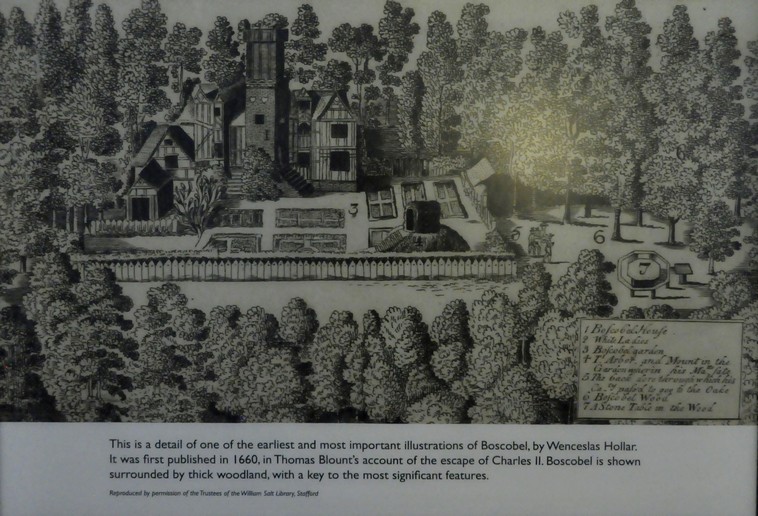
In 1651, Boscobel House was a hunting lodge in the forest. Charles found refuge there, not only hiding in a priest hole overnight, but also among the canopy of a large oak tree (the famous Royal Oak) close by, as Parliamentarian forces searched high and low for him. He was also hidden at nearby Moseley Old Hall (about 10 miles due east of Boscobel, now in the hands of the National Trust, and which we visited in April 2014).

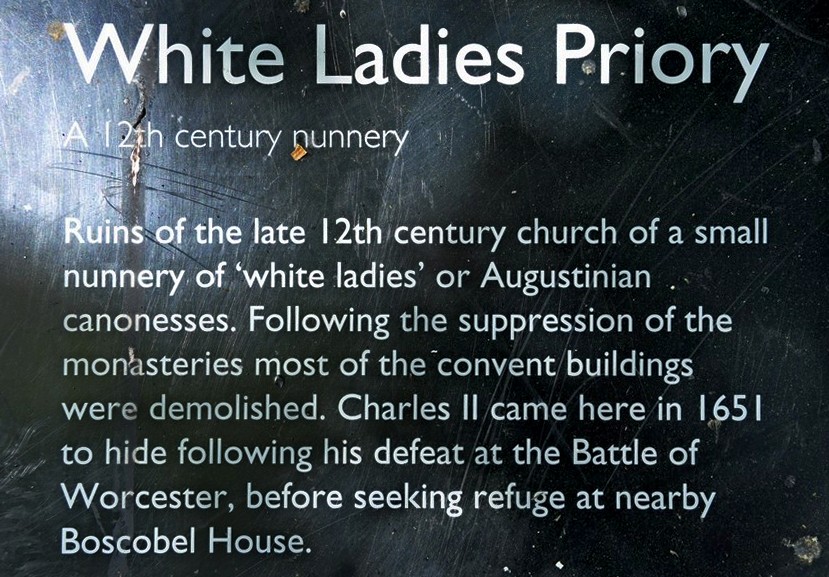
Boscobel House and the nearby White Ladies Priory (which was a converted residence when Charles sought refuge there in 1651) now belong to English Heritage. Yesterday, we made the 45 mile trip north to visit these two sites, and another English Heritage property, the ruins of Lilleshall Abbey, just over seven miles northwest from Boscobel.

Boscobel House and The Royal Oak
The house has Tudor, 17th century and Victorian extensions. The farmyard buildings are Victorian. It was owned by the Giffard family who lived at White Ladies Priory. The lonely Royal Oak that stands in a field a short distance from the house is a descendant of the original tree in which Charles hid.

(1) Hunting Lodge; (2) Garden; (3) Cowhouse; (4) Stables; (5) Dairy display; (6) Smithy; (7) Family room; (8) White Ladies Priory – about 1 mile, 20 minutes walk; (9) Royal Oak – approx 5 minutes walk.

White Ladies Priory

Lilleshall Abbey

It’s all about Trust and Heritage

When I fell over last January and broke my leg, and was incapacitated for almost three months, I never thought that we would be able to get out and about for National Trust and English Heritage visits as we had in previous years. How wrong I was!

Once I’d been given the all clear to drive, around the end of March—and relying on my trusty walking stick—we managed to visit eleven National Trust properties (including four times to our ‘local’ Hanbury Hall), and to five run by English Heritage. I have indicated the distance from my home in Bromsgrove, although we visited some properties while we were on holiday in the south of England in July.

National Trust
During our holiday in the New Forest we made a day visit to Corfe Castle, and on the way home a week later we stopped off at Kingston Lacy. Further on, we passed the entrance to Dyrham Park, north of Bath, but didn’t have time to visit then. So we decided to return later in August.

Not long after I gained my mobility, we visited three properties that are quite close to home, not to visit inside the houses, but to enjoy the gardens, and relax with a cup of coffee or a bite to eat for lunch. The restaurant at Packwood House, renovated over the past couple of years or so, is particularly nice.

If I wrote a specific blog post about each of these visits, I have included a link below.

Hanbury Hall (10 April, 4 May, 29 August, and 18 November) 6 miles
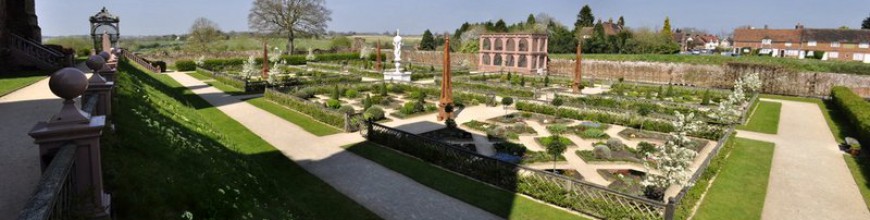
Hanbury is our local National Trust property. I think we’ve been inside the house only once, several years ago, but during the year we did pop over there, in about 15 minutes, to grab a cup of coffee, and walk through the gardens. Of particular interest for me is the glorious parterre, kept immaculately by the resident gardeners and volunteers.

Packwood House (20 April) 17 miles

Baddesley Clinton (12 May) 19 miles

Shugborough Hall (22 June) 53 miles
One of the things we particularly liked about Shugborough was the number of rooms open to the public. As always the volunteers were most helpful in pointing us towards items of interest.

Read about our visit here.

Avebury (2 July) 81 miles
We stopped in Avebury on the way south to our holiday in the New Forest. It was a good halfway place to have coffee and lunch. There’s much to see, with the stone circle and the house (with each room decorated in a different period).

Read about our visit here.

Corfe Castle (5 July) 176 miles
We visited Corfe Castle on a day trip from our holiday home in Dibden Purlieu on the east of the New Forest. The drive west was about 47 miles, on quite busy roads.

Read about our visit to Corfe Castle and Kingston Lacy here.

Kingston Lacy (10 July) 134 miles
Kingston Lacy was owned by the same family as Corfe Castle, about 19 miles to the north. This must be one of the National Trust’s premier properties – it’s full of treasures. Well worth another visit sometime.

Claydon (19 July) 67 miles
Our visit to Claydon was a delight. Normally, photography is not permitted inside the house, but when I explained that I write a blog about our National Trust visits, they gave me permission to photograph many of the architectural aspects I am interested in. And I have to say that the volunteers at Claydon were some of the most helpful and friendliest that we have come across.

Read about our visit here.

Dyrham Park (12 August) 77 miles
It’s quite a walk from the car park to the house and gardens. Thank goodness for the shuttle service. On the day of our visit the weather was beautiful, and we thoroughly enjoyed our visit.

Read about our visit here.

Brockhampton Estate (26 August) 25 miles
We made our first visit to Brockhampton in September 2012. It was great to see that other parts of the medieval house had been opened to the public.

Greyfriars’ House and Garden (14 December) 12 miles (by train)
This was our last visit for 2016, and we hopped on the train from Bromsgrove for the 20 minute ride to Worcester Foregate. From there it was a less than 10 minute walk to Greyfriars’. Nice to see the rooms decorated for Christmas, and we had an excellent tour guide.

Read about our visit here.

English Heritage
This was our second year as members of English Heritage, and we didn’t visit as many properties as we would have liked. But that will be rectified in 2017!

Buildwas Abbey (27 May) 36 miles
We had tried to visit Buildwas in 2015, on our way from Wenlock Abbey to Ironbridge. But it was closed. We had the place to ourselves when we visited in May. Peaceful!

Read about our visit to Buildwas and Langley Chapel here.

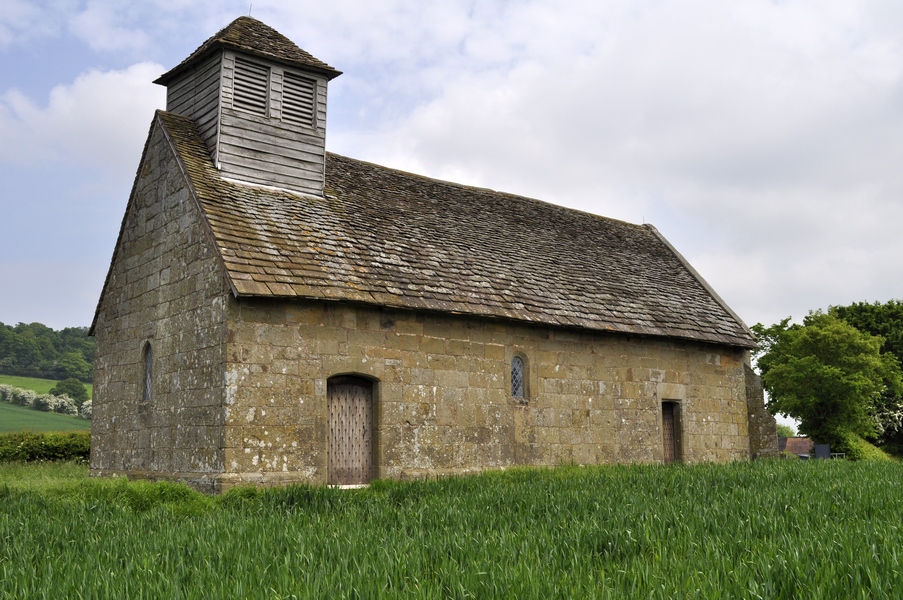
Langley Chapel (27 May) 11 miles from Buildwas Abbey
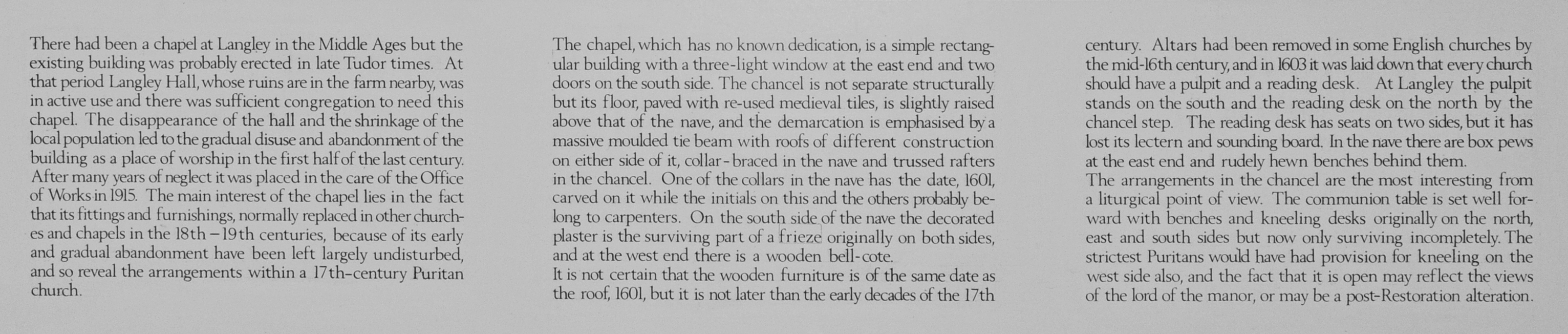
Standing isolated in a field, this is a delightful example of a 17th century chapel catering to a Puritan rural population.

20160527 007 Langley Chapel

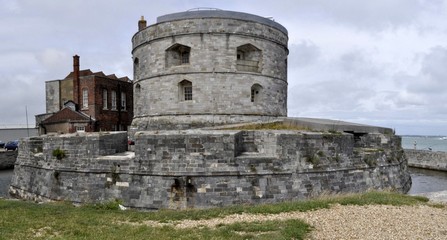
Calshot Castle (9 July) 136 miles
Calshot was just a few miles south of our holiday home in Dibden Purlieu. We were amazed to discover how well it had been maintained over the centuries. I guess this is not really surprising considering the active defensive role it has taken on all that time.

20160709 009 Calshot Castle

Read about our visit here.

Bolsover Castle (17 August) 90 miles
Bolsover Castle sits on the skyline to the east of the M1 motorway in Derbyshire. Whenever we travel north to visit our younger daughter Philippa and her family, we have to pass Bolsover. And for years we were intrigued by it, and what it might offer. We had also seen in the past few years a BBC program about the castle presented by historian Lucy Worsley. We were not disappointed in our visit.

Read about this interesting visit here.

Witley Court and Gardens (26 August) 16 miles
Witley Court is one of our local visits, just a few miles west of Bromsgrove on the far bank of the River Severn. We have been visiting Witley Court since the 1980s when you could just wander into and around the ruins. We had last been there in July 2015.

Apartments fit for a King – Bolsover Castle

20160817 012 Bolsover CastleBolsover Castle stands proudly over the northeast Derbyshire landscape, a prominent feature on the eastern skyline as one travels along the M1 motorway. It is owned and managed by English Heritage, and is just a few miles north of Hardwick Hall that we visited in 2015 almost exactly a year ago.

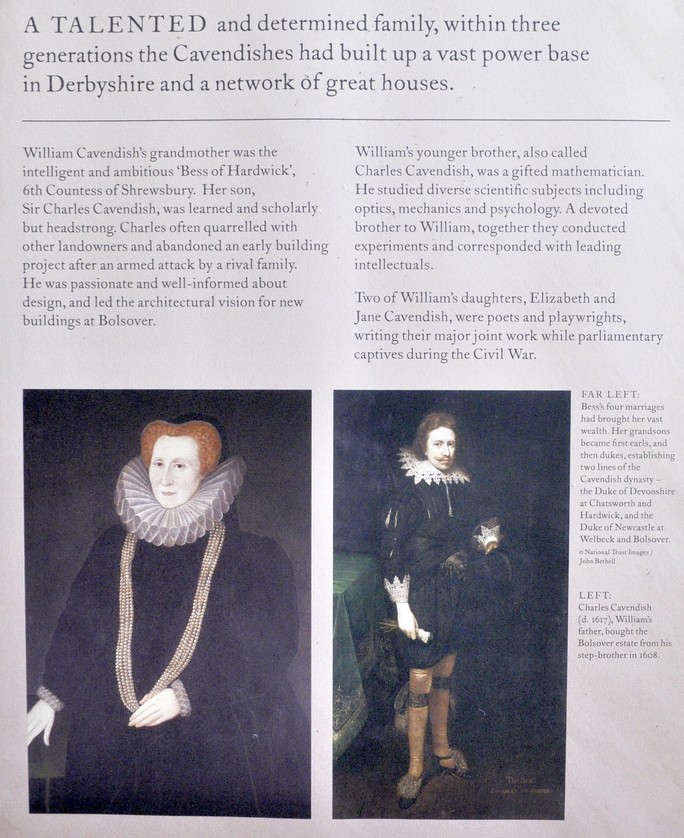
The histories of Bolsover Castle and Hardwick Hall are intertwined.

Bolsover_Castle_-_geograph.org.uk_-_205752

So who built Bolsover Castle? Standing on the site of a medieval castle, the castle we see today dates from the early decades of the 17th century. It was the vision of Charles Cavendish and his son William.

20160817 049 Bolsover Castle

20160817 050 Bolsover Castle

20160817 047 Bolsover Castle

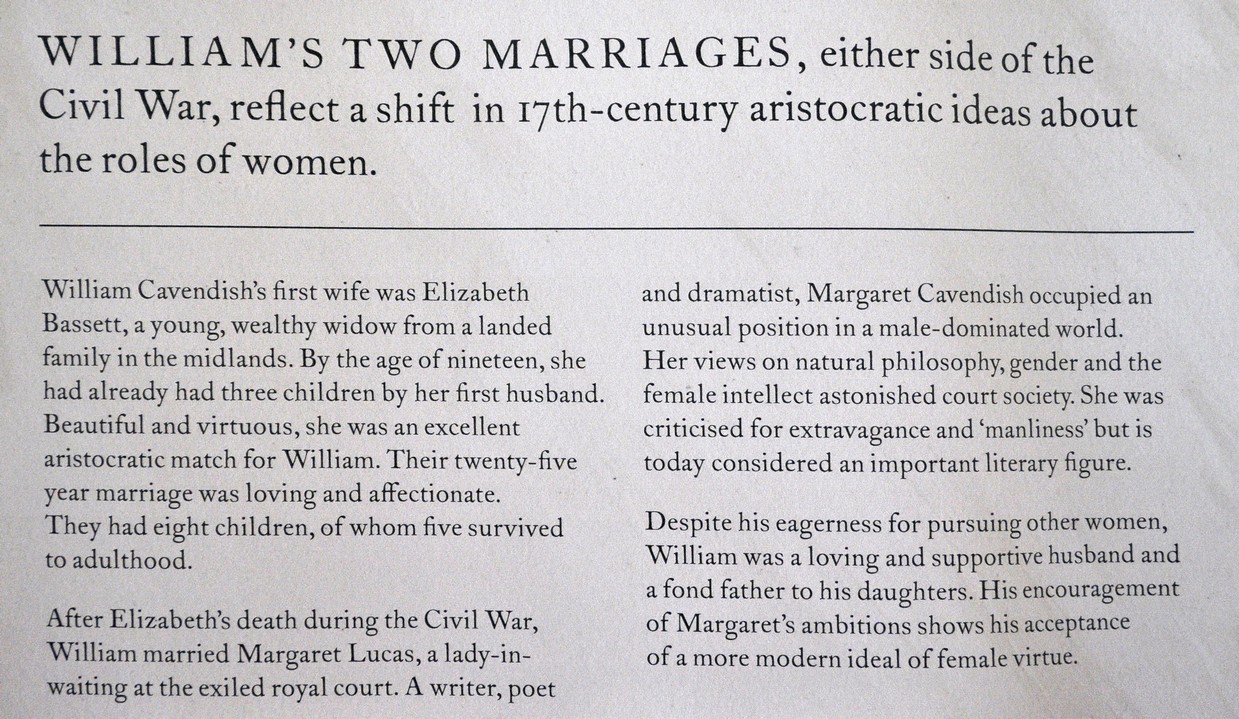
William was married twice.

20160817 046 Bolsover Castle

20160817 044 Bolsover Castle

William’s wives: Elizabeth Bassett (L) and Margaret Lucas (R).

Although one part of the castle was demolished (slighted) by Parliamentarian forces during the Civil Wars, the Little Castle and its exquisite interior decoration has survived until today (although with some restoration by English Heritage).

The Little Castle

20160817 007 Bolsover Castle

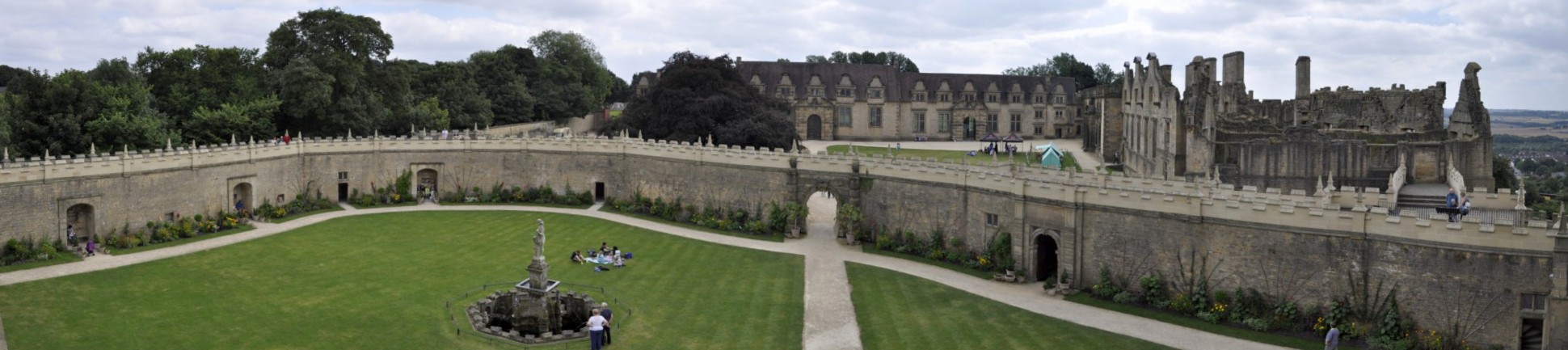
The Fountain Garden, the Walled Walk, the the Riding School Range in the distance, and the demolished Terrace Range on the right.

Seen better days – the Terrace Range
The Terrace Range is now in ruins, but when it was originally built it must have been spectacular, not only for the grandeur of the building itself, but also for the views over the Derbyshire landscape.

The heyday of Bolsover Castle did not last long.

20160817 048 (2) Bolsover CastlE

20160817 048 (3) Bolsover Castle

The Ante Room
Just inside the main entrance, and to the left, of the Little Castle is the small Ante Room, with wonderful wood panelling and wall paintings.

The Hall
The next room is the main hall, with fine vaulted ceilings, a large stone fireplace, and more paintings high on the walls.

The Pillar Parlour
Beyond the Hall, and on the left before climbing the stone stairs to the first floor, is the Pillar Parlour. This is one the finest rooms in the castle. It has, like many rooms in the Little Castle, a fine marble fireplace with insets of black marble, a common theme throughout the building.

The Star Chamber
On the first floor is the Star Chamber, named after the beautiful light blue ceiling decorated with gold stars. The tapestries hanging from the walls are not original, but have been installed to show what the room might have looked like four centuries ago. Again there is a fine white and black marble fireplace, and exquisite paintings on the wood panelling.

The Marble Closet
Just off the Star Chamber is the Marble Closet, furnished in black and white marble, with more wall decoration.

The Heaven Closet
This one of the most beautiful rooms in the building, so called because there is a figure of Christ is the center of the ceiling paining. It was completed in 1619.

The Elysium Closet
Decorated in a Greek style, this small room off William’s bedroom, has a theme that is quite the opposite of the Heaven Closet.

The Lantern and top floor rooms
On the top floor, underneath a cupola, is a series of rooms leading off this central feature. It must have been a place where residents and guests met because of the way that daylight floods down to highlight the golden walls.

The Kitchens
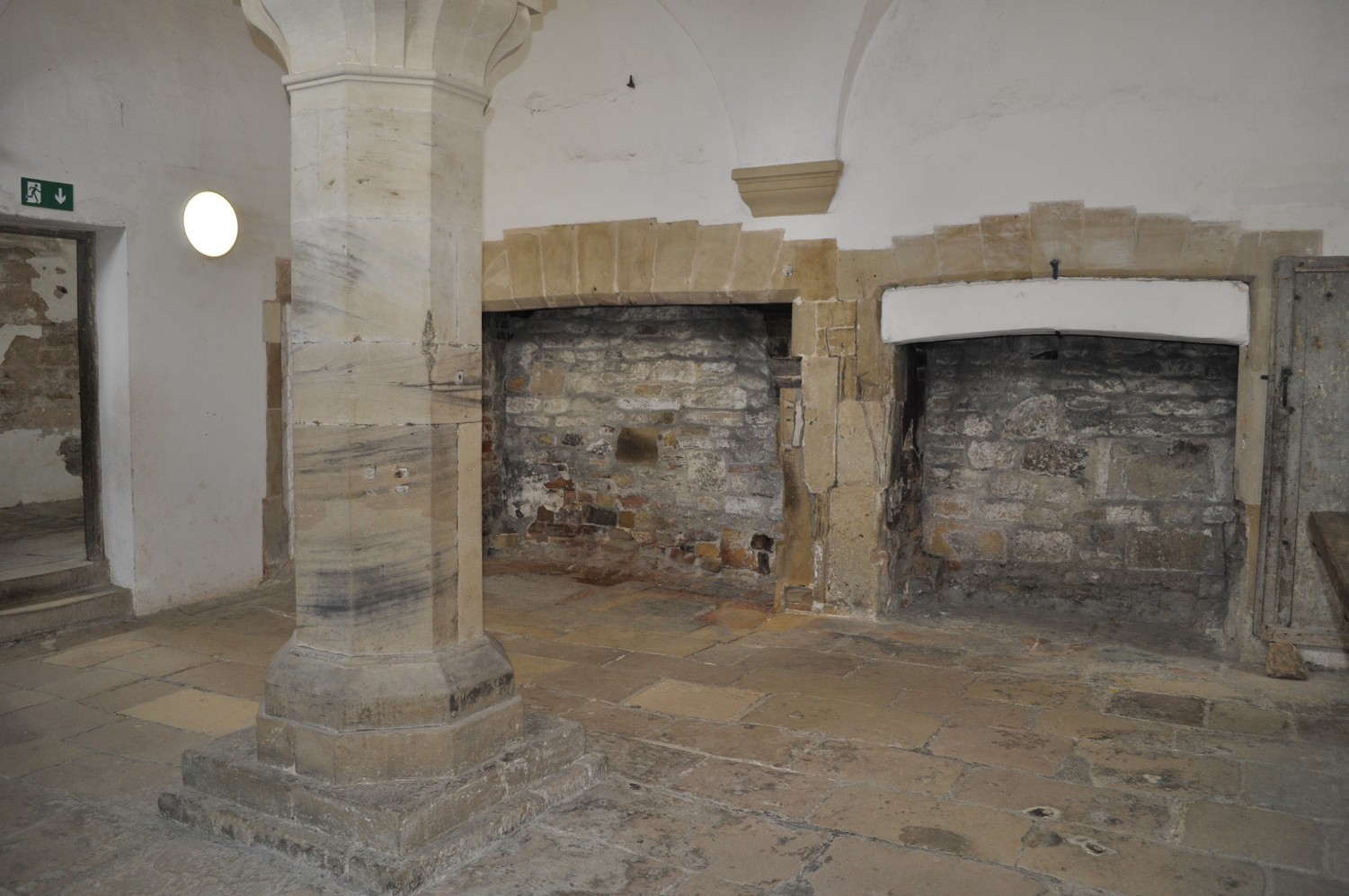
There are several rooms in the basement, kitchens and storage rooms, that must have always been busy to satisfy the culinary need of the residents upstairs.

20160817 173 Bolsover Castle

The Fountain Garden
Outside the Fountain Garden is dominated by a statue of Venus, and the planting reflects plants that would have been available during the 17th century. The Walled Walk provides great views over the garden.

The Riding School Range
Just through the main gateway to the castle, and to the left, is along 17th century building with a riding school. It’s possible to climb to the top floor and see the intricate and splendid wood beams holding up the roof.

We have passed Bolsover Castle so many times when we travel up to Newcastle upon Tyne to visit our younger daughter Philippa and family. It was a day trip of more than 180 miles, but well worth it.

In Bolsover there is just a small car park close to the castle entrance, that was already full when we arrived. Just a little further on, and through a rather discreet entrance is another overflow car park – not signposted at all – where you can park free of charge on what must have once been part of the castle terrace.


Here a henge, there a henge . . .

On 2 July we set off from home just before 10 am, heading south towards the New Forest in Hampshire, where we stayed for a week with our daughters Hannah and Philippa and their families.

The trip south was about 143 miles, on the route we took. That was south on the M5 motorway, over the Cotswolds to Swindon, then on south via Salisbury to our destination.

We broke our journey at Avebury in Wiltshire, a World Heritage Site, a dozen miles south of Swindon.

Avebury has two attractions: Avebury Henge and stone circles, and Avebury Manor, once the home of Alexander Keiller (of the marmalade family) who spent many years in the 1930s discovering the archaeology of this ancient Neolithic site.

aerial-avebury (eng-heritage)

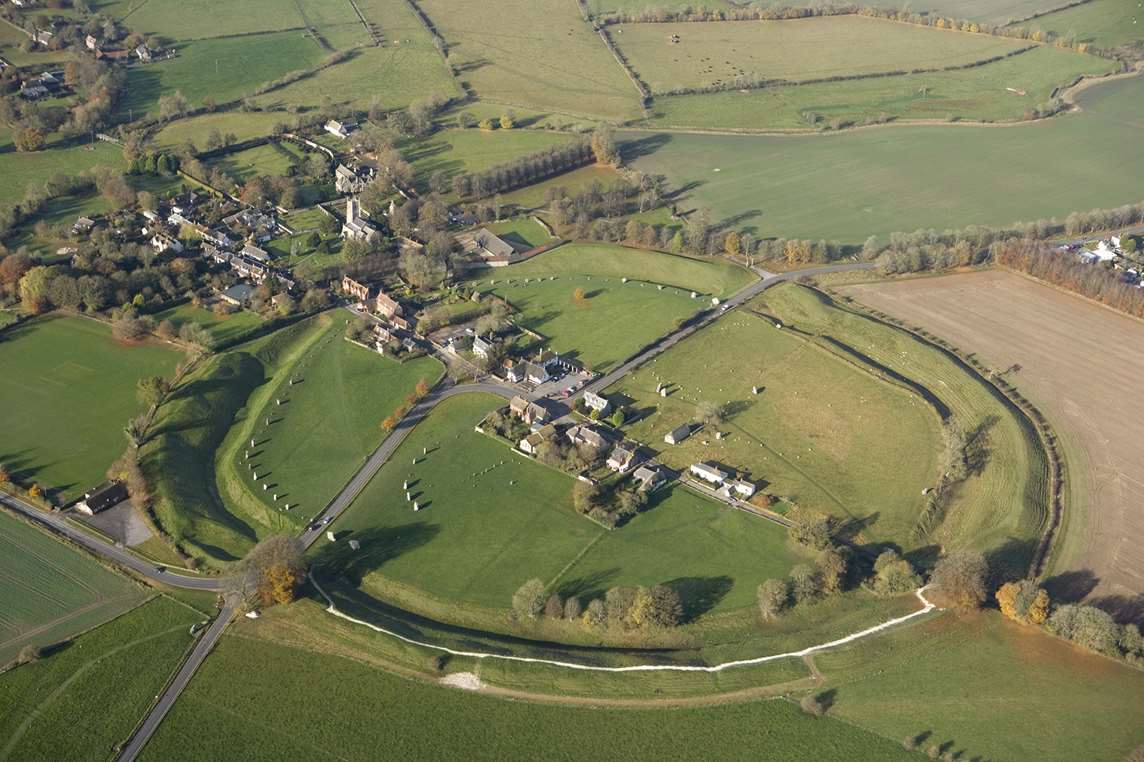
Avebury village and stone circle.

There is something enchanting about stone circles and, lost in the mists of time, it’s hard to imagine why and how ancient Neolithic people erected these thousands of years ago.

Entering Avebury you certainly do not get an impression of just how big the earthworks are. It’s only when you are on the ground, and see the massive ditches (the henges) that the full impact of their construction—by hand—using the most rudimentary of tools like antlers, really hits you. Of course there are other henges in the vicinity: Stonehenge and Woodhenge, to name just a couple. But this Wiltshire landscape for some reason is an area of considerable Neolithic activity. Due to my current disability, and not wanting to spend too much time walking over uneven surfaces, we did not explore the henge and stone circle as much as I would have wanted.

20160702 055 Avebury

20160702 004 Avebury

20160702 005 Avebury

20160702 009 Avebury

Avebury Manor is a 16th century building, that was restored by Keiller. But in 2011 its refurbishment was the subject of the BBC TV series The Manor Reborn, by a group of experts in collaboration with the National Trust. There is no consistent theme throughout the manor’s decoration, each room representing a different period in its history. It’s an interesting concept, but from my perspective this doesn’t allow a visitor satisfactorily to develop a solid impression of the house and its worth. There’s no doubt that it is a beautiful building in a rural setting. I thought the mishmash of historical themes was inappropriate and it would have been better to have chosen a single era for its decoration. nevertheless I do recognise that the BBC’s and experts’ involvement in this way have probably helped save the building in a better state for the future.

Almost 500 years and 21 monarchs later . . .

Yes, almost 500 years and 21 monarchs, not counting the Commonwealth (1649-1660) under Oliver Cromwell and his son Richard, nor the joint monarchy of William III and Mary II as two.

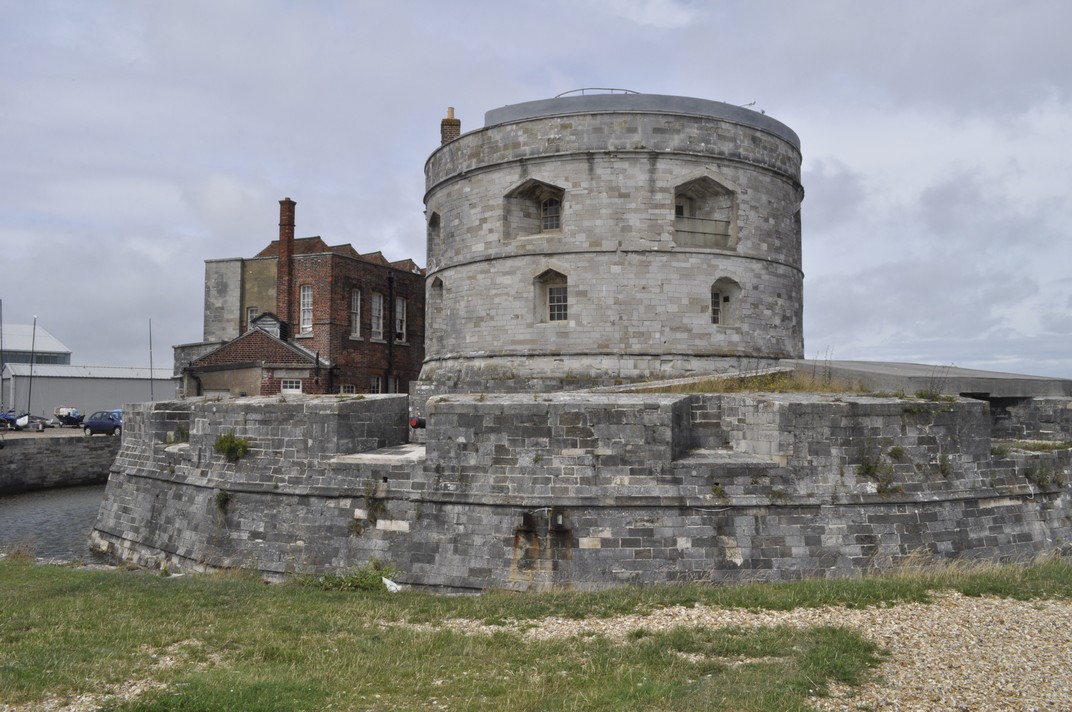
Built between 1539 and 1540, during the reign of Tudor monarch Henry VIII, Calshot Castle has proudly guarded the approaches to Southampton Water in southern England under almost continual occupation since then.

20160709 062 Calshot Castle

The south face of Calshot Castle, with an 18th century extension on the left.

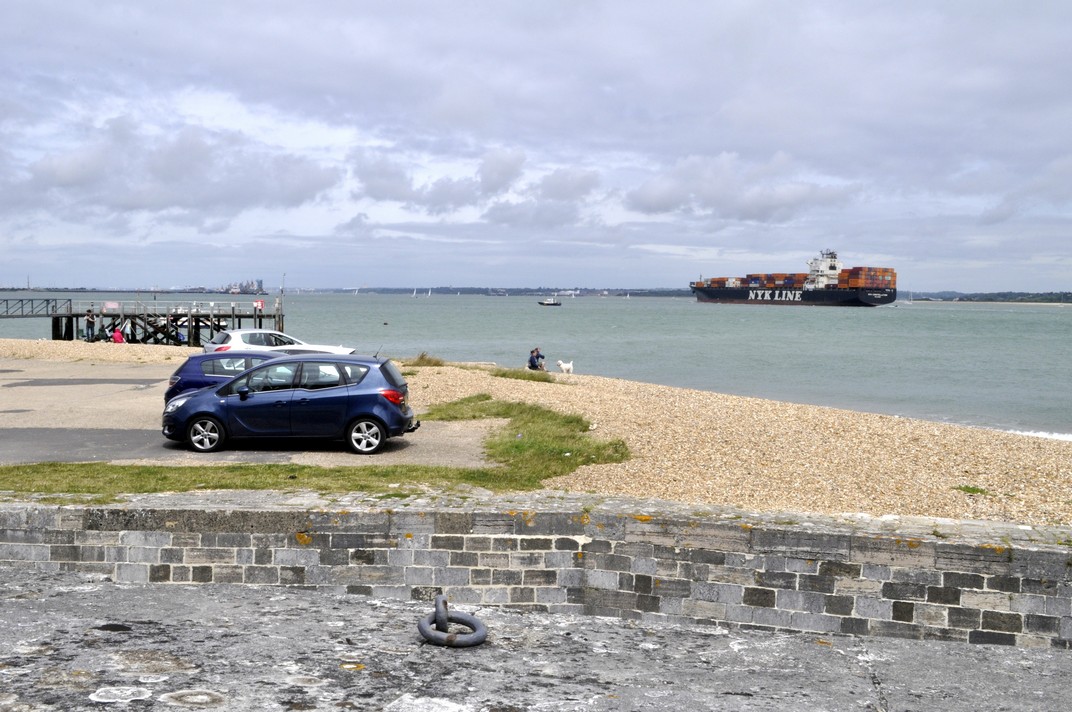
Situated at the tip of Calshot Spit it commands a view over The Solent towards the Isle of Wight to the south, and north along Southampton Water that leads to one of England’s premier and ancient ports.

20160709 003 Calshot Castle

Looking across The Solent to the Isle of Wight.

20160709 027 Calshot Castle

Looking north up Southampton Water towards the Port of Southampton.

Of course it has undergone several modifications during the intervening centuries, but from the basement to the roof it’s still possible to see some of the earliest Tudor constructions. It last saw active service during the Second World War, and anti-aircraft guns were mounted on the roof. Calshot Castle is now in the care of English Heritage. We visited there during our recent holiday in Hampshire. It was quite windy the day we headed along Calshot Spit. I thought that perhaps we would spend at most 30 minutes looking round the castle. We must have been there for almost two hours. Calshot Castle is fascinating, and its history just oozes from the fabric of the building.

The Royal Air Force maintained an air station there for many decades, and it was the site for seaplane and flying boat operations. There’s an interesting museum in the castle detailing this. Calshot was also the site for the 1929 Schneider Trophy air race. Today, the original hangars have been given a new lease of life as a recreation center. A lifeboat station and coastguard tower have also been constructed alongside the castle.

Two years in the planning . . .

Steph and I have two lovely daughters.
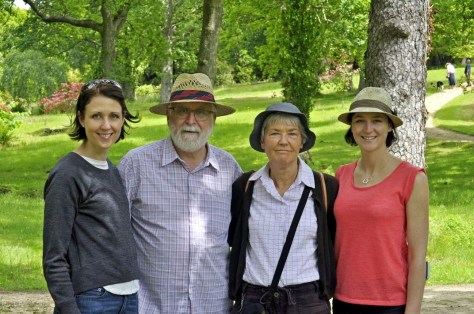
20160711 244 New Forest holiday

Hannah (on the left), the elder, lives in St Paul, Minnesota, and is married to Michael. They have two children: Callum, who will be six in mid-August, and Zoë, who turned four last May.

Philippa (on the right) has stayed in the UK. She lives in Newcastle upon Tyne, and married Andi in 2010. They have two boys: Elvis will be five at the end of September, and Felix will be three on 1 September.

But until this past week, we had never all been under the same roof. And the grandchildren had never met each other.
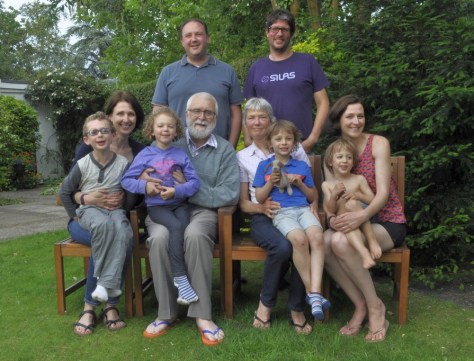
20160711 514 New Forest holiday

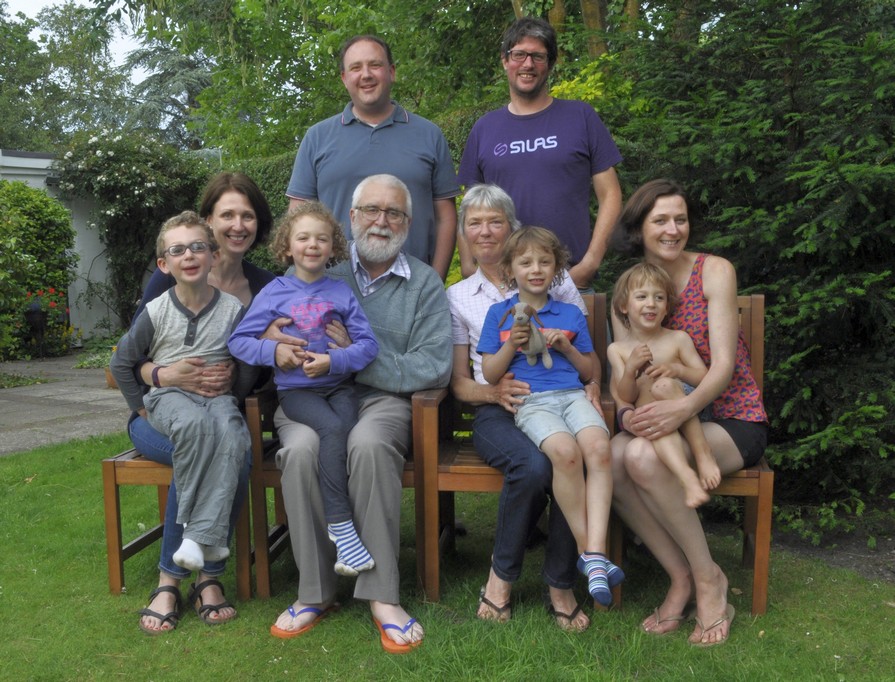
L to R standing: Michael and Andi. L to R sitting: Callum, Hannah, Zoë, me, Steph, Elvis, Felix, Philippa.

Two years ago, Hannah and Michael had planted the idea of coming over to the UK for a summer holiday. But where to stay, and what to do—apart from enjoying each other’s company? With us living in the Midlands south of Birmingham, and Philippa in the Northeast, it seemed logical to plan a holiday somewhere nearby to either of those locations. Unfortunately our home is not large enough to host everyone. Northumberland to the north of Newcastle is a beautiful county, but was eventually ruled out as probably not enjoying the warmer weather everyone hoped for.

So we eventually focused on the New Forest, west of Southampton, an area I know well having family links with the area, as well as from my undergraduate days at the University of Southampton. But apart from a week’s holiday there in the late 1980s, I haven’t been back since.

For various reasons the 2015 plans fell through, and even this year nothing was settled until quite late. Originally we had said that if Hannah and family came over to the UK we wouldn’t plan to take our usual break in Minnesota this year. As a trip to the UK didn’t seem to be in the offing, we went ahead and booked flights in early September for a three week stay in Minnesota. Then, Hannah and Michael confirmed that they would fly over here after all, and the search was on for a holiday home that would accommodate six adults and four small children. Thank goodness for the Internet. Hannah quickly zeroed in on three properties, and we eventually chose a five bedroom house in the village of Dibden Purlieu on the eastern edge of the New Forest National Park.

Our holiday began on Saturday 2 July, and we planned to get to the holiday home by about 5 pm, in time to be there when Hannah and Michael arrived from Southampton Airport. However, we decided to make something of the trip south, calling at Avebury in Wiltshire to visit two National Trust properties: the 16th century Avebury Manor and Garden, and the world famous Avebury Neolithic henge, comprising three stone circles. We spent just over two hours exploring the manor house and garden, but because of my current walking limitation, were not able to walk the length of the stone circles.

Sunday was a rest day. Hannah and family didn’t emerge from their beds until after noon, so we decided to spend the rest of the day relaxing around the house.

Phil and Andi didn’t arrive until Monday evening, so we decided to make a short excursion before lunch down to the coast at Lepe, just a few miles south of Dibden Purlieu. Callum and Zoë had a blast on the shingle beach, and afterwards in the play area above the cliff in the main part of the country park. Just what was needed to flush away the remnants of jet lag.

After Phil and Andi arrived, it didn’t take long before the newly-introduced cousins were playing together and running round the garden having a grand old time.

Tuesday was a very bright and sunny day, hot even, so we set out to cover the 40 miles plus drive west to Corfe Castle in Dorset (another National Trust property). Visiting a castle was on Callum’s list of things to do over here in England. So he was somewhat unimpressed—to begin with—when all he saw was a ruin. But once inside and we had the opportunity to climb on to the walls, peer through the narrow windows, imagine what life would have been like centuries ago, and even dress up in medieval clothes, then all the grandchildren had a whale of a time.

Wednesday saw us at Exbury Gardens just south of Beaulieu on the Beaulieu River, purchased by Lionel Nathan de Rothschild in 1919, and where he developed a world collection of rhododendrons and azaleas (which had mostly passed flowering when we visited). But there were many other features to explore, such as a very large Rock Garden, a steam train ride, and all the space the children needed to run around.

On Thursday, we set off for a walk from Beaulieu Road Station across the heath at Shatterford Bottom towards the southwest edge of Denny Wood, then on for a picnic on the edge of Matley Heath. After lunch we headed to the coast at Barton-on-Sea where the children could get their feet wet; the water was too cold for any swimming. And to watch the paragliders. We had hoped to have a fish and chip supper in Barton, but we’d finished on the beach by 4:30 or so. We therefore decided to head back to Hythe and had a pub meal at The Lord Nelson overlooking Southampton Water, where we could watch the huge container ships and cruise liners pass by.

Friday was a lazy day, and we didn’t head out into the forest until after lunch. Fritham was our destination, for another walk through the forest, and hopefully grab a bite to eat for dinner at The Royal Oak, a small pub I first visited in 1969 when I was Morris dancing with the Red Stags Morris Men (University of Southampton) and we joined the Winchester Morris Men on one of their tours.

Just south of Fritham, we visited the Rufus Stone where the killing of William II (William Rufus) in August 1100 is commemorated. I first went there as a young boy with my elder brother and mum and dad in the 1950s. It was great to be able to take my grandchildren there.

After a walk of a mile or so, we returned to The Royal Oak for a welcome pint. The pub, although modernised, still has all the kegs of beer lined up behind the bar, just as in the later 1960s.

20160711 507 New Forest holiday

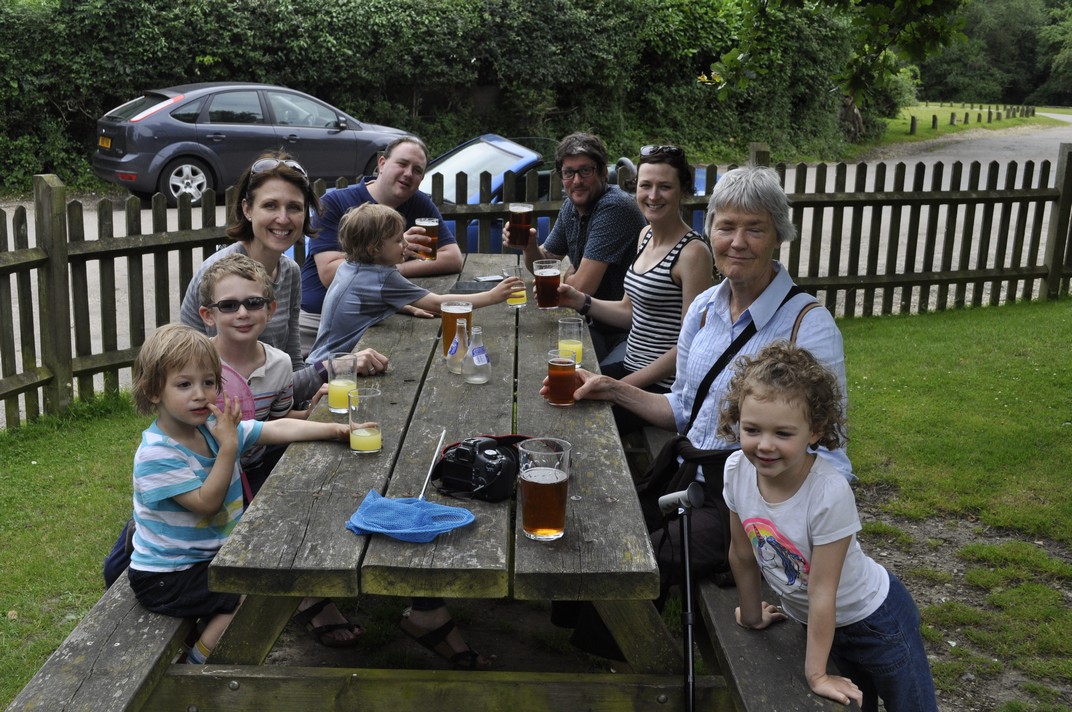
L to R: Felix, Callum, Hannah, Elvis, Michael, Andi, Philippa, Steph, and Zoë.

There was no food to be had at The Royal Oak, but we found a child-friendly pub, the Coach and Horses, at Cadnam.

On Saturday, the children were desperate to have a pony ride. So while they all headed off to a petting farm near Ashurst, Steph and I decided to visit an English Heritage property nearby. Calshot Castle, constructed by Henry VIII in 1539, guards the entrance to Southampton Water at the tip of Calshot Spit. For many decades it was an RAF base for flying boats and seaplanes; the original hangars are still there.

On the Saturday evening, Philippa and Hannah prepared a lovely roast chicken dinner that was washed down by several bottles of wine, and preceded by not a few G&Ts.
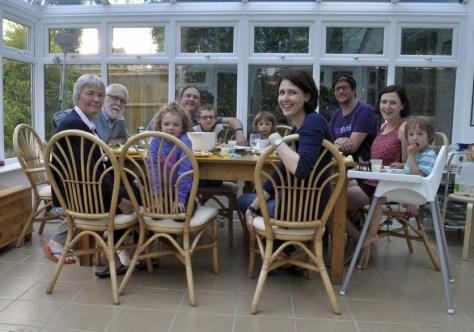
20160711 512 New Forest holiday

L to R: Steph, me, Zoë, Michael, Callum, Elvis, Hannah, Andi, Philippa, and Felix.

We departed for home on the Sunday morning, leaving Hannah and Phil and families to enjoy another week together. And from all accounts they have had a wonderful time.

But we didn’t head straight home. First we went due west about 45 miles, to Kingston Lacy, a 17th century country house and estate built by Sir John Bankes after the family was expelled from Corfe Castle during the English Civil Wars (between 1642 and 1651).

Kingston Lacy must be one of the jewels in the National Trust crown. It is sumptuous. In fact the only property that we have visited that can rival it is Waddesdon Manor in Buckinghamshire. But Kingston Lacy is several centuries older. The Bankes family apparently never threw anything away, and amassed a magnificent collection of works of art by several masters, furniture and porcelain. What a feast for the eyes!

From Kingston Lacy it was a direct, but rather winding, route north towards Bath and the M4 motorway, before joining the M5 motorway near Bristol, and covering the last 80 miles or so to Bromsgrove in much less time than I had feared. I think many people had stayed at home to watch Andy Murray win the Wimbledon Men’s Championship, or the British F1 Grand Prix. Or maybe they were settling themselves to watch the Euro2016 final from Paris between hosts France and Portugal. In any case, we did not have any hold-ups, thankfully, and were home not much after 5 pm, to enjoy a welcome cup of tea, and reflect on a wonderful week’s holiday with the family.


On the ecclesiastical trail in Shropshire . . .

In August last year, we had a great day out visiting Ironbridge and Wenlock Priory in Shropshire, between Telford and Shrewsbury. We intended also to visit Buildwas Abbey on the banks of the River Severn, north of Much Wenlock during the same trip. But I hadn’t checked my English Heritage handbook carefully, and we found the entrance gate to the abbey securely padlocked.

Not so yesterday, and Buildwas Abbey was the focus of our second ecclesiastical foray into Shropshire, a round trip from home of exactly 86 miles.

But, as on other days out, we always look for other National Trust and English Heritage properties close by to really make a day of it. On this occasion, it was Langley Chapel, about five miles west of Much Wenlock (map) over the other side of Wenlock Edge, and perhaps one of the most rural locations I have visited in a long while. There were minor roads, very narrow, edged by tall hedges, and just wide enough for one vehicle. I was commenting to Steph that my father would have said on such an occasion – just to encourage my Mum: ‘I hope we don’t meet a double-decker bus coming the other way!‘ Well, we did. Almost. I had to slow for a right angle bend, and just ahead of us was a large truck approaching down the lane, with several vehicles following slowly behind.

Rural and isolated it might have been. But what a glorious spot, with just the sounds of the lambs bleating in the meadows, and the wind rustling through the young wheat crop.

20160527 001 Langley ChapelOur first stop was Langley Chapel, an early 17th century building with its original roof dating from 1601. The chapel has no known dedication, and has not been used for services since the end of the 19th century. It was not altered during the 18th and 19th centuries (as happened in many other churches and chapels). It still retains the original Jacobean furnishings and fittings typical of a Puritan place of worship, such as box pews, a reading desk, and communion table, not an altar. the slightly raised chancel is paved with re-used medieval tiles.

Read more about the chapel and its origins below. Just click to view a larger image.

20160527 011 Langley Chapel

Buildwas Abbey
Founded in 1135 by Richard de Clinton, Bishop of Coventry, Buildwas Abbey was originally a Savignac monastery that eventually merged with the Cistercians. Situated on the Welsh borders, it suffered frequently in the civil turmoil and was often raided by Welsh princes. It was closed in 1536 during the Dissolution of the Monasteries during the reign of Henry VIII.

We were the only visitors (as at Langley Chapel). It was a haven of peace, and sitting there in the sun, taking in the beauty of the ruins, and some the fine dressed stone that can still be seen, many thoughts raced through my mind about the people and events that those noble ruins must have seen.

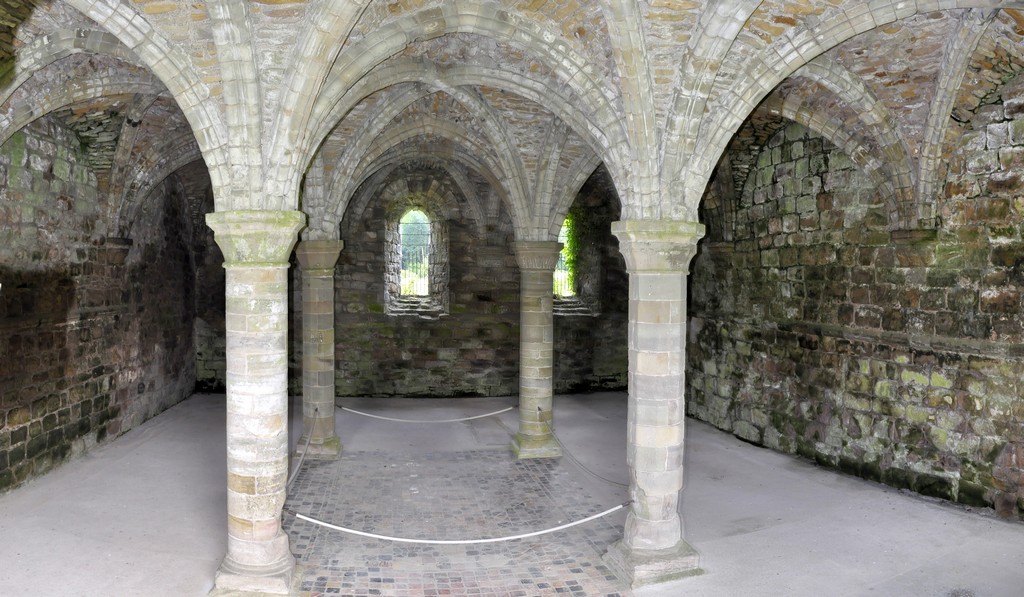
A particular fine feature is the Chapter House, with its columns and beautiful vaulted ceiling, and medieval tiles paving the central part of the floor.

20160527 078 Buildwas Abbey

The Chapter House.

These monks certainly knew how to choose a location to build their communities.

2015: a great year for National Trust and English Heritage visits

Steph and I have been members of the National Trust for five years now. We even qualify for the Seniors discount from January! And we’ve been members of English Heritage for just a year.

But we will be renewing our membership of both organizations in 2016. Why? Because they both offer excellent value for money, and certainly give purpose to our trips out, whatever the weather. Be it a visit to a stately home, a ruined castle, a country park, or a beautiful garden, there are so many properties to visit and experience so many aspects of our cultural heritage.

Looking back on our 2015 visits we have certainly had our money’s worth, and annual membership has more than paid for all the entrance fees we would have had to pay in any case. And much more!

So here is a pictorial summary of our great visits this past year, beginning in early April and ending just last week when we visited Charlecote Park to see the Christmas decorations. And there are links to individual posts about each visit.

NATIONAL TRUST

Lyveden New Bield (9 April)

20150409 092 Lyveden

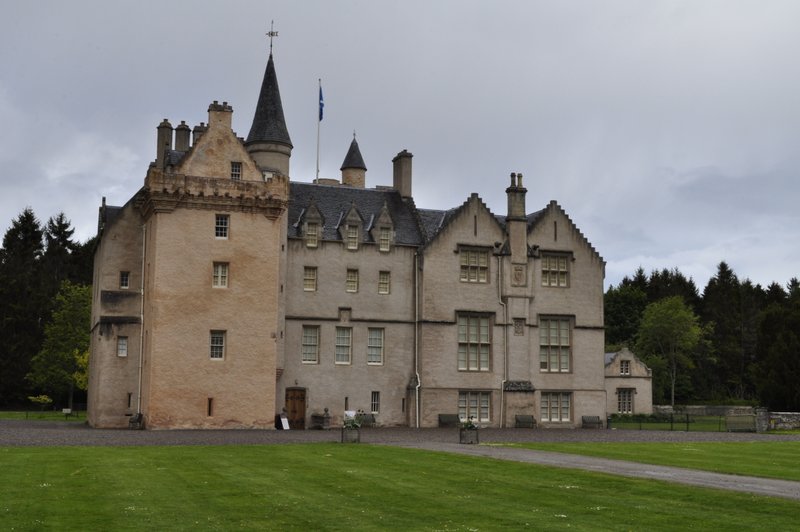
Brodie Castle (National Trust for Scotland – 29 May)

Brodie Castle

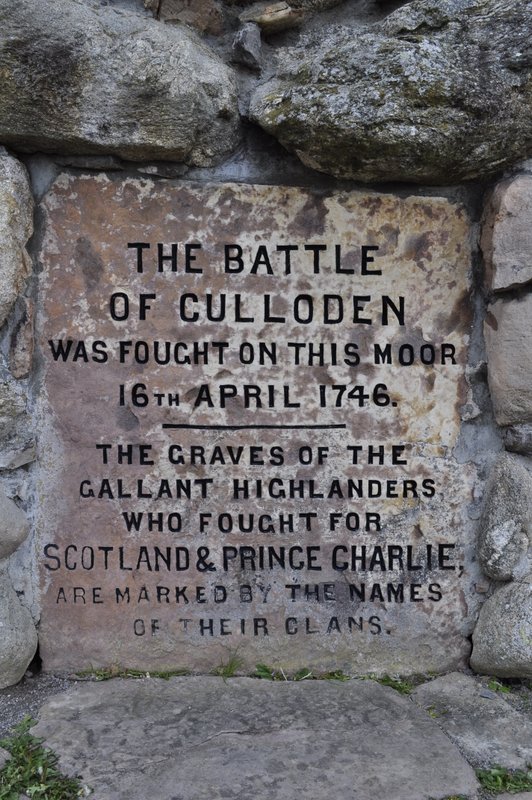
Culloden Battlefield (National Trust for Scotland – 29 May)

Scotland 082

Inverewe Garden (National Trust for Scotland – 1 June)

Scotland 312

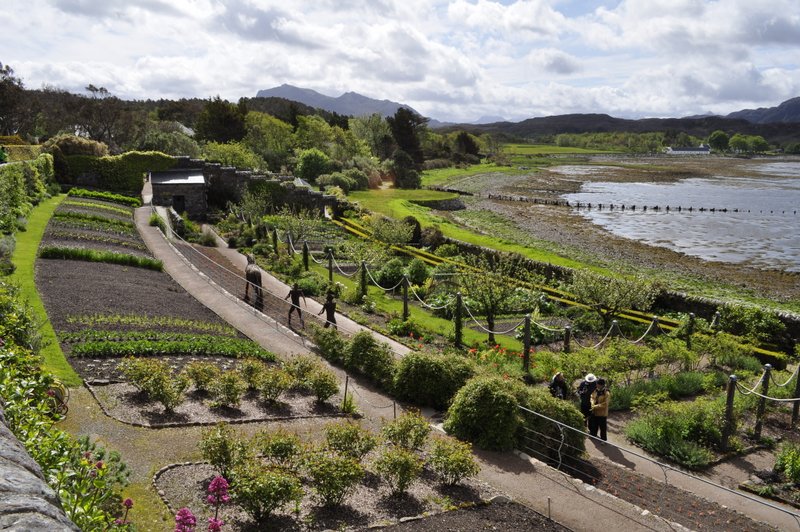
Arduaine Garden (National Trust for Scotland – 7 June)

Scotland 877

Rufford Old Hall (8 June)

The main entrance in the seventeenth century wing.

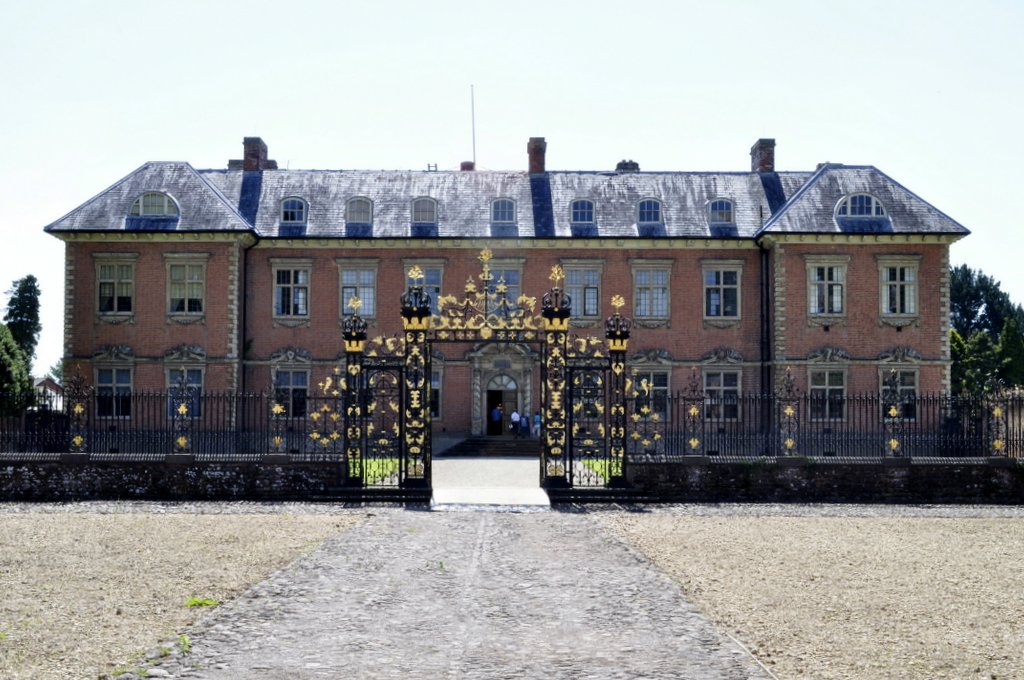
Tredegar House (18 June)

Tredegar House, near Newport in South Wales

Chirk Castle (1 July)

20150701 147 Chirk Castle

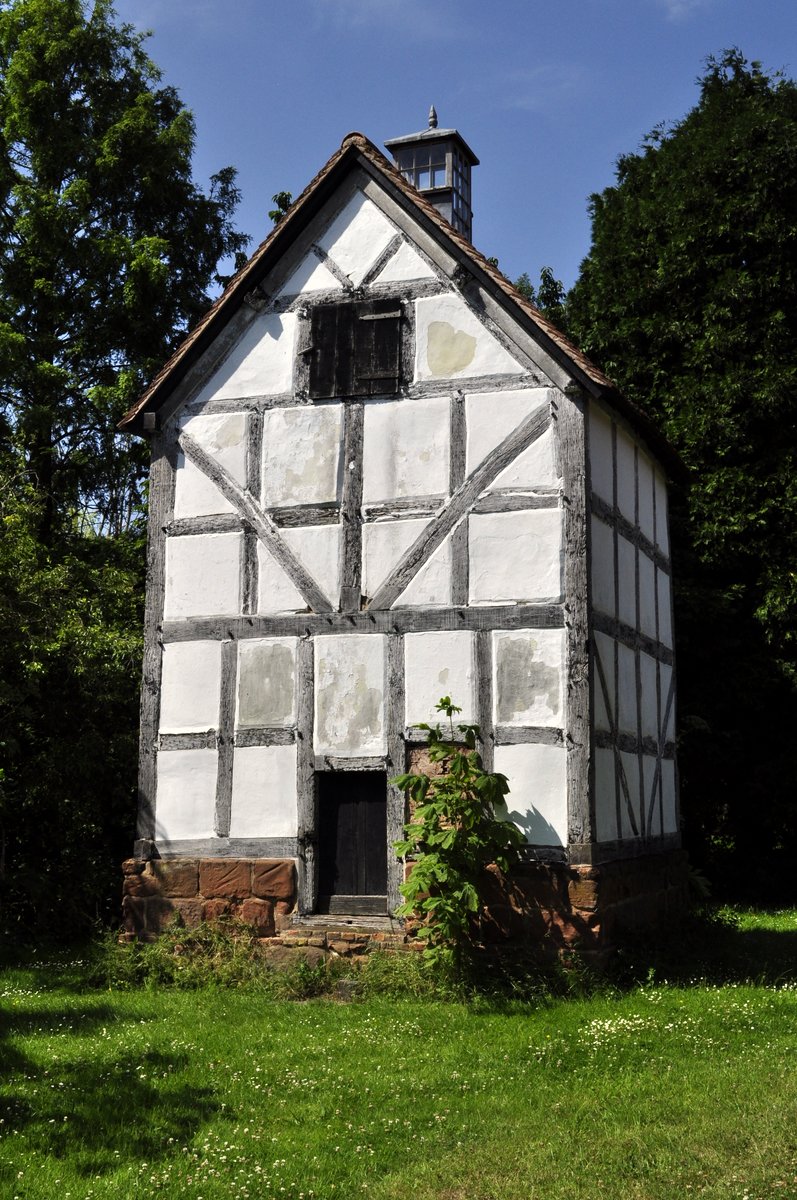
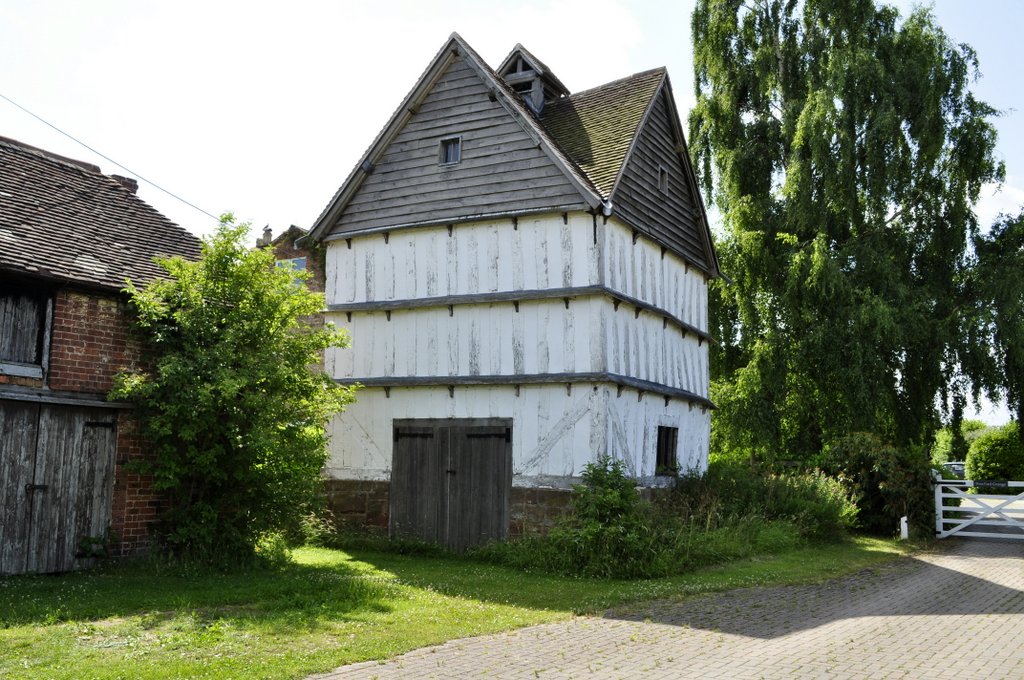
Hawford Dovecote (9 July)

20150709 010 Hawford dovecote

Wichenden Dovecote (9 July)

20150709 022 Wichenford dovecote

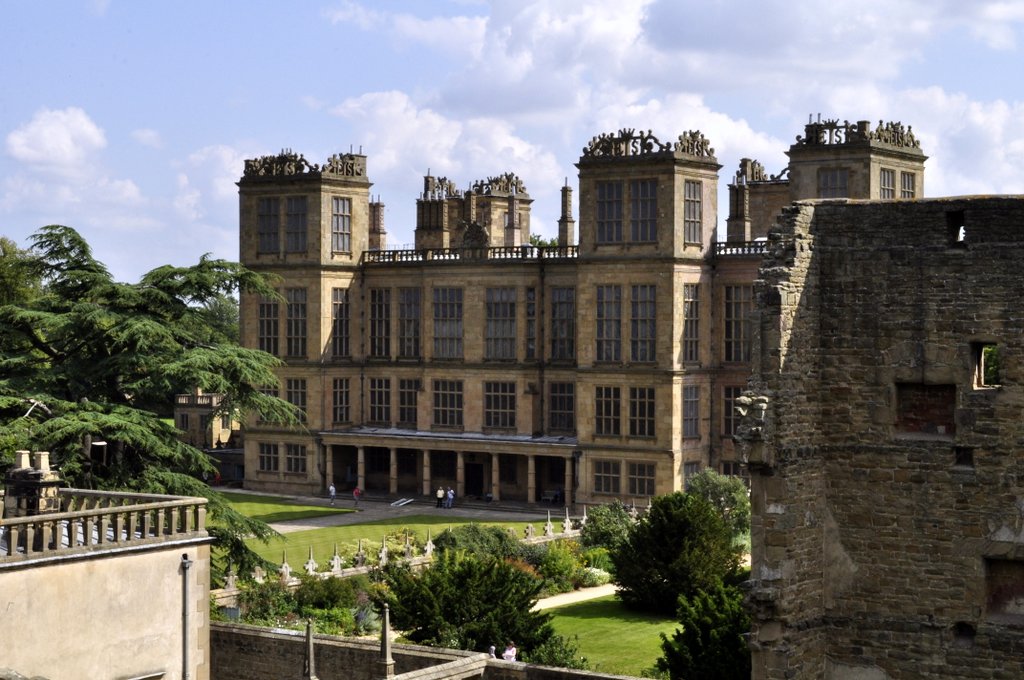
Hardwick Hall (12 August)

Hardwick Hall, Derbyshire

Newark Park (28 August)

20150828 031 Newark Park

Croome Park (12 October)

20110328046 Croome Court

Charlecote Park (16 December)

The entrance hall.

ENGLISH HERITAGE

Rushton Triangular Lodge (9 April)

Rushton Triangular Lodge, Northamptonshire

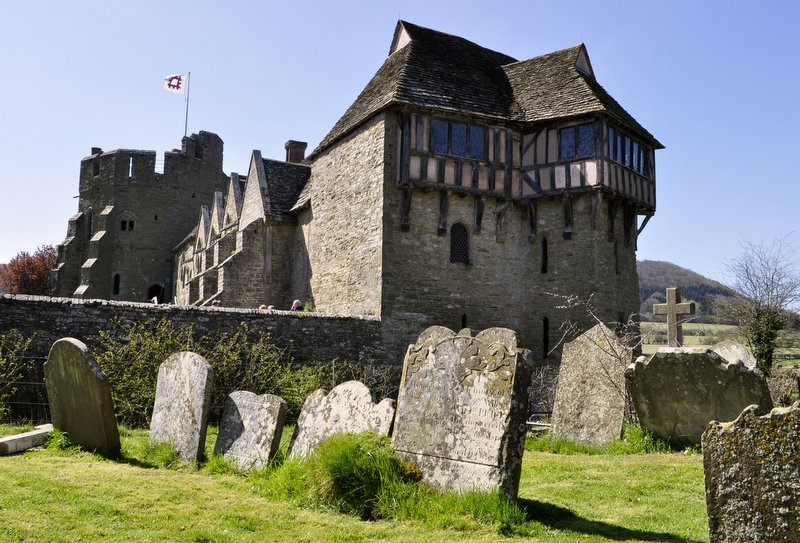
Stokesay Castle (14 April)

Stokesay Castle, Shropshire

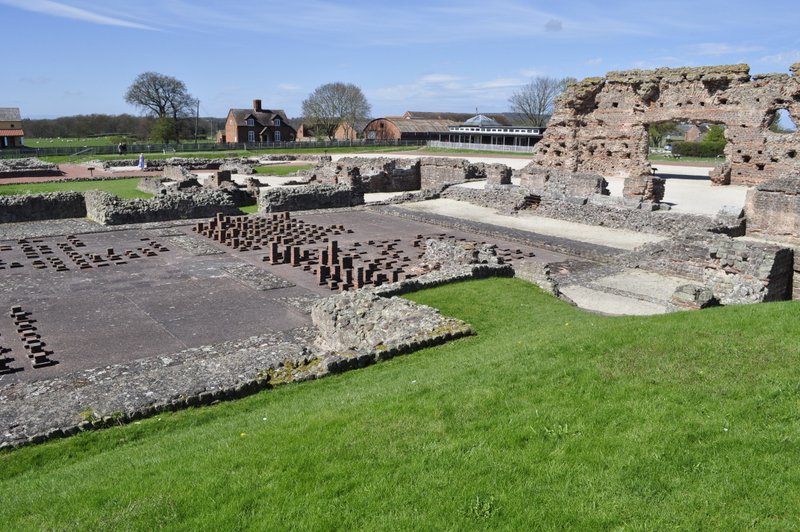
Wroxeter Roman City (14 April)

20150414 130 Wroxeter Roman city

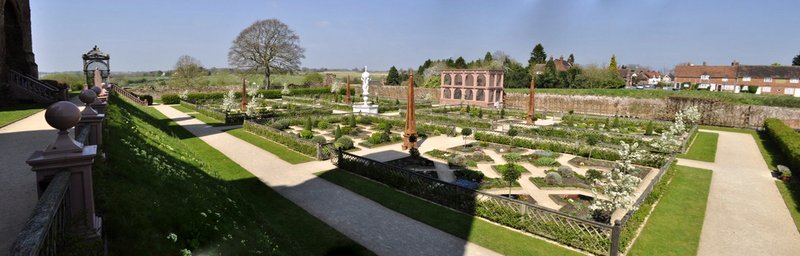
Kenilworth Castle (21 April)

cropped-20150421-023-kenilworth-castle.jpg

Goodrich Castle (21 May)

Goodrich Castle, Herefordshire

St Mary’s Church, Kempley (21 May)

20150521 135 St Marys Kempley

Witley Court (9 July)

20150709 091 Witley Court

Hardwick Old Hall (12 August)

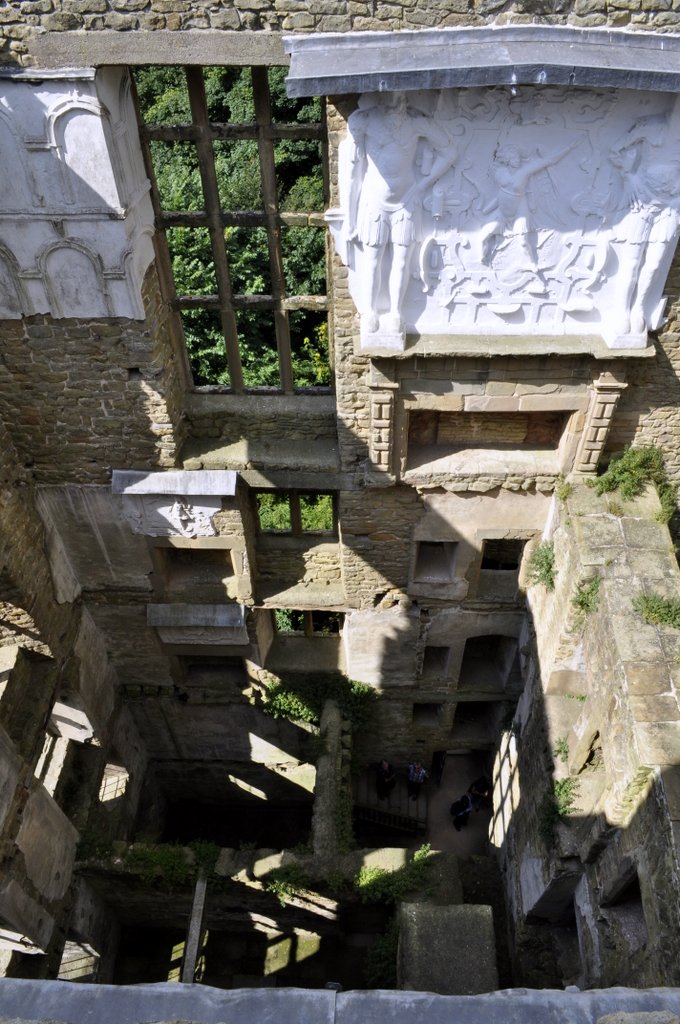
Looking down six floors in the Old Hall. And the magnificent plasterwork on the walls.

Wenlock Priory (18 August)

20150818 043 Wenlock Priory

Ironbridge (18 August)

From: http://en.wikipedia.org/wiki/File:Ironbridge

‘More glass than wall’ – a palace or prison?

It’s unusual to find properties managed or owned by English Heritage and the National Trust side-by-side. But that’s precisely the situation at Hardwick Old Hall and Hardwick ‘New’ Hall in Derbyshire.

With the weather set fair last Wednesday, we made the 177 mile round trip from our north Worcestershire home to visit ‘Hardwick Hall’, which we regularly pass on the M1 motorway when traveling to visit our younger daughter and her family in Newcastle upon Tyne. I had visited Hardwick once before, at least 50 years ago when my father organized an outing for the Leek Camera Club.

20150812 036 Hardwick Hall

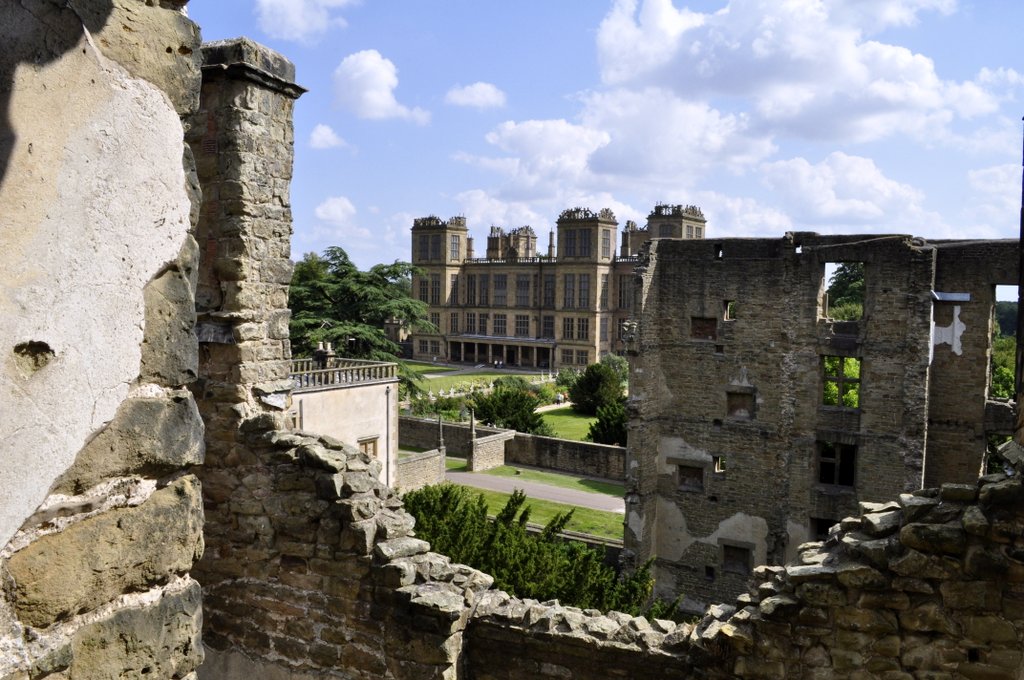
Hardwick Hall from the ruins of Hardwick Old Hall.

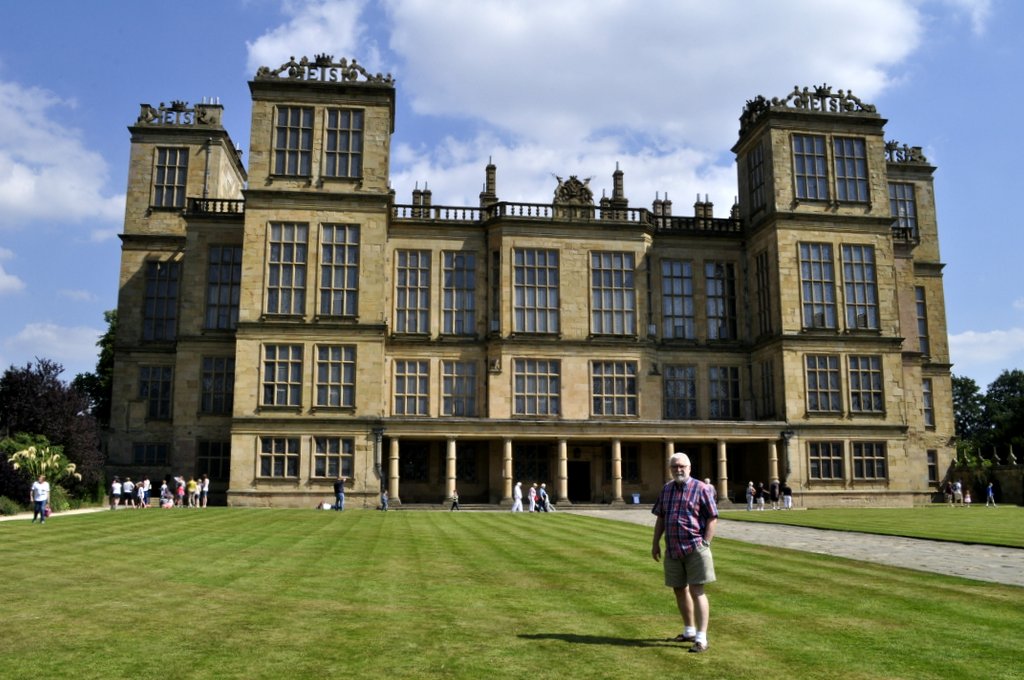
Standing on a ridge looking west over the Derbyshire countryside, Hardwick Hall was the later home of one of the most influential persons in Tudor times. Friend and confidante of Queen Elizabeth, Bess, Countess of Shrewsbury was originally from quite lowly stock, but through four and prestigious marriages (at least two of them in any case), she gained status and accumulated incredible wealth.

20150812 075 Hardwick Hall

20150812 151 Hardwick Hall

20150812 006 Hardwick Hall

Hardwick Hall proclaims the status of the owner to all and sundry. Not for nothing is her monogram ‘ES’ displayed proudly on at least three sides of each of the six ‘towers’ of the hall.

20150812 196 Hardwick Hall

The descendants of her second marriage, to Sir William Cavendish (d. 1557) are the Dukes of Devonshire, and Bess spent much of her married life to twice-widowed Sir William, at Chatsworth, still the ancestral seat of the Devonshires since 1549. She had eight children, two of whom died in infancy.

In 1568, Bess married George Talbot, 6th Earl of Shrewsbury (d. 1590), her fourth marriage, and one that brought her close to the royal court. For a number of years The Earl and Countess were given custody of Mary, Queen of Scots until she was removed from their care (essentially house arrest) and ultimately executed.

Hardwick Old Hall is now essentially a shell. After Bess moved to the ‘new hall’, and for centuries after, the house fell into disrepair, and during the 18th centuries, the building was reduced on purpose by the Dukes of Devonshire. One whole quarter of the hall, which housed the great hall I believe has disappeared altogether. But there is still a great deal to see, and English Heritage have made the greatest efforts to allow visitors to see the ruin in its entirety. The original stone staircase leads up to the top floor where there is now a wooden platform that enables everyone to view the wonderful plaster friezes on the walls, and the fireplaces at all levels. Of course the plaster friezes were never intended to be exposed to the elements. It’s a conservation conundrum—put an expensive new roof on the building or leave them possibly to deteriorate further. The views from the top of the building are stunning—these aristocrats knew where to build.

One can only imagine what sumptuous furnishings must have adorned Hardwick Old Hall. But just cross the lawn to the new hall, and you these in all their glory. What a feast for the eyes.

Climbing a broad stone staircase to the second floor ( ground, first and second), you enter the High Great Chamber with its ‘throne’, and unbelievable painted frieze high up on the wall.

Passing through an adjoining door, you are in the Long Gallery, one of the longest (but the highest) in any stately home in this country. Everywhere the walls are adorned with original tapestries, although I did overhear one of the guides saying that in Bess’ time the walls would have been plain. But in one corner of the Long Gallery are the Gideon Tapestries, hung by Bess 400 years ago and still hanging there today!

There is some fine furniture in the Withdrawing Chamber.

Several bedrooms on this floor house spectacular four-poster beds. The hall was still occupied by a Dowager Duchess of Devonshire until the 1960s.

Tall glass windows—in fact, glass everywhere—proclaim Bess’ status as a very wealthy lady. The hall has a very pleasing symmetry to it, and as I mentioned earlier, there’s no doubt whose house this was. Formal gardens lie to the south (since the house was built on a north-south axis) with the expanses of glass windows on the west and east sides.

20150812 153 Hardwick Hall

Arbella Stuart, granddaughter of Bess of Hardwick.

Through her marriage to the Earl of Shrewsbury, Bess became linked to royalty. In 1574, her sixth child, Elizabeth Cavendish married Henry Stuart, 1st Earl of Lennox, younger brother of Lord Darnley, husband of Mary, Queen of Scots. Their daughter, Arbella, was thus of royal blood (since Lennox was also descended from Margaret Tudor, sister of Henry VIII, through her second marriage). Arbella was a cousin to Elizabeth I and James VI of Scotland (who would become James I of England in 1603 on Elizabeth’s death). Arbella, Bess’ granddaughter, was effectively kept under house arrest at Hardwick for years and not permitted to marry. Neither Elizabeth (and subsequently James) need or want any more possible aspirants to the English throne. Arbella had an unhappy life. I doubt Arbella appreciated the grandeur of Hardwick. For her it was a prison. She eventually did secretly marry the Earl of Somerset, but was captured before she could escape to Holland. She spent her final years imprisoned in the Tower of London, and died there aged 40, supposedly having starved herself to death. 2015 is the 400th anniversary of her death and Hardwick is housing a special exhibition now to commemorate her death.

Without doubt, Hardwick is one of the most impressive National Trust properties I visited since we became members in 2011. And it’s popular, if the full car park was anything to go by. Now, as we speed along the motorway and see ‘ES’ peeping over the trees we will remember our interesting and enjoyable visit and a glimpse into Tudor life 400 years ago.

Iron and stone . . . heritage in Shropshire’s landscape

We’ve had a mixed summer, weather-wise, here in the UK. For the past month we’ve endured lower than average temperatures even though it’s supposed to be mid-summer. Some mornings it feels as though autumn has arrived six weeks early. The mixed weather we ‘enjoyed’ during our road trip around Scotland at the end of May and early June seems, in retrospect, quite good in comparison.

Fair weather days may be few and far between as autumn begins to encroach, so Steph and I are taking advantage of every good weather opportunity to get out and about. Last week, we traveled to Hardwick Hall in Derbyshire, a round trip of about 177 miles. So I wasn’t particularly inclined to take on a long journey for our outing yesterday.

We are fortunate that there are many interesting places to visit that are not too far from our home in northeast Worcestershire. With that in mind we headed northwest yesterday to visit two heritage sites in Shropshire’s beautiful landscape (map). And one of them really is part of a UNESCO World Heritage Site. One of them reaches back more than a thousand years, the other a mere 236 years. One is a ruin (almost) deliberately destroyed during the reign of Henry VIII in 1540. The other is a celebration of engineering ingenuity in the ‘home of the Industrial Revolution’.

Of course I’m referring to Wenlock Priory (in the small town of Much Wenlock, and incidentally the birthplace of the modern Olympic Games), and the world’s first bridge constructed of cast iron in the aptly named village of Ironbridge on the banks of England’s longest river, the River Severn. And both, in their different ways, are superb examples of architecture and construction.

_DSC0124

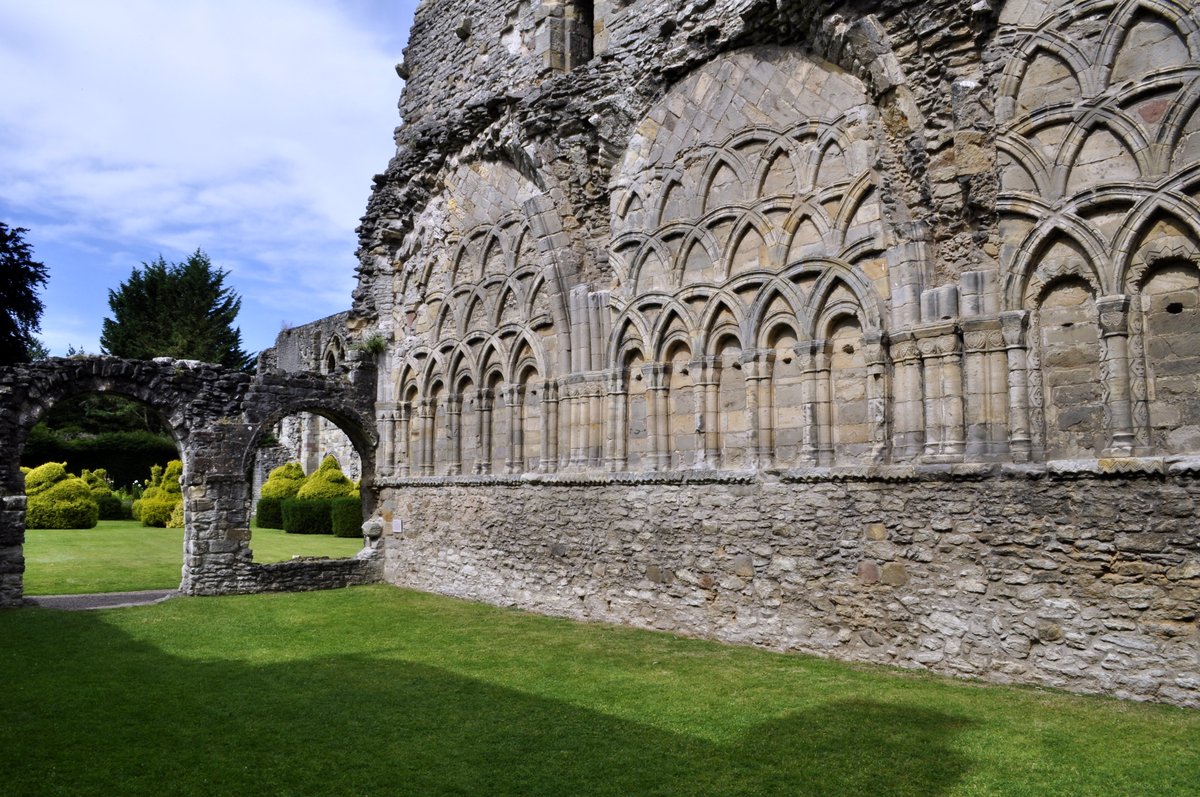
Remains of the church and monks’ residence at Wenlock Priory. The building on the left is now a private residence, and was not destroyed during the Dissolution of the Monasteries in the sixteenth centruy under Henry VIII.

_DSC0001

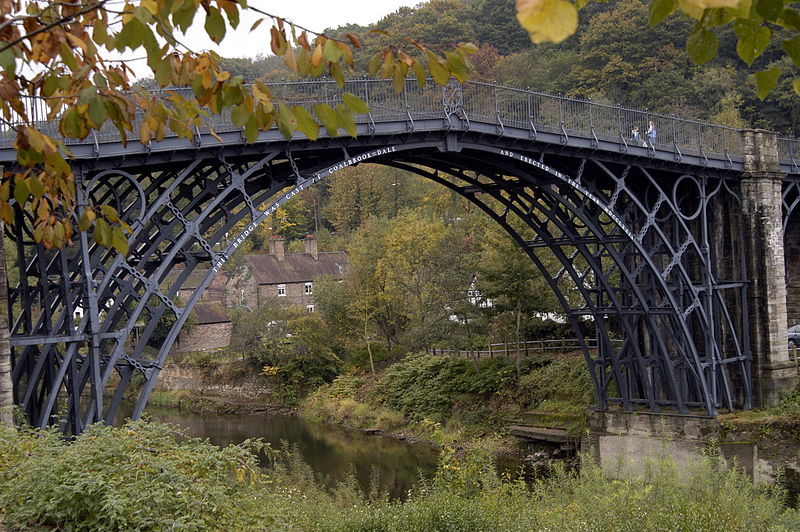
The iron bridge at Ironbridge, constructed in 1779, and now a UNESCO World Heritage Site.

Wenlock Priory—or its predecessor—was founded in the seventh century long before the Normans arrived on these shores in 1066 (and all that!). But thereafter it was refounded and expanded as a Cluniac (reformed Benedictine) priory.

_DSC0070

From the dimensions of the various building (or parts of) that are still standing, Wenlock Priory must have once been a very impressive complex of buildings. The length of the church and the girth of the bases of the columns that would have held up the roof give testament that Wenlock Priory was once an important ecclesiastical community. Having visited Fountains Abbey, Hailes Abbey_DSC0069, and viewed Rievaulx Abbey from above, I’m convinced that Wenlock was equally important. These were owned by the Cistercian order. Just a few miles down the road from Wenlock Priory lie the ruins of Cistercian Buildwas Abbey on the banks of the River Severn.

And I never to wonder as I wander around these ruins what they must have been like in their heyday. Busy of course, but also a haven of peace and tranquility I hope, notwithstanding the wealth that these ecclesiastical communities manifested and the power they exerted.

Wenlock Priory is privately owned, and part of the originally priory is still occupied as a residence. Obviously these buildings did not suffer at the time of the Dissolution of the Monasteries in 1540. Much of the stone from the priory was taken away and used in the construction of homes and farms in the surrounding countryside. Today, Wenlock Priory is managed by English Heritage.

The iron bridge at Ironbridge is, in my opinion, one of the most elegant ever constructed. And because of its association with the beginnings of the Industrial Revolution in Coalbrookdale, and Abraham Darby and his descendants, it’s even more special. I first visited Ironbridge in 1966 when, as a high school student, I attended a weekend course at nearby Attingham Park about the origins and reclamation of industrial landscapes.

What also makes the iron bridge special, and surely contributing to the World Heritage Site status of the Ironbridge Gorge, is its construction in the manner of a wooden bridge. The span of the bridge high over the River Severn is impressive indeed, and the various struts lock together and are fastened with nuts and bolts. All the iron for the bridge was cast in the nearby furnaces of Coalbrookdale where the art of smelting and production of steel was developed on an industrial scale.

_DSC0053

There’s a lot more to explore slightly further afield in Shropshire. Plenty to keep us busy and active members of English Heritage (and the National Trust) for many years to come.

Pigeons and peers – a des-res for doves and aristocrats

For my non-British readers, ‘des-res’ is an informal term for ‘desirable residence’.

And last Thursday we got to visit three in the Worcestershire countryside, only a handful of miles from our home in Bromsgrove.

The Hawford and Wichenford dovecotes
Built in the 16th and 17th centuries, respectively, Hawford and Wichenford dovecotes are today owned by the National Trust, and open for anyone to explore. Probably associated with a former abbey in the case of the Hawford dovecote, and the nearby Wichenford Court for the Wichenford dovecote, both are half-timbered structures, in a remarkable state of repair, notwithstanding their age. Although access to both dovecotes appears, on first glance, to be restricted, the doors are open and inside you can see all the nesting boxes, several hundred in each dovecote, where young pigeons or squabs and eggs would be collected for food.

The Hawford dovecote (map)

The Wichenford dovecote (map)

Next to the dovecote is a complex of semi-derelict farm buildings, dominated by a huge medieval barn that has obviously seen better days. We did wonder if some group was intending to ‘rescue’ this beautiful building and restore it to something like its former glory.

Witley Court (map)
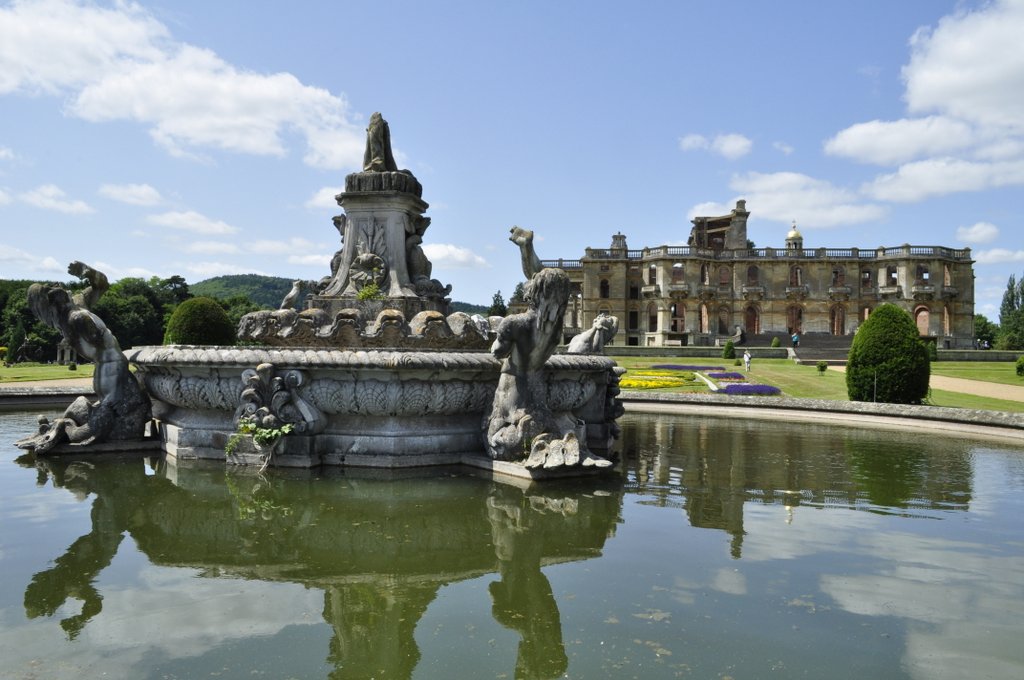
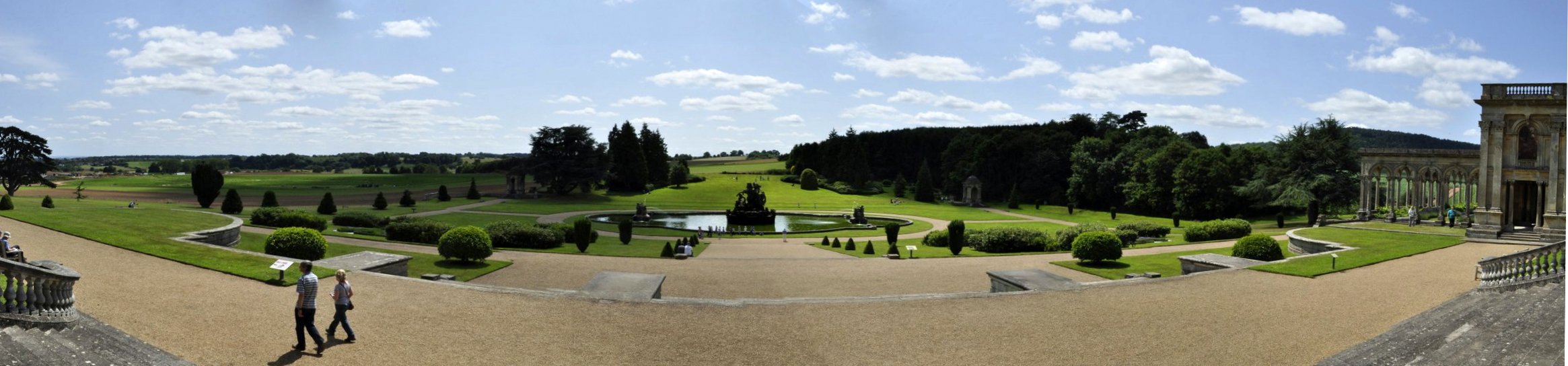
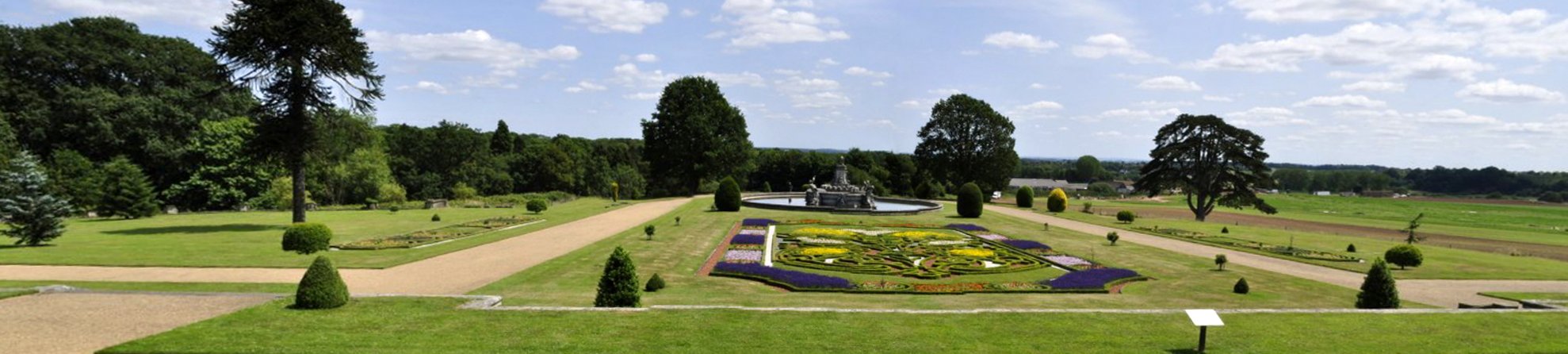
Then we headed off to Witley Court near the village of Great Witley, which we have visited many times over the past three decades. Even though it’s now just a shell of a building, having been gutted by fire in the 1930s, Witley Court still has an awsome presence in the countryside, and in its heyday it must have been a magnificent residence, truly a ‘des-res’. Now managed by English Heritage, much has been done to refurbish the grounds in recent years, the parterres have been replanted, and the impressive Perseus and Andromeda fountain is now in full working order. It fires up every hour on the hour.

fountain

The Perseus and Andromeda Fountain in the foreground, and the south face of Witley Court behind. On the left, behind the ruins of the orangery is the parish church of St Michael (with the gold domed roof), one of the finest examples of baroque architecture.

gardens-001

View from the south parterre and the Perseus and Andromeda Fountain. The orangery is on the right.

parterre-001

The refurbished East Parterre at Witley Court.

Here’s a short video I made in 2008.

English Heritage have placed on its website a floor plan of how the mansion developed over the centuries. A house was first built on the site in the mid-17th century, and was added to extensively during the 18th and 19th centuries.

Beside the ruined house is Great Witley parish church of St Michael, untouched, fortunately by the 1937 fire, and one of the country’s outstanding examples of baroque architecture, and a feast for the eyes inside. The organ is said to have been played by Handel.


Herefordshire’s Goodrich Castle . . . yet another castle slighted

Two days ago, after a couple of weeks of really cold, wet and windy weather, it was bright and warm enough to contemplate an outing. Thank goodness, as cabin fever had begun to set in. With our 2,000 mile road trip around Scotland less than a week away, I didn’t fancy a long journey so we looked for a National Trust or English Heritage property that was within easy distance. Having been members of the National Trust for over four years now, we’ve visited most of the nearby venues. As English Heritage members only since the beginning of the year we decided that one of their properties would be a more convenient choice.

We chose to visit Goodrich Castle, built in the 12th century on a red sandstone outcrop along the River Wye in southeast Herefordshire.


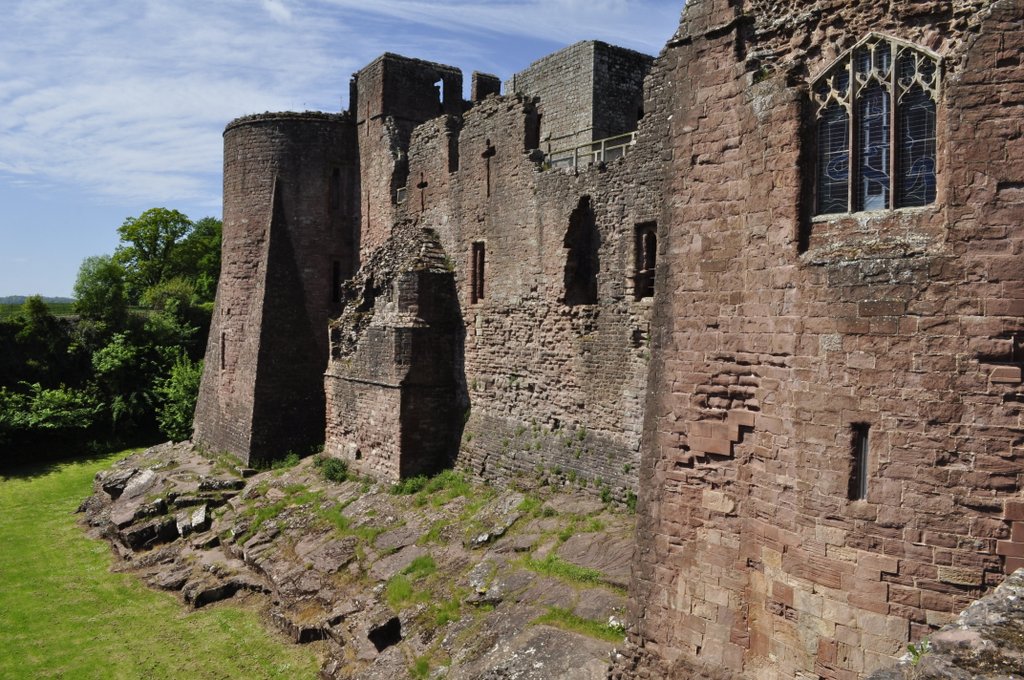
It’s about a 400 m walk from the car park to the castle, and emerging through the trees you get this wonderful panorama of the south walls of the castle—or rather, what’s left of them. For having survived from the 12th century, the walls and floors in the towers were deliberately demolished (or slighted) in 1646 after the Parliamentarians captured the castle from Royalist supporters (just as they did at Kenilworth Castle that we visited a month earlier) in the aftermath of the Civil Wars.

Goodrich panorama 1

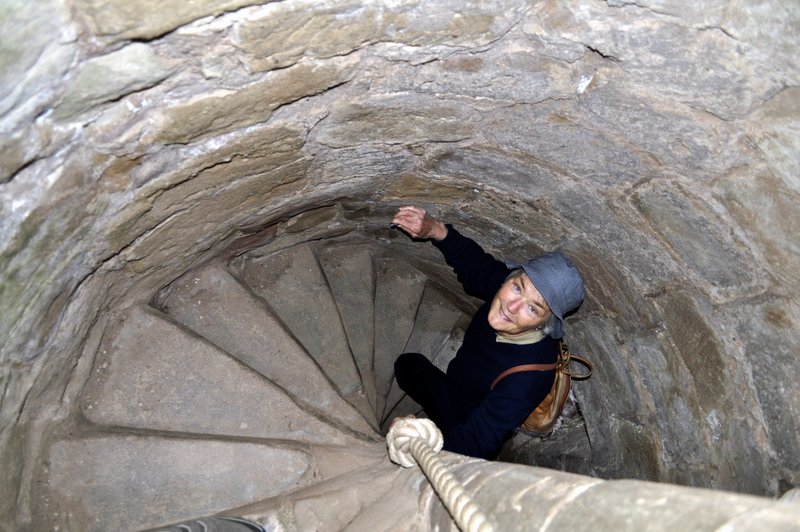
If you asked a child to draw a castle from memory, then I guess Goodrich Castle would fit the bill, minus the crenelations. These probably disappeared during the Parliamentarian vandalism. There are four towers around a ‘central’ keep (actually closer to the south wall). The towers no longer have any floors; but in the keep, stairs have been constructed up to first floor level from where it’s possible to climb to the roof of the keep, up an extremely narrow and tight spiral staircase.

20150521 066 Goodrich Castle

The climb to the roof of the keep – very narrow and steep. Not for the faint-hearted.

The castle is surrounded by a deep moat, although I don’t think it was ever filled with water, more of a deep ditch on the east, west and south sides. The outcrop on which the castle stands descends steeply on the north side to the River Wye that would have provided a natural defence. I did wonder whether the sandstone excavated to construct the moat was then used to build the castle’s walls. Above several courses of grey, and presumably harder sandstone, the upper courses of the walls were built from red sandstone.

What are particularly impressive are the straight-sided, triangular buttresses propping up the southeast and southwest round towers.

Below the gatehouse on the west side of the castle is a large hemispherical barbican, with a short causeway leading into the castle. This would have been protected originally by a drawbridge, wooden gates, and two separate portcullises.

Interestingly, the castle chapel can be found alongside the gatehouse, just to the south.

It seems that Goodrich Castle was more of a residence, luxuriously furnished, by its different owners over several centuries, rather than playing much part in the various conflicts that affected this part of England that is quite close to the border with Wales. That is until the 17th century English Civil Wars. Even after the Royalist besieged had surrendered, many parts of the castle were still inhabitable. That is why the Parliamentarians decided to demolish the walls and rooms deliberately.

English Heritage provides access to many parts of the castle, and you can walk along the upper part of the walls. In some buildings where there are no original stairwells, stairs have been installed.

It was our original intention of combining a visit to Goodrich Castle with a National Property such as Tredegar House in Newport (much further south), calling in at Goodrich on the way home. We thought that it would be just a quick visit to Goodrich, not a lot to see. How wrong we were! We must have spent well over two hours clambering over the various buildings, climbing up to the highest levels (at the top of the keep), and walking around the moat and remains (actually just the foundations) of the stable block—which was where the Parliamentarians first gained access to the castle in 1646.

‘England’s Sistine Chapel’ (Simon Jenkins)

20150521 142 St Marys Kempley

St Mary’s Church, Kempley. You’ve probably never heard of it, nor have the least idea where to find it. Neither had I—until yesterday, that is. Kempley is a small village just north of Junction 3 on the M50 in the Forest of Dean district of  Gloucestershire close to the county boundary with Herefordshire, a handful of miles north of Ross-on-Wye. St Mary’s is a further couple of miles to the north of the village, and was replaced by another parish church, dedicated to St Edward the Confessor.


Owned by English Heritage, 12th century St Mary’s Church (built around 1130) is an outstanding example—perhaps the most significant and most complete set in the whole of northern Europe—of Romanesque fresco paintings. We had stumbled across this little gem, while deciding if there were other sites near the main objective of our outing yesterday: Goodrich Castle (which is about 12 miles or so south of Kempley). St Mary’s is not the easiest building to find, but the effort is worthwhile. The north wall of the church is plain stone. But come around to the south side, and surprisingly the wall is rendered in the most fetching shade of pale pink.

But it’s inside that the biggest surprise awaits you. The church has the most exquisite medieval wall paintings you could ever imagine. It also proudly boasts one of the oldest roofs (even original doors) in the country, with its original timbers dating back to its construction.

It wasn’t until the late 19th century that these paintings were discovered beneath layers of whitewash—presumably applied for generations following the Reformation in Tudor times. The images on both north and south walls of the nave were worked in tempera on dry lime mortar, and depict the Wheel of Life and to its right either side of a window, depictions of St Anthony of Egypt (on the left side) and St Michael accompanied by the Virgin Mary (on the right).
But the real glory of St Mary’s is found in the chancel, where the wall paintings are true frescoes, painted on wet plaster. They lift your soul! On the ceiling is a magnificent portrayal of Christ. I cannot better Simon Jenkins’ description published in The Guardian in 2008: The sensation lies in the chancel, composed of the most complete set of Romanesque frescos in northern Europe. Christ sits in the middle of the ceiling on a rainbow, his feet on a globe. He is attended by sun, moon, stars, candelabra, a winged ox and seraphim with books and scrolls, the complete Book of Revelation. Below him sit rows of sepia apostles gazing up at Him from a Romanesque arcade. No inch is left untouched. Here is a bishop, there lay pilgrims heading for a heavenly Jerusalem. Everywhere is chequerboard and zigzag decoration. 

The church porch is apparently also original, and above the door is a depiction of the Tree of Life.

Let me finish with another quote from Simon Jenkins’ article. ‘England’s Sistine Chapel lies lost in the western reaches of Gloucestershire. It is smaller, to put it mildly, and older by 350 years. But what it lacks in grandeur it adds in serenity. I would exchange five minutes in the chancel of Kempley church for an hour in Rome. And I would have it to myself.’
Steph and I were fortunate to have this haven of serenity to ourselves for more than 30 minutes before we had to head home. I felt remarkably calm for several hours afterwards. Go and seek that serenity for yourselves. You won’t be disappointed.

A castle slighted – if only walls could talk

Neither modest in size, nor lacking in importance, Kenilworth Castle was indeed slighted – in about 1650. It’s an archaic use of the word. The walls were deliberately destroyed, and razed to the ground. So after five hundred years of continuous occupation, the castle became a ruin, with only the Gatehouse (now fully restored) made a home by Sir John Hawksworth after the end of the Civil Wars. The Gatehouse was still occupied into the middle of the 20th century. But by then, the castle had been a ruin for 400 years or more. Kenilworth Castle is a fascinating testament to power and wealth from the Normans (from the time of Henry I) to the Stuarts.

Built by a Norman baron in the middle of the 12th century, and occupied for the next five centuries – as fortress, royal palace, or aristocratic residence – Kenilworth Castle, in the heart of Warwickshire (Shakespeare country) is a jewel in the English Heritage crown.

Plan of the castle

On a beautiful Tuesday, a couple of days ago, we made the 30 mile trip due east arriving at the castle just before 11:00 and spending almost four hours exploring the site, and what remains of the ruined Priory of St Mary just a short distance from the castle and built about the same time.

I hadn’t appreciated before our visit just how large the castle site is, and for how long it had been occupied. As a budding historian, I’ve encountered references to Kenilworth Castle in many of the books I’ve read. It was, during the late 14th and throughout the 15th centuries a residence of John of Gaunt, Duke of Lancaster and a Lancastrian stronghold. During the reign of Elizabeth I in Tudor times a century later, Kenilworth Castle was gifted to Robert Dudley, Earl of Leicester, the queen’s favorite and erstwhile suitor. Many parts of the ruin and the (reconstructed) Elizabethan garden are the legacy of Robert Dudley. Elizabeth visited Kenilworth a number of times, and Dudley actually constructed the Leicester Building (#10 on the graphic above) in 1572 especially for one of Elizabeth’s visit while on royal progress. Likewise the garden.

20150421 011 Kenilworth CastleThe castle is entered through Mortimer’s Gate (#2) over a ‘dam’ that was originally constructed by King John in the 13th century. It blocked the flow of the Finham Brook on the south side of the castle’s curtain wall, and creating what was once one of the largest man-made lakes in England. It provided great defensive possibilities. The later buildings lie to the west and south of the Norman tower (#6). The 16th century half-timbered stable block (#3) is now a cafe and exhibition hall. The construction of the timber gables and eaves is impressive.

On the west side of the castle is the Great Hall constructed by John of Gaunt. Of course most of the floors have disappeared, but you can easily see where each floor was located, with its windows and fireplaces.

And then just to the east is Leicester’s Building, over four or five floors. Now it’s a hollow shell, but English Heritage have constructed a walkway inside right to the top. I’ve not got a very good head for heights, and my knees were just a little wobbly by the time we reached the top, and peered over the side.

Elsewhere, access has been made to reach some of the battlements and great views are afforded all over the site, especially the Elizabethan garden, with its aviary and singing canaries. The garden was researched before reconstruction and is believed to look much like it would have done during Elizabeth’s visit.

20150421 023 Kenilworth Castle

20150421 065 Kenilworth Castle

If walls could talk what secrets would they reveal? Did King John plot here against his barons, or the Lancastrians plan their anti-Yorkist strategy during the Wars of the Roses? Did Dudley eventually make it into Elizabeth’s bedchamber? We’ll never know.

As we arrived to Kenilworth Castle a large group of German school children was leaving. Their visit had lasted just 45 minutes, I was told. Very short! We were there for nearly four hours, and although I think we saw almost all there was to see, another visit would merit a perimeter walk along the exterior curtain wall. Again, we were lucky with the weather, and there were not too many visitors. Kenilworth Castle welcomes thousands of visitors during the school vacations. A late spring day was just right for us.

Just twenty miles but more than a thousand years . . .

Just twenty miles or so as the crow flies, maybe less, but separated by more than a thousand years. That pretty sums up two English Heritage properties that we visited yesterday.

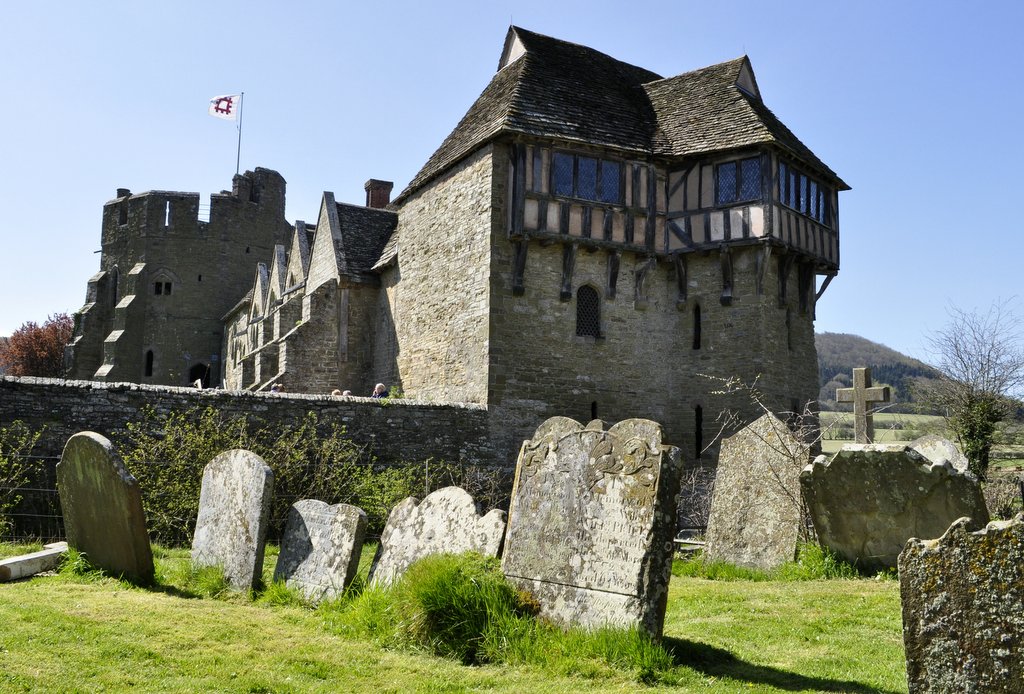
Nestling under the Shropshire Hills, Stokesay Castle is a fortified medieval manor house, a few miles north of Ludlow, built in the late 13th century, and added to over the centuries.

20150414 088 Stokesay Castle

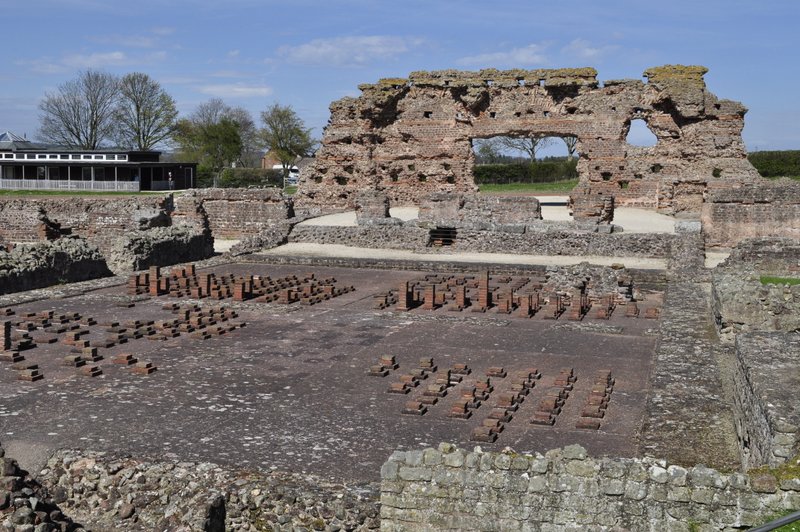
On the other hand, Wroxeter Roman city, a few miles southeast of Shrewsbury was established as a fortified outpost not long after the successful Claudian invasion of Britain by the Romans in AD40.

20150414 128 Wroxeter Roman city

As in all my blog posts, the links I included above will take you to web sites with a lot more information than I have space for here.

With the weather set fair – just as the forecasters had predicted – Steph and I set off just after 09:30 to our first stop, Stokesay Castle, arriving there just before 11:00.


Unlike many if not most of the properties owned by the National Trust, which are furnished, English Heritage manages many castles and other ruined buildings. However, Stokesay castle is remarkably intact. Once a moated property, the courtyard is entered through a 16th century half-timbered gatehouse, that has the most beautiful carvings on the wood surrounds. And, unlike many other Tudor buildings of this style, such as Little Moreton Hall in Cheshire, the Stokesay gatehouse has a yellowish daub instead of the ‘typical’ white.

Stokesay Castle comprises a large vaulted hall, with a number of lower and upper rooms at each end, and an adjoining three storey round tower. At the north end of the hall on the upper floor are half-timbered bay windows overlooking the parish church of St John the Baptist. This is as old as the manor, but was also rebuilt during the Civil Wars in the 17th century. Sadly, the main part of the church roof is covered in ‘modern’ tiles, rather than what were probably once stone tiles, just like the main hall of the castle.

No doubt if walls could talk, those at Stokesay would have a lot to relate. Located as it is on the English-Welsh border – the Marches – the castle no doubt saw its fair share of turmoil and violence. Some of the key conflicts of the Wars of the Roses occurred in this general area, and it’s unlikely that Stokesay would have been spared.

A number of features are worth describing, besides the gatehouse.

The roof of the hall is a wonderful timber construction, and the underside of the tiles is still exposed; you can still see how they were fastened to the eaves.

To the south of the hall, and one floor up, is the solar, a room with 17th century wood paneling. It has two small windows from which to monitor goings-on in the hall below.

Then there is the tower. Initially we couldn’t find any way to climb to the roof. And although we had reached the second floor, we didn’t notice a small doorway, in the wall to the side of a window, leading to another stone stairway.

The rooms in the tower are inhabited by several species of bat, some rare, and infected apparently with bat rabies. Caution!

The moat is now a walk right round the castle, and on the east side planted with flower beds, as are parts of the courtyard.

After almost two hours, and a visit to the church as well, we’d seen everything there was to see, and headed northeast, and two millennia back in time, to Roman Britain.

Now I have been to Rome many, many times, a city almost littered with ruins. In the Baths of Caracalla, for example (close the headquarters of the UN’s Food and Agriculture Organization where I attended many meetings), all the beauty of Roman brickwork is exposed for all to see. At Wroxeter Roman city – or, more correctly, Viroconium Cornoviorum – there are the remains of typical Roman buildings, displaying the same construction techniques as in the Baths of Caracalla, with alternate layers of red tiles and brickwork, hard as concrete. Click on the artist’s interpretation below for a large image of the city in its heyday.

20150414 134 Wroxeter Roman city

Viroconium was reportedly the fourth largest settlement in Roman Britain, and as large as Pompeii. Established as a Roman garrison in about AD55, the soldiers had moved on within a few decades, but the city continued to grow. It remained an important town until the Romans left Britain in the fifth century, and went into slow decline for another couple of centuries until sacked by the Anglo-Saxons.

Not much remains today, just a site about 150m square or so. Over the centuries stone was taken from the site and used for building materials in the local village of Wroxeter, and farms in the surrounding district. Located as it was close to the River Severn, and commanding a site on the border with Wales, Viroconium was an important base for the Roman campaign against the Welsh tribes.

20150414 095 Wroxeter Roman city

Close to Wroxeter lies Coalbrookdale – site of the birth of the Industrial Revolution and iron smelting. This part of Shropshire is rich in coal and iron ore.

The exposed ruins today cover the central city block or insula near the forum, markets and bath house.

If what remains exposed today is just one city block, then the city itself would have been an impressive piece of Rome in its distant province of Britannia – the very edge of the empire.

Three, five or seven? On the Tresham Trail.

Spring had really sprung a couple of days ago. With hardly a cloud in the sky, and a warm day promising, Steph and I headed east some 80 odd miles from our home in north Worcestershire, to visit two properties in Northamptonshire constructed in the late 16th century by Catholic Sir Thomas Tresham, a celebrated recusant who was imprisoned on several occasions for his faith.

First stop, in Rushton, was one of the most peculiar buildings I’ve ever visited but I’d wanted to see for quite some time – I’d seen it on TV in the past year.

eh-logoThe Triangular Lodge – a folly – was completed by 1597, is owned and managed today by English Heritage. This was our first visit to an English Heritage property since we became members at the beginning of the year.

20150409 002 Rushton Triangular Lodge

Full of religious symbolism, the Lodge is a perfect triangular building, and there are threes everywhere you look. The sides of the building are exactly 33 feet long, the windows are triangular. There are three floors from basement to upper floor. Each floor has a hexagonal room, with a small room in two of the corners and the stairwell in the third. The roof is a triangular maze.

Constructed of alternate bands of light and dark limestone, the Triangular Lodge is odd – and yet ethereally beautiful – in so many ways. A testament to Tresham’s devotion to the Holy Trinity, it continues to stand in a corner of rural Northamptonshire.


Just 12 miles from Rushton is another Tresham treasure – Lyveden New Bield. At first glance, it appears a desolate ruin, and one imagines what calamity has befallen this impressive building. But it’s not a ruin. Tresham died before it was completed, and there has never been a roof. It is now owned and managed by the National Trust.

20150409 092 Lyveden


Designed as a garden lodge or secret retreat to which he could retire, or even worship as a Catholic in privacy, Lyveden New Bield has all the religious symbolism – and more – that we encountered at the Rushton Triangular Lodge. It is shaped like a perfectly symmetrical Greek cross, each of the four wings of the building mirroring the others. Each of the bow windows has five sections, each five feet wide.

There are no floors but they must have been in place at some time or another since there are wood remnants in the walls where joists would have spanned the building. You enter the building through a very low servants’ entrance (on the south side), into what would have been the basement; there’s a large fireplace and behind, a series of ovens in what must have been the kitchen.

The main entrance, on the north side, is almost six feet or so above ground level. The arches above the entrance and to other internal doors are fully finished and sculpted.

CCI11042015_00001The lodge stands on an open lawn, surrounded by a ditch on all sides, not far from the moat that once surrounded (but on three sides only) a 14th century manor house, now totally demolished and erased from the landscape. But nearby, there are the outlines of what would have been a parterre, and more intriguingly, a Tudor labyrinth. Its existence only came to light in recent years after someone discovered a wartime aerial photograph from the Luftwaffe – presumably on their way to raid Coventry or Birmingham. An old orchard has been replanted with varieties of apple, pear, plum, damson, quince and medlar among others from the National Fruit Collection at Brogdale in Kent. Nearby is the old hall, Lyveden Old Bield, which was Tresham’s home after he moved from the original family home of Rushton Hall.

As a young boy, Tresham went to live with the Throckmorton family of Coughton Court near Alcester in Warwickshire (and only 12 miles from our home) and eventually married one of the daughters. One of their sons was implicated in the 1605 Gunpowder Plot, as were the Throckmorton family.