Two Bs, two Ps, seven Us, and nine Ds

Education is a wonderful thing, and my family and I have taken advantage of the opportunities a good education opens up.

As I read an email a few days ago from the University of Birmingham, announcing its 125th anniversary celebrations later this year, my mind wandered back to 1975.
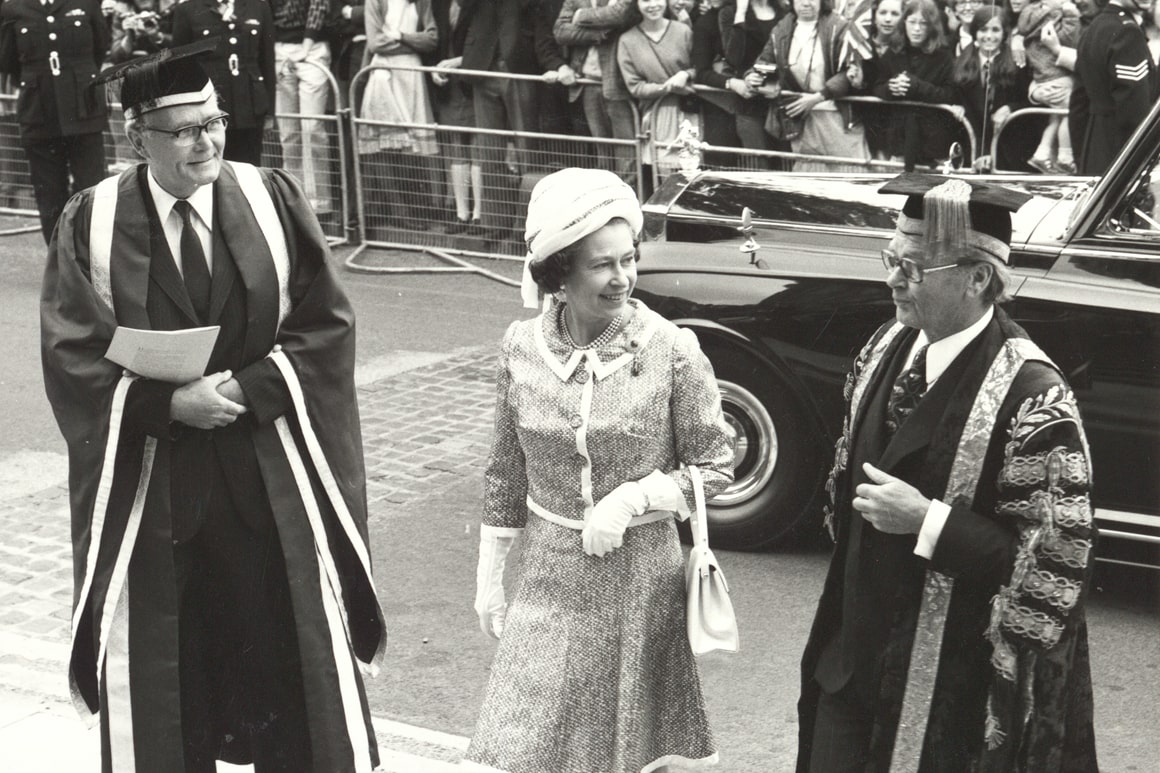
That was when the university celebrated the centennial of laying of the foundation stone of the Mason Science College in 1875, itself a successor of Queen’s College, founded in 1825 as a medical college. HM The Queen visited the university in 1975 to celebrate that centennial, seen in this photo with the university Chancellor, Sir Peter Scott (on the right) and the Vice-Chancellor, Dr Robert Hunter (later Baron Hunter of Newington, on the left). I was in the crowd there, somewhere.
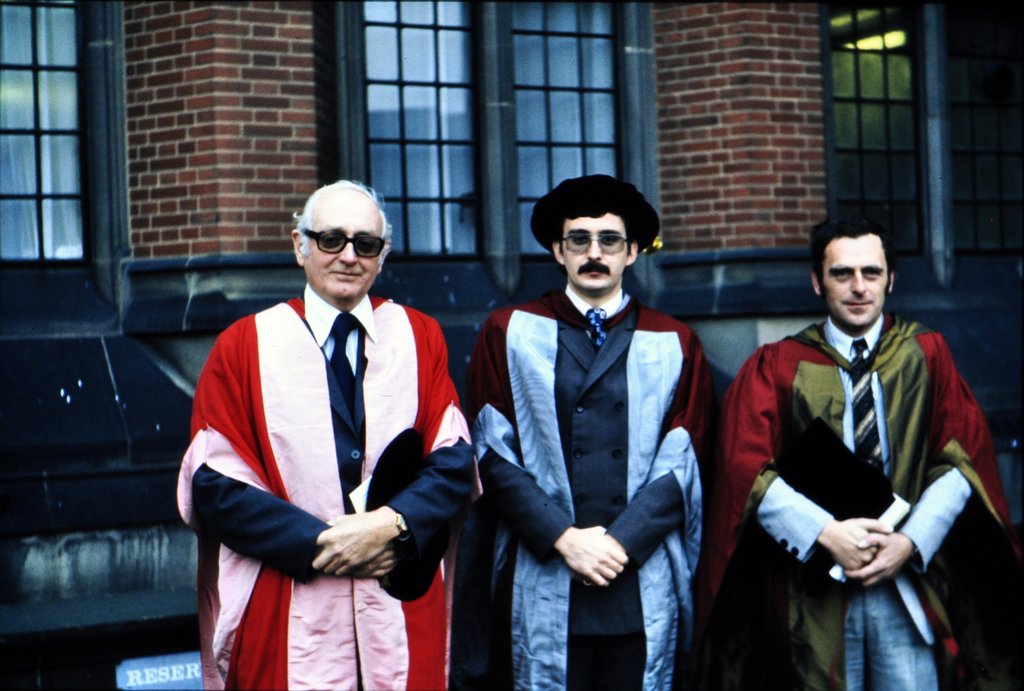
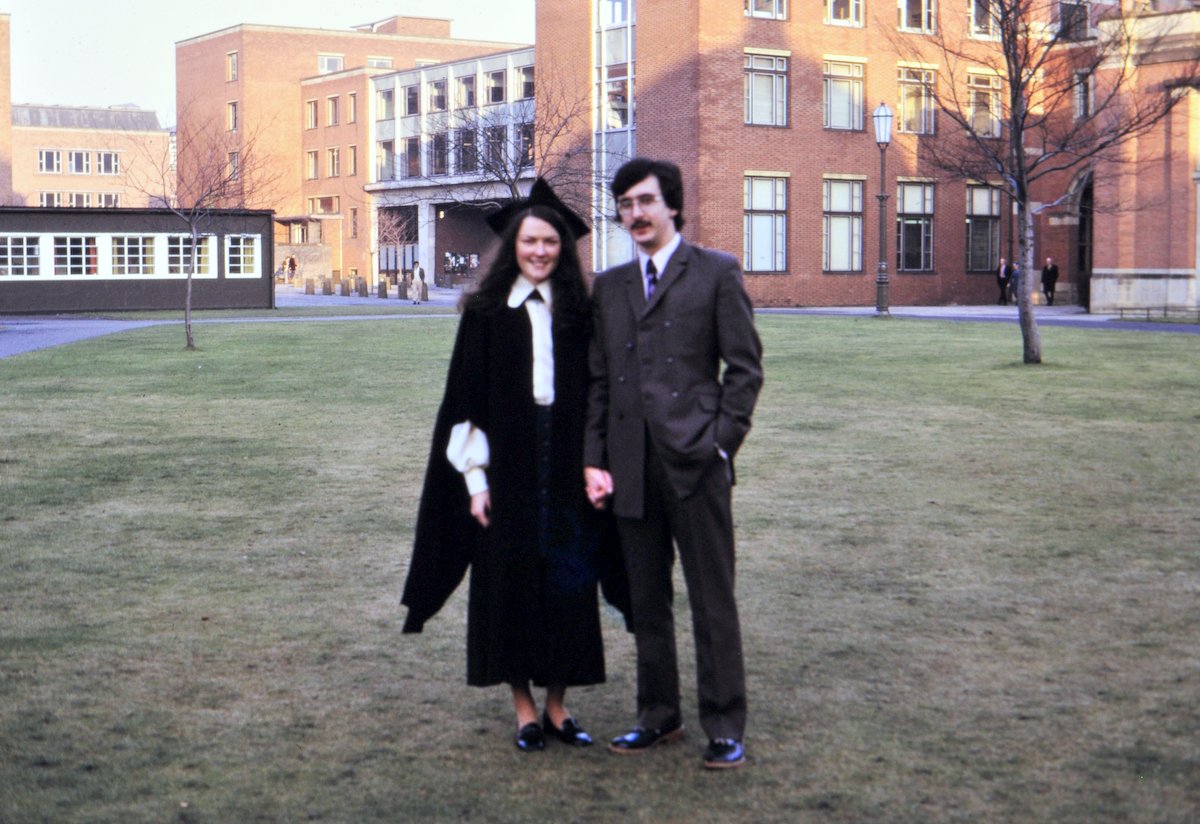
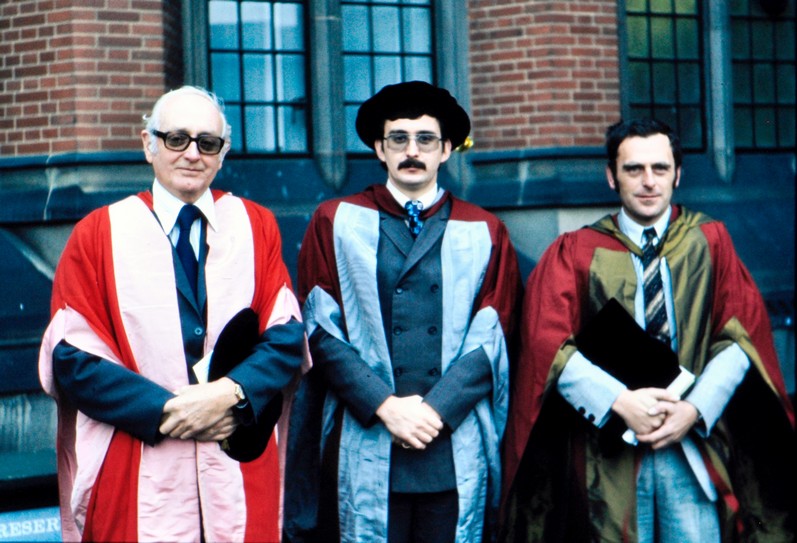
I was back at Birmingham for a few months (from the International Potato Center or CIP in Lima, Peru where I was working as an Associate Taxonomist) to complete the residency requirements for my PhD, and to submit my dissertation. I successfully defended that in late October, and the degree was conferred by Sir Peter Scott at a congregation on 12 December. In the photo below, my PhD supervisor and Mason Professor of Botany, Jack Hawkes is on my right, and Dr Trevor Williams on my left.
But I’m getting a little ahead of myself.

My first experience of Birmingham was in the late Spring of 1967, when I sat the Joint Matriculation Board Advanced or ‘A’ Level biology practical exam in the First Year Lab in the School of Biological Sciences. Many high schools took advantage of that arrangement if they had insufficient facilities in their own premises to hold the exam.

Going into my ‘A’ level exams I had ambitions to attend university. Not that I’d applied to Birmingham. That honour went to the University of Southampton where I had been accepted to study for a BSc degree in environmental botany and geography.

As ‘baby boomers’ my elder brother Edgar and I were the first in our family and among all our cousins to attend university. Once Edgar had persuaded our parents that he wanted to go to university (1964-1967) it was easier for me to follow that same path three years later.

I enjoyed my three years at Southampton. Although I’d registered for a combined degree in environmental botany and geography, my interests shifted significantly towards botany by my third and final year.

However, graduating in July 1970 and with just a BSc under my belt, I knew I’d have to pursue graduate studies to achieve my ambition of working overseas. And it was at the beginning of my final year at Southampton that a one year taught MSc course on the Conservation and Utilisation of Plant Genetic Resources was launched at Birmingham, under the leadership of Jack Hawkes. One of the lecturers at Southampton, geneticist Dr Joe Smartt, suggested that I should apply.

Which I duly did, and after an interview at Birmingham was offered a place for the following September, subject to funding being available for a maintenance grant and tuition fees. It was not until the course was about to commence that Professor Hawkes could confirm the financial support. By mid-September I headed to Birmingham, and the beginning of an association with the university that lasted several decades, as both student and member of staff.

I was awarded the MSc degree in December 1971. During that year, Hawkes (a world-renowned potato expert) had arranged for me to join CIP in Lima for just a year (which later extended to more than eight years) to help conserve its important collection of native potato varieties. An opportunity I jumped at. However, funding from the British government was not confirmed until late 1972. Instead of kicking my heels waiting for that funding to be confirmed, and concerned I might find a position elsewhere, Hawkes raised a small grant to allow me to begin a PhD project under his supervision, and that I would continue after arriving  in Peru.
A third cohort of students arrived in Birmingham in September 1971, among them Stephanie Tribble from Southend-on-Sea who had just graduated from the University College of Swansea (now Swansea University) with a degree in botany. By the summer of 1972 Steph and I had become an item.

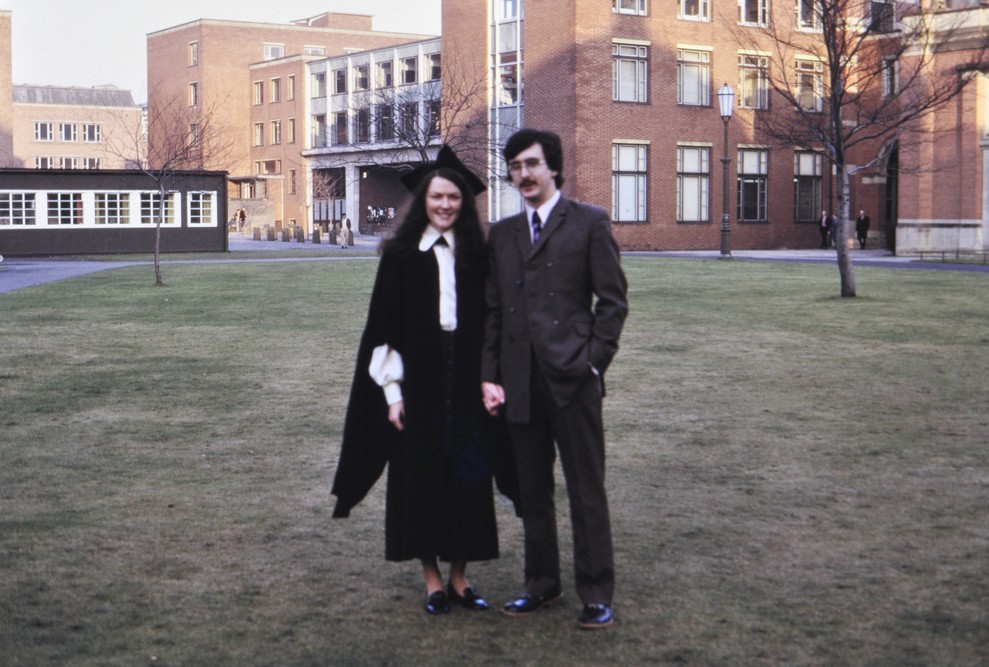
In November 1972 she joined the Scottish Plant Breeding Station (SPBS) at Pentlandfield, south of Edinburgh, as assistant curator of the Commonwealth Potato Collection. She returned to Birmingham in December for the MSc degree congregation, just three weeks before I was due to fly out to Peru at the beginning of January 1973.
Well, things have a habit of turning out for the best. Once I was in Peru, I asked Steph to marry me and join me in Lima where I knew there would be a position for her at CIP. Resigning from the SPBS, she arrived in early July and we were married in the local registry office in Lima in October.

So that’s two botanists, three universities (Southampton, Swansea, and Birmingham), and five degrees (2xBSc, 2xMSc, 1xPhD) between us.


After another fruitful five years with CIP based in Costa Rica after I’d completed my PhD (during which our elder daughter Hannah was born), a lectureship opened in the Department of Plant Biology at Birmingham, so I applied. I flew back from Peru for an interview, and having been offered the position, I joined the university on 1 April 1981.

Much of my teaching focused on the genetic resources MSc course that was accepting ever more numbers of students from around the world. I remained at Birmingham for a decade, before deciding that I wasn’t really cut out for academia and, in any case, a more exciting opportunity had presented itself at the International Rice Research Institute (IRRI) in the Philippines. I joined IRRI as head of the Genetic Resources Center in July 1991, remaining in that position for almost a decade. In May 2001, I was appointed Director for Program Planning and Communications (DPPC), joining the institute’s senior management team, until my retirement in April 2010.

During the 1990s, I had an excellent research collaboration with my former colleagues in the School of Biological Sciences at Birmingham, and each year when I returned to the UK on home leave, I’d spend time in the university discussing our research as well as delivering several lectures to the MSc students, for which the university appointed me an Honorary Senior Lecturer.


As I mentioned before, Hannah was born in 1978 when we were living in Costa Rica. Once back in the UK her younger sister Philippa was born in 1982 in the small market town of Bromsgrove, about 13 miles south of the University of Birmingham in north Worcestershire.

Both girls thrived in Bromsgrove, enjoyed school, and each had a good circle of friends.

We upended their world when I took the position at IRRI and they moved to the Philippines with Steph just after Christmas 1991. Even more challenging was their enrolment in the International School Manila, which had a US-based curriculum, and eventually an academic stream based on the International Baccalaureate (IB). There’s no doubt that the first year was tough. Not only was it challenging academically, but living 70 km south of Manila, IRRI students were bussed into school each day departing around 04:30 to begin classes at 07:30, and returning by 16:30, or later if there were holdups on the highway, as was often the case.

Despite the bumpy start, Hannah and Phil rose to the challenge and achieved outstanding scores on the IB in 1995 and 1999 respectively.

From the outset, attending university had been part of our plan for them, and an ambition they readily embraced. Both took a gap year between high school and university. Hannah was drawn towards Psychology, with a minor in Anthropology. And she discovered that this combination was offered at few universities in the UK, opting to attend Swansea University in 1996. And although she was on course to excel academically, half way through her second year she asked if she could transfer to Macalester College, a liberal arts college in Minnesota, USA.

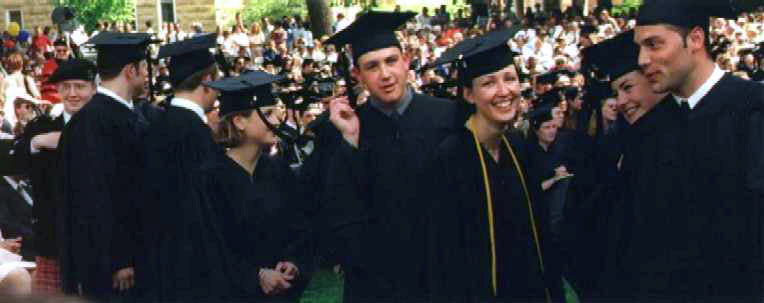
Macalester graduation in May 2000, with Hannah and Michael facing the camera.

Graduating Summa cum laude in May 2000 from Macalester, with a BA in Psychology and a minor in Anthropology, Hannah was then accepted into a graduate program in the Department of Psychology at the University of Minnesota in the Twin Cities.

She was awarded her PhD in Industrial and Organizational Psychology in 2006 with a thesis that assessed the behaviour and ethical misconduct of senior leaders in the workplace.
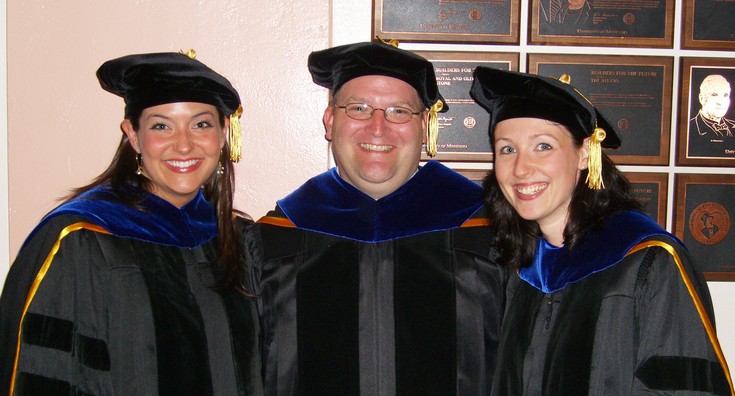
Hannah (right) with her peers in Industrial & organizational Psychology

That’s one psychologist, another two universities (Macalester and Minnesota), and two more degrees (BA, PhD).

Remaining in Minnesota, she married Michael (also a Macalester graduate) in 2006, became a US citizen, and has a senior position focused on talent management and performance with one of the largest international conglomerates. They have two children: Callum (14) and Zoë (12).


After a gap year, Philippa began her studies in Psychology at Durham University in 2000, graduating with a 2:i BSc degree three years later. Uncertain what path then to follow, she moved to Vancouver for a year, before having to return to the UK at short notice after the Canadian government refused to renew her work visa.
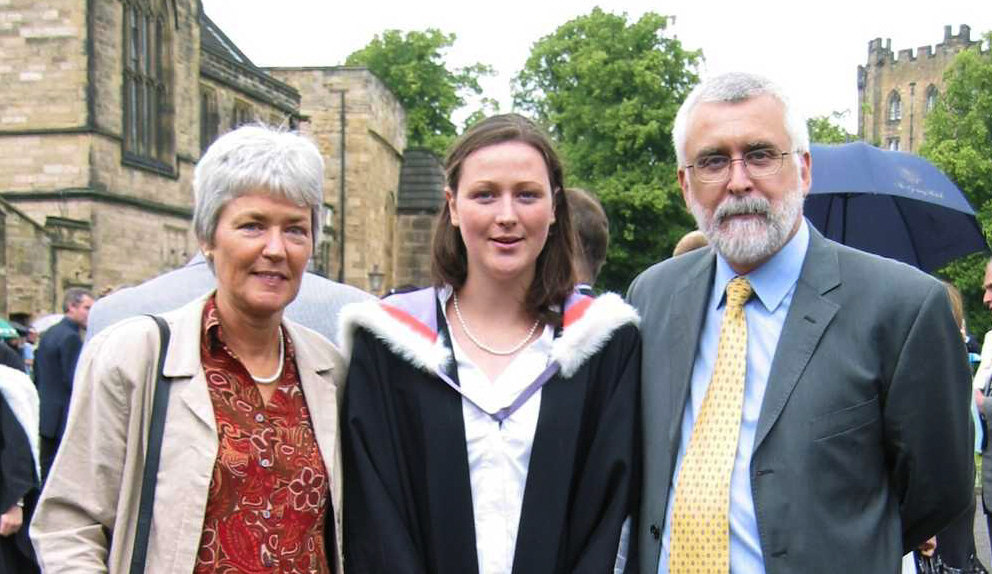
Post-graduation, outside Durham Cathedral.

She spent six months looking for a job, finally landing a research assistantship in the Brain, Performance and Nutrition Research Centre in the Department of Psychology at Northumbria University in Newcastle upon Tyne. After a couple of years she began her own PhD studies investigating the effects of bioactive lipids such as omega-3 fatty acids on cognition and brain health. She was awarded her PhD in December 2010.
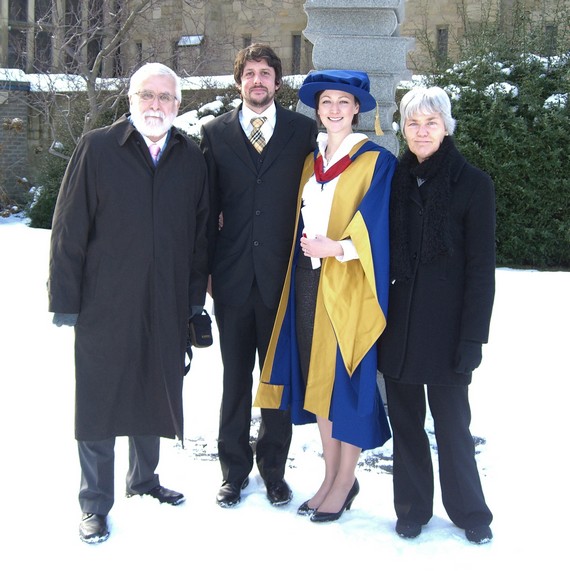
Post-graduation with Steph and me, and Andi.

She’s the second psychologist in the family, with two more universities and two degrees (BSc, PhD) under her belt.

Philippa is now Director of the Brain, Performance and Nutrition Research Centre, and Associate Professor in Biological Psychology at Northumbria.

She married Andi in September 2010 (taking themselves off to New York to get married), and have two sons: Elvis (13) and Felix (11).


Two botanists and two psychologists. Who’d have thought it? Neither Hannah nor Philippa showed any interest in pursuing biology at degree level. Having two psychologists in the family we do wonder, from time-to-time, if we went wrong somewhere along the line.

It doesn’t add up

Several weeks ago (or was it months?) UK Prime Minister Rishi Sunak (right) announced that his government would soon propose plans to reform secondary education for all pupils to study mathematics and English up to the age of 18, like many other countries.

After GCSEs (known as ‘O Levels’ back in the day when I was at school in the 1960s), taken at 15/16, many pupils receive no further tuition in maths (or English for that matter), and specialise in their final two years of high school, taking just three subjects, known as ‘A Levels’ (Advanced Level) as university entrance exams.

During his speech to the Tory Party conference on 4 October Sunak pledged to introduce this ‘revolutionary’ change. That’s assuming, of course, that the Tories remain in power after the next General Election. Which seems highly unlikely if the latest polls are to be believed. (Should Labour win the next election, I have no idea what its policy on continuing maths and English education will be, although as far back as 2014 they made it one of their policy pledges¹).

By teatime on the 4th, the Prime Minister’s Office had posted a press release on the government’s website.

Justifying this proposal, Sunak indicated that this new qualification for 16-19 year olds will put technical and academic education on an equal footing and ensure that all young people leave school knowing the basics in maths and English.

The new Advanced British Standard will bring together the best of A Levels and T Levels into a single new qualification. Students will take a larger number of subjects at both ‘major’ and ‘minor’ level, with most studying a minimum of five subjects at different levels – for example, three majors alongside two minors. Importantly, students will have the freedom to take a mix of technical and academic subjects, giving them more flexibility over their future career options.

However, it would take at least a decade to introduce such a change apparently. Very quickly, unions and teachers dismissed this proposed reform. Not, I hope, because they were opposed to reform in principle, but because schools do not have the staff or resources to teach English and maths to age 18. Yes, that is a real issue, and it will take political courage from the next government to tackle this issue head on, and support education at the level required. And to increase standards and achievements for GCSE students.


Notwithstanding there little or nothing about this Tory government I can support – and they certainly won’t have my vote in 2024 or whenever the election is called – I am actually in favor of this proposed educational reform. Let me explain.

When I was in high school (1960-1967), maths was one of my least favorite subjects. I dreaded maths lessons. But I did manage a pass in ‘O’ Level maths in 1964, but never took a maths course per se ever since. Much to my regret. And there are thousands of schoolchildren in exactly the same boat as me. Cowed by maths, and thus uninterested in the beauty of the discipline.

I often wish I had been able, had the ability, and perhaps more importantly had the support of good maths teachers to instill a continuing interest. I had really poor teachers at my high school, only interested in those who could and tolerating (just) those who struggled.

Having said all this, I have spent much of my career in agricultural science working with numbers, and thoroughly enjoying it. Indeed, in 2017 I wrote this blog post, There’s beauty in numbers, about my enjoyment of playing with data, looking for patterns and trends, and coming to conclusions about the behavior of the plants and crops I was studying. But although I became reasonably proficient (under guidance and advice from those better experienced than me) in the use of statistics, I do wish I had a better theoretical background underlying some of the statistical concepts I applied.

But beyond the basics of algebra, geometry, or trigonometry that high school pupils receive leading up to GCSEs, most do not need higher levels of mathematical education, like calculus for example. What they do need, in my opinion, are good numeracy skills, and how maths operates in the real world.

And as far as English is concerned, my emphasis for many students would be having the ability to write coherent prose and learning how to communicate effectively, both in written form and verbally. No need for deep analysis of set texts by Shakespeare or others.

So how would they achieve this? Sunak’s proposed Advanced British Standard qualification is his solution.

Often referred to (in previous government statements) as an English or British Baccalaureate, the Advanced British Standard seems remarkably similar to an existing and widely accepted qualification: the International Baccalaureate Diploma, offered in over 3600 state and private schools worldwide (but in just 22 state schools in the UK, although offered in 71 private ones).

If a widely-accepted qualification is up and running, and has been for decades, since 1968 in fact, why bother to reinvent the wheel with the Advanced British Standard? Is this another case of British exceptionalism?

This is what one headmistress, Victoria Hearn (right), Principal of state-assisted Impington Village College and Impington International College near Cambridge had to say about the proposal in a letter to The Guardian on 27 September last:

While Rishi Sunak’s plans to reform post-16 education are welcome news, I can’t help but feel that valuable resources could be saved by utilising a tried and tested education framework that students are already benefiting from. The international baccalaureate (IB) diploma enables students to study six subjects including mathematics, English and a foreign language until the age of 18, providing a broader and more rewarding syllabus compared with that of the UK’s national curriculum.

The development of a “British baccalaureate” will be costly, and funding this new vision will be a concern to many, particularly for state-funded schools that are already overstretched. In the UK, the IB is often seen as only accessible to independent schools, but with some creative budgeting and timetable management, a comprehensive IB programme can be delivered by state schools. We have been offering the IB at the state-maintained Impington Village college for more than 30 years as we believe it places our students in the best position to succeed in the global workplace.

Adapting the current curriculum framework is going to be lengthy and costly. The IB represents a proven alternative that can give students the broad range of skills required to thrive in the future.

Also, these are the IB values:

  • valuing inquiry and reflection, encouraging students to be open minded in their learning;
  • being principled and encouraging a caring attitude;
  • promoting high quality communication and discussions within the school community; and
  • encouraging international-mindedness and building respectful relationships.

I couldn’t agree more. And here are some reasons why.

First, from my own experience, I believe keeping your options broad is a positive perspective. In fact,

  • I studied both humanities and sciences at ‘A Level’: English Literature, Geography, and Biology (and General Studies).
  • I read for a combined BSc degree at the University of Southampton (1967-1970) in Environmental Botany and Geography.
  • For my MSc degree at the University of Birmingham in the conservation and use of plant genetic resources (1970-1971) many different topics were included.
  • It wasn’t until I began my PhD on potatoes (awarded 1975) that I settled into a narrow discipline.

Second, I don’t agree with either the retired teacher who thinks that additional ‘useless’ subjects in a baccalaureate would not be appropriate for many pupils, or the Emeritus Professor of Mathematical Education, who felt that students applying for maths at university would not have appropriate preparation. Both expressed their views in letters to The Guardian. The professor seemingly doesn’t appreciate that IB subjects are taught at both a higher and lower level. And, in any case, from my experience as a university lecturer (1981-1991, in plant biology in the School of Biological Sciences at the University of Birmingham) many first year university courses are designed to bring everyone up to the same level.

Furthermore, and again from my university days as a tutor, many students would certainly benefit from having a received a broader pre-university education, that would have given them a broader perspective on life, with access to the humanities as well as sciences, and would have enhanced, I believe, their ability to think and discuss more critically, and present their ideas verbally as well as written.

And lastly, both my daughters took the IB Diploma, and emerged with highly creditable grades at age 17, with subsequent access to good universities in the USA and UK, and endowing them with the academic capabilities and discipline to graduate with excellent degrees, and subsequently taking a PhD each in psychology.

But, I should add, their IB Diplomas were not earned at a British state school. In July 1991, I took a senior position with the International Rice Research Institute (IRRI) in the Philippines. My wife Steph and daughters followed me out to the Philippines by the end of the year, when Hannah and Philippa were 13 and nine (and had just moved up to high school and middle school respectively just three months previously in our home town, Bromsgrove, in Worcestershire).

Steph and I discussed the various education options. We were not keen in sending them to boarding school in the UK. There was a British School in Manila, but that did not, in the 1990s, offer an ‘A Level’ curriculum. So, after GCSEs, we would have had to send them back to the UK. Again not something we considered.

So both were enrolled in the fee-paying International School Manila (ISM), with the expectation from the outset that the IB Diploma would be their pre-university goal. Fees were subsidised by my employer as many IRRI children were also enrolled there, and traveled the 70 km daily each way north from Los Baños, where IRRI’s research center is located, into the city.
Yes, the courses were tough. Since besides the six academic subjects (three at higher, three at lower), IB students took a Theory of Knowledge course. Both our daughters studied English, history, and biology at higher level, and maths studies, French, and psychology at lower level.

Each had to complete a 4000 word essay based on independent research. Hannah’s history project was an analysis of the impact of the railways on the canals in mid-19th century England. Philippa made an analysis of A Shropshire Lad, an epic poem by Bromsgrove classical scholar poet, AE Housman (whose statue, right, proudly stands in the High St there) and interpreting his repressed sexuality through the poem’s themes.

For her community project, Hannah helped each weekend at a Montessori school in Los Baños, while Philippa joined a group for two weeks helping to construct a road in the mountains north of Manila.

There was one last challenge: the daily journey into Manila. Classes began at 07:15, and by the time my younger daughter graduated in 1999, the IRRI bus for ISM was departing from Los Baños at 04:30, and not returning until 16:30 or later. Then there were homework assignments to complete until late evening. All the family was relieved come graduation!

I’ve asked them about the IB experience. Both were unequivocal. The Diploma gave them enhanced skills for critical thinking, time organization, as well as covering the various subjects in depth. They both said the Diploma was a worthwhile qualification. It certainly hasn’t held them back.

So as the discussion continues over post-16 education and whether to replace ‘A Levels’ with a broader curriculum qualification, it’s certainly worthwhile looking at the IB mix, and what level of maths and English education and skills most students really need to prepare them for the workplace, and life in general.


¹ 11 October update. Labour just announced at its 2023 Conference that there will be a focus on teaching ‘real world maths’ to younger children. See this article in The Guardian.

Reaching for the stars . . .

I’m not a fan of talent shows like Britain’s Got Talent (BGT, or its US equivalent) or The X Factor, and never tune in to watch. But a few clips have caught my attention on YouTube (and once you’ve clicked on one such video, YouTube offers up others incessantly), and I will admit that some quite exceptional talents have been discovered in this way. Whether the really young ones go on to fulfilling careers in entertainment is another thing.

And, of course, many apply to appear on the show(s) just for the fun of it.

One particular BGT clip caught my attention the other day because, from the brief description, it appeared to be a 2019 audition by primary school children who got the Golden Buzzer. I was intrigued so decided to watch.

The children were from Flakefleet Primary School in Fleetwood, Lancashire, accompanied by their headmaster, Mr Dave McPartlin (no relation to one of the show’s hosts, Ant McPartlin).

Mr McPartlin told the judges that several of his pupils had an ambition to appear on the show. The children just liked to sing, and their abilities ranged from ‘good’ to the ‘enthusiastic’. Before long it seemed as though the whole school was on stage, and the headmaster was just as much part of the performance as his pupils.

It’s clear that his pupils adore Mr McPartlin, and he comes across as just the sort of head teacher any parent would wish for their children and any child to relate to. But enough from me, for now. Just take a few minutes to watch Flakefleet Primary’s performance, and listen carefully to how the headmaster encourages the children. Impressive.

They actually moved into the 2019 final, but didn’t win. Never mind, they’d already achieved more than they ever expected when they auditioned. After all, the school’s motto is Dare To Dream. What’s also impressive is the effort it must have taken from everyone: teachers, parents, children to prepare for each show. The rehearsals, the costumes, the encouragement for the shy ones.

The school was recently rated Good with some Outstanding features in its Ofsted report. And as the school highlighted on its homepage, ‘We are particularly thrilled that they recognized the outstanding job that we do at looking after, caring for and supporting our lovely children‘.

And this is what we can hope for – and indeed expect – from all schools and teachers. Sadly it’s not always the case. Some school fail. Whether this is lack of leadership, poor teacher recruitment, lack of local and government investment (especially in socially deprived areas, inner city areas), or lack of communication between schools and families I’m not expert to comment on.


When we moved to Bromsgrove in north Worcestershire in July 1981 after a period abroad, we were fortunate to find a house within the catchment areas of two excellent schools. Worcestershire has a three level First, Middle  and High School system.

Back in the day, Finstall First School (FFS) was less than a mile from home. It’s since moved to a new site just around the corner from our former home. Both our daughters Hannah and Philippa attended FFS whose head teacher was Mr Tecwyn Richards.

Mr Richards was a charismatic individual. He seemed to know the names of each and every child. Amazing. He came across as a gentle man, setting excellent standards among his staff and the pupils in his care.

Aston Fields Middle School (AFMS) was even closer to home, and Hannah moved there when she was nine. The headmaster was Mr Barrie Dinsdale who, like his colleague at FFS, interacted so well with all the children.

We count ourselves very fortunate that Hannah and Philippa were able to experience their first years in education under such rewarding circumstances. I should add that Hannah moved on to Bromsgrove South High School in the autumn of 1991, and Philippa on to AFMS at the same time. But they remained there for just one term until Christmas when they left the UK and joined me in the Philippines, continuing their education at the International School Manila. A totally different set-up and more of a grades factory!


I think I started school in September 1953. I don’t think it would have been earlier, since I turned five in November that year.

What do I remember of my schooling and particularly the headteachers? For the most part they didn’t even aspire to Mr McPartlin’s standards.

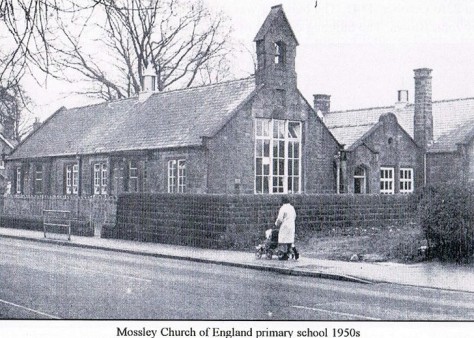
Although we lived in Congleton in Cheshire, I attended a small Church of England village school at Mossley, a mile or so southeast of the town.

The headmaster was Mr Morris, seen here with some of his staff.

Two of my teachers, Mrs Bickerton and Mrs Johnson are seated on the extreme right and left of Mr Morris. I don’t know who the other three ladies were.

I have happy memories of my time at Mossley. I didn’t complete my primary schooling there since my family moved to Leek in Staffordshire in April 1956. And from then until I completed high school in June 1967, my education was ‘ruled’ by the Catholic Church.

In Leek, my elder brother Edgar and I were enrolled at St Mary’s Catholic Primary School (now St Mary’s Catholic Academy), on the corner of the A53 and Cruso Street, a short walk from our home on St Edward Street. It was run by nuns of the Sisters of Loreto.

For my first term, the headmistress was Mother Michael, and her deputy was Mother Elizabeth (who became head when Mother Michael left later that year). As a small boy of seven, I found it quite frightening at first being faced with these ladies in long black robes and head veils (penguins almost).

My lasting impression was a strict regime, and the occasional rap over the knuckles with the edge of a steel ruler. Very painful! There was only one male teacher, Mr Smith. There’s still only one male teacher today.

I think my experience at St Mary’s was the start of my conversion to atheism, which I’ve written about earlier.

In September 1960, having passed my 11+ exam and won a scholarship to grammar school (that’s selective education for you), I attended St Joseph’s College, a Catholic grammar school for boys, in Trent Vale, Stoke on Trent, a 14 mile journey each way, every day. Motto: Fideliter et Fortiter (Faithful and Strong)!

The school was founded in 1932 and run by the Christian Brothers. Take ‘Christian’ with a pinch of salt. However there were more lay teachers than Brothers.

My first headmaster, for one year only was Brother Henry Wilkinson, who insisted on using the tannoy system that was installed in each classroom. Radio Wilko! You never knew just when a lesson might be interrupted by one of his messages.

He was followed by Brother JB O’Keefe (what a smoker!) who remained at the helm during the rest of my time at St Joseph’s. We didn’t see much of him on a daily basis, but at least he removed the tannoy. He seemed a kindly sort of man, but he oversaw a harsh regime. One that used frequently administered corporal punishment, as I have also described in that earlier post.

On reflection, not a happy education. Not one that I would write home about.

So when I see the joy of those children from Flakefleet Primary, I wonder what I missed out on. We have come a long way over the past 50-60 years, although some schools have a ways to travel yet. I’m sure that St Mary’s and St Joseph’s are not the same schools that I left half a century or more ago. For one thing, the two religious orders are no longer involved in the management of both.

School and religion should be separated, just like government and religion.


“Education isn’t what you learn, it’s what you do with what you learn.” Anon.

degreeThere’s been quite a bit in the news again recently about the value of a university education, after George Osbourne, the UK’s Chancellor of the Exchequer, announced the scrapping of maintenance grants from the 2016/17 academic year. From that date, grants will be replaced by loans, adding yet further to the financial loan burden that university students are already facing to pay their tuition fees through loans. These financial challenges are making some (or is it many?) prospective students question whether they really do want or need a university education. Add to that the pressure on prospective students to study a subject that ‘should contribute’ more effectively to society and the economy, it’s no wonder that students are beginning to have second thoughts about going to university.
Also, with the publication of this year’s university exam results, the issue of grade creep is once again on the political agenda, since more than 50% of all students have graduated with a so-called ‘good’ degree. In the UK, this is a First or Upper Second (2:1) Class degree.

So why have these issues now attracted my attention?

Life on the south coast
Early July 1970. Forty-five years! It’s hard to believe. Yes, it’s forty-five years since I graduated from the University of Southampton with a BSc degree (not a very good one, I’m afraid) in Environmental Botany and Geography. There again, no-one in my year gained a First in botany, only a couple in geography. They didn’t hand out many top degrees in those days. More than 70% of students today are awarded a First or Upper Second. What is interesting from my point of view is during my high school years, going to university was not a foregone conclusion, or even an expectation for that matter. However, a university education was something that my post-war generation did begin aspire to. I was only the second person in my family to attend university.

55 Ed & Mike

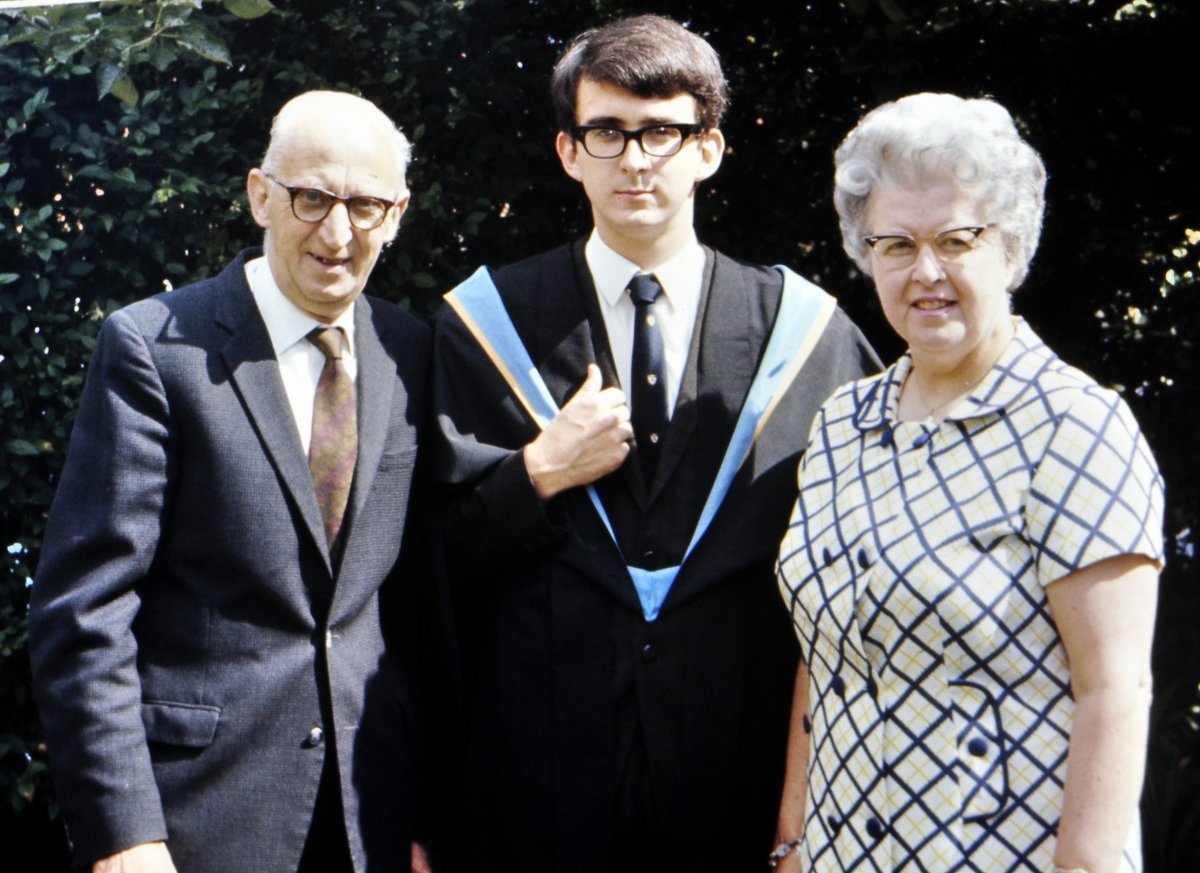
Graduation Day, July 1970 at the University of Southampton, with my Mum and Dad, Lilian and Fred Jackson. Was I ever that young looking?

Now, although I didn’t exactly excel academically at Southampton, I wouldn’t have traded those three undergraduate years for anything. Some of the best years I have ever spent. Ah, the enthusiasm of youth. Did I ever have second thoughts? Never. I was extremely fortunate that my parents were very supportive, even though it must have been hard financially for them at times. My elder brother Ed had (in 1967) just graduated from the London School of Economics (with a First in geography) when I started at Southampton. So my parents were faced with another three years of support, even though my tuition fees were paid by the state, and I did receive a maintenance grant which Mum and Dad had to top up.

I guess I was lucky that Southampton took me in the first place, and didn’t throw me out after my first year. I never was very good at taking exams, well not in those school and undergraduate years. I only found my métier once I’d moved on to graduate school in 1971.

I went for an admissions interview at Southampton in early 1967 and immediately knew that this was where I wanted to study at, if they offered me a place. So once I received the results from my high school A-level exams (in biology, geography, and English literature, but not quite what I’d hoped for, grades-wise) I was on tenterhooks for a couple of weeks waiting for a response from the university. I was earning some cash, working as a lorry (truck) driver’s mate for a company based in Leek called Adams Butter. We delivered processed butter to retail outlets all over the UK, often being away from home for several nights at a stretch. Then once we delivered our load of about 25 tons of butter, we would head to the nearest port to pick up another 25 tons of Australian or New Zealand ‘raw’ butter, in large 56 lb frozen packs. I soon got fit throwing those boxes around.

Anyway, to cut a long story short, I arrived back at the depot after a long day on the road, and my father had kindly left a brief message with the dispatcher on duty: “Southampton wants you!” Obviously elated, I began to make plans to start my university life in October. The rest is history.

Back to the Midlands
Having graduated, I still didn’t know what the next stage of my life held. I’d applied to The University of Birmingham for a place on its newly-established MSc course Conservation and Utilization of Plant Genetic Resources in the Department of Botany. In February 1970 I’d been interviewed by course director Professor Jack Hawkes, and was offered a place, but with no guarantee of any financial support. It wasn’t until mid-August that I received a phone call confirming that he had been able to secure a small maintenance grant (just over £6 a week for the whole year, equivalent to about £80 a week today) and payment of my tuition fees. Undaunted at the prospect, I quickly accepted. And what a joy studying at Birmingham was. I certainly found an area of plant sciences that I could really immerse myself in, the staff were (on the whole) inspiring (particularly Trevor Williams with whom I completed my thesis), and I knew that I’d made the right choice.

But still there was no guarantee of gainful employment in my chosen field. That is until Jack Hawkes invited me to consider a one-year position in Peru. As things turned out, I did make it to Peru, registered for a PhD (which I completed in 1975), and made a career for myself in international agricultural research and academia. I received my degree from the Chancellor of the University, Sir Peter Scott, renowned ornithologist and conservationist, and son of ill-fated Antarctic explorer, Captain Scott at a graduation ceremony at the University of Birmingham on 12 December 1975.

20 Ed & Mike

Graduation on 12 December 1975, with Professor Jack Hawkes on my right, and Dr Trevor Williams on my left. I’m with my Mum and Dad in the two photos above.

Was it worth it?
When I decided to study botany at university I had no idea whether this would lead to a worthwhile career. Actually, it was not something I considered when applying. I just knew I wanted to study plants and geography, and then I’d see what life had in store for me afterwards, assuming I did actually graduate.

Steph studied botany at Swansea University (BSc 2:1), and we met at Birmingham when she studied for her MSc (also in genetic resources conservation) in 1971-72.

1972 002 Steph MSc

Steph’s MSc graduation in December 1972. This was about three weeks before I headed off to Peru. Steph joined me there in July 1973, and we were married in Lima in October that same year. We both had considerably longer hair then – and darker!

I think there was more expectation that our daughters, Hannah and Philippa, would go on to university, from our point of view and theirs. Indeed, having had the advantage of attending an international (and quite competitive) school in Manila, and studying for the International Baccalaureate diploma, university was the logical next step. And they both chose psychology (with an anthropology minor)—it wasn’t planned that way, that’s how it turned out.

Hannah originally started her university years at Swansea University in 1996, but after two years she transferred to one of the top liberal arts colleges in the USA: Macalester College in St Paul, and graduated BA summa cum laude in 2000 (left below, with the gold tassel). She then went on to the University of Minnesota to complete her PhD in industrial and organizational psychology in September 2006 (right below).

Philippa joined Durham University in 2000, and graduated in 2003 with her BSc (2:1) Honours degree (left below). After spending a year in Canada, she returned to the UK in 2004 and spent six months of more searching for a job. Eventually she secured a Research Assistantship in the Brain, Performance and Nutrition Research Centre at Northumbria University in Newcastle upon Tyne. After a couple of years she decided to register for a PhD and she was awarded her doctorate in December 2010 (right below).

So we’ve all benefited from having attended university, and have gone on to have successful careers. But I still believe it was the overall experience of university life as much as the academics that contributed those benefits. Unlike students today, we were fortunate not to have racked up significant debts while studying, and already Hannah and Philippa and their spouses are making plans for college education for their children—should they opt to follow that option.

I think the words of Cardinal John Henry Newman (1801-1890) are appropriate and as good today as when he wrote them in his essay ‘The Idea of a University’ in 1852: If then a practical end must be assigned to a University course, I say it is that of training good members of society… It is the education which gives a man a clear, conscious view of their own opinions and judgements, a truth in developing them, an eloquence in expressing them, and a force in urging them. It teaches him to see things as they are, to go right to the point, to disentangle a skein of thought to detect what is sophistical and to discard what is irrelevant.

I’m not sure that we do achieve those lofty ideals today as perhaps they aspired to in Newman’s day. There are just so many students moving through the system, the pressures to achieve are greater. While I was teaching at The University of Birmingham (for a decade in the 1980s) I became even more convinced that a university education is, in itself, worthwhile. This is often the first time that a young person leaves home, and has the opportunity to grow up away from the ever-watchful eyes of parents. Not everyone takes to university it must be said. But I think the majority who do make it to university would agree that, just like me, the three years they spend studying—and playing—are not three years wasted. It also makes it especially worrying that politicians are increasingly threatening the very existence and roles of universities, as is happening, for example, in a high profile way at the University of Wisconsin.