Visiting again after almost 50 years . . .

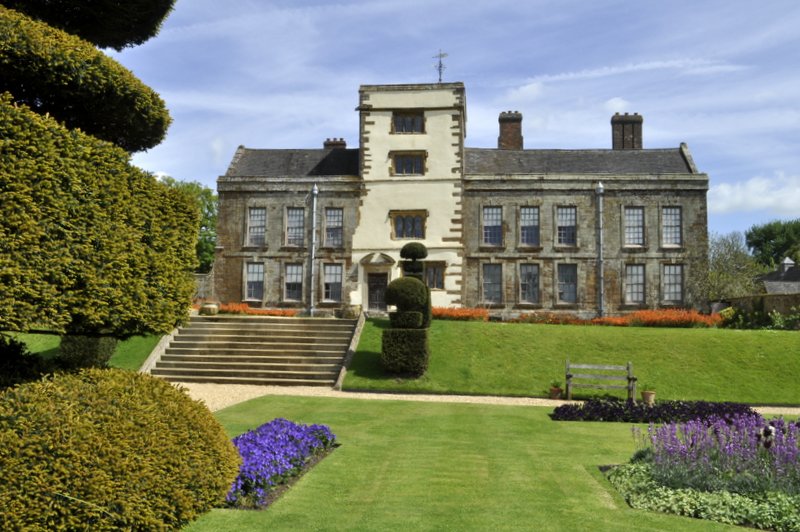
Although the weather yesterday wasn’t as bright as had been forecast a few days previously, we thought we would miss any showers that came along, so decided to push ahead with our visit to Attingham Park, a late 18th century mansion just southeast of Shrewsbury. And apart from one short shower, the weather did behave.

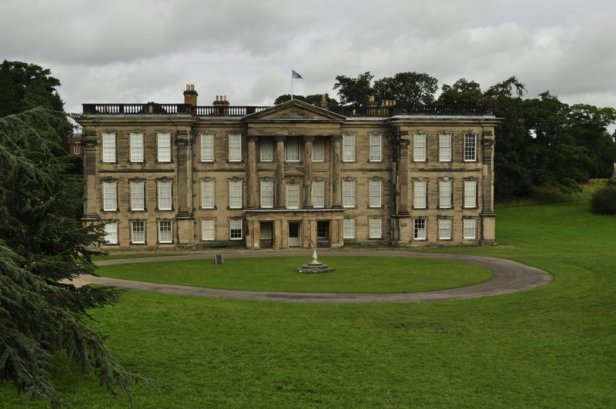
Built in 1785 for the 1st Lord Berwick, Noel Hill, politician and supporter of William Pitt the Younger, Attingham Park replaced an earlier house, Tern Hall. It had a chequered history, and the estate today (at around 3500 acres) is half the size it was at the beginning of the 19th century. The Berwick title became extinct in 1953 on the death of the ninth baron.

But it has a cornucopia of treasures inside, many collected by the 2nd and 3rd barons during their travels in Europe. A picture gallery and staircase, designed by architect John Nash (who designed other famous buildings such as te Brighton Pavilion and extensions to Buckingham Palace) were added in 1805. The roof of the gallery – considered a piece of outstanding architecture in its own right, but which leaked from the very beginning – is undergoing extensive refurbishment today. Apart from one or two glimpses here and there, the roof is not visible from the inside, but I’m sure it will look magnificent once fully restored.

Visitors to Attingham Park today have extensive access to rooms on three floors – in fact one of the better properties in this respect that the National Trust manages. Together with long walks through the Park, a tour of the impressive walled garden, as well as the house itself, Attingham Park is certainly worth a visit.

But as the title of this post suggests, this was not my first visit to Attingham Park. For almost 25 years from 1948, it was run as an adult education centre, and the warden was Sir George Trevelyan (of the Wallington House in Northumberland Treveleyans). In 1966 ( I think it was) I attended a weekend residential course – I was in high school at the time. I don’t remember seeing may of the treasures that were on display yesterday. Maybe we were kept well away.

A house beautiful . . .

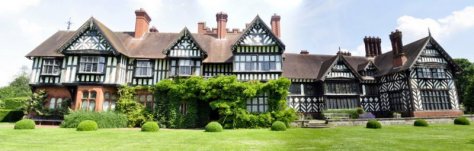
Just three miles west of the centre of Wolverhampton lies one of the most outstanding properties in the National Trust’s portfolio: Wightwick Manor and Gardens.

20140702 010 Wightwick Manor & Gardens

The entrance to Wightwick is on the Bridgnorth Road, west (to the left) of the crossroads (Windmill Lane) and The Mermaid public house on the corner.

Built by Wolverhampton industrialist Theodore Mander and his wife Flora in 1887, and extended (in fact the house doubled in size) in 1893, Wightwick Manor is a fake Elizabethan half-timbered Victorian Manor House (along the lines of Little Moreton Hall), and looks almost genuine. But what defines Wightwick is the incredible interior decoration and furnishing under the influence of the Arts and Crafts Movement. Theodore Mander and his wife were also influenced by the Aesthetic Movement and a lecture by Oscar Wilde on The House Beautiful. The house is exquisitely furnished with William Morris wallpapers and fabrics, De Morgan tiles, and Kempe glass, as well as hundreds of pre-Raphaelite paintings and other works of art.

His son Sir Geoffrey Mander, Liberal MP for Wolverhampton East, persuaded the National Trust to take over Wightwick in 1937 – a controversial move at the time since the house was only 50 years old. The family retains some interest in Wightwick Manor. Because of copyright issues, photography is not permitted inside the house – more’s the pity.

For a detailed account about Wightwick, follow this useful link. And you can find out more about the Mander family here.


‘. . . tomorrow do thy worst, for I have lived today’. (John Dryden, 1631-1700)

That’s a quotation from a poem by Poet Laureate John Dryden, and distant cousin to the family whose home we visited last week. Summer had arrived, and – having prepared a picnic – we headed 50 miles southeast to  Canons Ashby in Northamptonshire.

Canons Ashby House and estate was acquired by the National Trust only about 30 years ago. It had been offered to the Trust several decades earlier, but the Dryden family (which continues to have connections with Canons Ashby) was unable to provide the financial support needed to enable the Trust to take on the necessary long-term commitment. That changed around 1980 when the National Trust was able to secure public funds to acquire and restore the house that had already declined into a near terminal state of disrepair.

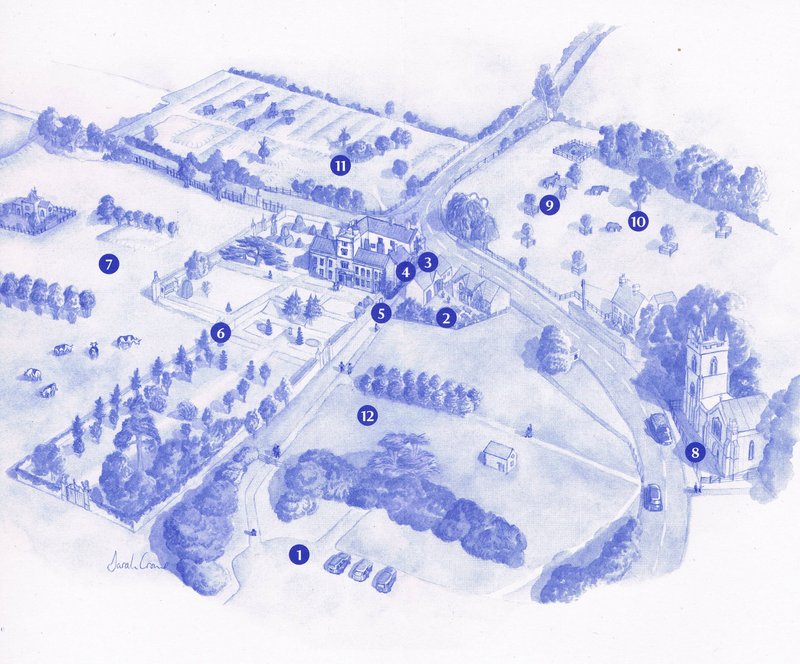
1. Car park; 2. Reception; 3. Toilets; 4. House entrance; 5. Garden entrance; 6. Steps into park; 7. Parkland; 8. Priory Church of St Mary; 9. The Norwell; 10. The Orchard; 11. Site of Medieval Village; 12. The Paddock.

Three decades on and you wouldn’t believe what a transformation has taken place, and Canons Ashby is indeed one of the nicer National Trust properties that we have visited since becoming members at the beginning of 2011.

The 2500 acre estate and house was inherited by Sir Henry Dryden in 1837 (the 8th generation of his family to live at Canons Ashby), when he was just 19. Leaving his studies at Cambridge, he set about rescuing the house from more than 100 years of neglect, and made some extensive alterations to the rooms inside.

But the origins of the estate go much further back. An Augustinian priory was founded there in the 13th century, and the Priory Church of St Mary is all that remains today of a much larger settlement. And from Tudor times, and after the Dissolution of the monasteries, stones from the priory were used in the construction of the original parts of the house. The Priory Church is one of just a handful of privately-owned churches in England. The site of a medieval village lies to the north side of the house (11 on the site plan). Apparently, the Black Death badly affected Canons Ashby in the mid-14th century and more than half of the village died.

The house itself is surrounded by a small formal garden leading southwards towards the Lion Gate through what is now a vegetable garden. Beautifully manicured lawns and flower beds grace the south side of the house, but to the west is a walled garden, the Green Court, planted with yews, which provided the family some degree of privacy from outsiders and servants alike.

This slideshow requires JavaScript.

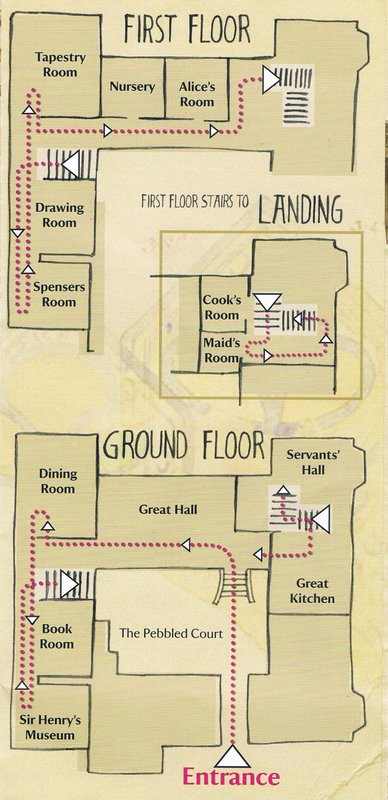
An archway (in part of the original Tudor building) leads into the Pebbled Court, and steps leading into the Great Hall. On the ground floor there are several rooms open to visitors: the hall itself, with an impressive display of swords and muskets on the walls and over the fireplace; the paneled dining rooms (with some impressive portraits including Sir John Dryden who erected paneling in many of the rooms in the 18th century); the book room/study, and a small room that was a museum developed by Sir Henry. Above the fireplace in the dining room is a mirror, slightly tilted forwards to enable anyone with their back to the window (but facing the fireplace) to see the garden (Green Court) outside.


This slideshow requires JavaScript.

On the first floor, two rooms in particular are impressive: the Drawing Room with its fireplace and domed, plastered ceiling; and the Tapestry Room, a bedroom with beautiful tapestries hanging on the walls. In another bedroom, Spensers Room, some of the oak paneling has been removed to reveal the remains of some fine Tudor wall paintings.

This slideshow requires JavaScript.

Off a long gallery on the north side of the building there is a nursery, and the bedroom of Alice, Sir Henry’s only daughter – who became a well-known photographer who established a dark room in the cellars. Descending gingerly through low-framed doors and winding stairs in the oldest part of the house, there is the Servants’ Hall (once thought to be the original family dining room) and the kitchen (with its incredibly high, vaulted ceiling). The Servants’ Hall is rather intriguing, for a couple of reasons at least. The walls are covered in paneling, brilliantly decorated with coats of arms and escutcheons, some of which seem to indicate a link with Freemasonry (even though the Freemasons as such were not founded for a couple of centuries later). At least one window was bricked up – which previously had a view over the Green Court – so that servants could not watch the family at play.

This slideshow requires JavaScript.

From Tudor times onwards, the Dryden family were harshly Puritan, and supported Parliament during the Civil Wars of the 1640s. In the Green Court there is a statue of a shepherd boy reputed to have warned the Parliament troops stationed at Canons Ashby about the approach of Royalist forces. It is rather curious, therefore, that a portrait of King Charles I is displayed rather prominently in the dining room.

Canons Ashby is a delightful National Trust property. It feels like a family home, but the centuries of its history just ooze from the woodwork.

Silent witness to the English Civil Wars and the Industrial Revolution . . .

High above the gorge of the River Severn in the Shropshire countryside, and close to Ironbridge and Coalbrookdale lies Benthall Hall, an intriguing Tudor manor house dating from 1535, and home to Edward and Sally Benthall.  It has been in the Benthall family for more than 500 years – and saw some of the excesses of the English Civil Wars of the 1640s, as well as the birth of the Industrial Revolution at the beginning of the 18th century. It lies about 20 miles as the crow flies to the west of Moseley Old Hall. But whereas the latter was originally a typical Elizabethan half-timbered building, Benthall Hall is constructed from stone.

Since the house is still occupied by the family from time-to-time, only certain rooms are open to the public. Photography is permitted only in the ground floor rooms. Nevertheless, Benthall Hall has a certain charm – and still retains a ‘lived-in’ feeling. The main entrance is rather modest, but opens into a grand hall, with three rooms off to the sides. Two of these are beautifully paneled and the over-mantles are exquisitely carved. In one room, on the east side of the main hall, paint has been removed from the paneling to reveal the underlying wood in all its glory. One the opposite side of the building the paneling is still painted, and matches in with the plaster ceiling. It’s been suggested that the family decided to paint over the paneling after it was damaged during various skirmishes in the Civil Wars.

There is a small collection of beautiful Caughley porcelain which was manufactured in Broseley near Benthall Hall between 1775 and 1799. The gardens are quite small – the ubiquitous ha-ha, a wilderness area, cottage garden, and terraced plantings close to the house. A small church in the grounds is not currently open to the public, but now belongs to the National Trust and, after refurbishment, will become the reception center.


History is more than skin deep . . .

In  south Staffordshire, at the end of a very narrow lane, and nestling just under the M54, is an unprepossessing brick farmhouse.


Yet it was witness to a remarkable period of English history. Let me take you back more than 360 years to 8 September 1651.

It’s almost three years since Charles I was executed. The Lord Protector, Oliver Cromwell and his Parliamentarians, are firmly in control of the reins of government. Yet there is still widespread opposition to the Commonwealth of England, ruled as a republic, and Charles II (although not crowned for another decade) has just attempted to defeat Cromwell at the Battle of Worcester (just a few miles south of where I live) a few days before, chiefly with the support of Scottish troops. Instead, heavily outnumbered, Charles was defeated, and had to flee for his life. On that dark morning three days later he finally arrived at this Elizabethan farmhouse, Moseley Old Hall, with a small group of retainers.

Built in 1600  by Thomas Whitgreave (and in fact occupied by the Whitgreave family until 1925), it was one of his Catholic and Royalist descendants who gave sanctuary to Charles over the course of a couple of nights, even as parliamentary troops were scouring the countryside in their bid to capture the king. At one point they arrived at Moseley but were convinced by Thomas Whitgreave that he had nothing to hide; the six foot plus king was hiding upstairs in a secret priest-hole, just four feet square and a couple of feet or so deep – hardly a comfortable place for someone of Charles’ stature. In fact it was so uncomfortable that Charles chose to sleep fully-clothed in a four poster bed that is still there in the ‘King’s bedroom’ at Moseley Old Hall. Charles did manage to escape to France, and although in disguise, his height and swarthy complexion almost gave him away on a couple of occasions.

In 1651, Moseley Old Hall would have looked very different than it does today. It started life as a typical half-timbered Elizabethan building – looking rather like Little Moreton Hall that we visited last September. However, in the nineteenth century the outer skin of the half-timbered structure was removed, and replaced with the bricks – a veneer almost – that we see today. Once inside however, the house is pure seventeenth century, and many parts of the house have not changed in centuries.

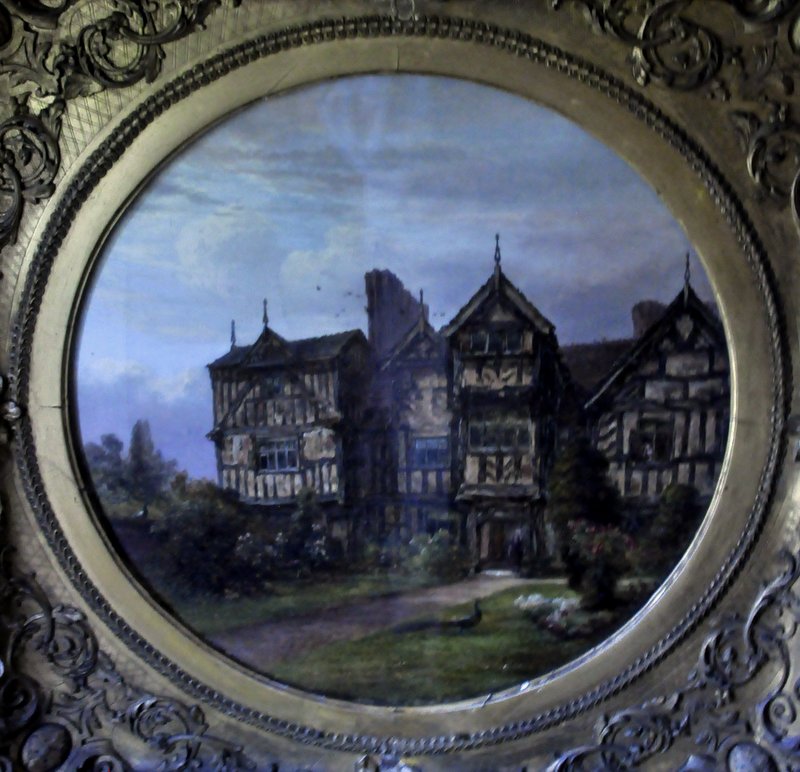
Moseley Old Hall as it would have looked as a typical Elizabethan half-timbered building.

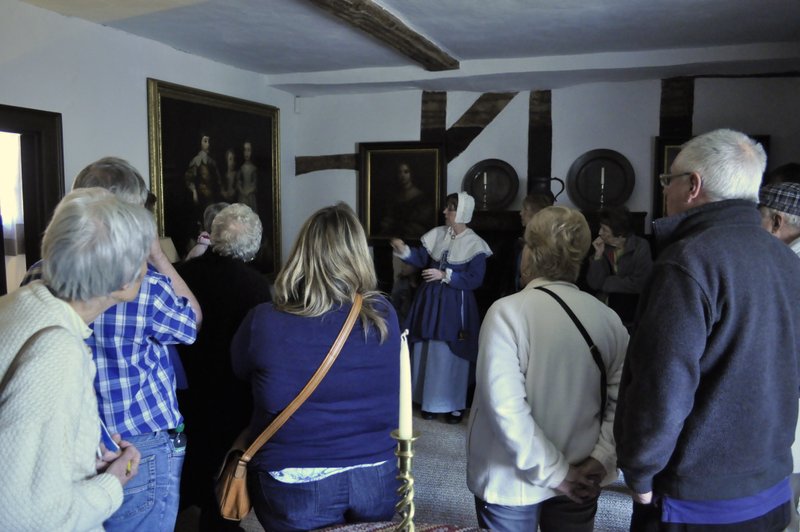
Moseley Old Hall is not a large property, but it has some real treasures. Many pieces of furniture are original to the property as are several of the altar ornaments in the attic chapel. Normally, Steph and I choose not to take a guided tour, preferring to wander around at our own pace. But because we could see that the hall might become quite congested, we did opt to take the tour, just fourteen of us in our tour. And it was worth every minute.

‘Mistress Whitgreave’ describing the features of an upstairs parlor.

On the ground floor the brew-house retains many of its original features, including a chute from the attic down which grain would have been dropped in preparation for brewing. There is an open kitchen and dining room, and a parlor with several original paintings.

The main feature on the first floor is the King’s bedroom and priest-hole. In the attic there is a Catholic chapel, which could only become an openly acknowledged feature once Catholics were permitted in 1791 to practise their religion under strictly prescribed conditions.

The gardens are not large, but there is an exquisite knot garden on the south side of the building. Alongside is a small orchard (with a lonely peacock wandering about). recently the National Trust has acquired a small piece of woodland to the west of the property and this has also been opened to visitors.

Moseley Old Hall was full of surprises – not what I had expected at all. Its royal connections certainly make it worthy of preservation as one of the National Trust’s properties. Had Charles been captured who knows what the dynastic consequences might have been. Another case of ‘What if?’

A terrace, temples and time to enjoy them . . .

As I have blogged on quite a number of occasions now, Steph and I have enjoyed our National Trust membership since becoming members in early 2011. It certainly gives a focus for days out when the weather permits – and we’ve more than had our money’s worth in terms of membership fees versus entrance charges. So on our way back home last Sunday from our visit to the northeast we took the opportunity of stopping off in North Yorkshire. The weather forecast had been so-so, but it turned out to be a perfect late September day: bright and sunny, balmy even; almost an Indian summer.

In July we had visited Fountains Abbey, a derelict Cistercian abbey near Ripon. About 20 miles as the crow flies northeast from Fountains Abbey is another famous Cistercian ruin: Rievaulx Abbey, which is owned and managed by English Heritage.

But it wasn’t the abbey that we went to visit, but a delight of 18th century landscape gardening on the hillside above the ruins – Rievaulx Terrace and Temples. Constructed in the mid-18th century by Thomas Duncombe II (who had inherited Duncombe Park in nearby Helmsley), it provided a pleasant landscape from which to view the abbey ruins in the valley below of the River Rye (which also runs alongside another NT property, Nunnington Hall, about eight miles away to the south).

The grassy terrace, just below the brow of the hill, is bordered on the east side by a beech wood, and on the west – towards the abbey ruins – the valley drops away steeply, and is densely wooded, except for a number of avenues that were cut through the trees to provide views of the ruins below. You can see these quite clearly in the Google Earth satellite image below, just below the label ‘Mossy Bank Wood’.

There are two temples – that at the north end is an Ionic temple, open to the public at various times of the day; and the southern temple is a Tuscan round design, and is permanently closed.

We were very lucky to arrive just after noon, and the Ionic temple was still open. Visitors are restricted because of the delicate nature – and quality – of the interior furnishings. And what masterpieces the temple contains: original table and chairs, Royal Worcester china from the 18th century, the marble fireplace, and most important of all, the absolutely stunning frescoes on the ceiling. They quite took my breath away. The temple was used to entertain guests, with a kitchen in the basement.

The Tuscan temple has the most gorgeous painted plaster ceiling. The National Trust has placed mirrors on the inside of the windows and it’s therefore possible to view the ceiling.

But a stroll along the terrace reveals the Rievaulx Abbey ruins in all their medieval glory. I visited the abbey once in my Southampton student days during a walking holiday in 1968 on the North York Moors. And then in the 1980s, when our daughters were small, we rented a holiday cottage just north of Scarborough on the coast, and one of our trips was to Helmsley and Rievaulx.

This slideshow requires JavaScript.

Rievaulx Terrace and Temples were a complete surprise. Beautiful (especially on the day we visited), simple, and serene. If you ever get chance to visit, do make sure it coincides with one of the Ionic Temple opening times. You would surely regret missing out on those Georgian glories.

Little Moreton Hall – an iconic Tudor manor house

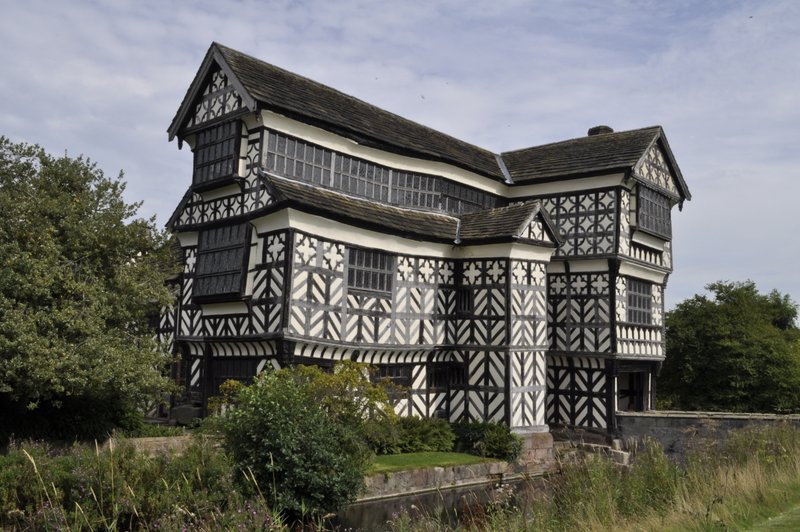
The Moreton family began to build Little Moreton Hall in the last years of the reign of Henry VII, and it was completed with various additions in the 17th century. Little Moreton Hall is the epitome of a half-timbered Tudor manor house, its black and white timber-framed construction and intricate patterns typical of the architectural features of that period. It is also surrounded by a moat.

The main entrance to Little Moreton Hall, over the moat. This photo shows the south face of the hall.

The main entrance to Little Moreton Hall over the moat, on the south face.

Located in southeast Cheshire, near the small town of Congleton (where I was born), Little Moreton Hall remained in the same family for more than 400 years until it was given to the National Trust in the 1940s.

I have memories of visiting Little Moreton Hall more than 60 years ago. My family certainly went there in the late 1940s shown in the photo below on the left taken, I believe, in 1947. I was born in 1948, and Ed in 1946; I think he must have been 12-14 months when this was taken, along with my mum and dad, sister Margaret, and eldest brother Martin. The other photo was taken from more or less the same spot just a few days ago.

Much of the hall is open to the public, with the exception of a few rooms on the first floor. There is very little furniture in each of the rooms; you can take in the innate beauty of each of the rooms and their construction. The woodwork is exquisite.

Here is a plan of the ground-floor (drawn by George Ponderevo):

1. Great Hall. 2. Parlour – with painted wall decorations. 5. Withdrawing room. 6. Exhibition room. 7. Chapel. 10. Gatehouse. 11. Bridge. 13. Brewhouse (now toilets). 14/15. Restaurant. 17. Hall porch. 18. Courtyard.

This slideshow requires JavaScript.

There are several rooms open on the first floor.

The first floor-plan (shaded areas not open). 1. Great Hall. 2. Prayer Room - now housing exhibits showing how the hall was constructed. 4. Guests' Hall. 5. Porch Room. 6. Garderobe and privy. 7. Guests' Parlour. 8. Brewhouse Chamber.

The first floor-plan (shaded areas not open). 1. Great Hall. 2. Prayer Room – now housing exhibits showing how the hall was constructed. 4. Guests’ Hall. 5. Porch Room. 6. Garderobe and privy. 7. Guests’ Parlour. 8. Brewhouse Chamber.

This slideshow requires JavaScript.

The crowning glory of the hall is the Long Gallery on the top floor of the south wing. Apparently added at a later date from the original building, the weight of this floor has distorted the walls below, causing them to bulge outwards. Strengthening bars were added in the 19th century. But the unevenness of the walls and floor are easily seen in the slideshow below. The roof is covered on stone tiles, an additional weight that the overall structure could hardly sustain.

This slideshow requires JavaScript.

The gardens are limited by the area of the island on which the hall was built. To the west is a small orchard, and on the north side a formal knot garden that is based on a 17th century design. The water quality of the moat must be quite high as we saw several large koi carp. But in Tudor times that could hardly have been the case, since the privies must have emptied directly into the moat.

This slideshow requires JavaScript.

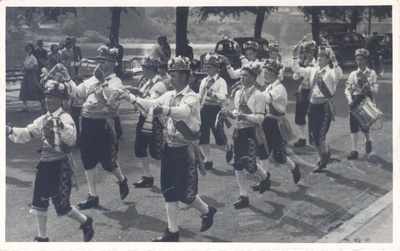
My first memory of Little Moreton Hall comes from about 1954. I’m not sure if we had made a special visit, or whether my father, as the Chief Photographer of The Congleton Chronicle, had gone there to cover an event. In any case it was my first encounter with Morris dancers. I still vividly remember the Manchester Morris Men dancing outside the hall in front of the bridge across the moat alongside the Manley Morris Men. Once upon a time we had a couple of photographs but I’m not sure if they exist any more. In any case, I did find these photos of them dancing in May 1954, as part of a Mid-Cheshire Tour, and another from May 1953 at Astbury. I’m grateful to the Manchester Morris Men for permission to use these in my blog.

Manley Morris Men

Manley Morris Men: I even remember the dancer on the left with the big grey beard – Leslie Howarth.

A majestic link with the agriculture of medieval England

In the village of Bredon, nestling at the foot of Cotswolds outlier Bredon Hill, and alongside the River Avon (of Shakespeare fame) in southern Worcestershire, is an agricultural treasure from medieval times. From 1350 or thereabouts.

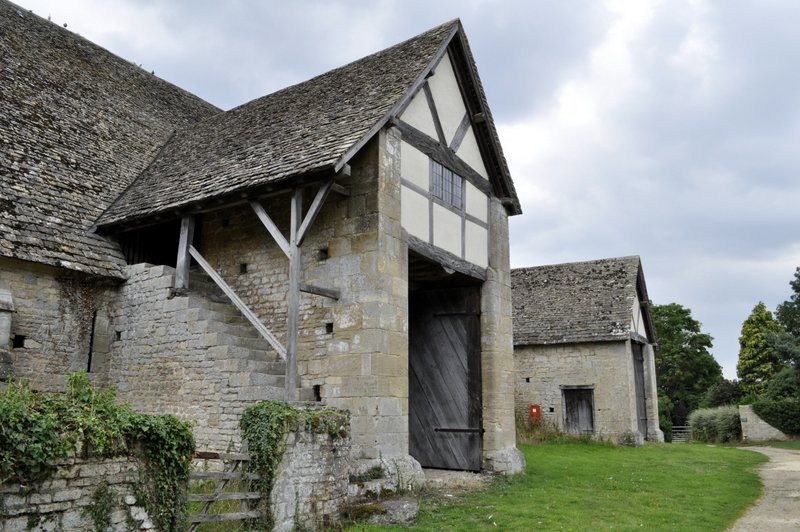
This is the Bredon tithe barn, constructed from golden Cotswolds limestone, with beams from local oak trees, and a stone roof. Oriented north-south, and measuring more than 130 feet long, by about 44 feet wide (and at least 50 feet or more to the apex of the roof) this tithe barn is one of the best remaining examples of its kind – there are others dotted around England’s landscape.

It’s not so easy to find. Although a National Trust (NT) property, there are no detailed directions in the NT Handbook, and in the village of Bredon itself there are no signs to indicate its precise location. We drove through the village and I thought I saw it in the distance, but actually finding a way to it was almost impossible. Eventually, we had to ask the church warden who was working in the churchyard.

Open 7 days a week, it’s possible just to wander around the barn and take in its magnificent woodwork and construction. Occupied by quite a large population of doves, it’s best not to wander round with one’s mouth open when looking up at the roof.

Here’s what is written on one of the National Trust display boards just inside the barn’s open door:
The name Bredon comes from bre, the old British word for a hill. In prehistoric times a fort stood on the hilltop, and the valley below was already being farmed.
   Bredon was an important place by the 8th century, when a minster, or monastery here was granted a great deal of land by the kings of Mercia. Its properties extended as far as Cutsdean in the Cotswolds and Rednal (now on the outskirts of Birmingham) to the north. Gradually this great estate declined and the monastery was reduced until it became no more than a rich parish church. The Bishops of Worcester took over the land and remained lords of Bredon from about 900 until 1559.
   The Bredon barn was built for the Bishops about 1350, at a tragic time in medieval history  The Black Death, the terrible plague that swept across Europe from the East, killed more than a third of the people of England. Half the population of Bredon died, and Bishop Wulstan de Bransford, who probably commissioned the barn here, himself fell victim on 6th August 1349.
   Although the barn at Bredon has traditionally been known as a tithe barn, recent research indicates that it was almost certainly a manorial barn, used for storage of crops from the large and important manor of Bredon.
   Tithe barns were attached to churches, and were used to store tithes (tenths of the produce of the land) paid to parish priests as part of their income. The fact that the Bishops of Worcester were lords of the manor here for more than 600 years probably accounts for the misapprehension. The Bredon barn was well-built and large – 132 feet (40.2 metres) by 44 feet (13.4 metres) – because it was vital to the economy of a large and important estate.

This slideshow requires JavaScript.

The barn was badly damaged by fire in the 1980s, but the National Trust was able to raise the money for its restoration, using locally-sourced oak for the beams, and quarried limestone. It really is a gem, and worth 45 minutes or more of anyone’s time in this lovely riverside village.

Veni, vidi . . . and took lots of photos

Despite dominating ‘England’ for only 400 years or so, the legacy of the Roman invasion and conquest of Britannia – first by Julius Caesar in 55 and 54BC, and then by the Emperor Claudius in AD43 – is quite remarkable. A Roman imprint can be seen in many of our towns and cities, at various fortresses (in the north along Hadrian’s Wall at Vercovicium, or Housesteads Roman Fort and Vindolanda, for example), and in the modern roads, some of which still follow the ancient Roman routes. And there are, of course, other ruins of settlements (such as Wroxeter – Viroconium – in Shropshire) and residences dotted around the countryside. Yesterday, we visited one of the most impressive and significant of the ruins of a private residence, at Chedworth Roman villa in the heart of the Gloucestershire Cotswolds.

Lying just north of Cirencester – Corinium, which was an important Roman town, and linked into three major roads, the Fosse Way (now the A429 to the east), Ermin Street (the A417) to the west and Akeman Street, Chedworth villa was undoubtedly the important and sumptuous residence of a wealthy family – but who? We just don’t know.

Lying hidden for centuries since its apparent abandonment in the late AD300s, the ruins were discovered in 1864, on land belonging to the 3rd Earl of Eldon, a 19th century landowner. The first evidence was some colored stone cubes – tesserae – from buried mosaics. Once uncovered, several beautiful mosaic floors were revealed in all their glory. The archaeology continues today, and while other mosaics continue to be revealed, most of the walls of the remaining ruins have been uncovered.

These are topped by ‘roofs’ to protect them against the elements. But an idea of what the villa must have looked like has been interpreted in a model at the entrance to the villa.

This slideshow requires JavaScript.

Today all that can be seen are the outline structures of the west and north wings, and a small part of the south wing. But what treasures lie inside the west wing. Some of the best mosaics are there, today protected by a National Lottery-funded building in which visitors are able to walk above the mosaic floors on a raised platform. The mosaic on the south side of the west wing covers what is regarded as the dining room. But to the north, there are bathrooms, plunge pools and the like for relaxation.

This slideshow requires JavaScript.

The central heating genius of the Romans is exposed in several locations, but particularly on the north wing, where pillars that supported the floors can still be seen.

Lying in the valley of the River Coln, a source of clean water would have been one of the main reasons for siting the villa here. And in the northwest corner of the villa, in what has been interpreted as a shrine or temple, yesterday’s trickle of water from the spring didn’t seem sufficient to sustain a large community that must have lived at Chedworth all those centuries ago.

The site is also a haven for wildlife, but we didn’t see any of the large edible snails (Helix pomatia) that are found at Chedworth and which were introduced by the Romans. I’ve never heard of these elsewhere but there surely must be other populations around the country. At Chedworth they’ve survived – even as a local population – for two millennia.

No doubt the continuing archaeology will eventually tell us more about the life and times of Chedworth, one of fifty or more villas in the Cotswolds. Another – but important – link in our rich history.

Dudmaston – in the same family for more than 800 years

The same family – more or less. Dudmaston Hall has come down to the present residents (I don’t think ‘owners’ is the right term as the National Trust is involved in looking after property) through various familial inheritance twists and turns, not by direct ancestry. Landed gentry but not aristocrats.

Lying in the Severn Valley, a few miles south of Bridgnorth in Shropshire (but close to Worcestershire and Staffordshire county boundaries), Dudmaston Hall (well, the present building at least) dates from the late 17th century.


In many ways the house itself is quite modest. The ground floor entrance hall, library and oak study are open to the public. Access to the first floor is up a beautiful cantilevered staircase. Several bedrooms can be viewed – some of them still used as guest bedrooms! As the house is still lived in, photography is not permitted inside the house.

From 1966 until their deaths in the late 1990s, Dudmaston Hall was home to Sir George and Lady  Rachel Labouchere (she had inherited the hall from her uncle Capt. Geoffrey Wolchyre-Whitmore, the family that had lived at Dudmaston for several generations). Sir George served in the diplomatic service during and after the Second World War, and was HM Ambassador in Spain from 1960-1966. He was also an avid collector of modern art (including many by Spanish artists), assembling – it’s reported – one the most important private collections in the country. Many of the best pieces are still displayed at Dudmaston today. I’m afraid I’m not really enthusiastic about modern art, but there was one bronze sculpture that really did take my fancy. Out of my budget range, though.

Lady Rachel Labouchere

Lady Rachel Labouchere

Lady Rachel was a collector of botanical paintings, and many of those she collected are also on display, and of particular interest to Steph and me because of our botany backgrounds.

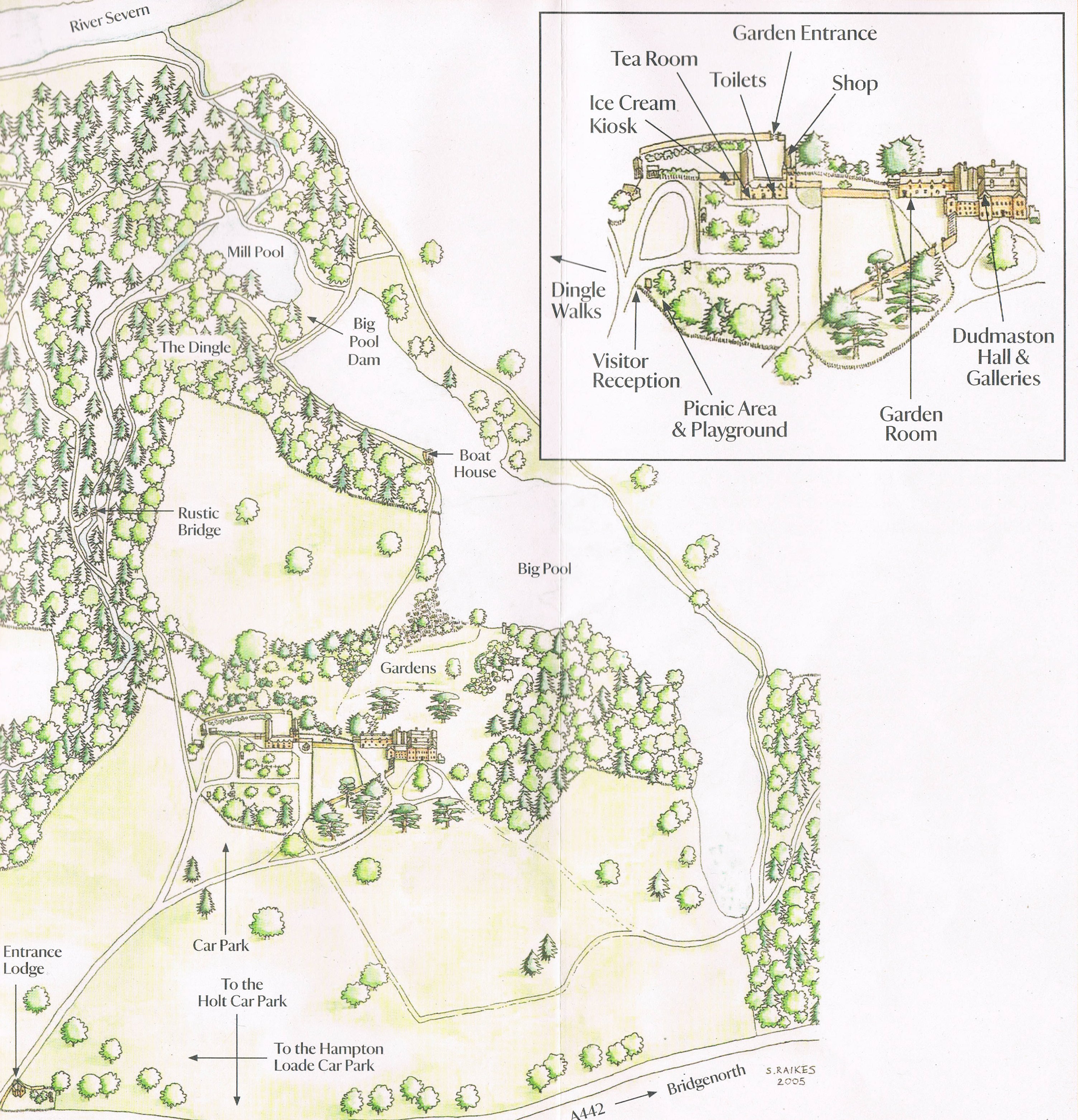
The gardens at Dudmaston are nothing to write home about, but the estate and park are extensive with opportunities for long walks – which we took full advantage of. Starting from the car park we headed towards the Big Pool that you can see on the map below (click on it for a larger image), over the Rustic Bridge, round the Dingle, across the dam, and following the path to the River Severn. Coming out of the woods on to a west-facing slope above the river, we could see the track of the Severn Valley Railway (a heritage line) on the other side. It would have been a great spot to watch the steam trains. But none came by, but once we’d headed back along the lake, we did hear a couple of locomotives whistling in the distance.
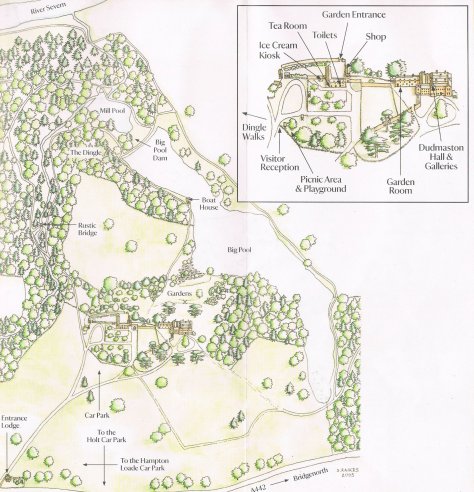
The lake has a high dam at the southern end, and is a haven for a large flock of Canada and greylag geese, that were swimming about in ‘family’ groups and happily honking to each other.

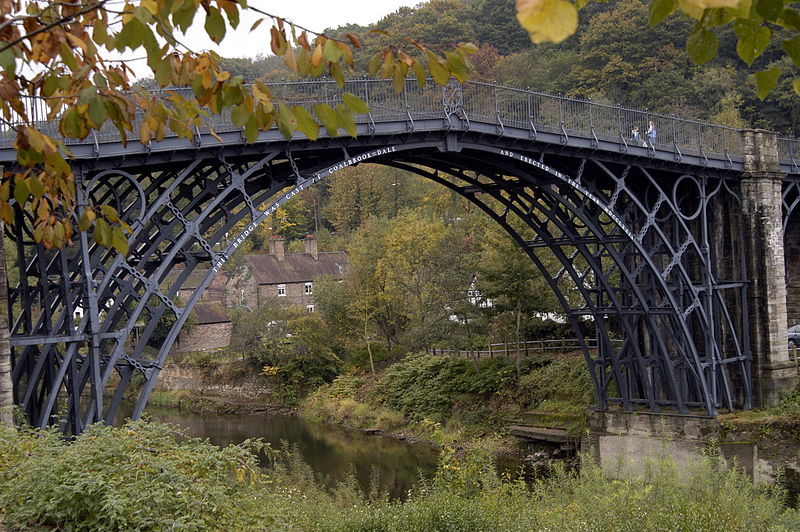
While not the seat of a distinguished aristocratic family, Dudmaston Hall does have some important links with Britain’s industrial heritage. Lady Rachel was descended from the Darby family of Coalbrookdale (said to be the birthplace of the Industrial Revolution, less than 15 miles north of Dudmaston), where Abraham Darby developed iron smelting in the first decade of the 18th century and where, at Ironbridge, the world’s first bridge constructed from iron was built across the River Severn in 1779 (by Darby’s grandson, Abraham Darby III), using the same design principles as if it had been made from wood.
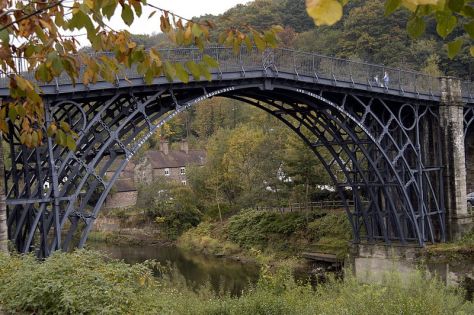
From: http://en.wikipedia.org/wiki/File:IronbridgeCharles Babbage, father of the computer who designed a mechanical Difference Machine in the early 19th century, was the brother-in-law of the Wolchyre-Whitmore owner of Dudmaston at that time. Babbage spent considerable periods at the hall. He also invented and installed the hall’s central heating system, and several of the metal vents are on display. 

So while the visit to Dudmaston was, in some respects, a little disappointing, it was nice to get out and about, and enjoy a late summer day in the fresh air. Fortunately the journey to Dudmaston took little more than 30 minutes, being only 18 miles or so to the northwest of Bromsgrove.


On 24 June 2020, we made a farewell visit to Dudmaston. As more National Trust properties begin to open, we are taking the opportunity to grab tickets as and when we can. Last week we had a lovely walk around the park at Hanbury Hall.

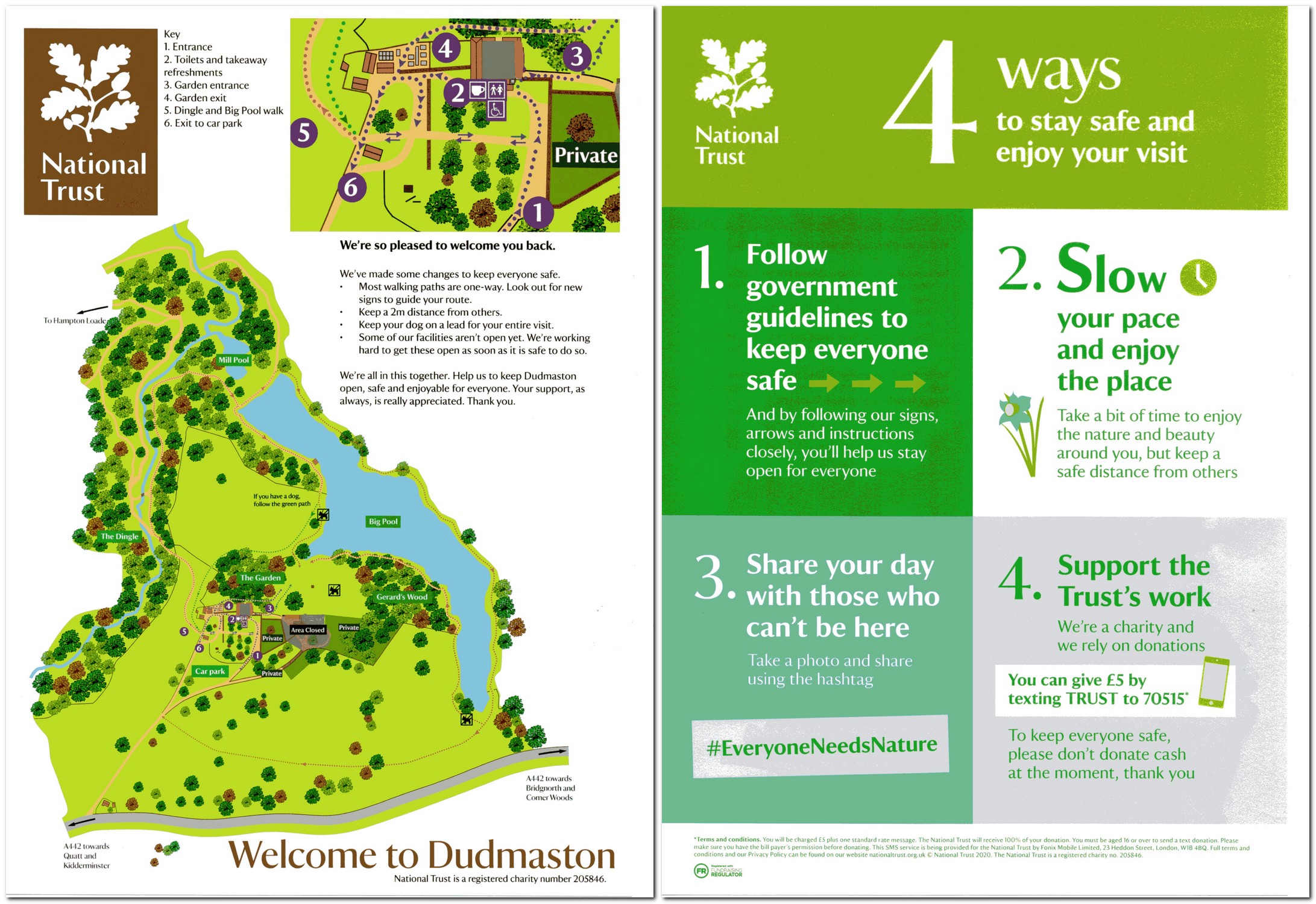
It was the hottest day of the year to date yesterday, but that didn’t deter us from heading to Dudmaston, and attempting a walk around the pool. In fact, when we arrived there, right on time at 13:30, we discovered that the NT had implemented a one-way system around the park, so once we’d started there was no turning back. We followed the route (shown by a red dotted line on the map below) through The Dingle, across the dam, and round the Big Pool back to the garden in front of the house.

Here is a link to a photo album of yesterday’s visit.


Three days, three houses . . .

During our trip to the northeast a couple of weeks ago, we visited three National Trust properties over three days. They all had one feature in common: until quite recently they were still occupied by their owners.

In Northumberland, the two houses were: Seaton Delaval Hall, just north of Whitley Bay, about a mile inland from the North Sea Coast (map); and Wallington House and Gardens (map), home to generations of the Blackett and Trevelyan families for generations, about 25 miles northwest of Newcastle. In North Yorkshire, just south of Helmsley in the North York Moors lies Nunnington Hall (map), which we visited on the journey home.

Seaton Delaval Hall
This impressive property was designed in 1718 by Sir John Vanbrugh (who also designed Blenheim Palace and Castle Howard) for the Delaval family who had occupied estates in the area since the time of the Norman Conquest in the 11th century. It comprises a Central Hall and West and East Wings (which houses the large stables). The Central Hall was destroyed in a fire in 1822, although a number of features did survive. The West Wing (and the extensive cellars) originally housed the servants, but in the 20th century became the residence of the owner. Some restoration has taken place, and the Parterre Garden was designed in the 1950s. Although Seaton Delaval will never again reach its former glory, its outward appearance speaks volumes for what it must have been like.

This slideshow requires JavaScript.

Wallington House and Gardens
The hall dates from the 17th century, but had extensive modifications in the Palladian style in the 18th. Two aspects particularly impressed me: it definitely had the feel of a family home; and the walled garden, about 15 minutes walk away from the house, in among the woods, is perhaps one of the nicest gardens I have visited. The entrance hall has bright murals showing many different aspects of the history of Northumbria, and the house is full of beautiful treasures. Wallington is definitely worth a visit for so many reasons.

This slideshow requires JavaScript.

Nunnington Hall
Alongside the River Rye, parts of the house date from the Tudor period, but over the centuries it was remodeled. There are signs of its occupation by Parliamentary forces during the English Civil Wars of the 1640s. The gardens are not extensive, but quite attractive.

This slideshow requires JavaScript.

The majesty of Kedleston Hall

Kedleston Hall. An impressive Palladian mansion in the Derbyshire countryside, just a few miles to the west of Derby city centre. Kedleston has been the seat of the Curzon family for generations, almost 1,000 years! The Curzons accompanied William the Conqueror on his 1066 jaunt to England, and stayed on, accruing vast estates in the process. What’s interesting from a personal point of view is that my grandmother’s family (BULL) come from the village of Hollington (and neighbouring villages) only a few miles further west from Kedleston. I guess over the centuries their lives must have been influenced, one way or the other, by the Curzons.

The present builing was designed by Robert Adam, relatively unknown at the time he received the commission from Sir Nathaniel Curzon. Kedleston Hall remains one of the best examples of Adams’ designs still standing.

Standing in about 800 acres of parkland, Kedleston is approached along a winding road, that crosses a bridge over a weir in the man-made lake.

It was never intended, apparently as a family home, but as a venue for Lord Curzon to show off all his accumulated art.

01-20130708001 Kedleston Hall

The east wing (on the left in the photo above) did house the family quarters, while the servants lived and worked in the west wing. The Grand Salon in the central structure was meant for entertaining and displaying the works of art. The entrance today is through the ground floor on the north, and entering the main hall on the first floor the size and height of the entrance hall are very impressive with marble columns either side. There are rooms leading off on both sides, and it’s possible to make a circular tour of the rooms, passing through a music room, a sitting room, a library, the dining room, and a state bedroom, among others.

This slideshow requires JavaScript.

Alongside the hall is the small All Saints Church, no longer used for worship, but the mortal remains of many of the Curzon family are buried there. Under floor near the main altar are two figures of the Fifth Lord Curzon of Kedleston and his wife, dated 1275.

While this house does not have impressive gardens through which to wander, the large parkland does offer the visitor an ample opportunity for some pleasant exercise in the Derbyshire countryside.

And on the ground floor is an interesting museum of Indian artifacts – weapons, jewellery, ornaments, silverware, and costumes – from the time of George Nathaniel Curzon who was Viceroy of India from 1899-1905.

400 years of decline in the heart of the Cotswolds . . .

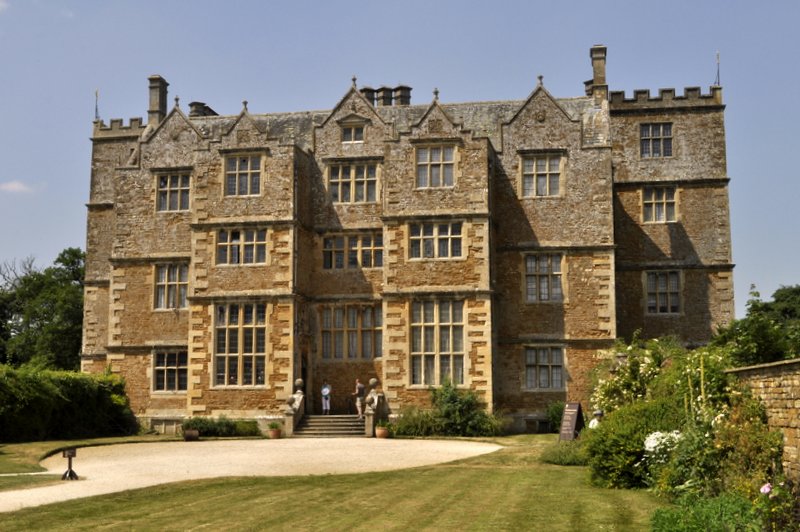
The entrance to Chastleton House

The entrance to Chastleton House

It seems that Chastleton House – a Jacobean mansion built between 1607 and 1612 in north Oxfordshire in the heart of the Cotswolds near Moreton-in-Marsh – was destined for decline. The same Jones family lived at Chastleton House for almost the entire period, until it was sold and became a National Trust property in the early 1990s.

Although the house itself has a rather grand façade, it has rather modest grounds, and is located in the centre of Chastleton village. The journey from Bromsgrove took us south around the historic town of Evesham, and a steep climb up the Cotswold escarpment near Broadway. On a glorious day like yesterday the views of the Cotswold landscapes were wonderful.

What makes this National Trust property different from most others is that there has been essentially no attempt to restore the house to its former glory (as with Calke Abbey in Derbyshire). Instead the Trust has made essential repairs to prevent further deterioration of the property’s fabric, but what’s on show is what was there when the house was vacated. And quite a number of rooms, such as the Great Chamber, with its magnificent plastered ceiling and fireplace, appear today much like they did several centuries ago.

And because the Trust is preserving not restoring, many more rooms are open to the public, who can access the house on timed visits. This means that the number of visitors in the house at any one time is limited which enhances the visitor experience.

Over four floors from the magnificent entrance hall, the dining room (with a fine display of Staffordshire salt ware from the 17th century), up the East Stairs to the Great Chamber, a library, and some of the bedrooms, and finally to the top floor to the Long Gallery that stretches the entire width of the house, and faces east. Apparently the family used the Long Gallery for exercise on days when it was impossible to go outside.

The gardens are not large, and must have been much finer in the past. The topiary bushes deteriorated many decades ago when it was no longer possible to maintain them. The village of Chastleton lies just beyond the garden walls, and the lack of several ‘expected’ facilities in the house (such as a laundry) is apparently down to these having been provided by villagers living close-by.

There were fewer visitors to Chastleton House yesterday than I expected, and it was lovely to experience the tranquility of its surroundings. Definitely well worth a visit, and one of the Trust properties that I have enjoyed most.

600 years in the same family

Coughton Court. An elegant Tudor house in the Warwickshire countryside near Alcester (and only 12 miles from home).


A National Trust property since 1946, it’s been owned by or lived in by the same Throckmorton family for six centuries.

The family has been involved in some of the major events of English history – as a major Catholic family during the Reformation under Henry VIII, Edward VI and Elizabeth I. They were dragged into the Gunpowder Plot of 1605, even if only tangentially.

One wing of the house is still occupied by the family under the terms of a very long lease with the National Trust. The house contains some wonderful treasures, and the extensive gardens and bluebell wood are worth the walk.

Hanbury Hall – a disputed date

We enjoy our National Trust visits, but the weather over the past months has really prevented us from getting out and about. Just over a month ago it really did look as though Spring had arrived and we visited Charlecote Park. But that was just one day, and we even had more snow and bitterly cold winds from the Arctic since then.

But over the weekend, the ‘blocking high’ did move away allowing Atlantic weather to encroach and bring in milder air from the south. And when that happens you have to grab every opportunity of enjoying the glorious outdoors. Well, the weather wasn’t too brilliant – at least it wasn’t so cold nor wet to prevent our second visit yesterday to Hanbury Hall, an elegant William and Mary mansion just over six miles from where we live in the rolling north Worcestershire countryside. After we joined the National Trust in 2011, Hanbury Hall was the first property we visited simply because it was right on our doorstep, so-to-speak.

Hanbury Hall main entrance

Hanbury Hall was the family home of Thomas Vernon, and may have been built on the site of an earlier residence. Above the main door is the date 1701, but other – and better evidence – suggests that the hall was not completed until 1706. The date above the door may have been added during Victorian times.

Among the glories of Hanbury are its extensive parkland – occupied by many ewes and their lambs during our walk yesterday, and its gardens, in particular the parterre on the southwest of the main building. There are extensive outhouses – a stable-yard, a dairy (in the process of renovation) a walled garden, an orangery, and an ice house.

As you might expect, the Hall’s interior is sumptuously decorated, and the main staircase is a magnificent feature with paintings on the ceiling blending into those on the walls.

The Hall was occupied until 1940 when the last Baron Vernon, in very poor health at the time, took his own life, and the baronetcy became extinct.

Hanbury Hall is easy to find in the Worcestershire countryside, has plenty of parking, and is certainly worth a few hours of anyone’s time.

Lucy in the sky . . .

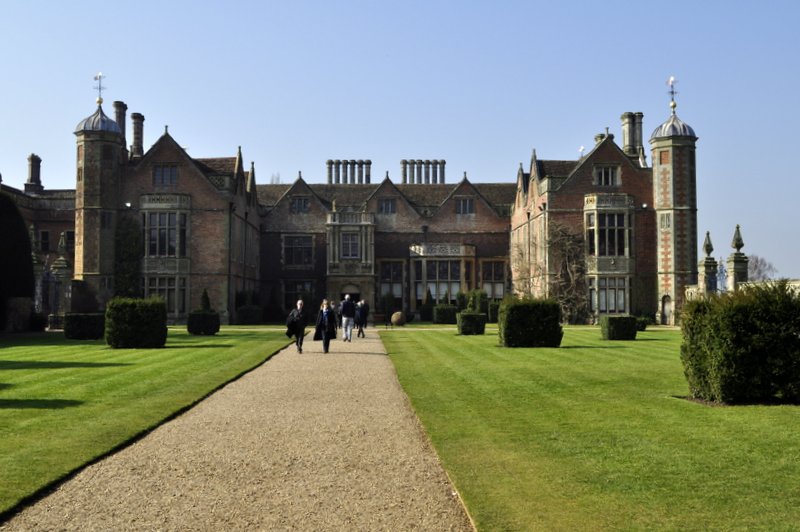
Today, the weather couldn’t be more different than yesterday when, with a clear blue sky and not a cloud, we headed out on our first National Trust visit of 2013. We’d just been waiting for the weather to improve.  And yesterday, Spring had truly sprung. Out of the wind it was really warm; it actually reached 13.1°C at Wellesbourne (one of the warmest places in the West Midlands yesterday), just a mile down the road from Charlecote Park, a Tudor mansion built beside the River Avon in Warwickshire, about half way between Stratford-upon-Avon and Warwick.

The Tudor gatehouse at the end of the main drive, in front of the house

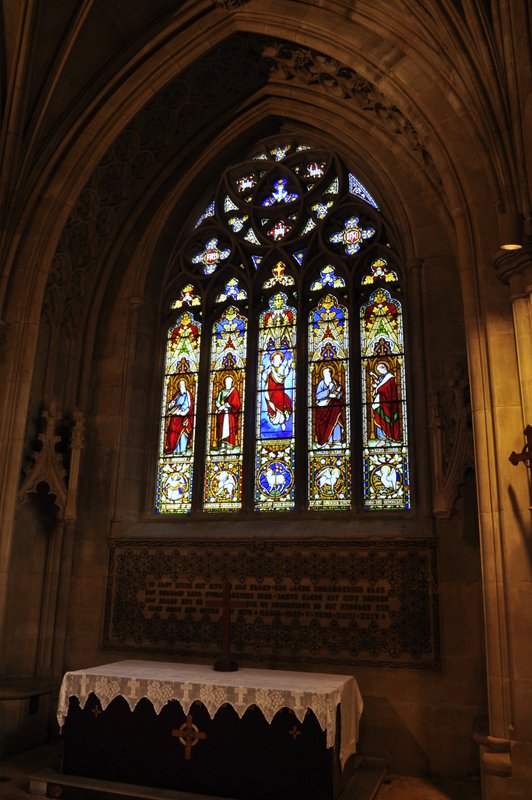
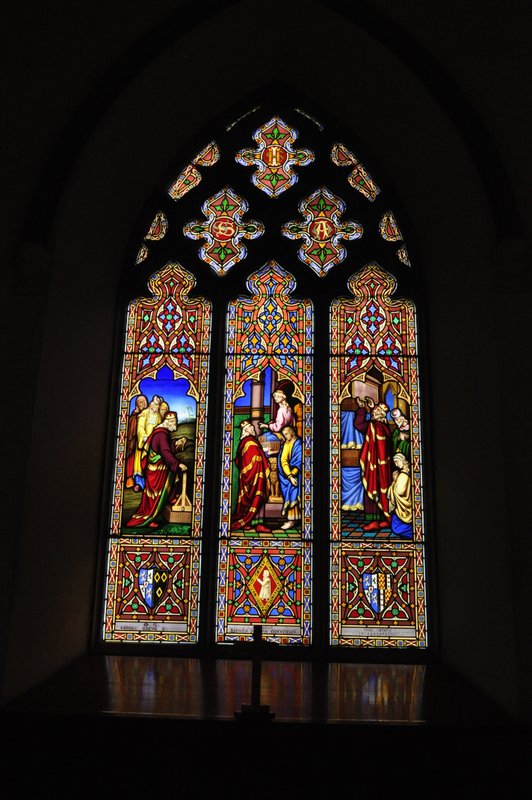
Since we joined the National Trust a couple of years ago, we visited nearly all the ‘low-hanging fruit’ – the properties reasonably close to our home. Hopefully as the weather improves over the coming months we’ll find it easier to travel further afield. Charlecote Park lies at the heart of a rather small estate, only about 75 ha, alongside the River Avon, and is the home (since the mid 13th century) of the Lucy family and descendants. The current house was built by Sir Thomas Lucy in the mid-16th century, but has been extensively modified in the intervening centuries, most significantly during Victorian times. The direct Lucy line died out in the mid-19th century, and Charlecote Park was inherited by the family that still lives in one of the wings, the Fairfax-Lucy’s. The tomb of Sir Thomas Lucy survives in the adjacent church, St Leonard’s, which was founded in Norman times but the building today is mainly Victorian. It has some beautiful stained glass windows, and the sculpted marble or alabaster tombs of Sir Thomas and others taken from the old church.

Stained glass window above the altar in St Leonard's, Charlecote

Stained glass window above the altar in St Leonard’s, Charlecote

Tomb of Sir Thomas Lucy and his wife

In the house there is access to the Great Hall inside the main entrance, the billiards and drawing rooms downstairs, and several bedrooms upstairs, as well as the main staircase. In the grounds are outbuildings housing a collection of Victorian carriages, and the laundry and brewery. In one wing is an immense Victorian kitchen.

In the brew house – there are plans to begin brewing at Charlecote once again

The formal grounds are quite limited – mainly a parterre beside the River Avon, from which there are views across the meadows to the village of Hampton Lucy (about 1 mile away) and what looks like its magnificent parish church of St Peter ad Vincula which, surprisingly, I’ve discovered was built in 1822 and added to 30 years later. In the park there are flocks of rare breed Jacob sheep and fallow deer, the later introduced in Tudor times in the 16th century.

Church of St Peter ad Vincula in Hampton Lucy, from Charlecote Park

Church of St Peter ad Vincula in Hampton Lucy, from Charlecote Park

The parterre beside the River Avon

Legend has it that the young William Shakespeare was caught poaching rabbits in the grounds of Charlecote Park in about 1583 (there’s a second edition folio of Shakespeare’s complete works on display in the Great Hall). The playwright had his ‘revenge’, it is said, on Sir Thomas Lucy by lampooning him as Justice Shallow in two of his plays: Henry IV (Part II) and The Merry Wives of Windsor.

The Great Hall – interestingly, the ceiling is not wood but plaster molded and painted to look like timber

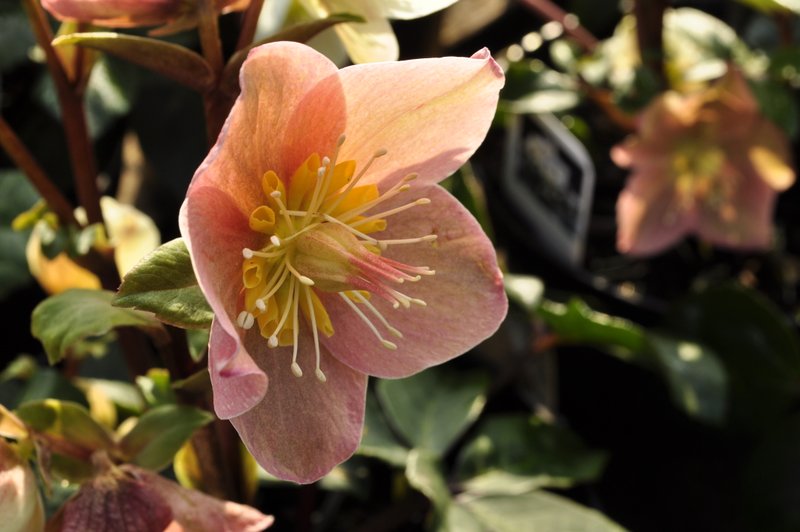
In some ways, this visit to Charlecote Park was a disappointment, despite the beautiful weather. The formal gardens were small – I had expected something more extensive. And access to parts of the house was rather limited, partly due to the fact that some sections of the house were being rewired. Nevertheless there were some beautiful objects on display. There was a large nursery selling plants for the garden – hellebores seemed to be the specialty.

This slideshow requires JavaScript.

Charles Paget Wade – collector extraordinaire

Snowshill. A small Gloucestershire village, nestling under the lip of the Cotswolds north-facing escarpment, with stunning views from Broadway Tower (close by) over the Vale of Evesham immediately to the north, the Malvern Hills to the west, the hills of South Wales to the southwest, and on a clear day (like when we visited just a couple of days ago) for more than 50 miles northwest to the hills of Shropshire, due north to Cannock Chase in Staffordshire, and the skyline of Birmingham creeping over the distant horizon beyond Warwickshire to the northeast. What a glorious part of this green and pleasant land we call England.

The village is home to Snowshill Manor and Garden, gifted to the National Trust in 1951 by its rather eccentric owner, painter-craftsman, and poet, Charles Paget Wade (1883-1956).

An architect by training, and having wealth derived from the family’s sugar plantations in the Caribbean island of St Kitts, Wade purchased Snowshill Manor in 1919 and used it to house his growing – and exceedingly eclectic – collections of craft work, furniture, paintings, and almost anything he considered beautiful.

There has been a manor house at Snowshill for centuries, but the oldest parts of the manor today date from the early years of the 16th century. In the 1920s he began to lay out the gardens in the Arts and Crafts Style, and today these are a delight of understatement: walled ‘rooms’ in the soft Cotswold limestone, broad sloping banks, intimate spaces.

Wade himself lived in a small house in the garden known as the Priest’s House – a rather rudimentary accommodation that he redesigned, installed ‘modern’ plumbing, and filled the house with even more collectibles.

The manor was turned over to his ever-increasing collection that he had begun to assemble as a small boy. His collection is full of extraordinary beautiful objects: oriental furniture, as well as English pieces; suits of armor from the English medieval period, the English Civil Wars of the 1640s, and Japanese samurai armor; many paintings and religious artifacts; bicycles; spinning wheels; and models and toys, among many other things.

Our visit to Snowshill Manor was a slight disappointment – I had expected rather more extensive gardens to wander through. Nevertheless, just seeing what Wade had accumulated through a lifetime of collecting was truly amazing. The collections at Calke Abbey that we saw recently are the efforts of one family. The Snowshill Manor collection of more than 20,000 items is the passion of just one man – Charles Paget Wade.

Just click on the photos below to open web albums.

Ancient woodland . . . and medieval lifestyle

Amid the hills and steep valleys of northeast Herefordshire lies the Brockhampton Estate, comprising some 1700 acres of farmland (with Hereford cattle and Ryeland sheep), woodland, and orchards (especially damsonsPrunus domestica) just a couple of miles east of the small town of Bromyard, and about 11 miles almost due west of Worcester.

The estate was gifted to the National Trust in 1946, and there are now miles of woodland and park trails to wander and stunning views over the Worcestershire, Herefordshire, and Shropshire countryside.

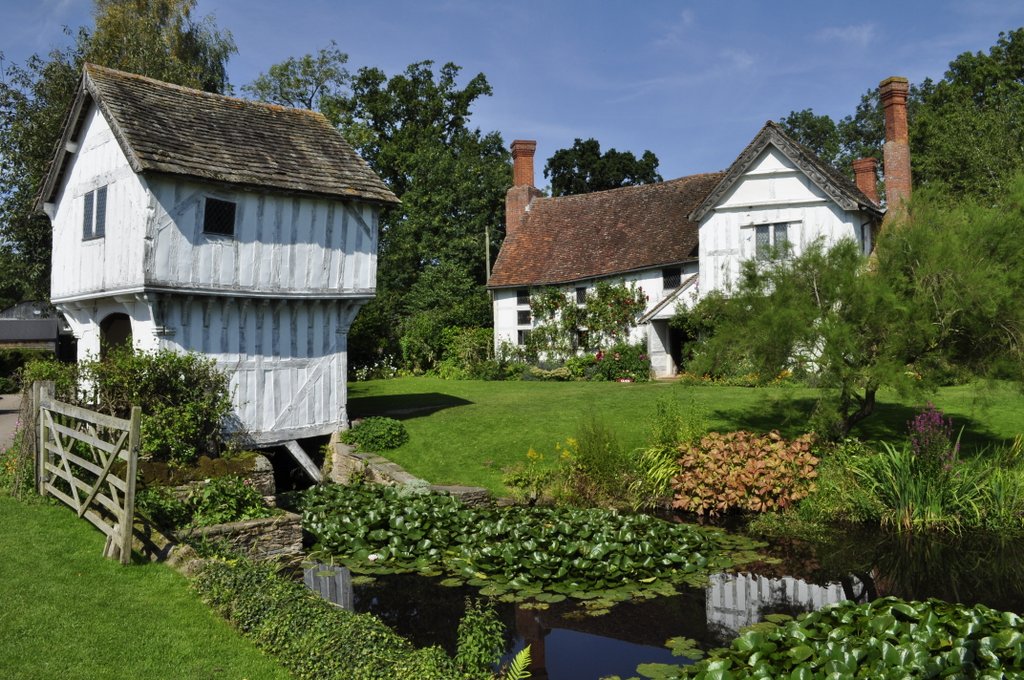
The weather was glorious yesterday, so we took the opportunity of getting to know the Brockhampton Estate (only about 30 miles from where we live), and view the magnificent 14th century moated manor house at Lower Brockhampton.

Approaching the manor house there is an imposing Gatehouse that was restored in recent years. In fact the house has gone through several phases of remodelling and refurbishment throughout its history.

And although the family moved out of the house towards the end of the 18th century (and built an imposing house overlooking the estate – the 100 year lease is apparently up for sale at £3 million!), the manor became a farm and has been lived in ever since. In fact one of the National Trust staff occupies the rear part of the manor.

There are also the ruins of a Norman chapel just to the side of the manor house.

The main features of the manor are the impressive beamed hall, the minstrel gallery, bedroom and study. Downstairs there is a parlor. These are the parts of the house open to the public.

The garden was filled with color, particularly dahlias – not exactly a ‘medieval’ blossom, since these were introduced into England (from their native Mexico via Spain, apparently) at the end of the 18th century or early 19th (I’ve seen 1803 or 1804 as specific dates cited).

Behind the house and across the moat is a large damson orchard. Because of the season this year, the damson harvest is running late, and the amount of fruit we observed on the trees did not seem abundant – probably due to poor pollination earlier in the year. It’s apparently been a very poor year for apples, pears, and plums among other fruit because of the very wet weather we have experienced. This part of the UK (in Herefordshire and Worcestershire) is famous for its apples and pears and other soft fruit.

As the autumn draws in, the swallows and house martins were beginning to gather and feed up their growing fledglings. I haven’t seen so many congregating in one spot for a long time.

In the woodland there are six estate walks ranging from 1 mile to over 3.5 miles. Given the recent wet weather it was very boggy underfoot in some parts on the 3.5 mile Oak Walk that we took (the longest), but on a warm sunny day like yesterday it was a delight to walk through the trees and experience the cool breeze of an ancient English woodland – full of enormous oak and beech tress, some pines, and a few ash.

What a magnificent sight. And just occasionally, as the woodland canopy opened up, views over the countryside to the hills beyond. All in all, Brockhampton Estate was a most enjoyable visit, and certainly one worth returning to at another season.
Click here for more photos.

A state of decline . . . repair, not restore

A few days ago, with a fair to promising weather forecast (it actually turned out much brighter and warmer than expected) we made another of our National Trust visits – this time to Calke Abbey, near the village of Ticknall which lies just to the southeast of Derby (of Rolls Royce aeroengines fame), in the English Midlands.

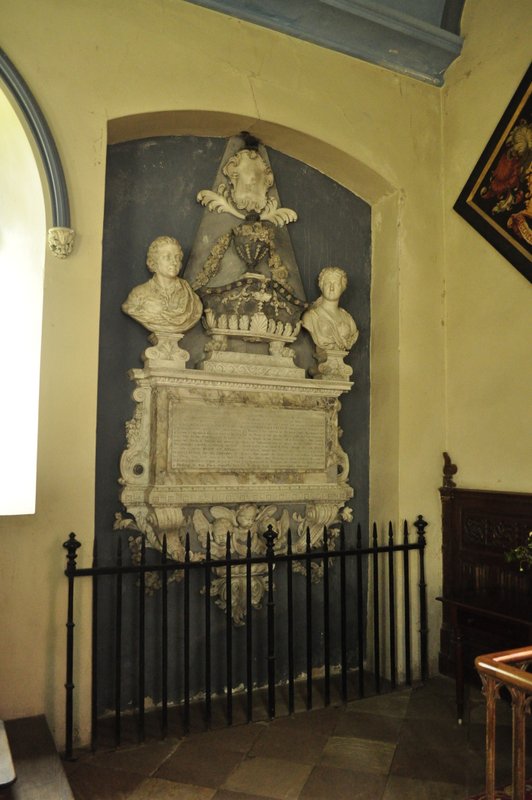
Calke Abbey (incidentally there was never an abbey there, although there had been an Augustinian priory in the vicinity from the 13th century) is a country house, rebuilt between 1701 and 1704 – amid several hundred acres of farm and park land (including a deer park) – by Sir John Harpur, the 4th baronet. His impressive memorial was built in St Giles Church on the Calke Abbey estate.

The original estate was purchased by the 1st baronet in 1622, and remained in the Harpur family until 1985. Sir John Harpur married a daughter of Lord Crewe, and at some date thereafter the family name was changed to Crewe, and then Harpur Crewe. The last baronet died in the early 20s, and the estate passed to a grandson, Charles Jenney – who changed his name to Harpur Crewe. When he died in 1981, the estate was faced with crippling death duties, and like so many ‘stately homes’ it began to deteriorate because the family could no longer afford its upkeep. In 1985 ownership passed to the National Trust. And what a treasure trove the Trust encountered!

It seems the Harpur Crewes were mildly eccentric, didn’t have electricity installed in the house until 1962, and almost never threw anything away – they were great hoarders. So when the National Trust came to inventory the house and its contents, they found a property that consisted entirely of its original contents. Whole rooms, such as the dining room, were furnished just as they had been originally completed in the 18th century.

Normally the National Trust acquires various items and displays them in its different properties according to the period or aspect they want to emphasise. But not so with Calke Abbey – nothing has been brought in. Although extensive roof repairs had to be carried out, there has been remarkably little water damage in the house. Even when the house was occupied, different wings were abandoned after the Second World War, and essentially left to their own devices and deteriorate (these had the feel perhaps of Miss Havisham’s house in Great Expectations by Victorian author and one of the world’s greatest novelists, Charles Dickens).

In the case of Calke Abbey, the National Trust took the decision to repair the fabric of the building (to reduce further deterioration) but not to renovate. So it’s quite fascinating to move through the house and see those parts which continued to be occupied, and those which had been shut up for decades.

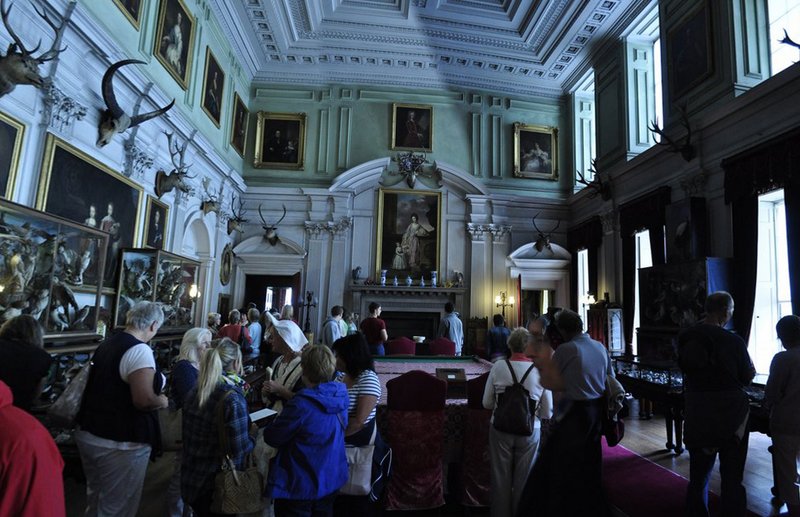
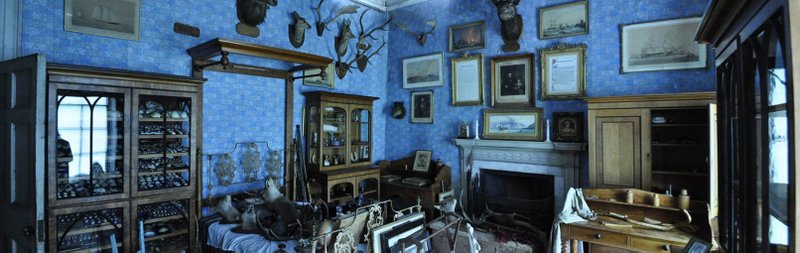
In the entrance hall and lobby there is a number of stuffed heads of longhorn cattle that were once farmed on the estate. In fact, the house is full of stuffed heads of deer – they are everywhere – and throughout the house there are dozens of glass cases of stuffed birds, mainly of British origin, but also fine examples from around the world. It’s a taxidermist’s paradise.

In the caricature room the walls are covered with 18th century cartoons relating to politics and society at that time.

The main staircase is very impressive, and is made from oak and yew.

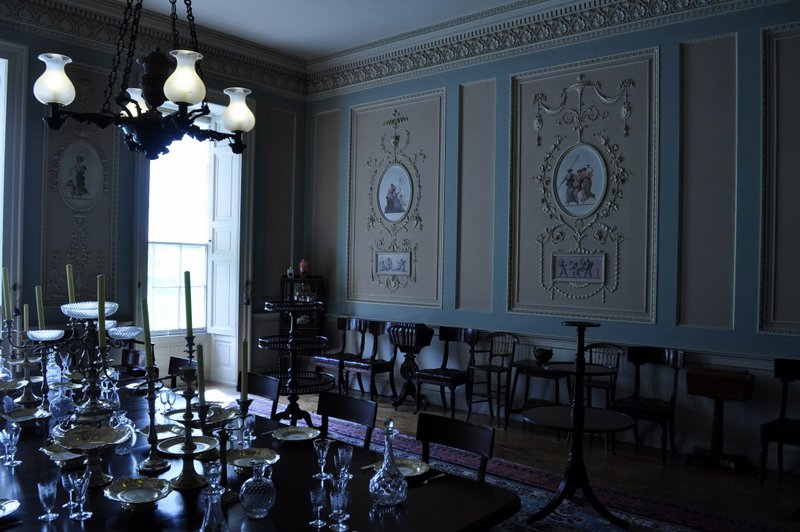
But it’s in the dining room, the breakfast room, and the saloon that the glory of Calke Abbey comes to the fore. The original plasterwork is still intact and speaks volumes for the quality of the craftsmanship of the 18th century.

The bedroom of Sir Vauncey Harpur Crewe remains apparently much as it was when he abandoned it for another when he was married in 1876.

On the National Trust website, it’s possible to take a virtual tour of Calke Abbey, which certainly gives you a feel for the house and its contents. I have also posted a web album where you can see many more photos from inside the house and the park and gardens.

A short distance from the house stands St Giles Church, and there is a beautiful stained glass window above the altar that was installed by Sir George Crewe who died in 1844.

There is a formal garden, and a walled kitchen garden (that was formally much larger) in addition to the farm and parkland. And two very interesting features are the tunnels that connect the gardens with the house, and one from the wine cellars in the house to the brew house, alongside the stable yard. This tunnel weaves for about 100 m, and allowed domestic staff to pass from the house to the brew house without being seen!

Calke Abbey was certainly more than I had expected, and is a fascinating insight to 18th and 19th century living.

Among the green hills . . .

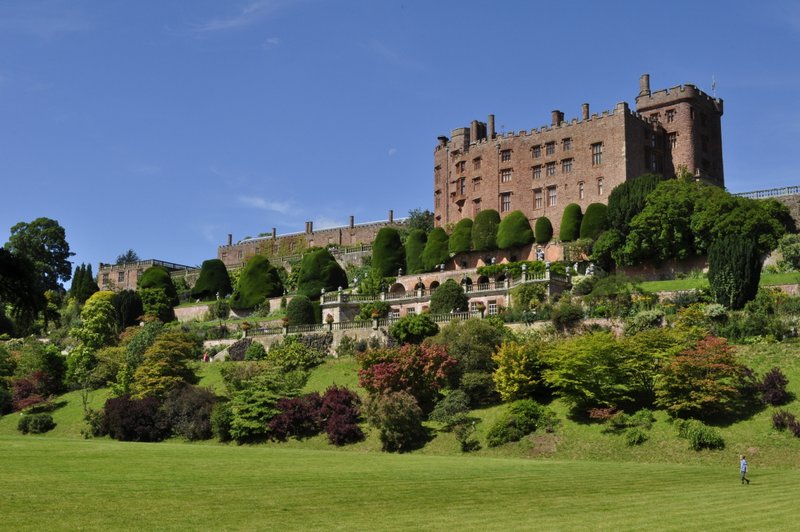
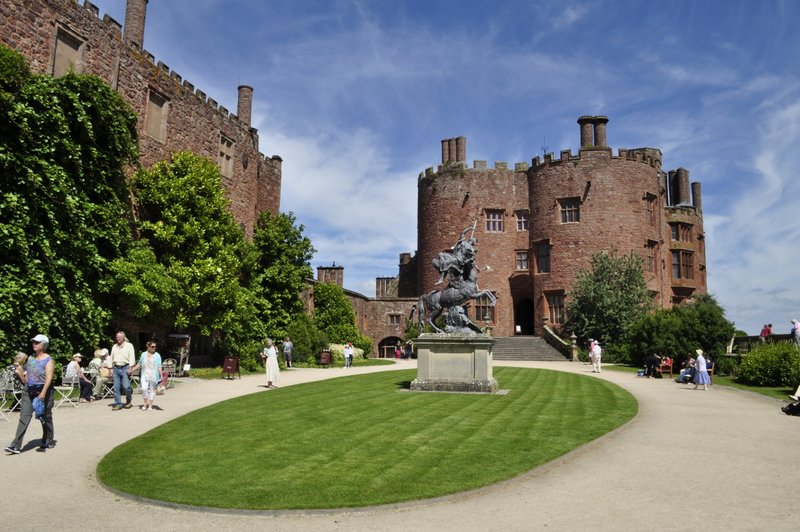
Powis Castle. A jewel among the rolling hills of mid-Wales just south of Welshpool, on the border with the English county of Shropshire, some 80 miles by road from my home in Bromsgrove.

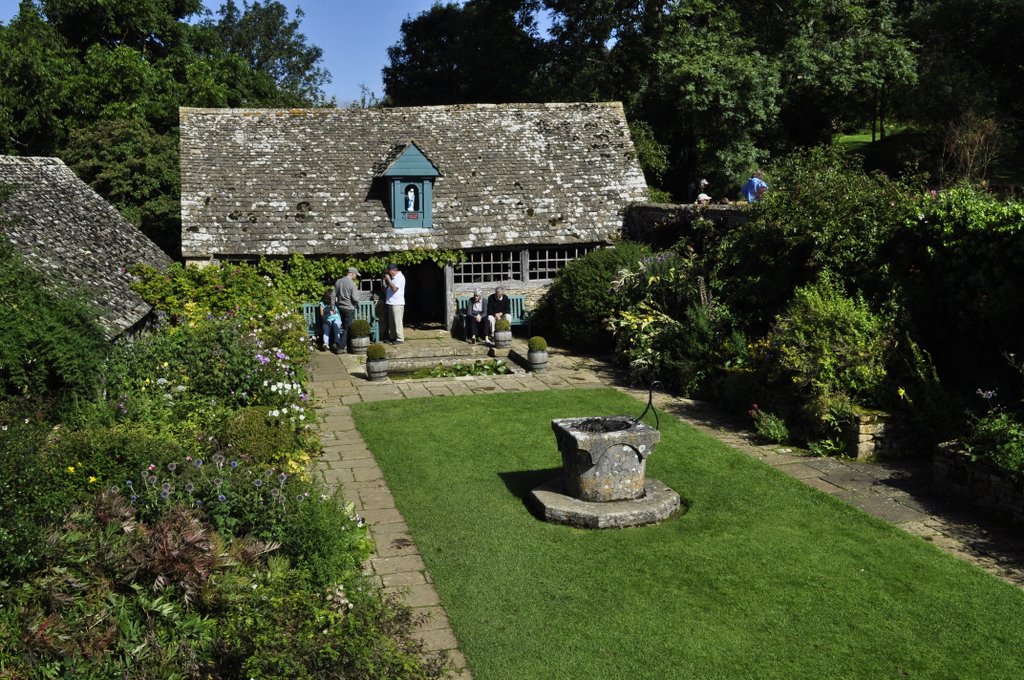
The original fortress was built around 1200, but over several hundred years it was extensively rebuilt and remodelled, reaching its zenith in the late 17th century under the Stuarts and into the 18th century. While many castles in Wales were built by the Normans post conquest to keep the Welsh under control, Powis Castle was built and retained by a local family, the Herberts, who accumulated power and were given titles under various monarchs, especially the Stuart monarchs Charles II and James II.

The Herberts fought on the Royalist side in the English Civil War, and the castle was eventually occupied by Cromwell’s Parliamentary forces. The Herberts were Catholic, and the then Lord Powis went into exile with James II in 1689, although his lands and estate were returned in about 1725.

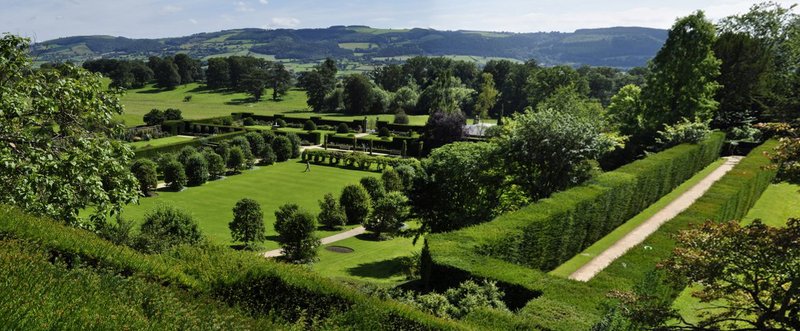
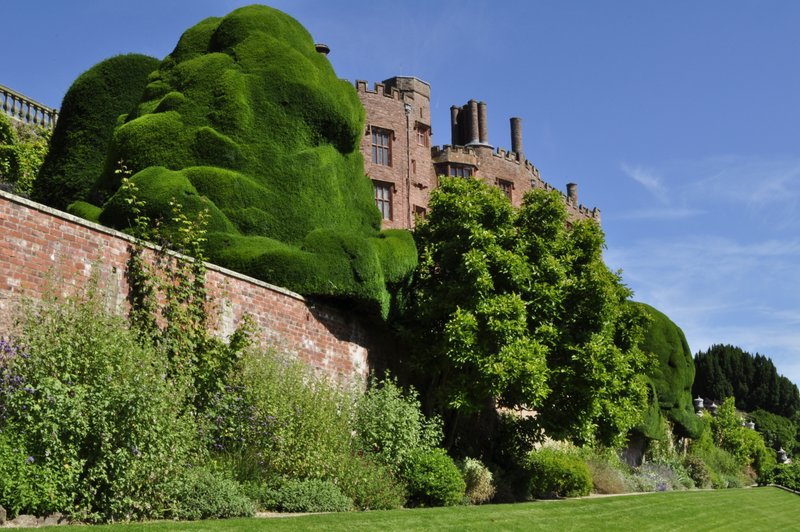
Built on a craggy rock, the castle and gardens owe much to 17th century investment, with formal gardens laid out on a series of very steep terraces cascading down from the house to a large lawn and formal garden that was once a vegetable and fruit garden.

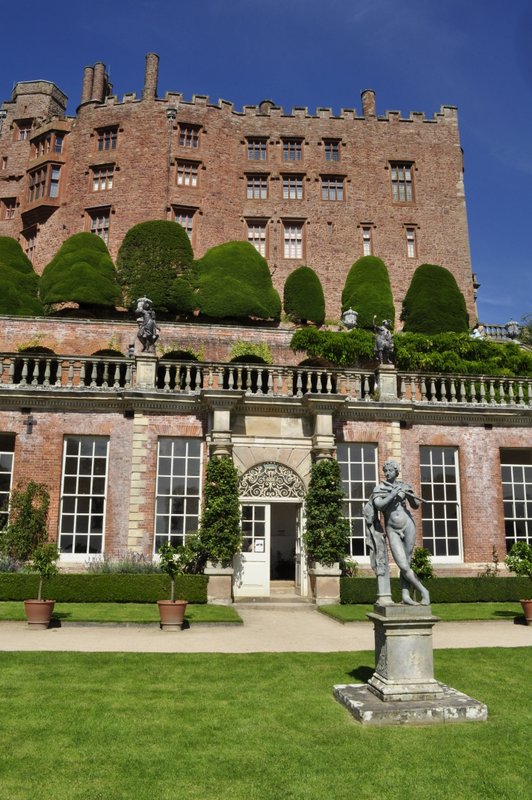
All around are quite large, sculptured yew trees that were planted in the 1680s. Originally they were allowed to grow ‘naturally’ but in the 19th century the change in horticultural taste was for a more formal look.

The terraces are full of colour, and the garden staff have taken great care to label many of the plants.

In the 18th century, one of the Herbert daughters married the son of Clive of India, and the castle houses a large collection of Clive memorabilia. While the National Trust owns and manages the buildings and gardens, it does not own many of the furnishings. As a consequence photography is not permitted inside the castle, so the only photos I have to show are external views of the castle and round the gardens.

The weather was fantastic, and we thoroughly enjoyed our visit to Powis.