Sister, nanny, nurse, wife, mother . . .

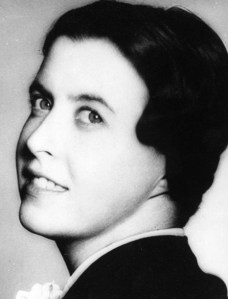
Lily May Jackson, née Healy, was born on 28 April 1908 in Shadwell in the East End of London, where her father, Martin Healy was a police officer with the Metropolitan Police. There were good Irish names in the family: Healy, Lenane, Phelan, Fitzgerald. After her father’s retirement from the Met, the family moved to Hook Road in Epsom, Surrey.

She died on 16 April 1992, just shy of her 84th birthday. Although christened as Lily, she was known as Lilian.

She was a beautiful woman, and she was my Mum.

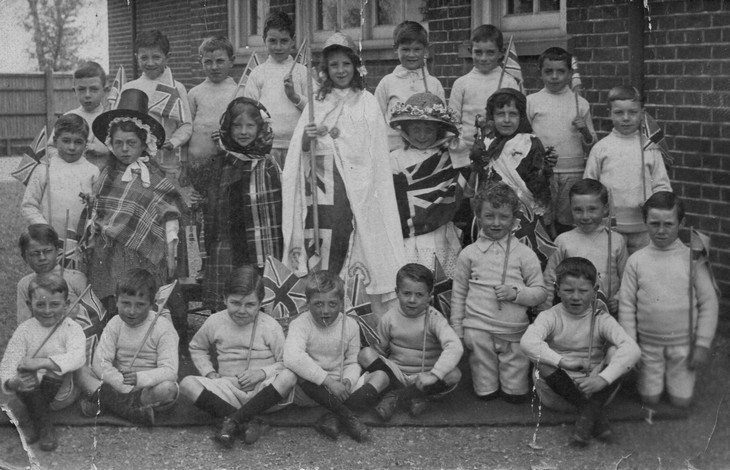
This is the earliest photo I have of her. It was taken on 1 May 1915, and she turned seven just a week earlier. She is second from the right in the middle row.
The Healys
Mum was the second child of eight. Her elder sister Margaret died in 1927 just before her 21st birthday. I wonder how close Mum and Margaret were? Mum had already been in Canada for six months when Margaret died. I wonder if she knew how ill Margaret was before she emigrated? How must have Margaret’s death affected her? There’s no record of her returning to England for the funeral – that would have been simply too expensive.

Her four younger sisters and two brothers were: Ellen (1909-1980); Ivy Ann (known as Ann, 1912-1998); Martin Patrick (known as Pat, 1914-2012); Eileen (1918-1994); John (1919-1994); and Irene Bridget (known as Bridie, 1921-1993).

I have no recollection of ever having met Ellen. I met Pat twice (in about 1955 and 1965 or so), and Mum reconnected with Ann in the mid-1960s and remained in contact afterwards. In about 1970 Bridie came over to the UK – probably the first time since she emigrated after the war, and that was the only time I met her. On the other hand Eileen and John were always in close contact with our family. In early 1955 or thereabouts –  but before
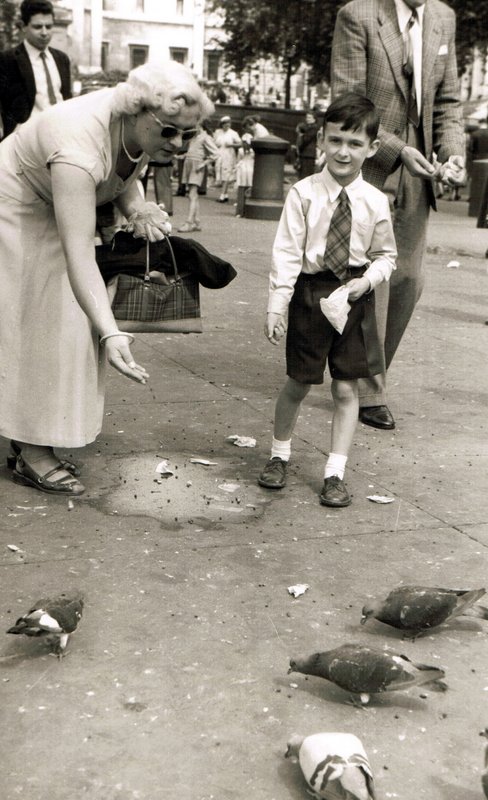
Eileen married Roy in May 1955 – I spent a week or more with Eileen at the family home in Hook Road, Epsom, Surrey. During that stay we visited John and Barbara at Worcester Park close to Epsom where John had his own gentleman’s outfitters business, and he gave me a red plaid tie. I wore that next day on a trip into London. Then she took me and my cousin Chris (born 1944), John and Barbara’s son, to Southend-on-Sea to visit Pat. I think he was a policeman there.
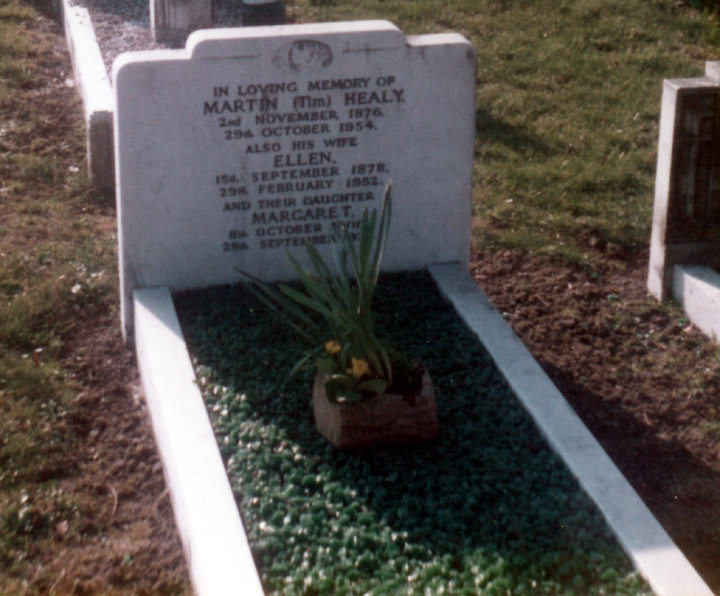
I guess Mum lost contact with some of her family because there was no longer the ‘focus’ of parents bringing everyone together from time-to-time. My grandmother had died in 1952 followed by granddad Healy in October 1954. I only met my grandmother once – I was very small and vaguely remember seeing this old lady in bed in a care home.

Eileen was quite a regular visitor as I was growing up in the 50s and 60s. She often needed hospital treatment and stayed with us to recuperate on one occasion after an operation at a hospital in The Potteries. John and Barbara became lifelong friends with my Dad’s elder sister Wynne and her family, and we’d often meet up on holiday in Saundersfoot in Pembrokeshire.
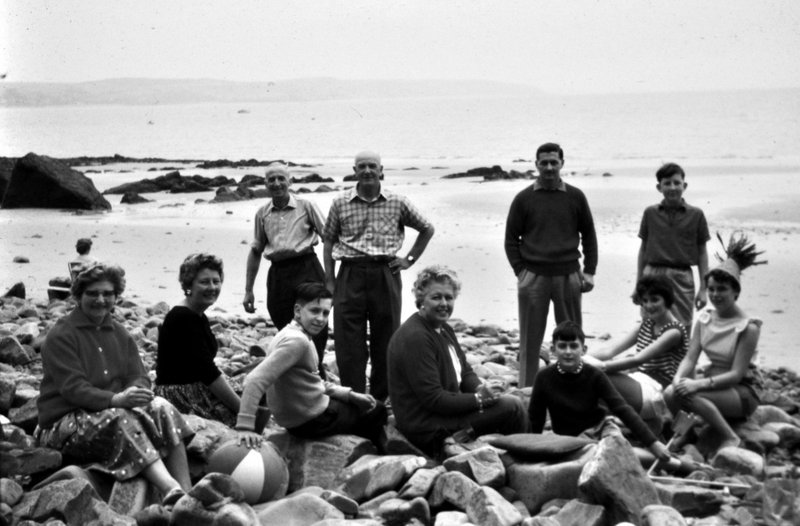
L to R: Wynne (Dad’s elder sister), Barbara Healy, Dad, Ed (my elder brother), Cyril Moore (Wynne’s husband), Mum, John Healy, me, Diana Moore (cousin), Chris Healy (cousin), Mary (Diana’s closest friend) – enjoying the beach at Saundersfoot, c. 1961
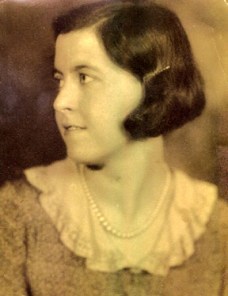
Healy, Lilian 6g

A new life across the Atlantic
Mum emigrated to Montreal, Canada in 1927 at the age of 19 to work as a nanny for a Mr and Mrs de Lothiere; then she moved to New Haven, Connecticut in 1931 and shortly afterwards to New Jersey in the USA. There she trained as a nurse and graduated in May 1936 from The Hospital and Home for Crippled Children, Newark, looking after children suffering from polio and tuberculosis. I wonder if it was exposure there to tuberculosis that led to me acquiring immunity to this terrible disease? I say ‘shortly afterwards’ about her move to New Jersey because Mum once told me about the ‘Crime of the Century‘ in March 1932 when the son of famous aviator Charles Lindbergh was kidnapped, and she remembered all the police activity.  She also knew New York before the Empire State Building was completed. We don’t know exactly what Mum did between leaving school and emigrating, but the manifest of the Cunard liner RMS Andania on which she sailed to Quebec from Southampton listed her as a ‘stenographer’.

Becoming a wife and mother
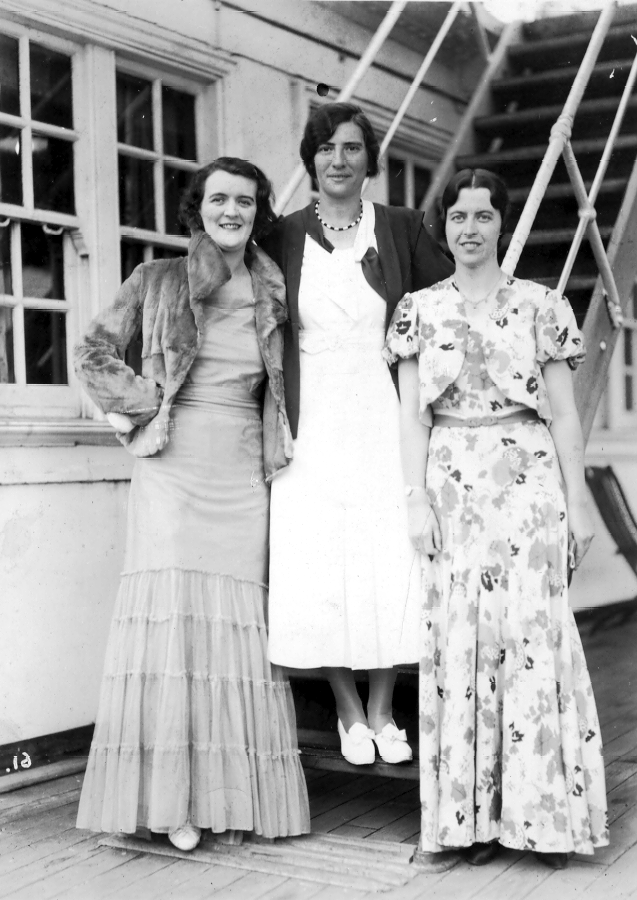
Mum first met my Dad on board a Cunard White Star liner in 1934 (probably the RMS Aquitania on which he served as a photographer for many of his transatlantic crossings) when she returned to England to see her parents and, with two friends asked him to take their photo. The rest is history!
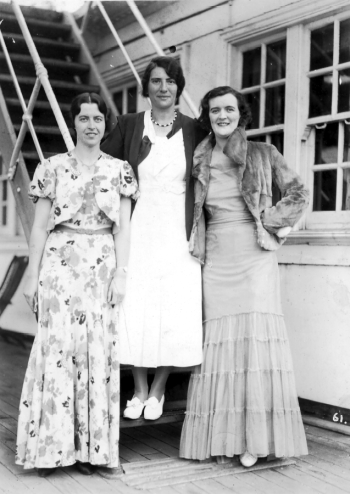
They were married on 28 November 1936 at St Joseph’s Roman Catholic church in Epsom, Surrey, less than a fortnight before the abdication of Edward VIII on 10 December.
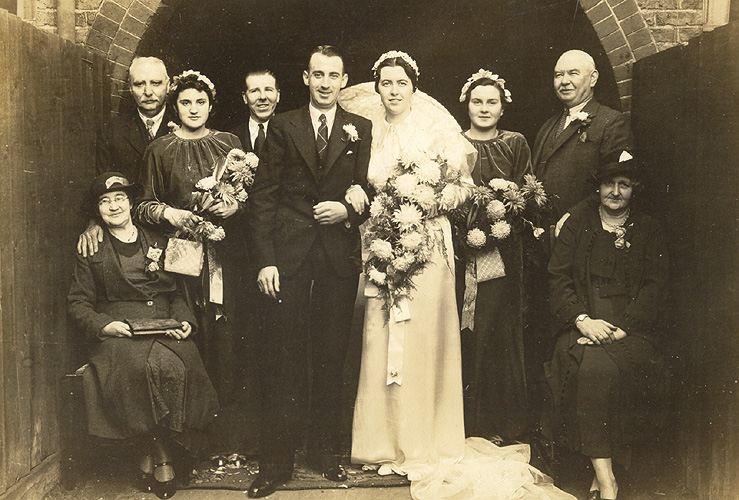
L to R: Alice Jackson, Thomas Jackson (Dad’s parents), Rebecca Jackson (Dad’s younger sister), Ernest Bettley (Dad’s best man and a longtime shipmate), Dad, Mum, Eileen (Mum’s second youngest sister), Martin Healy, Ellen Healy (Mum’s parents), photo taken at Hook Road, Epsom, Surrey.

Mum and Dad made home in Bath in Somerset and my eldest bother Martin was born there in 1939, just three days before war was declared on Germany. They moved to Congleton before 1941 because my sister Margaret was born there in January 1941. Dad served in the Royal Navy during the war, and Mum, Martin and Margaret lived some of the time with the Jackson in-laws in Hollington in Derbyshire. After the war, they returned to Congleton where Ed was born in 1946, and I followed in November 1948. In April 1956 we moved to Leek where Dad opened his own photographic business.

Mum and Dad were devoted to each other. They enjoyed a shared love of ballroom dancing, of whist, and were both very active in local groups in Leek, Mum with the Townswomen’s Guild (and amateur dramatics) and Dad with the Leek Camera Club.

Most years they would take a camping holiday in Wales (often with Ed and me in tow) mostly under canvas, but for a couple of years in a caravan. From the mid-60s they ventured more into Scotland on their own.

After Dad retired in 1976 and they sold the photographic business, Mum and Dad fulfilled a long-held ambition: to see the Grand Canyon. And so, 40 years after they had left the USA, they returned, visiting the West Coast, Yosemite, the Grand Canyon, and all places in between, and up to Alberta where my brother Ed lives.

Sadly Mum was widowed in 1980, but she continue to live, alone, in Leek. In late 1990 however, she suffered a stroke and was not expected to live more than a couple of days. But she did, and eventually moved into a nursing home in Newport near to where my sister Margaret and her husband Trevor then lived. I saw my Mum for the last time in June 1991 shortly before I moved to the Philippines to work at the International Rice Research Institute (IRRI). In April 1992, Steph, our two daughters Hannah and Philippa, and me had just arrived for an Easter long-weekend away at the beach when we received the news that Mum had passed away peacefully in her sleep the night before. I then made arrangements to fly back to the UK for her funeral. Eileen and Roy also attended the funeral. A couple of years later, Eileen’s health took a turn for the worse, and was hospitalized. It was early November 1994 that I happened to be in London on a work-related trip for IRRI and took the opportunity of visiting Eileen and Roy in Epsom. Eileen  passed away about three weeks later.

I have long since stopped grieving for my Mum – or for my Dad for that matter. Martin, Margaret, Ed and me are left with beautiful memories of our wonderful parents. Fortunately we also have a photographic legacy as well to support those memories – that fade just a little more with each passing year.

An extraordinary ordinary man . . .

Frederick Harry Jackson. Born 15 September 1908, died 29 April 1980, of heart failure. My Dad.

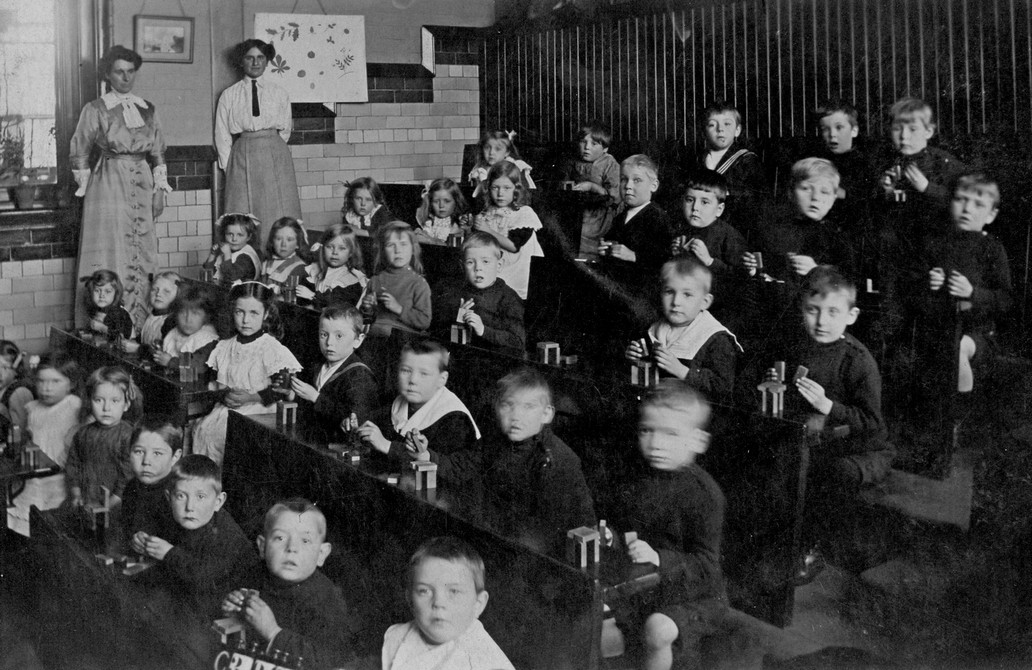
This is the earliest photo I have of him, as a young schoolboy. When was it taken? I can’t say, but he looks about seven, so it must date from around 1914 or 1915. He’s on the extreme right, third row back.

Why an extraordinary ordinary man? I’ll let my brother Ed explain: Why was Dad’s life exceptional? On the one hand he had no formal academic education beyond the age of 16 (although he did attend technical courses associated with one job or another over the course of his life). He married at the conventional age of 28, fathered four children, supported his family to the best of his ability, ran his own business, retired at a reasonable age, and enjoyed a short but happy and fulfilling retirement. Ordinary, yes, but this same man crossed the Atlantic Ocean ninety-nine times, photographed some of the most famous film stars of the 1930s, fought in the Second World War, became a local newspaper photographer (the Congleton Chronicle), and then took an enormous economic and emotional risk by opening his own photographic business and shop [in Leek] at the age of 48, with no assurance at all of success and a family of six to support. Not only was he civic-minded, he became a town council member in one town (Congleton), and later the Chairman of another town’s council (Leek).

Chairman’s Sunday in Leek, 1968

Dad was a photographer all his life, and I guess some of my own love of photography was ‘inherited’ from him. I was seven in 1956 when we moved from Congleton to Leek, and until I moved away to university at the age of almost 19, I helped out on many occasions in the shop and in his darkroom. The hours I spent agitating prints in baths of hypo, then washing them in running water, finally putting them to dry on a drum dryer. In Congleton, I used to visit Dad in his workroom at the Congleton Chronicle – and last September I had chance to visit there after almost 60 years!

Dad spent quite a few years as a photographer on board ship during the heyday of maritime travel in the 1930s, mostly with the Cunard White Star line, sailing from Southampton to New York, and often on winter cruises down to the Caribbean and the east coast of South America as far south as Buenos Aires. Shortly before he died, Dad put the finishing touches to a short memoir he’d written called Gathering No Moss. I can think of no better way than letting some of his own words speak for themselves.

Early days
By the time I was twenty, I had an urge to spread my wings, and also to improve my modest earnings, so I applied for and secured work with a firm which specialized in maritime photography, and supplied staff to do the photographic work on cruise liners. Cruising was by no means a new thing, and general photography at sea had been practiced for many years even as early as 1929. Our first voyages were a series of cruises from this country to Scandinavia that summer, and the memory of these days, fifty years on, is as vivid as ever. One memorable evening, when we were in the Norwegian fjords, stands out above all others, when, coming up on deck after dinner, we found a scotch mist falling, and cottonwool puffs of cloud floating along almost at eye level. Our work brought us into regular contact with all our passengers, and we lived almost as well as them, but technically we came under the jurisdiction of the captain, and signed “ship’s articles” as unpaid members of the crew.

Just look at the size of the half-plate reflex camera my father is toting. I often wonder what he would have made of the digital photographic revolution. I’m sure he would have seized it with enthusiasm given the number of 35 mm slides he took over the years many of which we have been able to save through digitizing.

Here’s what he had to say about working on board ship:
The setup on board may be worth a mention at this point. Very few of the vessels we worked on had been specifically built for cruising; indeed some of them were far from suitable for a life in the Tropics, and having been originally constructed to carry three classes of passengers, had ample space to spare below decks in the unused Third class, where we housed in comparative comfort. We ate in an otherwise generally deserted Tourist class dining room, along with other spare parts like ourselves: orchestra, pool attendants and the like. Almost invariably, our darkrooms were makeshift affairs in unwanted bathrooms and toilets. We needed to be near a source of fresh water, anyway, and an empty bathroom could easily be blacked out to make an adequate darkroom, with wet and dry benches.

Meeting and photographing the stars
The 30s were the age of sea travel, so if you wanted to travel to the USA, then ocean liner was really only the feasible way to go even though airships and seaplanes filled the need – but only partially.

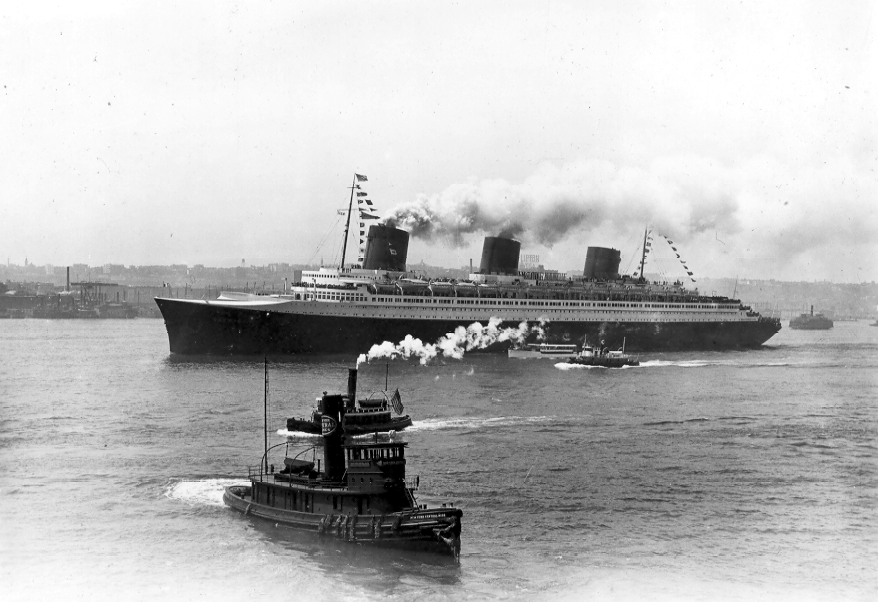
Actually, there were more ships plying the Atlantic than were really needed, and with the marriage of the Cunard and White Star fleets, it was not long before some reduction in tonnage took place. First to go was the biggest of them all, the ex-German liner Majestic, sold in the first instance to become a training ship, but soon to be sent to the knacker’s yard. [I believe that the end table that sits in my hallway came from the Majestic]. This and several other ships had been handed over as reparations after the war, but fairly soon the Germans were allowed to rebuild, and entered the lists with two crack liners, faster than anything else afloat, and being brand new, proceeded to cream off the best of the trade. It was not until the arrival of the Queen Mary and the Normandie some years later that the balance was restored.

SS Normandie steaming into New York

SS Normandie steaming into New York

Meanwhile, we still had our fair quota of near millionaires, people of title and stars from stage and screen. Hardly a voyage passed but what we had on our passenger list names that were very much in the public eye. Many of them, of course, are but fond memories, but perhaps my favourite star passenger of those days, and very much a force to be reckoned with still in Hollywood, was Bette Davis. I photographed her immediately on leaving Southampton Docks, hurriedly processed the results, and was able to dispatch copies back to head office by the time we called at Cherbourg. I also had prints made which I asked her to autograph, and I feel that she was quite impressed with my achievement. Yet another, Bessie Love, of the silent era, crossed with us to England at one time, and has stayed here ever since. Two British women, who are still very much in the forefront of our theatrical scene, who traveled with us on more than one occasion, were Anna Neagle and Evelyn Laye. I like to think that it was our slightly old-fashioned shape, rather than the floating hotel furnishings of our more modern sisters, which appealed to so many of our customers, who would travel with us repeatedly rather than elsewhere.

RMS Aquitania

Dad’s favorite ship, the RMS Aquitania

Here are some of the stars that Dad photographed, many on the RMS Aquitania: Madge Evans; Robert Montgomery; Merle Oberon; Marlene Dietrich; Jean Muir; Jack Hulbert; Frank Lawton and Evelyn Laye; Bette Davis; and the incomparable Cary Grant.

Other cruises took Dad south to the Caribbean and South America.

And finally, it was through his photographic work for Cunard White Star that Dad met my Mum. She had left England in 1927 when she was 19 to work as a nanny in Montreal. After some years she moved to New Jersey to train as an orthopedic nurse. It was on one of her return trips to the UK to see her family that they met. Again, let Dad tell the story:

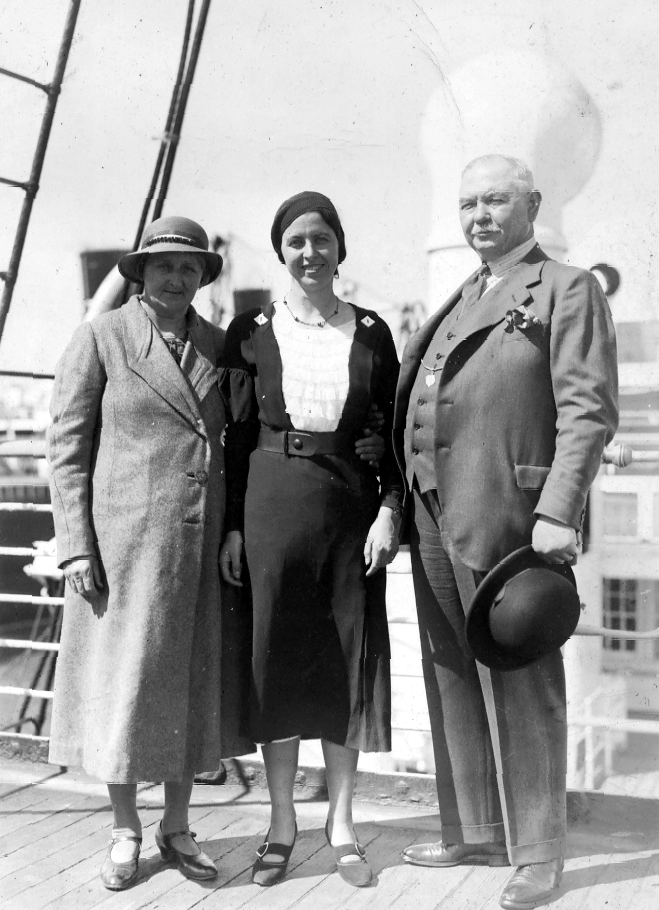
It was literally in the middle of the Atlantic that I met the girl who was to become my wife a few years later. My camera work was entirely devoted to photographing our passengers and their activities, and it was about halfway through the five day voyage that Lilian and two of her shipboard acquaintances asked me to photograph them before dinner. I am often reminded that initially I fell for another girl, but I must have known a trick or two, as before I let Lilian disembark at Southampton I persuaded her to part with an address where she could be found on her return to the States after her holiday at home in the U.K. She was met by her parents who came on board, anxious to see their daughter after so long a time, and I photographed them together, little realizing that I had just met my future mother and father-in-law.

That’s Mum on the left – she must have been about 26

Mum with her parents, Martin and Ellen Healy on board in Southampton Docks

By the autumn of that year, I ventured to ring Humboldt 2-7600, the nurses’ home attached to the hospital where she had taken up nursing training, a few miles across the river in Newark, New Jersey. From then on, the brief hours we had ashore in the States were spent in nipping over to Newark, and before long I had decided that this was the girl for me. Late on in the evening of Friday, December 13th the following year I came to the conclusion that I must do something about it, and popped the question at a few minutes before midnight on the steps of the nurses’ home. Getting an instant and emphatic “yes”, I journeyed back to New York with my head in the clouds, and to the uptown beer garden where I knew I should find my mates, and celebrated in no uncertain style.

Mum worked as a nurse for a while, but eventually returned to the UK and Mum and Dad were married in November 1936. Just before leaving New York they took time out to view the SS Normandie:
She eventually returned to the U.K. in preparation for our November wedding, travelling with us on the Aquitania, this time as a V.I.P. with a cabin to herself on “C” deck, a kindly gesture by the Cunard office staff in downtown New York, where we went to book her passage. While still in the States, we paid a memorable visit as sightseers to the French liner Normandie, latest and biggest of the Atlantic ships . . . 

And here’s Mum getting to know her future in-laws, my grandfather and grandmother Thomas and Alice Jackson.

Mum with her future in-laws, Thomas and Alice Jackson, on board ship in Southampton Docks

I was working abroad in Costa Rica when Dad died in 1980. I was not able to return to the UK for his funeral. And in some ways it was fortunate that I didn’t travel as our daughter Hannah who had just turned two a few days earlier was taken quite ill. And since we lived more than 70 km on a difficult road from the capital San José and better medical help I was at least on hand to run her to the pediatrician on several occasions.

But with Gathering No Moss – and a wonderful collection of photographs – my extraordinary Dad has left me and my brothers and sister some extraordinary memories to savour.


With a little help from my friends . . .

These days, I feel I can easily remember things that happened decades ago during my childhood. Ask me what I did yesterday or at least during the past few days and I often struggle to remember the details.

But recently I’ve been reminded of things that did happen 50 or more years ago that I had most definitely forgotten. And through the power of the Internet, and most probably Google, I have reconnected with a couple of childhood friends who I had not been in contact with for more than 50 years.

When I started this blog more than two years ago I never expected that long-lost friends would be in contact with me.

Almost two years ago, on 5 April 2012, I posted a story about the Beatles and my childhood love of skiffle music. I included this photo, and mentioned that the boy and little girl listening to me and my brother Ed were my best friend in Leek, Geoff Sharratt, and his sister Susan. A few months later I was contacted by Susan who had been doing some genealogy research and came across my blog. I’ve been in touch with Geoff on a regular basis since then, and posted another story in November 2012 about us renewing our friendship. We certainly had a lot to catch up on.

skifflepic

The Jackson Duo strutting their stuff, watched by their mother and friends Geoff and Susan Sharratt

5. Geoff, Sue and Mike Jackson above Rudyard Lake

Geoff, Susan and Mike in the late 50s, overlooking Rudyard Lake near Leek

Geoff and Sue

Geoff and Sue

Then in the middle of February, out of the blue I received a message from Alan Brennan, my first and best friend when I was growing up in Congleton. Alan has certainly filled in some gaps in my memories. I left Congleton in April 1956 when I was seven; Alan is 13 months younger than me. Although we lived just a few doors away from each other we didn’t go to the same school. But whenever we were home it seems to me that we were inseparable and got into some scrapes.

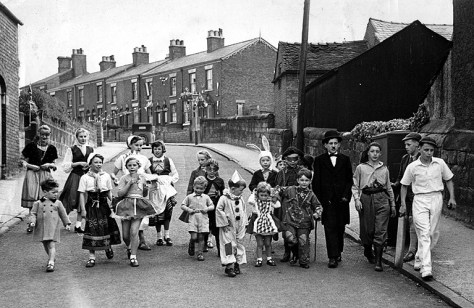
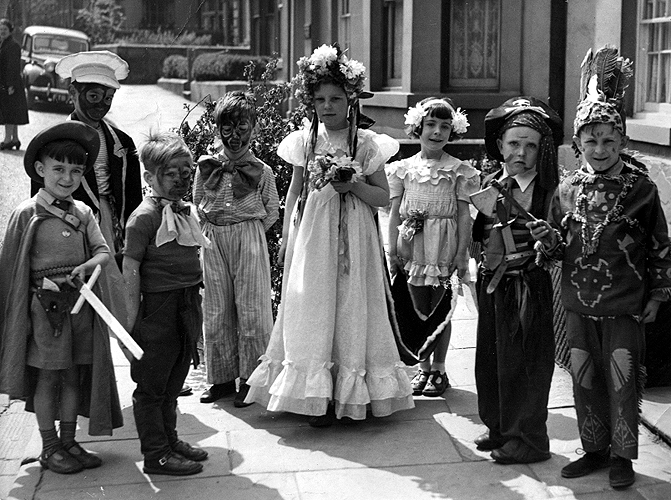
That’s me in the center of the photo below, partially dressed as a native American (sans war bonnet) and carrying a stick. Alan is to my right, the little boy looking rather shy in short trousers in front of the pirate, my elder brother Ed.

Coronation Day 1953

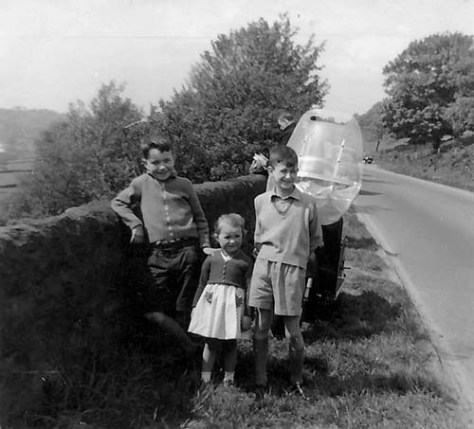
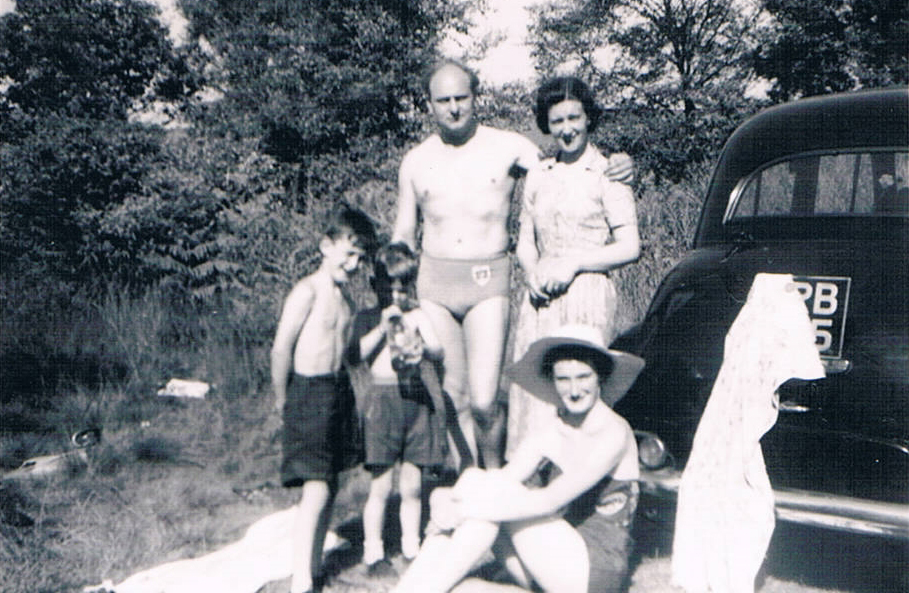
Alan has continued to live in Congleton, and like me has now retired. Here are a couple of photos he sent me recently. In the 1955 photo we were having a picnic at Rocky Pool near Timbersbrook, just east of Congleton. Alan’s parents are standing, a family friend is seated. In the background is the Brennan’s car – a Vauxhall Wyvern. I mentioned to Alan in one of our emails that I did indeed remember the car and thought it was a Wyvern, which he confirmed. The old memory was certainly working on that detail!

Summer1955mjPhotos (1)

May Day celebrations, pre-1956. That’s me on the left, and my brother Ed on the right. I’m not sure if that’s Alan standing on my left. Looks like Alan’s Dad’s car in the top left corner.

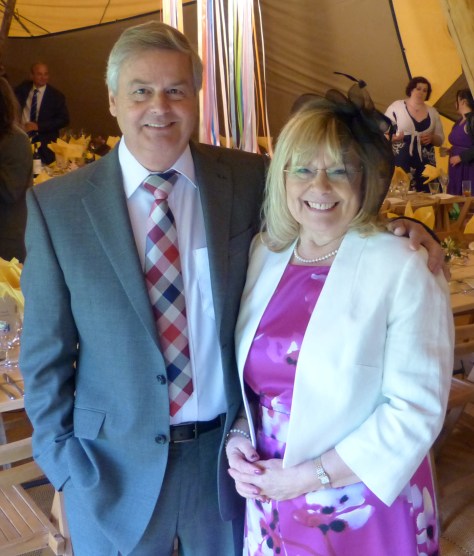
Alan with his wife Lyn

Alan with his wife Lyn

A modern plague . . .

tb-alertJust a couple of weeks ago I watched a 90 minute documentary on BBC4 that left me depressed yet at the same time somewhat optimistic. I haven’t watched a program like that for a long time that had such an emotional impact on me.

TB: Return of the Plague documented the rise and impact of multi-drug resistant tuberculosis (MDR-TB) in Swaziland. Although it wasn’t explicitly mentioned, as far as I can recall, the increase in TB seems to be linked with the the spread of HIV/AIDS as patients immune systems are compromised by the virus. The deadly evolution of MDR-TB has occurred because TB patients have failed to complete the course of treatment against this disease. And even now the disease has evolved into EDR-TD, or extreme drug resistant forms.

Doctors – and patients – face a difficult dilemma. It may take six months to two years or more to ‘cure’ someone with MDR-TB, or at least show that they are no longer infectious, and the ‘cure’ seems almost worse than the disease. The ever stronger cocktail of drugs (ever more powerful antibiotics) have terrible side effects – injections and pills – have terrible side-effects: continual vomiting and loss of hearing among the nastiest. And so many patients despair of ever getting better and simply stop taking the drugs. When patients are too weak to continue taking the drugs because of the side effects, doctors are reluctant to stop treatment because of the risks that the pathogen will mutate once again There have been no new drugs for decades to combat TB.

This was the situation of Bheki, once a healthy and hard-working man in his 30s, whose passion was football. TB has robbed him of the energy to play any longer – all he can do is watch from the touch-line and encourage those who can play. It was heart-wrenching to listen to his despair; he just couldn’t take the pain any longer. And what was worse, his sister Zandile died of TB – she wasted away because she no longer had the strength to withstand the ravages of the drugs on her emaciated body.

Listen to the despair of this young woman robbed of her youth and opportunities in life because of MDR-TB. Not long after this was filmed sadly she died.

There is hope
Yet the program was also full of hope. Take the case of 13 year old Nokubheka who had lost her mother to TB. Supported by her 17 year old brother, she became an in-patient at a TB hospital far from home, and had to remain there for more than six months, taking her drug cocktail daily, until she was no longer infectious. She was lonely (all the other patients were adults) and many died. She was separated from her brother, who she missed. But, at the end of the day, Nokubheka recovered, was fostered with a well-to-do family (who had a daughter just a little younger than herself), she returned to school and was once again developing an optimistic outlook on life. Her ambition was to study, go to university and then work for the future of her country. I was left with the encouraging image of a little girl with a broad smile. Now that’s optimism for you.

We can eradicate disease
Recently there have been reports of the resurgence of other diseases. Only today on the lunchtime news there was a report of a new outbreak of the Ebola virus in West Africa. And while smallpox has been eradicated some years ago, polio stubbornly hangs on in Pakistan, Afghanistan, and northern Nigeria – yet the prevention of this terrible childhood disease is so straightforward if only the doctors and nurses could reach all children in those areas where the disease is still a problem. And there has been a resurgence of polio in war-torn Syria, where it had been eradicated. Nevertheless, the outlook for the total eradication of polio is encouraging. In the UK and in the USA, measles has made a comeback – because parents failed to have their children vaccinated, a consequence of the scaremongering some years ago over the MMR vaccine.

Let us hope that the latest developments of medical science, involving molecular biology and genetics, can lead to more effective and cheaper drugs to combat diseases that we thought we once had under control. And in the case of TB that’s important for us all. TB is highly contagious, and there are now reports of the disease making a comeback here in the UK, even MDR-TB. And of course there always the opportunity (through air travel)  for drug resistant strains of any disease to spread quickly. All schoolchildren in the UK are – or should be – checked to see if they need the TB vaccination. When I was at high school in the mid-60s one of our teachers was diagnosed with TB. Everyone had to be tested, even if they had been vaccinated before. I had the Mantoux skin test twice, and both times had a violent reaction, my arm swelled up, and I was in bed for at least a fortnight on both occasions. It seems I have a very high immunity to TB. But would that protect me against MDR-TB? Just a couple of days ago there were reports of TB in domestic cats and the threats of this passing into the human population. Prevention is certainly better than cure.


11-11-11

10:58 am. On the outskirts of Mons in Belgium. A rifle shot rings out. It must be a sniper, defending the retreating German troops as they moved eastwards away from the Western Front. A British soldier – one of the countless Tommies who perished during the Great War – falls dead in his comrade’s arms.

Two minutes later and it will 11 o’clock on the eleventh day of the eleventh month. 1918, and the Armistice that the Germans had sued for over the previous weeks comes into effect (although some exchanges of fire would continue for a couple more hours along the Western Front). All became silent, but two minutes too late for this British soldier. One more tragedy after more than four years of the tragedy of conflict, during which the combatants tried to slug each other to defeat without success – until now.

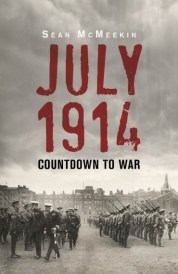
I had always wondered how Great Britain became embroiled in a European war that was started four years earlier in August 1914 following the assassination of Archduke Franz Ferdinand in Saravejo at the end of June. Just a month later Europe was consumed in a conflagration that came to be known as World War One or the Great War. How did an event hundreds of miles away in Bosnia drag Great Britain into war? Well, a couple of months I did write about the start of the Great War after reading Sean McMeekin’s excellent July 1914: Countdown to War published in 2013. In the first few months of the war, the respective front lines of the Entente Powers – France, Great Britain and her Dominions (Canada and Australia) and colonies, and eventually the Americans after 1917 and the Central Powers – Germany and her allies – were already established and didn’t move much over the next four years. Stalemate had been achieved.

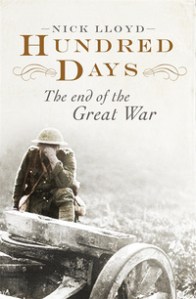
So what changed in 1918? How did the war come to an end. I have just finished reading an excellent review of the last months of the conflict, A Hundred Days – The end of the Great War* by Nick Lloyd, Senior Lecturer in Defence Studies at King’s College London (based at the Joint Services Command and Staff College in Wiltshire).

The Germans had launched a Spring offensive in April and May 1918, and although they came within a whisker of a victory over the Allies, they were not able to achieve their objectives. The Allies withstood this major assault, but the Germans were irretrievably weakened. Then from mid-August the Allies went on the offensive and, using tanks, superior (overwhelming in fact) air power, and improved battlefield tactics, began to make the sort of breakthrough that had eluded both sides in the conflict through four years of stalemate. Soon, the Germans were out-gunned, out-witted, demoralized and apparently disproportionately affected by a flu epidemic; they began retreating north and eastwards.

The end of the Great War was approaching, and Wilhelm II – ‘Kaiser Bill’ – was forced to abdicate just before the Armistice was signed, bringing to an end centuries of rule by the Hohenzollern dynasty, and going into exile in the Netherlands. He never did accept that Germany had been defeated.

The debate over the end of the war, whether the Allies should have pushed for outright victory, continues, as does that over who was to blame for starting the conflict in the first place. Having entered the war in August 1914 Great Britain was there for the duration – only defeat of Germany was the acceptable outcome. And to a large extent that was what was achieved. It was Germany that sued for peace – she could no longer sustain the conflict. Political reality set in, the threat of revolution in Germany hovered over the country, and the German military had nothing more to give.

Were the terms of the peace treaty signed at Versailles in June 1919 too harsh? There are those who argue that they were, and historians like Niall Ferguson argue that Great Britain should never have become involved in the first place. Germany was a ‘broken’ country. Since the Allies never invaded Germany (apart from occupying the Ruhr) there were always those who denied that she had ever been defeated. Certainly there was an upsurge of nationalism after the war leading ultimately to the coming to power of the Nazis in the 1930s – and all the consequences that arose therefrom. Had we learned nothing from the First World War. It took another world war to defeat German militarism once and for all. Today Europe is a much more stable continent although the Balkans have seen their fair share of conflict in recent decades. The ongoing crisis in the Ukraine and the flexing of Russian muscles is all too redolent of the mistakes that led to conflict in 1914. We can only hope that in today’s geopolitical environment there are fewer chances of mistakes happening because opposing sides in a potential conflict are unaware of what each other is doing, unlike in the days leading to the outbreak of the Great War.

~~~~~~~~~~~~~~~~~~~~~~~~~~~~~~~~~~~~~~~~~~~~~~~

* London: Viking. ISBN: 0670920061, 067092007X, 9780670920068, 9780670920075

These two books about the war are also worth considering:
Max Hastings, 2013. Catastrophe: Europe goes to war 1914. London: William Collins. ISBN: 0007398573, 9780007398577 

Ian F.W. Beckett and Steven J. Corvi (eds.), 2006. Haig’s Generals. Barnsley: Pen & Sword Military. ISBN: 1844151697, 9781844151691.

Yellow – the color that promises so much . . .

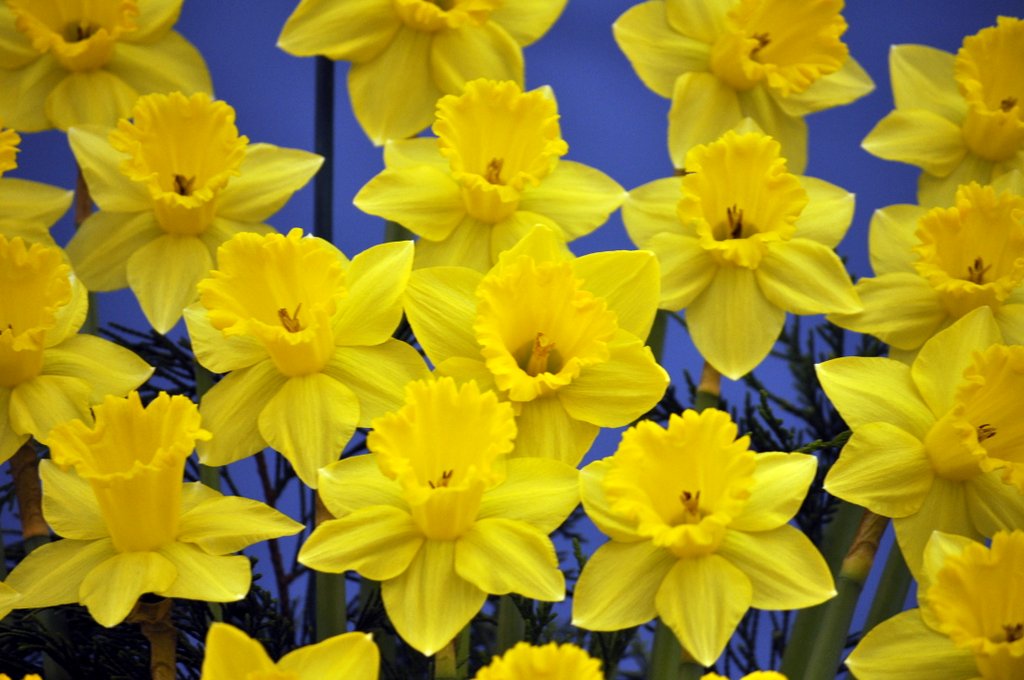
Spring! Probably my favorite season. And for me, yellow is the color of Spring.

A couple of days ago we enjoyed a bright, sunny – and almost warm – day. Not quite as warm as last weekend, but nevertheless a very welcome change from the dreary wet weather we have experienced here in the UK over the past three months. It has been the wettest winter on record, and some parts of the country are still flooded (and have been since before Christmas). Where I live in north Worcestershire we’ve had quite a mild winter, only a few frosty mornings, and no snow whatsoever. Now high pressure is dominating, and the jet stream – and its accompanying Atlantic storms, so much a feature of recent months – has been forced to the north. Looks like we are about to enjoy a spot of settled weather for a couple of weeks. But these conditions do have their down side – they have brought the fog today.

Nevertheless, Spring is clearly in the air. The days are getting longer, and the birds have started their dawn chorus. That’s another welcome sign right now – but in a few weeks when it’s warm enough to leave the bedroom windows open over night, the dawn chorus might not be quite so welcome if one is trying to grab a couple more hours sleep. You can hear what the birds in our garden sound like here.

Yellow is definitely the color of better things to come – weather and season-wise. As the gloom of winter comes to an end, Spring can creep up imperceptibly sometimes. One day there seems to be no life in the garden whatsoever. And the next – the first signs of life, the first green shoots. And before you know it, the early Spring flowers are in bloom.

First come the winter aconites (Eranthis hyemalis), followed by the snowdrops, crocuses (glorious carpets of gold, while and purple), lesser celandines (Ranunuculus ficaria), and before you know, the daffodils are ‘sounding’ the joys of Spring through their golden trumpets. Along the main A38 road close by where I live, the embankments are covered in these glorious yellow displays indicating that Spring has truly arrived. The Forsythia is also just beginning to open, and very soon the tulips will be pointing their cup-shaped blooms skywards. The primroses, oxslips and cowslips (Primula spp.) are just beginning to show.

Seeing all these wonderful yellow-flowered plants beginning to bloom is clearly a sign that the worst of winter has passed. But perhaps not completely – Mother Nature can often have a sting in her tale. Only 12 months back the UK was covered in a thick blanket of snow; and it’s not unknown (but highly unusual) for it to snow as late as the beginning of June. That’s unlikely this year (famous last words). In fact it has been so mild that we’ve had anemones flowering all winter in our front garden – plants that are usually at their best in late Spring. They began to perk up last Autumn and have been flowering ever since. But as climate change affects the weather patterns more and more, I hope we don’t ever lose the early season glory that is Spring – bathed in yellow.

Sound the trumpets!  Proclaim Spring!

Sound the trumpets!
Proclaim Spring!

Around the world in 40 years . . . Part 10. Follow the yellow brick road

Not to see the ‘Wizard of Oz’ but to experience the ‘Magic of Oz’!

During the 19 years I worked in the Philippines, I had opportunity of visiting Australia on three occasions: once on business for 10 days in 2000, traveling to Canberra (and into the Riverina), Adelaide and Melbourne; and twice on vacation, with the whole family over Christmas and New Year 1997-98, in the Sydney area, and again in 2003-04 with Steph when we drove down the coast road, the Princes Highway, from Sydney to Melbourne. Our 2003 trip took some planning, and we certainly packed a lot in during the 10 days we were actually in Australia.

I had originally wanted to book a fly-drive holiday, but by the time we’d decided to take enjoy the long Christmas-New Year break in Australia, all the fly-drive holidays I found on the Internet were all booked up. So it was a case of DIY. I booked direct flights from Manila to Sydney on Qantas, and then began to search for hotels in Sydney and Melbourne, and all stops in between. Getting a flight was no hassle whatsoever, since we actually flew out of Manila in the evening on Christmas Day. Making a rental car reservation was plain sailing as well. But how to plan a journey from Sydney to Melbourne, and how to pace the trip and find suitable accommodation?

The fly-drive options on the web also provided a map of the itinerary and listed the hotels that would be booked – if they had been available. I looked for other hotels in the same towns but, it being Christmas, the was no room at the inn. Instead, I identified the nearest towns to those listed on the fly-drive schedules, and easily booked hotels all the way down to Melbourne, spacing our overnight stops – and to have plenty of time to make side-trips and stop along the way.

Manila – Sydney, dep. 25 December, arr. 26 December
Since the flight from Manila arrived early in the morning, there was plenty of time to get to our hotel (Park Regis City Centre) and even have a short rest before our friend and former colleague, Duncan Macintosh from IRRI (who was on home-leave in Sydney) dropped by to take us out to lunch. We headed to Bondi Beach, chose Ravesi’s Hotel on the main drag for an excellent fish and chips lunch, and (as it was Boxing Day) watched the yachts in the Sydney to Hobart Race sail past the headland. Later on in the afternoon, Duncan dropped us at the main rail terminal where we collected out tickets for the return journey from Melbourne.

Sydney, 27 December
We headed down George Street early, stopping at a few stores on the way to the harbour, where we spent a few hours exploring The Rocks (just under the Bridge), and finding somewhere to have lunch. There’s no shortage of places to eat at The Rocks, as in the rest of downtown Sydney. In the afternoon, we decided to take the river trip to Parramatta, which is about 25 km west of Sydney. There are still many colonial era buildings to see in the town.

Sydney – Nowra, NSW, via Royal National Park (180 km), 28 December
This was the start of our road trip to Melbourne. Heading south from Sydney, it wasn’t long before we made our first diversion through the Royal National Park, rejoining the Princes Highway just north of Wollongong.

There was plenty of time to sit on the cliffs at Stanwell and watch the aerobatics of members of the Sydney Hang Gliding Centre

http://vimeo.com/28658170

We also went to see the Blowhole at Kiama, and Seven Mile Beach, before finally reaching our first stop for the night at Nowra, staying at the Pleasant Way Motel (it had another name when we were there).

Nowra – Tathra, NSW, via Central Tilba (263 km), 29 December
Continuing south along the coast, we stopped off at Huskisson on Jervis Bay,  to see what are supposed to be the ‘whitest sands in the world’. Well, we only found out that fact afterwards, then Ulladulla, and for an ice cream in Central Tilba. The landscape around Tilba is lovely rolling country, dotted with small farms. It reminded me of the landscapes in the movie Babe – not surprising really as one of the main locations used was in the same coastal range north of Central Tilba.

We stayed at the Tathra Hotel – nothing to write home about, a regular motel, but it was convenient and relatively cheap.

We had dinner at The Wharf Locavore, now a coffee shop and art gallery but in 2003 also served dinner. It was great eating dinner with the waves crashing underneath – you could see them through the floorboards!

Tathra – Bairnsdale, Victoria (329 km), 30 December
Crossing into Victoria from New South Wales, we took a side trip into the forest, hoping to see some wildlife. We caught one glimpse of a kangaroo but that was about it. In fact, during our whole trip south we saw very little wildlife – probably because the weather was very hot and everything was hiding in the shade.

We stayed at a very nice hotel, The Riversleigh, in Bairnsdale. Unfortunately Steph had come down with a cold, but I managed to enjoy a nice cold beer or three, sitting on the balcony of our room.

 Bairnsdale – Wonthaggi, via Wilson’s Promontory National Park (392 km), 31 December
The highlight of this day’s travel was the excursion around Wilson’s Promontory, which is the southern-most point on the Australian mainland. Lots of Banksias to look at, and many other exotic plants that I had no idea what they were.

We headed to Wonthaggi that had once been a coal-mining center, long since closed down. We stayed at the excellent Jongebloed’s B&B on Berry’s Road south of the town, towards Cape Paterson. The B&B was excellent. The house had once been located in the town proper, but a couple of years or so before our visit, it had been cut in two, transported towards the coast and reassembled on a spacious plot of land, with an exquisite garden. We just managed to grab a bite to eat in the town before all restaurants were taken over for the New Year’s Eve customers. But we spent a wonderful evening afterwards on the beach near Cape Paterson, watching the sun go down over the Bass Strait – next stop Tasmania, then Antarctica!

Wonthaggi – Melbourne, via Warburton (280 km), 1 January
We didn’t take the direct route into Melbourne this day, but headed north through the Yarra Ranges, and came into Melbourne from the east from Yarra Junction, Warburton and Healesville. I don’t remember the name and exact location of our Melbourne hotel, but it was central and also close to the rental car deport where I dropped off the car the morning after our arrival. And we’d arrived – after a journey of almost 1500 km.

Melbourne, 2 January
We had only one full day in Melbourne so had to pack a lot in. It was very hot, but that didn’t deter us getting around on foot. In the morning we decided to take the Yarra River ferry to Williamstown, arriving back in Melbourne just after lunch. Then we walked along the Yarra River to the wonderful Royal Botanic Gardens, taking the tram back into the city. My legs were giving out by then.

Melbourne – Sydney (by rail), 3 January
The XPT (express passenger train) journey back to Sydney should have taken under 11 hours, departing Melbourne at 8:30 and arriving in Sydney just after 7 pm.

Due to 65 kph speed restrictions around Albury (just over the state line in NSW), because of the high temperature causing buckling of the rails, we didn’t arrive in Sydney until just before 10 pm – rather tired. Fortunately our hotel was just a few blocks from Sydney’s Central Station.

Sydney, 4 January
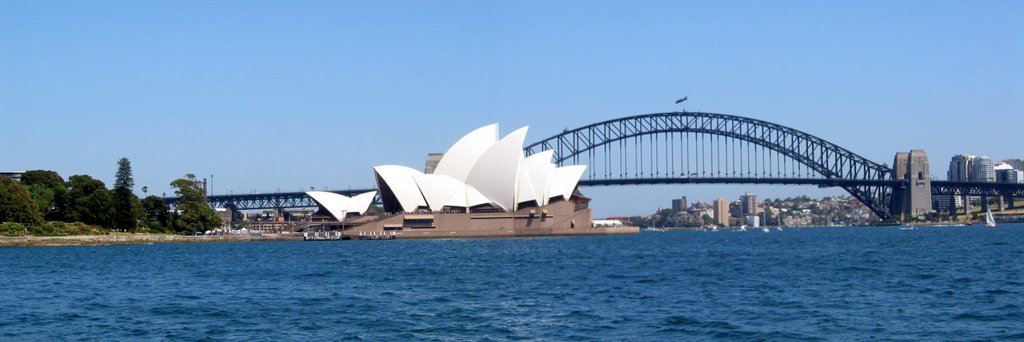
The next day we headed off to the Opera House and walked around Farm Cove to Mrs Macquarie’s Chair, from where there is a great view of the Sydney skyline, the Opera House and the Harbour Bridge. (In 1997 we’d watched the firework display over the bridge from the same viewpoint. Just one word to describe that. Spectacular!). Then, in the evening, we enjoyed a three hour Sydney Harbour dinner cruise, courtesy of Hannah and Philippa. We took a taxi back to the hotel – it was just too far to walk after a fine meal and a bottle of wine.

Sydney – Manila, 5 January
Our Qantas flight departed Sydney for the Philippines late morning, getting us into Manila in the early evening. Tired but contented we still had to endure the 2-3 hour journey back to Los Baños. Then it was a quick shower and into bed – I had to be in the office by 8 am the following morning.

And just to finish off, some panoramas from the whole trip:

I’d rather have a bottle in front of me . . .

There are occasions, I hasten to add, when a frontal lobotomy might have been a better option.

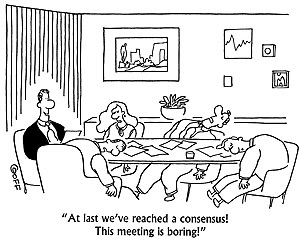
I’m not a very good committee sort of person, and I have quite a low tolerance level for poorly planned and chaired meetings. A particular grouch of mine is an unrealistic agenda. I remember one meeting more than 15 years ago that had an agenda with 14 or more items for discussion. After almost three hours we’d only worked our way through a couple of these. I don’t think we ever did get back to some of the points – although they must have merited some attention having been included in the first place. Better for the meeting chair to seek endorsement of various options by email than wasting everyone’s time (and at what dollar cost) sitting around a table getting nowhere. It’s no wonder that some organizations have taken radical measures in the way they organize meetings – and who they invite. Oh, and woe betide a meeting convener who hadn’t organized coffee and cookies!

Some meetings also appear to challenge the very laws of physics: time stands still (or even seems to go backwards), while other meetings expand to fill the available time and space. Much better in my opinion, on many occasions, is simply to bring together a group of informed folks to carefully work up some options, and actually get something done than sitting around ‘democratically’ and interminably discussing pros and cons – and in many instances identifying just what isn’t possible. Frustrating!

Over the decades I’ve had to sit through my fair share of meetings that I wish someone else had been deputed to attend. Perhaps the most mind-numbingly depressing meetings were those of the FAO Commission on Genetic Resources for Food and Agriculture I often had to attend on behalf of IRRI in the 1990s. Having accepted a job offer at IRRI at the end of January 1991, I couldn’t actually join the institute until the beginning of July as I had teaching and examining commitments until then at the University of Birmingham. But in April 1991 IRRI asked me if I would travel to Rome and represent the institute at the Commission’s meeting that year. I’d only been to Rome once before, so was quite keen to visit again, as well as get a better perspective on what was happening in genetic resources internationally. After attending several more meetings during that decade, my enthusiasm quickly waned.
The Commission has just celebrated its 30th anniversary, and has (and I quote directly from its web site)  ‘. . . provided a unique intergovernmental forum to reach global consensus on policies relevant to biodiversity for food and agriculture. It has prepared global assessments, negotiated global plans of action, codes of conduct and other instruments relevant for the conservation and sustainable use of genetic resources for food and agriculture.’

No doubt. There have been achievements and agreements – but at what cost and at what pace? The Commission meets periodically – usually at FAO headquarters in Rome – to discuss and agree (and I use that word advisedly) policies relating to the management and use/exchange of genetic resources for food and agriculture.

Forum? Read ‘talking shop’, because that was what it felt like on many occasions, square brackets [  ] notwithstanding. It’s a wonder that anything is ever agreed in these international meetings when so many different perspectives, by country or even geopolitical blocks, ‘confront’ one another. In the early 1990s there was clearly an expectation among several countries that their genetic resources would make them rich. After all, this was the decade of the Convention on Biological Diversity that set frameworks for the exchange and use of biodiversity and the expected benefits that would stream therefrom.

Negotiation by committee. I don’t even recall how many years it took to agree a revised set of genebank standards, for example – something that you would never imagine, in a thousand years, could be controversial. Always detailed scrutiny of the draft language of any document/agreement in the five official languages of the United Nations (and the French always complaining that the English and French versions of drafts did not agree). And of course constant use of the famous square brackets – enclosing text that had yet to be agreed. Again, it fades into the mists of boredom how often I had to sit (as a mere observer) through discussions of [  ]-enclosed text. International diplomacy – don’t you just appreciate it? Get two lawyers in the same room and there’s trouble – and lawyers were prominent in many of the delegations of FAO members. While agreements were completed or policies approved, it always seemed like an eleventh hour thing, with discussions continuing late into the night before agreement was reached, and after what appeared earlier in the day as irreconcilable positions were overcome as one [  ] after another was removed.

And it was at these Commission meetings that I first thought that a frontal lobotomy might just be happy release. The two saving graces about the whole experience were the many opportunities of visiting and getting to know Rome, its sites and excellent restaurants; and some of the friendships I made with delegates to the Commission from around the world. Not all totally hopeless, after all.

Around the world in 40 years. Part 9. That is the trouble with flying: we always have to return to airports . . . (Henry Minizburg)

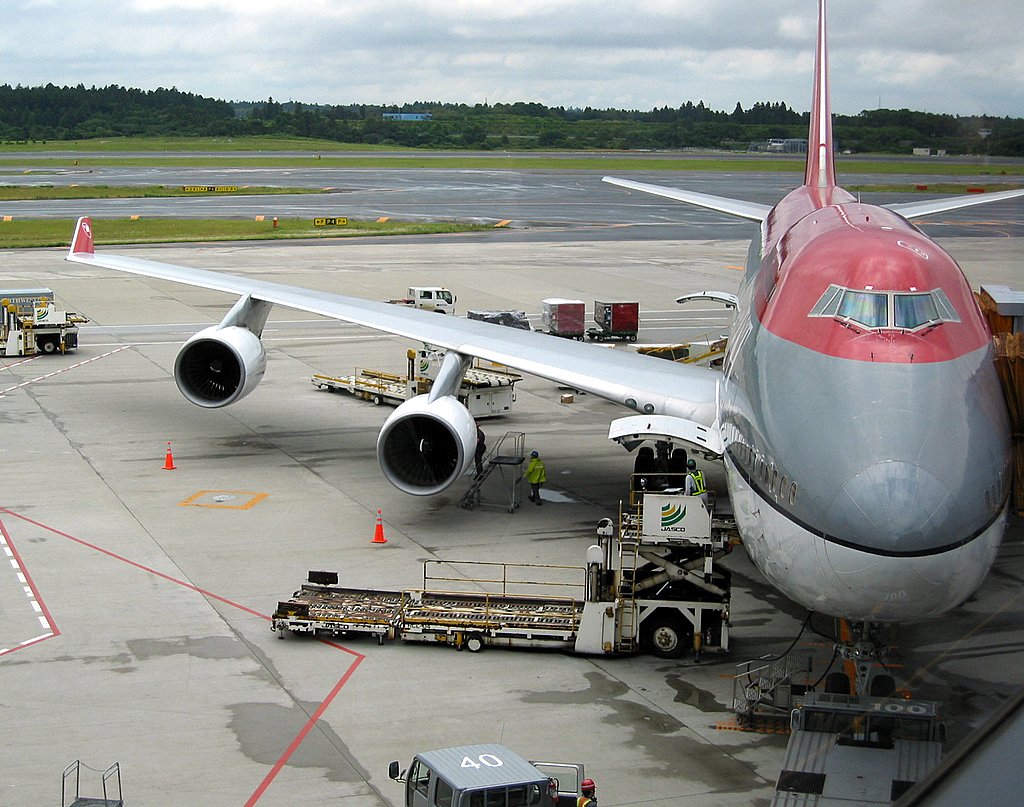
Maybe you’re a frequent flyer. Maybe not. How many of the flights you have taken were memorable? I hardly remember one flight from another (unless they were the two occasions when I was invited on to the flight-deck, on LH and EK flights, for the landing at Manila (MNL, RPLL). On the other hand, how many airport experiences – good or bad (mostly bad) – have you experienced?

Unless a flight was really bad – lots of turbulence, poor service, etc., you’re more likely to remember your airport experience. After all, for some journeys, you can spend more time getting to and from the airport, waiting for your flight to leave, or passing through immigration and customs on arrival, than you actually spend in the air.

Ever since I flew for the first time in 1966 – a short flight from Glasgow Airport (GLA, EGPF – then called Abbotsinch) to Benbecula (BEB, EGPL) in the Outer Hebrides on a British European Airways Viscount – I’ve passed through at least 180 airports worldwide. Since then, Glasgow has become quite an important hub for the west of Scotland, with many international airlines flying there. Benbecula is probably still the same – a small hut for a terminal building.

Now of all these 180 or so airports, some were just a transit stop en route from A to B; and others just a single visit or two.

On the other hand there are airports like Birmingham (BHX, EGBB) , Ninoy Aquino International Airport in Manila and Juan Santamaría International Airport in San Jose, Costa Rica (SJO, MROC) that I must have passed through many, many times – since they are/were my home airports for many years. And yet again others, like Hong Kong International (HKG, VHHH that replaced Kai Tak), the Twin Cities (Minneapolis-St Paul International, MSP, KMSP), or Narita in Tokyo (NRT, RJAA), are important hubs that I’ve passed through frequently over the years. Furthermore, I have traveled through MSP a lot (and still do) because my elder daughter Hannah and her family live there.

So what makes a good or a bad airport experience? And I’m sure we all have different criteria and tales to relate. As I was thinking about this, these are some of the ideas that came to mind:

  • the airport itself, its facilities, and capacity to handle passengers; travel to and from the airport; does it have one large terminal (such as Amsterdam Schipol, AMS, EHAM) or several like London Heathrow (LHR, EGLL) or New York JFK (a nightmare, JFK, KJFK) with all the headaches that can bring;
  • the check-in experience (depends on the airline to a large extent);
  • the immigration and customs experience;
  • connecting time between flights and the ability of the airport to handle tight schedules;
  • and then there’s the physical location of the airport and whether that can affect the takeoff and landing experience – as I’ll illustrate later on.

Some airports are well past their sell-by dates, and should have been demolished years ago. Although a new airport terminal was built at Manila a decade ago, it didn’t open for several years (a dispute with the company that financed its construction). Terminal 1 at NAIA is certainly not one of the most comfortable to travel from. The operators are always patching up the services, and there never do seem to be enough seats for everyone who needs one. But after almost 20 years of traveling through NAIA many times a year I can state unequivocally that the airport works and, most of the time on arrival, immigration, baggage handling and customs are really rather efficient. And of course (most of the time) one is greeted by a beautiful Filipino smile. I wish airport staff around the world were half as courteous and friendly as those you meet in Manila.

I was always wary of traveling through Murtala Muhammed International Airport in Lagos (LOS, DNMM) in Nigeria in the 90s. Immigration and customs staff could be quite menacing, and would always look for something in your bags to confiscate. The common question was’ What do you have for me?’ I’d always reply: ‘A big smile’ and then gave a big cheesy one. But they never did get anything off me. I wonder how things have changed since I was last there, more than a decade ago.

In Asia there has been an incredible airport boom – at Singapore’s Changi International (SIN, WSSS), Kuala Lumpur’s International Airport (KUL, WMKK) in Malaysia, and Bangkok’s Suvarnabhumi Airport (BKK, VTBS) in Thailand, and Hong Kong, of course. Another iconic airport, with a terminal building over a kilometer long, is Kansai International (KIX, RJBB) in Osaka, Japan, constructed (like Hong Kong) on an artificial island in Osaka Bay.

Some of the most difficult airports to pass through are in the USA. Many don’t have a transit area and even if you are only changing from international flight to another, you have to pass through immigration and customs. Not the easiest thing to do if you have a tight connection and there are a couple of other jumbo loads of  passengers waiting in the immigration queues ahead of you. US border staff are often not the friendliest. It must be tough sitting there facing a sea of faces every day. London Heathrow has become renowned for its difficult immigration, and that was a major concern ahead of the 2012 Olympic Games.

As I’ve been fortunate to travel business class on many long-haul flights, I’ve been able to take advantage of airline lounges in which to relax while waiting for a flight – a boon if there are delays. The Emirates lounges at Dubai International (DXB, OMDB) are superb.

In many airports it’s now difficult to view aircraft traffic easily from inside the terminal building. One of the best – when the airport was open – was the Cathay Pacific lounge at Hong Kong’s Kai Tak, with a view looking right down the runway from one end to the other. It was fascinating watching even the biggest jets manoeuvering above the apartment buildings and making the final sharp right turn to line up on the runway. It’s also quite an experience on board!

Now Kai Tak could be challenging for many reasons, as is the ‘new airport’ because of frequent crosswinds. But the landing on the short runway after a challenging approach at Tegucigalpa’s Toncontín International Airport (TGU, MHTG) in Honduras takes the biscuit. I flew in and out of there quite a few times in the 70s – never a comfortable experience.

I never visited Bhutan, but one of my staff, Eves Loresto, traveled there several times between 1995 and 2000 in connection with our Swiss-funded rice biodiversity project. Paro Airport (PBH, VQPR) in the heart of the Himalayas is considered one of the most demanding airports in the world, as this landing video shows. Only small jets operated by Drukair land there.

As I started this post, I suggested we’d all have our own stories to relate. And certainly while I have had some excellent flights (like when I was upgraded to First Class on my first A380 flight from DXB to BKK on EK), most of what I remember about those journeys has invariably to do with my experiences of the airports. What are yours?

Study botany and the world’s your oyster . . .

You bet!

Botany or banking? Is there really a serious choice? I saw a report last year in which botany graduates received higher initial salaries after graduation than many other professions, ranking third after medicine and dentistry, in the UK. That’s hard to believe really. Bankers might certainly reach for the giddy heights in terms of salary packages (and bonuses) but I’m sure that more botanists go to bed each night with a clearer conscience than bankers. And when was the last time you heard of a botanist being reviled by society at large? Well, perhaps if you are in the GM business . . . ?

Not convinced? Well let me tell you why. There is, however, a small caveat. It might be more appropriate to talk about ‘plant sciences’ in the widest sense, because many of the people I’ve met over the decades who do scientific research on and about plants didn’t necessarily study botany per se at university. I don’t think that diminishes my point, however. In the UK, I don’t think there’s a single botany department any longer in the university sector. They all morphed into ‘plant sciences’ or ‘plant biology’ (supposedly more appealing names) or became part of  biological sciences departments. If you were lucky there might be a ‘plants stream’. Botany appears to be in a healthier position in North America.

Plant scientists, it seems, are in great demand. And the traditional image of a botanist couldn’t be further from reality. Whether employed as molecular biologists, geneticists or biochemists (the distinctions are diminishing by the day), plant or crop physiologists, plant breeders, plant pathologists, ecologists, biodiversity and conservation specialists, or even taxonomists, there’s never been a greater need for people to study plants. After all, life on earth depends on plants. Where would we be if we could not successfully grow the crops needed for survival, to adapt to climate change, to keep one step ahead of evolving pathogens, or simply try and understand this wonderful world of ours and its glorious diversity?

Botany has been my ticket to a successful and fruitful career. It’s taken me to many countries in the Americas, Europe, Africa, Asia, and Oceania over four decades – as plant hunter, researcher, teacher, project manager, and speaker. I worked on two important plant species: potato (Solanum tuberosum) and rice (Oryza sativa) and their wild relatives as a taxonomist, germplasm expert, seed physiologist, agronomist, plant breeder, and plant pathologist. My work has been both lab and field based. What more could I have asked for? And I’ve worked with some inspiring colleagues who came to work on potatoes and rice – and other crops – through one avenue or another, not necessarily as botanists, but perhaps through an interest in and love of plants as part of agriculture.

I can’t deny that I have been fortunate – when opportunities arose I was well-placed to take advantage. I studied with some inspiring heavyweights in my chosen fields. But a love and study of plants has made me a happy person – on the whole.

I was out and about yesterday on one of my daily walks. It was a beautiful day, Spring was definitely in the air (at last), and the hedgerows were creeping back into life. In one spot, the bedstraws (Galium spp.) were in their first flush of new growth,  profusely spreading over the bank beside the road, and responding to milder days we have begun to experience recently (in any case it really has been a mild winter). And it was that sight that made me think back to my student days in the late 60s as an undergraduate at Southampton University. There were times when I did wonder if I’d ever use again some of things we were taught and how relevant they might become – like plant anatomy, for example. It’s interesting to know how important anatomy studies have become in the search for and development of a C4 rice to make its photosynthesis more efficient. Researchers at IRRI have studied the leaf anatomy of hundreds of samples of wild rice species, since C4 photosynthesis in plants is associated with the specialized Kranz anatomy.

As an undergraduate I took several plant ecology courses with Dr Joyce ‘Blossom’ Lambert who had worked on and discovered the origin of the Norfolk Broads in East Anglia, UK – not as natural lakes but flooded peat diggings abandoned by the 14th century. But once I’d discovered the ‘link’ between ecology and genetics, I was hooked, and that led to my focus on the conservation and use of plant genetic resources. The rest, as they say, is history . . . 

The fruit that keeps on giving . . .

So my Facebook friend, and IRRI’s coffee-shop entrepreneur Christine Jimenez (CJ to all her friends) told me, after I posted a story a couple of days ago from The Guardian website about the forthcoming sale in the UK of durians. Sounds almost philanthropic.

Reportedly one of the smelliest foodstuffs around, durian is definitely an acquired taste – that’s if it can be acquired at all. As another Filipino friend and former staff member of mine, Tom Clemeno, also commented: It’s the fruit that smells like hell but tastes like heaven.

Pass.

I have tried durian on just one occasion, and that was once too often. You definitely have to get past the smell in order to savor the fruit. I found the fruit extremely rich and ‘custardy’, that left me with a lingering aftertaste for a couple of days and, unfortunately, ferocious heartburn.

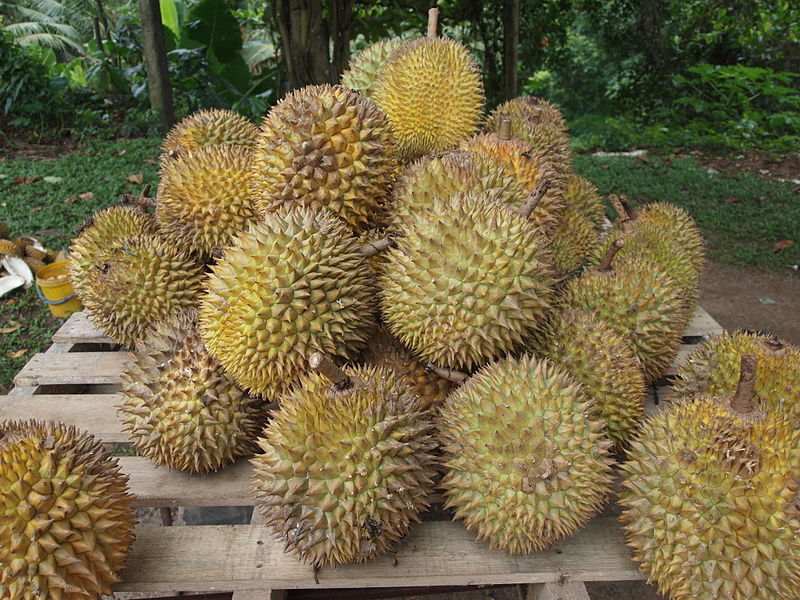
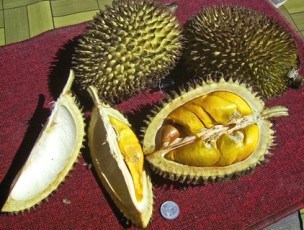
So what’s all the fuss about? Durian (Durio zibethinus), one of about 30 or so species, several edible, is quite a large fruit weighing up to several kilos. And although it is prized as a fruit delicacy in Southeast Asia (where it’s a native species) it is also one that is banned in many public venues. Just take a look at all the images here of public signs. There was a piece about it on the BBC One Show last night, and it was only at the very end of the program that a raw fruit was unwrapped – even though they had tasted durian products like ice-cream earlier on. One of the presenters, Matt Baker, became visibly distressed and almost threw up!

A former colleague, fish expert Roger Pullin, was traveling on Singapore Airlines one time, and as the passengers were settling into their seats the purser announced that there was a durian on board and asked the owner to approach one of the cabin crew. Nothing happened. The announcement was made a second time, and on the third occasion, the Captain announced that he would cancel the flight unless the owner of the durian was identified and the fruit removed. Sheepishly, Roger mentioned that he had a durian in his suitcase, in the hold. But this durian was in the cabin, and the odor was being distributed through the aircon system. Eventually a fruit was discovered in one of the overhead compartments, and unceremoniously thrown off the aircraft. It’s that sensitive an issue.

Why subject yourself to the unpleasantness of the durian when there are so many other wonderful tropical fruits to enjoy? Having lived in Peru, Costa Rica and the Philippines for almost 30 years in total, and having traveled throughout the Americas, Africa and Asia, I grew fond of several in particular. In the UK we have ready access to bananas, mainly from the Americas, the long, perfectly-formed Cavendish varieties. In the Philippines there is a wealth of diversity of delicious bananas: big ones, little ones, starchy or sweet, and some that have an exquisite apple-like flavor.

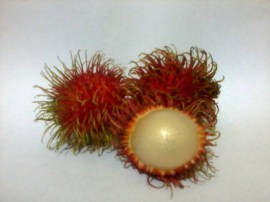
Then there’s the rambutan (Nephelium lappaceum) – arguably my favorite. The fruit is covered in soft spines, and this ‘shell’ is easily removed to reveal a fleshy covered seed inside. Sweet and juicy, they are hard to resist. One of my former staff, Amy Juliano, had several wonderful trees in her garden, and each September when they were in fruit, she would arrive in my office with several bags (kilos) of ripe fruit. Steph and I decided to plant some of the seeds. We should have done a little more botanical investigation beforehand. Although in just a few years the seed grew into quite a large tree, we had planted the seed of a male tree – not a single fruit!

A rambutan tree (on the left), in 2004, at the entrance to our house in IRRI Staff Housing

The Philippines does not have a large citrus industry like many other neighbor countries because of virus epidemics in the past. There are no oranges, limes or lemons to be had locally, but instead a native fruit not known in the wild, the calamansi (a hybrid species, × Citrofortunella microcarpa) – which, although small, does produce lots of juice – is great substitute for lime in a gin & tonic, or sprinkled over a sweet portion of papaya. One of its common names is ‘Philippine lime’. Another wonderful citrus fruit, imported into the Philippines as far as I’m aware, is the pomelo (Citrus maxima), rather like an overgrown grapefruit. The individual segments separate very easily. We found it just a couple of weeks ago on sale in our local supermarket, imported from China.

In Costa Rica one of the favorite fruits – but not mine – is the water apple (Syzygium samarangense, syn. Eugenia javanica). Once or twice a year the tree in our garden on the CATIE campus in Turrialba was covered in fruit, and lots of employees from the center would stop by to gather sacks of the fruit. I never did enjoy them.

In the Philippines we were fortunate to be able to buy a complete range of local and imported tropical and temperate fruits (like apples for example – still one of my favorites). The Fuji apples (imported from China) are certainly big enough to share between two. And that continues in the UK. So with all these wonderful fruits available I’m certainly not going to offend my taste buds by sampling again such a potent one as the durian. It won’t be on my shopping list any time soon even if it does arrive on the shelves of our local store.

¿Donde esta el baño?

I’ve just begun reading Anchee Min’s memoir The Cooked Seed (published by Bloomsbury in 2013). I’m only on page 58, but I’ve already reached the description about her arrival in Chicago, aged 27, in August 1984. Escaping from an impoverished upbringing in Shanghai and all the tribulations of the earlier Cultural Revolution that had so dramatically affected her life, she had applied (on false pretenses) to study in the US for a bachelor’s degree in art. She had one huge drawback: although indicating on her application and during her visa interview that she was fluent in English, she hardly spoke or understood a word of English. Her sense of utter helplessness leaps off the pages. A new language, new alphabet, as well as the challenge of a new consumer-driven culture and society, something way beyond her experiences until then.

And that got me thinking about how we adapt to new situations, cultures and language. I can empathize with Anchee Min, although of course my life experiences in childhood and my teens prior to moving abroad do not hold comparison with hers.

Before I moved, aged 24, to Peru in January 1973, I had traveled outside the UK on only two occasions, the first time in 1969 to Czechoslovakia, and then in April 1972 to attend a EUCARPIA genebank conference in Izmir Turkey. I’d flown only three times, never intercontinental, and Turkey was my furthest destination. So it was with a certain degree of trepidation I set out for Peru.

While I had made some (rather pathetic) attempts to begin to learn Spanish before I moved to Peru – I’d known for about a year that I would be working there before I actually left the UK – I didn’t make much progress. I was a graduate student at the University of Birmingham, and decided to take advantage of the language laboratory to begin Spanish lessons. I didn’t find it inspiring whatsoever – sitting alone in a booth, listening to a tape on headphones, and attempting to follow along with a text. Until then, my foreign language skills were minimal. I’d studied French at high school, passed the necessary exam (‘O Level’) in 1965, and not bothered subsequently. Well, at the language lab I thought I was making some progress until, that is, someone walked off with the only copy of the course text. On reflection I should have stuck with the audio tapes but being (at that time of life) a bit of a procrastinator, I gave up. With the consequence that when I landed in Peru I had hardly a word of Spanish.

In fact, when I came down to breakfast on my first morning in Lima – it was a Friday – I couldn’t even order my own breakfast! I must admit that I felt rather confused for several weeks, maybe months, until I began to understand a little more how things worked, and I’d picked up a basic vocabulary. I certainly used a lot of single words and waving of arms to get by.

In some ways there was less language pressure because many colleagues at the International Potato Center (CIP) at La Molina (then on the outskirts of Lima), where I worked as an Associate Taxonomist, were bilingual. Many of the support staff were not, and being able to communicate with them was a priority. I began intensive Spanish lessons with Maestro Jorge Palacios, who had taught ‘generations’ of ex-pats on the Peru-North Carolina State University Potato Program mission, and CIP staff. By mid-1973 I was much more confident and had begun to string sentences together – not particularly competently – but i was getting by. In May 1973 my colleague Zosima Huaman and I made a three-week germplasm collecting trip to the provinces of Ancash and La Libertad. I could never have made that trip alone. In one village we were greeted by everyone in the community. It was clear I would have to respond, having been identified as a ‘representante de la Reina Isabel‘. I quickly jotted down some phrases on the palm of my hand that Zosimo gave me. Afterwards, everyone (about 200 people) came and shook my hand!

By the time Steph joined me in July 1973 (and we were married in Lima in October that year) I was becoming a little more competent, and within a year I could make germplasm collecting trips in the boondocks (originally a Filipino word) on my own with just a support driver. It wasn’t until I moved to Costa Rica and Central America in April 1976 (where I stayed for almost five years)  however, that I became more or less fluent in Spanish, although my written Spanish has never really been competent. At CATIE in Turrialba where we lived English was used very little. In my potato work with farmers in various countries and researchers from national research institutes, I always spoke Spanish. It’s such a lovely language to learn and speak. And that’s one of the legacies of my time abroad. I got to learn a second language, and although I haven’t spoken Spanish for 30 years or more, it’s still locked away in the further recesses of my brain. So it’s quite fun when something in Spanish is broadcast on the TV (as the other night, in a program about Easter Island) trying to follow along without reading the sub-titlkes.

Faced with the difficulties of a new language and adjusting to a different society and culture – as I did in 1973 – I think made me better prepared to help graduate students who came to study genetic resources at the University of Birmingham when i taught there in the 1980s. Most were overseas students with English as a second language; and quite a numbered really struggled. As part of our teaching commitments we worked with the staff of the English as a Second Language Unit in English Department to provide weekly remedial classes. Each week one of the course staff would record a lecture that then formed the basis of a tutorial with the students. In this way they not only learned about the technical use of English, but also how the lecturers would sometimes (often?) unknowingly use colloquialisms, or maybe repeat the same idea but in a different way, using other descriptive terms.

I’m afraid that when I moved to the Philippines in 1991 I never did make an effort (shame on me!) to learn Tagalog, although I picked up a smattering of words, and was  able after some years to understand the gist of a conversation in Tagalog. But I’ve rarely been in a situation, as Anchee Min found herself, completely at sea and unable to communicate. As English has become (much to the chagrin of the French) the world’s lingua franca, it’s no longer unusual to find public signs and notices, even announcement on public transport, in English in Japan, China, Thailand and elsewhere that use a different alphabet.

A canal for all seasons . . .

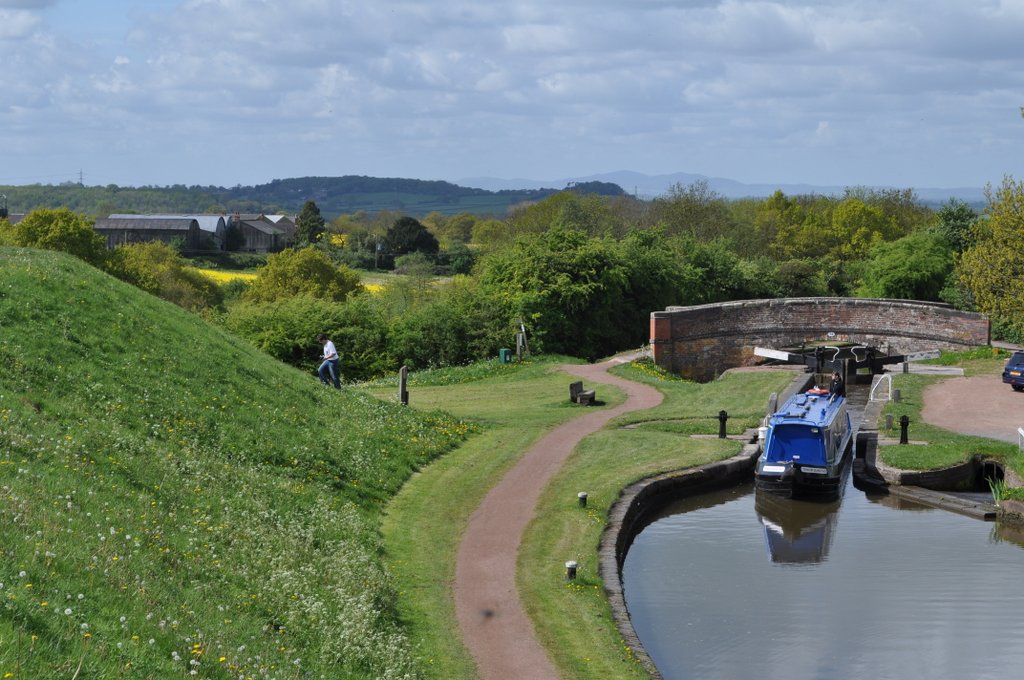
20100515010One of my favorite walks is along the towpath of the Worcester and Birmingham Canal. Managed by the Canal & River Trust (formerly British Waterways) the canal is just a couple of miles to the east of where I live in north Worcestershire.

Construction of the canal began in 1792, and was finally completed in 1815. Connecting central Birmingham (to the north) and Worcester (to the south, on the River Severn to which the canal connects), there is a drop in elevation of 130 m (428 feet). Fifty-eight locks were needed to navigate the topography, including the 30-lock flight at Tardebigge (also close to my home), one of the longest flights of locks in Europe, as well as five tunnels (including the Wasthill Tunnel under the Lickey Hills, at almost 2.5 km), and three reservoirs to ensure a constant supply of water to the canal. Near Tardebigge is the old engine house – now converted to luxury apartments – that pumped water from the Tardebigge Reservoir and kept the water level of the canal topped up below Tardebigge Top Lock. North of this lock towards central Birmingham, there are no locks.

With the building of the railways in the 19th century, many of the canals were abandoned for commercial traffic and fell into disrepair. Not until the middle of the 20th century did travel on the canals become a major leisure industry. Canals were rehabilitated and opened up for navigation once again all around the country.

This slideshow requires JavaScript.

The canal towpath is a haven for wildlife, and during the different seasons there is always a great variety of birds to observe, on the water and in the vegetation that hugs the canal on the opposite side from the towpath.

So why is it called a ‘towpath’? Before the days of steam traction or today’s diesel engines, canal boats were hauled along by men or, quite commonly, large working horses. In the video below, a narrowboat on the Huddersfield Narrow Canal is being pulled along as in days of yore. The video also excellently illustrates just how a canal lock works, the effort required to raise or lower the water level, and open and close the lock gates.

As I stroll alongside the Worcester and Birmingham Canal I never cease to wonder at what was involved to construct the canals at the end of the 18th century and early 19th. With access to little or no machinery, the canals were hand dug by huge squads of workers – the ‘navvies’ (derived from ‘navigator’ or ‘navigational engineer’ – who later went on to build the railways). Can you imagine what effort was required, what the working and living conditions must have been like for the men (and presumably their families, because we do know that wives and children followed the navvies when constructing the railways)? Not only had the canal bed or ‘cut’ to be dug, but the bed had to be lined in many places with clay to make them waterproof and reduce or prevent leakage. Then there were the elegantly constructed and brick lined canal locks and bridges. The lock gates themselves, most often made from oak, had to be man-handled into place, weighing many tons.

Now while one can wonder at all this when the canal is open for business as it were, when it’s drained and closed for maintenance – as was the case recently at Tardebigge Top Lock – you really can appreciate the scale of the whole endeavor, and what it takes today to repair the canal even with access to all sorts of machinery.

This slideshow requires JavaScript.

What if?

4 August 1914. Britain declares war on Germany, joining the Entente Powers Russia and France a couple of days after war had already been declared between them and the Central Powers, Germany and Austria-Hungary.

In August this year nations around the world will commemorate the beginning of the First World War (WWI) – ‘the Great War’. Already this week the BBC begins a four year, 2,500 hour broadcasting extravaganza about the war. No doubt there will be commentary, analysis, blame perhaps, but most of all (I hope), reflection on the folly of society and the politicians (and at the time of WWI, the heads of state including monarchs) who danced diplomatically around each other and into war.

I’ve just finished reading Sean McMeekin’s analysis*, published last year, of the lead up to the war from the initial incident – the ‘spark that set Europe aflame’ only a month later: the assassination of Archduke Franz Ferdinand (and his wife of a morgantic marriage, Sophie) on the morning of Sunday 28 June in Sarajevo, Bosnia-Herzegovina.

Until now I have paid scant attention to the Great War in my historical reading . For one thing, neither of my grandfathers fought in the war, although other relatives did. By 1914, my Jackson grandfather was almost 41 and profoundly deaf. My maternal grandfather Healy, born in 1876, was 38 years old and a serving officer in the Metropolitan Police in London. So although my curiosity was never roused about what my forebears did during that war, it has always been a mystery to me how an incident in the Balkans led to the conflagration that consumer Europe, and spread beyond that continent to Africa and beyond.

While Archduke Franz was the heir to the Austro-Hungarian Empire – but an unpopular one – his children had been barred from the succession because of his marriage to a commoner, and a former lady-in-waiting at that. His assassination at the hands of Serb nationalists focused the attention of Austria-Hungary once again on the Balkans, the scene of several wars in the preceding decade. One thing led to another, mobilization by Russia in support of Serbia, led to counter mobilization by Germany and Austria-Hungary, as well as France fulfilling its treaty support to Russia. Britain finally entered the fray on 4 August after Germany had invaded Belgium (which the Belgians resisted), fulfilling its guarantee of Belgian neutrality under a treaty of 1839.

Using cabinet records, telegrams and the like, McMeekin’s chronological analysis of the unfolding crisis and war certainly brought to my mind a number of images: misunderstanding, lack of understanding, failure to understand, mendacity, and disingenuousness, as well incuriosity and incompetence among politicians and diplomats serving in London, Paris, Berlin, Vienna, and St Petersburg. It’s not my intention here to provide my analysis or interpretation of events, not to describe them in any detail. That information can be found from many different sources, and undoubtedly the approaching centenary of the outbreak of hostilities will  surely bring with it a new crop of books to explain the whole affair. Furthermore, once hostilities broke out, and the war dragged on for four years, a number of myths grew (and have been sustained) about the nature of the conflict, and the (in)competence of the commanders directing the war from the British side. I found this brief debunking of myths by broadcaster and historian Dan Snow rather intriguing.

However, it’s the final chapter of McMeekin’s book, Epilogue: the Question of Responsibility, that I found most interesting really. And it’s the counterfactual, ‘what if’ analysis, that ties things together. It seems that a European war was just waiting to happen. Was it inevitable; could it have been localized to the Balkans? Could Turkey have been prevented from joining the Central Powers? What would have been the stance of the British government had it not been so focused at that time with the Irish question? If there had been fewer warmongers and more astute diplomats, would war have been averted? Who knows? These are good points to raise, and help focus attention on key issues or stages in the crisis leading up to the outbreak of hostilities 100 years ago. McMeekin does not absolve from blame any of the major protagonists for starting the war. His conclusions however are not what you might think or what you have been led to believe over the past century.

Counterfactual analysis is not an unknown as far as I’m concerned – but in a totally different context.  During the last decade I spent at IRRI with responsibility for program planning, donor support and fund raising, my office managed the development and submission for funding of research for development proposals. Part of that development process was ex ante impact assessment. My dear Australian friend Debbie Templeton, who worked at IRRI from 2005 to 2008 as an Impact Assessment Specialist before returning to ACIAR in Canberra, taught me a lot about counterfactuals. In evaluating the potential of a new technology to bring about a positive outcome she emphasized to me the need to assess what would/might happen in its absence, what could be the impact of adoption, how it could accelerate the achievement of a desired status, etc. It’s the ‘what if’ approach all over again but from a different perspective.

* July 1914: Countdown to War (2103) Icon Books, London: ISBN 978-184831-593-8

“Do you find the defendant guilty or not guilty?” We never got to decide.

From: http://en.wikipedia.org/wiki/Trial_by_Jury

“Now, Jurymen, hear my advice —
All kinds of vulgar prejudice
I pray you set aside:
With stem judicial frame of mind.
From bias free of every kind.
This trial must be tried.”

First produced at the Royalty Theatre, London, on 25 March 1875, Trial by Jury was the first of 13 Savoy operas (and only the second collaboration) between librettist Sir WS Gilbert (with whom I share my birthday) and composer Sir Arthur Sullivan, others including The Mikado, HMS Pinafore, and The Pirates of Penzance.

The quotation above, sung by the Usher almost at the very start of the opera, exhorts the members of the jury to fulfill their duties faithfully. So what has this to do with me?

In mid-October I received a summons to attend Worcester Crown Court on 16 December to serve on a jury. Since it’s a legal requirement to serve, and I had no extenuating circumstances that would prevent me serving, I duly completed the summons form and waited for further information. Funnily enough, only a few weeks beforehand, I had wondered if or when I might be called for jury service since it had never happened before. Names are selected at random from the Electoral Register.

So my schedule was set, and I had to commit two weeks for the court. About a couple of weeks ago however, I received a phone call from the court advising that since too many potential jurors had been summoned on the same day, they wished to re-schedule my attendance for the beginning of February next year. But as I’m working on a part-time consultancy for the 4th International Rice Congress in Bangkok in October 2014, and I need to be in contact with colleagues in the Philippines and Thailand on a regular basis – and I’d already informed everyone that I would be tied up with jury service from 16 December – I was able to keep to the originally agreed schedule.

The wheels of justice turn ever so slowly
Early on the Monday morning (16 December) I caught the 08:23 train to Worcester so I would get to the court by the agreed time of 09:15. As the train journey from Bromsgrove was only 18 minutes (and on time), I arrived in good time, especially as the court building is only a couple of hundred meters from the station in Worcester. And at the court I joined 29 other potential jurors. We were escorted to the jury waiting room on the first floor in readiness for a briefing. Little did I realize then that I’d  come to know that room very well indeed.

Following the briefing of what to expect as a juror (with a very informative DVD to explain all the details) we were divided into two groups of 15, and told to be ready to go into court shortly. In fact the other group from mine were immediately ‘partially released’ until 14:00 when their case was expected to begin. Our group sat and waited until 13:00 expecting to be called into court at any moment, only to be released for lunch until 14:00. At 15:10 we were informed that the defendant had changed his plea to guilty, and we would be no longer needed for the day, and could go home. But with the proviso that we had to ring in after 16:30 to check if we were needed the following day.

I had to return to court on the Tuesday morning, but only at 10:30. It was then we discovered that only 15 of the original 30 had been recalled, and we were a mix of the two groups. And again we sat around, while (apparently) the defence and prosecution counsel and the judge discussed various matters relevant to the case. Just after 13:00  we were told that both defendants had changed their plea to guilty and there would be no trial. And furthermore, we were being ‘released completely’ and did not have to return again. The previous morning we’d been told that the week before Christmas was a good week to be called for jury service, since the courts were trying to schedule cases to be completed during the week, and in any case, the trial judges would be replaced with new ones in the New Year.

So that’s the extent of my jury service: almost 10 hours sitting in a side room waiting to be called. I’ve completed my civic duty, answered the summons for jury service, and never even got to see the inside of a court room. If I am summoned in the next two years I can refuse, but after that I have to attend again. When I turn 70 I will no longer be eligible for jury service.

And so let me finish the short piece with a video of the judge’s song from Trial by Jury (taken from the 1953 film of the Gilbert and Sullivan story). I never had chance to see if ‘our’ judge had some interesting tales to tell:


It was colder than a witch’s tit . . .

Yes. It was that cold.

Having lived in some pretty hot places around the world over the past 40 years, I’d never experienced cold like that until then.

When? Well it was Christmas 2007, and Steph and I spent Christmas with Hannah and Michael in St Paul, Minnesota. And having flown in from the Philippines on Christmas Eve (and arriving in Minnesota almost before we departed the Philippines), you can imagine that super low temperatures came as a bit of a shock to the system. But I’m getting ahead of myself.

In all the almost 19 years in the Philippines we spent Christmas there, often heading to the beach for some well-deserved R&R, some diving, and generally lazing around under the tropical sun, except for four occasions when we visited Australia (twice) and once each to Hong Kong (and Macau) and Angkor Wat in Cambodia.

However, in 2007, I thought it would be fun to experience Christmas in a cold climate so, in my devious way, set about planning a Christmas break in Minnesota. Hannah had moved (as an undergraduate) to St Paul in 1998, and has settled there with husband Michael (and now children Callum and Zoë). Anyway, in about September of that year, I contacted Hannah and asked her if we could come and spend Christmas with them – if her Mum was willing to travel. Of course, Hannah was delighted at the idea and immediately said ‘Yes!’. Then I tackled Steph, asking her if she liked the idea of Christmas with Hannah and Michael. It didn’t take her long to agree – even though she has never been a fan of long-distance travel.

Unbeknown to either Hannah or Steph, I had already made Business Class reservations with Northwest Airlines, to depart on Christmas Eve (arriving to Minneapolis-St Paul, MSP, that same day), returning on New Year’s Eve, and back home on New Year’s Day. Originally our schedule was to fly to MSP via Tokyo (Narita) and Detroit, but about a week before flying seats opened on the direct Narita-MSP.

That was very fortunate as a major blizzard had moved through the Midwest just a couple of days before Christmas Eve and caused all manner of travel disruption, and our journey would have been even more tedious had we had to fly via Detroit.

There wasn’t a cloud in the a clear blue sky as we came into land at MSP, but we could see that a lot of snow had fallen within the previous 24-48 hours. Hannah and Michael were at the airport to meet us, and Hannah had brought along several items of warm clothing for Steph who didn’t have any in the Philippines since it was way below zero (Fahrenheit!). I was OK, since I often used to travel to the US or Europe during the winter months and had to have appropriate warm clothing to hand. From the airport we headed off to Target for a quick shop of extra clothes for Steph. We were amazed at how clear all the main roads were, eve tough there had been at least a couple of feet of snow.

Christmas Day was quite special. Not only was it nice to be with family, but it really did have a special traditional feel about it, sitting in front of a roaring log fire, opening presents, having a wee dram or three, and anticipating an excellent Christmas lunch of turkey.

We sat down to eat around 3 pm. It was just getting dark, the neighbors had switched on their Christmas lights (something that has grown in popularity here in the UK in the past few years), and then magic – it began to snow. Well, I’m now 65, and this for me was just about my first white Christmas. Even though there was food on the table, Steph and I had to go outside and experience that magic first hand.

Over the course of the next few days, Steph and I got to experience what ‘real cold’ was all about. It certainly was rather bracing heading out for a daily walk. But, by the same token, it was an experience that I thoroughly enjoyed, even though I don’t think I would recommend living somewhere that gets that cold.

All too soon our Minnesota sojourn was over, and on New Year’s Eve we headed back to MSP to catch a midday flight to Narita and on to Manila, arriving late at night on New Year’s Day. Great to be home, but pleased Continue reading

Something for your Christmas stocking – Plant Genetic Resources and Climate Change hits the shelves 11 December!

It’s taken just over two and half years, more than 2,400 emails, and many, many hours of editing. But Plant Genetic Resources and Climate Change, edited by myself, Brian Ford-Lloyd and Martin Parry will be published by CABI on 11 December.

Brian was first approached by CABI commissioning editor Vicki Bonham in April 2011. He was reluctant to take on the book by himself, but suggested to Vicki that the project would be feasible if he could persuade Martin and me to be co-editors. I was on vacation in the USA at the time, visiting the Grand Canyon and other locations in Arizona and New Mexico when Brian first contacted me about the possible project. Getting involved in a new book was the last thing on my mind.

The next steps were to produce an outline of the book and find authors whose arms we could twist to contribute a chapter. In the end the book has 16 chapters, as I have described elsewhere. Only two authors let us down and never completed a chapter before we met our deadline with CABI. The contract with CABI was signed in February 2012, and we submitted the final edited chapters by the end of March this year. After that things moved quite fast. We completed the review of page proofs by mid-September, and the figures a couple of weeks later. Early on we agreed I should take on the role of managing editor as I was the only one who was fully ‘retired’ at that time.
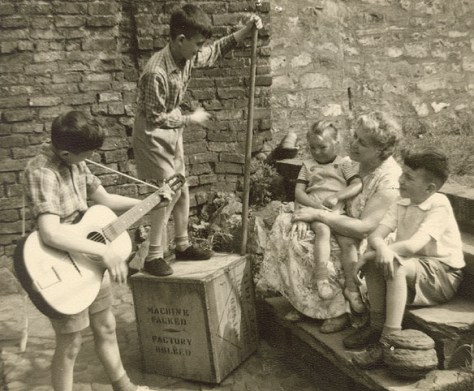
Martin Parry

And on Monday this week, David Porter (Books Marketing Manager at CABI) and his colleague Sarah Hilliar came up to Birmingham to video Brian and me (and two other authors, Nigel Maxted and Jeremy Pritchard of the University of Birmingham) for a short promotional video about the book. Unfortunately, Martin Parry was unable to join us.

So now the hard work is over and Plant Genetic Resources and Climate Change is about to be published. There are many interesting key messages, and the preface provides an excellent guide to the rest of the book.

It’s official – I’m an OAP

A birthday selfie!

A birthday selfie!

Yes, that’s right. Old Age Pensioner. Or, as my elder brother Ed told me, I’ve joined the Golden Pioneers Club.

It’s my 65th birthday today. Time to start drawing my state pension, and the small one that I will receive from my 10 years at the University of Birmingham in the 80s.

So am I going to slow down? Not exactly.

I did retire from IRRI at the end of April 2010 and have enjoyed the past three and a half years doing exactly what I wanted to do. That’s the beauty of no longer being in full-time employment.

And today, I’m not exactly putting my feet up either. I arrived to the Philippines last night, and will be working with my former colleagues at IRRI on plans for the 4th International Rice Congress (IRC2014) that will be held in Bangkok in October next year. After a little over a week in Los Baños I’m flying back to the UK via Bangkok where I’ll spend a couple of days working with the company that’s providing all the logistical support for the congress, Kenes Asia.

What with this congress, the imminent publication of Plant Genetic Resources and Climate Change, and some media events around its launch, and editorial commitments for the international scientific journal Genetic Resources and Crop Evolution, retirement continues full of opportunities.

And I wouldn’t have it any other way.

I’ve received lots of greetings. And my old friend, Geoff Sharratt, sent me the ecard below – takes me back quite a few years!

This one below came from Ed in chilly Canada. Somewhat different from the 33C (92F) I experienced on arrival in Manila yesterday. Ordered from Old Farts Greetings Cards, it’s most appropriate (for me and him).

Plant Genetic Resources and Climate Change: available mid-December 2013

Our new 16 chapter book on plant genetic resources has 34 contributors who agree that enhanced use of plant genetic resources is critically important for mitigating against the effects of climate change. The book reveals strong positive messages for the future, but also some substantial negative ones if improvements to conservation and the use of plant genetic resources for food and agriculture (PGRFA) by plant breeders do not happen soon.

Positive messages:

  • While the latest IPCC report (and Betts and Hawkins, Chapter 3) ‘confirms’ that climate change is a reality – and it will affect agriculture – already we can compare regions and see what the scale of the agricultural challenge is, and extrapolate to what will be the situation in the future (Parry, Chapter 4; Berry et al., Chapter 5).
  • Even though climate change will exacerbate the problem of food insecurity – and some of the poorest countries will be affected worst (Zeigler, Chapter 1) – the good news is that breeders are confident they will be able to produce the next generation of ‘climate-adapted crops’. To adapt crops to new climate conditions it is now universally agreed that breeders need access to sources of genetic diversity – and tools to use this diversity more efficiently and effectively. The good news is that major sources of genetic diversity are already conserved in ex situ genebanks.
  • It is also good news that it’s now possible through novel molecular and bioinformatic approaches to more carefully identify valuable genes and track their progress in breeding. New technologies – molecular and bioinformatic – should massively improve exploitation of PGRFA provided those resources still survive. Seed genebanks will lead to DNA sequence genebanks and then on to in silico genebanks and the creation of the ‘digital plant’ (McNally, Chapter 10) enabling the modelling of the ‘ideal plant’ for whatever conditions prevail.
  • Good news also is that breeders are already addressing climate change constraints and using germplasm for submergence, drought, salinity, heat, and pests and diseases, and making progress which gives optimism for the future (Chapters 12 to 16). Drought, submergence, heat and salinity are all environmental stresses that are likely to increase as a result of climate change. For example, rice has 25 related wild species, and 22 of these have already contributed genes to new stress tolerant varieties (Zeigler, Chapter 1).
  • We now have good evidence indicating that some plants in their natural environments can adapt genetically to changing conditions very rapidly – easily within 20 or 30 years and within the timescale of climate change. So as well as conservation in genebanks, plant genetic resources need to be conserved in situ in natural reserves (Maxted et al., Chapter 7) or on farms (Bellon and van Etten, Chapter 8) so that new genes can evolve and provide a greater armory against climate change than afforded just by germplasm ‘frozen’ in genebanks (Ford-Lloyd et al., Chapter 2).

Issue for concern:

  • International mechanisms are in place, through the International Treaty, for breeders to share germplasm for the benefit of society. But there are still political issues constraining the use of plant genetic resources currently conserved (Ford-Lloyd et al., Chapter 2). ‘Ready access’ to genetic resources has been jeopardized by the International Treaty. But, the International Treaty is the only instrument we have for allowing for the exchange and then use of PGRFA so we have to make the best of it (Moore and Hawtin, Chapter 6).

  • Enhanced use of PGRFA can help reduce the increasing risk of hunger predicted by climate change, but does not detract from the need to reduce or stabilize greenhouse gas emissions which would have the greatest effect on reduction of increasing world hunger (Parry, Chapter 4).

  • It is clear that up to now, use of PGRFA by breeders has been neither systematic nor comprehensive, and the vast majority of crop wild relatives remain untapped (Maxted et al., Chapter 7).

  • Critically, we know virtually nothing about how many landraces are currently being grown and fulfilling their potential for adapting to changes in the environment, so there is a need for a step change (Ford-Lloyd et al., Chapter 2).

  • As much as 20% of all plants, not just crop wild relatives, are now estimated to be threatened with extinction. Even within Europe substantial numbers of crop wild relatives are threatened or critically endangered in International Union for Conservation of Nature (IUCN) terms. However, it is the genetic diversity within species that is of greater value for crop improvement, and this diversity is almost certainly being lost (genetic erosion) at a much greater rate than the species themselves, and yet their conservation is far from sufficient (Maxted etal., Chapter 7).

  • Relatively few crop wild relatives (9%) are conserved in genebanks, and even fewer conserved in natural reserves. So, currently there is no guarantee that the genes we need for combating climate change will be available in newly adapted forms when we need them.

Would you like to purchase a copy? You can order online from CABI. When ordering from CABI online purchasers can use this code (CCPGRCC20) for a 20% discount off the retail price. The discount code is valid until 31 December 2013. The standard prices are £85.00, U5$160.00, or €11 0.00. The discounted prices are £68, $128, or €88 .

THE CONTRIBUTORS

Susan J. ARMSTRONG
Senior Lecturer, School of Biosciences, University of Birmingham, Edgbaston, Birmingham, B15 2TT, UK

Mauricio R. BELLON
Principal Scientist, Bioversity International, Via dei Tre Denari 472/a, Maccarese, Rome, Italy

Pam BERRY
Senior Research Fellow, Environmental Change Institute, University of Oxford, Dyson Perrins Building, South Parks Road, Oxford, OX1 3QY, UK

Richard A. BETTS
Professor and Head of the Climate Impacts, Met Office Hadley Centre, FitzRoy Road, Exeter, Devon EX1 3PB, UK

Helen BRAMLEY
Research Associate, Institute of Agriculture, The University of Western Australia, 35 Stirling Highway, Crawley, WA 6009, Australia

Joana Magos BREHM
Collaborator, Centre for Environmental Biology, University of Lisbon, Portugal and Research Assistant, School of Biosciences, University of Birmingham, Edgbaston, Birmingham, B15 2TT, UK

Colette BROEKGAARDEN
Postdoctoral Fellow, Wageningen UR Plant Breeding, PO Box 16, 6700 AJ Wageningen, The Netherlands

Salvatore CECCARELLI
Former Barley Breeder, International Center for Agricultural Research in the Dry Areas (ICARDA), Aleppo, Syria (now retired)

Maduraimuthu DJANAGUIRAMAN
Postdoctoral Research Associate, Department of Agronomy, 2004 Throckmorton Plant Science Center, Kansas State University, Manhattan, KS 66506, USA

Johannes M.M. ENGELS
Honorary Research Fellow, Bioversity International, Via dei Tre Denari 472/a, Maccarese, Rome, Italy

William ERSKINE
Professor and Director, International Centre for Plant Breeding Education and Research (ICPBER) and Centre for Legumes in Mediterranean Agriculture (CLIMA), The University of Western Australia, 35 Stirling Highway, Crawley WA 6009, Perth, Australia

Jacob van ETTEN
Theme Leader – Climate Change Adaptation, Bioversity International, Regional Office of the Americas, CIAT, Recta Cali – Palmira Km. 17, Palmira, Colombia

Brian FORD-LLOYD
Emeritus Professor, School of Biosciences, University of Birmingham, Edgbaston, Birmingham, B15 2TT, UK

Ed HAWKINS
NERC Advanced Research Fellow, National Centre for Atmospheric Science, Department of Meteorology, University of Reading, Earley Gate, PO Box 243, Reading, RG6 6BB, UK

Geoffrey HAWTIN
Former Director General, International Plant Genetic Resources Institute (IPGRI), Maccarese, Rome, Italy (now retired)

Abdelbagi M. ISMAIL
Principal Scientist – Plant Physiology, International Rice Research Institute (IRRI), DAPO 7777, Manila 1301, Philippines

Michael JACKSON
Former Head of the Genetic Resources Center and Director for Program Planning and Communications, International Rice Research Institute (IRRI), DAPO Box 7777, Manila 1301, Philippines (now retired)

Shelagh KELL
Research Fellow, School of Biosciences, University of Birmingham, Edgbaston, Birmingham, B15 2TT, UK

David J. MACKILL
Adjunct Professor, Department of Plant Sciences, University of California, Davis, CA 95616, USA and former Principal Scientist – Rice Breeding, International Rice Research Institute (IRRI), DAPO 7777, Manila 1301, Philippines

Al Imran MALIK
Research Associate, Centre for Legumes in Mediterranean Agriculture (CLIMA) and Institute of Agriculture, The University of Western Australia, 35 Stirling Highway, Crawley, WA 6009, Australia

Nigel MAXTED
Senior Lecturer in Genetic Conservation, School of Biosciences, University of Birmingham, Edgbaston, Birmingham, B15 2TT, UK

Kenneth L. McNALLY
Senior Scientist II – Molecular Genetics and Computational Biology, International Rice Research Institute (IRRI), DAPO Box 7777, Manila 1301, Philippines

Mary A. MGONJA
Principal Scientist and Program Leader (Genetic Resources Enhancement and Management), International Crops Research Institute for the Semi-Arid Tropics (ICRISAT), Regional Office for Eastern and Southern Africa, United Nations Avenue, World Agroforestry Centre, Gigiri PO Box 39063-00623, Nairobi, Kenya 

Samarendu MOHANTY
Head, Social Sciences Division, International Rice Research Institute (IRRI), DAPO Box 7777 Manila 1301, Philippines

Gerald MOORE
Former Legal Counsel, Food and Agriculture Organization of the United Nations (FAO), Rome, Italy (now retired)

Helen OUGHAM
Former Reader, Institute of Biological, Environmental and Rural Sciences, Aberystwyth University, Penglais, Aberystwyth, Ceredigion, SY23 3DA, UK(now retired)

Martin PARRY
Visiting Professor, Grantham Institute and Centre for Environmental Policy, Imperial College London, London, SW7 2AZ, UK

P.V. Vara PRASAD
Associate Professor and Director of K-State Center for Sorghum Improvement, Department of Agronomy, 2004 Throckmorton Plant Science Center, Kansas State University, Manhattan, KS 66506, USA

Jeremy PRITCHARD
Senior Lecturer and Head of Education,School of Biosciences, University of Birmingham, Edgbaston, Birmingham, B15 2TT, UK

Julian RAMIREZ-VILLEGAS
Doctoral Researcher, Institute for Climatic and Atmospheric Science (ICAS), School of Earth and Environment, University of Leeds, Leeds, UK, CGIAR Research Program on Climate Change, Agriculture and Food Security (CCAFS), Cali, Colombia, and International Center for Tropical Agriculture (CIAT), Cali, Colombia

Ian D. THOMAS
Research Scientist, Institute of Biological, Environmental and Rural Sciences, Aberystwyth University, Penglais, Aberystwyth, Ceredigion, SY23 3DA, UK

Hari D. UPADHYAYA
Principal Scientist, Assistant Research Program Director – Grain Legumes, and Head – Gene Bank, International Crops Research Institute for the Semi Arid Tropics (ICRISAT), Patancheru 502 324, Andhra Pradesh, India

Ben VOSMAN
Senior Scientist – Resistance Breeding, Wageningen UR Plant Breeding, PO Box 16, 6700 AJ Wageningen, The Netherlands

Robert S. ZEIGLER
Director General, International Rice Research Institute (IRRI), DAPO Box 7777, Manila 1301, Philippines

THE CHAPTERS

1. Food security, climate change and genetic resources
Robert S. Zeigler

2. Genetic resources and conservation challenges under the threat of climate change
Brian Ford-Lloyd, Johannes M.M. Engels and Michael Jackson

3. Climate projections
Richard A. Betts and Ed Hawkins

4. Effects of climate change on potential food production and risk of hunger
Martin Parry

5. Regional impacts of climate change on agriculture and the role of adaptation
Pam Berry, Julian Ramirez-Villegas, Helen Bramley, Samarandu Mohanty and Mary A. Mgonja

6. International mechanisms for conservation and use of genetic resources
Gerald Moore and Geoffrey Hawtin

7. Crop wild relatives and climate change
Nigel Maxted, Shelagh Kell and Joana Magos Brehm

8. Climate change and on-farm conservation of crop landraces in centres of diversity
Mauricio R. Bellon and Jacob van Etten

9. Germplasm databases and informatics
Helen Ougham and Ian D. Thomas

10. Exploring ‘omics’ of genetic resources to mitigate the effects of climate change
Kenneth L. McNally

11. Harnessing meiotic recombination for improved crop varieties
Susan J. Armstrong

12. High temperature stress
Maduraimuthu Djanaguiraman and P.V..Vara Prasad

13. Drought
Salvatore Ceccarelli

14. Salinity
William Erskine, Hari D. Upadhyaya and Al Imran Malik

15. Response to flooding: submergence tolerance in rice
Abdelbagi M. Ismail and David J. Mackill

16. Effects of climate change on plant-insect interactions and prospects for resistance breeding using genetic resources
Jeremy Pritchard, Colette Broekgaarden and Ben Vosman 

THE EDITORS

MICHAEL JACKSON retired from the International Rice Research Institute (IRRI) in 2010. For 10 years he was Head of the Genetic Resources Center, managing the International Rice Genebank, one of the world’s largest and most important genebanks. Then, for nine years, he was Director for Program Planning and Communications. He was also Adjunct Professor of Agronomy at the University of the Philippines-Los Baños. During the 1980s he was Lecturer in the School of Biological Sciences at the University of Birmingham, focusing on the conservation and use of plant genetic resources. From 1973-81 he worked at the International Potato Center, in Lima, Perú and in Costa Rica. He now works part-time as an independent agricultural research and planning consultant. He was appointed OBE in The Queen’s New Year’s Honours 2012, for services to international food science.

BRIAN FORD-LLOYD is Emeritus Professor of Conservation Genetics at the University of Birmingham, former Director of the University Graduate School, and former Deputy Head of the School of Biosciences. During his tenure as Director of the University Graduate School he aimed to ensure that doctoral researchers throughout the University were provided with the opportunity, training and facilities to undertake internationally valued research that would lead into excellent careers in the UK and overseas. He drew from his experience of having successfully supervised over 40 doctoral researchers from the UK and many other parts of the world in his chosen research area which included the study of the natural genetic variation in plant populations, and agricultural plant genetic resources and their conservation.

MARTIN PARRY is Visiting Professor at The Centre for Environmental Policy, Imperial College London, and also Visiting Research Fellow at The Grantham Institute at the same university. Until September 2008 he was Co-Chair of Working Group II (Impacts, Adaptation and Vulnerability), of the Intergovernmental Panel on Climate Change (IPCC) based at the Hadley Centre for Climate Prediction and Research, UK Meteorological Office. Previously he was Director of the Jackson Environment Institute (JEI), and Professor of Environmental Science at the University of East Anglia (1999-2002); Director of the JEI and Professor of Environmental Management at University College London (1994-99); foundation Director of the Environmental Change Institute and Professor of Geography at the University of Oxford (1991-94); and Professor of Geography at the University of Birmingham (1989-91). He was appointed OBE in The Queen’s New Year’s Honours 1998, for services to the environment and climate change.

Orange and Green: tribal loyalties and conflict in Northern Ireland

A story in The Guardian a couple of days ago caught my eye. It was a piece about happiness across the UK, the results from a survey by the Office for National Statistics (ONS). Those surveyed were asked to comment on their personal well-being, two components of which were ‘happiness’ and ‘anxiety’.

What surprised me, given its turbulent and uncertain past, were the apparent high level of happiness and low anxiety among those surveyed in Northern Ireland (relative to other regions of the UK). Now this interested me because I had just finished Michael Farrell’s detailed (and I have to say rather depressing) account of the birth of Northern Ireland, and the ethnic and religious conflicts and violence (tribal even, at least on the part of the Protestant community) that have characterized life in that province since 1922. Incidentally, the ONS survey provided aggregated data for Northern Ireland with no further breakdown across counties, some of which have a Catholic majority.

Northern Ireland: The Orange State is a comprehensive account of how partition and its aftermath shaped political, cultural and economic development in Northern Ireland, and how the domination of the Catholics by the majority Protestant Unionists or Loyalists was bound – eventually – to culminate in The Troubles that came to define the late 60s, the 70s and 80s.

The bald facts cannot be challenged. There was systematic and ‘official’ persecution of the Catholic population, collusion between the Unionist State and Protestant organizations like the Orange Order at the very least. With the backing of the Royal Ulster Constabulary (now disbanded and replaced with Police Service for Northern Ireland, PSNI), the Specials (particularly the violent B Specials) and other groups, the Northern Ireland government was determined never to let the Catholics improve their lot. Legislation, gerrymandering and discrimination (and thuggery) were used by the State as tools of repression of the Nationalist (Catholic) minority, and to prevent – as far as possible – the power and influence of the Protestant community from ever being assailed.

It’s no wonder then that at the end of the 1960s, a vibrant civil rights movement sprang up among the Catholic communities. And although I unreservedly condemn the violence that both sides of the conflict perpetrated on their fellow Irishmen, I can understand better the causes of that violence and what motivated the Provisional IRA to take up arms. And so Northern Ireland was subject to assassination and reprisals, often at ransom and against civilians not engaged in any form of political or civil disobedience or violence. Violence was used to inflict terror per se and, if Farrell’s analysis is to be believed, the Protestant community and its various bodies (including state bodies) has to carry the bulk of the blame. Even the British Army may have colluded with the Loyalist organizations to maintain the status quo.

In 1970 I was a young man of 21. Northern Ireland and its growing conflict didn’t really register on my radar. I was abroad for much of the 70s so didn’t fully appreciate what was happening in Northern Ireland. The 1980s (when I was back in the UK for a decade) were the Thatcher years, and the industrial conflicts seemed perhaps more newsworthy than what was happening across the Irish Sea. Frankly, my memory is now quite vague about those 10 years. And during the 1990s, when finally progress was being made in the Peace Process (with the active involvement of US President Bill Clinton and UK Prime Minister Tony Blair and their representatives) I was again out of the country, and got my news second-hand, so-to-speak.

I cannot – and don’t – claim to be a pundit on the affairs of Ireland. That would be naïve and presumptuous. As I have pointed out in other posts in this blog, I have been trying to understand my Irish ancestry and how the history of Ireland would have affected my family.

What I see today (simplistically or naïvely perhaps, and from afar it has to be said) is a more settled Northern Ireland, that is trying to come to grips with is turbulent past, trying to develop economically, and move forward. For several years the Peace process has led to a more stable democracy in which former arch enemies are working together, or at least giving the appearance of working together, and that can only be a positive thing. Unsavoury individuals like the Rev. Ian Paisley (whose bigotry and promotion of violence during the 60s and 70s must be roundly condemned), who formed the Democratic Unionist Party (DUP) that is the majority party in the Northern Ireland Assembly, eventually mellowed and did sit down in government with Sinn Féin. The signs of progress are everywhere to see. Derry-Londonderry is one of the 2013 European Cities of Culture. Who would have thought that would have been even thinkable several decades ago when Derry was the heart of the struggles.
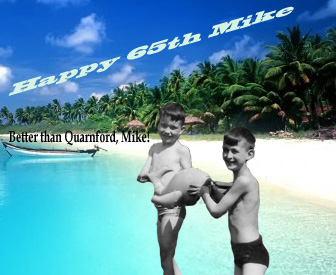
But one of the iconic moments of the whole Peace Process in a broad sense happened in when HM The Queen visited Northern Ireland and was introduced to members of the Northern Ireland Assembly. Not only were its Assembly Leader Peter Robinson (DUP) and Martin McGuinness (Deputy, Sinn Féin, and a former commander of the Provisional IRA in Derry) standing side-by-side, but McGuinness shook hands with Her Majesty. Who would have predicted that?

Nevertheless serious tensions lie just below the surface, old wounds are opened, and violence breaks out between the two communities, as we see during the annual Orange Order marches (how they still remain so insensitive – indifferent  or disdainful might be better descriptions – beggars belief). And of course the Protestant community (or at least one hard-line element) came on to the streets in December 2012 to protest the ending of the flying the Union Flag above Belfast City Hall. Memories are long, and prejudices run deep in Northern Ireland, it seems. Even today, letter bombs have been sent to the Chief Constable of the PSNI, reportedly by dissident Republicans. And so it goes on.

Is there hope for the future? There has to be, and surely increasing economic prosperity – and a new generation – will bring about the lasting positive changes that most (but not all, I’m convinced) cherish. Even Burmese Nobel Peace Laureate Aung San Suu Kyi has visited Northern Ireland recently to understand more about the Peace Process. Nevertheless, I think I’ll have to leave Irish history for the time-being – it does begin to get to you after a while.