A new railway station for Bromsgrove (updated 5 October 2018)

20160717 023

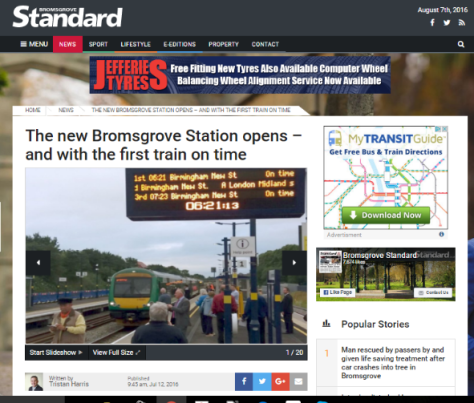
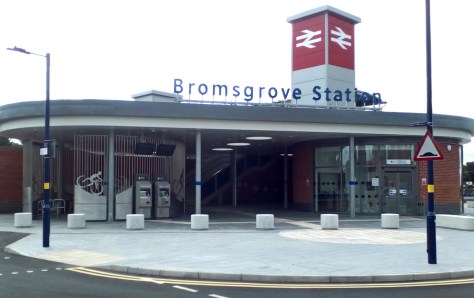
It has taken about three years or more to complete, but finally, on 12 July 2016, Bromsgrove’s new railway station in northeast Worcestershire opened for business as the first train pulled in, on time, at 6:21 am.

Bromsgrove station opens

20160717 011

So, 176 years after the first station opened on what was then the Birmingham and Gloucester Railway, Bromsgrove has a new station worthy of the 21st century, and managed by London Midland.

Bromsgrove station in 1960, looking south to where the new railway station has been constructed.

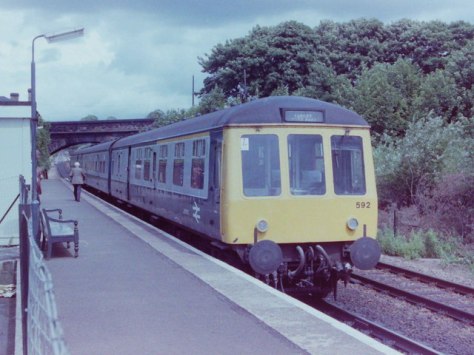
Bromsgrove’s one platform station in 1981.

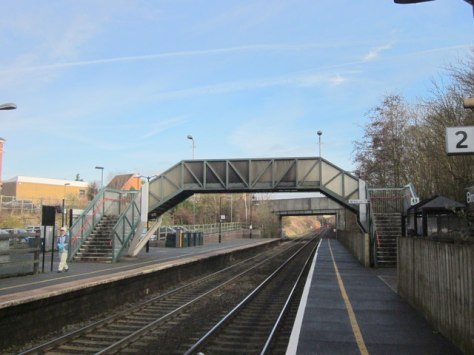
Bromsgrove station in 2012, looking north up the Lickey Incline, taken from the down line platform.

As with many infrastructure projects nowadays it seems, there have been several delays in completing this project. The station should have opened by Autumn 2015. Built on the site of the old carriage works, hidden signalling cables and a previously unmapped culvert required extensive additional engineering works to resolve these issues. In addition, hundreds of tonnes of oil-contaminated soil had to be removed from the site.

Now Bromsgrove proudly boasts of a modern, four platform station provided with lift access to all platforms, a ticket office, bicycle store, toilets, and parking for over 300 cars (payable by the day, week, month or annually). Regular bus services will connect the station with the town center over a mile away.

The new station replaces a two platform facility that was upgraded from a single platform (on the up line, towards Birmingham New Street) in the mid-1980s. Until then, trains on the down line (towards Worcester) were diverted on to the up line for the short period necessary to disembark and take on new passengers. Not the most convenient situation, as you can imagine, and one that led to serious traffic restrictions on this busy main line connecting the West Midlands with the south west (Gloucester, Bristol, South Wales, and beyond).

The station is about half a mile from my home, but I rarely used the train when I taught at the University of Birmingham in the 1980s. Even though the trains from Bromsgrove to Birmingham stopped at only one other station: University (right in the heart of the University of Birmingham campus, essentially).

The old station, at the foot of the famous Lickey Incline could accommodate trains with only three carriages. The new station has the length for six carriage trains, and once the electrification of the line has been extended from Barnt Green at the top of the Incline to Bromsgrove, a schedule of four or more trains per hour can be accommodated. Not only will stopping trains park on one of the platform branch platforms, thus permitting express through trains to keep to their schedule, but electric trains will be able to tackle the Lickey Incline faster from a standing start¹, unlike today’s diesel trains that chug up the Incline somewhat sedately.

The final platform branch line will not open until October this year, and new signalling installed. The mainline will be closed for two weeks. The final branch could not be laid until the old station closed as the curve into the fourth platform has to begin from where the old down line platform was located. Work has already begun, the old station platforms demolished, and the rails already laid ready to link into the main line later this year.


Update (November 2016)
The track laying and realignment are now complete, and new signalling has been installed. We just wait for the electrification of the line to Bromsgrove, which should be completed by this time next year.

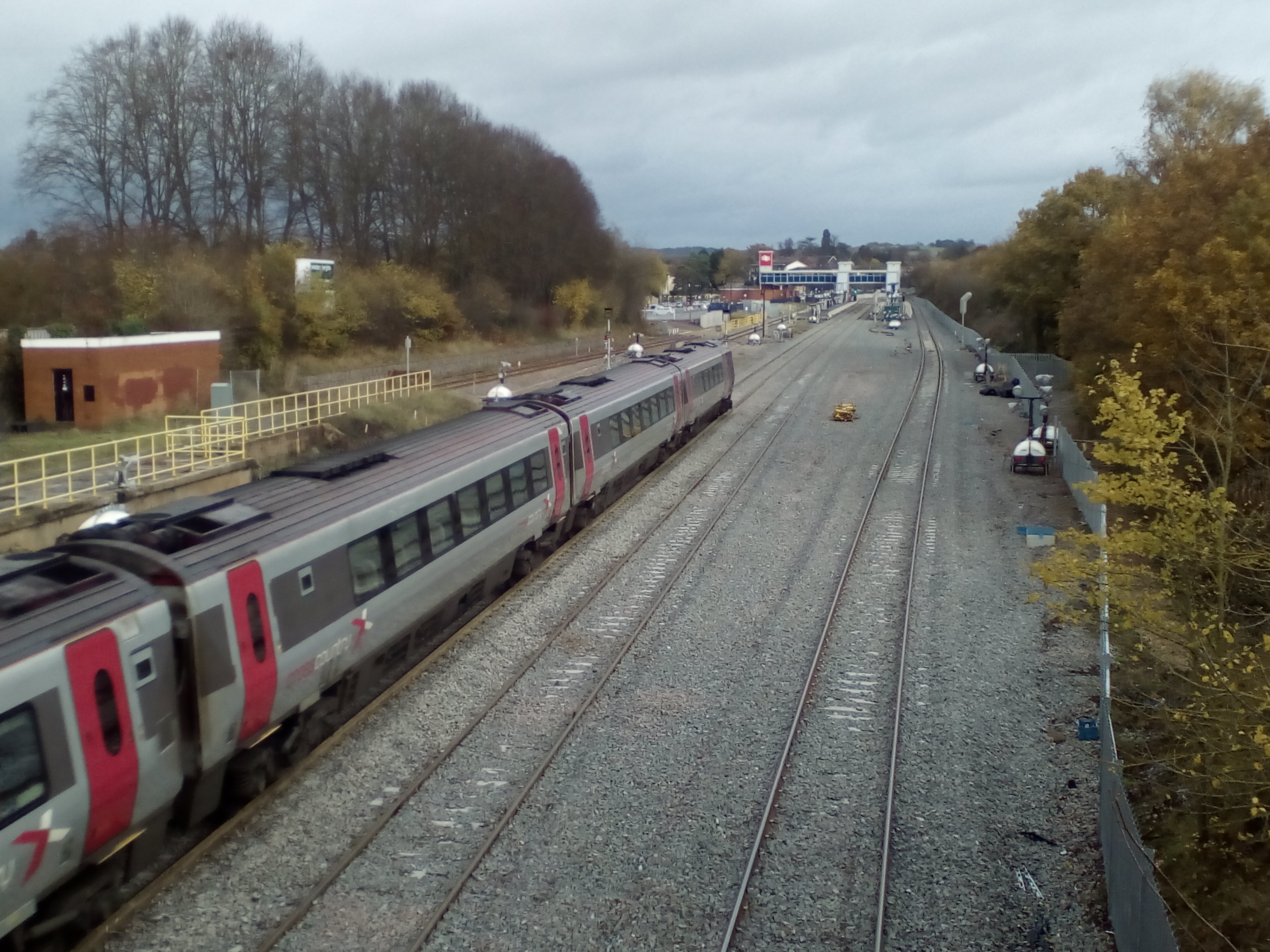
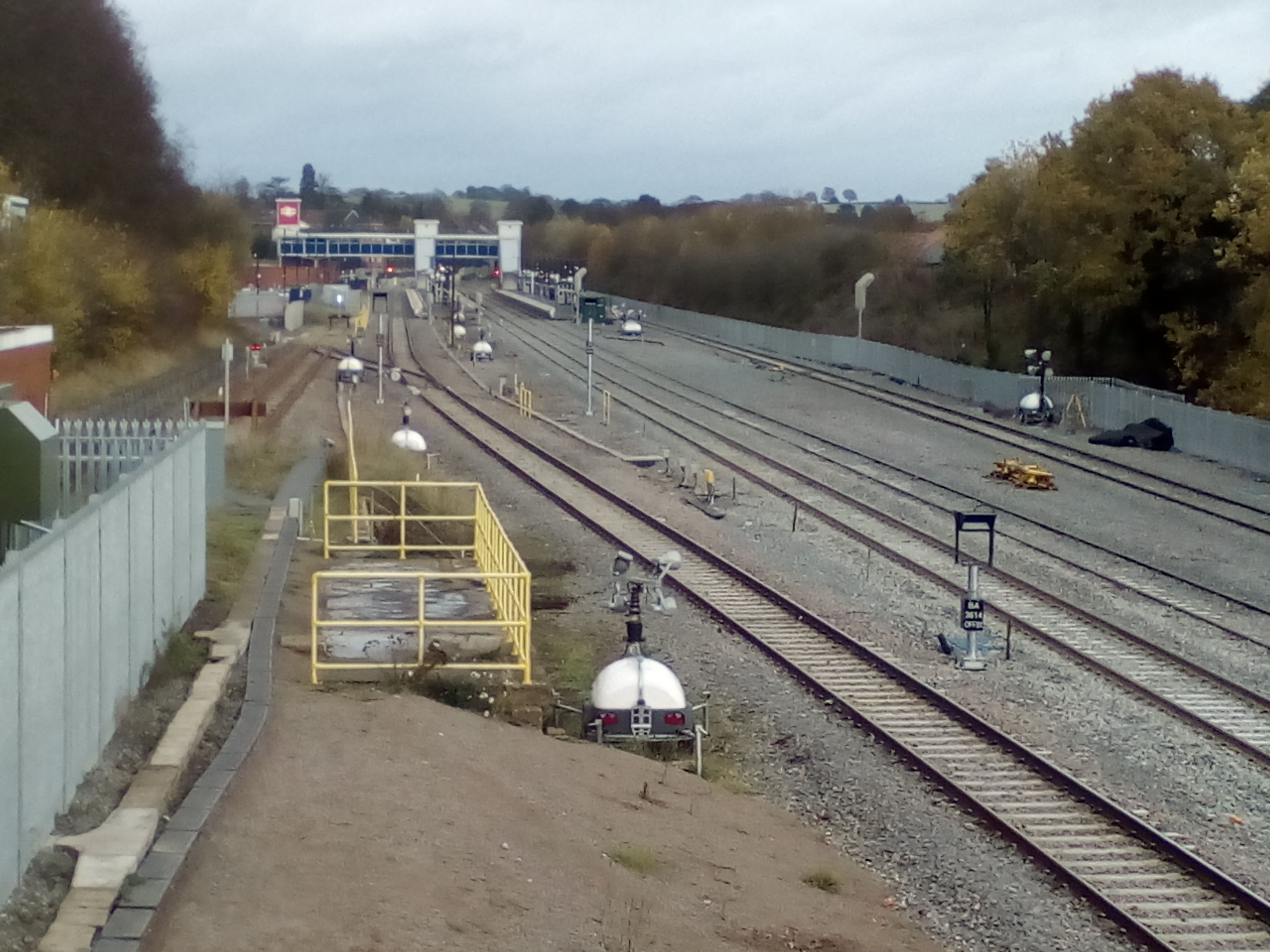
Much to my surprise, the new main down does in fact diverge from the old main down through the new Platform 4. You can see where that track was about to be laid in the photos above. And here is the track layout today. The old station was situated immediately below the bridge from where this photo was taken, looking south to the new station.

img_20161113_112359

South of the station, looking north to the station, you can see the new track layout, with the new through down on the right.

img_20161116_113112

img_20161116_113200

img_20161128_113731

A down express passing at speed through the new Platform 4 loop

Just south of the station, and on the left of this photo is a small siding for ‘bankers’—locomotives that add power to freight trains waiting to climb the Lickey Incline. They sit at the rear and gives a well-deserved push. Here’s a video from YouTube that illustrates what I mean (before the new station was built and track layout changed. However, this freight train was waiting on the freight loop that has been realigned in the recent work).

Also, the freight loop, that passes through Platform 1, is on the left.

img_20161116_112926

img_20161116_113415


Update (5 October 2018)
Electrification finally came to Bromsgrove at the end of July 2018. There had been serious delays, and Bromsgrove commuters were becoming increasingly angry about the delays to their promised new services.

But the overhead wires were finally installed and went live at the end of May to permit testing of the new installations and driver training before the implementation of the new services. Over the next few weeks, empty trains passed between Birmingham and Bromsgrove.

Bromsgrove is now served by West Midlands Railway, and there are five trains an hour into Birmingham New Street at peak times. Some are Class 323 electric units on the Cross City Line (that now connects Bromsgrove with Lichfield to the north of Birmingham), others are the same old diesel-powered Class 170 units that connect Bromsgrove with Birmingham and Hereford.

As I mentioned earlier in this story when I posted it in August 2016, it was expected that the new electric units would power up the Lickey Incline faster¹ than the diesel ones. Two minutes faster in fact! That might not seem much, but with additional platforms at Bromsgrove to accommodate waiting trains, and faster trains clearing the Lickey Incline sooner, the through expresses are not affected, and more trains per hour can be run. Well, someone filmed the difference between the Class 323 and Class 170 trains; here is the video:


Light of foot, nimble of finger . . .

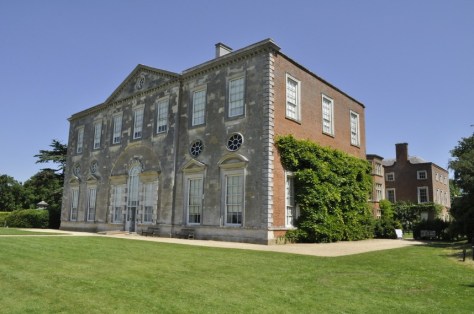
Luke Lightfoot. Never heard of him? Neither had I until just over a couple of weeks ago when we visited the National Trust’s Claydon House in Buckinghamshire, south of Buckingham, east of Bicester.

20160719 110 Claydon House

20160719 112 Claydon House


Claydon House is close to two other National Trust properties, Waddesdon Manor and Stowe, perhaps more illustrious, and probably they receive far more visitors.

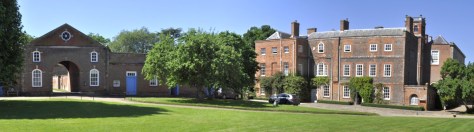
So how does Claydon compare? I think that anyone who visits Claydon House will come away with a sense of wonder of what 18th century master carver and stonemason Luke Lightfoot achieved for his employer, Ralph 2nd Earl Verney who rebuilt the family ancestral home between 1757 and 1771. The Verney family still occupies the red brick wings of the house.

The building standing today is just part of what was originally planned, and at least one wing was demolished. Although the exterior of the building is often described as austere, I think it has a charming symmetry and simplicity.

The interiors however, are something else—a riot of rococo wood carving of the very highest standard. Perhaps the most exquisite examples of 18th century carving to be seen anywhere in the country.

Luke Lightfoot, born in London in 1722, is somewhat of a mystery. Here’s what the National Trust has to say about him: Luke Lightfoot was a brilliant and talented stonemason and carver, but not an architect. However, Sir Ralph Verney engaged him as such at Claydon where Lightfoot used his skills to make impressive carvings, most notably in the north hall here at Claydon. He was a very talented carver but not a very trustworthy one and he swindled away a lot of Sir Ralph’s money before being dismissed. 

Most of the work done by Luke survives today, including the painted wooden carvings in the Chinese Room. All of the wood was painted white, which is believed to be because it was all carved in pine which comes in many shades and discolours over time. Due to the preserving coat of paint you can still see the unique and amazing craftsmanship of the carvings today.

The main entrance of the house leads into the Saloon, a beautifully proportioned room decorated in blue and white. You can’t fail to be impressed by the ceiling decoration, or the papier mâché reliefs high up on the walls.

But it’s in the North Hall that some of Lightfoot’s best carving is to be seen.

In the library there is equally fine carving high on the walls, but the ceiling was completed by Joseph Rose.

The Grand Staircase is in a class of its own. Can there be a finer example in England?

In the Pink Parlor, the door lintels are surmounted by other carvings depicting Aesop’s Fables, and the ceiling of the Great Red Room immediately above has some impressive ‘domes’.

Florence Nightingale was the sister of the second wife, Parthenope, of Sir Henry Verney (1801-1894), and she visited Claydon many times. On the second floor is the bedroom she used. Next door is the Gothic Room in which the only decoration that is not made of wood is the marble fireplace. Can you imagine such carving?

Next to the Gothic Room is the Chinese Room, where the rococo decoration has ‘exploded’. And more impressive ‘domes’ in the Paper Room.

Close by the house, no more than 50 m away is the Church of All Saints, with many memorials to the Verney family, and especially one to Sir Edmund Verney, Standard Bearer to King Charles I, who was killed at the Battle of Edgehill in October 1642.

Don’t miss Claydon. You won’t be disappointed.

I have only shown photos here of the decoration and architectural features, and I’m grateful to the National Trust for giving me permission for photography in the house. Photography is not normally permitted, and certainly not of any of the Verney family personal effects such as masterpiece paintings and furniture. In the Salon there’s an impressive Van Dyck painting of Charles I for example, and throughout the house there are many more examples of such quality.

Claydon House is not the easiest National Trust property to find. Thankfully we had detailed Ordnance Survey maps to guide us there; signage leaves something to be desired. Road signs petered out in several places, and I did overhear other patrons mentioning this to staff on arrival. That’s something the National Trust needs to improve upon, not just here at Claydon but elsewhere around the country.

I can’t finish this particular blog post without a mention of the volunteers at Claydon, some of the friendliest and most informative we have come across in all our National Trust visits.

If it’s Wednesday, it must be Colombia . . .

Not quite the ‘Road to Rio . . .’
I have just returned from one of the most hectic work trips I have taken in a very long time. I had meetings in three countries: Peru, Colombia, and Mexico in just over 6½ days.

And then, of course, there were four days of travel, from Birmingham to Lima (via Amsterdam), Lima to Cali (Colombia), then on to Mexico City, and back home (again via Amsterdam). That’s some going. Fortunately the two long-haul flights (BHX-AMS-LIM and MEX-AMS-BHX) were in business class on KLM. Even so the journeys from Lima to Cali (direct, on Avianca) and Cali to Mexico (via Panama City, on COPA) were 12 hours and 11 hours door-to-door, respectively, the former taking so long because we were delayed by more than 5 hours.

As I have mentioned in an earlier blog post, I am leading the evaluation of the program to oversee the genebank collections in eleven of the CGIAR centers (known as the Genebanks CRP). Together with my team colleague, Marisé Borja, we met with the genebank managers at the International Potato Center (CIP, in Lima), the International Center for Tropical Agriculture (CIAT, in Cali), and the International Maize and Wheat Improvement Center (CIMMYT, in Texcoco near Mexico City).
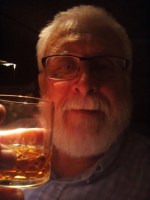
20160724 018

A drop of cognac.

It all started on Sunday 24 July, when I headed off to Birmingham Airport at 04:30 for a 6 o’clock flight to Amsterdam. Not really having slept well the night before, I can’t say I was in the best shape for flying half way round the world. I had a four hour stopover in Amsterdam, and managed to make myself more or less comfortable in the KLM lounge before boarding my Boeing 777-300 Lima flight sometime after noon. There’s not a lot to do on a long flight across the Atlantic except eat, drink and (try to) sleep. I mainly did the first two.

It never ceases to impress me just how vast South America is. Once we crossed the coast of Venezuela and headed south over the east of Colombia and northern Peru we must have flown for about three hours over rain forest as far as you could see. I wish I’d taken a few pictures of the interesting topography of abandoned river beds and oxbow lakes showing through all that dense vegetation. At one point we flew over a huge river, and there, on its banks, was a city, with an airport to the west. I checked later on Google Maps, and I reckon it must have been Iquitos in northern Peru on the banks of the Amazon. Over 2000 miles from the Atlantic, ocean going ships can sail all the way to Iquitos. I once visited Iquitos in about 1988 in search of cocoa trees, and we crossed the Amazon (about two miles wide at this point) in a small motorboat.

Then the majestic Andes came into view, and after crossing these we began our long descent into Lima, with impressive views of the mountains all the way and, nearer Lima, the coastal fogs that creep in off the Pacific Ocean and cling to the foothills of the Andes.

We landed on schedule at Jorge Chavez International Airport in Lima around 18:00 (midnight UK time) so I had been travelling almost 20 hours since leaving home. I was quickly through Immigration and Customs, using the Preferencial (Priority) line reserved for folks needing special assistance. My walking stick certainly gives me the edge these days on airlines these days.

Unfortunately, the taxi that had been arranged to take me to my hotel, El Condado, in the Lima district of Miraflores (where Steph and I lived in the 1970s) was a no-show. But I quickly hired another through one of the official taxi agencies inside the airport (necessary because of the various scams perpetrated by the cowboy taxi drivers outside the terminal) at half the price of the pre-arranged taxi.

After a quick shower, I met up with old friends and former colleagues at CIP, Dr Roger Rowe and his wife Norma. I first joined CIP in January 1973, and Roger joined in July that same year as CIP’s first head of Breeding & Genetics. He was my first boss!
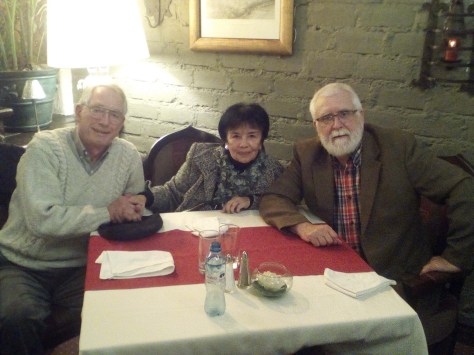
20160724 001

They were in the bar, and we enjoyed several hours of reminiscences, and a couple of pisco sours (my first in almost two decades), and a ‘lite bite’ in the restaurant. It must have been almost 11 pm before I settled into bed. That was Sunday done and dusted. The work began the following morning.

All things potatoes . . . and more
I haven’t been to CIP since the 1990s. Given the tight schedule of meetings arranged for us, I didn’t get to see much more than the genebank and dining room.

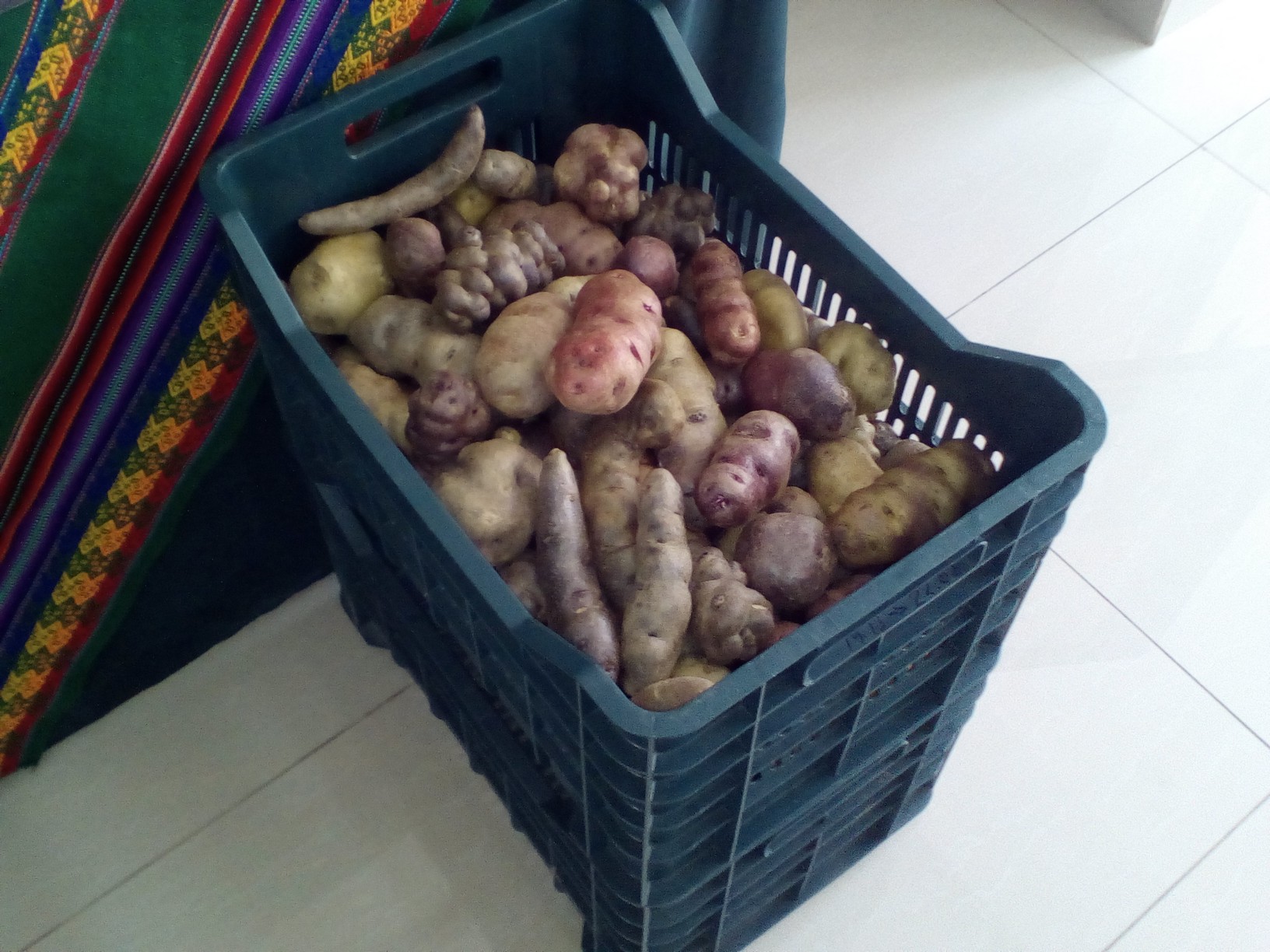
CIP has a genebank collection of wild and cultivated potatoes (>4700 samples or accessions, most from the Andes of Peru), wild and cultivated sweet potatoes (>6400, Ipomoea spp.), and Andean roots and tubers (>1450) such as ulluco (Ullucus tuberosus), mashua (Tropaeolum tuberosum), and oca (Oxalis tuberosa).
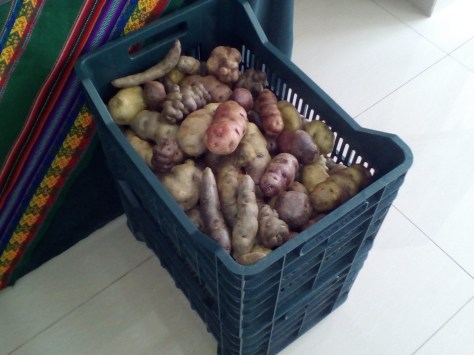
20160726 028

Native potato varieties.

Although potatoes are grown annually at the CIP experiment station at Huancayo, some six or more hours by road east of Lima, at over 10,000 feet in the Mantaro Valley, and sweet potatoes multiplied in greenhouses at CIP’s coastal headquarters at La Molina, the collections are maintained as in vitro cultures and, for potatoes at least, in cryopreservation at the temperature of liquid nitrogen. The in vitro collections are safety duplicated at other sites in Peru, with Embrapa in Brazil, and botanical seeds are safely stored in the Svalbard Global Seed Vault.

With a disease pressure from the many diseases that affect potato in its center of origin—fungal, bacterial, and particularly viruses—germplasm may only be sent out of the country if it has been declared free of these diseases. That requires growth in aseptic culture and treatments to eradicate viruses. It’s quite an operation. And the distribution does not even take into account all the hoops that everyone has to jump through to comply with local and international regulations for the exchange of germplasm.

The in vitro culture facilities at CIP are rather impressive. When I worked at CIP more than 40 years ago, in vitro culture was really in its infancy. Today, its application is almost industrial in scale.

Our host at CIP was Dr David Ellis, genebank manager, but we also met with several of the collection curators and managers.
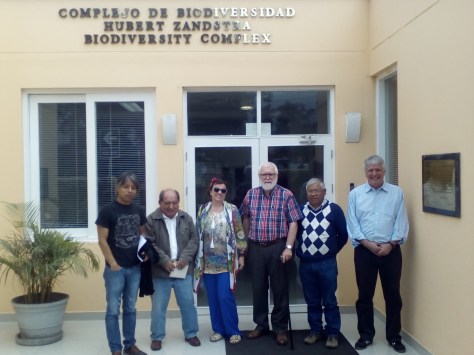
20160725 009

L to R: Ivan Manrique (Andean roots and tubers), Alberto Salas (consultant, wild potatoes), Marisé Borja (evaluation team), me, René Gómez (Senior Curator), David Ellis.
20160725 010

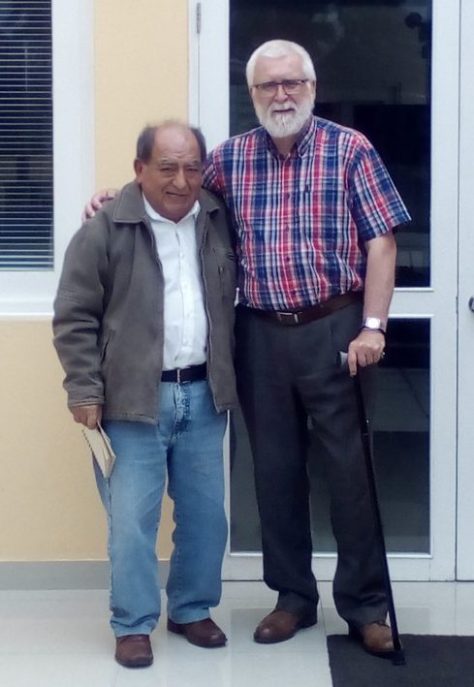
Alberto Salas, now in his 70s, worked as assistant to Peruvian potato expert Prof. Carlos Ochoa. Alberto’s wealth of knowledge about wild potatoes is enormous. I’ve known Alberto since 1973, and he is one of the most humble and kind persons I have ever met.

Prior to our tour of the genebank, René Gómez and Fanny Vargas of the herbarium had found some specimens that I had made during my studies in Lima during 1973 and 1974. I was also able to confirm how the six digit germplasm numbering system with the prefix ’70’ had been introduced and related to earlier designations.

It was great to see how the support from the Genebanks CRP has brought about so many changes at CIP.

Lima has changed so much over the past couple of decades. It has spread horizontally and upwards. So many cars! In the district of Miraflores where we used to live, the whole area has been refurbished and become even smarter. So many boutiques and boutique restaurants. My only culinary regret is that the famous restaurant La Rosa Nautica, on a pier over the Pacific Ocean closed down about two months ago. It served great seafood and the most amazing pisco sours.

All too soon our two days in Lima were over. Next stop: Cali, Colombia.

Heading to the Cauca Valley . . . 
Our Avianca flight to Cali (an Embraer 190, operated by TACA Peru) left on time at 10:25. Once we’d reached our cruising altitude, the captain turned off the seat belt sign, and I headed to the toilet at the front of the aircraft, having been turned away from the one at the rear. Strange, I thought. I wasn’t allowed to use the one at the front either. It seems that both refused to flush. The captain decided to return to Lima, but as we still almost a full load of fuel, he had to burn of the excess so we could land safely. So, at cruising altitude and as we descended, he lowered the undercarriage and flaps to create drag which meant he had to apply more power to the engines to keep us flying, thereby burning more fuel. Down and down we went, circling all the time, for over an hour! We could have made it to Cali in the time it took us to return to Lima. We could have all sat there with legs crossed, I guess.

Once back on the ground, engineers assessed the situation and determined they could fix the sensor fault in about a couple of hours. We were taken back to the terminal for lunch, and around 15:30 we took off again, without further incident.

But as we waited at the departure gate for a bus to the aircraft, there was some impromptu entertainment by a group of musicians.

Unfortunately because of our late arrival in Cali, we missed an important meeting with the CIAT DG, who was not available the following days we were there.

CIAT was established in 1967, and is preparing for its 5oth anniversary next year.

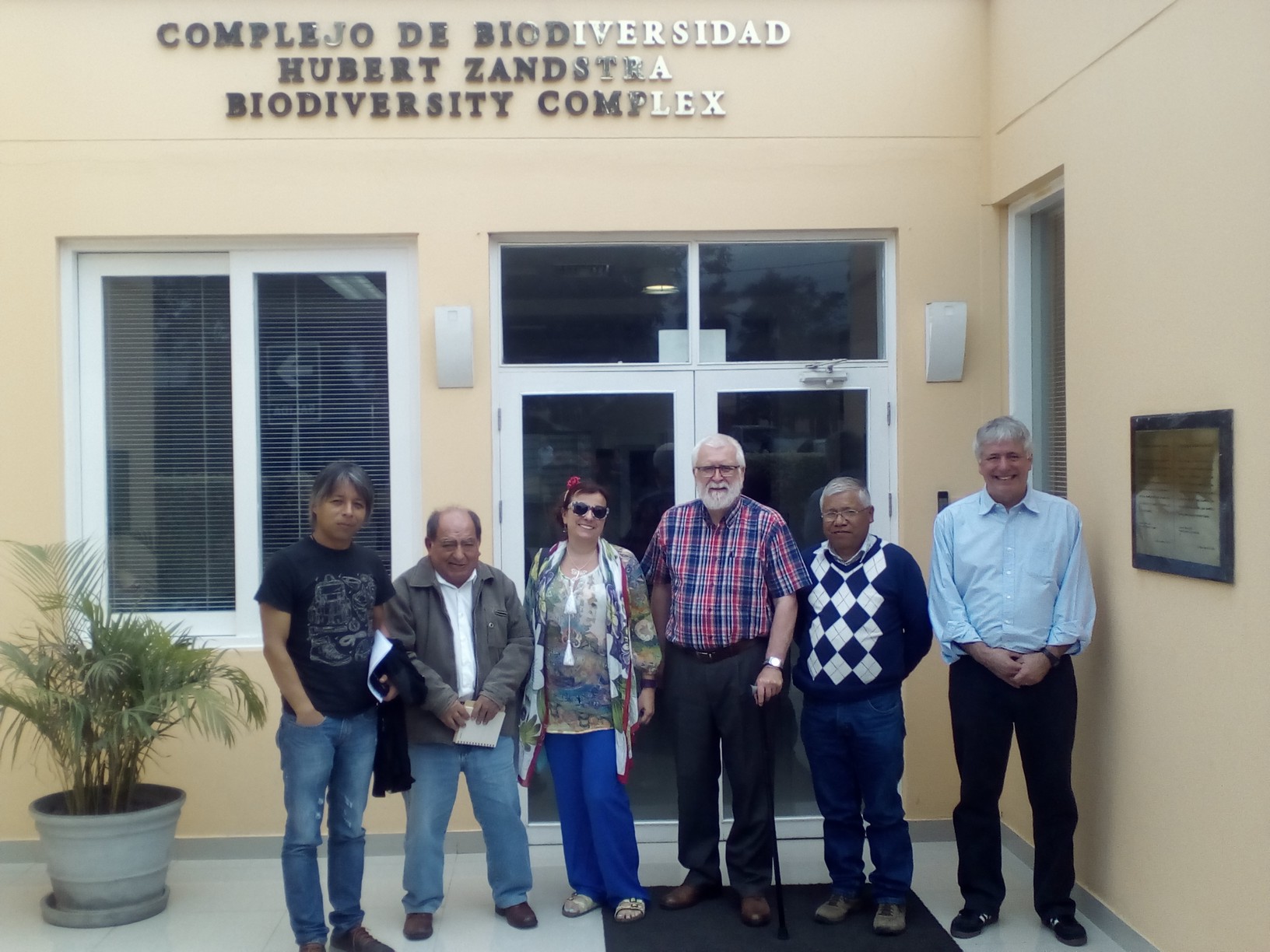
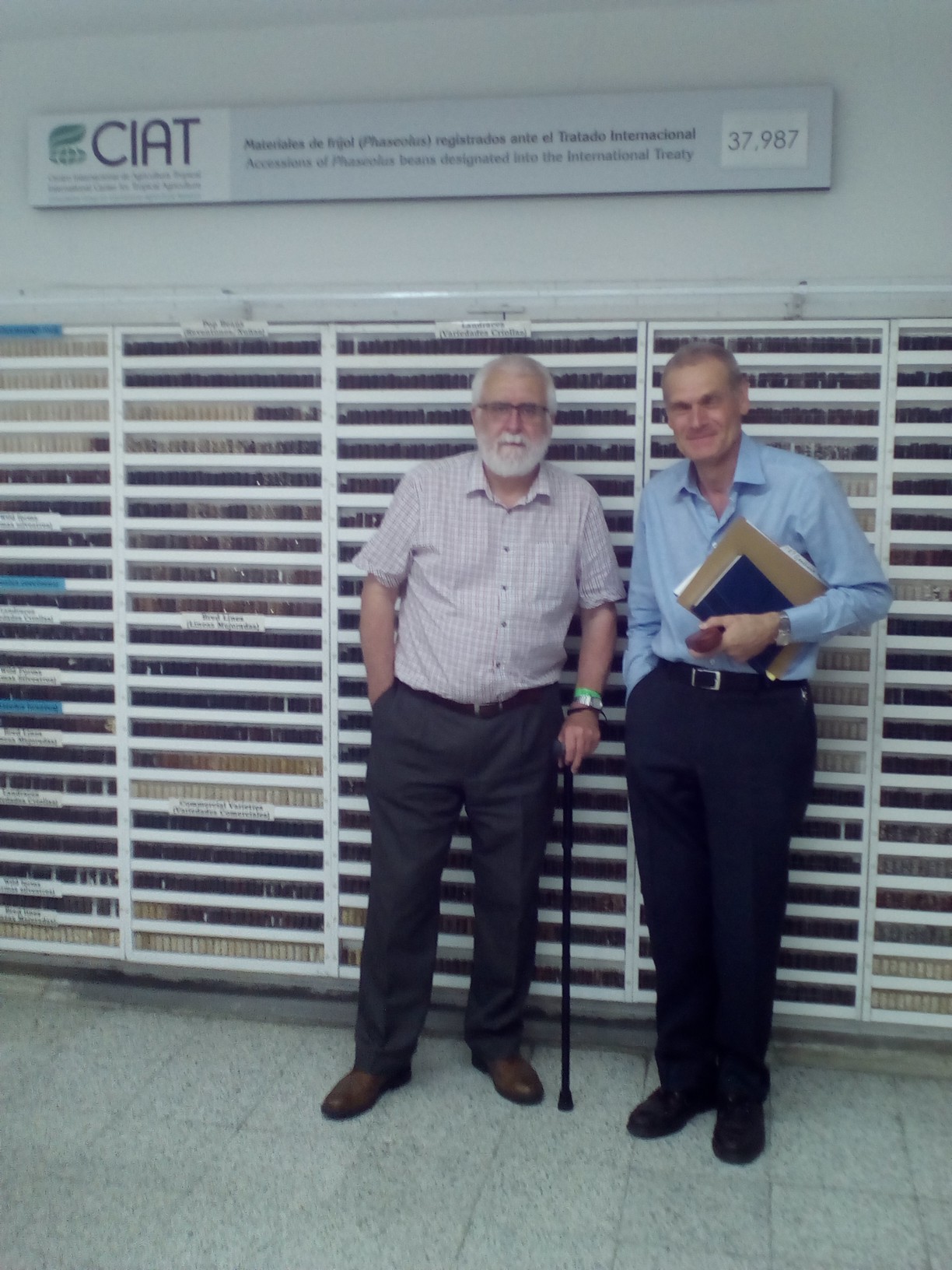
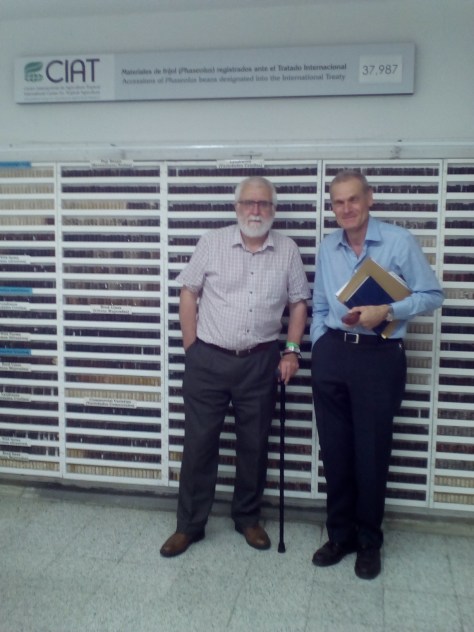
Daniel Debouck, from Belgium, is CIAT’s genebank manager, and he has been there for more than 20 years. He steps down from this position at the end of the year, and will be replaced by Peter Wenzl who was at the Global Crop Diversity Trust in Bonn until the end of April this year. Daniel is an internationally-recognised expert on Phaseolus beans.

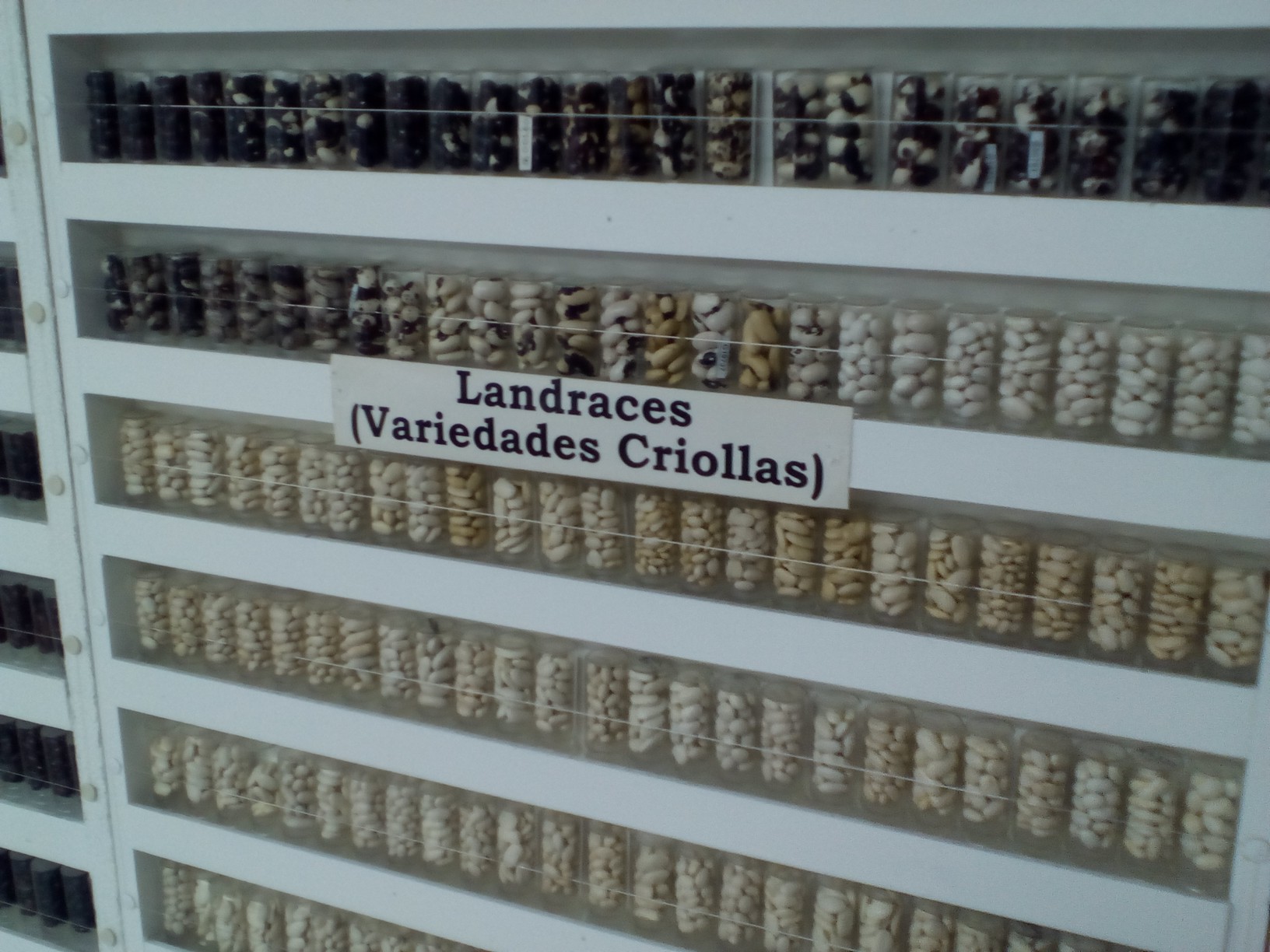
The CIAT genebank has three significant collections: wild and cultivated Phaseolus beans (almost 38,000 accessions), wild and cultivated cassava (Manihot spp., >6600 accessions in vitro or as ‘bonsai’ plants), and more than 23,000 accessions of tropical forages. Here’s an interesting fact: one line of the forage grass Brachiaria is grown on more than 100 million hectares in Brazil alone!
20160729 021

Me and Daniel Debouck.

20160729 022

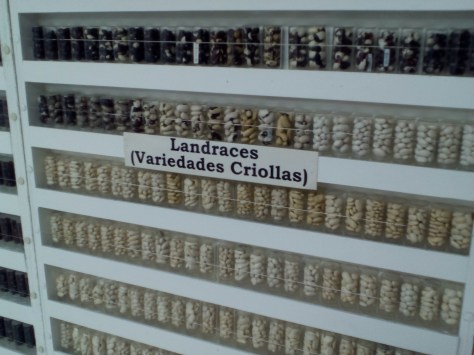
Bean varieties.

The bean collections are easily maintained as seeds in cold storage, as can most of the forages. But, like potato, the cassava accessions present many of the same quarantine issues, have to be cleaned of diseases, particularly viruses, and maintained in tissue culture. Cryopreservation is not yet an option for cassava, and even in vitro storage needs more research to optimise it for many clones.

20160729 040

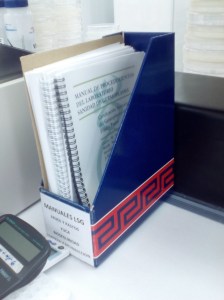
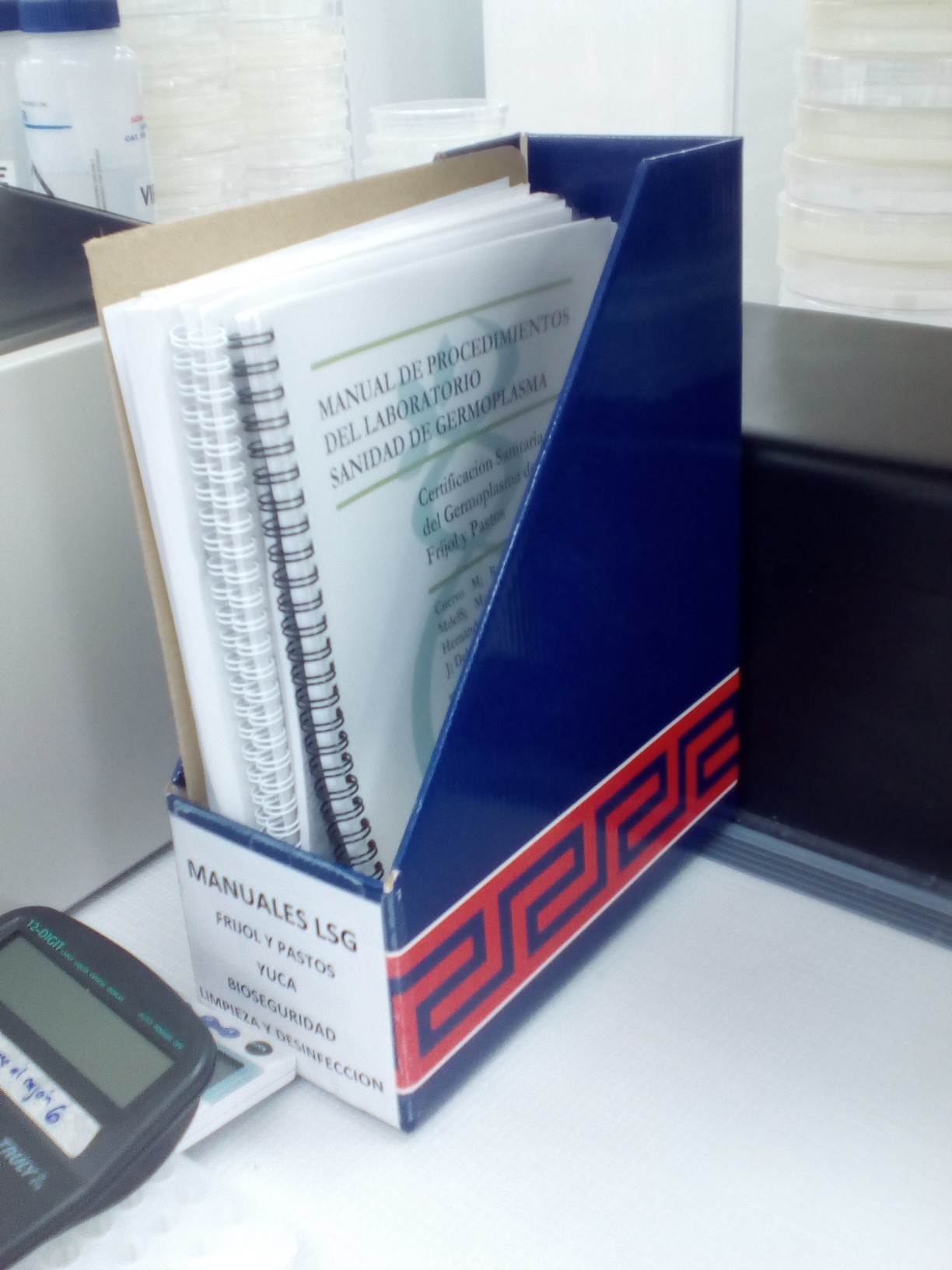
QMS manuals in the germplasm health laboratory.

Like many of the genebanks, CIAT has been upgrading its conservation processes and procedures through the application of a Quality Management System (QMS). A couple of genebanks (including CIP) have opted for ISO certification, but I am of the opinion that this is not really suitable for most genebanks. Everything is documented, however,  including detailed risk assessments, and we saw that the staff at CIAT were highly motivated to perform to the highest standards. In all the work areas, laboratory manuals are always to hand for easy reference.

An exciting development at CIAT is the planned USD18-20 million biodiversity center, with state of the art conservation and germplasm health facilities, construction of which is expected to begin next year. It is so designed to permit the expected thousands of visitors to have good views of what goes on in a genebank without actually having to enter any of the work areas.

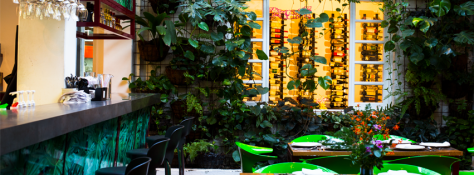
On our first night in Cali, our hosts graciously wined and dined us at Platillos Voladores, regarded as one of Cali’s finest restaurants.
1520778_329652313848934_5424856017809772967_n

We had the private room for six persons with all the wine bottles on the wall, which can be seen in this photo above.

Arriba, arriba! Andale!
On Saturday afternoon around 15:30, we headed to Mexico City via Tocumen International Airport in Panama City. Cali’s international airport is being expanded significantly and there are now international flights to Europe as well as the USA. This must be great for CIAT staff, as the airport is only 15 minutes or so from the research center.

After takeoff, we climbed out of the Cauca Valley and had great views of productive agriculture, lots of sugar cane.

Tocumen is lot busier than when I was travelling through therein the late 1970s. With several wide-bodied jets getting set to depart to Europe, the terminal was heaving with passengers and there was hardly anywhere to sit down. On our COPA 737-800 flight to Mexico I had chosen aisle seat 5D immediately behind the business class section, so had plenty of room to stretch my legs. Much more comfortable than had I stayed with the seat I was originally assigned. I eventually arrived to CIMMYT a little after midnight.

CIMMYT is the second oldest of the international agricultural centers of the CGIAR, founded in 1966. And it is about to celebrate its 50th anniversary in about 1 month from now. IRRI, where I worked for 19 years, was the first center.

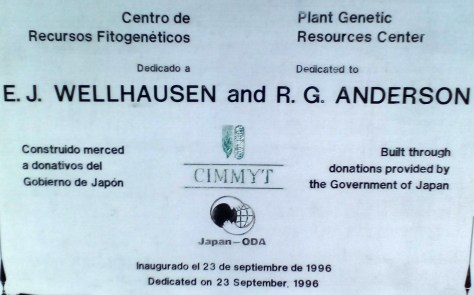
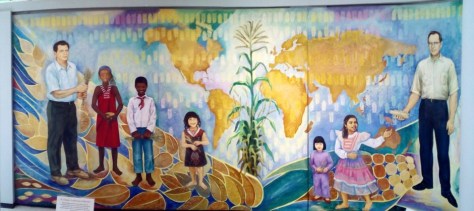
Unlike many of the CGIAR centers that have multi-crop collections in their genebanks (ICARDA, ICRISAT, and IITA for example), CIMMYT has two independent genebank collections for maize and wheat in a single facility, inaugurated in 1996, and dedicated to two renowned maize and wheat scientists, Edwin Wellhausen and Glenn Anderson. But CIMMYT’s most famous staff member is Nobel Peace prize Laureate, Norman Borlaug, ‘Father of the Green Revolution’.

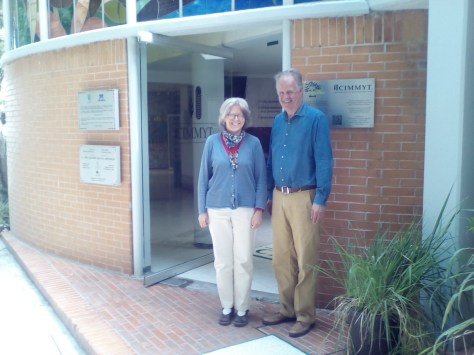
Tom Payne and Denise Costich are the wheat and maize genebank managers. CIMMYT’s genebank has ISO 9001:2008 accreditation.
20160802 014

20160802 003

Ayla Sençer

Tom has been at CIMMYT in various wheat breeding capacities for more than 25 years. In addition to managing the wheat genebank, Tom manages the wheat international nurseries. One of the first curators of the wheat collection was Ayla Sençer from Turkey, and a classmate of mine when we studied at Birmingham in 1970 for the MSc in Conservation and Utilisation of Plant Genetic Resources. The CIMMYT wheat collection is unlike many other germplasm collections in that most of the 152,800 samples are actually breeding lines (in addition to landrace varieties and wild species).

Denise joined CIMMYT just a year or so ago, from the USDA. She has some very interesting work on in situ conservation and management of traditional maize varieties in Mexico and Guatemala. A particular conservation challenge for the maize genebank is the regeneration of highland maizes from South America that are not well-adapted to growing conditions in Mexico. The maize collection comprises over 28,000 accessions including a field collection of Tripsacum (a wild relative of maize).

In recent years has received major infrastructure investments from both the Carlos Slim Foundation and the Bill & Melinda Gates Foundation. New laboratories, greenhouses and the like ensure that CIMMYT is well-placed to deliver on its mission. And the support received through the Genebanks CRP has certainly raised the morale of genebank staff.

On our last day at CIMMYT (Wednesday), we met with Janny van Beem from the Crop Trust. Janny is a QMS expert, based in Houston, Texas, and she flew over to Mexico especially to meet with Marisé and me. When we visiited Bonn in April we only had opportunity to speak by Skype with Janny for jsut 30 minutes. Since the implementation of QMS in the genebanks seems to be one of the main challenges—and success stories—of the Genebanks CRP, we thought it useful to have an in-depth discussion with Janny about this. And very useful it was, indeed!

On the previous evening (Tuesday) Tom, Denise, Marisé, Janny and I went out for dinner in Texcoco, to a well-known tacqueria, then into the coffee shop next door afterwards. No margaritas that night – we’d sampled those on Monday.
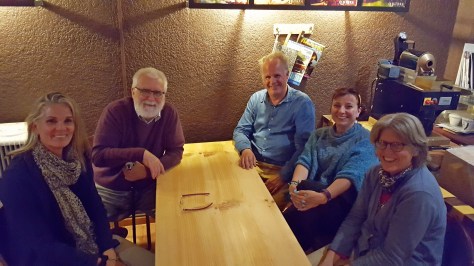
20160802 044

L to R: Janny, me, Tom, Marisé, and Denise.

But on this trip we did have one free day, Sunday. And I met up with members of CIMMYT’s Filipino community, many of them ex-IRRI employees, some of who worked in units for which I had management responsibility. They organised a ‘boodle fight‘ lunch, and great fun was had by one and all.

Hasta la vista . . .
At 6 pm on Wednesday I headed into Mexico City to take the KLM flight to Amsterdam. It was a 747-400 Combi (half passengers, half cargo). I haven’t flown a 747 for many years, and I’d forgotten what a pleasant experience it can be. It’s remarkable that the 747 is being phased out by most airlines; they are just not as economical as the new generation twin engine 777s, 787s, and A350s.

With the new seating configuration, I had a single seat, 4E, in the center of the main deck forward cabin. Very convenient. I was glad to have the opportunity of putting my leg up for a few hours. Over the previous 10 days my leg had swelled up quite badly by the end of each day, and it was quite painful. The purser asked if I had arranged any ground transport at Schipol to take me from the arrival to departure gates. I hadn’t, so she arranged that for me before we landed. The distances at Schipol between gates can be quite challenging, so I was grateful for a ride on one of the electric carts.

But after we went through security, my ‘assistant’ pushed me to my gate in a wheelchair. I must admit I felt a bit of a fraud. An electric cart is one thing, and most welcome. But a wheelchair? Another was waiting for me on arrival at Birmingham. Go with the flow!
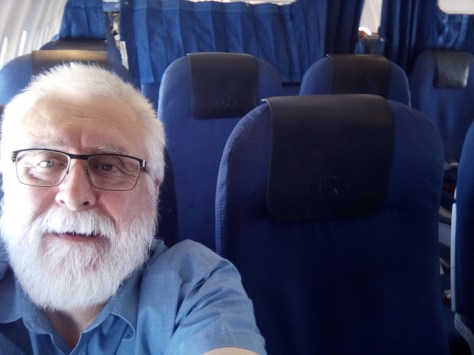
20160804 014

I was all alone in Business Class from Schipol to Birmingham. We were back at BHX on time, and I was out in the car park looking for my taxi home within about 20 minutes, and home at 6 pm.

Now the hard work really begins—synthesising all the discussions we had with so many staff at CIP, CIAT, and CIMMYT. For obvious reasons I can’t comment about those discussions, but visiting these important genebanks in such a short period was both a challenging but scientifically enriching experience.

Two years in the planning . . .

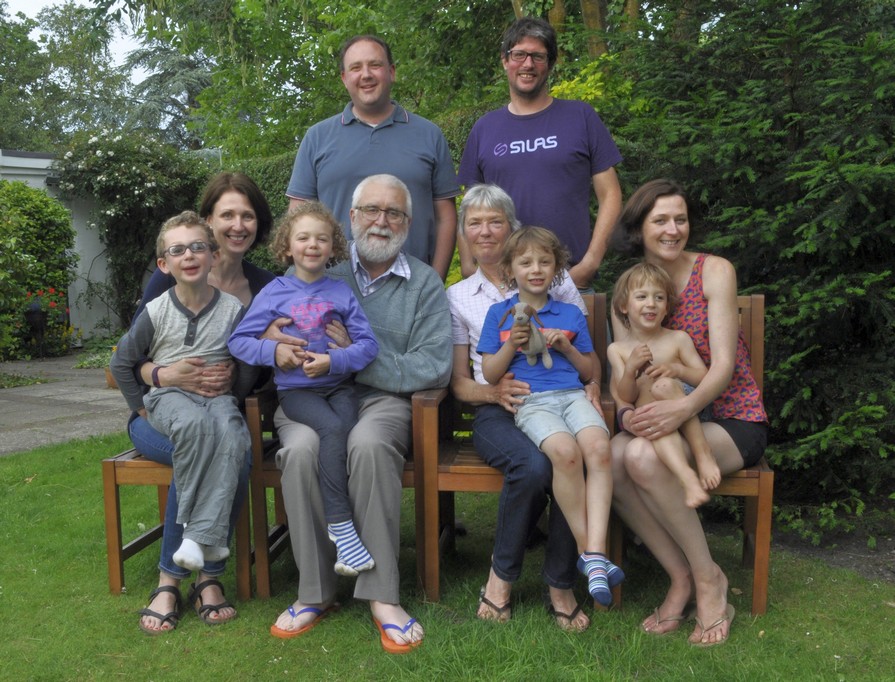
Steph and I have two lovely daughters.

20160711 244 New Forest holiday

Hannah (on the left), the elder, lives in St Paul, Minnesota, and is married to Michael. They have two children: Callum, who will be six in mid-August, and Zoë, who turned four last May.

Philippa (on the right) has stayed in the UK. She lives in Newcastle upon Tyne, and married Andi in 2010. They have two boys: Elvis will be five at the end of September, and Felix will be three on 1 September.

But until this past week, we had never all been under the same roof. And the grandchildren had never met each other.

20160711 514 New Forest holiday

L to R standing: Michael and Andi. L to R sitting: Callum, Hannah, Zoë, me, Steph, Elvis, Felix, Philippa.

Two years ago, Hannah and Michael had planted the idea of coming over to the UK for a summer holiday. But where to stay, and what to do—apart from enjoying each other’s company? With us living in the Midlands south of Birmingham, and Philippa in the Northeast, it seemed logical to plan a holiday somewhere nearby to either of those locations. Unfortunately our home is not large enough to host everyone. Northumberland to the north of Newcastle is a beautiful county, but was eventually ruled out as probably not enjoying the warmer weather everyone hoped for.

So we eventually focused on the New Forest, west of Southampton, an area I know well having family links with the area, as well as from my undergraduate days at the University of Southampton. But apart from a week’s holiday there in the late 1980s, I haven’t been back since.

For various reasons the 2015 plans fell through, and even this year nothing was settled until quite late. Originally we had said that if Hannah and family came over to the UK we wouldn’t plan to take our usual break in Minnesota this year. As a trip to the UK didn’t seem to be in the offing, we went ahead and booked flights in early September for a three week stay in Minnesota. Then, Hannah and Michael confirmed that they would fly over here after all, and the search was on for a holiday home that would accommodate six adults and four small children. Thank goodness for the Internet. Hannah quickly zeroed in on three properties, and we eventually chose a five bedroom house in the village of Dibden Purlieu on the eastern edge of the New Forest National Park.

Our holiday began on Saturday 2 July, and we planned to get to the holiday home by about 5 pm, in time to be there when Hannah and Michael arrived from Southampton Airport. However, we decided to make something of the trip south, calling at Avebury in Wiltshire to visit two National Trust properties: the 16th century Avebury Manor and Garden, and the world famous Avebury Neolithic henge, comprising three stone circles. We spent just over two hours exploring the manor house and garden, but because of my current walking limitation, were not able to walk the length of the stone circles.

Sunday was a rest day. Hannah and family didn’t emerge from their beds until after noon, so we decided to spend the rest of the day relaxing around the house.

Phil and Andi didn’t arrive until Monday evening, so we decided to make a short excursion before lunch down to the coast at Lepe, just a few miles south of Dibden Purlieu. Callum and Zoë had a blast on the shingle beach, and afterwards in the play area above the cliff in the main part of the country park. Just what was needed to flush away the remnants of jet lag.

After Phil and Andi arrived, it didn’t take long before the newly-introduced cousins were playing together and running round the garden having a grand old time.

Tuesday was a very bright and sunny day, hot even, so we set out to cover the 40 miles plus drive west to Corfe Castle in Dorset (another National Trust property). Visiting a castle was on Callum’s list of things to do over here in England. So he was somewhat unimpressed—to begin with—when all he saw was a ruin. But once inside and we had the opportunity to climb on to the walls, peer through the narrow windows, imagine what life would have been like centuries ago, and even dress up in medieval clothes, then all the grandchildren had a whale of a time.

Wednesday saw us at Exbury Gardens just south of Beaulieu on the Beaulieu River, purchased by Lionel Nathan de Rothschild in 1919, and where he developed a world collection of rhododendrons and azaleas (which had mostly passed flowering when we visited). But there were many other features to explore, such as a very large Rock Garden, a steam train ride, and all the space the children needed to run around.

On Thursday, we set off for a walk from Beaulieu Road Station across the heath at Shatterford Bottom towards the southwest edge of Denny Wood, then on for a picnic on the edge of Matley Heath. After lunch we headed to the coast at Barton-on-Sea where the children could get their feet wet; the water was too cold for any swimming. And to watch the paragliders. We had hoped to have a fish and chip supper in Barton, but we’d finished on the beach by 4:30 or so. We therefore decided to head back to Hythe and had a pub meal at The Lord Nelson overlooking Southampton Water, where we could watch the huge container ships and cruise liners pass by.

Friday was a lazy day, and we didn’t head out into the forest until after lunch. Fritham was our destination, for another walk through the forest, and hopefully grab a bite to eat for dinner at The Royal Oak, a small pub I first visited in 1969 when I was Morris dancing with the Red Stags Morris Men (University of Southampton) and we joined the Winchester Morris Men on one of their tours.

Just south of Fritham, we visited the Rufus Stone where the killing of William II (William Rufus) in August 1100 is commemorated. I first went there as a young boy with my elder brother and mum and dad in the 1950s. It was great to be able to take my grandchildren there.

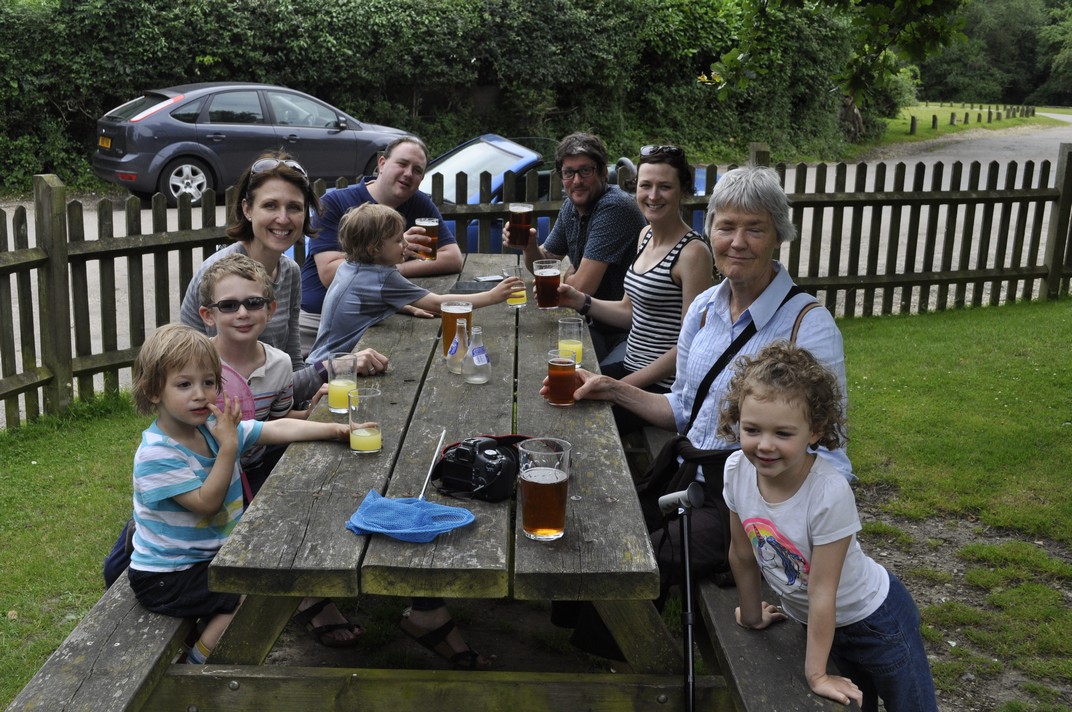
After a walk of a mile or so, we returned to The Royal Oak for a welcome pint. The pub, although modernised, still has all the kegs of beer lined up behind the bar, just as in the later 1960s.

20160711 507 New Forest holiday

L to R: Felix, Callum, Hannah, Elvis, Michael, Andi, Philippa, Steph, and Zoë.

There was no food to be had at The Royal Oak, but we found a child-friendly pub, the Coach and Horses, at Cadnam.

On Saturday, the children were desperate to have a pony ride. So while they all headed off to a petting farm near Ashurst, Steph and I decided to visit an English Heritage property nearby. Calshot Castle, constructed by Henry VIII in 1539, guards the entrance to Southampton Water at the tip of Calshot Spit. For many decades it was an RAF base for flying boats and seaplanes; the original hangars are still there.

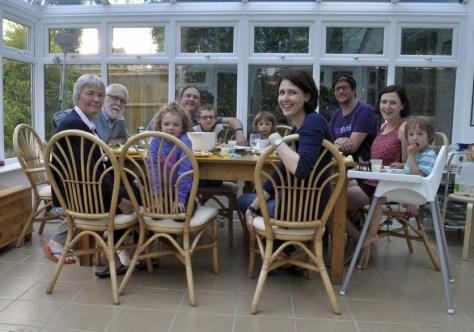
On the Saturday evening, Philippa and Hannah prepared a lovely roast chicken dinner that was washed down by several bottles of wine, and preceded by not a few G&Ts.

20160711 512 New Forest holiday

L to R: Steph, me, Zoë, Michael, Callum, Elvis, Hannah, Andi, Philippa, and Felix.

We departed for home on the Sunday morning, leaving Hannah and Phil and families to enjoy another week together. And from all accounts they have had a wonderful time.

But we didn’t head straight home. First we went due west about 45 miles, to Kingston Lacy, a 17th century country house and estate built by Sir John Bankes after the family was expelled from Corfe Castle during the English Civil Wars (between 1642 and 1651).

Kingston Lacy must be one of the jewels in the National Trust crown. It is sumptuous. In fact the only property that we have visited that can rival it is Waddesdon Manor in Buckinghamshire. But Kingston Lacy is several centuries older. The Bankes family apparently never threw anything away, and amassed a magnificent collection of works of art by several masters, furniture and porcelain. What a feast for the eyes!

From Kingston Lacy it was a direct, but rather winding, route north towards Bath and the M4 motorway, before joining the M5 motorway near Bristol, and covering the last 80 miles or so to Bromsgrove in much less time than I had feared. I think many people had stayed at home to watch Andy Murray win the Wimbledon Men’s Championship, or the British F1 Grand Prix. Or maybe they were settling themselves to watch the Euro2016 final from Paris between hosts France and Portugal. In any case, we did not have any hold-ups, thankfully, and were home not much after 5 pm, to enjoy a welcome cup of tea, and reflect on a wonderful week’s holiday with the family.


The Captain’s cat . . .

nt-logoSteph and I have been members of the National Trust since 2011, and over the past five and a half years, we have enjoyed some wonderful day trips to view exquisite houses and inspiring landscapes.

We have now visited 53 properties, and most of those within a 50 mile radius of home. We’ve picked the ‘low-hanging fruit’ so to speak, although we have ventured further afield from time to time. This year, once the weather improved to make outings possible, we have been constrained to some extent in our choice of properties to visit because I still recovering from that nasty accident in early January when I broke my leg.

So, in the main, we have chosen to revisit a number of properties quite close to home: Hanbury Hall, Packwood House, Baddesley Clinton, Coughton Court, and the like. Last week, however, I was determined to wander further afield. But it wasn’t my leg holding me back (although by the end of the day my ankle had swollen to almost twice the size of the other, and I was ready to put my foot up on a stool and rest it). No, it was the thought of the journey. Any trip north of Birmingham, either to the west on the M5/M6 motorways or to the east on the M42. Inevitably the volume of traffic just makes such journey tedious in the extreme. The Birmingham metropolitan area is a huge obstacle around which north-south journeys have to be navigated.

20160622 102 Shugborough Hall

So when I suggested to Steph that we should head north to Shugborough Hall, just a few miles east of Stafford, I wasn’t really too enthusiastic about the prospects for an enjoyable day out. How wrong I was!

First, making the trip mid-week, we did not encounter the volume of traffic that I had feared, so the 55 mile journey too just over an hour. Second, although I can’t say I had any high expectations of Shugborough, it was one of the nicest National Trust properties that we have visited since becoming members.

Earl_of_Lichfield_COAShugborough is the ancestral home of the Earls of Lichfield – the Anson family. In writing this account of our visit to Shugborough, I came across this excellent account (by archivist and architectural historian Nick Kingsley) of the Anson family, so all I need to do is describe some of those aspects of our visit last Thursday that caught my attention. The central manor house dates from 1695 (William & Mary), and wings either side were added by 1745. The portico was added at the beginning of the 19th century.

The estate was passed to the National Trust in 1960 on the death of the 4th earl, in lieu of death duties. However, the estate was managed by Staffordshire County Council (SCC) until this year when the council decided it could no longer afford the £35 million annual cost of upkeep, and the property will revert entirely to the National Trust in due course.

Patrick Lichfield

Patrick Lichfield (from the blog of Nick Kingsley)

The 5th earl, society photographer Patrick Lichfield (as he liked to be known) and first cousin (once removed) to Her Majesty The Queen, continued to reside at Shugborough, occupying first (upper) floor apartments at a nominal rent from SCC until his untimely death at the age of 66 in 2005. Then his son Thomas, the 6th earl, cleared the private apartments of personal effects. The apartments are open, almost in their entirety today, but have been ‘refurnished’ by the National Trust in the style they originally enjoyed, with just a few original pieces left behind.

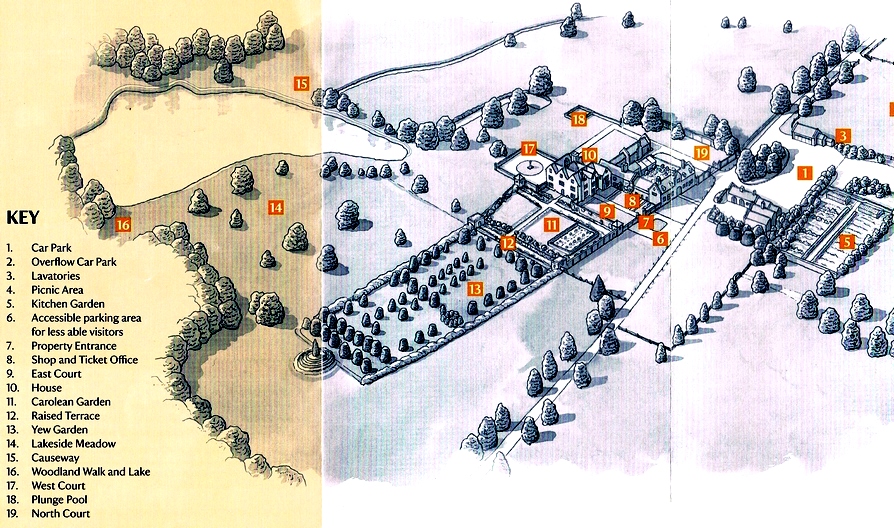
Given my reduced walking capacity, I was relieved to see that a shuttle bus (and a ‘train’) operated throughout the day from the entrance up to house, a distance of about 800 m.

shugborough-map001

Under normal circumstances it would have been a delightful walk across the parkland, but I knew that this would have been impossible for me. As it is we did walk for more than 3 miles, and my foot and leg were certainly complaining by the evening.

Not all parts of the estate are open under National Trust membership, and there is a car parking fee of £3 to everyone, only refundable if you purchase a ticket for all the attractions at Shugborough. We wanted to see only the gardens and the house, and those were accessible with our membership.

Before lunch, we decided to walk the gardens and part of the park. The weather was threatening for later on when we could at least then be under cover in the house. Behind the house, on the west side, and across a channel of the River Sow (that is very slow flowing, and controlled by sluice gates) are the formal terrace gardens.

20160622 032 Shugborough Hall

The west (rear) face of Shugborough Hall from across the River Sow channel

There are just a few formal parts to the gardens. To the rear, west side of the house, is a rather splendid terrace laid out with a series of sculptured shrubs.  In the grounds there is a number of features, including the Cat’s Monument (commemorating a moggie that reputedly belonged to Admiral George Anson), and the Shepherd’s Monument. A delightful bridge next to the Chinese House crosses the River Sow channel and there is walking access to other parts of the parkland opposite the house.

From the entrance hall (where there are some splendid Italian plaster casts of centaurs) you pass through the Bust Parlor and Ante Room to the dining room and its exquisite plaster ceiling.

The Red Drawing Room was originally several bedrooms on two floors. But it was opened up to form this beautiful reception room decorated in a beautiful coral pink. In the other (south sing) is the Salon. The Library also has a beautiful plaster ceiling.

The ‘private apartments’ on the upper floor are decorated now to the style they had when they were the Shugborough residence of the Earl of Lichfield. Among the most finely decorated is the Bird Room, with its ‘matching’ ceiling and carpet.

From the outside, Shugborough Hall is not particularly impressive. Its grey façade is not exactly welcoming. But what a delight the inside is, and how many of the rooms ares, unexpectedly, open to visitors. And the National Trust volunteers here are really special—friendly, helpful, and knowledgeable. A thoroughly enjoyable visit.


Retired? Never been busier . . .

47212bf119d17ee84106d4b745b2a091

A week ago or so, I received an email from an old friend who, like me, had spent much of his career in international agricultural research. He was writing to tell me that he had now retired, giving me his latest contact details, but also musing on the void he was feeling now that he was no longer gainfully employed. Apart from a couple of small consultancies he did wonder how he was going to fill his days.

I know how he feels. I didn’t have to retire when I did at the end of April 2010. I was not yet 62, but having decided that my pension would keep us comfortably, Steph and I decided to return to the UK and begin a new life in retirement. My Director general, Bob Zeigler, did his best to persuade me sign another contract and stay on at IRRI until 65. But I felt there were other things I wanted to do, places to visit, and we would only be able to enjoy those if no longer tied to an 8 to 5 regime.

Nevertheless, it was still a shock to the system once we’d returned home. I did find myself, from time-to-time, at a loose end. However, on receiving that recent email, I got to wondering what I had done over the past six years, how I’d filled my time. And once I compiled my list, I’m both surprised—and impressed—with my energy and activities.

So here goes:

  • I initially took up swimming on a daily basis, but once the local council reinstated swimming and parking fees for pensioners within about four months, I felt I could no longer justify such an expense of about £7 daily. So I took up walking, as much on a daily basis as energy and weather permitted, and really got to explore my town and surrounding countryside. I must have walked somewhere between 2000 and 3000 miles.
  • The house was in need of some TLC, so in the first year back (2010) I set about decorating most of the inside. There’s still one small bedroom (now Steph’s work room and full of all her things) and the kitchen to complete. I’m inclined now to find a professional decorator for that, and in any case, the kitchen could do with a complete refurbishment after 30+ years.
  • I oversaw the complete refurbishment of two bathrooms and a downstairs toilet/washroom (in late 2010), the erection of a new garden fence (in 2014), and the re-roofing of the house, the remodelling of our drive, and the installation of an electric garage door (all in 2015).
  • Professionally, I rejoined the editorial board of the science journal Genetic Resources and Crop Evolution published by Springer, and have regularly reviewed manuscripts over the past three years.
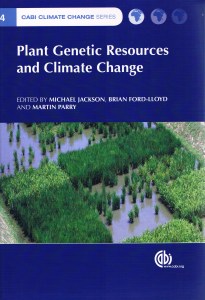
  • PGRCCI co-edited (as lead editor) a 16 chapter book—Plant Genetic Resources and Climate Change—published in 2014 by CABI, and also contributing one of the chapters.
  • In 2010 and 2014, I organised (as Chair of the Scientific Committee) the major science conferences at two international rice congresses in Hanoi, Vietnam (IRC2010) and Bangkok, Thailand (IRC2014), each attended by more than 1000 participants.
  • I also undertook two short consultancies (a week each) for the CGIAR through IRRI, contributing to the development of a common financial and administrative online tool called One Corporate System or OCS. This took me to Malaysia and the Philippines in 2012 or 2013. I don’t remember the exact dates. My involvement was curtailed as I rather spoke my mind when I saw that things were going awry, and my perspectives were not particularly appreciated. But I could see some pitfalls that the project managers were not willing to recognise. As far as I know there are still some challenges for the full implementation of the system.
  • Since March 2016 I have been leading the team for the evaluation of the CGIAR program for Maintaining and Sustaining Crop Collections (also known as the Genebanks CRP), commissioned by the CGIAR’s Independent Evaluation Arrangement in Rome. This evaluation will involve me until early 2017. In fact we have only really just begun. Even so, the evaluation has already taken me to Bonn, Germany at the end of April, to Montpellier in the south of France in mid-May, and to Rome, Italy just two weeks ago. I’m scheduled to make a 12-day trip to three CGIAR centers in Peru, Colombia, and Mexico at the end of July, to two more in Kenya and Ethiopia in October, before returning to Rome for a week in mid-November to draft a report.
  • I began this blog, A Balanced Diet, in February 2012, and have now posted 308 stories comprising, I guess, at least 300,000 words, probably more.
  • We became members of the National Trust in 2011, and English Heritage last year. We must have visited more than 40 properties, some for a second or even third time. Descriptions of these visits are one of the staples of this blog. I think we have visited most of those within a 50 mile radius from home, some a little further afield, and we have now picked the low-hanging fruit. Time to think about some trips where we book ourselves into a bed and breakfast for a couple of nights much further away.
  • Besides my consultancy travel to Vietnam (twice), Bangkok (three times) and the Philippines (at least half a dozen times), we have travelled to the USA each year since 2010, and will be there again for three weeks from early September. This is of course to visit our elder daughter Hannah and her family in Minnesota. But each year (apart from 2010) we have also made a trip to explore other regions of the country:
    • in May 2011, we had a spectacular road trip through Arizona and New Mexico;
    • we headed north along Lake Superior on the Minnesota Riviera in May 2012;

Grand Canyon album

04-20130523 131 Chelsea Flower Show

  • Music is very important to me, so hardly a day goes by without something being played on my iPod (connected to my sound system) or on CD. I have catholic tastes in music, just depending on my mood.
  • On 23 May 2010, I went to my second rock concert to hear Mark Knopfler and his band play at the LG Arena in Birmingham during his Get Lucky Tour. A great evening. (I’d been to my first concert in 2008 [?] in St Paul, Minnesota, to see the great Fleetwood Mac).
  • History books have been my main reading material, and I am a regular visitor the Bromsgrove’s public library. Since my accident last January I haven’t been able to get about as much so have delved more into books I bought in the UK in past years, those given me for Christmas, or the novels of Anthony Trollope (his Barsetshire chronicles) that I haven’t picked up for more than 30 years, but which I am thoroughly enjoying once again.
  • Yes, my accident in January certainly curtailed my mobility, but at least I was able to spend more time reading or working on this blog.
  • In February 2012 we visited Buckingham Palace where I was invested with the Order of the British Empire (Officer or OBE) in a ceremony presided by HRH The Prince of Wales. An unbelievable experience.
  • Philippa (our younger daughter, pictured with Steph and me at Buckingham Palace above) married Andi in New York in October 2010, and was awarded her PhD in psychology from Northumbria University in December.
  • But perhaps the most important happenings in the past six years have been the births of my four grandchildren: Callum Andrew (in August 2010), Elvis Dexter (in September 2011), Zoë Isabel (in May 2012), and Felix Sylvester (in September 2013). We only get to see Callum and Zoë once a year. Elvis and Felix live in Newcastle upon Tyne so we see them several times a year either when we travel the 250 miles northeast, or they come down to Worcestershire. But next weekend (2 July), Hannah and Michael, Callum and Zoë fly over here for two weeks holiday. And we are meeting up with Phil and Andi, Elvis and Felix in the New Forest where we have rented a holiday home. It will the first time we will have all been together, and the first time that the four cousins will meet each other.

So, there you have it. Quite busy, and I don’t intend to slow down if I can help it.

Be careful what you wish for . . .

IMG_1623I’m proud to be British. But yesterday, 23 June, was a profoundly depressing day.

I’m also old (67 going on 68, if that counts as old), white-haired, and very ANGRY. I belong to that generation that overwhelmingly sold the youth of the UK down the river yesterday when they voted to leave in the referendum on the UK’s continuing membership of the European Union (EU).

There’s just one important difference. I voted to Remain. I was proud to be a British member of the EU. Now that has been dashed.

strongerin2

Now we are faced with the unedifying prospect of a (Not Caring) Conservative party led by the likes of ex-London Mayor and professional buffoon, Boris Johnson (BoJo), and his sidekick Michael Gove (MiGo) who always looks as though someone has just shoved a poker up his rear end.

From a photo I saw in one of yesterday’s newspapers, when they spoke at a news conference, they seemed as surprised – and as worried as many of us – that the vote had supported Leave.

13494953_10154072682472911_4451137048557914411_n

The Muppets, aka Michael Gove and Boris Johnson

Well BoJo and MiGo, it’s up to you now. You led the electorate down a slippery slope with your claims and beliefs not supported by any credible factual information. And the majority of voters, especially all the Little Englanders, duped by the virulent and racist propaganda spread by the moronic Nigel Farage (NiFa) of UKIP (immigration was the big issue it seems), placed their X in the ‘Leave’ box on the voting slip.

There was an interesting article in The Guardian newspaper today. The article surmises that BoJo really didn’t expect the Leave side to win the referendum – and frankly has no idea how to salvage the situation. Brexiters, be careful what you wish(ed) for!

It was a close call. Just under 52% of a 72% turnout (referendum statistics and maps here). A high turnout admittedly. Even so, that’s only 37% of the total electorate actually voted in favour of Brexit. Surely the bar for winning should have been set higher in light of the expected constitutional and far-reaching economic and social change that Brexit would inevitably bring about. But maybe that’s jumping the gun.

The country is now fragmented, a ‘house divided’. Scotland and Northern Ireland voted to Remain. England (apart from London) and most of Wales voted to Leave. This will surely lead to a second referendum for Scottish independence, and who would really blame the Scots this time round if they made the choice to go solo. The Northern Ireland perspective is much more problematical. After several decades of peace (more or less) after ‘The Troubles‘, could that increasing stability and prosperity be put in jeopardy if a border has to be set up between Northern Ireland and the Irish Republic. This alone should have been enough to make voters pause for thought. No-one wants to see a return to the violence, both in Ireland and in mainland Great Britain, of the 1970s to 1990s.

poundAnyway, it’s too late now. The electorate has ‘spoken’. The pound has fallen off a cliff, and more damage has been done to the British economy in a few hours than the contributions to the EU would have cost the country for many years to come.

The tone of debate in the referendum campaign was banal on so many occasions. And I was appalled listening to several members of the public asked on TV why they had voted to leave the EU.

I didn’t think my vote to leave would count‘, said one man, obviously regretting how he had voted in the light of the immediate aftermath when the value of pound fell, the stock market crashed and the Prime Minister resigned.

Another woman wisely commented (and I paraphrase): ‘We have taken control back and can now make our country great again, just as it was hundreds of years ago‘. How prophetic!

Another ignorant woman (and I’m sorry to have to use such a description) voted Leave because she claimed ‘All those immigrants are taking OUR (my emphasis) money and sending it back to their countries. It’s our money‘. I don’t think anyone ever questioned how she disposed of her legally-earned income.

It has to be admitted that the Remain side did not run a smart campaign. They did not persuade the electorate of the benefits of EU membership, and continuing membership. The campaign was hijacked by unsubstantiated promises of untold wealth outside the EU and growing fears of immigration. Oh, and the fact that everyone would be queuing at our door to make agreements with us.

OK. The EU is far from a perfect institution. But, warts and all, I still feel very strongly that it’s better to be in rather than out. We are now floating, rudderless, in uncharted waters. It seems our former EU partners wish us to float off westwards into the Atlantic, and as soon as possible. Far from countries lining up to support us, even close allies like the USA have indicated that when it comes to trade deals, the UK will have to join the queue. Heaven knows how our economy will shape up over the coming years. I’m not optimistic.

It’s a great pity that this lecture by Michael Dougan, Professor of European Law at Liverpool University, was not compulsory viewing for everyone intending to participate in the referendum.

I have many fewer years ahead of me than I have already enjoyed. With all the economic, constitutional, and political turmoil, we can expect the next years to be challenging. But I feel for my daughters’ generation and their children. Bigotry, false promises, and downright lies have condemned us all to an uncertain future.

There are even (anecdotal?) reports in the media that immediately after the polls closed on Thursday there was surge of Google searches from the UK for ‘What is the EU?’ I despair.

The leaders of the Brexit campaign now have to deal with the aftermath of the momentous decision to Leave. Are they up to it? Probably not. Many are second-rate or failed politicians, and that does not bode well for the country of my birth.

~~~~~~~~~~~~~~~~~~~~~~~~~~~~~~~~~~~~~~~~~~~~~~
And I just came across this on a Facebook post:

I voted to remain in the European Union but I guess I should congratulate those who supported the Leave campaign.

  • Congratulations to Boris Johnson, a political flip-flopper who has convinced the general population he is a cuddly, bumbling, caricature as opposed to the publicly schooled politically astute ego-driven megalomaniac he is.
  • Congratulations to Michael Gove, former Education minister who genuinely believed all schools could be “above average” and who literally said about the EU campaign “This is not the time to listen to experts”
  • Congratulations to Nigel Farage, man of the people who is actually a former commodities broker and deeply divisive. The man who put up Nazi-inspired propaganda just last week.
  • Congratulations to the Baby Boomers; you’ve already fucked our economy, our healthcare, our housing market, our education, and our pensions and now this.
  • Congratulations to “My name is Death To Traitors, Britain First”.
  • Congratulations to everyone who doesn’t believe in scientific research, academia, arts, culture, and intellectual development.
  • Congratulations to the firm who flew a Brexit plane over Jo Cox’s memorial service.
  • Congratulations to everyone who doesn’t believe in social mobility or social progress.
  • Congratulations to everyone who is deathly scared of anybody who looks or sounds slightly different to you.
  • Congratulations to everyone who believes we’ll now have a brand new hospital every week with the money we’ll save (if only we had access to a skilled workforce from which we could staff them eh!).
  • Congratulations to everyone who wanted to “get our country back”. You haven’t got it back, but you’ll get the country you deserve.
  • Congratulations to Katie Hopkins.
  • Congratulations to everyone who hates the NHS and our education system and thinks that someone, somewhere should making profit from these systems.
  • Congratulations to Nick Griffin.
  • Congratulations to everyone who wanted to seize power from the “unelected elite” by leaving the EU but who happily clap like a seal when new pictures of a fucking royal baby come out. “They’re better than me because look….he’s royal. He’s made from like different sperm and that”.
  • Congratulations to everyone who is against universal workers’ rights, universal human rights, maternity leave, climate change interventions, and labour laws.
  • Congratulations to everyone who is against the scary scary refugees but at the same time support bombing the countries from whence they came.
  • Congratulations to everyone who believes this will make the country better.
  • Congratulations to those who believe more of our wealth should be shared by fewer of our people.
  • Congratulations to everyone who disagreed with the politics of Jo Cox who refused to acknowledge the cause of the hatred and anger which may have led to her assassination.
  • Congratulations to the constituencies who received masses of EU funding recently to repair damages caused by flooding who voted Out. You fuckwits.
  • Congratulations to those who say “You have no right to tell people how to vote” but who made their mind up because they saw six minutes of a televised debate during the Gogglebox ad breaks and they thought “That guy has funny hair”.
  • Congratulations to every single person who voted to leave the largest single economic market in global history.
  • Congratulations to everyone who thinks we’ll now travel back to the glory days of the 40s, 50s, and 60s. Everyone was much better back then don’t you know?
  • Congratulations to everyone who voted Out because they listened to the racist elements of our society.
  • Congratulations if you are indeed one of the racist elements of our society. Not everyone who voted Out is a racist, but all the racists voted Out.
  • Congratulations to everyone older than 70 who voted Out whose vote somehow counts as much as mine, you’ll only have to live with the consequences for a few more years. Well done you. As of 04:35, at least 60% of over 65s voted Out compared to just 24% of 18-25 year olds. Nice one you guys! Thanks so much
  • Congratulations to everyone who is persuaded by characters, by headlines, by propaganda, by impossible dreams, by xenophobia, by racism, by idiocy. You hate facts and you’re right, facts are scary, especially when you disagree with them.
  • Congratulations to anyone who voted for the above.
  • Congratulations to anyone who loves political, financial, and social instability. It normally works out fine….

Seriously. Congratulations to you all. Well fucking done…..
~~~~~~~~~~~~~~~~~~~~~~~~~~~~~~~~~~~~~~~~~~~~~~

Plant Genetic Resources: Our challenges, our food, our future

phillips-jade

Jade Phillips

That was the title of a one day meeting on plant genetic resources organized by doctoral students, led by Jade Phillips, in the School of Biosciences at The University of Birmingham last Thursday, 2 June. And I was honoured to be invited to present a short talk at the meeting.

Now, as regular readers of my blog will know, I began my career in plant genetic resources conservation and use at Birmingham in September 1970, when I joined the one year MSc course on genetic conservation, under the direction of Professor Jack Hawkes. The course had been launched in 1969, and 47 years later there is still a significant genetic resources presence in the School, even though the taught course is no longer offered (and hasn’t accepted students for a few years). Staff have come and gone – me included, but that was 25 years ago less one month, and the only staff member offering research places in genetic resources conservation is Dr Nigel Maxted. He was appointed to a lectureship at Birmingham (from Southampton, where I had been an undergraduate) when I upped sticks and moved to the International Rice Research Institute (IRRI) in the Philippines in 1991.

image

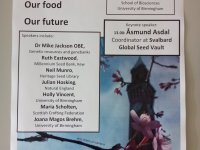
Click on this image for the full program and a short bio of each speaker.

Click on each title below; there is a link to each presentation.

Nigel Maxted (University of Birmingham)
Introduction to PGR conservation and use

Ruth Eastwood (Royal Botanic Gardens, Kew – Wakehurst Place)
‘Adapting agriculture to climate change’ project

Holly Vincent (PhD student, University of Birmingham)
Global in situ conservation analysis of CWR

Joana Magos Brehm (University of Birmingham)
Southern African CWR conservation

Mike Jackson
Valuing genebank collections

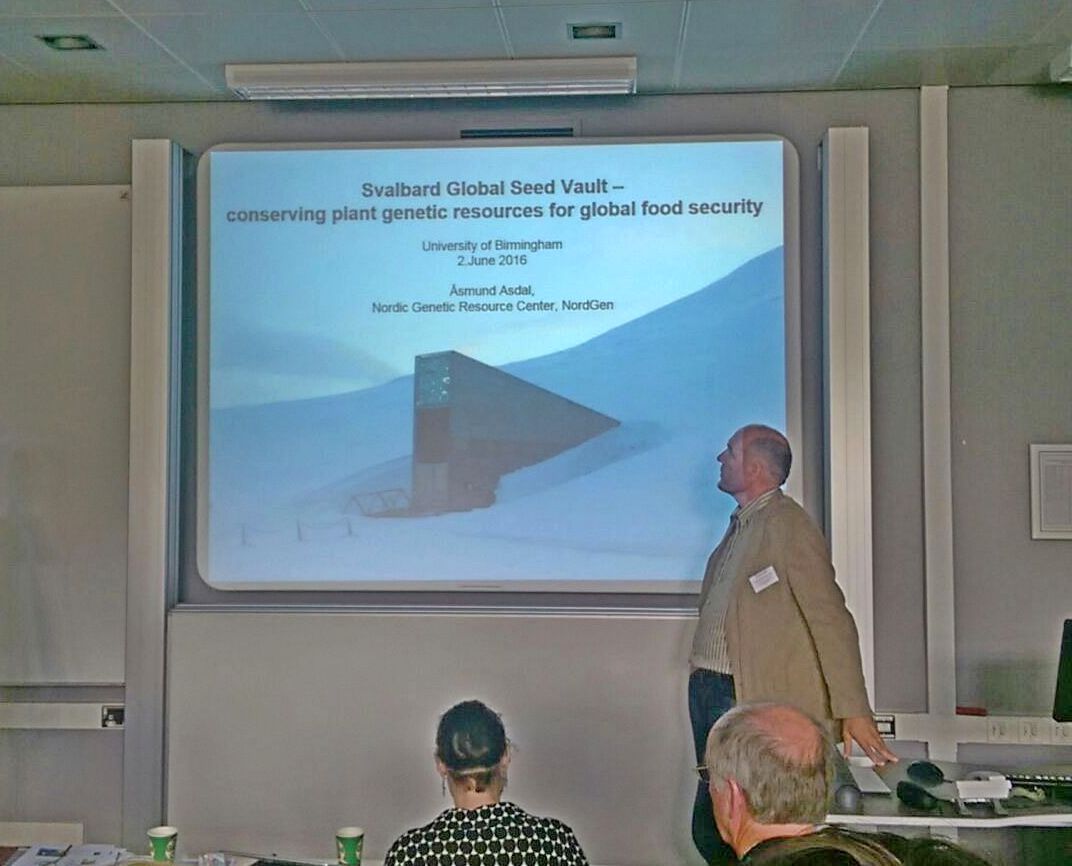
Åsmund Asdal (NordGen)
The Svalbard Global Seed Vault

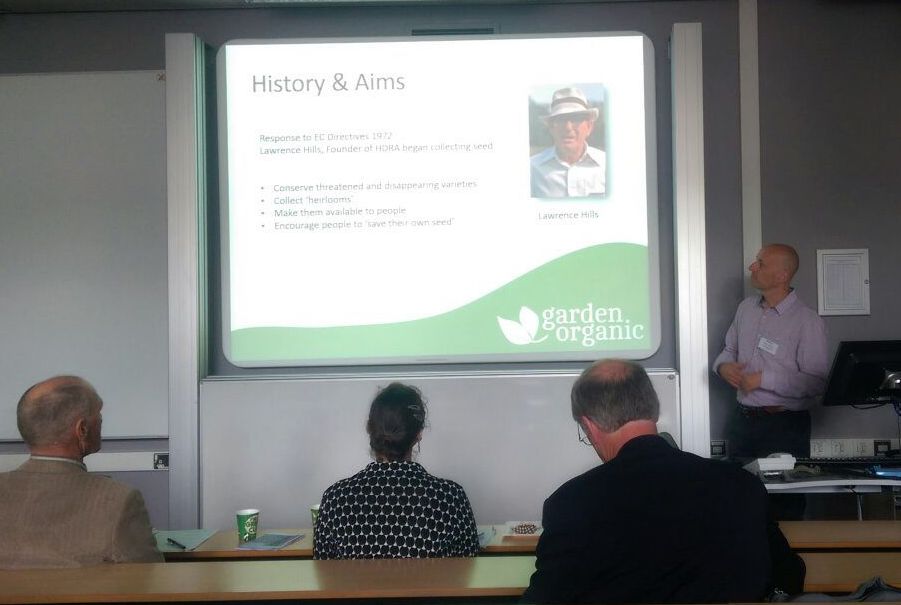
Neil Munro (Garden Organic)
Heritage seed library

Maria Scholten
Natura 2000 and in situ conservation of landraces in Scotland: Machair Life (15 minute film)

Aremi Contreras Toledo, Maria João Almeida, and Sami Lama (PhD students, University of Birmingham)
Short presentations on their research on maize in Mexico, landraces in Portugal, and CWR in North Africa

Julian Hosking (Natural England)
Potential for genetic diversity conservation – the ‘Fifth Dimension’ – within wider biodiversity protection

I guess there were about 25-30 participants in the meeting, mainly young scientists just starting their careers in plant genetic resources, but with a few external visitors (apart from speakers) from the Millennium Seed Bank at Kew-Wakehurst Place, the James Hutton Institute near Dundee, and IBERS at Aberystwyth.

The meeting grew out of an invitation to Åsmund Asdal from the Nordic Genetic Resources Center (NordGen) to present a School of Biosciences Thursday seminar. So the audience for his talk was much bigger.

asmund

Åsmund is Coordinator of Operation and Management for the Svalbard Global Seed Vault, and he gave a fascinating talk about the origins and development of this important global conservation facility, way above the Arctic Circle. Today the Vault is home to duplicate samples of germplasm from more than 60 depositor genebanks or institutes (including the international collections held in the CGIAR genebank collections, like that at IRRI.

Nigel Maxted’s research group has focused on the in situ conservation and use of crop wild relatives (CWR), although they are also looking at landrace varieties as well. Several of the papers described research linked to the CWR Project, funded by the Government of Norway through the Crop Trust and Kew. Postdocs and doctoral students are looking at the distributions of crop wild relatives, and using GIS and other sophisticated approaches that were beyond my comprehension, to determine not only where there are gaps in distributions, lack of germplasm in genebank collections, but also where possible priority conservation sites could be established. And all this under the threat of climate change. The various PowerPoint presentations demonstrate these approaches—which all rely on vast data sets—much better than I can describe them. So I encourage you to dip into the slide shows and see what this talented group of scientists has been up to.

Neil Munro from Garden Organic described his organization’s approach to rescue and multiply old varieties of vegetables that can be shared among enthusiasts.

n_munro

Seeds cannot be sold because they are not on any official list of seed varieties. What is interesting is that one variety of scarlet runner bean has become so popular among gardeners that a commercial seed company (Thompson & Morgan if I remember what he said) has now taken  this variety and selling it commercially.

julian

Julian Hosking from Natural England gave some interesting insights into how his organization was looking to combine the conservation of genetic diversity—his ‘Fifth Dimension’—with conservation of natural habitats in the UK, and especially the conservation of crop wild relatives of which there is a surprisingly high number in the British flora (such as brassicas, carrot, and onions, for example).

So, what about myself? When I was asked to contribute a paper I had to think hard and long about a suitable topic. I’ve always been passionate about the use of plant genetic diversity to increase food security. I decided therefore to talk about the value of genebank collections, how that value might be measured, and I provided examples of how germplasm had been used to increase the productivity of both potatoes and rice.

m_jackson

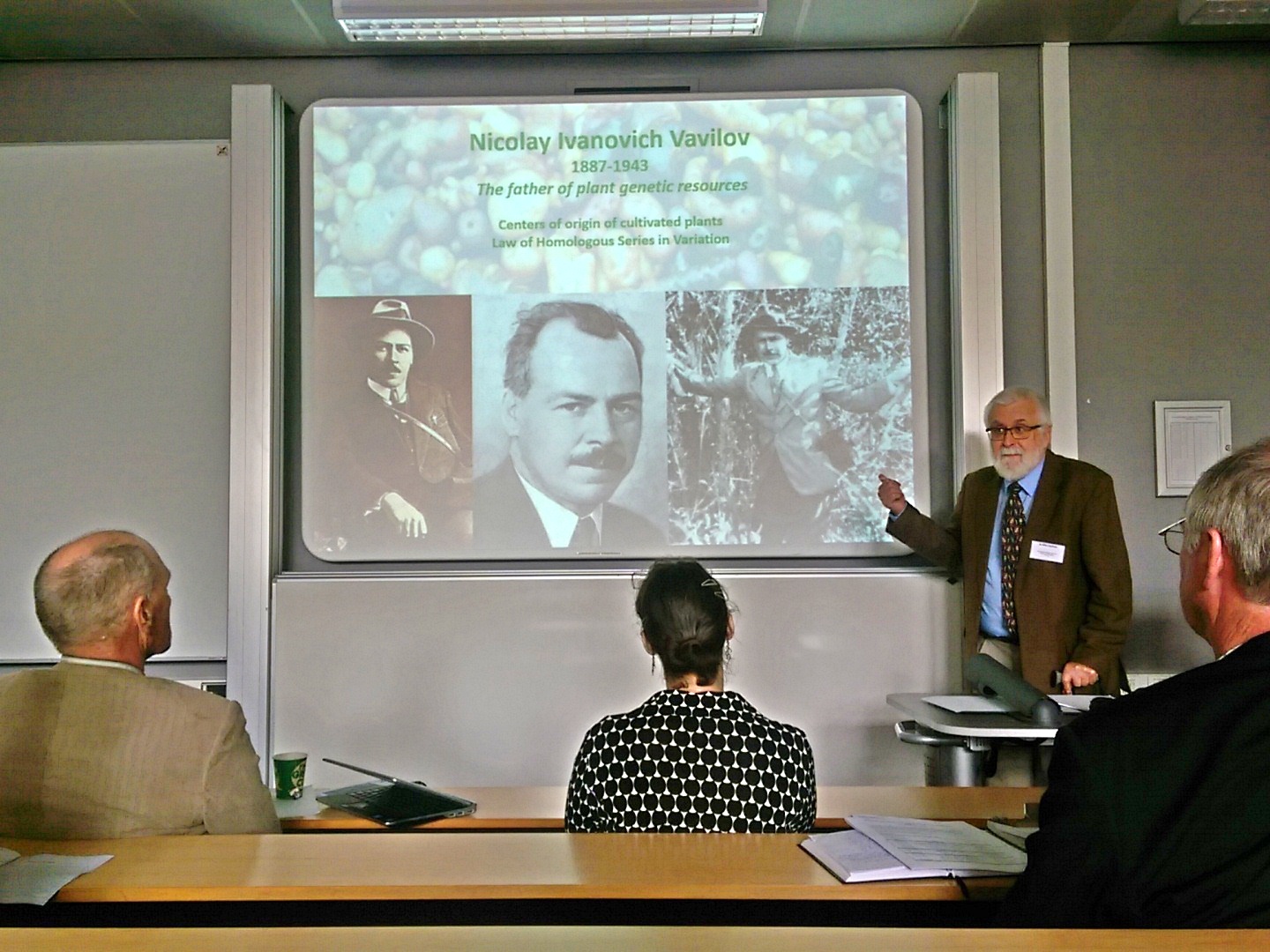
Nicolay Vavilov is a hero of mine

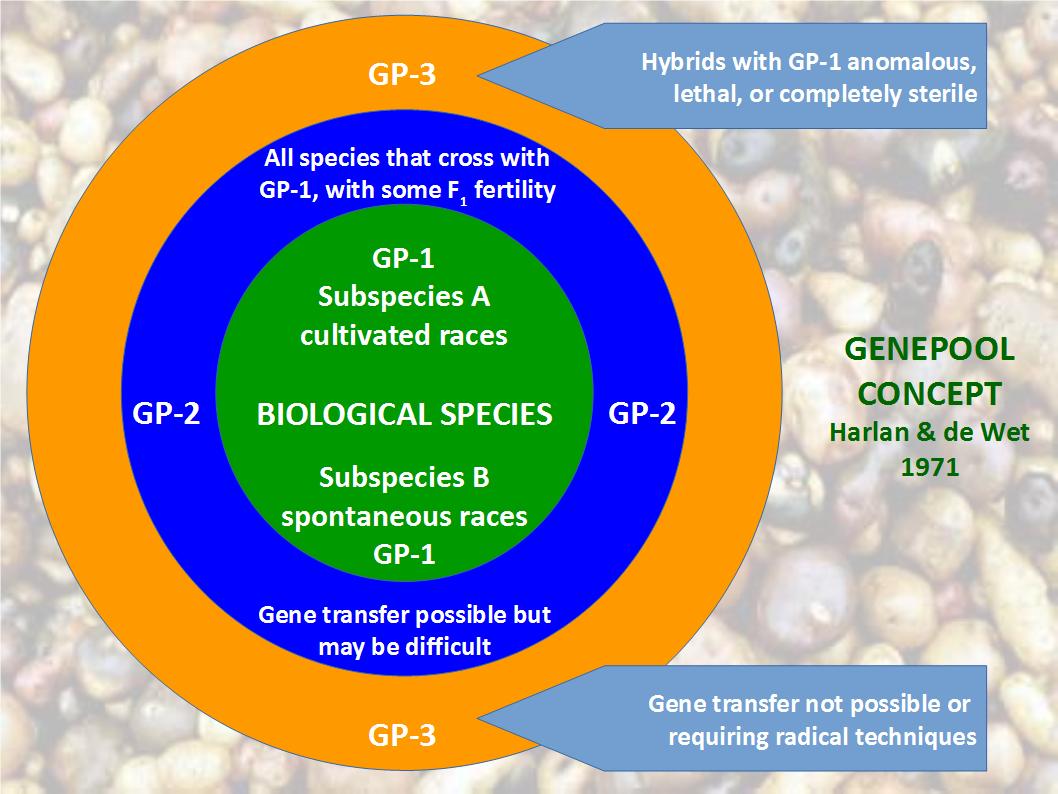
Although all the speakers developed their own talks quite independently, a number of common themes emerged several times. At one point in my talk I had focused on the genepool concept of Harlan and de Wet to illustrate the biological value (easy to use versus difficult to use) of germplasm in crop breeding.

Jackson FINAL - Valuing Genebank Collections

In the CWR Project research several speakers showed how the genepool concept could be used to set priorities for conservation.

Finally, there was one interesting aspect to the meeting—from my perspective at least. I had seen the titles of all the other papers as I was preparing my talk, and I knew several speakers would be talking about future prospects, especially under a changing climate. I decided to spend a few minutes looking back to the beginning of the genetic conservation movement in which Jack Hawkes was one of the pioneers. What I correctly guessed was that most of my audience had not even been born when I started out on my genetic conservation career, and probably knew very little about how the genetic conservation movement had started, who was involved, and what an important role The University of Birmingham had played. From the feedback I received, it seems that quite a few of the participants were rather fascinated by this aspect of my talk.

On the ecclesiastical trail in Shropshire . . .

In August last year, we had a great day out visiting Ironbridge and Wenlock Priory in Shropshire, between Telford and Shrewsbury. We intended also to visit Buildwas Abbey on the banks of the River Severn, north of Much Wenlock during the same trip. But I hadn’t checked my English Heritage handbook carefully, and we found the entrance gate to the abbey securely padlocked.

Not so yesterday, and Buildwas Abbey was the focus of our second ecclesiastical foray into Shropshire, a round trip from home of exactly 86 miles.

But, as on other days out, we always look for other National Trust and English Heritage properties close by to really make a day of it. On this occasion, it was Langley Chapel, about five miles west of Much Wenlock (map) over the other side of Wenlock Edge, and perhaps one of the most rural locations I have visited in a long while. There were minor roads, very narrow, edged by tall hedges, and just wide enough for one vehicle. I was commenting to Steph that my father would have said on such an occasion – just to encourage my Mum: ‘I hope we don’t meet a double-decker bus coming the other way!‘ Well, we did. Almost. I had to slow for a right angle bend, and just ahead of us was a large truck approaching down the lane, with several vehicles following slowly behind.

Rural and isolated it might have been. But what a glorious spot, with just the sounds of the lambs bleating in the meadows, and the wind rustling through the young wheat crop.

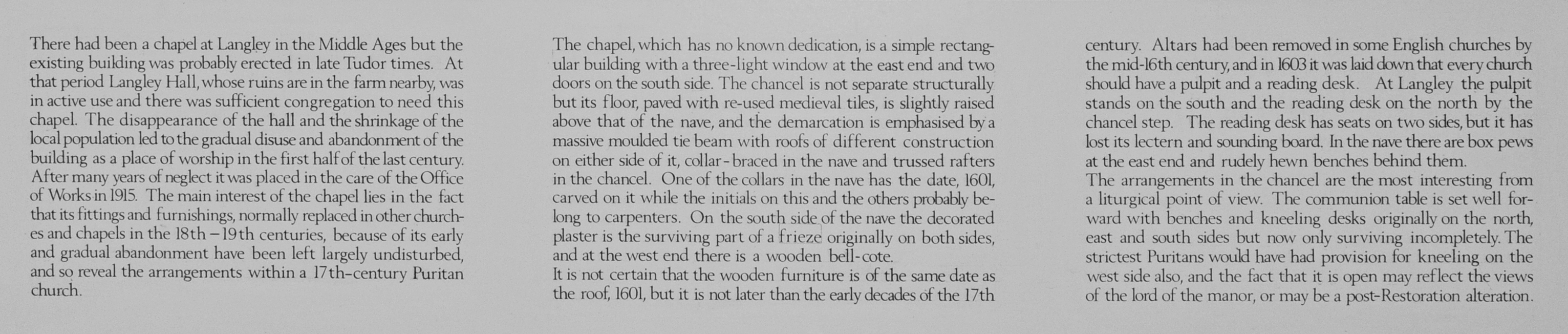
20160527 001 Langley ChapelOur first stop was Langley Chapel, an early 17th century building with its original roof dating from 1601. The chapel has no known dedication, and has not been used for services since the end of the 19th century. It was not altered during the 18th and 19th centuries (as happened in many other churches and chapels). It still retains the original Jacobean furnishings and fittings typical of a Puritan place of worship, such as box pews, a reading desk, and communion table, not an altar. the slightly raised chancel is paved with re-used medieval tiles.

Read more about the chapel and its origins below. Just click to view a larger image.

20160527 011 Langley Chapel

Buildwas Abbey
Founded in 1135 by Richard de Clinton, Bishop of Coventry, Buildwas Abbey was originally a Savignac monastery that eventually merged with the Cistercians. Situated on the Welsh borders, it suffered frequently in the civil turmoil and was often raided by Welsh princes. It was closed in 1536 during the Dissolution of the Monasteries during the reign of Henry VIII.

We were the only visitors (as at Langley Chapel). It was a haven of peace, and sitting there in the sun, taking in the beauty of the ruins, and some the fine dressed stone that can still be seen, many thoughts raced through my mind about the people and events that those noble ruins must have seen.

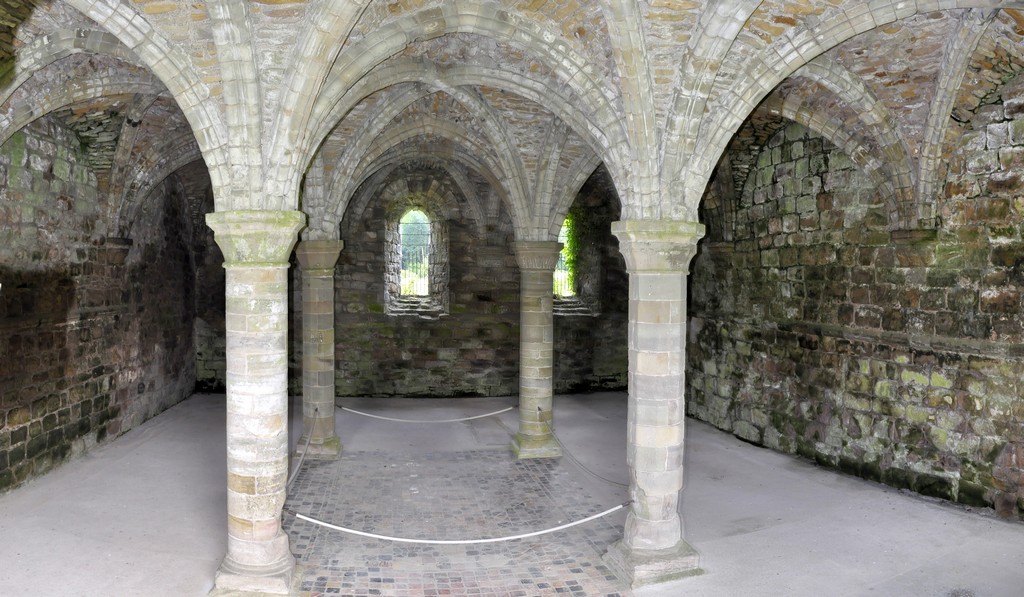
A particular fine feature is the Chapter House, with its columns and beautiful vaulted ceiling, and medieval tiles paving the central part of the floor.

20160527 078 Buildwas Abbey

The Chapter House.

These monks certainly knew how to choose a location to build their communities.

Three sheets to the wind . . .

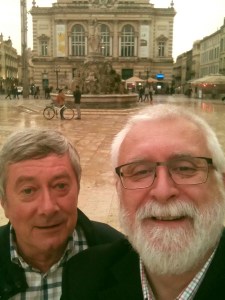
Three sheets to the wind?¹ Well, hardly, but maybe well on the way after all. This was the conclusion by an old friend and colleague from IRRI, Gene Hettel, when I posted the photo below on Facebook during a short trip (Wednesday to Friday) to Montpellier in the Languedoc-Roussillon region of the south of France last week.

Three sheets to the wind?

I travelled to Montpellier with another old friend and colleague, Professor Brian Ford-Lloyd (we were graduate students together at The University of Birmingham in the early 70s, colleagues there during the 80s, and research collaborators during the 90s after I joined IRRI).

Our trip took us via Charles de Gaulle airport in Paris. Not my favorite, but as we only had hand luggage we didn’t have to face that perennial CDG problem: lost luggage. But the walking distance between terminals was certainly a challenge for me, and my ankle and lower leg were quite swollen and painful by the time we arrived to Montpellier. I did put my walking stick to good use, however, and was able to have us boarded on each of the four flights before all other passengers. This brought another advantage: first occupancy of of the ‘allocated’ overhead luggage bins. All flights were full, and everyone had hand luggage.

Anyway, to cut a long story short, in the early evening of Wednesday, we set off for the city center by tram, to the Place de la Comédie on the Ligne 1 route (Mosson-Odysseum) from Place de l’Europe.

There were plenty of restaurants around the square, and we finally chose one with tables set up under an awning. That didn’t work out as intended. The waiter wanted to seat us near others who were smoking, and I just couldn’t face being two feet from someone who would be polluting me with cigarette smoke all through my meal. However, all seating inside the restaurant building was non-smoking, and that’s where we ended up. A few minutes later the heavens burst and there was quite a downpour.

But were we ‘three sheets to the wind’, as Gene cheekily described us? Well, we were certainly merry after a couple of beers (and a couple of small ones earlier in the hotel bar), a nice bottle of red Languedoc, followed by a couple of cognacs each. Brian looks particularly surprised because I dropped my walking stick and it hit the ground with a clatter just as I took that selfie.

Thursday was a glorious hot day—but we were in meetings all day (in connection with the program evaluation I’m leading, and for which we travelled to Bonn recently). At around 5:30 pm we were all done, so set off into the city center again, joined by Professor Wayne Powell, Chief Scientist of the CGIAR (until the end of June), and an old friend from Birmingham graduate student days. Wayne is Welsh, as is Brian, and both are passionate rugby fans (of Wales of course!). Anyway, Wayne took us to one of his favorite watering holes for a glass or three of wine, on a little tree-lined plaza near where he has an apartment, and about 400 m west of the Place de la Comédie. The hostelry was owned by twins who Wayne had given the nickname Les Misérables—and they were!

Afterwards, he pointed us in the direction of a favorite restaurant close by (he and his wife couldn’t join us as they had friends just arrived in Montpellier), and we enjoyed a delightful fish supper before heading back to the Place de la Comédie through a maze of narrow streets, to take the tram back to our hotel.

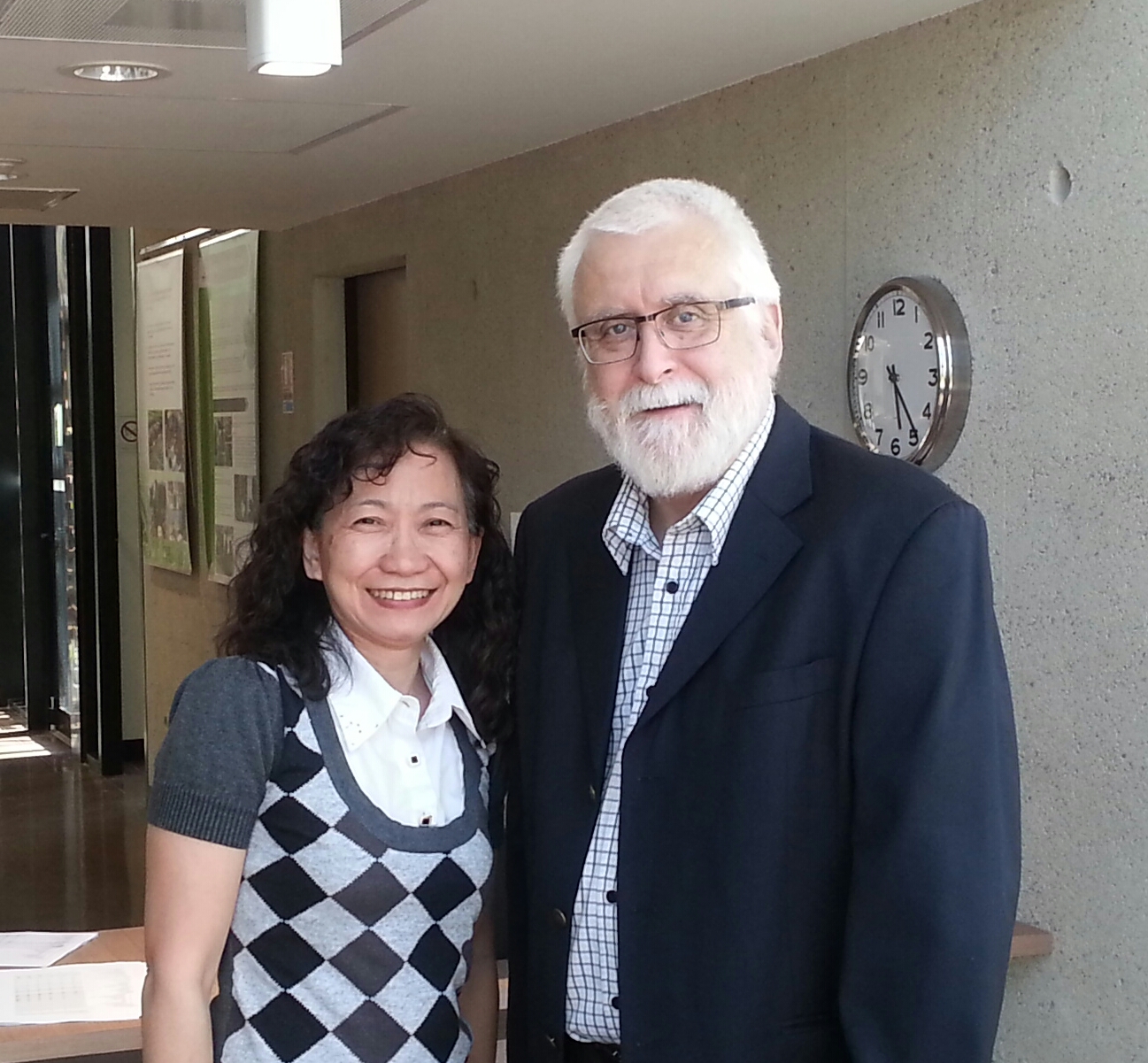
At the CGIAR Consortium office, where we held our meetings last Thursday, I bumped into an old friend from IRRI: Lori Dagdag. Lori used to be a senior manager in the IRRI finance department, but a decade ago or more she moved to Washington, DC to work as Finance Officer in the CGIAR Fund Office located in the World Bank. What a lovely surprise. I haven’t seen her since just before I retired in 2010.

Lori and yours truly.

~~~~~~~~~~~~~~~~~~~~~~~~~~~~~~~~~~

¹ Three sheets to the wind – drunk!

The innate hostility of inanimate things

Friday 13 May. It was not a good day. In fact, it went downhill about mid-morning, and stayed that way for the rest of the day. By the end of the afternoon I was climbing up the wall in frustration.

Having posted a comment on Facebook this morning about yesterday’s events, one of my old friends, Malcolm, from Southampton days replied: Sometimes when computers display what someone once called the innate hostility of inanimate things, I truly doubt whether I really am a rational being!

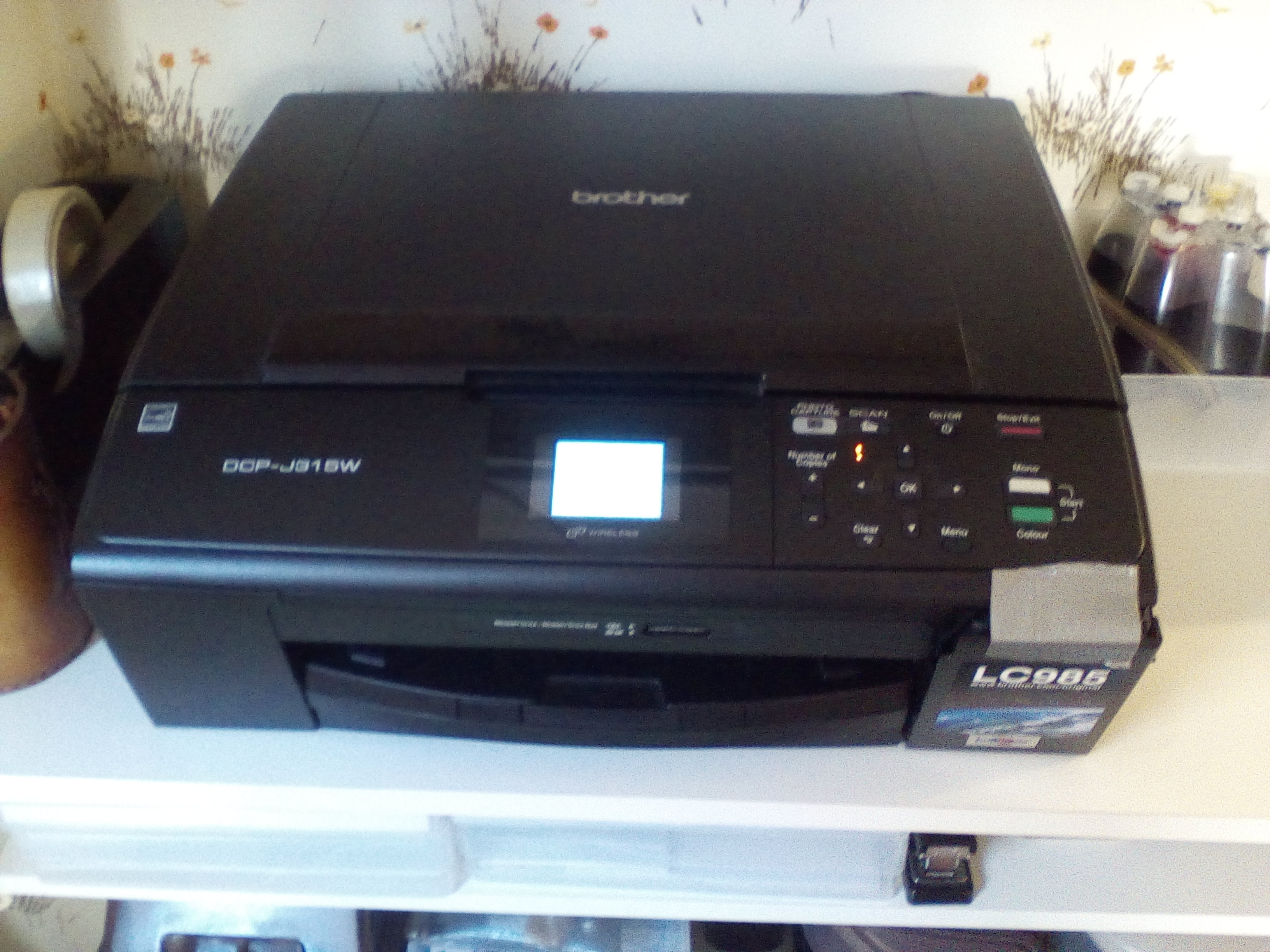
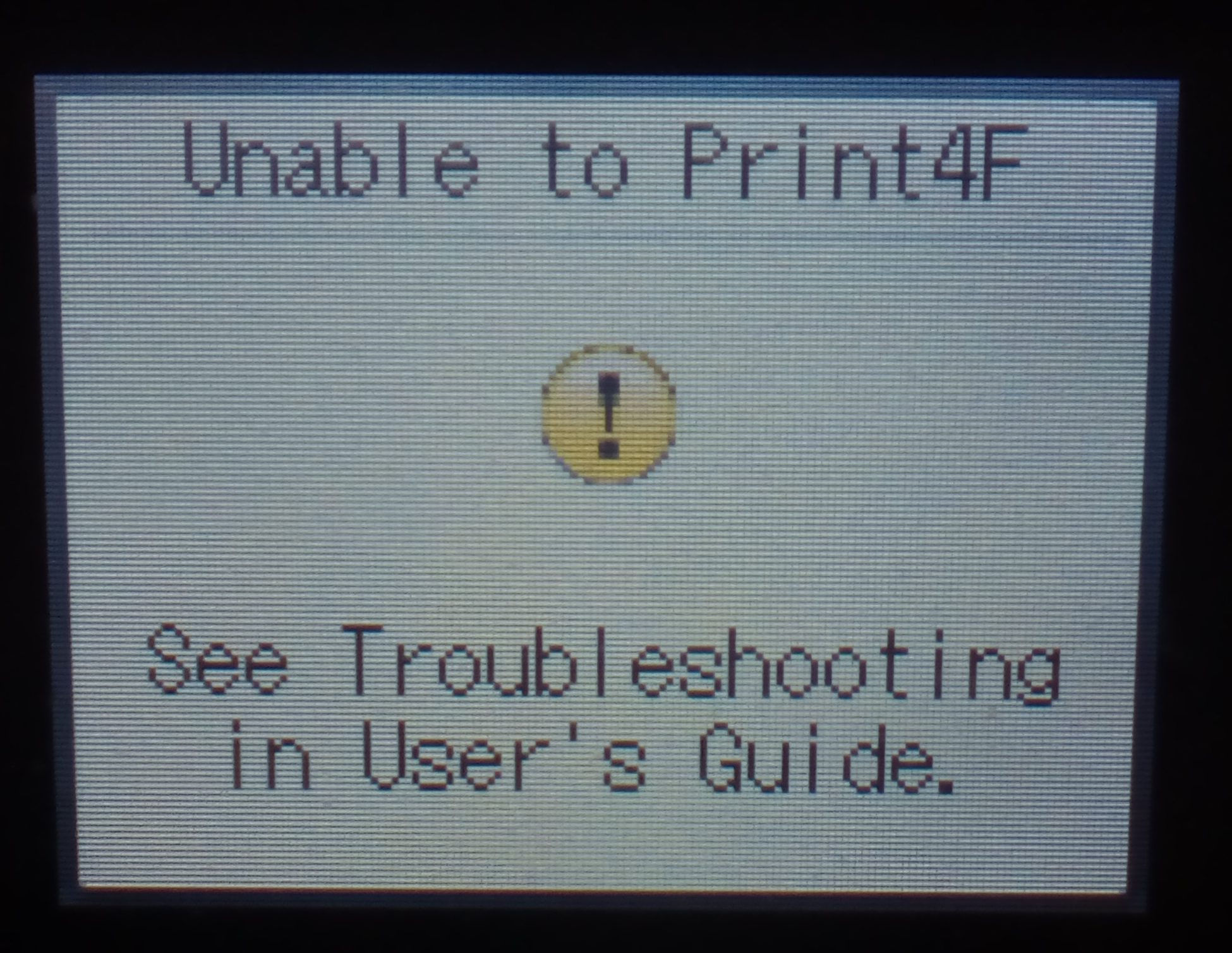
Yes, yesterday’s angst was caused by a Brother printer that, all of a sudden, decided that it no longer wished to cooperate with me. I bought this particular all-in-one printer (the DCP-J315W model, now discontinued by the manufacturer I believe) in October 2011. It prints, scans, and copies (or did).

IMG_20160514_124718

It has given me good service, and I don’t have much to say against it. That is, until yesterday. But I guess it’s not just this particular printer, but Brother in general. I should add that I fitted a continuous ink supply system that has also provided excellent service, and my printing costs have been a fraction of what I would have had to pay using disposable cartridges (the cost of printer ink is a scandal; but that’s for another day).

IMG_20160514_124638

Anyway, to cut a long story short, I was busy printing a couple of documents in preparation for a short visit to Montpellier in the south of France next Wednesday. This has to do with the program evaluation I’m leading of the genebanks managed by 11 of the CGIAR centers. There was a paper jam, and everything came to a halt. I have to admit that getting into the back of the printer is not easy as I have to rotate it on the shelf and hope I don’t disturb any of the ink supply connections.

The jammed paper was removed intact, and I set the printer on its way again. But then I noticed that many lines were failing to print. Time to use the cleaning maintenance procedure that is programmed in the printer. After a first pass, I was not satisfied with the resulting test pattern, so decided to complete a second clean.

And that’s when the printer seized up and I saw this error message on the LCD screen.

IMG_20160514_124606

Unable to Print4F? Not very helpful! Whatever did that mean? And it was no good looking in the User’s Guide, nor in any Brother manual online.

However, there were many sources of information online, some helpful, others entirely misleading, with ‘solutions’ to the problem. It seems that during the cleaning process extra ink is pumped through the printer heads, and this accumulates in a sort of waste tray or sponge. By using a maintenance menu that involves pressing a selection of buttons on the printer in a specific order and number of times as the printer powers up (instructions that are nowhere to be found in any Brother literature) it’s possible to purge the system and reset it to zero, ‘fooling’ the printer that there’s no excess ink problem. That should have worked, and in more than 95% of instances apparently it’s sufficient to get the printer operating again. Alas, not for me. It seems that there is either a real problem with the printer head or the waste sponge needs replacing, by a professional, neither of which will come cheap. Probably almost as much as the cost of a new printer.

So this morning, I bit the bullet and have ordered a new printer that comes with refillable ink tanks: the Epson ET-2500.

Epson Expression ET-2500 Eco Tank Printer

Not cheap, but in the long run I hope it will meet all my needs. The reviews I saw were promising. Having splashed out on a new notebook computer earlier in the week (my old Acer Aspire ONE has the Windows XP operating system and I decided that I needed an up-to-date Windows 10 machine to be able to work more effectively during this program evaluation) I hadn’t anticipated yet another computer-related expense so soon. This printer won’t be delivered until after I’ve left for Montpellier. So setting it up is a ‘pleasure’ deferred until next Saturday.

Four seasons in one day . . . and white asparagus

I’ve just returned from a week-long trip to Bonn, the former capital of West Germany. And on two of the days, our meetings were held in the former Bundestag (the German parliament building) in United Nations Plaza, just south of the city center, and close to the south/ west bank of the mighty River Rhine. It’s now home to the Crop Trust.

20050306015

The River Rhine, looking southeast from the Kennedy Bridge (Kennedybrücke).

CGIARI am leading the evaluation of an international genebanks program, part of the portfolio of the CGIAR (now the CGIAR Consortium). The evaluation has been commissioned by the Independent Evaluation Arrangement (IEA, an independent unit that supports the CGIAR Consortium) whose offices are hosted by the Food and Agriculture Organization of the United Nations (FAO) in Rome. Regular readers of my blog will know that for almost nine years from 1973 and 19 years from 1991, I worked for two international agricultural research centers, CIP and IRRI respectively. This evaluation of the CGIAR Research Program (CRP) on Managing and Sustaining Crop Collections (also known as the Genebanks CRP) focuses on 11 (of 15) CGIAR centers with genebanks.

Joining me in Bonn were two other team members: Dr Marisé Borja (from Spain) and Professor Brian Ford-Lloyd (from the UK). Our meeting was managed by IEA staff member Ms Jenin Assaf. Dr Sirkka Immonen, the IEA Senior Evaluation Officer was unable to travel at the last moment, but we did ‘meet’ with her online at various times during the four days of our meetings.

20160428 001

On our way to dinner last Thursday evening. L to R: Jenin Assaf, Marisé Borja, Brian Ford-Lloyd, and yours truly.

Brian and I traveled together from Birmingham, flying from BHX to Frankfurt, and catching the fast train from there to Siegburg/Bonn, a 20 minute taxi ride into the center of the city. The weather on arrival in Frankfurt was quite bright and sunny. By the time we reached Bonn it was raining very heavily indeed. In fact over the course of the next few days we experienced everything that a northern European Spring can throw at you (as in the Crowded House song, Four Seasons in One Day).

Now you can see from the photo above, I’m still using a walking stick¹, and expect to do so for several months more. While walking is definitely becoming easier, my lower leg and ankle do swell up quite badly by the end of the day. I therefore decided to wear ‘flight socks’ for travel. Even so, I had not anticipated the long walk we’d have in Frankfurt Airport. We arrived to a C pier, and it must have been at least a mile by the time we were on the platform waiting for our intercity express (ICE) to Bonn. Now that 40 minute journey was interesting, reaching over 300 kph on several occasions!

We stayed at the Stern Hotel in the central market square in Bonn, which is dominated at the northern end by the Bundesstadt Bonn – Altes Rathaus, the city’s municipal headquarters (it’s the building at the far end of the square in the image below).

20050306014

On the first night, last Monday, we met with an old friend and colleague, Dr Marlene Diekmann, and her husband Jürgen. Marlene works for the German development aid agency, GIZ, and was one of my main contacts whenever I had to visit Germany while working for IRRI. Jürgen was the Experiment Station manager for ICARDA based in Aleppo for many years before the Syrian civil war forced the closure of the center there and evacuation of personnel. South of Bonn is the Ahr Valley, a small red wine growing area where Marlene and I have walked through the vineyards in all weathers. It’s amazing how the vines are cultivated on the steep slopes of the valley.

Arriving at the end of April, and with the weather so unpredictable, and unseasonably cold, we missed the cherry blossom festival in Bonn a week earlier. In fact, I don’t recall seeing any cherry blossom anywhere in the city.

Cherry blossom in the streets of Bonn, mid-April 2016. (Photo courtesy of Luigi Guarino).

But there was another delight – culinary – that we did experience, having arrived just as Spargelzeit or ‘asparagus time’ began.

With so many food options to choose from in Bonn, Marlene suggested that we should try the Gaststätte Em Höttche, a traditional German restaurant right next door to the Stern Hotel. That was fine by me as I didn’t fancy a long walk in any case. The food was good (as was the weissbier or wheat beer), and we ate there the following night as well.

And since it was Spargelzeit, it wasn’t just any old asparagus. But white asparagus! Big, white, succulent spears of heaven. Just click on the image below for a more detailed explanation. Enjoyed on their own with a butter sauce, or with ham, schnitzel or fish (halibut was my particular favorite), white asparagus is offered on most menus from the end of April to June. The Germans just go crazy for it.

white asparagus

On the final evening, we had dinner with a number of colleagues from the Crop Trust, at the Restaurant Oliveto in Adenauerallee, less than half a kilometer from the hotel, on the bank of the Rhine.

After a wrap-up meeting on the Friday morning, Brian and I returned to Frankfurt by train, and caught the late afternoon Lufthansa flight back to BHX. Where the weather was equally unpredictable – and cold!

As far as the program evaluation is concerned, the hard work is just beginning, with genebank site visits planned (but not yet confirmed) to Peru (CIP), Colombia (CIAT), and Mexico (CIMMYT) in July/August, to Ethiopia (ILRI) and Kenya (ICRAF) in October, as well as the CGIAR Consortium Office in Montpellier before the end of May, and FAO in Rome by mid-June. We’ll be back in Rome to draft our report in mid-November. Before that, there will be lots of documents to review, and interviews over Skype. No peace for the wicked!

~~~~~~~~~~~~~~~~~~~~~~~~~~~~~~~~~~
¹ The walking stick came in handy on the return journey. Waiting in line at Frankfurt Airport to board our flight to Birmingham, one of the Lufthansa ground staff pulled me and Brian out of the queue and took us first through the boarding gate, even offered me a seat until the door to the air-bridge was opened. And we boarded the plane first.


Dr. M. Redux . . . courtesy of the National Trust!

It is fifteen weeks today since I went base over apex and broke my leg. But I have made good progress, and I’m pleased to say that since I saw my surgeon at the end of March, and finished with formal physiotherapy sessions, I have been able to get behind the wheel and drive again. And we have been fortunate that despite the mixed weather that April has brought us so far, there have been one or two really spectacular late Spring-early Summer days that have permitted us to get out and about.

20160410 018 Hanbury HallI still can’t walk more than about a mile and a half before I feel the need to sit down and rest my leg. The ankle and lower leg swell up quite badly, and where the various pins and screws are holding my bones together, it really does hurt from time to time. That hasn’t stopped us, however, and two weeks ago (10 April), a Sunday, we decided to head out to our ‘local’ National Trust property, Hanbury Hall.

It was a glorious morning, if not a little chilly in the stiff breeze. We were hoping to see Spring flowers in the parterre garden. And we weren’t disappointed. What a magnificent display of hyacinths!

20160410 034 Hanbury Hall

20160410 033 Hanbury Hall

20160410 001 Hanbury Hall

20160410 035 Hanbury Hall

The Hanbury parterre

Last Wednesday (20 April) was an even better day, weather-wise. Warm and sunny, and a joy to be outside in the fresh air. So we headed southeast from home, just 17 miles by motorway (and less than 30 minutes if there’s little traffic congestion) from home to Packwood House, another National Trust site we have already visited on several occasions also, but about which I don’t appear to have posted anything on my blog. That will have to be remedied. Packwood is a much-restored Tudor manor house. One of its signature features is the Yew Garden.

Anyway, we just wanted to enjoy the gardens, the lakeside meadow, and have a bite to eat in the lovely refurbished café there.

Packwood map

The Carolean Garden, and its beautiful yellow border . . .

20160420 045 Packwood House

The sunken garden, part of the Carolean Garden, installed in the 1930s.

20160420 046 Packwood House

The Raised Terrace, leading into the Yew Garden, from the Carolean Garden.

Scenes around the Yew Garden . . .

20160420 036 Packwood House

Packwood House from the Lakeside Meadow.

Until my leg heals further, our National Trust visits and walks will be limited to a wander round the gardens closest to the various properties. A walk at Croome Park, for example is certainly not on the cards in the foreseeable future. But, after being confined to a chair for so many weeks, followed by limited movement around the house, it’s great to be in the great outdoors. And our membership of the National Trust is, as always, a great encouragement to make the effort to take an outing.


A triple century . . .

300_tl copy

Yes, this is my 300th blog post! I can hardly believe it. What started, rather tentatively in September 2011 (when I first tried my hand at blogging on WordPress), has become a regular pastime for me.

I posted my first public post on 1 February 2012—all about a visit we’d made in 2008 to a pumping station on the Kennet and Avon Canal. And from that modest beginning, my blog A Balanced Diet has grown quite significantly. Maybe it’s rather self-indulgent, but I’ve written this blog for my own pleasure. However, it’s also quite gratifying to know that so many folks around the world have also found interesting some of what I write about.

Visitors to my blog have grown over the past four years, and there are few countries that are not represented, as this slide show illustrates year by year.

This slideshow requires JavaScript.

And, to date there have been almost 88,000 views.

views and visitors

Popular topics include genetic resources (and especially one post about potatoes in the Andes), various travels around the world, and our visits to National Trust properties.

But also popular are my two blogs about the investiture I attended at Buckingham Palace at the end of February 2012, and what to wear to an investiture. I think other honorees have faced the same dilemma I did. Another popular post, about cricket, must reflect the popularity of the sport and the various formats played around the world. Last year one of the most read posts was the obituary I wrote for my friend and former colleague, Professor Trevor Williams.

It’s strange how an idea will suddenly come to me, and then I can see how a blog post might be written. It could be hearing a piece of music, reading a book, or seeing something on television.

I hope you will continue to enjoy my random musings as much as I enjoy putting them together. Finding additional information from resources like Wikipedia (and yes, I have made a subscription to support that) and YouTube make my task easier. There’s often no need to go into great detail as there are already better resources out in the ether. I’ve uploaded more than 6000 images! I must have written more than 300,000 words over the past four years, maybe more. Well, as long as the ol’ neurons keep on being fired up, I’ll continue to blog.

Do keep coming back.


On political campaigns . . .

ballotbox copyI’m a bit of a news junkie, so I’ve been avidly following presidential election campaigns in three countries in online newspapers and on social media.

News from the US presidential election is never absent from the daily headlines, mainly because the two principal contenders on the Republican side, billionaire Donald Trump (or is that Donald Drumpf)¹ and evangelical Senator Ted Cruz, battling it out to win the nomination, increasingly descend to ever lower levels of political debate. Political debate? Their exchanges are not worthy of that epithet. Trump is hardly running an election campaign. I think it would be better to describe it as an election ego-trip.

You would hardly know there’s also an interesting contest on the Democrat side between former First Lady, New York Senator, and Secretary of State Hillary Clinton and Vermont Senator Bernie Sanders. At least they seem to be having a sensible debate.

The other campaigns that interest me are taking place in Peru in April, and in the Philippines in May. Why? Because I have lived and worked in both those countries.

Reading about the three campaigns, two quotations come to mind:

  • Toute nation a le gouvernement qu’elle mérite (Every nation gets the government it deserves) — attributed to Joseph de Maistre (1753 – 1821)
  • Democracy is being allowed to vote for the candidate you dislike least — Robert Byrne

Goodness knows what sort of campaign there will be in the US after the party conventions if Trump really does become the Republican candidate. He’s both scary and a worry. What will happen if he is ‘denied’ the nomination, and how will his supporters react. The violence we have seen so far directed by these folks against anti-Trump protesters does not bode well for the future.

But there are scary things going on in the Cruz camp as well. He is a right-wing evangelical Christian. And I’ve recently seen footage of him sharing the stage with a fundamentalist Christian preacher who, through his language was inciting Christians to violence, death even, against homosexuals. Because it says so in the Bible.

On the Democrat side, I’m actually surprised how well Bernie Sanders is doing, although I can’t believe he can win the nomination. Nor can I see a 74 year old candidate moving on to be a successful president.

In Peru and the Philippines, some of the candidates are as old as Sanders, but the political situation there is very different from the USA.

The polls in Peru seem to be dominated by Keiko Fujimori, daughter of the disgraced and gaoled former President Alberto Fujimori (who I met in the Philippines during his visit to IRRI). But Fujimori – daughter is also a controversial politician, believed to have benefited personally from her father’s corrupt government. Nevertheless, she is predicted to win the first round of voting. Another discredited candidate is the APRA former president Alan García who served two terms already (1985-1990, 2006-2011).

In the Philippines, which has a party system even weaker than that in Peru, the lists of candidates for both president and vice-president are filled with controversial characters. The posts of President and Vice-President are voted for separately (not as a single ticket in the USA), and it’s often the case that elected candidates come from different political persuasions and diametrically-opposed political platforms.

The current Vice-President Jejomar Binay heads yet another political dynasty, and has been accused of overwhelming corruption. The Mayor of Davao City (in Mindanao) Rodrigo Duterte has served his city for more than two decades, successfully apparently, and regarded as a political ‘hard man’. How a Duterte Administration would pan out nationally is anyone’s guess. Senator Miriam Defensor Santiago is an outspoken – and (formerly) popular – international lawyer who, once she had declared her candidacy (despite being near death’s door from Stage 4 lung cancer only a short time before), was thought to be well placed to win the presidency. Until, that is, she chose Senator Ferdinand Marcos, Jr. (aka ‘Bongbong’) as her running mate for vice-president. Son of former dictator Ferdinand Marcos (ousted in a popular uprising in 1986), Bongbong is widely regarded as corrupt and implicated in many of the worst human rights excesses of his father’s regime. Another, Senator Grace Poe, has had her candidacy questioned because of her nationality, having taken US citizenship at one time, which she has now renounced. Which leaves us with the ‘administration’ candidate and Secretary of the Interior and Local Government, Mar Roxas (a scion of yet another political dynasty). Is his wife Korina Sanchez a political liability??

So, in all three countries, the electorates are faced with choosing Presidents or Vice-Presidents from lists of some unsavory candidates, several of whom do not qualify (in my opinion) on ethical or moral grounds to ask for anyone’s vote, never mind political acumen or leadership potential, not even for the most humble elected post.

There will be bumpy political times and roads ahead in all three countries, whatever the election outcomes. Although not a General Election, we face an uncertain political (and economic) future here in the UK with the referendum on continuing membership of the European Union being held on 23 June. Political campaigning and false arguments have not brought out the best on either side of the referendum debate.

~~~~~~~~~~~~~~~~~~~~~~~~~~~~~~~~
¹ See the full 22 minute video here.

Through hard work, great things are achieved

BirminghamUniversityCrestPer Ardua Ad Alta

That’s the motto of The University of Birmingham, and ‘these sentiments sum up the spirit of Birmingham and illustrate the attitude of the people who have shaped both the city and the University.’

Almost 50 years ago, I had no inkling that I would have more than half a lifetime’s association with this university. Receiving its royal charter in 1900 (although the university was a successor to several institutions founded in the 19th century as early as 1828), Birmingham is the archetypal ‘redbrick university‘, located on its own campus in Edgbaston, about 3 miles southwest of Birmingham city center.


First encounter in 1967

My first visit to the university was in May or June 1967—to sit an exam. Biology was one of the four subjects (with Geography, English Literature, and General Studies) I was studying for my Joint Matriculation Board Advanced Level high school certificate (essentially the university entrance requirement) here in the UK. We were only four or five biology students at my high school, St Joseph’s College in Trent Vale, Stoke-on-Trent (motto: Fideliter et Fortiter).

Now, I don’t remember (maybe I never knew) whether we were too few in number to sit our biology practical exam at the school, or all students everywhere had to attend an examination venue, but we set off by train from Stoke to Birmingham, and ended up at the School of Biological Sciences building. It was a new building then, and the (federal) School had only recently been formed from the four departments of Botany, Zoology & Comparative Physiology, Genetics, and Microbiology.

Just before 2 pm, the five of us—and about 100 other students—trooped into the main laboratory (that I subsequently came to know as the First Year Lab) on the second floor. Little did I know that just over three years later I’d be joining the Department of Botany as a graduate student, nor that 14 years later in 1981 I would join the faculty as Lecturer in Plant Biology. Nothing could have been further from my mind as I settled down to tackle a dissection of the vascular system of a rat, and the morphology of a gorse flower, among other tasks to attempt.

Birmingham was not on the list of universities to which I had applied in December 1966. I’d chosen King’s College, London (geography), Aberystwyth (zoology and geography), Southampton (botany and geography), York (biology), Queen Mary College, London (general biological sciences), and Newcastle (botany and geography). In the end, I chose Southampton, and spent three very happy if not entirely fruitful years there.

Entering the postgraduate world

Jack Hawkes

Jack Hawkes

The next time I visited Birmingham was in February 1970. I had applied to join the recently-founded postgraduate MSc Course on Conservation and Utilization of Plant Genetic Resources. I was interviewed by Course Director and Head of the Department of Botany, Professor JG Hawkes and Senior Lecturer and plant ecologist, Dr Denis Wilkins.

Despite the grilling from both of  them, I must have made an impression because I was offered a place for the following September. The only problem: no support grant. Although Hawkes had applied for recognition by one of the research councils to provide postgraduate studentships, nothing had materialized when I applied (although he was successful the following year, and for many years afterwards providing studentships to British students). So, after graduation from Southampton in July 1970 I was on tenterhooks all summer as I tried to sort out a financial solution to attend the course. Finally, around mid-August, I had a phone call from Hawkes telling me that the university would provide a small support grant. It was only £380 for the whole year, to cover all my living expenses including rent. That’s the equivalent of about £5600 today. The university would pay my fees.

All set then. I found very comfortable bed-sit accommodation a couple of miles from the university, and turned up at the department in early September to begin my course, joining four other students (from Nigeria, Pakistan, Turkey and Venezuela). It was during this one year course that I really learned how to study, and apart from my weekly Morris dancing night, I had few other distractions. It was study, study, study: and it paid off. The rest is history. I graduated in September 1971, by which time I’d been offered a one-year position at the newly-founded International Potato CenterCIP logo (CIP) in Lima, Peru, and I was all set for a career (I hoped) in the world of genetic resources and conservation. As it turned out, my travel to South America was delayed by more than a year during which time I registered for and commenced a PhD study on potatoes, finally landing in Lima in January 1973 and beginning a career in international agricultural research that lasted, on and off, until my retirement in 2010. I carried out most of my PhD research in Peru, and submitted my thesis in October 1975.

Jack Hawkes and me discussing landrace varieties of potatoes in the CIP potato germplasm collection, Huancayo, central Peru in early 1974.

Graduation December 1975. L to R: Jack Hawkes (who co-supervised my PhD), me, and Trevor Williams (who became the first Director General of the International Board for Plant Genetic Resources). Trevor supervised my MSc dissertation.

Then I returned to Lima, spending another five years with CIP in Costa Rica carrying out research on bacterial diseases of potatoes among other things.

I should add that during the academic year 1971-72, a young woman, Stephanie Tribble, joined the MSc course. A few months later we became an ‘item’.

Steph’s MSc graduation at the University of Birmingham in December 1972, just weeks before I flew to South America and join the International Potato Center in Lima, Peru.

After graduation, she joined the Scottish Plant Breeding Station just south of Edinburgh, but joined me in Lima in July 1973. We married there in October, and she also had a position with CIP for the years we remained in Lima.

A faculty position
On 1 April 1981 I joined the University of Birmingham as a lecturer in the Department of Plant Biology.

Richard Sawyer

By mid-1980, after almost five years in Costa Rica, I felt that I had achieved as much as I could there, and asked my Director General in Lima, Dr Richard Sawyer, for a transfer to a new position. In November, we moved back to Lima, and I was expecting to be posted either to Brazil or possibly to the Philippines. In the meantime, I had been alerted to a recently-established lectureship in the Department of Plant Biology (formerly Botany) at Birmingham, and had been encouraged to apply¹. With encouragement from Richard Sawyer², and having been invited for interview, I made the trek back to the UK from Lima towards the end of January 1981. The interview process then was very different from what might be expected nowadays. No departmental seminar. Just a grilling from a panel chaired by the late Professor John Jinks, FRS, Dean of the Faculty of Science and head of the Department of Genetics. There were three staff from Plant Biology (Hawkes, Dennis Wilkins, and Brian Ford-Lloyd), and the head of the Department of Biochemistry and Deputy Dean, Professor Derek Walker.

We were three candidates. Each interview lasted about 45 minutes, and we all had to wait outside the interview room to learn who would be selected. I was interviewed last. Joining the other two candidates afterwards, we sat side-by-side, hardly exchanging a word between us, nervously waiting for one of us to be called back in to meet the panel. I was the lucky one. I was offered the position, accepted immediately, and a couple of days later flew back to Lima to break the news and make plans to start a new life with Steph and our daughter Hannah (then almost three) in Birmingham.

Over the 10 years I spent at Birmingham I never had the worry (or challenge) of teaching any First Year Course – thank goodness. But I did contribute a small module on agricultural systems to the Second Year common course (and became the Second Year Chair in the School of Biological Sciences), as well as sharing teaching of flowering plant taxonomy to plant biology stream students mtj-and-bfl-book-launchin the Second Year. With my colleague Brian Ford-Lloyd (with whom I’ve published three books on genetic resources) I developed a Third Year module on genetic resources that seems to have been well-received (from some subsequent feedback I’ve received). I also contributed to a plant pathology module for Third Year students. But the bulk of my teaching was to MSc students on the graduate course on Conservation and Utilization of Plant Genetic Resources – the very course I’d attended a decade earlier. My main focus was crop evolution, germplasm collecting, and agricultural systems, among others. And of course there was supervision of PhD and MSc student research projects.

One of the responsibilities I enjoyed was tutoring undergraduate students, and always had an open door if they needed to see me. It quite shocked me in the late 1990s when my elder daughter, then a student at Swansea University, told me that her tutors had very limited and defined access hours for students. Of course you can’t be on call all day, every day, but you have to be there if a student really need to see you. And my tutees knew that if my office door was open (as it mostly was) they were free to come in and see me.

Once the four departments of the School of Biological Sciences merged into a single department in 1988, I aligned myself with and joined the Plant Genetics Group, and found a better role for myself. I also joined and became Deputy Chair of a cross-disciplinary group called Environmental Research Management (ERM) whose aim was to promote the strength of environment-related research across the university. Through ERM I became acquainted with Professor Martin Parry, and together with Brian Ford-Lloyd we published a book on genetic resources and climate change in 1990, and another in 2014 after we had retired.

Moving on
Even though the prospect of promotion to Senior Lecturer was quite good (by 1989 I’d actually moved on to the Senior Lecturer pay scale), I was becoming somewhat disillusioned with university life by that time. Margaret Thatcher and her government had consistently assaulted the higher education sector, and in any case I couldn’t see things getting any better for some years to come. In this I was unfortunately proved correct. In September 1990 a circular dropped into my post, advertising a new position at the International Rice Research Institute (IRRI) in the Philippines. This was for a germplasm specialist and first head of the Genetic Resources Center. So I applied, was interviewed in January 1991, and accepted the position with a view to joining the institute from 1 July. They actually wanted me to start on 1 April. But as I explained—and IRRI Management accepted—I had teaching and examination commitments to fulfill at the university. In February I began to teach my third year module on genetic resources for the last time, and set the exams for all students to take in May and June. Once the marking and assessments had been completed, I was free to leave.

Friday 28 June was my last day, ending with a small farewell party in the School. I flew out to the Philippines on Sunday 30 June. And, as they say, the rest is history. I never looked back. But now, retirement is sweet, as are my memories.

~~~~~~~~~~~~~~~~~~~~~~~~~~~~~~~~~~~~~~~~~~
¹ Jack Hawkes was due to retire in September 1982 and, recognizing that his departure would leave a big hole in the MSc teaching, the university approved the recruitment of a lecturer in plant genetic resources (with a focus on crop evolution, flowering plant taxonomy, and the like) essentially covering those areas where Jack had contributed.
² Dick Sawyer told me that applying for the Birmingham position was the right thing to do at that stage of my career. However, the day before I traveled to the UK he called me to his office to wish me well, and to let me know whichever way the interview went, he would have a new five-year contract waiting on his desk for me on my return. From my point of view (and I hope CIP’s) it was a win-win situation. Thus I left for the interview at Birmingham full of confidence.


Once upon a time in Barsetshire

Anthony Trollope

The novels of 19th century writer Anthony Trollope are not an easy read. Indeed, ‘challenging’ might be a better description. It’s not the tales themselves that’s the difficulty, but Trollope’s style and literary techniques¹ that are no longer fashionable. Yet, as I have found with great pleasure over several decades, they are worth the effort.

I first became acquainted with the works of  Anthony Trollope in 1976. Steph and I were doing a weekly shop in San José, Costa Rica. We had relocated there in early April to establish a research program on breeding heat- and disease-resistant potatoes in Turrialba for the International Potato Center (CIP).

Having spent an hour at one of San José’s better supermarkets, we decided to investigate The English Bookshop (I think that was its name) in one of the side streets near the city center and see what literary delights it had to offer.

The shelves were stacked with all the current best sellers: crime, thrillers, a modicum of erotica. None of them were cheap, however. And once I’ve bought a book, I never like to discard them. I just didn’t think that much of what was on offer deserved a place on my bookshelf, not at those prices – whether or not that’s a rather arrogant attitude towards the popular fiction of the 1970s.

As it happened, the wife of a colleague from Turrialba was in the bookshop at the same time. Mary Boynton, a retired professor of English Literature at Cornell University had accompanied her husband Damon Boynton, a retired professor of pomology at Cornell on a short term consultancy at CATIE, the institute to which I had also been seconded. Anyway, as I was browsing the shelves, I asked Mary if she could recommend any of the novels spread out before us.

Why don’t you try these‘, she suggested, pointing at a group of books by Anthony Trollope. These were the six Palliser novels², tales of politics, preferment, aristocratic intrigue, the Irish question. Well, in for a penny, in for a pound (well, several £££ in this case) and I bought the first in the series, hoping that if I did enjoy it, the others would still be available on a later visit. However, I didn’t anticipate there would be much of a market for Trollope in 1970s Costa Rica.

Alan Rickman

And enjoy them I did. The remaining Palliser novels found a home in my library, as did Trollope’s The Chronicles of Barsetshire³, another six books recounting the lives of the great and good, the Church, and the ‘lower and artisan classes’ in the fictitious counties of West and East Barsetshire; and linked to the Palliser novels through at least one character in common: the Duke of Omnium (bachelor uncle to Plantagenet Palliser). Several of the novels are centred around the ecclesiastical community of Barchester. So it was a delight, after we returned to the UK, in 1981 that the BBC broadcast an adaptation (The Barchester Chronicles) of the first two of these novels (The Warden, Barchester Towers) and starring a relative newcomer to our screens, the late lamented (and young) Alan Rickman as the Reverend Obadiah Slope, the bishop’s chaplain (here with the late Donald Pleasance as the Rev. Septimus Harding – the Warden).

The Palliser novels were adapted for television (in 26 episodes) in 1974 by Simon Raven and have recently been rebroadcast on daytime television. The Pallisers starred Philip Latham as Plantagenet Palliser and Susan Hampshire as his vibrant and wealthy wife Lady Glencora M’Cluskie. Today, the production seems so dated compared to recent offerings.

Dr. Thorne on TV
In the past month, an adaptation of the third of the Barchester novels, Dr. Thorne, has been broadcast on ITV (one of the UK’s commercial channels) with all the drawbacks of commercial breaks every ten to fifteen minutes. Adapted for television by Julian Fellowes—the creator and writer of Downton Abbeythis adaptation of Dr. Thorne suffered from Fellowes’ inability to write a scene lasting more than 30 seconds (I’ve never been a fan of Downton Abbey). I exaggerate of course. But the narrative moved swiftly on from one set piece to another. On the whole, the first two episodes were fine, but the third was a complete let-down. Very wooden. But not everyone agrees.

Oh for the more leisurely (and commercial-free) pace of a BBC production. The celebrated writer Andrew Davies has adapted to many of the great works of literature for the small screen, including Pride and Prejudice by Jane Austen in 1995, and War and Peace by Leo Tolstoy earlier this year.

However, the locations chosen for filming Dr. Thorne, the costumes, and the whole look and feel of the production were outstanding. But the cast of characters as dramatised by Julian Fellowes were generally one dimensional, except for the wonderful Ian McShane as the nouveau riche railway baron, Sir Roger Scatcherd. And Rebecca Front as Lady Arabella Gresham was another joy to watch. The character of Dr. Thorne was played by Tom Hollander.

In the book itself, Dr. Thorne is obviously the central character, a sensitive yet strong character. I’m not convinced this was captured as satisfactorily on screen. Maybe it was the writing as Hollander’s performance per se was also very good. As it happened that Tom Hollander was appearing at the same hour (it started a couple of weeks earlier) in another production on the BBC, The Night Manager (adapted from a John Le Carré novel), playing a homosexual, psychopathic factotum. Two opposite characters could hardly be dreamed up, and unintentionally might have prejudiced my take on Hollander’s Dr. Thorne.

Dr. Thorne was broadcast over three Sundays at 9 pm. Given how commercial breaks can, and do, disrupt the narrative, I wonder if adaptations of this type are better suited to the commercial-free environment of the BBC, and portrayed at a slower pace over more episodes. Even two episodes, each 90 minutes with no breaks, would lend themselves perhaps to a more satisfactory and enjoyable experience.

However, having been left somewhat dissatisfied with the TV production, I decided to retrieve Dr. Thorne from my library. I’m now more than half way through. It’s just as enjoyable today as when I first tackled it almost 40 years when I found a copy in a secondhand bookshop in Leigh-on-Sea in Essex—a reprint from 1915! I think it’s time to immerse myself once again in the world of the Pallisers, which should keep me occupied for a few months more.

~~~~~~~~~~~~~~~~~~~~~~~~~~~~~~~~~~~~~
¹ For example, even as the narrative is romping along, Trollope will call a halt and, as though someone quite disconnected from the story, begin a commentary on the events. He also uses an interesting technique of addressing the reader from time-to-time, seeking as it were a response on what is happening and what this character or that should do. It’s rather like talking to camera as a kind of narrative, employed quite successfully by comedienne Miranda Hart in her series Miranda. Even though she might be in the middle of a sketch, the narrative might  stop, and she talks direct to camera, to the audience, to great effect.

² Can You Forgive Her? (1864); Phineas Finn (1869); The Eustace Diamonds (1873); Phineas Redux (1874); The Prime Minister (1876); The Duke’s Children (1879)

³ The Warden (1855); Barchester Towers (1857); Doctor Thorne (1858); Framley Parsonage (1861); The Small House at Allington (1864); The Last Chronicle of Barset (1867)

Nature abhors a vacuum . . .

PACIFIC_Royal.inddI’m thoroughly enjoying Simon Winchester’s Pacific – the Ocean of the Future (published in 2015 by William Collins, ISBN 978-0-00-755075-3), which I received for Christmas 2015. I already mentioned it in a recent post.

With a Prologue (The lonely sea and the sky), an author’s note (On carbon), and an epilogue (The call of the running tide), the chapters are ten essays on a range of topics about the Pacific Ocean, its geography, politics, and history since 1 January 1950 (Before Present):

  • Chapter 1: The great thermonuclear sea (all about the series of atomic bomb test at many locations in the Pacific in the 1950s)
  • Chapter 2: Mr Ibuka’s radio revolution (Sony and the transistor revolution)
  • Chapter 3: The ecstasies of wave riding (the rise of surfing culture, from Hawaii to California)
  • Chapter 4: A dire and dangerous irritation (North Korea)
  • Chapter 5: Farewell, all my friends and foes (the end of colonialism)
  • Chapter 6: Echoes of distant thunder (the Pacific and world weather)
  • Chapter 7: How goes the lucky country? (Australia)
  • Chapter 8: The fires in the deep (deep ocean exploration)
  • Chapter 9: A fragile and uncertain sea (climate change and other environmental challenges)
  • Chapter 10: Of masters and commanders (the emergence/resurgence of China)

It was Chapter 5 on the end of colonialism that fired the neurons in my brain, resurrecting several memories from the deep recesses of my mind. It began with an account of the Cunard ocean liner, RMS Queen Elizabeth and her demise after catching fire (in what appears to have been a deliberate act of sabotage) in Hong Kong harbor. The head of the company that had bought the QE, Tung Chee Hwa, became the first Chinese-appointed chief executive of the Hong Kong Special Administrative Region after the Union Jack was lowered on 30 June 1997 and British rule came to an end.

The essay in Chapter 6 described how the Pacific Ocean influences weather systems right across the globe. Pacific Ocean weather is something in both its glory and at its most ferocious I came to appreciate and experience during my 19 years in the Philippines.

But it was the tenth essay, about the geopolitics of the South China Sea, that made me sit up and really take notice. Hardly a week goes by without some report in the media about the territorial claims to the islands of and expansion into the South China Sea by the People’s Republic of China. Absurdly (but not obviously from a Chinese perspective) China has laid claim to almost all the South China Sea, riding roughshod over the legitimate (and, it has to be said, the conflicting claims of Vietnam, Philippines, Malaysia, Brunei, and Indonesia). But even a cursory glance at a map of the South China Sea shows just how outrageous China’s claims and actions are.

south-china-sea

China has even taken to building outposts on a number of islands, reefs and atolls, obviously destined to become military bases with sophisticated defences and airfields to take the biggest planes.

0,,18270383_303,00

Chinese claims
While China’s claims to the South China Sea stretch back to the end of the Second World War, it’s only in the past 25 years that this regional expansion has increased, and both the civil and military mobilized to achieve its aims. For the first time in 2006, evidence of China’s blue water navy aspirations and expanding naval capabilities was seen when a Chinese submarine sailed unnoticed within a few miles of a US carrier fleet. Over the years there have been a number of close encounters of the military kind. So far, both countries have managed to keep a lid on these confrontations escalating into a ‘shooting war’. But for how long?

Now, until I read Winchester’s account in Chapter 10, I had not put two and two together, even though I lived in the Philippines for almost two decades. Two events—one natural, one political—occurred in 1991, and subsequent analysis allows me to ask one of the important ‘What ifs’ of Southeast Asia history. As we approach the 25th anniversary of the Pinatubo eruption I’m just beginning to understand the inter-connectivity of the events of that year. Part of this will not make particularly comfortable reading for many Filipinos, I fear. Nevertheless it’s an interesting perspective on what events encouraged the Chinese to assert themselves as they have done, much to the chagrin of her neighbours. Not that China is concerned it seems, about their counter claims, or that much of the area they claim as sovereign territory is viewed as international waters or airspace. A UN international tribunal in The Hague, to which the Philippines had taken its case, ruled against China. But that will make no difference. China does not recognize the tribunal. Economic prowess and military might are what count.
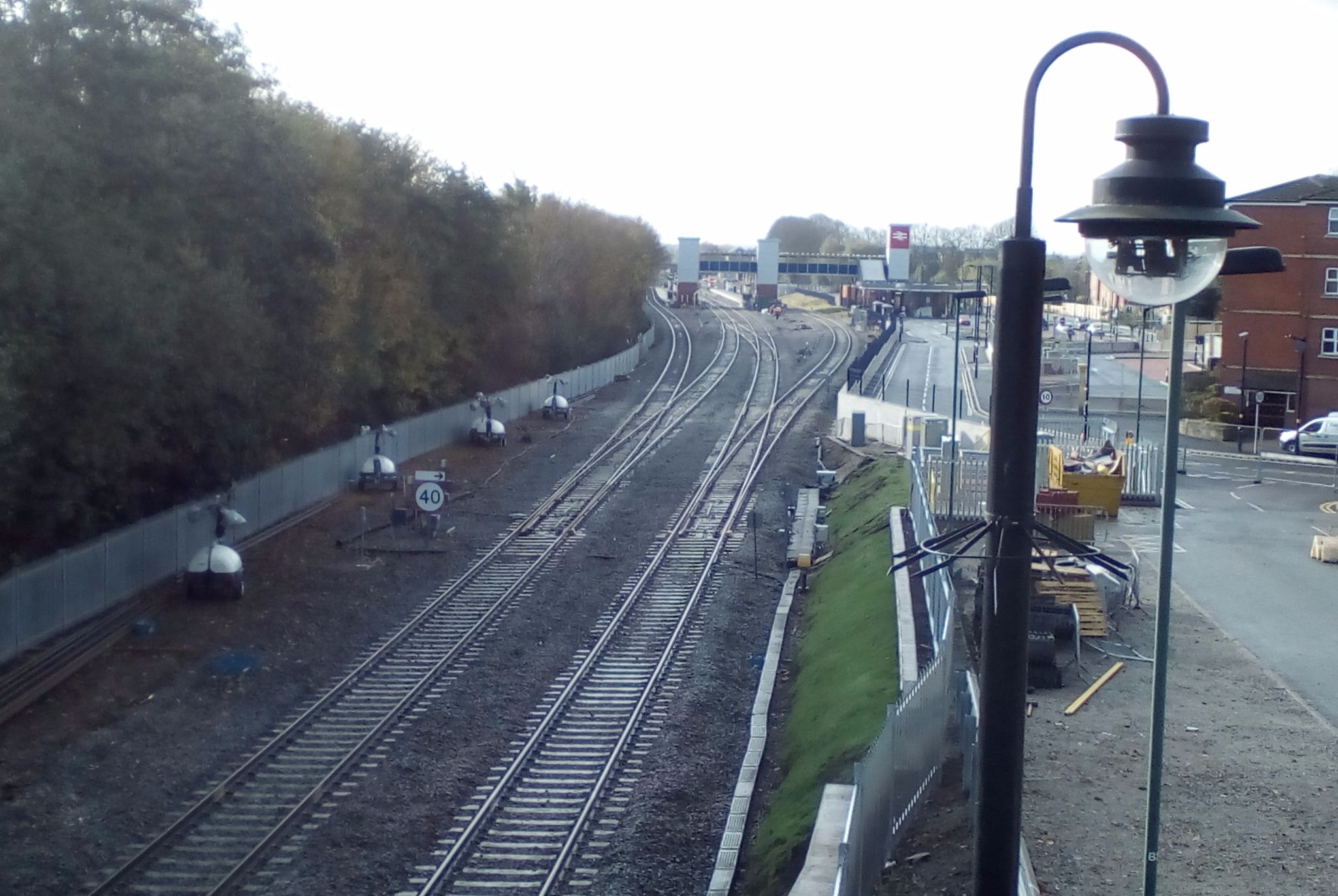
The events of 1991
In 1991, Mt Pinatubo awoke from its slumber of many centuries, and erupted on 15 June in a climactic explosion, depositing ash over a huge area. This dire situation was further exacerbated because Typhoon Yunya (Diding in the Philippines) hit Luzon on precisely the same day. Within spitting distance of Pinatubo were located two of the US’s most important overseas military bases: Clark Field, nestling at the foot of the volcano near Angeles City, and Subic Bay, home to the US Seventh Fleet, and one of the most important naval facilities that the US had access to anywhere. As we approach the 25th anniversary of the Pinatubo eruption I’m just beginning to understand the inter-connectivity of different events of that year.

Mt Pinatubo (from Clark Air Base) erupting on 12 June 1991, three days before the climactic eruption that led to the abandonment of the airbase in November that year.

At Clark it became clear within a day or two of the eruption, and covered in feet of volcanic ash, that the airbase would have to be abandoned. Aircraft had been flown out beforehand and personnel successfully evacuated to Subic. In November 1991 the US Air Force closed Clark¹.

At the end of 1991 there was perhaps an even more event, political this time, that has perhaps contributed more to the present South China Sea situation than the Pinatubo eruption ever did. In an increasingly nationalistic Senate, the future of an American presence in the Philippines was being debated. The Senate rejected a treaty that would have extended use of Subic Bay because of concerns over the presence of nuclear weapons (which the US would not reveal). Finally at the end of December 1991, the then president Cory Aquino informed the US government that US forces would have to leave the Philippines by the end of 1992. The US Navy pulled out in November 1992.

And into the vacuum left by the US departure cleverly stepped the Chinese, sensing the opportunity to fulfill their long-standing regional geopolitical ambitions. The rest is history; the Chinese are now well and truly entrenched in the South China Sea, and will not be easily budged. There is, however, another interesting twist to the story. In January 2016, the Philippines Supreme Court approved the return of US troops to bases in the Philippines, as a counter to Chinese expansionism in the South China Sea. What goes around comes around?

What if?
What if Pinatubo had never blown her top on that fateful June day in 1991? What if the US had been more forthcoming about the status of nuclear weapons during the finely balanced base renewal negotiations in 1991? What if the Philippines Senate had not openly expressed its rejection of the treaty in a display of anti-colonialism? What if the US navy had never left?

Would the Chinese have been off the mark with such alacrity, developing its own blue water navy, and (with contempt, many would say) revealing its true regional hegemonic ambitions? Nature abhors a vacuum, as they say. The Chinese have been only too happy to fill the military vacuum.

Let us hope that the war of words being fought over the South China Sea never evolves into a ‘hot war’. Notwithstanding Chinese intransigence and, it has to be said, overt hostility at times, it may depend in some degree on who occupies the White House after next November’s presidential election in the US. The jingoistic foreign policy rhetoric of a couple of the Republican candidates does not give me much cause for optimism.

~~~~~~~~~~~~~~~~~~~~~~~~~~~~~~~~~~~
¹ In the intervening years, it should be noted, Clark has been refurbished and reopened as Clark International Airport. Were it closer to Manila, and connected with better transport links, Clark could well have become Manila’s principal airport, relieving congestion at the Ninoy Aquino International Airport, close-by Manila’s business district of Makati.

Around the world in 40 years . . . Part 13. Tales (mainly) from the ‘Ring of Fire’

Earth, wind, and fire (not that Earth, Wind & Fire—still active 45 years after the group formed).

No, these are some reflections, going back almost as far as EWF, about my encounters with and experiences of earthquakes, typhoons, and volcanoes (fortunately mostly dormant) around the Ring of Fire.

But first, a summer morning in west Wales
Take 19 July 1984 for example. Steph and I with our two daughters Hannah and Philippa were enjoying a week’s holiday in Pembrokeshire, in west Wales. We’d rented a nice cottage, in Broad Haven, on the coast south of St David’s. As usual, one of us had gone downstairs to make a cup of tea. Steph says it was her; I think it was me. No matter. But just as the tea-maker was about to climb the stairs back to our bedroom (lying in bed, waking up to and enjoying a cup of tea, is one of life’s simple pleasures), we felt the house shake. There had been an earth tremor, hardly worthy of the description ‘earthquake’. But noticeable enough, especially if, like me, you had become sensitized to such tectonic events.

Further north, close to the epicenter on the Llŷn Peninsula, it was much stronger, registering 5.4 on the Richter scale, and was ‘the largest known onshore earthquake to occur in the UK since instrumental measurements began‘. It was felt all over Wales and many parts of England. Chimneys fell from roofs. Liverpool was apparently quite badly hit.

But a Richter 5 quake in the UK is nothing compared to what I have experienced along the ‘Ring of Fire‘.

October 1974
Thursday 3 October started as a normal day. Steph and I had taken the staff bus from our apartment in the Lima district of Miraflores to the International Potato Center (CIP) in La Molina (on the eastern outskirts of the city, and close to the National Agrarian University). We didn’t have our car that day. The government had introduced a gasoline rationing system, and the decal we choose allowed us to drive only over the weekends and on alternate days during the week. This is relevant.

36 chromosomes from a triploid potato variety.

I had arranged to show one of the laboratory technicians how to make chromosome preparations from potatoes. Then, around 09:20, as I was enjoying a cup of coffee, and without any warning, the whole building started to rock and shake backwards and forwards. Clearly this was more than the all-too-frequent earth tremors or temblores that we were ‘used’ to. We all rushed out of the building into the car park. I was still carrying my cup of coffee! And in the car park we all endeavored to remain upright as the ground rolled back and forth, almost a meter at a time, for over two minutes! At La Molina the earthquake (or terremoto) was recorded over 8 on the Richter Scale. Remember of course that the scale is a logarithmic one, so the La Molina earthquake was hundreds of times more powerful than the alarming Llŷn Peninsula version in 1984.

Damage to laboratories and offices at CIP was considerable.

Fortunately there were fewer than 80 deaths and only a couple of thousand injuries around the city, because many people were already in their places of work that were better constructed to withstand an earthquake. However, it was the continual aftershocks (the strongest—at 7.1—felt on Saturday 9 November just before 08:00 as military parade was commencing in downtown Lima) that unnerved everyone. Ever since I have been hypersensitive to any sort of movement of that kind. ‘Did the earth move for you?‘ holds no pleasant connotations.

However, it was in May 1973 that I saw first hand the aftermath of a powerful earthquake. My colleague, Zosimo Huaman and I were away from Lima on a three-week trip to collect native varieties of potatoes from farmers in the Departments of Ancash and La Libertad in central-northern Peru. Just north of Huaraz in the Callejon de Huaylas, and beneath Peru’s highest mountain, Huascarán, lie the remains of two towns, Yungay and Ranrahirca. On 31 May 1970 a huge earthquake triggered an ice and rock landslide from the top of Huascarán, which quickly sped down the mountain obliterating everything in its path. More than 70,000 people lost their lives, and the two towns were destroyed. When we visited just three years later the scene in Yungay was one of utter devastation, with just a few palm trees surviving, and the statue of Christ in the cemetery.

Further north, Zosimo and I had the opportunity of visiting several remote villages on foot. In one (I don’t recall the name) we were welcomed as honored guests, and in my case, as a representative of Queen Elizabeth. After making a short speech of thanks in broken Spanish to about 200 residents gathered in the ‘town hall’, everyone came up and shook my hand. Apparently they had received no help for the government to rebuild their communities nor livelihoods even three years after the earthquake.

Over the course of our three years in Lima, five years in Costa Rica, and almost 19 years in the Philippines, we felt many earth tremors, some stronger than others, but never as awe-inspiring or sphincter-challenging as that in October 1974.

Winds over the Pacific
The Pacific Ocean sees its fair share of tropical storms and stronger. Severe storms in the Pacific are called ‘typhoons’, and the Philippines is unlucky to be battered, on average, by 20 or more each year.  Developing way to the east in the open ocean, typhoons head due west towards the Philippines, but often veer northwards and clip the northern tip of the main island of Luzon. Nevertheless, the weather effects of high winds and heavy and prolonged rainfall can affect a much wider area than hit by the ‘eye of the storm’. Some typhoons do head straight for Metro Manila and its 11.8 million population, many living in poverty.

During our almost two decades in Los Baños (working and living at the International Rice Research Institute, IRRI, some 65 km south of Manila, we were hit by just a couple of super typhoons (although after our departure in May 2010 there have been others) but we did feel the effects of many of the typhoons that barreled into the country, disrupting daily life and communications.

I was away in Laos on 3 November 1995 when Los Baños was hit by Super Typhoon Angela (known as Rosing in the Philippines). I’d departed totally unaware that a typhoon was headed for the Philippines, let alone one that was expected to develop into a ‘super typhoon’. It was only when I tried to phone home during the height of the storm that I realised what I had missed. You can experience something of the force of this typhoon and the unimaginable rainfall that accompanied it in the video below, made by my neighbor and former colleague, Gene Hettel.

At the end of September 2006, the Philippines was hit by Typhoon Milenyo. This was a slow-moving typhoon, dumping a huge amount of rain. In the Los Baños area, most damage was caused by flooding not by the wind. Laguna de Bay rose several meters. The Philippines national genebank in Los Baños was flooded to a depth of several meters because debris washed down the sides of nearby Mt Makiling accumulated created a log jam under a bridge and causing the creek to overflow.

At IRRI Staff Housing, there were several major landslips and the integrity of the Guesthouse and several houses threatened. Creeks around the campus of the University of the Philippines – Los Baños were scoured, and much timber and other vegetation felled.

This slideshow requires JavaScript.

Since 2010, there have been two super typhoons. In November 2013, Typhoon Haiyan (Yolanda in the Philippines) killed more than 6000 people in the Philippines, and was the strongest storm ever recorded at landfall. Many of the deaths in Tacloban were caused by a storm surge. And in July 2014 (just before I made a visit to IRRI) Super Typhoon Glenda did considerable damage to IRRI’s glasshouses and other buildings. Here is another video by Gene Hettel taken at the height of Super Typhoon Glenda.

Now the fire . . . 
I lived on the slopes of two volcanoes for almost 24 years; in Costa Rica, on Volcán Turrialba and in the Philippines, on Mt Makiling. On one occasion I got to the top of Turrialba, driving most of the way with a colleague from CATIE, Dr Andrew King and his wife Heather. That must have been about 1976 or 1977. I almost made it to the top of Makiling, but the final stretch—almost vertical and defeating my arthritic hips—was impossible. Makiling has been dormant for centuries. Turrialba had been inactive for a hundred years but burst into life at the end of October 2014.

To the west of Turrialba stands the Irazú volcano, the highest in Costa Rica at more than 3400 m. It has a perfect crater with a turquoise lake.

The main potato growing area of Costa Rica is found on the slopes of Irazú, and I’ve spent many a long week planting research trials and growing seed potatoes there. After the 1963 eruption, meters of volcanic ash were dumped on the slopes. The soils today are fine, deep and fertile.

A field of potatoes, var. Atzimba, above Cartago on the slopes of the Irazú volcano in Costa Rica.

Los Baños is surrounded by volcanoes.

Mt Makiling from the IRRI research station and rice fields (looking northwest).

cropped-banahaw1.jpg

Mt Banahaw and other volcanoes near San Pablo, south and southeast from the IRRI research station.

About 20 km or so as the crow flies almost due west from Los Baños lies the Taal volcano, apparently one of the world’s most dangerous volcanoes.

Taal volcano and volcano island from Tagaytay, on the northern rim of a vast caldera.

During our time in the Philippines there was the occasional rumble, but nothing significant since its last major eruption in 1977. Some 400 km southeast from Los Baños and north of the port city of Legazpi is the Mayon volcano, a perfect cone. This is very active and farmers often have to be evacuated when an eruption occurs.

Rice farmer Gloria Miranda’s house at the foot of Mayon Volcano was threatened by lava flows in July 2006. (Photo courtesy of IRRI. Photo by Ariel Javellana).

However, I’ve never been affected directly by a volcanic eruption, only indirectly. Let me explain.

Mt Pinatubo
At the beginning of January 1991 I was invited to interview for the position of Head of the Genetic Resources Center at IRRI. I flew out from Gatwick on British Airways via Hong Kong, after a 13 hour delay in London. After a week at IRRI, I flew back to the UK. Uneventful you may say, and so it was. At the end of January, IRRI offered me the position, and I accepted to join in July that year once I’d completed some teaching and examination commitments at The University of Birmingham.

From mid-March, Mount Pinatubo, a seemingly innocuous volcano north of Manila, began to show signs of seismic activity. In early June there was a series of eruptions, but the massive, climactic eruption of 15 June had a massive effect over a huge area. Ash fell on Los Baños, 150 km to the south.

Fewer than 900 people lost their lives, due in no small part to the evacuations that had been enforced in the days leading up to the 15 June eruption.Nevertheless, the impact on humans, livestock and agriculture in general was immense and pitiful.

On June 15, 1991, this is the eruption plume minutes after the climactic eruption.

Manila airport was closed for days, flights were diverted. This was just a fortnight before I was scheduled to fly to the Philippines. Glued to the news each day I waited to see what the outcome would be. Fortunately I was able to travel on 30 June. But it was touch and go.

Over a year later, when we visited the flight deck of a British Airways 747 out of Hong Kong bound for Manila, the First Officer indicated that flights into the Philippines had to take well-defined flight paths to avoid the lingering ash layers at certain levels in the atmosphere, clearly visible to the naked eye.

A volcano with an unpronounceable name
And when it was time to return to the UK in 2010 on my retirement, it was another volcano, thousands of miles from the Philippines, that almost derailed our travel plans. We had booked to fly back (on our usual Emirates route via Dubai) on Sunday 2 May. But just a fortnight or so earlier, Iceland’s Eyjafjallajökull volcano had erupted; the ever expanding ash cloud effectively closed the airspace over much of Europe for many days.

The estimated ash cloud at 18:00 GMT on 15 April, just a day after the main eruption began.

Once again Fortune smiled on us, and we returned to the UK without delay or incident. Nevertheless, the disruption to air travel, inconvenience to passengers, and not least the economic costs just illustrate how feeble humanity is in the face of the forces of Nature.

Having ‘survived’ numerous earth tremors (or worse) I’m now highly sensitive to anything that smacks of an earthquake. I’m instantly alert. The fugitive impulse kicks in immediately. And you never know, even here in the UK when the next tremor will hit.

The UK is experiencing ever more severe winter storms, with gale-force winds. Not quite on the typhoon scale, but damaging enough, all the same. I hate lying in bed hearing the wind howling around, gusting as though the chimney might be toppled at any moment.

But unless I choose to, I’m unlikely to encounter an active volcano any time soon. Touch wood! However, those Icelandic volcanoes can be highly unpredictable.


Farewell to a Queen . . .

Halloween. 31 October 1967. Tuesday.

I’d been an undergraduate at the University of Southampton for less than a month, and here I was already skipping classes. But, in my defence, it was for a once-in-a-lifetime event. For that was the day that the iconic ocean liner, RMS Queen Mary, owned and operated by the Cunard Line, made her last voyage from her home port of Southampton, bound (via Cape Horn) to Long Beach, California where she was destined to become a luxury hotel and major tourist attraction. Almost 50 years on, she is still a fixture on the Long Beach skyline.

QueenMary31-10-67

What started as just a whim among a group of friends quickly gained traction. And once we’d persuaded one of our colleagues, Tom Power (a mature student who was studying geology and, more importantly, had his own set of wheels) we had to decide on the best vantage point from which to observe the Queen Mary glide down Southampton Water towards the Isle of Wight and the English Channel. My father’s cousin, Chris Jewett and her husband Norman (and daughters of roughly my age, Anne and Pat) lived in Weston, on the east shore of Southampton Water, and just south of what was then Cunard’s Ocean Terminal in the port. I checked with her and was told that they would have an excellent view from the terrace of their house overlooking Southampton Water. And so, quite early in the morning that’s where about five of us headed, piled into Tom’s Hillman Imp.

And what a magnificent sight the Queen Mary was, surrounded by a flotilla of sailing vessels of all sizes. She was escorted on her way by tug boats, and overhead flew a squadron of helicopters.

PACIFIC_Royal.inddSo what has brought all these memories to the surface. Well, I’m about halfway through a book I was given last Christmas called Pacific: The Ocean of the Future by Simon Winchester. It’s an interesting series of essays about events and people that have shaped the history and influence of this region of the world. The first chapters were concerned with the atomic bomb tests on Bikini Atoll, the rise of surfing as a Pacific Ocean phenomenon, the ‘nuisance’ (his words) that is North Korea and, in the chapter that I have just begun, Winchester describes the demise of the Queen Mary’s younger sister ship, the RMS Queen Elizabeth. After the Queen Elizabeth had been decommissioned, it was sold as a possible tourist rival to the Queen Mary (but on the US east coast), but eventually made its final voyage to Hong Kong destined to become the floating  Seawise University. Instead it ended up lying on its starboard side, settling into the mud of Hong Kong harbour in January 1972. In what was clearly a well-planned arson attack, the beautiful Queen Elizabeth was destroyed in a wanton act of violence. It was scrapped two years later but its steel lives on in the many skyscrapers that make up the Hong Kong skyline. The Parker Pen Company made a limited edition pen from the salvaged brass fittings on board. What could not be salvaged, mainly the keel, now lies buried beneath one of Hong Kong’s container ports on land reclaimed from the sea.
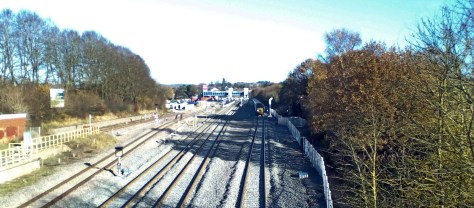
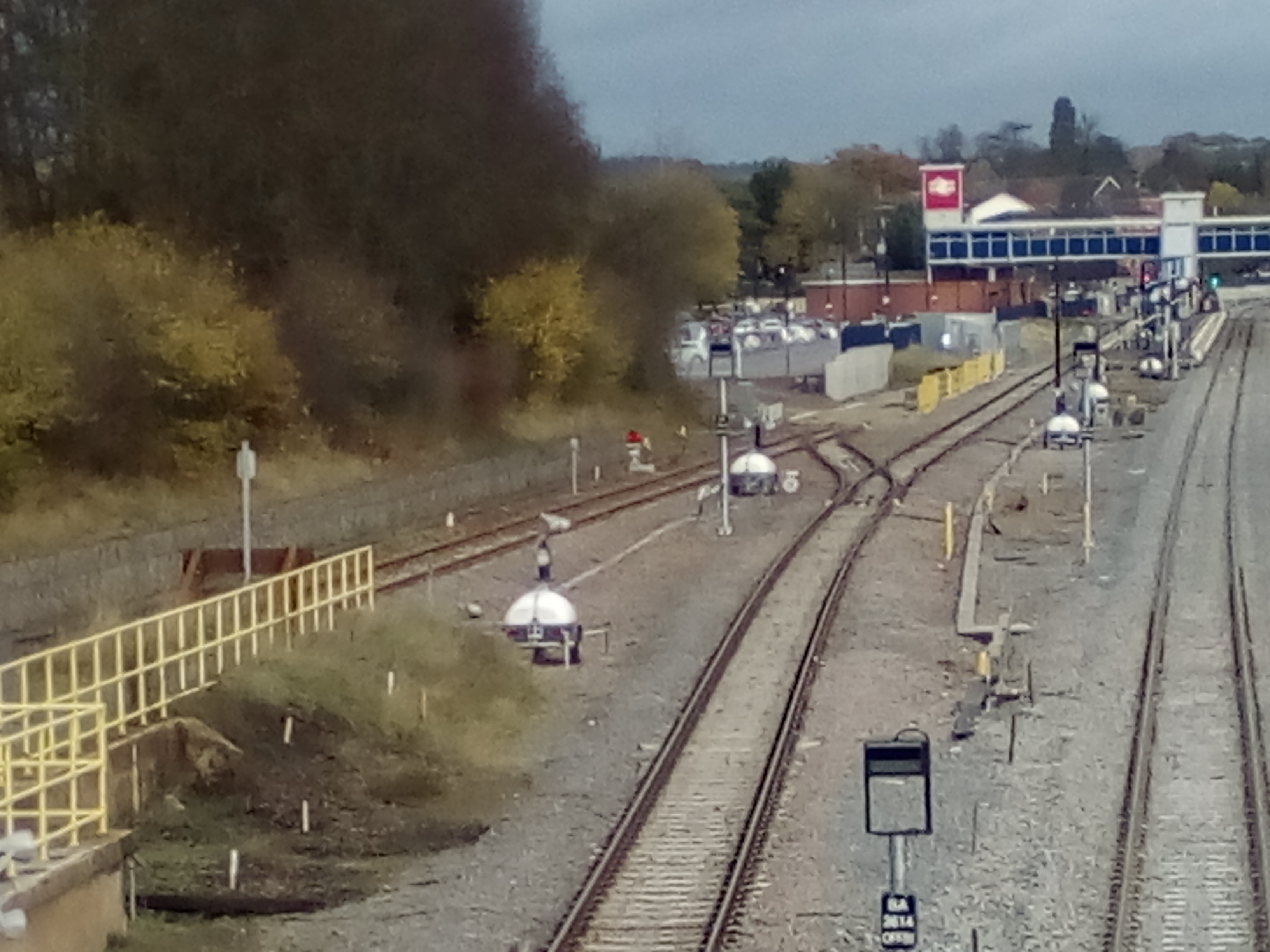
queenelizabeth07

RMS Queen Elizabeth on fire in Hong Kong Harbour in January 1972

Seawise_University_wreck

The once magnificent RMS Queen Elizabeth lying on her starboard side and settling into the mud of Hong Kong Harbour

My father, Fred Jackson, was born in 1908 in the Staffordshire brewing town of Burton upon Trent in the English Midlands. It hard to think of anywhere in the country that’s further from the coast than Burton. Yet, he and his younger brother Edgar both had naval careers, and when war broke out in 1939 and they were finally conscripted into the armed forces, they joined the Royal Navy. But in the previous decade my father had sailed the Atlantic almost 100 times as ship’s photographer on ships operated by the Cunard White Star Line. His favourite ship was the RMS Aquitania.

He met my mother on one of these Atlantic crossings, and before they married in 1936 they returned to the UK on board the Aquitania. He did not serve on either the Queen Mary (launched 1934) or the Queen Elizabeth (launched 1938). However, I recall my mother mentioning that she had sailed just the once on the Queen Mary, but I may be mistaken.

Apart from my university days in Southampton, our family has a long ‘Southampton connection’. Dad’s aunt and uncle, Albert and Rebecca Osman (my grandmother’s sister) settled in Southampton, with their son Jim Osman and daughter Chris who I mentioned earlier. Dad’s brother Edgar moved to Lyndhurst in the New Forest, and their elder son Roger joined the merchant marine spending some years as an engineer on the SS Canberra.

My cousin Roger Jackson and his bride Anne. That’s my bridesmaid cousin Caroline on the left, Roger’s younger sister.

On holidays in the New Forest around 1960, we paid a couple of visits to Southampton Docks, nostalgic visits for my Mum and Dad. In those days you could just wander around on the quayside, enter the Ocean Terminal and get up really close to the ships. Here are a few images of both the Queen Mary and Queen Elizabeth and other ships in port. The girl with my brother Ed and me is our older second cousin Anne Jewett.

There really was a majesty about these great ocean liners. The RMS Queen Elizabeth 2 (launched 1967, but now enjoying retirement in Dubai) and the RMS Queen Mary 2 (launched 2003) carried on the graceful tradition and lines of their predecessors, and are worthy successors to their 1930s namesakes.

The cruise behemoths that now carry 4-5000 passengers at a time have, in my eyes, a fraction of the grace and glamour of the Queens, notwithstanding that they are wonders of modern maritime engineering and technology.