A final commission . . .

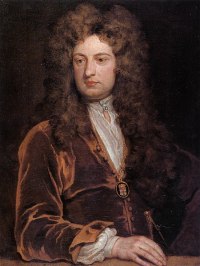
Sir John Vanbrugh (1664-1726)

Among the pantheon of English architects of the late 17th and early 18th centuries, Sir John Vanbrugh (dramatist, herald, and fervent Whig) is surely one of the most extraordinary since he never—apparently—received any formal training. His commissions included Castle Howard (for the Earl of Carlisle, in 1699) in North Yorkshire, and Blenheim Palace in Oxfordshire for John Churchill, 1st Duke of Marlborough in 1705.

Perhaps his most elegant—and final—commission was Seaton Delaval Hall (on a much smaller scale than either Castle Howard or Blenheim), designed for Vice-Admiral George Delaval and begun in 1718. Both Delaval and Vanbrugh died before the house was completed.

The Hall stands between the small communities of Seaton Delaval and Seaton Sluice in Northumberland, and just under 10 miles (as the crow flies) northeast from the center of Newcastle upon Tyne. It’s only six miles by road from our home in North Tyneside, and is our nearest National Trust property.

Admiral Delaval purchased the estate from an impoverished cousin, but the family had owned land in this area since the Norman Conquest in the 11th century. Seaton Delaval Hall has had an interesting history and was occupied by various branches of the extravagant Delaval family. In 1822 there was a catastrophic fire which gutted the central main block, which has remained derelict ever since. Now a Grade 1 listed house, it is owned by the National Trust.


Like Blenheim and Castle Howard, Seaton Delaval Hall reflects Vanbrugh’s baroque design penchant for buildings with symmetrical wings on either side of a central block.

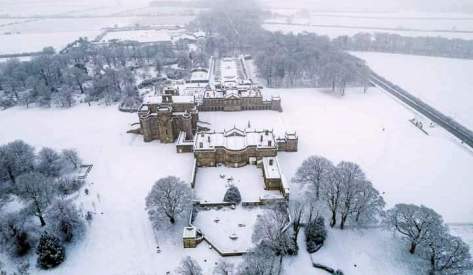
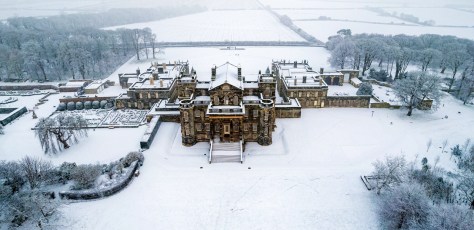
Here are three aerial images of the Hall taken recently (courtesy of local photographer John Fatkin [1]) that brilliantly show this symmetry.

The north entrance of Seaton Delaval Hall, with the grand stables block on the left (east) side, and accommodation on the right (west). Courtesy of John Fatkin – Coastal Portraits.

The Hall from the east.

The grand South Portico, with the gardens to the left.

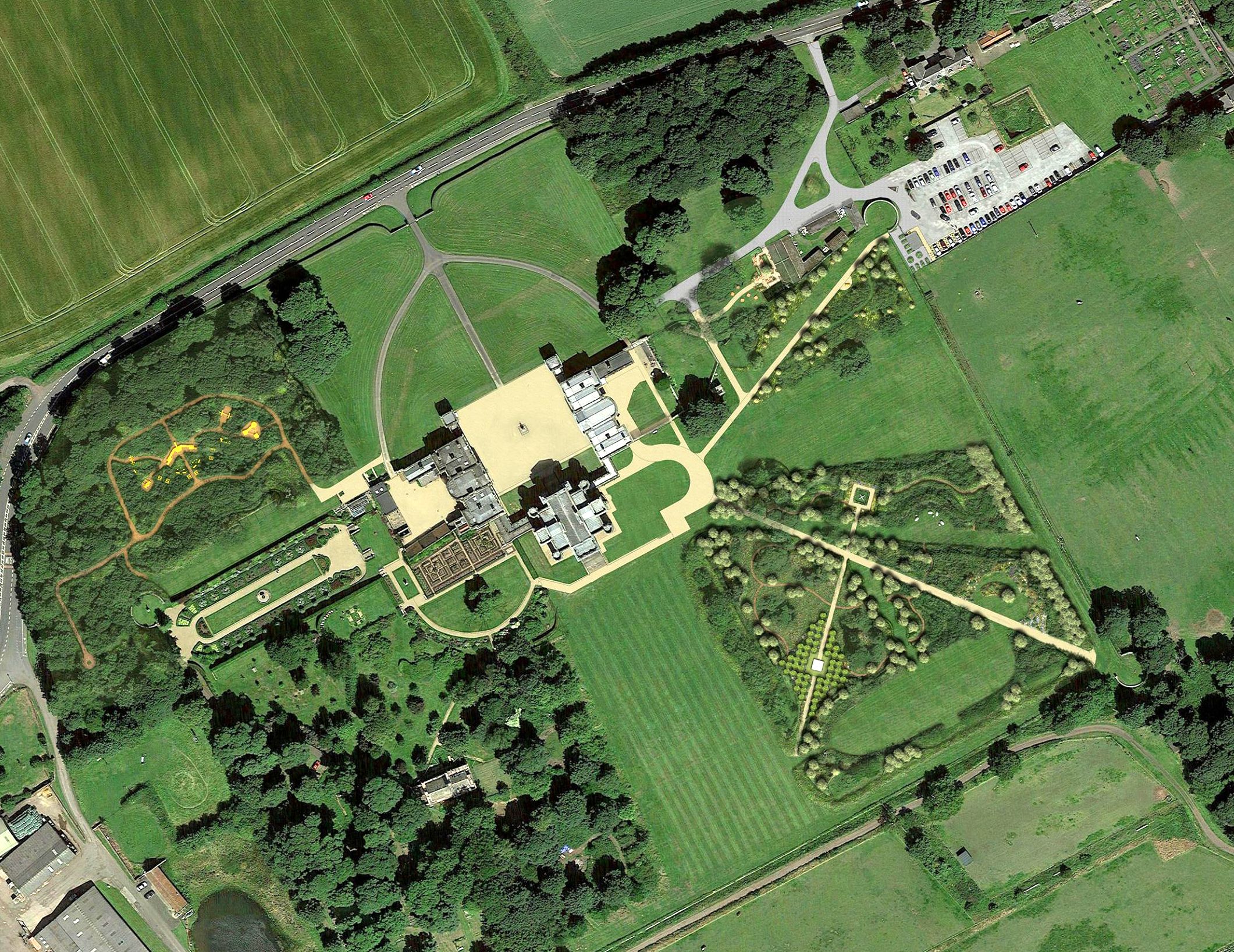
The Hall stands within an area of just under 8 hectares, and is surrounded by a 2m high Ha-Ha wall, 360 x 220m, with rounded bastions at each of the four corners. These bastions each had a statue on a pedestal, but these have been removed to other parts of the garden. The Church of Our Lady (originally Saxon) lies within the Ha-Ha wall, and was the private chapel of the Delaval family (in the trees in the bottom left corner of the photo below).

Just to the west of the South Portico there is a small formal garden, and beyond that a magnificent parterre that must be at least 50m, if not longer. The grounds have undergone extensive renovation in recent years.


The main entrance to Seaton Delaval Hall is through the gates off the Seaton Delaval-Seaton Sluice road, the A190, round to the car park on the east side. It’s then a short walk to the South Portico, with its magnificent ionic columns.

Inside, one is greeted with a scene of devastation: blank walls, evidence of fire, walls devoid of panelling or plaster. The roof is a modern addition. Even so, strangely enough, one can still appreciate how magnificent it must have looked in its heyday. Some features survived the 1822 fire and still on display in the main hall, which leads to another door opening on the north side, and into the main courtyard.

Either side of the entrance hall are quite spectacular spiral staircases which provide access to a first floor balcony from which to observe the destruction of the fire two centuries ago.

The basement rooms, which were servant quarters and the like, have been recently refurbished somewhat and can be explored.

The East Wing has a set of magnificent stables. I do not recall what the rooms above were once used for.

In our last visit to Seaton Delaval we were surprised—and pleased—to see that the West Wing had been opened, with a series of furnished rooms to view, and Delaval paintings and other possessions on display. On our previous visits going back to 2013 this wing had always been closed.

The gardens are not extensive, but paths have been opened up over the past couple of years or so to allow more access to explore the area within the Ha-Ha wall.


[1] You can find more of John’s stunning images around the local area on his Facebook page, Coastal Portraits by John Fatkin, and on X/Twitter at Coastal Portraits – It’s Grim up North.


Nunnington Hall – from 13th century manor house to 20th century family home

There has been a manor house beside the River Rye in the small village of Nunnington (lying within the Howardian Hills National Landscape of North Yorkshire) since the 13th century.

Built from a light colored coral rag Jurassic limestone, the Nunnington Hall estate occupies around 5 acres (2 ha) and is surrounded by a walled garden. The house has changed in character over the centuries, as each resident (owner or tenant) stamped their mark on its architecture and layout. It has been owned and managed by the National Trust since 1952, although it remained a family home until 1978.

In Tudor times there were distant royal connections, and during the 17th century English Civil Wars, Parliamentarian troops were garrisoned in the Hall.

A wealthy cloth merchant, Ranald Graham (right, created Viscount Preston in the Peerage of Scotland in 1681, died 1689) bought the Nunnington estate in 1655, and it remained in the family until the mid-18th century when the direct Graham line became extinct. Sublet and allowed to deteriorate, it was offered up for sale in 1839 in a semi-derelict state, and bought by William Rutson (1791-1867) whose family had made their fortune through colonial trade and slavery.

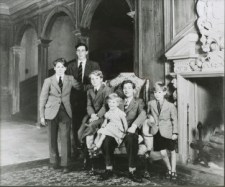
The five children of Susan and Peter Clive and their cousin Michael in the Oak Hall at Nunnington Hall.

Nunnington Hall was inherited by Margaret Fife (née Rutson, the great-niece of William Rutson) in 1920, and she set about the renovation of the Hall with her husband, Colonel Ronald D’Arcy Fife, funding the project from the sale of another Rutson property, Newby Wiske near Northallerton. One of their adopted daughters, Susan Clive, raised her family at Nunnington Hall, until moving to a house in the village.


I first visited Nunnington Hall in the summer of 1968, but recall very little of that visit, since only a few rooms were open to the public, and then only twice a week. It was only after the family vacated the Hall that the National Trust opened more of the house to the public, and more frequently.

In 2013, Steph and I stopped off on our way back south after visiting family in Newcastle.

Unlike Worcestershire where we lived until 2020, there are just a few National Trust properties near our home (since 2020) here in the northeast. And not all open for the Christmas season. I wrote briefly about our various Christmas visits after last year’s to Ormesby Hall near Middlesbrough.

So, on Friday last, we made the 162 mile round trip from North Tyneside to enjoy Nunnington Hall decorated in its Christmas finery. Being the first day of the Hall’s Christmas season (only each Friday to Sunday until just before Christmas), it was a delight to see many of the rooms brightly lit with Christmas trees and candles.


Let me take you on a brief tour of the house in 2013 and last Friday, highlighting some of the features that particularly caught my attention. A photo album of all the photos taken during both visits can be viewed here.

The entrance was suitably decorated for the Hall’s Christmas season, and we headed straight for the tearoom (with waitress service, unusual for National Trust tearooms) for a welcome cup of coffee before beginning the tour.

A kitchen or a Great Hall in earlier centuries, by 1921 the Stone Hall had become the entrance hall on the west facade of the building. One wall is hung with shooting trophies (mainly antelope of one species or another), with the skins of big cats on another. A huge fireplace (which was lit on our recent visit) dominates a third wall. And for Christmas, there was a tall (maybe 15 foot) tree, a Fashionable Victorian theme, with one of the volunteers (dressed as a butler) offering a small sherry or cranberry juice to each new visitor.

The Smoking Room, a few steps up from the Stone Hall, was Lord Preston’s bedchamber in the 17th century, but was adopted by Colonel Fife. The walls were painted Georgian green by Margaret Fife, and its theme was an indulgent Georgian Christmas. On our 2013 visit, this room was set up as a small dining room. And beyond the main room, in a small withdrawing room, the walls are covered in 18th century prints, and the ceiling decorated with original coats of arms.

From the Smoking Room, you step into the large Oak Hall with its stone floor, stone fireplace, and elegant, low-rise staircase leading to the first floor. This was an open courtyard in Tudor times, but was enclosed by Lord Preston in the late 17th century. There was a Tudor feast theme last Friday.

There are several paintings of William Rutson and his horses.

L: William Rutson’s groom and horses; R: William Rutson on a grey hunter

Hanging on the walls above the staircase are three tapestries, 300 years old, and another one in the Sitting Room.

During Margaret Fife’s time, the Sitting Room was the main family room, with a balcony overlooking the walled garden, with its terraces and orchard. Peacocks also strutting around the grounds. The Christmas theme was 1980s Party Time.

One feature which caught my attention in 2013 (and still prominently on display) was the superb set of porcelain figurines—Chelsea I presume—on the mantelpiece. How I would like to own a set like that, but my pockets aren’t deep enough!

In Margaret Fife’s bedroom and dressing room on the first floor, there is a charming (but controversial) portrait of her as a young girl, hanging above the fireplace.

Colonel Fife had his own bedroom, and particular feature that you can’t miss is the Chinese-style wallpaper, decorated with birds, flowers, and fruits.

A child’s bedroom, decorated with a tree and toys completed the bedrooms that were open. Wood-paneled, I seem to remember from our 2013 visit that there were carvings or graffiti in the wood made by Parliamentarian soldiers in the 17th century.

Schoolchildren from the nearby Slingsby Community Primary School had created the snowman exhibit in another bedroom.

The Nursery had a 1940s Rationing theme. The walls were covered with another impressive wallpaper, and a delightful doll’s house stood in one corner.

The attic floor under the eaves houses a couple of exhibitions. One of these is the permanent home of a collection of miniature rooms, donated to the National Trust by Londoner, Mrs Carlisle (known as ‘Kitty’). The models are truly exquisite in the amount of detail, even handwriting on miniature letters. The other exhibition, Fields, Folds, and Farming Life on display last week was a collection of photos and videos of farming life in Yorkshire by photographer Valerie Mather.

After a short (and rather muddy) walk around the garden, our visit to Nunnington Hall came to an end, and we headed back home.


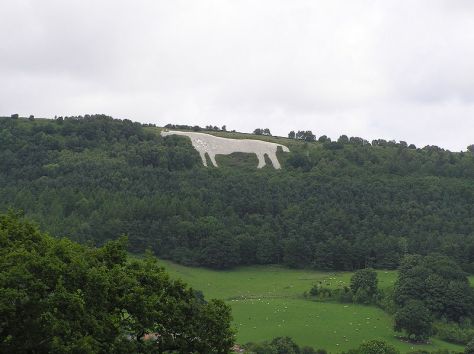
But with just one other feature in the landscape to find: the Kilburn White Horse (map)The origin of the horse is disputed, but it appeared in November 1857, cut into the hillside above the village of Kilburn. Some credit the local schoolmaster and his pupils. The top soil was scraped away, and the horse covered in limestone chippings. It has needed regular maintenance over the years.

The Kilburn White Horse can be clearly seen from a distance, particularly from the A19 between Thirsk and York.

We made our way down the escarpment to the car park just below the horse, but from there you can only see the horse’s legs and part of its body.


I can’t finish this post without mentioning the spectacular climb into the Howardian Hills.

We had traveled south from North Tyneside on the A19 as far as Thirsk, where we took the A170 towards Scarborough. Just under six miles east of Thirsk, the A170 ascends the notorious Sutton Bank, with its 25% incline and hairpin bends. It’s such a challenge for some vehicles that caravans are banned from this stretch of road and have to find an alternative route on to the moors. Even HGVs struggle up the Bank.

Here’s some footage I made of the ascent and descent (almost 5 minutes, and available in HD).


‘Teaching is the one profession that creates all other professions.’ (Unknown)

I was surprised recently to read a tweet (or whatever they’re now called) on X suggesting that all university lecturers should be required to receive formal teacher training and an appropriate qualification. Just as teachers of schoolchildren must complete the Postgraduate Certificate in Education (or PGCE). Not that the PGCE automatically makes everyone a good teacher. Far from it. But the training must surely provide or hone the skills needed to teach better.

Well, whoever it was who tweeted that comment is behind the times. Many (most/all?) universities here in the UK now require incoming, probationary staff at least to take courses, such as the Postgraduate Certificate in Higher Education (PGCHE, a Masters level qualification) and also offer various teaching support modules to more established staff, that cover topics such as small/large group teaching, curriculum design, supervision, and many more.

But when I joined the University of Birmingham as a lecturer in the Department of Plant Biology (School of Biological Sciences) in April 1981 there was no such requirement for teacher training, nor do I remember much if any support being provided. You simply got on with it – for better or worse. Furthermore, teaching loads or commitments, or ability never counted much towards promotion prospects. Research (and research income) was the be-all and end-all.


I’d never aspired to be an academic. Before joining the university, I was working in the Americas over the previous eight years. In November 1980, I had just returned from a five-year assignment in Central America to the headquarters of the International Potato Center (CIP) in Lima, Peru while waiting for my next assignment in the Philippines. I had, however, already applied to Birmingham.

In January 1981 I flew to the UK for an interview and was offered the position immediately. So I returned to Lima knowing that my wife Steph and young daughter Hannah and I would be resettling in the UK before long.

Initially I had no teaching commitments, and I was able to get myself settled and oriented as a faculty member. I knew my way around the Birmingham campus since I was awarded my MSc degree in genetic resources there in 1971, and PhD in botany in 1975. But being a faculty member was very different from being a graduate student.

Come the beginning of the Summer Term in May however, I found myself facing a group of about 35 second year plant biology students for the first time to teach them some aspects of flowering plant taxonomy (along with my colleague Dr Richard Lester, at right, with whom I didn’t always see eye-to-eye over many aspects of course content and delivery).

Anyway, until then I had never taught a class in my life, although I was quite comfortable with public speaking, even enjoying it. I think I must have inherited my ‘love’ of public speaking from my father. Anyway, getting up in front of an audience never particularly fazed me, talking to my peers about my work, and the like. Nevertheless, I always had ‘butterflies in my stomach’ before facing a class for the first time.

Fortunately during the decade I spent at Birmingham I never had to teach any first year classes. Much of my teaching focused on graduate students (many from overseas) attending the 1-year MSc course on Conservation and Utilisation of Plant Genetic Resources (the very course I had attended in 1970-71). I taught a semester long (10 week term) course on crop evolution, two lectures and three hour practical classes per week, principles of germplasm exploration and collection (also with a practical component using a synthetic population made up of many different barley varieties), and a small module on agroecosystems. I also helped my colleague Professor Brian Ford-Lloyd (right) in some aspects of his data management module.

Then, during the summer months (when undergraduates were on vacation) we would supervise the dissertation projects of the MSc students. I guess I must have averaged two or three each year.

Brian and I jointly taught a five week undergraduate course on plant genetic resources, with at least one lecture per day, for final year undergraduates who would graduate with a Biological Sciences (Plant Biology) degree. I guess we must have between 10 and 15 students on average each year, who also had to complete an independent research project over the same period. It was always a challenge to devise projects that could be completed in the time available and that would (generally) generate positive results. Each student would take four of these five week modules.

I also gave a lecture on potato diseases on the third year plant pathology module taught by my colleague Dr Gillian Butler.

Around the mid-1980s I was asked to become chair of the Second Year Common Course, one that all biological sciences students had to take and which was taught by staff from all the four departments (Plant Biology, Zoology and Comparative Physiology, Genetics, and Microbiology) that made up the School of Biological Sciences. I contributed five or six lectures on agriculture and agroecosystems, based on my own experiences of working with crops in the Americas.


To some extent I agree with American novelist Gail Godwin that Good teaching is 1/4 preparation and 3/4 theatre. When you get up in front of a class of students, whether you feel up to it or not, whether it’s a topic you are enthusiastic or not, you have to ‘perform‘. Engage with the class.

The feedback I had from my students was that I was quite an effective teacher. That was gratifying to know. Back in the day, there was no Powerpoint or other digital props. Just the blackboard and chalk (which I hated as I had a slight allergy to chalk), the overhead projector with acetates, and 35 mm slides.

The tools which are available today permit a much more dynamic use of information, provided that there isn’t information overload. Less is often more. And you don’t try to use all 56 million colours in the Powerpoint pallette (as I have seen some speakers attempt to do!).

I think I became a more effective teacher because I had to interact with many graduate students who did not have English as their first language. We worked closely with a unit in the English department who assisted these students, to make their Birmingham experience better and help them through the rigors of graduate study. Lecturing to these students, I learned how to pace myself, and also how better to explain, often in different ways, aspects of the topics I was teaching. And working with the English unit staff (who would analyse our recorded lectures) I came to realise (as did my colleagues) just how often we use colloquialisms in everyday speech, and which are not easily translated for someone who is not a native English speaker.

Anyway, that experience of a decade’s worth of teaching overseas students stood me in good stead when I moved to the Philippines in 1991 and often had to give talks to diverse groups of visitors.


But returning to the opening premise of this post, about teaching qualifications for university staff, I think I would have welcomed much more formal feedback. Nowadays, there are mechanisms in place in universities to provide feedback. After all, the students are the clients who are paying handsomely for their education, and are not shy about denouncing poor teaching (and value for money) when warranted.


Three score and ten . . . plus five

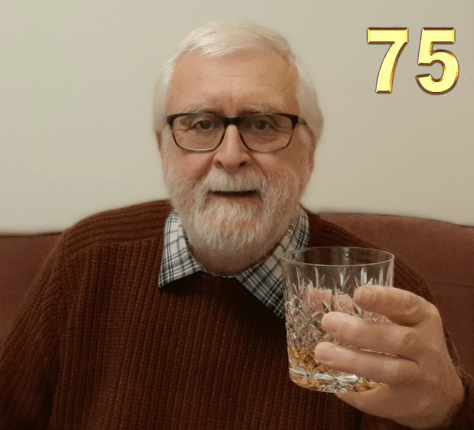
It was my birthday yesterday.

Let me take this opportunity of thanking friends and former colleagues – from all over the world – who sent me birthday greetings. Very much appreciated.

One friend greeted me on achieving three quarters of a century. Now that sounds really old. Another wished me 25 years more. I replied that 10-15 would do me nicely.

In 1948, average life expectancy for males in England and Wales was only 65.9 years. Now it’s 79, due undoubtedly to increased living standards over the intervening decades leading to healthier diets, and better health propped up by the National Health Service that had been founded just a few months before my birth.

I wonder what hopes my Mum had for me on that day.

I was living in Congleton, Cheshire with my parents, Fred and Lilian Jackson, my brothers Martin (b. 1939) and Edgar (b. 1946), and sister Margaret (b. 1941). I started school around 1953.

Come 18 November 1958 – my 10th birthday – we had been living in Leek, Staffordshire for 2½ years already. I attended the local Catholic primary school, St Mary’s, just a few minutes walk from home, and hoped eventually to win a place at the Catholic grammar school in Stoke-on-Trent a couple of years later. Which I did.

Christmas 1958 in Leek (with my elder brother Edgar).


Moving on to 18 November 1968, I had just started the second year of my BSc degree course in environmental botany and geography at the University of Southampton. I had enjoyed my first year there, living in South Stoneham House, one of the halls of residence southeast of the university campus. I’d been elected Vice President of the Junior Common Room at the end of the first year, and that guaranteed me a second year at Stoneham. I guess I celebrated my 20th birthday in the pub with a few friends.

Over the previous summer vacation I’d attended an excellent botany field course on the west coast of island. And afterwards had spent several weeks with my girlfriend at her home just south of York or at my parents’ home in Leek. We also enjoyed a walking tour together of the North York Moors, staying at youth hostels (YHA) each night.

But our relationship was not to last. Just before the beginning of term in October, I received a Dear John letter from her. But not one to be downhearted for long, I picked myself up but forswore dating for a while.

And I threw myself into a new interest: morris dancing. Together with one of the botany department lecturers, Dr Joe Smartt, we founded the university morris side, the Red Stags (still active today, but in a different format and no longer associated with the university).

The Red Stags Morris Men after performing at the University of Southampton Open Day in March 1970. That’s me, kneeling on the right.

Along with my continuing enjoyment of English and Scottish folk dancing, this foray into morris dancing became one of my principal hobbies for the rest of my time at Southampton, and afterwards for several years.

I graduated from Southampton in June 1970, and by September I was studying once again at the University of Birmingham.


By my 30th birthday in November 1978, I already had MSc and PhD degrees from Birmingham under my belt, and had been working for the International Potato Center (CIP), an international agricultural research institute based in Lima, Peru for five years.

Steph (who I met in Birmingham) and I had been married for just over five years, and our first daughter Hannah was born in April. We were living in Costa Rica, but my work with CIP took me throughout the region, as well as to Mexico and the islands of the Caribbean.

If my memory serves me right, I ‘celebrated’ this birthday, a Saturday, on the Caribbean island of Montserrat. I was stuck in my hotel room in Plymouth (the island’s capital until it was destroyed in the Soufrière Hills volcanic eruption of the 1990s) while it rained cats and dogs outside.


In 1988, I had been teaching at the University of Birmingham for over seven years, in the Department of Plant Biology. It was a Friday. My 40th birthday. By then, my colleagues and I had developed a ‘tradition’ of celebrating in the Staff House bar at lunchtime (disgraceful!) with a bottle or two of Beaujolais Nouveau, the release of which always occurs around my birthday. Enjoying a bottle of the ‘new release’ was quite the rage in the UK back in the 1980s, perhaps less so today.

Hannah had turned 10 that year, and Philippa (born in Bromsgrove in 1982) turned six.


I left the university in 1991, to head the Genetic Resources Center (GRC) at the International Rice Research Institute (IRRI) at Los Baños, south of Manila, in the Philippines. In 1998, my GRC staff helped me celebrate my milestone 50th birthday. There must have been lots of snacks such as pancit and spring rolls and the like, ice cream (always vanilla!) and lots of cake. Probably donuts.

Then, in the evening, Steph and Philippa served champagne, and our helper Lilia had made a cake. Hannah was already away at university in Minnesota (where she still lives).

Steph and I celebrated our 25th (Silver) wedding anniversary just a month earlier.


A decade on, and I had changed jobs at IRRI, having moved from GRC to become the institute’s Director for Program Planning and Communications in May 2001.

I had an office suite in the main administration building, and my staff and others from nearby offices in HR and finance joined me to celebrate my 60th birthday.

Then, in the evening, Steph and I enjoyed the company of very close friends Corinta Guerta from my office, plant physiologist (and my closest friend at IRRI) John Sheehy, and Director for Development Duncan Macintosh (from Australia) and Cel (his Filipina girlfriend and now his wife) for an intimate dinner that almost ended in disaster before it had begun.

Nevertheless,we had a great time, but I think I must have drunk too much because I chose the wrong settings on my camera and the resulting images were not the best quality.


I retired from IRRI in 2010, and Steph and I returned to our home in Bromsgrove that we had first moved into way back in 1981, but which we’d kept furnished by unoccupied during the 19 years we stayed in the Philippines.

I celebrated my 70th birthday in 2018, and we did something I’d wanted to do for several years: a weekend away in Liverpool, visiting the childhood homes of Paul McCartney and John Lennon (both managed by the National Trust), as well as The Beatles Story beside the Royal Albert Dock.

We had a great weekend, taking the train from Bromsgrove (via Birmingham New Street) to Liverpool Lime Street. That was an added bonus. I love train journeys!


So here we are in 2023. It has become a tradition over the years for Steph to prepare my favorite meal on my birthday: homemade steak and kidney pie. I always look forward to that one special meal. And, as always, it was delicious, served with a bottle of good Portuguese red: Montaria Gold 2020 from the Lisbon region, a blend of Syrah, Alicante Bouschet, Trincadeira, and Aragonez grape varieties, made by Luis Vieira.


Had the weather been better we would have taken an excursion yesterday. But since the forecast had promised rain (which was the case) we headed north on Friday to the Alnwick Garden and the beach at Amble afterwards.

Oh, and we’d quietly celebrated our 50th (Golden) wedding anniversary a month ago.


Celebrating the beauty of England’s northeast coast

We moved to North Tyneside, just east of Newcastle upon Tyne, a little over three years ago, from our home of 39 years in Bromsgrove, Worcestershire to be closer to our younger daughter and her family who live in Newcastle. We had enjoyed living in Worcestershire; it’s a lovely county. But we also relished the thought of exploring the glorious northeast.

We have not been disappointed. It’s also a special delight living so close to the North Sea coast, just six miles to the spot where we usually park for a walk on Seaton Sluice beach.

Having lived in the Tropics for so many years, and enjoyed snorkeling and scuba diving there, swimming in the cold North Sea holds no attraction whatsoever. There are, however, hardier individuals than me.

But the magnificent coastline has everything: long, sandy beaches; dunes; rocks; and cliffs. And, as often as we can, weather permitting, we make a beeline for the coast.

So let me share with you some of the beauty of this coast that we’ve experienced so far.  A coast that boasts some of the best beaches in the whole of the country, and many stunning views. Several parts of the coast are managed by the National Trust.

I’ll take you on a tour from north to south.


Lying just off the Northumberland coast, a few miles north of Bamburgh, the Holy Island of Lindisfarne is separated twice a day by a tidal causeway. We first visited Holy Island in 1998 when, on home leave from the Philippines, we spent a week touring the county. We returned in July 2022.

Holy Island was a centre of early Celtic Christianity, and the ruins of the priory still stand there. As does the Tudor castle (very much modernised) on a promontory.

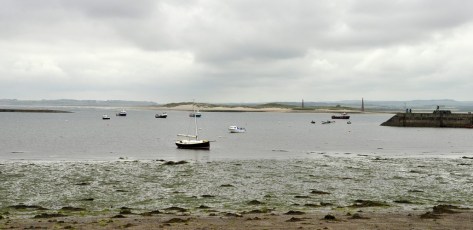
At the entrance to the harbor (on Guile Point) are two obelisks, which can be seen just right of center in the image below.

These are the Old Law Beacons, built in 1826 and are a navigational aid that, when lined up, guide sailors into the harbor through the safe channel.

Heading south, it’s not long before the early 14th century ruins of Dunstanburgh Castle on a remote headland come into view. The castle is only accessible on foot, just under 1½ miles north of the fishing village of Craster (famous for its kippers!) along a rugged rocky coast. The cliffs around the castle are home to an important colony of kittiwakes.

Embleton beach can be seen from the castle to the north, but we’ve not been there yet.


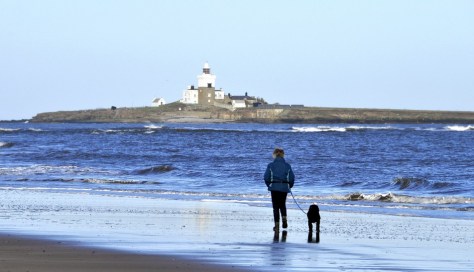
Just 5 miles south from Craster, the River Aln reaches the North Sea at Alnmouth, with sandy beaches flanking the estuary. On the distant horizon to the south lies Coquet Island, 1 mile off the coast from the fishing port of Amble (a town we have yet to explore).

Next south is Warkworth beach, a favorite of my daughter and her family. It’s just north of the town, with its 12th century castle, and the estuary of the River Coquet (which has its source high in the Cheviot Hills to the west). It’s a good walk through the dunes from the car park to the beach itself.

Quite often after we have made one of our regular visits to the Alnwick Garden (where we have Friends of the Garden membership), we head down to the coast south of Amble (next images) to have our picnic lunch looking out towards Coquet Island, an important reserve managed by the Royal Society for the Protection of Birds (RSPB) and the most important breeding site in the UK for roseate terns.

It has been badly hit by avian flu. Boat-landings are not permitted on the island even without the restrictions of avian flu.

Just a little further south, and inland from the northern end of Druridge Bay lies Hauxley Wildlife Discovery Centre. There’s a circular walk (about 1¼ miles or 2 km), several hides from which to observe the numerous bird species, and the Lookout Café there serves an excellent cup of coffee.

We’ve visited there a few times, most recently less than a month back. On that visit we saw 36 different species of birds within the space of an hour: wildfowl, waders, and hedgerow birds. A complete range.

Druridge Bay must be one of the longest beaches in Northumberland, over 7 miles long, and backed by high dunes (which, in one location, is the haunt of naturists—presumably during the summer months only!). The Bay stretches from Amble in the north to Cresswell in the south. Inland from the beach, Druridge Bay Country Park covers an area of almost 66 acres (27 ha), with a large freshwater lake, woodland, and grassland and meadows, as well a stretch of the beach and dunes.

At Cresswell there are exposed—at very low tides—the remains of an submerged forest, but we’ve not yet had luck in finding them. The beach is flanked by rocky outcrops at both ends. Parts of the beach are also covered with sea coal which some of the locals gather.


We haven’t yet explored any of the beaches between Cresswell and Blyth, but those south of Blyth as far as the mouth of the River Tyne are where we most often go for a walk. These include Blyth and Seaton Sluice beaches, St Mary’s lighthouse, Whitley Bay, Cullercoats, Long Sands Beach between Cullercoats and Tynemouth, with King Edward’s Bay nestling under the Tynemouth headland on which stand Tynemouth castle and priory, with a magnificent view over the Tyne.

The small harbor at Seaton Sluice, at the mouth of the Seaton Burn, was built by the Delaval family (of nearby Seaton Delaval Hall) in the 18th century to export coal and glass.

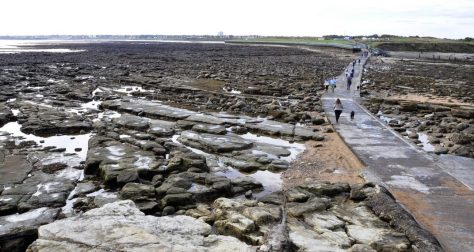
St Mary’s Lighthouse is only accessible across a causeway at low tide.

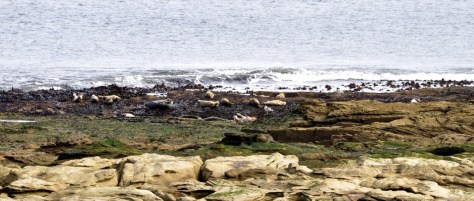
We regularly see a small colony of Atlantic grey seals, and the rocky outcrops there attract large numbers of waders like curlew and golden plover in autumn and early winter.


At the end of March this year, we took the Tyne Ferry to cross from North Shields to South Shields, mainly to visit Arbeia, the Roman fort there. But also to take a look at the entrance to the Tyne from the south and the beaches at South Shields.

South of the South Shields beaches, crumbling magnesian limestone cliffs tower over the coast at Marsden and Whitburn. There are sea stacks and arches dotted along the coast, nesting sites for many sea birds. This stretch of coast is one of our favorites to walk. There is also the added attraction of Souter Lighthouse, visible from miles away.

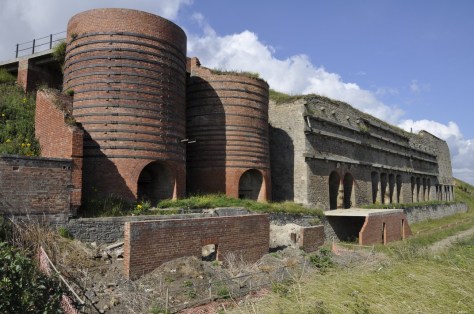
The limestone is quarried, and in the 1870s a bank of 15 lime kilns was built to process the limestone, linked to the Whitburn colliery and Marsden colliery village, both of which have now been demolished.

The National Glass Centre stands alongside the River Wear in Sunderland.

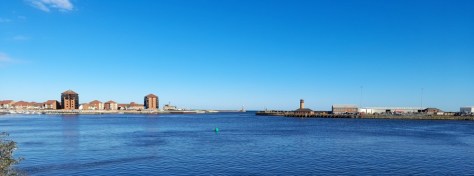
The mouth of the Port of Sunderland on the River Wear, across from the National Glass Centre.

It’s really worth a visit, and we enjoyed ours a year ago. There’s a long history of glass-making there, and it’s also connected to the establishment of early Christianity. Close by is the Saxon church of St Peter (below), one half, with St Paul’s in Jarrow, of the double Monkwearmouth-Jarrow monastery where the Venerable Bede, one of England’s greatest ecclesiastical scholars spent most of his life in the 8th century.

And talking of glass, in August 2022, Steph and I did some serious beachcombing at Seaham, south of Sunderland, searching for sea glass. I wrote about that visit in this blog post. The beaches there are part of the Durham Heritage Coast, which has been rehabilitated after decades of industrial abuse in the past. Blast Beach is where we found a nice source of sea glass, but the beach north of the town is supposed to be richer. We’ve yet to search there.

So, there you have it. At around 80 miles, and in many locations less than an hour from home, this stretch of coast must be one of the more interesting and beautiful in the country.


More plant blindness?

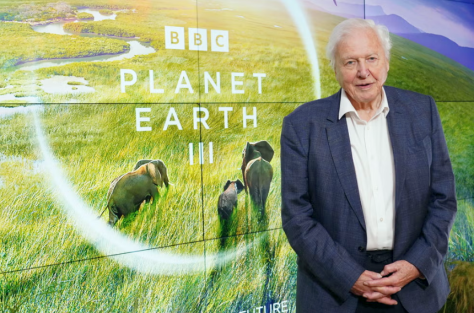
Tomorrow, 22 October, BBC1 will air Sir David Attenborough‘s next blockbuster 8-part series, Planet Earth III¹, just a year after his last series Frozen Planet II was broadcast.

Planet Earth III? From what I have seen in the trailer for the series, perhaps this should—once again—be titled [Animal] Planet Earth III.

There’s no doubt that the filming is spectacular, the ‘stories’ riveting. As one of the cinematographers has written, [the series] is set to be the most ambitious natural history landmark series ever undertaken by the BBC. It will take audiences to stunning new landscapes, showcase jaw-dropping newly-discovered behaviors, and follow the intense struggles of some of our planet’s most amazing animals (my underlining emphasis).

It’s not very likely that the series will feature plants much, if at all. Are plants being short-changed yet again? Of course there are many programs on television about gardening. But these don’t count, in my opinion, towards any greater understanding of and knowledge about plants and their uses.

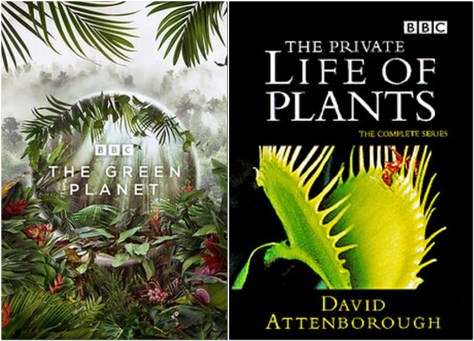
That’s not to say that the BBC (or Sir David) have completely ignored plants. In January 2022, his five episode The Green Planet series was broadcast. It was, for me however, a bit like the curate’s egg²: good in parts.

And you have to go way back to 2003 for his The Private Life of Plants series, described as a study of the growth, movement, reproduction and survival of plants.

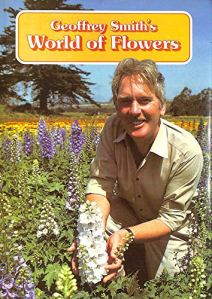
Before that, I can only think of Geoffrey Smith‘s World of Flowers double series, broadcast on BBC2 in 1983 and 1984, and apparently attracting an audience of over five million.

Who said there was no appetite for programs about plants? These programs weren’t your run-of-the-mill gardening programs. No, in each program Smith highlighted the origin and development of different groups of plant species commonly grown in British gardens.

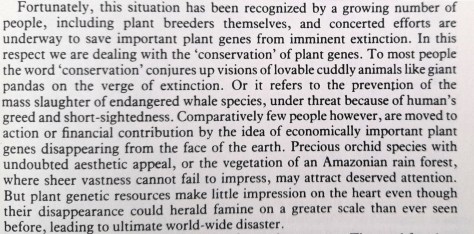
Furthermore, conservation for many relates to animals. This is something my former Birmingham colleague Brian Ford-Lloyd and I wrote back in 1986.


So what has brought about this latest concern of mine? Well, I first came across the announcement for Planet Earth III‘s imminent broadcast on the same day recently that I subscribed to a new plant-based blog: Plant Cuttings. And there, on the home page, was the blog’s goal for all to see: to reduce plant blindness.

The blog is the creation of Mr P Cuttings (aka Dr Nigel Chaffey, a former senior lecturer in botany at Bath Spa University, and a self proclaimed freelance plant science communicator), and is dedicated to all those who find fascination in plants (and how they are used by people). You can find more about the rationale for and antecedents of Plant Cuttings here. It’s a continuation of the series of articles he published in Annals of Botany, the last one, Check beneath your boots . . ., being published in 2019 (also about ‘plant blindness’).

Unfortunately, plants are often seen as boring, especially by high school students who we need to attract to the plant sciences if the discipline (in all its aspects) is to thrive. Thus this initiative by PlantingScience, a Student-Teacher-Scientist partnership in the USA that was founded in 2005 by the Botanical Society of America.

Let me wish Nigel all the best as he develops this new Plant Cuttings blog. I’m very much in accord with his goals. After all, much of my career in the plant sciences has focused on the origin of the plants that feed us, how they can preserved for posterity in genebanks, and used to increase crop productivity.

So what sparked my interests in plants and human societies? 

While a high school student, I first thought I’d become a zoologist. But I saw the light and my interests turned towards plants, and I took a botany degree (combined with geography) in the late 1960s at the University of Southampton.

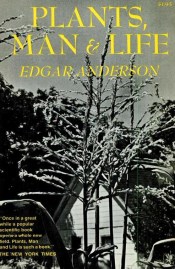
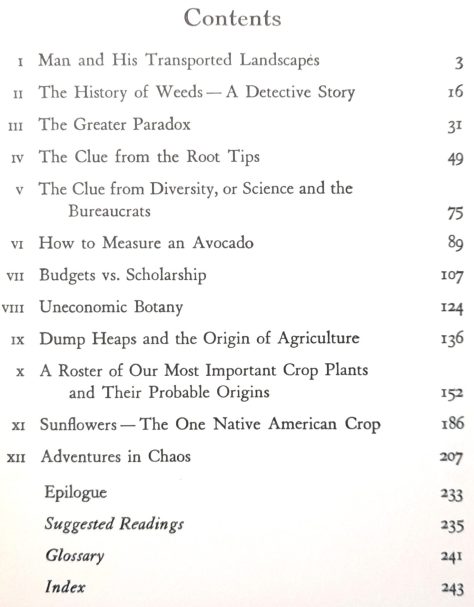
One of the books that I read was first published in 1952 (I have the 1969 reprint) by American botanist Edgar Anderson. He wrote it for readers with little technical understanding of plants. After 70 years it has stood the test of time, and I thoroughly recommend anyone who has the slightest interest of the relationships between humans and plants to delve into Plants, Man & Life.

Thus I’ve been fascinated for decades about the beginnings of agriculture and how humans domesticated wild plants, and where, and to what uses they have put the myriad of varieties that were developed. My own expertise in conservation of genetic resources has permitted me to explore the Andes of Peru to find many different varieties of potato, the foundation on which Andean civilizations such as the Incas became successful.

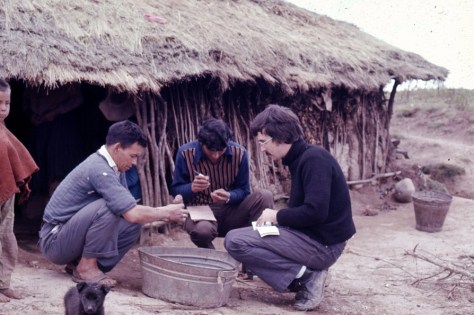
Collecting potatoes from a farmer in northern Peru, May 1974.

A graduate student of mine worked out the probable origin of the grasspea, a famine crop in some parts of the world. And I’ve managed the largest genebank for rice in the world (rice feeding half the world’s population every day), and with my colleagues expanded our knowledge of the relationships of cultivated rices to their wild ancestors. I directed a five year program in the mid-1990s to collect cultivated rices from many countries in Asia and Africa, especially from the Lao PDR.

These are just three examples from all the plants which societies use and depend on. So many more, and so many fascinating stories of how civilization and agriculture developed.

Just recently, on holiday in North Wales, my wife and I came across the site of about 20 hut circles on the northwest tip of Anglesey, dating back to the Iron Age, some 2500 years ago.

What is particularly fascinating for me is that there is good evidence that crops like wheat, barley, and oats among others were being cultivated there 3000 years earlier. That’s about 4500 years after these crops were first domesticated in the Near East in Turkey and along the river valleys of the Tigris and Euphrates. In the intervening years, these crops were carried across Europe by migrating peoples as they headed west until they became staples on the far west of mainland Britain. The domestication and expansion of these crops is also the story of those societies.

Plants are definitely not boring. Botany opens up a host of career opportunities. Today we need to harness the whole range of plant sciences, from molecule to field, to understand and use all the genetic diversity that is safely conserved in genebanks around the world, and backed up in many cases in the Svalbard Global Seed Vault. We now have so many more tools, particularly molecular ones, at our fingertips to study plants.

Be sure to follow Plant Cuttings to find out more about the joy of plants and their value to humankind. I trust many more generations will be proud to say they became botanists (or, at the very least, took up one of the allied plant sciences).


¹I watched the first episode of Planet Earth III on BBC IPlayer catch up. Verdict: stunning photography but boring content, seemingly a rehash of so many nature programs. All animals. However, at 97, Sir David Attenborough is a remarkable presenter.

² A curate’s egg is something described as partly bad and partly good.

We walked to Scotland last Thursday

Well, I might be exaggerating a wee bit. We didn’t walk all the way there. Just the last half mile. Let me explain.

Thursday was, for the first time in many days, bright and sunny although much cooler than we have enjoyed of late. And while the weather has been better here on the coast (we live just a few miles inland), it has been much more unpredictable in the hills, and rainy on many days.

However, with a more promising forecast we decided to head off to the Cheviots, and specifically to Chew Green Roman fort and encampment (built around 79 AD) close to the border with Scotland, and a location we have visited twice before.

At its nearest, the Scottish border is only 40 miles or so (65 km) northwest as the crow flies from our home in North Tyneside, or about 55 miles or so by road. This is the route we took.

Chew Green is just beyond the ‘end’ of the road near the headwaters of the River Coquet, and the drive there (on a very narrow road) beyond Alwinton winds its way through beautiful Upper Coquetdale.

This video, of the drive from Alwinton to Chew Green lasts over 41 minutes. You can double the playback  speed (without affecting your appreciation of the marvellous landscapes) by clicking on the Settings button.

The road does continue beyond Chew Green. However, it passes over the Otterburn Ranges, an area of the Northumberland National Park controlled by the Ministry of Defence where troops are trained and live firing takes place. Access is often restricted, as it was on Thursday, when the red flags are raised.

Nevertheless, we just drove a few hundred meters beyond the parking spot, climbing the hill facing Chew Green to get a better view of the embankments of the camp, something we had not done on either of our previous visits.

Leaving the parking spot on foot, we headed west (just south of the fort/encampment) until we reached a dip in the landscape with a small burn (and tributary of the River Coquet, if not the beginnings of the river itself), crossing over a stile, and stepping into Scotland.

No border patrols here, although for centuries past this was a most contentious border, and the location of many cross-border raids and cattle rustling.

That’s Scotland beyond the dip in the landscape in this video. It’s a pity there was no post along the path to indicate exactly where you pass from one nation into the other.

Then we walked up over the fort, and made our way back to the car. Dere Street, one of the most important Roman roads that connected Eboracum (York) with Roman forts beyond Hadrian’s Wall and over the border into Scotland, runs right beside Chew Green. It’s remarkable that the camp’s embankments are so well preserved, after 1900 years.

At its headwaters here in the Cheviots, the River Coquet is no more than a babbling brook.

But within a short distance from Chew Green, it becomes a substantial river (as you can see in this video of the return journey down the valley) wending its way east to the North Sea at Amble.

Incidentally, most of the sheep in the videos are the local Cheviot breed, with some horned Scottish blackface.


Potatoes have no special chemistry to induce romance . . . but they brought us together

Saturday 13 October 1973, 11:30 am
Lima, Peru

Fifty years ago today, Steph and I were married at the town hall (municipalidad) in the Miraflores district of Lima, where we had an apartment on Avenida José Larco. Steph had turned 24 just five days earlier; it would be my 25th in the middle of November.
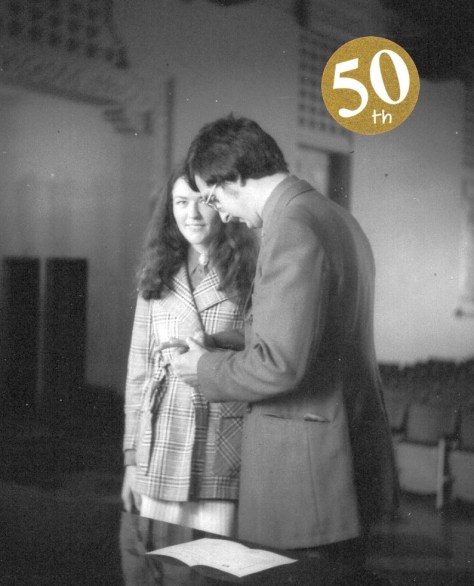
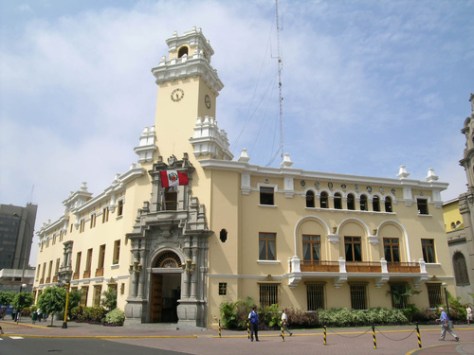
Municipalidad de Miraflores, Lima

It was a brief ceremony, lasting 15 minutes at most, and a quiet affair.  Just Steph and me, and our two witnesses, John and Marian Vessey. And the mayor (or other official) of course.

John, a plant pathologist working on bacterial diseases of potato, was a colleague of ours at the International Potato Center (CIP) in Lima, who had joined the center a few months before I arrived in Lima in January 1973.
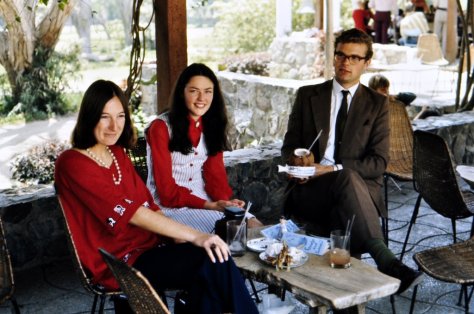
Enjoying pre-lunch drinks with Marian and John at ‘La Granja Azul‘ restaurant at Santa Clara – Ate, on the outskirts of Lima.

The newly-weds.


It’s by chance, I suppose, that Steph and I got together in the first place. We met at the University of Birmingham, where we studied for our MSc degrees in Conservation and Utilization of Plant Genetic Resources.

Steph arrived in Birmingham in September 1971, just after I had finished the one-year course. I was expecting imminently to head off to Peru where I had been offered a position at CIP to help curate the large collection of native potato varieties in the CIP genebank. So, had I flown off to South America then, our paths would have hardly crossed.

But fate stepped in I guess.

My departure to Peru was delayed until January 1973. So I registered for a PhD with renowned potato expert Professor Jack Hawkes (right, head of the Department of Botany and architect of the MSc course), and began my research in Birmingham while CIP’s Director General, Richard Sawyer, negotiated a financial package from the British government to support the center’s research for development agenda, and my work there in particular.

It must have been early summer 1972 that Steph and I first got together. Having completed the MSc written exams in May, Steph began a research project on reproductive strategies in three legume species, directed by Dr Trevor Williams (who had supervised my project a year earlier on lentils). And she completed the course in September.

By then, she had successfully applied for a scientific officer position at the Scottish Plant Breeding Station in Edinburgh (SPBS, now part—after several interim phases—of the James Hutton Institute in Dundee), as Assistant Curator of the Commonwealth Potato Collection. But that position wasn’t due to start until November.
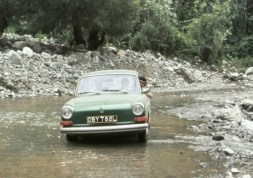
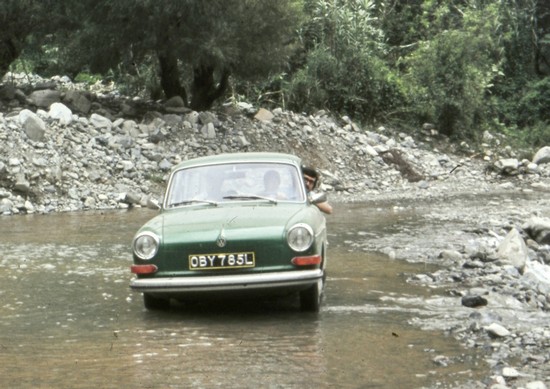
Our VW Variant in Peru, around May 1973 – before receiving a Peruvian registration plate.

In early November I took delivery of a left-hand-drive Volkswagen for shipment to Peru. On a rather dismal Birmingham morning, we loaded up the VW with Steph’s belongings and headed north to Edinburgh. She returned to Birmingham in mid-December for her graduation.
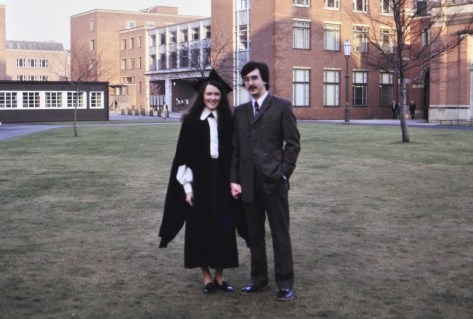
Then, just after Christmas 1972, we met up in a London for a couple of days before I was due to fly out to Lima.

At that time we could not make any firm commitments although we knew that—given the opportunity—we wanted to be together.

Again fate stepped in. On 4 January 1973, Jack Hawkes and I flew to Lima. Jack had been asked to organize a planning conference to guide CIP’s program to collect and conserve native Andean potato varieties and their wild relatives.
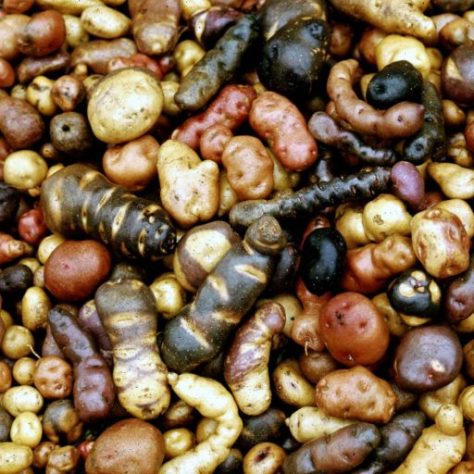
Potato varieties from the Andes of Peru.

While I stayed in a small hotel (the Pensión Beech, in the San Isidro district) until I could find an apartment to rent, Jack stayed with Richard Sawyer and his wife Norma. And it was over dinner one evening that Jack mentioned to Richard that I had a ‘significant other’ in the UK, also working on potato genetic resources, and was there a possibility of finding a position at CIP for her. Richard mulled the idea over, and quickly reached a decision: he offered Steph a position in the Breeding and Genetics Department to work with the germplasm collection.

With that, Steph resigned from the SPBS and made plans to move to Lima in July, with us planning to get married later on in the year.

In the CIP germplasm screenhouses in La Molina. Bottom: with Peruvian potato expert Ing. Carlos Ochoa.


A couple of weeks after I arrived in Peru, I found an apartment in Miraflores at 156 Los Pinos (how that whole area has changed in the intervening 50 years), and that’s where Steph joined me.

In our Los Pinos apartment, Miraflores in July 1973.

A few weeks later we found a larger apartment, nearby at 730 Avda. Larco, apartment 1003. Very interesting during earthquakes!
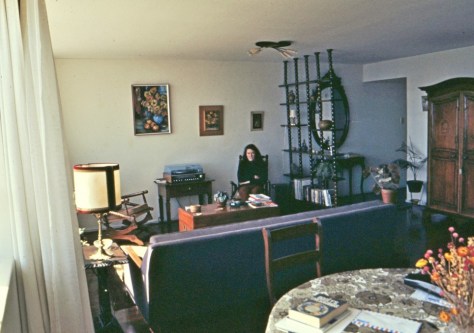
Around mid-August 1973 we began the paperwork (all those tramites!) to marry in Peru. Not as simple as you might think, but on reflection perhaps not as difficult as we anticipated.

While we were allowed to post marriage banns in the British Embassy, we had to announce our intention to marry in the official Peruvian government gazette, El Peruano, and one of the principal daily broadsheets (El Comercio if memory serves me right), and have the police visit us at our apartment to verify our address. I think we also had to have blood tests as well. This all took time, but everything was eventually in place for us to set the wedding date: 13 October.

Some friends wanted to give us a big wedding, but Steph said she just wanted an intimate, quiet day. So that’s what we organized.

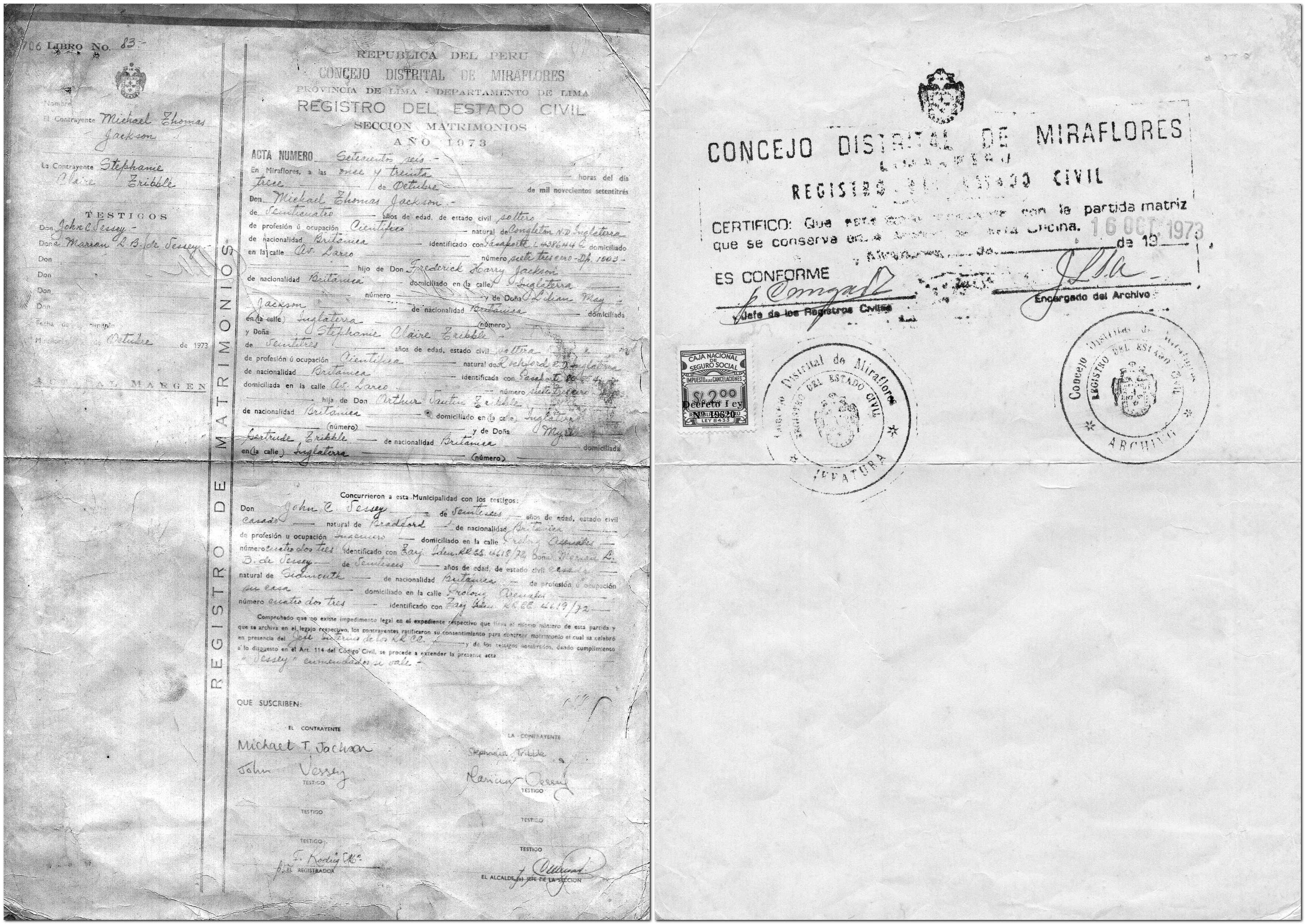
In the week leading up to our wedding, we had to present all the notarised documents at the municipality. After the ceremony, we signed the registry, hand-written in enormous volumes (or tomos). There was a bank of clerical staff, all with their Parker fountain pens, inscribing the details of each wedding in their respective tomo. A week later we collected our Constancia de Matrimonio (with some errors) which detailed in which tomo (No. 83, page 706) our marriage had been recorded, as well as photocopies (now sadly faded) of the actual page.

My work, collecting potatoes, took me all over the Andes; not so much for Steph who only made visits every other week or so to CIP’s highland experiment station (at over 3000 masl) in Huancayo east of Lima, and a six hour drive away.

However, Steph and I explored Peru together as much as we could, taking our VW on several long trips, to the north and central Andes, and south to Lake Titicaca. We also delayed our honeymoon until December 1973, flying to Cusco for a few days, and spending one night at Machu Picchu.
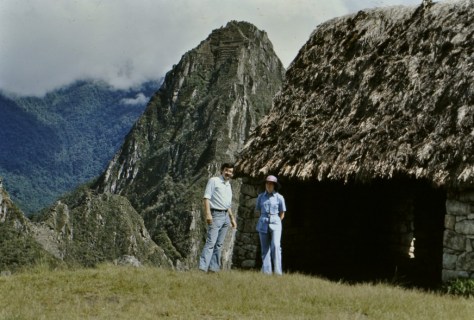
At Machu Picchu, December 1973.


In May 1975, we returned to the UK for seven months for me to complete my PhD, returning to Lima just before New Year.
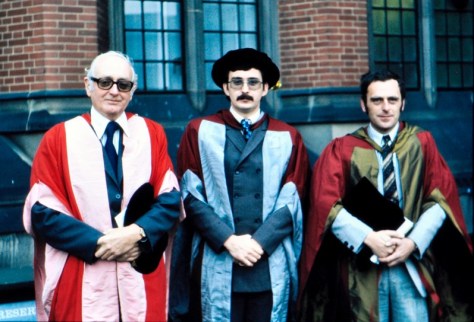
With Jack Hakes and Trevor Williams at my PhD graduation on 12 December 1975 at the University of Birmingham.
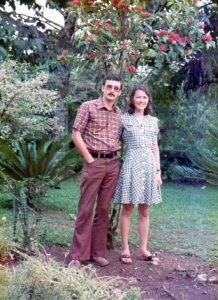
Christmas Day 1976 in Turrialba.

Then, in April 1976, we moved to Costa Rica where I worked on potato diseases and production, based in Turrialba, some 70 km east of the capital city, San José. Under the terms of our visas, Steph was not permitted to work in Costa Rica. I became regional representative for CIP’s Region II (Mexico, Central America, and the Caribbean) in August 1997 when my colleague, Oscar Hidalgo (who was based in Toluca, Mexico) headed to North Carolina to begin his PhD studies.

Our elder daughter Hannah Louise was born in San José in April 1978. Later that year, we took our first home leave in the UK and both sets of grandparents were delighted to meet their first granddaughter.
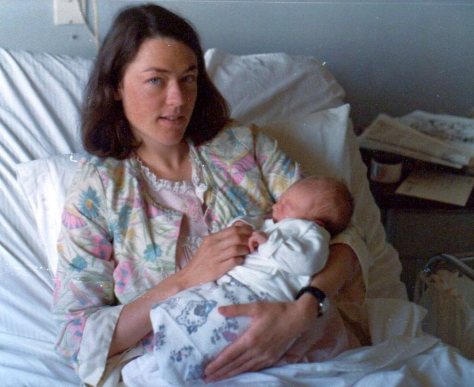
24 April 1978 in the Clinica Santa Rita, San José, Costa Rica.
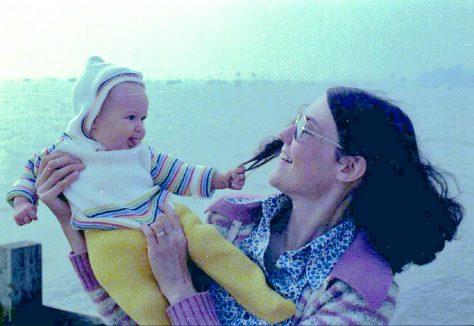
On home leave in the UK in September 1978.
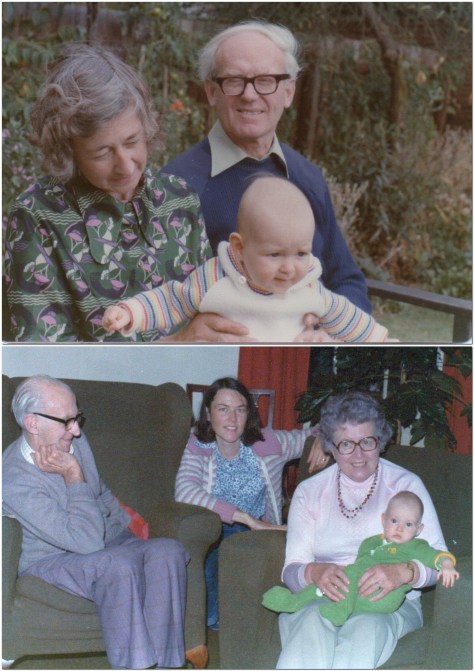
With Steph’s parents Myrtle and Arthur (top) in Southend-on-Sea, and mine, Lilian and Fred, in Leek.

We spent five happy years in Costa Rica before moving back to Lima at the end of November 1980, and began making plans to move to the Philippines by Easter 1981.

However, in early 1981, a lectureship was created at the University of Birmingham, in the Department of Plant Biology (formerly Botany, where Steph and I had studied), for which I successfully applied. We left CIP at the end of March and had set up home in Bromsgrove (about 13 miles south of Birmingham in north Worcestershire) by the beginning of July.
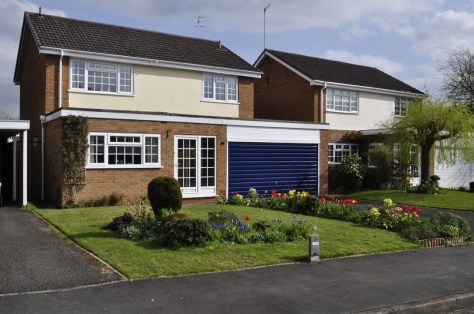
4 Davenport Drive


A decade after we were married, we were already a family of four. In May 1982 Philippa Alice was born in Bromsgrove.
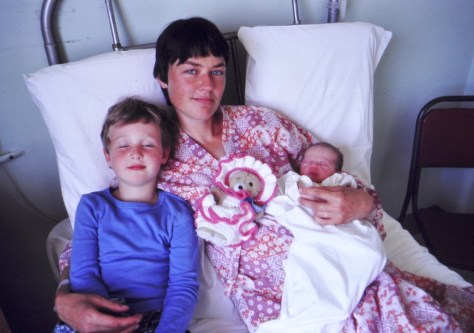
30 May 1982 in Bromsgrove hospital.

During the 1980s we enjoyed many family holidays, including this one in 1983 on the canals close to home.

Many other family holidays followed, in South Wales, in Norfolk, on the North York Moors, and in 1989, in the Canary Islands.
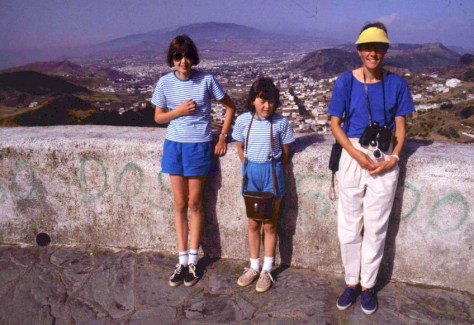
In Tenerife, Canary Islands in July 1989. Steph is carrying the binoculars that I bought around 1964 and which I still possess.

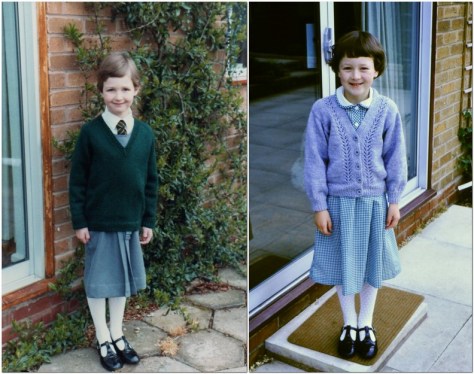
Hannah (left) and Philippa (right) thrived at local Finstall First School, shown here on their first day of school in 1983 and 1987, respectively.
My work at Birmingham kept me very busy (perhaps too busy), but I particularly enjoyed working with my graduate students (many of them from overseas), and my undergraduate tutees.

All in all, it looked like Birmingham would be a job for life. That was not to be, however. By the end of the 1980s, academic life had sadly lost much of its allure, thanks in no small part to the policies and actions of the Thatcher government. We moved on.


By 1993, we had already been in the Philippines for almost two years, where I had been hired (from July 1991) as head of the Genetic Resources Center (GRC) at the International Rice Research Institute (IRRI) in Los Baños, some 65 km south of Manila in the Philippines. I moved there ahead of Steph and the girls (then aged 13 and nine) who joined me just after Christmas 1991.

Meeting fellow newcomer and head of communications, Ted Hutchcroft and his wife at our joint IRRI welcoming party in early 1992.

In 1993 I learned to scuba dive, a year after Hannah, and it was one of the best things I’ve ever done. Philippa trained a couple of years later.
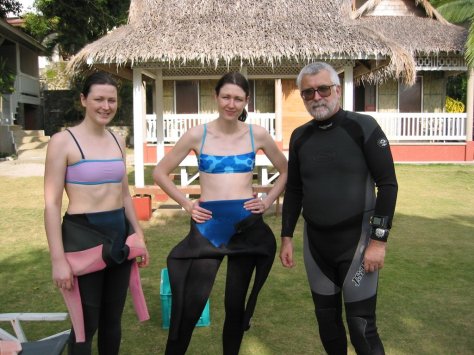
Getting ready to dive, at Arthur’s Place, Anilao, Philippines in January 2003.

Steph was quite content simply to snorkel or beachcomb, and we derived great pleasure from our weekends away (about eight or nine a year) at Anilao, 92 km south from Los Baños. In fact, our weekends in Anilao were one of our greatest enjoyments during the 19 years we spent in the Philippines.

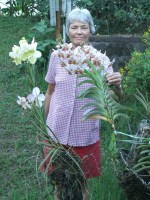
Steph became an enthusiastic beader and has made several hundred pieces of jewelry since then. In Los Baños we had a live-in helper, Lilia, and so in the heat of Los Baños, Steph was spared the drudgery of housework or cooking, and could focus on the hobbies she enjoyed, including a daily swim in the IRRI pool, and looking after her garden and orchids.
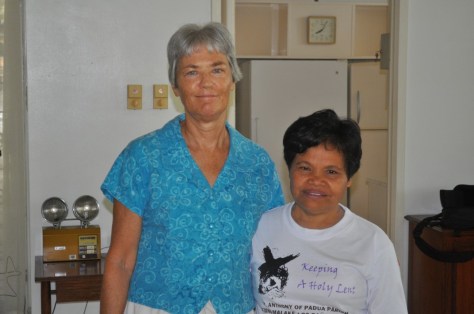
Steph and Lilia on our last day in IRRI Staff Housing #15 on 30 April 2010.

Hannah and Philippa completed their school education at the International School Manila (ISM) in 1995 and 1999 respectively, both passing the International Baccalaureate Diploma with commendably high scores.
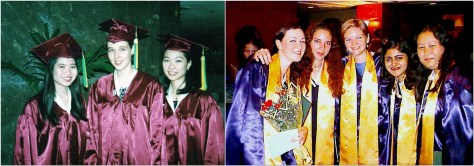
Graduation at ISM: Hannah and Philippa with their friends from around the world.

Traveling to Manila each day from Los Baños had not been an easy journey, due to continual roadworks and indescribable traffic. It was at least two hours each way. By the time Philippa finished school in 1999, the buses were leaving Los Baños at 04:30 in order to reach Manila by the start of classes at 07:15.

In October 1996, Hannah started her university degree in psychology and social anthropology at Swansea University in the UK. However, after two years, she transferred to Macalester College, a highly-rated liberal arts college in St Paul, Minnesota, graduating summa cum laude in psychology and anthropology in May 2000. She then registered for a PhD in industrial and organizational psychology at the University of Minnesota. Philippa began her BSc degree in psychology at the prestigious University of Durham, UK later that same year, in October.

Hannah’s graduation in May 2000 at Macalester College, with Philippa and Michael (Hannah’s boyfriend, now her husband).

Once Hannah and Philippa had left for university, IRRI paid for return visits each year, especially at Christmas.

Christmas 2001. Michael joined Hannah for the visit.

While my work took me outside the Philippines quite often, Steph and I did manage holidays together in Hong Kong/Macau and Australia. And, together with Philippa, we toured Angkor Wat in Cambodia in December 2000.

But Steph also accompanied me on work trips to Laos, Bali, and Japan. She also joined me and my staff when we visited the rice terraces in northern Luzon in March 2009.

Enjoying a cold beer as the sun goes down, near Sagada, northern Luzon, Philippines.
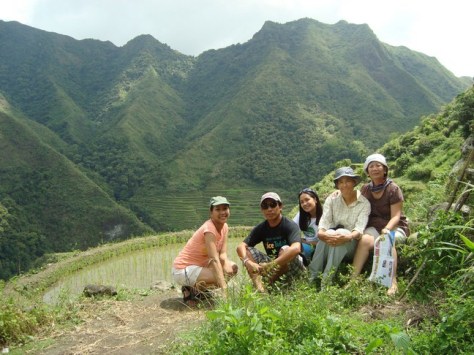
Overlooking the Batad rice terraces in northern Luzon in March 2009.

However, we always used our annual home leave allowance to return to the UK, stay in our home in Bromsgrove (which we had purposely left unoccupied), and meet up with family and friends.

Philippa was awarded a 2:1 degree in July 2003, and the graduation ceremony took place inside Durham Cathedral. She then headed off to Vancouver for a year, before returning to the UK and looking for a job, eventually settling in Newcastle upon Tyne where she has lived ever since.
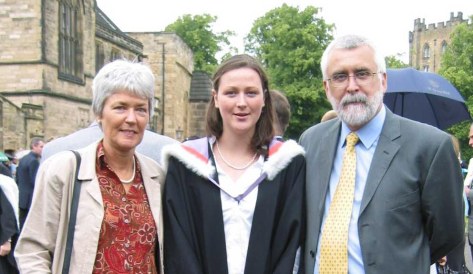
Outside Durham Cathedral where Phil received her BSc degree from the university’s Chancellor, the late Sir Peter Ustinov.

Hannah married Michael in May 2006, and finished her PhD. We flew to Minnesota from the Philippines.
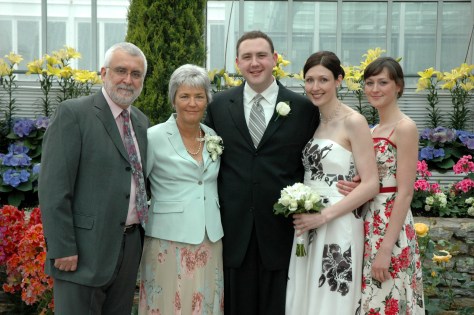
15 May 2006, at the Marjorie McNeely Conservatory in Como Park, St Paul.
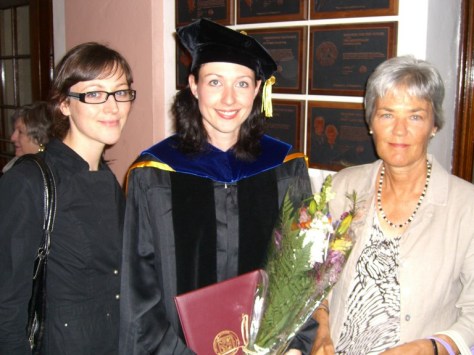
PhD graduation at the University of Minnesota.

Philippa registered for a PhD in biological psychology at Northumbria University in Newcastle upon Tyne where she was already working.

Professionally, the period between 2001 and my retirement in 2010 was the most satisfying. I had changed positions at IRRI in May, moving from GRC to join the institute’s senior management team as Director for Program Planning and Communications (DPPC). I worked with a great team, and we really made an impact to increase donor support for IRRI’s research program. However, by 2008/9 when my contract was up for renewal, Steph and I had already agreed not to continue with IRRI, but take early retirement and return to the UK.

But not quite yet. IRRI’s Director General, Bob Zeigler, persuaded me to stay on for another year, and organize the celebrations for the institute’s 50th anniversary. Which I duly did, and had great fun doing so.

But as our retirement date approached in April 2010, I was honored by the institute’s Board of Trustees with a farewell party (despedida) coinciding with the 50th anniversary of the very first Board meeting in April 1960.
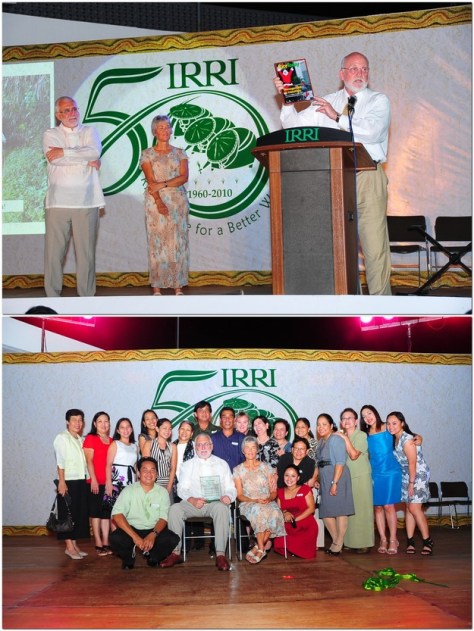
14 April 2010 – IRRI’s 50th celebration dinner and our despedida.


Friday 30 April was my last day in the office.
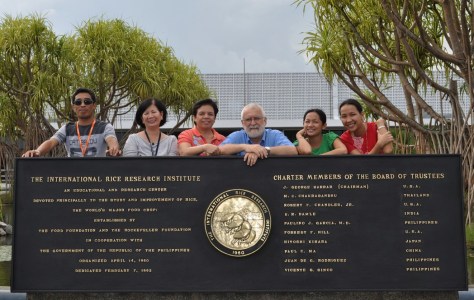
With my DPPC friends. L-R: Eric, Corinta, Zeny, me, Vhel, and Yeyet.

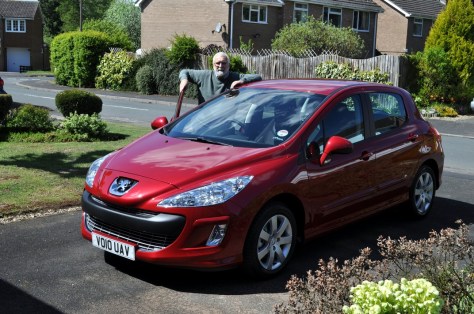
We flew back to the UK two days later, arriving on Monday 3 May and taking delivery of our new car, a Peugeot 308, the following day.
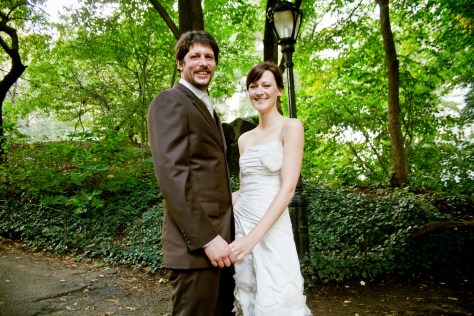
Philippa and Andi flew off to New York in October 2010 and were married in Central Park. She graduated with her PhD in December.
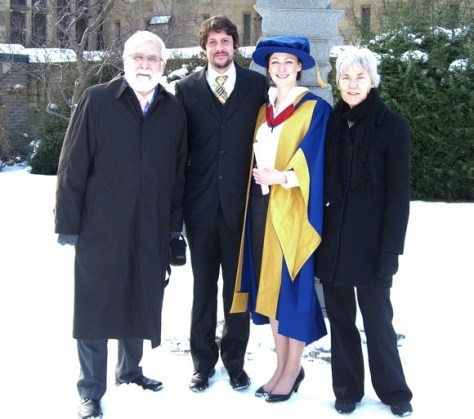
By 2013 we had been married for four decades, and were well-settled into retirement, enjoying all the opportunities good weather gave us to really explore Worcestershire and neighboring counties, especially as National Trust and English Heritage members. And touring Scotland in 2015, Northern Ireland in 2017, Cornwall in 2018, East Sussex and Kent in 2019, and Hampshire and West Sussex in 2022.

We were, by then, the proud grandparents of three beautiful boys and a girl.

Callum Andrew (August 2010) – St Paul, Minnesota
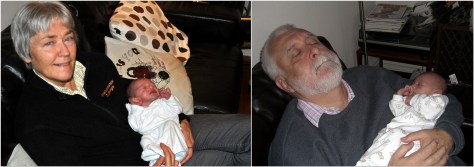
Elvis Dexter (September 2011) – Newcastle upon Tyne
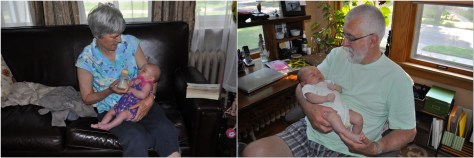
Zoë Isobel (May 2012) – St Paul, Minnesota
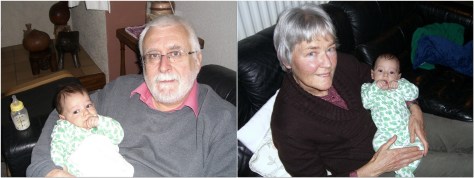
Felix Sylvester (September 2013) – Newcastle upon Tyne

And how could we ever forget a very special day in February 2012, when Steph, Philippa and my former colleague from IRRI, Corinta joined me at Buckingham Palace for an investiture.

Receiving my OBE from King Charles III (then HRH The Prince of Wales) on 14 February 2012.
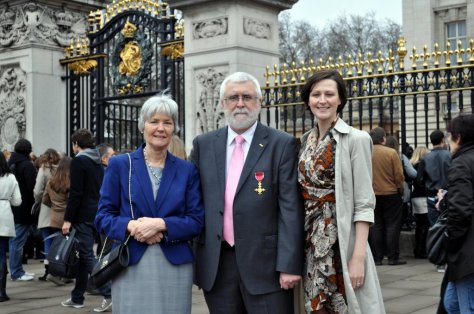
With Steph and Philippa outside the gates of Buckingham Palace.
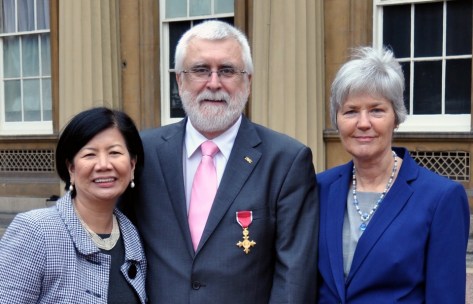
With Corinta and Steph in the courtyard of Buckingham Palace after the investiture.

Since 2010, we have traveled to the USA each year except during the pandemic years (2020-2022), and only returning there this past May and June. We’ve made some pretty impressive road trips around the USA, taking in the east and west coasts, and all points in between with the exception of the Deep South. Just click here to find a list of those road trips.

In July 2016, a few months after I broke my leg, Hannah and family came over to the UK, and we got together with Phil and Andi and the boys for the first time, sharing a house in the New Forest.

Our first group photo as a family, near Beaulieu Road station in the New Forest, 7 July 2016. L-R: Zoë, Michael, me (still using a walking stick), Steph, Callum, Hannah, Elvis, Andi, Felix, and Philippa.

And they came over again in July 2022, to our new home in the northeast of England where we had moved from Bromsgrove in October 2020 at the height of the Covid-19 pandemic.
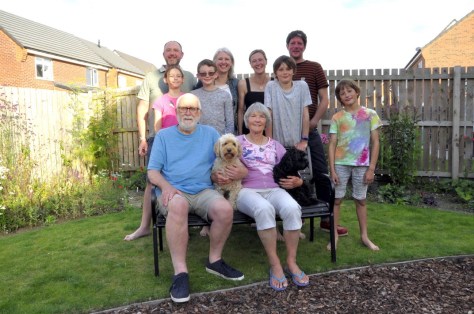
In our garden in Backworth, North Tyneside, August 2022.

L-R: Felix, Elvis, Zoë, and Callum, at Dunstanburgh Castle, Northumberland in August 2022.


So it’s 2023, and fifty years have passed since we married.

During our visit to the USA this past May and June, we met up with Roger Rowe and his wife Norma, along the Mississippi River at La Crosse in Wisconsin.
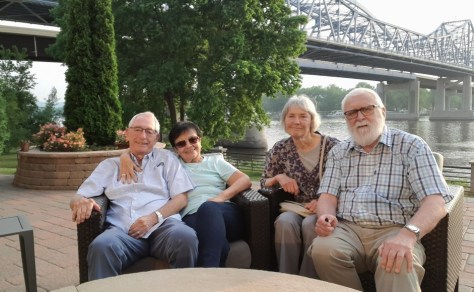
Roger joined CIP in 1973 as head of the Breeding and Genetics Department and was our first boss. Roger also co-supervised my PhD. So it was great meeting up with them again 50 years on.

We’ve been in the northeast just over three years now, and haven’t regretted for a moment making the move north. It’s a wonderful part of the country, and in fact has given us a new lease of life.
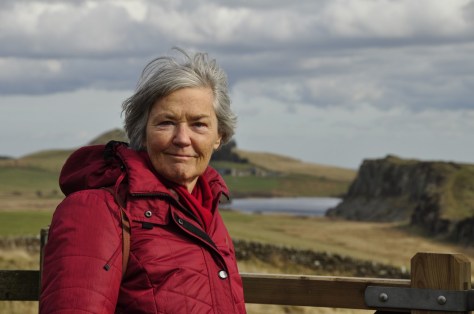
At Steel Rigg looking east towards the Whin Sill, Crag Lough, and Hadrian’s Wall, Northumberland, February 2022.

Steph has taken great pleasure in developing her new garden here. It’s a work in progress, and quite a different challenge from her garden in Worcestershire, discovering what she can grow and what won’t survive this far north or in the very heavy (and often waterlogged) soil.
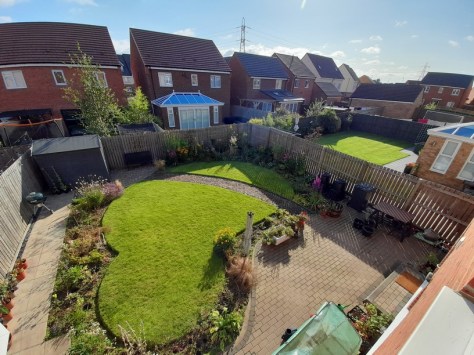
22 August 2023

I’ve had much enjoyment writing this blog since 2012, combining my interests of writing and photography. It has certainly given me a focus in retirement. I never thought I’d still be writing as many stories, over 700 now, and approaching 780,000 words. Since returning to the UK, I’ve also tried to take a daily walk of 2-4 miles. However, that’s not been possible these past six months. A back and leg problem has curtailed my daily walk, but I’m hopeful that it will eventually resolve itself and I’ll be able to get out and about locally, especially along the famous North Tyneside waggonways.

After 50 years together, we have much to be thankful for. We’ve enjoyed the countries where we have lived and worked, or visited on vacation. Our daughters and their families are thriving. Hannah is a Senior Director of Talent Management and Strategy for one of the USA’s largest food companies, and Philippa is an Associate Professor of Biological Psychology at Northumbria University.
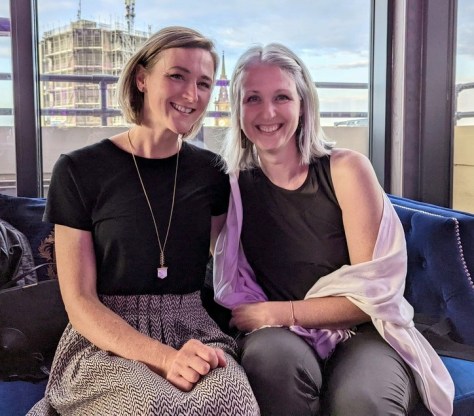
Sisters!
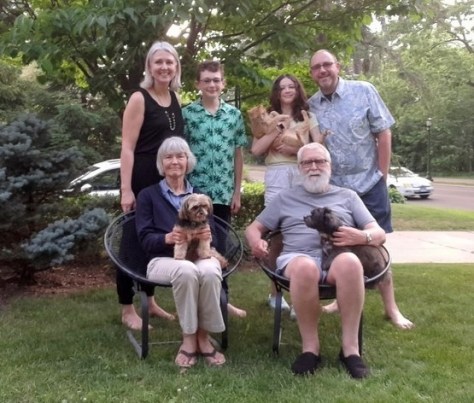
With Hannah and Michael, Callum and Zoë (and doggies Bo and Ollie, and cat Hobbes) in St Paul, MN on 18 June 2023.
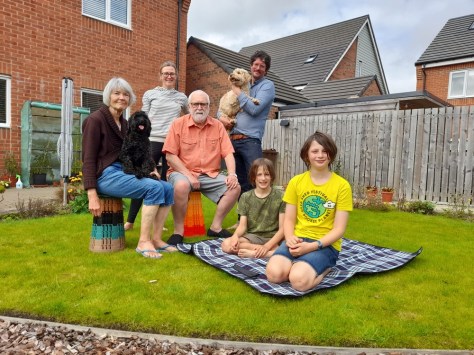
With Philippa and Andi, Elvis and Felix (and doggies Rex and Noodle) on 2 September 2023.

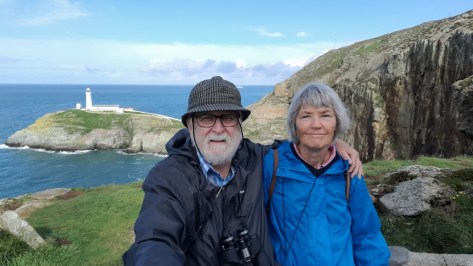
And here we are, at South Stack cliffs, in the prime of life (taken in mid-September) when we enjoyed a short break in North Wales.
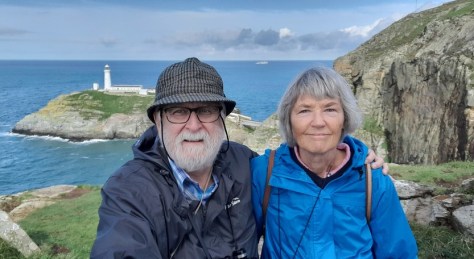
Steph with Philippa and family on her birthday on 8 October.
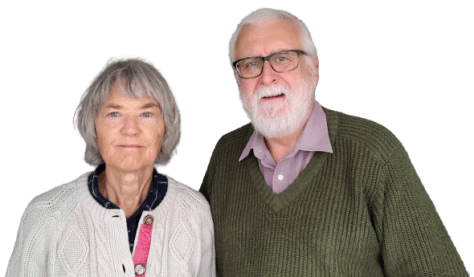
13 October 2023 – still going strong!


While drafting this reminiscence, I came across this article by Hannah Snyder on the Northwest Public Broadcasting website, and it inspired the title I used.

It doesn’t add up

Several weeks ago (or was it months?) UK Prime Minister Rishi Sunak (right) announced that his government would soon propose plans to reform secondary education for all pupils to study mathematics and English up to the age of 18, like many other countries.

After GCSEs (known as ‘O Levels’ back in the day when I was at school in the 1960s), taken at 15/16, many pupils receive no further tuition in maths (or English for that matter), and specialise in their final two years of high school, taking just three subjects, known as ‘A Levels’ (Advanced Level) as university entrance exams.

During his speech to the Tory Party conference on 4 October Sunak pledged to introduce this ‘revolutionary’ change. That’s assuming, of course, that the Tories remain in power after the next General Election. Which seems highly unlikely if the latest polls are to be believed. (Should Labour win the next election, I have no idea what its policy on continuing maths and English education will be, although as far back as 2014 they made it one of their policy pledges¹).

By teatime on the 4th, the Prime Minister’s Office had posted a press release on the government’s website.

Justifying this proposal, Sunak indicated that this new qualification for 16-19 year olds will put technical and academic education on an equal footing and ensure that all young people leave school knowing the basics in maths and English.

The new Advanced British Standard will bring together the best of A Levels and T Levels into a single new qualification. Students will take a larger number of subjects at both ‘major’ and ‘minor’ level, with most studying a minimum of five subjects at different levels – for example, three majors alongside two minors. Importantly, students will have the freedom to take a mix of technical and academic subjects, giving them more flexibility over their future career options.

However, it would take at least a decade to introduce such a change apparently. Very quickly, unions and teachers dismissed this proposed reform. Not, I hope, because they were opposed to reform in principle, but because schools do not have the staff or resources to teach English and maths to age 18. Yes, that is a real issue, and it will take political courage from the next government to tackle this issue head on, and support education at the level required. And to increase standards and achievements for GCSE students.


Notwithstanding there little or nothing about this Tory government I can support – and they certainly won’t have my vote in 2024 or whenever the election is called – I am actually in favor of this proposed educational reform. Let me explain.

When I was in high school (1960-1967), maths was one of my least favorite subjects. I dreaded maths lessons. But I did manage a pass in ‘O’ Level maths in 1964, but never took a maths course per se ever since. Much to my regret. And there are thousands of schoolchildren in exactly the same boat as me. Cowed by maths, and thus uninterested in the beauty of the discipline.

I often wish I had been able, had the ability, and perhaps more importantly had the support of good maths teachers to instill a continuing interest. I had really poor teachers at my high school, only interested in those who could and tolerating (just) those who struggled.

Having said all this, I have spent much of my career in agricultural science working with numbers, and thoroughly enjoying it. Indeed, in 2017 I wrote this blog post, There’s beauty in numbers, about my enjoyment of playing with data, looking for patterns and trends, and coming to conclusions about the behavior of the plants and crops I was studying. But although I became reasonably proficient (under guidance and advice from those better experienced than me) in the use of statistics, I do wish I had a better theoretical background underlying some of the statistical concepts I applied.

But beyond the basics of algebra, geometry, or trigonometry that high school pupils receive leading up to GCSEs, most do not need higher levels of mathematical education, like calculus for example. What they do need, in my opinion, are good numeracy skills, and how maths operates in the real world.

And as far as English is concerned, my emphasis for many students would be having the ability to write coherent prose and learning how to communicate effectively, both in written form and verbally. No need for deep analysis of set texts by Shakespeare or others.

So how would they achieve this? Sunak’s proposed Advanced British Standard qualification is his solution.

Often referred to (in previous government statements) as an English or British Baccalaureate, the Advanced British Standard seems remarkably similar to an existing and widely accepted qualification: the International Baccalaureate Diploma, offered in over 3600 state and private schools worldwide (but in just 22 state schools in the UK, although offered in 71 private ones).

If a widely-accepted qualification is up and running, and has been for decades, since 1968 in fact, why bother to reinvent the wheel with the Advanced British Standard? Is this another case of British exceptionalism?

This is what one headmistress, Victoria Hearn (right), Principal of state-assisted Impington Village College and Impington International College near Cambridge had to say about the proposal in a letter to The Guardian on 27 September last:

While Rishi Sunak’s plans to reform post-16 education are welcome news, I can’t help but feel that valuable resources could be saved by utilising a tried and tested education framework that students are already benefiting from. The international baccalaureate (IB) diploma enables students to study six subjects including mathematics, English and a foreign language until the age of 18, providing a broader and more rewarding syllabus compared with that of the UK’s national curriculum.

The development of a “British baccalaureate” will be costly, and funding this new vision will be a concern to many, particularly for state-funded schools that are already overstretched. In the UK, the IB is often seen as only accessible to independent schools, but with some creative budgeting and timetable management, a comprehensive IB programme can be delivered by state schools. We have been offering the IB at the state-maintained Impington Village college for more than 30 years as we believe it places our students in the best position to succeed in the global workplace.

Adapting the current curriculum framework is going to be lengthy and costly. The IB represents a proven alternative that can give students the broad range of skills required to thrive in the future.

Also, these are the IB values:

  • valuing inquiry and reflection, encouraging students to be open minded in their learning;
  • being principled and encouraging a caring attitude;
  • promoting high quality communication and discussions within the school community; and
  • encouraging international-mindedness and building respectful relationships.

I couldn’t agree more. And here are some reasons why.

First, from my own experience, I believe keeping your options broad is a positive perspective. In fact,

  • I studied both humanities and sciences at ‘A Level’: English Literature, Geography, and Biology (and General Studies).
  • I read for a combined BSc degree at the University of Southampton (1967-1970) in Environmental Botany and Geography.
  • For my MSc degree at the University of Birmingham in the conservation and use of plant genetic resources (1970-1971) many different topics were included.
  • It wasn’t until I began my PhD on potatoes (awarded 1975) that I settled into a narrow discipline.

Second, I don’t agree with either the retired teacher who thinks that additional ‘useless’ subjects in a baccalaureate would not be appropriate for many pupils, or the Emeritus Professor of Mathematical Education, who felt that students applying for maths at university would not have appropriate preparation. Both expressed their views in letters to The Guardian. The professor seemingly doesn’t appreciate that IB subjects are taught at both a higher and lower level. And, in any case, from my experience as a university lecturer (1981-1991, in plant biology in the School of Biological Sciences at the University of Birmingham) many first year university courses are designed to bring everyone up to the same level.

Furthermore, and again from my university days as a tutor, many students would certainly benefit from having a received a broader pre-university education, that would have given them a broader perspective on life, with access to the humanities as well as sciences, and would have enhanced, I believe, their ability to think and discuss more critically, and present their ideas verbally as well as written.

And lastly, both my daughters took the IB Diploma, and emerged with highly creditable grades at age 17, with subsequent access to good universities in the USA and UK, and endowing them with the academic capabilities and discipline to graduate with excellent degrees, and subsequently taking a PhD each in psychology.

But, I should add, their IB Diplomas were not earned at a British state school. In July 1991, I took a senior position with the International Rice Research Institute (IRRI) in the Philippines. My wife Steph and daughters followed me out to the Philippines by the end of the year, when Hannah and Philippa were 13 and nine (and had just moved up to high school and middle school respectively just three months previously in our home town, Bromsgrove, in Worcestershire).

Steph and I discussed the various education options. We were not keen in sending them to boarding school in the UK. There was a British School in Manila, but that did not, in the 1990s, offer an ‘A Level’ curriculum. So, after GCSEs, we would have had to send them back to the UK. Again not something we considered.

So both were enrolled in the fee-paying International School Manila (ISM), with the expectation from the outset that the IB Diploma would be their pre-university goal. Fees were subsidised by my employer as many IRRI children were also enrolled there, and traveled the 70 km daily each way north from Los Baños, where IRRI’s research center is located, into the city.

Yes, the courses were tough. Since besides the six academic subjects (three at higher, three at lower), IB students took a Theory of Knowledge course. Both our daughters studied English, history, and biology at higher level, and maths studies, French, and psychology at lower level.

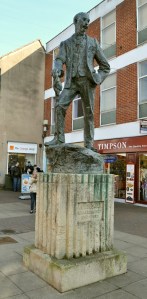
Each had to complete a 4000 word essay based on independent research. Hannah’s history project was an analysis of the impact of the railways on the canals in mid-19th century England. Philippa made an analysis of A Shropshire Lad, an epic poem by Bromsgrove classical scholar poet, AE Housman (whose statue, right, proudly stands in the High St there) and interpreting his repressed sexuality through the poem’s themes.

For her community project, Hannah helped each weekend at a Montessori school in Los Baños, while Philippa joined a group for two weeks helping to construct a road in the mountains north of Manila.

There was one last challenge: the daily journey into Manila. Classes began at 07:15, and by the time my younger daughter graduated in 1999, the IRRI bus for ISM was departing from Los Baños at 04:30, and not returning until 16:30 or later. Then there were homework assignments to complete until late evening. All the family was relieved come graduation!

I’ve asked them about the IB experience. Both were unequivocal. The Diploma gave them enhanced skills for critical thinking, time organization, as well as covering the various subjects in depth. They both said the Diploma was a worthwhile qualification. It certainly hasn’t held them back.

So as the discussion continues over post-16 education and whether to replace ‘A Levels’ with a broader curriculum qualification, it’s certainly worthwhile looking at the IB mix, and what level of maths and English education and skills most students really need to prepare them for the workplace, and life in general.


¹ 11 October update. Labour just announced at its 2023 Conference that there will be a focus on teaching ‘real world maths’ to younger children. See this article in The Guardian.

Definitely not castles in the air . . .

Portrait in Westminster Abbey supposedly depicting Edward I, installed sometime during his reign.

King Edward I of England. Eldest son of Henry III. Born 1239, reigned 1272 to 1307.

Also known as Edward Longshanks (on account of his height, over six feet) and Hammer of the Scots.

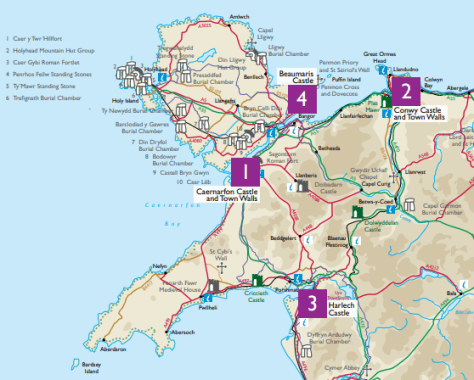
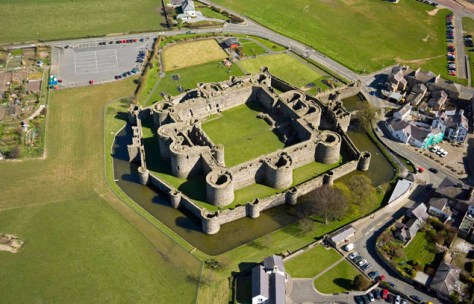
Notwithstanding his campaigns against the Scots, Edward I left a permanent legacy of 17 castles in Wales following military campaigns against the Welsh princes.

During our recent holiday in North Wales, we took time out to visit four of these (all owned and managed by Cadw, on whose website you can find the necessary information for visiting), among the most impressive still standing today, and all of them World Heritage Sites: (1) Caernarfon, (2) Conwy, (3) Harlech, and (4) Beaumaris.

Their construction began in 1283, but one—Caernarfon Castle—was not completed until 1330, long after Edward’s death when his grandson, Edward III was already king. Situated along the coast they were presumably more easily re-supplied than if they had been built inland, like many others.

These castles are not only impressive feats of medieval engineering but also symbolic representations of English dominance over Wales. They played a significant role in shaping the political and cultural landscape of the region for centuries to come. Today, these castles stand as enduring testaments to the historical events that unfolded in North Wales during Edward I’s reign.

Behind the design and construction of these castles was master of works/architect, James of Saint George from Savoy, regarded as one of the greatest architects of the European Middle Ages.

Caernarfon Castle
Situated on the Menai Strait, Caernarfon Castle is perhaps the grandest fortress constructed by Edward I in Wales.

Begun in 1283, it took 47 years to complete, at the enormous cost of £25,000. The remains of the Roman fort Segontium (founded AD 77) are close by.

Caernarfon Castle from the southwest, across the Afon Seiont.

The castle was designed not only as a military stronghold but also as a royal residence, exemplifying Edward’s desire to display English authority in North Wales. Edward I’s fourth son (who became Edward II) was born at Caernarfon in April 1284 and later, in 1301, he was invested here as the first English Prince of Wales. Caernarfon Castle was the location, in July 1969, for the investiture of Prince Charles (now King Charles III) as Prince of Wales. Not a popular occasion for many proud Welsh.

Caernarfon’s distinctive polygonal towers and color-coded stone work make it one of the most visually striking castles in the region.

View more photos of Caernarfon Castle here.

Conwy Castle
One of the most iconic examples of Edwardian architecture, Conwy Castle, built in the remarkably short period between 1283 and 1289, stands at the mouth of the River Conwy. The castle is characterized by its twin-towered gatehouse and imposing curtain walls. Once again, James of Saint George was the master mason.

The town of Conwy was also enclosed in town walls, like at Caernarfon.

Take a look at this photo album.

Harlech Castle
Perched dramatically on a cliff overlooking the Irish Sea, Harlech Castle was strategically positioned to control the vital sea routes along the western coast of Wales.

Its design included a concentric structure, making it an architectural marvel of its time. Harlech played a significant role in the Welsh uprisings of the 15th century, becoming a symbol of Welsh resistance.

Here are a few more photos.

Beaumaris Castle 
While Beaumaris Castle was part of Edward I’s comprehensive plan to assert control over North Wales, it remained unfinished. He ran out of funds while campaigning against the Scots. So although the castle today looks like it was slighted (demolished), the towers never reached their projected height. Nevertheless, its design was highly innovative for its time, incorporating concentric walls and a water-filled moat. Beaumaris Castle is located on Anglesey.

Although the castle was never completed due to resource shortages, its architectural prowess is evident in its symmetrical layout.

This is a photo album of more Beaumaris photos.


Cadw does a great job of looking after these castles, and enhancing the visitor experience as much as possible. There’s lots of information posted everywhere.

I was surprised to find such extensive access to the castle walls and towers/turrets, from where there are excellent views over the castles and surrounding landscapes, as you can see from the photos I have posted. And the passageways inside the walls connecting the various exterior towers.

During our visit to Harlech the walls were closed because workmen were repairing the safety handrails. Just one turret (very high) was accessible there, but the climb was well worth it, with just enough space at the top for four or five people.

At Caernarfon, Cadw has constructed a viewing platform on the King’s Gate Tower (the main entrance), where the gift shop and a cafe are also located, for those unable or unwilling to tackle the walls and numerous (and narrow) tower steps.


A Victorian in Tudor clothing . . .

Speke Hall, a National Trust property on the eastern outskirts of Liverpool (right next to Liverpool John Lennon Airport, built on former Speke estate land) is a typical half-timbered, moated Tudor manor house. Although the moat has long since dried up.

However, much of the interior is—to all intents and purpose—Victorian.

Speke Hall is a late Elizabethan house, completed by Edward Norris (son of Sir William Norris, who had begun the build) in 1598. Although, at the rear of the house, another gate also displays the date 1605.

The main entrance to Speke Hall, showing the 1598 date.

The rear of the house, with an arched stone gateway with the date 1605.

Being short on time during our visit (we’d stopped off on our way home from holiday in North Wales), we took the guided tour and missed some of the rooms that remain closer to their Tudor origins. Only in one bedroom that we viewed, above the main entrance, was there a fireplace with clear Tudor craftsmanship.


The house is also a tale of two families: the Norris family that built the house and lived there for generations; and the Watt family that purchased the Speke estate in 1795. Both the Norrises and Watts made their fortunes from the transatlantic slave trade and plantations in the Caribbean.

There were a number of tenants over the centuries, the most prominent being Frederick Leyland (right), a Liverpool shipping magnate who lived at Speke for a decade from 1867, while the current owner, Adelaide Watt (1857-1921) was living in Scotland until she came of age and could inherit the estate.

There’s a nice potted history of the hall and its inhabitants on the National Trust website.

It was Leyland who refurbished the Speke interior in heavy and dark Victorian Gothic style.

He also patronised artists like Dante Gabriel Rossetti and James McNeil Whistler (of Whistler’s Mother painting fame). I’m not sure if William Morris (of the Arts and Crafts Movement) was actually involved directly with the decoration of the passageway and two rooms, but three of his wallpaper designs were hung there. We’ve also seen Morris designs at Wightwick near Wolverhampton, and Standen House in West Sussex.

After Leyland’s tenancy came to an end, Adelaide Watt (right) returned to Speke, and although only a young woman (around 21 years of age, and unmarried) set about running the estate herself, and introducing numerous innovations to make the estate more productive.

She immersed herself in every detail of the estate’s management. Today we’d view her as the archetypal micromanager, perhaps almost a termagant. But the estate thrived.

In her will Adelaide named three members of the Norris family as estate trustees (who sold off land to Liverpool corporation), with the proviso that the estate would transfer to the National Trust after 21 years. In 1942 the estate was handed to the Trust, which took on full management from 1986.


A full album of photos can be viewed here.

A view to Snowdonia’s foothills, and to the sea

During our recent short break in North Wales, Steph and I visited two very different gardens for the first time, Bodnant and Plas yn Rhiw, and made a quick return visit to a third (Plas Newydd on Anglesey), all managed by the National Trust.

Bodnant, a few miles south of Conwy in the river valley of the same name, is a world-famous garden home to National Collections and Champion Trees, covering around 80 acres (32 ha), and with 8 miles of trails to explore. Just click on the map below to open a larger version.

The history of Bodnant goes back 150 years or so, and is the story of the Pochin and McLaren families, who were united when Laura Pochin married Charles McLaren in 1877. Charles was ennobled in 1911 and took the name Lord Aberconway. The Aberconway family is still closely associated with the garden, and owns Bodnant House (which is not open to the public).

Like other gardens we have visited (such as Cragside in Northumberland), it never ceases to amaze me what vision the creators of these gardens had. They introduced and planted all manner of species, with many trees today reaching skywards more than 100 feet (among them various redwoods), a landscape they could only have dreamed about but never seen. It has been left to their descendants to nurture that vision alongside the National Trust.

I guess we must have arrived by about 10:30, and after enjoying a welcome cup of coffee, headed off into the garden.

Just inside the garden, beside one of the main paths, was a glorious perennial border, in full early Autumn bloom.

Given my more limited mobility over the past months, we initially decided just to walk the more accessible paths, and the various terraces that add so much magnificence to the garden, and from which there are inspiring views over the Snowdonia foothills to the west, across the other side of the Rover Conwy.

Below the west elevation of Bodnant House, there is a series of five terraces, the uppermost and another below it planted to roses. There are two large pools, a long rectangular one almost covering the length of the lowest terrace where a pavilion known as The Pin Mill (8 on the map) can be found.

We then followed the path towards the tower known as The Poem (19), then descending to the bottom of The Dell, and crossing over the Waterfall Bridge (20).

We then walked along The Dell as far as the Old Mill (10), taking in the beautiful blue hydrangeas growing along the banks of the stream (which you can see in the video clip), before ascending towards Bodnant House and the exit.

I visited Bodnant once before, 60 or so years ago, with members of Leek Camera Club but remember very little of that excursion. I’m sure that National Trust has made great improvements in the garden with the Aberconways in the intervening decades. Our recent visit was most enjoyable.


At the tip of the Llŷn Peninsula, near the small community of Aberdaron, Plas yn Rhiw is a delightful 17th century manor house, and an estate of approximately 150 acres (61 ha).

It’s owned by the National Trust, but not open every day. As from October, it will close for the winter. So we were lucky that we found an opportunity of making our visit.

It was the home of three unmarried sisters, Eileen, Lorna and Mary Honora Keating from Nottingham, and their mother, Constance, who could trace their ancestry back to the original owners of the manor. They bought the estate in 1939. In 1946 they donated the surrounding land to the National Trust to honor the memory of their parents William (d. 1893) and mother (d. 1945). Then, in 1952, the house was given to the National Trust (although it had been open to the public before then), and continued to live there until the last sister, Lorna, died in 1981.

Honor was made an OBE in 1939 for her work with maternity and child welfare.

The sisters were passionate about the environment, and they set about refurbishing the house. The front porch overlooks a small ornamental garden, and from there to the coast and views of Cardigan Bay.

The house is like a time capsule, full of all the sisters’ belongings. Check out this photo album to view many images of the interior of the cottage.

It’s a real gem of a National Trust property and well worth making the trip along the Llŷn Peninsula (which is worth a trip in it’s own right).


On the way back to our holiday cottage, we stopped off in Aberdaron and enjoyed the view (although hazy) over Cardigan Bay, as well as along the north coast of the Llŷn Peninsula.


Have bridge . . . will travel

Do bridges speak to your soul? They do to mine. I find them completely fascinating. Many are architecturally stunning, and wonders of engineering, apart from the odd miscalculation that can lead to catastrophic collapse, as was the case of the Tacoma Narrows Bridge, Washington in 1940.

Many have stood the test of time, crossing obstacles in the landscape and connecting communities for hundreds of years.

Numerous bridges across rivers in the USA aided the westward expansion, and I wrote about many that we have seen (and crossed) in a blog posted in April 2022 (just scroll down to the section about the USA).

Some bridges, like the Golden Gate (opened 1937) in San Francisco, the Sydney Harbour Bridge (1932), or the Forth Bridge (1890) for example, have become icons in their own right.

More recent icons include the Millau Viaduct (20004) in France, or the road and rail Øresund Bridge (2000) connecting Denmark and Sweden (and featured in that excellent Scandi Noir series, The Bridge).

I’m now living in Newcastle upon Tyne, where there are several road, rail, and pedestrian bridges over the River Tyne. The iconic Tyne Bridge (1928) is home, during the nesting season, to some 700 pairs of kittiwakes, the furthest inland colony in the world.

In the small community of Ironbridge, in Shropshire, stands a remarkable bridge over the River Severn. Erected in 1779, it was the world’s first cast iron bridge, the pieces fitting together as though constructed from wood.


While we were on holiday just over a week ago in North Wales we crossed the Menai Strait to Anglesey several times, on the Britannia Bridge that was first opened (as a tubular bridge of wrought iron to carry rail traffic only) in 1850. It was designed by Robert Stephenson, son of the great railway engineer, George Stephenson (the Father of the Railways), who was born in the small village of Wylam, Northumberland, west of Newcastle in 1781.

The Britannia Bridge today, seen from Plas Newydd, home to the Marquesses of Anglesey.

Thomas Telford

So why was the Britannia Bridge rail only to begin with? That’s because there was already a suspension road bridge, carrying the A5 trunk road, further east, designed and built by an even more famous engineer, Thomas Telford (1757-1834).

Telford was a Scottish civil engineer, who established himself as an engineer of road and canal projects in Shropshire, and designing numerous infrastructure projects in his native Scotland, as well as harbours and tunnels.

The Menai Suspension Bridge (and its ‘little brother’, the Conwy Suspension Bridge further east up the coast) was opened in 1826, as was the Conwy bridge.

It really is a marvel of early 19th century engineering, being the world’s first iron suspension bridge, 1,265 feet/305m long, with a central span of 579 feet/177m and its roadway set 98m/30m above the water to allow tall ships to sail beneath.

It was constructed from iron links, and you can appreciate its construction in the video below as we crossed the bridge. It is remarkable that it’s still open to traffic after almost 200 years, although it is currently undergoing some serious maintenance to extend its life.

Exactly the same construction method was used on the Conwy Bridge. Check out this informative National Trust video.

The Conwy bridge is open only to pedestrians, and is managed by the National Trust. To the west is a modern road bridge. To the east, a tubular rail bridge, also designed by Robert Stephenson, and opened in 1849.

Until 1972, the Menai Suspension Bridge was the only road link on to Anglesey.

After a major fire in 1970 caused extensive damage to the Britannia Bridge, it was reconstructed and a second deck was added above the rail level to take road traffic. That was opened in 1980. Even so, and although much wider than the Menai Suspension Bridge, it carries traffic in each direction in one lane only, reducing from dual carriageway on both sides of the bridge. And is therefore a source of considerable traffic congestion at busy times of the day.


On our way back home from North Wales, we stopped off briefly at Speke Hall on the eastern outskirts of Liverpool, right next to Liverpool John Lennon Airport. Our route in from North Wales took us over the Mersey Gateway Bridge. Opened in 2017, and spanning the River Mersey and the Manchester Ship Canal, it adds a new elegance to the local landscape.

Mersey Gateway Bridge


Croeso i Gymru!

Until recently, I hadn’t been back to North Wales for decades, apart from just passing through on three occasions when traveling to Holyhead (on Anglesey) to catch the ferry to Ireland.

It was different in the late 1950s and early 60s. My parents loved camping in North Wales. It was less than 100 miles west from their home in Leek in North Staffordshire, and most summers they would head off there for a week.

Until around 1955, we enjoyed family holidays there, including my eldest brother Martin and sister Margaret. Later on, just my my elder brother Edgar and I would join Mum and Dad. I guess it must have been around 1963 that I last went camping with them. I would have been fourteen.


Ten days ago, Steph and I traveled the 246 miles south from our home in North Tyneside to a holiday cottage just inland from the Menai Strait, and five miles from Caernarfon, to enjoy a week exploring this fascinating part of the country.

The return journey home was slightly longer as we stopped off at a National Trust property, Speke Hall, on the eastern outskirts of Liverpool. But more of that later.

Our base for the week was Hafod, a one bedroom self-catering granary cottage at Tŷ Mawr Farm, a great (and very comfortable) location for exploring the whole area. Highly recommended! The owner, Jane, also offers bed and breakfast accommodation on the farm.

This video shows our arrival at the farm, where I initially took a slightly wrong turn, before parking in front of our cottage. Entering the farm drive, you can see Yr Wyddfa (Mt Snowdon) and surrounding mountains off to the left. Yr Wyddfa is the highest peak in Wales, at 1,085 metres or 3,560 ft.

Yr Wyddfa is the peak in the center of this image, taken from the Tŷ Mawr farmyard.

On arrival, we found that Jane had left several plates of baked treats (including her excellent Welsh cakes) for us to enjoy throughout our stay.

Looking back on our holiday, it’s amazing how much we managed to pack so much into just six days, as you can see from this map. Just use the +/- buttons to view more details.

And, despite earlier forecasts, the weather behaved during the whole week – just a couple of overcast days, but mostly sunny, and even quite warm.

I’ll also be blogging about some of the places we visited in more detail.


Our National Trust visits took in Penrhyn Castle, near Bangor, Bodnant Garden, a horticultural jewel in the Conwy valley, the Conwy Suspension Bridge (built by Thomas Telford in 1826), Plas yn Rhiw, a cottage overlooking Aberdaron bay at the far western end of the Llŷn Peninsula, and we made a return visit to Plas Newydd on Anglesey to have another look at the Whistler mural and the Italian garden. We’d first visited Plas Newydd in 2017 on our way to Northern Ireland.


As members of English Heritage, we could use our membership to visit Cadw (the Welsh heritage protection organization) sites. And we took full advantage of that privilege.

On the way to Plas yn Rhiw, we stopped off to view a medieval farmhouse at Penarth Fawr.

In the late 13th century, King Edward I (also known as Edward Longshanks – on account of his height; reigned 1272-1307) built a string of castles along the North Wales coast as part of his campaign to subdue the Welsh. We visited four at Caernarfon (built from 1283 for almost 40 years), Conwy (1283-1287), Beaumaris (started in 1295 but never completed), all along the coast separating the mainland from Anglesey, and Harlech (1283-1289), a little further south and standing on a cliff overlooking Cardigan Bay.

Just by chance we came across two prehistoric sites on Anglesey, also managed by Cadw. On the northwest tip of the island lies Holy Island, and overlooking the Irish Sea are the remains of about 20 hut circles, dating back to the Iron Age, 2500 years ago. But there’s also evidence of ancient farmers growing wheat, oats, and barley among other crops, and keeping livestock, as long ago as 5500 years.

On the east side of the island we eventually found the celtic village of Din Lligwy, which dates from around 400 AD, at about the time the Romans were abandoning these islands.


Thomas Telford (1757-1834) was a remarkable engineer. Besides the smaller suspension bridge at Conwy, his bridge over the Menai Strait must be one of his most remarkable designs and constructions.

Opened in 1826, a marvel of early 19th century engineering, it was the world’s first iron suspension bridge, 1,265 feet/305m long, with a central span of 579 feet/177m and its roadway set 98m/30m above the water to allow tall ships to sail beneath.

It still carries traffic today, and we crossed it, but it’s also undergoing some extensive maintenance works, and only one lane was open.

In 1845, the larger Britannia Bridge carrying both road and rail traffic was constructed further west, and today is the main route on to Anglesey. Designed by renowned railway engineer Robert Stephenson (son of George), the bridge took four years to complete. It suffered a serious fire in 1970. While the main road is a dual carriageway, the bridge itself has only one in each direction, and is the cause of considerable traffic congestion during peak travel times.


And in our travels around North Wales, there were so many spectacular landscapes to admire, but so few places where we could stop and capture them photographically. But we managed some, shown on the map.

On our tour of Snowdonia National Park, we stopped off in the village of Beddgelert, to view the grave of Gelert, the faithful hound of Llywelyn ab Iorwerth (Llywelyn the Great).

According to the legend, Llywelyn returned from a hunting trip (when—unusually—he hadn’t taken Gelert along), only to find his son missing from his cradle, and the dog covered in blood. Believing that the dog had killed his son, he thrust his sword through its heart. At that moment he heard a cry and discovered his son was alive. Beside the boy was a dead wolf that Gelert had killed while saving the baby. Grief-stricken, Llywelyn buried the hound where we now find the grave.

On one of visits to Anglesey, I had to stop briefly in the small community of Llanfairpwllgwyngyll, which probably has one of the most famous railway stations in the world. And certainly the longest name.

I was there just the once, about 70 years ago. In the B&W photo below, taken around 1954, I’m the little boy on the extreme left, with my mum and her sister, my two brothers Edgar (next to me) and Martin, and sister Margaret.

Having changed our plans to tour Snowdonia on one particular day, we decided on Anglesey as the weather looked much more promising. And we weren’t disappointed, heading to the Royal Society for the Protection of Birds (RSPB) reserve at South Stack cliffs on the northwest tip of Holy Island, very close to the hut circles mentioned earlier.

The view over the cliffs to the lighthouse is spectacular. There are 400+ steps down the cliff to the lighthouse, and a suspension bridge over to the island on which the lighthouse stands.

Even if I didn’t have my current mobility issue, we wouldn’t have attempted visiting the island. Too many steps. But in the late 1950s, on holiday with our parents, my elder brother Edgar and I did make the climb down and up the cliff, and even climbed to the top of the lighthouse, which was open to visitors in those days.

I remember quite distinctly that my mum (who must have been around 52 or so) being quite distressed once we had reached the top of the cliff again. I wonder how I would have felt had I made the excursion today, just short of my 75th birthday. Not good!

And besides the great views, the main reason for our visit was to see the choughs, iconic birds for the South Stack cliffs, and some of the only 300 breeding pairs in the UK. We’d first seen choughs on our visit to Cornwall at The Lizard in 2018.

We weren’t disappointed. Within a couple of minutes of our arrival in the RSPB car park, a flock of about six or seven choughs flew low overhead. And throughout the couple of hours we walked around, we had several more sightings. Impressive. And the icing on the bird cake was a flock of seventeen greenfinches perched on the telegraph wires. Greenfinches have been in serious decline in recent years, and I hardly ever see one nowadays. So to see seventeen was wonderful.

One cannot help but be impressed by the many different landscapes of North Wales: the coast, the mountains and river valleys, the lush greenness. Here are just a few views that we enjoyed, and which, with any luck, we might return to enjoy once again.


We decided to break our journey home a week later. It was almost 83 miles from Hafod to Speke Hall on the eastern outskirts of Liverpool (right next to Liverpool John Lennon Airport that was built on land that once belonged to the Speke estate).

On the outside it’s a Tudor building, built in 1598. But it was extensively remodelled inside during the 19th century, and from that perspective, Speke Hall is essentially Victorian. It was only ever owned by two families, the Norrises and the Watts although various tenants did live there, notably Frederick Leyland, a Liverpool shipping magnate, for a decade from 1867. It was Leyland who made most of the interior alterations.

From Speke, it was a 3 hour 15 minute (and 177 miles) drive northeast along the M62, M1, A1(M), and A19 to arrive home safe and sound just around 4:15 pm, and to enjoy a cup of tea with some more Welsh cakes provided by Jane just as we departed Tŷ Mawr.


Once in a . . .

. . . blue moon.

A couple of nights ago, on 30 August, we observed an uncommon natural phenomenon. A ‘Super Blue Moon’.

To be honest, neither ‘Super Moon’ or ‘Blue Moon’ had registered with me until then (and I’m approaching my 75th birthday). I’ve never been particularly interested in all things celestial or cosmic. But as the phenomenon had been mentioned on the lunchtime weather forecast, I decided to take a look outside around 9pm to see what all the fuss was about.

And I wasn’t disappointed. There, climbing the horizon to the southeast of my home on the northeast outskirts of Newcastle upon Tyne (in NE27 to be precise), was this large, golden orange orb, a ‘Super Blue Moon'(rise).

Moonrise over NE27 at 21:05 on 30 August 2023.

I had to do some background reading. And there’s plenty out there. Because the Moon’s orbit is elliptical, there are times when it is closest to the Earth (at its perigee), and when it’s furthest away, and therefore appears smaller in the sky (at its apogee).

And when a full moon coincides with its perigee, we see a ‘Super Moon’, appearing much brighter and larger in the sky. Although not an ‘official’ astronomical term, ‘Super Moon’ is used to describe a full moon that comes within at least 90 percent of perigee.

Just four days before my 68th birthday in 2016, the Moon was closest to the Earth since January 1948 (I was born in November that year). It must have been a cloudy night because I have no recollection of having observed it. We were very lucky on the 30th; not a cloud in the sky.

And it was also a ‘Blue Moon’, the second full moon in a calendar month. Since the lunar cycle is 28 days, ‘Blue Moons’ are not particularly common: Months with 31 days—January, March, May, July, August, October, and December—have a much better chance of hosting a blue moon because of their length. On average, a blue moon occurs once every 33 months or full moons, 41 times per century, or about seven times every 19 years.

And the ‘Super Blue Moon’ we observed is a rather rare event: about 25% of all full moons are supermoons, but only about 3% of full moons are blue moons, NASA says. The time in between super blue moons is rather irregular, with 10 years the average and 20 years the maximum.

So I was pleased I made the effort to look at last Wednesday’s ‘Super Blue Moon’. We won’t see another until January 2037, when I’ll be approaching (hopefully) my 89th birthday. Now there’s a target to aim for!


It’s the blogging life for me . . . 700 posts and counting

Never in my wildest dreams would I have imagined, way back in February 2012 when I posted the first story on this personal blog of mine, A Balanced Diet, that I’d still be at it eleven years later. I guess it’s almost become an obsession.

Although I created my WordPress account in September 2011, I spent the next few months just learning what this blogging business was all about. But never publishing anything until that first post the following February.

At just 131 words long, it described a visit Steph and I made in the summer of 2008 to a first decade 19th century pumping station along the Kennet and Avon Canal (below) in Wiltshire.

How things have moved on since. Now my posts are, on average, about nine times longer.

And this is my 700th post! That’s an average of over 58 posts a year. And a total of almost 778,000 words.

There have been 162,800 visitors (and 312,500 views) from almost every country, with most from the UK, the USA, and the Philippines, with Canada, Australia, Germany, India, France, Peru, and Ireland making up the top ten.


The style of my blog has changed subtly over the past decade. I quickly settled on a blog scheme, colors and fonts. For several years now I have highlighted any web links in bold (with a different color). I use images and videos quite liberally when available or appropriate. There are currently more than 17,000 items (mostly mine) in my WordPress media library that I’ve used since 2012.

And because my blog doesn’t have a main theme, I write about what comes to mind or what has caught my attention.

Obviously I’ve written a great deal about the travels Steph and I have made, in particular the many visits to National Trust and English Heritage properties since becoming members in 2011.

Then there are the blogs about my work in agricultural research and genetic resources conservation.

Also about family.

And I have been known to write several posts about politics, about the situation here in the UK as well as in the USA. But recently there is so much bad news in that respect, I’ve given up on that idea. It’s too depressing.

For many years I was a fan of the author and raconteur Garrison Keillor and his A Prairie Home Companion show on Minnesota Public Radio, no longer broadcast since 2017. During a visit to our daughter and her family in St Paul in 2015, we managed to acquire tickets to the show at the Fitzgerald Theater in downtown St Paul. This post described that evening, and it has received more hits than any other post I have written.


Writing a blog has allowed me to bring together two of my hobbies: writing and photography.

I find that a couple of hours first thing in the morning is the best time to get my thinking cap on and develop a new post. Once I’ve had my mid-morning coffee or been out for my daily walk (weather permitting) I’ve generally by then lost the muse, so have to come back to a story another day.

I often have several stories on the go at the same time. If an idea grabs me, I’m quick to get my ideas in print, so to speak. Sometimes a story will take several days to complete, or I’ll begin one and leave it for a week or so while I bring together the ideas in my mind.

And I don’t always go into lots of detail, often providing just a framework but with links to other information online. I don’t think it’s necessary to repeat what others have often written more eloquently and in detail that I could.

Unlike my scientific paper writing—which I always did by hand in pencil (always HB) on blank sheets of paper—I compose my blog posts directly at the keyboard, and then spend an inordinate amount of time spell-checking, formatting, and looking for links and images (most of which are my own) to illustrate my narratives. There have been 25 revisions of this post alone!

I always look for a better way to express my ideas, and on reflection will often find a better way. I just enjoy the process of committing my ideas to ‘paper’. As I’ve often mentioned, I write this blog for my own enjoyment.

But if others also enjoy what I write, that’s also a reward in itself. Do keep on returning. I haven’t run out of ideas . . . yet! How many years to 1000 posts? I’ll be in my early 80s if I keep publishing at the same rate.


A significant site of Christianity in the northeast

As you exit the Tyne Tunnel south on the A19, there’s a road sign on the right, pointing left towards South Shields, Jarrow, and Hebburn on the A185, and a brown sign for Jarrow Hall and St Paul’s, with the English Heritage logo (right) prominently displayed. A road we’d not been down until last week.

St Paul’s is a part-Saxon church and ruins of a Saxon-medieval monastery, dating from the 7th century, which surely must be one of the most significant sites for early English Christianity. It has been an active site of worship for over 1300 years.

The site was excavated by the late Professor Dame Rosemary Cramp of Durham University (who died in April this year) between 1963 and 1978. Today, flat stones mark out the Anglo-Saxon monastery, and cobbles the later medieval buildings.

The church and monastery were built on land given by King Ecgfrith of Northumbria in AD 681, beside the River Don, on the south bank of the River Tyne, into which it flows (map). The community was founded by Benedict Biscop (right) an Anglo-Saxon abbot from a noble Northumbrian family, who had also founded—seven years earlier—St Paul’s twin, St Peter’s (below) on the north bank of the River Wear at Monkwearmouth (map).

Steph and I had first come across the name of Benedict Biscop when we visited the National Glass Centre in Sunderland in November 2022. In AD 674 Biscop had sought help from craftsmen from Gaul to make windows for St Peter’s, which is close by the glass center.

So why is St Paul’s so significant? Having entered the monastic life, aged seven, at Monkwearmouth around AD 680, and transferring later to St Paul’s at Jarrow, their most famous resident was Saint Bede (often known as the Venerable Bede). Although traveling to other ecclesiastical communities around the country, Bede essentially spent his life at Jarrow, and died there around AD 735. He is now buried in Durham Cathedral.

Portrait of Bede writing, from a 12th-century copy of his Life of St Cuthbert (British Library, Yates Thompson MS 26, f. 2r).

Bede is considered one of the most important teachers and writers of the early medieval period, his most famous work being Ecclesiastical History of the English People written about AD 731. In 1899, Pope Leo XIII declared him a Doctor of the Church, a rare accolade indeed.

So what is there to see at Jarrow¹? St Paul’s was dedicated on 23 April 685, but the only surviving Saxon section is the chancel.

The Victorian north door, with west door (and main entrance today) on the right.

The rest was added or refurbished by the Victorian architect Sir George Gilbert Scott in the 1860s. In the nave of the church the foundations of the original church can also be seen in a window placed in the floor.

The Anglo-Saxon chancel on the right. A belfry was added in the 12th century.

Click on the image below to open a larger version.

The dedication stones can be seen above the arch leading into the chancel which is the only surviving section of the original Saxon church.

The ruins alongside the church are quite extensive and date mostly from the 11th century. And, like all other ecclesiastical communities it suffered during the Dissolution of the Monasteries during the reign of Henry VIII. Here is a selection of some of the photos I took during our visit. I have put all of them (including images of the English Heritage information boards) in this photo album.

Northumbria was certainly a cradle of Christianity in England. To the south of St Paul’s and St Peter’s stand Finchale Priory and Durham Cathedral on the banks of the River Wear. North and northeast in the heart of the Northumberland landscape stand at least two medieval chapels at Edlingham (dedicated to St John the Baptist) and Heavenfield (dedicated to St Oswald), and the early Christian pilgrimage site of Lady’s Well, Holystone.


¹ I must take this opportunity to recognise the very friendly and knowledgeable volunteers inside St Paul’s who made us feel most welcome.

Life begins the day you start a garden (Chinese proverb)

Moving back to the UK from South America in March 1981, we began the search for a house not too far outside Birmingham (where I started a lectureship in plant biology at the university). Quite quickly we identified a three bedroom house, built in 1975, in the market town of Bromsgrove in north Worcestershire, 13 miles south of the university campus, moving in at the beginning of July.

While the previous owners had made a start to creating a garden, little had been accomplished, apart from planting a weeping willow tree and some spiny berberis bushes, and constructing a lean-to glasshouse from old window frames at the bottom of the garden.

Over the next 39 years Steph worked hard to make a beautiful garden, albeit with a break of 19 years between 1991 and 2010 when we lived in the Philippines and only had the opportunity to work on the garden during our home leave each year, six to eight weeks in the summer months. Click on the image below to open a higher resolution version.

Very early on we removed the weeping willow, and replaced it with a Himalayan birch (which, by 2017, had become too tall so we had it felled), added a fishpond, and a rockery, as well as expanding the flower beds all round. A free-standing glasshouse replaced the lean-to, and where that had once stood, Steph developed a small vegetable plot, mixed with ornamentals, foxgloves being a common self-seeded addition.

The rest of the garden (at the rear of the house) was a lawn whose care (if you can call it that) was in my hands, mowing the grass every couple of weeks or so. While we’d been in the Philippines we had a gardener come once a month, from Spring to early Autumn, to mow the grass both front and rear of the house.

On the front there was a small lawn and a couple of flower beds, one of them running the length of the drive. In Spring this would have a stunning display of golden daffodils, and yellow and red tulips. Neighbors always commented on how nice they looked as you entered Davenport Drive. And a vigorous Clematis montana over the kitchen window.

Steph liked to plant lots of flowering perennials and among our favorites were the promiscuous columbines, which freely hybridised and gave us a whole range of flower colors and sizes.

After we returned from the Philippines on my retirement in 2010, Steph really threw herself into rediscovering her garden. So it was with a tinge of sadness that we left that garden behind, on 30 September 2020, when we moved north to Newcastle upon Tyne. We weren’t sure what sort of property we would find to move into, nor the state of its garden.

In the event, we bought a new-build house (built in 2018), and moved in at the beginning of March 2021. Moving house at the height of the pandemic was both stressful and remarkable. And loaded on to the removal van were several crates of plants that Steph had propagated from seeds or cuttings from her old garden. So, as she planned her new garden, she had this legacy of Bromsgrove favorites to fall back on in some measure.


The garden at our new home was a blank canvas, just rectangles of grass front and back, no flower beds at all, except for a row of privet bushes on the front. How totally uninspiring, yet a serious challenge.

By April, Steph had finalised a design for the garden at the rear. We took out the privet on the front and dug flower beds along one side and under the bay window.

We’d quickly discovered that the soil was very heavy indeed, so we contracted the heavy digging to a local firm.

Even though we had a layer of top soil added all round, on reflection we should have added more organic matter and worked it in, as well as some sharp grit to increase drainage. The garden does flood close to the house when we get heavy or persistent rain. But that has added to the challenge of learning what plants we can and cannot grow successfully.

Steph was keen to get many of her plants in the ground, and by June 2021, the flower beds were beginning to take shape.

By August-September, things were beginning to look much better, and we’d had the first butterflies appear.

In February 2022 we planted a crab apple, var. Evereste, which did flower that season, and a year later was well and truly established and producing bright orange fruits.

Now in August 2023, many of the plants are well-established, and for several months the garden has given us great pleasure. Steph is certainly pleased with how the garden has developed, although there’s so much more to do. It’s a work in progress.

Another fine feature is the auricula theater that I made for Steph and in which we had a great display of these wonderful primulas earlier this year.

But one aspect that has given us perhaps the greatest pleasure has been the significant increase in biodiversity. Many of our neighbors are not keen gardeners, and have replaced what lawn they had with artificial grass. Nor have they planted flowers to attract pollinating insects.

In contrast, our garden is a hive of insect activity. I’ve seen at least six species of bees, and many other pollinators that I am unable to identify.

Butterflies (although not so frequent visitors to the garden) have included red admiral, peacock, little tortoiseshell, small white, and comma.

As for birds, we have a family of pied wagtails that regularly visits us throughout the year. But so far, the garden hasn’t attracted as many different species as I’d hoped for. We’re somewhat reluctant to put out bird feeders, worried that spilt food might attract rodents into the garden. But we have seen goldfinches, a mistle thrush on one occasion, and more recently, linnets a couple of times. These photos are courtesy of Northamptonshire photographer Barry Boswell.

In summer the sky is full of house martins that nest on neighbors’ houses, but sadly I’ve only seen one swift this year. Starlings are common and often land in a small flock on the lawn, as do the occasional wood pigeons. Herring gulls and magpies call to us from surrounding roofs.

Anyway, as I mentioned, the garden is a work in progress, and although I actually do very little in the garden (gardening is not my thing) I really appreciate all the effort that Steph has taken to create a thing of beauty.


Traveling for 55 years

I have been very fortunate. There’s no denying. Since I made my first trip outside the UK, to the west coast of Ireland for a botany field course in July 1968, followed a year later, in September 1969 to participate in a folk festival in Czechoslovakia, I’ve had so many opportunities to travel around the globe—to more than 60 countries (sometimes on vacation, but mostly on business associated with my work in international agricultural research).

Morris dancing at the folk festival in Strakonice, Czechoslovakia in 1969. That’s me on the extreme right.

I’ve lived and worked in three countries (besides the UK of course): Peru (1973-76); Costa Rica (1976-1980); and the Philippines (1991-2010). I’ve visited several countries multiple times, and others just the once. Whenever I was traveling on business, I would also try to fit in some tourism over a weekend if possible. I have so many memories over those 55 years. Here are some that spring to mind.

The Americas
I guess I should begin this section with Peru. In 1971 I was thrilled to be offered a job in Peru, at the newly-founded International Potato Center (CIP), although I didn’t actually travel there until January 1973.

13 October 1973

So many memories. Steph and I were married in Lima in October 1973.

My work took me all over the Andes collecting native varieties of potatoes (and some of the hundreds of wild species of potato that are indigenous to Peru). And Steph and I made several road trips to the north, central, and southern Andes. I visited Machu Picchu twice, and we saw some remarkable sights and sites.

It’s almost impossible to choose any one aspect that stands out. The diversity of landscapes, with desert on the coast, the high Andes, and the jungle on the eastern side. The long history of agriculture in difficult environments, and the archaeology of civilizations that go way back before the invasion by the Spanish in the 16th century.
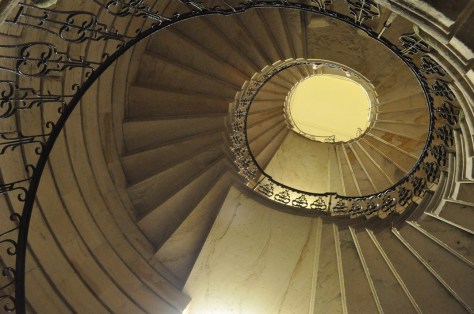
Then we moved to Costa Rica in April 1976, living in Turrialba, about 70 km east of the capita, San José. Once again I was working on potatoes and with farmers.

We enjoyed our five years in that beautiful country, and our elder daughter Hannah was born there in April 1978.

A land of volcanoes (some very active), Costa Rica is a verdant country, and there are national parks everywhere. The bird and plant life is extraordinary, so I guess this is what stands out for me in particular.

My work took me to all the countries of Central America, as well as to Mexico where, until 1977, CIP’s regional headquarters was based just outside Mexico City at Toluca. And also out into the Caribbean islands, to Haiti and the Dominican Republic, to Jamaica, St Kitts, Antigua, Montserrat, Barbados, and Trinidad.

In Mexico, most of my visits were to Toluca. But on one visit there, I joined the participants of a potato training course to study potato production in Mexico State, Michoacán, Puebla, Jalisco, and Guanajuato. Later, in the 1980s I also visited Nuevo Leon in the north, and Morelos south of Mexico City.

But if I had to choose one highlight, it would be the pyramids at Teotihuacán, northeast of Mexico City that Steph and visited in 1975 when we visited some friends at CIMMYT (a sister center to CIP) on our way back to the UK.

Guatemala is a fascinating and beautiful country, and I was a regular visitor. A land of lakes and volcanoes, it has a high indigenous population, who wear the most colorful fabrics.

In 1977, Steph and I flew into the Mayan city of Tikal, deep in the jungle, for an overnight stay.

On another trip I spent a few days in Belize, first in Belize City on the coast, then in Belmopan, the smallest capital city in the Americas.

The overriding memory I have of Honduras was the white-knuckle landings in Tegucigalpa. How they managed to land jets there is beyond me. What pilot skill!

I visited El Salvador and Nicaragua just once each, and then only overnight. They had virtually no potato sector.

Flying in and out of Panama City was quite a regular occurrence. It was a transit for Costa Rica from South America. The main potato area was in the west of the country near the frontier with Costa Rica (map), north of the city of David at Volcán and Boquete. A region of deep volcanic soils, it was very good potato-growing country, and one I traveled to by road from my base in Turrialba on a couple of occasions.

Potato fields in Boquete, northern Panama

It was only after I moved to the Philippines in 1991 that my work took me back to Costa Rica for the first time in about 15 years, and one other country, Venezuela, which I’d not visited before although landing at Caracas airport on several occasions. This airport is located on the Caribbean coast north of the city, and is connected by a 27 km motorway that crosses the mountains, a spectacular drive over what I assume is a northern extension of the Andes.

In the 1990s I spent a week in Caracas attending a potato network meeting, but seeing very little of the city, just the metro from hotel to meeting venue and back!

Another international agricultural research center in Cali, Colombia is CIAT (map), supported in the same way as CIP and CIMMYT (and the rice institute, IRRI, in the Philippines, that I joined in 1991). Located in the Cauca Valley, CIAT is surrounded by huge plantations of sugar cane, but the rice-growing area is nearby as well. The last time I was there (and in Peru and Mexico) was in July 2016 conducting a review of the CIAT genebank.

I was in Chile just the once, for a week in Santiago in July 1979. I’d flown down from Costa Rica to join two colleagues from Lima to carry out a short review of the Chilean potato program. Two things come to mind: wine and ABBA. Wine, because we were taken to dinner at Enoteca, a fine restaurant overlooking the city on Camino Real, where all the wines produced in Chile were on display, and we were invited to sample many of them. On one evening, while out enjoying some souvenir shopping, I heard (for the first time) the refrains of Chiquitita by ABBA emitting from one of the shops. My visit to Santiago will always be associated with ABBA.

What can I say about Brazil? It’s huge. My first visit there was in 1979 when I attended a potato conference at Poços de Caldas in Minas Gerais (map), followed by a couple of nights in Rio de Janeiro. On another occasion I attended a conference in Foz do Iguaçu (in Paraná state) close to the border with Argentina and Paraguay, and site of the impressive Iguazu Falls.

I’ve been to Brasilia twice, and once upon a time, that nearly became home for Steph and me when CIP’s Director General deliberated whether to post me to Brazil or the Philippines. In the event we returned to the UK in 1981 when I joined the faculty of the University of Birmingham.

I guess the most impressive thing I’ve experienced in Brazil is the statue of Christ at Corcovado, high above Rio de Janeiro, with the most spectacular views over the city. My dad was there in the 1930s.

I’ve been to Canada twice, the first time in 1979 (with Steph and 15 month-old Hannah) when I attended a potato conference in Vancouver, then we drove across the Rockies to meet up with my late elder brother Ed and his wife Linda in Edmonton, AB.

In the early 2000s, I made a short visit to Ottawa to meet with representatives of Canadian overseas development assistance agencies, and managed to spend a day getting to know the city, before heading back to the USA.

Parliament Hill from the banks of the Ottawa River

Over the decades I’ve traveled to the USA many times, and have now visited all states and DC except Hawaii, Alaska (although one flight touched down in Anchorage), Idaho, Nevada (I changed flights in Las Vegas), Oklahoma, Kansas, North Dakota, Louisiana, Mississippi, and Alabama. It’s such a vast country, but since 2011, Steph and I have managed several mega road trips and seen so many wonderful sights. It’s hard to pick any one. I have written about these trips and you can find a link here; just scroll down to the USA section).

But what highlights do I choose? The Oregon coast, Crater Lake, or the redwoods of northern California? Or would it be canyon country in Arizona? How about Yellowstone National Park, the Appalachians, the Mississippi River, Mt Washington in New Hampshire, or the coast of Maine? What about the Civil War sites like Gettysburg?

However, I’ve often said since we made the visit there in 2011, that if I ever got the opportunity to return, it would be to Canyon de Chelly in northeast Arizona. It’s a special place.

There’s not a lot of potatoes grown throughout the Caribbean, with only the Dominican Republic having any significant potato program, in the central highlands close to the border with Haiti. The Dominican Republic became one of the founder members of a regional potato program, PRECODEPA, set up in 1978, so I guess I must have traveled there five or six times.

I was just the once in Haiti, in the late 1970s attending a conference for about a week. We stayed in a nice hotel overlooking Port-au-Prince, and ventured out into the city just the once. Even then the city was not a safe place to wander round, and following the disastrous 2010 earthquake followed by the cholera outbreak, the country has become even more ungovernable, and not somewhere I would want to visit again. It’s one of the poorest countries in the Western Hemisphere.

I also paid short visits to Jamaica, St Kitts, Montserrat (which had a small but thriving potato sector before the Soufrière Hills volcano erupted in 1995, covering half the island with ash), Barbados, and Trinidad. Before long-haul jets could make the flight direct from Europe to South America, Antigua was a refuelling stop, which I made a couple of times. And after being being bumped off a flight to Montserrat, I spent the night in Antigua at a luxury resort (the only hotel bed I could find on the island!) and enjoying a delicious lobster dinner for the same price as a steak.

Asia
Let’s turn to Asia now. I spent almost 19 years in the Philippines, joining the International Rice Research Institute (IRRI) in 1991, first as head of the Genetic Resources Center (GRC, and managing the world’s largest genebank for rice) until 2001, when I became the institute’s Director for Program Planning and Communications (DPPC). In both roles my work took me all over the world. But let’s focus on the countries in the region to begin with.

My first trip to Asia, to Indonesia in fact, was in the early 1980s, when I attended a genetic resources meeting in Jakarta, but spending a weekend at the Bogor Botanical Garden beforehand. The oil palm tree on the right below is one of the original trees introduced into Asia and became the foundation of the oil palm industry.

Over the 19 years I spent living in the Philippines, I returned to Indonesia several times, the most memorable being in September 2005 when the IRRI Board of Trustees held one of it bi-yearly meetings there. Steph was able to join me on that trip, and along with excursions into the Bali countryside, we also enjoyed a long weekend break at our hotel before returning to the Philippines.

Bali landscape, Indonesia

In the Philippines, we lived in Los Baños, some 60 km south of Manila, where IRRI had its research center.

On the IRRI experiment station, with Mt Makiling (a dormant volcano) in the background.

Although we didn’t travel much around the Philippines (and apart from one short trip to Cebu, we didn’t wander beyond the island of Luzon), we went to the beach most months, and in March 2009, Steph joined me and my DPPC staff when we took an office outing over five days to the rice terraces in the mountains north of Manila. Very impressive.

Looking south towards Banaue town center.

In 1993 I learnt to scuba dive, one of the best things I’ve ever done, opening up a totally new world for me. The Philippines has some of the best diving in the world, especially at Anilao south of Manila.

Diving at Anilao, Philippines

But one of the best things about the Philippines? The Filipinos! Always smiling. Such friendly people. And I had great Filipino colleagues working with and for me in both the roles I took on at IRRI.

The ‘IRRI All Stars’ who helped during the IRRI Day in October 2002.

Colleagues from the Genetic Resources Center.

In 1995, I launched a major rice biodiversity project (funded by the Swiss government), and one of my staff, Dr Seepana Appa Rao was recruited to help the national rice program in Laos to collect native varieties of rice. Over five years, I visited Laos at least twice a year, taking part several times in a baci ceremony to welcome me to the country, and other visitors as well. Steph joined me on one trip, and here we are during one such ceremony at the house of my colleague, the late Dr John Schiller.

On that particular trip, we took a weekend off, flying to Luang Prabang and enjoying a river trip on the Mekong.

Mekong River, nr. Luang Prabang, Laos

IRRI had a country program in Cambodia, and I visited a couple of times to discuss rice germplasm conservation, and stayed in Phnom Penh. But after Christmas 2000, Steph and I were joined by our younger daughter Philippa (who had just begun her undergraduate studies at the University of Durham in the UK) for a mini-break in Cambodia (and Singapore).

We flew from Phnom Penh to Siem Reap, and spent three nights there visiting the amazing Angkor Wat temple complex, and a boat trip on the Tonle Sap, before flying back to the capital for one night, and back to Singapore.

We celebrated the New Year in Singapore, taking in the beautiful botanic gardens. Work has taken me to Singapore on several occasions, and Changi airport has to be one of the world’s aviation destinations. How it must have changed since I was last there.

Work took me to Seoul in South Korea on several occasions, and Japan. Steph joined me on one trip to Japan in September 2009 when the IRRI Board of Trustees met in Tsukuba north of Tokyo. We stayed on for a long weekend sightseeing in Tokyo, although she got to see more than I did earlier in the week, when a series of excursions for IRRI and Trustee wives were organised from Tsukuba.

Narita airport was also a hub for Northwest Airlines (now Delta) for flights from Manila to the USA, so I would fly through there at least a couple of times a year, also Osaka.

I’ve been to Beijing in China a couple of times, taking in the Great Wall during my first visit in 1995.

With my colleague, Bao-Rong Lu (middle) on the Great Wall, north of Beijing

On that trip we also took in Hangzhou and Guangzhou. I was in Beijing again around 2005 for a meeting, and in 2004, Steph and I flew to Hong Kong over Christmas and New Year. We also crossed to Macau on that trip.

The view from Victoria Peak, Hong Kong

Ruins of St Paul’s, Macau

Again, Hong Kong was one of those hub airports that I passed through many times, first at the old Kai Tak airport alongside Kowloon harbor (an interesting approach), and later at the new airport reclaimed from the sea.

I’ve only been to India a handful of times, always to meetings, and only then to Delhi and Hyderabad, so I can’t say that I’ve ever seen much of the country. There’s no doubt it’s a fascinating country, but I’m not sure it’s really on my bucket list – except if I could travel on one of those luxury trains, perhaps.

The same goes for Bangladesh, with just a couple of visits to Dhaka so I can’t say that I’ve ever known the country.

I was in Sri Lanka just the once, spending most of my time in Kandy. The hotel where I stayed was outside the city, on a hill, with breath-taking views over the surrounding hills. And I remember waking up early one still morning, and listening to the bird calls echoing all around. Magic!

I been to the north and south of Vietnam. On my first trip, I traveled to Can Tho in the Mekong Delta, and on the return journey to the airport in Ho Chi Minh City, I had to cross the river in a small boat (the bridge was down) and flag down a tuk-tuk for the last 20 km or so. I caught my flight!

Then I was in Hanoi several times in connection with the rice biodiversity project, but in 2010 I was the chair of the science committee for the 3rd International Rice Congress held in that city.

Myanmar has been closed off to visitors for many years, but I was able to visit just the once in the late 1990s, to the rice genebank at Yezin, about 250 miles north of the old capital Yangon. The train ride was interminable, and the sleeper on the return journey left a lot to be desired in terms of comfort and cleanliness. Nevertheless it was an interesting visit, but compared to the cuisine of other countries in the region (especially Thailand and Indonesia) the food was not inspiring: served quite cold and swilling in oil.

I’ve been in Bangkok many times, as it where I would change flights for Vientiane in Laos, having to spend one night to catch the early morning flight on Thai or Lao Airlines. But I never got to know the country, just a couple of visits to Chiang Mai in the north (again for meetings but no tourism). The same goes for Malaysia, with meetings in Kuala Lumpur and Penang.

In 2014 IRRI once again asked me to chair the science committee for the 4th International Rice Congress that was held in Bangkok, so I made several visits there (and on to the Philippines) before the congress was held in November.

Australia
I’ve been in Australia four times. As a family, Steph, our elder daughter Hannah, Philippa and I flew from the Philippines just after Christmas 1998 to Sydney, spending just under a week there, enjoying a trip up into the Blue Mountains, and watching the awesome fireworks display over Sydney Harbour on New Year’s Eve.

I made a work trip there around 2001, taking in Canberra, the rice-growing area in the Riverina, Adelaide, and Melbourne.

In December 2003, Steph and I drove from Sydney to Melbourne over the course of a week, taking the train back to Sydney, where we enjoyed a harbour dinner cruise.

At the Sydney Harbour Bridge during our Christmas vacation in Australia in December 2003

We spent New Year’s Eve on the south coast near Melbourne.

Next stop: Antarctica

The last time I was there was November 2016, when my friend and former colleague, Professor Brian Ford-Lloyd flew from Birmingham to Melbourne for three days as part of a review of genebanks.

Enjoying a stiff one on the Emirates A380 flight from Melbourne to Dubai.

Africa
Africa now, where I have visited Morocco in the north, Ghana, Ivory Coast, and Nigeria in West Africa, Ethiopia and Kenya in East Africa, and Zambia, South Africa, Mozambique, and Madagascar in southern Africa. I wrote this general account in 2013.

There are several international agricultural research centers in Africa: ILRI (a livestock center) in Kenya and Ethiopia; World Agroforestry (ICRAF) in Kenya; IITA in Ibadan, Nigeria; and Africa Rice (WARDA) in Bouaké, Ivory Coast. I have attended meetings there on several occasions. In Ethiopia, the ILRI campus is located in Addis Ababa, and during my first visit there, in January 1993, I had the opportunity of traveling down into the Rift Valley. What I most remember about that trip, and the stay in Addis, was the incredible bird life. An ornithologist’s paradise. Likewise on the campus of IITA in Nigeria. IITA has a 1000 ha campus, and part of it has been left as pristine rainforest with its assemblage of species, some of them crop wild relatives.

Looking for wild yams on the IITA Forest Reserve.

I made my first visit to Nigeria and Ivory Coast after the genetic resources meeting in Addis Ababa in 1993. For security reasons, visitors to IITA who arrive in Lagos in the afternoon and evening spend the night there, before being escorted to Ibadan, around 2 hours by road to the northeast. I always enjoyed my visits to IITA. But Lagos airport was another thing. The situation there did improve, but throughout the 1990s, I always felt uneasy passing through, as officials (some in uniform, others in plain clothes) would often ask for a bribe.

I must have visited Ivory Coast a couple of times, the first time flying from Abidjan (the capital) to Bouaké on the national airline, a Boeing 727 that had once been the presidential aircraft! I made those visits before the disastrous civil wars of 2002-2004 and 2010-2011.

Africa Rice had to abandon its research center in Bouaké for many years, although the institute has now returned there. I planted a tree during my first visit. I wonder if it’s still there?

With Deputy Director General Perter Matlon at the tree planting.

On another occasion, I was in Ghana for a week, attending a planning meeting, and didn’t see much of Accra outside my hotel.

I’ve been in Kenya probably half a dozen times, straddled the Equator, and enjoyed the wildlife in the Nairobi National Park.

With my dear friend from CIMMYT, the late Sir Bent Skovmand (from Denmark), wheat pathologist and then head of the CIMMYT wheat genebank.

In October 2005, I was in Marrakech, Morocco to attend the annual meeting of the CGIAR, the consortium of donors and international centers. I got sick, and I had to work on a project proposal so spent much of my time in my hotel room, with just one excursion to the souk for some souvenir shopping.

Looking for silver beads for Steph.

In southern Africa, I spent several days in Lusaka, Zambia visiting the SADC genebank there. I’ve passed through Johannesburg several times, and on my transit there (on my way to Lusaka) was caught up in a car bomb incident on the day of the election that first brought Nelson Mandela to power in April 1994. On another occasion I spent a week in Durban (meetings once again) with a side trip to Pietermaritzburg, almost 90 km inland from Durban,

IRRI had a country program in Mozambique, and I was there a couple of times. The rice program joined our biodiversity project, and the CGIAR held its annual meeting there in 2009.

I was in Madagascar just the once, staying in the capital Antananarivo on the east coast, and traveling along dreadful roads north to the rice experiment station. Madagascar also participated in the rice biodiversity project.

At a training course on rice genetic resources in Madagascar in 1998.

Middle East
I had the opportunity of visiting Izmir in Turkey in April 1972, one of my first overseas trips from Birmingham, to attend a genetic resources conference. There was an excursion to Ephesus.

On another visit (also to Izmir) in the late 1970s, I spent a day in Istanbul before taking an evening flight to the UK, enjoying the Topkapi Palace and various mosques.

The Blue Mosque

I was fortunate to travel to Syria several times, to Aleppo, before the civil war pulled the country apart. Another agricultural research center, ICARDA, had its headquarters there and genebank. I even went for a job interview once. It’s a beautiful country, and I guess many of the beautiful almond orchards have probably been destroyed in the fighting. I also spent some time in Damascus, visiting the famous souk there.

In 1982, I took a party of graduate students from the University of Birmingham to Israel for a two week course on genetic resources of the Mediterranean. I wrote about that visit here.

And then there’s Dubai in the United Arab Emirates. I’ve spent a few nights there in between flights but never had enough time to explore the city. When Emirates Airlines began a service from Manila (MNL) to Dubai (DXB), and on to Birmingham (BHX), we flew that route each year on home leave, and Emirates also became my airline of choice for trips into Europe. In the 1990s it had either been with Lufthansa into Frankfurt (FRA) or KLM into Amsterdam (AMS).

Europe
Steph and I have been married almost 50 years but we’ve never taken a vacation on mainland Europe. But my work has taken me there quite often, and to three countries, Germany, Switzerland and especially Italy, several times a year between 1991 and 2010.

On that first trip to Czechoslovakia in 1969, we traveled by road, through the Netherlands, southern German, and into Czechoslovakia.

I was next in Germany in the late 1980s, when I visited agricultural research institute near Hannover (also taking in the scenic town of Celle), before crossing into East Germany. I spent several interesting days at the genebank in Gatersleben (now part of The Leibniz Institute of Plant Genetics and Crop Plant Research), before flying on to Warsaw in Poland.

There I gave a series of seminars on crop evolution and genetic conservation (focusing on potatoes) to staff of the agricultural research institute (IHAR). My hosts took me to the family home of Frédéric Chopin west of Warsaw. As we walked around the gardens, we could hear several of Chopin’s piano pieces broadcast over speakers there. His Mazurka in D Major has remained a firm favorite ever since (here interpreted by acclaimed pianist Vladimir Horowitz), and is always a reminder of that visit whenever I hear it.

I also took in Cracow in the south of the country, a most elegant city.

While I was DPPC at IRRI, my work with the institute’s donors took me many times into Europe, particularly to Germany (Bonn and Frankfurt), to Switzerland (at Bern), and to Rome in Italy.

I had a good friend, plant pathologist Dr Marlene Diekmann, who lived near Bonn, and who worked for one of the German aid agencies. Whenever I was in Bonn, we’d try and spend some time walking the wine terraces of the Ahr Valley south of Bonn.

The last time I was in Bonn was 2016 during the genebank review I mentioned earlier.

I love trains, and have often traveled that way from one European capital to another. In fact I have traveled from my former home of Bromsgrove in Worcestershire to Rome, with stops in Belgium, Germany, and Switzerland on the way.

One of the best trips I made was to view the Matterhorn in Switzerland near Zermatt. I had a free weekend before I had to travel on to Rome, so I took the opportunity of a day excursion from Bern.

My trips to France have taken in Paris, where I spent a very wet weekend once walking around the city. But it was worth it. And to Montpellier on the Mediterranean coast several times, the last being in 2016.

Brussels (in Belgium) has a beautiful central square, but I’ve never had much time to explore there.

For many years, Amsterdam was a hub airport for home leave flights back to the UK. In the Netherlands, I’ve spent time in the university town of Wageningen (east of Amsterdam), in the capital, The Hague, and in Amsterdam itself. A boat tour of the canals is well worth it.

My donor trips took me to Lisbon in Portugal and Madrid in Spain, which I wrote about in this blog post from 2019. Then in 2012, Steph and I visited my late eldest brother Martin and wife Pauline at their beautiful home in Tomar, north of Lisbon. What a glorious 10 days.

Central square in Tomar

I was in the Canary Islands (part of Spain) a couple of times, collecting various wild crop relatives. Steph, the girls, and me had a holiday there in 1989.

On the north coast of Tenerife

Looking over the Tenerife landscape.

However, the country I have visited most in Europe is Italy, and Rome in particular. I was once in the Po Valley southwest of Milan, looking at the rice research there. The Food and Agriculture Organization of the United Nations (FAO) has its headquarters in Rome, as does Bioversity International (formerly the International Plant Genetic Resources Institute, IPGRI). I guess over the 19 years I spent in the Philippines, I must have traveled to Rome at least once a year for one meeting or another, and up to five times in one year. It’s a magnificent place, although my elder daughter Hannah who has just spent a few days there commented on how dirty it was, and full of tourists. But I’ve always enjoyed my stays there, and have had ample opportunity to enjoy the history and archaeology, and the fantastic cuisine.

I’ve only been in Austria, Norway, and Denmark on one occasion each, and in the capitals Vienna, Oslo, and Copenhagen. In Vienna, I spent a week at the International Atomic Energy Agency (where they have a program in mutation breeding) consulting on germplasm databases. I visited donor agencies in Norway and Denmark, but had no time for any tourism in Oslo. It was a different situation in Copenhagen where I looked round the pretty city over a weekend.

I started this blog post in the Republic of Ireland, and Steph and I have returned there three times, two with Hannah and Philippa in the 1990s, and also in 2017 after we’d spent a little over a week touring Northern Ireland.

Northern Ireland was a revelation. Prosperous, and beautiful. We visited many National Trust properties over there, and I wrote about our 10 days there afterwards, with links in the post to many of the properties we visited.

Giant’s Causeway, Northern Ireland

In Great Britain (United Kingdom minus Northern Ireland), Steph and I have visited so many National Trust and English Heritage properties around the country. This link gives a complete list (and maps) of all those we have visited.

Since we returned to the UK in 2010, we have toured Scotland, spent time in the south and southeast of England, and in Cornwall.

Now that we are living in the northeast of England, we have spent time exploring Northumberland, including its incredible Roman heritage.

The Whin Sill along Hadrian’s Wall

As a small boy, I spent many holidays with my parents in different parts of Wales, and Steph and I will be returning there at the beginning of September to renew our acquaintance with North Wales after so many decades.

So, there we have it. Fifty-five years of travel. So many special experiences.


An oasis of tranquillity . . . and statues

It really is! Standing at the heart of Crook Hall Gardens along the bank of the River Wear in Durham, it’s hard to believe you are only a short distance from the center of a bustling city. Peaceful hardly describes it. Just the occasional rumble as trains arrive at or depart from Durham railway station just to the north.

The River Wear alongside Crook Hall Gardens.

Since we returned from our trip to Minnesota towards the end of June, there have been few opportunities, weather-wise, for any excursions. I can’t remember when we last experienced such a dismal July (after all the hot dry weather of June); it’s been so cold and wet.

Anyway, the forecast for yesterday seemed hopeful, so we decided to make the short, 22 mile and 30 minute drive south to Durham to take in Crook Hall Gardens. The Trust acquired the property in 2022, and if I understood correctly, it was opened to the public for the first time in March this year.

Crook Hall has its own car park, free for National Trust members, that really is a blessing in a city where parking is at a premium, and not cheap. We arrived around 10:20, and headed immediately to the cafe for a refreshing Café Americano.


The gardens have been there for many centuries. In fact there is a 14th century medieval hall (which is open to the public) adjoining an 18th century Georgian house overlooking a beautiful walled garden.

Crook Hall was a family home since the 1300s, and occupied over the centuries by several families who stamped their mark on the property. Originally it was the home of the Billingham family for 300 years from 1372. Between 1834 and 1858 it was rented by the Raine family. Canon James Raine (right, 1791-1858) was a historian and librarian at nearby Durham Cathedral. He died at Crook Hall.

By 1979 the property was essentially derelict, but was taken on by Mary and John Hawgood who rescued it from oblivion. Mary believes she saw The White Lady of Crook Hall in 1989. The Hawgoods moved on in 1995 when it was sold to Maggie and Keith Bell, and Crook Hall became a wedding venue, with the gardens open to the public on occasion.

With the onset of the Covid-19 pandemic, the Bell’s wedding business collapsed, and in 2020 Crook Hall was put up for sale. Then, in stepped the National Trust – thankfully.

Here’s a potted history of Crook Hall from a 2020 article in The Northern Echo.


The gardens, which cover about 10 acres (or 4 ha), comprise a series of interconnected gardens, each with their own character, are a credit to the National Trust garden staff and volunteers.

Being mid-summer, many of the flower beds were in full bloom, although roses and some others were past their best. Notwithstanding, the gardens were a delight for the spirit, and by the looks on the faces of other visitors (it was quite busy considering) they also felt the same way.

A path leads up the garden from the entrance and cafe, and immediately on the right is a cotoneaster maze planted in 2000. We gave that a miss, heading instead for the Solar Wing Garden and the Walled Garden.

I really do like the style of planting adopted at Crook Hall, with so many different species clustered together to provide a kaleidoscope of color.

Adjacent to the medieval hall is a second-hand bookshop in the Georgian house, and on one wall, some of the brightest—and botanical—wallpaper I have ever seen.

Passing through a small courtyard (with a small fountain and yet another statue) we headed towards the Moat Pond at the top of the garden. The pond itself is a relatively new feature, created in 1998 beside what was a 14th century defensive dry ditch.

Turning back towards the entrance, there is a series of four gardens: the Silver and White Garden (dating from 1983); the Orchard; the Shakespeare Garden (with Will observing the garden from a corner); and finally the Cathedral Garden, with its magnificent views towards the city and Durham Castle and Cathedral. There’s also a Wooded Glade.

As you exit the Cathedral Garden and turn towards the maze, a side path leads to a pebble garden. Also there are informal beds of wild flowers.

Ever since we noted, in the National Trust Handbook for 2023, that there was a new property in Durham, we’ve been waiting for an appropriate day to visit. Although the weather had been forecast as showery, we only experienced (for just a short while) threatening black clouds overhead, but apart from that, a bright and sunny—and for once, warm—day. We shall return.

I have posted a full album of photos here.