A botanical field trip to the south of Peru . . . 45 years ago

In 1976, a paper appeared in the scientific journal Flora, authored by University of St Andrews botanist Peter Gibbs¹ (now retired), on the breeding system of a tuber crop, oca (Oxalis tuberosa), that is grown by farmers throughout the Andes of Peru and Bolivia.

Like a number of Oxalis species, oca has a particular floral morphology known as heterostyly that promotes outcrossing between different plants. In his 1877 The Different Forms of Flowers on Plants of the Same Species, Charles Darwin had illustrated (in Fig. 11) the particular situation of tristyly in ‘Oxalis speciosa‘, the same floral morphology that is found in oca. In this illustration taken from Darwin’s publication, the ‘legitimate’ pollinations are shown; stigmas can only receive pollen from stamens at the same level in another flower.
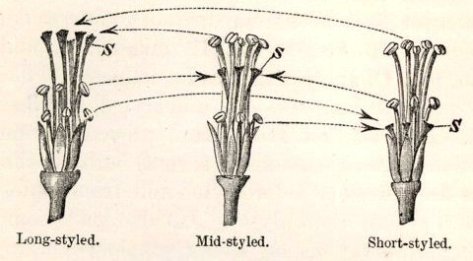
Anyway, to cut a long story short, Peter had visited Peru in early 1974 (hard to believe that it’s 45 years ago), made collections of oca from a number of localities, particularly one village, Cuyo Cuyo, in the Department of Puno in the south of Peru (just north of Lake Titicaca), and then studied the breeding system of the oca varieties that he’d collected. His 1976 paper in Flora emanated from that field trip.


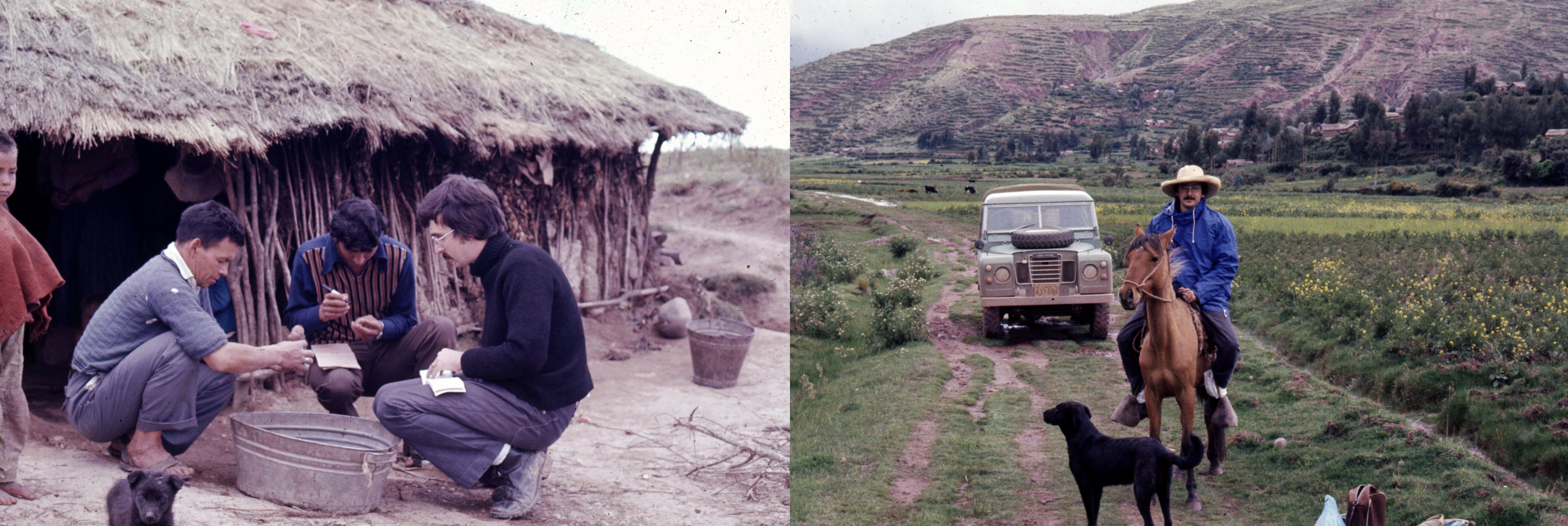
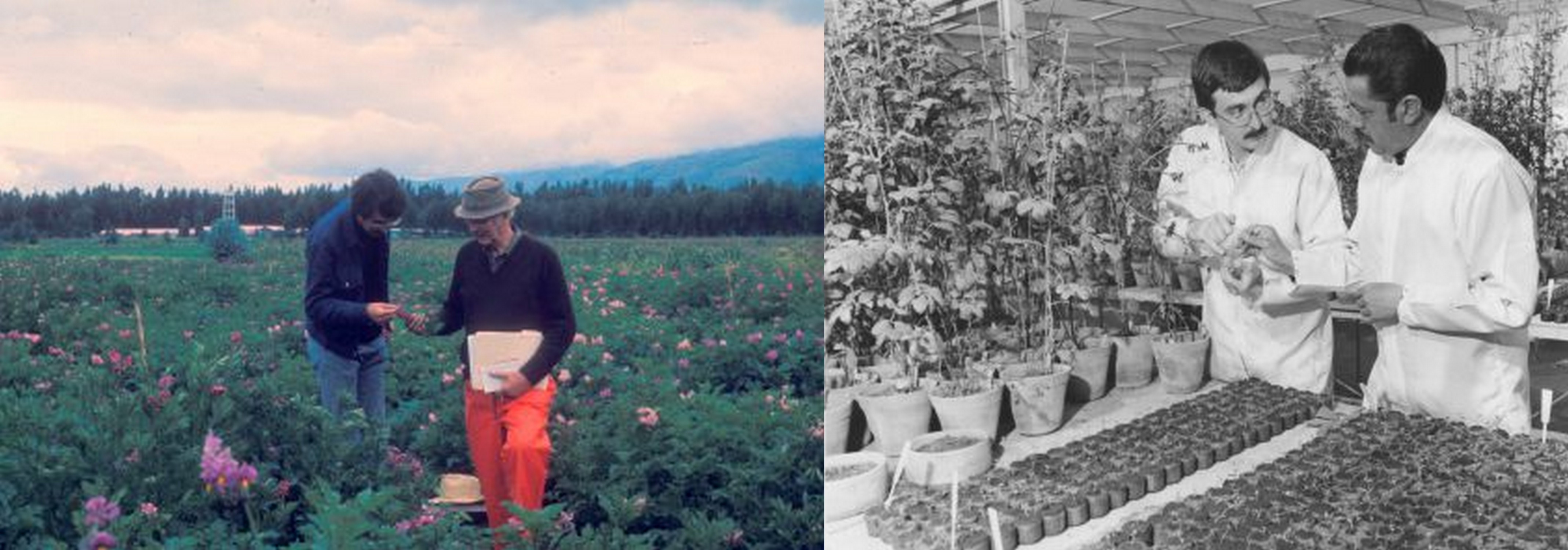
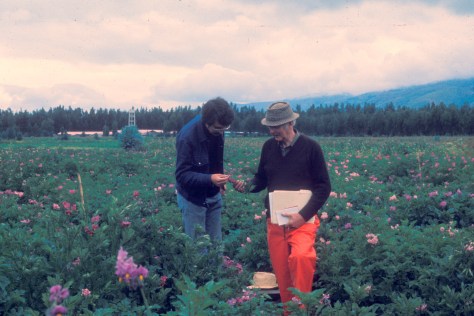
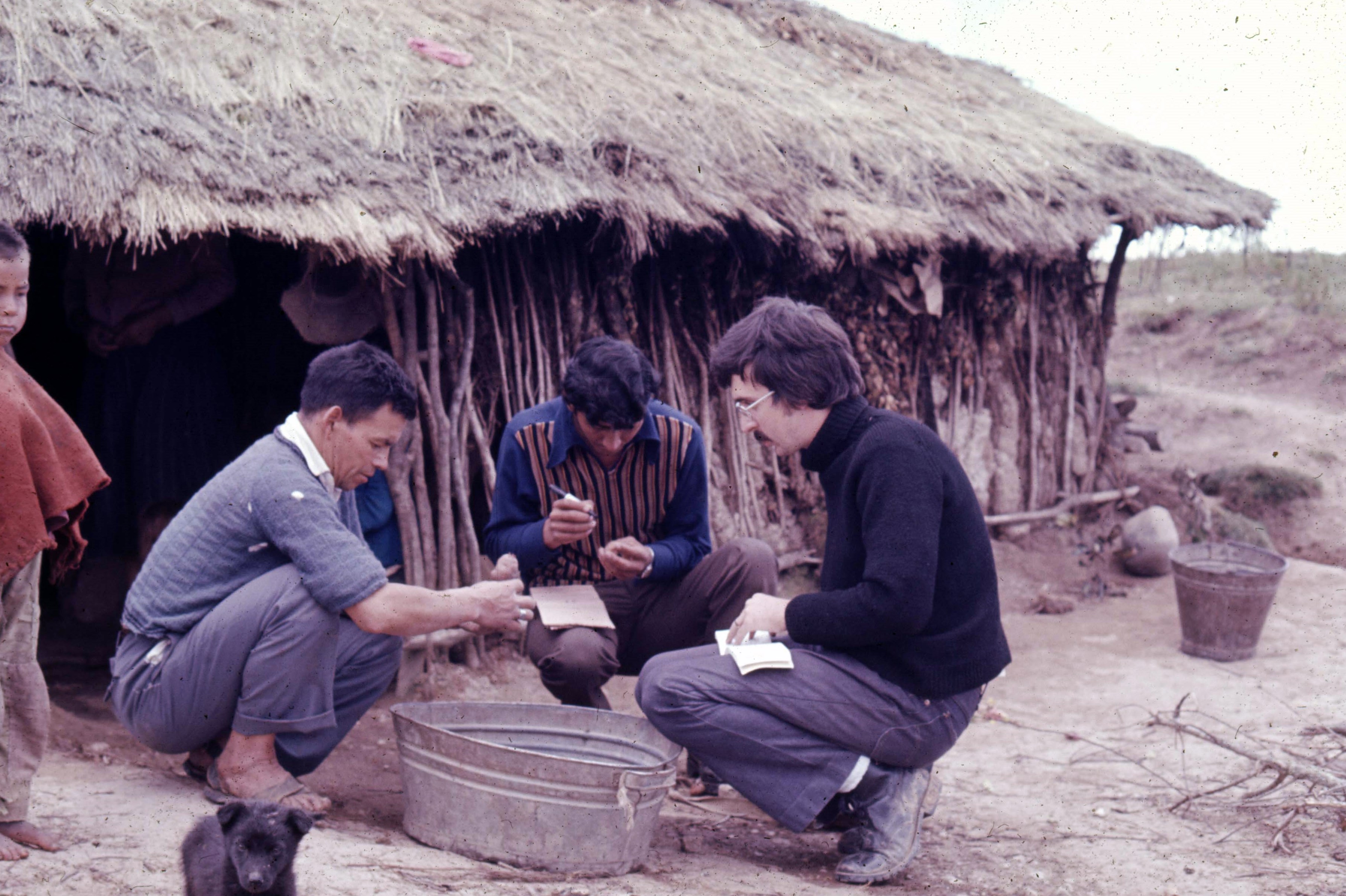
But there’s more to that story (and publication) than meets the eye. It was also tied up with the research I was carrying out on potatoes in the Peruvian Andes at that time. Peter and I made that field trip together, spending at least three weeks on the road, before flying back to Lima from Cuzco.
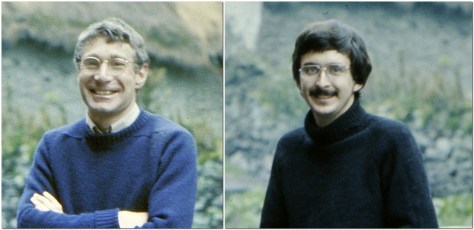
I don’t recall precisely when I first met Peter. We were obviously in touch when planning the trip south, but I simply can’t remember whether, during 1973, Peter had passed through Lima where I was working at the International Potato Center (CIP) in La Molina since January that year, or he had contacted CIP’s Director General Richard Sawyer asking if the center could provide logistical support and the DG had passed that request on to me. Whatever the course of events, Peter and I came to an agreement to make a field trip together to the south of Peru.

This is the route of more than 2000 km that we took.

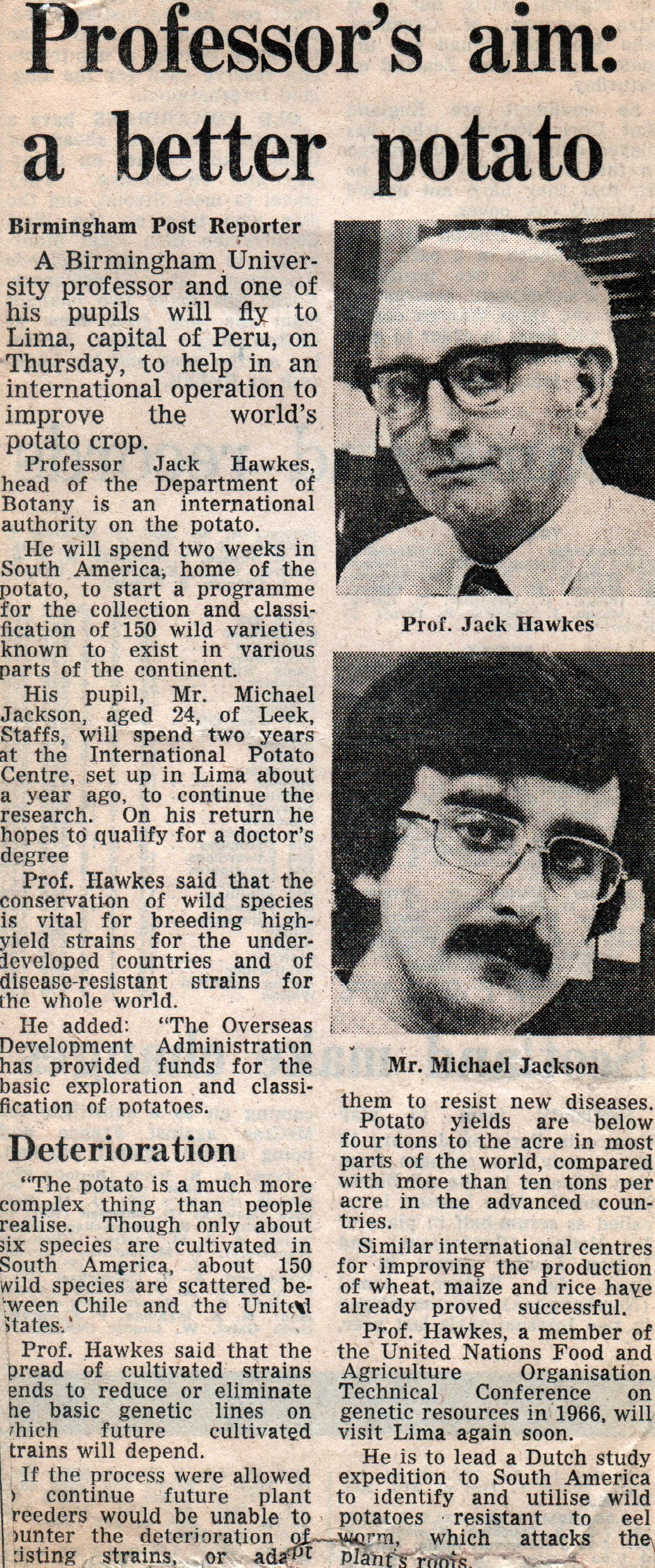
While working as an Associate Taxonomist at CIP I was also registered for a PhD in potato biosystematics (under potato expert Professor Jack Hawkes at The University of Birmingham) which I was expected to complete by 1975. My work, studying the breeding relationships of potato varieties with different chromosome numbers was similar, in some respects, to that Peter envisaged with oca.

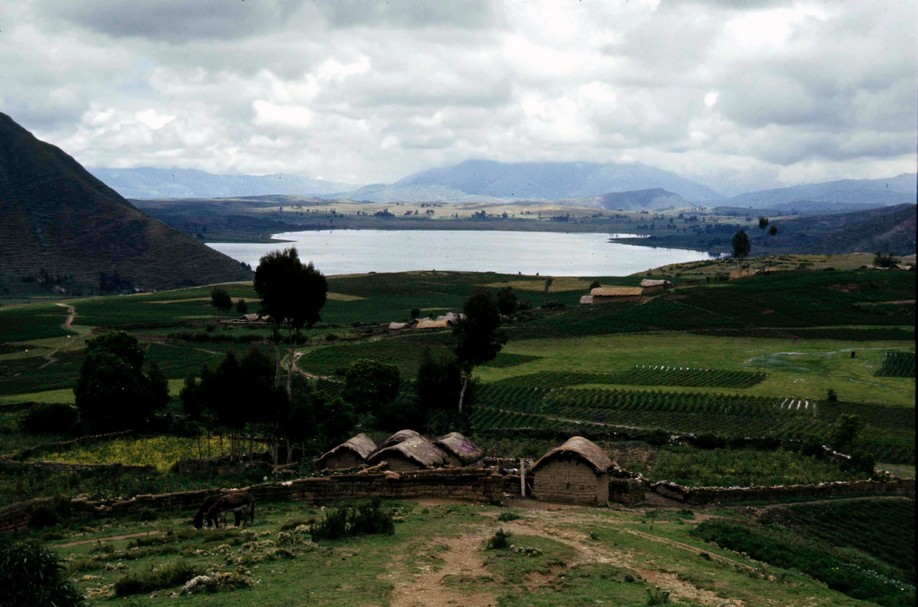
I’d been looking for suitable field locations where it might be possible to study the dynamics of potato cultivation in an ‘unspoiled’ area where mostly traditional potato varieties were cultivated rather than varieties bred and released on the market in recent years. At the back end of 1973 I made a short visit to Puno on the shore of Lake Titicaca to explore several possible field sites. Then, Peter proposed we visit the remote village of Cuyo Cuyo, around 250 km north of Puno. He’d come across a paper (either one by AW Hill in 1939 or another by WH Hodge in 1951 – both are cited by Peter in his Flora paper) that described widespread oca cultivation at Cuyo Cuyo on a series of ancient terraces, but also of potato varieties. I wasn’t sure if this was the location I was looking for, but agreed that we could explore Cuyo Cuyo first before heading north towards Cuzco in search of other likely sites.


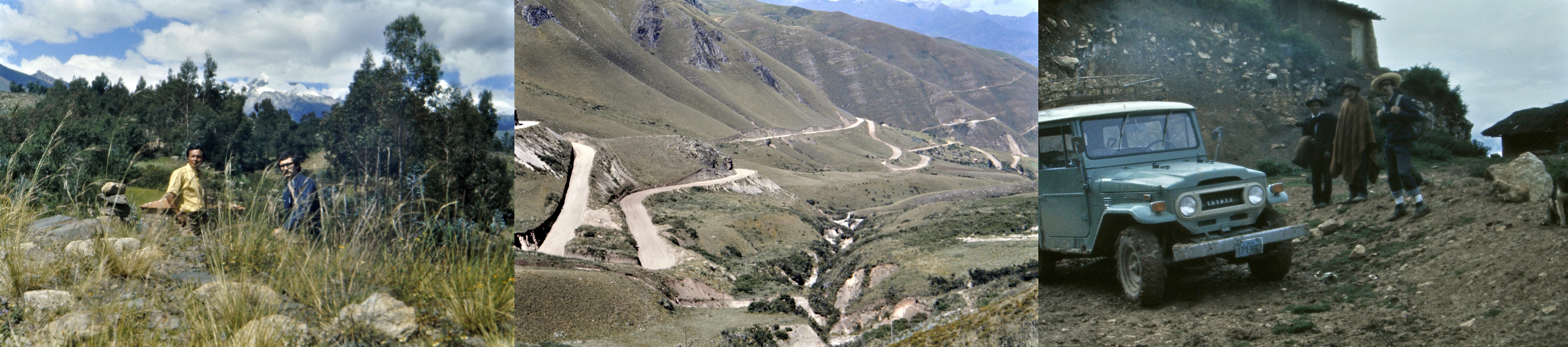
Our journey south to Puno took at least three days if memory serves me correctly. Our trusty chariot was a short wheelbase Land Rover, with a canvas hood.
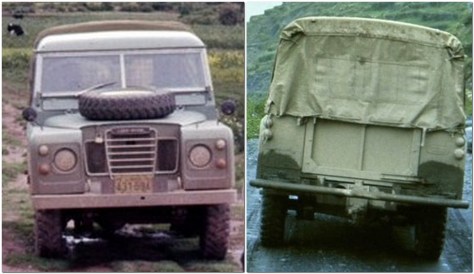
Not the most secure vehicle if you have to park up overnight in an unprotected lot. Nor the most comfortable; very sturdy suspension. But an excellent vehicle otherwise for ‘driving’ out of tricky situations.

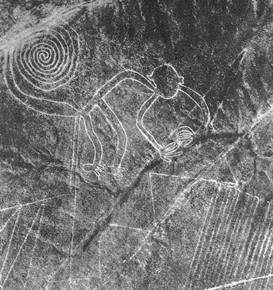
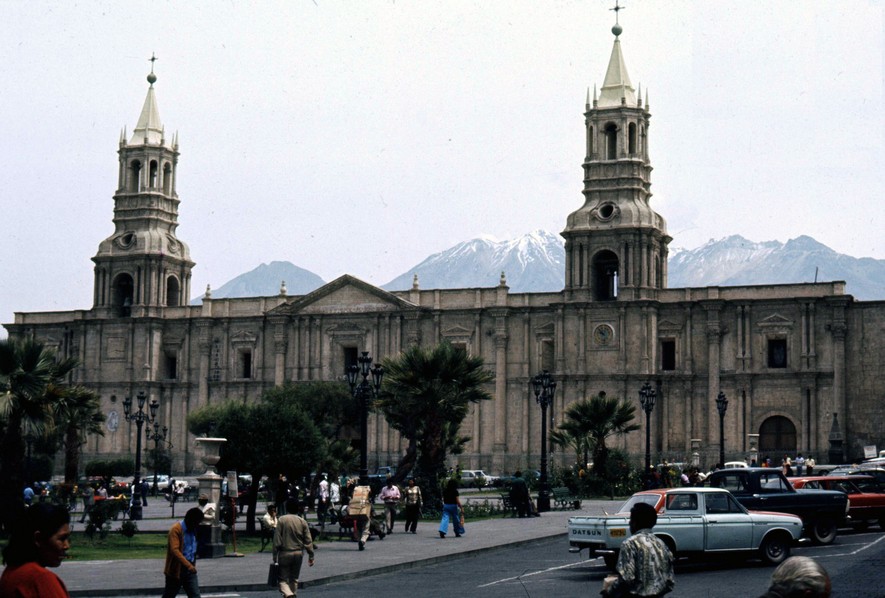
We headed south on the Panamericana Sur, stopping at Ica or Nazca on the first night south of Lima, then on to Arequipa on the second day.

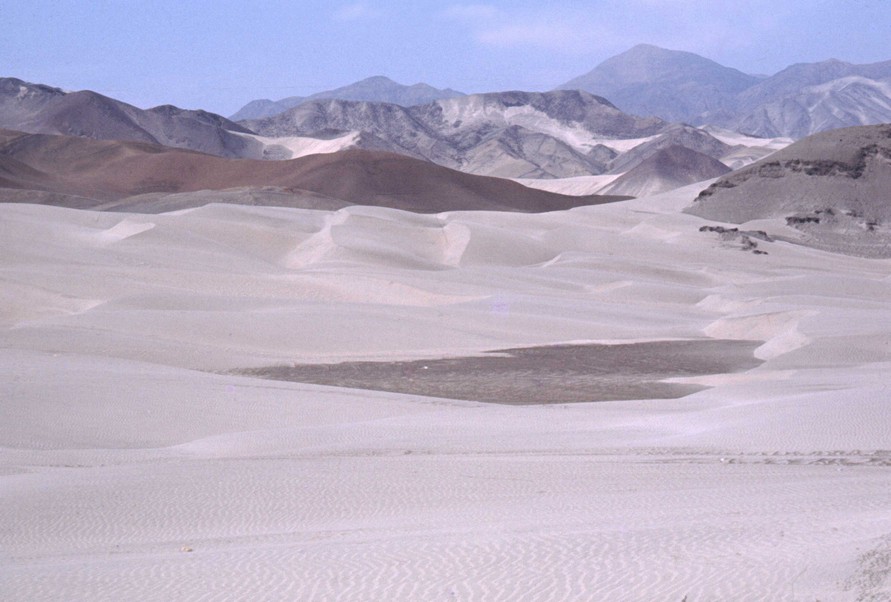
The Panamericana hugs the coast through the southern desert, crossing river valleys that flow down from the Andes to meet the Pacific Ocean. Along these, and in the area of Camana (where the road heads inland to Arequipa) quite a lot of rice is grown.

From Arequipa it must have taken another day to travel to Puno across the altiplano.

We then had another night to recoup in Puno, enjoying a comfortable bed, some good food, and perhaps one too many algarrobina cocktails (made from pisco) that Peter had taken a shine to.
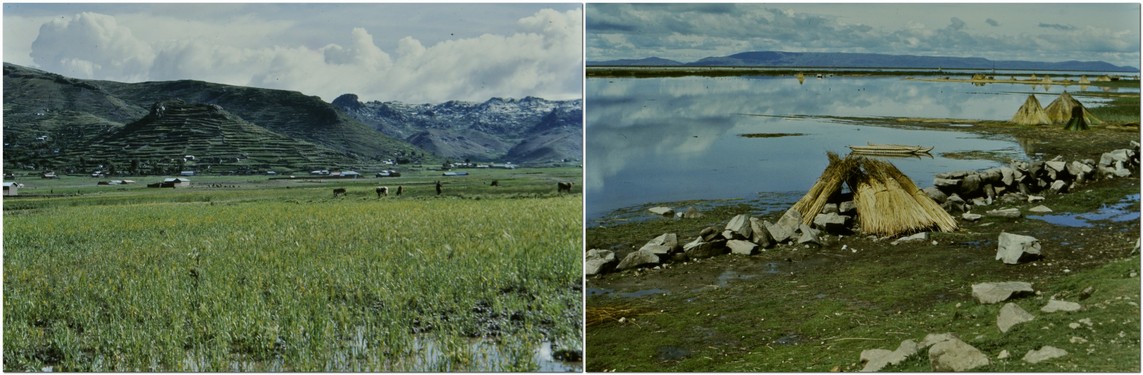
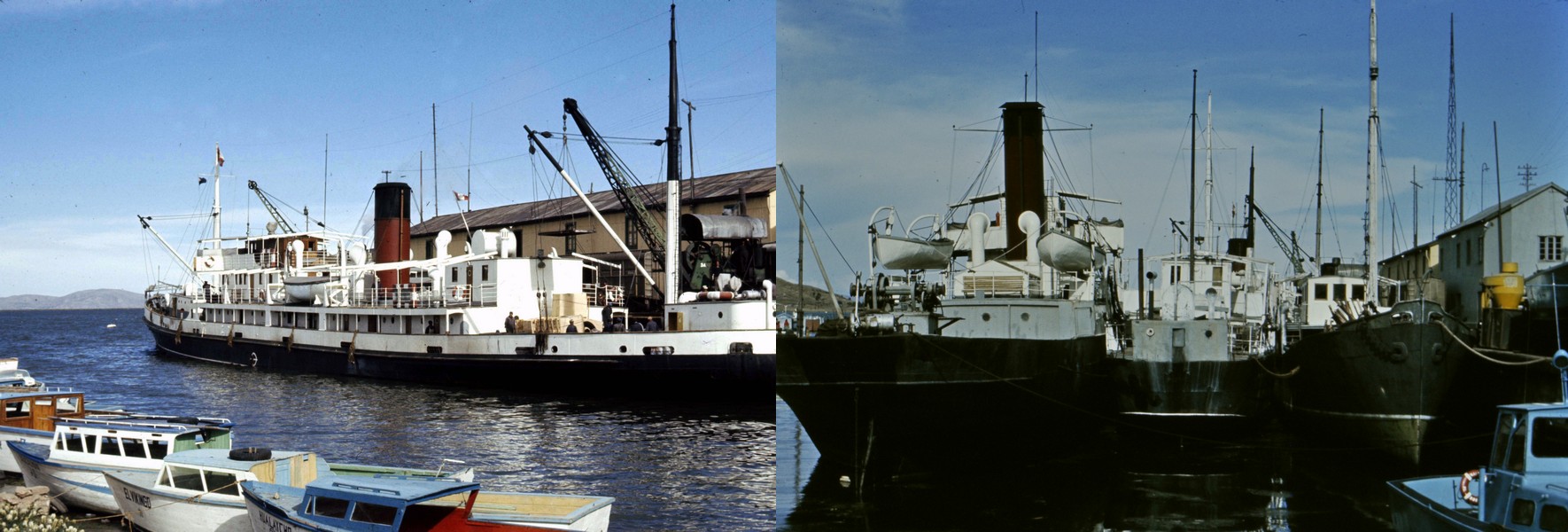
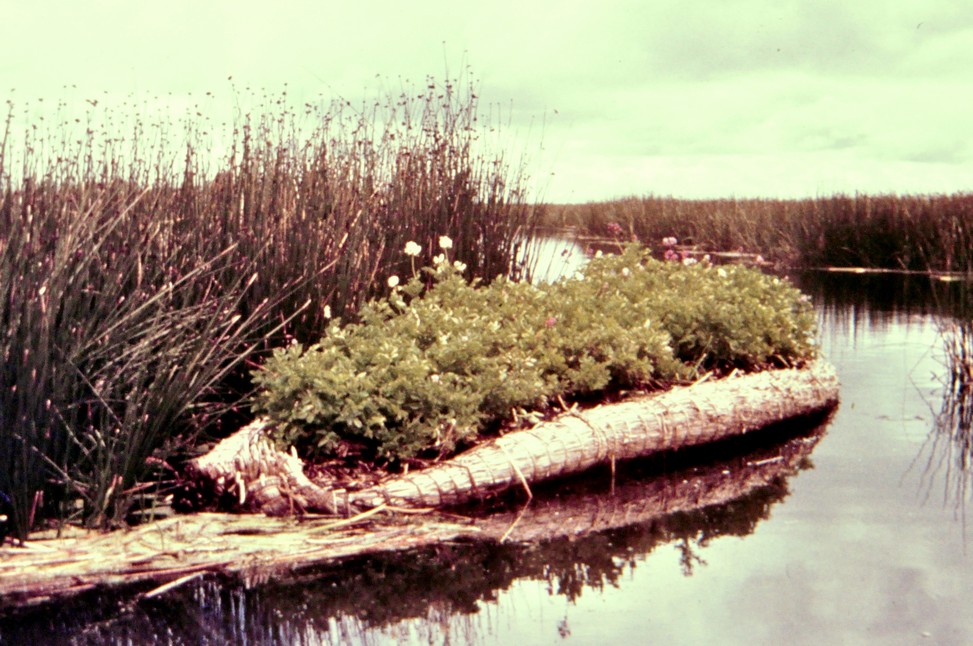
Along the shore of Lake Titicaca near Puno


It took a day to travel to Cuyo Cuyo, across the altiplano (>4000 masl), fording rivers, and then, as we approached the village from the south, dropping into a steep-sided valley, the Sandia Gorge.

We hit a cloud layer, obscuring views of the valley, but also coming across a landslide that had to be cleared before we could make progress.

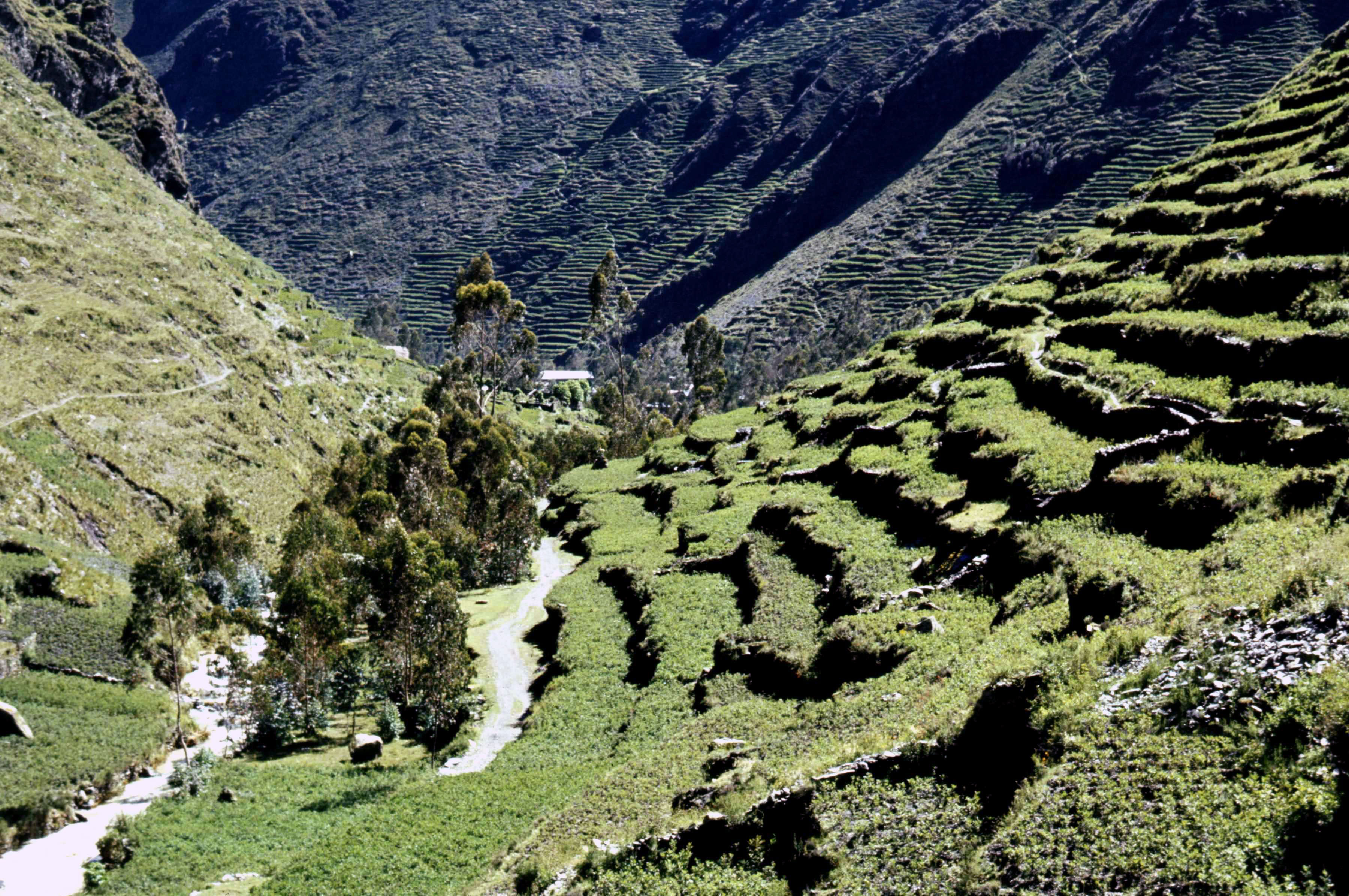
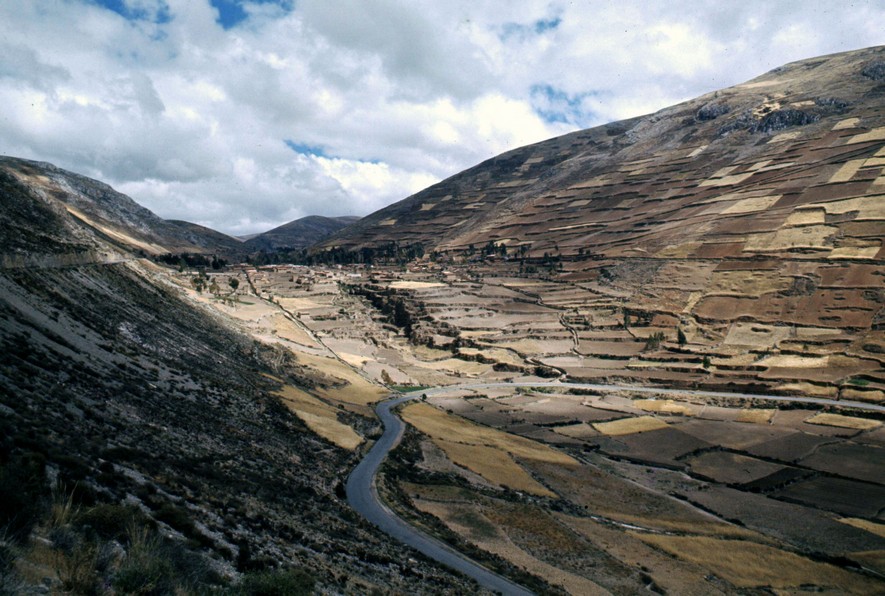
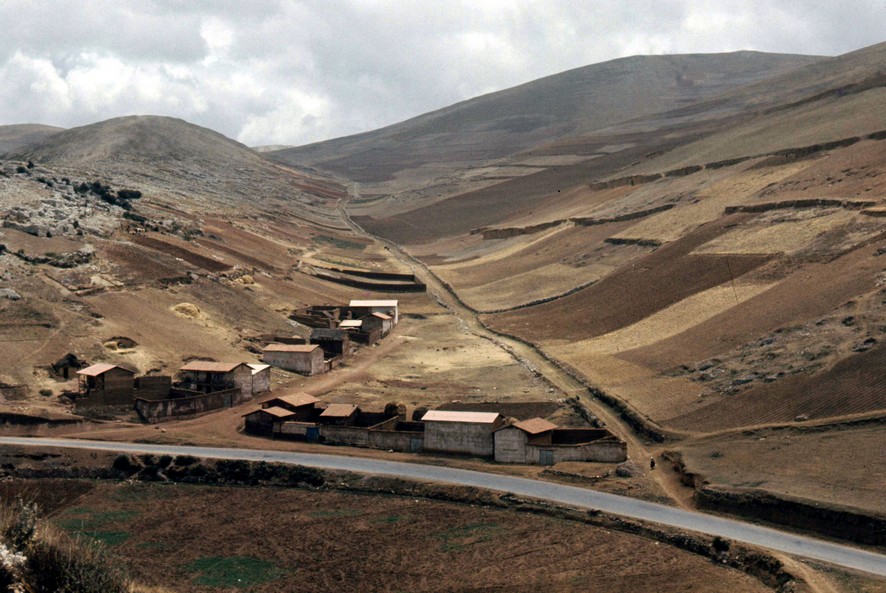
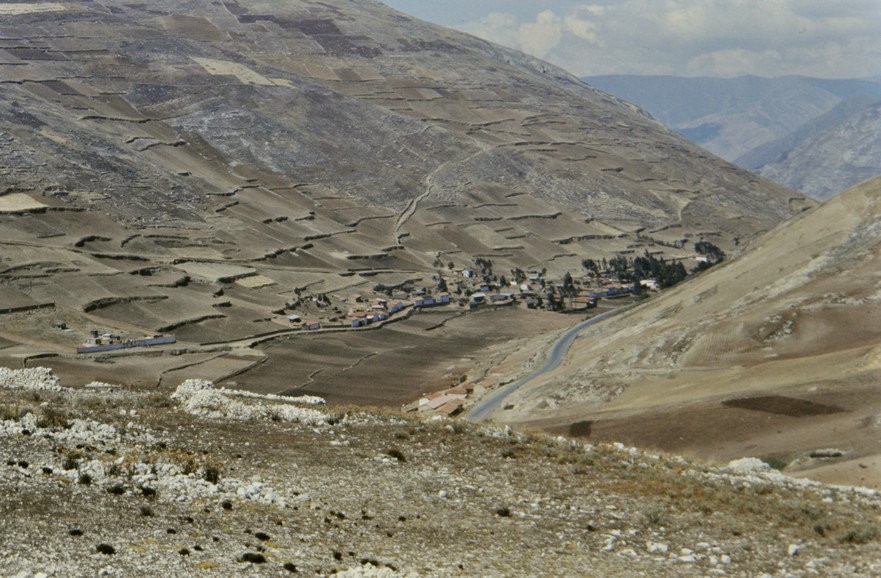
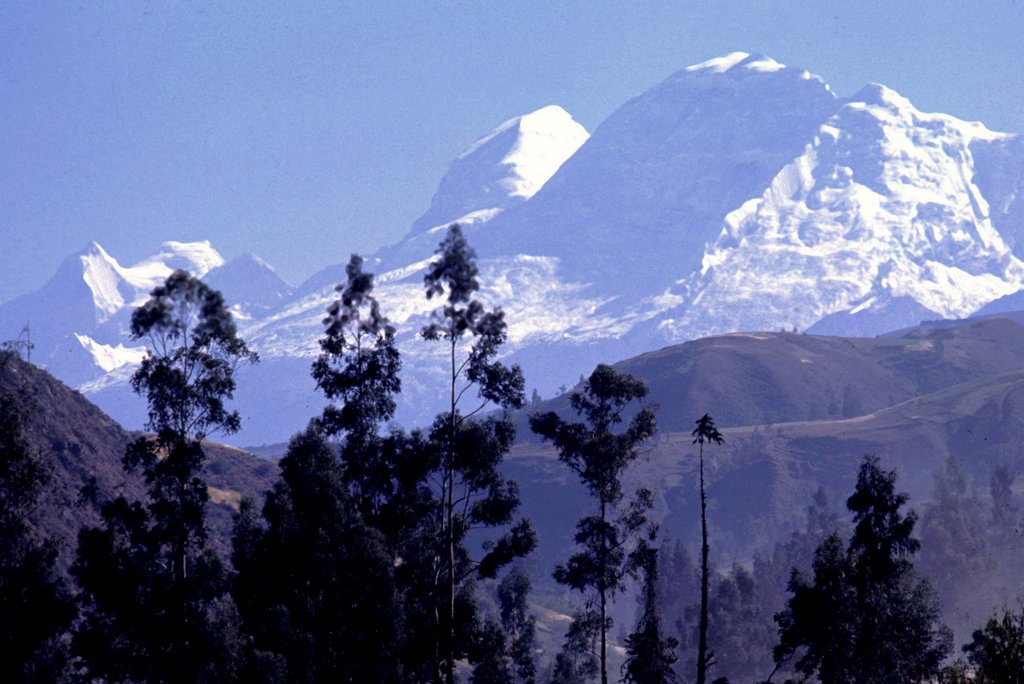
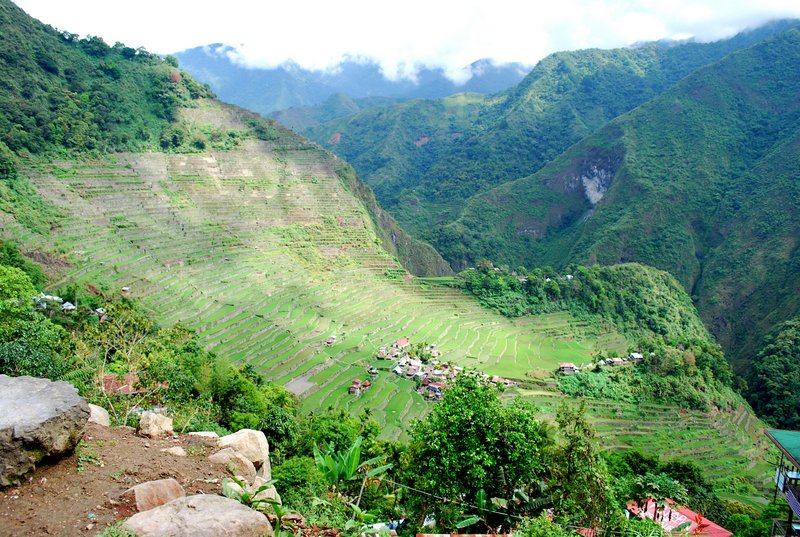
Once past that barrier, the cloud cleared and we began to see something of the majesty of the Cuyo Cuyo valley, with the steep valley sides covered in ancient terraces that, as we discovered over the next few days, were still be farmed communally as they had been for generations apparently. On the descent into Cuyo Cuyo, the banks alongside the road were also covered in masses of a beautiful begonia (Begonia clarkei Hook.) with large white flowers about 3-4 inches in diameter.


Where to stay? There was no hotel or pensión in Cuyo Cuyo. We did however have some camping gear with us such as camp beds, sleeping bags and the like. Plus all our other equipment for collecting (and drying) herbarium samples, and flowers and flower buds for pollen and chromosome studies.

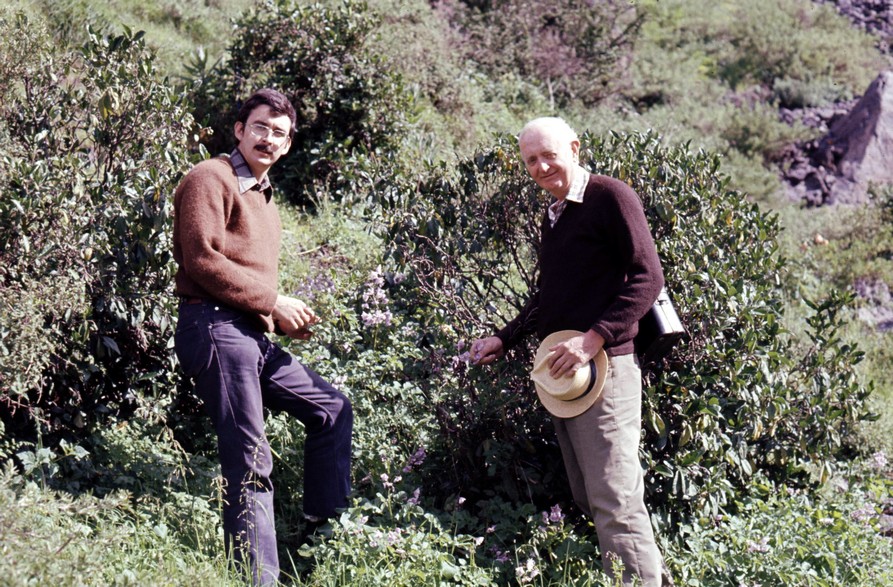
After some enquiries we met Sr Justo Salas Rubín (who was, if I remember correctly, the local postmaster – seen with Peter below) who gave us space in one of the rooms of his home (the ‘post office’?) to set up ‘camp’. We also soon became quite a curiosity for the local children (and some animal friends as well).

I was not disappointed that we chose Cuyo Cuyo first. It was an extraordinary location where we could interact with potato and oca farmers who grew a wide range of varieties, and who were open to collaborate with us. Since that visit in 1974 several other botanists (and anthropologists) have made field studies at Cuyo Cuyo on the agricultural terraces that I described here.

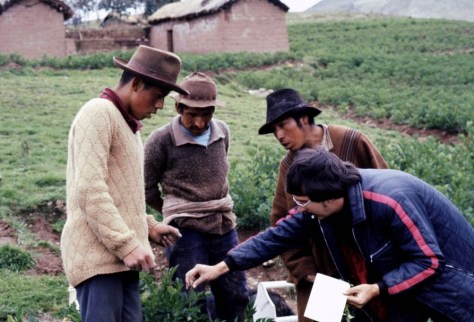
While Peter set about collecting samples in the many oca fields (mainly beside the river on the valley floor), I set off up the terraces to study a couple of fields for their varietal composition, the ploidy (or chromosome number) of these varieties, and the factors that led farmers to accept or reject varieties. I was interested to see how triploid varieties (sterile forms with 36 chromosomes that can only be formed following hybridization between varieties with 48 and 24 chromosomes) could enter farmer systems, and at what frequency.

I also looked at the methods used to cultivate potatoes, and the tools used.²
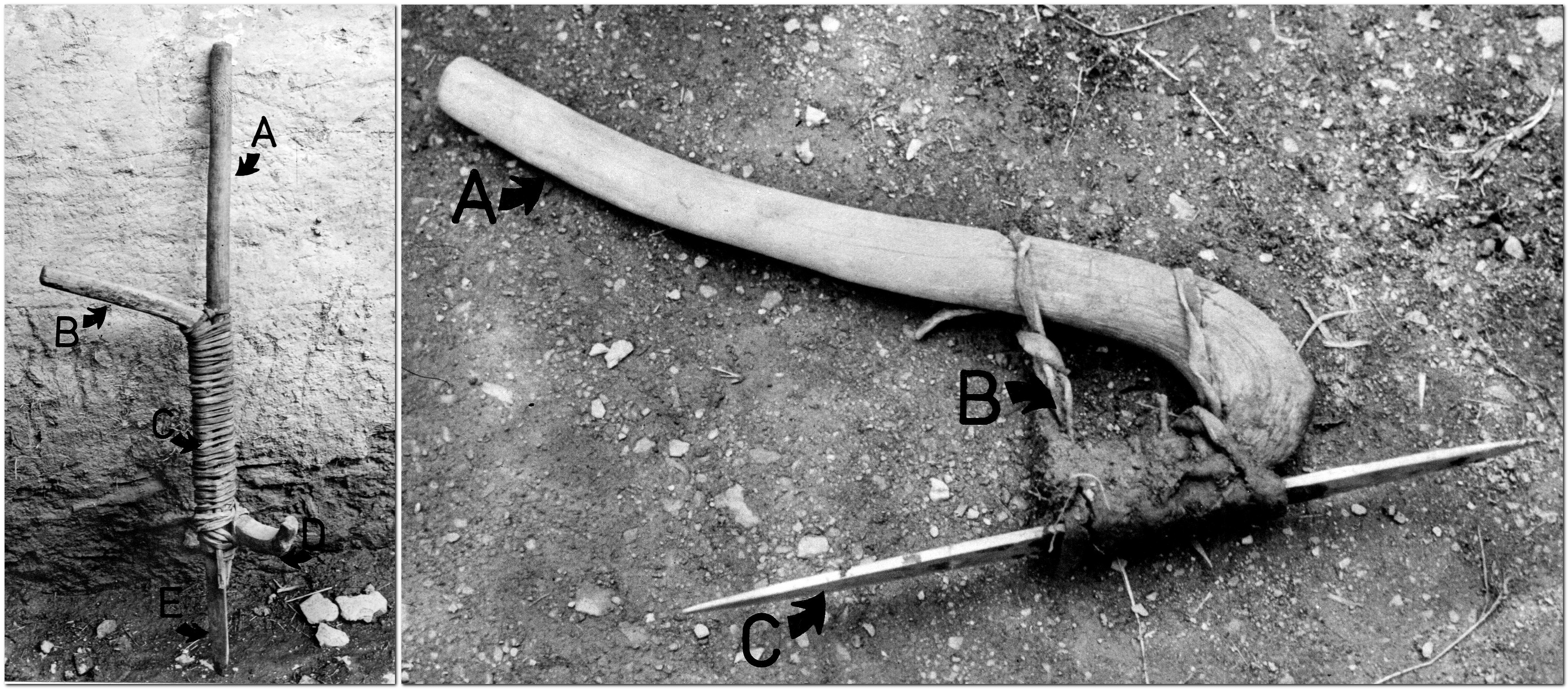
On the left is a foot plough, about 4 feet in length, known in Cuyo Cuyo as a ‘huire’ (most often ‘chaqui taccla’ in other parts of Peru). Its component parts are: A. ‘calzada’ that rests on the shoulder; B. ‘huiso’ or hand grip; C. ‘lazo’ or leather binding fastening the parts together; D. ‘taquillpo’ or foot rest; and E. the ‘reja’ or blade. On the right is a hand tool used for harvesting potatoes (and presumably oca as well) called the ‘lawccana’, as well as other cultivations during the growing season. Its component parts are: A. the ‘ccalo’ or handle; B. the ‘lazo’, a leather thong holding the blade C. or ‘chonta’ on to the handle.

My paper on potatoes at Cuyo Cuyo was finally published in 1980 in the journal Euphytica. And that’s a tale in itself.³

Peter was keen to make herbarium sheets of many of the varieties he’d collected. We set up a dryer in the house where we were staying. But there was a problem. Most of the samples were pretty wet to begin with, as we experienced intermittent rain during our stay in Cuyo Cuyo. Oca stems are very fleshy, and despite our best efforts, they just didn’t dry out. Even when we got them back to Lima, and Peter prepared them for shipping back to St Andrews, many of the samples were still showing signs of life.
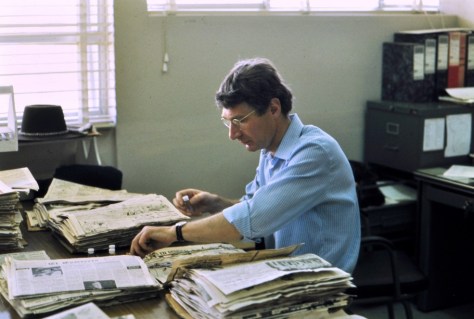
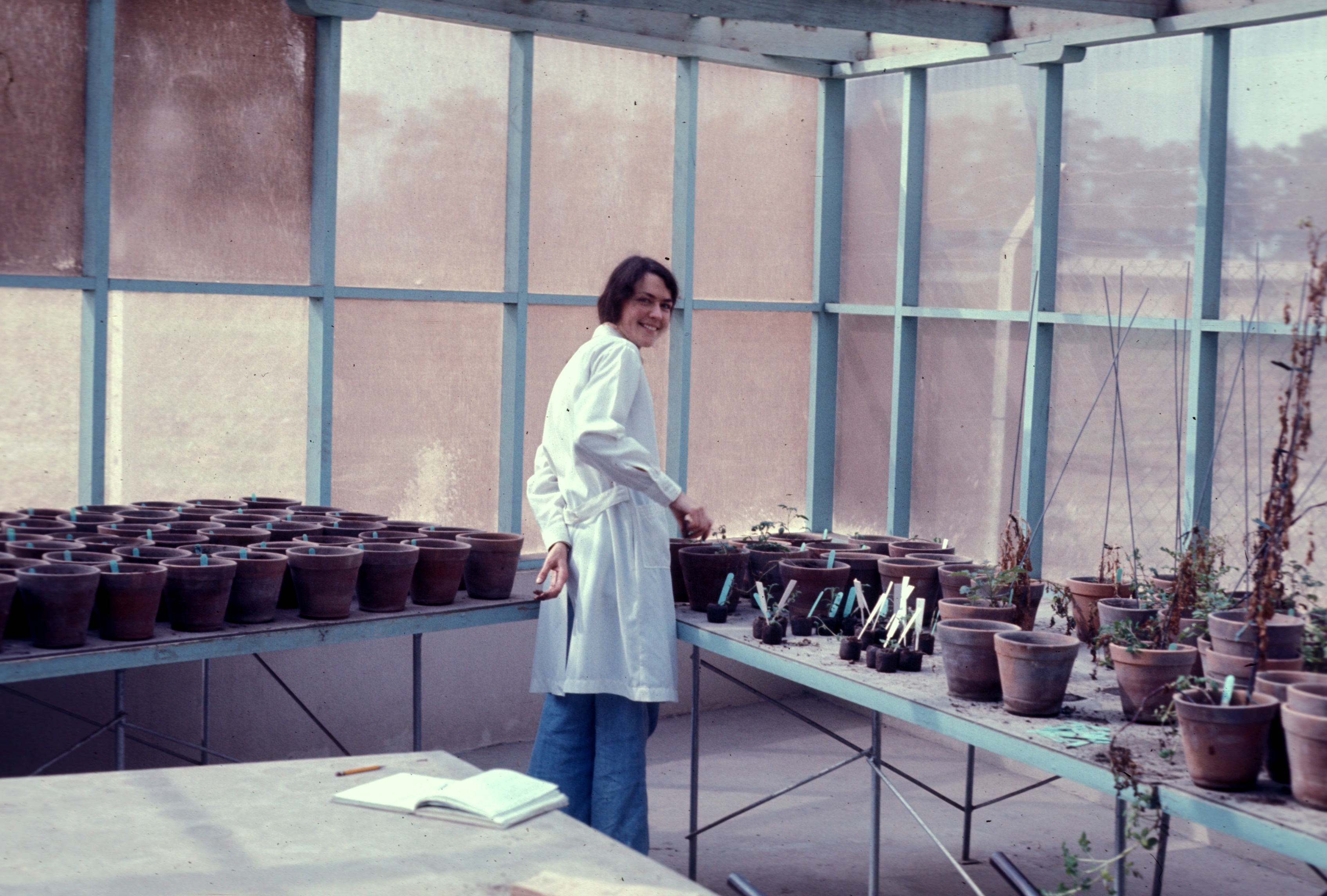
Indeed, after he returned to Scotland, Peter was able to take cuttings from his herbarium samples and grow plants to maturity in the glasshouse, thus continuing his studies there.


After three or four days in Cuyo Cuyo, we retraced our steps to Puno, then headed north towards Cuzco and further study sites near Chinchero.

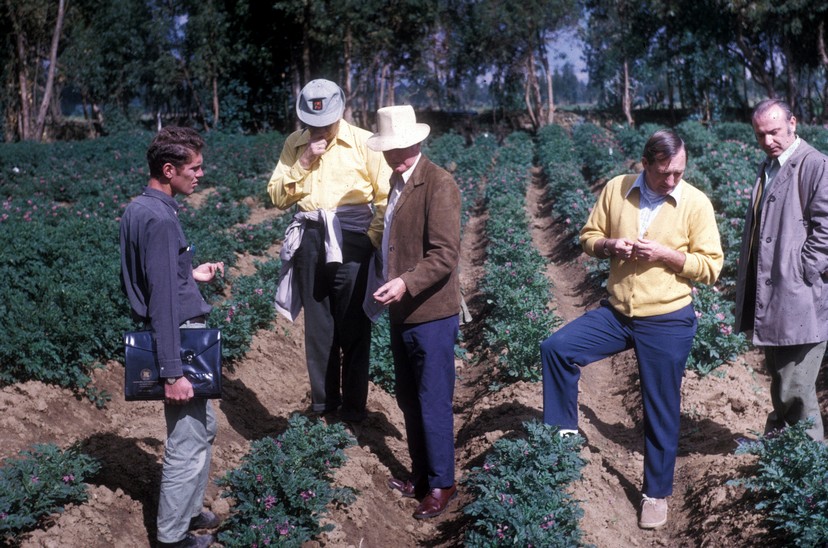
At these, I was particularly interested in taking flower bud samples from different potato fields. In the area we chose, farmers grew a combination of bred varieties for sale in the local markets of Cuzco and, around their homes, native varieties for home consumption. In this photo, large plantings of commercial varieties stretch into the distance. Around the homes in the foreground, in walled gardens, farmers grew their native varieties.
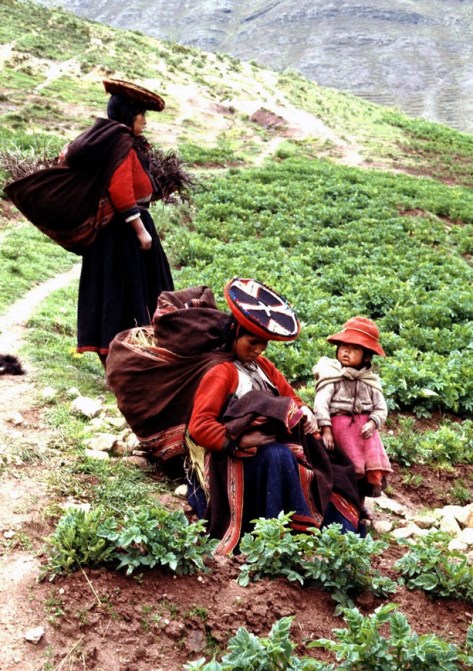
As I was busy looking at different varieties, these two women came by, and one sat down to breastfeed her baby. They are wearing the traditional dress of that region of Cuzco.
On another day we set out to study potato (and oca) fields a little more remote, so had to hire horses to reach our destination.
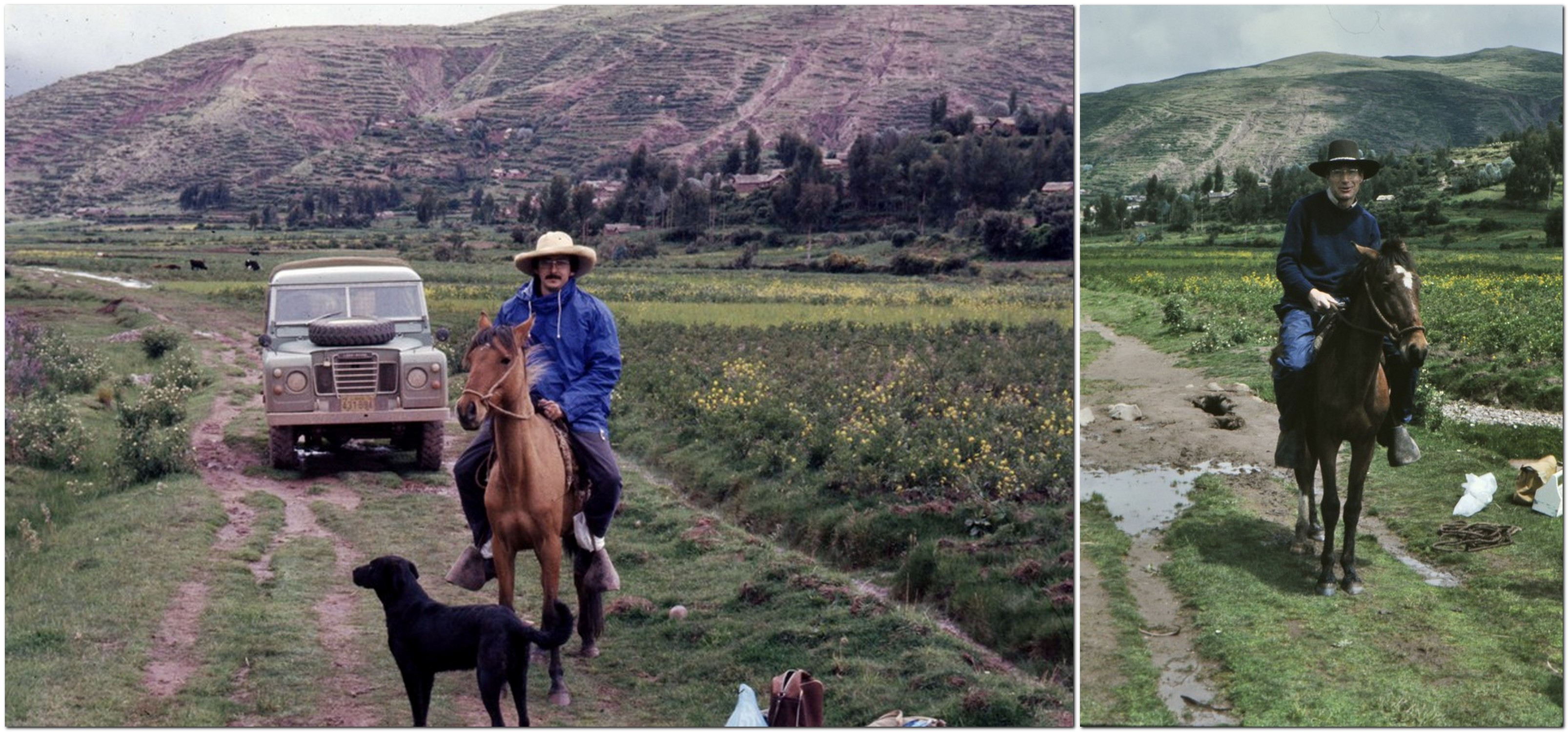
Field work complete, Peter and I spent a couple of days resting up in Cuzco before flying back to Lima. We left the Land Rover there for one of my colleagues Zósimo Huamán to pick up, as he planned to undertake some fieldwork as well before driving back to Lima.

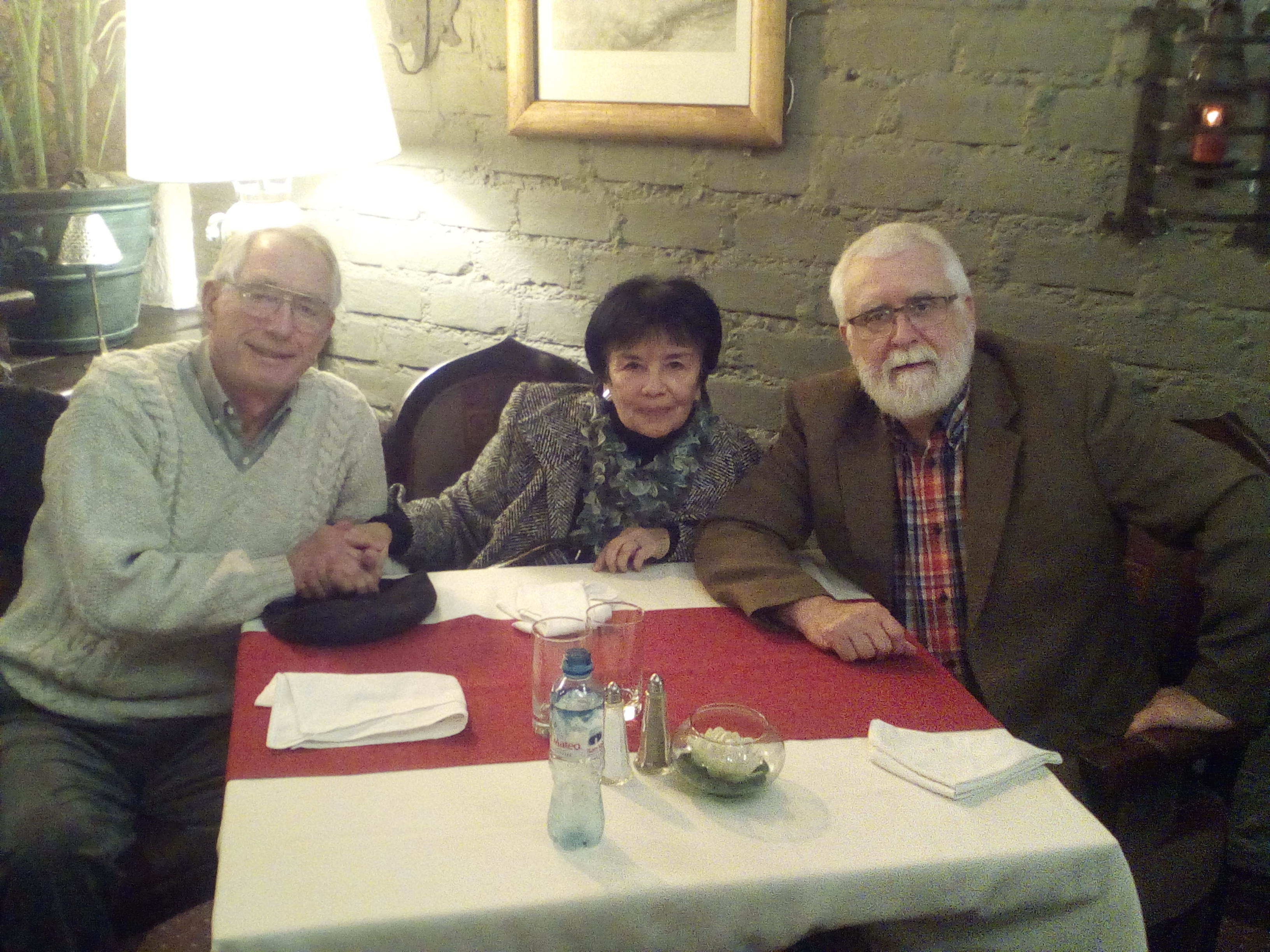
During the couple of days in Cuzco we paid a call on Prof. César Vargas, a renowned Peruvian botanist (and close friend of my PhD supervisor Jack Hawkes), who I’d met once before in January 1973 not long after I arrived in Peru. Prof Vargas’s daughter Martha studied for her MSc degree in botany at the University of St Andrews.
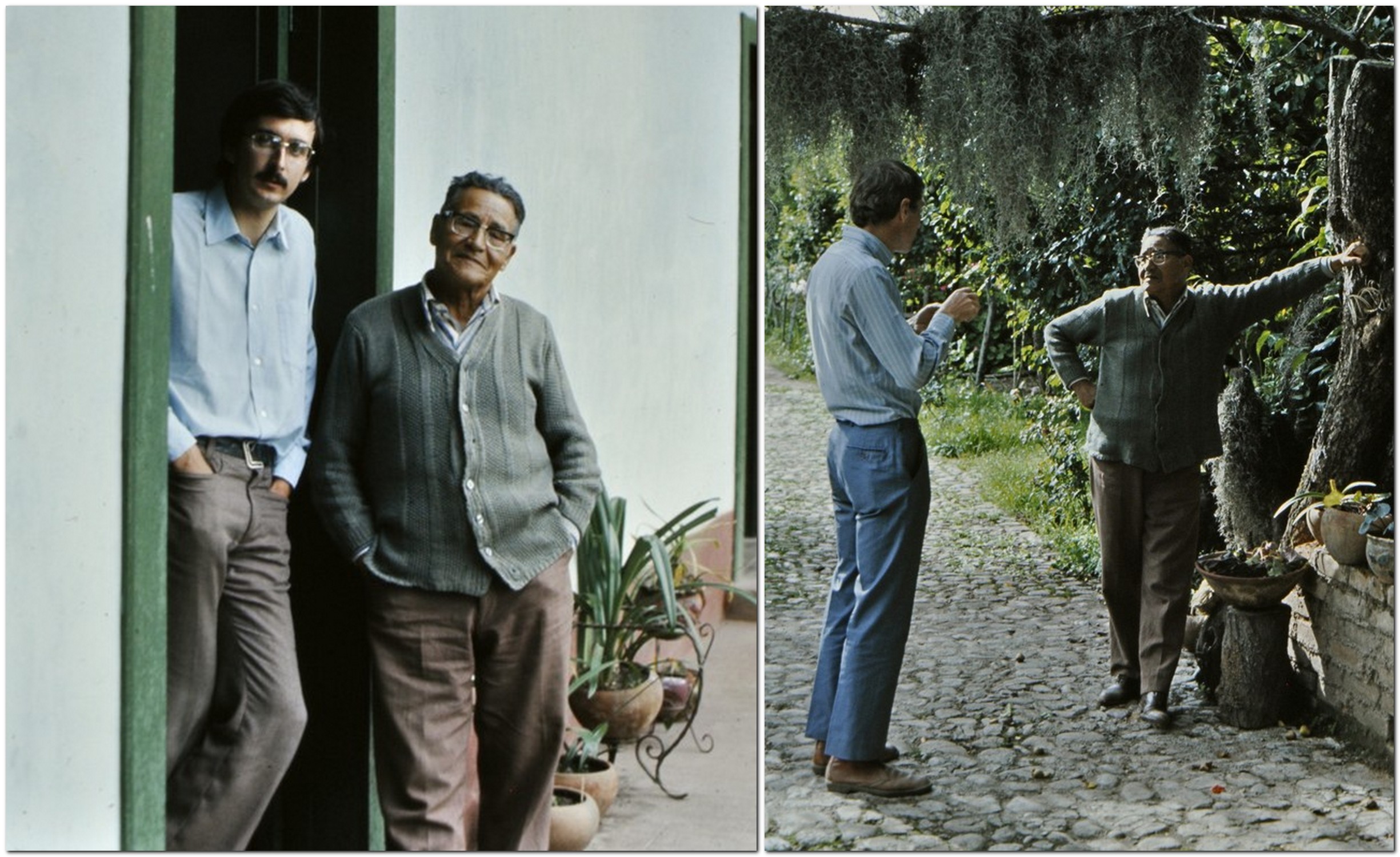
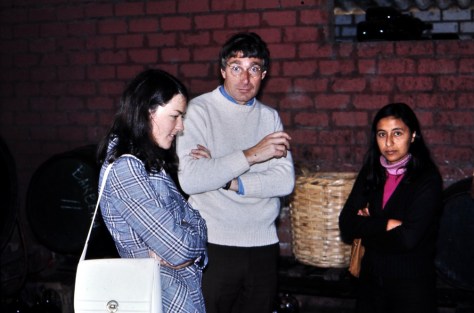
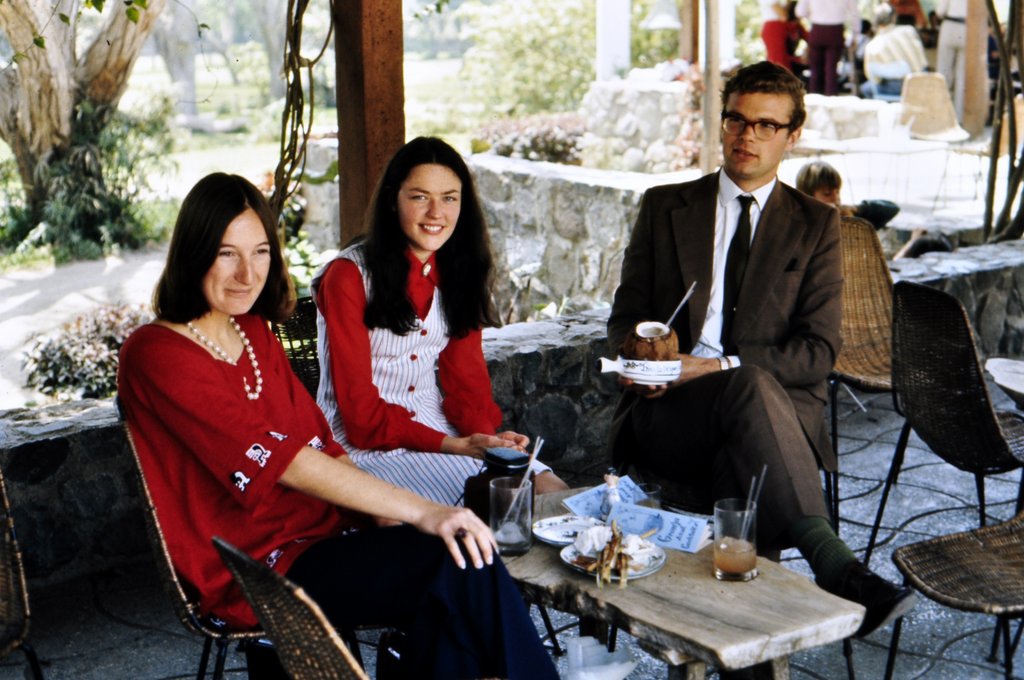
L to R: my wife Steph, Peter, and Martha Vargas

All in all, we had a successful field trip to the south of Peru. It’s hard to believe it all took place 45 years ago next month. But it remains, in my mind’s eye, quite a significant trip from the years I spent in Peru.


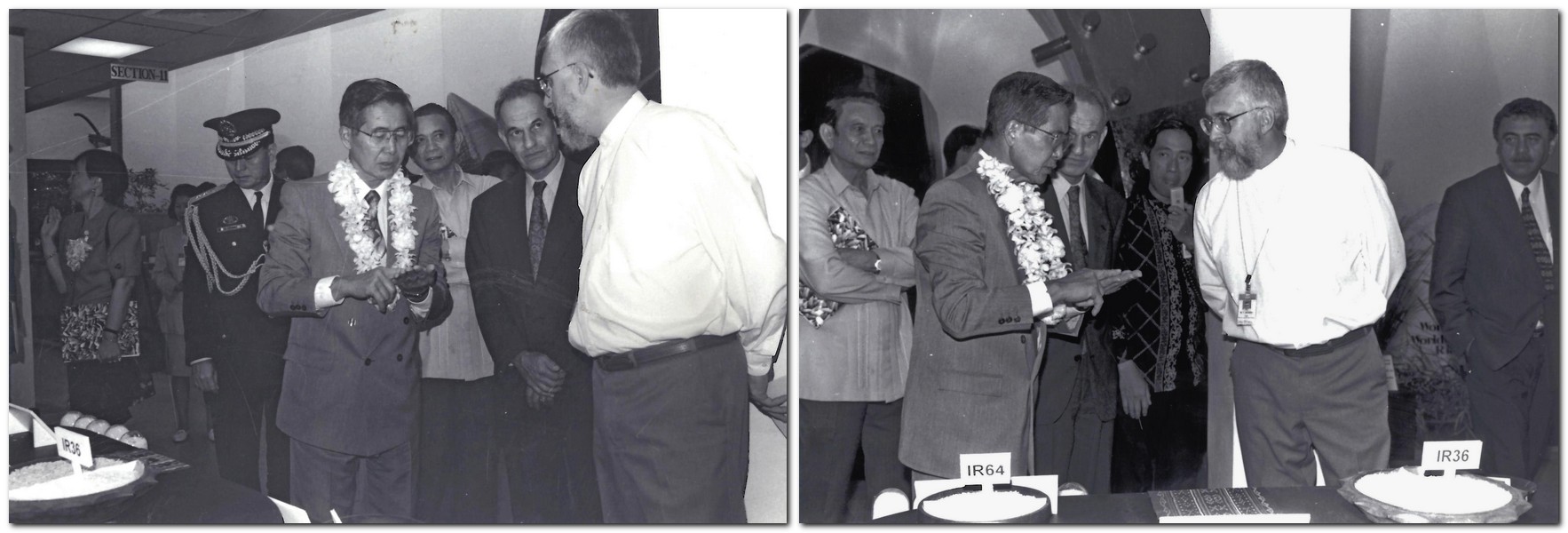
¹ Peter graduated in botany from the University of Liverpool, and completed his PhD in 1964 there under the supervision of Professor Vernon Heywood, who moved to the University of Reading to become head of that university’s Department of Botany a couple of years later. Peter and I had a lot to talk about, because in 1969-70, when I was an undergraduate at the University of Southampton, Vernon Heywood gave a series of 20 lectures on flowering plant taxonomy over 10 weeks to Southampton botanists, because Leslie Watson, Southampton’s taxonomy lecturer had moved to Australia. Vernon and I renewed our acquaintance some years later, in 1991, when he and I attended a genetic resources meeting at the Food and Agriculture Organization of the United Nations (FAO) in Rome just before I moved to the Philippines to join the International Rice Research Institute (IRRI).

² One interesting piece of information that didn’t make it into my thesis but which I remember clearly was the incidence of geophagy among some residents of Cuyo Cuyo. I was taken to a location where farmers would excavate small quantities of a hard clay, that would be ground to a powder and mixed with water to form a slurry or soft paste. They would then dip recently harvested boiled potatoes in the clay as this, apparently, would decrease the slightly ‘spicy’ flavor of some of the varieties. I’m not sure how widespread this behavior was, but it’s something that has stuck in my mind all these years. I think I once had photos but they are long lost, more’s the pity.

³ I completed my PhD in December 1975, and shortly afterwards moved to Costa Rica to continue working for CIP, in potato breeding and agronomy. I started to prepare three manuscripts from my thesis for publication in Euphytica. The first, on varietal diversity, was submitted in February 1977, and published later the same year. The second, on breeding relationships, was published in 1978, having been submitted in July 1977. The third, on the ethnobotany of potato cultivation in Cuyo Cuyo finally appeared in print in 1980, having been submitted to Euphytica in February 1979.

But Euphytica had not been the first choice for this third paper. I actually produced a manuscript for the journal Economic Botany, and it included more details of the cropping systems and varietal choices made by farmers. My paper was received by the journal and acknowledged, but then I heard nothing more, for months and months. Eventually I wrote to the editor asking about the status of my manuscript. And I received a very strange reply.

It seemed that the editor-in-chief had retired, and his replacement had found, on file, manuscripts that had been submitted up to 20 years earlier, but had never been published! I was asked how I wanted to proceed with my manuscript as there was no guarantee it would appear in print any time soon. But about the same time, I received a nice letter from the then editor of Euphytica, Dr AC Zeven, complimenting me on my PhD thesis (which he had read in the library at Wageningen University in the Netherlands) and encouraging me to publish my work on the ethnobotany of potatoes – if I hadn’t already done so. I withdrew my manuscript from Economic Botany, and after some reformatting to fit the Euphytica style, sent it to Dr Zeven. He requested some deletions of the more descriptive sections on ethnobotany, and published my paper in 1980.


One last thing: I also remember was the novel that Peter was reading throughout the trip. Watership Down by Richard Adams, first published in 1972, that went on to become a literary sensation. I did read it myself at some point, but whether I borrowed Peter’s copy immediately after the trip, or some time later, I don’t recall. I know I didn’t think it would become the phenomenon that it did. What do I know?


9 February 2023
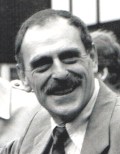
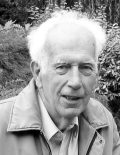
Today I received the news that Peter passed away, at home in St Andrews, on 6 February. That would be almost 49 years to the day since we set out from Lima on our expedition to the south of Peru. Rest in peace, Peter.
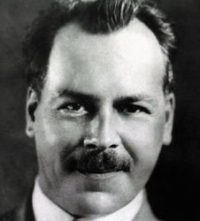


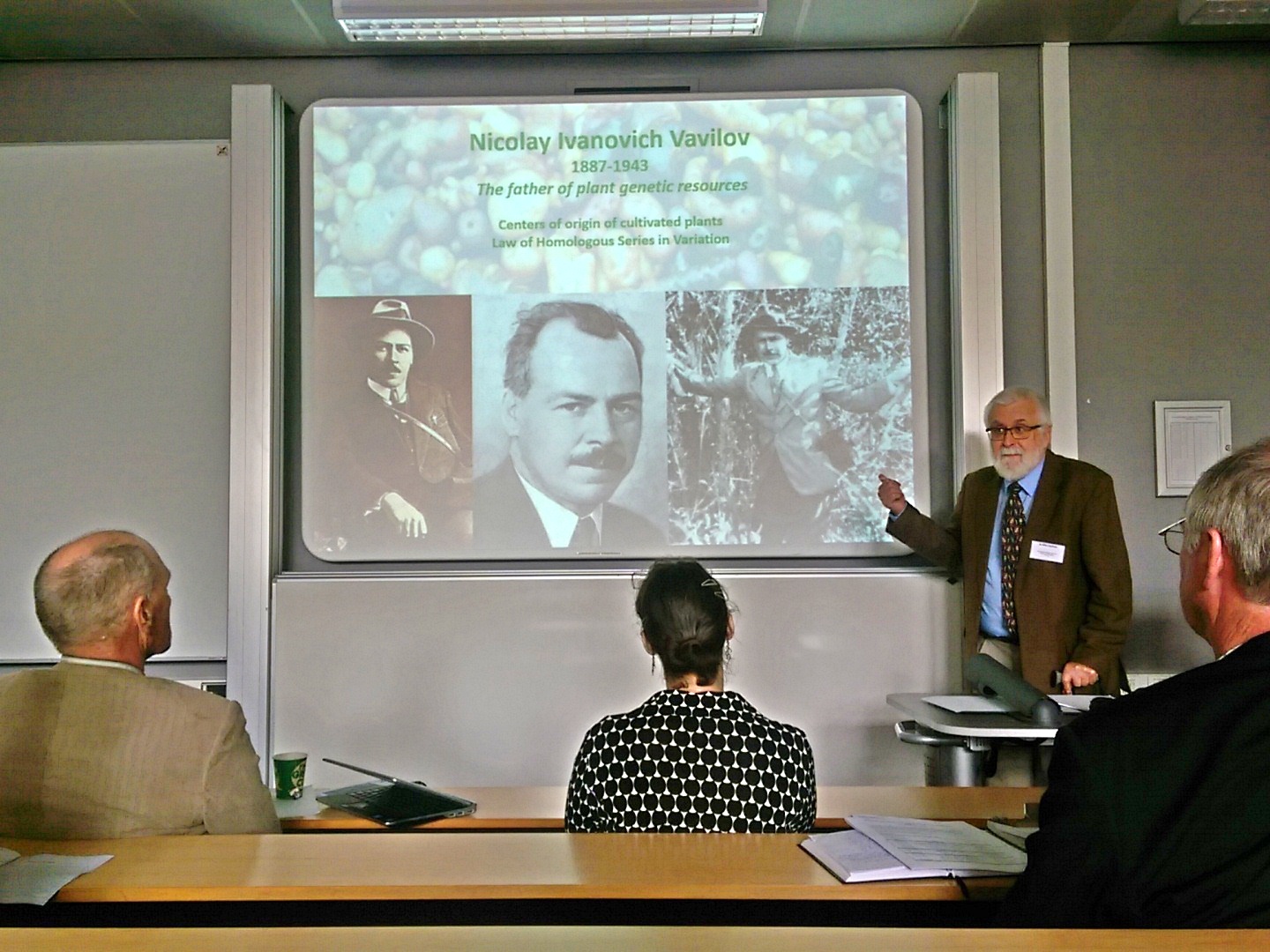
Discovering Vavilov, and building a career in plant genetic resources: (1) Starting out in South America in the 1970s

Nikolai Vavilov

Russian geneticist and plant breeder Nikolai Vavilov (1887-1943) is a hero of mine. He died, a Soviet prisoner, five years before I was born.

Until I began my graduate studies in the Department of Botany at the University of Birmingham in the conservation and use of plant genetic resources (i.e., crops and their wild relatives) almost 50 years ago in September 1970, his name was unknown to me. Nevertheless, Vavilov’s prodigious publications influenced the career I subsequently forged for myself in genetic conservation.

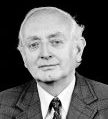
At the same time I was equally influenced by my mentor and PhD supervisor Professor Jack Hawkes, at Birmingham, who met .

Vavilov undoubtedly laid the foundations for the discipline of genetic resources —the collection, conservation, evaluation, and use of plant genetic resources for food and agriculture (PGRFA). It’s not for nothing that he is widely regarded as the Father of Plant Genetic Resources.

Almost 76 years on from his death, we now understand much more about the genetic diversity of crops than we ever dreamed possible, even as recently as the turn of the Millennium, thanks to developments in molecular biology and genomics. The sequencing of crop genomes (which seems to get cheaper and easier by the day) opens up significant opportunities for not only understanding how diversity is distributed among crops and species, but how it functions and can be used to breed new crop varieties that will feed a growing world population struggling under the threat of environmental challenges such as climate change.

These tools were not available to Vavilov. He used his considerable intellect and powers of observation to understand the diversity of many crop species (and their wild relatives) that he and his associates collected around the world. Which student of genetic resources can fail to be impressed by Vavilov’s theories on the origins of crops and how they varied among regions.

In my own small way, I followed in Vavilov’s footsteps for the next 40 years. I can’t deny that I was fortunate. I was in the right place at the right time. I had some of the best connections. I met some of the leading lights such as Sir Otto Frankel, Erna Bennett, and Jack Harlan, to name just three. I became involved in genetic conservation just as the world was beginning to take notice.


Knowing of my ambition to work overseas (particularly in South America), Jack Hawkes had me in mind in early 1971 when asked by Dr Richard Sawyer, the first Director General of the International Potato Center (CIP, based in Lima, Peru) to propose someone to join the newly-founded center to curate the center’s collection of Andean potato varieties. This would be just a one-year appointment while a Peruvian scientist received MSc training at Birmingham. Once I completed the MSc training in the autumn of 1971, I had some of the expertise and skills needed for that task, but lacked practical experience. I was all set to get on the plane. However, my recruitment to CIP was delayed until January 1973 and I had, in the interim, commenced a PhD project.

I embarked on a career in international agricultural research for development almost by serendipity. One year became a lifetime. The conservation and use of plant genetic resources became the focus of my work in two international agricultural research centers (CIP and IRRI) of the Consultative Group on International Agricultural Research (CGIAR), and during the 1980s at the University of Birmingham.


My first interest were grain legumes (beans, peas, etc.), and I completed my MSc dissertation studying the diversity and origin of the lentil, Lens culinaris whose origin, in 1970, was largely speculation.

Trevor Williams

Trevor Williams, the MSc Course tutor, supervised my dissertation. He left Birmingham around 1977 to become the head of the International Board for Plant Genetic Resources (IBPGR) in Rome, that in turn became the International Plant Genetic Resources Institute (IPGRI), and continues today as Bioversity International.

Joe Smartt

I guess that interest in legume species had been sparked by Joe Smartt at the University of Southampton, who taught me genetics and encouraged me in the first instance to apply for a place to study at Birmingham in 1970.

But the cold reality (after I’d completed my MSc in the autumn of 1971) was that continuing on to a PhD on lentils was never going to be funded. So, when offered the opportunity to work in South America, I turned my allegiance to potatoes and, having just turned 24, joined CIP as Associate Taxonomist.

From the outset, it was agreed that my PhD research project, studying the diversity and origin, and breeding relationships of a group of triploid (with three sets of chromosomes) potato varieties that were known scientifically as Solanum x chaucha, would be my main contribution to the center’s research program. But (and this was no hardship) I also had to take time each year to travel round Peru and collect local varieties of potatoes to add to CIP’s germplasm collection.

I explored the northern departments of Ancash and La Libertad (with my colleague Zósimo Huamán) in May 1973, and Cajamarca (on my own with a driver) a year later. Each trip lasted almost a month. I don’t recall how many new samples these trips added to CIP’s growing germplasm collection, just a couple of hundred at most.

Collecting in Ancash with Zosimo Huaman in May 1973.

Collecting potatoes from a farmer in Cajamarca, northern Peru in May 1974 (L); and getting ready to ride off to a nearby village, just north of Cuzco, in February 1974 (R).

In February 1974, I spent a couple of weeks in the south of Peru, in the department of Puno, studying the dynamics of potato cultivation on terraces in the village of Cuyo-Cuyo.

Potato terraces at Cuyo Cuyo in Puno, southern Peru.

I made just one short trip with Jack Hawkes (and another CIP colleague, Juan Landeo) to collect wild potatoes in central Peru (Depts. of Cerro de Pasco, Huánuco, and Lima). It was fascinating to watch ‘the master’ at work. After all, Jack had been collecting wild potatoes the length of the Americas since 1939, and instinctively knew where to find them. Knowing their ecological preferences, he could almost ‘smell out’ each species.

With Jack Hawkes, collecting Solanum multidissectum in the central Andes north of Lima, early 1975.

My research (and Zósimo’s) contributed to a better understanding of potato diversity in the germplasm collection, and the identification of duplicate clones. During the 1980s the size of the collection maintained as tubers was reduced, while seeds (often referred to as true potato seed, or TPS) was collected for most samples.

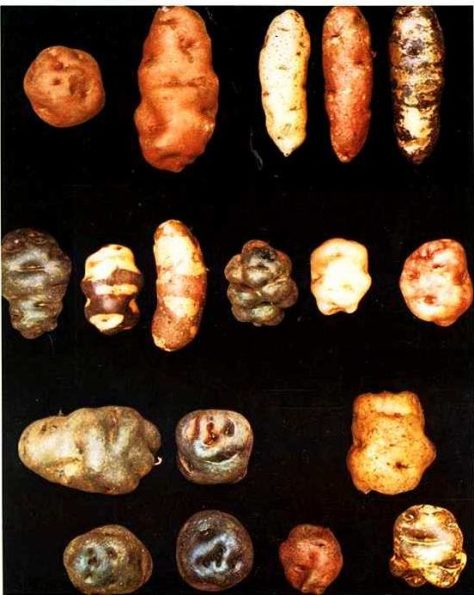
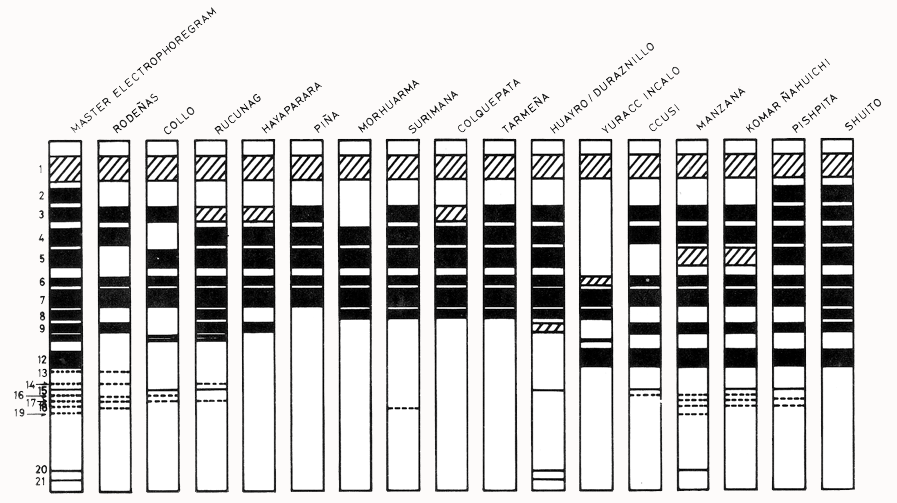
Potato varieties (representative ‘morphotypes’) of Solanum x chaucha that formed part of my PhD study. L-R, first row: Duraznillo, Huayro, Garhuash Shuito, Puca Shuito, Yana Shuito L-R, second row: Komar Ñahuichi, Pishpita, Surimana, Piña, Manzana, Morhuarma L-R, third row: Tarmeña, Ccusi, Yuracc Incalo L-R, fourth row: Collo, Rucunag, Hayaparara, Rodeñas

Roger Rowe

Dr Roger Rowe was my department head at CIP, and he became my ‘local’ PhD co-supervisor. A maize geneticist by training, Roger joined CIP in July 1973 as Head of the Department of Breeding & Genetics. Immediately prior to joining CIP, he led the USDA’s Inter-Regional Potato Introduction Project IR-1(now National Research Support Program-6, NRSP-6) at the Potato Introduction Station in Sturgeon Bay, Wisconsin.

Although CIP’s headquarters is at La Molina on the eastern outskirts of Lima, much of my work was carried out in Huancayo, a six hour drive winding up through the Andes, where CIP established its highland field station. This is where we annually grew the potato collection.

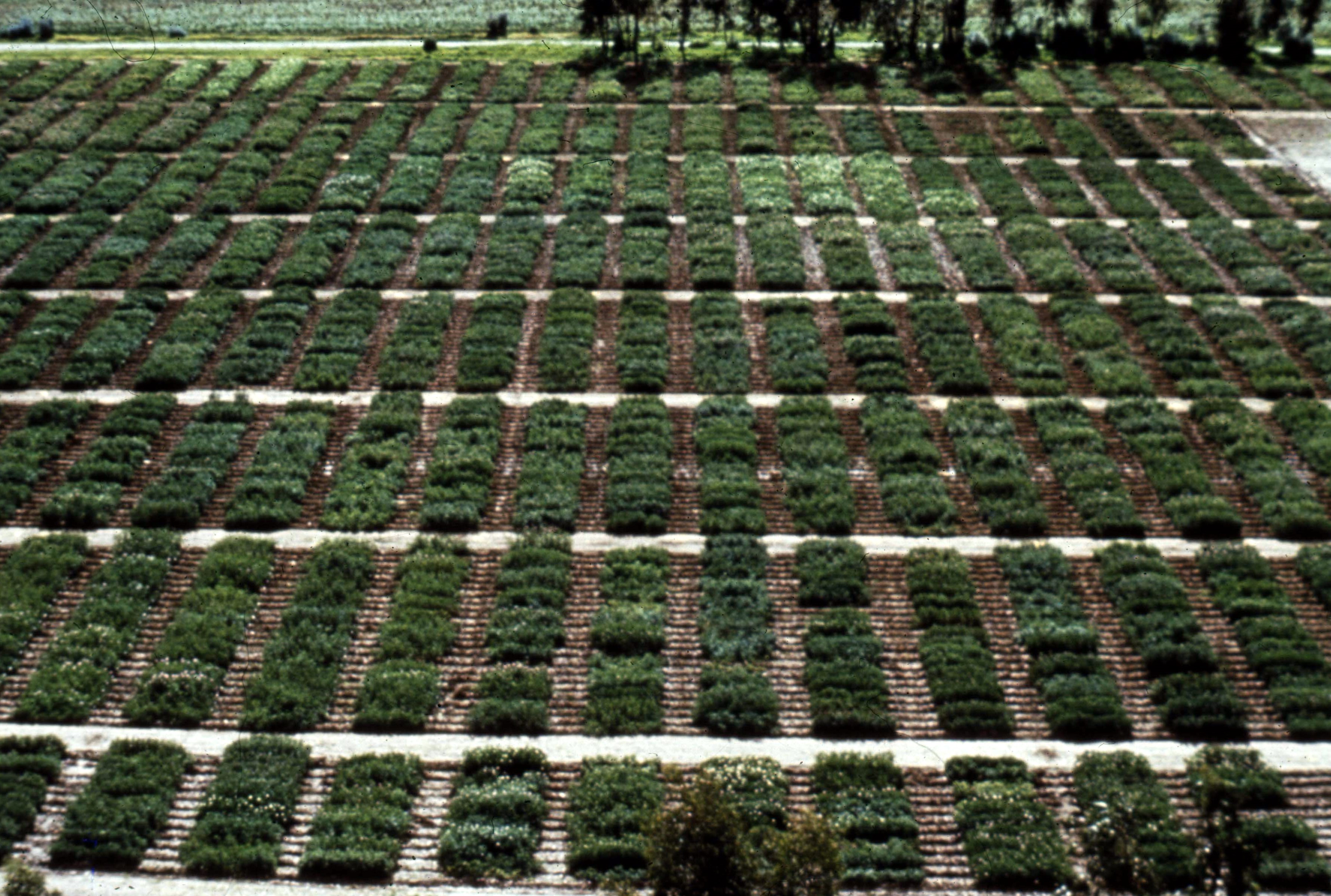
Aerial view of the potato germplasm collection at the San Lorenzo station of CIP, near Huancayo in the Mantaro Valley, central Peru, in the mid-1970s.

During the main growing season, from about mid-November to late April  (coinciding with the seasonal rainfall), I’d spend much of every week in Huancayo, making crosses and evaluating different varieties for morphological variation. This is where I learned not only all the practical aspects of conservation of a vegetatively-propagated crop, and many of the phytosanitary implications therein, but I also learned how to grow a crop of potatoes. Then back in Lima, I studied the variation in tuber proteins using a tool called polyacrylamide gel electrophoresis (that, I guess, is hardly used any more) by separating these proteins across a gel concentration gradient, as shown diagrammatically in the so-called electrophoregrams below. Compared to what we can achieve today using a range of molecular markers, this technique was really rather crude.

Jack Hawkes visited CIP two or three times while I was working in Lima, and we would walk around the germplasm collection in Huancayo, discussing different aspects of my research, the potato varieties I was studying, and the results of the various crossing experiments.

With Jack Hawkes in the germplasm collection in Huancayo in January 1975 (L); and (R), discussing aspects of my research with Carlos Ochoa in a screenhouse at CIP in La Molina (in mid-1973).

I was also fortunate (although I realized it less at the time) to have another potato expert to hand: Professor Carlos Ochoa, who joined CIP (from the National Agrarian University across the road from CIP) as Head of Taxonomy.

Well, three years passed all too quickly, and by the end of May 1975, Steph and I were back in Birmingham for a few months while I wrote up and defended my dissertation. This was all done and dusted by the end of October that year, and the PhD was conferred at a congregation held at the university in December.

With Jack Hawkes (L) and Trevor Williams (R) after the degree congregation on 12 December 1975 at the University of Birmingham.

With that, the first chapter in my genetic resources career came to a close. But there was much more in store . . .


I remained with CIP for the next five years, but not in Lima. Richard Sawyer asked me to join the center’s Regional Research Program (formerly Outreach Program), initially as a post-doctoral fellow, the first to be based outside headquarters. Thus, in April 1976 (only 27 years old) I was posted to Turrialba, Costa Rica (based at a regional research center, CATIE) to set up a research project aimed at adapting potatoes to warm, humid conditions of the tropics. A year later I was asked to lead the regional program that covered Mexico, Central America, and the Caribbean.

CATIE had its own germplasm collections, and just after I arrived there, a German-funded project, headed by Costarrican scientist Dr Jorge León, was initiated to strengthen the ongoing work on cacao, coffee, and pejibaye or peach palm, and other species. Among the young scientists assigned to that project was Jan Engels, who later moved to Bioversity International in Rome (formerly IBPGR, then IPGRI), with whom I have remained in contact all these years and published together. So although I was not directly involved in genetic conservation at this time, I still had the opportunity to observe, discuss and learn about crops that had been beyond my immediate experience.

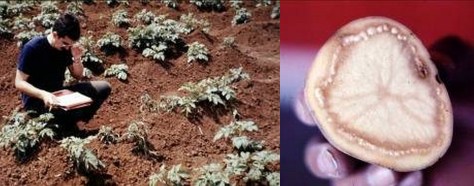
It wasn’t long before my own work took a dramatically different turn. In July 1977, in the process of evaluating around 100 potato varieties and clones (from a collection maintained in Toluca, Mexico) for heat adaptation (no potatoes had ever been grown in Turrialba before), my potato plots were affected by an insidious disease called bacterial wilt (caused by the pathogen Ralstonia solanacearum).

(L) Potato plants showing typical symptoms of bacterial wilt. (R) An infected tuber exuding the bacterium in its vascular system.

Turrialba soon became a ‘hot spot’ for evaluating potato germplasm for resistance against bacterial disease, and this and some agronomic aspects of bacterial wilt control became the focus of much of my research over the next four years. I earlier wrote about this work in more detail.

This bacterial wilt work gave me a good grounding in how to carefully evaluate germplasm, and we went on to look at resistance to late blight disease (caused by the fungus Phytophthora infestans – the pathogen that caused the Irish Potato Famine of the 1840s, and which continues to be a scourge of potato production worldwide), and the viruses PVX, PVY, and PLRV.

One of the most satisfying aspects of my work at this time was the development and testing of rapid multiplication techniques, so important to bulk up healthy seed of this crop.

My good friend and seed production specialist colleague Jim Bryan spent a year with me in Costa Rica on this project.

Throughout this period I was, of course, working more on the production side, learning about the issues that farmers, especially small farmers, face on a daily basis. It gave me an appreciation of how the effective use of genetic resources can raise the welfare of farmers and their families through the release of higher productivity varieties, among others.

I suppose one activity that particularly helped me to hone my management skills was the setting up of PRECODEPA in 1978, a regional cooperative potato project involving six countries, from Mexico to Panama and the Dominican Republic. Funded by the Swiss, I had to coordinate and support research and production activities in a range of national agricultural research institutes. It was, I believe, the first consortium set up in the CGIAR, and became a model for other centers to follow.

I should add that PRECODEPA went from strength to strength. It continued for at least 25 years, funded throughout by the Swiss, and expanding to include other countries in Central America and the Caribbean.

However, by the end of 1980 I felt that I had personally achieved in Costa Rica and the region as much as I had hoped for and could be expected; it was time for someone else to take the reins. In any case, I was looking for a new challenge, and moved back to Lima (38 years ago today) to discuss options with CIP management.

It seemed I would be headed for pastures new, the southern cone of South America perhaps, even the Far East in the Philippines. But fate stepped in, and at the end of March 1981, Steph, daughter Hannah (almost three) and I were on our way back to the UK. To Birmingham in fact, where I had accepted a Lectureship in the Department of Plant Biology.


The subsequent decade at Birmingham opened up a whole new set of genetic resources opportunities . . .


Three score and ten . . .

18 November 1948. Today is my 70th birthday. Septuagenarian. The Biblical three score and ten (Psalm 90:10)!
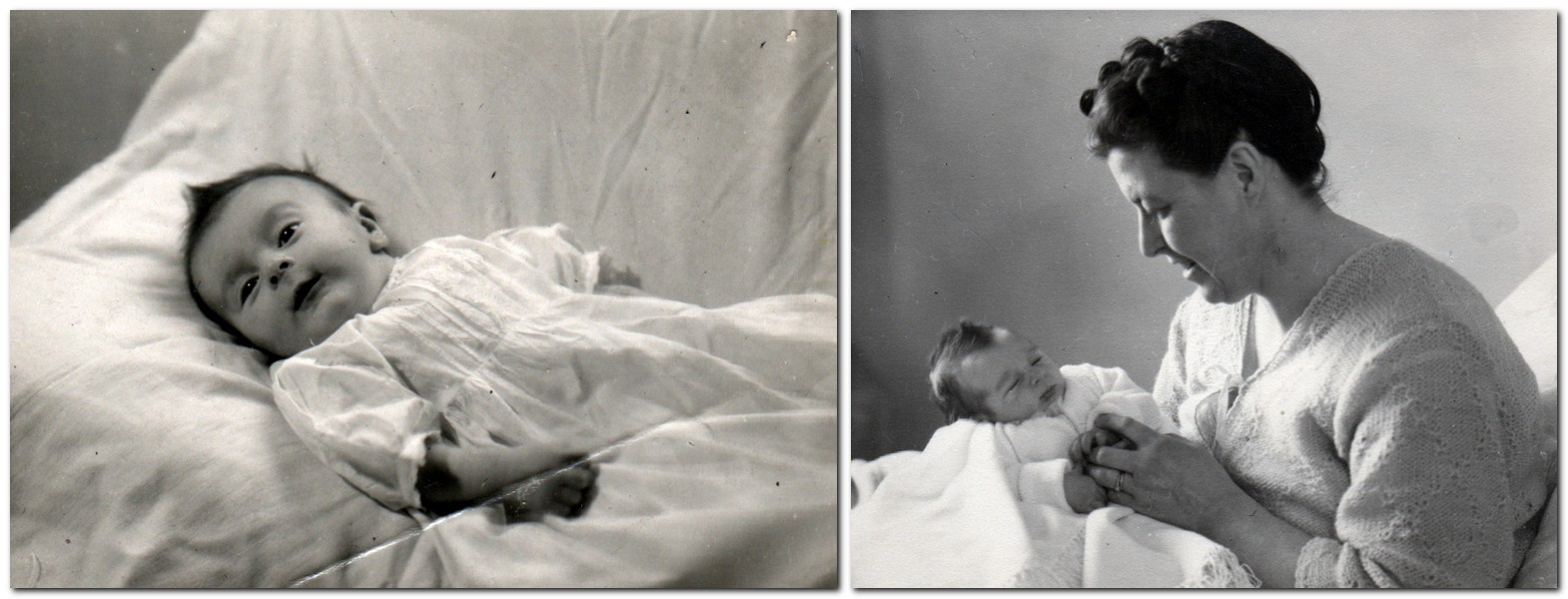
Steph and I have come away for the weekend to celebrate my birthday with The Beatles in Liverpool.

We are staying for a couple of nights at Jurys Inn close to the Albert Dock. Later this morning we’ve booked to visit the National Trust-owned Beatles’ Childhood Homes (of John Lennon and Paul McCartney). And after lunch, we will tour The Beatles Story where I’m hoping to see, displayed there, something special from my childhood.

How the years have flown by. Just a month ago, Steph and I celebrated our 45th wedding anniversary. And I find it hard to believe that I started university over 50 years ago.

That got me thinking. I’ve written quite a lot in this blog about the years after I graduated, my time working overseas, about travel, and what Steph and I have been up to since retiring in 2010.

However, I written much less about my early years growing up in Cheshire and Staffordshire. This is then an appropriate moment to fill some gaps.

A son of Cheshire
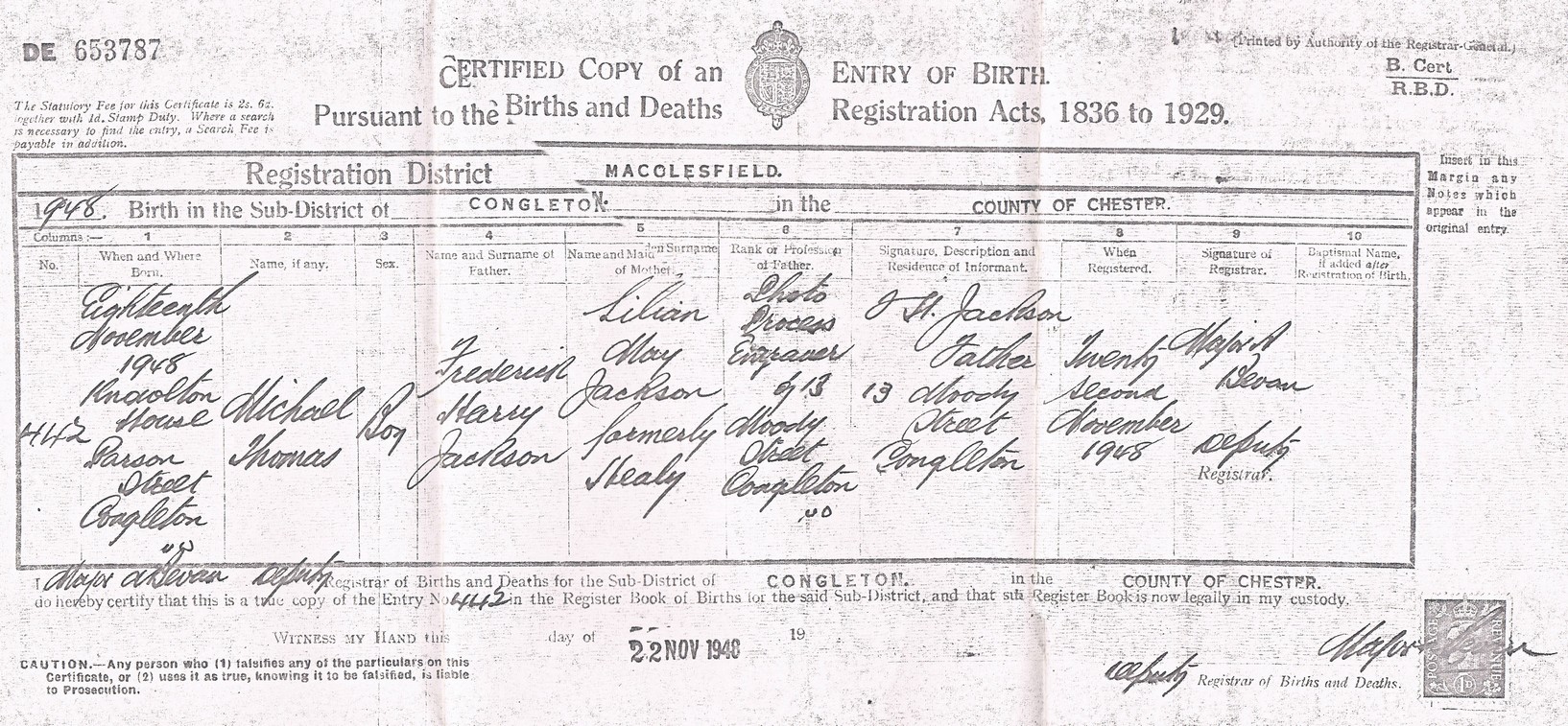
I was born in Knowlton House nursing home in Congleton, Cheshire (map), third son and fourth and youngest child of Frederick Harry Jackson (aged 40), a photo process engraver, and Lilian May Jackson, also aged 40, housewife.

Mum and Dad, around 1959/60 after we had moved to Leek

My eldest brother Martin has been able to trace our family’s ancestry (mainly on my father’s side) back to someone named Bull, who was my 13th great-grandfather, born around 1480 on the Staffordshire/ Derbyshire border, just one of my 32,000 plus direct ancestors then. I must be related to royalty in one way or another (as are most of us), although looking at the occupations noted for many of them in various official documents (birth and marriage certificates, census data), we came a long way down the pecking order. Definitely below the salt! We’re Irish on my mother’s side of the family.

A punk before it was fashionable!

I am also a child of the National Health Service (NHS) that was founded in July 1948. In fact, I’m (approximately) the 190,063rd baby born under the NHS!

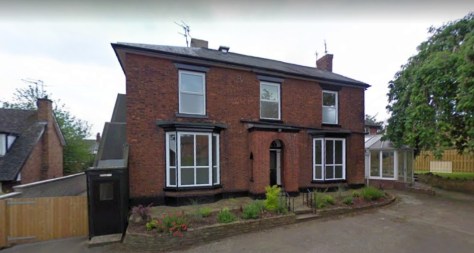
Knowlton House on Parson Street in Congleton – it’s no longer a nursing home.

I wonder who assisted at my birth? It could well have been our family Dr Galbraith, or Nurses Frost and Botting.

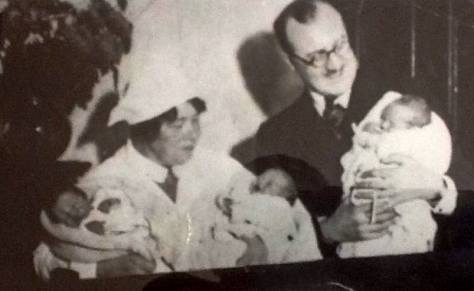
Dr Galbraith (R) was our family doctor, who (with his partner Dr Ritchie) often attended births at Knowlton House, and is seen here with resident midwife Nurse Rose Hannah Frost, who assisted at more than 3000 births. There is a very good chance either Nurse Frost or Nurse May Botting (who ran the nursing home) assisted at my birth. In this photo from 1936, Dr Galbraith and Nurse Frost are holding the Nixon triplets. Photo courtesy of Alan Nixon, who was apparently named after Dr Galbraith.

My dad registered my birth¹ on 22 November (Entry No. 442). There are few ‘Michaels’ in the family; Thomas is my paternal grandfather’s name.

My eldest brother Martin was born in September 1939, just a couple of days before war was declared on Germany. My sister Margaret was born in January 1941. Martin and Margaret spent much of WWII with my paternal grandparents in rural Derbyshire. My elder brother Edgar (‘Ed’) is, like me, one of the baby boomer generation, born in July 1946.

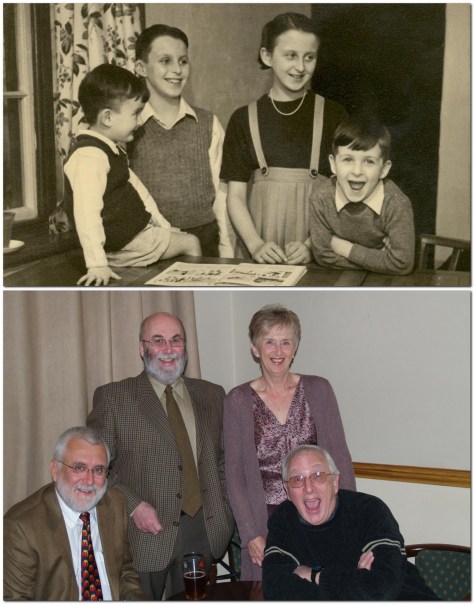
The difference of around 55 years – 1951/52 and 2006

I’ve often wondered what sacrifices Mum and Dad had to make to give us all such a good start in life.

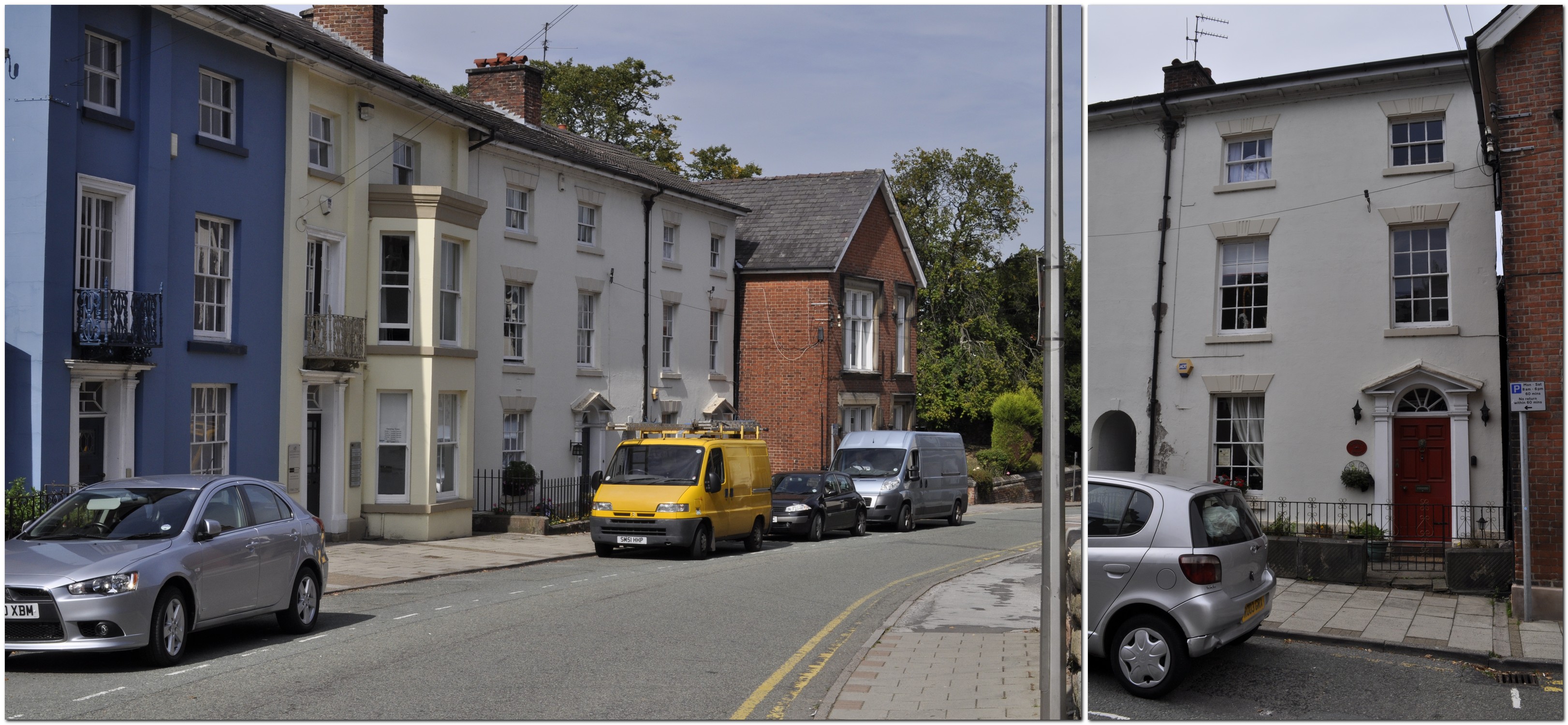
Growing up in Congleton, we lived at 13 Moody Street, close to the town center’s High Street.

There’s not much to tell about my first couple of years, other than what I can surmise from a few photographs taken around that time when I was still in my pram or just beginning to walk. Two things I do remember clearly, though. The hens my father used to keep, and even the large henhouse he constructed at the bottom of the garden. And our female cat, Mitten, and all her kittens. That must have been the start of becoming an ailurophile (cat lover).

My best friend was Alan Brennan, a year younger, who lived a little further up Moody Street at No. 23 (and with whom I reconnected through this blog, after a gap of around 60 years!).

With Alan and his parents (and friends) at Timbersbrook, in 1955. I clearly remember Mr Brennan’s Vauxhall car – a Wyvern I believe.

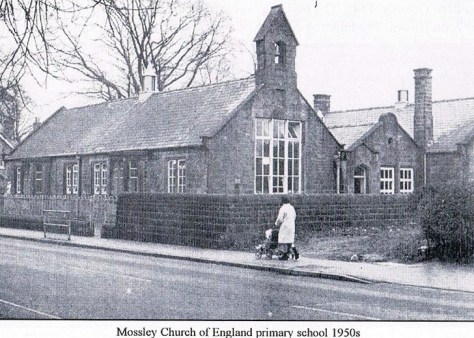
We didn’t go to the same primary school. Like my brothers and sister before me, I was enrolled (in September 1952 or April 1953, maybe as late as September 1953) at the small Church of England school on Leek Road in Mossley, south of the town. By then, Martin had moved on to grammar school in Macclesfield; Margaret had also transferred to secondary school in Congleton.

Each morning, Ed and I would catch the bus in the High Street together for the short, 1½ mile ride to Mossley. And even as young as five, I would sometimes walk home alone from school during the summer months, along Leek Road and Canal Road/Street. How times change!

I remember the headteacher, Mr Morris, as a kind person. My class teachers were Mrs Bickerton (on the left) and Mrs Johnson (on the right). Courtesy of Liz Campion.

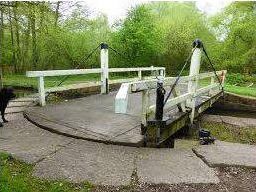
There was a real community of children around Moody Street, Howie Lane/Hill, and Priesty Fields. In summer, we’d all wander up to play on the swing bridge over the Macclesfield Canal (beyond the cemetery – where we would also play in a WWII air raid shelter). The bridge has long been replaced, but from comments on a Congleton Facebook group I belong to, it seems that over the generations, many children enjoyed the swing bridge as much as we did.

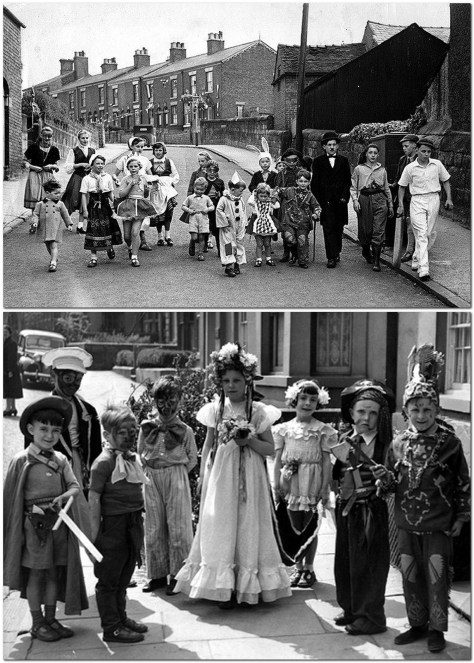
In winter, we had fun in the snow at Priesty Fields just round the corner from Moody St. And, as you can see below, we enjoyed dressing up. Happy days!

In the upper image, taken on Coronation Day in 1953, I’m fifth from the right (carrying the stick). Alan Brennan is the little by to the left of the ‘clown’, and in front of the ‘pirate’, my elder brother Ed. The lower image was taken on May Day, probably 1953 or 54. I’m on the left, carrying the sword, uncertain whether to be a knight or a cowboy.

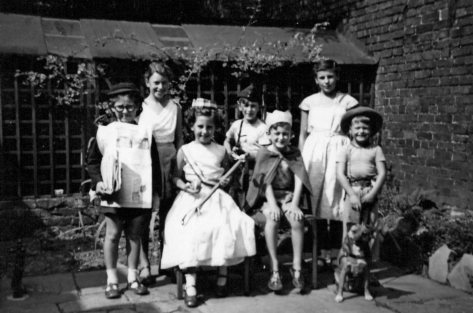
c. 1955. L-R: Veronica George, Carol Brennan, Jessica George, my elder brother Ed, me, Margaret Moulton, and Alan Brennan. Taken in the garden of No 13 Moody St. The George sisters lived at No. 21 Moody St.

I often joined my father when he went out on photographic assignments for the Congleton Chronicle (where he was Chief Photographer), often to Biddulph Grange when it was an orthopedic hospital, also to Astbury, and out into the beautiful Cheshire countryside.

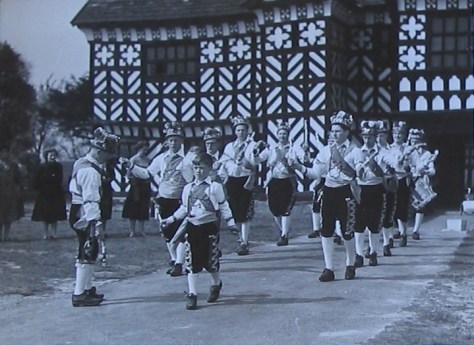
I remember one outing in particular, to Little Moreton Hall in May 1954. This is my father’s photo of Manley Morris Men dancing there, an image that stuck in my mind for many years. So much so that when I went to university in the later 1960s, I helped form a morris dancing side, the Red Stags, that’s still going strong (albeit in a slightly different form) 50 years later.

The Manley Morris Men at Little Moreton Hall on 8 May 1954.

For family holidays I remember those in North Wales, at a caravan park or, on one occasion, a camping coach, a converted railway carriage alongside the mainline to Holyhead next to the beach at Abergele.

During these early years, until July 1954, rationing was still in place that had come into effect at the start of the Second World War. I often wonder how my parents managed to raise four children during these difficult years. One thing I do recall, however, is how we shared things, particularly confectionery. No individual treats. My father would buy a Mars bar (I’m sure they were bigger then) and cut it into six pieces. Funny how these things stick in one’s memory.


The move to Leek
April 1956. A big change in my life. My family upped sticks and moved 12 miles southeast to the market town of Leek in north Staffordshire, where my father took over a retail photography business. As I was only 7½ when we moved, I’ve come to regard Leek as my home town. My parents lived there for the rest of their lives. My father passed away in 1980, and after my mother had a stroke in 1990, only then did she move away from Leek to spend her last couple of years in a care home near my sister in South Wales.

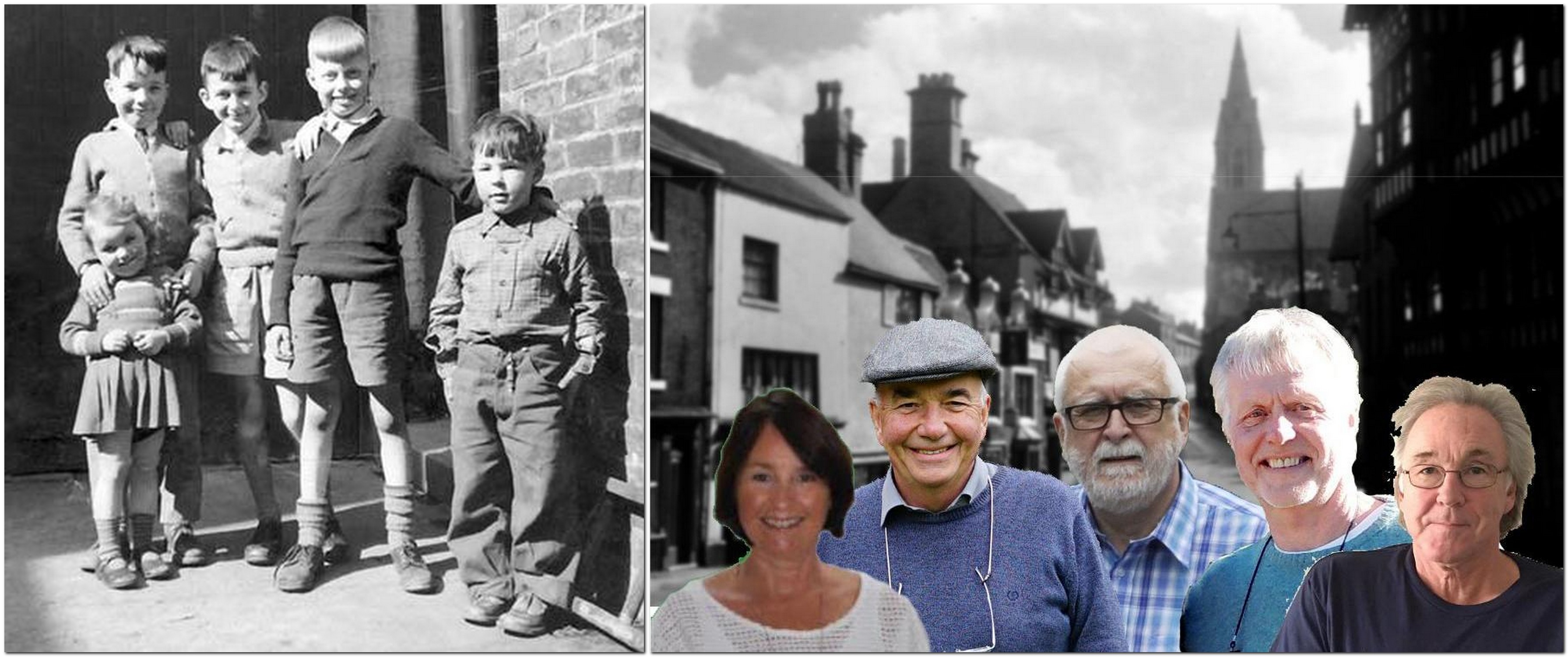
We lived at No. 65, St Edward Street, and within a couple of days of arriving there, I’d made friends with three boys who lived close by: Philip Porter (next door), Geoff Sharratt – whose father was publican at The Quiet Woman pub a few doors away, and David Phillips who lived over the road. Geoff’s younger sister Susan sometimes joined in our games, as did Philip’s sister Jill. We were the ‘St Edward Street Gang’.

Here we are in the late 1950s (probably 1958), in the yard of The Quiet Woman pub. L-R: Sue, Geoff, me, Philip, and Dave. And again in 2018.

Geoff was my best friend, and we spent a lot of time playing together. There were several upstairs rooms at The Quiet Woman, one of which was the Lodge of the Royal Antediluvian Order of Buffaloes (RAOB, the Buffs, a fraternal organization somewhat similar to the Freemasons). During inclement weather, we often took refuge in the Lodge, playing among the benches and high chairs.

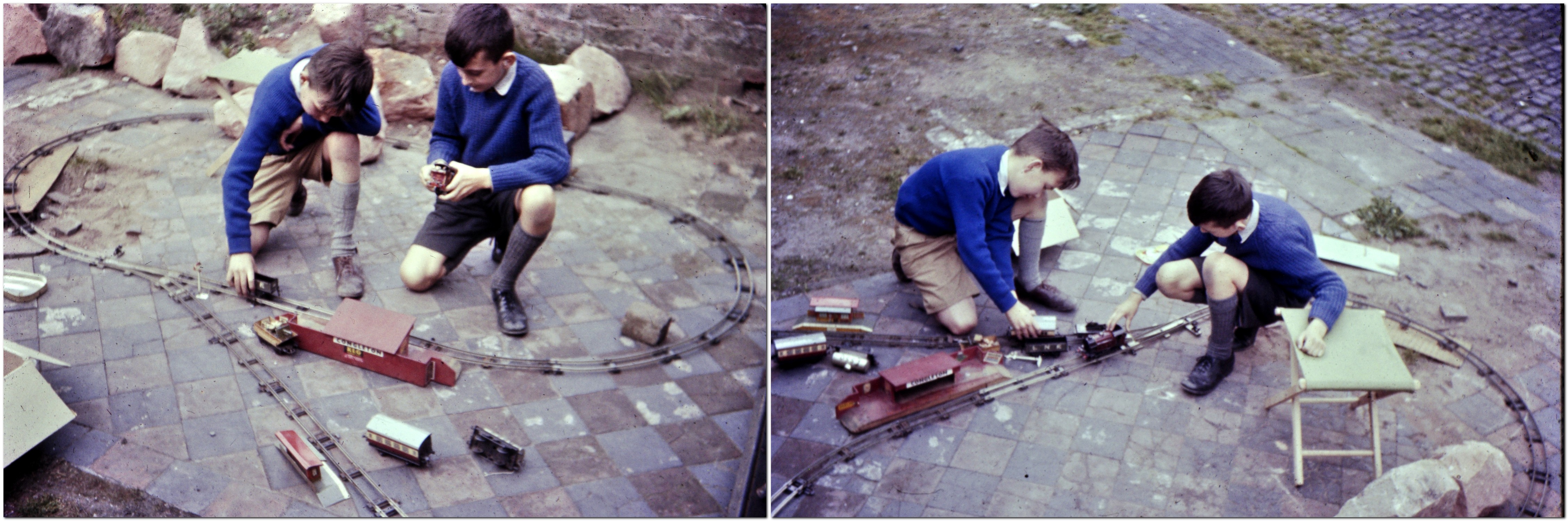
Playing with my Hornby ‘O’ gauge clockwork train at ‘Congleton’ station – it would be a collectors’ item today. Taken around 1958.

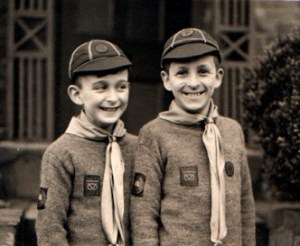
I was also a cub scout, as was Ed.

Around 1960, the lease on No. 65 came due, so my father decided to to find a better location for his business. First, he moved across St Edward’s St to No. 56 (while we lived in a flat at the top of the Market Place). In 1962/63 my father acquired No. 19 Market Place as premises for his photographic business, with living accommodation above. This was just what he had been looking for, centrally located in the town, lots of footfall. But the whole property had to be refurbished; there was only one water tap – in the cellar. He did much of the refurbishment himself. I’ve never ceased to be amazed at his DIY talents, something I sadly have not inherited to the same degree. My parents remained at No. 19 until they retired in 1976.

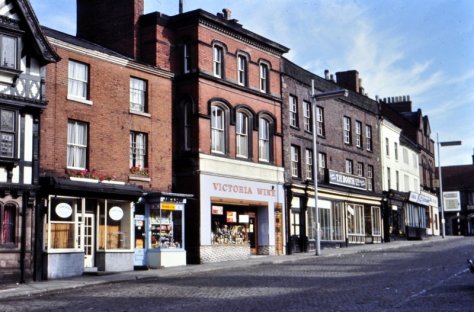
Sandwiched between Jackson the Optician (no relation) on the left, and Victoria Wine on the right, No 19 Market Place was my parents home for 14 years.

Around the same time, Geoff’s parents left The Quiet Woman and moved elsewhere in the town. I was also traveling every day to school to Trent Vale on the south side of Stoke-on-Trent (a round trip of about 28 miles), while Geoff continued his education in Leek. As a consequence, we drifted apart, but through my blog we reconnected in 2012.

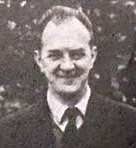
Mr Smith

My mother’s family were Irish Catholics, and although we had not been brought up in the faith while in Congleton, both Ed and myself were enrolled in St. Mary’s RC primary school on Cruso Street, a short walk away from home. We were taught by Sisters of Loreto nuns. Headmistress Mother Elizabeth or my class teacher, Mother Bernadine, were never averse to wrapping us across the knuckles with the sharp edge of a ruler. In my final year at St Mary’s (1959-60), we were taught by Mr Smith. But my recollections don’t tally so much with many others who also attended St Mary’s. And I have been horrified at some accounts of how unhappy they were at the school in the 1950s and 60s.

In the late 50s and early 60s, just Ed and I would join our parents for holidays in Wales, most often camping or in our own caravan.

Some of my happiest memories though come from our visits to my grandparents² (my father’s parents) in Hollington, a small Derbyshire village between Ashbourne and Derby. My grandfather was almost 76 when I was born; Grandma was 68.

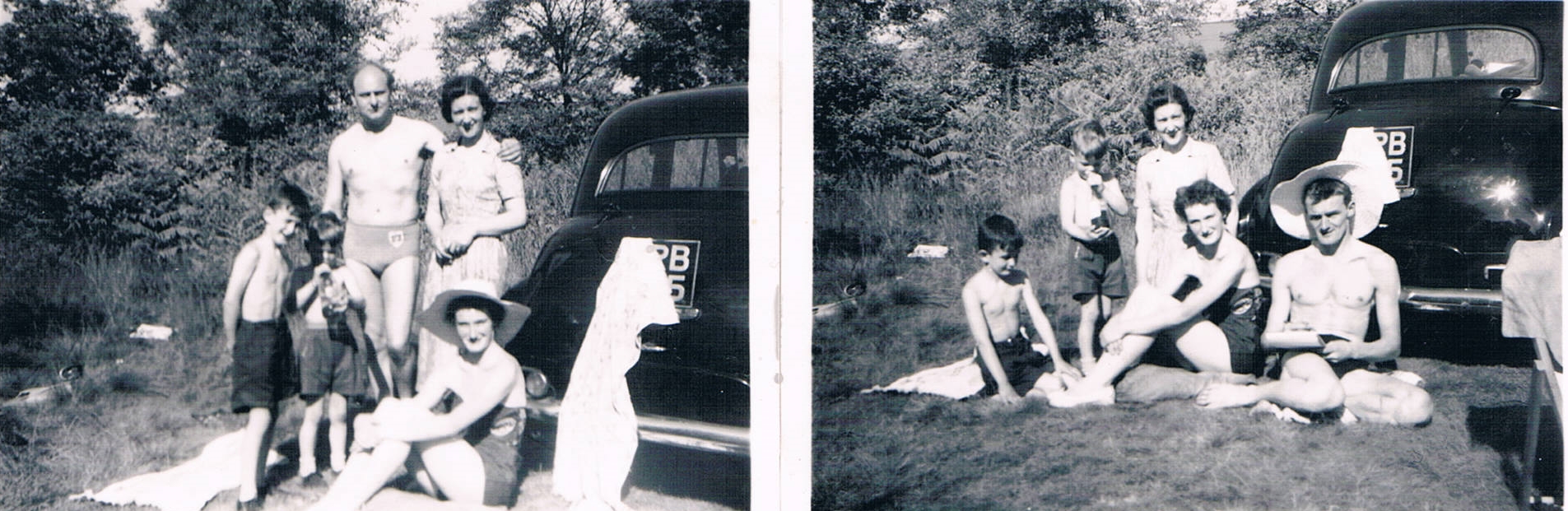
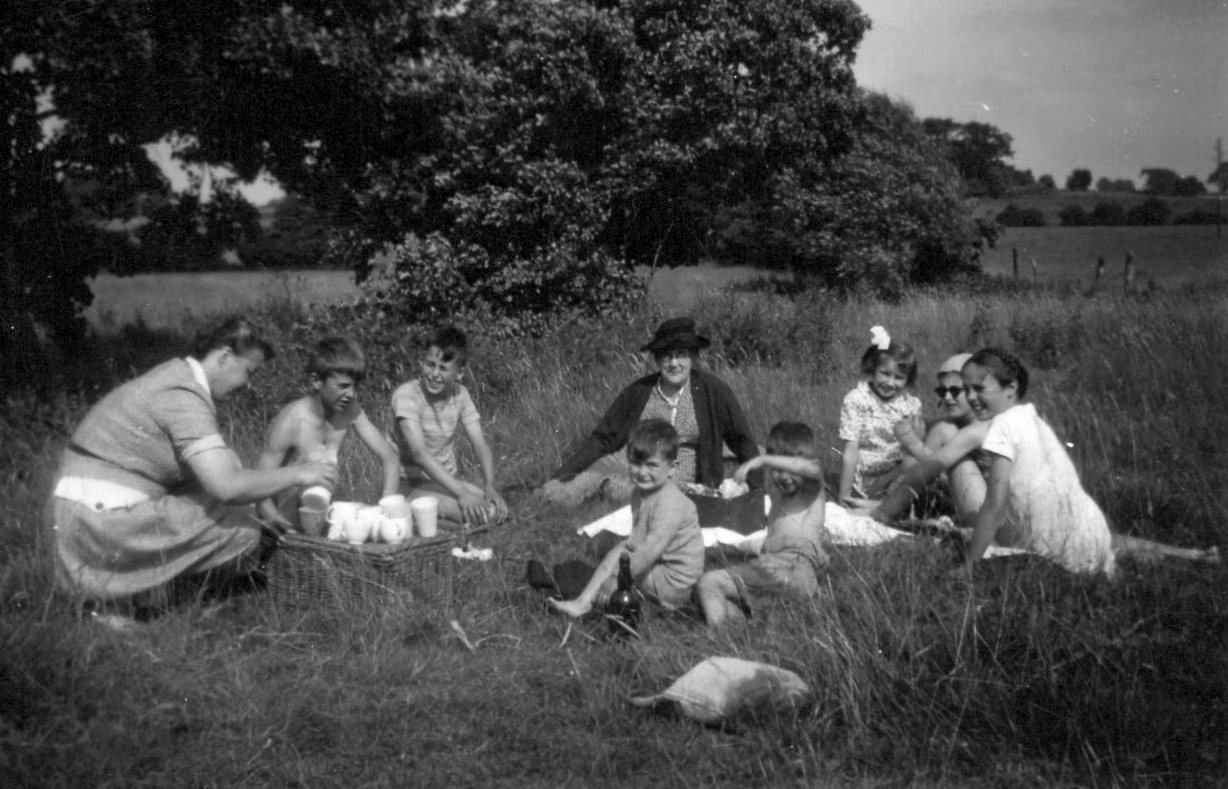
Family picnic at Hollington, c. 1952, with cousins. Grandma in the center, my mum is on the left. I’m center front ‘guarding’ the bottle.

With Grandad and Grandma Jackson, and our cousin Diana, c. 1959 at Ebenezer Cottage.

Grandma and Grandad celebrated their Golden Wedding in 1954, the occasion of a large gathering of family and friends in Hollington.


Enduring high school
I passed my 11 Plus exam to attend a Roman Catholic grammar school, St Joseph’s College, at Trent Vale on the south side of Stoke-on-Trent. Founded by Irish Christian Brothers in 1932, the school took boys only (but is now co-educational). I had to be on the bus by 07:50 each morning if I was to get to school by 09:00. This was my daily routine for the next seven years.
On reflection, I can’t say that I found the school experience satisfying or that the quality of the education I received was worth writing home about. Yes, there were some good teachers who I looked up to, but much of the teaching was pretty mediocre. I’ve written elsewhere about the gratuitous use of corporal punishment at the school.

Perhaps one of the school’s claims to fame was the priest who attended to our ‘spiritual needs’. He was Father John Tolkien, son JRR Tolkien, the author of Lord of the Rings and The Hobbit. My first impressions of Fr Tolkien were not favorable. He came across as cold and authoritarian. When I got to know him later on, however, I found he was a warm person with a good sense of humor. I was saddened to learn that his last years were blighted by accusations of abuse, later dropped.


On to university . . . and faraway places
I was lucky to secure a place in October 1967 at the University of Southampton to study botany and geography, beginning three of the happiest years of my life. I’ve already blogged about various aspects of my time at Southampton, and you can read them here. Little did I think that I would have a career in botany, and that would lead me to fulfill one of my ambitions: to visit Peru.

Even though I graduated in 1970 with only an average BSc degree, that didn’t hold me back. I had ambitions.

I was fortunate to be accepted into graduate school at the University of Birmingham, where I completed MSc and PhD degrees in plant genetic resources, and returned there in 1981 for a decade as Lecturer in Plant Biology.

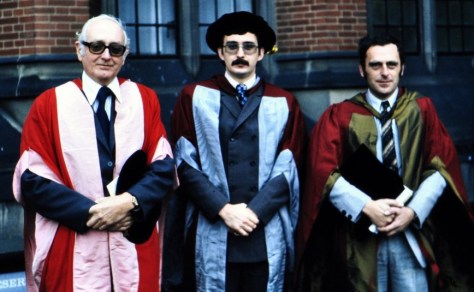
After my PhD graduation at The University of Birmingham on 12 December 1975 with my PhD supervisor, Prof. Jack Hawkes (L) and Prof. Trevor Williams (R) who supervised my MSc dissertation.

My international career in plant genetic resources conservation and agriculture took me to Peru and Costa Rica from 1973-1981, to work on potatoes for the International Potato Center (CIP). And then in July 1991, I moved to the Philippines to join the International Rice Research Institute (IRRI) for the next 19 years as head of the genebank then as Director for Program Planning and Communications.

I had good opportunities to publish my research over the years, in terms of journal articles, books and book chapters, and presentations at scientific conferences.

I retired in April 2010, at the age of 61. But I haven’t rested on my laurels. Scientifically I have:

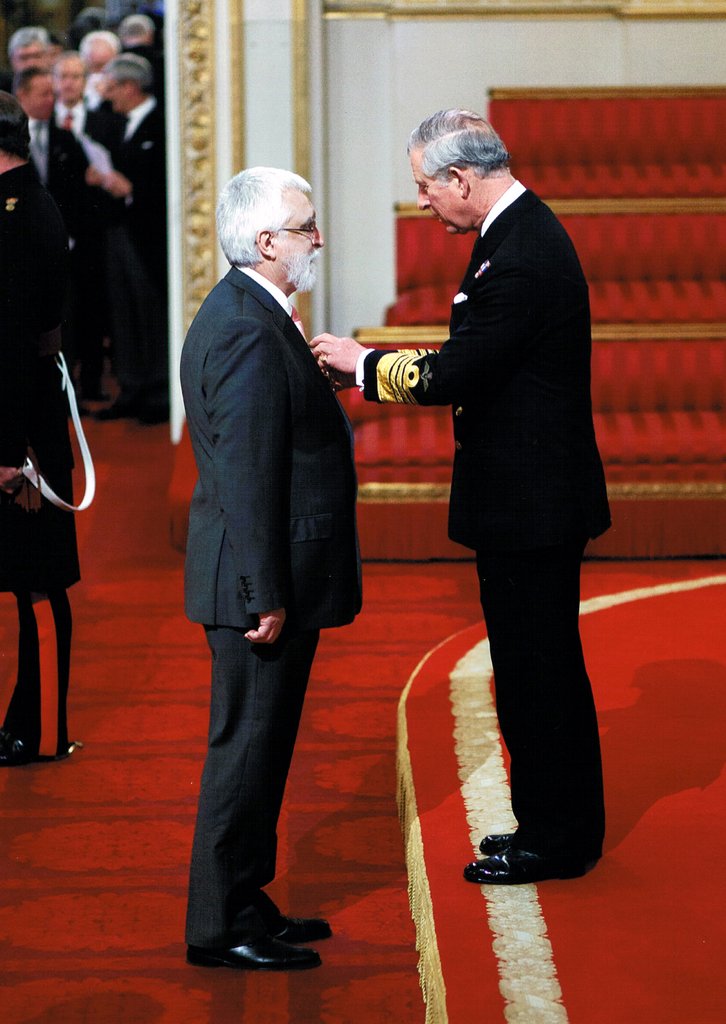
In the 2012 I was honored to be made an Officer of the Most Excellent Order of the British Empire, or OBE, for services to international food science (in the New Year’s Honours).

I set up this blog in February 2012, and have written more than 460 stories for a total of around 470,000 words since then, and posted thousands of images, most of which I have taken myself.


Family
Steph and I were married on 13 October 1973 in Lima, Peru. We’d met at Birmingham during 1971-72, and after I’d moved to Lima in January 1973, she joined me there in July and also worked at CIP.

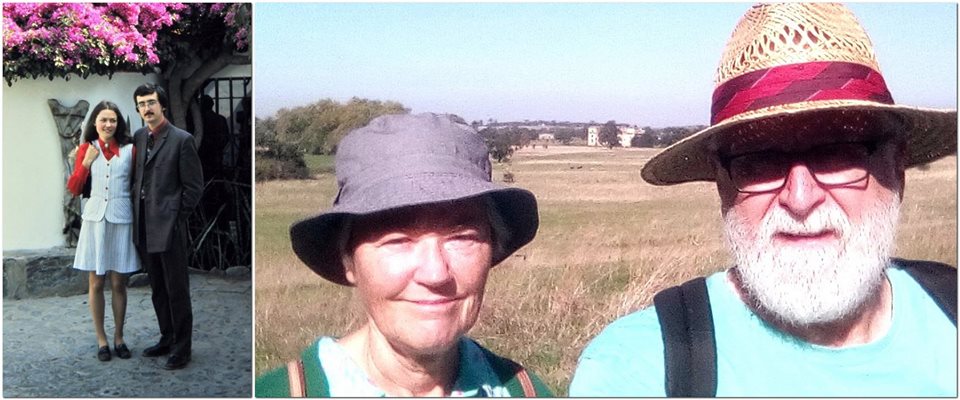
At La Granja Azul restaurant near Lima (on the left) after our wedding in 1973. And on the right, exactly 45 years later during one of our walks at Croome Court in Worcestershire.

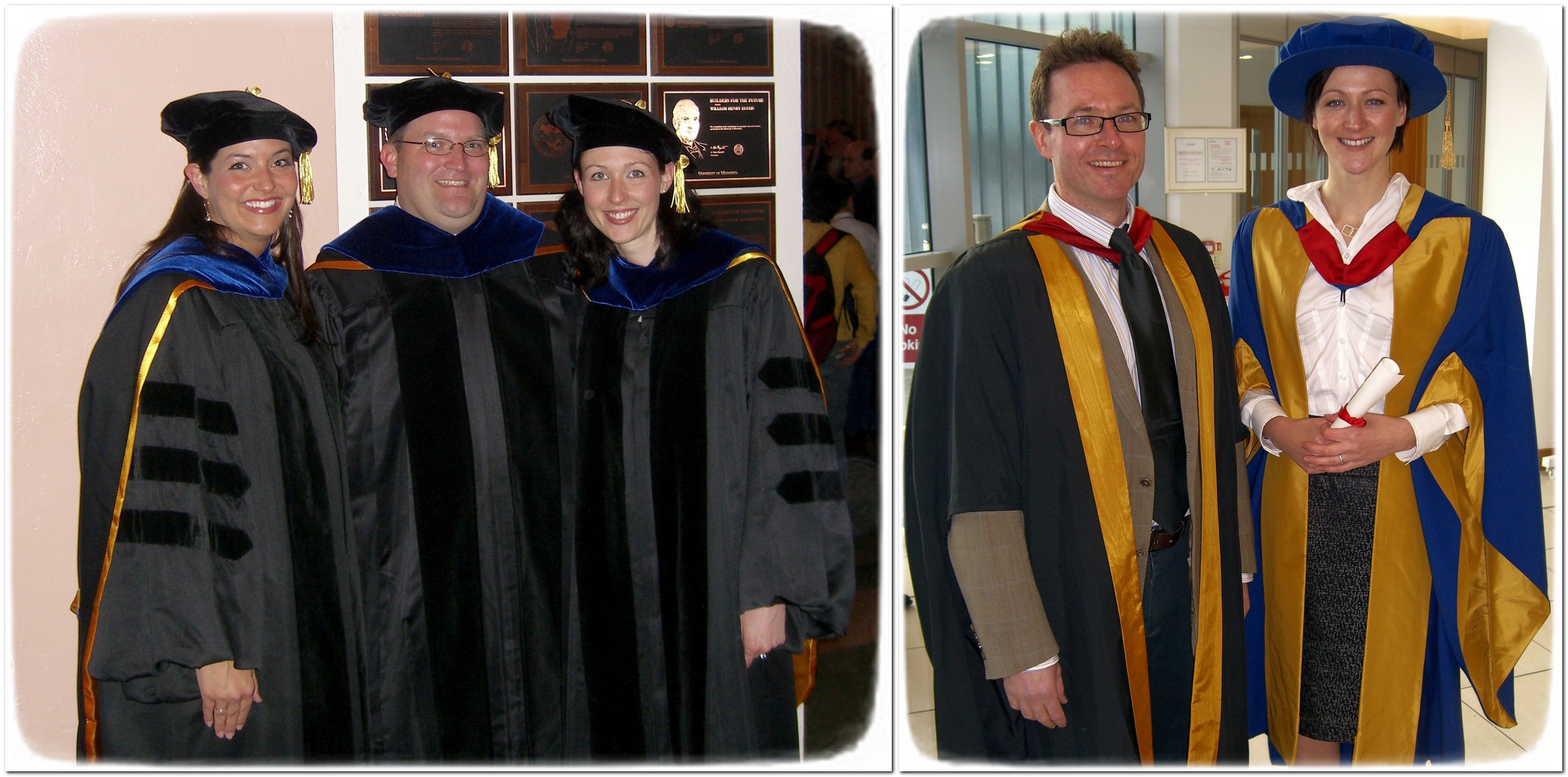
Hannah, our elder daughter was born in Costa Rica in April 1978. Philippa was born in Bromsgrove in May 1982, a year after we had moved back to the UK (in March 1981). When we moved to the Philippines in 1991, they both attended the International School Manila, and then went on to university in the USA (Macalester College in Minnesota) and Durham in the UK, respectively. In 2006 and 2010, they completed their PhD degrees in psychology, respectively at the University of Minnesota and Northumbria University.

PhD graduands! On the left, Hannah is with her classmates in Industrial-Organizational Psychology at the University of Minnesota, Emily and Mike, on 12 May 2006. Philippa (on the right) is with one of her PhD supervisors, Prof. David Kennedy of the Brain, Performance and Nutrition Research Centre in the Dept. of Psychology at Northumbria University on 7 December 2010.

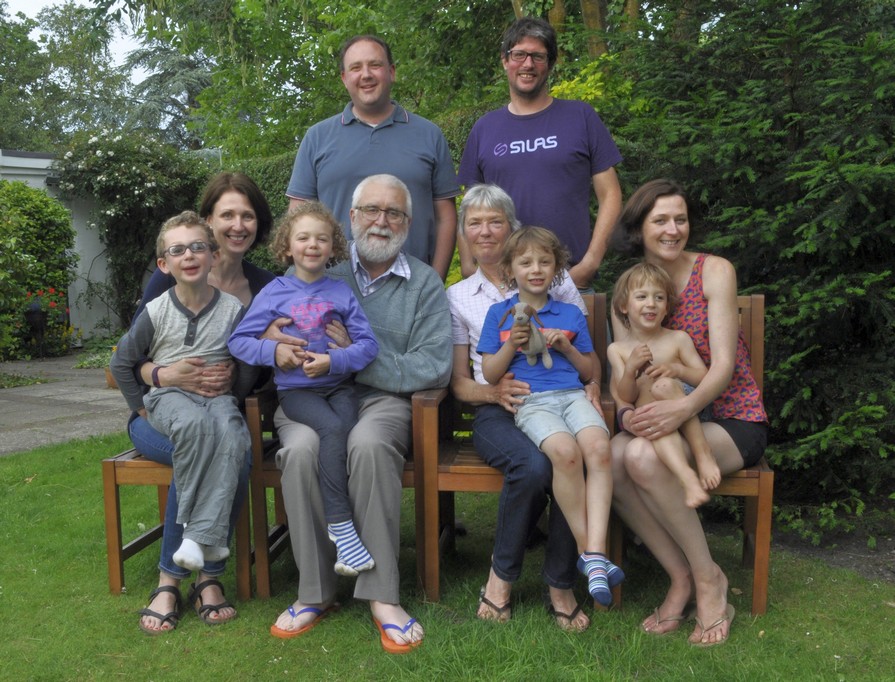
In those same years Hannah married Michael, and Phil married Andi. We now have four wonderful grandchildren: Callum (8), Elvis (7), Zoë (6), and Felix (5). The family came together for the first time in a New Forest holiday in July 2016.

On holiday in the New Forest in July 2016. L-R (sitting): Callum, Hannah, Zoë, me, Steph, Elvis, Felix, and Philippa. Standing: Michael and Andi

The 2018-19 school year started for Callum and Zoë in August, and for Elvis and Felix in September. It was also Felix’s first day at school.

In September, Steph and I spent a week in Cornwall exploring many National Trust and English Heritage properties around the county.

Foldes and Fenner family photos in July and September


So, as I look back on the past 70 years, I can’t say I have much to complain about. Steph and I have a beautiful family. An interesting career took me to more than 65 countries (and Steph to some of those). We’ve lived and worked in three countries and made some wonderful friends.

Je ne regrette rien

At 70, though, what does life have in store?

I think Fleetwood Mac (one of my favorite bands) sum it up quite nicely. If it was fine for Bill Clinton, it’s good enough for me.

Retirement is sweet. Who could ask for more?


¹ I no longer have my original birth certificate. That now sits in an archive somewhere in the Miraflores Municipality building in Lima, Peru. When Steph and I married there in October 1973 we had to present our original birth certificates, not realizing these would be filed away in perpetuity and never returned to us.

² I did not really know my mother’s parents, who died before my sixth birthday. They lived in Epsom, Surrey.

Riding a big wave of nostalgia for Peru

I recently posted a link on a Facebook group to a photo album that shows many of the places Steph and I visited when we lived in Peru in the early 1970s. We worked at the International Potato Center (CIP) in Lima. One friend and former colleague expressed her surprise that we’d lived there only three years.
In 1976, after we moved to Costa Rice (but still working for CIP), I continued to visit Peru regularly, at least once a year for CIP’s annual science review meetings. Then, after I left the center in 1981 to return to the UK, I visited Peru several times during the 1980s in connection with my potato research at the University of Birmingham. I also had a consultancy in the late 1980s to help the UK chocolate industry scope a cocoa (Theobroma cacao) conservation project [2] in the northeast of Peru, similar to the one it had supported in eastern Ecuador [3] some years earlier.

Moving to the Philippines in 1991, my genetic resources and CGIAR system-wide management roles at IRRI took me back to Lima on at least a couple of occasions. And the last time I was there was July 2016; and how Lima had changed!


Every day I am reminded of the brief time we spent in Peru.

I find my nostalgia for Peru can be quite overwhelming sometimes. I’d had such a strong ambition to visit Peru from an early age that I sometimes wonder if, almost 46 years since I first landed there (on 4 January 1973) it was, after all, just a dream. But no, it was for real. Steph and I were even married in Lima, in October 1973.

Just take a look at all the stories I have written about Peru in this blog, which highlight its beauty and diversity: the landscapes, people, cultures and heritage, history, and archaeology. And not least, its fascinating agriculture and indigenous crops. Peru is the full monty! [1]

Why not listen to a haunting melody, Dolor indio, played on the Peruvian flute or quena by Jaime Arias Motta (with Ernesto Valdez Chacón on charango and guitar, and Elias Garcia Arias on bass) while reading the rest of this post.


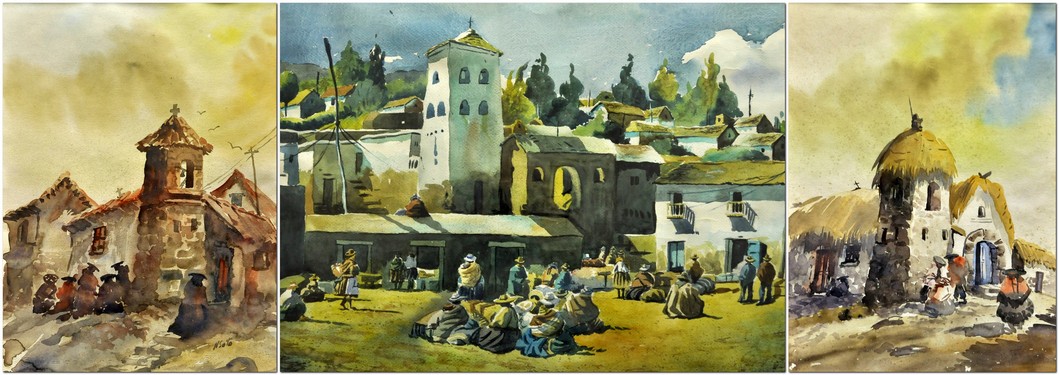
Each morning I wake to see these three watercolors on the wall opposite. I’ve experienced scenes just like these so many times in my travels around the country.

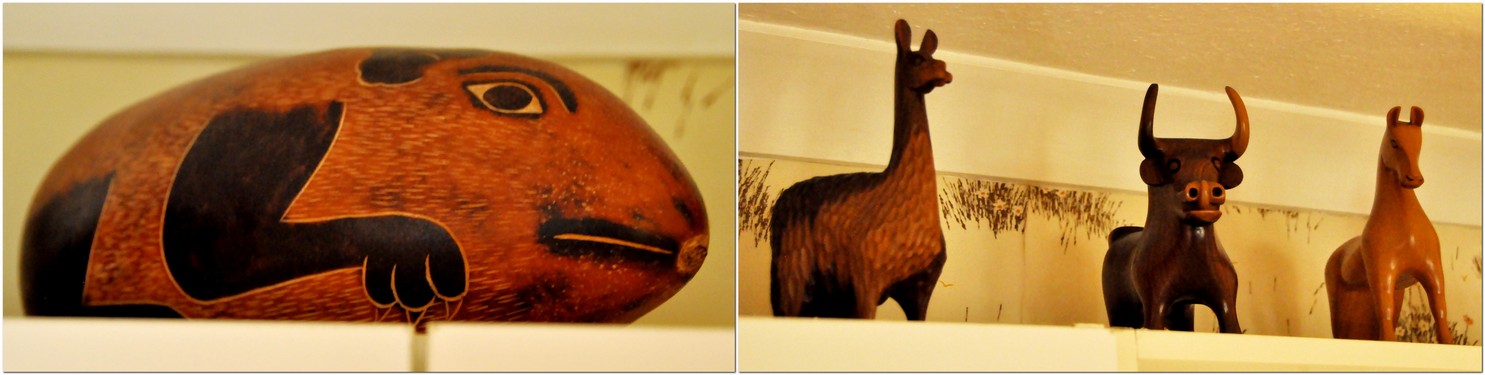
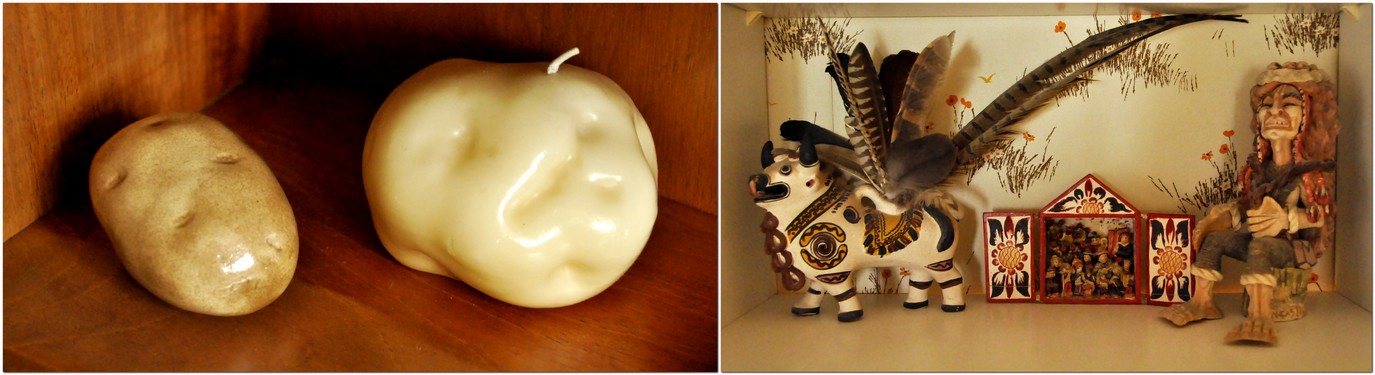
Our home is graced with many other reminders. In the kitchen/diner we have a number of ornaments that we picked up at ferias and markets.

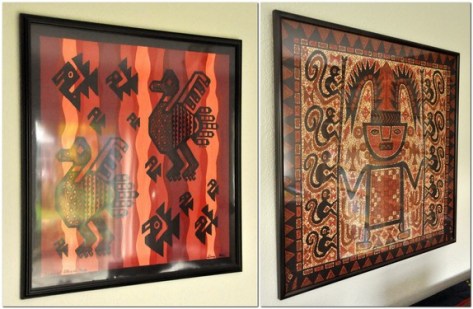
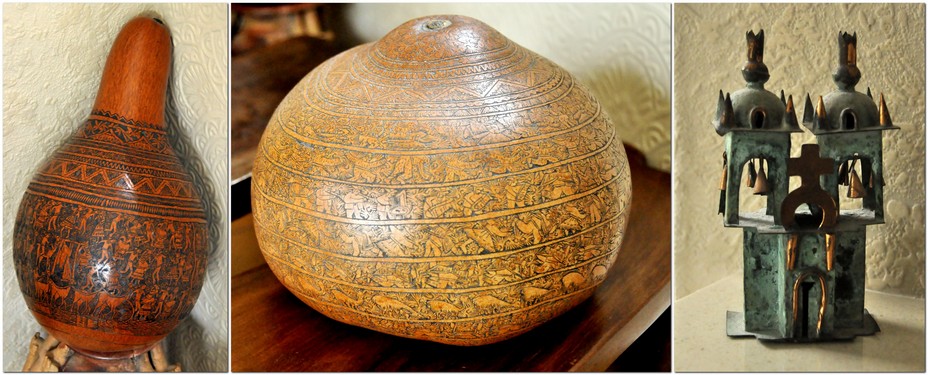
In our living room, there are several iconic pieces that you just can’t miss. On one wall we have two framed cushion covers from Silvania Prints. And, of course, finely-carved gourds from Huancayo, and a copper church


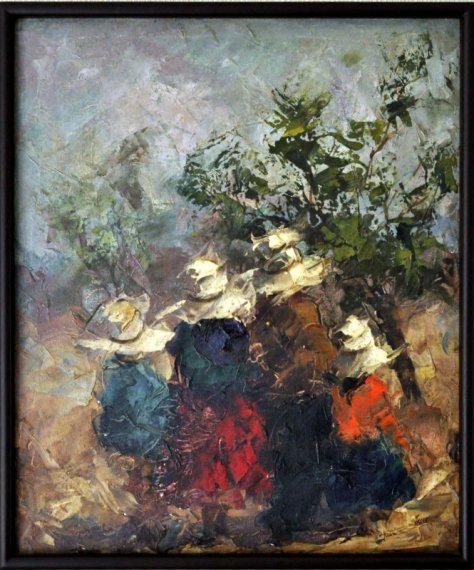
The centerpiece, however, is an oil painting hanging above the fireplace. For me, this painting evokes so many memories. I have seen that image in so many places, a family walking to market perhaps. Although I bought this painting in Miraflores (at the Sunday market there) it depicts a family, probably from Cajamarca in the north of the country. You can tell that by the style of hat.


After I’d posted the link to that photo album on a ex-CIP Facebook group, another member commented that I’d probably seen more of the country than many Peruvians. And 45 years ago that was probably the case.

Then, travel around Peru was rather difficult. Few roads were paved, although gravel roads were passable under most circumstances. Landslides commonly affected many roads (such as the main road to the Central Andes from Lima, the Carretera Central) during the rainy season, between December and May. And improving the roads can’t take away that particular risk.

Many of the people I knew in Lima had never traveled much around Peru, at least not by road. I guess this will have changed as communications improved in the intervening years. Air travel to distant cities, such as Cuzco was the preferred mode of transport for many.

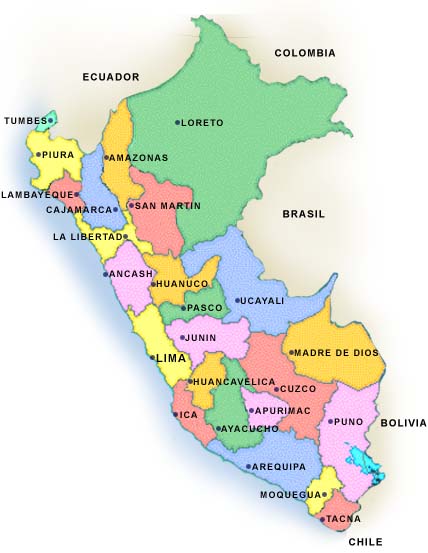
However, that point got me thinking. So I searched for a map of Peru showing the major administrative districts or Departments as they are known; Peru has twenty-four.

I’ve visited them all except seven: Tumbes, Piura, and Amazonas in the north; Ucayali and Madre de Dios in the east-southeast; and Moquegua and Tacna in the south. But I’m not really sure about Moquegua. I was checking the road from Arequipa to Puno, and if it still takes the same route across the altiplano as it did more than 40 years ago, it cuts across the northwest corner of Moqegua for a distance of about 3 km. So technically, I guess, I can say I’ve been to that department. But in all the others I have done some serious traveling. Well, most of them.


Steph and I took the opportunity whenever we had free time to jump in the car and explore the Santa Eulalia valley, east of Lima. Steph had (has) an interest in cacti and succulents, and this was a great place for some relaxed botanizing. Further up the valley, at higher altitudes wild potatoes were quite common by the side of the road.

And it was in relation to several extensive trips that I made to collect native potato varieties that I got to see parts of Peru that perhaps remain quite isolated even today. In May 1973, my colleague Zosimo Huaman and I spent almost a month traveling around the Departments of Ancash and La Libertad. A year later, I went by myself (with a driver) to explore the Department of Cajamarca. I was so impressed with what I saw in all three that I took Steph and a couple of friends back there. But my work-related travels took me off the beaten track: by road as far as the roads would take us, and then on foot or on horseback. Again, take a look at the Peru stories and photo album to marvel at beauty of the landscapes and sights we experienced, the archaeology we explored, the botanizing we attempted.

Steph and I drove around central Peru in Ayacucho, Junin, and down to the selva lowlands to the east. In the south we drove to Arequipa and Puno (where my potato collecting work also took me to Cuyo Cuyo), as well as to Cuzco (by air) and Machu Picchu of course.

My cocoa consultancy took me to Tarapoto in San Martin (proposed site of the cocoa field genebank), and to Iquitos where I crossed the two mile-wide Amazon in a small motorboat to reach a site of some very old cocoa trees (the ‘Pound Collection‘) on the far bank.

I’ve written also about Peru’s cuisine and its famous pisco sour. Lima now boasts some of the world’s most highly acclaimed restaurants.

And talking of food and drink, Steph and I loved to dine at La Granja Azul, a former monastery on the eastern outskirts of Lima along the Carretera Central. We had our wedding lunch there. The restaurant only served chicken grilled on the spit; and the most delicious chicken liver kebabs or anticuchos. These were served while waiting in the bar for dinner to be served. And, in the bar, there were (and still is) the most cocktails. We often enjoyed a particular one: Batchelor’s Desire. I don’t recall all its ingredients, but I think it had a base of gin, with kirsch among other ingredients. What a kick! Its signature however was a small ceramic statue of a naked female embellishing the cocktail. It must have made an impression, as we still have one of the figures displayed in a cabinet! From the image I just saw on the restaurant website, the naked lady is no longer part of the experience. Very 1970s perhaps.
Peru is a country that should be on the bucket list of anyone with a hankering for travel. Don’t take my word for it. Go and and experience it for yourself.


[1] A British slang phrase of uncertain origin. It is generally used to mean everything which is necessary, appropriate or possible; ‘the works’.

[2] The project never got off the ground. The political situation in Peru had deteriorated, the terrorist organization Sendero Luminoso or Shining Path was in the ascendant nationwide, and drug traffickers (narcotraficantes) were active in the region of Peru (near Tarapoto) where it was hoped to establish the field genebank.

[3] In that context, a story in The Guardian recently is quite interesting, putting back the domestication of cacao some 1500 years, and to Ecuador not Central America and the Mayas as has long been surmised.

Wishing I was in Cuzco . . .

The 10th World Potato Congress takes place in the southern Peruvian city of Cuzco at the end of May this year. I wish I was going.

It would be a great opportunity to renew my links with potato research, and revisiting one of Peru’s most iconic cities would be a joy.

I like this quotation from the Congress website: Potatoes are the foundation of Andean society. It shaped cultures and gave birth to empires. As the world population explodes and climate change places increased demands on the world’s farmers, this diverse and hearty tuber will play an instrumental role in feeding a hungry planet.

Cuzco lies at the heart of the Andean potato culture. The region around Cuzco, south to Lake Titicaca and into northern Bolivia is where most diversity in potatoes and their wild species relatives has been documented. When I worked for the International Potato Center (CIP) in Peru during the early 1970s I had several opportunities of looking for potatoes on the Peruvian side of the border, and made three (possibly four) visits to Cuzco. I see from a quick scrutiny of the street map of Cuzco on Google maps that the city has changed a great deal during the intervening years. That’s hardly surprising, including many fast food outlets dotted around the city. The golden M get everywhere! Also there are many more hotels (some of the highest luxury) in the central part of the city than I encountered 45 years ago.

At Machu Picchu in January 1973

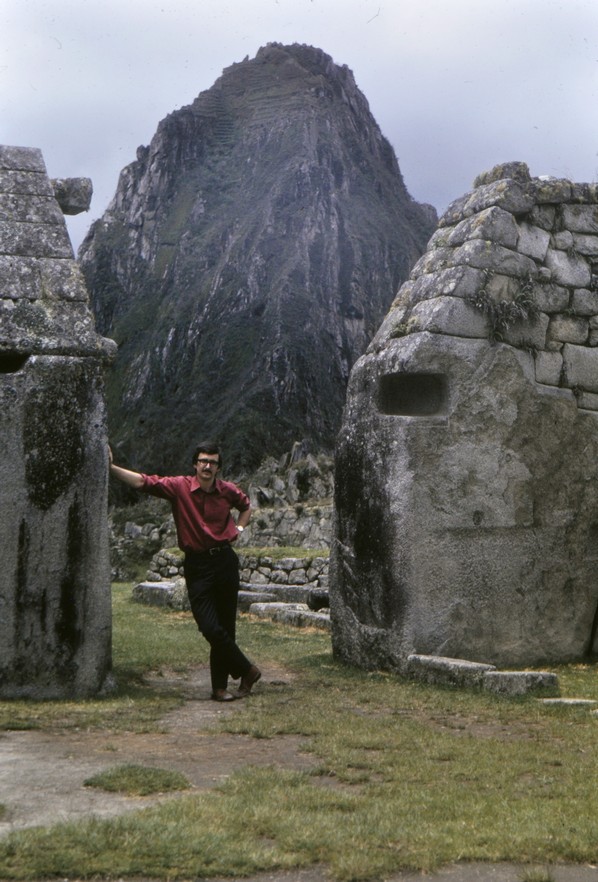
I visited Cuzco for the first time within two weeks of arriving in Peru in January 1973. The participants of a potato germplasm workshop (that I described just a few days ago) spent a few days in Cuzco, and I had the opportunity of taking in some of the incredible sights that the area has to offer, such as Machu Picchu and the fortress of Sacsayhuamán on the hillside outside the city.

Steph and I were married in Lima in October 1973, but we delayed our honeymoon until December. And where could there be a more romantic destination than Cuzco, taking in a trip to Machu Picchu (where we stayed overnight at the turista hotel right beside the ruins), Sacsayhuamán, the Sacred Valley, and the Sunday market at Pisac.

In the early 70s, the Peruvian airline Faucett flew Boeing 727s into Cuzco. In January 1973 I’d only ever flown three times: in 1966 to the Outer Hebrides in Scotland on a BEA Viscount turboprop; from London to Istanbul on Turkish Airlines to attend a scientific meeting in Izmir; and the intercontinental flight from London to Lima with BOAC.

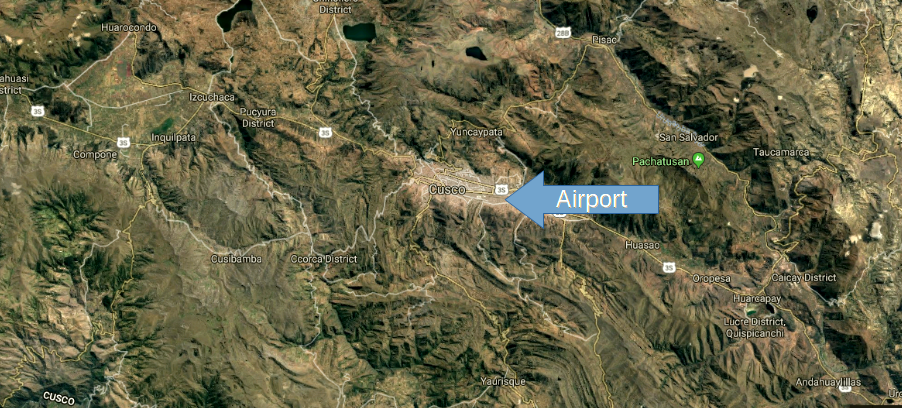
Flying into Cuzco was (is) quite an experience. There’s only one way in, and out! It is quite awesome (if not a little unnerving) dropping through the cloud cover, knowing that some of the highest mountains in the world are just below, then seeing the landscape open as you emerge from the clouds, banking hard to the left and follow the valley, landing at Cuzco from the east.

The city has now expanded eastwards beyond the airport, but in 1973 it was more or less at the city limits. The main part of the city lies at the western end of the runway, and hills rise quite steeply just beyond, thus the single direction for landing and the reverse for take-off. Maybe with new, and more highly powered aircraft, it’s now possible to take off to the west. Those attending the World Potato Congress should have a delightful trip from the coast. By the end of May the dry season should be well-established, and the skies clear.

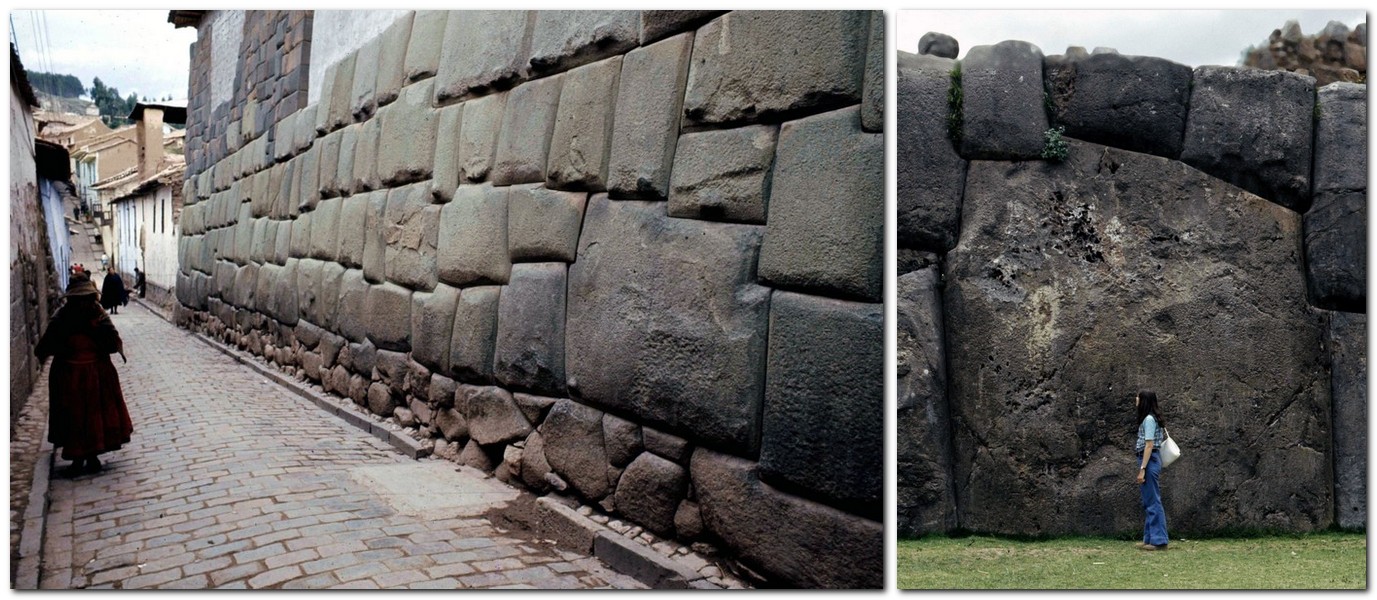
So, what is so special about Cuzco? It’s a city steeped in history, with Spanish colonial buildings blending into, and even constructed on top of the Inca architecture. That architecture leaves one full of wonder, trying to imagine how the stones were brought to the various sites, and sculpted to fit so snugly. Perhaps the best example is the twelve-sided (or angled) stone in the street named Hatun Rumiyoc (a couple of blocks east of the Plaza de Armas). This is taken to an even greater level at Sacsayhuamán, with an enormous eleven-sided stone.

My first impressions of Cuzco were the orange-tiled roofs of most buildings in the city.

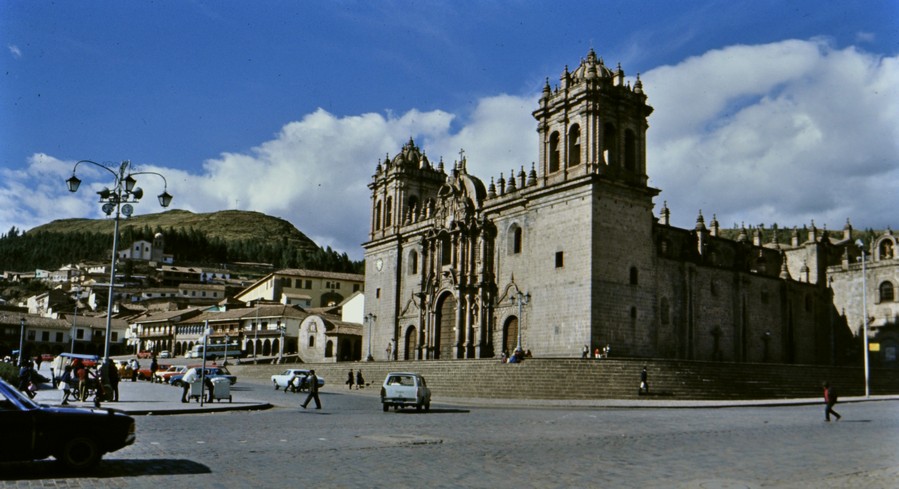
All streets eventually lead to the main square, the Plaza de Armas in the city center, dominated on its eastern side by the Cathedral Basilica of the Assumption of the Virgin, and on its southern side by the late 16th century Templo de la Compañía de Jesús (a Jesuit church).

This slideshow requires JavaScript.

One of the finest examples of the Inca-Colonial mixed architecture is the Coricancha temple upon which was constructed the Convent of Santo Domingo. The Incan stonework is exquisite (although showing some earthquake damage), and inside 16th/17 century paintings have survived for centuries.

Another aspect of Cuzco’s architectural heritage that caught our attention were the balconies adorning many (if not most) buildings on every street, at least towards the city center.

In the early 1970s steam locomotives were still in operation around Cuzco and, being somewhat of a steam buff, I had to take the opportunity of wandering around the locomotive shed. During our trip to Machu Picchu, our tourist diesel-powered train actually crossed with another pulled by a steam locomotive.

This slideshow requires JavaScript.

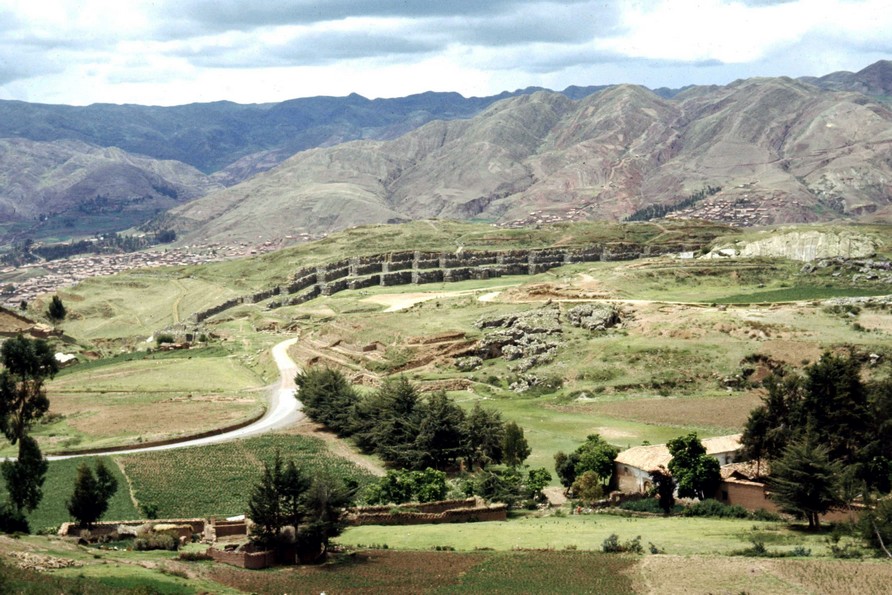
Outside the city, to the north lies the Inca fortress citadel of Sacsayhuamán, the park covering an area of more than 3000 hectares. Steph and I spent a morning exploring the fortress, viewing it from many different angles, and pondering just how a workforce (probably slave labour) came to construct this impressive site, with its huge stones so closely sculpted against each other that it’s impossible to insert the blade of a knife.

This slideshow requires JavaScript.

Among the most commonly visited locations by many tourists is the small town of Pisac, some 35 km from northeast of Cuzco at the head of the Sacred Valley, where a vibrant market is held each Sunday. We took a taxi there, and joined quite a small group of other tourists to wander around, bargain for various items (including an alpaca skin rug that we still had until just a couple of years ago). This is not a tourist market, however—or at least it wasn’t in December 1973 when we visited. As you can see in the slideshow below, it was very much a place and occasion frequented by people coming from the surrounding communities to sell their produce, and meet up with family and friends. Whenever I look at these photographs I always feel quite sad, as it’s likely that many who appear have since passed away.

This slideshow requires JavaScript.

It’s no wonder that Cuzco and surrounding areas have been afforded UNESCO World Heritage status (as so many other treasures in this wonderful country). So, as I think about the opportunities that potato scientists from all around the world will enjoy when they visit Cuzco at the end of May, I can’t help but feel a tinge of envy. However, they’d better take advantage of the odd cup of coca tea, or maté de coca, if offered. An infusion of coca leaves (yes, that coca!), it really does help mitigate the effects of high altitude and the onset of so-called ‘altitude sickness’.


How long is a piece of string?

Just three decades after Spanish conquistador Francisco Pizarro first encountered the potato in the high Andes of Peru in 1532, the potato was already being grown in the Canary Islands. And it found its way to mainland Europe via the Canaries shortly afterwards [1].

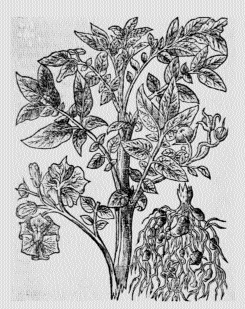
The first known published illustration of the potato in Gerard’s Herball of 1597.

The potato was described by English herbalist John Gerard in his Herball published in 1597. In a revised version, published in 1633 over 20 years after his death, there is another beautiful woodcut of the potato, referred to Battata Virginiana or Virginian potatoes.

Potatoes became an important crop by the late 18th century, and particularly the staple of Ireland’s impoverished citizens in the years leading up to the Irish Potato Famine of the mid-1840s.

Today, potatoes are one of the world’s most important crops, grown in every continent except Antarctica. Known scientifically as Solanum tuberosum, it was given this name by the famous Swedish naturalist, Carl Linnaeus in his 1753 magnum opus, Species Plantarum.

The potato and its wild relatives must be one of the most studied groups of crop plants. Not that I’m biased (having researched potatoes for more than 20 years).

Potato diversity and germplasm collections
Its clear that there is a wealth of information about the diversity within the section of the genus Solanum that encompasses the potato. They have been studied extensively from a taxonomic point of view, breeding efforts worldwide have incorporated genes from many wild species to enhance productivity, and important germplasm collections were set up decades ago to preserve this important diversity, to study it, and use it in potato breeding.

My former colleague (and fellow PhD student at Birmingham), Dr Zosimo Huaman, describes the management of CIP’s wild potato collection in Huancayo to members of the CGIAR’s Inter-Center Working Group on Genetic Resources who held their annual meeting at CIP in 1996.

Among the most important collections are held at:

The wild relatives of the potato have one of the broadest geographical and ecological ranges among species that have been domesticated for human consumption. While the various forms of cultivated potatoes were domesticated in the Andes of Peru and Bolivia, and on the coast of Chile, the wild species are found from the southwest USA (in the coniferous forests of Arizona, for instance) through Mexico and the countries of Central America to Panama, along the Andes south to Chile and northern Argentina, and south and east on to the plains of Argentina, Brazil, Paraguay and Uruguay. Wild species are found in the coastal desert of Peru, in the cloud forests of central America to almost 3000 m, at the highest altitudes of the Andes, well over 4000 m, and also growing in the highly humid transition zone on the eastern side of the Andes dropping down to the lowland forests (known as the ‘eyebrow of the mountain’ or ceja de la montaña).

Here is just a very small sample of the diversity—and beauty—of wild potato species (photos courtesy of my friends at the Commonwealth Potato Collection).

How many potato species are there?
Well, it depends, to some extent, on one’s perspectives as a taxonomist, use of different species concepts, and the methods used to study species diversity, and also on the work that earlier taxonomists published.

Essentially, there are three basic taxonomic approaches:

  • Morphology: often based on the study of dried herbarium specimens collected in the wild. In the case of potatoes, this has led to the description of a multiplicity of species, with almost every variant being described as a separate species. This reliance on plant morphology was the approach taken by the 19th and early 20th century botanists.
  • Biosystematics: takes an experimental view of species diversity, of breeding behaviour and relationships, and very much based on collections in the field and the study of ecology, and growing samples in a uniform environment such as the study one of my PhD students, Susan Juned, made of Solanum chacoense, a species from Argentina and Paraguay.
  • Molecular biology: methods have become available in the last couple of decades to analyse the most basic variation in DNA, and helped to refine further how potato taxonomists view the diversity within the tuber-bearing Solanums, and the relationships between species.

While these different approaches still do not provide a definitive answer to the question of how many species there are, we know that taxonomists have described and named more than 200 species. To some extent it’s like asking how long is a piece of string. And that helps me to provide an analogy.

Take a piece of string. If you were to view this string along its length that, to your vision would be fore-shortened, it would be very difficult to say with any degree of certainty just how long the string actually was. However, if you increase the angle at which you view the string, until you are looking at right angles, your ability to estimate its length also increases. At right angles you can see the whole length, and measure it accurately in many different ways.

Taxonomic study is a bit like looking at the string from different angles. Each taxonomist builds on earlier studies, and describing new species or subsuming previously described ones into another species (as merely variants). This is one of the challenges of studying wild potato species: they are highly variable and show considerable phenotypic (or morphological) plasticity. It’s not always possible to study large numbers of plants under uniform conditions to reduce the variation caused by differences in habitats.

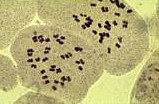
The 2n=3x=36 chromosomes of a triploid potato, from a root-tip squash in two cells.

Furthermore potatoes have considerable chromosomal variation, with a base number of x=12, with diploids (2n=24) the most frequent, and mostly self-incompatible (i.e. they cannot self fertilise), infertile triploids (2n=36, including two cultivated species), tetraploids with 2n=48 (mostly self-fertile, and including the cultivated Solanum tuberosum of world-wide agriculture), some pentaploids (2n=60; including one cultivated form), and a few hexaploids with 2n=72. Wild potatoes are uncommonly promiscuous when grown together under experimental conditions, and will inter-cross readily (they are bee-pollinated), yet hybrids often do not survive beyond the second generation in the wild. Many species are separated by ecology, and generally do not come into contact with each other, thus maintaining their species identity.

Nevertheless, this is what makes the study of potatoes and wild species so very interesting, and that captured my interest directly for over two decades, and continues to do so, even though I moved on to the study of other crops like rice and grain legumes.

The potato taxonomists
Many botanists have taken an interest in wild potatoes. During the 19th century, the Swiss-French botanist Alphonse de Candolle (d. 1893) named a number of species, as did François Berthault (d. 1916). But the first decades of the 20th century leading up to the Second World War saw a lot of collecting and taxonomic description. In Germany, Friedrich August Georg Bitter, who specialised in the genus Solanum, described and named many species. However, it was the involvement of several Russian botanists and geneticists, under the leadership of Nicolai Vavilov, that saw an expansion in the collection of potatoes throughout the Americas, but a systematic evaluation of this germplasm leading to even more species being described.

SM Bukasov

Two names come to mind, in particular: SM Bukasov and VS Juzepczuk. They were active during the 1920s and 30s, taking part in several missions to South America, and developing further the concept of potato species. But much of their work was based on morphological comparison leading to the identification of even small variants as new species.

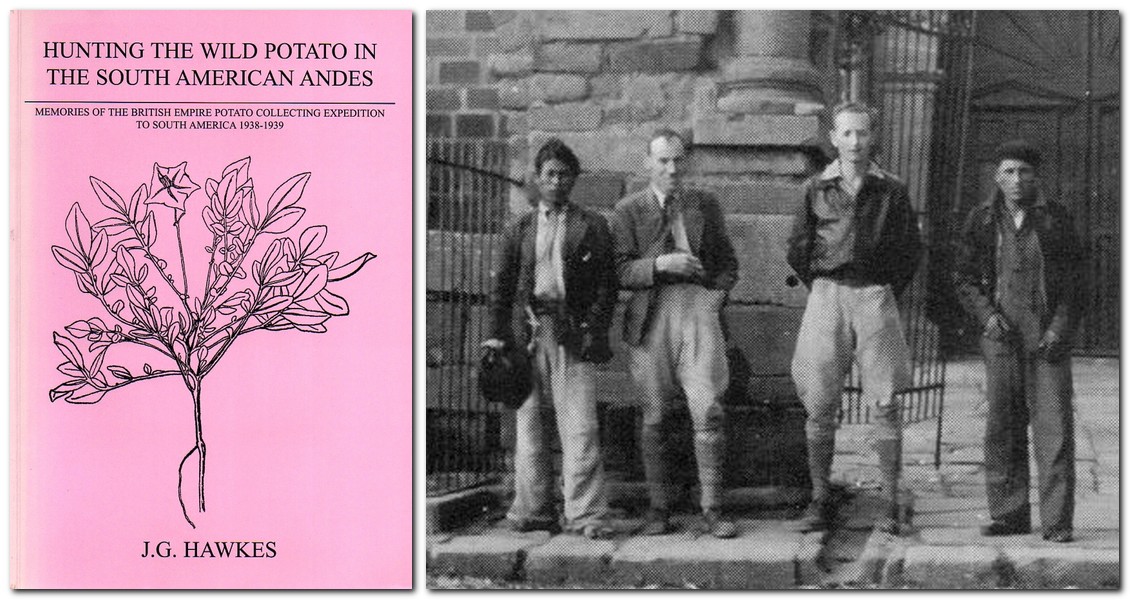
In August 1938, a young Cambridge graduate, Jack Hawkes, traveled to Leningrad in Russia to meet and discuss with Bukasov and Juzepczuk (and Vavilov himself) in preparation for the 1938-39 British Empire Potato Collecting Expedition to South America (which Jack has described in his 2004 memoir Hunting the Wild Potato in the South American Andes [2]).

A young Jack Hawkes (second from right) stands outside a church near Lake Titicaca in northern Bolivia, alongside expedition leader Edward Balls (second from the left).

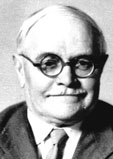
Jack Hawkes

That collecting expedition, and the subsequent studies (which led to Hawkes being awarded his PhD from the University of Cambridge in 1941 for a thesis Cytogenetic studies on South American potatoes supervised by renowned potato scientist Sir Redcliffe N Salaman), was the launch pad, so to speak, of potato taxonomy research for the rest of the 20th century, in which Hawkes became one of the leading exponents.

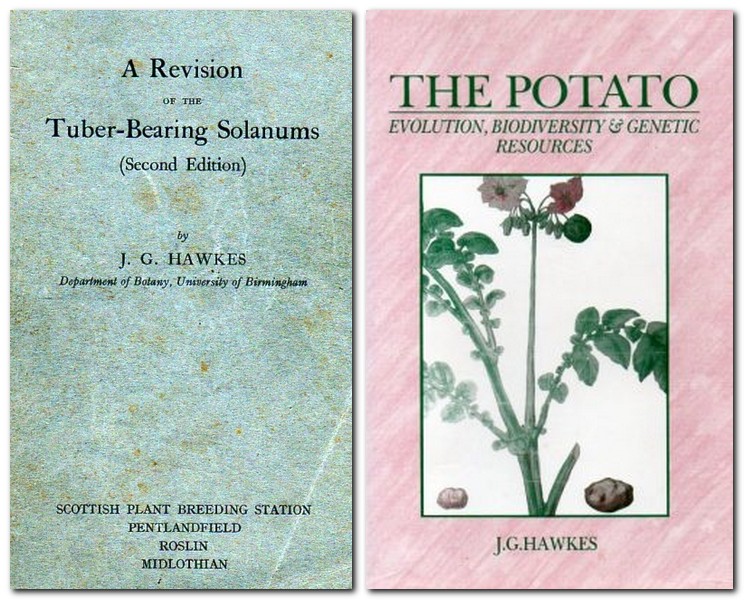
After Cambridge, Hawkes spent some years in Colombia (where he no doubt continued his studies of wild potatoes) but it was on his return to the UK in 1952 when appointed to a lectureship in the Department of Botany at The University of Birmingham (where he was to remain until his retirement in 1982) that his potato studies flourished, leading him to publish in 1956 his first taxonomic revision of the tuber-bearing Solanums (with a second edition appearing in 1963).

In 1990, he published his final synopsis of the tuber-bearing Solanums [3]; that taxonomic treatment is the one followed by the curators of the Commonwealth Potato Collection.

Jack’s approach to potato taxonomy was based on a thorough study of morphology backed up by rigorous crossing experiments, and a cytogenetic and sometimes serological evaluation of species relationships.

I first met Jack in February 1970 when he interviewed me for a place on his newly-founded MSc course on plant genetic resources, joining the course later that same year. In September 1971 I became one of Jack’s PhD students, joining others who were looking at the origin and evolution of the cultivated species [4].

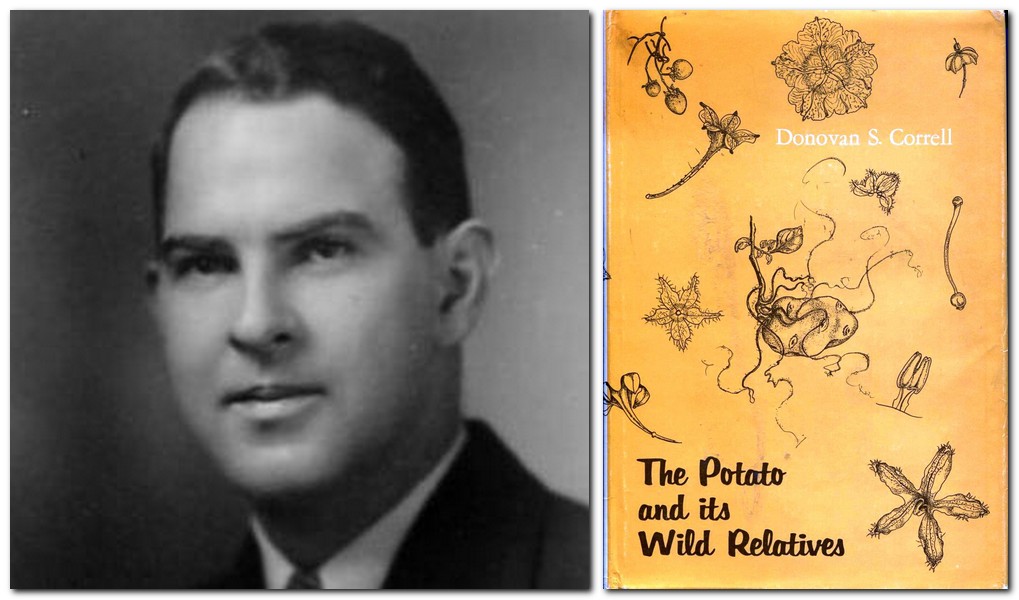
Donovan S CorrellIn these revisions he was also taking into account the work of US botanist, Donovan S Correll who published his own potato monograph in 1962 [5], as well as three important South American botanists with whom he would collaborate from time-to-time: Professor César Vargas from the National University of Cuzco; Professor Martín Cárdenas from Cochabamba in Bolivia; and Professor Carlos Ochoa, originally from Cuzco, who was a professor at the Universidad Nacional Agraria (UNA) in La Molina, Lima and, around 1975 or so, joined the International Potato Center across the street from the UNA.

L-R: Danish botanist J Peter Hjerting, Martin Cardenas, and Jack Hawkes in Cochabamba.

Vargas published a number of species descriptions in the 1950s, but made his most significant contribution in his two part monographs, Las Papas Sudperuanas published in 1949 and 1956. I met Vargas on a couple of occasions, first in January 1973 just after I’d joined CIP as Associate Taxonomist. And a second time in February 1974 when I was passing through Cuzco with Dr Peter Gibbs from the University of St Andrews in Scotland. Peter was making a study of incompatibility among different forms of the Andean tuber crop, oca (Oxalis tuberosa), and had joined me on an excursion to Cuyo-Cuyo in the Department of Puno. Vargas’s daughter Martha was studying for her MSc degree under Peter’s supervision at St Andrews.

With Prof Cesar Vargas at his home in Urubamba, near Cuzco

It was Carlos Ochoa, however, whose studies of potatoes and their relatives rivalled (and in some respects eclipsed) those of Jack Hawkes. They were quite intense taxonomic rivals, with a not-altogether harmonious relationship at times. Carlos certainly played his taxonomic cards very close to his chest.

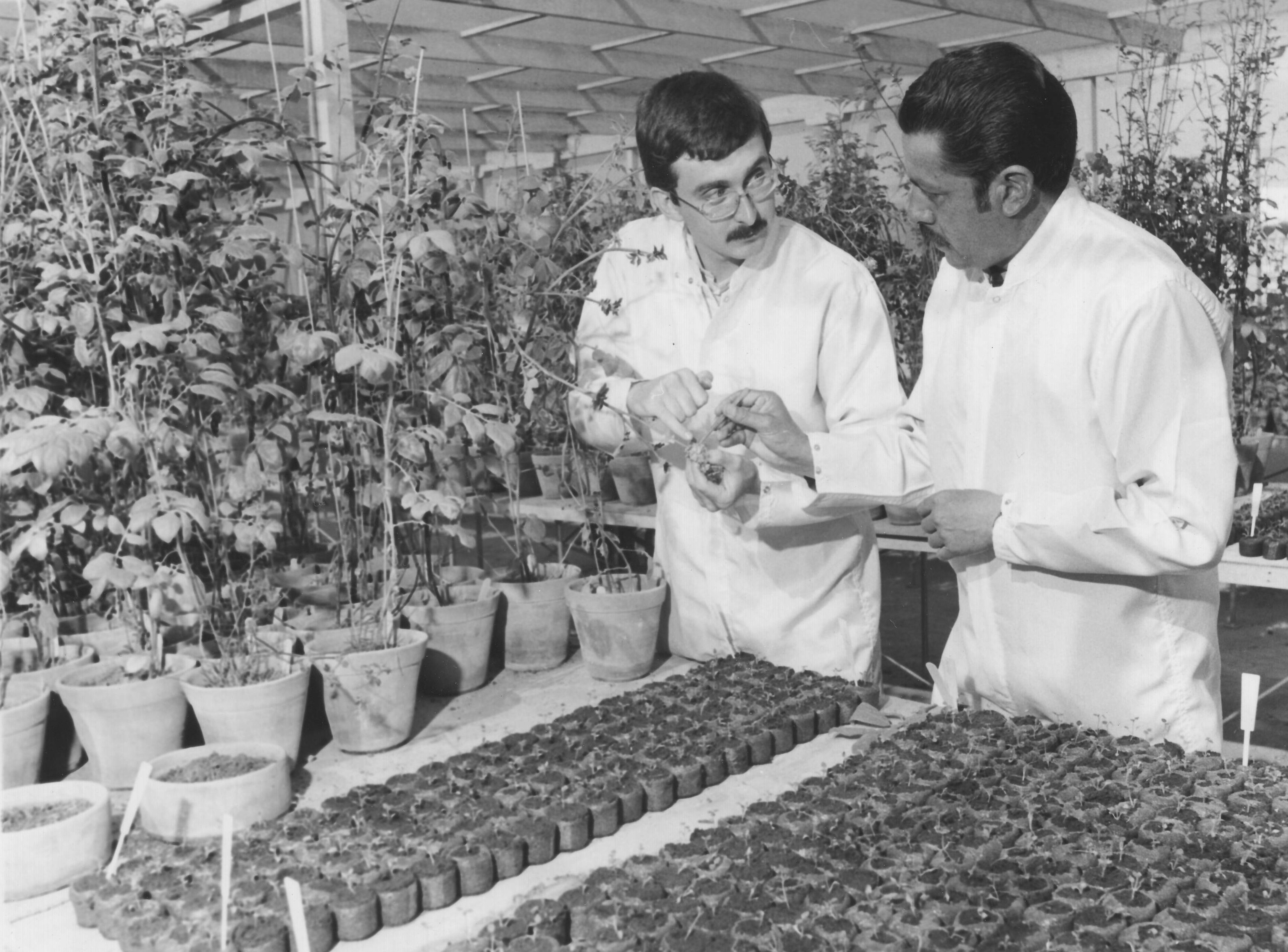
Me consulting with Carlos Ochoa concerning the identity of some triploid potatoes, in one the screenhouses at the International Potato Center in 1974.

But the fact that he grew up in the Andes and had, from an early age, taken an interest in the diversity of this quintessential Andean crop and its wild relatives, led him to dedicate his life to uncovering the diversity of potatoes in his homeland. He was also a potato breeder and released some of the most important varieties in Peru, such as Renacimiento, Yungay, and Tomasa Condemayta.

In this video (in Spanish, and broadcast on Peruvian TV on his death in 2008) he talks about his early life in Cuzco, the pressures on him to study medicine or become a lawyer, and how he found his true vocation: the study of wild potatoes.

Setting potato taxonomy and germplasm exploration priorities at CIP
Forty-five years ago this week, CIP convened the first planning workshop on the exploration and taxonomy of potatoes [6], inviting a group of taxonomists and potato breeders to meet in Lima and mull over the ‘state of play’ taking into consideration what taxonomic research had already been accomplished, what was in the pipeline, and what CIP’s germplasm exploration policy (especially in Peru) should be. I attended that meeting (as an observer), having landed in Lima just a few days earlier.

On the taxonomic side were Jack Hawkes, Carlos Ochoa, and Donald Ugent who was a ethnobotany professor at Southern Illinois University in Carbondale. Richard Tarn, a potato breeder from Agriculture Canada at Fredericton, New Brinswick, had completed his PhD under Jack’s supervision at Birmingham. Frank Haynes, a professor of genetics and potato breeder at North Carolina State University (and long-time friend and colleague of CIP’s first Director General, Richard Sawyer) and Roger Rowe [7], then curator of the USDA’s potato collection at Sturgeon Bay (who would join CIP in July 1973 as the Head of Breeding and Genetics, and become my PhD co-supervisor) were the other participants.

Workshop participants looking at CIPs germplasm collection in the field at Huancayo (3000 m) in central Peru. L-R: David Baumann (CIP field manager), Frank Haynes, Jack Hawkes, Roger Rowe, and Don Ugent.

In 1969, Jack had published (with his Danish colleague Peter Hjerting [8]) a monograph of the potatoes of southern cone countries of South America [9], and by the time of the CIP 1973 workshop was well into research on the potatoes of Bolivia [10], leading publication of a monograph in 1989.

Peter Hjerting collecting Solanum chacoense in Bolivia in 1980. Standing next to him is Ing. Israel Aviles, a Bolivian member of the expedition. Their driver looks on.

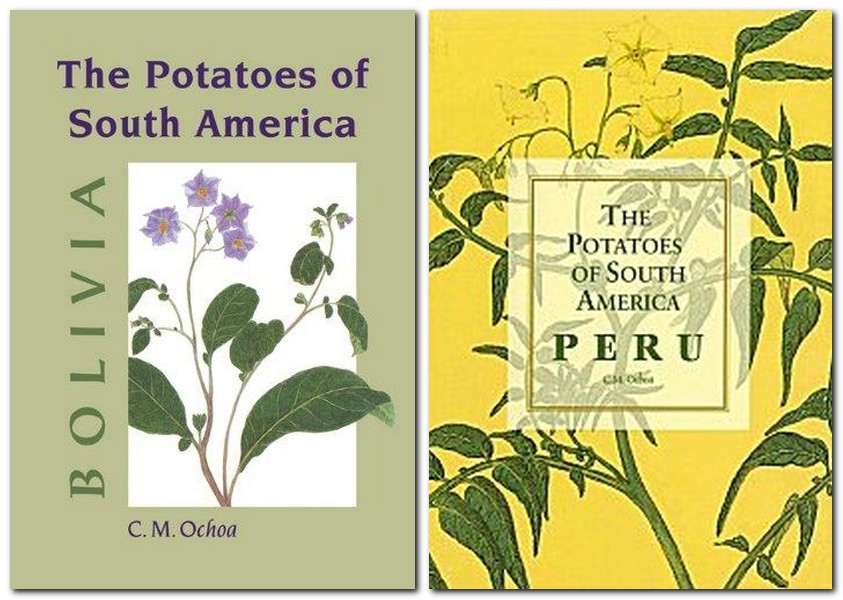
What I’ve never been able to fathom after all these years is why Ochoa decided to write his own monograph of the Bolivian species rather than concentrating in the first instance on the Peruvian species. Nevertheless Ochoa did produce his own fine monograph in 1990 [11], beautifully illustrated with some fine watercolours by CIP plant pathologist Franz Frey. This was followed by an equally magnificent volume on the potatoes of Peru in 2004 [12], also illustrated by Frey.

Throughout his expeditions and research, Ochoa was supported by several assistants, the most notable being Ing. Alberto Salas. Now in his mid-70s, he has been collecting wild potatoes for five decades.

I knew Alberto when I first joined CIP in 1973, and it was a delight to meet him again (although he had retired) during my visit to CIP in July 2016.

Taking up the baton
With retirement, Hawkes and Ochoa passed the potato taxonomy baton to a new generation of researchers, principally David Spooner, a USDA scientist at the University of Wisconsin-Madison who made several collecting trips throughout the Americas.

David Spooner

David’s research took potato systematics to a new level, employing the developing molecular and genomic approaches, and use of different classes of markers to help him refine his understanding of the diversity of the tuber-bearing Solanums, building of course on the very solid Hawkes and Ochoa foundations.

Although no longer working on potatoes (his most recent focus on carrots supported the PhD thesis of Carlos Arbizu, Jr, the son of one of my PhD students at Birmingham in the 1980s), David’s scientific output on potatoes has been prodigious. With molecular insights supporting more traditional methods he has proposed a 50% reduction in the number of potato species from the more than 200 listed in Hawkes’s 1990 publication.

Is this the end of the potato taxonomy story? Probably for the time-being. It’s unlikely that anyone will pursue these studies to the same depth as Hawkes and Hjerting, Ochoa, or Spooner. Nevertheless, as the curators of the Commonwealth Potato Collection have done, most potato researchers will take a pragmatic approach and fix on a particular taxonomic treatment on which to base their management or use of germplasm. Taxonomy is one of those disciplines in which subjective interpretations (obviously based on empirical studies of diversity) can lead to contrary classifications. What is a distinct species to one taxonomist may be merely a variant to another. Undoubtedly these different taxonomic treatments of the tuber-bearing Solanums have permitted us to have a much better appreciation of just how long ‘the potato piece of string’ really is.

~~~~~~~~~~~~~~~~~~~~~~~~~~~~~~~~~~~~~~~~~~~~~

[1] Hawkes, JG & J Francisco-Ortega, 1993. The early history of the potato in Europe. Euphytica 70, 1-7.

[2] Hawkes, JG, 2004. Hunting the Wild Potato in the South American Andes – Memories of the British Empire Potato Collectiing Expedition to South America 1938-1939. Wageningen, the Netherlands. ISBN: 90-901802-4.

[3] Hawkes, JG, 1990. The Potato – Evolution, Biodiversity and Genetic Resources. Belhaven Press, London.

[4] Since I was working on the origin and evolution of a cultivated species of potato for my PhD, I made only one short collecting trip for wild species with Jack in early 1975, to the Departments of Huanuco, Cerro de Pasco, and Lima. On his trips to Peru between 1973 and 1975 he would join me in the field to look at the germplasm I was studying and give me the benefit of his potato wisdom.

[5] Correll, DS, 1962. The Potato and its Wild Relatives. Contributions from the Texas Research Fiundation 4, pp. 606. Texas Research Foundation, Renner, Texas.

[6] International Potato Center, 1973. Report of the Workshop on Germplasm Exploration and Taxonomy of Potatoes. Lima, Peru. 35 pp.

[7] I’ve kept in touch with Roger and his wife Norma all these years. After I left CIP in 1981, Roger moved to East Africa to work with the animal diseases center that became ILRI after its merger with another CGIAR livestock center in Ethiopia. He was DDG-Research at CIMMYT in Mexico in the late 1980s and early 1990s. While I was at IRRI, he was based in Cairo working for the CGIAR center that became WorldFish (with its headquarters in Penang, Malaysia). Before it moved to Malaysia, ICLARM as it then was had its offices in Manila, and we would see Roger in the Philippines from time-to-time. It was great to meet up with Roger and Norma again in July 2016 when I was in Lima for the genebank review that I led.

[8] From what I can determine through a Google search, as of January 2018, Peter celebrated his 100th birthday in 2017. He has a Mexican tetraploid (2n=4x=48) species named after him, Solanum hjertingii. When I was at Birmingham in the 1980s I had two PhD students, Lynne Woodwards and Ian Gubb who studied this species because its tubers lack so-called enzymatic blackening, a trait that could be very useful in potato breeding.

[9] Hawkes, JG & JP Hjerting, 1969. The Potatoes of Argentina, Brazil, Paraguay, and Uruguay – A Biosystematic Study. Annals of Botany Memoirs No. 3. Clarendon Press, Oxford.

[10] Hawkes, JG & JP Hjerting, 1989. The Potatoes of Bolivia – Their Breeding Value and Evolutionary Relationships. Clarendon Press, Oxford.

[11] Ochoa, CM, 1990. The Potatoes of South America: Bolivia. Cambridge University Press, Cambridge.

[12] Ochoa, CM, 2004. The Potatoes of South America: Peru. International Potato Center, Lima, Peru.

And pigs might fly . . .

Steph and I made two road trips together to the small town of San Ramón (see map), that lies at just over 800 m on the eastern slopes of the Andes in the Department of Junín.

Nothing particularly special or interesting in that, you might ask, especially if you know the region. The International Potato Center (CIP) opened an experiment station there in the 1970s, as somewhere it could evaluate potato breeding lines against several pests and diseases that appeared more regularly at this site than at higher elevations. But also for testing potatoes in their ability to grow under higher temperatures than usual for potatoes, a temperate crop that evolved in the Tropics. This emphasis on adaptation to high temperatures, with the aim of potentially expanding potato production worldwide into less favorable environments, was work I would continue once I moved to Costa Rica in 1976.

San Ramón today has a population of 30,000 inhabitants but was very much smaller when we first visited. It was not normally on our itinerary, since Steph’s and my work only took us to Huancayo high up in the central Andes, at over 3000 m.

Our first trip, in August 1973 (with CIP plant pathologist John Vessey and physiologist Ray Meyer) was just a few weeks after Steph joined me in Peru. This was our first experience of the hot and humid lowland tropics. Little did we imagine that just a few years later (from 1976) we would spend almost five years in Costa Rica living under those conditions in Turrialba, nor that almost two decades later we would move to the Philippines for 19 years.

Our second and short vacation trip was in September 1974.

I’ve been back only a couple of times, once in early 1976 before we headed off to Costa Rica, and another¹ in the mid-1980s when, working at The University of Birmingham, I had a research project with CIP, and took the opportunity of a visit to Lima to travel from Huancayo to San Ramón.

Dropping down to San Ramón the only road passes through the town of Tarma, famous for its flower production. What a delight. Higher up, the road sweeps round broad valleys with it patchwork of fields, one of the most attractive views I think I’ve seen in all my travels across the Andes.

Below Tarma, the valley narrows, and winds its way beside a fast flowing river (that becomes the Chanchamayo River beyond San Ramón), with numerous tunnels carved through the rock, and barely wide enough in places for two vehicles to pass. There are steep precipices into the river below at numerous locations.

And given that the San Ramón region and beyond is (was) a particularly important fruit-growing one (especially for papayas), there was always a constant stream of lorries loaded with fruit grinding their way out of the valley to climb over Ticlio (at almost 5000 m) before dropping rapidly to Lima on the coasts.

Steph’s first trip to Huancayo (and San Ramon) in August 1973.

On the second morning of our September 1974 trip, we set off after breakfast along the Chanchamayo River towards La Merced, stopping frequently to look at the vegetation, explore the river bank, and take photos. It’s hard to imagine that La Merced now has a population approaching 170,000. Beyond La Merced we had thoughts of eventually reaching Oxapampa, but as the road deteriorated so did our expectations of being able to travel there and back in a single day. With some regret we turned around. Oxapampa was (is) an interesting community, founded in the 19th century by German immigrants, and retaining much of that influence today.

Our trip on the third day was much more eventful. Following a suggestion by John Vessey, we decided to take advantage of the local light aircraft flights from San Ramón servicing communities further out in the lowland areas (the ‘jungle’) and visit one such beside the Pichis River, Puerto Bermúdez (some 550 m lower in altitude than San Ramón). Today, Puerto Bermúdez is connected by road to La Merced and San Ramón, a drive of some 176 km, and about four hours. There was no road in 1974, and flights were the only option. From satellite images, the town does not appear to have an airstrip anymore. What looks like a former airstrip is flanked by buildings and criss-crossed by streets. Maybe with the road now reaching the town, an air bridge to San Ramón or other towns is no longer economically viable.

Having purchased our tickets, we arrived at the airfield early the next morning, and found ourselves squeezed into the rear seats of a single engine plane (probably a Cessna) for the 45 minute flight to Puerto Bermúdez. We were scheduled to return mid-afternoon, and had decided that we’d try and rent a boat for a trip along the river.

In 1974, Puerto Bermúdez was a very small settlement, and the area is home to one of Peru’s largest indigenous communities in its Amazon region, the Asháninka².

We soon found somewhere to buy a quick cup of coffee, and someone who would rent his boat to us for several hours for a trip along the Pichis, a river that flows north to join the even bigger Ucayali River south of Pucallpa, being some of the headwaters of the River Amazon.

In this gallery of photos, you can see the type of dugout canoes that are common along the river, with their long shaft outboard motors. In the distance along the river you can also see the Andes rising in the west. And also some of the communities we observed along the riverbanks, and the rafts carrying fruits. This was our first experience of an environment like this, and we thoroughly enjoyed ourselves. Everyone was most friendly.

After a quick bite to eat for lunch, we headed back to the airstrip for our mid-afternoon flight back to San Ramón.

And that’s when we had our next surprise. There was an aircraft waiting for the return flight. We were the only passengers. But the aircraft had no seats for us. There was some ‘freight’ to take: several dead pigs that were loaded along with empty beer crates that we were to use as seats. No seat belts!

Communicating with base back in San Ramón, the pilot told us that the weather had ‘closed in’ and that our departure would be delayed. And there we sat, looking westwards towards the Andes and wondering when we would be able to take off. After about an hour, the pilot told us that there was still ‘weather’ along the proposed return route, but ‘bugger it’ or words to that effect in Spanish, he said we should leave, and we’d better climb aboard if we wanted to return to San Ramón that same day.

With some trepidation—that I can still feel after all these years (I’ve never been the world’s best flier)—Steph and I climbed aboard, settled ourselves on our respective beer crates (or maybe they were cases of beer), and held on for dear life to anything we could as the plane hurtled down the runway and took to the air.

All was well for the first half of the flight. We gained height easily (after all the plane was carrying quite a light load  and I was very much lighter than I am, unfortunately, today). We could see the foothills of the Andes approaching, with rain squalls across our path. Needless to say things became rather more uncomfortable as we crossed that weather system, and bounced our way into San Ramón. But we lived to tell the tale.

Given the chance to make a journey like that again, I’d probably decline. The enthusiasm of youth, the risk taking. In any case one might hope that today, safety regulations are much more assiduously applied. The only time I’ve ever shared a flight with three dead pigs.

~~~~~~~~~~~~~~~~~~~~~~~~~~~~~~~~~~~~~~~~

¹ The 1980s were the Michael Jackson years. The singer, not me. Arriving at our hotel in San Ramón, it didn’t take long before a very large crowd of children had assembled outside the hotel and chanting ‘We want Michael Jackson‘. Some mix-up!

² Puerto Bermúdez’s Asháninka suffered during the years of the Sendero Luminoso (Shining Path) guerrilla insurrection of the 1990s, and many inhabitants of the town were massacred.

Heading south to the highest lake in the world

At 3812 m above sea level, Lake Titicaca straddles the border between Peru and Bolivia, and is the ‘highest navigable lake in the world’. It’s more than 1200 km south from Lima by road, and was the destination of a trip that Steph and I made in November 1974. Our first idea was to drive to La Paz, the capital of Bolivia, some 256 km southeast from Puno. However, we decided that would be one sector too far in the time we had available.

Most of the drive follows the Panamericana Sur for 850 km through a coastal desert, one of the driest in the world.

The highway crosses the Nazca Plain about 450 km south of Lima, and is the site of the world famous Nazca Lines (yet another UNESCO World Heritage Site in Peru!), ancient geoglyphs that can only be appreciated from the air. Sadly, we never took the opportunity for a flight over the Lines¹.

The Nazca monkey. Photo taken by renowned archaeologist Maria Reiche in 1953.

Much further south, at Camana, the road branches north towards the southern city of Arequipa, some 180 km away, and at an altitude of around 2330 m. Puno is reached from Arequipa after a climb to well over 4000 m before dropping to 3800 m on the shore of Lake Titicaca, crossing (among other locations) the Reserva Nacional Salinas y Aguada Blanca (and its flamingos).

We had already decided to drive ourselves just as far as Arequipa, then take a colectivo (a communal taxi) for the rest of the journey to Puno, and use taxis to move between the various sites we wanted to visit around Puno. On reflection we could have taken our VW the whole distance given some of the other trips we made around Peru and the state of some of those roads. From Arequipa to Puno we left the asphalt behind, travelling on a graded dirt road.

We spent the first night in Nazca, traveling on to Camana and its turista hotel on the second day. Like most of our travels there were frequent stops to admire the landscape, take photos, and investigate the local flora, especially the various cactus species, a particular hobby of Steph’s at that time.

This cactus, possibly an Echinocactus species, was less than 3 inches in diameter.

The highway crosses quite a number of rivers that flow down from the Andes. In the desert, and along the valleys themselves, irrigated rice cultivation is quite important. I had no idea when looking at these rice paddies in the 1970s that I’d be working on that crop across the other side of the world two decades later².

In Arequipa, we found a garage where we could leave the car safely for a few days while we traveled on to Puno. And then spent the next day and a half walking around the city to enjoy some of its sites.

Arequipa, founded in 1540, is (was) an elegant city, with a skyline dominated by the symmetrical cone of the Misti volcano, rising to over 5800 m. It is seasonally snow-capped, but with the effects of climate change affecting so many mountain ranges in the Andes today, I wonder to what extent Misti now has any snow cover at all during the year.

There were two sites we wanted to visit: the Basilica Cathedral, located on the north side of the Plaza de Armas, Arequipa’s central square. It has a facade of beautifully carved white stone, like the cathedral in Cajamarca that we visited in June 1974.

It was constructed over more than two centuries beginning in the 1540s. Progress was interrupted many times by volcanic eruptions and earthquakes, and the church had to be reconstructed several times. As recently as June 2001, one of its towers was toppled by a powerful earthquake that shook southern Peru. It is a building of great beauty, and dominates the Plaza de Armas.

A short distance north of the Plaza de Armas, the 16th century Dominican Convent of Saint Catherine (Monasterio Santa Catalina) is a quiet haven among the bustle of a busy city, and open for tourists to visit. Well, that was the situation four decades ago, so it must be even more so today. It has the feel of a small Spanish village, with winding streets, open doorways off to the side, and colonnaded hidden courtyards. And all decorated in a glorious umber.

The nuns could not receive visitors inside the convent, but could communicate with the outside world through grills. Natural light brightens the visitors’ corridor through skylights hewn from rock crystal. Inside the convent there are beautiful murals dating from as early as 1516. That’s interesting, because in the article about the convent on Wikipedia linked to above, the founding date is given as 1579, and Arequipa was not founded until 1540. Maybe some early buildings were incorporated into the convent. Nevertheless, there are some date inconsistencies I need to check further.

In Puno, there were three attractions we wanted to visit: the harbour and its large steamships; the floating islands made from the local totora reeds (Schoenoplectus californicus subsp. tatora), and home to a community of indigenous Urus; and the pre-Incan archaeological site of Sillustani, some 32 km northwest from Puno towards the airport town of Juliaca.

Some of the vessels that ply (or used to ply) Lake Titicaca are remarkable for their size. So how did they come to be sailing around the lake? The SS Ollanta was built in 1929 in Kingston upon Hull in England, in kit form, and sent out to Peru in pieces. The original Lego! Transported from the port of Mollendo to Puno by rail, it was riveted together on the shore of Lake Titicaca, and launched in 1931. It is still sailing today, but no longer on any scheduled services.

Tourism was, and must still be, a significant source of income for the Uru community that lives on the totora reed islands just offshore from Puno. Steph and I took the short motor boat trip from Puno to spend a couple of hours there. It is quite a remarkable community, seemingly self-sufficient, and getting around on their beautifully-crafted reed boats (the inspiration for Thor Heyerdahl’s Ra II expedition).

Given my interest in potatoes, I was fascinated to come across this brilliant example of potato hydroponics. Now that’s a good use for an old totora reed boat. Ingenious!

Although we didn’t make it into Bolivia, we did head out along the south shore of the lake towards the border, as far as Juli, just over 80 km southeast from Puno. As with so many small communities in the Andes, the town is dominated by a Catholic church, that we took the opportunity of visiting. The opulence of its interior was quite unexpected.

Our final visit in the Puno area was to the pre-Incan cemetery of Sillustani constructed by the Qulla people on the edges of Lake Umayo, and comprising a series of round towers called chullpas. The stones making up the chullpas are smooth and regular is shape, and one is left, yet again, with a sense of awe, at how such beautiful pieces of architecture were actually constructed. Interestingly, the Qulla are an indigenous people of western Bolivia, northern Argentina, and Chile. Sillustani must have been at the northern limit of their territory and range.

And then the vacation was over and we were headed back to Arequipa, to pick up our car and drive to Camana on the coast for an overnight stop. I think we made it back to Lima from there is one very long day of driving.

Besides this visit, I’d been in Puno on two previous occasions. One of my abiding memories was to seemingly acquire a taste for the algarrobina cocktail, made with Pisco. While I love a delicious Pisco sour, the thought of this rather sweet concoction now sends shivers down my spine. Happy days!

~~~~~~~~~~~~~~~~~~~~~~~~~~~~~~~~~~~~~~~~

¹ The Greenpeace delinquents who staged a protest on and defaced the Lines in December 2014 should have faced the full force of the law.

² In about 1996, the then President of Peru, Alberto Fujimori (now disgraced and serving a prison term for various human rights crimes, among others), visited the International Rice Research Institute (IRRI) in Los Baños, Philippines. I showed him around the genebank, and then joined discussions with IRRI’s Director General George Rothschild about rice production in Peru. Peru grows a number of IRRI varieties that have fallen out of favor in other parts of the world because of their susceptibility to pests and diseases. These, including IR43 and IR48 were less affected in Peru.

Around the world in 40 years . . . Part 15. In my father’s footsteps

Almost 50 years after my father visited Brazil, I made my first trip there in early 1979, when I attended a meeting of the Latin American Potato Association, ALAP. Its meeting that year was held in Poços de Caldas, in southwest Minas Gerais State, about 280 km north of São Paulo.

I was living in Costa Rica, and to fly to South America it was necessary to transit via Panama City. The itinerary took us from Panama to Bogotá in Colombia, then a Varig flight to Rio de Janeiro with an intermediate stop in Manaus on the Amazon in central northern Brazil. From Manaus, we flew south for hours to land in Rio in the early hours. It was that flight that made me appreciate just what a huge country Brazil is.

In Panama I’d joined up with other delegates to the same meeting, from Mexico, Guatemala, Costa Rica, and Panama. Our flight to Rio didn’t leave until the late evening so we had almost a whole day for some sight-seeing around Bogotá. One of the places we visited was an emerald dealer, where I couldn’t resist the temptation and bought a nice stone for my wife¹.

Colombian emeralds in Bogota

A Varig 727 on the tarmac at Rio de Janeiro. Varig ceased operations in 2006.

We arrived in Rio in the early morning, in time for the first air shuttle (Ponte Aérea or air bridge) flight from Rio de Janeiro’s Santos Dumont airport to São Paulo’s Congonhas airport, a journey of a little over an hour, affording some spectacular views of the coastline south of Rio. Then it was a four or five hour road trip from São Paulo to Poços de Caldas.

Poços de Caldas nestles in a valley in the surrounding rolling landscape. Very agricultural, and obviously an important potato growing area.

Heading back to Rio de Janeiro a week later, several of us decided to stop over there for about three nights, and explore this vibrant city.

The Sugar Loaf from Corcovado

Whether it was such a violent city then (or even when my father visited) as it is today, I have no recollection. We moved around the city seemingly oblivious to any such threats, spent an afternoon and evening on Copacabana beach, taking in all the ‘sights’: tangas to the left, tangas to the right!

But we also made the mandatory excursion to the top of the Sugarloaf, from where there were magnificent views north and south over the city and its beaches.

Also we made the climb by taxis to Corcovado, where the statue of Christ the Redeemer stands, on a 2328 ft granite peak, looking out to sea.

These next photos were taken by my father (who was a professional photographer) in Rio all those decades ago. How that city has grown in the intervening years, and even how much more since I first visited in 1979 as we saw during all the TV broadcasts from the 2016 Olympic Games.

There’s no doubt about it, Rio de Janeiro is one of the world’s iconic cities.

I’ve been back to Brazil just one other time. In 1997 I attended a CGIAR workshop on Ethics and Equity in Plant Genetic Resources², held in Foz do Iguaçu, close by the magnificent Iguaçu Falls. I then flew on to Brasilia, to negotiate participation of Brazilian institutes in a major rice biodiversity project there and in Goiânia, transiting through Rio de Janeiro on leaving the country.

~~~~~~~~~~~~~~~~~~~~~~~~~~~~~~~~~~~~~~~~~~~~~~

¹ It wasn’t until about 2005 or 2006 that this stone was finally made into a ring, flanked by a couple of diamonds that I’d picked up in Israel in 1982.

² (CGIAR) Consultative Group on International Agricultural Research. 1997. Ethics and Equity in Plant Genetic Resources. Proceedings of a workshop to develop guidelines for the CGIAR, 21–25 April, Foz do Iguaçu, Brazil. IPGRI, Rome.

In the blink of an eye, it seems, 50 years have passed

The first week of October 1967. 50 years ago, to the day and date. Monday 2 October.

I was setting off from my home in north Staffordshire to the port city of Southampton on the the UK’s south coast (via London for a couple of nights), to begin a three year BSc Combined Honours degree course in [Environmental] Botany and Geography at the university. I was about to become a Freshman or ‘Fresher’. Not only anticipating being away from home for the first time (although I’d always been sort of independent), I was looking forward to the excitement of ‘Freshers’ Week’ to make new friends, discovering new activities to take up.

On the afternoon of Wednesday 4 October, I joined the ‘Freshers’ Special’ from Waterloo Station in London, a train chartered by the Students’ Union, and met several fellow students in the same compartment who remained close friends throughout my time at Southampton. Unlike mainline rail services, our train stopped at the small suburban station at Swaythling, and hordes of Freshers were disgorged on to the platform and into buses to take them to their respective Hall of Residence, several of which were close-by.

I’d accepted a place in South Stoneham House (becoming Vice President of the Junior Common Room in my second year in autumn 1968), comprising a sixteen floor tower (now condemned for habitation as there’s a lot of asbestos) alongside a rather elegant Queen Anne mansion built in 1708.

I later discovered that the grounds had been landscaped by Capability Brown. Quite a revelation considering my interest in these things nowadays associated with my membership of the National Trust. It’s sad to know what has happened to South Stoneham in the last decade or so.

I had a room on the sixth floor, with a view overlooking Woodmill Lane to the west, towards the university, approximately 1.2 miles and 25 minutes away on foot. In the next room to mine, or perhaps two doors away, I met John Grainger who was also signed up for the same course as me. John had grown up in Kenya where his father worked as an entomologist. Now that sounded quite exotic to me.

Over the course of the next couple of days, I met the other students who had enrolled for Combined Honours as well as single honours courses in botany or geography, and others who were taking one of these as a two-year subsidiary or one-year ancillary subject.

We were five Combined Honours students: Stuart Christophers from Devon, Jane Elliman from Stroud in Gloucestershire, another whose name was Michael (I forget his surname; he came from Birmingham), John and me. Failing his exams at the end of the first year in early summer 1968, Michael was asked to withdraw, as were about one third of the botany class, leaving fewer than twenty students to head off to an end-of-year field course in Co. Clare, Ireland.

End of first year field course in Co. Clare, 27 July 1968. Dept of Botany lecturers Alan Myers and Leslie Watson are on the left. Beside them is Jenny ? Back row, L-R: Chris ? (on shoulders), Paul Freestone, Gloria Davies, John Grainger, Peter Winfield. Middle row: Nick Lawrence (crouching), Alan Mackie, Margaret Barran, Diana Caryl, John Jackson (Zoology with Botany subsidiary), Stuart Christophers. Front row: Jill Andison, Janet Beasley, Patricia Banner, Mary Goddard, Jane Elliman, Chris Kirby.

As ‘Combined’ students we had, of course, roots in both departments, and tutors in both as well: Dr Joyce ‘Blossom’ Lambert (an eminent quantitative ecologist) in Botany, and Dr Brian Birch, among others, in Geography. However, because of the course structure, we actually had many more contact hours in botany, and for my part, I felt that this was my ‘home department’.

Three years passed quickly and (mainly) happily. The odd pull at the old heart strings, falling in and out of love. I took up folk dancing, and started a Morris dancing team, The Red Stags, that continues today but outside the university as a mixed male-female side dancing Border Morris.

And so, in late May 1970 (the day after the Late Spring Bank Holiday), we sat (and passed) our final exams (Finals), left Southampton, and basically lost contact with each other.

In developing this blog, I decided to try and track down my ‘Combined’ colleagues John, Stuart, and Jane. Quite quickly I found an email address for Stuart and sent a message, introducing myself. We exchanged several emails, and he told me a little of what he had been up to during the intervening years.

Despite my best efforts, I was unable to find any contact information for John, although I did come across references to a ‘John Grainger’ who had been involved in wildlife conservation in the Middle East, primarily Saudi Arabia and Egypt. The profile seemed right. I knew that John had stayed on at Southampton to complete a PhD in ecology. Beyond that – nothing! Then, out of the blue in late 2015, John contacted me after he’d come across my blog and posts that I had written about Southampton. We’ve been in touch ever since.

To date, I’ve had no luck tracking down Jane.

Why choose Southampton?
Southampton was a small university in the late 1960s, maybe fewer than 5000 undergraduates. There was no medical faculty, and everything was centred on the Highfield campus. I recently asked John why he decided to study at Southampton. Like me, it seems it was almost by chance. We both sat the same A level exams: biology, geography, and English literature, and we both applied for quite a wide range of university courses. He got a place at Southampton through clearing; I had been offered a provisional place (Southampton had been my third or fourth choice), and my exam results were sufficiently good for the university to confirm that offer. I’d been very impressed with the university when I went for an interview in February. Instinctively, I knew that I could settle and be happy at Southampton, and early on had decided I would take up the offer if I met the grade.

John and I are very much in agreement: Southampton was the making of us. We enjoyed three years academics and social life. It gave us space to grow up, develop friendships, and relationships. As John so nicely put it: . . . thank you Southampton University – you launched me.

My story after 1970
After Southampton, I moved to the University of Birmingham in September 1970, completing a MSc in conservation and use of plant genetic resources in 1971, then a PhD under potato expert Professor Jack Hawkes in 1975. Thus began a career lasting more than 40 years, working primarily on potatoes and rice.

By January 1973 I’d moved to Peru to work in international agricultural research for development at the International Potato Center (CIP), remaining in Peru until 1975, and moving to Costa Rica between 1976 and 1981. Although it was not my training, I did some significant work on a bacterial pathogen of potatoes in Costa Rica.

I moved back to the UK in March 1981, and from April I taught at the University of Birmingham in the Dept. of Plant Biology (formerly botany) for ten years.

By 1991, I was becoming restless, and looking for new opportunities. So I upped sticks and moved with my family to the Philippines in July 1991 to join the International Rice Research Institute (IRRI), firstly as Head of the Genetic Resources Center until 2001, and thereafter until my retirement in April 2010 as Director for Program Planning and Communications.

In the Philippines, I learned to scuba dive, and made over 360 dives off the south coast of Luzon, one of the most biodiverse marine environments in the country, in Asia even.

Retirement is sweet! Back in the UK since 2010, my wife Steph and I have become avid National Trusters (and seeing much more of the UK than we had for many years); and my blog absorbs probably more time than it should. I’ve organized two major international rice congresses in Vietnam in 2010 and Thailand in 2014 and just completed a one year review of the international genebanks of eleven CGIAR centers.

Steph and me at the Giant’s Causeway in Northern Ireland in mid-September 2017

I was made an OBE in the 2012 New Year’s Honours for services to international food science, and attended an investiture at Buckingham Palace in February 2012.

Receiving my gong from HRH The Prince of Wales (L); with Philippa and Steph after the ceremony in the courtyard of Buckingham Palace (R)

Steph and I met at Birmingham when she joined the genetic resources MSc course in 1971. We married in Lima in October 1973 and are the proud parents of two daughters. Hannah (b. 1978 in Costa Rica) is married to Michael, lives in St Paul, Minnesota, and works as a group director for a company designing human capital and training solutions. Philippa (b. 1982), married to Andi, lives in Newcastle upon Tyne, and is Senior Lecturer at Northumbria University. Both are PhD psychologists! We are now grandparents to four wonderful children: Callum (7) and Zoë (5) in Minnesota; and Elvis (6) and Felix (4) in Newcastle.

Our first full family get-together in the New Forest in July 2016. Standing: Michael and Andi. Sitting, L-R: Callum, Hannah, Zoë, Mike, Steph, Elvis, Felix, and Philippa

Stuart’s story (in his own words, 2013)
I spent my first year after Southampton teaching English in Sweden and the following year doing a Masters at Liverpool University. From there I joined Nickersons, a Lincolnshire-based plant breeding/seeds business, acquired by Shell and now part of the French Group Limagrain. 

In 1984 I returned to my native Devon to run a wholesale seeds company that fortunately, as the industry rationalised, had an interest in seed-based pet and animal feeds. Just prior to coming home to Devon I was based near York working with a micronutrient specialist. A colleague of mine there was Robin Eastwood¹ who certainly knew of you. Robin tragically was killed in a road accident while doing consultancy work in Nigeria.

This is my third year of retirement. We sold on our business which had become centred around wild bird care seven years ago now and I stayed on with the new owners for four years until it was time to go !

Stuart has a son and daughter (probably about the same as my two daughters) and three grandchildren.

John’s story
John stayed on at Southampton and in 1977 was awarded his PhD for a study that used clustering techniques to structure and analyse grey scale data from scanned aerial photographs to assess their use in large-scale vegetation survey. In 1975 he married his girlfriend from undergraduate days, Teresa. After completing his PhD, John and Teresa moved to Iran, where he took up a British Council funded lecturing post at the University of Tehran’s Higher School of Forestry and Range Management in Gorgan, on the southern shore of the Caspian Sea.

Alice, Teresa, and John at the Hejaz railway in Saudi Arabia, c. 1981/82.

By early 1979 they were caught up in the Iranian Revolution, and had to make a hurried escape from the country, landing up eventually in Saudi Arabia in February 1980, where John joined the Institute of Meteorology and Arid Land Studies at King Abdul Aziz University in Jeddah. Between Iran and Saudi Arabia there was an ‘enforced’ period of leisure in the UK, where their daughter Alice was born in December 1979.

John’s work in Jeddah included establishing an herbarium, researching traditional range conservation practices (hima system), and exploring places with intact habitats and interesting biodiversity. This is when his career-long interest in and contributions to wildlife management took hold, and in 1987 he joined a Saudi Commission for wildlife conservation. The work included an ambitious programme of establishing protected areas and breeding endangered native wildlife species for re-introduction – particularly Arabian oryx, gazelles and houbara bustards. The photos below show some of the areas John visited in Saudi Arabia, often with air logistical support from the Saudi military. 

In 1992, he was recruited by IUCN to lead a protected area development project in Ghana where he spent an exhausting but exhilarating 28 months doing management planning surveys of eight protected areas including Mole National Park. Then in 1996, the Zoological Society of London appointed him as  the project manager for a five year, €6 million EU-funded project in South Sinai to establish and develop the Saint Katherine Protectorate. John stayed until 2003, but by then, Teresa and he had separated; Alice had gained a good degree from St Andrew’s University in Scotland.

With a range of other assignments, and taking some time out between in Croatia, South Africa and other places, he was back in Egypt by 2005 to head up a project aimed at enhancing the institutional capacity of the Nature Conservation Sector for planning and implementing nature conservation activities. By 2010, and happily settled with a new partner, Suzanne, John moved to South Africa for several years, returning to Somerset in the past year. Suzanne and John were married in 2014. Retirement brings extra time for pastimes such as sculpting (many stunning pieces can be seen on his website), and some continuing consultancies in the wildlife management sector.

But I can’t conclude this brief account of John’s career without mentioning his thoughts on what being at Southampton meant to him: I have many reasons to be grateful to Southampton University – the degree involved me in the nascent environmental movement and provided me with the general tools and qualifications to participate professionally in the field. It was I think in the years that I was a postgraduate that I learned the true value of being at university and to become intellectually curious.

John sent me a more detailed account of his post-Southampton career that you can read here.

What next?
Fifty fruitful years. Time has flown by. I wonder what others from our cohort got up to? I have some limited information:

  • Allan Mackie went into brewing, and he and I used to meet up regularly in Birmingham when I was a graduate student there.
  • Peter Winfield joined what is now the Department for Agriculture & Fisheries for Scotland at East Craigs in Edinburgh.
  • Diana Caryl married barrister Geoffrey Rowland (now Sir Geoffrey) who she met at Southampton, and moved to Guernsey, where Geoff served as the Bailiff between 2005 and 2012. She has been active with the plant heritage of that island.
  • Mary Goddard completed a PhD at the Plant Breeding Institute in Cambridge (awarded by the University of Cambridge), and married Dr Don MacDonald from the university’s Dept. of Genetics.
  • Zoologist John Jackson (who took the subsidiary botany course for two years) completed a Southampton PhD on deer ecology in the New Forest, and spent many years in Argentina working as a wildlife coordinator for INTA, the national agricultural research institute.

The others? Perhaps someone will read this blog and fill in some details. As to geography, I have no contacts whatsoever.

However, through one of the earliest posts on this blog, Proud to be a botanist, which I wrote in April 2012, I was contacted by taxonomist Les Watson, who was one of the staff who took us on the first year field course to Co. Clare, and by graduate student Bob Mepham, who had taught a catch-up chemistry course to students like John Grainger and me, as we hadn’t studied that at A Level, and which was a requirement to enter the Single Honours course in botany. Another botany graduate, Brian Johnson, two years ahead of me and who sold me some books he no longer needed, also commented on one post about a field course in Norfolk.

I’m ever hopeful that others will make contact.

~~~~~~~~~~~~~~~~~~~~~~~~~~~~~~~~~~~~~

¹Robin Eastwood had completed the Birmingham MSc course in the early 1970s when I had already left for Peru. If memory serves me right, Robin did start a PhD, and was around the department when I returned from Lima in Spring 1975 to submit my PhD dissertation.

~~~~~~~~~~~~~~~~~~~~~~~~~~~~~~~~~~~~~

I wrote this story, looking back on my degree course, in October 1967. I added this link today, 10 July 2020, exactly 50 years since I graduated from Southampton with my BSc in Environmental Botany and Geography.

Outside the EU . . . even before Brexit

Imagine a little corner of Birmingham, just a couple of miles southwest of the city center. Edgbaston, B15 to be precise. The campus of The University of Birmingham; actually Winterbourne Gardens that were for many decades managed as the botanic garden of the Department of Botany / Plant Biology.

As a graduate student there in the early 1970s I was assigned laboratory space at Winterbourne, and grew experimental plants in the greenhouses and field. Then for a decade from 1981, I taught in the same department, and for a short while had an office at Winterbourne. And for several years continued to teach graduate students there about the conservation and use of plant genetic resources, the very reason why I had ended up in Birmingham originally in September 1970.

Potatoes at Birmingham
It was at Birmingham that I first became involved with potatoes, a crop I researched for the next 20 years, completing my PhD (as did many others) under the supervision of Professor Jack Hawkes, a world-renowned expert on the genetic resources and taxonomy of the various cultivated potatoes and related wild species from the Americas. Jack began his potato career in 1939, joining Empire Potato Collecting Expedition to South America, led by Edward Balls. Jack recounted his memories of that expedition in Hunting the Wild Potato in the South American Andes, published in 2003.

29 March 1939: Bolivia, dept. La Paz, near Lake Titicaca, Tiahuanaco. L to R: boy, Edward Balls, Jack Hawkes, driver.

The origins of the Commonwealth Potato Collection
Returning to Cambridge, just as the Second World War broke out, Jack completed his PhD under the renowned potato breeder Sir Redcliffe Salaman, who had established the Potato Virus Research Institute, where the Empire Potato Collection was set up, and after its transfer to the John Innes Centre in Hertfordshire, it became the Commonwealth Potato Collection (CPC) under the management of institute director Kenneth S Dodds (who published several keys papers on the genetics of potatoes).

Bolivian botanist Prof Martin Cardenas (left) and Kenneth Dodds (right). Jack Hawkes named the diploid potato Solanum cardenasii after his good friend Martin Cardenas. It is now regarded simply as a form of the cultivated species S. phureja.

Hawkes’ taxonomic studies led to revisions of the tuber-bearing Solanums, first in 1963 and in a later book published in 1990 almost a decade after he had retired. You can see my battered copy of the 1963 publication below.

Dalton Glendinning

The CPC was transferred to the Scottish Plant Breeding Station (SPBS) at Pentlandfield just south of Edinburgh in the 1960s under the direction of Professor Norman Simmonds (who examined my MSc thesis). In the early 1970s the CPC was managed by Dalton Glendinning, and between November 1972 and July 1973 my wife Steph was a research assistant with the CPC at Pentlandfield. When the SPBS merged with the Scottish Horticultural Research Institute in 1981 to form the Scottish Crops Research Institute (SCRI) the CPC moved to Invergowrie, just west of Dundee on Tayside. The CPC is still held at Invergowrie, but now under the auspices of the James Hutton Institute following the merger in 2011 of SCRI with Aberdeen’s Macaulay Land Use Research Institute.

Today, the CPC is one of the most important and active genetic resources collections in the UK. In importance, it stands alongside the United States Potato Genebank at Sturgeon Bay in Wisconsin, and the International Potato Center (CIP) in Peru, where I worked for more than eight years from January 1973.

Hawkes continued in retirement to visit the CPC (and Sturgeon Bay) to lend his expertise for the identification of wild potato species. His 1990 revision is the taxonomy still used at the CPC.

So what has this got to do with the EU?
For more than a decade after the UK joined the EU (EEC as it was then in 1973) until that late 1980s, that corner of Birmingham was effectively outside the EU with regard to some plant quarantine regulations. In order to continue studying potatoes from living plants, Jack Hawkes was given permission by the Ministry of Agriculture, Fisheries and Food (MAFF, now DEFRA) to import potatoes—as botanical or true seeds (TPS)—from South America, without them passing through a centralised quarantine facility in the UK. However, the plants had to be raised in a specially-designated greenhouse, with limited personnel access, and subject to unannounced inspections. In granting permission to grow these potatoes in Birmingham, in the heart of a major industrial conurbation, MAFF officials deemed the risk very slight indeed that any nasty diseases (mainly viruses) that potato seeds might harbour would escape into the environment, and contaminate commercial potato fields.

Jack retired in 1982, and I took up the potato research baton, so to speak, having been appointed lecturer in the Department of Plant Biology at Birmingham after leaving CIP in April 1981. One of my research projects, funded quite handsomely—by 1980s standards—by the Overseas Development Administration (now the Department for International Development, DFID) in 1984, investigated the potential of growing potatoes from TPS developed through single seed descent in diploid potatoes (that have 24 chromosomes compared with the 48 of the commercial varieties we buy in the supermarket). To cut a long story short, we were not able to establish this project at Winterbourne, even though there was space. That was because of the quarantine restrictions related to the wild species collections were held and were growing on a regular basis. So we reached an agreement with the Plant Breeding Institute (PBI) at Trumpington, Cambridge to set up the project there, building a very fine glasshouse for our work.

Then Margaret Thatcher’s government intervened! In 1987, the PBI was sold to Unilever plc, although the basic research on cytogenetics, molecular genetics, and plant pathology were not privatised, but transferred to the John Innes Centre in Norwich. Consequently our TPS project had to vacate the Cambridge site. But to where could it go, as ODA had agreed a second three-year phase? The only solution was to bring it back to Birmingham, but that meant divesting ourselves of the Hawkes collection. And that is what we did. However, we didn’t just put the seed packets in the incinerator. I contacted the folks at the CPC and asked them if they would accept the Hawkes collection. Which is exactly what happened, and this valuable germplasm found a worthy home in Scotland.

In any case, I had not been able to secure any research funds to work with the Hawkes collection, although I did supervise some MSc dissertations looking at resistance to potato cyst nematode in Bolivian wild species. And Jack and I published an important paper together on the taxonomy and evolution of potatoes based on our biosystematics research.

A dynamic germplasm collection
It really is gratifying to see a collection like the CPC being actively worked on by geneticists and breeders. Especially as I do have sort of a connection with the collection. It currently comprises about 1500 accessions of 80 wild and cultivated species.

Sources of resistance to potato cyst nematode in wild potatoes, particularly Solanum vernei from Argentina, have been transferred into commercial varieties and made a major impact in potato agriculture in this country.

Safeguarded at Svalbard
Just a couple of weeks ago, seed samples of the CPC were sent to the Svalbard Global Seed Vault (SGSV) for long-term conservation. CPC manager Gaynor McKenzie (in red) and CPC staff Jane Robertson made the long trek north to carry the precious potato seeds to the vault.

Potato reproduces vegetatively through tubers, but also sexually and produces berries like small tomatoes – although they always remain green and are very bitter, non-edible.

We rarely see berries after flowering on potatoes in this country. But they are commonly formed on wild potatoes and the varieties cultivated by farmers throughout the Andes. Just to give an indication of just how prolific they are let me recount a small piece of research that one of my former colleagues carried out at CIP in the 1970s. Noting that many cultivated varieties produced an abundance of berries, he was interested to know if tuber yields could be increased if flowers were removed from potato plants before they formed berries. Using the Peruvian variety Renacimiento (which means rebirth) he showed that yields did indeed increase in plots where the flowers were removed. In contrast, potatoes that developed berries produced the equivalent of 20 tons of berries per hectare! Some fertility. And we can take advantage of that fertility to breed new varieties by transferring genes between different strains, but also storing them at low temperature for long-term conservation in genebanks like Svalbard. It’s not possible to store tubers at low temperature.

Here are a few more photos from the deposit of the CPC in the SGSV.

I am grateful to the James Hutton Institute for permission to use these photos in my blog, and many of the other potato photographs displayed in this post.

If it’s Wednesday, it must be Colombia . . .

Not quite the ‘Road to Rio . . .’
I have just returned from one of the most hectic work trips I have taken in a very long time. I had meetings in three countries: Peru, Colombia, and Mexico in just over 6½ days.

And then, of course, there were four days of travel, from Birmingham to Lima (via Amsterdam), Lima to Cali (Colombia), then on to Mexico City, and back home (again via Amsterdam). That’s some going. Fortunately the two long-haul flights (BHX-AMS-LIM and MEX-AMS-BHX) were in business class on KLM. Even so the journeys from Lima to Cali (direct, on Avianca) and Cali to Mexico (via Panama City, on COPA) were 12 hours and 11 hours door-to-door, respectively, the former taking so long because we were delayed by more than 5 hours.

As I have mentioned in an earlier blog post, I am leading the evaluation of the program to oversee the genebank collections in eleven of the CGIAR centers (known as the Genebanks CRP). Together with my team colleague, Marisé Borja, we met with the genebank managers at the International Potato Center (CIP, in Lima), the International Center for Tropical Agriculture (CIAT, in Cali), and the International Maize and Wheat Improvement Center (CIMMYT, in Texcoco near Mexico City).

20160724 018

A drop of cognac.

It all started on Sunday 24 July, when I headed off to Birmingham Airport at 04:30 for a 6 o’clock flight to Amsterdam. Not really having slept well the night before, I can’t say I was in the best shape for flying half way round the world. I had a four hour stopover in Amsterdam, and managed to make myself more or less comfortable in the KLM lounge before boarding my Boeing 777-300 Lima flight sometime after noon. There’s not a lot to do on a long flight across the Atlantic except eat, drink and (try to) sleep. I mainly did the first two.

It never ceases to impress me just how vast South America is. Once we crossed the coast of Venezuela and headed south over the east of Colombia and northern Peru we must have flown for about three hours over rain forest as far as you could see. I wish I’d taken a few pictures of the interesting topography of abandoned river beds and oxbow lakes showing through all that dense vegetation. At one point we flew over a huge river, and there, on its banks, was a city, with an airport to the west. I checked later on Google Maps, and I reckon it must have been Iquitos in northern Peru on the banks of the Amazon. Over 2000 miles from the Atlantic, ocean going ships can sail all the way to Iquitos. I once visited Iquitos in about 1988 in search of cocoa trees, and we crossed the Amazon (about two miles wide at this point) in a small motorboat.

Then the majestic Andes came into view, and after crossing these we began our long descent into Lima, with impressive views of the mountains all the way and, nearer Lima, the coastal fogs that creep in off the Pacific Ocean and cling to the foothills of the Andes.

We landed on schedule at Jorge Chavez International Airport in Lima around 18:00 (midnight UK time) so I had been travelling almost 20 hours since leaving home. I was quickly through Immigration and Customs, using the Preferencial (Priority) line reserved for folks needing special assistance. My walking stick certainly gives me the edge these days on airlines these days.

Unfortunately, the taxi that had been arranged to take me to my hotel, El Condado, in the Lima district of Miraflores (where Steph and I lived in the 1970s) was a no-show. But I quickly hired another through one of the official taxi agencies inside the airport (necessary because of the various scams perpetrated by the cowboy taxi drivers outside the terminal) at half the price of the pre-arranged taxi.

After a quick shower, I met up with old friends and former colleagues at CIP, Dr Roger Rowe and his wife Norma. I first joined CIP in January 1973, and Roger joined in July that same year as CIP’s first head of Breeding & Genetics. He was my first boss!

20160724 001

They were in the bar, and we enjoyed several hours of reminiscences, and a couple of pisco sours (my first in almost two decades), and a ‘lite bite’ in the restaurant. It must have been almost 11 pm before I settled into bed. That was Sunday done and dusted. The work began the following morning.

All things potatoes . . . and more
I haven’t been to CIP since the 1990s. Given the tight schedule of meetings arranged for us, I didn’t get to see much more than the genebank and dining room.

CIP has a genebank collection of wild and cultivated potatoes (>4700 samples or accessions, most from the Andes of Peru), wild and cultivated sweet potatoes (>6400, Ipomoea spp.), and Andean roots and tubers (>1450) such as ulluco (Ullucus tuberosus), mashua (Tropaeolum tuberosum), and oca (Oxalis tuberosa).

20160726 028

Native potato varieties.

Although potatoes are grown annually at the CIP experiment station at Huancayo, some six or more hours by road east of Lima, at over 10,000 feet in the Mantaro Valley, and sweet potatoes multiplied in greenhouses at CIP’s coastal headquarters at La Molina, the collections are maintained as in vitro cultures and, for potatoes at least, in cryopreservation at the temperature of liquid nitrogen. The in vitro collections are safety duplicated at other sites in Peru, with Embrapa in Brazil, and botanical seeds are safely stored in the Svalbard Global Seed Vault.

With a disease pressure from the many diseases that affect potato in its center of origin—fungal, bacterial, and particularly viruses—germplasm may only be sent out of the country if it has been declared free of these diseases. That requires growth in aseptic culture and treatments to eradicate viruses. It’s quite an operation. And the distribution does not even take into account all the hoops that everyone has to jump through to comply with local and international regulations for the exchange of germplasm.

The in vitro culture facilities at CIP are rather impressive. When I worked at CIP more than 40 years ago, in vitro culture was really in its infancy. Today, its application is almost industrial in scale.

Our host at CIP was Dr David Ellis, genebank manager, but we also met with several of the collection curators and managers.

20160725 009

L to R: Ivan Manrique (Andean roots and tubers), Alberto Salas (consultant, wild potatoes), Marisé Borja (evaluation team), me, René Gómez (Senior Curator), David Ellis.

20160725 010

Alberto Salas, now in his 70s, worked as assistant to Peruvian potato expert Prof. Carlos Ochoa. Alberto’s wealth of knowledge about wild potatoes is enormous. I’ve known Alberto since 1973, and he is one of the most humble and kind persons I have ever met.

Prior to our tour of the genebank, René Gómez and Fanny Vargas of the herbarium had found some specimens that I had made during my studies in Lima during 1973 and 1974. I was also able to confirm how the six digit germplasm numbering system with the prefix ’70’ had been introduced and related to earlier designations.

It was great to see how the support from the Genebanks CRP has brought about so many changes at CIP.

Lima has changed so much over the past couple of decades. It has spread horizontally and upwards. So many cars! In the district of Miraflores where we used to live, the whole area has been refurbished and become even smarter. So many boutiques and boutique restaurants. My only culinary regret is that the famous restaurant La Rosa Nautica, on a pier over the Pacific Ocean closed down about two months ago. It served great seafood and the most amazing pisco sours.

All too soon our two days in Lima were over. Next stop: Cali, Colombia.

Heading to the Cauca Valley . . . 
Our Avianca flight to Cali (an Embraer 190, operated by TACA Peru) left on time at 10:25. Once we’d reached our cruising altitude, the captain turned off the seat belt sign, and I headed to the toilet at the front of the aircraft, having been turned away from the one at the rear. Strange, I thought. I wasn’t allowed to use the one at the front either. It seems that both refused to flush. The captain decided to return to Lima, but as we still almost a full load of fuel, he had to burn of the excess so we could land safely. So, at cruising altitude and as we descended, he lowered the undercarriage and flaps to create drag which meant he had to apply more power to the engines to keep us flying, thereby burning more fuel. Down and down we went, circling all the time, for over an hour! We could have made it to Cali in the time it took us to return to Lima. We could have all sat there with legs crossed, I guess.

Once back on the ground, engineers assessed the situation and determined they could fix the sensor fault in about a couple of hours. We were taken back to the terminal for lunch, and around 15:30 we took off again, without further incident.

But as we waited at the departure gate for a bus to the aircraft, there was some impromptu entertainment by a group of musicians.

Unfortunately because of our late arrival in Cali, we missed an important meeting with the CIAT DG, who was not available the following days we were there.

CIAT was established in 1967, and is preparing for its 5oth anniversary next year.

Daniel Debouck, from Belgium, is CIAT’s genebank manager, and he has been there for more than 20 years. He steps down from this position at the end of the year, and will be replaced by Peter Wenzl who was at the Global Crop Diversity Trust in Bonn until the end of April this year. Daniel is an internationally-recognised expert on Phaseolus beans.

The CIAT genebank has three significant collections: wild and cultivated Phaseolus beans (almost 38,000 accessions), wild and cultivated cassava (Manihot spp., >6600 accessions in vitro or as ‘bonsai’ plants), and more than 23,000 accessions of tropical forages. Here’s an interesting fact: one line of the forage grass Brachiaria is grown on more than 100 million hectares in Brazil alone!

20160729 021

Me and Daniel Debouck.

20160729 022

Bean varieties.

The bean collections are easily maintained as seeds in cold storage, as can most of the forages. But, like potato, the cassava accessions present many of the same quarantine issues, have to be cleaned of diseases, particularly viruses, and maintained in tissue culture. Cryopreservation is not yet an option for cassava, and even in vitro storage needs more research to optimise it for many clones.

20160729 040

QMS manuals in the germplasm health laboratory.

Like many of the genebanks, CIAT has been upgrading its conservation processes and procedures through the application of a Quality Management System (QMS). A couple of genebanks (including CIP) have opted for ISO certification, but I am of the opinion that this is not really suitable for most genebanks. Everything is documented, however,  including detailed risk assessments, and we saw that the staff at CIAT were highly motivated to perform to the highest standards. In all the work areas, laboratory manuals are always to hand for easy reference.

An exciting development at CIAT is the planned USD18-20 million biodiversity center, with state of the art conservation and germplasm health facilities, construction of which is expected to begin next year. It is so designed to permit the expected thousands of visitors to have good views of what goes on in a genebank without actually having to enter any of the work areas.

On our first night in Cali, our hosts graciously wined and dined us at Platillos Voladores, regarded as one of Cali’s finest restaurants.

1520778_329652313848934_5424856017809772967_n

We had the private room for six persons with all the wine bottles on the wall, which can be seen in this photo above.

Arriba, arriba! Andale!
On Saturday afternoon around 15:30, we headed to Mexico City via Tocumen International Airport in Panama City. Cali’s international airport is being expanded significantly and there are now international flights to Europe as well as the USA. This must be great for CIAT staff, as the airport is only 15 minutes or so from the research center.

After takeoff, we climbed out of the Cauca Valley and had great views of productive agriculture, lots of sugar cane.

Tocumen is lot busier than when I was travelling through therein the late 1970s. With several wide-bodied jets getting set to depart to Europe, the terminal was heaving with passengers and there was hardly anywhere to sit down. On our COPA 737-800 flight to Mexico I had chosen aisle seat 5D immediately behind the business class section, so had plenty of room to stretch my legs. Much more comfortable than had I stayed with the seat I was originally assigned. I eventually arrived to CIMMYT a little after midnight.

CIMMYT is the second oldest of the international agricultural centers of the CGIAR, founded in 1966. And it is about to celebrate its 50th anniversary in about 1 month from now. IRRI, where I worked for 19 years, was the first center.

Unlike many of the CGIAR centers that have multi-crop collections in their genebanks (ICARDA, ICRISAT, and IITA for example), CIMMYT has two independent genebank collections for maize and wheat in a single facility, inaugurated in 1996, and dedicated to two renowned maize and wheat scientists, Edwin Wellhausen and Glenn Anderson. But CIMMYT’s most famous staff member is Nobel Peace prize Laureate, Norman Borlaug, ‘Father of the Green Revolution’.

Tom Payne and Denise Costich are the wheat and maize genebank managers. CIMMYT’s genebank has ISO 9001:2008 accreditation.

20160802 014

20160802 003

Ayla Sençer

Tom has been at CIMMYT in various wheat breeding capacities for more than 25 years. In addition to managing the wheat genebank, Tom manages the wheat international nurseries. One of the first curators of the wheat collection was Ayla Sençer from Turkey, and a classmate of mine when we studied at Birmingham in 1970 for the MSc in Conservation and Utilisation of Plant Genetic Resources. The CIMMYT wheat collection is unlike many other germplasm collections in that most of the 152,800 samples are actually breeding lines (in addition to landrace varieties and wild species).

Denise joined CIMMYT just a year or so ago, from the USDA. She has some very interesting work on in situ conservation and management of traditional maize varieties in Mexico and Guatemala. A particular conservation challenge for the maize genebank is the regeneration of highland maizes from South America that are not well-adapted to growing conditions in Mexico. The maize collection comprises over 28,000 accessions including a field collection of Tripsacum (a wild relative of maize).

In recent years has received major infrastructure investments from both the Carlos Slim Foundation and the Bill & Melinda Gates Foundation. New laboratories, greenhouses and the like ensure that CIMMYT is well-placed to deliver on its mission. And the support received through the Genebanks CRP has certainly raised the morale of genebank staff.

On our last day at CIMMYT (Wednesday), we met with Janny van Beem from the Crop Trust. Janny is a QMS expert, based in Houston, Texas, and she flew over to Mexico especially to meet with Marisé and me. When we visiited Bonn in April we only had opportunity to speak by Skype with Janny for jsut 30 minutes. Since the implementation of QMS in the genebanks seems to be one of the main challenges—and success stories—of the Genebanks CRP, we thought it useful to have an in-depth discussion with Janny about this. And very useful it was, indeed!

On the previous evening (Tuesday) Tom, Denise, Marisé, Janny and I went out for dinner in Texcoco, to a well-known tacqueria, then into the coffee shop next door afterwards. No margaritas that night – we’d sampled those on Monday.

20160802 044

L to R: Janny, me, Tom, Marisé, and Denise.

But on this trip we did have one free day, Sunday. And I met up with members of CIMMYT’s Filipino community, many of them ex-IRRI employees, some of who worked in units for which I had management responsibility. They organised a ‘boodle fight‘ lunch, and great fun was had by one and all.

Hasta la vista . . .
At 6 pm on Wednesday I headed into Mexico City to take the KLM flight to Amsterdam. It was a 747-400 Combi (half passengers, half cargo). I haven’t flown a 747 for many years, and I’d forgotten what a pleasant experience it can be. It’s remarkable that the 747 is being phased out by most airlines; they are just not as economical as the new generation twin engine 777s, 787s, and A350s.

With the new seating configuration, I had a single seat, 4E, in the center of the main deck forward cabin. Very convenient. I was glad to have the opportunity of putting my leg up for a few hours. Over the previous 10 days my leg had swelled up quite badly by the end of each day, and it was quite painful. The purser asked if I had arranged any ground transport at Schipol to take me from the arrival to departure gates. I hadn’t, so she arranged that for me before we landed. The distances at Schipol between gates can be quite challenging, so I was grateful for a ride on one of the electric carts.

But after we went through security, my ‘assistant’ pushed me to my gate in a wheelchair. I must admit I felt a bit of a fraud. An electric cart is one thing, and most welcome. But a wheelchair? Another was waiting for me on arrival at Birmingham. Go with the flow!

20160804 014

I was all alone in Business Class from Schipol to Birmingham. We were back at BHX on time, and I was out in the car park looking for my taxi home within about 20 minutes, and home at 6 pm.

Now the hard work really begins—synthesising all the discussions we had with so many staff at CIP, CIAT, and CIMMYT. For obvious reasons I can’t comment about those discussions, but visiting these important genebanks in such a short period was both a challenging but scientifically enriching experience.

Plant Genetic Resources: Our challenges, our food, our future

phillips-jade

Jade Phillips

That was the title of a one day meeting on plant genetic resources organized by doctoral students, led by Jade Phillips, in the School of Biosciences at The University of Birmingham last Thursday, 2 June. And I was honoured to be invited to present a short talk at the meeting.

Now, as regular readers of my blog will know, I began my career in plant genetic resources conservation and use at Birmingham in September 1970, when I joined the one year MSc course on genetic conservation, under the direction of Professor Jack Hawkes. The course had been launched in 1969, and 47 years later there is still a significant genetic resources presence in the School, even though the taught course is no longer offered (and hasn’t accepted students for a few years). Staff have come and gone – me included, but that was 25 years ago less one month, and the only staff member offering research places in genetic resources conservation is Dr Nigel Maxted. He was appointed to a lectureship at Birmingham (from Southampton, where I had been an undergraduate) when I upped sticks and moved to the International Rice Research Institute (IRRI) in the Philippines in 1991.

image

Click on this image for the full program and a short bio of each speaker.

Click on each title below; there is a link to each presentation.

Nigel Maxted (University of Birmingham)
Introduction to PGR conservation and use

Ruth Eastwood (Royal Botanic Gardens, Kew – Wakehurst Place)
‘Adapting agriculture to climate change’ project

Holly Vincent (PhD student, University of Birmingham)
Global in situ conservation analysis of CWR

Joana Magos Brehm (University of Birmingham)
Southern African CWR conservation

Mike Jackson
Valuing genebank collections

Åsmund Asdal (NordGen)
The Svalbard Global Seed Vault

Neil Munro (Garden Organic)
Heritage seed library

Maria Scholten
Natura 2000 and in situ conservation of landraces in Scotland: Machair Life (15 minute film)

Aremi Contreras Toledo, Maria João Almeida, and Sami Lama (PhD students, University of Birmingham)
Short presentations on their research on maize in Mexico, landraces in Portugal, and CWR in North Africa

Julian Hosking (Natural England)
Potential for genetic diversity conservation – the ‘Fifth Dimension’ – within wider biodiversity protection

I guess there were about 25-30 participants in the meeting, mainly young scientists just starting their careers in plant genetic resources, but with a few external visitors (apart from speakers) from the Millennium Seed Bank at Kew-Wakehurst Place, the James Hutton Institute near Dundee, and IBERS at Aberystwyth.

The meeting grew out of an invitation to Åsmund Asdal from the Nordic Genetic Resources Center (NordGen) to present a School of Biosciences Thursday seminar. So the audience for his talk was much bigger.

asmund

Åsmund is Coordinator of Operation and Management for the Svalbard Global Seed Vault, and he gave a fascinating talk about the origins and development of this important global conservation facility, way above the Arctic Circle. Today the Vault is home to duplicate samples of germplasm from more than 60 depositor genebanks or institutes (including the international collections held in the CGIAR genebank collections, like that at IRRI.

Nigel Maxted’s research group has focused on the in situ conservation and use of crop wild relatives (CWR), although they are also looking at landrace varieties as well. Several of the papers described research linked to the CWR Project, funded by the Government of Norway through the Crop Trust and Kew. Postdocs and doctoral students are looking at the distributions of crop wild relatives, and using GIS and other sophisticated approaches that were beyond my comprehension, to determine not only where there are gaps in distributions, lack of germplasm in genebank collections, but also where possible priority conservation sites could be established. And all this under the threat of climate change. The various PowerPoint presentations demonstrate these approaches—which all rely on vast data sets—much better than I can describe them. So I encourage you to dip into the slide shows and see what this talented group of scientists has been up to.

Neil Munro from Garden Organic described his organization’s approach to rescue and multiply old varieties of vegetables that can be shared among enthusiasts.

n_munro

Seeds cannot be sold because they are not on any official list of seed varieties. What is interesting is that one variety of scarlet runner bean has become so popular among gardeners that a commercial seed company (Thompson & Morgan if I remember what he said) has now taken  this variety and selling it commercially.

julian

Julian Hosking from Natural England gave some interesting insights into how his organization was looking to combine the conservation of genetic diversity—his ‘Fifth Dimension’—with conservation of natural habitats in the UK, and especially the conservation of crop wild relatives of which there is a surprisingly high number in the British flora (such as brassicas, carrot, and onions, for example).

So, what about myself? When I was asked to contribute a paper I had to think hard and long about a suitable topic. I’ve always been passionate about the use of plant genetic diversity to increase food security. I decided therefore to talk about the value of genebank collections, how that value might be measured, and I provided examples of how germplasm had been used to increase the productivity of both potatoes and rice.

m_jackson

Nicolay Vavilov is a hero of mine

Although all the speakers developed their own talks quite independently, a number of common themes emerged several times. At one point in my talk I had focused on the genepool concept of Harlan and de Wet to illustrate the biological value (easy to use versus difficult to use) of germplasm in crop breeding.

Jackson FINAL - Valuing Genebank Collections

In the CWR Project research several speakers showed how the genepool concept could be used to set priorities for conservation.

Finally, there was one interesting aspect to the meeting—from my perspective at least. I had seen the titles of all the other papers as I was preparing my talk, and I knew several speakers would be talking about future prospects, especially under a changing climate. I decided to spend a few minutes looking back to the beginning of the genetic conservation movement in which Jack Hawkes was one of the pioneers. What I correctly guessed was that most of my audience had not even been born when I started out on my genetic conservation career, and probably knew very little about how the genetic conservation movement had started, who was involved, and what an important role The University of Birmingham had played. From the feedback I received, it seems that quite a few of the participants were rather fascinated by this aspect of my talk.

Through hard work, great things are achieved

BirminghamUniversityCrestPer Ardua Ad Alta

That’s the motto of The University of Birmingham, and ‘these sentiments sum up the spirit of Birmingham and illustrate the attitude of the people who have shaped both the city and the University.’

Almost 50 years ago, I had no inkling that I would have more than half a lifetime’s association with this university. Receiving its royal charter in 1900 (although the university was a successor to several institutions founded in the 19th century as early as 1828), Birmingham is the archetypal ‘redbrick university‘, located on its own campus in Edgbaston, about 3 miles southwest of Birmingham city center.


First encounter in 1967

My first visit to the university was in May or June 1967—to sit an exam. Biology was one of the four subjects (with Geography, English Literature, and General Studies) I was studying for my Joint Matriculation Board Advanced Level high school certificate (essentially the university entrance requirement) here in the UK. We were only four or five biology students at my high school, St Joseph’s College in Trent Vale, Stoke-on-Trent (motto: Fideliter et Fortiter).

Now, I don’t remember (maybe I never knew) whether we were too few in number to sit our biology practical exam at the school, or all students everywhere had to attend an examination venue, but we set off by train from Stoke to Birmingham, and ended up at the School of Biological Sciences building. It was a new building then, and the (federal) School had only recently been formed from the four departments of Botany, Zoology & Comparative Physiology, Genetics, and Microbiology.

Just before 2 pm, the five of us—and about 100 other students—trooped into the main laboratory (that I subsequently came to know as the First Year Lab) on the second floor. Little did I know that just over three years later I’d be joining the Department of Botany as a graduate student, nor that 14 years later in 1981 I would join the faculty as Lecturer in Plant Biology. Nothing could have been further from my mind as I settled down to tackle a dissection of the vascular system of a rat, and the morphology of a gorse flower, among other tasks to attempt.

Birmingham was not on the list of universities to which I had applied in December 1966. I’d chosen King’s College, London (geography), Aberystwyth (zoology and geography), Southampton (botany and geography), York (biology), Queen Mary College, London (general biological sciences), and Newcastle (botany and geography). In the end, I chose Southampton, and spent three very happy if not entirely fruitful years there.

Entering the postgraduate world

Jack Hawkes

Jack Hawkes

The next time I visited Birmingham was in February 1970. I had applied to join the recently-founded postgraduate MSc Course on Conservation and Utilization of Plant Genetic Resources. I was interviewed by Course Director and Head of the Department of Botany, Professor JG Hawkes and Senior Lecturer and plant ecologist, Dr Denis Wilkins.

Despite the grilling from both of  them, I must have made an impression because I was offered a place for the following September. The only problem: no support grant. Although Hawkes had applied for recognition by one of the research councils to provide postgraduate studentships, nothing had materialized when I applied (although he was successful the following year, and for many years afterwards providing studentships to British students). So, after graduation from Southampton in July 1970 I was on tenterhooks all summer as I tried to sort out a financial solution to attend the course. Finally, around mid-August, I had a phone call from Hawkes telling me that the university would provide a small support grant. It was only £380 for the whole year, to cover all my living expenses including rent. That’s the equivalent of about £5600 today. The university would pay my fees.

All set then. I found very comfortable bed-sit accommodation a couple of miles from the university, and turned up at the department in early September to begin my course, joining four other students (from Nigeria, Pakistan, Turkey and Venezuela). It was during this one year course that I really learned how to study, and apart from my weekly Morris dancing night, I had few other distractions. It was study, study, study: and it paid off. The rest is history. I graduated in September 1971, by which time I’d been offered a one-year position at the newly-founded International Potato CenterCIP logo (CIP) in Lima, Peru, and I was all set for a career (I hoped) in the world of genetic resources and conservation. As it turned out, my travel to South America was delayed by more than a year during which time I registered for and commenced a PhD study on potatoes, finally landing in Lima in January 1973 and beginning a career in international agricultural research that lasted, on and off, until my retirement in 2010. I carried out most of my PhD research in Peru, and submitted my thesis in October 1975.

Jack Hawkes and me discussing landrace varieties of potatoes in the CIP potato germplasm collection, Huancayo, central Peru in early 1974.

Graduation December 1975. L to R: Jack Hawkes (who co-supervised my PhD), me, and Trevor Williams (who became the first Director General of the International Board for Plant Genetic Resources). Trevor supervised my MSc dissertation.

Then I returned to Lima, spending another five years with CIP in Costa Rica carrying out research on bacterial diseases of potatoes among other things.

I should add that during the academic year 1971-72, a young woman, Stephanie Tribble, joined the MSc course. A few months later we became an ‘item’.

Steph’s MSc graduation at the University of Birmingham in December 1972, just weeks before I flew to South America and join the International Potato Center in Lima, Peru.

After graduation, she joined the Scottish Plant Breeding Station just south of Edinburgh, but joined me in Lima in July 1973. We married there in October, and she also had a position with CIP for the years we remained in Lima.

A faculty position
On 1 April 1981 I joined the University of Birmingham as a lecturer in the Department of Plant Biology.

Richard Sawyer

By mid-1980, after almost five years in Costa Rica, I felt that I had achieved as much as I could there, and asked my Director General in Lima, Dr Richard Sawyer, for a transfer to a new position. In November, we moved back to Lima, and I was expecting to be posted either to Brazil or possibly to the Philippines. In the meantime, I had been alerted to a recently-established lectureship in the Department of Plant Biology (formerly Botany) at Birmingham, and had been encouraged to apply¹. With encouragement from Richard Sawyer², and having been invited for interview, I made the trek back to the UK from Lima towards the end of January 1981. The interview process then was very different from what might be expected nowadays. No departmental seminar. Just a grilling from a panel chaired by the late Professor John Jinks, FRS, Dean of the Faculty of Science and head of the Department of Genetics. There were three staff from Plant Biology (Hawkes, Dennis Wilkins, and Brian Ford-Lloyd), and the head of the Department of Biochemistry and Deputy Dean, Professor Derek Walker.

We were three candidates. Each interview lasted about 45 minutes, and we all had to wait outside the interview room to learn who would be selected. I was interviewed last. Joining the other two candidates afterwards, we sat side-by-side, hardly exchanging a word between us, nervously waiting for one of us to be called back in to meet the panel. I was the lucky one. I was offered the position, accepted immediately, and a couple of days later flew back to Lima to break the news and make plans to start a new life with Steph and our daughter Hannah (then almost three) in Birmingham.

Over the 10 years I spent at Birmingham I never had the worry (or challenge) of teaching any First Year Course – thank goodness. But I did contribute a small module on agricultural systems to the Second Year common course (and became the Second Year Chair in the School of Biological Sciences), as well as sharing teaching of flowering plant taxonomy to plant biology stream students mtj-and-bfl-book-launchin the Second Year. With my colleague Brian Ford-Lloyd (with whom I’ve published three books on genetic resources) I developed a Third Year module on genetic resources that seems to have been well-received (from some subsequent feedback I’ve received). I also contributed to a plant pathology module for Third Year students. But the bulk of my teaching was to MSc students on the graduate course on Conservation and Utilization of Plant Genetic Resources – the very course I’d attended a decade earlier. My main focus was crop evolution, germplasm collecting, and agricultural systems, among others. And of course there was supervision of PhD and MSc student research projects.

One of the responsibilities I enjoyed was tutoring undergraduate students, and always had an open door if they needed to see me. It quite shocked me in the late 1990s when my elder daughter, then a student at Swansea University, told me that her tutors had very limited and defined access hours for students. Of course you can’t be on call all day, every day, but you have to be there if a student really need to see you. And my tutees knew that if my office door was open (as it mostly was) they were free to come in and see me.

Once the four departments of the School of Biological Sciences merged into a single department in 1988, I aligned myself with and joined the Plant Genetics Group, and found a better role for myself. I also joined and became Deputy Chair of a cross-disciplinary group called Environmental Research Management (ERM) whose aim was to promote the strength of environment-related research across the university. Through ERM I became acquainted with Professor Martin Parry, and together with Brian Ford-Lloyd we published a book on genetic resources and climate change in 1990, and another in 2014 after we had retired.

Moving on
Even though the prospect of promotion to Senior Lecturer was quite good (by 1989 I’d actually moved on to the Senior Lecturer pay scale), I was becoming somewhat disillusioned with university life by that time. Margaret Thatcher and her government had consistently assaulted the higher education sector, and in any case I couldn’t see things getting any better for some years to come. In this I was unfortunately proved correct. In September 1990 a circular dropped into my post, advertising a new position at the International Rice Research Institute (IRRI) in the Philippines. This was for a germplasm specialist and first head of the Genetic Resources Center. So I applied, was interviewed in January 1991, and accepted the position with a view to joining the institute from 1 July. They actually wanted me to start on 1 April. But as I explained—and IRRI Management accepted—I had teaching and examination commitments to fulfill at the university. In February I began to teach my third year module on genetic resources for the last time, and set the exams for all students to take in May and June. Once the marking and assessments had been completed, I was free to leave.

Friday 28 June was my last day, ending with a small farewell party in the School. I flew out to the Philippines on Sunday 30 June. And, as they say, the rest is history. I never looked back. But now, retirement is sweet, as are my memories.

~~~~~~~~~~~~~~~~~~~~~~~~~~~~~~~~~~~~~~~~~~
¹ Jack Hawkes was due to retire in September 1982 and, recognizing that his departure would leave a big hole in the MSc teaching, the university approved the recruitment of a lecturer in plant genetic resources (with a focus on crop evolution, flowering plant taxonomy, and the like) essentially covering those areas where Jack had contributed.
² Dick Sawyer told me that applying for the Birmingham position was the right thing to do at that stage of my career. However, the day before I traveled to the UK he called me to his office to wish me well, and to let me know whichever way the interview went, he would have a new five-year contract waiting on his desk for me on my return. From my point of view (and I hope CIP’s) it was a win-win situation. Thus I left for the interview at Birmingham full of confidence.


How many crop varieties can you name?

Do you ever look at the variety name on a bag of potatoes in the supermarket? I do. Must get a life.

How many potato varieties can you name? Reds? Whites? Or something more specific, like Maris Piper, King Edward, or Desiree to name just three? Or do you look for the label that suggests this variety or that is better for baking, roasting, mashing? Let’s face it, we generally buy what a supermarket puts on the shelf, and the choice is pretty limited. What about varieties of rice? Would it just be long-grain, Japanese or Thai, arboreo, basmati, maybe jasmine? 

When I lived in the Philippines, we used to buy rice in 10 kg bags (although you could buy 25 kg or larger if you so desired). On each, the variety name was printed. This was important because they all had different cooking qualities or taste (or fragrance in the case of the Thai jasmine rice). In Filipino or Thai markets, it’s not unusual to see rice sold loose, with each pile individually labelled and priced, as the two images below show¹:

Today, our rather limited choice of varieties on the shelf does change over time as new ones are adopted by farmers, or promoted by the breeding companies because they have a better flavor, cooking quality, or can be grown more efficiently (often because they have been bred to resist diseases better).

Apples on the other hand are almost always promoted and sold by variety: Golden Delicious, Pink Lady, Granny Smith, Red McIntosh, and Bramley are some of the most popular. That’s because, whether you consciously think about it, you are associating the variety name with fruit color, flavor and flesh texture (and use). But there were so many more apple varieties grown in the past, which we often now describe as ‘heirloom varieties’. Most of these are just not commercial any more.

In many parts of the world, however, what we might consider as heirloom varieties are everyday agriculture for farmers. For example, a potato farmer in the Andes of South America, where the plant was first domesticated, might grow a dozen or more varieties in the same field. A rice farmer in the uplands of the Lao People’s Democratic Republic in Southeast Asia grows a whole mixture of varieties. As would a wheat farmer in the Middle East. There’s nothing heirloom or heritage about these varieties. This is survival.

Heirloom potato varieties still grown by farmers in the Andes of Peru.

An upland rice farmer and her family in the Lao People’s Democratic Republic showing just some of the rice varieties they continue to cultivate. Many Lao rice varieties are glutinous (sticky) and particular to that country.

What’s even more impressive is that these farmers know each of the varieties they grow, what characteristics (or traits) distinguish each from the next, whether it is disease resistant, what it tastes like, how productive it will be. And just as we name our children, all these varieties have names that, to our unsophisticated ears, sound rather exotic.  Names can be a good proxy for the genetic diversity of varieties, but it’s not necessarily a perfect association. In the case of potatoes, for example, I have seen varieties that were clearly different (in terms of the shape and color of the tubers) but having the same name; while other varieties that we could show were genetically identical and looked the same had different names. The cultural aspects of naming crop varieties are extremely interesting and can point towards quite useful traits that a plant breeder might wish to introduce into a breeding program. Some years back, my colleague Appa Rao, I and others published a paper on how and why farmers name rice varieties in the Lao PDR.

In the genebank of the International Rice Research Institute (IRRI) in Los Baños in the Philippines, there are more than 120,000 samples of cultivated rice. And from memory there are at least 65,000 unique names. Are these genetically distinct? In many cases, yes they are. The genebank of the International Potato Center (CIP) in Lima, Peru conserves about 4000 different potato varieties.

What these potato and rice varieties represent (as do maize varieties from Mexico, wheats from the Middle East, soybeans from China, and beans from South and Central America, and many other crops) is an enormous wealth of genetic diversity or, if you prefer, agricultural biodiversity (agrobiodiversity): the genetic resources of the main staple crops and less widely planted crops that sustain human life. The efforts over the past six decades and more to collect and conserve these varieties (as seeds in genebanks wherever possible) provides a biological safety net for agriculture without depriving farmers of the genetic heritage of their indigenous crops. But as we have seen, time and time again, when offered choices—and that’s what it is all about—farmers may abandon their own crop varieties in favor of newly-bred ones that can offer the promise of higher productivity and better economic return. The choice is theirs (although agricultural policy in a number of countries has worked against the continued cultivation of so-called ‘farmer varieties’).

CGIARThank goodness for the genebanks of 11 centers of the global agricultural research partnership that is the Consultative Group on International Agricultural Research (CGIAR). These centers carefully conserve the largest, most important, and genetically-diverse collections of crop germplasm (and forages and trees) of the most important agricultural species. The flow of genetic materials to users around the world is sustained by the efforts of these genebanks under the International Treaty on Plant Genetic Resources for Food and Agriculture. And, of course, these collections have added long-term security because they are duplicated, for the most part, in the long-term vaults of the Svalbard Global Seed Vault¹ deep within a mountain on an island high above the Arctic Circle.

Heritage is not just about conservation. Heritage is equally all about use. So it’s gratifying (and intriguing) to see how IRRI, for example, is partnering with the Philippines Department of Agriculture and farmers in an ‘heirloom rice project‘ that seeks ‘to enhance the productivity and enrich the legacy of heirloom or traditional rice through empowered communities in unfavorable rice-based ecosystems‘ by adding value to the traditional varieties that farmers continue to grow but which have not, until now, been widely-accepted commercially. I gather a project is being carried out by the International Maize and Wheat Improvement Center (CIMMYT) for maize in Mexico that aims to raise the cuisine profile of traditional varieties.

Genetic conservation is about ensuring the survival of heritage varieties (and their wild relatives) for posterity. We owe a debt of gratitude to farmers over the millennia who have been the custodians of this important genetic diversity. It’s a duty of care on which humanity must not renege.

~~~~~~~~~~~~~~~~~~~~~~~
¹ Courtesy of IRRI
² The Seed Vault is owned and administered by the Ministry of Agriculture and Food on behalf of the Kingdom of Norway and is established as a service to the world community. The Global Crop Diversity Trust provides support for the ongoing operations of the Seed Vault, as well as funding for the preparation and shipment of seeds from developing countries to the facility. The Nordic Gene Bank (NordGen) operates the facility and maintains a public on-line database of samples stored in the seed vault. An International Advisory Council oversees the management and operations of the Seed Vault.

Around the world in 40 years . . . Part 11. Peru: jewel of the Andes

peru_map_outline_titleOver the past few days, I have exchanged some messages on Facebook with the son of a former PhD student of mine from Peru, Dr  Carlos Arbizu. The son, also named Carlos, is currently a PhD student at the University of Wisconsin.

The Arbizu family hails from the fair city of Ayacucho, in the central Andes, almost 600 miles by road southeast of Lima. And it was a photo that Carlos Jr had posted on Facebook recently that made me think about the various travels Steph and I enjoyed around Peru during the two and a half years we lived and worked in Peru. And then I realized that I hadn’t blogged very much about our travels around Peru, although I have posted several stories about our time and work there.

Abra Apacheta

Carlos’ photo was taken at a location known as Abra Apacheta and, as you can see, it’s rather high (map). He confirmed that this place is on the road between Pisco on the coast, and Ayacucho, capital of the Department of the same name further east. But the condition of the road looks significantly better today than in 1974 when Steph and I took our 1600 cc VW Variant on the same trip. I also remember rather a lot of mud somewhere near the top, and great relief when we eventually ploughed through it and reached a slightly firmer road surface on the long descent towards Ayacucho.

I purchased the VW in the UK in September 1972 (for about £1200 tax free), used it for three months, and then it was shipped from Liverpool to Callao. And it served us well for the three years we lived in Peru.

Just a few days after Steph arrived in Peru in early July 1973, we took a day trip up the Santa Eulalia valley near Chosica. This would become one of our favorite short trip destinations.

Steph and I made these long road trips:

  1. Lima-Pisco-Ayacucho-Huancayo-Lima (September 1973)
  2. Lima-Huaraz-Trujillo-Cajamarca-Lima (in June 1974, with our friends John and Marion Vessey)
  3. Lima-San Ramon-Lima (with a day trip by air to Puerto Bermudez, September 1974)
  4. Lima-Arequipa-Puno-Arequipa-Lima (November 1974)

Lima-Pisco-Ayacucho-Huancayo-Lima (map)
to tell the truth, I don’t remember too many details. It seemed like a long climb to the top, and even longer down to Ayacucho. Carlos Arbizu Jr mentioned a duration of 17 hours for the journey. I guess I must have told his father about it once upon a time. Of course Ayacucho became an extremely unsafe place to travel after about 1975 as it was a center of terrorist Sendero Luminoso activity. In 1973 it was a lovely city, with a beautiful Plaza de Armas. The continuation of our journey took us north to Huancayo (location of CIP’s mountain research station) along the valley of the Rio Mantaro. The road was so narrow, with many steep drops into the river below that, in 1973 at least, traffic was only permitted in each direction on alternate days.

Steph was a keen aficionado of cacti, so we had to stop frequently especially on the road north from Ayacucho before we reached the Rio Mantaro valley.

Lima-Huaraz-Trujillo-Cajamarca-Lima (map)
In May 1973 (just a few months after I’d joined CIP), my colleague Zosimo Huaman and I made a month-long collecting trip to the Departments of Ancash and La Libertad. The scenery is stunning, so I had to take Steph there.

19731013005

Marion, Steph, and John on 13 October 1973 – the day Steph and I were married in Miraflores town hall. John and Marion were our witnesses, and we celebrated afterwards at La Granja Azul near Chosica.

And we were joined by our friends John and Marion Vessey (John was a plant pathologist at CIP).

We stayed in Huaraz in the Callejón de Huaylas, and traveled north from there to view the destruction of the earthquake from May 1970 in the former towns of Ranrahirca and Yungay just below Peru’s tallest mountain, Huascarán. We also visited the famous archaeological site at Chavín de Huantar east of Huaraz. It was on that part of the journey that I slammed into a small boulder in the road. I couldn’t see any damage so we continued. The following day as we climbed out of the Callejón de Huaylas towards the coast, i could hear creaking from the rear of the car, and I discovered that one of the shock absorber mountings had been damaged. In fact there was a split, so we limped back into Huaraz to see if it could be repaired. I didn’t have much hope of finding a replacement. Well, as soon as the mechanic had jacked the car up, the mounting split and the wheel almost fell off. With some judicious welding, we were on our way again after a little over an hour. I soon had all the shock absorbers replaced with heavy duty ones.

On the coast, near Casma we visited the archaeological site of Cerro Sechín that has a collection of the most extraordinary carved stones depicting severed heads and the like, obviously the site of a battle.

Peru 027

Battle carvings at Cerro Sechin.

And from the coast, we climbed back up into the Andes to Cajamarca, probably my favorite city in the mountains. It’s not so high, around 2700 m, and has a very pleasant climate. I had visited just a month earlier as part of a three week collecting trip that I made throughout the Department.

Two memories stand out. First, the leche asada (or crème caramel) for which Cajamarca is famous. And the Inca hot baths where we spent a relaxing couple of hours. Cajamarca had in the 1970s a thriving dairy industry. Cajamarca cheese was justly renowned. The British overseas aid had a veterinary team based in Cajamarca, and their offices were located in a renovated ranch house (or finca). The cathedral in the Plaza de Armas was never completed, but the carving of the stonework is exquisite.

Lima-San Ramón-Lima (map)
CIP had a field station on San Ramón (just 770 m altitude), where germplasm was tested for adaptation to warm climates, as well as resistance to various diseases. My work didn’t take me there, so Steph and I decided to go and see for ourselves. The first part of the journey was the same as traveling to Huancayo, but turning north towards Tarma before reaching Huancayo. Tarma is famous for its flower production. The drop down to San Ramón from there is quite spectacular, and it’s quite a sensation to feel the air getting much warmer and more humid as you descend. On one day we drove on to La Merced along the Rio Chanchamayo. On another day we took a light aircraft from San Ramón to the hamlet of Puerto Bermudez on the Rio Pichis, which is apparently the geographical center of Peru. We hired a dugout canoe for a trip upriver, from which there is a great view west towards the escarpment of the east side of the Andes. We faced our return flight with some trepidation. The weather en route was a little stormy, and San Ramón was rained in. There were no seats for us passengers, so we sat on upturned empty beer crates. And our travel companions were several pig carcasses. We lived to tell the tale.

Lima-Arequipa-Puno-Arequipa-Lima (map)
It’s a long drive to Puno, although I’d made the same trip in January that year to carry out field studies at Cuyo-Cuyo. We drove only as far as Arequipa, and then decided to take a communal taxi (or colectivo) for the rest of the trip over the mountains to Puno, which lies at over 4000 m above sea level.

Arequipa is a lovely city and its Plaza de Armas is framed with the  El Misti volcano in the background. The cathedral dates back to the late 17th century. Another site we visited was the Santa Catalina monastery, built almost like a small Spanish village with painted ochre walls.

In Puno we took a trip to the floating islands on Lake Titicaca (the highest navigable lake in the world), inhabited by the Uru people. The beautiful boats made from the totora reeds are used for everyday activities, including school classes, and even growing potatoes. On another day we headed north from Puno to see the Aymara stone towers or chullpas of the Colla people at Sillustani on the shore of Lake Umayo. The chullpas were family tombs, and the stonework is fantastic.

We traveled back to Arequipa to pick up our car, and return to Lima, a journey of two days.

I was lucky to visit Machu Picchu within a week of arriving to Lima in January 1973, and although Steph and I were married in Lima in October that year, we didn’t go away on honeymoon until December, when we visited Cuzco (and Machu Picchu) by air. In Cuzco we visited the famous fortress of Sacsayhuaman.

On the Sunday we went by taxi to the market at Pisac in the Urubamba valley, about 30 km northeast of Cuzco.

Of course I made other trips in the course of my work, and Steph and I regularly traveled to Huancayo for field work, that involved crossing Ticlio, one of the highest passes in the Andes.

Peru 037


The humble spud

Humble? Boiled, mashed, fried, roast, chipped or prepared in many other ways, the potato is surely the King of Vegetables. And for 20 years in the 1970s and 80s, potatoes were the focus of my own research.

The potato (Solanum tuberosum) has something scientifically for everyone: the taxonomist or someone interested in crop diversity, geneticist or molecular biologist, breeder, agronomist, plant pathologist or entomologist, seed production specialist, biotechnologist, or social scientist. So many challenges – so many opportunities, especially since many potatoes are polyploids; that is, they have multiple sets of chromosomes, from 2x=24 to 6x=72.

MTJ collecting cultivated potatoes in 1974Much of my own work – both in the Andes of Peru in the early 70s and once I was back in Birmingham during the 80s – focused on potato genetic resources, understanding the evolutionary dynamics of speciation, and the distribution and breeding value of wild potatoes.

If you’re interested in species diversity, then the potato is the crop for you. In South America there are many indigenous varieties integral to local farming systems at high altitude. Grown alongside other crops such as oca (Oxalis tuberosa) and other Andean tubers of limited distribution, quinoa, and introduced crops such as barley and faba bean (that must have been brought to South America by the Spanish in the 16th century and afterwards). In a recent series on BBC TV (The Inca – Masters of the Cloud), archaeologist and South American expert Dr Jago Cooper repeatedly talked about the wonders of Incan agriculture as one of the foundations of that society yet, disappointingly chose not to illustrate anything of indigenous agriculture today. Farmers still grow potatoes and other crops on the exactly the same terraces that the Incas constructed hundreds of years ago (see my post about Cuyo Cuyo, for example). The continued cultivation of native potato varieties today is a living link with the Incas.

Native varieties of potato from Peru

Native cultivated potatoes are found throughout the Andes from Colombia and Venezuela in the north, south through Ecuador, Peru, Bolivia and Chile, and into northern Argentina. One of the main centres of diversity lies in the region of Lake Titicaca that straddles the border between Peru and Bolivia.

Another important centre of diversity is in the island of Chiloé , southeast of Puerto Montt, a well-known potato growing region of Chile.

The wild tuber-bearing Solanums have a much wider distribution, from the USA south through Mexico and Central America, and widely in South America. And from the coast of Peru to over 4000 m in the high Andes. They certainly have a wide ecological range. But how many wild species are there? Well, it depends who you follow, taxonomy-wise.

SM Bukasob

SM Bukasov

Some of the earliest studies (in the 1930s) were made by Russian potato experts SM Bukasov and SV Juzepczuk, contemporaries of the great geneticist and plant breeder, Nikolai I Vavilov.

In 1938, a young Cambridge graduate, Jack Hawkes (on the left below), visited the Soviet Union to meet with Bukasov (and Vavilov) as he would soon be joining a year-long expedition to the Americas to collect wild and cultivated potatoes. His PhD thesis (under the supervision of Sir Redcliffe Salaman) was one of the first taxonomies of wild potatoes. By 1963, Hawkes had published a second edition of A Revision of the Tuber-Bearing Solanums. By 1990 [1] the number of wild species that he recognized had increased to 228 and seven cultivated ones. Hawkes (and his Danish colleague Peter Hjerting) focused much of their effort on the wild potatoes of the southern cone countries (Argentina, Brazil, Paraguay and Uruguay) [2] and Bolivia [3]. Working at the National Agrarian University and the International Potato Center (CIP) in La Molina, Lima, Peru, potato breeder and taxonomist Carlos Ochoa (on the right below) spent several decades exploring the Andes of his native country, and discovered many new species. But he also produced monographs on the potatoes of Bolivia [4] and Peru [5].

Both Hawkes and Ochoa – rivals to some extent – primarily used plant morphology to differentiate the species they described or recognized, but also using the tools of biosystematics (crossing experiments) and a detailed knowledge of species distributions and ecology.

MTJ and JGH collecting wild potatoes

March 1975, somewhere above Canta in Lima Province. Probably a small population of Solanum multidissectum = S. candolleanum (that now includes S. bukasovii)

I made only one short collecting trip with Jack Hawkes, in March 1975 just before I returned to Birmingham to defend my PhD thesis. Travelling in the Andes between Cerro de Paso, Huanuco and Lima, at one point he asked me to stop our vehicle. “There are wild potatoes near here,” he told me. “To be specific, I think we’ll find Solanum bukasovii”. And within minutes, he had. That’s because Jack had a real feel for the ecology of wild potatoes; he could almost smell them out. I’m sure Carlos Ochoa was just the same, if not more so.

Spooner_David_hs10_9951

David Spooner

The potato taxonomist’s mantle was taken up in the early 1990s by USDA Agricultural Research Service professor David Spooner at the University of Wisconsin. Over two decades, and many field expeditions, he has published an impressive number of papers on potato biology. More importantly, he added molecular analyses to arrive at a comprehensive revision and understanding of the diversity of the tuber-bearing Solanums. In fact, in December 2014, Spooner and his co-authors published one of the most important papers on the biodiversity of wild and cultivated potatoes, recognizing just 107 wild and four cultivated species [6]. For anyone interested in crop evolution and systematics, and potatoes in particular, I thoroughly recommend you take the time to look at their paper (available as a PDF file).


~~~~~~~~~~~~~~~~~~~~~~~~~~~~~~~~~~
[1] Hawkes, JG. 1990. The Potato – Evolution, Biodiversity and Genetic Resources. Belhaven Press, London.
[2] Hawkes, JG & JP Hjerting. 1969. The Potatoes of Argentina, Brazil, Paraguay, and Uruguay – A Biosystematic Study. Annals of Botany Memoirs No. 3, Clarendon Press, Oxford.
[3] Hawkes, JG & JP Hjerting. 1989. The Potatoes of Bolivia – Their Breeding Value and Evolutionary Relationships. Clarendon Press, Oxford.
[4] Ochoa, CM. 1990. The Potatoes of South America: Bolivia. Cambridge University Press.
[5] Ochoa, CM. 2004. The Potatoes of South America: Peru. Part 1. The Wild Species. International Potato Center, Lima, Peru.
[6] Spooner, DM, M Ghislain, R Simon, SH Jansky & T Gavrilenko. 2014. Systematics, diversity, genetics, and evolution of wild and cultivated potatoes. Bot. Rev. 80:283–383
DOI 10.1007/s12229-014-9146-y.


Around the world . . . in 40 years. Part 2. Winter days in Santiago

During the years that I lived in Lima (1973-March 1976) I didn’t visit any other country in South America. However, once I moved to Costa Rica in April 1976, I traveled extensively in Central America, Mexico, and out to the Caribbean islands (more of those in a later posts). And from Costa Rica I also made my first excursions to Brazil and Chile; while I was working in the Philippines, I also got to travel once again to Brazil and Peru on more than one occasion, and also to Caracas, capital of Venezuela.

But let me tell you about a visit to Santiago in Chile during July 1979 while I was working for the International Potato Center (CIP) in Costa Rica.

Nelson Estrada

Nelson Estrada

I was asked by my boss in Lima, Ken Brown, to join a small team (with two CIP colleagues Drs Oscar Malamud and Nelson Estrada, who worked in Lima) to review some of the activities and strategy of the Chilean National Potato Program (INIA, the government agricultural research institute). While the potato growing regions of Chile are south of Santiago, the five day review was scheduled only for office and laboratory visits in the capital.

I flew down to Santiago from San José via Panama City, picking up an overnight LAN Chile flight in Panama. It had just the one stop en route – in Lima, where I had the opportunity of phoning my boss at CIP and telling him I was on the way south. I had traveled down from mid-summer in Costa Rica to mid-winter in Chile, and it was quite a shock to the system. I hadn’t experienced a cold climate for several years, seeing all the trees bare of leaves, and a nip in the air. There were also street vendors roasting chestnuts in Santiago.

Arriving in Santiago around noon, an INIA driver took me to my hotel, and agreed to pick me up later that evening to return to the airport to meet my two Lima-based colleagues, whose flight was arriving at about 8.30 pm. That evening at the airport, I was a little puzzled why it was so busy as there didn’t seem to be many flights departing or arriving.  I decided to go outside and have a look at the airport apron (something you could do in those pre 9-11 days), and I saw there was quite a large crowd, that spontaneously broke into applause. It was then that I saw Chile’s dictator, General Augusto Pinochet, stepping down from his air force plane that had just arrived, and being met by government officials – and a large crowd of fervent Pinochet supporters had gone to the airport to greet him. This was less than six years after he had seized power in a coup that toppled the democratically-elected government of left-wing politician Salvador Allende in September 1973. And we all know what horrors that led to in Chile. But Pinochet’s government was firmly in control in 1979 – everything seemed calm in Santiago.

I don’t actually remember too much about the potato program review – it must have gone quite well, because on the last evening the head of INIA took us all to a very fine restaurant called Enoteca. Now I’ve looked for this restaurant on the web, and it looks like it’s undergone some major changes since I was there more than 30 years ago. The restaurant was also a ‘Chilean wine library’, housed in an old monastery, on a hill overlooking the city. It was  a fantastic view, and the meal was excellent. In the basement, all the wines produced in Chile were on display, available for tasting, and you could then choose one (or more) to have with your meal. Is it now called the Camino Real, on the Cerro San Cristobal in the Parque Metropolitano?

But what I remember most was the entertainment. In those days I spoke quite fluent Spanish – it’s still there in the recesses of my brain, but a little rusty. These two musicians, with guitars, wearing short dark jackets, broad black hats, came into the room and began to sing, moving between the tables, asking for requests, and stopping to chat with the guests around each table. At our table were our Chilean hosts, of course, and my two colleagues and me. What I’ve forgotten to mention is that Oscar and Nelson were Argentinian and Colombian, respectively. The musicians greeted and welcomed each of us, but with Oscar they had some fun. In 1979, tensions were still high as Chile and Argentina had been to the brink of war in 1978 over the Beagle Channel in the far south of both countries.
So‘, says one of the musicians to Oscar, ‘from Argentina, eh? Welcome, welcome. And isn’t it stupid‘, he continued, ‘that two great countries like Chile and Argentina, with very similar traditions and history and background, should be on the verge of war. I have this vision‘ he emphasized, ‘that one day our two nations will be united, and called Chile!

It brought the house down. Doesn’t translate so well into English, but at the time, we almost fell off our chairs we were laughing so much.

There are two other things I remember particularly about this trip. First, I was meandering down one of the main shopping streets when I heard ABBA’s Chiquitita for the first time, emanating from a record store – it had just been released. But my two colleagues didn’t go shopping for souvenirs like me. Instead they headed to the nearest butcher and bought enough beef, securely wrapped in plastic bags, to fill a 20 kg suitcase each. In those days there was a shortage of beef in Lima.

My stay in Chile was all too short. I would love to return, and visit the regions south of Santiago where Chile’s great wines are produced, to visit the potato growing areas around Puerto Montt, and close to one of the centers of origin and diversity of the potato, the Isle of Chiloé, and further south still to the land of snow-capped peaks, glaciers,  and fjords.

It was 40 years ago today . . .

News item in The Birmingham Post, 2 January 1973

News item in The Birmingham Post, 2 January 1973

One evening in February 1971 I received a phone call from Professor Jack Hawkes who was head of the Department of Botany at the University of Birmingham, and Course Director for the MSc on Conservation and Utilization of Plant Genetic Resources. I’d begun my studies at Birmingham in September 1970 after graduating some months earlier from the University of Southampton with a BSc in environmental botany and geography. He asked me if I was interested in working in Peru for a year. Well, it had been my ambition for many years to visit Peru, and here was my chance.

Jack was a world-renowned authority on the potato, its taxonomy and origins in the Andes of South America. And on the day that he phoned me, he had just returned from a two month expedition to Bolivia to collect samples of wild potato species. He had been joined on that expedition by his close collaborator from Denmark, Dr Peter Hjerting, and one of his PhD students, Phillip Cribb (who went on to become an orchid expert at the Royal Botanic Gardens – Kew).

Dr Richard L Sawyer, Director General of CIP, 1971-1991

Dr Richard L Sawyer, Director General of CIP, 1971-1991

The expedition also received logistical support from the North Carolina State University-Peru USAID project, led at that time by Dr Richard Sawyer who would go on to found and become the first Director General of the International Potato Center (CIP) in October 1971.

Peruvian potato expert, Dr Zosimo Huaman

While in Lima at the start and end of the expedition, Jack has stayed with Richard and his wife Norma. Richard talked of his vision to found CIP, and that he wanted to send a young Peruvian to study on the MSc course at Birmingham. That was Zosimo Huaman, who would go on to complete his PhD with Jack, and stay with CIP for the next 20 or more years. Zosimo was helping to manage a collection of native varieties of potato from Peru that the USAID project had taken over, and which would pass to CIP once that institute was open for business.

But if Zosimo went off to the UK, who would look after the potato collection? Richard asked Jack if he knew of anyone from Birmingham who might be interested in going out to Peru, just for a year, while Zosimo was completing his master’s studies. ‘I think I know just the person’, was Jack’s reply. And that’s how Jack came to phone me that February evening over 40 years ago.

But it wasn’t quite that simple.

There was the question of funding to support my year-long appointment, and Richard Sawyer was hoping that the British government, through the then Overseas Development Administration (now the Department for International Development – DfID) might cough up the support. The intention was for me to complete my MSc and fly out to Peru in September 1971. In the event, however, my departure was delayed until January 1973.

By February 1971, an initiative was already under way that would lead to the formation of the Consultative Group on International Agricultural Research (CGIAR) later that same year, and the ODA was contemplating two issues: whether to join the CGIAR, and whether to fund a position at CIP on a bilateral basis, or on a multilateral basis if it became a member of the CGIAR. But that decision would not be made before my expected move to Peru in September.

At what became a pivotal meeting in London in mid-1971, Jack argued – convincingly as it turned out – that he’d identified a suitable candidate, me, to join CIP’s genetic resources program, and that if some funding support was not found quickly, I’d likely find a job elsewhere. And so ODA agreed to support me at Birmingham on a Junior Research Fellowship for 15 months until December 1972, and that if negotiations to join the CGIAR went smoothly, I could expect to join CIP in January 1973. In the interim, Richard Sawyer did come through Birmingham and I had the chance to meet him, and for him to give me the once over. All seemed set for a January 1973 move to Peru, and I settled down to begin a PhD study under Jack’s supervision, working on the group of triploid potatoes known as Solanum x chaucha.

Mike discussing potato taxonomy with renowned Peruvian potato expert, Prof. Carlos Ochoa

Steph checking potatoes in the CIP germplasm collection in one of the screenhouses at La Molina

Although I went on to the CIP payroll on 1 January 1973, I didn’t fly out to Peru until the 4th (a Thursday). After spending Christmas with my parents in Leek, then a couple of days in London with my girlfriend Stephanie (who joined me in Peru in July 1973, where we were married in October, and she joined CIP’s staff as well) I spent a couple of nights in Birmingham with Jack and his wife Barbara before we set out on the long journey to Lima.

In those days, the ‘direct’ route to Peru from the UK was with BOAC from London-Heathrow, with three intermediate stops: in St John’s, Antigua in the Caribbean; in Caracas, Venezuela; and finally in Bogotá, Colombia. We finally arrived in Lima late at night, were met at Jorge Chavez airport by plant pathologist Ed French, and whisked off to our respective lodgings: me to the Pension Beech on Los Libertadores in the San Isidro district of Lima, and Jack to stay with the Sawyers. Thus began my association with CIP – for the next eight and a half years (I moved to Costa Rica in April 1976), and with the CGIAR until my retirement in 2010.

Celebrating the 20th anniversary of the Birmingham genetic resources MSc course in 1989. R to L: Trevor Williams, Jim Callow (Mason Professor of Botany), Jack Hawkes, Brian Ford-Lloyd, Mike Jackson, not sure

After CIP I returned to the UK to teach at the University of Birmingham. By then, many of the overseas MSc students were being supported by another of the CGIAR institutes, the International Board for Plant Genetic Resources, IBPGR (later to become the International Plant Genetic Resources Institute, IPGRI, then Bioversity International) based in Rome. A former Birmingham faculty member, Dr Trevor Williams (who had supervised my master’s thesis) was the first Director General of IBPGR. I maintained my links with CIP, and for a number of years had a joint research project with it and the Plant Breeding Institute in Cambridge on true potato seed. I also took part in a very detailed project review for CIP in about 1988.

In 1991 I joined the International Rice Research Institute (IRRI) in the Philippines, which was founded in 1960, and is the oldest of the 15 centers that are part of the CGIAR Consortium. I was head of IRRI’s Genetic Resources Center for 10 years, followed by almost nine as Director for Program Planning and Communications.

The CGIAR gave me a great career. I was able to work for excellent scientific research organizations that had noble goals to reduce rural poverty, increase food security, ensure better nutrition and health, and manage resources sustainably. As a small cog in a big wheel it’s hard to fathom what contribution you might be making. But I often thought that if people were going to bed less hungry each night, then we were making a difference. This does not diminish the scale of the continuing problems of poverty and food security problems in the developing world, which are all-too-often exacerbated by civil strife and conflict in some of the most vulnerable societies. Nevertheless, I feel privileged to have played my part, however small. It was my work with the CGIAR that led to my appointment as an OBE by HM The Queen in 2012, for services to international food science.

Around the world . . . in 40 years. Part 1: Home is where the heart is.

The other day I was using TripAdvisor on Facebook to see how many countries I’d visited over the past 40 odd years, and was surprised to discover that it’s almost 90. Many of these visits were connected with my work one way or another. However, I’ve lived in three countries outside the UK:

  • in Peru from January 1973 to April 1976, and November 1980 to March 1981, with the International Potato Center (CIP), at its Lima headquarters; 
  • in Costa Rica, from April 1976 to November 1980, leading CIP’s regional program at that time, located at CATIE in Turrialba; and
  • in the Philippines, from July 1991 to April 2010, with the International Rice Research Institute (IRRI) in Los Baños, about 65 km south of Manila.

In this series of stories, I will recall many of the places I’ve visited, and my impressions. In this first part, I focus on Peru, Costa Rica, and the Philippines. I’ll add more images to all posts as and when I am able to digitize the many slides that I have in my collection.

First foreign forays
But first things first. Until 1969, however, I had never been outside the UK. In September that year, I joined a group of Morris and sword dancers from Newcastle-upon-Tyne to participate in a bagpipe festival at Strakonice in Czechoslovakia. It was a novel experience for me to travel across Holland and southern Germany by road, seeing new sights (and sites). But more of this in another post.

In 1972, I attended a genetic resources conference organized by EUCARPIA – the European Association for Plant Breeding Research, held at Izmir on the Aegean coast of Turkey, south of Istanbul – quite exotic. Together with a group of other students from Birmingham, I stayed at an olive research institute at Bornova, some miles outside Izmir, rather than at the comfortable hotel in the city center where the conference was being held. One thing I do remember was the daily breakfast – a plate of stuffed olives, some goat’s milk cheese, crusty bread, and a glass of tea. I was a much fussier eater in those days, and was not taken with olives – quite the reverse today! We did get to visit the ancient ruins of Ephesus – a magnificent city. I returned to Izmir in the late 70s while I was working for CIP, and there was a regional meeting about potato production.

Peru
In January 1973 I moved to Lima, Peru, fulfilling an ambition I’d had since I was a little boy. Peru was everything I hoped it would be. It’s a country of so many contrasts. Of course the Andes are an impressive mountain chain, stretching the whole length of the country, and reaching their highest point in Nevado Huascarán (shown in the photo above), at over 22,000 feet.  Then there’s the coastal desert along the Pacific Ocean, which is bisected every so often with rivers that flow down from the mountains, creating productive oases, wet enough to grow rice in many places. And on the eastern side of of the mountains, the tropical rainforest drops to the lowlands of the Amazon basin, with rivers meandering all the way to the Atlantic Ocean, thousands of miles away.

Lima is a huge city today, with more than 8 million inhabitants; in 1973 it had perhaps a million or so. Situated in one of the world’s driest deserts, there is always a water problem. Goodness knows how the city authorities cope; it was a big problem 40 years ago. I first arrived to Lima in the dead of night and was whisked away to my pensión. It was a bit of a shock the following morning seeing all the bare mountains surrounding the city, even though I was staying in one of the more leafy and green suburbs, San Isidro. Flying into Lima in daylight, and driving into the city from the airport one is confronted by the reality of poverty, with millions now living in the shanty towns or pueblos jovenes that spread incessantly over the desert and into the coastal foothills of the Andes.

But Lima is a vibrant city, and the country is full of exquisite surprises. In 1973 there was a left-wing military junta governing Peru, and although there have been many democratically-elected governments since (and some more military ones as well) there was the major threat from terrorist groups like Sendero Luminoso and Tupac Amaru in the 80s that made travel difficult around the country. Between 1973 and 1975 when I lived there it was relatively safe, and my work took me all over the Andes, collecting potatoes for the germplasm collection at CIP, and carrying out research in farmers’  fields.

I visited Cuzco and Machu Picchu on a couple of occasions, and the market town of Pisac, as well as many of the archaeological sites on the Peruvian coast. Although I have traveled across the Nazca plain by road, and could see evidence of the famous lines even at ground level, I never did get to see them from the air – one ambition yet to be fulfilled. Getting to know Lima is a must, and visiting the many museums. The skyline of the second city Arequipa, in the south of the country is dominated by the volcano El Misti. And no visit to Peru is complete without a trip to Puno and Lake Titicaca at over 4000 m above sea level. Take your oxygen bottle, or try the mate de coca (an infusion made from the leaves of the coca plant) to cope with the altitude.

My work with IRRI took me back to Peru on several occasions in later years. While at Birmingham University in the 80s I had also been part of a four man review that traveled around Peru for three weeks looking at a seed potato project. I also had a research project with CIP, and on a couple of visits, I also did some work on cocoa, traveling to some native cocoa sites near Iquitos on the Amazon River, and also at Tarapoto. Unfortunately, a cocoa germplasm project I was advising the UK chocolate industry about, and some of my potato research, was affected by the activities of the terrorist groups mentioned earlier, and the drug dealers or narcotraficantes.

My wife and I were married in Lima in October 1973.

Click to read all my Peru stories, my CIP stories, and view a web album of Peru photos taken in 1973 and 1974.

Costa Rica
After three years in Peru, we moved to Costa Rica, one of the most beautiful countries in the world. The continental divide, dotted with a number of active volcanoes, runs the length of the country, with tropical lowlands on the east Caribbean coast, and drier lowlands on the west Pacific. We lived in Turrialba, some 70 km or so, east of the capital San José. Our elder daughter Hannah was born in Costa Rica.

The volcanoes are spectacular, and my potato work took me almost every week to the slopes of the Irazú volcano, the main potato growing area of the country, and about 50 km from Turrialba. It dominates the horizon from San Jose, and its most famous recent activity was in 1963 on the day that President Kennedy landed in San José for a state visit. That eruption lasted for more than a year. But the volcanic activity is the basis of deep and rich soils on the slopes of the volcano.

Costa Rica has had an interesting history. After a short civil war in 1948 the armed forces were abolished, and the country invested heavily in social programs and education. It also established a nation-wide network of national parks, and has one of the biggest proportions of land dedicated to national parks of any country. In April 1980 Steph, Hannah and me were staying at the Monteverde Cloud Forest Reserve when we received the sad news of my father’s death. We’d gone to Monteverde to try and see the resplendent quetzal – and how lucky we were. Magnificent!

In the 1970s, Costa Rica was a very safe place to live. San José was a small city; it had only about 250,000 inhabitants while we lived there. And the police did not carry any sidearms or other automatic weapons – only screwdrivers. Screwdrivers? Yes, to remove the plates from illegally parked cars! In the late 70s, when the Sandinista Revolution against the Somoza government was at its height in Nicaragua, many refugees came south over the border. And crime rates – along with house rentals – climbed steeply.

In the mid-90s I had opportunity to return to Costa Rica on a couple of occasions, and went hunting wild rices in the Guanacaste National Park in the northwest of the country, close to the frontier with Nicaragua. Ecotourism is a major activity, and with so many national parks to visit and a wealth of wildlife to observe, Costa Rica offers plenty for those interested in the outdoors.

The Philippines
Having spent a decade teaching at the University of Birmingham in the UK after leaving CIP, I began to get itchy feet towards the end of the 80s, and was offered a position at IRRI from July 1991. I moved then, and my family (my wife and two daughters, Hannah and Philippa) made the move just after Christmas.

Even today the Philippines is the easiest country to travel in – especially if you don’t have much free time. First of all, it’s spread over more than 7000 islands. But travel by road can be slow, and extremely frustrating. It certainly tested my patience for long enough – and I was driving mainly between Los Baños and Manila. For all the almost 19 years we lived in the Philippines, there were always roadworks on the road to Manila – now completed – and the highway also connects the port of Batangas on the south coast of Luzon with Manila. The volume of traffic is horrendous, and on the open road the slow-moving (and frequently stopping) tricycles and jeepneys don’t help with the traffic flow.

And because we took our annual home-leave in the UK, there wasn’t much other time for getting to know the Philippines., even though my wife and I lived in Los Baños for longer than we’d lived anywhere else. Each year we’d depart on home-leave and going home. On the return we would be coming home. Our home was provided by IRRI in a gated community some 10 minutes drive from the research center. It was built in the early 60s on the slopes of dormant volcano Mt Makiling. Los Baños is the thriving Science City of the Philippines, home to the Los Baños campus of the University of the Philippines (UPLB) and other important scientific research institutes, besides IRRI.

Our daughters attended the International School in Manila (ISM), and were bused into Manila early each day. By 1999, Philippa’s senior year, the school bus would leave IRRI Staff Housing at 0430 in order to reach the Makati campus by the start of school at 0715. The children would return by about 1630 or so, relax for a while, have dinner, then get down to homework, studying sometimes as late as midnight. Then up again at 0400. We were all glad when Philippa graduated. In 2002 ISM moved to a new (and more easily accessible) campus, several years after Hannah and Philippa had left, and a move that had been promised since about 1994.

Steph and I would get away to the beach as often as possible, about once a month. She would snorkel, and kept very detailed records over 18 years of the fish and corals that she observed in front of Arthur’s Place in Anilao, Batangas. I learned to scuba dive in 1993, and until we left the Philippines, that was my main hobby. Here are two more underwater videos from Anilao:

Finally in March 2009, we had the opportunity of visiting the world-famous rice terraces in the Ifugao province north of Manila. We went with a group of staff from my office. The journey both ways was tedious to say the least, taking almost 17 hours door-to-door on the return, with stops, even though the distance is less than 500 km. But it was worth it. The terraces are spectacular, and although it’s necessary to walk into the terraces at Batad, it’s well worth the effort. We stayed in Banaue, then traveled on to Sagada to see the famous caves with ‘hanging coffins’ and the local weaving. It was a short trip, but very memorable. Click here to open a web album.

We unfortunately did not get to see many of the fiestas that abound in the Philippines. But what we did see – every day – were the smiling faces of the lovely Filipino people. Yes, the Philippines was where our hearts were, for almost 19 years.

I’ll be posting other stories about the countries and places I’ve visited over the past 40 years, so please check from time-to-time.