Birding at Wallington

Over the past 12 months I have been afflicted by a bad back that has also affected my legs and mobility (finally—after an MRI scan last August—diagnosed as spinal stenosis). Consequently, I’ve not been walking quite as regularly as I used to. Well, not as far on each walk as I had enjoyed up until about March last year, and I’m still using a stick for support.

However, with medication and exercises, my condition has improved thank goodness, and I enjoy getting out and about again, trying for about 2 miles each time. But, when I’m feeling up to it, and the weather looks promising, it’s always a pleasure to enjoy a longer walk.

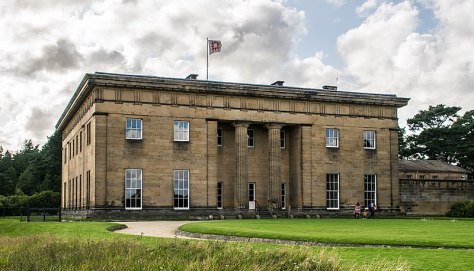
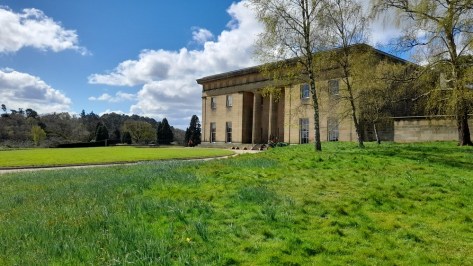
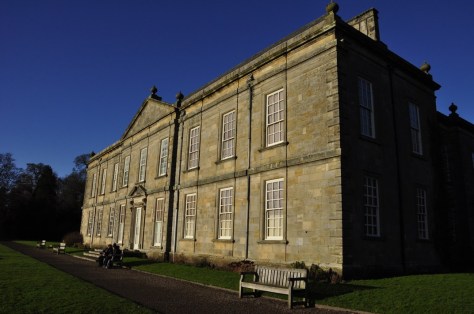
And that’s precisely why Steph and I headed out into Northumberland last Monday to the National Trust’s Wallington, just under 23 miles northwest from home, a drive of around 40 minutes depending on route and traffic. Even though the temperature was only around 6°C, it was bright and sunny, a gentle breeze, and there was some early Spring warmth in the sunshine.

Leaving home around 09:45, we arrived at Wallington before 10:30 and headed immediately to the café for a welcome cup of Americano. It was our intention to complete the River Walk through the grounds of Wallington (around 45 hectares or 111 acres) and along the upper reaches of the River Wansbeck (which rises 5 miles or so further west above Sweethope Lough).

The walk around the Wallington estate has been shut temporarily on several occasions in the past few years. Intense named storms have become a feature of our winters in recent years, and have brought down trees. The National Trust had to close paths until the fallen timber could be made safe.

The stepping stones over the Wansbeck were closed as one of the stones had been washed away, so we had to by-pass that section of the walk. The last time we tried to take the River Walk (in December 2020) we couldn’t cross because the river was in spate.

The walk was a little over three miles. Click on the special symbols in the map to see some of the birds seen at those points on the walk, or other landscape features we came across. And because Monday was such a fine day, I decided to take my binoculars in the hope of seeing some of the birdlife so common through Wallington’s woods and on its ponds.

Quite often I’ll leave my binoculars at home, and regret doing so after we catch sight of something interesting.

Along the path beside the Garden Pond, there’s a newly installed sculpture of an owl, carved from one of the downed trees, standing in open woodland (mainly of beech) but with lots of understorey bushes.

I had wondered if—and hoped—we’d see nuthatches (below) scurrying along the branches and picking out insects above our heads,

It’s a bird I’ve seen on only a few occasions, but that particular habitat was just right for nuthatches.

Then, a very small bird alighted on the branch just a few meters in front of me, and in full sunlight. I was fortunate to bring my binoculars to bear on this little bird, and I had a brief view before it flew off.

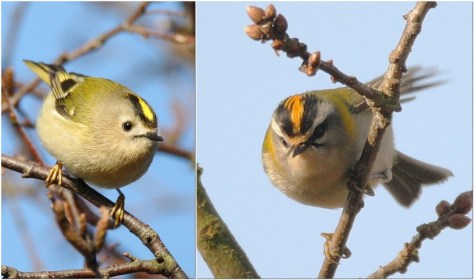
My immediate reaction was that it was a goldcrest, the smallest bird in the UK. But as it turned its head towards me, and the sun caught the feathers on its head, they appeared a much deeper reddish-orange rather than yellow. And its cheeks seemed whiter than I’d seen in a goldcrest. A firecrest was my next reaction.

I checked my bird books and online photographs when we arrived home. Although it seems that firecrests are quite uncommon in Northumberland, I’m now convinced—more than ever, and having compared images of a goldcrest and a firecrest side by side—that I saw a firecrest. Here are two images sent to me by my Northamptonshire friend, Barry Boswell (whose beautiful bird images I have used in other blog posts).

Goldcrest (L) and firecrest (R)

On the Garden Pond there was a small group of little grebes or dabchicks, several moorhens, and a flock of about 30 mallard ducks.

We walked through the walled garden, and enjoyed the crocus lawns at their best on the upper terrace, before heading through the gate that led to the River Walk path.

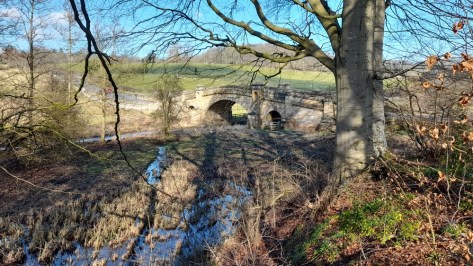
As I mentioned, we couldn’t cross the Wansbeck at the Stepping Stones, so had to walk along the road until we came to the fine 18th century hump-backed bridge, and then took the path alongside the river on its southern/western bank. Having left the road, we had a fine view of the bridge behind us.

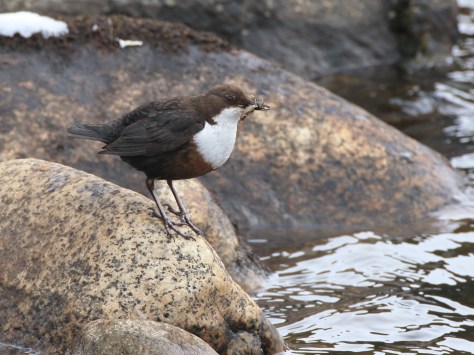
Given the state of the river, with tranquil stretches interspersed with shallow rapids, I was hopeful that we might see a dipper or two.

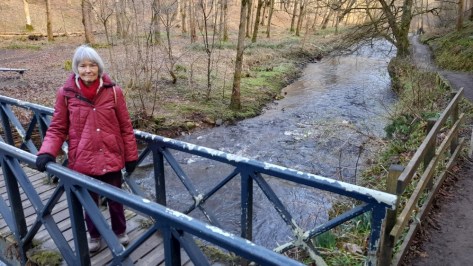
And we weren’t disappointed. Just as we approached the footbridge, there was a solitary dipper sitting on a stone in mid-stream, preening itself. And taking no notice of us whatsoever, we had a great view for at least five minutes, before we crossed over the footbridge close by.

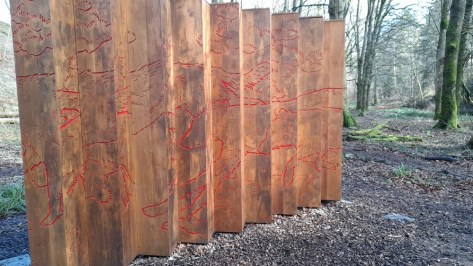
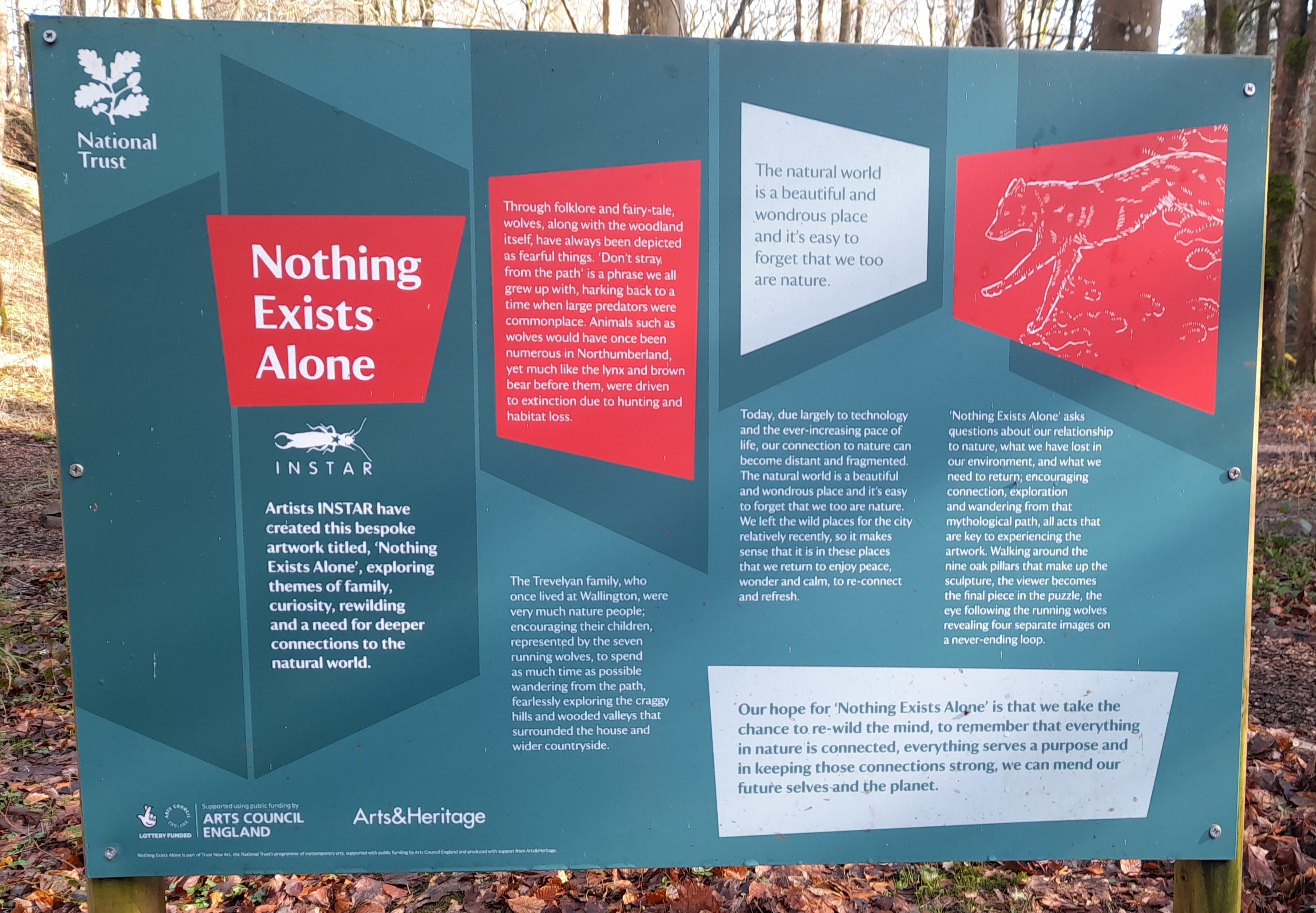
On the opposite bank there is an interesting piece of bespoke artwork depicting wolves, Nothing Exists Alone, which you can only appreciate fully from the right angle.

Click on this next image to read the description more easily.

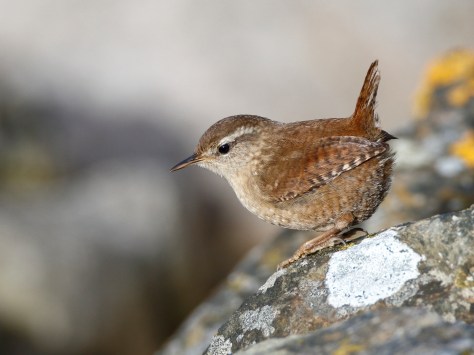
Then we took the path away from the river and climbed towards the thick woodland on the brow of the hill (with a great view of a wren at the side of the path), ending up at the wildlife hide.

Wren

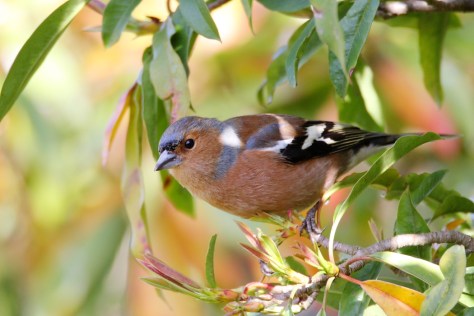
There was a range of bird feeders there, attracting a range of tit species (great, blue, coal, and long-tailed) and some chaffinches.

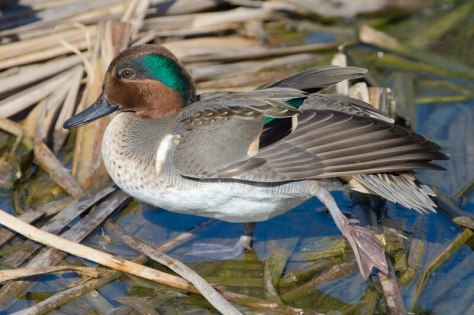
Making our way back to the house, we saw another nuthatch in one of the large trees, and a pair of beautiful teal ducks on the Middle Pond.

Then, as we were making our way back to the car park, we saw a large flock of chaffinches on the bird feeders close to the entrance drive, one of the largest flocks I’ve seen in a long while.

Of course these weren’t the only birds that caught our attention as we wandered round the River Walk. There were numerous blackbirds and robins, as well as crows and jackdaws in the fields.

But this Wallington walk will be remembered for that flash of reddish-orange early on. I wonder if others have spotted a firecrest there as well?


The wonder of Cambodia’s temples

You’ve probably never heard of Jayavarman VII (right).

Born around 1122/25, he is widely regarded as one of the most powerful of Khmer monarchs, and ruled the vast Khmer Empire between 1181 and 1218. He was the first Khmer king to fully embrace Buddhism (earlier kings had been Hindu).

The empire was founded at the beginning of the 9th century, and at its zenith in the 12th century had subjugated much of Southeast Asia. By the middle of the 15th century however it had disappeared. All the temples and surrounding buildings were reclaimed by the jungle, and not uncovered again until the 19th century, mainly by French archaeologists. Archaeology is thriving in Cambodia today, and new discoveries are being made.

Southeast Asia circa 900 CE, showing the Khmer Empire in red.

At the heart of the empire was the capital, Angkor, with its principal temple Angkor Wat, now one of the most visited heritage sites worldwide. Angkor Wat features on the national flag of Cambodia.

Steph and I (with our younger daughter Philippa) had the privilege of visiting Angkor Wat in December 2000.

Angkor Wat was actually built by Suryavarman II (ruled 1113– c.1150) as a Hindu temple, and took almost 30 years to construct. Under Jayavarman II, it gradually became a Buddhist one. The king was also responsible for one of the most beautiful temples, Bayon (below), at Angkor.

And he established an impressive network of more than 100 hospitals throughout his empire, and other temples and cities that are now only being intensively studied in the northwest of Cambodia close to the frontier with Thailand.

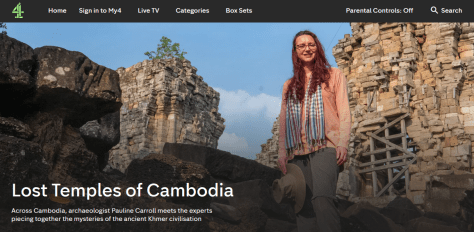
Last Saturday Steph and I watched (on Channel 4) the third and final part of Lost Temples of Cambodia, fronted by British archaeologist Pauline Carroll (about whom I can find no information other than she worked on the dig in Leicester that discovered the remains of King Richard III in 2012). Click on the image below to access each of the programs.

Filmed at Angkor Wat and other close-by sites, the programs also explored newly-discovered sites to the north west close to the frontier with Thailand. And, as with Angkor Wat, the temples at Banteay Chhmar (and another recently-discovered a short distance away at Banteay Toap) are revealing much about the king who built them.

As we watched the programs, it was hard not to pinch ourselves that we had been so lucky to have visited Angkor Wat before it became overrun with tourists. We had flown to Siem Reap from the Philippines (where I was working at the International Rice Research Institute) via Singapore on Silk Air, and spent three nights there. Which gave us two full days to explore the many Angkor sites and take a boat ride on the large lake nearby, the Tonlé Sap.

Just click on each of the icons on the Angkor map below to explore a photo album for each, and zoom out to see the location of other sites in the northwest of Cambodia that were featured in the Channel 4 programs.

We didn’t join any tour to explore Angkor. Through one of my IRRI colleagues based in Phnom Penh we arranged for a driver to pick us up at the airport, and then stay with us over the next two and a half days. Once we had toured one of the sites, the driver quickly whisked us off to the next, finding the best locations to start from. Such as at Banteay Kdei (photo album), where he dropped us at one entrance, and picking us up on the far side of the site once we had walked through at our own pace, and not one dictated by any tour guide.

Even at Angkor Wat itself it’s quite remarkable how many photos I was able to take with only a smattering (if any) of other tourists (photo album).

As we watched the TV programs, it brought back to us how beautiful are the many bas-reliefs and stone carvings in general through the Angkor complex. Absolutely exquisite! And to some extent, those at Banteay Chhmar and Banteay Toap (more recent than Angkor Wat although constructed by Jayavarman II) are even finer.

Here is just a small selection of those we saw.


Taking the Angkor complex in total (and the many other sites across Cambodia) the construction of temples and other buildings would have required millions of tons of sandstone that had to be quarried some distance away and transported to the sites.

The stone came from Phnom Kulen, a range of hills to the northeast of Angkor Wat by about 30 miles. A series of canals was constructed to float the millions of stone blocks to the construction sites, on rafts pulled by elephants. Evidence for the canals was first gleaned from satellite images, and verified at ground level.

The construction must have involved a very large population. It has been estimated that perhaps as many 1 million people lived at Angkor, making it one of the largest cities in the ancient world. And they would have to be fed. But on what? Rice, of course, and that crop remains the staple in Cambodia today, thriving in the hot humid lowland climate, even in seasonally deep-water sites.

Eventually the Khmer Empire declined. Was it due to overpopulation, climate change affecting agricultural productivity, or warfare both internal and foreign? Certainly the Khmer faced threats and invasion from Thailand and Vietnam. Probably it was a combination of many factors.

But as new sites are discovered and recovered from the jungle, the history of this once thriving empire is being revealed in ever more detail.


There were a few things that caught my attention in the three program series on Channel 4.

I mentioned that Pauline Carroll was an unknown entity before now. And yet, she didn’t ‘front’ the series in quite the way you might expect in such programs. There was a background narrative, from restaurateur and presenter of The Great British Bake Off, Prue Leith. What a strange choice as narrator! Instead, Pauline Carroll was left to wander around the various sites, ask a few questions of local archaeologists, and occasionally speak to camera.

Second, as with many documentary programs nowadays, considerable use was made of drones to capture aerial shots, which certainly enhanced appreciation of the scope and scale of Angkor Wat and the other sites. In the past, such aerial photography would have required helicopters, but even low-cost drones can provide high quality output, and reaching areas inaccessible to helicopters.

And the final point I would like to make is about the healthy state, it seems, of Cambodian archaeology. Pauline Carroll met and spoke with several knowledgeable Cambodian archaeologists who have taken on the role of revealing their nation’s cultural history. And this is even more remarkable and encouraging considering it’s not that many decades since the appalling Cambodian genocide perpetrated by the murderous regime of Pol Pot in the 1970s, when millions of lives were sacrificed, particularly from the intelligentsia.


Klaus Lampe, IRRI’s fifth Director General, passes away at 92

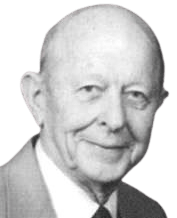
Dr Klaus J Lampe was the Director General of the International Rice Research Institute (IRRI) in the Philippines, serving one term from 1988 to 1995. He succeeded Professor MS Swaminathan as Director General.

Yesterday we heard the sad news that he had passed away in hospital in Germany on 6 February, aged 92.

Born in Freiburg in 1931, Klaus Lampe grew up in Nazi Germany, and he once described to me the horror of escaping the fire storm following Allied bombing.

He was an agricultural engineer, spending time in Afghanistan from 1965 to 1968, and thereafter he held various agricultural development aid positions back home in West Germany.

His appointment at IRRI in 1988 was the beginning of the institute’s renewal. Just shy of its 30th anniversary the institute was beginning to show its age. Its infrastructure was in dire need of refurbishment and enlargement to allow the institute to address several new research challenges, particularly in the areas of biotechnology and molecular biology.

And with a mandate to revitalise IRRI’s research strategy and program, Klaus adopted a matrix management system (alluded to in this post) with five research programs setting the specific research agenda on one side of the matrix and divisions (the organizational units where research was carried out) on the other.

He encouraged several long-term staff to retire or seek pastures new, and set about recruiting a new (and younger) cohort of staff. I was part of that recruitment, as head of the newly-formed Genetic Resources Center (GRC), with special responsibility for the genebank.

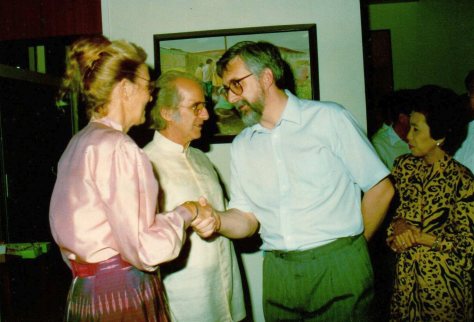
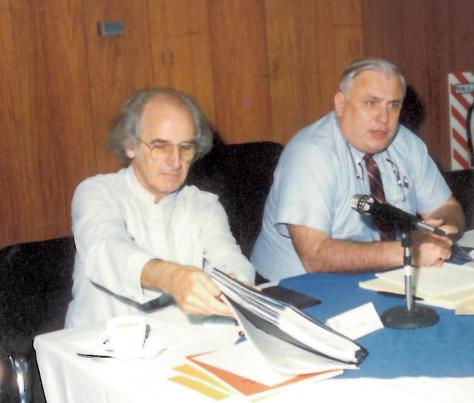
Meeting Dr Lampe and his wife, Annemarie, at an IRRI reception shortly after my arrival at IRRI in July 1991.

In addition to the innovative management that brought focus to IRRI’s research and refurbishment of the institute’s buildings, Klaus’s other achievements included his sincere engagement (not always successful) with suspicious NGOs in the Philippines and more widely across Asia as IRRI developed its biotechnology agenda (supported by the Rockefeller Foundation), and the adoption of new rice breeding objectives, particularly the so-called New Plant Type and hybrid rice. Certainly IRRI began to feel like a re-energised institute.

Klaus Lampe with US Ambassador to the Philippines, Frank G Wisner, Gurdev Khush, principal plant breeder, and agronomist Ken Cassman, discussing the ‘New Plant Type’.


When I interviewed for the GRC position (in January 1991), Klaus and I had a long discussion about the changes that he felt were needed to upgrade the genebank, known then as the International Rice Germplasm Center (IRGC), and how to integrate the operations of the International Network for Genetic Evaluation of Rice (INGER) and the Seed Health Unit into GRC. By the time of my arrival in Los Baños, it had been decided to retain the Seed Health Unit as an independent entity outside GRC.

I explained how important research on germplasm conservation and use was, and that I expected, if appointed, to add a research string to the activities of GRC. That had not been envisaged when IRRI advertised the GRC position in September 1990.

Once in post, Klaus supported my research plans for the genebank. I also pushed enthusiastically that the genebank should benefit substantially from the investment being made in the refurbishment around the institute. After all, I chided him, if the genebank was the jewel in IRRI’s crown, so to speak, it was only fair that management and Board of Trustees approved that investment. And he agreed.

We made major changes, adding a bespoke seed drying room, and reconfiguring many of the genebank facilities to increase the efficiency of genebank operations and bring them up to international standards. I was permitted to increase the number of staff to tackle the significant backlog of processing seeds for long-term conservation. And the majority of the staff positions were upgraded to reflect their increased responsibilities.

With Klaus’s support and commitment I was able to significantly enhance the genebank operations such that, in an external review around 1994, the genebank was described as a model for others to emulate. And for that I will remain forever grateful to him.


I had first come across Klaus Lampe in the summer of 1989 (maybe 1990). I was lecturing at the University of Birmingham, and had no intention then (or inkling even) of leaving, or that Klaus would  soon be my boss.

I was visiting Dr Jaap Hardon, head of the Dutch genebank (Centre for Genetic Resources, the Netherlands or CGN) in Wageningen. He invited me to attend a special university seminar one afternoon with guest speakers from two centers of the Consultative Group on International Agriculture or CGIAR: the Director General (I don’t remember his name) of the International Food Policy Research Institute (IFPRI) in Washington, DC, and Dr Klaus Lampe from IRRI.

Klaus was not a tall man, but he certainly stood out in a crowd, with his long flowing grey hair. Which reminds me of a story that former Chair of IRRI’s Board of Trustees, Dr Walter ‘Wally’ P Falcon recounted during his last report to the institute’s staff before he stepped down from the Board in the early 1990s.

Klaus and Wally Falcon at a meeting of IRRI’s Board of Trustees.

Although a member of the Board of Trustees when Klaus was appointed as Director General, Wally was not a member of the appointment committee, and did not meet Klaus until the next Board meeting. As Wally told it, he saw this man walking towards him, hair standing out, and he immediately thought, My God, they’ve appointed Beethoven!

Klaus, always supported by Annemarie (who predeceased him a few years back) encouraged visitors to IRRI, especially VIPs, and he was never short of a few words to say at the frequent receptions held at the IRRI Guest House.

Klaus and Annemarie at the despedida for Dr Ernie Nunn, IRRI’s Director for Operations and his wife (next to Annemarie).

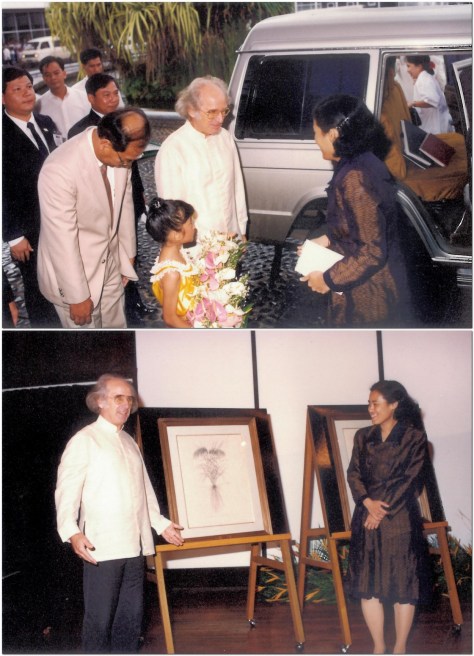
One of the first VIP visitors I had to show around the genebank was Princess Sirindhorn of Thailand, in 1991, not long after I arrived in Los Baños.


One of my colleagues, Dr Bob Zeigler, a plant pathologist from CIAT in Colombia was appointed Program Leader for Rainfed Lowland Rice at the end of 1991. Bob became IRRI’s 9th Director General in 2005.

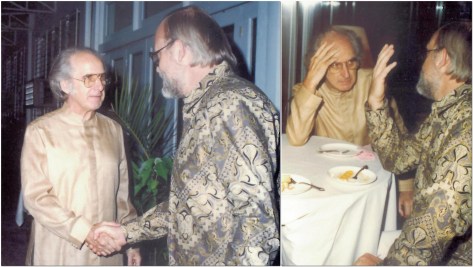
DG5 and DG9 together in 1991.


Klaus was a complex man. Exceedingly kind on the one hand, but he could be quite ruthless, and a number of staff fell foul of his displeasure, me included. So when he left IRRI in 1995, we didn’t exactly part the best of friends, although for much of the time we worked together, I had an excellent relationship with him.

I didn’t meet him again until early 2010 when he returned to IRRI to attend some of the institute’s 50th anniversary celebrations. I can’t say I was particularly keen to meet him again. But we did, and during one reception he approached me, taking me by the arm and steering me to a quiet corner of the room. Whereupon he apologized for how he had behaved towards me 15 years previously. We parted on good terms, and that’s exactly how I will remember him.

My former colleague Gene Hettel interviewed Klaus for his series of Pioneer Interviews, who spoke at length on the challenges he saw IRRI facing. Here’s a snippet from that interview.

Gene has also today published this obituary on the IRRI website.


Let the mystery be . . .

Until quite recently, I’d never heard of American singer-songwriter Iris DeMent. I’ve since become quite obsessed with her music. She has quite an extraordinary voice, and a rare song-writing talent.

One evening, Steph and I were watching a compilation of programs from Transatlantic Sessions (on BBC Scotland via the BBC IPlayer), and Iris DeMent was featured from Series 1, Program 3, first broadcast in 1995.

Singing one of her own compositions, Let the Mystery Be, she was accompanied by members of the Transatlantic Sessions house band: American fiddle player Jay Ungar (composer of the well-known Ashokan Farewell), guitarist Russ Barenberg, mandola player Dónal Lunny, and accordionist Phil Cunningham. I believe the female bassist was Molly Mason.

She appeared on Transatlantic Sessions in the very first program (and the first featured performance) accompanying Emmylou Harris (whose music I came to appreciate in her collaboration with Mark Knopfler on the 2006 album, All the Roadrunning) on Wheels of Love, along with Irish singer Mary Black.

DeMent was born in 1961 in Paragould in northeast Arkansas, the youngest of 14 children, and now lives in rural southeast Iowa. Her music is a blend of folk, country, and gospel, often with a political theme. She has often dueted with folk-country singer-songwriter John Prine.

In Transatlantic Sessions Series 1, Program 4 DeMent sang one of her best compositions, Our Town, about one of her enduring themes: small-town America. Shetland fiddle virtuoso Aly Bain also figures in this version, as does a young dobro player Jerry Douglas (who would go on to co-host Transatlantic Sessions with Aly Bain in Series 2 to 6 between 1998 and 2013).

Here is another great song from Series 1, Program 6.

I did wonder whether DeMent had ever appeared on Garrison Keillor’s A Prairie Home Companion, from the Fitzgerald Theater in St Paul, Minnesota, believing that her music was just the genre to feature in the show. I found this reference to an appearance from 2 November 2002. You can hear her singing at 14′:22″ and another composition, Mama’s Opry, at 51′:42″. Garrison Keillor said that DeMent was one of his favorite singers, whose songs he had performed many times.

Here is DeMent singing Mama’s Opry with the Nitty Gritty Dirt Band and Matraca Berg (performed at the Grand Ole Opry?)


So what about Transatlantic Sessions? In my opinion, it was one of the best series to be broadcast from BBC Scotland. And as Aly Bain says by way of introduction, it brought together ‘. . . some of the best musicians from both sides of the Atlantic. No audience. Just the music‘.

We came late to the series, seeing Series 5 and 6 in 2011 and 2013 respectively, the previous four having been broadcast while we were living in the Philippines during the 1990s and 2000s. But since then, BBC Scotland has rebroadcast some compilations, hosted by North Uist singer Julie Fowlis and Irish singer Muireann Nic Amhlaoibh.

What a delight the programs were, and such talent on display – the best of Scottish, Irish and American music. Here’s a link to many of the videos from all six series. Enjoy!


“One must be willing to release one’s mind and soul from one’s body to achieve ecstasy through music” (Nusrat Fateh Ali Khan)

As I wrote way back in February 2012 not long after I launched this blog, I have broad tastes in music: rock, pop, folk, country & western, classical (particularly Baroque and Chopin). There’s always music in our house, all hours of the day. And my listening experience has improved since I added an Echo Dot 5th generation to my office at Christmas.

Anyway, I was looking through my CD collection the other day (yes, I still hold on to more than 200 CDs although I play them much less frequently now since having access to streaming services like Spotify), and came across one that that took me right back to the 1980s.

I don’t remember why I happened to be home alone on that particular weekend afternoon. I’d switched on the TV and was surfing the small number of channels available then. I came across a program on the BBC aimed at its Asian audience. It was a concert by qawwali virtuoso Nusrat Fateh Ali Khan from Pakistan.

Nusrat Fateh Ali Khan (1948-1997)

And only intending to check what was on each channel, I became immediately mesmerised by his performance with his backing singers, and watched the whole program.

One song in particular, Yeh Jo Halka Halka, caught my attention. It lasted over 18 minutes!

Here is that song, recorded in Birmingham in 1985:

And this is the version from the CD:

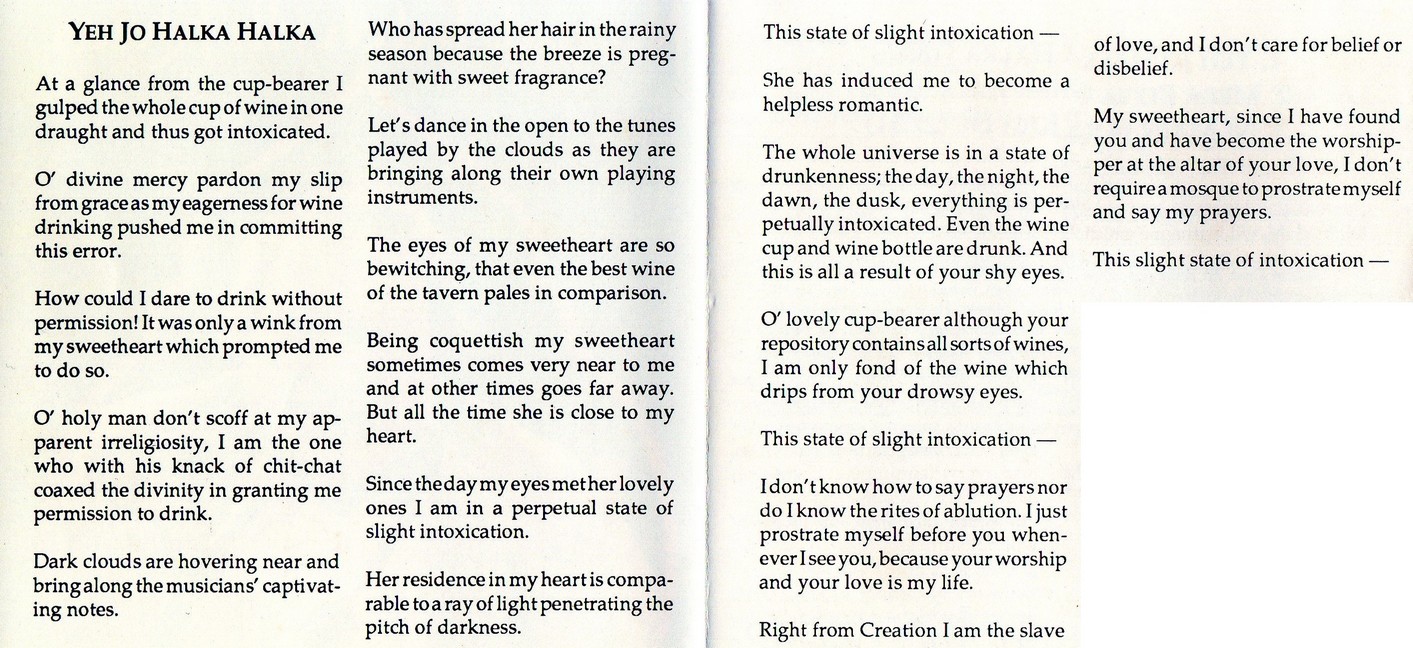
This is the English translation. Just click on the image for an enlarged version.

It made quite an impression on me, and I find myself returning to it from time-to-time.

Suffering from ill health (he weighed over 300 pounds or 137 kg) he travelled to London for treatment in August 1997, but suffered cardiac arrest just after arriving in the country.

His legacy is continued by family members.


I’m a ‘glass half-full’ sort of person, but . . .

I’m an optimist. I like to keep a positive perspective and get on with my life with a sunny disposition.

But as we approach the end of January, the level in my glass has started to fall. Notwithstanding the appalling situations in Ukraine and the Middle East and the real possibility of a serious escalation of conflict, closer to home there’s definitely a feeling of malaise in the UK right now.

After 14 years of Conservative government, I think Shakespeare’s  ‘something is rotten in the state of Denmark’ (Hamlet, Act 1, Scene 4) sums it up appropriately. Something has gone wrong very badly.

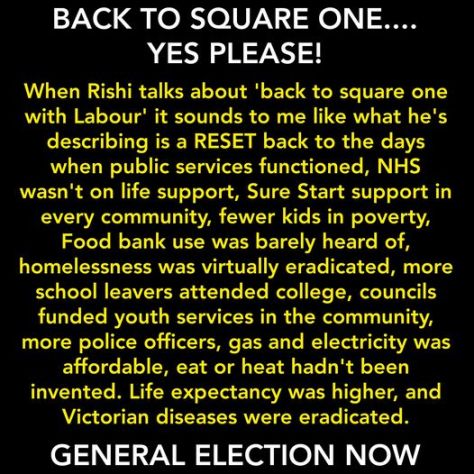
Just compare how Labour left the nation in 2010 when David Cameron led the Tories to victory in the General Election (propped up by the Liberal Democrats in coalition), to what the situation is currently under Rishi Sunak, or as I prefer to refer to him as ‘Rish! Pipsqueak‘ (the fifth Prime Minister since 2010).

Prime Ministers since 2010, clockwise from top left: Cameron, May, Johnson, Sunak, and Truss.

It began with an austerity package from which we have yet to recover, and from what I read just a few days ago, the justification for austerity measures was based on a flawed paper by two economists.

British mathematician Professor Hannah Fry spoke about this on her Instagram account, fryrsquared, and wrote: Just after the financial crisis, an influential paper called “Growth in a time of debt” was published, in which two Harvard profs used data to show that high levels of debt hurt a nations economic growthThe paper was cited at the G20, referenced by George Osborne and Paul Ryan and used as a justification for the global austerity movement. Except the conclusions were based on a pretty important spreadsheet error.

Then, the outright Conservative win in the 2015 General Election gave David Cameron the opportunity to hold the Brexit Referendum, and the country has been on the downward path ever since. Just see what the UK has lost as a result [1].

Theresa May replaced Cameron after he lost the Brexit referendum, and she in turn was ousted by clown Boris Johnson. Liz Truss lasted just 50 days (the shortest-serving Prime Minister in British history) after Johnson departed in ignominy, when she almost crashed the economy with her Chancellor of the Exchequer, Kwasi Kwarteng.

When Rishi Sunak  (the first Prime Minister of Asian origin) replaced Truss (he had been Johnson’s Chancellor) I was not hopeful of much improvement in how the Tories governed, but at least he wasn’t Johnson or Truss.

But what a thin-skinned petty individual he has turned out to be. As vacuous as the rest of his party. I’m tempted to throw something at the TV the next time he says that what the government is doing is ‘the will of the British people’. He says there’s no appetite right now for a General Election (even though one must be held by the end of the year) yet the polls indicate otherwise. And the polls also show a majority (at around 60%) in favour of re-joining the European Union.

Then there’s the government handling of the immigration and its flawed Rwanda asylum plan to relocate those seeking to settle in the UK but cross the English Channel (La Manche) in small boats. Taxes are at their highest levels, the high cost of living has driven even more people into poverty, and Covid-19 inquiry that is revealing incompetence at the highest levels of government, corruption even, during the pandemic, and the appalling Post Office scandal that has blighted the lives of hundreds of sub-postmasters and postmistresses.

With Labour leading in the polls with a comfortable margin over the Tories, let’s hope that the General Election (whenever it’s called) brings the result so many desire. Oust the Tories and bring in a government that cares about this nation’s citizens, not just the privileged. Let’s wipe them out.

The prospect of Sir Keir Starmer (leader of the Labour Party) as the next Prime Minister doesn’t excite me particularly, but he will be a damn sight better than anyone the Conservative Party can offer up. But he does have, as far as I can tell, some competent colleagues around him. At least they’re not Tories.


What fills me with trepidation, however, is the real possibility that Donald Trump will regain the White House in November.

Once a cockwomble, always a cockwomble, as I wrote in June 2020.

I know we have more than enough shyster politicians here in the UK, but Trump takes the biscuit. Indicted 91 times, found guilty of rape, defamation, ordered to pay millions, and more trials pending, it’s hard to understand just why his MAGA following worships him. I’m sure he has absolutely no regard for those folks whatsoever.

And many of those around him in the Republican party have seemingly offered up their souls on the altar of Trump. Extraordinary!

A second Trump presidency does not bode well for the future, not for the USA where he’s already stated that he’ll be out for revenge, nor for the rest of the world.

I believe that Biden will win the popular vote, but could well lose the Electoral College. It could well be the same handful of states that push Trump over the line with EC votes. But if he loses – again – no doubt there will be more unrest as he once again claims fraud. He’s already laying the grounds for that eventuality.

The divisions in US society are going to be hard to heal. And does Trump care? Not one jot, as long as he benefits. What have we come to?

I can only wish/hope that he simply disappears off the scene.


[1] Edwin Hayward, author (of Slaying Brexit Unicorns) and political commentator, just published on his X feed (@edwinhayward) a list of 88 examples that Brexit has taken from us all, and which he states we might stand to gain again if we were to ever re-join the EU, subject of course to the agreement of existing members.

It makes depressing reading.

  • Full unfettered access to the largest trading bloc in the world. Not merely no tariffs, but no non-tariff barriers either. Bristol, Berlin or Barcelona all equally accessible. Sling your goods into a van, and go. No queues, no reams of paperwork.
  • Free trade deals with over 70 countries around the world, including Japan, Canada, South Korea, New Zealand and soon the Mercosur bloc in South America.
  • Frictionless borders (no more nasty queues) allowing for just-in-time manufacturing, and supporting millions of jobs in the auto industry, aerospace etc.
  • Wide open borders between Northern Ireland and Ireland, and between NI and GB, with no customs checks or extra paperwork needed.
  • Support for the Good Friday Agreement and the Irish peace process (NI benefitted from over 1.5 billion euro of PEACE funding from the EU between 1995 and 2020).
  • A stronger united front against the dangers of the modern world, such as a resurgent Russia. (Friends don’t tend to fight friends; this striving for peace was one of the founding impulses behind the precursor to the EU.)
  • Freedom for UK citizens to travel, work, study and retire anywhere in the EU. No more long queues at airports and ports. No more worries about keeping track of 90 days in every 180. No more worries around business travel. (Also solves the problems bands and musicians are experiencing when trying to tour since Brexit.)
  • Freedom for EU citizens to travel, work, study and retire in the UK.
  • Participation in the EU Single Energy Market, enhancing the resilience of our energy supply.
  • Intense scientific and academic collaboration, including access to grants, and knowledge pooling. Participation in Horizon 2020’s successor programme (Horizon 2020 was the world’s largest multinational research programme, and provided funding and assistance for over 10,000 collaborative research projects in the UK.)
  • Collaborative space exploration, and participation in the Galileo GPS satellite cluster, including access to its high quality military signal.
  • Driving licenses valid all over the EU. No need for international driving permits, or to carry an insurance green card. Car insurance valid all over the EU.
  • Multi-year pet passports which make travel with pets easy and cheap.
  • A simple, generous system of fixed compensation for flight delays and cancellations thanks to EU passenger rights.
  • European Health Insurance Card (EHIC) that grants access to healthcare in the EU free or at reduced cost, plus prescriptions at local rates.
  • EU-wide roaming (voice, texts and data) at home rates. No surcharges like the majority of mobile carriers have imposed since Brexit.
  • Access to your home content on streaming services (Netflix, Amazon Video, Spotify etc.) wherever you travel in the EU.
  • Participation in Erasmus student exchange programme, involving more than 4000 universities across 31 countries. In the past, more than 15,000 UK students a year took advantage of this.
  • Study in EU universities at cheaper local rates.
  • Enhanced consumer protections, including protections on cross-border shopping (i.e. ordering online from the EU and/or EU customers ordering from the UK).
  • Simplified VAT filing for firms selling to EU customers.
  • Cross-border tax collaboration, aimed at holding massive firms like Amazon and Facebook to account more than any one country acting alone could hope to.
  • Training courses for the unemployed, funded from the European Social Fund.
  • Disaster relief funding, such as the 60 million euro the UK received for flood relief in 2017.
  • Access to a court of last resort (the ECJ) that provides EU citizens with a means of holding their government to account.
  • Significant environmental protections (which act as a floor rather than a ceiling, i.e. individual EU members can’t diverge below EU standards, but can enhance them further).
  • Quicker access to safe/new medicines, thanks to a one-stop pan-EU medical testing regime.
  • A single system of chemical regulation (REACH) to improve human, animal and environmental safety around chemicals. (Since Brexit, firms have to register chemicals in parallel with both REACH and UK REACH if they want to sell to the UK and EU markets, adding cost and complexity to the process.)
  • Cooperation on security issues, and access to shared crime and terrorism databases.
  • Participation in the European arrest warrant, allowing for the speedy capture and extradition of criminals.
  • Participation in the EURATOM programme to ensure the ongoing availability of vital medical isotopes, including very short half-life radiologicals.
  • Financial support for rural areas (too long ignored by successive UK governments).
  • Better food labelling regulations, including from April 2020 the requirement to identify the country of origin of the primary ingredient in processed food, as well as the country of manufacture of the finished product.
  • EU funding to support the British film industry, theatre and music.
  • Free movement for musicians and instruments, bands and equipment, artists and materials etc., enabling a flourishing European culture scene.
  • Participation in the European Capital of Culture programme, which has previously given a boost to cities such as Glasgow and Liverpool.
  • The ability for service providers (e.g. freelance translators) to offer their services all over the EU on the same basis as to UK clients.
  • EU citizenship. It’s a real thing, separate to UK citizenship, and conveys certain additional rights and protections. All citizens of individual EU countries are also EU citizens, by virtue of their citizenship of an EU member state.
  • No additional VAT or duty payable on goods imported from the EU (so no unpleasant surprises when receiving packages purchased online).
  • Substantial venture capital funding, and access to start-up loans.
  • Legal protection of minority languages (e.g. Welsh).
  • Mutual recognition of academic and many professional qualifications, meaning anyone qualified in the UK or in an EU country can rely on their qualification anywhere within the EU.
  • EU-wide protection of foods of geographic origin (e.g. Melton Mowbray pork pies can only be made in Melton Mowbray). Since Brexit, a dual regime operates, so producers have to seek protection in the UK and separately in the EU, introducing new cost and complexity to the process.
  • No surcharges on credit card and debit card transactions (illegal under EU law). Since Brexit, UK customers have been subject to additional charges when purchasing from the EU (May be hidden by vendors, but still act to drive costs up).
  • EU structural funding (e.g. Liverpool received £2 billion for regeneration in the past) including the requirement to raise matched funds in order to boost effectiveness further.
  • Support for and encouragement of democracy in post-Communist countries.
  • A bigger presence on the world stage when facing economic giants such as the USA and China (the EU as a whole is a worthy third opponent in that triangular fight, and would be more so were the UK to ever re-join).
  • Products made or grown in the UK can be sold in over 30 countries without needing type approval, phytosanitary certificates or other costly red tape. (These are some of the processes UK exporters have faced since Brexit, driving up costs and extending delivery times.)
  • Strong legally enforced food hygiene standards, including prohibitions on chlorinated chicken, hormone-raddled beef, and GM crops. (Like the EU’s environmental protections, these are a floor not a ceiling. Individual EU states can go further. They just can’t erode their own standards below the EU minimum.)
  • Objective 1 funding for deprived areas and regions.
  • Financial passporting, allowing firms in the City of London to service clients all over the EU without having a local presence.
  • A legally enforced 14-day cooling off period on new timeshare agreements.
  • Mandatory minimum 2-year warranty period against goods being faulty.
  • Consular protection in countries outside the EU available from any EU embassy or consulate (if there’s no UK embassy present in the country).
  • Protection against discriminatory treatment when working in other EU countries: all EU staff from across the EU must be treated the same as local staff.
  • A secure baseline of worker protections, including limits on maximum hours worked, maternity leave periods etc. (We’re free to improve on them as much as we like, we just can’t erode local conditions below the EU minimums. Indeed, in many cases the UK has already gone further than EU law required. But there would be no danger of losing rights conferred by the EU, no matter what the UK government of the day decided.)
  • Minimum of 4 weeks of paid leave a year (introduced by EU in 1993, taken up by UK in 1998, and later extended to 28 days in 2009).
  • Right to land fish in any EU port (EU countries used to buy more than half of all fish caught by UK fishermen before Brexit), along with an easy process for declaring catches.
  • Access to a willing seasonal workforce to pick our fruit and vegetables (rather than heart-breaking scenes of millions of pounds of crops rotting in British fields during the cost of living crisis).
  • Guaranteed supply of medicines (we import over 30 million packs a month from the EU).
  • A major say in the running of the EU, with MEPs representing the UK in the European Parliament, British judges on the ECJ panel, etc. And of course the right to propose and amend new EU legislation.
  • A say in the setting of the multi-year EU budget, and on steering the EU’s priorities and its focus.
  • More influence on environmental issues, since EU law governs the behaviour of 27 countries.
  • Cleaner air, backed by the EU Air Quality Directive. In the past, the EU has successfully taken the UK Government to court for failing to meet its obligations. (The system’s not perfect, but it provides a lot more protection than our post-Brexit homegrown one claims to.)
  • Strong pan-EU intellectual property protection, including potential participation in the upcoming unified patent system which will enable firms to obtain a single patent valid across 24 (at first) EU countries.
  • Some of the highest toy safety standards in the world.
  • Protection of 500 bird species under legislation dating back to 1979, and enhanced in 2009.
  • Cleaner beaches, with stronger penalties for untreated sewage discharges than the toothless post-Brexit system.
  • Pan-EU regulators (food, chemicals etc.) that offer simplified testing regimes, since a single test is valid for all EU countries. Since Brexit, the UK has had to duplicate these functions locally, adding cost and complexity.
  • A more powerful presence on the world stage, thanks to 27 countries acting in unison. Not all the time or on all matters. But when it counted most, EU countries have shown a willingness to set aside differences and band together.
  • The right to vote (and stand as a candidate) in local and European elections in any EU country you happen to live in, under the same conditions as local candidates and local electors.
  • Right to communicate with EU institutions in any of 24 official languages.
  • The right to petition the European Parliament, either singly or jointly with others, on any matter within the EU’s fields of activity. This right extends to companies headquartered in EU countries, as well as to individuals.
  • Support for people with disabilities, including the European accessibility act (which mandates the accessibility requirements of various products and services) and the EU parking card.
  • The right to purchase services (e.g. hotel bookings, car rentals) online from anywhere in the EU at the same price as local buyers. Firms cannot discriminate their pricing by geography.
  • Ability to bring home anything you buy in another EU country without a customs declaration, so long as it is for your own personal use. (Think booze cruises, for one.)
  • Right to cancel and return the order of any product bought outside of a shop (e.g. online or by telephone) within 14 days, for any reason.
  • Strong data protection laws such as GDPR, that protect personal data maintained in any format (online, on paper, etc.) Include right to withdraw your consent for the processing of your data, and right to object to receiving direct marketing. Even firms based outside of the EU must abide by GDPR rules when processing the information of EU citizens.
  • Right to know what personal data a firm holds on you, within a month of requesting it. Info should be free of charge and in accessible format.
  • Strong right to be forgotten, obliging organisations to delete the personal data they have stored about you upon request.
  • Banks must charge the same for payments in euro across the EU as they do for the equivalent national transactions.
  • Insurance firms can sell their products all across the EU, without having to be established in every EU country they service.
  • EU citizens and firms can register .eu domain names (over 300,000 were lost to UK entities as a result of Brexit).
  • Enhanced human rights protection (especially against the State) through the Charter of Fundamental Rights of the European Union.
  • Broadcasters can obtain a single broadcasting licence that is valid across the whole of the EU, negating the need for TV networks to obtain licences country by country.
  • Regulation and reporting of CO2 emissions in new vans and lorries, with a monitoring and enforcement system that includes fines for manufacturers that fail to meet the specified targets.
  • Participation in the EU emissions trading scheme, which establishes total caps on emissions while allowing individual companies to buy and sell their emission allowances to meet changing requirements. This is more flexible than the post-Brexit system where there’s an EU trading scheme and a separate scheme for the UK market only.
  • Participation in the EU pandemic Early Warning and Response system (EWRS) that ties together governments and key agencies to combat cross-border health threats.
Hayward concludes his long thread with these final observations:
  • As a political entity, the EU is NOT perfect. No sensible commentator has ever claimed it was. But it operates to try and maximise the long-term interests of 27 member countries, rather than to further the electability of whatever political party happens to be in power in one.
  • This means that, all other things being equal, the decisions it takes end up being less damaging to fewer people than those taken by uncaring national governments (does that scenario sound familiar?)
  • Like it or loathe it, we are trapped by geography. Grab any globe, and you’ll see the UK hovering just off the EU mainland. EU countries are always going to be our nearest neighbours. So it makes all the sense in the world to try to take full advantage of that proximity.
  • Unfortunately, politicians of all stripes seem singularly lacking in sense right now. Let’s hope that will change.
  • And, beyond mere hope, let’s strive to see that it does.

Memories of Russian geneticist Nikolai Ivanovich Vavilov (1887-1943)

A recent article brought to mind what I learned about Nikolai Ivanovich Vavilov (left) when I was a student, and also conversations I had with two eminent scientists who actually met Vavilov in Leningrad more than 80 years ago.

Vavilov was a brilliant geneticist, whose story the whole world deserves to know. The Crop Trust has just launched a new web series, Seed Heroes, with this first story, Nikolai Vavilov: The Father of Genebanks.

Surprisingly, as an undergraduate student studying botany in the late 1960s, I never heard anything about Vavilov or his pioneering work. In retrospect, I’m of the firm opinion that he should be part of every plant sciences or genetics degree curriculum. He was such a colossus, and one of my science heroes, about whom I have written or referred to in many blog posts.

It was only when I began a one-year MSc course on the Conservation and Utilization of Plant Genetic Resources at the University of Birmingham in September 1970 that I became acquainted with Vavilov and what he achieved to collect and study different varieties of crop plants from more than 100 countries. All with the aim of using the varieties—or genetic resources as we now can describe them—to breed new crops and make Soviet agriculture more resilient. Indeed, Vavilov is often referred to as the father of plant genetic resources, and correctly so, nevermind father of genebanks.

Vavilov was highly respected in the West, and he visited the UK spending time in the early years of the last century at the John Innes Horticultural Institution near London. His study of crop variation also opened new perspectives on the nature and distribution of genetic diversity in crop plants and their wild relatives, and where crops were domesticated thousands of years ago.

What would Vavilov have gone on to achieve had he not fallen foul of Stalin’s Soviet regime and his nemesis, Trofim Denisovich Lysenko, dying of starvation in prison in Saratov in 1943 at the age of 55?


So, what was Vavilov like as a man and scientist? Having spoken at length with Professor Jack Hawkes and Dr John Niederhauser about their visits to Russia in the 1930s, and meeting Vavilov, I almost feel that I knew him myself, albeit vicariously.

Jack Hawkes (right, 1915-2007), a potato taxonomist and head of the Department of Botany at the University of Birmingham founded the genetic resources MSc course there in 1969. Jack was also the co-supervisor (with Dr Roger Rowe of the International Potato Center in Peru) of my PhD research and dissertation.

In 1937, having just graduated from the University of Cambridge, Jack applied for an assistant’s position to join Dr PS Hudson, Director of the Imperial Bureau of Plant Breeding and Genetics in Cambridge, on an expedition to Lake Titicaca in the South American Andes to collect wild and cultivated potatoes. That expedition was delayed, and it wasn’t until early January 1939, under a new expedition leader, that Jack finally found himself in South America. The germplasm that was collected—from Argentina in the south to Venezuela in the north of the continent—became the founding accessions of what is now known as the Commonwealth Potato Collection.

You can read all about the Empire Potato Collecting Expedition to South America on this website (and view films that Jack made more than 80 years ago) based on Jack’s expedition notes and a 2003 memoir of the expedition, which he titled Hunting the Wild Potato in the South American Andes.

In Chapter 1 of that memoir, Jack describes at length the two week visit he made to Russia to meet with potato experts SM Bukasov, VS Juzepczuk, and VS Lechnovicz, to understand more about potato diversity (he’d never worked on potatoes until then), and discuss where and when to collect in South America since the Russians had already made collections there.

Jack writes that the visit to Leningrad was an experience that changed [his] life in many ways. He never forgot the kindness shown to him, a young man of only 23, by Vavilov and his colleagues.

Arriving in Leningrad on 26 August (or thereabouts), he first met Professor Bukasov, and almost immediately that same afternoon he was taken to the Lenin Academy of Sciences to meet Vavilov. Jack was invited to Vavilov’s apartment in Leningrad and his house in Moscow. They visited research stations together, and Vavilov even took Jack to the opera in Leningrad.

They discussed Vavilov’s ideas on the origin of crop plants and his theory of centers of diversity, his ‘Law of Homologous Series’ (which I applied in a paper on potatoes I presented at a Vavilov Centenary Symposium in 1987), the Russian system of potato taxonomy (which Jack initially used but found it over-complicated), and comparisons of British and Soviet agriculture.

They couldn’t avoid discussing Lysenko and his strong rejection of Mendelian genetics. Vavilov acknowledged Lysenko’s good work on wheat vernalization, and did not seem upset at Lysenko’s rejection of [Vavilov’s] results. Inevitably Jack and Lysenko crossed paths. Jack found him a dangerous, bigoted personality, entirely wrapped up in his own ideas. He was a . . . wholly repellent person. He was a politician rather than a scientist, and very much able to ingratiate himself with the communist politicians in Moscow. Here was, they thought, a Soviet man, born an unlettered peasant and now the sort of “first class” scientist that the communist system had created.

By 1938, Lysenko was in the ascendance, and obtaining more money for his work than Vavilov. In 1940, Vavilov was arrested and sent to prison on a trumped-up charge, and died there three years later, apparently of starvation. Ironic really, given that Vavilov had devoted his life to making agriculture more sustainable and increase crop productivity with the aim of defeating famine.

After he retired from Birmingham in 1982 (I had been appointed lecturer in plant biology the year before), Jack and I would often meet for lunch and a beer, and he would tell me all about that visit to Russia and meeting Vavilov. He said it had been  a great experience, and still couldn’t quite believe that Vavilov, a world-famous scientist, had treated him, a young man embarking on his scientific adventure, as an honored guest.

Jack’s lasting impression of Vavilov (who he admired immensely)  more than 60 years later was a large, jovial, hospitable and friendly person, putting [Jack] at ease and talking to [him] as an equal about his work and that of his colleagues.


I first met John Niederhauser (left, 1916-2005) in the early 1970s when I was an Associate Taxonomist at the recently-founded International Potato Center (CIP) in Lima, Peru and he was a consultant/advisor to CIP’s Director General, Dr Richard Sawyer.

John was the 1990 World Food Prize Laureate. A plant pathologist, he spent much of his career as a member of the Rockefeller Foundation’s agriculture program in Mexico (where his colleague in the wheat program was Norman Borlaug, the Nobel Peace Laureate in 1970), and researching resistance to the late blight pathogen of potatoes, Phytophthora infestans, the cause of the Irish Potato Famine of the 1840s.

In 1976, I had moved to Costa Rica and by 1977 I had been appointed CIP’s regional representative covering Mexico, Central America, and the Caribbean. About then, John’s and my paths crossed again, and we worked closely together for a year to design and launch a regional potato program, PRECODEPA, in six countries (later expanded to several more countries, and funded by the Swiss government for at least 25 years).

John and I traveled frequently together to those initial six countries, spending hours in airports and on the various flights, so had ample opportunity to really get to know one another.

He had been brought up on a farm in Washington state, but at the age of 17 in 1934 he bought himself a ticket to travel to Russia (I subsequently learned he had relatives there). So why choose Russia? Well, as John recounted the story, he had gone to a travel agent in San Francisco, and asked how far he could travel on his available funds. A return ticket to Leningrad was the outcome.

It seems that he and Vavilov met quite by chance. John had been visiting a botanical garden in Moscow, when a gentleman stopped and asked (in English) who he was and where he had come from. It was Nikolai Vavilov, of course. Well, the outcome (based apparently in part on John’s self-declared knowledge of tractor mechanics) was that Vavilov offered him a summer job on a state farm in the Ukraine where important germplasm collections were being multiplied. I’ve subsequently learnt that John spent an academic year in Moscow, all at the behest of Vavilov, before moving to Cornell University, where he also obtained his PhD in 1943 (the year of Vavilov’s death).

And like Jack Hawkes, John was full of admiration for Vavilov. He said that meeting him had changed the course of his life.


In the field of conservation and use of plant genetic resources, Vavilov is a giant. His scientific ideas about crop diversity have mainly stood the test of time. The collections he made are still held in the genebank that now bears his name. And his descriptions of crop diversity (I’ll never forget those of the rosaceous tree fruit forests—apples, pears and the like—in the mountain foothills of Kazakhstan), have inspired later generations of germplasm scientists, me in particular. As an MSc student, I wrote a dissertation on the origin of lentils, Lens culinaris. One of the major publications I had to consult was a monograph by Russian scientist Elena Barulina, Vavilov’s second wife.

Again I find myself wondering just what else Vavilov might have achieved had the Soviet regime never persecuted him so cruelly.


That was the year that was . . .

Let me begin this round-up of my 2023 blogging activity by wishing all my readers A Happy and Prosperous New Year 2024.

When I began thinking about this end-of-year post, it seemed to me that I’d been much less active on my blog during 2023 than in previous years. However, when I checked the stats, I saw that this is post number 45 for the year (compared with 43 in 2021 and 42 last year), and a slightly higher number of words overall.

There was, however, a particular blog milestone back in mid-August: my 700th post since I began in February 2012.

So why did I have this impression about my blog productivity this year?

Throughout 2023, I’ve had this constant feeling that Steph and I just didn’t do so much this past year compared to previous ones. That’s partly due to the fact that from the beginning of March (until quite recently) my mobility has been seriously constrained by lower back and leg pains, caused by spinal stenosis (that was finally diagnosed in August after an MRI scan). In recent weeks, things have improved compared to earlier in the year, but I still need to take daily pain medication and I have a regime of exercises first thing in the morning. It meant that for several months I just wasn’t able to get out and about on my daily walk or, if I did, just a short shuffle close to home.

Then, in July and August in particular, the weather here in the UK was particularly wet, and it hasn’t been much better ever since. So whenever we saw a break in the weather we tried to make an excursion somewhere: to some of the magnificent beaches on the Northumberland coast or inland to explore the awe-inspiring Northumberland landscapes. But those days have been few and far between.

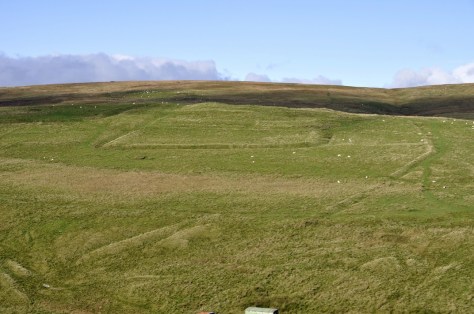
Chew Green, a Roman fort in the Cheviot Hills, close to the border with Scotland.

But we have enjoyed our visits to The Alnwick Garden (where we have Friend of the Garden membership) every few weeks, to enjoy a coffee in the excellent cafe there before making a tour (lasting about an hour) around the garden. It’s always a pleasure to see the Garden in its different moods throughout the seasons.

And then it’s on to the coast or inland for one of our favorite views over the Northumberland landscape. We are so lucky to live close to the North Sea coast and its awesome beaches, such as this one at Cresswell.


Mid-year we spent three weeks in the USA, visiting our elder daughter Hannah and her family in Minnesota.

The St Paul skyline.

This was our first overseas trip since 2019. The Covid pandemic prevented us traveling to the USA in 2020 and 2021. In 2022 we still felt somewhat uncomfortable about air travel, so Hannah and family came over to the UK.

Then in September, we spent a week in North Wales, enjoying the landscapes that neither I nor Steph had explored since we were children. Staying in a farm cottage just south of Caernarfon we visited several National Trust properties such as Bodnant Garden and Penrhyn Castle, as well as Edward I’s 12th century castles owned by Cadw, the Welsh heritage organization (equivalent to English Heritage).

Caernarfon Castle

All in all, a great week away with much better than expected weather, which deteriorated quite rapidly thereafter. At the end of September, Storm Agnes barreled in off the Atlantic, and there have been six since then named jointly by UK Met Office, Met Éireann and the Dutch National Weather Service (KNMI). And just these past days, Storm Gerrit (following on almost immediately after Storm Pia that had been named by the Danish Met Service) caused major disruption across the country (especially in Scotland), including a tornado in the Manchester area.


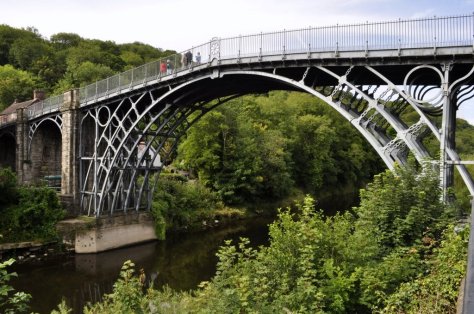
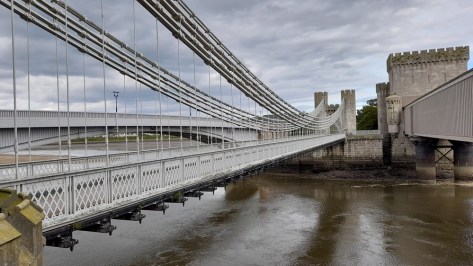
If you browse through my posts for 2023 you will see they cover a whole range of topics — just as the name, A Balanced Diet, of my blog suggests. Obviously there were several posts about our Minnesota visits, and the holiday in North Wales. But often something in the news catches my eye, and inspires me to write something. Like the time I shared my thoughts about proposed changes to England’s education system and the introduction of a broader curriculum. Or the post I wrote about bridges after reading about someone inspired by these awesome constructions. Then Steph and I celebrated our 50th wedding anniversary in October and I turned 75 in November. Two more stories there.


For several years now, I haven’t commented on politics or the state of the world as I see it. But 2023 has been an extraordinary year, both nationally and internationally, for all the wrong reasons, that I feel I cannot end the year without making some comments.

In the UK, the Tory government (if you can call it that) lurches from one catastrophe to another. The dismissal and appointment of Cabinet members has seemed like a game of musical chairs. Fortunately, the ever cruel Suella Braverman has gone from the Home Office but her decidedly far right agenda with regard to immigration (legal or illegal) still pervades the Tories.

Rishi Sunak (or Rish! Pipsqueak as I prefer to refer to him) is a weak, arrogant, and inept Prime Minister, who has been found wanting in several areas. His appearance before the Covid Inquiry didn’t help his image. And where did all those WhatsApp messages go?

Former Prime Minister Boris Johnson’s appearance before the same inquiry just confirmed what we already knew about this self-serving, narcissistic liar.

Hopefully, there will be a General Election before long (there must be one by the end of 2024), and Labour will sweep to power with an overwhelming majority. That’s if the polls are to be believed.

I can’t say I have too much faith in Labour leader Sir Keir Starmer, but he should be a damn sight better as Prime Minister than the present incumbent (or immediate predecessors). However, I fear that the Tories will engineer the nation’s finances in such a way to leave Labour with a toxic legacy to deal with. For the Tories it’s definitely ‘Party before Country’.


Over in the United States, it’s hard to believe that Donald Trump has a good chance of winning back the White House in 2024. I was amazed (and equally appalled) when Trump won in 2016, but to think that he can make a comeback after all he has been accused of (and indicted for) beggars belief. The MAGA Republicans are no better than a Trump cult.

But the Democrats have their own problems. While the country has prospered under Joe Biden (who has kept quite a low profile compared to Trump when in office), does it really make sense for an octogenarian (he’ll be almost 82) to contest this general election? But who to take his place?


The outrageous invasion of Ukraine by Russia has slipped somewhat from the headlines in recent months, but every day still brings news of Russian aggression against civilians, with a flare-up just over the past couple of days. Day 676! Can it really be almost two years since the war began, and remaining stalemated to some extent? The prognosis for 2024 is not optimistic.


I have hesitated to make any public comments about the current situation in the Middle East, concerned that anything I might add would be construed as being anti-semitic. But read this from political commentator here in the UK, Robert Peston.

What Hamas perpetrated against innocent Israeli civilians on 7 October was beyond abhorrent, and bound to trigger a military response. But has Israel’s response been proportionate?

What the Israeli government and the Israel Defence Force have subsequently have inflicted upon millions of innocent Palestinian civilians in Gaza, and thousands of deaths (many of whom were women and children) is equally abhorrent, if not more so. And Israeli aggression continues in the occupied West Bank, where illegal settlements continue to spread, and settlers continue their attacks on Palestinians, supported by the Israeli government. What a depressing circle of violence.


And don’t get me started on climate change . . .


‘Teaching is the one profession that creates all other professions.’ (Unknown)

I was surprised recently to read a tweet (or whatever they’re now called) on X suggesting that all university lecturers should be required to receive formal teacher training and an appropriate qualification. Just as teachers of schoolchildren must complete the Postgraduate Certificate in Education (or PGCE). Not that the PGCE automatically makes everyone a good teacher. Far from it. But the training must surely provide or hone the skills needed to teach better.

Well, whoever it was who tweeted that comment is behind the times. Many (most/all?) universities here in the UK now require incoming, probationary staff at least to take courses, such as the Postgraduate Certificate in Higher Education (PGCHE, a Masters level qualification) and also offer various teaching support modules to more established staff, that cover topics such as small/large group teaching, curriculum design, supervision, and many more.

But when I joined the University of Birmingham as a lecturer in the Department of Plant Biology (School of Biological Sciences) in April 1981 there was no such requirement for teacher training, nor do I remember much if any support being provided. You simply got on with it – for better or worse. Furthermore, teaching loads or commitments, or ability never counted much towards promotion prospects. Research (and research income) was the be-all and end-all.


I’d never aspired to be an academic. Before joining the university, I was working in the Americas over the previous eight years. In November 1980, I had just returned from a five-year assignment in Central America to the headquarters of the International Potato Center (CIP) in Lima, Peru while waiting for my next assignment in the Philippines. I had, however, already applied to Birmingham.

In January 1981 I flew to the UK for an interview and was offered the position immediately. So I returned to Lima knowing that my wife Steph and young daughter Hannah and I would be resettling in the UK before long.

Initially I had no teaching commitments, and I was able to get myself settled and oriented as a faculty member. I knew my way around the Birmingham campus since I was awarded my MSc degree in genetic resources there in 1971, and PhD in botany in 1975. But being a faculty member was very different from being a graduate student.

Come the beginning of the Summer Term in May however, I found myself facing a group of about 35 second year plant biology students for the first time to teach them some aspects of flowering plant taxonomy (along with my colleague Dr Richard Lester, at right, with whom I didn’t always see eye-to-eye over many aspects of course content and delivery).

Anyway, until then I had never taught a class in my life, although I was quite comfortable with public speaking, even enjoying it. I think I must have inherited my ‘love’ of public speaking from my father. Anyway, getting up in front of an audience never particularly fazed me, talking to my peers about my work, and the like. Nevertheless, I always had ‘butterflies in my stomach’ before facing a class for the first time.

Fortunately during the decade I spent at Birmingham I never had to teach any first year classes. Much of my teaching focused on graduate students (many from overseas) attending the 1-year MSc course on Conservation and Utilisation of Plant Genetic Resources (the very course I had attended in 1970-71). I taught a semester long (10 week term) course on crop evolution, two lectures and three hour practical classes per week, principles of germplasm exploration and collection (also with a practical component using a synthetic population made up of many different barley varieties), and a small module on agroecosystems. I also helped my colleague Professor Brian Ford-Lloyd (right) in some aspects of his data management module.

Then, during the summer months (when undergraduates were on vacation) we would supervise the dissertation projects of the MSc students. I guess I must have averaged two or three each year.

Brian and I jointly taught a five week undergraduate course on plant genetic resources, with at least one lecture per day, for final year undergraduates who would graduate with a Biological Sciences (Plant Biology) degree. I guess we must have between 10 and 15 students on average each year, who also had to complete an independent research project over the same period. It was always a challenge to devise projects that could be completed in the time available and that would (generally) generate positive results. Each student would take four of these five week modules.

I also gave a lecture on potato diseases on the third year plant pathology module taught by my colleague Dr Gillian Butler.

Around the mid-1980s I was asked to become chair of the Second Year Common Course, one that all biological sciences students had to take and which was taught by staff from all the four departments (Plant Biology, Zoology and Comparative Physiology, Genetics, and Microbiology) that made up the School of Biological Sciences. I contributed five or six lectures on agriculture and agroecosystems, based on my own experiences of working with crops in the Americas.


To some extent I agree with American novelist Gail Godwin that Good teaching is 1/4 preparation and 3/4 theatre. When you get up in front of a class of students, whether you feel up to it or not, whether it’s a topic you are enthusiastic or not, you have to ‘perform‘. Engage with the class.

The feedback I had from my students was that I was quite an effective teacher. That was gratifying to know. Back in the day, there was no Powerpoint or other digital props. Just the blackboard and chalk (which I hated as I had a slight allergy to chalk), the overhead projector with acetates, and 35 mm slides.

The tools which are available today permit a much more dynamic use of information, provided that there isn’t information overload. Less is often more. And you don’t try to use all 56 million colours in the Powerpoint pallette (as I have seen some speakers attempt to do!).

I think I became a more effective teacher because I had to interact with many graduate students who did not have English as their first language. We worked closely with a unit in the English department who assisted these students, to make their Birmingham experience better and help them through the rigors of graduate study. Lecturing to these students, I learned how to pace myself, and also how better to explain, often in different ways, aspects of the topics I was teaching. And working with the English unit staff (who would analyse our recorded lectures) I came to realise (as did my colleagues) just how often we use colloquialisms in everyday speech, and which are not easily translated for someone who is not a native English speaker.

Anyway, that experience of a decade’s worth of teaching overseas students stood me in good stead when I moved to the Philippines in 1991 and often had to give talks to diverse groups of visitors.


But returning to the opening premise of this post, about teaching qualifications for university staff, I think I would have welcomed much more formal feedback. Nowadays, there are mechanisms in place in universities to provide feedback. After all, the students are the clients who are paying handsomely for their education, and are not shy about denouncing poor teaching (and value for money) when warranted.


Three score and ten . . . plus five

It was my birthday yesterday.

Let me take this opportunity of thanking friends and former colleagues – from all over the world – who sent me birthday greetings. Very much appreciated.

One friend greeted me on achieving three quarters of a century. Now that sounds really old. Another wished me 25 years more. I replied that 10-15 would do me nicely.

In 1948, average life expectancy for males in England and Wales was only 65.9 years. Now it’s 79, due undoubtedly to increased living standards over the intervening decades leading to healthier diets, and better health propped up by the National Health Service that had been founded just a few months before my birth.

I wonder what hopes my Mum had for me on that day.

I was living in Congleton, Cheshire with my parents, Fred and Lilian Jackson, my brothers Martin (b. 1939) and Edgar (b. 1946), and sister Margaret (b. 1941). I started school around 1953.

Come 18 November 1958 – my 10th birthday – we had been living in Leek, Staffordshire for 2½ years already. I attended the local Catholic primary school, St Mary’s, just a few minutes walk from home, and hoped eventually to win a place at the Catholic grammar school in Stoke-on-Trent a couple of years later. Which I did.

Christmas 1958 in Leek (with my elder brother Edgar).


Moving on to 18 November 1968, I had just started the second year of my BSc degree course in environmental botany and geography at the University of Southampton. I had enjoyed my first year there, living in South Stoneham House, one of the halls of residence southeast of the university campus. I’d been elected Vice President of the Junior Common Room at the end of the first year, and that guaranteed me a second year at Stoneham. I guess I celebrated my 20th birthday in the pub with a few friends.

Over the previous summer vacation I’d attended an excellent botany field course on the west coast of island. And afterwards had spent several weeks with my girlfriend at her home just south of York or at my parents’ home in Leek. We also enjoyed a walking tour together of the North York Moors, staying at youth hostels (YHA) each night.

But our relationship was not to last. Just before the beginning of term in October, I received a Dear John letter from her. But not one to be downhearted for long, I picked myself up but forswore dating for a while.

And I threw myself into a new interest: morris dancing. Together with one of the botany department lecturers, Dr Joe Smartt, we founded the university morris side, the Red Stags (still active today, but in a different format and no longer associated with the university).

The Red Stags Morris Men after performing at the University of Southampton Open Day in March 1970. That’s me, kneeling on the right.

Along with my continuing enjoyment of English and Scottish folk dancing, this foray into morris dancing became one of my principal hobbies for the rest of my time at Southampton, and afterwards for several years.

I graduated from Southampton in June 1970, and by September I was studying once again at the University of Birmingham.


By my 30th birthday in November 1978, I already had MSc and PhD degrees from Birmingham under my belt, and had been working for the International Potato Center (CIP), an international agricultural research institute based in Lima, Peru for five years.

Steph (who I met in Birmingham) and I had been married for just over five years, and our first daughter Hannah was born in April. We were living in Costa Rica, but my work with CIP took me throughout the region, as well as to Mexico and the islands of the Caribbean.

If my memory serves me right, I ‘celebrated’ this birthday, a Saturday, on the Caribbean island of Montserrat. I was stuck in my hotel room in Plymouth (the island’s capital until it was destroyed in the Soufrière Hills volcanic eruption of the 1990s) while it rained cats and dogs outside.


In 1988, I had been teaching at the University of Birmingham for over seven years, in the Department of Plant Biology. It was a Friday. My 40th birthday. By then, my colleagues and I had developed a ‘tradition’ of celebrating in the Staff House bar at lunchtime (disgraceful!) with a bottle or two of Beaujolais Nouveau, the release of which always occurs around my birthday. Enjoying a bottle of the ‘new release’ was quite the rage in the UK back in the 1980s, perhaps less so today.

Hannah had turned 10 that year, and Philippa (born in Bromsgrove in 1982) turned six.


I left the university in 1991, to head the Genetic Resources Center (GRC) at the International Rice Research Institute (IRRI) at Los Baños, south of Manila, in the Philippines. In 1998, my GRC staff helped me celebrate my milestone 50th birthday. There must have been lots of snacks such as pancit and spring rolls and the like, ice cream (always vanilla!) and lots of cake. Probably donuts.

Then, in the evening, Steph and Philippa served champagne, and our helper Lilia had made a cake. Hannah was already away at university in Minnesota (where she still lives).

Steph and I celebrated our 25th (Silver) wedding anniversary just a month earlier.


A decade on, and I had changed jobs at IRRI, having moved from GRC to become the institute’s Director for Program Planning and Communications in May 2001.

I had an office suite in the main administration building, and my staff and others from nearby offices in HR and finance joined me to celebrate my 60th birthday.

Then, in the evening, Steph and I enjoyed the company of very close friends Corinta Guerta from my office, plant physiologist (and my closest friend at IRRI) John Sheehy, and Director for Development Duncan Macintosh (from Australia) and Cel (his Filipina girlfriend and now his wife) for an intimate dinner that almost ended in disaster before it had begun.

Nevertheless,we had a great time, but I think I must have drunk too much because I chose the wrong settings on my camera and the resulting images were not the best quality.


I retired from IRRI in 2010, and Steph and I returned to our home in Bromsgrove that we had first moved into way back in 1981, but which we’d kept furnished by unoccupied during the 19 years we stayed in the Philippines.

I celebrated my 70th birthday in 2018, and we did something I’d wanted to do for several years: a weekend away in Liverpool, visiting the childhood homes of Paul McCartney and John Lennon (both managed by the National Trust), as well as The Beatles Story beside the Royal Albert Dock.

We had a great weekend, taking the train from Bromsgrove (via Birmingham New Street) to Liverpool Lime Street. That was an added bonus. I love train journeys!


So here we are in 2023. It has become a tradition over the years for Steph to prepare my favorite meal on my birthday: homemade steak and kidney pie. I always look forward to that one special meal. And, as always, it was delicious, served with a bottle of good Portuguese red: Montaria Gold 2020 from the Lisbon region, a blend of Syrah, Alicante Bouschet, Trincadeira, and Aragonez grape varieties, made by Luis Vieira.


Had the weather been better we would have taken an excursion yesterday. But since the forecast had promised rain (which was the case) we headed north on Friday to the Alnwick Garden and the beach at Amble afterwards.

Oh, and we’d quietly celebrated our 50th (Golden) wedding anniversary a month ago.


Celebrating the beauty of England’s northeast coast

We moved to North Tyneside, just east of Newcastle upon Tyne, a little over three years ago, from our home of 39 years in Bromsgrove, Worcestershire to be closer to our younger daughter and her family who live in Newcastle. We had enjoyed living in Worcestershire; it’s a lovely county. But we also relished the thought of exploring the glorious northeast.

We have not been disappointed. It’s also a special delight living so close to the North Sea coast, just six miles to the spot where we usually park for a walk on Seaton Sluice beach.

Having lived in the Tropics for so many years, and enjoyed snorkeling and scuba diving there, swimming in the cold North Sea holds no attraction whatsoever. There are, however, hardier individuals than me.

But the magnificent coastline has everything: long, sandy beaches; dunes; rocks; and cliffs. And, as often as we can, weather permitting, we make a beeline for the coast.

So let me share with you some of the beauty of this coast that we’ve experienced so far.  A coast that boasts some of the best beaches in the whole of the country, and many stunning views. Several parts of the coast are managed by the National Trust.

I’ll take you on a tour from north to south.


Lying just off the Northumberland coast, a few miles north of Bamburgh, the Holy Island of Lindisfarne is separated twice a day by a tidal causeway. We first visited Holy Island in 1998 when, on home leave from the Philippines, we spent a week touring the county. We returned in July 2022.

Holy Island was a centre of early Celtic Christianity, and the ruins of the priory still stand there. As does the Tudor castle (very much modernised) on a promontory.

At the entrance to the harbor (on Guile Point) are two obelisks, which can be seen just right of center in the image below.

These are the Old Law Beacons, built in 1826 and are a navigational aid that, when lined up, guide sailors into the harbor through the safe channel.

Heading south, it’s not long before the early 14th century ruins of Dunstanburgh Castle on a remote headland come into view. The castle is only accessible on foot, just under 1½ miles north of the fishing village of Craster (famous for its kippers!) along a rugged rocky coast. The cliffs around the castle are home to an important colony of kittiwakes.

Embleton beach can be seen from the castle to the north, but we’ve not been there yet.


Just 5 miles south from Craster, the River Aln reaches the North Sea at Alnmouth, with sandy beaches flanking the estuary. On the distant horizon to the south lies Coquet Island, 1 mile off the coast from the fishing port of Amble (a town we have yet to explore).

Next south is Warkworth beach, a favorite of my daughter and her family. It’s just north of the town, with its 12th century castle, and the estuary of the River Coquet (which has its source high in the Cheviot Hills to the west). It’s a good walk through the dunes from the car park to the beach itself.

Quite often after we have made one of our regular visits to the Alnwick Garden (where we have Friends of the Garden membership), we head down to the coast south of Amble (next images) to have our picnic lunch looking out towards Coquet Island, an important reserve managed by the Royal Society for the Protection of Birds (RSPB) and the most important breeding site in the UK for roseate terns.

It has been badly hit by avian flu. Boat-landings are not permitted on the island even without the restrictions of avian flu.

Just a little further south, and inland from the northern end of Druridge Bay lies Hauxley Wildlife Discovery Centre. There’s a circular walk (about 1¼ miles or 2 km), several hides from which to observe the numerous bird species, and the Lookout Café there serves an excellent cup of coffee.

We’ve visited there a few times, most recently less than a month back. On that visit we saw 36 different species of birds within the space of an hour: wildfowl, waders, and hedgerow birds. A complete range.

Druridge Bay must be one of the longest beaches in Northumberland, over 7 miles long, and backed by high dunes (which, in one location, is the haunt of naturists—presumably during the summer months only!). The Bay stretches from Amble in the north to Cresswell in the south. Inland from the beach, Druridge Bay Country Park covers an area of almost 66 acres (27 ha), with a large freshwater lake, woodland, and grassland and meadows, as well a stretch of the beach and dunes.

At Cresswell there are exposed—at very low tides—the remains of an submerged forest, but we’ve not yet had luck in finding them. The beach is flanked by rocky outcrops at both ends. Parts of the beach are also covered with sea coal which some of the locals gather.


We haven’t yet explored any of the beaches between Cresswell and Blyth, but those south of Blyth as far as the mouth of the River Tyne are where we most often go for a walk. These include Blyth and Seaton Sluice beaches, St Mary’s lighthouse, Whitley Bay, Cullercoats, Long Sands Beach between Cullercoats and Tynemouth, with King Edward’s Bay nestling under the Tynemouth headland on which stand Tynemouth castle and priory, with a magnificent view over the Tyne.

The small harbor at Seaton Sluice, at the mouth of the Seaton Burn, was built by the Delaval family (of nearby Seaton Delaval Hall) in the 18th century to export coal and glass.

St Mary’s Lighthouse is only accessible across a causeway at low tide.

We regularly see a small colony of Atlantic grey seals, and the rocky outcrops there attract large numbers of waders like curlew and golden plover in autumn and early winter.


At the end of March this year, we took the Tyne Ferry to cross from North Shields to South Shields, mainly to visit Arbeia, the Roman fort there. But also to take a look at the entrance to the Tyne from the south and the beaches at South Shields.

South of the South Shields beaches, crumbling magnesian limestone cliffs tower over the coast at Marsden and Whitburn. There are sea stacks and arches dotted along the coast, nesting sites for many sea birds. This stretch of coast is one of our favorites to walk. There is also the added attraction of Souter Lighthouse, visible from miles away.

The limestone is quarried, and in the 1870s a bank of 15 lime kilns was built to process the limestone, linked to the Whitburn colliery and Marsden colliery village, both of which have now been demolished.

The National Glass Centre stands alongside the River Wear in Sunderland.

The mouth of the Port of Sunderland on the River Wear, across from the National Glass Centre.

It’s really worth a visit, and we enjoyed ours a year ago. There’s a long history of glass-making there, and it’s also connected to the establishment of early Christianity. Close by is the Saxon church of St Peter (below), one half, with St Paul’s in Jarrow, of the double Monkwearmouth-Jarrow monastery where the Venerable Bede, one of England’s greatest ecclesiastical scholars spent most of his life in the 8th century.

And talking of glass, in August 2022, Steph and I did some serious beachcombing at Seaham, south of Sunderland, searching for sea glass. I wrote about that visit in this blog post. The beaches there are part of the Durham Heritage Coast, which has been rehabilitated after decades of industrial abuse in the past. Blast Beach is where we found a nice source of sea glass, but the beach north of the town is supposed to be richer. We’ve yet to search there.

So, there you have it. At around 80 miles, and in many locations less than an hour from home, this stretch of coast must be one of the more interesting and beautiful in the country.


More plant blindness?

Tomorrow, 22 October, BBC1 will air Sir David Attenborough‘s next blockbuster 8-part series, Planet Earth III¹, just a year after his last series Frozen Planet II was broadcast.

Planet Earth III? From what I have seen in the trailer for the series, perhaps this should—once again—be titled [Animal] Planet Earth III.

There’s no doubt that the filming is spectacular, the ‘stories’ riveting. As one of the cinematographers has written, [the series] is set to be the most ambitious natural history landmark series ever undertaken by the BBC. It will take audiences to stunning new landscapes, showcase jaw-dropping newly-discovered behaviors, and follow the intense struggles of some of our planet’s most amazing animals (my underlining emphasis).

It’s not very likely that the series will feature plants much, if at all. Are plants being short-changed yet again? Of course there are many programs on television about gardening. But these don’t count, in my opinion, towards any greater understanding of and knowledge about plants and their uses.

That’s not to say that the BBC (or Sir David) have completely ignored plants. In January 2022, his five episode The Green Planet series was broadcast. It was, for me however, a bit like the curate’s egg²: good in parts.

And you have to go way back to 2003 for his The Private Life of Plants series, described as a study of the growth, movement, reproduction and survival of plants.

Before that, I can only think of Geoffrey Smith‘s World of Flowers double series, broadcast on BBC2 in 1983 and 1984, and apparently attracting an audience of over five million.

Who said there was no appetite for programs about plants? These programs weren’t your run-of-the-mill gardening programs. No, in each program Smith highlighted the origin and development of different groups of plant species commonly grown in British gardens.

Furthermore, conservation for many relates to animals. This is something my former Birmingham colleague Brian Ford-Lloyd and I wrote back in 1986.


So what has brought about this latest concern of mine? Well, I first came across the announcement for Planet Earth III‘s imminent broadcast on the same day recently that I subscribed to a new plant-based blog: Plant Cuttings. And there, on the home page, was the blog’s goal for all to see: to reduce plant blindness.

The blog is the creation of Mr P Cuttings (aka Dr Nigel Chaffey, a former senior lecturer in botany at Bath Spa University, and a self proclaimed freelance plant science communicator), and is dedicated to all those who find fascination in plants (and how they are used by people). You can find more about the rationale for and antecedents of Plant Cuttings here. It’s a continuation of the series of articles he published in Annals of Botany, the last one, Check beneath your boots . . ., being published in 2019 (also about ‘plant blindness’).

Unfortunately, plants are often seen as boring, especially by high school students who we need to attract to the plant sciences if the discipline (in all its aspects) is to thrive. Thus this initiative by PlantingScience, a Student-Teacher-Scientist partnership in the USA that was founded in 2005 by the Botanical Society of America.

Let me wish Nigel all the best as he develops this new Plant Cuttings blog. I’m very much in accord with his goals. After all, much of my career in the plant sciences has focused on the origin of the plants that feed us, how they can preserved for posterity in genebanks, and used to increase crop productivity.

So what sparked my interests in plants and human societies? 

While a high school student, I first thought I’d become a zoologist. But I saw the light and my interests turned towards plants, and I took a botany degree (combined with geography) in the late 1960s at the University of Southampton.

One of the books that I read was first published in 1952 (I have the 1969 reprint) by American botanist Edgar Anderson. He wrote it for readers with little technical understanding of plants. After 70 years it has stood the test of time, and I thoroughly recommend anyone who has the slightest interest of the relationships between humans and plants to delve into Plants, Man & Life.

Thus I’ve been fascinated for decades about the beginnings of agriculture and how humans domesticated wild plants, and where, and to what uses they have put the myriad of varieties that were developed. My own expertise in conservation of genetic resources has permitted me to explore the Andes of Peru to find many different varieties of potato, the foundation on which Andean civilizations such as the Incas became successful.

Collecting potatoes from a farmer in northern Peru, May 1974.

A graduate student of mine worked out the probable origin of the grasspea, a famine crop in some parts of the world. And I’ve managed the largest genebank for rice in the world (rice feeding half the world’s population every day), and with my colleagues expanded our knowledge of the relationships of cultivated rices to their wild ancestors. I directed a five year program in the mid-1990s to collect cultivated rices from many countries in Asia and Africa, especially from the Lao PDR.

These are just three examples from all the plants which societies use and depend on. So many more, and so many fascinating stories of how civilization and agriculture developed.

Just recently, on holiday in North Wales, my wife and I came across the site of about 20 hut circles on the northwest tip of Anglesey, dating back to the Iron Age, some 2500 years ago.

What is particularly fascinating for me is that there is good evidence that crops like wheat, barley, and oats among others were being cultivated there 3000 years earlier. That’s about 4500 years after these crops were first domesticated in the Near East in Turkey and along the river valleys of the Tigris and Euphrates. In the intervening years, these crops were carried across Europe by migrating peoples as they headed west until they became staples on the far west of mainland Britain. The domestication and expansion of these crops is also the story of those societies.

Plants are definitely not boring. Botany opens up a host of career opportunities. Today we need to harness the whole range of plant sciences, from molecule to field, to understand and use all the genetic diversity that is safely conserved in genebanks around the world, and backed up in many cases in the Svalbard Global Seed Vault. We now have so many more tools, particularly molecular ones, at our fingertips to study plants.

Be sure to follow Plant Cuttings to find out more about the joy of plants and their value to humankind. I trust many more generations will be proud to say they became botanists (or, at the very least, took up one of the allied plant sciences).


¹I watched the first episode of Planet Earth III on BBC IPlayer catch up. Verdict: stunning photography but boring content, seemingly a rehash of so many nature programs. All animals. However, at 97, Sir David Attenborough is a remarkable presenter.

² A curate’s egg is something described as partly bad and partly good.

Potatoes have no special chemistry to induce romance . . . but they brought us together

Saturday 13 October 1973, 11:30 am
Lima, Peru

Fifty years ago today, Steph and I were married at the town hall (municipalidad) in the Miraflores district of Lima, where we had an apartment on Avenida José Larco. Steph had turned 24 just five days earlier; it would be my 25th in the middle of November.
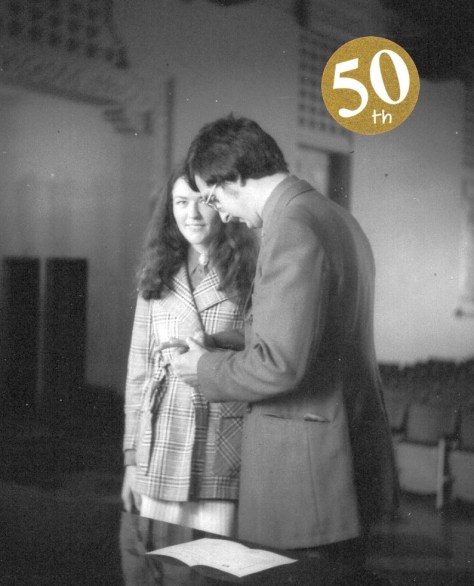
Municipalidad de Miraflores, Lima

It was a brief ceremony, lasting 15 minutes at most, and a quiet affair.  Just Steph and me, and our two witnesses, John and Marian Vessey. And the mayor (or other official) of course.
John, a plant pathologist working on bacterial diseases of potato, was a colleague of ours at the International Potato Center (CIP) in Lima, who had joined the center a few months before I arrived in Lima in January 1973.
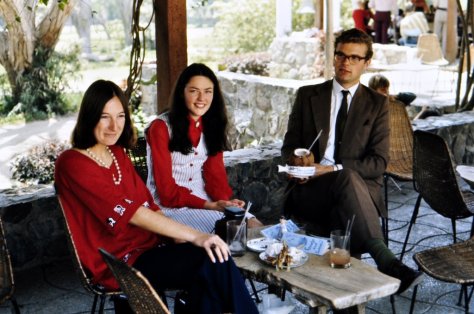
Enjoying pre-lunch drinks with Marian and John at ‘La Granja Azul‘ restaurant at Santa Clara – Ate, on the outskirts of Lima.

The newly-weds.


It’s by chance, I suppose, that Steph and I got together in the first place. We met at the University of Birmingham, where we studied for our MSc degrees in Conservation and Utilization of Plant Genetic Resources.

Steph arrived in Birmingham in September 1971, just after I had finished the one-year course. I was expecting imminently to head off to Peru where I had been offered a position at CIP to help curate the large collection of native potato varieties in the CIP genebank. So, had I flown off to South America then, our paths would have hardly crossed.

But fate stepped in I guess.

My departure to Peru was delayed until January 1973. So I registered for a PhD with renowned potato expert Professor Jack Hawkes (right, head of the Department of Botany and architect of the MSc course), and began my research in Birmingham while CIP’s Director General, Richard Sawyer, negotiated a financial package from the British government to support the center’s research for development agenda, and my work there in particular.

It must have been early summer 1972 that Steph and I first got together. Having completed the MSc written exams in May, Steph began a research project on reproductive strategies in three legume species, directed by Dr Trevor Williams (who had supervised my project a year earlier on lentils). And she completed the course in September.

By then, she had successfully applied for a scientific officer position at the Scottish Plant Breeding Station in Edinburgh (SPBS, now part—after several interim phases—of the James Hutton Institute in Dundee), as Assistant Curator of the Commonwealth Potato Collection. But that position wasn’t due to start until November.
Our VW Variant in Peru, around May 1973 – before receiving a Peruvian registration plate.

In early November I took delivery of a left-hand-drive Volkswagen for shipment to Peru. On a rather dismal Birmingham morning, we loaded up the VW with Steph’s belongings and headed north to Edinburgh. She returned to Birmingham in mid-December for her graduation.
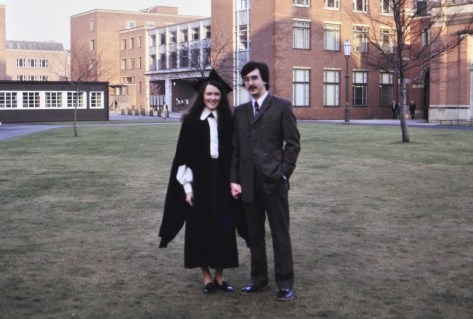
Then, just after Christmas 1972, we met up in a London for a couple of days before I was due to fly out to Lima.

At that time we could not make any firm commitments although we knew that—given the opportunity—we wanted to be together.

Again fate stepped in. On 4 January 1973, Jack Hawkes and I flew to Lima. Jack had been asked to organize a planning conference to guide CIP’s program to collect and conserve native Andean potato varieties and their wild relatives.
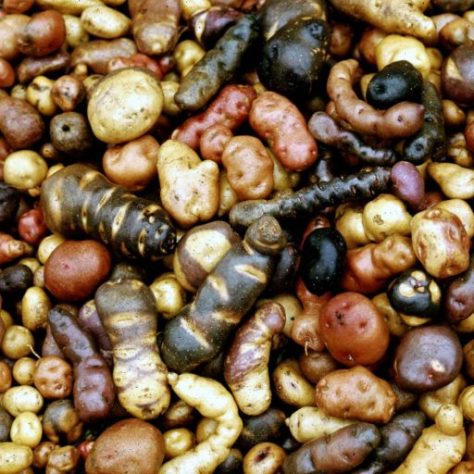
Potato varieties from the Andes of Peru.

While I stayed in a small hotel (the Pensión Beech, in the San Isidro district) until I could find an apartment to rent, Jack stayed with Richard Sawyer and his wife Norma. And it was over dinner one evening that Jack mentioned to Richard that I had a ‘significant other’ in the UK, also working on potato genetic resources, and was there a possibility of finding a position at CIP for her. Richard mulled the idea over, and quickly reached a decision: he offered Steph a position in the Breeding and Genetics Department to work with the germplasm collection.

With that, Steph resigned from the SPBS and made plans to move to Lima in July, with us planning to get married later on in the year.

In the CIP germplasm screenhouses in La Molina. Bottom: with Peruvian potato expert Ing. Carlos Ochoa.


A couple of weeks after I arrived in Peru, I found an apartment in Miraflores at 156 Los Pinos (how that whole area has changed in the intervening 50 years), and that’s where Steph joined me.

In our Los Pinos apartment, Miraflores in July 1973.

A few weeks later we found a larger apartment, nearby at 730 Avda. Larco, apartment 1003. Very interesting during earthquakes!
Around mid-August 1973 we began the paperwork (all those tramites!) to marry in Peru. Not as simple as you might think, but on reflection perhaps not as difficult as we anticipated.

While we were allowed to post marriage banns in the British Embassy, we had to announce our intention to marry in the official Peruvian government gazette, El Peruano, and one of the principal daily broadsheets (El Comercio if memory serves me right), and have the police visit us at our apartment to verify our address. I think we also had to have blood tests as well. This all took time, but everything was eventually in place for us to set the wedding date: 13 October.

Some friends wanted to give us a big wedding, but Steph said she just wanted an intimate, quiet day. So that’s what we organized.

In the week leading up to our wedding, we had to present all the notarised documents at the municipality. After the ceremony, we signed the registry, hand-written in enormous volumes (or tomos). There was a bank of clerical staff, all with their Parker fountain pens, inscribing the details of each wedding in their respective tomo. A week later we collected our Constancia de Matrimonio (with some errors) which detailed in which tomo (No. 83, page 706) our marriage had been recorded, as well as photocopies (now sadly faded) of the actual page.

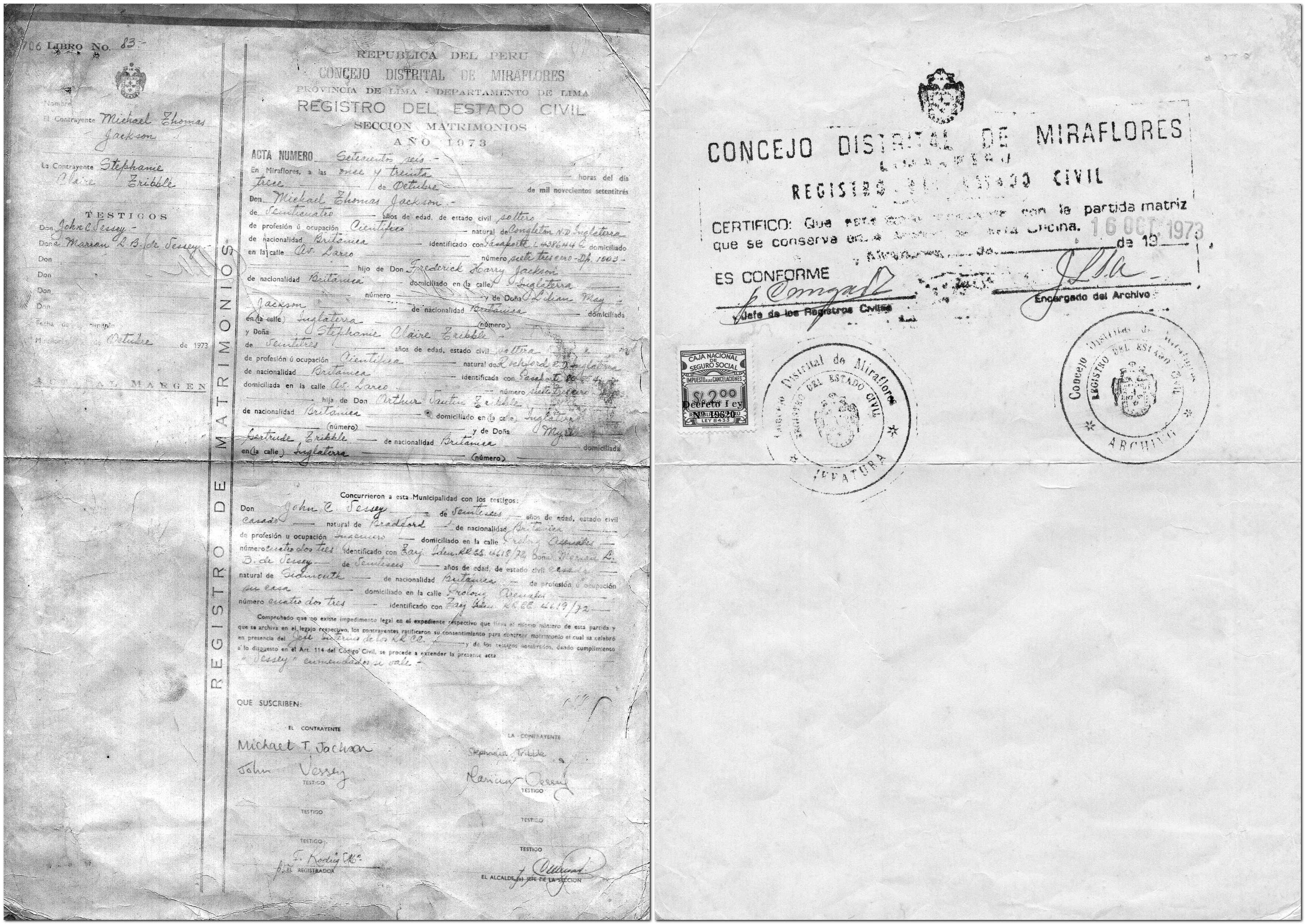
My work, collecting potatoes, took me all over the Andes; not so much for Steph who only made visits every other week or so to CIP’s highland experiment station (at over 3000 masl) in Huancayo east of Lima, and a six hour drive away.

However, Steph and I explored Peru together as much as we could, taking our VW on several long trips, to the north and central Andes, and south to Lake Titicaca. We also delayed our honeymoon until December 1973, flying to Cusco for a few days, and spending one night at Machu Picchu.
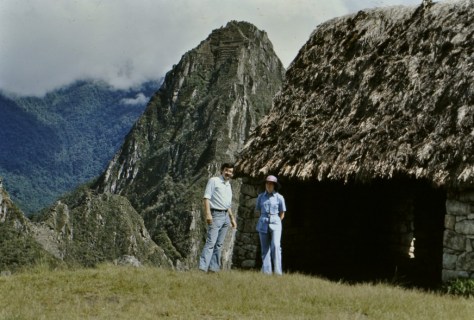
At Machu Picchu, December 1973.


In May 1975, we returned to the UK for seven months for me to complete my PhD, returning to Lima just before New Year.
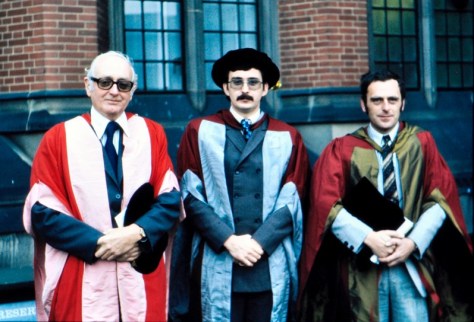
With Jack Hakes and Trevor Williams at my PhD graduation on 12 December 1975 at the University of Birmingham.
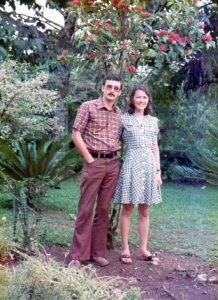
Christmas Day 1976 in Turrialba.

Then, in April 1976, we moved to Costa Rica where I worked on potato diseases and production, based in Turrialba, some 70 km east of the capital city, San José. Under the terms of our visas, Steph was not permitted to work in Costa Rica. I became regional representative for CIP’s Region II (Mexico, Central America, and the Caribbean) in August 1997 when my colleague, Oscar Hidalgo (who was based in Toluca, Mexico) headed to North Carolina to begin his PhD studies.

Our elder daughter Hannah Louise was born in San José in April 1978. Later that year, we took our first home leave in the UK and both sets of grandparents were delighted to meet their first granddaughter.
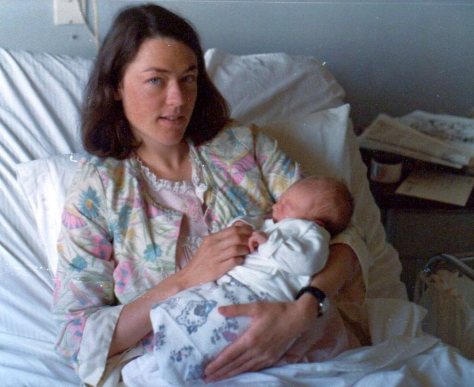
24 April 1978 in the Clinica Santa Rita, San José, Costa Rica.
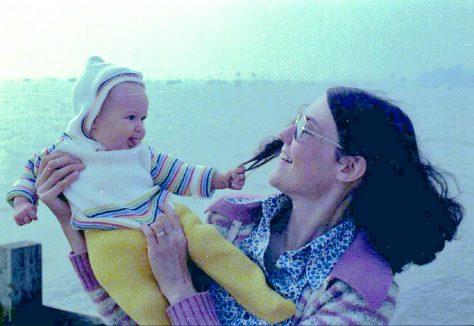
On home leave in the UK in September 1978.
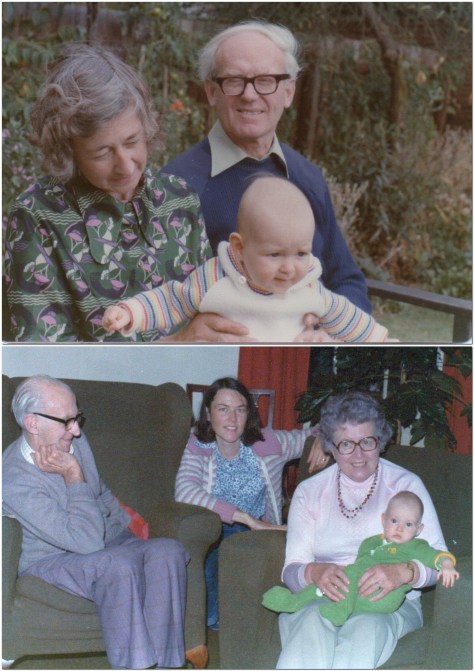
With Steph’s parents Myrtle and Arthur (top) in Southend-on-Sea, and mine, Lilian and Fred, in Leek.

We spent five happy years in Costa Rica before moving back to Lima at the end of November 1980, and began making plans to move to the Philippines by Easter 1981.

However, in early 1981, a lectureship was created at the University of Birmingham, in the Department of Plant Biology (formerly Botany, where Steph and I had studied), for which I successfully applied. We left CIP at the end of March and had set up home in Bromsgrove (about 13 miles south of Birmingham in north Worcestershire) by the beginning of July.
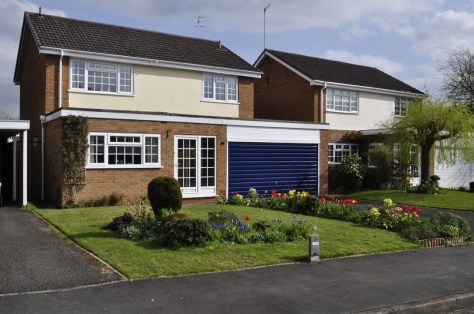
4 Davenport Drive


A decade after we were married, we were already a family of four. In May 1982 Philippa Alice was born in Bromsgrove.
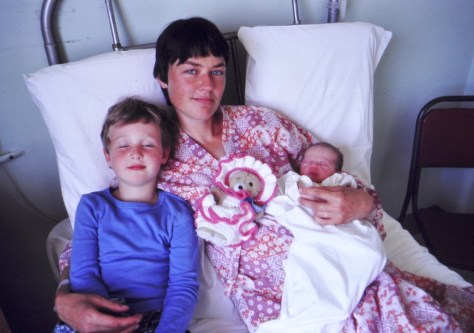
30 May 1982 in Bromsgrove hospital.

During the 1980s we enjoyed many family holidays, including this one in 1983 on the canals close to home.

Many other family holidays followed, in South Wales, in Norfolk, on the North York Moors, and in 1989, in the Canary Islands.
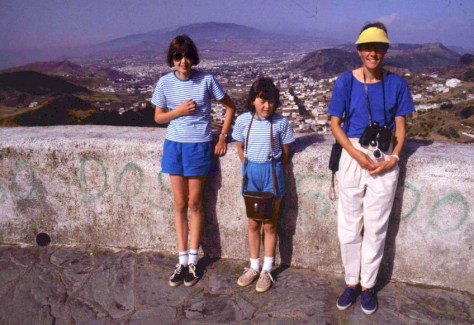
In Tenerife, Canary Islands in July 1989. Steph is carrying the binoculars that I bought around 1964 and which I still possess.

Hannah (left) and Philippa (right) thrived at local Finstall First School, shown here on their first day of school in 1983 and 1987, respectively.
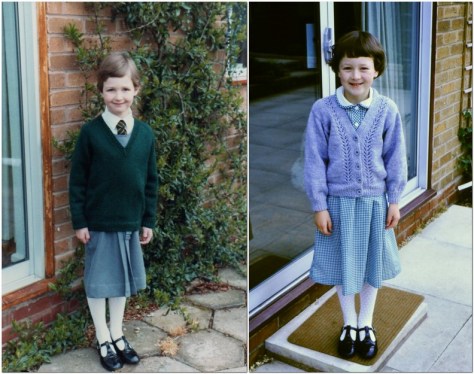
My work at Birmingham kept me very busy (perhaps too busy), but I particularly enjoyed working with my graduate students (many of them from overseas), and my undergraduate tutees.

All in all, it looked like Birmingham would be a job for life. That was not to be, however. By the end of the 1980s, academic life had sadly lost much of its allure, thanks in no small part to the policies and actions of the Thatcher government. We moved on.


By 1993, we had already been in the Philippines for almost two years, where I had been hired (from July 1991) as head of the Genetic Resources Center (GRC) at the International Rice Research Institute (IRRI) in Los Baños, some 65 km south of Manila in the Philippines. I moved there ahead of Steph and the girls (then aged 13 and nine) who joined me just after Christmas 1991.

Meeting fellow newcomer and head of communications, Ted Hutchcroft and his wife at our joint IRRI welcoming party in early 1992.

In 1993 I learned to scuba dive, a year after Hannah, and it was one of the best things I’ve ever done. Philippa trained a couple of years later.
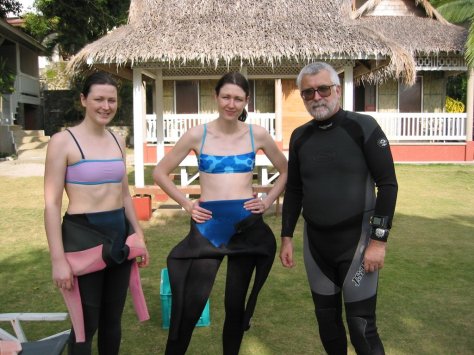
Getting ready to dive, at Arthur’s Place, Anilao, Philippines in January 2003.

Steph was quite content simply to snorkel or beachcomb, and we derived great pleasure from our weekends away (about eight or nine a year) at Anilao, 92 km south from Los Baños. In fact, our weekends in Anilao were one of our greatest enjoyments during the 19 years we spent in the Philippines.

Steph became an enthusiastic beader and has made several hundred pieces of jewelry since then. In Los Baños we had a live-in helper, Lilia, and so in the heat of Los Baños, Steph was spared the drudgery of housework or cooking, and could focus on the hobbies she enjoyed, including a daily swim in the IRRI pool, and looking after her garden and orchids.
Steph and Lilia on our last day in IRRI Staff Housing #15 on 30 April 2010.

Hannah and Philippa completed their school education at the International School Manila (ISM) in 1995 and 1999 respectively, both passing the International Baccalaureate Diploma with commendably high scores.
Graduation at ISM: Hannah and Philippa with their friends from around the world.

Traveling to Manila each day from Los Baños had not been an easy journey, due to continual roadworks and indescribable traffic. It was at least two hours each way. By the time Philippa finished school in 1999, the buses were leaving Los Baños at 04:30 in order to reach Manila by the start of classes at 07:15.

In October 1996, Hannah started her university degree in psychology and social anthropology at Swansea University in the UK. However, after two years, she transferred to Macalester College, a highly-rated liberal arts college in St Paul, Minnesota, graduating summa cum laude in psychology and anthropology in May 2000. She then registered for a PhD in industrial and organizational psychology at the University of Minnesota. Philippa began her BSc degree in psychology at the prestigious University of Durham, UK later that same year, in October.

Hannah’s graduation in May 2000 at Macalester College, with Philippa and Michael (Hannah’s boyfriend, now her husband).

Once Hannah and Philippa had left for university, IRRI paid for return visits each year, especially at Christmas.

Christmas 2001. Michael joined Hannah for the visit.

While my work took me outside the Philippines quite often, Steph and I did manage holidays together in Hong Kong/Macau and Australia. And, together with Philippa, we toured Angkor Wat in Cambodia in December 2000.

But Steph also accompanied me on work trips to Laos, Bali, and Japan. She also joined me and my staff when we visited the rice terraces in northern Luzon in March 2009.

Enjoying a cold beer as the sun goes down, near Sagada, northern Luzon, Philippines.
Overlooking the Batad rice terraces in northern Luzon in March 2009.

However, we always used our annual home leave allowance to return to the UK, stay in our home in Bromsgrove (which we had purposely left unoccupied), and meet up with family and friends.

Philippa was awarded a 2:1 degree in July 2003, and the graduation ceremony took place inside Durham Cathedral. She then headed off to Vancouver for a year, before returning to the UK and looking for a job, eventually settling in Newcastle upon Tyne where she has lived ever since.
Outside Durham Cathedral where Phil received her BSc degree from the university’s Chancellor, the late Sir Peter Ustinov.

Hannah married Michael in May 2006, and finished her PhD. We flew to Minnesota from the Philippines.
15 May 2006, at the Marjorie McNeely Conservatory in Como Park, St Paul.
PhD graduation at the University of Minnesota.

Philippa registered for a PhD in biological psychology at Northumbria University in Newcastle upon Tyne where she was already working.

Professionally, the period between 2001 and my retirement in 2010 was the most satisfying. I had changed positions at IRRI in May, moving from GRC to join the institute’s senior management team as Director for Program Planning and Communications (DPPC). I worked with a great team, and we really made an impact to increase donor support for IRRI’s research program. However, by 2008/9 when my contract was up for renewal, Steph and I had already agreed not to continue with IRRI, but take early retirement and return to the UK.

But not quite yet. IRRI’s Director General, Bob Zeigler, persuaded me to stay on for another year, and organize the celebrations for the institute’s 50th anniversary. Which I duly did, and had great fun doing so.

But as our retirement date approached in April 2010, I was honored by the institute’s Board of Trustees with a farewell party (despedida) coinciding with the 50th anniversary of the very first Board meeting in April 1960.
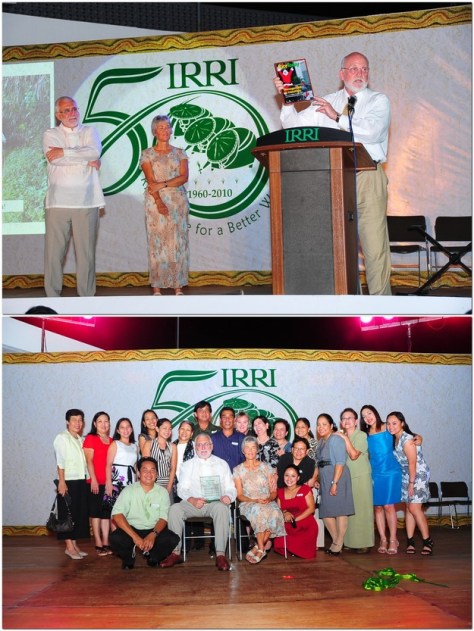
14 April 2010 – IRRI’s 50th celebration dinner and our despedida.


Friday 30 April was my last day in the office.
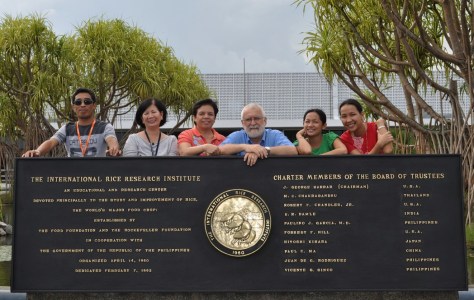
With my DPPC friends. L-R: Eric, Corinta, Zeny, me, Vhel, and Yeyet.

We flew back to the UK two days later, arriving on Monday 3 May and taking delivery of our new car, a Peugeot 308, the following day.
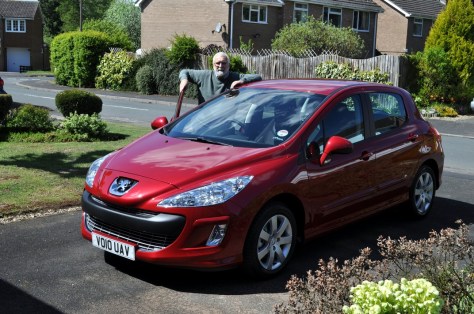
Philippa and Andi flew off to New York in October 2010 and were married in Central Park. She graduated with her PhD in December.
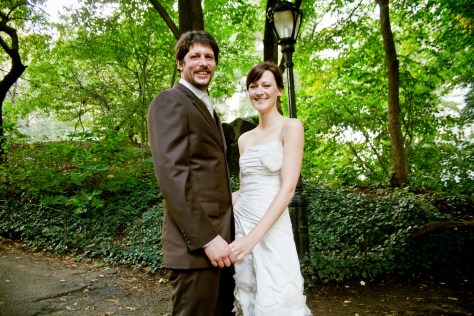
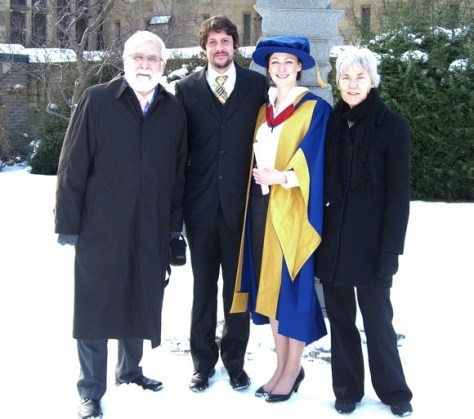
By 2013 we had been married for four decades, and were well-settled into retirement, enjoying all the opportunities good weather gave us to really explore Worcestershire and neighboring counties, especially as National Trust and English Heritage members. And touring Scotland in 2015, Northern Ireland in 2017, Cornwall in 2018, East Sussex and Kent in 2019, and Hampshire and West Sussex in 2022.

We were, by then, the proud grandparents of three beautiful boys and a girl.

Callum Andrew (August 2010) – St Paul, Minnesota
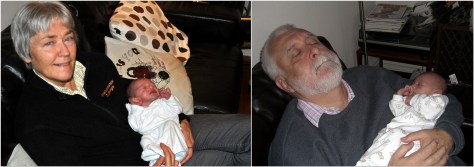
Elvis Dexter (September 2011) – Newcastle upon Tyne
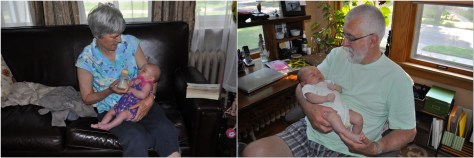
Zoë Isobel (May 2012) – St Paul, Minnesota
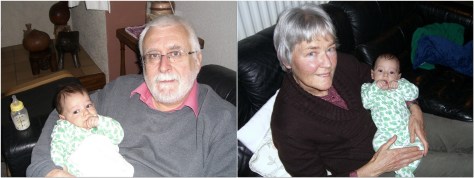
Felix Sylvester (September 2013) – Newcastle upon Tyne

And how could we ever forget a very special day in February 2012, when Steph, Philippa and my former colleague from IRRI, Corinta joined me at Buckingham Palace for an investiture.

Receiving my OBE from King Charles III (then HRH The Prince of Wales) on 14 February 2012.
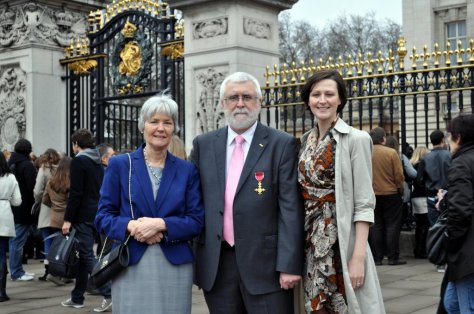
With Steph and Philippa outside the gates of Buckingham Palace.
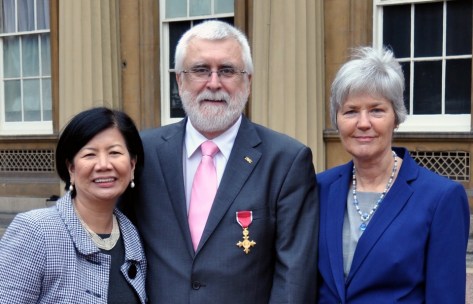
With Corinta and Steph in the courtyard of Buckingham Palace after the investiture.

Since 2010, we have traveled to the USA each year except during the pandemic years (2020-2022), and only returning there this past May and June. We’ve made some pretty impressive road trips around the USA, taking in the east and west coasts, and all points in between with the exception of the Deep South. Just click here to find a list of those road trips.

In July 2016, a few months after I broke my leg, Hannah and family came over to the UK, and we got together with Phil and Andi and the boys for the first time, sharing a house in the New Forest.

Our first group photo as a family, near Beaulieu Road station in the New Forest, 7 July 2016. L-R: Zoë, Michael, me (still using a walking stick), Steph, Callum, Hannah, Elvis, Andi, Felix, and Philippa.

And they came over again in July 2022, to our new home in the northeast of England where we had moved from Bromsgrove in October 2020 at the height of the Covid-19 pandemic.
In our garden in Backworth, North Tyneside, August 2022.

L-R: Felix, Elvis, Zoë, and Callum, at Dunstanburgh Castle, Northumberland in August 2022.


So it’s 2023, and fifty years have passed since we married.

During our visit to the USA this past May and June, we met up with Roger Rowe and his wife Norma, along the Mississippi River at La Crosse in Wisconsin.
Roger joined CIP in 1973 as head of the Breeding and Genetics Department and was our first boss. Roger also co-supervised my PhD. So it was great meeting up with them again 50 years on.

We’ve been in the northeast just over three years now, and haven’t regretted for a moment making the move north. It’s a wonderful part of the country, and in fact has given us a new lease of life.
At Steel Rigg looking east towards the Whin Sill, Crag Lough, and Hadrian’s Wall, Northumberland, February 2022.

Steph has taken great pleasure in developing her new garden here. It’s a work in progress, and quite a different challenge from her garden in Worcestershire, discovering what she can grow and what won’t survive this far north or in the very heavy (and often waterlogged) soil.
22 August 2023

I’ve had much enjoyment writing this blog since 2012, combining my interests of writing and photography. It has certainly given me a focus in retirement. I never thought I’d still be writing as many stories, over 700 now, and approaching 780,000 words. Since returning to the UK, I’ve also tried to take a daily walk of 2-4 miles. However, that’s not been possible these past six months. A back and leg problem has curtailed my daily walk, but I’m hopeful that it will eventually resolve itself and I’ll be able to get out and about locally, especially along the famous North Tyneside waggonways.

After 50 years together, we have much to be thankful for. We’ve enjoyed the countries where we have lived and worked, or visited on vacation. Our daughters and their families are thriving. Hannah is a Senior Director of Talent Management and Strategy for one of the USA’s largest food companies, and Philippa is an Associate Professor of Biological Psychology at Northumbria University.
Sisters!
With Hannah and Michael, Callum and Zoë (and doggies Bo and Ollie, and cat Hobbes) in St Paul, MN on 18 June 2023.
With Philippa and Andi, Elvis and Felix (and doggies Rex and Noodle) on 2 September 2023.

And here we are, at South Stack cliffs, in the prime of life (taken in mid-September) when we enjoyed a short break in North Wales.
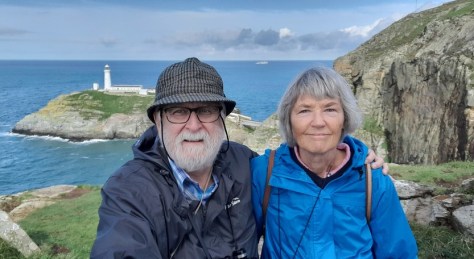
Steph with Philippa and family on her birthday on 8 October.
13 October 2023 – still going strong!


While drafting this reminiscence, I came across this article by Hannah Snyder on the Northwest Public Broadcasting website, and it inspired the title I used.


It doesn’t add up

Several weeks ago (or was it months?) UK Prime Minister Rishi Sunak (right) announced that his government would soon propose plans to reform secondary education for all pupils to study mathematics and English up to the age of 18, like many other countries.

After GCSEs (known as ‘O Levels’ back in the day when I was at school in the 1960s), taken at 15/16, many pupils receive no further tuition in maths (or English for that matter), and specialise in their final two years of high school, taking just three subjects, known as ‘A Levels’ (Advanced Level) as university entrance exams.

During his speech to the Tory Party conference on 4 October Sunak pledged to introduce this ‘revolutionary’ change. That’s assuming, of course, that the Tories remain in power after the next General Election. Which seems highly unlikely if the latest polls are to be believed. (Should Labour win the next election, I have no idea what its policy on continuing maths and English education will be, although as far back as 2014 they made it one of their policy pledges¹).

By teatime on the 4th, the Prime Minister’s Office had posted a press release on the government’s website.

Justifying this proposal, Sunak indicated that this new qualification for 16-19 year olds will put technical and academic education on an equal footing and ensure that all young people leave school knowing the basics in maths and English.

The new Advanced British Standard will bring together the best of A Levels and T Levels into a single new qualification. Students will take a larger number of subjects at both ‘major’ and ‘minor’ level, with most studying a minimum of five subjects at different levels – for example, three majors alongside two minors. Importantly, students will have the freedom to take a mix of technical and academic subjects, giving them more flexibility over their future career options.

However, it would take at least a decade to introduce such a change apparently. Very quickly, unions and teachers dismissed this proposed reform. Not, I hope, because they were opposed to reform in principle, but because schools do not have the staff or resources to teach English and maths to age 18. Yes, that is a real issue, and it will take political courage from the next government to tackle this issue head on, and support education at the level required. And to increase standards and achievements for GCSE students.


Notwithstanding there little or nothing about this Tory government I can support – and they certainly won’t have my vote in 2024 or whenever the election is called – I am actually in favor of this proposed educational reform. Let me explain.

When I was in high school (1960-1967), maths was one of my least favorite subjects. I dreaded maths lessons. But I did manage a pass in ‘O’ Level maths in 1964, but never took a maths course per se ever since. Much to my regret. And there are thousands of schoolchildren in exactly the same boat as me. Cowed by maths, and thus uninterested in the beauty of the discipline.

I often wish I had been able, had the ability, and perhaps more importantly had the support of good maths teachers to instill a continuing interest. I had really poor teachers at my high school, only interested in those who could and tolerating (just) those who struggled.

Having said all this, I have spent much of my career in agricultural science working with numbers, and thoroughly enjoying it. Indeed, in 2017 I wrote this blog post, There’s beauty in numbers, about my enjoyment of playing with data, looking for patterns and trends, and coming to conclusions about the behavior of the plants and crops I was studying. But although I became reasonably proficient (under guidance and advice from those better experienced than me) in the use of statistics, I do wish I had a better theoretical background underlying some of the statistical concepts I applied.

But beyond the basics of algebra, geometry, or trigonometry that high school pupils receive leading up to GCSEs, most do not need higher levels of mathematical education, like calculus for example. What they do need, in my opinion, are good numeracy skills, and how maths operates in the real world.

And as far as English is concerned, my emphasis for many students would be having the ability to write coherent prose and learning how to communicate effectively, both in written form and verbally. No need for deep analysis of set texts by Shakespeare or others.

So how would they achieve this? Sunak’s proposed Advanced British Standard qualification is his solution.

Often referred to (in previous government statements) as an English or British Baccalaureate, the Advanced British Standard seems remarkably similar to an existing and widely accepted qualification: the International Baccalaureate Diploma, offered in over 3600 state and private schools worldwide (but in just 22 state schools in the UK, although offered in 71 private ones).

If a widely-accepted qualification is up and running, and has been for decades, since 1968 in fact, why bother to reinvent the wheel with the Advanced British Standard? Is this another case of British exceptionalism?

This is what one headmistress, Victoria Hearn (right), Principal of state-assisted Impington Village College and Impington International College near Cambridge had to say about the proposal in a letter to The Guardian on 27 September last:

While Rishi Sunak’s plans to reform post-16 education are welcome news, I can’t help but feel that valuable resources could be saved by utilising a tried and tested education framework that students are already benefiting from. The international baccalaureate (IB) diploma enables students to study six subjects including mathematics, English and a foreign language until the age of 18, providing a broader and more rewarding syllabus compared with that of the UK’s national curriculum.

The development of a “British baccalaureate” will be costly, and funding this new vision will be a concern to many, particularly for state-funded schools that are already overstretched. In the UK, the IB is often seen as only accessible to independent schools, but with some creative budgeting and timetable management, a comprehensive IB programme can be delivered by state schools. We have been offering the IB at the state-maintained Impington Village college for more than 30 years as we believe it places our students in the best position to succeed in the global workplace.

Adapting the current curriculum framework is going to be lengthy and costly. The IB represents a proven alternative that can give students the broad range of skills required to thrive in the future.

Also, these are the IB values:

  • valuing inquiry and reflection, encouraging students to be open minded in their learning;
  • being principled and encouraging a caring attitude;
  • promoting high quality communication and discussions within the school community; and
  • encouraging international-mindedness and building respectful relationships.

I couldn’t agree more. And here are some reasons why.

First, from my own experience, I believe keeping your options broad is a positive perspective. In fact,

  • I studied both humanities and sciences at ‘A Level’: English Literature, Geography, and Biology (and General Studies).
  • I read for a combined BSc degree at the University of Southampton (1967-1970) in Environmental Botany and Geography.
  • For my MSc degree at the University of Birmingham in the conservation and use of plant genetic resources (1970-1971) many different topics were included.
  • It wasn’t until I began my PhD on potatoes (awarded 1975) that I settled into a narrow discipline.

Second, I don’t agree with either the retired teacher who thinks that additional ‘useless’ subjects in a baccalaureate would not be appropriate for many pupils, or the Emeritus Professor of Mathematical Education, who felt that students applying for maths at university would not have appropriate preparation. Both expressed their views in letters to The Guardian. The professor seemingly doesn’t appreciate that IB subjects are taught at both a higher and lower level. And, in any case, from my experience as a university lecturer (1981-1991, in plant biology in the School of Biological Sciences at the University of Birmingham) many first year university courses are designed to bring everyone up to the same level.

Furthermore, and again from my university days as a tutor, many students would certainly benefit from having a received a broader pre-university education, that would have given them a broader perspective on life, with access to the humanities as well as sciences, and would have enhanced, I believe, their ability to think and discuss more critically, and present their ideas verbally as well as written.

And lastly, both my daughters took the IB Diploma, and emerged with highly creditable grades at age 17, with subsequent access to good universities in the USA and UK, and endowing them with the academic capabilities and discipline to graduate with excellent degrees, and subsequently taking a PhD each in psychology.

But, I should add, their IB Diplomas were not earned at a British state school. In July 1991, I took a senior position with the International Rice Research Institute (IRRI) in the Philippines. My wife Steph and daughters followed me out to the Philippines by the end of the year, when Hannah and Philippa were 13 and nine (and had just moved up to high school and middle school respectively just three months previously in our home town, Bromsgrove, in Worcestershire).

Steph and I discussed the various education options. We were not keen in sending them to boarding school in the UK. There was a British School in Manila, but that did not, in the 1990s, offer an ‘A Level’ curriculum. So, after GCSEs, we would have had to send them back to the UK. Again not something we considered.

So both were enrolled in the fee-paying International School Manila (ISM), with the expectation from the outset that the IB Diploma would be their pre-university goal. Fees were subsidised by my employer as many IRRI children were also enrolled there, and traveled the 70 km daily each way north from Los Baños, where IRRI’s research center is located, into the city.

Yes, the courses were tough. Since besides the six academic subjects (three at higher, three at lower), IB students took a Theory of Knowledge course. Both our daughters studied English, history, and biology at higher level, and maths studies, French, and psychology at lower level.

Each had to complete a 4000 word essay based on independent research. Hannah’s history project was an analysis of the impact of the railways on the canals in mid-19th century England. Philippa made an analysis of A Shropshire Lad, an epic poem by Bromsgrove classical scholar poet, AE Housman (whose statue, right, proudly stands in the High St there) and interpreting his repressed sexuality through the poem’s themes.

For her community project, Hannah helped each weekend at a Montessori school in Los Baños, while Philippa joined a group for two weeks helping to construct a road in the mountains north of Manila.

There was one last challenge: the daily journey into Manila. Classes began at 07:15, and by the time my younger daughter graduated in 1999, the IRRI bus for ISM was departing from Los Baños at 04:30, and not returning until 16:30 or later. Then there were homework assignments to complete until late evening. All the family was relieved come graduation!

I’ve asked them about the IB experience. Both were unequivocal. The Diploma gave them enhanced skills for critical thinking, time organization, as well as covering the various subjects in depth. They both said the Diploma was a worthwhile qualification. It certainly hasn’t held them back.

So as the discussion continues over post-16 education and whether to replace ‘A Levels’ with a broader curriculum qualification, it’s certainly worthwhile looking at the IB mix, and what level of maths and English education and skills most students really need to prepare them for the workplace, and life in general.


¹ 11 October update. Labour just announced at its 2023 Conference that there will be a focus on teaching ‘real world maths’ to younger children. See this article in The Guardian.

A view to Snowdonia’s foothills, and to the sea

During our recent short break in North Wales, Steph and I visited two very different gardens for the first time, Bodnant and Plas yn Rhiw, and made a quick return visit to a third (Plas Newydd on Anglesey), all managed by the National Trust.

Bodnant, a few miles south of Conwy in the river valley of the same name, is a world-famous garden home to National Collections and Champion Trees, covering around 80 acres (32 ha), and with 8 miles of trails to explore. Just click on the map below to open a larger version.

The history of Bodnant goes back 150 years or so, and is the story of the Pochin and McLaren families, who were united when Laura Pochin married Charles McLaren in 1877. Charles was ennobled in 1911 and took the name Lord Aberconway. The Aberconway family is still closely associated with the garden, and owns Bodnant House (which is not open to the public).

Like other gardens we have visited (such as Cragside in Northumberland), it never ceases to amaze me what vision the creators of these gardens had. They introduced and planted all manner of species, with many trees today reaching skywards more than 100 feet (among them various redwoods), a landscape they could only have dreamed about but never seen. It has been left to their descendants to nurture that vision alongside the National Trust.

I guess we must have arrived by about 10:30, and after enjoying a welcome cup of coffee, headed off into the garden.

Just inside the garden, beside one of the main paths, was a glorious perennial border, in full early Autumn bloom.

Given my more limited mobility over the past months, we initially decided just to walk the more accessible paths, and the various terraces that add so much magnificence to the garden, and from which there are inspiring views over the Snowdonia foothills to the west, across the other side of the Rover Conwy.

Below the west elevation of Bodnant House, there is a series of five terraces, the uppermost and another below it planted to roses. There are two large pools, a long rectangular one almost covering the length of the lowest terrace where a pavilion known as The Pin Mill (8 on the map) can be found.

We then followed the path towards the tower known as The Poem (19), then descending to the bottom of The Dell, and crossing over the Waterfall Bridge (20).

We then walked along The Dell as far as the Old Mill (10), taking in the beautiful blue hydrangeas growing along the banks of the stream (which you can see in the video clip), before ascending towards Bodnant House and the exit.

I visited Bodnant once before, 60 or so years ago, with members of Leek Camera Club but remember very little of that excursion. I’m sure that National Trust has made great improvements in the garden with the Aberconways in the intervening decades. Our recent visit was most enjoyable.


At the tip of the Llŷn Peninsula, near the small community of Aberdaron, Plas yn Rhiw is a delightful 17th century manor house, and an estate of approximately 150 acres (61 ha).

It’s owned by the National Trust, but not open every day. As from October, it will close for the winter. So we were lucky that we found an opportunity of making our visit.

It was the home of three unmarried sisters, Eileen, Lorna and Mary Honora Keating from Nottingham, and their mother, Constance, who could trace their ancestry back to the original owners of the manor. They bought the estate in 1939. In 1946 they donated the surrounding land to the National Trust to honor the memory of their parents William (d. 1893) and mother (d. 1945). Then, in 1952, the house was given to the National Trust (although it had been open to the public before then), and continued to live there until the last sister, Lorna, died in 1981.

Honor was made an OBE in 1939 for her work with maternity and child welfare.

The sisters were passionate about the environment, and they set about refurbishing the house. The front porch overlooks a small ornamental garden, and from there to the coast and views of Cardigan Bay.

The house is like a time capsule, full of all the sisters’ belongings. Check out this photo album to view many images of the interior of the cottage.

It’s a real gem of a National Trust property and well worth making the trip along the Llŷn Peninsula (which is worth a trip in it’s own right).


On the way back to our holiday cottage, we stopped off in Aberdaron and enjoyed the view (although hazy) over Cardigan Bay, as well as along the north coast of the Llŷn Peninsula.


Have bridge . . . will travel

Do bridges speak to your soul? They do to mine. I find them completely fascinating. Many are architecturally stunning, and wonders of engineering, apart from the odd miscalculation that can lead to catastrophic collapse, as was the case of the Tacoma Narrows Bridge, Washington in 1940.

Many have stood the test of time, crossing obstacles in the landscape and connecting communities for hundreds of years.

Numerous bridges across rivers in the USA aided the westward expansion, and I wrote about many that we have seen (and crossed) in a blog posted in April 2022 (just scroll down to the section about the USA).

Some bridges, like the Golden Gate (opened 1937) in San Francisco, the Sydney Harbour Bridge (1932), or the Forth Bridge (1890) for example, have become icons in their own right.

More recent icons include the Millau Viaduct (20004) in France, or the road and rail Øresund Bridge (2000) connecting Denmark and Sweden (and featured in that excellent Scandi Noir series, The Bridge).

I’m now living in Newcastle upon Tyne, where there are several road, rail, and pedestrian bridges over the River Tyne. The iconic Tyne Bridge (1928) is home, during the nesting season, to some 700 pairs of kittiwakes, the furthest inland colony in the world.

In the small community of Ironbridge, in Shropshire, stands a remarkable bridge over the River Severn. Erected in 1779, it was the world’s first cast iron bridge, the pieces fitting together as though constructed from wood.


While we were on holiday just over a week ago in North Wales we crossed the Menai Strait to Anglesey several times, on the Britannia Bridge that was first opened (as a tubular bridge of wrought iron to carry rail traffic only) in 1850. It was designed by Robert Stephenson, son of the great railway engineer, George Stephenson (the Father of the Railways), who was born in the small village of Wylam, Northumberland, west of Newcastle in 1781.

The Britannia Bridge today, seen from Plas Newydd, home to the Marquesses of Anglesey.

Thomas Telford

So why was the Britannia Bridge rail only to begin with? That’s because there was already a suspension road bridge, carrying the A5 trunk road, further east, designed and built by an even more famous engineer, Thomas Telford (1757-1834).

Telford was a Scottish civil engineer, who established himself as an engineer of road and canal projects in Shropshire, and designing numerous infrastructure projects in his native Scotland, as well as harbours and tunnels.

The Menai Suspension Bridge (and its ‘little brother’, the Conwy Suspension Bridge further east up the coast) was opened in 1826, as was the Conwy bridge.

It really is a marvel of early 19th century engineering, being the world’s first iron suspension bridge, 1,265 feet/305m long, with a central span of 579 feet/177m and its roadway set 98m/30m above the water to allow tall ships to sail beneath.

It was constructed from iron links, and you can appreciate its construction in the video below as we crossed the bridge. It is remarkable that it’s still open to traffic after almost 200 years, although it is currently undergoing some serious maintenance to extend its life.

Exactly the same construction method was used on the Conwy Bridge. Check out this informative National Trust video.

The Conwy bridge is open only to pedestrians, and is managed by the National Trust. To the west is a modern road bridge. To the east, a tubular rail bridge, also designed by Robert Stephenson, and opened in 1849.

Until 1972, the Menai Suspension Bridge was the only road link on to Anglesey.

After a major fire in 1970 caused extensive damage to the Britannia Bridge, it was reconstructed and a second deck was added above the rail level to take road traffic. That was opened in 1980. Even so, and although much wider than the Menai Suspension Bridge, it carries traffic in each direction in one lane only, reducing from dual carriageway on both sides of the bridge. And is therefore a source of considerable traffic congestion at busy times of the day.


On our way back home from North Wales, we stopped off briefly at Speke Hall on the eastern outskirts of Liverpool, right next to Liverpool John Lennon Airport. Our route in from North Wales took us over the Mersey Gateway Bridge. Opened in 2017, and spanning the River Mersey and the Manchester Ship Canal, it adds a new elegance to the local landscape.

Mersey Gateway Bridge


Once in a . . .

. . . blue moon.

A couple of nights ago, on 30 August, we observed an uncommon natural phenomenon. A ‘Super Blue Moon’.

To be honest, neither ‘Super Moon’ or ‘Blue Moon’ had registered with me until then (and I’m approaching my 75th birthday). I’ve never been particularly interested in all things celestial or cosmic. But as the phenomenon had been mentioned on the lunchtime weather forecast, I decided to take a look outside around 9pm to see what all the fuss was about.

And I wasn’t disappointed. There, climbing the horizon to the southeast of my home on the northeast outskirts of Newcastle upon Tyne (in NE27 to be precise), was this large, golden orange orb, a ‘Super Blue Moon'(rise).

Moonrise over NE27 at 21:05 on 30 August 2023.

I had to do some background reading. And there’s plenty out there. Because the Moon’s orbit is elliptical, there are times when it is closest to the Earth (at its perigee), and when it’s furthest away, and therefore appears smaller in the sky (at its apogee).

And when a full moon coincides with its perigee, we see a ‘Super Moon’, appearing much brighter and larger in the sky. Although not an ‘official’ astronomical term, ‘Super Moon’ is used to describe a full moon that comes within at least 90 percent of perigee.

Just four days before my 68th birthday in 2016, the Moon was closest to the Earth since January 1948 (I was born in November that year). It must have been a cloudy night because I have no recollection of having observed it. We were very lucky on the 30th; not a cloud in the sky.

And it was also a ‘Blue Moon’, the second full moon in a calendar month. Since the lunar cycle is 28 days, ‘Blue Moons’ are not particularly common: Months with 31 days—January, March, May, July, August, October, and December—have a much better chance of hosting a blue moon because of their length. On average, a blue moon occurs once every 33 months or full moons, 41 times per century, or about seven times every 19 years.

And the ‘Super Blue Moon’ we observed is a rather rare event: about 25% of all full moons are supermoons, but only about 3% of full moons are blue moons, NASA says. The time in between super blue moons is rather irregular, with 10 years the average and 20 years the maximum.

So I was pleased I made the effort to look at last Wednesday’s ‘Super Blue Moon’. We won’t see another until January 2037, when I’ll be approaching (hopefully) my 89th birthday. Now there’s a target to aim for!


It’s the blogging life for me . . . 700 posts and counting

Never in my wildest dreams would I have imagined, way back in February 2012 when I posted the first story on this personal blog of mine, A Balanced Diet, that I’d still be at it eleven years later. I guess it’s almost become an obsession.

Although I created my WordPress account in September 2011, I spent the next few months just learning what this blogging business was all about. But never publishing anything until that first post the following February.

At just 131 words long, it described a visit Steph and I made in the summer of 2008 to a first decade 19th century pumping station along the Kennet and Avon Canal (below) in Wiltshire.

How things have moved on since. Now my posts are, on average, about nine times longer.

And this is my 700th post! That’s an average of over 58 posts a year. And a total of almost 778,000 words.

There have been 162,800 visitors (and 312,500 views) from almost every country, with most from the UK, the USA, and the Philippines, with Canada, Australia, Germany, India, France, Peru, and Ireland making up the top ten.


The style of my blog has changed subtly over the past decade. I quickly settled on a blog scheme, colors and fonts. For several years now I have highlighted any web links in bold (with a different color). I use images and videos quite liberally when available or appropriate. There are currently more than 17,000 items (mostly mine) in my WordPress media library that I’ve used since 2012.

And because my blog doesn’t have a main theme, I write about what comes to mind or what has caught my attention.

Obviously I’ve written a great deal about the travels Steph and I have made, in particular the many visits to National Trust and English Heritage properties since becoming members in 2011.

Then there are the blogs about my work in agricultural research and genetic resources conservation.

Also about family.

And I have been known to write several posts about politics, about the situation here in the UK as well as in the USA. But recently there is so much bad news in that respect, I’ve given up on that idea. It’s too depressing.

For many years I was a fan of the author and raconteur Garrison Keillor and his A Prairie Home Companion show on Minnesota Public Radio, no longer broadcast since 2017. During a visit to our daughter and her family in St Paul in 2015, we managed to acquire tickets to the show at the Fitzgerald Theater in downtown St Paul. This post described that evening, and it has received more hits than any other post I have written.


Writing a blog has allowed me to bring together two of my hobbies: writing and photography.

I find that a couple of hours first thing in the morning is the best time to get my thinking cap on and develop a new post. Once I’ve had my mid-morning coffee or been out for my daily walk (weather permitting) I’ve generally by then lost the muse, so have to come back to a story another day.

I often have several stories on the go at the same time. If an idea grabs me, I’m quick to get my ideas in print, so to speak. Sometimes a story will take several days to complete, or I’ll begin one and leave it for a week or so while I bring together the ideas in my mind.

And I don’t always go into lots of detail, often providing just a framework but with links to other information online. I don’t think it’s necessary to repeat what others have often written more eloquently and in detail that I could.

Unlike my scientific paper writing—which I always did by hand in pencil (always HB) on blank sheets of paper—I compose my blog posts directly at the keyboard, and then spend an inordinate amount of time spell-checking, formatting, and looking for links and images (most of which are my own) to illustrate my narratives. There have been 25 revisions of this post alone!

I always look for a better way to express my ideas, and on reflection will often find a better way. I just enjoy the process of committing my ideas to ‘paper’. As I’ve often mentioned, I write this blog for my own enjoyment.

But if others also enjoy what I write, that’s also a reward in itself. Do keep on returning. I haven’t run out of ideas . . . yet! How many years to 1000 posts? I’ll be in my early 80s if I keep publishing at the same rate.


Life begins the day you start a garden (Chinese proverb)

Moving back to the UK from South America in March 1981, we began the search for a house not too far outside Birmingham (where I started a lectureship in plant biology at the university). Quite quickly we identified a three bedroom house, built in 1975, in the market town of Bromsgrove in north Worcestershire, 13 miles south of the university campus, moving in at the beginning of July.

While the previous owners had made a start to creating a garden, little had been accomplished, apart from planting a weeping willow tree and some spiny berberis bushes, and constructing a lean-to glasshouse from old window frames at the bottom of the garden.

Over the next 39 years Steph worked hard to make a beautiful garden, albeit with a break of 19 years between 1991 and 2010 when we lived in the Philippines and only had the opportunity to work on the garden during our home leave each year, six to eight weeks in the summer months. Click on the image below to open a higher resolution version.

Very early on we removed the weeping willow, and replaced it with a Himalayan birch (which, by 2017, had become too tall so we had it felled), added a fishpond, and a rockery, as well as expanding the flower beds all round. A free-standing glasshouse replaced the lean-to, and where that had once stood, Steph developed a small vegetable plot, mixed with ornamentals, foxgloves being a common self-seeded addition.

The rest of the garden (at the rear of the house) was a lawn whose care (if you can call it that) was in my hands, mowing the grass every couple of weeks or so. While we’d been in the Philippines we had a gardener come once a month, from Spring to early Autumn, to mow the grass both front and rear of the house.

On the front there was a small lawn and a couple of flower beds, one of them running the length of the drive. In Spring this would have a stunning display of golden daffodils, and yellow and red tulips. Neighbors always commented on how nice they looked as you entered Davenport Drive. And a vigorous Clematis montana over the kitchen window.

Steph liked to plant lots of flowering perennials and among our favorites were the promiscuous columbines, which freely hybridised and gave us a whole range of flower colors and sizes.

After we returned from the Philippines on my retirement in 2010, Steph really threw herself into rediscovering her garden. So it was with a tinge of sadness that we left that garden behind, on 30 September 2020, when we moved north to Newcastle upon Tyne. We weren’t sure what sort of property we would find to move into, nor the state of its garden.

In the event, we bought a new-build house (built in 2018), and moved in at the beginning of March 2021. Moving house at the height of the pandemic was both stressful and remarkable. And loaded on to the removal van were several crates of plants that Steph had propagated from seeds or cuttings from her old garden. So, as she planned her new garden, she had this legacy of Bromsgrove favorites to fall back on in some measure.


The garden at our new home was a blank canvas, just rectangles of grass front and back, no flower beds at all, except for a row of privet bushes on the front. How totally uninspiring, yet a serious challenge.

By April, Steph had finalised a design for the garden at the rear. We took out the privet on the front and dug flower beds along one side and under the bay window.

We’d quickly discovered that the soil was very heavy indeed, so we contracted the heavy digging to a local firm.

Even though we had a layer of top soil added all round, on reflection we should have added more organic matter and worked it in, as well as some sharp grit to increase drainage. The garden does flood close to the house when we get heavy or persistent rain. But that has added to the challenge of learning what plants we can and cannot grow successfully.

Steph was keen to get many of her plants in the ground, and by June 2021, the flower beds were beginning to take shape.

By August-September, things were beginning to look much better, and we’d had the first butterflies appear.

In February 2022 we planted a crab apple, var. Evereste, which did flower that season, and a year later was well and truly established and producing bright orange fruits.

Now in August 2023, many of the plants are well-established, and for several months the garden has given us great pleasure. Steph is certainly pleased with how the garden has developed, although there’s so much more to do. It’s a work in progress.

Another fine feature is the auricula theater that I made for Steph and in which we had a great display of these wonderful primulas earlier this year.

But one aspect that has given us perhaps the greatest pleasure has been the significant increase in biodiversity. Many of our neighbors are not keen gardeners, and have replaced what lawn they had with artificial grass. Nor have they planted flowers to attract pollinating insects.

In contrast, our garden is a hive of insect activity. I’ve seen at least six species of bees, and many other pollinators that I am unable to identify.

Butterflies (although not so frequent visitors to the garden) have included red admiral, peacock, little tortoiseshell, small white, and comma.

As for birds, we have a family of pied wagtails that regularly visits us throughout the year. But so far, the garden hasn’t attracted as many different species as I’d hoped for. We’re somewhat reluctant to put out bird feeders, worried that spilt food might attract rodents into the garden. But we have seen goldfinches, a mistle thrush on one occasion, and more recently, linnets a couple of times. These photos are courtesy of Northamptonshire photographer Barry Boswell.

In summer the sky is full of house martins that nest on neighbors’ houses, but sadly I’ve only seen one swift this year. Starlings are common and often land in a small flock on the lawn, as do the occasional wood pigeons. Herring gulls and magpies call to us from surrounding roofs.

Anyway, as I mentioned, the garden is a work in progress, and although I actually do very little in the garden (gardening is not my thing) I really appreciate all the effort that Steph has taken to create a thing of beauty.


Traveling for 55 years

I have been very fortunate. There’s no denying. Since I made my first trip outside the UK, to the west coast of Ireland for a botany field course in July 1968, followed a year later, in September 1969 to participate in a folk festival in Czechoslovakia, I’ve had so many opportunities to travel around the globe—to more than 60 countries (sometimes on vacation, but mostly on business associated with my work in international agricultural research).

Morris dancing at the folk festival in Strakonice, Czechoslovakia in 1969. That’s me on the extreme right.

I’ve lived and worked in three countries (besides the UK of course): Peru (1973-76); Costa Rica (1976-1980); and the Philippines (1991-2010). I’ve visited several countries multiple times, and others just the once. Whenever I was traveling on business, I would also try to fit in some tourism over a weekend if possible. I have so many memories over those 55 years. Here are some that spring to mind.

The Americas
I guess I should begin this section with Peru. In 1971 I was thrilled to be offered a job in Peru, at the newly-founded International Potato Center (CIP), although I didn’t actually travel there until January 1973.

13 October 1973

So many memories. Steph and I were married in Lima in October 1973.

My work took me all over the Andes collecting native varieties of potatoes (and some of the hundreds of wild species of potato that are indigenous to Peru). And Steph and I made several road trips to the north, central, and southern Andes. I visited Machu Picchu twice, and we saw some remarkable sights and sites.

It’s almost impossible to choose any one aspect that stands out. The diversity of landscapes, with desert on the coast, the high Andes, and the jungle on the eastern side. The long history of agriculture in difficult environments, and the archaeology of civilizations that go way back before the invasion by the Spanish in the 16th century.

Then we moved to Costa Rica in April 1976, living in Turrialba, about 70 km east of the capita, San José. Once again I was working on potatoes and with farmers.

We enjoyed our five years in that beautiful country, and our elder daughter Hannah was born there in April 1978.

A land of volcanoes (some very active), Costa Rica is a verdant country, and there are national parks everywhere. The bird and plant life is extraordinary, so I guess this is what stands out for me in particular.

My work took me to all the countries of Central America, as well as to Mexico where, until 1977, CIP’s regional headquarters was based just outside Mexico City at Toluca. And also out into the Caribbean islands, to Haiti and the Dominican Republic, to Jamaica, St Kitts, Antigua, Montserrat, Barbados, and Trinidad.

In Mexico, most of my visits were to Toluca. But on one visit there, I joined the participants of a potato training course to study potato production in Mexico State, Michoacán, Puebla, Jalisco, and Guanajuato. Later, in the 1980s I also visited Nuevo Leon in the north, and Morelos south of Mexico City.

But if I had to choose one highlight, it would be the pyramids at Teotihuacán, northeast of Mexico City that Steph and visited in 1975 when we visited some friends at CIMMYT (a sister center to CIP) on our way back to the UK.

Guatemala is a fascinating and beautiful country, and I was a regular visitor. A land of lakes and volcanoes, it has a high indigenous population, who wear the most colorful fabrics.

In 1977, Steph and I flew into the Mayan city of Tikal, deep in the jungle, for an overnight stay.

On another trip I spent a few days in Belize, first in Belize City on the coast, then in Belmopan, the smallest capital city in the Americas.

The overriding memory I have of Honduras was the white-knuckle landings in Tegucigalpa. How they managed to land jets there is beyond me. What pilot skill!

I visited El Salvador and Nicaragua just once each, and then only overnight. They had virtually no potato sector.

Flying in and out of Panama City was quite a regular occurrence. It was a transit for Costa Rica from South America. The main potato area was in the west of the country near the frontier with Costa Rica (map), north of the city of David at Volcán and Boquete. A region of deep volcanic soils, it was very good potato-growing country, and one I traveled to by road from my base in Turrialba on a couple of occasions.

Potato fields in Boquete, northern Panama

It was only after I moved to the Philippines in 1991 that my work took me back to Costa Rica for the first time in about 15 years, and one other country, Venezuela, which I’d not visited before although landing at Caracas airport on several occasions. This airport is located on the Caribbean coast north of the city, and is connected by a 27 km motorway that crosses the mountains, a spectacular drive over what I assume is a northern extension of the Andes.

In the 1990s I spent a week in Caracas attending a potato network meeting, but seeing very little of the city, just the metro from hotel to meeting venue and back!

Another international agricultural research center in Cali, Colombia is CIAT (map), supported in the same way as CIP and CIMMYT (and the rice institute, IRRI, in the Philippines, that I joined in 1991). Located in the Cauca Valley, CIAT is surrounded by huge plantations of sugar cane, but the rice-growing area is nearby as well. The last time I was there (and in Peru and Mexico) was in July 2016 conducting a review of the CIAT genebank.

I was in Chile just the once, for a week in Santiago in July 1979. I’d flown down from Costa Rica to join two colleagues from Lima to carry out a short review of the Chilean potato program. Two things come to mind: wine and ABBA. Wine, because we were taken to dinner at Enoteca, a fine restaurant overlooking the city on Camino Real, where all the wines produced in Chile were on display, and we were invited to sample many of them. On one evening, while out enjoying some souvenir shopping, I heard (for the first time) the refrains of Chiquitita by ABBA emitting from one of the shops. My visit to Santiago will always be associated with ABBA.

What can I say about Brazil? It’s huge. My first visit there was in 1979 when I attended a potato conference at Poços de Caldas in Minas Gerais (map), followed by a couple of nights in Rio de Janeiro. On another occasion I attended a conference in Foz do Iguaçu (in Paraná state) close to the border with Argentina and Paraguay, and site of the impressive Iguazu Falls.

I’ve been to Brasilia twice, and once upon a time, that nearly became home for Steph and me when CIP’s Director General deliberated whether to post me to Brazil or the Philippines. In the event we returned to the UK in 1981 when I joined the faculty of the University of Birmingham.

I guess the most impressive thing I’ve experienced in Brazil is the statue of Christ at Corcovado, high above Rio de Janeiro, with the most spectacular views over the city. My dad was there in the 1930s.

I’ve been to Canada twice, the first time in 1979 (with Steph and 15 month-old Hannah) when I attended a potato conference in Vancouver, then we drove across the Rockies to meet up with my late elder brother Ed and his wife Linda in Edmonton, AB.

In the early 2000s, I made a short visit to Ottawa to meet with representatives of Canadian overseas development assistance agencies, and managed to spend a day getting to know the city, before heading back to the USA.

Parliament Hill from the banks of the Ottawa River

Over the decades I’ve traveled to the USA many times, and have now visited all states and DC except Hawaii, Alaska (although one flight touched down in Anchorage), Idaho, Nevada (I changed flights in Las Vegas), Oklahoma, Kansas, North Dakota, Louisiana, Mississippi, and Alabama. It’s such a vast country, but since 2011, Steph and I have managed several mega road trips and seen so many wonderful sights. It’s hard to pick any one. I have written about these trips and you can find a link here; just scroll down to the USA section).

But what highlights do I choose? The Oregon coast, Crater Lake, or the redwoods of northern California? Or would it be canyon country in Arizona? How about Yellowstone National Park, the Appalachians, the Mississippi River, Mt Washington in New Hampshire, or the coast of Maine? What about the Civil War sites like Gettysburg?

However, I’ve often said since we made the visit there in 2011, that if I ever got the opportunity to return, it would be to Canyon de Chelly in northeast Arizona. It’s a special place.

There’s not a lot of potatoes grown throughout the Caribbean, with only the Dominican Republic having any significant potato program, in the central highlands close to the border with Haiti. The Dominican Republic became one of the founder members of a regional potato program, PRECODEPA, set up in 1978, so I guess I must have traveled there five or six times.

I was just the once in Haiti, in the late 1970s attending a conference for about a week. We stayed in a nice hotel overlooking Port-au-Prince, and ventured out into the city just the once. Even then the city was not a safe place to wander round, and following the disastrous 2010 earthquake followed by the cholera outbreak, the country has become even more ungovernable, and not somewhere I would want to visit again. It’s one of the poorest countries in the Western Hemisphere.

I also paid short visits to Jamaica, St Kitts, Montserrat (which had a small but thriving potato sector before the Soufrière Hills volcano erupted in 1995, covering half the island with ash), Barbados, and Trinidad. Before long-haul jets could make the flight direct from Europe to South America, Antigua was a refuelling stop, which I made a couple of times. And after being being bumped off a flight to Montserrat, I spent the night in Antigua at a luxury resort (the only hotel bed I could find on the island!) and enjoying a delicious lobster dinner for the same price as a steak.

Asia
Let’s turn to Asia now. I spent almost 19 years in the Philippines, joining the International Rice Research Institute (IRRI) in 1991, first as head of the Genetic Resources Center (GRC, and managing the world’s largest genebank for rice) until 2001, when I became the institute’s Director for Program Planning and Communications (DPPC). In both roles my work took me all over the world. But let’s focus on the countries in the region to begin with.

My first trip to Asia, to Indonesia in fact, was in the early 1980s, when I attended a genetic resources meeting in Jakarta, but spending a weekend at the Bogor Botanical Garden beforehand. The oil palm tree on the right below is one of the original trees introduced into Asia and became the foundation of the oil palm industry.

Over the 19 years I spent living in the Philippines, I returned to Indonesia several times, the most memorable being in September 2005 when the IRRI Board of Trustees held one of it bi-yearly meetings there. Steph was able to join me on that trip, and along with excursions into the Bali countryside, we also enjoyed a long weekend break at our hotel before returning to the Philippines.

Bali landscape, Indonesia

In the Philippines, we lived in Los Baños, some 60 km south of Manila, where IRRI had its research center.

On the IRRI experiment station, with Mt Makiling (a dormant volcano) in the background.

Although we didn’t travel much around the Philippines (and apart from one short trip to Cebu, we didn’t wander beyond the island of Luzon), we went to the beach most months, and in March 2009, Steph joined me and my DPPC staff when we took an office outing over five days to the rice terraces in the mountains north of Manila. Very impressive.

Looking south towards Banaue town center.

In 1993 I learnt to scuba dive, one of the best things I’ve ever done, opening up a totally new world for me. The Philippines has some of the best diving in the world, especially at Anilao south of Manila.

Diving at Anilao, Philippines

But one of the best things about the Philippines? The Filipinos! Always smiling. Such friendly people. And I had great Filipino colleagues working with and for me in both the roles I took on at IRRI.

The ‘IRRI All Stars’ who helped during the IRRI Day in October 2002.

Colleagues from the Genetic Resources Center.

In 1995, I launched a major rice biodiversity project (funded by the Swiss government), and one of my staff, Dr Seepana Appa Rao was recruited to help the national rice program in Laos to collect native varieties of rice. Over five years, I visited Laos at least twice a year, taking part several times in a baci ceremony to welcome me to the country, and other visitors as well. Steph joined me on one trip, and here we are during one such ceremony at the house of my colleague, the late Dr John Schiller.

On that particular trip, we took a weekend off, flying to Luang Prabang and enjoying a river trip on the Mekong.

Mekong River, nr. Luang Prabang, Laos

IRRI had a country program in Cambodia, and I visited a couple of times to discuss rice germplasm conservation, and stayed in Phnom Penh. But after Christmas 2000, Steph and I were joined by our younger daughter Philippa (who had just begun her undergraduate studies at the University of Durham in the UK) for a mini-break in Cambodia (and Singapore).

We flew from Phnom Penh to Siem Reap, and spent three nights there visiting the amazing Angkor Wat temple complex, and a boat trip on the Tonle Sap, before flying back to the capital for one night, and back to Singapore.

We celebrated the New Year in Singapore, taking in the beautiful botanic gardens. Work has taken me to Singapore on several occasions, and Changi airport has to be one of the world’s aviation destinations. How it must have changed since I was last there.

Work took me to Seoul in South Korea on several occasions, and Japan. Steph joined me on one trip to Japan in September 2009 when the IRRI Board of Trustees met in Tsukuba north of Tokyo. We stayed on for a long weekend sightseeing in Tokyo, although she got to see more than I did earlier in the week, when a series of excursions for IRRI and Trustee wives were organised from Tsukuba.

Narita airport was also a hub for Northwest Airlines (now Delta) for flights from Manila to the USA, so I would fly through there at least a couple of times a year, also Osaka.

I’ve been to Beijing in China a couple of times, taking in the Great Wall during my first visit in 1995.

With my colleague, Bao-Rong Lu (middle) on the Great Wall, north of Beijing

On that trip we also took in Hangzhou and Guangzhou. I was in Beijing again around 2005 for a meeting, and in 2004, Steph and I flew to Hong Kong over Christmas and New Year. We also crossed to Macau on that trip.

The view from Victoria Peak, Hong Kong

Ruins of St Paul’s, Macau

Again, Hong Kong was one of those hub airports that I passed through many times, first at the old Kai Tak airport alongside Kowloon harbor (an interesting approach), and later at the new airport reclaimed from the sea.

I’ve only been to India a handful of times, always to meetings, and only then to Delhi and Hyderabad, so I can’t say that I’ve ever seen much of the country. There’s no doubt it’s a fascinating country, but I’m not sure it’s really on my bucket list – except if I could travel on one of those luxury trains, perhaps.

The same goes for Bangladesh, with just a couple of visits to Dhaka so I can’t say that I’ve ever known the country.

I was in Sri Lanka just the once, spending most of my time in Kandy. The hotel where I stayed was outside the city, on a hill, with breath-taking views over the surrounding hills. And I remember waking up early one still morning, and listening to the bird calls echoing all around. Magic!

I been to the north and south of Vietnam. On my first trip, I traveled to Can Tho in the Mekong Delta, and on the return journey to the airport in Ho Chi Minh City, I had to cross the river in a small boat (the bridge was down) and flag down a tuk-tuk for the last 20 km or so. I caught my flight!

Then I was in Hanoi several times in connection with the rice biodiversity project, but in 2010 I was the chair of the science committee for the 3rd International Rice Congress held in that city.

Myanmar has been closed off to visitors for many years, but I was able to visit just the once in the late 1990s, to the rice genebank at Yezin, about 250 miles north of the old capital Yangon. The train ride was interminable, and the sleeper on the return journey left a lot to be desired in terms of comfort and cleanliness. Nevertheless it was an interesting visit, but compared to the cuisine of other countries in the region (especially Thailand and Indonesia) the food was not inspiring: served quite cold and swilling in oil.

I’ve been in Bangkok many times, as it where I would change flights for Vientiane in Laos, having to spend one night to catch the early morning flight on Thai or Lao Airlines. But I never got to know the country, just a couple of visits to Chiang Mai in the north (again for meetings but no tourism). The same goes for Malaysia, with meetings in Kuala Lumpur and Penang.

In 2014 IRRI once again asked me to chair the science committee for the 4th International Rice Congress that was held in Bangkok, so I made several visits there (and on to the Philippines) before the congress was held in November.

Australia
I’ve been in Australia four times. As a family, Steph, our elder daughter Hannah, Philippa and I flew from the Philippines just after Christmas 1998 to Sydney, spending just under a week there, enjoying a trip up into the Blue Mountains, and watching the awesome fireworks display over Sydney Harbour on New Year’s Eve.

I made a work trip there around 2001, taking in Canberra, the rice-growing area in the Riverina, Adelaide, and Melbourne.

In December 2003, Steph and I drove from Sydney to Melbourne over the course of a week, taking the train back to Sydney, where we enjoyed a harbour dinner cruise.

At the Sydney Harbour Bridge during our Christmas vacation in Australia in December 2003

We spent New Year’s Eve on the south coast near Melbourne.

Next stop: Antarctica

The last time I was there was November 2016, when my friend and former colleague, Professor Brian Ford-Lloyd flew from Birmingham to Melbourne for three days as part of a review of genebanks.

Enjoying a stiff one on the Emirates A380 flight from Melbourne to Dubai.

Africa
Africa now, where I have visited Morocco in the north, Ghana, Ivory Coast, and Nigeria in West Africa, Ethiopia and Kenya in East Africa, and Zambia, South Africa, Mozambique, and Madagascar in southern Africa. I wrote this general account in 2013.

There are several international agricultural research centers in Africa: ILRI (a livestock center) in Kenya and Ethiopia; World Agroforestry (ICRAF) in Kenya; IITA in Ibadan, Nigeria; and Africa Rice (WARDA) in Bouaké, Ivory Coast. I have attended meetings there on several occasions. In Ethiopia, the ILRI campus is located in Addis Ababa, and during my first visit there, in January 1993, I had the opportunity of traveling down into the Rift Valley. What I most remember about that trip, and the stay in Addis, was the incredible bird life. An ornithologist’s paradise. Likewise on the campus of IITA in Nigeria. IITA has a 1000 ha campus, and part of it has been left as pristine rainforest with its assemblage of species, some of them crop wild relatives.

Looking for wild yams on the IITA Forest Reserve.

I made my first visit to Nigeria and Ivory Coast after the genetic resources meeting in Addis Ababa in 1993. For security reasons, visitors to IITA who arrive in Lagos in the afternoon and evening spend the night there, before being escorted to Ibadan, around 2 hours by road to the northeast. I always enjoyed my visits to IITA. But Lagos airport was another thing. The situation there did improve, but throughout the 1990s, I always felt uneasy passing through, as officials (some in uniform, others in plain clothes) would often ask for a bribe.

I must have visited Ivory Coast a couple of times, the first time flying from Abidjan (the capital) to Bouaké on the national airline, a Boeing 727 that had once been the presidential aircraft! I made those visits before the disastrous civil wars of 2002-2004 and 2010-2011.

Africa Rice had to abandon its research center in Bouaké for many years, although the institute has now returned there. I planted a tree during my first visit. I wonder if it’s still there?

With Deputy Director General Perter Matlon at the tree planting.

On another occasion, I was in Ghana for a week, attending a planning meeting, and didn’t see much of Accra outside my hotel.

I’ve been in Kenya probably half a dozen times, straddled the Equator, and enjoyed the wildlife in the Nairobi National Park.

With my dear friend from CIMMYT, the late Sir Bent Skovmand (from Denmark), wheat pathologist and then head of the CIMMYT wheat genebank.

In October 2005, I was in Marrakech, Morocco to attend the annual meeting of the CGIAR, the consortium of donors and international centers. I got sick, and I had to work on a project proposal so spent much of my time in my hotel room, with just one excursion to the souk for some souvenir shopping.

Looking for silver beads for Steph.

In southern Africa, I spent several days in Lusaka, Zambia visiting the SADC genebank there. I’ve passed through Johannesburg several times, and on my transit there (on my way to Lusaka) was caught up in a car bomb incident on the day of the election that first brought Nelson Mandela to power in April 1994. On another occasion I spent a week in Durban (meetings once again) with a side trip to Pietermaritzburg, almost 90 km inland from Durban,

IRRI had a country program in Mozambique, and I was there a couple of times. The rice program joined our biodiversity project, and the CGIAR held its annual meeting there in 2009.

I was in Madagascar just the once, staying in the capital Antananarivo on the east coast, and traveling along dreadful roads north to the rice experiment station. Madagascar also participated in the rice biodiversity project.

At a training course on rice genetic resources in Madagascar in 1998.

Middle East
I had the opportunity of visiting Izmir in Turkey in April 1972, one of my first overseas trips from Birmingham, to attend a genetic resources conference. There was an excursion to Ephesus.

On another visit (also to Izmir) in the late 1970s, I spent a day in Istanbul before taking an evening flight to the UK, enjoying the Topkapi Palace and various mosques.

The Blue Mosque

I was fortunate to travel to Syria several times, to Aleppo, before the civil war pulled the country apart. Another agricultural research center, ICARDA, had its headquarters there and genebank. I even went for a job interview once. It’s a beautiful country, and I guess many of the beautiful almond orchards have probably been destroyed in the fighting. I also spent some time in Damascus, visiting the famous souk there.

In 1982, I took a party of graduate students from the University of Birmingham to Israel for a two week course on genetic resources of the Mediterranean. I wrote about that visit here.

And then there’s Dubai in the United Arab Emirates. I’ve spent a few nights there in between flights but never had enough time to explore the city. When Emirates Airlines began a service from Manila (MNL) to Dubai (DXB), and on to Birmingham (BHX), we flew that route each year on home leave, and Emirates also became my airline of choice for trips into Europe. In the 1990s it had either been with Lufthansa into Frankfurt (FRA) or KLM into Amsterdam (AMS).

Europe
Steph and I have been married almost 50 years but we’ve never taken a vacation on mainland Europe. But my work has taken me there quite often, and to three countries, Germany, Switzerland and especially Italy, several times a year between 1991 and 2010.

On that first trip to Czechoslovakia in 1969, we traveled by road, through the Netherlands, southern German, and into Czechoslovakia.

I was next in Germany in the late 1980s, when I visited agricultural research institute near Hannover (also taking in the scenic town of Celle), before crossing into East Germany. I spent several interesting days at the genebank in Gatersleben (now part of The Leibniz Institute of Plant Genetics and Crop Plant Research), before flying on to Warsaw in Poland.

There I gave a series of seminars on crop evolution and genetic conservation (focusing on potatoes) to staff of the agricultural research institute (IHAR). My hosts took me to the family home of Frédéric Chopin west of Warsaw. As we walked around the gardens, we could hear several of Chopin’s piano pieces broadcast over speakers there. His Mazurka in D Major has remained a firm favorite ever since (here interpreted by acclaimed pianist Vladimir Horowitz), and is always a reminder of that visit whenever I hear it.

I also took in Cracow in the south of the country, a most elegant city.

While I was DPPC at IRRI, my work with the institute’s donors took me many times into Europe, particularly to Germany (Bonn and Frankfurt), to Switzerland (at Bern), and to Rome in Italy.

I had a good friend, plant pathologist Dr Marlene Diekmann, who lived near Bonn, and who worked for one of the German aid agencies. Whenever I was in Bonn, we’d try and spend some time walking the wine terraces of the Ahr Valley south of Bonn.

The last time I was in Bonn was 2016 during the genebank review I mentioned earlier.

I love trains, and have often traveled that way from one European capital to another. In fact I have traveled from my former home of Bromsgrove in Worcestershire to Rome, with stops in Belgium, Germany, and Switzerland on the way.

One of the best trips I made was to view the Matterhorn in Switzerland near Zermatt. I had a free weekend before I had to travel on to Rome, so I took the opportunity of a day excursion from Bern.

My trips to France have taken in Paris, where I spent a very wet weekend once walking around the city. But it was worth it. And to Montpellier on the Mediterranean coast several times, the last being in 2016.

Brussels (in Belgium) has a beautiful central square, but I’ve never had much time to explore there.

For many years, Amsterdam was a hub airport for home leave flights back to the UK. In the Netherlands, I’ve spent time in the university town of Wageningen (east of Amsterdam), in the capital, The Hague, and in Amsterdam itself. A boat tour of the canals is well worth it.

My donor trips took me to Lisbon in Portugal and Madrid in Spain, which I wrote about in this blog post from 2019. Then in 2012, Steph and I visited my late eldest brother Martin and wife Pauline at their beautiful home in Tomar, north of Lisbon. What a glorious 10 days.

Central square in Tomar

I was in the Canary Islands (part of Spain) a couple of times, collecting various wild crop relatives. Steph, the girls, and me had a holiday there in 1989.

On the north coast of Tenerife

Looking over the Tenerife landscape.

However, the country I have visited most in Europe is Italy, and Rome in particular. I was once in the Po Valley southwest of Milan, looking at the rice research there. The Food and Agriculture Organization of the United Nations (FAO) has its headquarters in Rome, as does Bioversity International (formerly the International Plant Genetic Resources Institute, IPGRI). I guess over the 19 years I spent in the Philippines, I must have traveled to Rome at least once a year for one meeting or another, and up to five times in one year. It’s a magnificent place, although my elder daughter Hannah who has just spent a few days there commented on how dirty it was, and full of tourists. But I’ve always enjoyed my stays there, and have had ample opportunity to enjoy the history and archaeology, and the fantastic cuisine.

I’ve only been in Austria, Norway, and Denmark on one occasion each, and in the capitals Vienna, Oslo, and Copenhagen. In Vienna, I spent a week at the International Atomic Energy Agency (where they have a program in mutation breeding) consulting on germplasm databases. I visited donor agencies in Norway and Denmark, but had no time for any tourism in Oslo. It was a different situation in Copenhagen where I looked round the pretty city over a weekend.

I started this blog post in the Republic of Ireland, and Steph and I have returned there three times, two with Hannah and Philippa in the 1990s, and also in 2017 after we’d spent a little over a week touring Northern Ireland.

Northern Ireland was a revelation. Prosperous, and beautiful. We visited many National Trust properties over there, and I wrote about our 10 days there afterwards, with links in the post to many of the properties we visited.

Giant’s Causeway, Northern Ireland

In Great Britain (United Kingdom minus Northern Ireland), Steph and I have visited so many National Trust and English Heritage properties around the country. This link gives a complete list (and maps) of all those we have visited.

Since we returned to the UK in 2010, we have toured Scotland, spent time in the south and southeast of England, and in Cornwall.

Now that we are living in the northeast of England, we have spent time exploring Northumberland, including its incredible Roman heritage.

The Whin Sill along Hadrian’s Wall

As a small boy, I spent many holidays with my parents in different parts of Wales, and Steph and I will be returning there at the beginning of September to renew our acquaintance with North Wales after so many decades.

So, there we have it. Fifty-five years of travel. So many special experiences.